The long-term decline in viewership for America’s big TV outlets is finally starting to catch up to their stock prices. Since 2009, media stocks have been some of the best performers in S&P 500, but the last few days have seen $50 billion wiped from these companies.
According to Bloomberg, “Ignited by a plunge in Walt Disney Co., shares tracked by the 15-company S&P 500 Media Index have tumbled 8.2 percent in two days, the biggest slump for the group since 2008…In just five stocks — Disney, Time Warner Inc., Fox, CBS and Comcast Corp. — almost $50 billion of value was erased in two days. Viacom slid 14 percent on Thursday alone, its biggest drop since October 2008.”
Stock analysts say the reason behind the drop is simple on the surface: many of the media companies missed their profit projections, prompting investors to drop their stocks. Disney has lowered its growth projections for its sports brand, ESPN, while Viacom reported lower revenues than expected, which triggered a sell-off.
However, there is a larger trend at play here—one that the mainstream media—which is owned by these very companies facing the stock beat-down—doesn’t want to talk about. People are simply outgrowing the old media paradigm, and instead, are turning to the internet for both their news and entertainment at a break-neck pace. As we reported last month, Netflix will have more viewers than ABC, CBS, NBC, or Fox by 2016.
Viewership of television media is dropping — and it’s left the old media scrambling for answers. According to the Huffington Post,
“Though overall video viewing is up thanks to a plethora of new online services, fewer people are sitting down in front of a television set and a growing number of households — roughly 2.6 million, or 2.8 percent — are becoming ‘broadband only,’ forgoing cable and broadcast signals altogether. In the third quarter of 2014, the average viewer watched 141 hours of TV a month, down 6 hours from the same time last year, and a full 12 minutes less per day.
Digital, on the other hand, has shown strong growth over the past year across all age groups, with viewership up 53 percent among people 18-49, up 62 percent among people 25-54, and up 55 percent among those 55 and older since the third quarter of 2013.”
In the past, TV news outlets relied on a virtual monopoly between the big six companies that own 90% of the media to make their numbers. This left viewers with no choice but to consume media from one of these companies if they watched TV.
But now, as people have multiple sources and choices of news thanks to the internet and independent media, the monopoly is coming under pressure. Aging generations, which will probably never break their TV habits, are now the only reliable audiences for the likes of CNN, Fox News, NBC, CBS, and the rest of the mainstream media. Members of the internet age would rather have choices and read or watch news from sources they both trust and believe in. This is major problem for the old media, as poll after poll has shown eroding trust in the big six. According to Gallup polling numbers, Americans’ confidence in the media’s ability to report “the news fully, accurately, and fairly” reached an all-time low of 40% in 2014.
The reason for the falling ratings and trust in the media is not mentioned in the poll, but one could speculate that younger generations have become disillusioned by endless war mongering, partisanship, racial bias, politician and police worship, reality TV, and celebrity media frenzies that have become the trademarks of TV news. However, one thing is clear: television media will soon suffer the same fate as the near-extinct newspaper industry—barring some unexpected miracle—and that is a positive development for the well being of the political and social conversation in America. America’s new media is becoming more like America as a whole: diverse.
Editor’s note: This is a revised article from last year followed by recent podcasts and videos on the topic.
One of the ways corrupt people and institutions retain power is by discouraging criticism and discussions that could lead to organized opposition. A classic tactic is to vilify targets as unpatriotic, disloyal, traitorous, heretical, dangerous, crazy, etc. Think about what happened to critics of capitalism during the peak of the cold-war hysteria. George Orwell’s 1984 depicted how governments could also manipulate language, history, media and other information in order to diminish critical thought (which leads to critical speech and organizing) and to control thought. The creation of a Big Brother-style police/surveillance state is another way to create a climate of fear and foster a culture which discourages the sharing of knowledge about certain topics and prevents people from taking action.
This should be kept in mind when discussing 9/11, because those who still have complete faith in government and corporate media (an increasingly shrinking number), have been conditioned to ignore, deny or dismiss any information that would lead them to question the official story. The most common knee-jerk reaction is to defend the official story by labeling all alternative narratives “conspiracy theory”. Though this argument is not as convincing today, when political scandals and crimes are almost a daily occurrence, the association between “conspiracy theories” and negative terms such as “crazy” and “wacko” are deeply ingrained in the culture, and not by accident.
The term “conspiracy theory” was not used as an ad hominem attack until shortly after the assassination of John F. Kennedy. Documented evidence shows the CIA needed to develop new and more effective ways to attack and discredit those who dared to question the Warren Commission Report. So when one counters questions about the official narrative with “That’s just a crazy conspiracy theory” they’re actually using a psy-op attack developed by and for a conspiracy. Because of experience and greater proliferation of information through the internet, fewer people are naive enough to deny extremely wealthy and powerful people would conspire to protect their position and interests. History and hard evidence shows it would be crazier to suppose that they don’t.
Another common argument is “The government is too incompetent to pull off something of that scale and keep it a secret”. It’s true that aspects of the government are incompetent, but the incompetence is generally limited to things they care little about such as medical and educational systems, the food system, domestic infrastructure, safety, financial regulation, disaster relief, fair elections, etc. When it comes to things they prioritize such as wars, bailouts, black budgets, black ops, cronyism, crowd control, surveillance, propaganda, etc., the US government is extremely effective. And the higher up the hierarchy, the easier it is to keep secrets. All it takes is a relatively small number of people in key positions, and through division of labor, compartmentalization, formation of policies conducive to conspiring, and covert actions and communications protected under the cloak of “national security” (with help from a mass culture of conformity, credulity and fear). One should also keep in mind that governments are not monolithic and are comprised of factions with conflicting interests which can be used, manipulated and/or compromised by players involved in the conspiracy (not just within U.S. government but in foreign governments and the private sector as well).
Some simply can’t accept that individuals and factions within U.S. government could intentionally cause an attack such as 9/11 or let it happen. This speaks to the power of corporate media and establishment propaganda on different levels. It shows how a significant majority of Americans can be kept completely ignorant of decades of violent imperialist policy around the world and how false flags have been used to start wars through history. There’s also a long history of state violence against its own people and on American soil going back to the genocide of Native Americans, murders of countless slaves and people of color, multiple massacres of labor activists, assassination of leaders such as JFK, RFK, MLK, Black Panthers, and MOVE, the 93 WTC bombing, WACO, OK City bombing, etc. There’s also ample documentation proving the US government has at least considered actions not dissimilar to 9/11 such as Operation Northwoods and Project for a New American Century. What this argument presupposes is that powerful and wealthy (mostly) white men are inherently more trustworthy, empathetic, and righteous than “Muslim fanatics” or any other “enemy” most Americans have been conditioned to fear and hate.
Other attacks against independent 9/11 researchers include dismissals like “9/11 is no longer relevant” and/or “there’s more important problems to deal with so we need to move on”. I would argue that when such crimes occur that have harmed and killed vast numbers of people and is responsible for countless casualties and elimination of civil liberties more than a decade after due to policies supposedly justified by the event, we have a moral obligation to uncover who did it and why. There’s no peace without justice and no justice as long as the truth behind such nation-changing crimes remains suppressed. Of course there’s always plenty of immediate and equally important issues to address, but those who don’t know history are condemned to repeat it. More specifically, those who benefit most from historical events such as 9/11 are motivated to repeat it while those who only know a distorted version of history while remaining ignorant of the truth are more likely to let it happen again.
Because of the work of “conspiracy theorists” we are now more aware of the scope of government/corporate criminality and connections between government, wall street, war-profiteers, and the criminal underworld. For example, without the work of independent JFK researchers we wouldn’t be aware of Operation Northwoods which many now view as a false flag template used for 9/11. Gaining a better understanding of how and why 9/11 happened helps us put current geopolitical events in context while providing insight into how such operations work and how they can be counteracted.
There’s also the “straw man” argument which creates the illusion of having refuted a proposition by replacing an argument with a superficially similar yet non-equivalent proposition and refuting it without ever having refuted the original position. This is particularly easy to do with complex high profile incidents such as 9/11 and the JFK assassination, where there can be a wide array of theories and speculation due to the complexity of the narrative, widespread interest, deep secrecy and disinformation or misinformation from “useful idiots” and/or those who would benefit from keeping crucial information hidden.
Discussing controversial subjects is never easy but it’s always rewarding when people turn out to be more receptive and thoughtful than one might suspect. Though corporate media does its best to defend the official stories, more people than ever are waking up. On this 9/11 anniversary with the potential for another war on the horizon, it’s as good a day as any to talk about it, share this information and help others wake up.
9/11/14 Update:
On the 9/3/14 episode of “Guns and Butter” Tod Fletcher uses a contextual approach to analyzing events at the Pentagon, explores origins and elements of the hijacker story (ie. telephone calls from the planes, analysis of eyewitness reports, physical debris, photo/video evidence, black boxes and FBI involvement) and investigates means, motive and opportunity.
Project Censored 9/8/14: With the anniversary of the September 11 attacks at hand, Peter and Mickey speak with Ken Jenkins, organizers of the annual 911 Film Festival in Oakland, California, about questions that still linger 13 years after the attacks. Then Shahid Buttar of the Bill of Rights Defense Committee talks about the scope and implications of the ongoing federal surveillance activities against Americans, and how to resist them. The program concludes with Robbie Martin of Media Roots, speaking about his new documentary “American Anthrax.”
A dangerous thing can occur when you start learning about what’s really going on in the world. The problems start to seem so complex, and you’re just one person, doubts begin to creep in. You sincerely want to help change the world, but from all this knowledge you start to believe that the world is too out of control and too big to change, so you end up not doing anything.
What aspiring change-agents can easily forget is that there is a large amount of meaningful groundwork that still needs to be laid. Many conscious people may take it for granted, but there is still a lot of important information people aren’t aware of yet. A friend recently admitted, “I take for granted that the mainstream media implicitly neglects serious philosophical concerns about the crises we collectively face, as a species, as a unified human family. I apologize for my demeanor in assuming this was common knowledge.”
Yeah. It’s good to remember. All of us at one point in time were not aware of all the knowledge we’re aware of now. All of us were asleep at one point too, and remembering this builds our own empathy and humility when getting into discussions with people. It also helps us remember how important this first step is in the process of building the mass-movement necessary to realize our idealistic dreams.
Just imagine what would happen if an entire city had seen The Corporation. Just imagine what would be possible if everyone in the country was aware of how unhealthy the mainstream media was for our future and started turning to independent sources in droves.
It really does start with getting informed, and there’s lots of subject matter to cover. Our country has to come to terms with the true history of the United States. It has to learn about basic ecology. It needs to understand the basic truths about peak oil, the monetary system, the Federal Reserve, the truth about capitalism and governments. Our society needs a new story to belong to. The old story of empire and dominion over the earth has to be looked at in the full light of day – all of our ambient cultural stories and values that we take for granted and which remain invisible must become visible. And all of this knowledge and introspection, questioning, and discovery is essential for a cultural transformation that addresses root causes. This knowledge is vitally necessary. Taken together, this knowledge, which is documented throughout the 1000 videos on the Films For Action website, will lay the foundation on which the next paradigm will be built, post empire.
After becoming familiar with these understandings over the years, it may be easy to internalize, accept, and then be occasionally shocked at how crazy our culture still is. Lots of ‘givens’ that activists take for granted still need to go mainstream.
That’s where you come in. Don’t complain about the mainstream media failing to inform people. Become the media. Become a walking, talking distro of quality information that your friends can trust. Who needs FOX and CNN, after all, when you’ve got your friends?
Host film screenings, forward articles and videos, buy and burn copies of documentaries to give to your elected officials and school faculty, promote Films For Action. Get the information out in to your community and you will be laying the foundation for a local movement for mass societal, environmental and economic change.
All you have to do (the first easy thing) is plant the seeds. The community (as the seeds grow) will help with watering, weeding, expanding the garden, harvesting and so on. Social change is a social effort, after all, and you won’t be doing this alone. I’ve often said, why struggle working on these issues with a small group of 10 to 15, when we could be working with a collaboration of 15,000? If we lay the foundation, recruit an army of “culture gardeners,” things are going to start happening organically, both organized and spontaneously, all across the cities where we live.
People that are new to this culture of creative activism often ask me, “Yea, I’m on board. I get it. But what can I do?” If we’ve been involved in this work for some time, part of our responsibility is to offer people tangible ways they can plug in. But the second thing we have to convey is: no one can answer this question but you. Everyone is an expert on their own life. What’s your passion? You are the best one to decide the best use of your time and efforts. No one is going to know better than you what your unique gifts and skills are.
And hey, if it takes you some time to figure this out. That’s okay. Simmer on it for a minute. Let it stew. While you’re figuring things out you can always continue disseminating information. I spent about two years learning about this jigsaw puzzle called changing the world before I figured out a path of action that I could really commit myself to. Of all the issues I could work on, I decided that the problem of the media was the number one bottleneck impeding the progress of every other issue. Focus on education and raising awareness. Break this bottleneck and the rest will follow.
A lot of people knock raising awareness as being too abstract. But when you consider it as a strategic first step in the larger picture, taken concurrently with other actions, I don’t think we can underestimate its significance.
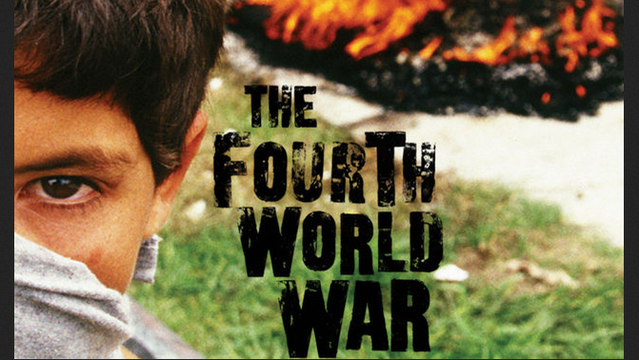
From the front-lines of conflicts in Mexico, Argentina, South Africa, Palestine, Korea, and the North; from Seattle to Genova, and the War on Terror in New York, Afghanistan, and Iraq, The Fourth World War is the story of men and women around the world who resist being annihilated in this war.While our airwaves are crowded with talk of a new world war, narrated by generals and filmed from the noses of bombs, the human story of this global conflict remains untold. The Fourth World War brings together the images and voices of the war on the ground. It is a story of a war without end and of those who resist.The product of over two years of filming on the inside of movements on five continents, The Fourth World War is a film that would have been unimaginable at any other moment in history. Directed by the makers of This Is What Democracy Looks Like and Zapatista, produced through a global network of independent media and activist groups, it is a truly global film from our global movement.
For English speakers, portions of the film may need translation, activated by clicking on the “CC” button on bottom right corner of the video (on some mobile device browsers the function can be found on the upper right corner).
On a recent episode of PBS Newshour, Jeffrey Brown hosted a roundtable discussion exploring the dangers of polarized politics for American Governance. The guests were Eric Liu, Steven Hayward and Beverly Gage. Most of the discussion was an analysis of the recent government shutdown from a typical left vs. right perspective, but I thought their view of reactions of average citizens was interesting:
JEFFREY BROWN: And so, Eric Liu, let me ask you, because I know you’re very — you’re trying to engage people in the act of citizenship. What do you see the effect of all of this? Are they more engaged? Are they just more disgusted and turned off?
ERIC LIU: Well, I don’t think those are mutually exclusive. There is disgust.
(LAUGHTER)
ERIC LIU: But, because of the disgust, there’s actually more engagement.
And that’s true on both the left and the right. Look, I think the reality is, when Steven was speaking a moment ago about the kind of encroachment of ever-growing and ever-larger government, we can have reasonable debates in this country about what the proper size and scope of government ought to be, but we ought to regard those debates not as “on/off, yes/no, my way or we shut the whole thing down” kind of debates.
…so people from both left and right watching these last two weeks are ready for something different.
They’re ready to actually hear each other and see one another and not the caricatures of one another, and try to figure out, well, where is it that we can manage to agree on the role of government, and where we can’t agree, how can we recognize that to be a citizen isn’t just a single-shot sudden death game. It’s infinite repeat play, and you’re going to win some, and I’m going to win some.
JEFFREY BROWN: All right, let me ask Steven Hayward to respond to this.
Do you see the result of this as people ready to work together or more divisions that ever more polarizes?
STEVEN HAYWARD: Well, I think there’s two things to think about here.
One is, is we have divided government once again. The voters, God bless them, have a lot of cognitive dissonance. Right? In the last week, what you saw is people say, I don’t like Obamacare, but I don’t want the government shut down. I don’t want it to be a matter of a budget fight the way it’s become. And that’s why Republicans lost this proximate battle.
But if you look at some of the poll numbers right now, I think they ought to be very worrying for everybody, but I think more worrying ultimately for liberals, for this reason. You have seen record high numbers of people who now say — I think 65 percent in one poll — that government is a threat to their rights.
You have seen a long-term trend going back really to the 1960s of the number of people saying they have confidence that the federal government will do the right thing down in 15 percent, 20 percent, when it used to be in the ’50s up around 60 to 70 percent. And to the extent that if you’re liberal and that you believe in political solutions to our social problems or government engagement with our problems, you want the public to have confidence in the federal government’s capacities.
And so it seems to me that, as much as this might have been a train wreck for Republicans, the long-term effect of this might not necessarily play out that way.
JEFFREY BROWN: Well, Beverly, when you look back at political — what could be called political crises of the past, what does it — what happens in terms of public response to those?
BEVERLY GAGE: Well, I think to some degree, Steven’s quite right, in that I would kind of like to subscribe to Eric’s view that we’re going to have a much more serious conversation, a much more bipartisan conversation.
But I think it’s equally possible that you’re actually going to see people throw their hands up and say, oh, it’s all such a mess. I don’t really want to make sense of it. I don’t want to deal with it. And, in that way, it sort of serves an anti-government message, and in some ways, even serves sort of the Tea Party message in ways that maybe were intended and maybe weren’t.
But I think there’s also a danger for the Republican Party in all of this, which is to say that these divisions that we’re seeing right now within the Republican Party between moderates and Tea Party conservatives and also between a sort of establishment business class, which is very, very alarmed about what’s happening, and this more right-wing part of the party, that actually may in fact spell destruction for the Republican Party.
Those are divisions that have been there for a long time. They have often been papered over. But when you’re on the brink of financial catastrophe in the way that we were, we may not see them be papered over, and we may in fact see some sort of political realignment coming out of this.
All three guests made good points, though the views of conservatives and liberals are typically generalized in such discussions and I think issues of most concern to citizens on a grassroots level are often not the ones being debated enough in Washington D.C. There definitely needs to be more political discussion between left and right not just within government but among the general public. Increased communication and education is the best defense against “divide and conquer” tactics but of course this is easier said than done because politics has become a taboo subject for many, mainly due to fear of getting into heated arguments. But perhaps this fear is unwarranted because there’s many issues that the left and right can agree on (though motives and priorities may differ). These are just some of the more topical examples:
End the Wars – As demonstrated by widespread negative reaction to war threats against Syria, people are perhaps becoming more aware of political trickery thus becoming harder to persuade. Also, as living standards drop for more people, the connection between costly foreign policy and the nation’s declining economy and infrastructure has never been more obvious.
Stop the Surveillance State – Privacy is a universal human need. Mass spying on citizens is illegal and unethical whether online or through drones and informants.
End Unjust Trade Agreements – Agreements such as NAFTA and the Trans-Pacific Partnership (TPP) hurt working people and endangers health and safety, the environment, and national sovereignty.
End the Fed – We’ve endured 100 years of a “Federal” Reserve run by private bankers and all we have to show for it is a debt of tens of trillions of dollars. It will never be paid off as long as we continue to use interest-bearing federal reserve notes as currency.
Create Affordable Health Care – It can be argued that Obamacare is an incremental improvement but everyone knows it’s not enough and is far more beneficial for greedy insurance companies than the poor.
End the Drug War – We can all agree the Drug War is a colossal failure (when it comes to the stated purpose of reducing drug addiction). It has only increased incarceration rates while enriching the prison-industrial complex and drug cartels. We need to adopt policies that have proven to be effective such as legalization, decriminalization and harm-reduction.
Stop GMOs – GMOs are unnecessary, physically and economically harmful to farmers, may have potentially catastrophic effects on the ecosystem, and only serves to increase profits for companies like Monsanto.
End Obscene Economic Inequality – Complete economic equality might not be possible, but when economic inequality reaches absurd and unsustainable levels as they have today, obviously something needs to change.
Protect Internet Freedom – Legislation such as the NDAA, SOPA and PIPA indicate that government and corporations are threatened by the internet. Attacks against internet freedom are attacks against freedom of speech, freedom of information and cognitive liberty.
Ignore Corporate News – Another point of agreement between right and left is the corporate news media’s increasing irrelevancy and bias. Today it is not so much a liberal or conservative bias as it is a neoliberal and neoconservative bias.




 After the Crash