Why Are so Few Americans Able to Get Ahead?

By Charles Hugh Smith

Source: Of Two Minds

Our entire economy is characterized by cartel rentier skims, central-bank goosed asset bubbles and stagnating earned income for the bottom 90%.

Despite the rah-rah about the “ownership society” and the best economy ever, the sobering reality is very few Americans are able to get ahead, i.e. build real financial security via meaningful, secure assets which can be passed on to their children.

As I’ve often discussed here, only the top 10% of American households are getting ahead in both income and wealth, and most of the gains of these 12 million households are concentrated in the top 1% (1.2 million households). (see wealth chart below).

Why are so few Americans able to get ahead? there are three core reasons:

1. Earnings (wages and salaries) have not kept up with the rising cost of living.

2. The gains have flowed to capital, which is mostly owned by the top 10%, rather than to labor ((wages and salaries).

3. Our financialized economy incentivizes cartels and other rentier skims, i.e. structures that raise costs but don’t provide any additional value for the additional costs.

It’s instructive to compare today’s household with households a few generations ago. As recently as the early 1970s, 45 years ago, it was still possible for a single fulltime-earner to support the household and buy a home, which in 1973 cost around $30,000 (median house price, as per the St. Louis FRED database).

As recently as 20 years ago, in 1998, the median house price in the U.S. was about $150,000— still within reach of many two-earner households, even those with average jobs.

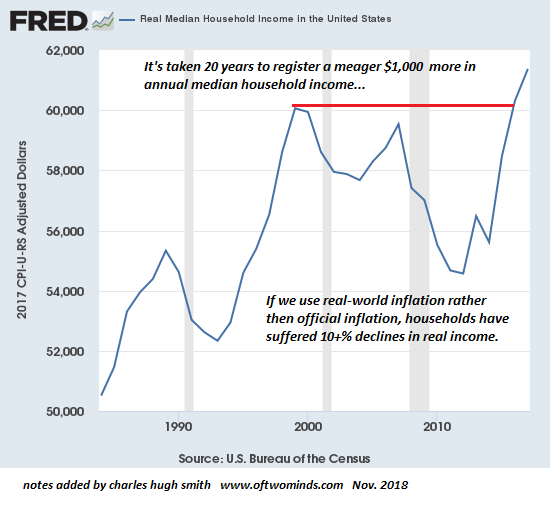
As the chart below shows, real median household income has only recently exceeded the 1998 level— and only by a meager $1,000 annually. If we use real-world inflation rather than the under-estimated official inflation, real income has plummeted by 10% or more in the past 20 years.

This reality is reflected in a new study of wages in Silicon Valley, which we might assume would keep up due to the higher value of the region’s output. The study found the wages of the bottom 90% declined when adjusted for inflation by as much as 14% over the past 20 years:

“The just-released report showed that wages for 90 percent of Silicon Valley workers (all levels of workers except for the top 10 percent)are lower now than they were 20 years ago, after adjusting for inflation. That’s in stark contrast to the 74 percent increase in overall per capita economic output in the Valley from 2001 to 2017.”

source: Why Silicon Valley Income Inequality Is Just a Preview of What’s to Come for the Rest of the U.S.

Meanwhile, the median house price has more than doubled to $325,000 while median household income has stagnated. Please note this price is not adjusted for inflation, like the median income chart. But if we take nominal household income in 1998 (around $40,000 annually) and compare it to nominal household income now in 2018 (around $60,000), that’s a 50% increase–far below the more than doubling of house prices.

To raise stagnant incomes, the Federal Reserve and other central banks have attempted to generate a wealth effect by boosting the valuations of risk-on assets such as stocks, bonds and commercial real estate. But the Fed et al. overlooked the fact that the vast majority of these assets are owned by the top 10%–and as noted above, the ownership of the top 10% is concentrated in the top 1% and .1%.

As a result, the vast majority of the wealth effect capital gains have flowed to the top 1%:

Lastly, the cartel structure of the U.S. economy has raised costs while providing no additional value. One example is higher education, a cartel that issues diplomas with diminishing economic value that now cost a fortune, a reality reflected in this chart of student loan debt, which simply didn’t exist a generation ago:

Our entire economy is characterized by cartel rentier skims, central-bank goosed asset bubbles and stagnating earned income for the bottom 90%. Given these realities, the bottom 90% are left with few pathways to get ahead in terms of financial security and building secure family wealth.


The Entire Status Quo Is a Fraud

corruptPoliticalSystem2

By Charles Hugh Smith

Source: Of Two Minds

Fraud as a way of life caters an extravagant banquet of consequences.

This can’t be said politely: the entire status quo in America is a fraud.

The financial system is a fraud.

The political system is a fraud.

National Defense is a fraud.

The healthcare system is a fraud.

Higher education is a fraud.

The mainstream corporate media is a fraud.

Culture–from high to pop–is a fraud.

Need I go on?

We have come to accept fraud as standard operating practice in America, to the detriment of everything that was once worthy. why is this so?

One reason, which I outline in my book A Radically Beneficial World: Automation, Technology and Creating Jobs for All, is that centralized hierarchies select for fraud and incompetence. Now that virtually every system in America is centralized or regulated by centralized hierarchies, every system in America is fraudulent and incompetent.

Nassim Taleb explains this further in his recent article How To Legally Own Another Person (via Lew G.)

The three ingredients of fraud are abundant: pressure (to get an A, to please your boss, to make your sales numbers, etc.), rationalization (everybody’s doing it) and opportunity.

Taleb explains why failure and fraud become the status quo: admitting error and changing course are risky, and everyone who accepts the servitude of working in a centralized hierarchy–by definition, obedience to authority is the #1 requirement– is averse to risk.

As as I explain in my book, these systems select for risk aversion and the appearance of obedience to rules and authority while maximizing personal gain: in other words, fraud as a daily way of life.

Truth is a dangerous poison in centralized hierarchies: anyone caught telling the truth risks a tenner in bureaucratic Siberia. (In the Soviet Gulag ,a tenner meant a ten-year sentence to a labor camp in Siberia.)

And so the truth is buried, sent to a backwater for further study, obfuscated by jargon, imprisoned by a Top Secret stamp, or simply taken out and executed.Everyone in the system maximizes his/her personal gain by going along with the current trajectory, even if that trajectory is taking the nation off the cliff.

Consider the F-35 Joint Strike Fighter, a $1+ trillion failure. The aircraft is underpowered, under-armed, insanely overpriced, insanely over-budget and still riddled with bugs after seven years of fixes, making it an unaffordable maintenance nightmare that puts our servicepeople and nation at risk.

But no one in a position of power will speak the truth about the F-35, because it is no longer a weapons system–it’s a jobs program. Defense contractors are careful to spread the work of assembling parts of the F-35 to 40+ states, so 80+ senators will support the program, no matter how much a failure it is as a weapons system, or how costly the failure is becoming.

A rational person in charge would immediately cancel it and start from scratch, with a program run outside the Pentagon and outside congressional meddling.But this is impossible in America: instead, we build failed, under-armored, under-powered, under-armed and unreliable ships (LCS) and failed under-powered, under-armed and unreliable fighters as the most expensive make-work programs in history.

As for our failed healthcare system, one anecdote will do. (You undoubtedly have dozens from your own experience.) A friend from Uruguay with a high-tech job in the U.S. recently flew home to Montevideo for a medical exam because 1) the cost of the flight was cheaper than the cost of the care in the U.S. and 2) she was seen the next day in Montevideo while it would have taken two months to get the same care in the U.S.

I’ve listed dozens of examples here over the years: $120,000 for a couple days in a hospital, no procedures performed; $20,000+ for a single emergency room visit, no procedures performed; several thousand dollars charged to Medicare for a few minutes in an “observation room” that was occupied by patients, no staff present–the list is endless.

We’ve habituated to fraud as a way of life because every system is fraudulent.Consider the costly scam known as higher education. The two essentials higher education should teach are: 1) how to learn anything you need to learn or want to learn on your own, and 2) how to think, behave, plan and function entrepreneurially (i.e. as an autonomous problem-solver and lifelong learner who cooperates and collaborates productively with others) as a way of life.

That higher education fails to do so is self-evident. We could create a highly effective system of higher education that costs 10% of the current corrupt system. I’ve described such a system (in essence, a directed apprenticeship as opposed to sitting in a chair for four years) in The Nearly Free University and the Emerging Economy: The Revolution in Higher Education.

As for what passes as culture in the U.S.: the majority of what’s being sold as culture, both high and low, is derivative and forgettable. We suffer the dual frauds of absurd refinement (so only the elites can “appreciate” the art, music, food, wine, etc.) and base coarsening: instead of Tender (romantic love and sex) we have Tinder (flammable trash).

Fraud as a way of life caters an extravagant banquet of consequences. While everyone maximizes their personal gain in whatever system of skim, scam and fraud they inhabit, the nation rots from within. We’ve lost our way, and lost the ability to tell the truth, face problems directly, abandon what has failed and what is unaffordable, and accept personal risk as the essential element of successful adaptation.

Here’s a good place to start: require every politician to wear the logos of their top 10 contributors–just like NASCAR drivers and vehicles display the logos of their sponsors. The California Initiative to make this a reality is seeking signatures of registered California voters. Since politicians are owned, let’s make the ownership transparent.

The Poverty Machine: Student Debt, Class Society, and Securing Bonded Labor

StudentLoanDebt070313_0

By Jeremy Brunger

Source: The Hampton Institute

At the dawn of the 20th century, very few American students attended high school, as the demands of the heavy-industrial and the agricultural economies of that period were ill-suited to an extended education beyond the family sphere. In the middle of the 20th century, most Americans who either aspired to or had to work entered the full-time workforce immediately after high school, for such a postwar economy featured plenty of growth and comparably fair wage-compensation for the average worker. As the economy became more complex in its labor needs, its extending length of education complemented these requirements. The transformation of the agricultural economy into the technological economy after World War II, in turn, transformed the university, once the commune of the well-to-do, into a center for job training, an adjunct to industry, and one which continued to increase in enrollment as the technological necessities of an increasingly complex economy required further education. What was once the realm of the study of Christian religion, the Rennaissance humanists, and the Aufklärung became, for most students, the study of the technical labor necessary to produce and reproduce the new forms of capitalism and scientific production coming into existence. The growth of the American middle class became co-incident with the growth of the education industries which had hardly existed a century previous, when the middle class itself had hardly existed in any recognizable form. Where there was study, there was hope for economic success-the maxim “if a man falls in a field he is redeemed in a library” comes to mind-and the institution of the university became as integral to living well in the United States as the ownership of property and the propagation of the nuclear family.

However, in the 21st century, although attendance of university courses is at an all-time high as the millennial generation achieves the highest historical rate on record of college attendance, that same generation is forecast to experience a decline in standards of living comparative to their forebears. Not only this qualitative fact, but also the quantitative method of that attendance is worthy of critical analysis-for the funding of undergraduate and graduate educations comes largely from the borrowing of money from lenders with the Federal government playing its role as intermediary. As the declining middle class cannot pay for its children’s higher educations, it looks to the loan system to cover the ever-increasing costs of reproducing its standards of living over time. But such loans cannot be discharged in bankruptcy, and with the already saturated labor markets of the majority of the professions that could hope to pay off those loans, the economic situation comes to look much different: rather than the state intent on spreading enlightenment to the masses, the state appears to be securitizing a labor force that will simply have to perform whatever jobs are available, perhaps for decades on end, in order to pay off those loans.

That is, the students will have to do so if they want to qualify for home mortgages and otherwise live free from debt, which historically has always loomed over the subaltern and the serf alike. The parallels between the indebted student and the historical bond-laborer are strong enough to warrant comparison. One trend that especially deserves critical analysis is the outreach of the market to cover students from low-income backgrounds and whether or not such outreach is democratic-a Rawlsian lifting of the boats-or if it is merely predatory in nature and outcome. For, if the state and its lenders are merely financing higher education in order to secure a labor force that will not practice in the professions for which it trained but rather any job available by fiat of the debt-load, then a new reckoning is due of the state of affairs between the working-class young and their educations, the relationship between the state and the private sector, and the ongoing presence of class determinism in the free world.
Debt Corvee

According to The Institute for College Access and Success, statistics for the average student debt load from 2014 suggest that 71% of all students graduating from four-year colleges had student loan debt and the average level of this debt for public colleges was about $25,550, about $5000 higher than 2008. At the for-profit colleges the level was even higher, with students graduating with about $40,000 in debt. Most of this debt is mediated by government loan programs-about 80%-with the rest being covered by private lenders without mediation. The average student debt has increased, since 1993, about three-fold; given the rising cost of living and institutional funding in general, an increase in cost is not particularly surprising. What is surprising is how steep that increase in cost is. The cost of the aspirant apparatus of education increases beyond the market value of the professions on offer when viewed sociologically-the combination of public funding and private ambition allows tuition rates to soar even as student returns on investment plummet.

It appears the days when middle-class parents, a status declining in real terms since the 1970’s, directly financed their children’s college educations are largely over. While this may appear to be beneficial to the working class, in that the gatekeeping apparatus for entry into the professions-the colleges and universities-are more easily accessible than ever before, the debt that falls on the students is that much more of a burden. Students “who received Pell Grants, most of whom had family incomes under $40,000, were much more likely to borrow and to borrow more” than their more middle class peers, according to the Institute for College Access and Success. The debt load is thus geared to the children of the working class and the working poor who, no doubt seeking a better future for themselves, expend large sums of money-often more than a year’s wages, and sometimes two years’ worth-in accessing the portals of higher education. Given that student loans mediated by the government cannot be discharged in bankruptcy, students often have no choice but to live with that debt load for years and years if not forever: they have an education which cannot be repossessed, but they are also forced to work in professions for which they did not train in order to pay off that initial investment. This situation comes to resemble the historical institution of corvee labor, or other forms of debt-labor, in that the young, in being promised a better future, must nevertheless work for others as bonded servants in order to pay off their contracts. This is especially true for graduates in the non-scientific disciplines, as a Bachelor’s degree in a field other than business or the sciences becomes a mere shibboleth for entry into work that is not at the very bottom of the labor market, and even those “safe degrees” harbor little real safety for the student at the whim of capital. Having a Master’s degree in economics, the social science that ended The Great Depression, is yet no guarantee against waiting tables for tips for an indefinite period. The same can be said of the other disciplines.

The historical practice of corvee labor has much in common with the emergence of the indebted student. Corvee was a form of near-slavery, often linked to the military, that indentured laborers to a contract with an owner; nominally, the contract was entered into freely by the laborer, was guaranteed by the state, and was therefore not legally slavery, but due to the conditions of existence the laborer otherwise faced, the contract’s foundations were more reminiscent of the Hobbesian outlook than the Lockean. It was often the only viable option available for the children of the poor, and so, faced with hunger or hard labor, they chose labor on contract with the state. The structural difference between this practice and the practice of loaning to students are small, in that the state was involved in corvee as much as it is involved in student lending-for the student who may seek jobs after graduation is still in the economic red even as the student receives compensation for work. Corvee’s goals were to fill up a floating labor pool; the side effect, whether designed or accidental, of student lending winds up much the same. A student who accrued $30,000 in debt studying philosophy is likely to wind up working in the lower sectors of the labor market, unless they go back to school for a different or a higher degree-and so, in terms of base economics, their impersonal labor has been securitized by the public sector in favor of the private sector. Unless, that is, that student winds up working for the state in some other capacity than what they expected when they entered into their field of study, in which case the state has merely financed its own labor pool: and plenty of state jobs, like those in the sector of public secondary education, offer debt-manumission in reward for practicing in those fields for a period of several years. As such, the claim that only for-profit colleges are to blame for high student debt is false, for public universities contribute massively to rates of student debt and possess internal incentives for producing indebted students who might seek to dissolve their debt through public service.

The same may be said to apply to a pre-medical student who decides it is not prudent to enter into the “megaloans” required for medical school-at which point that student is already indebted for the undergraduate education and so, like the student of philosophy, winds up working for any institution that is hiring. This aleatory materialism may not have been intended by the state-the rhetoric behind opening access to higher education to as many people as possible was couched in democracy and enlightenment, to which every “Dream Big” sign on college campuses will attest-but its practical effects come to much the same result as corvee labor. The ideological state apparatus metamophoses into the financial state apparatus, yet focuses on the same people-the students, who, now indebted, represent a securitized labor force for private and public sectors alike. Most internships available to the graduate are unpaid internships-a relatively new development since the 1990s-thus leaving workng-class graduates desperate for income only non-professional career avenues. As the only broad field of economic growth under the last two presidential terms has occured in the service sector, educated working-class students can expect to enter the same service sectors in which their parents worked. Most interestingly, the etymological root of the word “service” stems from the word “serf.”
The Graeberian Insight

According to Dr. David Graeber’s 2011 book Debt: The First 5000 Years, the centralizing state has employed debt as its apparatus of growth for centuries. Debt, for Graeber, informs the very epistemology of Western people-we think in terms of credit and debit, of libertas and indebtedness, of squaring up our moral accounts. Debt is thus an all-pervasive category in how the Western world works, whether in the ancient world or in the contemporary 21st century. Graeber’s insight is useful beyond his idealist prescriptions for “everyday communism” and his moral philosophy, for the latent commodification of the ideals of democracy-education among them-is still a very real phenomenon. Education may have its necessary infrastructural costs, but it need not be a commodity traded between lenders, or traded between speculators, with unwitting students-especially students from non-professional backgrounds-used as its financial pawns. Given that the actually-existing professions cannot absorb these students, and that the state serves as mediator between lenders financing their educations, the surplus labor which the students provide can only be absorbed by sectors they did not intend on entering: the various service sectors, the only growing sectors in the economy, the only employers broadly willing to accept non-professionals.

Graeber writes that “presented with the prospect of its own eternity, capitalism-or anyway, financial capitalism-simply explodes. Because if there’s no end to it, there’s absolutely no reason not to generate credit-that is, future money-infinitely. Recent events would certainly seem to confirm this. The period leading up to [the financial crisis of] 2008 was one in which many began to believe that capitalism really was going to be around forever; at the very least, no one seemed any longer to be able to imagine an alternative. The immediate effect was a series of increasingly reckless bubbles that brought the whole apparatus crashing down” (360). Given that higher education has become an industry like any other, subject to the same laws of capital and labor, it also suffers the same proneness to instability endemic to any other capitalist endeavor. Consider the recent closure of Sweet Briar College, the glut of PhDs, or the models of infinite growth to which larger universities seem to adhere. The universities are awash in internal commentary that they are swiftly becoming corporatized, going from the internally-administed grove of academe to an organ of capital’s interest-just look at any critical article on The Chronicle of Higher Education, especially those written by educators and researchers already secure in their tenure, such as Terry Eagleton’s 2015 article “The Slow Death of the University.” With such extension of the sphere of capital and its models of development into academia, academia comes to suffer the same risks as capital, along with its students-or, according to the corporatized university, its customers.

The social form of capitalism, in synthesizing Louis Althusser’s social theory of economic reproduction and Graeber’s theory of debt, thus reproduces itself not only through relations of the commodity-form but also through relations of debt (Althusser 47). Capital has a tendency to perform its name-to capitalize, to penetrate into vulnerable markets-and what market is more vulnerable than youth? From ancient Greece to Africa it was not uncustomary for families to lend their children to the market in the form of pawnship or peonage, or in the early modern Western world with indentured servitude, according to the Historical Dictionary of Slavery and Abolition; and with corvee, the state guaranteed the trade-and within the structures of contemporary student lending these kinds of practices appear to have survived into the 21st century even in the liberal West (174, 229-30). The millennial cohort, massive as it is and funded into debt by the state, represents not a boon for the professions but a huge and exploitable labor pool for the industries.
The Re-proletarianization of Youth

In world-systems theory, as understood by the scholar Immanuel Wallerstein in his book Historical Capitalism, the spread of capitalist social relations produces two key processional phenomena: embourgeoisement and proletarianization. These historical processes act in tandem, as some become bourgeois through the labor of those who become proletarianized, and others, more unfortunate, reverse that process. Such a process, now that the university systems have co-opted the capitalist mode of financing, has been enacted in large swathes of the student population. In seeking embourgeoisement and standards of living that have been viable for only a very few for decades, many students actually become proletarianized-and perhaps moreso than had they not attended higher education with the help of the lending system in the first place. Now that higher education is a thoroughly penetrated market for historical capitalism, many of its students become proletarians as surely as if they had went to work in the nearest factory-only it is not the lonely capitalist who profits but rather the university institutions and the state. The funding models of higher education depend on a floating student body, just how labor-intensive industry depends on a floating labor pool; both groups of people come to resemble each other more and more in terms of base material economy in relation to overall American wealth.

The trappings of economic success-a diploma, the social capital of calling oneself educated-only signify the sort of well-being to which people aspire. Those trappings do not guarantee it. Indeed, even many of the teaching scholars who profess at America’s universities still have debt from their undergraduate years well into their careers that prevent them from attaining the truly middle class lifestyles their students expect to earn. The academic phenomenology of the indebted teacher becomes the capitalist yoke of the indebted student who, upon graduation, in all likelihood does not even know the definition of “liberal capitalism.” It is odd, given America’s general strain of individualism, that it has become a normative part of life to amass such large amounts of debt-that the insistence on neoliberal economics binds the citizenry that much more powerfully by debt-relations than by individualism. Such a process is bound to produce discontent not in isolated outliers but in a whole cohort of the population.

The cornerstone of proletarianization is that one expects, in resignation, to work for low wages in industry-any industry, at that. The structural similarity between the historical proletariat and the new student proletariat is profound enough to warrant its assertion; even if standards of living have increased for the working class since Karl Marx’s 19th century by vast leaps and bounds, the group of people graduating from universities with mortgage-sized loans fit into the same category of social utility as that historical proletariat. An indebted youth cohort is very good for capitalist endeavor-businesses, having already offloaded job-training responsibilities to the colleges, can expect an incoming workforce that is more desperate for employment because of the debt-burden-and it is very good for the state, since so many students attend public universities. Given that universities, once homesick spaces of learning and temporary poverty, have become profiteering enterprises of not only education but also entertainment akin to theme parks, they produce permanent poverty under the current administrative model of offering high loans to undergraduates.

Consider the critical theorist Theodor Adorno’s observations, in “The Culture Industry” section of Dialectic of Enlightenment, on “the original affinity between business and entertainment” which “reveals itself in the meaning of entertainment itself: as society’s apologia” (115). Even the studious and earnest student plays today and pays tomorrow in the contemporary university-the hardships of education are passed onto not the undergraduate of today but the graduate of tomorrow. The right to proletarian entertainment is not the “jazz-machines” of Adorno’s era, but the sites of higher education which only since the 1980s welcomes proletarians on their credit. Through a Kantian education that is supposed to free them from external determination, the young have become mere objects of financial speculation, as well as objects of exploitable and undifferentiated labor. The parallels in labor, in relation to the social totality, suggests that the average student body upon graduation becomes the reproduced proletarian body due to debt peonage, which has always been the chief exploitable force and method in industrial society.

In contrast, the medieval institution of journeymanship, by which a student learns gradually more and more from a teacher-worker, was not a relationship of bondage so much as a relationship of tutorship, but despite the modern university’s medieval roots in these practices, the emergence of student debt of such magnitude renders null those benign roots. The indebted student is, as a rule of thumb with its exceptions, rendered by the system of higher education the indebted servant to capital. Working-class 18 year olds ought not be the victims of financial speculation instruments wielded from above, nor should the narrative of enlightenment reproduce inequal relations of capitalism on their shoulders. Beyond this, it is perhaps symptomatic of general living conditions that so many working-class students are attending higher education in the first place-that being poor in a world-historically dynamic economy is that much more intolerable than in the past.

The most worrying facet of this indebting process is the public insistence that students from low-income families attend university on credit. Born into poverty, they can expect to continue enduring it even upon graduation, even if they amass the scholarships and grants that are geared to supporting them. Given the statistics on debt provided by The Institute for College Access and Success, this low-income cohort is the most vulnerable to predatory lending, and so becomes the most indebted relative to their wealthier peers. The class determinism inherent to this shifting of capital from private business to the educational sector all too often makes poor teenagers into poor students into poor working adults. The kinds of jobs these students were taught never to do, by their parents who worked those very jobs in order to keep food on the table, are the only kinds of jobs available to the majority of indebted students upon graduation. While standing debts that pose no possibility of discharge in bankrupty might be good for the speculators of the macro-economy, it represents a monumental burden for individuals and especially those individuals who compose the working class. The pedagogical theorist Henry Giroux suggests in his 2014 book Neoliberalism’s War on Higher Education that the funding mechanisms for American universities are abrasively neoliberal, in that they are extended to students only in the interest of maximum returns on investment-and not only does the funding mechanism support inequality, but also the class interests vested in university research that favors the wealthy over the interests of the poor: the aspirant young become as grist for the capitalist mill by the very institutions they were taught to trust since birth.

The sociology of student debt suggests that indebted working-class students will live in, in relation to society at large, the same socioeconomic position as their parents despite their higher educational attainments. According to findings in the economist Dr. Thomas Piketty’s Capital in the Twenty-First Century, “even with the considerable increase in the average level of education over the course of the twentieth century, earned income inequality did not increase,” and neither did “the intergenerational correlation of education and earned incomes, which measures the reproduction of the skill hierarchy over time” that “shows no trend toward greater [social] mobility over the long run” (484). The cycle of sociological immiseration thus continues unabated, no matter how loud the college yells of freedom and democracy resound, for someone-most likely not the student-profits off the exploited student body. The social utility of higher education transforms, under capitalism, into the private utility of the capitalist; the social affectation of education-as-commodity transforms into the relations between master and bondsman in the new feudalism. Cultures are changed not by the beliefs of the old but by the beliefs of the young. Where the forces of conservatism-not necessarily undesirable in themselves provided they are matched with creativity-over-reach their purview is in the debt-relations extended to the young, who alone amongst the age groups offer history an American future.

Youth is a time for creative experiment and creative destruction, for healthy questioning of the decadent status quo, for sane inquiry into our insane history; it is not a time to be enslaved to financial circumstance, the time clock, or the manager with delusions of grandeur. Such inexuscable waste now doubtless bears future repercussions. Education has always had its costs, and any prosperous society has paid them-but to what result? Creating a vast age group that, in coming to political and economic consciousness, despises the institutions that led it into servitude is not only damaging to the quality of life the students themselves experience. It is also damaging to the self-serving patriotism that conservative forces depend on, for student debt loads only foster distrust of hallowed institutions. “Mistreat the young,” the old adage goes, “and doom the old.” Not only this, but it is also destructive to middle-class capitalism itself, for a generation that pays student debt is a generation that does not buy homes-a high mark of complaint given that so many American cities are falling into infrastructural decay and personal poverty. The populist imperative to preserve a future worth living in need not clash with the profit motive, provided speculators find means other than the young to achieve their profits. The theory of higher education-its opening of access to a more democratic cross-cut of the classes-ought to inform its more predatory practices which, under the debt-relation, only reproduces poverty.

A Victorian patriarch despite himself, Marx despised the immiseration of proletarians most of all because their subordinate positions rendered them incapable of independence, as though by virtue of their servitude they became adult children permanently. Similar in his criticism was that the chief goal of the working class is self-abolition, that is, the working class’s aspiration is to no longer be working class. In seeking to escape the mire of poverty amidst splendor-for America remains the wealthiest country on the planet-working-class students all too often dig themselves deeper into the poverty trap, however adorned with diplomas its ever-heightening walls become. The only way out of the poverty trap for most of them is to become the very thing they were taught not to become by their parents and their professors: bonded servants, or, as the economist Frederic Lordon calls them,willing slaves of capital,” in his book of the same name.

It is not that state involvement in higher education is destructive to the common weal. Far from it-higher education is definitely an institution best left to public administration, for it is a valuable aspect of the commons and its democratic purview. The attendance of higher education may represent one area where the erosion of the commons, at first appearance, has not progressed. But the erosion of the commons occurs where capital privatizes public utility, whether or not it happens in land-grant universities or in private colleges. Where the danger lies is in the inter-relationships between the state and funding models that target the poor for the benefit of the wealthy, thereby fostering uneven development and the reproduction of the conditions of poverty for the working class. Were the attendance of university by the poor and the children of the poor not incumbent upon credit, and therefore upon their probable future immiseration, higher education in America would actually function in harmonious accordance with its original raison d’etre: the humane enlightenment of society no matter the class situations its members may have happened to inherit in the lottery of birth.

Works Cited

Adorno, Theodor & Horkheimer. “The Culture Industry.” Dialectic of Enlightenment. Stanford UP, 2002.

Althusser, Louis. “The Reproduction of the Conditions of Production.” On the Reproduction of Capitalism. Verso, 2014.

Eagleton, Terry. “The Slow Death of the University.The Chronicle of Higher Education. 2015.

Giroux, Henry. Neoliberalism’s War on Higher Education. Harmarket, 2014.

Graeber, David. Debt: The First 5000 Years. Melville House, 2012.

Klein, Martin. “Pawnship.” Historical Dictionary of Slavery and Abolition. Scarecrow Press, 2002.

Lordon, Frederic. Willing Slaves of Capital: Spinoza and Marx on Desire. Verso, 2014.

Piketty, Thomas. “Regulating Capital in the Twenty-First Century: Do Educational Institutions Foster Social Mobility?” Capital in the Twenty-First Century. Harvard UP, 2014.

TICAS.Quick Facts About Student Debt, March 2014. The Institute for College Access and Success. 2014.

Wallerstein, Immanuel. Historical Capitalism. Verso, 2011.

Inside the Belly of the Beast

banksy-dreams-cancelled-b223-colour-white-40366-55087_medium

The Manifold Crises Threatening Higher Education

By Vince Chernak and Henry A. Giroux

Source: Counterpunch

When Western University president Amit Chakma’s jaw-dropping income was posted recently on the Sunshine list, it put a spotlight on the inequities and conflicts that exist in the contemporary university between the administration and faculty, contract instructors and students. The corporatization of the university means the administrators are well off, while those responsible for actual education, doing the teaching, are struggling to survive.

But that may just be the tip of iceberg in this scandal. Prof. Henry Giroux, a renowned and formative thinker in critical pedagogy notes that the role of the university president has diminished into a fundraising machine and is just part of the disturbing decline in the university. “What we need to do is reimagine that the university is a place to think,” he says, “a place for peace, a place that has something to say about critical thought, about educating people to being engaged citizens. I think the public nature of the university is under siege.”

The McMaster University Professor for Scholarship in the Public Interest is the author of over 60 books, including the recent Zombie Politics and Culture in the Age of Casino Capitalism, Dangerous Thinking in the Age of the New Authoritarianism, Neoliberalism’s War on Higher Education, and The Violence of Organized Forgetting. Giroux discusses how we might retake agency in our universities and in the zombie culture at large.

Vince Chernak: Is it fair to say this situation of discord between administration and faculty is not unique to Western?

Henry A. Giroux: No, it’s a trend that’s highlighted both in the United States and the United Kingdom, but also increasingly true in Canada. What we basically see is a business model taking over the universities in which power is being concentrated more and more in the hands of administrators and faculty are basically becoming more powerless. I think the real issue here is as Noam Chomsky points out is what you have is a model in which labour costs are being reduced and what’s being increased at the same time is labour servility. I think this increasing casualization of faculty is horrendous in terms of its implications; not only are faculty powerless, their incomes are increasingly being reduced. Now, that’s not as bad in Canada as it is in the U.S. In the U.S. 70 percent of faculty are either part-time or non-tenure track. That’s horrendous. That basically is about the death of the university in my estimation as a critical institution.

So you have a neo-liberal model at work there and increasingly now under the Conservative government in the U.K. that really is destroying education as a public good. It’s no longer seen as a public good, it’s seen as a training centre for corporate interests.

VC: You’ve said 10 years ago that the university president has become a technocratic fund-raising machine. That wouldn’t have been the case a few decades ago?

HG: If you look at the university presidents of the ’60s and ’70s what you see are a number of people who are well known for producing big ideas. People who wrote books about the university, who saw it as a public good. Or at least were struggling with what it meant to maintain it as a public good in an economy that was increasingly coming into the power of financial interests. But I think what we increasingly see now is presidents being reduced to fund raisers. Of course fund raising is important but what you want to see is presidents who have some sense of vision, that can provide a model of what it means to talk about the university in ways that suggest it’s connected to public life, that address important social problems, that it’s a public good, a public trust. This is not what the Harper administration wants from universities, he wants to turn them basically into car factories. I think you have a lot of university presidents in Canada who are caught in the middle of that, who don’t buy that assessment. Certainly not the president of McMaster University. But at the same time I think the pressures are so overwhelming to instrumentalize the university, to turn it into a business culture and at the same time, produce a faculty that’s practically powerless is an ongoing problem that has to be addressed.

VC: It might be that the vociferous outrage here in London isn’t so much about Chakma bringing in a half-million or a million a year in salary, but that his job mostly entails just such fundraising and that he and the board of governors supporting him are out of touch with the real issues on campus. Before a non-confidence vote Chakma even admitted that. But when government support has been in decline, is that such a bad thing—to hire the guy who’s going to bring in revenues? What are the alternatives?

HG: The faculty have to mobilize, along with the students, like they did in the’60s and take the university back. The university is a site of struggle. I think those people who are most affected, the faculty and students, have got to find ways to link up with social movements outside of the university to be able to educate the public, mobilize, do everything they can to say, ‘Look, sorry, the model that we have now defining the university is a model that is not healthy for democracy, and it’s not healthy for students and faculty. Faculty are more than casual labour, students are more than customers and the university is more than simply a training centre for big business.’

We can’t become like Margaret Thatcher, we can’t fall into the argument that there’s no alternative. What we need to do is reimagine that the university is a place to think, a place for peace, a place that has something to say about critical thought, about educating people to being engaged citizens. I think the public nature of the university is under siege.

VC: Faculty and students are agitating to get the board of governors to see that they have lost sight of the purpose of the university. And while Chakma has said he will work diligently to understand the complaints, he recently declined a meeting with the faculty of Media and Information Studies because the faculty allowed media to observe. He’s in damage control mode and his advisors are clearly trying to protect “the brand.” It looks like administration isn’t just suppressing critical and creative thinking from the faculty, they’re almost at war with faculty.

HG: It’s sad to say that when the administrators shut down any possibility for dialogue, when administrations withdraw into cocoon-like gated communities in which they’re always on the defensive, I think that it’s probably not unreasonable to say that this is not just about an assault, this looks like a war strategy. It looks like power is functioning in such a way as to both stamp out dissent and at the same time concentrate itself in ways in which it’s not held accountable.

HG: You’ve noted the branding extends down to the student body: “the school looks like a mall.” The students are branded, and the curriculum is written by corporations. “Where are the public spaces for young people to learn a discourse that’s not commodified?” you ask. “To think about non-commodifiable values like trust, justice, honesty, integrity, caring for others, compassion. There’s no room for the imagination, for creativity.”

VC: That’s an enormously important issue. If the university is going to be a space that takes seriously what it means to educate young people to be critically engaged citizens it can’t construct the university around a set of structures and spaces and organizing principles that seem to suggest the opposite of that — that basically they’re just consumers. The reason that that’s so deadly is that when you instrumentalize and commodify the university like that and you just see students as clients who have to make choices for the marketplace, you’re really talking about the death of a formative culture that is essential for educating people to live in a real democracy. So the issue is not just that branding is becoming an organizing principle of the universities, the real issue is, at what cost? What price is paid for that? What kind of disservice do we do to students? For instance, I was reading today that between 2001 and 2013 the Koch Foundation provided $70 million to 400 campuses — they’re buying faculty, they’re buying courses — in some cases, some of these major corporations have suggested that they’ll give a donation but everyone in the freshman class has to read Atlas Shrugged. What happens when a university is so susceptible that corporate interests step in and decide who is going to be hired, what’s going to be taught? That’s truly the death of the university.

VC: One thing that’s come up under scrutiny through this Western scandal is the prioritizing of STEM (science, technology, engineering, medicine) faculty funding. I believe German post-secondary education may involve such a split between humanities and the technical or professional streams. Do we have an outmoded idea of the university, one that needs a fundamental restructuring?

HG: I think it’s outmoded, entirely. I’ll give you an example. People often talk about health faculties as simply being instrumentalized faculties, professional faculties that are really bogged down in doing practical things. If you look at health faculties today like at McMaster, they’re involved in community work, public services, interdisciplinary work…so I think that when administrators begin to separate these faculties out in ways in which they say things like, ‘Well, the humanities and liberal arts are concerned about things that are non-instrumental, non-functional, we need to diminish their power in the university… the real work is being done by professionals,’ I think that’s a joke and it’s a misrepresentation. The organizing principles in the liberal arts are so entrenched now in the professional faculties that you can’t separate them anymore. It doesn’t make any sense: nuclear scientists are obviously going to have to take in ethical considerations, right? Professional people don’t work in an ethical void. The liberal arts, people can’t simply live in gated communities and write in languages that nobody can understand. There’s going to be a melding, a bleeding into each other in these faculties in ways in which we say, okay, how do we merge questions of public values and professional skills.

But let me go back to your question. You’re right in the sense that increasingly what we see administrations doing are favouring STEM faculties as an excuse to diminish and eliminate the liberal arts and humanities. I’ll give you one example that is unbelievable. In the States you have a governor that’s instituted a policy in which he said that if you take a course that’s in the field of business, that has a direct application to the business world, we will lower your tuition. If you take courses in the liberal arts then you’re going to pay a higher tuition. Can you believe this?

VC: A lot of kids might be avoiding university these days for more practical trade school or college training that’ll lead to employment. Distinguish the value of education versus training.

HG: When I claim that education is simply a form of training I think that what I’m arguing is that you get people sort of educated to learn very specific skills in ways that completely remove from larger socio- political and economic conditions or questions or disciplines, so that people are learning how to be plumbers but they’re not learning about the nature of work and what it means to have meaningful work in a society. I think that when you place the emphasis on simply a kind of instrumental rationality and you refuse to deal with larger questions, conceptual questions about what it means to be well-rounded educationally and what it means to get a general education and what it means to be able to cross disciplines, what it means to learn how to govern and not simply be governed, I think something terrible happens and that distinction is very important. Education is not simply about an immediate fix, i.e., getting a job. Education is about preparing people for life, it’s about preparing people for the future. And I’ll tell you something else, even the rationale that education is training is not good because often the skills people get in five years, those skills are obsolete. Who wants a doctor who can’t think? I mean we don’t want to turn out Joseph Mengele. You want to have people who have some sense of compassion, who understand the world in terms of power relations, who understand that their work is always enmeshed in political relations and relations of power and never can escape from questions of ethical and social responsibility. When we cut that element of education out, I don’t know what you have. You basically have training schools. I don’t want to create mechanics, I want to create people who can think but also can fix your car.

VC: In his book, Shop Class as Soulcraft: an Inquiry into the Value of WorkMatthew Crawford notes that much of work today is mere training in following rote procedures, conceived by a systems engineer and perhaps better done by robots than humans. He argues that there can be more human excellence in working with your hands, in practical work that involves actual thinking and coming up with creative solutions.

HG: John Dewey said the same thing, he said in true experience people learn how to think. Multiple things happen when you have to solve problems and you put things together and you apply them to the real world. We do see a lot of that in the university but I think those economic, political and religious fundamentalists who really see the university as a threat… you know, look, the kind of discussion that we’re having in some ways has to have a historical context and I think that what we often forget is that in the ’60s something happened that blew the lid off the conservative mentality. All of a sudden the ’60s were an era of enormous turbulence, people were struggling over the meaning and the purpose of the university, they were arguing for more ethnic and racial representation, they wanted to broaden courses in what was available in terms of academic disciplines in ways that had something to do with the real world, and all of a sudden the university opened up in a way in which all kinds of people were now coming to the university, in the past they were excluded, ethnic groups, religious groups, minorities.

The right never got over this. I mean they never got over this. That’s why you have the Powell Memo of the 1970s saying that the right has to get together and do something about these cultural apparatuses including schools so that we indoctrinate people for capitalism, we don’t let this happen again. I think that much of what we see all over North America and increasingly in Europe is the legacy of that backlash. This is really a counter-revolution. When you talk about doubling up the salaries, all that, I get it, yeah it’s offensive morally and politically but there’s a larger issue here. When you put the context together what’s happening all over North America you have to say two things, you have to say, one, the university as a site for creating the formative cultures that make a democracy possible is a) under siege, that’s for sure. Democracy is dangerous, and the institutions that produce people who engage in it basically are dangerous. Secondly, neoliberalism as we know it is not just about the governing of the market, it’s about the governing of all social life.

VC: Let’s mention zombies for a bit: zombies are back in a big way in the cultural zeitgeist since at least the beginning of the recession in ’09. You referenced them in Zombie Politics and Culture in the Age of Casino Capitalism. I think originally George Romero cheekily used this metaphor for the numbed conspicuous consumer in the ‘60s and the age of the Cold War threat of nuclear annihilation. Tell us how the zombie is recast in your book in contemporary times.

HG: The zombies suggest two or three things. At one level, zombie becomes a metaphor for talking about the way in which life is being sucked out of a society by a financial elite who really represent the walking dead. They really have produced a death-saturated age, and in that sense the zombies, they’re unthinking, they’re unfeeling, they have no sense of the social and I think in that sense they’re reproducing both an enormous amount of misery and violence in the world and also against the planet itself. Secondly I talk about zombies in ways that suggest a kind of sleeplessness, people basically are so tied to simply surviving that in some ways they have no… time has become an utter deprivation rather than a luxury. They’re so focused on just simply staying alive as opposed to the ’50s and the ’60s when people talked about moving up, that they’ve become zombie-like in the kind of political comas that they find themselves in. They lose all sense of agency, at least a kind of agency that would be individual, collective and engaged towards addressing the world in which they live in. I think we don’t even need to use the word ‘zombie’, we can say this is a population marked by horrible precarity. I mean, we see it in students who are so burdened by debt now that their radical imagination has been eliminated. They’ve become zombies in a sense. They’ve become zombies as victims. And I think ‘zombies as victims’ because it becomes very difficult for them to think about anything else than simply paying back this debt and being able to survive. When you live in a world in which survival of the fittest is the only logic available to you, that’s a form of depoliticization.

VC: One could say we’re living in an age of mass psychopathy, madness. From the short-term thinking of governments, self-serving corporations and down to the wretched individual waiting to win the lottery, we seem to be in a very dark place culturally. Is this a terminal state of the human condition?

HG: No, no, no, it’s not terminal. I mean we see all kinds of movements that basically are fighting against this, and let me just say something about that, it’s an important question. I think first of all you can’t sort of universalize power as only a form of despair. Power is also a form of resistance and I think that what we see all over the world right now, we have seen movements fighting against this kind of neoliberal ‘juggernaut’, we see that with Podemos in Spain, Syriza in Greece, we see it with the Black Lives Matter movement, we see it all over the United States. I think young people are waking up. I’m actually more optimistic than I’ve been in a long time. I think the contradictions of neoliberal capitalism are now so severe, so unbelievable that nobody’s fooled anymore, it’s difficult to be fooled. You know when you don’t have food, you don’t have health care, you don’t have social provisions, people are chipping away at your life to make your life miserable, eliminating the conditions that would enable some sense of security, then it seems to me the space of politics opens up in a way like we haven’t seen before. Now, it doesn’t offer any guarantees, I mean, people could become Nazis, right? They could be like Golden Dawn in Greece, they could join right-wing movements. But I do think that space is opening up, that the alternative media is opening up, I think that a lot of youth movements are now all of a sudden mobilizing in ways to try addressing the most immediate problems they find themselves in, there’s an environmental movement. But the real issue here is not whether we have resistance. There’s resistance. It’s local, it’s invested, it’s serious, but it’s got to be unified. I think from the Occupy movement to the Quebec student movement, what we’ve seen is that these movements tend to fizzle out quickly. They need focus. There’s no long-term organization. The other side of this is that we don’t talk about power enough. There’s an enormous attempt to sort of talk about leaderless revolutions. I’ll be honest, I don’t know what that means. I don’t know what it means to claim that everybody is empowered, that we don’t need organizations to sort of address the issues that we find ourselves in. We’ve got to rethink something about horizontal power, to seize it in ways that suggest that power has to be seized. You have to fight for it. Do you really believe these ruling classes are going to sort of just step down? And that’s not a call for violence; that’s a call for non-violence. That’s a call for street actions, for mobilizations, people developing third parties, trying to imagine political systems outside of the traditional liberal notion of capitalism. Liberalism is dead. It’s dead. It’s simply a center-right movement now. It’s all about accommodation with Obama being the ultimate spectacle of that accommodation. And so the time does exist for reinventing the very meaning of politics and what that might mean.

VC: Do you think the digital revolution we’re going through is aiding that process?

HG: I think it has enormous potential, I really do. I think it has an enormous amount of potential. I think it has to be seized. I mean right now that revolution is in the hands of both the surveillance industry and people who in fact are wedded to privatization, putting everything up on the web, from if you wiped your baby today to when you went to the movies last night. I think that what people have to realize is that that site itself is not about entertainment, it’s not just about happiness, it’s not about instant pleasure, it’s also a site of struggle and that we know the cultural apparatuses that dominate neoliberal societies are really in the hands of financial elites. We need to educate a generation of young people who are not just cultural critics but are also cultural producers. They have to learn these technologies. They have to learn to create their own radio stations, they have to learn how to do alternative media, they have to learn how to open up alternative sites. I look at sites like TruthDig and TruthOut and Counterpunch. These sites are growing like you can’t imagine because there are very few sites that are offering up the kind of alternative languages and modes of understanding that young people really need. They need a new language. The alternative media offers enormous possibilities for that.

VC: You gave a talk at Fanshawe College last year, “A World Beyond Violence in Media.”

HG: What I was trying to say is that we need to really reclaim the radical imagination, we need to rethink the world in terms that don’t simply define it through exchange values, through privatization, commodification, deregulation. We need to invent new modes of solidarity, we need to reclaim public values, public trust, we need to reclaim a sense of the common good and we need to do it globally. We need a new understanding of politics, one that refuses to equate capitalism with democracy. I think that one of the great changes that marks the 21st century is that power is global and politics is local. The global elite, they’re not indebted to anybody, they don’t believe in political concessions anymore because they float. They’re not tied to nation states, and I think there’s an enormous need to really rethink democracy in global terms and not just simply local terms, that’s not going to work. And I think one of the greatest things we’re beginning to see is, if you look at the movements that are now developing against police brutality, I mean these kids are talking to people in Mexico, they’re talking to youth groups in France. What the internet has opened up is the possibility for creating global alliances and I think that that matters. The real crisis that we face is not simply about the crisis of economics, it’s about the crisis of ideas. The crisis of ideas does not match the crisis of economics. And I think that’s an educational and pedagogical issue. We need to make education central to politics. Central. And I don’t just simply mean that we need to recognize that education takes place outside of the schools, I think it means that we need to build those kind of sites, those kind of cultural apparatuses in which education is crucial in which it mobilizes people, it educates people, and it offers a sense of alternative and a space for agency that we haven’t seen before.

VC: You have a new book, Dangerous Thinking in the Age of the New Authoritarianism. There’s a quote, “There are no dangerous thoughts. Thinking itself is dangerous.”

HG: t comes from Hannah Arendt. One of the things that Arendt said that I love is, she said at the base of fascism was a kind of thoughtlessness. An inability to think. An inability to understand the world in terms that related different issues, that brought things together. I think what we have to recognize is, thinking is not simply a by-product of actions, it has to inform action, and thinking has to be central to how we talk about a whole range of things from education to a number of public spheres. Thinking is so crucial in that once you eliminate it or you place it under siege or you repress dissent, then what you do is you create the foundation for a kind of authoritarianism in which thinking is seen as dangerous. And I think we’re increasingly seeing that. I think that thinking is dangerous in many places, not only in the most authoritarian states like Iran and others that we can mention but increasingly in the West. When you have a Harper government that wants to censor what scientists are saying about climate change, who are criticizing it and saying it’s man-made, that’s thinking that’s dangerous. You have in the United States the head of the Senate committee on the environment who says that only God can change the environment — believe me, that’s not just an argument for religious fundamentalism, that’s an argument against critical thinking itself.

A Shorter Version of this interview appeared in the London Yodeller.

Vince Chernak writes for the London Yodeller. 

Henry A. Giroux currently holds the McMaster University Chair for Scholarship in the Public Interest in the English and Cultural Studies Department and a Distinguished Visiting Professorship at Ryerson University. His most recent books are America’s Education Deficit and the War on Youth (Monthly Review Press, 2013) and Neoliberalism’s War on Higher Education (Haymarket Press, 2014). His web site is www.henryagiroux.com.