Vault 7: CIA Hacking Tools Revealed

Source: WikiLeaks

Press Release

Today, Tuesday 7 March 2017, WikiLeaks begins its new series of leaks on the U.S. Central Intelligence Agency. Code-named “Vault 7” by WikiLeaks, it is the largest ever publication of confidential documents on the agency.

The first full part of the series, “Year Zero”, comprises 8,761 documents and files from an isolated, high-security network situated inside the CIA’s Center for Cyber Intelligence in Langley, Virgina. It follows an introductory disclosure last month of CIA targeting French political parties and candidates in the lead up to the 2012 presidential election.

Recently, the CIA lost control of the majority of its hacking arsenal including malware, viruses, trojans, weaponized “zero day” exploits, malware remote control systems and associated documentation. This extraordinary collection, which amounts to more than several hundred million lines of code, gives its possessor the entire hacking capacity of the CIA. The archive appears to have been circulated among former U.S. government hackers and contractors in an unauthorized manner, one of whom has provided WikiLeaks with portions of the archive.

“Year Zero” introduces the scope and direction of the CIA’s global covert hacking program, its malware arsenal and dozens of “zero day” weaponized exploits against a wide range of U.S. and European company products, include Apple’s iPhone, Google’s Android and Microsoft’s Windows and even Samsung TVs, which are turned into covert microphones.

Since 2001 the CIA has gained political and budgetary preeminence over the U.S. National Security Agency (NSA). The CIA found itself building not just its now infamous drone fleet, but a very different type of covert, globe-spanning force — its own substantial fleet of hackers. The agency’s hacking division freed it from having to disclose its often controversial operations to the NSA (its primary bureaucratic rival) in order to draw on the NSA’s hacking capacities.

By the end of 2016, the CIA’s hacking division, which formally falls under the agency’s Center for Cyber Intelligence (CCI), had over 5000 registered users and had produced more than a thousand hacking systems, trojans, viruses, and other “weaponized” malware. Such is the scale of the CIA’s undertaking that by 2016, its hackers had utilized more code than that used to run Facebook. The CIA had created, in effect, its “own NSA” with even less accountability and without publicly answering the question as to whether such a massive budgetary spend on duplicating the capacities of a rival agency could be justified.

In a statement to WikiLeaks the source details policy questions that they say urgently need to be debated in public, including whether the CIA’s hacking capabilities exceed its mandated powers and the problem of public oversight of the agency. The source wishes to initiate a public debate about the security, creation, use, proliferation and democratic control of cyberweapons.

Once a single cyber ‘weapon’ is ‘loose’ it can spread around the world in seconds, to be used by rival states, cyber mafia and teenage hackers alike.

Julian Assange, WikiLeaks editor stated that “There is an extreme proliferation risk in the development of cyber ‘weapons’. Comparisons can be drawn between the uncontrolled proliferation of such ‘weapons’, which results from the inability to contain them combined with their high market value, and the global arms trade. But the significance of “Year Zero” goes well beyond the choice between cyberwar and cyberpeace. The disclosure is also exceptional from a political, legal and forensic perspective.”

Wikileaks has carefully reviewed the “Year Zero” disclosure and published substantive CIA documentation while avoiding the distribution of ‘armed’ cyberweapons until a consensus emerges on the technical and political nature of the CIA’s program and how such ‘weapons’ should analyzed, disarmed and published.

Wikileaks has also decided to redact and anonymise some identifying information in “Year Zero” for in depth analysis. These redactions include ten of thousands of CIA targets and attack machines throughout Latin America, Europe and the United States. While we are aware of the imperfect results of any approach chosen, we remain committed to our publishing model and note that the quantity of published pages in “Vault 7” part one (“Year Zero”) already eclipses the total number of pages published over the first three years of the Edward Snowden NSA leaks.


Analysis

CIA malware targets iPhone, Android, smart TVs

CIA malware and hacking tools are built by EDG (Engineering Development Group), a software development group within CCI (Center for Cyber Intelligence), a department belonging to the CIA’s DDI (Directorate for Digital Innovation). The DDI is one of the five major directorates of the CIA (see this organizational chart of the CIA for more details).

The EDG is responsible for the development, testing and operational support of all backdoors, exploits, malicious payloads, trojans, viruses and any other kind of malware used by the CIA in its covert operations world-wide.

The increasing sophistication of surveillance techniques has drawn comparisons with George Orwell’s 1984, but “Weeping Angel”, developed by the CIA’s Embedded Devices Branch (EDB), which infests smart TVs, transforming them into covert microphones, is surely its most emblematic realization.

The attack against Samsung smart TVs was developed in cooperation with the United Kingdom’s MI5/BTSS. After infestation, Weeping Angel places the target TV in a ‘Fake-Off’ mode, so that the owner falsely believes the TV is off when it is on. In ‘Fake-Off’ mode the TV operates as a bug, recording conversations in the room and sending them over the Internet to a covert CIA server.

As of October 2014 the CIA was also looking at infecting the vehicle control systems used by modern cars and trucks. The purpose of such control is not specified, but it would permit the CIA to engage in nearly undetectable assassinations.

The CIA’s Mobile Devices Branch (MDB) developed numerous attacks to remotely hack and control popular smart phones. Infected phones can be instructed to send the CIA the user’s geolocation, audio and text communications as well as covertly activate the phone’s camera and microphone.

Despite iPhone’s minority share (14.5%) of the global smart phone market in 2016, a specialized unit in the CIA’s Mobile Development Branch produces malware to infest, control and exfiltrate data from iPhones and other Apple products running iOS, such as iPads. CIA’s arsenal includes numerous local and remote “zero days” developed by CIA or obtained from GCHQ, NSA, FBI or purchased from cyber arms contractors such as Baitshop. The disproportionate focus on iOS may be explained by the popularity of the iPhone among social, political, diplomatic and business elites.

A similar unit targets Google’s Android which is used to run the majority of the world’s smart phones (~85%) including Samsung, HTC and Sony. 1.15 billion Android powered phones were sold last year. “Year Zero” shows that as of 2016 the CIA had 24 “weaponized” Android “zero days” which it has developed itself and obtained from GCHQ, NSA and cyber arms contractors.

These techniques permit the CIA to bypass the encryption of WhatsApp, Signal, Telegram, Wiebo, Confide and Cloackman by hacking the “smart” phones that they run on and collecting audio and message traffic before encryption is applied.


CIA malware targets Windows, OSx, Linux, routers

The CIA also runs a very substantial effort to infect and control Microsoft Windows users with its malware. This includes multiple local and remote weaponized “zero days”, air gap jumping viruses such as “Hammer Drill” which infects software distributed on CD/DVDs, infectors for removable media such as USBs, systems to hide data in images or in covert disk areas ( “Brutal Kangaroo”) and to keep its malware infestations going.

Many of these infection efforts are pulled together by the CIA’s Automated Implant Branch (AIB), which has developed several attack systems for automated infestation and control of CIA malware, such as “Assassin” and “Medusa”.

Attacks against Internet infrastructure and webservers are developed by the CIA’s Network Devices Branch (NDB).

The CIA has developed automated multi-platform malware attack and control systems covering Windows, Mac OS X, Solaris, Linux and more, such as EDB’s “HIVE” and the related “Cutthroat” and “Swindle” tools, which are described in the examples section below.


CIA ‘hoarded’ vulnerabilities (“zero days”)

In the wake of Edward Snowden’s leaks about the NSA, the U.S. technology industry secured a commitment from the Obama administration that the executive would disclose on an ongoing basis — rather than hoard — serious vulnerabilities, exploits, bugs or “zero days” to Apple, Google, Microsoft, and other US-based manufacturers.

Serious vulnerabilities not disclosed to the manufacturers places huge swathes of the population and critical infrastructure at risk to foreign intelligence or cyber criminals who independently discover or hear rumors of the vulnerability. If the CIA can discover such vulnerabilities so can others.

The U.S. government’s commitment to the Vulnerabilities Equities Process came after significant lobbying by US technology companies, who risk losing their share of the global market over real and perceived hidden vulnerabilities. The government stated that it would disclose all pervasive vulnerabilities discovered after 2010 on an ongoing basis.

“Year Zero” documents show that the CIA breached the Obama administration’s commitments. Many of the vulnerabilities used in the CIA’s cyber arsenal are pervasive and some may already have been found by rival intelligence agencies or cyber criminals.

As an example, specific CIA malware revealed in “Year Zero” is able to penetrate, infest and control both the Android phone and iPhone software that runs or has run presidential Twitter accounts. The CIA attacks this software by using undisclosed security vulnerabilities (“zero days”) possessed by the CIA but if the CIA can hack these phones then so can everyone else who has obtained or discovered the vulnerability. As long as the CIA keeps these vulnerabilities concealed from Apple and Google (who make the phones) they will not be fixed, and the phones will remain hackable.

The same vulnerabilities exist for the population at large, including the U.S. Cabinet, Congress, top CEOs, system administrators, security officers and engineers. By hiding these security flaws from manufacturers like Apple and Google the CIA ensures that it can hack everyone &mdsh; at the expense of leaving everyone hackable.


‘Cyberwar’ programs are a serious proliferation risk

Cyber ‘weapons’ are not possible to keep under effective control.

While nuclear proliferation has been restrained by the enormous costs and visible infrastructure involved in assembling enough fissile material to produce a critical nuclear mass, cyber ‘weapons’, once developed, are very hard to retain.

Cyber ‘weapons’ are in fact just computer programs which can be pirated like any other. Since they are entirely comprised of information they can be copied quickly with no marginal cost.

Securing such ‘weapons’ is particularly difficult since the same people who develop and use them have the skills to exfiltrate copies without leaving traces — sometimes by using the very same ‘weapons’ against the organizations that contain them. There are substantial price incentives for government hackers and consultants to obtain copies since there is a global “vulnerability market” that will pay hundreds of thousands to millions of dollars for copies of such ‘weapons’. Similarly, contractors and companies who obtain such ‘weapons’ sometimes use them for their own purposes, obtaining advantage over their competitors in selling ‘hacking’ services.

Over the last three years the United States intelligence sector, which consists of government agencies such as the CIA and NSA and their contractors, such as Booz Allan Hamilton, has been subject to unprecedented series of data exfiltrations by its own workers.

A number of intelligence community members not yet publicly named have been arrested or subject to federal criminal investigations in separate incidents.

Most visibly, on February 8, 2017 a U.S. federal grand jury indicted Harold T. Martin III with 20 counts of mishandling classified information. The Department of Justice alleged that it seized some 50,000 gigabytes of information from Harold T. Martin III that he had obtained from classified programs at NSA and CIA, including the source code for numerous hacking tools.

Once a single cyber ‘weapon’ is ‘loose’ it can spread around the world in seconds, to be used by peer states, cyber mafia and teenage hackers alike.


U.S. Consulate in Frankfurt is a covert CIA hacker base

In addition to its operations in Langley, Virginia the CIA also uses the U.S. consulate in Frankfurt as a covert base for its hackers covering Europe, the Middle East and Africa.

CIA hackers operating out of the Frankfurt consulate ( “Center for Cyber Intelligence Europe” or CCIE) are given diplomatic (“black”) passports and State Department cover. The instructions for incoming CIA hackers make Germany’s counter-intelligence efforts appear inconsequential: “Breeze through German Customs because you have your cover-for-action story down pat, and all they did was stamp your passport”

Your Cover Story (for this trip)
Q: Why are you here?
A: Supporting technical consultations at the Consulate.

Two earlier WikiLeaks publications give further detail on CIA approaches to customs and secondary screening procedures.

Once in Frankfurt CIA hackers can travel without further border checks to the 25 European countries that are part of the Shengen open border area — including France, Italy and Switzerland.

A number of the CIA’s electronic attack methods are designed for physical proximity. These attack methods are able to penetrate high security networks that are disconnected from the internet, such as police record database. In these cases, a CIA officer, agent or allied intelligence officer acting under instructions, physically infiltrates the targeted workplace. The attacker is provided with a USB containing malware developed for the CIA for this purpose, which is inserted into the targeted computer. The attacker then infects and exfiltrates data to removable media. For example, the CIA attack system Fine Dining, provides 24 decoy applications for CIA spies to use. To witnesses, the spy appears to be running a program showing videos (e.g VLC), presenting slides (Prezi), playing a computer game (Breakout2, 2048) or even running a fake virus scanner (Kaspersky, McAfee, Sophos). But while the decoy application is on the screen, the underlaying system is automatically infected and ransacked.


How the CIA dramatically increased proliferation risks

In what is surely one of the most astounding intelligence own goals in living memory, the CIA structured its classification regime such that for the most market valuable part of “Vault 7” — the CIA’s weaponized malware (implants + zero days), Listening Posts (LP), and Command and Control (C2) systems — the agency has little legal recourse.

The CIA made these systems unclassified.

Why the CIA chose to make its cyberarsenal unclassified reveals how concepts developed for military use do not easily crossover to the ‘battlefield’ of cyber ‘war’.

To attack its targets, the CIA usually requires that its implants communicate with their control programs over the internet. If CIA implants, Command & Control and Listening Post software were classified, then CIA officers could be prosecuted or dismissed for violating rules that prohibit placing classified information onto the Internet. Consequently the CIA has secretly made most of its cyber spying/war code unclassified. The U.S. government is not able to assert copyright either, due to restrictions in the U.S. Constitution. This means that cyber ‘arms’ manufactures and computer hackers can freely “pirate” these ‘weapons’ if they are obtained. The CIA has primarily had to rely on obfuscation to protect its malware secrets.

Conventional weapons such as missiles may be fired at the enemy (i.e into an unsecured area). Proximity to or impact with the target detonates the ordnance including its classified parts. Hence military personnel do not violate classification rules by firing ordnance with classified parts. Ordnance will likely explode. If it does not, that is not the operator’s intent.

Over the last decade U.S. hacking operations have been increasingly dressed up in military jargon to tap into Department of Defense funding streams. For instance, attempted “malware injections” (commercial jargon) or “implant drops” (NSA jargon) are being called “fires” as if a weapon was being fired. However the analogy is questionable.

Unlike bullets, bombs or missiles, most CIA malware is designed to live for days or even years after it has reached its ‘target’. CIA malware does not “explode on impact” but rather permanently infests its target. In order to infect target’s device, copies of the malware must be placed on the target’s devices, giving physical possession of the malware to the target. To exfiltrate data back to the CIA or to await further instructions the malware must communicate with CIA Command & Control (C2) systems placed on internet connected servers. But such servers are typically not approved to hold classified information, so CIA command and control systems are also made unclassified.

A successful ‘attack’ on a target’s computer system is more like a series of complex stock maneuvers in a hostile take-over bid or the careful planting of rumors in order to gain control over an organization’s leadership rather than the firing of a weapons system. If there is a military analogy to be made, the infestation of a target is perhaps akin to the execution of a whole series of military maneuvers against the target’s territory including observation, infiltration, occupation and exploitation.


Evading forensics and anti-virus

A series of standards lay out CIA malware infestation patterns which are likely to assist forensic crime scene investigators as well as Apple, Microsoft, Google, Samsung, Nokia, Blackberry, Siemens and anti-virus companies attribute and defend against attacks.

“Tradecraft DO’s and DON’Ts” contains CIA rules on how its malware should be written to avoid fingerprints implicating the “CIA, US government, or its witting partner companies” in “forensic review”. Similar secret standards cover the use of encryption to hide CIA hacker and malware communication (pdf), describing targets & exfiltrated data (pdf) as well as executing payloads (pdf) and persisting (pdf) in the target’s machines over time.

CIA hackers developed successful attacks against most well known anti-virus programs. These are documented in AV defeats, Personal Security Products, Detecting and defeating PSPs and PSP/Debugger/RE Avoidance. For example, Comodo was defeated by CIA malware placing itself in the Window’s “Recycle Bin”. While Comodo 6.x has a “Gaping Hole of DOOM”.

CIA hackers discussed what the NSA’s “Equation Group” hackers did wrong and how the CIA’s malware makers could avoid similar exposure.

Examples

The CIA’s Engineering Development Group (EDG) management system contains around 500 different projects (only some of which are documented by “Year Zero”) each with their own sub-projects, malware and hacker tools.

The majority of these projects relate to tools that are used for penetration, infestation (“implanting”), control, and exfiltration.

Another branch of development focuses on the development and operation of Listening Posts (LP) and Command and Control (C2) systems used to communicate with and control CIA implants; special projects are used to target specific hardware from routers to smart TVs.

Some example projects are described below, but see the table of contents for the full list of projects described by WikiLeaks’ “Year Zero”.


UMBRAGE

The CIA’s hand crafted hacking techniques pose a problem for the agency. Each technique it has created forms a “fingerprint” that can be used by forensic investigators to attribute multiple different attacks to the same entity.

This is analogous to finding the same distinctive knife wound on multiple separate murder victims. The unique wounding style creates suspicion that a single murderer is responsible. As soon one murder in the set is solved then the other murders also find likely attribution.

The CIA’s Remote Devices Branch‘s UMBRAGE group collects and maintains a substantial library of attack techniques ‘stolen’ from malware produced in other states including the Russian Federation.

With UMBRAGE and related projects the CIA cannot only increase its total number of attack types but also misdirect attribution by leaving behind the “fingerprints” of the groups that the attack techniques were stolen from.

UMBRAGE components cover keyloggers, password collection, webcam capture, data destruction, persistence, privilege escalation, stealth, anti-virus (PSP) avoidance and survey techniques.


Fine Dining

Fine Dining comes with a standardized questionnaire i.e menu that CIA case officers fill out. The questionnaire is used by the agency’s OSB (Operational Support Branch) to transform the requests of case officers into technical requirements for hacking attacks (typically “exfiltrating” information from computer systems) for specific operations. The questionnaire allows the OSB to identify how to adapt existing tools for the operation, and communicate this to CIA malware configuration staff. The OSB functions as the interface between CIA operational staff and the relevant technical support staff.

Among the list of possible targets of the collection are ‘Asset’, ‘Liason Asset’, ‘System Administrator’, ‘Foreign Information Operations’, ‘Foreign Intelligence Agencies’ and ‘Foreign Government Entities’. Notably absent is any reference to extremists or transnational criminals. The ‘Case Officer’ is also asked to specify the environment of the target like the type of computer, operating system used, Internet connectivity and installed anti-virus utilities (PSPs) as well as a list of file types to be exfiltrated like Office documents, audio, video, images or custom file types. The ‘menu’ also asks for information if recurring access to the target is possible and how long unobserved access to the computer can be maintained. This information is used by the CIA’s ‘JQJIMPROVISE’ software (see below) to configure a set of CIA malware suited to the specific needs of an operation.


Improvise (JQJIMPROVISE)

‘Improvise’ is a toolset for configuration, post-processing, payload setup and execution vector selection for survey/exfiltration tools supporting all major operating systems like Windows (Bartender), MacOS (JukeBox) and Linux (DanceFloor). Its configuration utilities like Margarita allows the NOC (Network Operation Center) to customize tools based on requirements from ‘Fine Dining’ questionairies.

HIVE

HIVE is a multi-platform CIA malware suite and its associated control software. The project provides customizable implants for Windows, Solaris, MikroTik (used in internet routers) and Linux platforms and a Listening Post (LP)/Command and Control (C2) infrastructure to communicate with these implants.

The implants are configured to communicate via HTTPS with the webserver of a cover domain; each operation utilizing these implants has a separate cover domain and the infrastructure can handle any number of cover domains.

Each cover domain resolves to an IP address that is located at a commercial VPS (Virtual Private Server) provider. The public-facing server forwards all incoming traffic via a VPN to a ‘Blot’ server that handles actual connection requests from clients. It is setup for optional SSL client authentication: if a client sends a valid client certificate (only implants can do that), the connection is forwarded to the ‘Honeycomb’ toolserver that communicates with the implant; if a valid certificate is missing (which is the case if someone tries to open the cover domain website by accident), the traffic is forwarded to a cover server that delivers an unsuspicious looking website.

The Honeycomb toolserver receives exfiltrated information from the implant; an operator can also task the implant to execute jobs on the target computer, so the toolserver acts as a C2 (command and control) server for the implant.

Similar functionality (though limited to Windows) is provided by the RickBobby project.

See the classified user and developer guides for HIVE.

Frequently Asked Questions

Why now?

WikiLeaks published as soon as its verification and analysis were ready.

In Febuary the Trump administration has issued an Executive Order calling for a “Cyberwar” review to be prepared within 30 days.

While the review increases the timeliness and relevance of the publication it did not play a role in setting the publication date.

Redactions

Names, email addresses and external IP addresses have been redacted in the released pages (70,875 redactions in total) until further analysis is complete.

  1. Over-redaction: Some items may have been redacted that are not employees, contractors, targets or otherwise related to the agency, but are, for example, authors of documentation for otherwise public projects that are used by the agency.
  2. Identity vs. person: the redacted names are replaced by user IDs (numbers) to allow readers to assign multiple pages to a single author. Given the redaction process used a single person may be represented by more than one assigned identifier but no identifier refers to more than one real person.
  3. Archive attachments (zip, tar.gz, …) are replaced with a PDF listing all the file names in the archive. As the archive content is assessed it may be made available; until then the archive is redacted.
  4. Attachments with other binary content are replaced by a hex dump of the content to prevent accidental invocation of binaries that may have been infected with weaponized CIA malware. As the content is assessed it may be made available; until then the content is redacted.
  5. The tens of thousands of routable IP addresses references (including more than 22 thousand within the United States) that correspond to possible targets, CIA covert listening post servers, intermediary and test systems, are redacted for further exclusive investigation.
  6. Binary files of non-public origin are only available as dumps to prevent accidental invocation of CIA malware infected binaries.

Organizational Chart

The organizational chart corresponds to the material published by WikiLeaks so far.

Since the organizational structure of the CIA below the level of Directorates is not public, the placement of the EDG and its branches within the org chart of the agency is reconstructed from information contained in the documents released so far. It is intended to be used as a rough outline of the internal organization; please be aware that the reconstructed org chart is incomplete and that internal reorganizations occur frequently.

Wiki pages

“Year Zero” contains 7818 web pages with 943 attachments from the internal development groupware. The software used for this purpose is called Confluence, a proprietary software from Atlassian. Webpages in this system (like in Wikipedia) have a version history that can provide interesting insights on how a document evolved over time; the 7818 documents include these page histories for 1136 latest versions.

The order of named pages within each level is determined by date (oldest first). Page content is not present if it was originally dynamically created by the Confluence software (as indicated on the re-constructed page).

What time period is covered?

The years 2013 to 2016. The sort order of the pages within each level is determined by date (oldest first).

WikiLeaks has obtained the CIA’s creation/last modification date for each page but these do not yet appear for technical reasons. Usually the date can be discerned or approximated from the content and the page order. If it is critical to know the exact time/date contact WikiLeaks.

What is “Vault 7”

“Vault 7” is a substantial collection of material about CIA activities obtained by WikiLeaks.

When was each part of “Vault 7” obtained?

Part one was obtained recently and covers through 2016. Details on the other parts will be available at the time of publication.

Is each part of “Vault 7” from a different source?

Details on the other parts will be available at the time of publication.

What is the total size of “Vault 7”?

The series is the largest intelligence publication in history.

How did WikiLeaks obtain each part of “Vault 7”?

Sources trust WikiLeaks to not reveal information that might help identify them.

Isn’t WikiLeaks worried that the CIA will act against its staff to stop the series?

No. That would be certainly counter-productive.

Has WikiLeaks already ‘mined’ all the best stories?

No. WikiLeaks has intentionally not written up hundreds of impactful stories to encourage others to find them and so create expertise in the area for subsequent parts in the series. They’re there. Look. Those who demonstrate journalistic excellence may be considered for early access to future parts.

Won’t other journalists find all the best stories before me?

Unlikely. There are very considerably more stories than there are journalists or academics who are in a position to write them.

Phantom Democracy in the Age of the Internet

trumpandflag

By Nozomi Hayase

Source: Dissident Voice

After the Electoral College vote, the Trump presidency is now official. As denial and blame games continue, it becomes clear this was not a foreign government coup d’état. The truth is that democracy in America has been rotten to the core for decades. It is meddled with by corporate lobbyists, Big Pharma, Big Oil and Wall Street –those who are addicted to money and power.

American democracy is hollowed out, veiled with a loud media echo chamber, bringing feigned solidity to its emptiness. Out of this vacuum emerges a madness for power. U.S. politics is a contest of those who are driven by insatiable hunger – the most callous, cunning and manipulative people in society.

In this system, only people who lack empathy and advance self-serving agendas without concerns for others can rise to the top. The results of this year’s presidential election may mean that this person who many saw as ‘unfit to be president’ was better suited to play this dirty game than his opponent, Hillary Clinton.

Ascent of Trump

Donald Trump, a perceived outsider, seemed to appear out of nowhere. The former producer of the American game show The Apprentice sniffed the vulnerability of disfranchised Americans who are continually betrayed by the establishment. He then quickly moved in for the kill, turning the electoral arena into a new Reality TV show.

With social media as a hunting ground, this new Republican contender made direct connection with his audience, pouring out charm and grooming them with fake promises. By deploying words as weapons of control, he managed to garner favorable reactions from his followers. His language cast a magic spell where contradictory remarks and lies bypassed critical examination. Emotions triumphed over reason and under the grip of irrational logic, facts no longer seemed to matter. With a chameleon-like ability to shape-shift and say whatever voters wanted to hear, he was able to create a mirage and ensnare the populace into a grandiose fantasy.

What was the press, as a supposed watchdog of power doing during this Trump’s uncanny rise in popularity? Mainstream media did nothing to prevent it and instead facilitated this process. His bombastic comments hit jackpot high ratings in the corporate media and rhetoric not bound by facts was not only tolerated, but actively promoted with their shortsighted mentality of profit at any cost.

WikiLeaks and the Democratizing Power of the Internet

This same corporate media also buried a few important facts regarding the 2016 U.S. presidential election. This year’s election was an unprecedented phenomenon. This is not only because the lesser evil game was fought between two of the historically most disliked candidates, but also because of the role played by a new actor from outside of the U.S. electoral arena. Days before the election, a Forbes article acknowledged the significance of WikiLeaksDNC emails, calling them a “Holy Grail of understanding of U.S. electoral politics.” It noted how “few understand the importance of WikiLeaks in the eventual writing of the history of presidential politics.”

WikiLeaks has shown how elections in the existence of a truly free press will never be the same as before. U.S. politics sponsored by corporate masters creates a milieu of deception, lies and fraud that is fraught with corruption. These power driven politicians can only thrive in secrecy. When their actions are exposed, like Hillary’s highly paid Goldman Sachs speeches, crafted public images that suck the masses into their illusions of grandeur tend to shatter. Contrary to hysterical rants of ‘Russia hacked the election!’, the defeat of the Clinton dynasty was a testimony to the power of transparency.

WikiLeaks, the world’s first global 4th estate, which operates outside of any government was birthed on the Internet. It showed a potential for emancipation unleashed by this Net. Much of the force of democratization on the Internet is being subverted to create mass surveillance and censorship. Yet at the same time, its effect of empowering ordinary people cannot be denied.

In fact, Bernie Sander’s campaign was built on social media’s grassroots organizing. With independent campaign funding, this virtually unknown senator from Vermont successfully sparked the idea of socialism and raised issues of Wall Street corruption, economic injustice and poverty at a national level. Sander’s largest support came from millennials. It was these natives of the Internet that galvanized his political revolution.

Fake News and Fake Authority

Democrats appear to be disconnected with this new reality of the Internet’s bottom up spontaneous crowd gathering or even worse were adversaries to it. This was shown in their reaction to the corruption revealed in the DNC email database and Trump’s winning of the election.

On the second day of the Democratic National Convention, hundreds of Sanders delegates who learned about DNC’s rigging of the primary walked out in protest. Chanting “This is what Democracy looks like!”, they vowed not to go with Hillary. This crisis of the American political system opened up an opportunity for real democracy. But then, Bernie turned away, urging his supporters to nominate Hillary and sided with the corrupted Democratic Party. His failure to seize this historical moment helped throw the election to Trump, who the Clinton campaign had portrayed as a ‘pied piper candidate’.

After all this came the Fake News explosion. Some established liberal media, freaked out by the country quickly turning red in this Republican takeover, created a new red scare. On November 24, an article in The Washington Postmade wild accusations that Russia was engaging in propaganda during the election to spread ‘fake news’ in favor of Trump. The anonymous site that claimed to have identified these fake news sites that the author cited in the article, was shown to be nothing but a black list that labels anyone who challenges the official narrative as untrustworthy or even insinuating them to be Russian agents, spies or traitors.

Despite U.S. Intelligence Chief James Clapper’s claim that intelligence agencies lacked strong evidence for WikiLeaks’ connection with an alleged Russian cyberattack, it was way easier for progressives to ignore facts and spread paranoia, blaming the loss of Clinton on anyone but themselves.

In the age of the Internet, fake news can easily be manufactured and spread. Yet, at the same time it can also be shut down with countering views that surround them. Also, in this new environment, traditional media is losing its monopolizing power to disseminate information. They no longer can claim to be the sole purveyor of truth. In the case of the Washington Post‘s fake news scandal, The Intercept and Matt Taibbi of Rolling Stone quickly denounced and challenged its claim, halting this report on ‘fake news’. Social media networks also countered the gatekeepers who tried to dictate what is real through filtering views that challenge the official narrative. In the end, this fake news article was debunked, with Wapo issuing a correction on that story shortly after its publication. What this has shown is the publisher’s false authority and the establishment’s desperate attempt to reassert their shrinking legitimacy to keep people under their sphere of influence.

From Regime Change to Game Changer

The election is over and liberals’ hope to stop the rise of demagoguery is fading. The president elect began recruiting his rich buddies into his cabinet. Recently, he convened a group of Silicon Valley tech leaders to invite them into his new ‘construction project to rebuild America’. As this void of American democracy is being filled with more blatant patronage networks, new insurgencies of civic power are also arising. The potent and creative power of the Internet is already here. Those who have experienced it will not easily succumb to the reality being handed down to them from the teetering Trump Tower.

Just as the power of the Internet can be used by the oligarchic class to corral the masses, it can also be used to empower the people, through its open network. When the liberating force of a free net is claimed by citizens to create movements across borders, linking diverse struggles, it can give all a chance to not only change a regime, but to change the game altogether.

One game changer is WikiLeaks. With the creative use of technology, this Internet of the media built a robust network that is resistant to censorship, making it possible for the organization to be free from state and corporate influence, allowing it to truly serve the interests of the people. It has gained its own credibility through a perfect record of authentication of documents and rigorous scientific journalism that publishes full and verifiable archives. Despite corporate media’s smearing of the organization, public opinion polls indicate that Americans strongly approve WikiLeaks’ Podesta leaks.

Another democratic tool that is available to people everywhere is cryptocurrency like Bitcoin. With this new invention, ordinary people now have power to create their own money and peer-to-peer networks that are not intermediated by any governments, banks or corporations. Just as WikiLeaks distributes free speech beyond borders and lets truth be discovered through each individual’s participation, with Bitcoin, free speech becomes an app that can be downloaded from anywhere by anyone and values are created through people transacting freely, verified by a consensus of equal peers.

In Their Nothingness, We Find Our Power

On January, 20 2017, Trump will be sworn in with the Oath of Office. The White House will become his new executive boardroom. With this United States Incorporated, the Constitution may be slowly shredded off from his business contract. With the president elect’s proposal on Twitter to give penalties, including jail time or loss of citizenship for burning the American flag, coupled with his recent call for the expansion of nuclear weapons, many are rightfully fearful of the future.

Yet, wars and destruction of civil society are already happening around the world. Crackdowns on cash and schemes of demonetization are taking place in countries like Venezuela and India. When faced with the reality of their national currencies quickly disappearing or losing value, people are waking up to the fact that these claimed values are fake and that they are not backed by real economic activity or anything of true value. More and more people are seeing bubbles pumped up by toxic assets and fraud of financial engineering that rent-seeks earnings of hard working people and creates money out of thin air.

In his speech “Currency Wars and Bitcoin’s Neutrality”, technologist and author Andreas Antonopoulos spoke of how “cash is being eradicated around the world as a scourge.” He then pointed out how governments are waging currency wars against other countries and their own people in order to benefit from a crisis they artificially created. He emphasized how governments and central banks can’t win this game, because “cash is something that we can create, electronic cash, self sovereign cash, digital cash – Bitcoin.” He then noted how this math-based ‘Internet of money’ offers an exit from this old world of currency wars. He alerted the Bitcoin community that as the battle intensifies, those who create a new infrastructure as an exit from nation-state gated economies, and those who point to this exit will be called traitors, criminals, thug and terrorists.

This war on cash and censorship with Fake News memes are attacks on our fundamental freedoms. It is a battle for truth, involving the question of who will define our human reality. This war is now full on, yet mostly brewing beneath the radar. Just before Christmas, President Obama quietly signed into law the 2017 National Defense Authorization Act. This included the ‘Countering Disinformation and Propaganda Act’, which was presented to help counter foreign enemy propaganda, yet is actually a McCarthy era-style censorship law.

We live in a time when traditional authority and leaders have failed us and there is vacuousness in this space where a center used to hold. In the story of Faust, Goethe wrote about a universal man following his thirst for knowledge. In this journey, Dr. Faust meets Mephisto (the devil) who tried to trick and tempt him to come under his control. In the scene A Dark Gallery, Faust told Mephisto, “In your Nothingness I hope to find my All”. He then took the key and entered into this mysterious unknown.

Our quest for real democracy invokes this thirst for knowledge. It invites us all to enter into the realm of Nothingness. We no longer want to believe; we want to know. We no longer blindly accept a world conceived by a few elites. Now, in this chaos and abyss we are descending into, we may be able to find the real source of our own legitimacy. With knowledge that springs from deep within, we are able to penetrate the deception of those who seek to control us and recognize their actual emptiness. In their nothingness, we can find the creative power that has always been there, power that can bring life back to this phantom of democracy.


Nozomi Hayase, Ph.D., is a writer who has been covering issues of freedom of speech, transparency, and decentralized movements. Her work is featured in many publications. Find her on twitter @nozomimagine. Read other articles by Nozomi.

Indict Clinton For the Russian DNC and RNC Hack

Foxes Guard Facebook Henhouse

hqdefault

By F. William Engdahl

Source: New Eastern Outlook

The latest mantra of CIA-linked media since the “Pizzagate” leaks of data alleging that Hillary Clinton Campaign Manager John Podesta and other highly influential political persons in Washington were connected to an unusual pizza place near the White House run by a 41-year old James Achilles Alefantis called Comet Ping Pong, is the need to crack down (i.e. censorship) on what is being called “Fake News.” The latest step in this internet censorship drive is a decision by the murky social media organization called Facebook to hire special organizations to determine if Facebook messages are pushing Fake News or not. Now it comes out that the “fact check” private organizations used by Facebook are tied to the CIA and CIA-related NGO’s including George Soros’ Open Society Foundations.

In the last weeks of the US Presidential campaign, Wikileaks released a huge number of emails linked to Clinton Campaign Manager, John Podesta. The contents of thousands of emails revealed detailed exchanges between Podesta and the oddly-influential Comet Ping Pong pizza place owner, Alefantis, as well as the Clinton campaign, which held fundraisers at Comet Ping Pong.

The Pizzagate scandal exploded in the final weeks of the US campaign as teams of private researchers documented and posted Facebook, Instagram and other data suggesting that Alefantis and Comet Ping Pong were at the heart of a pedophilia ring that implicated some of the most prominent politicians in Washington and beyond.

The New York Times and Washington Post moved swiftly to assert that the Pizzagate revelations were Fake News, quoting “anonymous sources” who supposedly said the CIA “believed” Russia was behind hackers who exposed emails and documents from the Democratic National Committee (DNC) and Hillary Clinton’s campaign chair John Podesta. Former NSA senior intelligence expert William Binney claimed the Podesta and Clinton campaign data were leaked, not hacked. The NSA, he pointed out, would immediately identify a hack, especially a foreign hack, and they have remained silent.

The uncovering and release to Wikileaks of the Podesta emails were immediately blamed on Russian intelligence by the CIA, and now by the US President, with not a shred of proof, and despite the fact that NSA. Wikipedia, whose content is often manipulated by US intelligence agencies, rapidly posted a page with the curious title, “Pizzagate (Conspiracy Theory).”

To make certain the neutral interested reader gets the message, the first line reads, “Pizzagate is a debunked conspiracy theory which emerged during the 2016 United States presidential election cycle, alleging that John Podesta’s emails, which were leaked by WikiLeaks, contain coded messages referring to human trafficking, and connecting a number of pizzerias in Washington, D.C. and members of the Democratic Party to a child-sex ring.”

‘Fake News’ Mantra Begins

My purpose in mentioning Pizzagate details is not to demonstrate the authenticity of the Pizzagate allegations. That others are doing with far more resources. Rather, it is to point out the time synchronicity of the explosive Pizzagate email releases by Julian Assange’s Wikileaks web blog, with the launch of a massive mainstream media and political campaign against what is now being called “Fake News.”

The cited New York Times article that Wikipedia cites as “debunking” the Pizzagate allegations states, “None of it was true. While Mr. Alefantis has some prominent Democratic friends in Washington and was a supporter of Mrs. Clinton, he has never met her, does not sell or abuse children, and is not being investigated by law enforcement for any of these claims. He and his 40 employees had unwittingly become real people caught in the middle of a storm of fake news.” The article contains not one concrete proof that the allegations are false, merely quoting Alefantis as the poor victim of malicious Fake News.

That New York Times story was accompanied by a series of articles such as “How Fake News Goes Viral: A Case Study.” Another headline reads, “Obama, With Angela Merkel in Berlin, Assails Spread of Fake News.” Then on November 19, strong Clinton supporter, Facebook billionaire Mark Zuckerberg is quoted in a prominent article titled, “Facebook Considering Ways to Combat Fake News, Mark Zuckerberg Says.”

Facebook uses CIA Censors

Zuckerberg, CEO and founder of the world-leading social media site, Facebook.com, the world’s 5th wealthiest man at an estimated $50 billion, has now established a network of “Third Party Fact Checkers” whose job is to red flag any Facebook message of the estimated one billion people using the site, with a prominent warning that reads, “Disputed by Third-Party Fact Checkers.”

Facebook has announced that it is taking its censorship ques from something called The International Fact-Checking Network (IFCN). This IFCN, a new creation, has drafted a code of five principles for news websites to accept, and Facebook will work with “third-party fact checking organizations” that are signatories to that code of principles.

If we search under the name International Fact-Checking Network, we find ourselves at the homepage of something called the Poynter Institute for Media Studies in St. Petersburg, Florida.

OK. If we look a bit deeper we find that the Poynter Institute’s International Fact-Checking Network in turn, as its website states, gets money from the Bill & Melinda Gates Foundation, Google, the National Endowment for Democracy, the Omidyar Network, the Open Society Foundations of George Soros.

Oh my, oh my! Bill & Melinda Gates Foundation who partners with Soros in numerous nasty projects such as convincing African countries to accept Genetically Modified or GMO seeds? Google, whose origins date back to funding by the CIA and NSA as what intelligence researcher Nafeez Ahmed describes as a “plethora of private sector start-ups co-opted by US intelligence to retain ‘information superiority‘ “?

The Omidyar Foundation is the foundation of eBay founder and multi billionaire, Pierre Omidyar, which finances among other projects the online digital publication, The Intercept, launched in 2014 by Glenn Greenwald, Laura Poitras and Jeremy Scahill.

And the National Endowment for Democracy (NED), the US Government-financed “private” NGO behind every Color Revolution CIA regime change from the Ukraine Color Revolutions to the Arab Spring? The NED was a CIA project created in the 1980’s during the Reagan Administration as part of privatizing US intelligence dirty operations, to do, as Allen Weinstein, who drafted the Congressional legislation to establish the NED, noted in a candid 1991 Washington Post interview, “A lot of what we do today was done covertly 25 years ago by the CIA.”

And if we dig even deeper we find, lo and behold, the name George Soros, convicted hedge fund insider trader, tax-exempt philanthropist and giga-billionaire who seems to fund not only Hillary Clinton and virtually every CIA and US State Department Color Revolution from Russia to China to Iran through his network of Open Society Foundations including the 1990’s Jeffrey Sachs Shock Therapy plunder of Russia and most of former Communist East Europe.

Another one of the media working with Zuckerberg’s Facebook censorship of Fake News is the Washington Post, today owned by Amazon billionaire founder Jeff Bezos. Bezos is a major media business partner of….The US Central Intelligence Agency, a fact he omitted to inform about after taking over ownership of the most important newspaper in Washington.

Bezos’ Washington Post recently published a bizarre list of 200 websites it claimed generated Fake News. It refused to identify who gave them the list. Veteran Washington investigative reporter, Wayne Madsen, exposed the source of the McCarthy-style taboo list of so-called Fake News. It was a “website called PropOrNot.com that has links to the CIA and George Soros.”

It’s not merely the Pizzagate revelations that have triggered such a massive attack on independent Internet websites. It seems that back in January 2014 at the Davos World Economic Forum control of information on the Internet was a top item of discussion. At the time, Madsen noted, “With the impending demise of World Wide Web ‘net neutrality,’ which has afforded equal access for website operators to the Internet, the one percent of billionaire investors are busy positioning themselves to take over total control of news reporting on the Internet.”

It’s not even the foxes who are guarding the Internet Henhouse. It’s the werewolves of CIA and US Government censorship. Whether the explosive Pizzagate Podesta revelations merely triggered a dramatic acceleration in the timetable for the CIA’s planned “Fake News” operation as the successor to their 1980’s “Conspiracy Theory” linguistic discrediting operation, it’s clear this is no unbiased, objective, transparent public service to protect the Internet public from harmful content.

And, besides, who are they to tell me or you what you are allowed to read, digest and form your independent ideas about? This is a 21st Century reincarnation of the Spanish Inquisition, one by the real fake newsmakers–Washington Post, AP, ABCNews, Snopes.com, FactCheck.org, the CIA and friends. I would say it’s an alarming development of cyber warfare, not by Russia, but by those CIA-run networks that are fomenting Fake News to demonize any and everyone who opposes Washington intelligence propaganda.


F. William Engdahl is strategic risk consultant and lecturer, he holds a degree in politics from Princeton University and is a best-selling author on oil and geopolitics, exclusively for the online magazine “New Eastern Outlook.” 


The Second Phase of the propaganda Fake News War: Economic Strangulation. What Comes Next?

index

Frustrated and outraged at how reality has turned out, the ruling class denizens of Hillary Clinton’s failed presidential tent are lashing out at truth-tellers. “Fake news” is whatever contradicts their lies, and Russia is their all-purpose boogeyman. “Google and Facebook have joined theri corporate media compatriots in an attempt to limit the public’s access to alternative news analysis and independent investigative reporting.”

By Dr. Marsha Adebayo

Source: Black Agenda Report

The public has determined that the corporate media is actually the purveyor of “fake news” and turned to media organizations, such as BAR, Truthout and other outlets for information.”

Within the last 14 days, two phases of the “fake news” strategy has been rolled out for public consumption.  Phase I of the fake news strategy was to demonize news organizations, such as Black Agenda Report (BAR) through McCarthy-era red-baiting and intimidation that included government officials pondering whether the FBI should investigate alternative media on “the list” or hinting that such organizations could be subject to legal prosecution under foreign espionage laws.  The corporate media’s thinly veiled intimidation tactics are intended to depress readership of “fake” news organizations and to link these media outlets with an alleged Russian strategy to elect Donald Trump president of the US.

Corporate media gatekeepers determine which stories are labeled fake news dependent upon which stories serve US foreign and domestic interests and which stories expose US corruption. The corporate media obsession with “fake news” would be laughable if not for the individuals committed to truth-telling who will be sacrificed in the process. Where was the corporate news obsession with fake news when Secretary of State (General) Colin Powell beat the war drums for America’s war adventures in Iraq based on fictitious intelligence that Iraq had weapons of mass destruction?

However, anyone familiar with duopoly propaganda strategy against progressive news organizations would expect an escalation in their intimidation tactics. A covert strategy that would move from a campaign of mere words to direct and consequential actions with corporate coalition members poised to play their part.  Phase 2 of this strategy would exact a higher cost to the intended progressive media targets and by extension to their supporters.

This week, it was revealed that the escalation to Phase 2 will be economic sanctions or economic strangulation. This will be the pressure point in an attempt to force progressive news organizations to heel.  Two of the largest internet companies have joined their counterparts in government to squeeze legitimate investigative reporting into compliance.

Google was the first media giant to announce that it would ban websites that “peddle fake news” from using its online advertising service. In other words, media organizations, such as BAR, Truthout, Truthdig, etc could no longer advertise on Google in order to reach a larger audience or raise funds.

Hours later, Facebook, the social network, updated its policy and announced that “it will not display ads in sites that contains content considered by the duopoly as “fake news” according to corporate news gatekeepers.

The Facebook statement asserted:

“We have updated the policy to explicitly clarify that this applies to fake news…Our team will continue to closely vet all prospective publishers and monitor existing ones to ensure compliance.”

What was “explicitly” clear was that Google and Facebook have joined their corporate media compatriots in an attempt to limit the public’s access to alternative news analysis and independent investigative reporting.

The bait and switch corporate media/government strategy recognizes that the public no longer trusts corporate media, such as the Washington Post and New York Times, to investigate government corruption. There is a growing public recognition that a conflict of interest exists between corporate media investigating government since these two groups are inextricably linked by class and economic interests.  The public has determined that the corporate media is actually the purveyor of “fake news” and turned to media organizations, such as BAR, Truthout and other outlets for information.

This is not the first time corporate power has joined with the political duopoly to undermine the media’s ability to engage in truth-telling.  Julian Assange accused right-wing US politicians of imposing a “death penalty’ on WikiLeaks after major US credit cards blocked its card holders from making contributions to the organization. Assange asserted that six US payment firms blocked WikiLeaks from receiving contributions at a cost of £30 million.

Visa and Mastercard started the financial stranglehold after WikiLleaks published some 250,000 secret State Department cables in December 2010.  WikiLeaks presented documents that proved these financial decisions were made at the instigation of “right-wing” members of Congress. This attack against WikiLeaks forced the staff to take a 40% pay cut.  However, the financial “war” was just the beginning. The unforeseen Phase III of this attack would eventually find Assange and Chelsea Manning incarcerated; Assange taking refuge in an Ecuadorian Embassy in London and Manning sentenced to serve time at Ft. Leavenworth in Kansas.

This is the time to support BAR, Truthout and other progressive media organizations under attack by forces that attempt to obfuscate and distort US domestic and foreign policy. Frederick Douglass during his 1857 address on “West India Emancipation” at Canandaigua, New York, on the 23rd anniversary of the event said:

“The general sentiment of mankind is that a man who will not fight for himself, when he has the means of doing so, is not worth being fought for by others, and this sentiment is just. For a man who does not value freedom for himself will never value it for others, or put himself to any inconvenience to gain it for others.”

Phases I and II forebode a challenging Phase III for truth-tellers in the current iteration of a corporate “fake news” strategy.  This is our time to fight for press freedom and the right to blow the whistle on government corruption. The future of our families and our planet depend on our uncompromising passion for justice.

Dr. Marsha Adebayo is the author of the Pulitzer Prize nominated: No FEAR: A Whistleblowers Triumph over Corruption and Retaliation at the EPA. She worked at the EPA for 18 years and blew the whistle on a US multinational corporation that endangered South African vanadium mine workers. Marsha’s successful lawsuit led to the introduction and passage of the first civil rights and whistleblower law of the 21st century: the Notification of Federal Employees Anti-discrimination and Retaliation Act of 2002 (No FEAR Act). She is Director of Transparency and Accountability for the Green Shadow Cabinet and serves on the Advisory Board of ExposeFacts.com.


Related Video:

The Deepening Deep State

cia-deep-state-inside-washingtons-shadowy-power-elite

By James Howard Kunstler

Source: Clusterfuck Nation

One amusing angle on the news media broadside about Russia “hacking” the US election is the failure to mention — or even imagine! — that the US incessantly and continually runs propaganda psy-ops against every other country in the world. And I’m not even including the venerable, old, out-in-the-open propaganda organs like Voice of America and Radio Free Europe (reminder: the Iron Curtain came down a quarter century ago). Do you suppose that nobody at Langley, or the Pentagon, or the NSA’s sprawling 1.5 million square foot Utah Data Center is laboring night and day to sow confusion among other societies to push our various agendas?

The main offensive started with The Washington Post’s publication on Nov 26 of “The List,” a story calling out dozens of blogs and web news-sites as purveyors of “fake news” fronting for Russian disinformation forces. The list included Zero Hedge, Naked Capitalism, and David Stockman’s blog. There were several whack-job sites mixed in the list for seasoning — The Daily Stormer (Nazis), Endtime.com (Evangelical apocalyptic), GalacticConnection (UFO shit). The rest range between tabloid-silly and genuine, valuable news commentary. What else would you expect in a society with an Internet AND a completely incoherent consensus about reality?

Pretty obviously, the struggle between mainstream news and Web news climaxed over the election, with the mainstream overwhelmingly pimping for Hillary, and then having a nervous breakdown when she lost. Desperate to explain the loss, the two leading old-line newspapers, The New York Times and The Washington Post, ran with the Russia-Hacks-Election story — because only Satanic intervention could explain the fall of Ms. It’s-My-Turn / I’m-With-Her. Thus, the story went, Russia hacked the Democratic National Committee (DNC), gave the hacked emails to Wikileaks, and sabotaged not only Hillary herself but the livelihoods of every myrmidon in the American Deep State termite mound, an unforgivable act.

Also interestingly, these newspapers and their handmaidens on TV, were far less concerned as to whether the leaked information was true or not — e.g. the Clinton Foundation donors’ influence-peddling around arms deals made in the State Department; the DNC’s campaign to undermine Bernie Sanders in the primaries; DNC temporary chair (and CNN employee) Donna Brazille conveying debate questions to HRC; the content of HRC’s quarter-million-dollar speeches to Wall Street banks. All of that turned out to be true, of course.

Then, a few weeks after the election, the US House of Representatives passed H.R. 6393, the Intelligence Authorization Act for Fiscal Year 2017. Blogger Ronald Thomas West reports:

Section 501 calls for the government to “counter active measures by Russia to exert covert influence … carried out in coordination with, or at the behest of, political leaders or the security services of the Russian Federation and the role of the Russian Federation has been hidden or not acknowledged publicly.”

The measure has not been passed by the Senate or signed into law yet, and the holiday recess may prevent that. But it is easy to see how it would empower the Deep State to shut down whichever websites they happened to not like. My reference to the Deep State might even imply to some readers that I’m infected by the paranoia virus. But I’m simply talking about the massive “security” and surveillance matrix that has unquestionably expanded since the 9/11 airplane attacks, creating a gigantic NSA superstructure above and beyond the Central Intelligence Agency, the Department of Defense’s DIA, and the hoary old FBI.

A little paranoia about the growing fascist behavior of the US government is a useful corrective to trends that citizens ought to be concerned about — for instance, the militarization of police; the outrageous “civil forfeiture” scam that allows police to steal citizens cash and property without any due process of law; the preferential application of law as seen in the handling of the Clinton Foundation activities and the misconduct of banking executives; the attempt to impose a “cashless society” that would herd all citizens into a financial surveillance hub and eliminate their economic liberty.

These matters are especially crucial as the nation stumbles into the next financial crisis and the Deep State becomes desperate to harvest every nickel it can to rescue itself plus the cast of “systemically important” (Too-Big-To-Fail) banks and related institutions like Fannie Mae and Freddie Mac, which are about to once again be left holding colossal bags of worthless non-performing mortgages, not to mention the pension funds and insurance companies that will also founder in the Great Unwind that is likely to commence as Trump hangs his golden logo over the White House portico.

The Media Can’t Get Its Story Straight on Election Hacking

obamariggedelections

By Dan Engelke

Source: Who.What.Why.

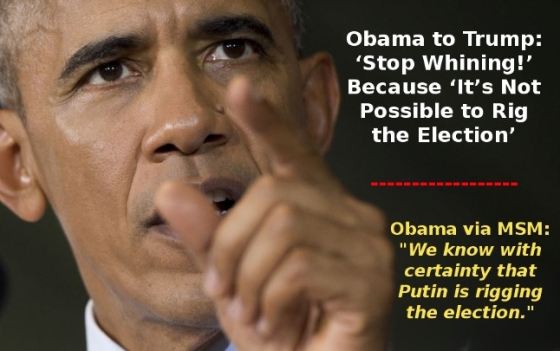
In August, the corporate media was falling all over itself with breathless coverage on how Russia is interfering in the US election. Back then, stories citing experts suggested that voting machines were vulnerable to tampering that could change the outcome of the vote. A month later, something curious happened.

By September, government officials were doing all they could to tamp down those concerns, and the media duly reported their reassurances.

Should the public be comforted that election mischief will be homegrown?

The articles, usually citing active government officials, serve a dual purpose in reassuring the public: First, there is no way Russia can hack the election, despite cyber hacks in the Illinois and Arizona voter registration banks. Meanwhile, the message is also to insist Russian President Vladimir Putin is still giving orders to disrupt US cyberspace. This latter message culminated in the Obama administration publicly blaming the Russian government for trying to influence the election in early October.

Voter System vs Election System

The Washington Post began the trend on August 31 with the definitive headline “There’s Almost No Chance Our Elections Can Be Hacked by the Russians. Here’s why.”

The Post cites two major obstacles for potential (Russian) disruption of our election. One is the difference between the “voter system” and the “election system.” The voter system involves registered voter databases throughout the country, while the election system refers to voting machines and paper ballots.

According to executive director Merle King of the state-funded Center for Election Systems in Georgia, the public conflates these two issues about the election, and that leads to a lot of confusion.

The second hindrance for potential hackers is the decentralized voting process, the Post reported. A major positive for vote security, according to the Post, is that local jurisdictions set their own rules for how votes will be counted.

This claim is buttressed by a letter sent by state election officials to Florida voters which notes the public safeguards already in place for our voting process — including (1) layers of encryption for voting machines, (2) thumb drive backups of votes, (3) lack of internet connection to voting machines, and (4) a review of votes after an election.

The Los Angeles Times followed on September 8 with a report titled “Could Russian Hackers Mess with the US Election Results? It Wouldn’t Be Easy; Here’s Why.”

The Times also highlights the decentralized nature of the voting system as a safeguard against tampering. However, while the Post viewed the system as sophisticated, the Times saw the state-run and community-monitored systems as too cumbersome to be susceptible to any hacking.

Quoted again is Merle King, along with Connecticut Secretary of State Denise Merrill, and FBI Director James Comey. Pamela Smith of Verified Voting — an organization that highlights the susceptibility to election rigging — is also sourced to reassure readers that the upcoming election is safe, thanks to an uptick in paper ballot usage.

Russia’s Goal Not Hacking — But Scandal

On September 10, Washington, D.C.-based political newspaper The Hill worked the same dual agenda with “Hacking the Election is Nearly Impossible. But that’s not Russia’s Goal.”

Like the previous articles in the Washington Post and LA Times, The Hill presents the decentralized process of US elections as an impenetrable obstacle to Russian hacking. Bolstering the claims of election security in the piece are Florida’s Secretary of State Ken Detzner, Colorado’s Secretary of Wayne Williams, Pennsylvania Department of State spokesperson Wanda Murren, and Wisconsin’s Administrator of State Elections Division Michael Hass. The only non-governmental official quoted is Chris Porter, an administrator of strategic intelligence at cybersecurity firm FireEye Horizons.

Porter cited examples of Russian election tampering in the Ukraine and efforts to “create scandal,” despite their inability to hack the election.

The Chicago Tribune got its turn on September 14, quoting Assistant to the President for Homeland Security and Counterterrorism Lisa Monaco, who reiterated the safety of the election thanks to the decentralization of the voting process.

These assertions of election security and passive blame on Russia culminated in early October with the Obama administration publicly accusing “senior-most officials in Russia” of tampering with the election, despite their claimed inability to do so.

Taking a Screwdriver to the Election

Let’s go back to August to see why certain experts said that elections could indeed be tampered with.

Princeton professor Andrew Appel made headlines in August after hacking the Sequoia AVC Advantage electronic voting machine in seven minutes. Such machines are used in Louisiana, New Jersey, Virginia and Pennsylvania.

“[Appel] summoned a graduate student named Alex Halderman, who could pick the machine’s lock in seven seconds. Clutching a screwdriver, he deftly wedged out the four ROM chips — they weren’t soldered into the circuit board, as sense might dictate — making it simple to replace them with one of his own: A version of modified firmware that could throw off the machine’s results, subtly altering the tally of votes, never to betray a hint to the voter. The attack was concluded in minutes.”

Former government officials working in the cyber sphere have also warned of election tampering. Former White House counterterrorism czar Richard Clarke asserted: “Yes, It’s Possible to Hack the Election” on August 18.

“I have had three jobs that together [under Bill Clinton, George W. Bush, and Barack Obama] taught me at least one thing: If it’s a computer, it can be hacked.”

Special Interests and the Machines

Clarke sees the decentralized election system as the access point for potential tampering —rather than a potential safeguard. While there are safeguards, such as the voter tabulation through paper ballots, almost no state exclusively uses paper ballots. Instead, voting machines — even allowing votes from home — produce no paper ballot record and thus no way to ensure the “correct” vote was cast.

Furthermore, Clark argues paper ballot receipts from the voting machines are only used in the case of a recount — something today’s sophisticated hackers are aware of and would seek to avoid.

“My first reaction to all this government reassurance was ‘are you kidding me?’” Dr. Jonathan Simon of the Election Defense Alliance told WhoWhatWhy. “There is all this concern about outside hacking, but absolutely no talk of internal rigging.”

While Simon points out that there are many election safeguards, connections to special interests by those that control voting machines provides easy access to election rigging.

“Anyone who could stand to profit off certain policies — the Koch brothers, for example — have a better chance of rigging the election due to their connections to voting systems like Dominion, SES and their satellite companies,” Simon explained. “Russia, China, nor any terrorist group in the Middle East have a connection like that.”

Despite encryption and the lack of an Internet connection, Simon claims that there are other ways to change voting results.

“In a memory card, which is used in optical scanner-verified voting, three lines of code to flip votes one way or another can be entered into 7,000 or 8,000 lines of code virtually without detection. Multiple memory cards can be manipulated like this at the push of a button.”

Why Overlook Potential Domestic Hacking?

With articles by outside experts in August claiming the election could be hacked, followed in September with articles by government officials claiming it could not be — by Russia — it raises the question: why overlook domestic tampering?

“These are relatively unsophisticated and simple ways to rig the election,” Simon concluded.

Washington moves to silence WikiLeaks

germanywikileaks-12d90

By Bill Van Auken

Source: WSWS.org

The cutting off of Internet access for Julian Assange, the founder of WikiLeaks, is one more ugly episode in a US presidential election campaign that has plumbed the depths of political degradation.

Effectively imprisoned in the Ecuadorian embassy in London for over four years, Assange now is faced with a further limitation on his contact with the outside world.

On Tuesday, the Foreign Ministry of Ecuador confirmed WikiLeaks’ charge that Ecuador itself had ordered the severing of Assange’s Internet connection under pressure from the US government. In a statement, the ministry said that WikiLeaks had “published a wealth of documents impacting on the US election campaign,” adding that the government of Ecuador “respects the principle of non-intervention in the internal affairs of other states” and “does not interfere in external electoral processes.” On that grounds, the statement claimed, the Ecuadorian government decided to “restrict access” to the communications network at its London embassy.

This statement from the bourgeois government of Ecuadorian President Rafael Correa is a study in hypocrisy and cowardice. By abetting the US government’s suppression of WikiLeaks, Quito has intervened in the US elections on the side of the ruling establishment and against the rights of the American people. If Correa expects that his professed sensitivity toward the “principle of non-intervention” will be reciprocated, he should recall the fate of Honduran President Manuel Zelaya, who was toppled in a coup orchestrated by then-Secretary of State Hillary Clinton in 2009.

WikiLeaks cited reports that Secretary of State John Kerry had demanded that the government of Ecuador carry out the action “on the sidelines of the negotiations” surrounding the abortive Colombian peace accord last month in Bogota. The US government intervened to prevent any further exposures that could damage the campaign of Clinton, who has emerged as the clear favorite of the US military and intelligence complex as well as the Wall Street banks.

Whether the State Department was the only entity placing pressure on Ecuador on behalf of the Clinton campaign, or whether Wall Street also intervened directly, is unclear. The timing of the Internet cutoff, in the immediate aftermath of the release of Clinton’s Goldman Sachs speeches, may be more than coincidental.

In the spring of 2014, the government of Ecuador agreed to transfer more than half of its gold reserves to Goldman Sachs Group Inc. for three years, in an attempt to raise cash to cover a growing deficit brought on by the collapse in oil prices. It reportedly sent 466,000 ounces of gold to Goldman Sachs, worth about $580 million at the time, in return for “high security” financial instruments and an anticipated profit on its investment. It is hardly a stretch of the imagination to believe that such a relationship would give Goldman Sachs considerable leverage in relation to the Ecuadorian government.

In any case, it is evident that the US ruling establishment is growing increasingly desperate to stanch the flow of previously secret emails and documents that are exposing the real character not only of Clinton, but of capitalist politics as a whole. While WikiLeaks has released over 17,000 emails from the account of Clinton campaign manager and top establishment Democrat John Podesta, it is believed that there are more than 33,000 still to come.

The transcripts of Clinton’s speeches to Goldman Sachs and other top banks and employers’ groups, for which she was paid on average $200,000 per appearance, are the most incriminating. They expose the workings of the oligarchy that rules America and the thinking and actions of a politician prepared to do anything to advance the interests of this ruling stratum, while simultaneously accruing ever greater riches and power for herself.

While on the campaign trail, Clinton has postured as a “progressive,” determined to hold Wall Street’s feet to the fire. But in her speeches to Goldman Sachs, she made clear her unconditional defense of the banks and financial houses. Under conditions of popular outrage against the bankers and their role in dragging millions into crisis in the financial meltdown of 2008, Clinton gave speeches praising the Wall Street financiers and insisting that they were best equipped to regulate themselves. She apologized to them for supporting the toothless Dodd-Frank financial regulatory law, saying that it had to be enacted for “political reasons.”

In front of her Wall Street audiences, Clinton made clear she had no inhibitions about ordering mass slaughter abroad. While telling her public audiences that she supports a “no-fly zone” in Syria as a humanitarian measure to save lives, she confidentially acknowledged to her Goldman Sachs audience that such an action is “going to kill a lot of Syrians” and become “an American and NATO involvement where you take a lot of civilians.” In the same speech she declared her willingness to bomb Iran.

The emails have laid bare the nexus of corrupt connections between the State Department, the Clinton Foundation, her various campaigns and her network of financial and corporate donors, which together constitute a quasi-criminal influence-peddling enterprise that could best be described as “Clinton, Inc.”

The revelations contained in the WikiLeaks material have been ignored or downplayed by the corporate media, which instead has focused unrelentingly on the charges of sexual misconduct leveled against Clinton’s Republican rival, Donald Trump.

The Clinton camp itself has sought to deflect any questions regarding what the candidate said in her speeches or the corrupt operations of her campaign by claiming, with no evidence whatsoever, that the material released by WikiLeaks had been hacked by the Russian government and therefore cannot be trusted.

This line of argumentation serves not only to divert attention from the WikiLeaks material, but also to further the Clinton campaign’s neo-McCarthyite claims of Kremlin intervention on behalf of Trump and advance a propaganda campaign aimed at preparing popular opinion for a direct military confrontation with Russia.

There is an air of desperation in the attempt to quash the WikiLeaks material. CNN news anchor Chris Cuomo, an open supporter of Clinton, went so far as to lie to his audience, claiming it was illegal for them to access the emails and insisting they could obtain any information on them only through the filter of the corporate media.

Well before the release of documents related to the Democratic Party, the determination of ruling circles to suppress WikiLeaks had found repeated and violent expression. State Department officials have come forward with a report that in 2010, in the midst of WikiLeaks’ mass release of State Department cables exposing US imperialist operations around the world, Clinton, then secretary of state, asked subordinates, “Can’t we just drone this guy?” She recently said she could not remember the remark, but if she made it, it was a joke.

During the same period, however, Clinton supporter and longtime Democratic campaign operative Bob Beckel declared in a television interview in relation to Assange: “A dead man can’t leak stuff. This guy’s a traitor, he’s treasonous, and he has broken every law of the United States… there’s only one way to do it: illegally shoot the son of a bitch.”

To this point, the American ruling class has limited itself to judicial frame-ups and character assassination, counting on the help of its servants within both the media and the pseudo-left, large sections of which have either joined the witch-hunt against Assange or downplayed his victimization.

The principal vehicle for this campaign of persecution had been fabricated allegations of sexual misconduct pursued by Swedish authorities acting in league with the US and British governments. Earlier this year, the UN’s Working Group on Arbitrary Detention issued findings that Assange had been “deprived of his liberty in an arbitrary manner,” meaning the body had reached the conclusion that the Swedish case constituted a politically motivated frame-up.

In the midst of the current attempt to silence Assange, an even more bizarre and filthy frame-up has been concocted, attempting to smear the WikiLeaks founder with charges of taking Russian money as well as pedophilia.

At the center of these allegations is a little known online dating service, Toddandclare.com, which first attempted to lure Assange into a supposed deal to film an ad for the site, for which he supposedly would be paid $1 million, to be provided by the Russian government. When WikiLeaks rejected this preposterous provocation, the same site claimed that Assange had been charged with inappropriate contact through the site with an eight-year-old Canadian child visiting the Bahamas. This accusation was then invoked in an attempt to pressure the UN to drop its demand for an end to the persecution of Assange.

Even a cursory investigation makes clear that these allegations constitute a grotesque fabrication. Bahamian police have stated that there are no charges or any case whatsoever against Assange. The dating service has no business address, working phone number or corporate presence anywhere in the US, having all the earmarks of a dummy company created by US intelligence for the purpose of hounding Assange.

The use of such tactics is a measure of how terrified the US ruling class has become in the face of growing mass hostility to both major political parties and their two abhorrent candidates. Their fear is that the relentless exposure of the inner workings of a government of the rich, by the rich and for the rich is robbing the existing political setup of what little legitimacy it had left within the population, and creating the conditions for a political radicalization within the working class and social upheavals, whoever is elected on November 8.


Related Article:

Real Reason Trump’s Being Treated Like He’s Crazy for Refusing to Accept Election Results by Rob Kall