Twitter has permanently suspended the personal account of Republican Congresswoman Marjorie Taylor Greene for what the platform calls “repeated violations of our COVID-19 misinformation policy,” much to the delight of liberals and pro-censorship leftists everywhere. This follows the Twitter ban of Dr Robert Malone on the same grounds a few days prior, which followed an unbroken pattern of continually escalating and expanding censorship protocols ever since the 2016 US election.
In reality nobody ever gets banned for “Covid misinformation”; that’s just today’s excuse. Before that it was the fallout from the Capitol riot, before that it was election security, before that it was Russian disinformation, foreign influence ops, fake news, etc. In reality the real agenda behind the normalization of internet censorship is the normalization of internet censorship itself. That’s the real reason so many people get banned.
I myself had already written many, many articles warning warning about the increasingly widespread use of internet censorship via algorithm manipulation and deplatforming long before the first “Covid misinformation” bans started happening. Arguably the most significant political moment in the US since 9/11 and its aftermath was when liberal institutions decided that Trump’s 2016 election was not a failure of status quo politics but a failure of information control, which just so happened to align perfectly with the agendas of the ruling power structure to control the dominant narratives about what’s going on in the world.
Having unelected tech oligarchs ban duly elected members of Congress – or even the sitting President – from using their massive platforms is dystopian. Remember how many world leaders warned that FB & Twitter's banning of Trump was a threat to democracy.https://t.co/zIT7l04hMWhttps://t.co/2BPFrgeZXv
We saw this exemplified in 2017 when Google, Facebook and Twitter were called before the Senate Judiciary Committee and instructed to come up with a strategy “to prevent the fomenting of discord”.
“We all must act now on the social media battlefield to quell information rebellions that can quickly lead to violent confrontations and easily transform us into the Divided States of America,” the social media giants were told by think tanker and former FBI agent Clint Watts, who added, “Stopping the false information artillery barrage landing on social media users comes only when those outlets distributing bogus stories are silenced—silence the guns and the barrage will end.”
Since that time the coordination between those tech platforms and the US government in determining whose voices should be silenced has gotten progressively more intimate, so now we have these giant platforms which people have come to rely on to share ideas and information censoring speech in complete alignment with the will of the most powerful government on earth.
The danger of this is obvious to anyone who isn’t a stunted emotional infant. The danger of government-tied monopolistic tech platforms controlling worldwide speech far outweighs the danger of whatever voice you might happen to dislike at any given moment. The only way for this not to be clear to you is if you are so psychologically maladjusted that you can’t imagine anything bad coming from your personal preferences for human expression being imposed upon society by the most powerful institutions on earth.
Silicon Valley Should Not Restrict Public Discourse About Covid Measures Which Affect Everyone
"Government-tied oligarchic megacorporations are among the very last institutions who should be in charge of worldwide political discourse."https://t.co/WlDypacgmM
It really only takes the tiniest bit of personal growth to understand this. I for example absolutely hate QAnoners. Hate them, hate them, hate them. They always used to make my job annoying because they saw my criticisms of the mass media and the oligarchic empire as aligning with their view that Donald Trump was leading a righteous crusade against the Deep State, so they’d often clutter my comments sections with foam-brained idiocy that perfectly served the very power structures I oppose. They saw me as on their side when in reality we had virtually nothing in common and couldn’t really be more opposed.
When QAnon accounts were purged from all mainstream social media platforms following the Capitol riot, it made my work significantly less irritating. I no longer had to share social media spaces with people I despised, and, if I were an immature person, I would see this as an inherently good thing. But because I am a grown adult, I understand that the danger of giant monopolistic government-tied platforms controlling worldwide human speech to a greater and greater extent far outweighs the emotional ease I personally receive from their absence.
I therefore would choose to allow QAnoners to voice their dopey nonsense freely on those platforms if it were up to me. Whatever damage they might do is vastly less destructive than allowing widespread communication to be regulated by powerful oligarchic institutions who amount to US government proxies. The same is true of Marjorie Taylor Greene and everyone like her.
This should not be an uncommon perspective. It doesn’t require a lot of maturity to get this, it just requires some basic self-preservation and enough psychological growth to understand that the world should not be forced to align with your personal will. It says bad things about the future that even this kindergarten-level degree of insight has become rare in some circles.
Welcome to the Matrix (i.e. the metaverse), where reality is virtual, freedom is only as free as one’s technological overlords allow, and artificial intelligence is slowly rendering humanity unnecessary, inferior and obsolete.
Mark Zuckerberg, the CEO of Facebook, sees this digital universe—the metaverse—as the next step in our evolutionary transformation from a human-driven society to a technological one.
Yet while Zuckerberg’s vision for this digital frontier has been met with a certain degree of skepticism, the truth—as journalist Antonio García Martínez concludes—is that we’re already living in the metaverse.
The metaverse is, in turn, a dystopian meritocracy, where freedom is a conditional construct based on one’s worthiness and compliance.
In a meritocracy, rights are privileges, afforded to those who have earned them. There can be no tolerance for independence or individuality in a meritocracy, where political correctness is formalized, legalized and institutionalized. Likewise, there can be no true freedom when the ability to express oneself, move about, engage in commerce and function in society is predicated on the extent to which you’re willing to “fit in.”
We are almost at that stage now.
Consider that in our present virtue-signaling world where fascism disguises itself as tolerance, the only way to enjoy even a semblance of freedom is by opting to voluntarily censor yourself, comply, conform and march in lockstep with whatever prevailing views dominate.
Fail to do so—by daring to espouse “dangerous” ideas or support unpopular political movements—and you will find yourself shut out of commerce, employment, and society: Facebook will ban you, Twitter will shut you down, Instagram will de-platform you, and your employer will issue ultimatums that force you to choose between your so-called freedoms and economic survival.
This is exactly how Corporate America plans to groom us for a world in which “we the people” are unthinking, unresistant, slavishly obedient automatons in bondage to a Deep State policed by computer algorithms.
Science fiction has become fact.
Twenty-some years after the Wachowskis’ iconic film, The Matrix, introduced us to a futuristic world in which humans exist in a computer-simulated non-reality powered by authoritarian machines—a world where the choice between existing in a denial-ridden virtual dream-state or facing up to the harsh, difficult realities of life comes down to a blue pill or a red pill—we stand at the precipice of a technologically-dominated matrix of our own making.
We are living the prequel to The Matrix with each passing day, falling further under the spell of technologically-driven virtual communities, virtual realities and virtual conveniences managed by artificially intelligent machines that are on a fast track to replacing human beings and eventually dominating every aspect of our lives.
In The Matrix, computer programmer Thomas Anderson a.k.a. hacker Neo is wakened from a virtual slumber by Morpheus, a freedom fighter seeking to liberate humanity from a lifelong hibernation state imposed by hyper-advanced artificial intelligence machines that rely on humans as an organic power source. With their minds plugged into a perfectly crafted virtual reality, few humans ever realize they are living in an artificial dream world.
Neo is given a choice: to take the red pill, wake up and join the resistance, or take the blue pill, remain asleep and serve as fodder for the powers-that-be.
Most people opt for the blue pill.
In our case, the blue pill—a one-way ticket to a life sentence in an electronic concentration camp—has been honey-coated to hide the bitter aftertaste, sold to us in the name of expediency and delivered by way of blazingly fast Internet, cell phone signals that never drop a call, thermostats that keep us at the perfect temperature without our having to raise a finger, and entertainment that can be simultaneously streamed to our TVs, tablets and cell phones.
Yet we are not merely in thrall with these technologies that were intended to make our lives easier. We have become enslaved by them.
Look around you. Everywhere you turn, people are so addicted to their internet-connected screen devices—smart phones, tablets, computers, televisions—that they can go for hours at a time submerged in a virtual world where human interaction is filtered through the medium of technology.
This is not freedom. This is not even progress.
This is technological tyranny and iron-fisted control delivered by way of the surveillance state, corporate giants such as Google and Facebook, and government spy agencies such as the National Security Agency.
So consumed are we with availing ourselves of all the latest technologies that we have spared barely a thought for the ramifications of our heedless, headlong stumble towards a world in which our abject reliance on internet-connected gadgets and gizmos is grooming us for a future in which freedom is an illusion.
Yet it’s not just freedom that hangs in the balance. Humanity itself is on the line.
If ever Americans find themselves in bondage to technological tyrants, we will have only ourselves to blame for having forged the chains through our own lassitude, laziness and abject reliance on internet-connected gadgets and gizmos that render us wholly irrelevant.
Indeed, we’re fast approaching Philip K. Dick’s vision of the future as depicted in the film Minority Report. There, police agencies apprehend criminals before they can commit a crime, driverless cars populate the highways, and a person’s biometrics are constantly scanned and used to track their movements, target them for advertising, and keep them under perpetual surveillance.
Cue the dawning of the Age of the Internet of Things (IoT), in which internet-connected “things” monitor your home, your health and your habits in order to keep your pantry stocked, your utilities regulated and your life under control and relatively worry-free.
By the end of 2018, “there were an estimated 22 billion internet of things connected devices in use around the world… Forecasts suggest that by 2030 around 50 billion of these IoT devices will be in use around the world, creating a massive web of interconnected devices spanning everything from smartphones to kitchen appliances.”
As the technologies powering these devices have become increasingly sophisticated, they have also become increasingly widespread, encompassing everything from toothbrushes and lightbulbs to cars, smart meters and medical equipment.
Between driverless cars that completely lacking a steering wheel, accelerator, or brake pedal, and smart pills embedded with computer chips, sensors, cameras and robots, we are poised to outpace the imaginations of science fiction writers such as Philip K. Dick and Isaac Asimov. (By the way, there is no such thing as a driverless car. Someone or something will be driving, but it won’t be you.)
These Internet-connected techno gadgets include smart light bulbs that discourage burglars by making your house look occupied, smart thermostats that regulate the temperature of your home based on your activities, and smart doorbells that let you see who is at your front door without leaving the comfort of your couch.
Nest, Google’s suite of smart home products, has been at the forefront of the “connected” industry, with such technologically savvy conveniences as a smart lock that tells your thermostat who is home, what temperatures they like, and when your home is unoccupied; a home phone service system that interacts with your connected devices to “learn when you come and go” and alert you if your kids don’t come home; and a sleep system that will monitor when you fall asleep, when you wake up, and keep the house noises and temperature in a sleep-conducive state.
The aim of these internet-connected devices, as Nest proclaims, is to make “your house a more thoughtful and conscious home.” For example, your car can signal ahead that you’re on your way home, while Hue lights can flash on and off to get your attention if Nest Protect senses something’s wrong. Your coffeemaker, relying on data from fitness and sleep sensors, will brew a stronger pot of coffee for you if you’ve had a restless night.
Yet given the speed and trajectory at which these technologies are developing, it won’t be long before these devices are operating entirely independent of their human creators, which poses a whole new set of worries. As technology expert Nicholas Carr notes, “As soon as you allow robots, or software programs, to act freely in the world, they’re going to run up against ethically fraught situations and face hard choices that can’t be resolved through statistical models. That will be true of self-driving cars, self-flying drones, and battlefield robots, just as it’s already true, on a lesser scale, with automated vacuum cleaners and lawnmowers.”
Moreover, it’s not just our homes and personal devices that are being reordered and reimagined in this connected age: it’s our workplaces, our health systems, our government, our bodies and our innermost thoughts that are being plugged into a matrix over which we have no real control.
It is expected that by 2030, we will all experience The Internet of Senses (IoS), enabled by Artificial Intelligence (AI), Virtual Reality (VR), Augmented Reality (AR), 5G, and automation. The Internet of Senses relies on connected technology interacting with our senses of sight, sound, taste, smell, and touch by way of the brain as the user interface. As journalist Susan Fourtane explains:
Many predict that by 2030, the lines between thinking and doing will blur. Fifty-nine percent of consumers believe that we will be able to see map routes on VR glasses by simply thinking of a destination… By 2030, technology is set to respond to our thoughts, and even share them with others… Using the brain as an interface could mean the end of keyboards, mice, game controllers, and ultimately user interfaces for any digital device. The user needs to only think about the commands, and they will just happen. Smartphones could even function without touch screens.
In other words, the IoS will rely on technology being able to access and act on your thoughts.
1: Thoughts become action: using the brain as the interface, for example, users will be able to see map routes on VR glasses by simply thinking of a destination.
2: Sounds will become an extension of the devised virtual reality: users could mimic anyone’s voice realistically enough to fool even family members.
3: Real food will become secondary to imagined tastes. A sensory device for your mouth could digitally enhance anything you eat, so that any food can taste like your favorite treat.
4: Smells will become a projection of this virtual reality so that virtual visits, to forests or the countryside for instance, would include experiencing all the natural smells of those places.
5: Total touch: Smartphones with screens will convey the shape and texture of the digital icons and buttons they are pressing.
6: Merged reality: VR game worlds will become indistinguishable from physical reality by 2030.
This is the metaverse, wrapped up in the siren-song of convenience and sold to us as the secret to success, entertainment and happiness.
It’s a false promise, a wicked trap to snare us, with a single objective: total control.
Orwell’s masterpiece, 1984, portrays a global society of total control in which people are not allowed to have thoughts that in any way disagree with the corporate state. There is no personal freedom, and advanced technology has become the driving force behind a surveillance-driven society. Snitches and cameras are everywhere. And people are subject to the Thought Police, who deal with anyone guilty of thought crimes. The government, or “Party,” is headed by Big Brother, who appears on posters everywhere with the words: “Big Brother is watching you.”
Last year, a government commission called for the US to adopt an AI-driven mass surveillance system far beyond that used in any other country in order to ensure American hegemony in artificial intelligence. Now, many of the “obstacles” they had cited as preventing its implementation are rapidly being removed under the guise of combating the coronavirus crisis.
Last year, a U.S. government body dedicated to examining how artificial intelligence can “address the national security and defense needs of the United States” discussed in detail the “structural” changes that the American economy and society must undergo in order to ensure a technological advantage over China, according to a recent document acquired through a FOIA request. This document suggests that the U.S. follow China’s lead and even surpass them in many aspects related to AI-driven technologies, particularly their use of mass surveillance. This perspective clearly clashes with the public rhetoric of prominent U.S. government officials and politicians on China, who have labeled the Chinese government’s technology investments and export of its surveillance systems and other technologies as a major “threat” to Americans’ “way of life.”
In addition, many of the steps for the implementation of such a program in the U.S., as laid out in this newly available document, are currently being promoted and implemented as part of the government’s response to the current coronavirus (Covid-19) crisis. This likely due to the fact that many members of this same body have considerable overlap with the taskforces and advisors currently guiding the government’s plans to “re-open the economy” and efforts to use technology to respond to the current crisis.
The FOIA document, obtained by the Electronic Privacy Information Center (EPIC), was produced by a little-known U.S. government organization called the National Security Commission on Artificial Intelligence (NSCAI). It was created by the 2018 National Defense Authorization Act (NDAA) and its official purpose is “to consider the methods and means necessary to advance the development of artificial intelligence (AI), machine learning, and associated technologies to comprehensively address the national security and defense needs of the United States.”
The NSCAI is a key part of the government’s response to what is often referred to as the coming “fourth industrial revolution,” which has been described as “a revolution characterized by discontinuous technological development in areas like artificial intelligence (AI), big data, fifth-generation telecommunications networking (5G), nanotechnology and biotechnology, robotics, the Internet of Things (IoT), and quantum computing.”
However, their main focus is ensuring that “the United States … maintain a technological advantage in artificial intelligence, machine learning, and other associated technologies related to national security and defense.” The vice-chair of NSCAI, Robert Work – former Deputy Secretary of Defense and senior fellow at the hawkish Center for a New American Security (CNAS), described the commission’s purpose as determining “how the U.S. national security apparatus should approach artificial intelligence, including a focus on how the government can work with industry to compete with China’s ‘civil-military fusion’ concept.”
The recently released NSCAI document is a May 2019 presentation entitled “Chinese Tech Landscape Overview.” Throughout the presentation, the NSCAI promotes the overhaul of the U.S. economy and way of life as necessary for allowing the U.S. to ensure it holds a considerable technological advantage over China, as losing this advantage is currently deemed a major “national security” issue by the U.S. national security apparatus. This concern about maintaining a technological advantage can be seen in several other U.S. military documents and think tank reports, several of whichhave warned that the U.S.’ technological advantage is quickly eroding.
The U.S. government and establishment media outlets often blame alleged Chinese espionage or the Chinese government’s more explicit partnershipswith private technology companies in support of their claim that the U.S. is losing this advantage over China. For instance, Chris Darby, the current CEO of the CIA’s In-Q-Tel, who is also on the NSCAI, told CBS News last year that China is the U.S.’ main competitor in terms of technology and that U.S. privacy laws were hampering the U.S.’ capacity to counter China in this regard, stating that:
“[D]ata is the new oil. And China is just awash with data. And they don’t have the same restraints that we do around collecting it and using it, because of the privacy difference between our countries. This notion that they have the largest labeled data set in the world is going to be a huge strength for them.”
In another example, Michael Dempsey – former acting Director of National Intelligence and currently a government-funded fellow at the Council on Foreign Relations – argued in The Hill that:
“It’s quite clear, though, that China is determined to erase our technological advantage, and is committing hundreds of billions of dollars to this effort. In particular, China is determined to be a world leader in such areas as artificial intelligence, high performance computing, and synthetic biology. These are the industries that will shape life on the planet and the military balance of power for the next several decades.”
In fact, the national security apparatus of the United States is so concerned about losing a technological edge over China that the Pentagon recently decided to join forces directly with the U.S. intelligence community in order “to get in front of Chinese advances in artificial intelligence.” This union resulted in the creation of the Joint Artificial Intelligence Center (JAIC), which ties together “the military’s efforts with those of the Intelligence Community, allowing them to combine efforts in a breakneck push to move government’s AI initiatives forward.” It also coordinates with other government agencies, industry, academics, and U.S. allies. Robert Work, who subsequently became the NSCAI vice-chair, said at the time that JAIC’s creation was a “welcome first step in response to Chinese, and to a lesser extent, Russian, plans to dominate these technologies.”
Similar concerns about “losing” technological advantage to China have also been voiced by the NSCAI chairman, Eric Schmidt, the former head of Alphabet – Google’s parent company, who argued in February in the New York Times that Silicon Valley could soon lose “the technology wars” to China if the U.S. government doesn’t take action. Thus, the three main groups represented within the NSCAI – the intelligence community, the Pentagon and Silicon Valley – all view China’s advancements in AI as a major national security threat (and in Silicon Valley’s case, threat to their bottom lines and market shares) that must be tackled quickly.
Targeting China’s “adoption advantage”
In the May 2019 “Chinese Tech Landscape Overview” presentation, the NSCAI discusses that, while the U.S. still leads in the “creation” stage of AI and related technologies, it lags behind China in the “adoption” stage due to “structural factors.” It says that “creation”, followed by “adoption” and “iteration” are the three phases of the “life cycle of new tech” and asserts that failing to dominate in the “adoption” stage will allow China to “leapfrog” the U.S. and dominate AI for the foreseeable future.
The presentation also argues that, in order to “leapfrog” competitors in emerging markets, what is needed is not “individual brilliance” but instead specific “structural conditions that exist within certain markets.” It cites several case studies where China is considered to be “leapfrogging” the U.S. due to major differences in these “structural factors.” Thus, the insinuation of the document (though not directly stated) is that the U.S. must alter the “structural factors” that are currently responsible for its lagging behind China in the “adoption” phase of AI-driven technologies.
Chief among the troublesome “structural factors” highlighted in this presentation are so-called “legacy systems” that are common in the U.S. but much less so in China. The NSCAI document states that examples of “legacy systems” include a financial system that still utilizes cash and card payments, individual car ownership and even receiving medical attention from a human doctor. It states that, while these “legacy systems” in the US are “good enough,” too many “good enough” systems “hinder the adoption of new things,” specifically AI-driven systems.
Another structural factor deemed by the NSCAI to be an obstacle to the U.S.’ ability to maintain a technological advantage over China is the “scale of the consumer market,” arguing that “extreme urban density = on-demand service adoption.” In other words, extreme urbanization results in more people using online or mobile-based “on-demand” services, ranging from ride-sharing to online shopping. It also cites the use of mass surveillance on China’s “huge population base” is an example of how China’s “scale of consumer market” advantage allowing “China to leap ahead” in the fields of related technologies, like facial recognition.
In addition to the alleged shortcomings of the U.S.’ “legacy systems” and lack of “extreme urban density,” the NSCAI also calls for more “explicit government support and involvement” as a means to speed up the adoption of these systems in the U.S. This includes the government lending its stores of data on civilians to train AI, specifically citing facial recognition databases, and mandating that cities be “re-architected around AVs [autonomous vehicles],” among others. Other examples given include the government investing large amounts of money in AI start-ups and adding tech behemoths to a national, public-private AI taskforce focused on smart city-implementation (among other things).
With regards to the latter, the document says “this level of public-private cooperation” in China is “outwardly embraced” by the parties involved, with this “serving as a stark contrast to the controversy around Silicon Valley selling to the U.S. government.” Examples of such controversy, from the NSCAI’s perspective, likely include Google employees petitioning to end the Google-Pentagon “Project Maven,” which uses Google’s AI software to analyze footage captured by drones. Google eventually chose not to renew its Maven contract as a result of the controversy, even though top Google executives viewed the project as a “golden opportunity” to collaborate more closely with the military and intelligence communities.
The document also defines another aspect of government support as the “clearing of regulatory barriers.” This term is used in the document specifically with respect to U.S. privacy laws, despite the fact that the U.S. national security state has long violated these laws with near complete impunity. However, the document seems to suggest that privacy laws in the U.S. should be altered so that what the U.S. government has done “in secret” with private citizen data can be done more openly and more extensively. The NSCAI document also discusses the removal of “regulatory barriers” in order to speed up the adoption of self-driving cars, even though autonomous driving technology has resulted in several deadlyand horrific car accidents and presents other safety concerns.
Also discussed is how China’s “adoption advantage” will “allow it to leapfrog the U.S.” in several new fields, including “AI medical diagnosis” and “smart cities.” It then asserts that “the future will be decided at the intersection of private enterprise and policy leaders between China and the U.S.” If this coordination over the global AI market does not occur, the document warns that “we [the U.S.] risk being left out of the discussions where norms around AI are set for the rest of our lifetimes.”
The presentation also dwells considerably on how “the main battleground [in technology] are not the domestic Chinese and US markets,” but what it refers to as the NBU (next billion users) markets, where it states that “Chinese players will aggressively challenge Silicon Valley.” In order to challenge them more successfully, the presentation argues that, “just like we [view] the market of teenagers as a harbinger for new trends, we should look at China.”
The document also expresses concerns about China exporting AI more extensively and intensively than the U.S., saying that China is “already crossing borders” by helping to build facial databases in Zimbabwe and selling image recognition and smart city systems to Malaysia. If allowed to become “the unambiguous leader in AI,” it says that “China could end up writing much of the rulebook of international norms around the deployment of AI” and that it would “broaden China’s sphere of influence amongst an international community that increasingly looks to the pragmatic authoritarianism of China and Singapore as an alternative to Western liberal democracy.”
What will replace the US’ “legacy systems”?
Given that the document makes it quite clear that “legacy systems” in the U.S. are impeding its ability to prevent China from “leapfrogging” ahead in AI and then dominating it for the foreseeable future, it is also important to examine what the document suggests should replace these “legacy systems” in the U.S.
As previously mentioned, one “legacy system” cited early on in the presentation is the main means of payment for most Americans, cash and credit/debit cards. The presentation asserts, in contrast to these “legacy systems” that the best and most advanced system is moving entirely to smartphone-based digital wallets.
It notes specifically the main mobile wallet provider in India, PayTM, is majority owned by Chinese companies. It quotes an article, which states that “a big break came [in 2016] when India canceled 86% of currency in circulation in an effort to cut corruption and bring more people into the tax net by forcing them to use less cash.” At the time, claims that India’s 2016 “currency reform” would be used as a stepping stone towards a cashless society were dismissed by some as “conspiracy theory.” However, last year, a committee convened by India’s central bank (and led by an Indian tech oligarch who also created India’s massive civilian biometric database) resulted in the Indian government’s “Cashless India” program.
Regarding India’s 2016 “currency reform,” the NSCAI document then asserts that “this would be unfathomable in the West. And unsurprisingly, when 86% of the cash got cancelled and nobody had a credit card, mobile wallets in India exploded, laying the groundwork for a far more advanced payments ecosystem in India than the US.” However, it has become increasingly less unfathomable in light of the current coronavirus crisis, which has seen efforts to reduce the amount of cash used because paper bills may carry the virus as well as efforts to introduce a Federal Reserve-backed “digital dollar.”
In addition, the NSCAI document from last May calls for the end of in-person shopping and promotes moving towards all shopping being performed online. It argues that “American companies have a lot to gain by adopting ideas from Chinese companies” by shifting towards exclusive e-commerce purchasing options. It states that only shopping online provides a “great experience” and also adds that “when buying online is literally the only way to get what you want, consumers go online.”
Another “legacy system” that the NSCAI seeks to overhaul is car ownership, as it promotes autonomous, or self-driving vehicles and further asserts that “fleet ownership > individual ownership.” It specifically points to a need for “a centralized ride-sharing network,” which it says “is needed to coordinate cars to achieve near 100% utilization rates.” However, it warns against ride-sharing networks that “need a human operator paired with each vehicle” and also asserts that “fleet ownership makes more sense” than individual car ownership. It also specifically calls for these fleets to not only be composed of self-driving cars, but electric cars and cites reports that China “has the world’s most aggressive electric vehicle goals….and seek[s] the lead in an emerging industry.”
The document states that China leads in ride-sharing today even though ride-sharing was pioneered first in the U.S. It asserts once again that the U.S. “legacy system” of individual car ownership and lack of “extreme urban density” are responsible for China’s dominance in this area. It also predicts that China will “achieve mass autonomous [vehicle] adoption before the U.S.,” largely because “the lack of mass car ownership [in China] leads to far more consumer receptiveness to AVs [autonomous vehicles].” It then notes that “earlier mass adoption leads to a virtuous cycle that allows Chinese core self-driving tech to accelerate beyond [its] Western counterparts.”
In addition to their vision for a future financial system and future self-driving transport system, the NSCAI has a similarly dystopian vision for surveillance. The document calls mass surveillance “one of the ‘first-and-best customers’ for AI” and “a killer application for deep learning.” It also states that “having streets carpeted with cameras is good infrastructure.”
It then discusses how “an entire generation of AI unicorn” companies are “collecting the bulk of their early revenue from government security contracts” and praises the use of AI in facilitating policing activities. For instance, it lauds reports that “police are making convictions based on phone calls monitored with iFlyTek’s voice-recognition technology” and that “police departments are using [AI] facial recognition tech to assist in everything from catching traffic law violators to resolving murder cases.”
On the point of facial recognition technology specifically, the NSCAI document asserts that China has “leapt ahead” of the US on facial recognition, even though “breakthroughs in using machine learning for image recognition initially occurred in the US.” It claims that China’s advantage in this instance is because they have government-implemented mass surveillance (“clearing of regulatory barriers”), enormous government-provided stores of data (“explicit government support”) combined with private sector databases on a huge population base (“scale of consumer market”). As a consequence of this, the NSCAI argues, China is also set to leap ahead of the U.S. in both image/facial recognition and biometrics.
The document also points to another glaring difference between the U.S. and its rival, stating that: “In the press and politics of America and Europe, Al is painted as something to be feared that is eroding privacy and stealing jobs. Conversely, China views it as both a tool for solving major macroeconomic challenges in order to sustain their economic miracle, and an opportunity to take technological leadership on the global stage.”
The NSCAI document also touches on the area of healthcare, calling for the implementation of a system that seems to be becoming reality thanks to the current coronavirus crisis. In discussing the use of AI in healthcare (almost a year before the current crisis began), it states that “China could lead the world in this sector” and “this could lead to them exporting their tech and setting international norms.” One reason for this is also that China has “far too few doctors for the population” and calls having enough doctors for in-person visits a “legacy system.” It also cited U.S. regulatory measures such as “HIPPA compliance and FDA approval” as obstacles that don’t constrain Chinese authorities.
More troubling, it argues that “the potential impact of government supplied data is even more significant in biology and healthcare,” and says it is likely that “the Chinese government [will] require every single citizen to have their DNA sequenced and stored in government databases, something nearly impossible to imagine in places as privacy conscious as the U.S. and Europe.” It continues by saying that “the Chinese apparatus is well-equipped to take advantage” and calls these civilian DNA databases a “logical next step.”
Who are the NSCAI?
Given the sweeping changes to the U.S. that the NSCAI promoted in this presentation last May, it becomes important to examine who makes up the commission and to consider their influence over U.S. policy on these matters, particularly during the current crisis. As previously mentioned, the chairman of the NSCAI is Eric Schmidt, the former head of Alphabet (Google’s parent company) who has also invested heavily in Israeli intelligence-linked tech companies including the controversial start-up “incubator” Team8. In addition, the committee’s vice-chair is Robert Work, is not only a former top Pentagon official, but is currently working with the think tank CNAS, which is run by John McCain’s long-time foreign policy adviser and Joe Biden’s former national security adviser.
Safra Catz, CEO of Oracle, with close ties to Trump’s top donor Sheldon Adelson
Steve Chien, supervisor of the Artificial Intelligence Group at Caltech’s Jet Propulsion Lab
Mignon Clyburn, Open Society Foundation fellow and former FCC commissioner
Chris Darby, CEO of In-Q-Tel (CIA’s venture capital arm)
Ken Ford, CEO of the Florida Institute for Human and Machine Cognition
Jose-Marie Griffiths, president of Dakota State University and former National Science Board member
Eric Horvitz, director of Microsoft Research Labs
Andy Jassy, CEO of Amazon Web Services (CIA contractor)
Gilman Louie, partner at Alsop Louie Partners and former CEO of In-Q-Tel
William Mark, director of SRI International and former Lockheed Martin director
Jason Matheny, director of the Center for Security and Emerging Technology, former Assistant director of National Intelligence and former director of IARPA (Intelligence Advanced Research Project Agency)
Katharina McFarland, consultant at Cypress International and former Assistant Secretary of Defense for Acquisition
Andrew Moore, head of Google Cloud AI
As can be seen in the list above, there is a considerable amount of overlap between the NSCAI and the companies currently advising the White House on “re-opening” the economy (Microsoft, Amazon, Google, Lockheed Martin, Oracle) and one NSCAI member, Oracle’s Safra Katz, is on the White House’s “economic revival” taskforce. Also, there is also overlap between the NSCAI and the companies that are intimately involved in the implementation of the “contact tracing” “coronavirus surveillance system,” a mass surveillance system promoted by the Jared Kushner-led, private-sector coronavirus task force. That surveillance system is set to be constructed by companies with deep ties to Google and the U.S. national security state, and both Google and Apple, who create the operating systems for the vast majority of smartphones used in the U.S., have said they will now build that surveillance system directly into their smartphone operating systems.
Also notable is the fact that In-Q-Tel and the U.S. intelligence community has considerable representation on the NSCAI and that they also boast close ties with Google, Palantir and other Silicon Valley giants, having been early investors in those companies. Both Google and Palantir, as well as Amazon (also on the NSCAI) are also major contractors for U.S. intelligence agencies. In-Q-Tel’s involvement on the NSCAI is also significant because they have been heavily promoting mass surveillance of consumer electronic devices for use in pandemics for the past several years. Much of that push has come from In-Q-Tel’s current Executive Vice President Tara O’Toole, who was previously the director of the Johns Hopkins Center for Health Security and also co-authored several controversial biowarfare/pandemic simulations, such as Dark Winter.
In addition, since at least January, the U.S. intelligence community and the Pentagon have been at the forefront of developing the U.S. government’s still-classified “9/11-style” response plans for the coronavirus crisis, alongside the National Security Council. Few news organizations have noted that these classified response plans, which are set to be triggered if and when the U.S. reaches a certain number of coronavirus cases, has been created largely by elements of the national security state (i.e. the NSC, Pentagon, and intelligence), as opposed to civilian agencies or those focused on public health issues.
Furthermore, it has been reported that the U.S. intelligence community as well as U.S. military intelligence knew by at least January (though recent reports have said as early as last November) that the coronavirus crisis would reach “pandemic proportions” by March. The American public were not warned, but elite members of the business and political classes were apparently informed, given the record numbers of CEO resignations in January and several high-profile insider trading allegations that preceded the current crisis by a matter of weeks.
Perhaps even more disconcerting is the added fact that the U.S. government not only participated in the eerily prescient pandemic simulation last October known as Event 201, it also led a series of pandemic response simulations last year. Crimson Contagion was a series of four simulations that involved 19 U.S. federal agencies, including intelligence and the military, as well as 12 different states and a host of private sector companies that simulated a devastating pandemic influenza outbreak that had originated in China. It was led by the current HHS Assistant Secretary for Preparedness and Response, Robert Kadlec, who is a former lobbyist for military and intelligence contractors and a Bush-era homeland security “bioterrorism” advisor.
In addition, both Kadlec and the Johns Hopkins Center for Health Security, which was intimately involved in Event 201, have direct ties to the controversial June 2001 biowarfare exercise “Dark Winter,” which predicted the 2001 anthrax attacks that transpired just months later in disturbing ways. Though efforts by media and government were made to blame the anthrax attacks on a foreign source, the anthrax was later found to have originated at a U.S. bioweapons lab and the FBI investigation into the case has been widely regarded as a cover-up, including by the FBI’s once-lead investigator on that case.
Given the above, it is worth asking if those who share the NSCAI’s vision saw the coronavirus pandemic early on as an opportunity to make the “structural changes” it had deemed essential to countering China’s lead in the mass adoption of AI-driven technologies, especially considering that many of the changes in the May 2019 document are now quickly taking place under the guise of combatting the coronavirus crisis.
The NSCAI’s vision takes shape
Though the May 2019 NSCAI document was authored nearly a year ago, the coronavirus crisis has resulted in the implementation of many of the changes and the removal of many of the “structural” obstacles that the commission argued needed to be drastically altered in order to ensure a technological advantage over China in the field of AI. The aforementioned move away from cash, which is taking place not just in the U.S. but internationally, is just one example of many.
For instance, earlier this week CNN reported that grocery stores are now considering banning in-person shopping and that the U.S. Department of Labor has recommended that retailers nationwide start “‘using a drive-through window or offering curbside pick-up’ to protect workers for exposure to coronavirus.” In addition, last week, the state of Florida approved an online-purchase plan for low income families using the Supplemental Nutrition Assistance Program (SNAP). Other reports have argued that social distancing inside grocery stores is ineffective and endangering people’s lives. As previously mentioned, the May 2019 NSCAI document argues that moving away from in-person shopping is necessary to mitigate China’s “adoption advantage” and also argued that “when buying online is literally the only way to get what you want, consumers go online.”
Reports have also argued that these changes in shopping will last far beyond coronavirus, such as an article by Business Insider entitled “The coronavirus pandemic is pushing more people online and will forever change how Americans shop for groceries, experts say.” Those cited in the piece argue that this shift away from in-person shopping will be “permanent” and also states that “More people are trying these services than otherwise would have without this catalyst and gives online players a greater chance to acquire and keep a new customer base.” A similar article in Yahoo! News argues that, thanks to the current crisis, “our dependence on online shopping will only rise because no one wants to catch a virus at a shop.”
In addition, the push towards the mass use of self-driving cars has also gotten a boost thanks to coronavirus, with driverless cars now making on-demand deliveries in California. Two companies, one Chinese-owned and the other backed by Japan’s SoftBank, have since been approved to have their self-driving cars used on California roads and that approval was expedited due to the coronavirus crisis. The CPO of Nuro Inc., the SoftBank-backed company, was quoted in Bloomberg as saying that “The Covid-19 pandemic has expedited the public need for contactless delivery services. Our R2 fleet is custom-designed to change the very nature of driving and the movement of goods by allowing people to remain safely at home while their groceries, medicines, and packages are brought to them.” Notably, the May 2019 NSCAI document references the inter-connected web of SoftBank-backed companies, particularly those backed by its largely Saudi-funded “Vision Fund,” as forming “the connective tissue for a global federation of tech companies” set to dominate AI.
California isn’t the only state to start using self-driving cars, as the Mayo Clinic of Florida is now also using them. “Using artificial intelligence enables us to protect staff from exposure to this contagious virus by using cutting-edge autonomous vehicle technology and frees up staff time that can be dedicated to direct treatment and care for patients,” Kent Thielen, M.D., CEO of Mayo Clinic in Florida stated in a recent press release cited by Mic.
Like the changes to in-person shopping in the age of coronavirus, other reports assert that self-driving vehicles are here to stay. One report published by Mashable is entitled “It took a coronavirus outbreak for self-driving cars to become more appealing,” and opens by stating “Suddenly, a future full of self-driving cars isn’t just a sci-fi pipe dream. What used to be considered a scary, uncertain technology for many Americans looks more like an effective tool to protect ourselves from a fast-spreading, infectious disease.” It further argues that this is hardly a “fleeting shift” in driving habits and one tech CEO cited in the piece, Anuja Sonalker of Steer Tech, claims that “There has been a distinct warming up to human-less, contactless technology. Humans are biohazards, machines are not.”
Another focus of the NSCAI presentation, AI medicine, has also seen its star rise in recent weeks. For instance, several reports have touted how AI-driven drug discovery platforms have been able to identify potential treatments for coronavirus. Microsoft, whose research lab director is on the NSCAI, recently put $20 million into its “AI for health” program to speed up the use of AI in analyzing coronavirus data. In addition, “telemedicine”– a form of remote medical care – has also becomewidely adopted due to the coronavirus crisis.
Several other AI-driven technologies have similarly become more widely adopted thanks to coronavirus, including the use of mass surveillance for “contact tracing” as well as facial recognition technology and biometrics. A recent Wall Street Journal report stated that the government is seriously considering both contact tracing via phone geolocation data and facial recognition technology in order to track those who might have coronavirus. In addition, private businesses – like grocery stores and restaurants – are using sensors and facial recognition to see how many people and which people are entering their stores.
As far as biometrics go, university researchers are now working to determine if “smartphones and biometric wearables already contain the data we need to know if we have become infected with the novel coronavirus.” Those efforts seek to detect coronavirus infections early by analyzing “sleep schedules, oxygen levels, activity levels and heart rate” based on smartphone apps like FitBit and smartwatches. In countries outside the U.S., biometric IDs are being touted as a way to track those who have and lack immunity to coronavirus.
In addition, one report in The Edge argued that the current crisis is changing what types of biometrics should be used, asserting that a shift towards thermal scanning and facial recognition is necessary:
“At this critical juncture of the crisis, any integrated facial recognition and thermal scanning solution must be implemented easily, rapidly and in a cost-effective manner. Workers returning to offices or factories must not have to scramble to learn a new process or fumble with declaration forms. They must feel safe and healthy for them to work productively. They just have to look at the camera and smile. Cameras and thermal scanners, supported by a cloud-based solution and the appropriate software protocols, will do the rest.”
Also benefiting from the coronavirus crisis is the concept of “smart cities,” with Forbes recently writing that “Smart cities can help us combat the coronavirus pandemic.” That article states that “Governments and local authorities are using smart city technology, sensors and data to trace the contacts of people infected with the coronavirus. At the same time, smart cities are also helping in efforts to determine whether social distancing rules are being followed.”
That article in Forbes also contains the following passage:
“…[T]he use of masses of connected sensors makes it clear that the coronavirus pandemic is–intentionally or not–being used as a testbed for new surveillance technologies that may threaten privacy and civil liberties. So aside from being a global health crisis, the coronavirus has effectively become an experiment in how to monitor and control people at scale.”
Another report in The Guardian states that “If one of the government takeaways from coronavirus is that ‘smart cities’ including Songdo or Shenzhen are safer cities from a public health perspective, then we can expect greater efforts to digitally capture and record our behaviour in urban areas – and fiercer debates over the power such surveillance hands to corporations and states.” There have also been reports that assert that typical cities are “woefully unprepared” to face pandemics compared to “smart cities.”
Yet, beyond many of the NSCAI’s specific concerns regarding mass AI adoption being conveniently resolved by the current crisis, there has also been a concerted effort to change the public’s perception of AI in general. As previously mentioned, the NSCAI had pointed out last year that:
“In the press and politics of America and Europe, Al is painted as something to be feared that is eroding privacy and stealing jobs. Conversely, China views it as both a tool for solving major macroeconomic challenges in order to sustain their economic miracle, and an opportunity to take technological leadership on the global stage.”
It is indeed striking how the coronavirus crisis has seemingly fulfilled the NSCAI’s entire wishlist and removed many of the obstacles to the mass adoption of AI technologies in the United States. Like major crises of the past, the national security state appears to be using the chaos and fear to promote and implement initiatives that would be normally rejected by Americans and, if history is any indicator, these new changes will remain long after the coronavirus crisis fades from the news cycle. It is essential that these so-called “solutions” be recognized for what they are and that we consider what type of world they will end up creating – an authoritarian technocracy. We ignore the rapid advance of these NSCAI-promoted initiatives and the phasing out of so-called “legacy systems” (and with them, many long-cherished freedoms) at our own peril.
The emergence of the internet was met with hope and enthusiasm by people who understood that the plutocrat-controlled mainstream media were manipulating public opinion to manufacture consent for the status quo. The democratization of information-sharing was going to give rise to a public consciousness that is emancipated from the domination of plutocratic narrative control, thereby opening up the possibility of revolutionary change to our society’s corrupt systems.
But it never happened. Internet use has become commonplace around the world and humanity is able to network and share information like never before, yet we remain firmly under the thumb of the same power structures we’ve been ruled by for generations, both politically and psychologically. Even the dominant media institutions are somehow still the same.
So what went wrong? Nobody’s buying newspapers anymore, and the audiences for television and radio are dwindling. How is it possible that those same imperialist oligarchic institutions are still controlling the way most people think about their world?
1) Ranking corporate news higher in YT's algorithim 2)Suppressing independent news/politics channels 3)Suppressing people creating content "from their basement" (THE ORIGINAL PURPOSE of YT)
Last month a very informative interview saw the CEO of YouTube, which is owned by Google, candidly discussing the way the platform uses algorithms to elevate mainstream news outlets and suppress independent content.
At the World Economic Forum’s 2021, YouTube CEO Susan Wojcicki told Atlantic CEO Nicholas Thompson that while the platform still allows arts and entertainment videos an equal shot at going viral and getting lots of views and subscribers, on important areas like news media it artificially elevates “authoritative sources”.
“What we’ve done is really fine-tune our algorithms to be able to make sure that we are still giving the new creators the ability to be found when it comes to music or humor or something funny,” Wojcicki said. “But when we’re dealing with sensitive areas, we really need to take a different approach.”
Wojcicki said in addition to banning content deemed harmful, YouTube has also created a category labeled “borderline content” which it algorithmically de-boosts so that it won’t show up as a recommended video to viewers who are interested in that topic:
“When we deal with information, we want to make sure that the sources that we’re recommending are authoritative news, medical science, et cetera. And we also have created a category of more borderline content where sometimes we’ll see people looking at content that’s lower quality and borderline. And so we want to be careful about not over-recommending that. So that’s a content that stays on the platform but is not something that we’re going to recommend. And so our algorithms have definitely evolved in terms of handling all these different content types.”
Progressive commentator Kyle Kulinski has a good video out reacting to Wojcicki’s comments, saying he believes his (entirely harmless) channel has been grouped in the “borderline” category because his views and new subscribers suddenly took a dramatic and inexplicable plunge. Kulinski reports that overnight he went from getting tens of thousands of new subscriptions per month to maybe a thousand.
“People went to YouTube to escape the mainstream nonsense that they see on cable news and on TV, and now YouTube just wants to become cable news and TV,” Kulinski says. “People are coming here to escape that and you’re gonna force-feed them the stuff they’re escaping like CNN and MSNBC and Fox News.”
It is not terribly surprising to hear Susan Wojcicki admit to elevating the media of the oligarchic empire to the CEO of a neoconservative publication at the World Economic Forum. She comes from the same elite empire management background as all the empire managers who’ve been placed in charge of mainstream media outlets by their plutocratic owners, having gone to Harvard after being literally raised on the campus of Stanford University as a child. Her sister Anne is the founder of the genetic-testing company 23andMe and was married to Google co-founder Sergey Brin.
Google itself also uses algorithms to artificially boost empire media in its searches. In 2017 World Socialist Website (WSWS) began documenting the fact that it, along with other leftist and antiwar outlets, had suddenly experienced a dramatic drop in traffic from Google searches. In 2019 the Wall Street Journal confirmed WSWS claims, reporting that “Despite publicly denying doing so, Google keeps blacklists to remove certain sites or prevent others from surfacing in certain types of results.” In 2020 the CEO of Google’s parent company Alphabet admitted to censoring WSWS at a Senate hearing in response to one senator’s suggestion that Google only censors right wing content.
We should be extremely alarmed that the Atlantic Council—funded by NATO and the state department and Gulf monarchies and weapons companies—is telling Facebook who to delete https://t.co/7N6fDjDSHRpic.twitter.com/W2zLmx1MKI
Then you’ve got Facebook, where a third of Americans regularly get their news. Facebook is a bit less evasive about its status quo-enforcing censorship practices, openly enlisting the government-and-plutocrat-funded imperialist narrative management firm The Atlantic Council to help it determine what content to censor and what to boost. Facebook has stated that if its “fact checkers” like The Atlantic Council deem a page or domain guilty of spreading false information, it will “dramatically reduce the distribution of all of their Page-level or domain-level content on Facebook.”
All the algorithm stacking by the dominant news distribution giants Google and Facebook also ensures that mainstream platforms and reporters will have far more followers than indie media on platforms like Twitter, since an article that has been artificially amplified will receive far more views and therefore far more clicks on their social media information. Mass media employees tend to clique up and amplify each other on Twitter, further exacerbating the divide. Meanwhile left and antiwar voices, including myself, have been complaining for years that Twitter artificially throttles their follower count.
If not for these deliberate acts of sabotage and manipulation by Silicon Valley megacorporations, the mainstream media which have deceived us into war after war and which manufacture consent for an oppressive status quo would have been replaced by independent media years ago. These tech giants are the life support system of corporate media propaganda.
India is currently witnessing a COVID-19 surge of unprecedented proportions, with an allegedly triple-mutant strain stretching the nation’s healthcare infrastructure to the limits. The uncertainty hanging over the nation is compounded by viral despatches of dead bodies piling up in morgues; of people dropping dead in the streets; of despondent souls jumping off their balconies; and of funeral pyres all over the country. There will be no public service-minded Big Tech censorship in this instance.
This is supposedly Wuhan 2.0. Any social media addict would be forgiven for thinking that India’s population of 1.3 billion might suffer a dip before the year is out.
Amidst the toxic miasma of fear-mongering, coherent explanations over this surge are hard to come by. Therefore, one needs to resort to correlations and proxies in order to gauge causations and effects. For starters, one should compare the yearly death tolls (from all causes) before and after the advent of COVID-19 in India, particularly for the year 2021. But relevant data will only be available a year from now. Many will die as a result of continued lockdowns which generally weaken the immune system. Essential medical procedures will be deferred as hospitals are compelled to focus on COVID-19. Rising socioeconomic despair will naturally lead to a surge in suicides. In the end, not all coronavirus deaths can be directly attributed to the virus no matter how “experts” add them up.
Other correlations must also be explored in the Indian context. India was rather late in joining the mass vaccination bandwagon. Throughout 2020, its COVID-19 mortality figures were moderate by global standards due to the efficacy of low-cost treatment protocols. Hydroxychloroquine (HCQ) was sanctioned for early stage treatment from March 2020 onwards; while a few months later, India’s most populous state of Uttar Pradesh (population 231 million) replaced HCQ with ivermectin (an anti-parasitic drug).
The results were highly encouraging. As the TrialSiteNews (TSN) reported on Jan 9 2021:
By the end of 2020, Uttar Pradesh — which distributed free ivermectin for home care — had the second-lowest fatality rate in India at 0.26 per 100,000 residents in December. Only the state of Bihar, with 128 million residents, was lower, and it, too, recommends ivermectin.
Despite having the coronavirus situation under control, New Delhi was under immense pressure from various international lobbies and their local proxies to roll out a mass vaccination campaign. It can be argued that India’s ongoing oxygen shortages are the direct result of prioritizing foreign-curated experimental vaccines over local necessities.
While the initial mass vaccination launch was pencilled for Jan 16, the campaign effectively took off only in late February. With uncanny timing, the New York Times hailed India as an “unmatched vaccine manufacturing power” that could counter China in the area of vaccine diplomacy.
As the goal of vaccinating 300 million people by August 2021 neared the midway mark, however, the number of COVID-19 cases surged accordingly. The graph below broadly charts this anomaly.
Not only has India’s COVID-19 cases surged in tandem with increased vaccination, the trajectory of infections and inoculations can be neatly superimposed as the following graph suggests.
Can one infer that there may be a correlation between increased vaccinations and infections? This is not the first time that gene-based therapies ended up creating new viral chimeras. The World Health Organisation (WHO) recently admitted that a Bill & Melinda Gates Foundation (BMGF)-backed vaccine program was responsible for a new polio outbreak in Africa. The usual suspects were also behind a vaccination-linked polio surge in Pakistan and Afghanistan.
Vaccines causing deadly outbreaks of the very diseases they are supposed to eradicate happen to be a 21st century phenomenon – brought to you by an unholy alliance of Big Tech and Big Pharma. In the process, new mutant strains or “vaccine-derived viruses” emerge, necessitating even more potent vaccines which deliver greater profits and levers of global control to Big Tech. This is how the Davos cabal tries to stay relevant in a century that should otherwise be dominated by Asia. India may end up being the first Asian victim of Big Tech’s Great Reset against the East.
A recent study by Tel Aviv University may shed further light on India’s bizarre surge. It seems those who have been vaccinated with the Pfizer-BioNTech vaccine are 8 times more likely to contract the new South African variant of COVID-19 than the unvaccinated.
The Covishield (Oxford University-AstraZeneca) and Covaxin (Bharat Biotech) vaccines used in India may have produced a similar effect. Dr. Harvey Risch, a professor of epidemiology at Yale University, has estimated that over 60 percent of all new COVID-19 cases seem to occur among the “vaccinated.” Dr Michael Yeadon, former vice president and chief science officer for Pfizer, fears a more alarming outcome which includes the possibility of “massive-scale depopulation”. These are not your average basement-dwelling conspiratorial kooks!
“The vaccine,” to paraphrase Francis Bacon, “is now appearing to be the worse than the disease itself.” Gene-based vaccines open up a Pandora’s Box of what systems theorists call “emergence”. The human body is a complex system that may react unpredictably to interferences at its most substrate (or genetic) levels. As a result, mutant virus strains may emerge alongside unforeseen side effects. This is what we are witnessing worldwide.
But as the virus mutates, so does the official narrative. The Indian Medical Association (IMA) now claims that mass vaccinations in densely-packed stadiums and halls are “superspreader” events. Is the IMA suggesting that new vaccine delivery systems, as lobbied by Big Tech, will solve this problem? Let us wait and see. Furthermore, is close proximity the prime culprit behind the super-surge in India? India is a nation where trains, buses and all forms of public spaces teem with human bodies. Yet, it did not lead to mass casualties in 2020 as many had feared.
In the absence of a watertight scientific explanation from mainstream gatekeepers, a more plausible narrative may be sought from peripheral sources. The Daily Expose offers one such graphic-laden narrative to explain the correlation between mass vaccinations and the rising death toll in India.
While the Daily Expose concedes that correlation does not always equal causation, a similar pattern was noticed in other nations. The vaccination-mortality graph for Mongolia, for example, is particularly eye-popping.
Did Mongolia witness a near-zero to mutant COVID-19 surge just when mass vaccinations rolled out? How coincidental can that be?
The Case of America: Red vs Blue States
One may scientifically argue that India’s surge had nothing to do with ramped-up vaccinations. A new mutant virus may also somehow explain the vaccination-mortality correlations in Mongolia.
Therefore one should resort to another layman-friendly proxy to see whether similar correlations exist elsewhere. How about a comparison within the most coronavirus-affected nation on earth – the United States of America?
Reports thus far suggest that US states which have been resisting mass vaccinations and/or mandatory masking, at least in relative terms, are generally faring better than those adhering to draconian COVID-19 guidelines. Just weeks after Texas lifted its public mask mandate – featuring full crowds at bars, restaurants and concerts no less – COVID-19 cases as well as hospitalizations dropped to its lowest levels since October 2020. The current White House occupant, who continues to make a buzz over his mental acuity, nonetheless panned the move as a symptom of “Neanderthal thinking”. In the meantime, South Dakota Governor Kristi Noem, a prominent opponent of mandatory masking, is using COVID-19 restrictions elsewhere to lure businesses to her state. Other red states such as Florida and Arizona have moved to ban the so-called vaccine passports.
Rather coincidentally, the annual flu has virtually disappeared in the United States since the onset of the pandemic. It must be a modern medical miracle!
How will India fare?
With the surge affecting the nation badly, the CEOs of Google, Microsoft and Apple, among others, have pledged heartfelt aid to India. With friends like these, one wonders why Indians cannot question the global COVID-19 narrative on Twitter, Facebook or YouTube without being summarily banned or censored. If India can concede the digital rights of its own citizens and the digital sovereignty of the nation to Big Tech, then how is it going to crowdsource solutions for COVID-19? Or deal with any other future crisis for that matter? An Indian scientific paper which tentatively explored a laboratory origin for COVID-19 can be summarily removed after concerted condemnation from Western academics but a similar claim made by the former head of the US Centers for Disease Control (CDC) appears relatively palatable. Isn’t this a textbook example of neoliberal racism?
Indians should also question why Africa has not been badly affected thus far, despite a South African variant hovering in the region. This is a continent mired in conflicts, poverty, serious healthcare deficits and other Third World-related woes. It lacks world-class scientists and institutions which India admittedly has. Is it because Africa does not pose an economic threat to the Western oligarchy the way Asia does? Or maybe, mass vaccinations haven’t yet taken off in Africa?
For the time being, India cannot reverse course on its vaccination drive and adopt measures similar to the one employed by the Eisenhower administration during the 1957-58 Asian Flu pandemic. The fear genie is already out of the bottle. Big Tech controls the digital narrative in India as it does elsewhere. Even if New Delhi manages to tame the COVID-19 crisis within the next few weeks or months, Big Tech will still be around to stifle India’s destiny.
Ultimately, this game is much bigger than COVID-19; it is about global domination through perennial mass-manufactured crises until a Great Reset is achieved.
So, according to Facebook and the Atlantic Council, I am now a “dangerous individual,” you know, like a “terrorist,” or a “serial murderer,” or “human trafficker,” or some other kind of “criminal.” Or I’ve been praising “dangerous individuals,” or disseminating their symbols, or otherwise attempting to “sow dissension” and cause “offline harm.”
Actually, I’m not really clear what I’m guilty of, but I’m definitely some sort of horrible person you want absolutely nothing to do with, whose columns you do not want to read, whose books you do not want to purchase, and the sharing of whose Facebook posts might get your account immediately suspended. Or, at the very least, you’ll be issued this warning:
Now, hold on, don’t click away just yet. You’re already on whatever website you’re reading this “dangerous,” “terrorist” column on (or you’re reading it in an email, probably on your phone), which means you are already on the official “Readers of Mass-Murdering Content” watch-list. So you might as well take the whole ride at this point.
Also, don’t worry, I’m not going to just whine about how Facebook was mean to me for 2,000 words … well, all right, I’m going to do that a little, but mostly I wanted to demonstrate how “reality” is manufactured and policed by global corporations like Facebook, Twitter, Google, the corporate media, of course, crowdfunding platforms like Patreon and PayPal, and “think tanks” like the Atlantic Council and its Digital Forensic Research Lab (“DFRLab”).
First, though, let me tell you my Facebook story.
What happened was, I made a Facebook post, and a lot of people tried to share it, so Facebook and the DFRLab suspended or disabled their accounts, or just prevented them from sharing it, and sent them the above warning. Facebook didn’t suspend my account, or censor the post on my account, or contact me to let me know that they have officially deemed me a “dangerous individual.”
Instead, they punished anyone who tried to “boost” my “dangerous” post, a tactic anyone who has been through boot camp or in prison (or has watched this classic scene fromFull Metal Jacket) will be familiar with.
Here’s the “dangerous” post in question. (If you’re particularly sensitive to “terrorist” content, you may want to put on your “anti-terrorism” glasses, or take some other type of prophylactic measures to protect yourself from “offline harm,” before you venture any further.)
The photo, which I stole from Gunnar Kaiser, is of an art exhibit in Düsseldorf, Germany. My commentary is self-explanatory. As you can see, it is extremely “dangerous.” It literally radiates “offline harm.”
OK, before you write to inform me how this was just the work of a dumb Facebook algorithm, think about what I described above. If an algorithm was preventing sharing and suspending people’s accounts based on keyword spotting, it would have censored my original post, and presumably suspended my account.
Or, if Facebook has an algorithm that recognizes certain “dangerous” phrases, and then censors or suspends the accounts of people who share a post including those phrases, but doesn’t censor the original post or suspend the account of the author of the post…well, that’s kind of strange, isn’t it?
In any event, shortly after I posted it, I started seeing reports like this on Facebook:
Those are just a few examples, but I think you get the general idea.
The point is, apparently, the Corporatocracy feel sufficiently threatened by random people on Facebook that they are conducting these COINTELPRO-type ops. Seriously, think about that for a minute. I am not Stephen King or Margaret Atwood. I’m not even Glenn Greenwald or Matt Taibbi.
I’m a midlist-level author of unusual literature, and a political satirist, and a blogger, basically, and yet Facebook, and their partners at the Atlantic Council, and AstraZeneca, and Pfizer, and Moderna, and who knows which other global corporations and transnational, non-governmental entities like the WEF and WHO, consider someone of my lowly status enough of a threat to their “New Normal” narrative to warrant the attention of the Reality Police.
Now, let me be clear about who I’m talking about when I’m talking about the “Reality Police.” Facebook’s partnership with the Atlantic Council is only one example, but it is a rather good one. Here’s a quick profile of the Atlantic Council…
The Atlantic Council of the United States was founded in 1961 as a think tank and anticommunist public relations organization to prop up support within the US for NATO in the post-World War II era … [its] current, honorary and lifetime directors list reads like a bipartisan rogues gallery of American war-criminals, including Henry Kissinger, George P. Shultz, Frank Carlucci, James A. Baker, R. James Woolsey, Condoleezza Rice, Colin Powell, Robert Gates and Leon Panetta. Among the former Atlantic Council chairman have been Obama administration officials James L. Jones, (national security advisor) and Chuck Hagel (secretary of defense).
The chairman of the council is Brent Scowcroft, the retired US Air Force officer who held national security and intelligence positions in the Nixon, Bush I and Bush II administrations. [It] is funded by substantial government and corporate interests from the financial, defense and petroleum industries.
Its 2017 annual report documents substantial contributions from HSBC, Chevron, The Blackstone Group, Raytheon, Lockheed Martin and Ford Motor Company, among many others. Also listed is Google Inc. in the $100,000 to $250,000 donor category. Among the largest council contributors are the US State Department, The Foreign & Commonwealth Office of the UK, and the United Arab Emirates. Other contributors include Saudi Arabia, Qatar, Boeing, BP, Exxon and the US Army, Navy, Air Force and Marines.
These are the folks that are policing “reality” (the “reality” they have manufactured, and are manufacturing moment by moment), deciding what officially happened, and didn’t happen, and what it means, and who qualifies as an “authoritative news source,” and “fact-checking” everything we see on the Internet. It’s not a bunch of pimply-faced IT nerds writing sloppy code in Menlo Park. It’s GloboCap and the Military-Industrial Complex.
If you’re one of my “New Normal” ex-friends and colleagues (or one of my Facebook or Twitter trolls) who, for some unknown reason, is still reading this column, perhaps on your way to get experimentally “vaccinated” or report one of your neighbors for not wearing a mask or being outdoors without a valid reason, this is who has manufactured your “reality” and the so-called “science” you claim I am “denying,” even as reality stares you in the face…
This did not begin with the “New Normal,” of course. Every system of power manufactures its own “reality” (totalitarian systems more fanatically than others). No, I’ve been writing about the manufacturing of “normality,” and the War on Dissent and Populism that GloboCap has been relentlessly waging on anyone and everyone opposing its hegemony or refusing to conform to its ideology, since back when I was still writing heretical columns like this for CounterPunch…before the editors saw which way the wind was blowing and ideologically purged its roster to get back into the good graces of GloboCap (following which ideological purge, Google restored it to the ranks of “real news”).
And that is how reality-policing works. It’s a bullying operation, basically. The entire “cancel culture” phenomenon is. “Cancel culture” is a silly name for it. We are talking about a global empire imposing total ideological conformity (or, in simpler terms, its version of “reality”) on the entire planet through fear and force. The Nazis referred to this process as Gleichschaltung.
Global capitalism has reached the stage where it no longer needs to tolerate dissent (any kind of dissent, from any quarter) to maintain the illusion of “freedom and democracy,” because there is no alternative to global capitalism. It is everywhere. There is nowhere to run or hide. When the Reality Police find you, and threaten to “cancel” you, you have two choices … obey or be vaporized.
If you’re a Palestinian, a Syrian, a Yemeni, the president of an uncooperative African country, or some other type of non-Western person, you might very well be physically vaporized. For Westerners, vaporization is less dramatic and final. You will simply be disappeared from the Internet, fired from your job, socially ostracized, deemed a “dangerous individual,” a “racist,” an “anti-Semite,” a “conspiracy theorist,” a “white supremacist,” a “domestic terrorist,” an “anti-vaxxer,” a “Covid denier.”
If you’re a member of the independent media, or a prominent activist, or a lawyer, or doctor, or just someone with a big social media platform, and have not seen the “New Normal” light, you will be demonized, demonetized, deplatformed, censored, and subjected to the type of creepy COINTELPRO-type tactics I described above.
Or have a look at this “warning” you get on Twitter if you attempt to read anything published by OffGuardian …
I could go on and on with this, and I’m sure I will in future columns. It’s kind of the only story at the moment, the changeover from simulated democracy to pathologized-totalitarianism as the governing structure of global capitalism. For now, I’ll just leave you with one more image in this already overly pictorial column. Don’t worry, it’s been thoroughly “fact-checked,” so there’s no need to read or question the fine print (even though I have a feeling you will)…
Do watch out for those “unrelated coincidences.” Some of them, I hear, can be rather nasty.
If Covid-19 has been a boon for anyone, that would be Big Business and Big Tech – overblowing fears, widening the wealth gap and facilitating global control through all-powerful technology the world now depends on.
What happens when systems cross the threshold of peak complexity and can no longer be improved in their current forms?
Decision-makers can commission competing models in order to pick a winner. This however calls for patience, prudence and sound oversight. Alternately, they can pounce on a fantastical blueprint that will supposedly gel via Artificial Intelligence and get to play monopoly at the same time. An all-in-one solution!
Such thinking was precisely what beleaguered the F-35 combat aircraft program with its estimated $1.7 trillion in lifetime costs. After 20 years of troubled development, the stealth fighter’s problems have become so insurmountable that there is talk in the US Air Force of considering a clean slate fighter jet program to replace its ageing F-16s.
The F-35 illustrates the other barely-analysed pandemic infecting our world – that of ‘technological voodooism’ (coined by the author for want of a better term).
Returns on investments these days are no longer measured by healthy profits generated by proven products. The devotees of techno-voodooism are essentially totalitarians who believe that not just markets, but the world itself, must be reorganized and monopolized by an enlightened few in a smart era called the Great Reset. The prime agency promoting this technopia is the World Economic Forum (WEF) which has promised a wonderful world where we will “own nothing” and yet “be happy.”
The outcome thus far has been societal meltdowns, malfunctioning jets in the skies and iRobot Roomba vacuums that meander aimlessly on the floor. The modern adage ‘if it ain’t broke, don’t fix it’ may have been lost on iRobot’s C-Suite executives. Roomba machines use “artificial intelligence to scan room size, identify obstacles and remember the most efficient routes for cleaning.” But the quest for greater efficiency and profits at lesser costs – a process which Buckminster Fuller called ‘ephemeralization’ more than 80 years ago – has resulted in smart updates and berserk gadgets. Even after the vacuum is reset, IoT connectivity ensures that the robot is updated back to its state of regression.
Now, imagine the consequences of similar systems breakdowns worldwide? For starters, consider the point of singularity when robot chefs are updated with a new definition of what constitutes meat? A berserk Roomba machine can at least be switched off and plopped down as a paperweight. That is not an option for Boeing 737 MAX 8 planes which reportedly used artificial intelligence to bend aerodynamic laws on the cheap.
The string of Boeing disasters – as well as other failures mentioned thus far – has not deterred the merchants of techno-voodooism. Instead, every new crisis is seen as an opportunity for AI-mediated quick fixes and big profits. Remember Big Tech’s apocalyptic Covid-19 projections of the previous year?
Pseudosciences, based on the chimera of smart systems have been allowed to run amok, emboldening the WEF to claim that Covid-19 “lockdowns are quietly improving cities around the world.” Tell that to the tens of millions of small businesses who have lost their livelihoods to multinational corporations. Just how did cities improve with the archipelago of trash that piled up during lockdowns? What about the environmental impacts which happen to be a pet peeve of the WEF?
It is not just cities that have supposedly “improved” with Covid-19. Bill Gates is now the largest owner of farmland in the United States – coincidentally at a time when lockdowns have worsened food security and incomes among the poor. Logically, this great humanitarian could have matched his suite of predictive analytics software with owned farmland capacity to alleviate lockdown-induced hunger, but Gates is reportedly too busy promoting synthetic beef and vaccines.
The global ‘coronapsychosis’ has in fact accelerated wealth fractionation at the expense of the mid-to-low income classes. Just 655 people now own $4 trillion in wealth, while 200 million can’t cover a $1,000 expense in the United States alone. Imagine the sheer numbers of the impoverished worldwide, especially in nations bonded to the Anglo-American compact?
As for Covid-19 itself, inconvenient facts are routinely censored or shadow-banned by AI-powered social media platforms and search engines. Annual flu deaths in the US – which the British Medical Journal once questioned whether it was more PR than science – have surprisingly disappeared from official health statistics due to the pandemic.
Big Tech will not allow us to question the efficacy of vaccines developed in the West. After all, Artificial Intelligence has seemingly accelerated the development of vaccines that would have otherwise taken years or decades to research, test and deploy.
We should not ask why dozens of people (as of early February) had contracted a rare blood disorder after taking vaccines from Pfizer and Moderna. Or why there is an alarming number of deaths from Norway to Spain to the Netherlands post-vaccination? Or even how thousands of Israelis could test positive for Covid-19 despite receiving Pfizer/BioNTech jabs?
The Covid-19 vaccination figures in Israel are so alarming that two researchers have even called the fiasco “a new Holocaust.” Yet, the Israeli government wants local authorities to maintain a database of its vaccine refuseniks. (The Nazis, too, once maintained a meticulous database of “undesirables” in localities they were about to occupy, but that historical parallel is lost on today’s lamestream media).
Supine Governments
Techno-voodooism did not emerge in a vacuum. It thrived in tandem with ‘inclusivity’ and ‘sustainability’ programs which, in turn, handed the reins of power, scholarship and opinion-making to a horde of half-wits worldwide. This is one reason why governments, backed by spineless bureaucrats and academics, are increasingly surrendering national sovereignties to Big Tech.
One can imagine the quid pro quo: A post-retirement sinecure; jobs for children and relatives; and coding opportunities for trolls who push the Big Tech agenda. No wonder planes are falling from the skies and a raft of disasters await humanity throughout this decade.
Europe is an exemplar in this regard. Its leaders are now worried that Apple and Google may end up issuing Covid-19 health certificates before the union can reach a consensus. Isn’t that the job of sovereign governments with taxpayer-funded healthcare systems? But this trend is getting more sordid by the day.
Bureaucrats are falling over each other to gift vaccine roadmaps and distributions systems to Big Tech because their AI-driven systems can supposedly deliver optimal outcomes. They should just pick Bill Gates’ concept of using mosquitoes as airborne syringes. Call it a bang for the bite!
These shameless capitulations are not limited to the healthcare sector alone. Entire government machineries are gradually hived off to Big Tech. The trailblazing US state of Nevada may even allow tech giants to set up their own governments. These entities can impose taxes, form school districts and even run the judicial system. The first such ‘smart city’ may break ground as early as 2022. What could possibly go wrong?
In the final analysis, while the author argues that Artificial Intelligence and smart systems have real, sectoral potentials, these have been hijacked by the techno-voodooism of Big Tech. We should therefore brace ourselves for a very turbulent decade!
The interplay between the First Amendment and corporations like Twitter, Google, Amazon, Apple and Facebook is the most significant challenge to free speech in our lifetimes. Pretending a corporation with the reach to influence elections is just another place that sells stuff is to pretend the role of debate in a free society is outdated.
From the day the Founders wrote the 1A until very recently no entity existed that could censor at scale other than the government. It was difficult for one company, never mind one man, to silence an idea or promote a false story in America, never mind the entire world. That was the stuff of Bond villains.
The arrival of global technology controlled by mega-corporations like Twitter brought first the ability the control speech and soon after the willingness. The rules are their rules, so we see the permanent banning of a president for whom some 70 million Americans voted from tweeting to his 88 million followers (ironically the courts earlier claimed it was unconstitutional for the president to block those who wanted to follow him.) Meanwhile the same censors allowed the Iranian and Chinese governments (along with the president’s critics) to speak freely. For these companies violence in one form is a threat to democracy while similar violence is valorized under a different color flag.
The year 2020 also saw the arrival of a new tactic by global media, sending a story down the memory hole to influence an election. The contents of Hunter Biden’s laptop, which strongly suggest illegal behavior on his part and unethical behavior by his father the president, were purposefully and effectively kept from the majority of voters. It was no longer for a voter to agree or disagree, it was now know and judge yourself or remain ignorant and just vote anyway.
Try an experiment. Google “Peter Van Buren” with the quotes. Most of you will see on the first page of results articles I wrote four years ago for outlets like The Nation and Salon. Almost none of you will see the scores of columns I wrote for The American Conservative over the past four years. Google buries them.
The ability of a handful of people nobody voted for to control the mass of public discourse has never been clearer. It represents a stunning centralization of power. It is this power which negates the argument of “why not start your own web forum.” Someone did until Amazon withdrew its server support, and Apple and Google banned the Parler app.
The same thing happened to The Daily Stormer, driven offline through a coordinated effort by tech companies, and 8Chan, deplatformed by Cloudflare. Amazon partner GoDaddy deplatformed the world’s largest gun forum AR15. Tech giants have also killed off local newspapers and other forums by gobbling up ad revenues. The companies are not, in @jack’s words, “one small part of the larger public conversation.”
The tech companies’ logic in destroying Parler was particularly evil – either start censoring like we do (“moderation”) or we shut you down. Parler allowing ideas and people banned by the others is what brought its demise. Amazon, et al, brought their power to censor to another company. The tech companies also said while Section 230 says we are not publishers, we just provide the platform, if Parler did not exercise editorial control to tech’s satisfaction it was finished. Even if Parler comes back online it will live only at the pleasure of the powerful.
Since democracy was created it has required a public forum, from the Acropolis to the town square on down. That place exists today, for better or worse, across global media. It is this seriousness of the threat to free speech that requires us to move beyond platitudes like “it’s not a violation of free speech, just a breach of the terms of service!” People once said “I’d like to help you vote ladies, but the Constitution specifically refers to men, my hands are tied.” That’s the side of history some are standing on.
This new reality must be the starting point, not the end point of discussions on the First Amendment and global media. Facebook, et al, have evolved into something new which can reach beyond their own corporate borders, beyond the idea of a company that just sells soap or cereal. Never mind being beyond the vision of the Founders when they wrote the 1A, it is hard to imagine Thomas Jefferson endorsing having a college dropout determine what the president can say to millions of Americans. The magic game play of words – it’s a company so it does not matter – is no longer enough to save us from drowning.
Tech companies currently work in casual consultation with one another, taking turns being the first to ban something so the others can follow. The next step is when a decision by one company ripples instantly across to the others, and then down to their contractors and supplies as a requirement to continue business. The decision by AirBnB to ban users for their political stance could cross platforms automatically so that same person could not fly, use a credit card, etc., essentially a non-person unable to participate in society beyond taking a walk. And why not fully automate the task, destroying people who use a certain hashtag, or like an offending tweet? Perhaps create a youth organization called Twitter Jugend to watch over media 24/7 and report dangerous ideas? A nation of high school hall monitors.
Consider linkages to the surveillance technology we idolize when it helps arrest the “right” people. So with the Capitol riots we fetishize how cell phone data was used to place people on site, coupled with facial recognition run against images pulled off social media. Throw in the calls from the media for people to turn in friends and neighbors to the FBI, alongside amateur efforts across Twitter and even Bumble to “out” participants. The goal was to jail people if possible, but most loyalists seemed equally satisfied if they could cause someone to lose their job. Tech is blithely providing these tools to users it approves of, knowing full well how they will be used. Orwellian? Orwell was an amateur.
There are legalarguments to extend limited 1A protections to social media. Section 230 could be amended. However, given Democrats benefit disproportionately from corporate censorship and current Democratic control of the government, no legislative solution appears likely. Those people care far more for the rights of some of its citizens (trans people seem popular now, it used to be disabled folks) then the most basic right for all the people.
They rely on the fact it is professional suicide today to defend all speech on principle. It is easy in divided America to claim the struggle against fascism (racism, misogyny, white supremacy, whatever) overrules the old norms. And they think they can control the beast.
But imagine someone’s views, which today match @jack and Zuck’s, change. Imagine Zuck finds religion and uses all of his resources to ban legal abortion. Consider a change of technology which allows a different company, run by someone who thinks like the MyPillow Guy, replacing Google in dictating what you can read. As one former ACLU director explained “Speech restrictions are like poison gas. They seem like they’re a great weapon when you’ve got your target in sight. But then the wind shifts.”
The election of 2020, when they hid the story of Hunter Biden’s laptop from voters, and the election’s aftermath, when they banned the president and other conservative voices, was the coming-of-age moment, the proof of concept for media giants that they could operate behind the illusion of democracy.
Hope rests with the Supreme Court expanding the First Amendment to social media, as it did when it grew the 1A to cover all levels of government, down to the hometown mayor, even though the Constitution specifically only mentions Congress. The Court has long acknowledged the flexibility of the 1A in general, expanding it over the years to acts of “speech” as disparate as nudity and advertising. But don’t expect much change any time soon. Landmark decisions on speech, like those on other civil rights, tend to be more evolutionary in line with society’s changes than revolutionary.
It is sad that many of the same people who quoted that “First they came for…” poem over Trump’s Muslim Ban are now gleefully supporting social media’s censorship of conservative voices. The funny part is both Trump and Twitter claim what they did was for peoples safety. One day people will wake up and realize it doesn’t matter who is doing the censoring, the government or Amazon. It’s all just censoring.
What a sad little argument “But you violated the terms of service nyah nyah!” is going to be then.

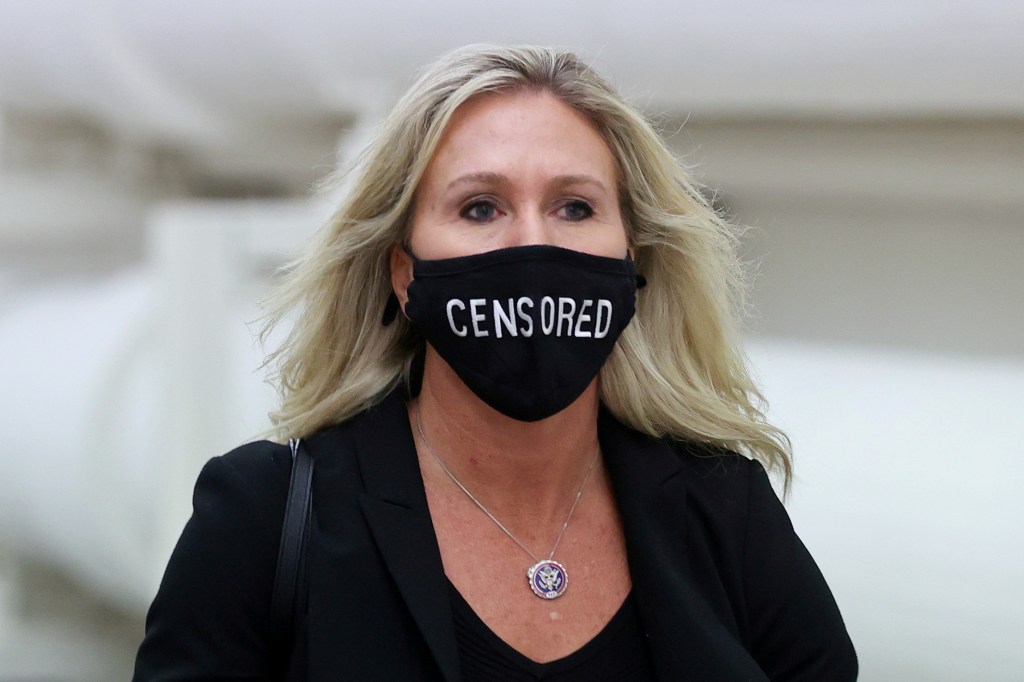




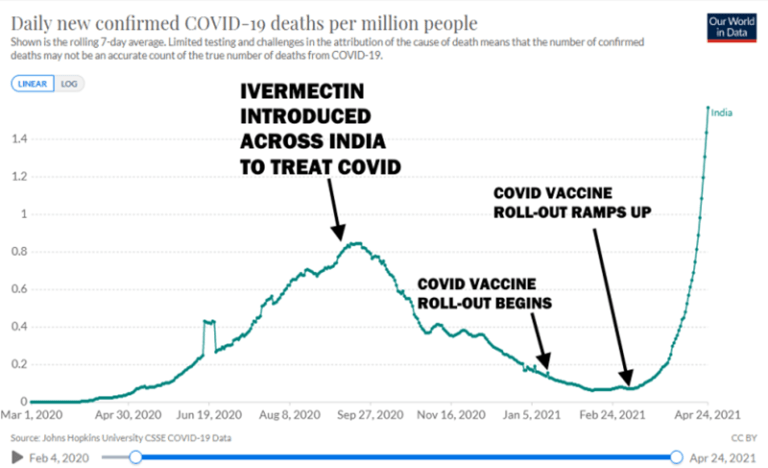



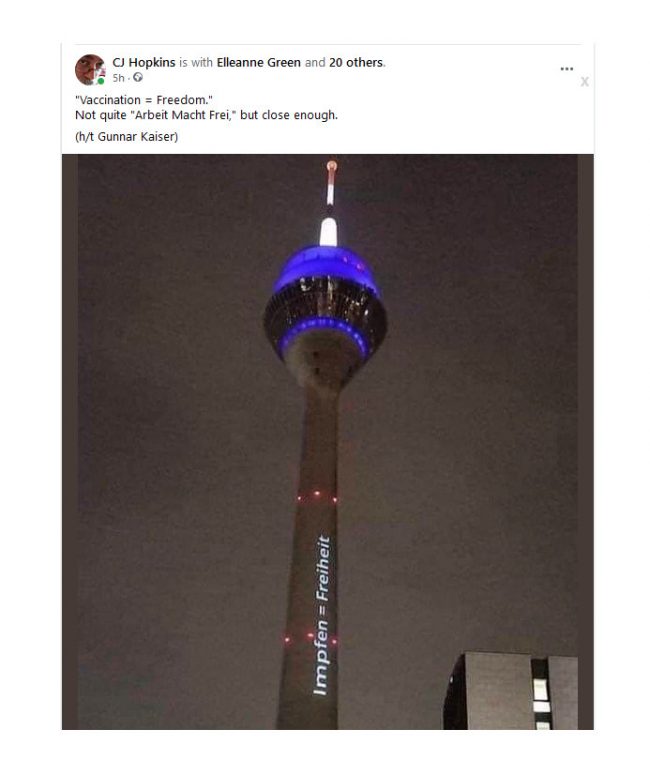
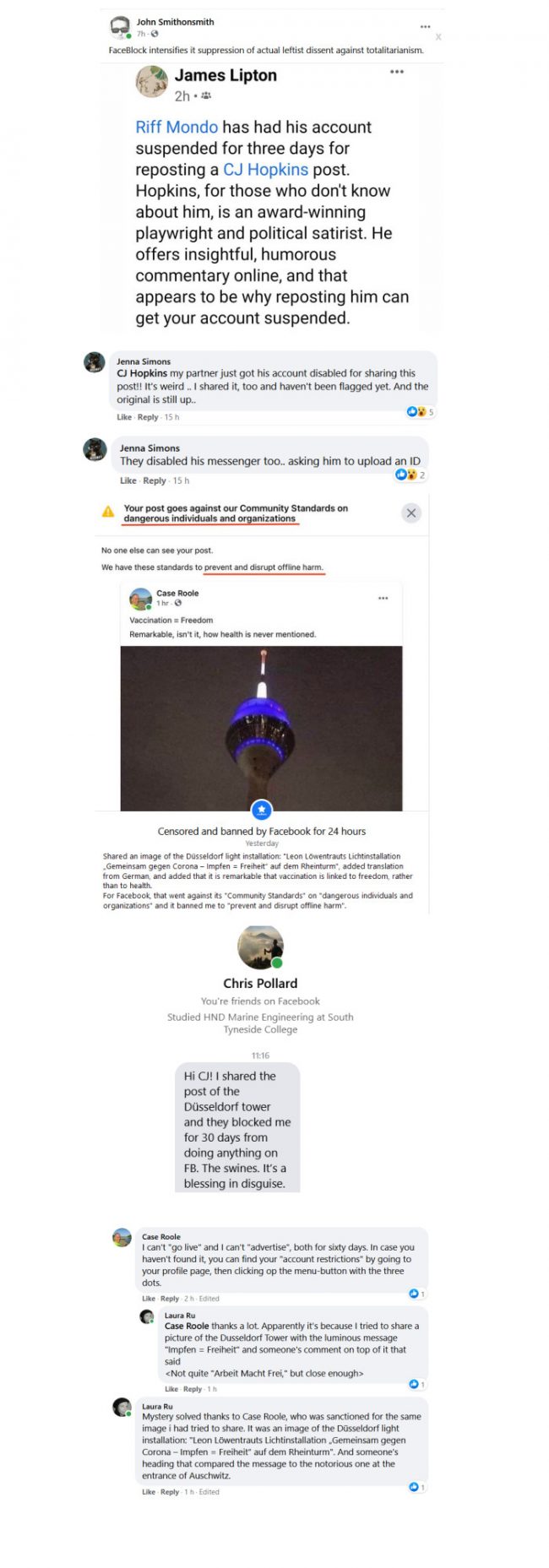

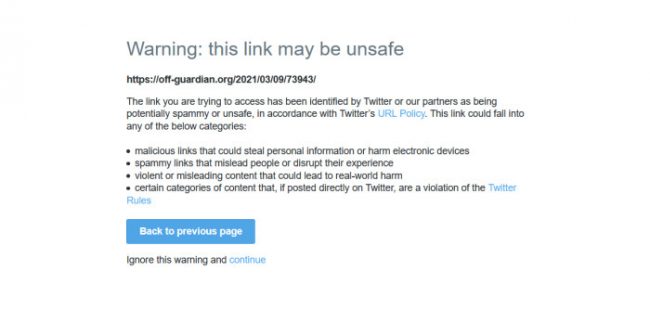


 After the Crash