Who Pressed the Great Reset Button?

By Dr. Joseph Mercola

Source: Global Research

What is this “Great Reset” we’re now hearing about? In a nutshell, the Great Reset refers to a global agenda to monitor and control the world through digital surveillance.

As explained by journalist James Corbett in his October 16, 2020, Corbett Report below,1 the Great Reset is a new “social contract” that ties every person to it through an electronic ID linked to your bank account and health records, and a social credit ID that will end up dictating every facet of your life.

It’s about “getting rid of capitalism” and free enterprise, and replacing them with so-called “sustainable development” and “stakeholder capitalism” — terms that belie their nefarious, anti-humanity intents. As noted in the book, “Technocracy: The Hard Road to World Order”:2

“… Sustainable Development is Technocracy … The Sustainable Development movement has taken careful steps to conceal its true identity, strategy and purpose, but once the veil is lifted, you will never see it any other way. Once its strategy is unmasked, everything else will start to make sense.”

The Grand Plan

In her blog post “The Great Reset for Dummies,” Tessa Lena summarizes the purpose behind the call for a global “reset”:3

“The mathematical reason for the Great Reset is that thanks to technology, the planet has gotten small, and the infinite expansion economic model is bust — but obviously, the super wealthy want to continue staying super wealthy, and so they need a miracle, another bubble, plus a surgically precise system for managing what they perceive as ‘their limited resources.’

Thus, they desperately want a bubble providing new growth out of thin air — literally — while simultaneously they seek to tighten the peasants’ belts, an effort that starts with ‘behavioral modification,’ a.k.a. resetting the western peasants’ sense of entitlement to high life standards and liberties (see awful ‘privilege’).

The psychological reason for the Great Reset is the fear of losing control of property, the planet. I suppose, if you own billions and move trillions, your perception of reality gets funky, and everything down below looks like an ant hill that exists for you. Just ants and numbers, your assets. Thus, the practical aim of the Great Reset is to fundamentally restructure the world’s economy and geopolitical relations based on two assumptions:

One, that every element of nature and every life form is a part of the global inventory (managed by the allegedly benevolent state, which, in turn, is owned by several suddenly benevolent wealthy people, via technology).

And two, that all inventory needs to be strictly accounted for: be registered in a central database, be readable by a scanner and easily ID’ed, and be managed by AI, using the latest ‘science.’

The goal is to count and then efficiently manage and control all resources, including people, on an unprecedented scale, with unprecedented digital … precision — all while the masters keep indulging, enjoying vast patches of conserved nature, free of unnecessary sovereign peasants and their unpredictability.”

Global Asset Reallocations Will Not Benefit ‘the People’

These new global “assets” can also be turned into brand new financial instruments that can then be traded. An example of this was given by Vandana Shiva, Ph.D., in my interview with her.

In it, she explained how India is headed toward Zero-Budget Natural Farming — a brand-new concept of farming in which farmers must trade the carbon rate in their soil on the global market if they want to make a living. They’ll get no money at all for the crops they actually grow.

There’s not a single area of life that is left out of this Great Reset plan. The planned reform will affect everything from government, energy and finance to food, medicine, real estate, policing and even how we interact with our fellow human beings in general.

Privacy protections, of course, are a major hurdle in this plan, which is why every effort is made to get people to loosen their views on the right for privacy. In the U.S., we also have the Constitution that stands in the way, which is why efforts to undermine, circumvent, ignore or nullify it are increasing.

“To sum it up, the desired end result is a giant, joyless, highly controlled global conveyor of everything and everybody where privacy is tremendously expensive, dissent is unthinkable, and spiritual submission is mandatory.

It’s like a 24/7 medicated reality, except the medications are both chemical and digital, and they are reporting you back to the mothership, which can then punish you for bad behavior by, say, blocking your access to certain places or by putting a hold on your digital bank account — perhaps without any human intervention at all,” Lena writes.4

Stakeholder Capitalism

An October 5, 2020, Winter Oak article5 addressed the “technocratic fascist vision” of professor Klaus Schwab, founder and executive chairman of the World Economic Forum who wrote the book on the Fourth Industrial Revolution. Schwab announced the World Economic Forum’s Great Reset Initiative in June 2020, which includes stripping all people of their privately owned assets.

In addition to being a staunch technocrat, Schwab also has a strong transhumanist bend, and he has spoken of a near future in which humans merge with machines and in which law enforcement will be able to read our mind.6

Winter Oak — a British nonprofit social justice organization — points out that Schwab and his globalist accomplices are using the COVID-19 pandemic “to bypass democratic accountability, to override opposition, to accelerate their agenda and to impose it on the rest of humankind against our will.”

Ultimately, the Great Reset will result in two tiers or people: The technocratic elite, who have all the power and rule over all assets, and the rest of humanity, who have no power, no assets and no say-so in anything.

This is no conspiracy theory. The plan is out in the open. As noted by Time magazine,7 “The COVID-19 pandemic has provided a unique opportunity to think about the kind of future we want.” The same statement has been delivered by a number of politicians and organizations around the world in recent months.

Schwab’s book,8,9 “COVID-19: The Great Reset” also urges industry leaders and decision makers to “make good use of the pandemic” and “not letting the crisis go to waste.” Incidentally, the owner of Time magazine and founder of Salesforce, Mark Benioff, is also a board member of the World Economic Forum,10 so he’s clearly familiar with the reset plan.

The problem is that while the plan is being sold as a way to, finally, make life fair and equitable for all people, the required sacrifices do not apply to the technocrats running the system. Ultimately, the Great Reset will result in two tiers or people: the technocratic elite, who have all the power and rule over all assets, and the rest of humanity, who have no power, no assets and no say-so in anything.

While technocracy is not a political system but an economic one, in practical terms it does resemble fascism. None of it is being sold under the banner of fascism, of course. Instead, they use financial terms like “stakeholder capitalism,” described by Forbes magazine11 as “the notion that a firm focuses on meeting the needs of all its stakeholders: customers, employees, partners, the community and society as a whole.”

In that same article, Forbes points out that this strategy has already been tried and failed. It failed because balancing conflicting stakeholder claims was near-impossible and only led to mass confusion and poor returns. The failure of this strategy is what led big businesses to focus on maximizing shareholder value instead.

Now, at a time when big business finds itself under attack for “single-mindedly shoveling money to its shareholders and its executives at the expense of customers, employees, the environment and society as a whole,” the answer, they say, is to return to stakeholder capitalism. But if it didn’t work before, what makes us think it will work now?

Great Reset Plan for Big Food

A November 9, 2020, article12 in The Defender, a new media platform by the Children’s Health Defense, also points out the problems with the World Economic Forum’s Great Reset plan for the food industry:

“The architects of the plan claim it will reduce food scarcity, hunger and disease, and even mitigate climate change. But a closer look at the corporations and think tanks the WEF is partnering with to usher in this global transformation suggests that the real motive is tighter corporate control over the food system by means of technological solutions.”

Aside from the food industry, partners13 include data mining giants, telecommunications, weapons manufacturers, finance, drug companies and the biotechnology industry.

Looking at that list, it should come as no surprise that the World Economic Forum insists the future of food and public health hinges on genetically modified organisms (GMOs), laboratory-grown protein, drugs and industrial chemicals.

The EAT Forum and the Rise of Food Imperialism

To further the fake food takeover, the World Economic Forum has partnered with the EAT Forum, which will set the political agenda for global food production. The EAT Forum was cofounded by the Wellcome Trust, which in turn was established with the financial help of GlaxoSmithKline.

EAT currently collaborates with nearly 40 city governments across Africa, Europe, Asia, North and South America and Australia, and maintains close relationships with imitation meat companies such as Impossible Foods, which was co-funded by Google, Jeff Bezos and Bill Gates.14

As noted by The Defender, the ultimate aim is to “replace wholesome nutritious foods with genetically modified lab creations.” To this end, EAT is working with the United Nations Children’s Fund (UNICEF) to establish global dietary guidelines and sustainable development initiatives.

The “Planetary Health Diet”15 developed by EAT is a diet that is supposed to replace all others. Federic Leroy, a food science and biotechnology professor at University of Brussels told The Defender:16

“The diet aims to cut the meat and dairy intake of the global population by as much as 90% in some cases and replaces it with lab-made foods, cereals and oil.”

Vandana Shiva, Ph.D., has raised harsh critique against the proposed diet saying it “is not about nutrition at all. It’s about big business and it’s about a corporate takeover of the food system.”17 The Defender adds:18

“According to EAT’s own reports, the big adjustments the organization and its corporate partners want to make to the food system are ‘unlikely to be successful if left up to the individual,’ and the changes they wish to impose on societal eating habits and food ‘require reframing at the systemic level with hard policy interventions that include laws, fiscal measures, subsidies and penalties, trade reconfiguration and other economic and structural measures.’

But Shiva said this is the wrong approach, because ‘all of the science’ shows that diets should be centered around regional and geographical biodiversity. She explained that ‘EAT’s uniform global diet will be produced with western technology and agricultural chemicals. Forcing this onto sovereign nations by multinational lobbying is what I refer to as food imperialism.’”

The Future of Food and Health Care

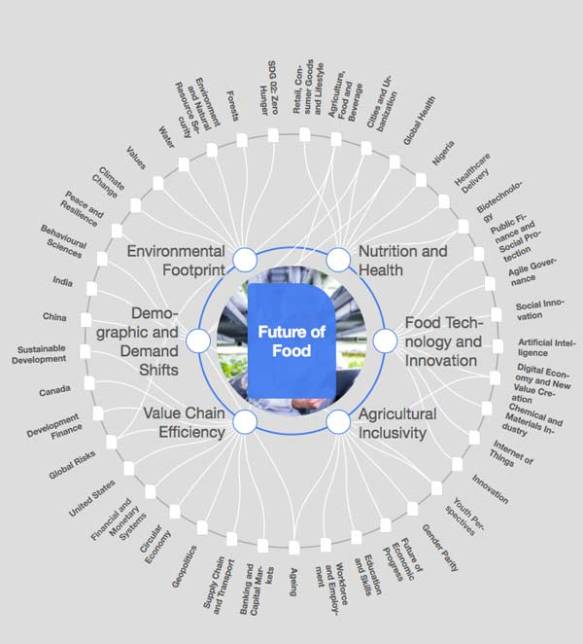
You can get a feel for where the future of food is headed by analyzing the World Economic Forum’s strategic intelligence map.19 As you can see, this top-down approach ties food production to a wide range of sectors, including biotech, the chemical industry, artificial intelligence, the internet of things and the digital economy.

For more details on Schwab and the World Economic Forum’s strategic intelligence plan, see Covert Geopolitic’s article,20 “Breaking Down the Global Elite’s Great Reset Master Plan.”
If any of this raises your concern, you’re probably not going to like what the World Health Economic Forum has in store for health care reform either. As detailed on their website:21

“Our current capital intensive, hospital-centric model is unsustainable and ineffective. The Platform for Shaping the Future of Health and Healthcare leverages a data-enabled delivery system and virtual care, integrated across the continuum of care from precision prevention to personalized care delivery …”

Aiding the World Economic Forum in this health care transformation are the biggest corporate criminals in the history of the modern world, including Bill Gates, AstraZeneca,22 Bayer,23 Johnson & Johnson,24 Merck,25 Pfizer,26 Novartis27 and a host of others.28

These companies have at various times been found guilty of all sorts of crimes that they have paid tens of billions of dollars in fines for. They are also loaded with conflicts of interest in nearly every venture they are involved with. Yet we’re now supposed to believe these companies are going to put aside their profit incentives and fix the whole system?

Build Back Better

As noted in a July 21, 2020, World Economic Forum article,29 the economic devastation caused by COVID-19 pandemic shutdowns “has the potential to hobble global prosperity for generations to come.” The answer is to come up with stimulus measures, such as infrastructure development, that can allow countries to move forward.

But while at it, countries are urged to make sure the economic system is “built back better.” Make no mistake, this catchy slogan is part and parcel of the Great Reset plan and cannot be separated from it, no matter how altruistic it may sound. As reported by Fox News:30

“A radical movement called the Great Reset embraced by some Democrats poses a grave threat to liberty and free markets in the United States and around the world … The Great Reset is perhaps the biggest danger to capitalism and individual rights since the collapse of the Soviet Union …

It would destroy the current capitalist system and replace it with progressive and modern socialist systems, with a special emphasis placed on eco-socialist policies … Policy ideas offered by ‘Great Reset’ advocates include government-provided basic income programs, universal health care, massive tax increases and the Green New Deal …

For example, at a campaign event on July 9, Biden said we need to end the ‘era of shareholder capitalism,’ a major part of the Great Reset proposal that would alter how companies are evaluated, elevating social justice causes and climate change concerns over property rights …

The Build Back Better plan comes straight from the Great Reset’s playbook … As recently as July 13, the World Economic Forum promoted ‘building back better’ through ‘green’ infrastructure programs as part of the Great Reset …”

Part of the “building back better” is to shift the financial system over to an all-digital currency system, which in turn is part of the system of social control, as it can easily be used to incentivize desired behaviors and discourage undesired ones.

An August 13, 2020, article31 on the Federal Reserve website discusses the supposed benefits of a central bank digital currency (CBDC). There’s general agreement among experts that most major countries will implement CBDC within the next two to four years.

Many uninformed people believe that these new CBDCs will be very similar to existing cryptocurrencies like Bitcoin, but they would be mistaken. Bitcoin is decentralized and a rational strategy to opt out of the existing central bank controlled system, while these CBDCs will be centralized and completely controlled by the central banks and will have smart contracts that allow the banks to surveil and control your life.

The Great Reset Psyops Guide

It goes without saying that to achieve the kind of radical transformation of every part of society has its challenges. No person in their right mind would agree to it if aware of the details of the whole plan. So, to roll this out, they had to use psychological manipulation, and fear is the most effective tool there is.

As explained by psychiatrist Dr. Peter Breggin, there’s an entire school of public health research that focuses on identifying the most effective ways to frighten people into accepting desired public health measures.

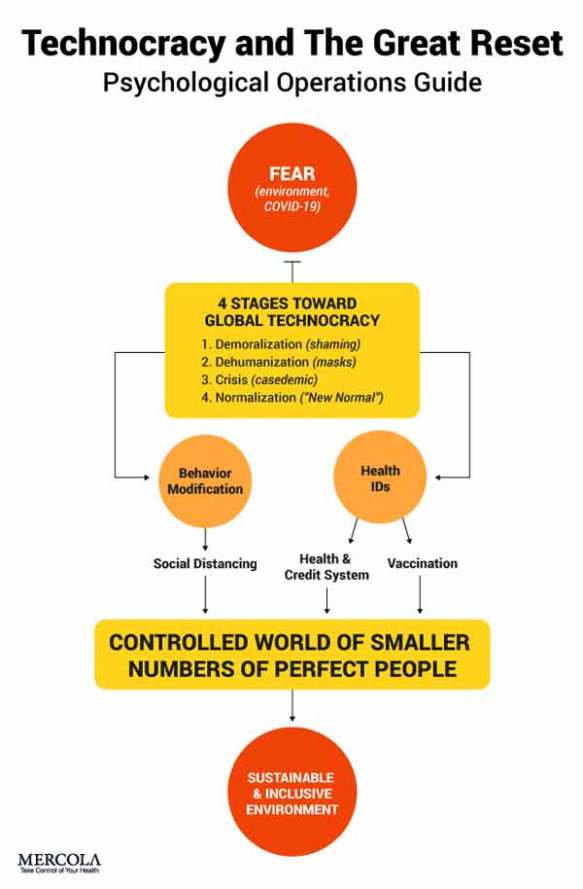
By adding confusion and uncertainty to the mix, you can bring an individual from fear to anxiety — a state of confusion in which you can no longer think logically — and in this state, you are more easily manipulated. The following graphic illustrates the central role of fearmongering for the successful rollout of the Great Reset.
Social Engineering Is Central to Technocratic Rule

In closing, keep in mind that technocracy is inherently a technological society run through social engineering. Fear is but one manipulation tool. The focus on “science” is another. Anytime someone dissents, they’re simply accused of being “anti-science,” and any science that conflicts with the status quo is declared “debunked science.”

The only science that matters is whatever the technocrats deem to be true, no matter how much evidence there is against it. We’ve seen this first hand during this pandemic, as Big Tech has censored and banned anything going against the opinions of the World Health Organization, which is just another cog in the technocratic machine.

If we allow this censorship to continue, the end result will be nothing short of devastating. We simply must keep pushing for transparency and truth. We must insist on medical freedom, personal liberty and the right to privacy.

One fight in particular that I don’t see us being able to evade is the fight against mandatory COVID-19 vaccinations. If we don’t take a firm stand against that and fight for the right to make our own choice, there will be no end to the medical tyranny that will follow. As noted in the Covert Geopolitics article:32

“As you might have guessed, ‘the most important anchor of recovery’ is for a COVID-19 vaccination … The implication is that without a vaccine the world will be unable to return to any sense of normality, particularly in terms of open interaction with your fellow man …

You can actually participate in the global efforts to cripple the Deep State organized criminal cabal’s ability for genocide, while enjoying healthcare freedom at the same time, by boycotting Big Pharma for good.”

*

Note to readers: please click the share buttons above or below. Forward this article to your email lists. Crosspost on your blog site, internet forums. etc.

Notes

1 Corbett Report October 16, 2020

2, 20, 32 Geopolitics August 29, 2020

3, 4 Tessa.substack.com October 28, 2020

5, 6 Winter Oak October 5, 2020

7 Time Magazine The Great Reset

8 COVID-19: The Great Reset

9 Steven Guiness September 3, 2020

10, 12, 14, 16, 17, 18 The Defender November 9, 2020

11 Forbes January 5, 2020

13, 28 Weforum.org Partners

15 Eatforum.com The Planetary Health Diet

19 World Economic Forum Strategic Intelligence Map, Future of Food

21 Weforum.org Shaping the Future and Health of Healthcare

22 Nordic Life Sciences October 14, 2014

23 Newspunch March 20, 2019

24 CBS News August 27, 2019

25 ABC.net.au August 20, 2005

26 Lawyers and Settlements Pfizer found guilty of Medicaid fraud

27 Medical Xpress July 2, 2020
29 World Economic Forum July 21, 2020

30 Fox News July 23, 2020

31 Federal Reserve August 13, 2020

Beware the Transhumanists: How ‘Being Human’ is being Re-engineered by the Elite’s Covid-19 Coup

By Robert J. Burrowes

“If you tell a lie, tell a big one.”
“If you tell a lie long enough, it becomes the truth.”
“Propaganda works best when those who are being manipulated are confident they are acting on their own free will.”
— Joseph Goebbels, Nazi Minister of Propaganda, 1933 to 1945

Transhumanism is a set of beliefs based on the premise that human beings can be improved by genetic manipulation and/or implanting technologies into the brain and body to achieve enhanced capacities. Transhumanism has a long history as an idea but since 1990 it has attracted serious attention from an increasing number of technology-lovers and early advocates are readily identified. See ‘What is Transhumanism?’

As part of his research as an investigative reporter throughout his life, which included writing a comprehensive exposé of how the AIDS hoax was perpetrated in the 1980s, in 2001 Jon Rappoport interviewed a Cold War-era propagandist-turned-anonymous-whistleblower who had spent decades working for the medical and other cartels to promote their agendas to gain increasing control over the human population. Here, in part, is what the propagandist told Rappoport:

Look at the medical cartel. Do they ever declare victory? From now until the end of time they’ll be planting stories in the press about the latest medical advance that will make life better for every person in the world. Most of it is a lie, but that doesn’t stop them. Until the planet is depopulated down to under a billion people and every one left is a robot, these cartels [elsewhere identified as energy, 
government, intelligence, media,
 medical, military,
 money] are not going to quit. And even then, with a lobotomized world, they’ll still push their propaganda. This IS 1984, and people better realize it… The medical cartel. They’re planning to take over the mind… after which PR won’t really matter.… [pp.61-62 & 87.]

The
 cartels 
were
 using 
and 
creating
 and
 bolstering 
the 
Cold 
War 
as 
a
 means 
to
 an
 end.

 Making
 what
 you
 could
 call 
the 
enemy‐game 
a
 part 
of 
the 
human 
psyche
 at
 such
 a
 level 
that 
it 
would 
maintain itself 
as 
a 
living 
myth
 that
 could
 be 
tapped 
into
 at
 any
 time
 with 
any 
enemies 
inserted 
into 
the 
line‐up.

 The 
enemies‐game 
is 
as 
old 
as
 time
 itself. 

But 
this 
was 
the 
version 
of 
the 
moment.

 To 
install
 a 
rigid 
sense 
of
 national 
security 
as 
the 
overriding 
fact or 
that 
would 
damn 
well justify
 the 
deflating
 of 
individual 
freedom 
on 
many 
fronts. 

Make
 national
 security
 the
 thing 
you
 couldn’t
 refuse….
 [p.70.]

A: 


Once
 you 
fatigue
 people
 enough 
with 
the
 strategies 
of 
1984, 
they 
are 
set 
up 
for
 the
 medicalization 
of 
society. 

Which 
is 
the 
brain 
stuff. 

The 
altering 
of 
the 
human
 brain
 with
 drugs 
and
 other 
approaches. 

Genes, 
perhaps. 

A 
brain‐machine
 linkup.

 Creating 
a 
different
 perception 
of 
reality. 

Externally 
applied
 electromagnetic 
fields.

 In 
which
 people
 will 
feel 
happy 
even
 though 
they 
are 
slaves.

 You
 see, 
in 
1984 
it’s really 
all 
about 
hysteria. 

The 
people 
are 
being
 driven
 into 
the 
wall 
with
 lies 
about
 wars 
and 
lies
 about 
enemies 
and 
lies 
about 
political 
structure, 
and
 the 
control 
over
 individuals 
is 
very 
harsh, 
and 
the 
leaders
 are
 not
 looking 
to 
create 
real 
happiness,
 not 
the 
fluffy 
stuff.

 Redemption,
 yes. 

Forgiveness, 
perhaps. 

The 
people 
are
 being
 fed 
pain 
and 
big 
brother 
is 
commanding
 them 
like 
a 
drill 
sergeant
 through 
their 
TV
 sets. But
 after 
that,
 after 
people 
sink 
into
 an
 acceptance 
of
 the 
delusions 
that
 are
 being 
foisted 
on 
them, 
then 
comes 
the 
science. 

The
 making
 of 
some
 kind 
of 
replica
  of
 happiness.

 The 
old
 order 
is
 1984. 

You
 can 
call 
that 
the
 Plan 
from
 the 
dawn
 of
 time
 to 
about 
1945. 

After 
that 
is 
the 
transition
 to 
Brave 
New
 World.

Q: 


And
 that’s 
why 
the 
medical 
cartel 
is 
the 
prince 
of 
the 
cartels.

A: 


The
 prince, 
the 
king.

Q:


 1984…

A: 


Leaves 
people 
with 
no 
moral
 conviction. 

It 
runs
 over
 that
 like 
a 
freight‐train.

 1984
 is 
dark. 

Brave 
New 
World 
is
 sunny 
and
 light 
and 
the 
control 
is
 applied
 so
 that
 the 
interior
 life 
changes.

Q: 


So
 you 
worked 
on 
medical 
stories.

A:


 Yes. 

Making 
the 
medical 
cartel
 look
 good, 
look
 humane,
 look 
rational, 
look
 like
 excellent 
science 
that 
works. 

Especially 
psychiatry
 and
 neurology.

 And
  pharmacology.

 That 
became 
a 
major 
job 
for 
me. Because…they’re 
experimenting
 on
 the 
human 
race, 
and 
they 
want
 their 
horrible 
mistakes 
which
 are
 legion,
 to
 look
 like
 advances
 and 
good
 science
 at 
every 
step
 until 
they
 get 
it 
right,
 until 
they
 have 
your
 brain 
in 
their 
hands 
from
 cradle 
to 
grave. [p.71.]

As noted earlier, the words above were penned in 2001. If you would like to read the full transcript of the interview, which offers a reasonably accurate explanation of what is happening around the world at the moment, you can do so in ‘The Matrix Revealed Volume 1, Jon Rappoport Interviews Ellis Medavoy (Part 1 of 3)’.

And if you would like to read about the AIDS hoax (‘caused’ by the non-existent HIV) and how it was done, using much of the same formula being used to perpetrate the elite’s Covid-19 hoax (‘caused’ by the non-existent SARS-CoV-2), you can do so in AIDS Inc.: Scandal of the Century.

Unfortunately, the Covid-19 hoax is being played for stakes that are infinitely higher than they were during the AIDS hoax.

After 200,000 years of Homo Sapiens, the species is about to ‘evolve’ rapidly and profoundly. But it won’t be a natural evolution. And it won’t be an improvement unless you don’t like the many qualities that make humans human, biologically and socially.

If the transhumanists have their way, individual human identity will vanish along with human volition. Homo Sapiens will be superseded by ‘Homo Cyborg’.

If this all sounds like science fiction or just plain ridiculous, let me invite you to consider the evidence below.

As ‘warned’ by scientist Andrew Herr in an article – see ‘This Scientist Wants Tomorrow’s Troops to Be Mutant-Powered’ – published in 2012:

Greater strength and endurance. Enhanced thinking. Better teamwork. New classes of genetic weaponry, able to subvert DNA. Not long from now, the technology could exist to routinely enhance – and undermine – people’s minds and bodies using a wide range of chemical, neurological, genetic and behavioral techniques.

It’s warfare waged at the evolutionary level. And it’s coming sooner than many people think.

Well, that time has arrived. The thin edge of the wedge, if we keep allowing it to happen, is the various restrictions and technologies being introduced under cover of Covid-19 which are supposedly being used to tackle the ‘virus’.

However, just as in the ‘AIDS epidemic’ when no (HIV) virus was ever scientifically demonstrated to exist, there is zero science to prove the existence of the ‘virus’ labeled SARS-CoV-2. Instead, this elite coup is designed and being conducted to achieve a profound transformation in the nature of the human individual and human society, including a substantial ‘depopulation’. Moreover, it is proceeding rapidly because it entails a complexity and depth that is not easy to comprehend but also because it seems so preposterous that few people are inclined to contemplate the possibility objectively. Joseph Goebbels knew why. For some of the detail of essential elements of this coup, see ‘Covid-19 Does Not Exist: The Global Elite’s Campaign of Terror Against Humanity’ and ‘Halting our Descent into Tyranny: Defeating the Global Elite’s Covid-19 Coup’.

But for another recent comprehensive history and critique of the coup being conducted by the ‘billionaire’s club’, see Dr. Jacob Nordangård’s insightful article ‘Analysis: Globalists’ reboot of the world and their plans for us’ which opens with the following words:

The Corona crisis is the trigger for a global coup d’état of monumental dimensions. It is the beginning of a new era, with a new international economic order that risks completely destroying human freedoms. Tyrants have now taken over to forcibly steer us into a ‘climate smart’ and ‘healthy’ world through the World Economic Forum’s new techno-totalitarian roadmap – ‘The Great Reset’.

In this article, however, I want to focus on the agenda of the transhumanists under cover of this coup and what this would mean for Homo Sapiens unless it is stopped.

Technotyranny

In one of his videos about the Covid-19 coup – watch ‘This Couldn’t Possibly Happen. Could it?’ the transcript for which can be accessed by clicking the ‘Health’ tab after entering his website – the UK’s Dr Vernon Coleman explains the sinister agenda of the technological control sought by the transhumanists:

If you were a mad doctor and you wanted to control an individual it would be a doddle.
You’d just tell them you were giving them an injection to protect them against the flu or something like that and in the syringe there would be a little receiver. And then you’d stick a transmitter on the roof of the house across the road from where they lived.

And then you could send messages to make them do whatever you wanted them to do. You could make them sad or angry or happy or contented. You could make them run or fight or just spend all day in bed.

Remember, that’s what Dr Delgado was doing over half a century ago. It’s nothing new.

Of course, if you wanted to do the same thing for lots of people you’d need a whole lot of people to help you….

And you’d need something to inject into people. A medicine of some kind for example.

And then you’d need someone good at software to help with all the transmitting and the receiving and you’d need people with access to lots of tall poles or roofs where they could put the transmitter things.

But none of that would be any good unless you had a reason for injecting people. You can’t just go around injecting millions of people for no reason.

Ideally, you’d need them all to be frightened of something so that they were keen to let you inject them. And then you could put your tiny receivers into the stuff that was being injected. Or squirted up their noses or whatever.

Introducing her own careful explanation of the agenda of the transhumanists, in her video Dr. Carrie Madej opens with the following words:

So what do you think about going from human 1.0 to human 2.0?… Transhumanism… is about taking humans, as we know ourselves, and melding with artificial intelligence…. That might seem kinda cool to you, we might have some superhuman abilities… that’s the idea, that’s what you see in sci-fi movies… Thinking about this topic… I [had thought that it was] many years in the future.

However, this question, this idea is now right in this moment. We need to make a decision… because I investigated the proposed Covid-19 vaccine and this is my alarm call to the world. I looked at the pros and cons and it frightens me.

And I want you to know about this, you need to be very well informed because this new vaccine is not like your normal flu vaccine. This is something very different, this is something brand new, something completely experimental on the human race. And it’s not just about being a different vaccine. There are technologies that are being introduced with this vaccine that can change the way we live, who we are and what we are. And very quickly….

Some people… like Elon Musk, who is the founder of SpaceX and Tesla Automotive, as well as Ray Kurzweil, who is one of the bigwigs of Google, … are self-proclaimed ‘transhumanists’. They believe that we should go to human 2.0 and they are very big proponents of this. There’s a lot of other people… involved with this…. I think the easiest way to explain this to you is to go with one of the frontrunners for the vaccine and go into a little bit of the history and tell you how they want to make the vaccine and I think that will speak volumes. So, for instance, Moderna is one of the frontrunners for the Covid-19 vaccine…. Watch ‘Human 2.0 – Transhumanist Vaccine – A Wake Up Call to the World’.

If you doubt the capacity of ‘medicine’ to achieve this level of human transformation, in this video produced in August 2020, transhumanist Elon Musk explains how his Neuralink microchip will be surgically implanted into the human brain, as has already been done with animals. While he specifically mentions the chip’s capacity to monitor certain health parameters and to play you music, he does not mention its intended uses for digitization of your identity, recording of your personal data such as medical and bank records, any of its surveillance functions or its capacity for emotional, thought and behavioural control. Watch ‘This Is How Elon Musk’s Neuralink Microchip Will Be Put In Your Brain’.

As Raul Diego explains in his own article on this subject:

The most significant scientific discovery since gravity has been hiding in plain sight for nearly a decade and its destructive potential to humanity is so enormous that the biggest war machine on the planet immediately deployed its vast resources to possess and control it, financing its research and development through agencies like the National Institutes of Health (NIH), the Defense Advanced Research Projects Agency (DARPA) and HHS’ Biomedical Advanced Research and Development Authority (BARDA).

The revolutionary breakthrough… [involved devising] a way to ‘reprogram’ the molecules that carry the genetic instructions for cell development in the human body, not to mention all biological lifeforms.

These molecules are called ‘messenger ribonucleic acid’ or mRNA and the newfound ability to rewrite those instructions to produce any kind of cell within a biological organism has radically changed the course of Western medicine and science, even if no one has really noticed yet. As [inventor, Professor Derek] Rossi, himself, puts it: ‘The real important discovery here was you could now use mRNA, and if you got it into the cells, then you could get the mRNA to express any protein in the cells, and this was the big thing.’ See ‘A Transhumanist Dream: A DARPA-Funded Implantable Biochip to Detect COVID-19 Could Hit Markets by 2021’.

Moreover, as Patrick Wood, who has intensively studied and reported the efforts of the transhumanists for decades, explains in a recent article – ‘The Siamese Twins of Technocracy and Transhumanism’ – and discusses in a related video – ‘Humans 2.0: GMO Vaccinations and Transhumanism’ – that draws out some of the more nuanced elements of their agenda:

Technocracy and Transhumanism have always been joined at the hip. Technocracy uses its ‘science of social engineering’ to merge technology and society. Transhumanism uses its field of NBIC to merge technology directly into humans. To put it another way, Technocracy is to society what Transhumanism is to the humans that live in it….

NBIC stands for Nano (nano-technology), Bio (bio-technology), Info (information technology) and Cogno (cognitive sciences). These four scientific disciplines remained separate avenues of study in Universities around the world until the early 1970s. Today, NBIC has become an established discipline of its own in most major universities with personnel contributed from each separate department….

All together, NBIC offers a scientific cauldron to Transhumans in their quest to create Humans 2.0….

It’s also no wonder that the upcoming vaccine for COVID-19 being produced by Moderna is also using NBIC science to accomplish a merging of the human body with advanced technology. The Trump Administration has contracted with Moderna – see ‘Trump Administration collaborates with Moderna to produce 100 million doses of COVID-19 investigational vaccine’ – to deliver 100 million doses of its investigational vaccine, ostensibly to be kitted and transported to the nation by the U.S. Military….

[Technocracy and Transhumanism are both] extremely dangerous for all of humankind and must be rejected before it is too late to stop them.

And Whitney Webb provides further insight into the elite intention in this regard. In one of her meticulously-researched articles – ‘Coronavirus Gives a Dangerous Boost to DARPA’s Darkest Agenda’ – she outlines the hidden technological agenda behind the Covid-19 coup that might well be delivered as part of any vaccination program by the Pentagon’s Defense Advanced Research Projects Agency (DARPA). After carefully outlining the history and ‘logic’ of what is taking place – such as the development of ‘cyborg “super soldiers”’ and ‘injectable Brain Machine Interfaces (BMIs) with the capability to control one’s thoughts’ – she concludes with the chilling words:

Technology developed by the Pentagon’s controversial research branch is getting a huge boost amid the current coronavirus crisis, with little attention going to the agency’s ulterior motives for developing said technologies, their potential for weaponization or their unintended consequences.…

Those who are fearful and desperate will not care that the vaccine may include nanotechnology or have the potential to genetically modify and re-program their very being, as they will only want the current crisis that has upended the world to stop.

In this context, the current coronavirus crisis appears to be the perfect storm that will allow DARPA’s dystopian vision to take hold and burst forth from the darkest recesses of the Pentagon into full public view. DARPA’s transhumanist vision for the military and for humanity presents an unprecedented threat, not just to human freedom, but an existential threat to human existence and the building blocks of biology itself.

Of course, if you want to read how involved corporations, DARPA and other elite agencies explain it, you can do so. But unless you dig beneath the surface you will only get their sanitized accounts which, just like Elon Musk, focus on seemingly benign elements like ‘digitized identity’ and health reporting while not mentioning the technology’s capacities and intended uses for the invasion of your privacy, the recording of your personal data such as medical and bank records, any of its surveillance functions or its capacity for emotional, thought and behavioural control. See, for example, ‘Moderna’s mRNA Technology’, ‘Profusa is pioneering tissue-integrating biosensors for continuous monitoring of body chemistries’, ‘A Military-Funded Biosensor Could Be the Future of Pandemic Detection’ (which discusses the role of ‘hydrogel’) and DARPA’S ‘Developing novel, safe and efficacious treatments for COVID-19’ following its much earlier ‘In Vivo Nanoplatforms (IVN)’. For two elite presentations of the importance of your ‘digital identity’, see ‘The Need for Good Digital ID is Universal’ and ‘ID2020 and partners launch program to provide digital ID with vaccines’.

What is at Stake?

As discussed above, the technology now available after decades of effort enables receiver nanochips to be sprayed, injected or otherwise implanted into human bodies. With the ongoing deployment of 5G (which includes extensive space and ground-based technologies: see ‘Deadly Rainbow: Will 5G Precipitate the Extinction of All Life on Earth?’), just one outcome of these combined technologies is that it will be possible to direct the individual behaviour of each person so implanted. Given that the control technology will be owned by corporate executives, here is a list of examples of how the elite might direct that it be used (more or less as a ‘drone pilot’ sitting in the United States controls a drone flying in the Middle East that fires weapons on local people):

  1. The official chain of command to launch nuclear weapons can be subverted by using remote control to direct the chosen individual in a particular chain of command to order (or execute) the launch of one or more nuclear weapons at the target(s) nominated at the time(s) specified. Subordinates can be directed to follow orders they might otherwise question.
  2. ‘Cyborg soldiers’ (either as mercenaries or as members of national military forces) in groups or as individuals can be deployed anywhere to fight as ordered by those in charge of their remote controls.
  3. ‘Cyborg workers’ can be directed to work in dangerous conditions for extended periods and simply be replaced as required. Someone else nearby will have been vaccinated too and can be directed to take their place.
  4. ‘Cyborg consumers’ can be directed to purchase a particular product, irrespective of its functionality, including health or otherwise, for the person so directed. That is assuming that money is not just taken directly from their bank account, given that it will no longer be under their exclusive control.
  5. ‘Cyborg activists’ on any issue can simply to be directed to refrain from further involvement in their campaign. Or to actively take the opposite position to the one they had previously.

What can we do to halt this transhumanist agenda and the elite coup itself?

Fortunately, we can do a great deal.

For a detailed series of options on how to have strategic impact, see the end of the article ‘“Ye are Many, They are Few”: Nonviolent Resistance to the Elite’s Covid-19 Coup’.

Importantly, however, if you would like to be part of the campaign to defeat the elite coup and prevent implementation of the transhumanist agenda, see the list of strategic goals necessary to achieve these outcomes here: Coup Strategic Aims.

If you wish to nurture children to be far more able to critique society and elite propaganda, rather than be easily duped, see ‘My Promise to Children’.

If you wish to reduce your vulnerability to elite control, consider joining those who recognize the critical importance of reduced consumption and greater self-reliance by participating in ‘The Flame Tree Project to Save Life on Earth’. In addition, you are welcome to consider signing the online pledge of ‘The People’s Charter to Create a Nonviolent World’.

Finally, if you want a better fundamental understanding of how we reached this point, see ‘Why Violence?’, ‘Fearless Psychology and Fearful Psychology: Principles and Practice’ and ‘The Global Elite is Insane Revisited’.

Conclusion

In the elegant words of South African liberation activist Steve Biko:

The most potent weapon of the oppressor is the mind of the oppressed.

When he uttered these words before being tortured to death in an Apartheid prison, Biko presumably did not realize the profound meaning they would acquire in 2020.

The transhuman mind will be owned and controlled by the oppressor.

If we are to avert this fate, we must struggle with clarity and purpose.


Biodata: Robert J. Burrowes has a lifetime commitment to understanding and ending human violence. He has done extensive research since 1966 in an effort to understand why human beings are violent and has been a nonviolent activist since 1981. He is the author of Why Violence? His email address is flametree@riseup.net and his website is here.

Was the COVID-19 virus genetically engineered?

By Claire Robinson

Source: GM Watch

Since the COVID-19 pandemic took off, speculation has been rife about its origins. The truth is that nobody knows for certain how the virus first took hold. But despite that uncertainty, suggestions that the virus may have been genetically engineered, or otherwise lab-generated, have been rejected as “conspiracy theories” incompatible with the evidence.

Yet the main evidence that is cited as ending all speculation about the role of genetic engineering and as proving the virus could only have been the product of natural evolution turns out to be surprisingly weak. Let’s take a look at it.

The authors of a recently published paper in the journal Nature Medicine argue that the SARS-CoV-2 virus driving the pandemic arose through natural mutation and selection in animal (notably bats and pangolins) or human hosts, and not through laboratory manipulation and accidental release. And they say they have identified two key characteristics of the virus that prove this: the absence of a previously used virus backbone and the way in which the virus binds to human cells.

Not the “ideal” design for infectivity?

As you would expect of a virus that can cause a global pandemic, SARS-CoV-2 is good at infecting human cells. It does this by binding with high affinity (that is, it binds strongly) to the cell surface membrane protein known as angiotensin-converting enzyme 2 (ACE2), which enables it to enter human cells. But, basing their argument on a computer modelling system, the authors of the Nature Medicine paper argue that the interaction between the virus and the ACE2 receptor is “not ideal”.

They say that the receptor-binding domain (RBD) amino acid sequence of the SARS-CoV-2 spike protein – the part of the spike protein that allows the virus to bind to the ACE2 protein on human cell surfaces – is different from those shown in the SARS-CoV family of viruses to be optimal for receptor binding.

They appear to argue, based on their and others’ computer modelling data, that they have identified the “ideal” CoV spike protein RBD amino acid sequence for ACE2 receptor binding. They then seem to imply that if you were to genetically engineer SARS-CoV for optimal human ACE2 binding and infectivity, you would use the RBD amino acid sequence predicted by their computer modelling. But they point out that SARS-CoV-2 does not have exactly the same computer program-predicted RBD amino acid sequence. Thus they conclude that it could not have been genetically engineered, stating: “This is strong evidence that SARS-CoV-2 is not the product of purposeful manipulation.”

To put it simply, the authors are saying that SARS-CoV-2 was not deliberately engineered because if it were, it would have been designed differently.

However, the London-based molecular geneticist Dr Michael Antoniou commented that this line of reasoning fails to take into account that there are a number of laboratory-based systems that can select for high affinity RBD variants that are able to take into account the complex environment of a living organism. This complex environment may impact the efficiency with which the SARS-CoV spike protein can find the ACE2 receptor and bind to it. An RBD selected via these more realistic real-world experimental systems would be just as “ideal”, or even more so, for human ACE2 binding than any RBD that a computer model could predict. And crucially, it would likely be different in amino acid sequence. So the fact that SARS-CoV-2 doesn’t have the same RBD amino acid sequence as the one that the computer program predicted in no way rules out the possibility that it was genetically engineered.

Limits to computer modelling

Dr Antoniou said that the authors’ reasoning is not conclusive because it is based largely on computer modelling, which, he says, is “not definitive but only predictive. It cannot tell us whether any given virus would be optimized for infectivity in a real world scenario, such as in the human body. That’s because the environment of the human body will influence how the virus interacts with the receptor. You can’t model that accurately with computer modelling as there are simply too many variables to factor into the equation.”

Dr Antoniou added, “People can put too much faith in computer programs, but they are only a beginning. You then have to prove whether the computer program’s prediction is correct or not by direct experimentation in a living organism. This has not been done in the case of this hypothesis, so it remains unproven.”

It is even possible that SARS-CoV-2 was optimized using a living organism model, resulting in a virus that is better at infecting humans than any computer model could predict.

More than one way to engineer a virus

The authors of the Nature Medicine article seem to assume that the only way to genetically engineer a virus is to take an already known virus and then engineer it to have the new properties you want. On this premise, they looked for evidence of an already known virus that could have been used in the engineering of SARS-CoV-2.

And they failed to find that evidence. They stated, “Genetic data irrefutably show that SARS-CoV-2 is not derived from any previously used virus backbone.”

But Dr Antoniou told us that while the authors did indeed show that SARS-CoV-2 was unlikely to have been built by deliberate genetic engineering from a previously used virus backbone, that’s not the only way of constructing a virus. There is another method by which an enhanced-infectivity virus can be engineered in the lab.

A well-known alternative

A well-known alternative process that could have been used has the cumbersome name of “directed iterative evolutionary selection process”. In this case, it would involve using genetic engineering to generate a large number of randomly mutated versions of the SARS-CoV spike protein receptor binding domain (RBD), which would then be selected for strong binding to the ACE2 receptor and consequently high infectivity of human cells.

This selection can be done either with purified proteins or, better still, with a mixture of whole coronavirus (CoV) preparations and human cells in tissue culture. Alternatively, the SARS-CoV spike protein variants can be genetically engineered within what is known as a “phage display library”. A phage is a virus that infects bacteria and can be genetically engineered to express on its exterior coat the CoV spike protein with a large number of variants of the RBD. This preparation of phage, displaying on its surface a “library” of CoV spike protein variants, is then added to human cells under laboratory culture conditions in order to select for those that bind to the ACE2 receptor.

This process is repeated under more and more stringent binding conditions until CoV spike protein variants with a high binding affinity are isolated.

Once any of the above selection procedures for high affinity interaction of SARS-CoV spike protein with ACE2 has been completed, then whole infectious CoV with these properties can be manufactured.

Such a directed iterative evolutionary selection process is a frequently used method in laboratory research. So there is little or no possibility that the Nature Medicine article authors haven’t heard of it – not least, as it is considered so scientifically important that its inventors were awarded the Nobel Prize in Chemistry in 2018.

Yet the possibility that this is the way that SARS-CoV-2 arose is not addressed by the Nature Medicine article authors and so its use has not been disproven.

No proof SARS-CoV-2 was not genetically engineered

In sum, the Nature Medicine article authors offer no evidence that the SARS-CoV-2 virus could not have been genetically engineered. That’s not to say that it was, of course. We can’t know one way or the other on the basis of currently available information.

Dr Antoniou wrote a short letter to Nature Medicine to point out these omissions in the authors’ case. Nature Medicine has no method of submitting a simple letter to the editor, so Dr Antoniou had to submit it as a Matters Arising commentary, which the journal defines as presenting “challenges or clarifications” to an original published work.

Dr Antoniou’s comments were titled, “SARS-CoV-2 could have been created through laboratory manipulation”. However, Nature Medicine refused to publish them on the grounds that “we do not feel that they advance or clarify understanding” of the original article. The journal offered no scientific argument to rebut his points.

In our view, those points do offer clarification to the original article, and what’s more, there is a strong public interest case for making them public. That’s why we reproduce Dr Antoniou’s letter below this article, with his permission.

Not genetic engineering – but human intervention

There is, incidentally, another possible way that SARS-CoV-2 could have been developed in a laboratory, but in this case without using genetic engineering. This was pointed out by Nikolai Petrovsky, a researcher at the College of Medicine and Public Health at Flinders University in South Australia. Petrovsky says that coronaviruses can be cultured in lab dishes with cells that have the human ACE2 receptor. Over time, the virus will gain adaptations that let it efficiently bind to those receptors. Along the way, that virus would pick up random genetic mutations that pop up but don’t do anything noticeable.

“The result of these experiments is a virus that is highly virulent in humans but is sufficiently different that it no longer resembles the original bat virus,” Petrovsky said. “Because the mutations are acquired randomly by selection, there is no signature of a human gene jockey, but this is clearly a virus still created by human intervention.”

Dr Antoniou agrees that this method is possible – but he points out that waiting for nature to produce the desired mutations is a lot slower than using genetic engineering to generate a large number of random mutations that you can then select for the desired outcome by a directed iterative evolutionary procedure.

Because genetic engineering greatly speeds up the process, it is by far the most efficient way to generate novel pathogenic viruses in the lab.

Vested interests?

So why do some experts – and non-experts for that matter – seem so determined to put a stop to any speculation about whether SARS-CoV-2 could have been genetically engineered?

One explanation might be fear of a backlash against such research from the victims of the pandemic. Virologists, for example, who may want as much freedom as possible to study and manipulate viruses in their labs, won’t want their research restricted because of public concern. Others using genetic engineering in their work may also fear it will damage the general reputation of the technology and encourage tighter regulation.

And if concerns that SARS-CoV-2 may have been developed in a lab were to gain traction, the consequences in such a heavily commercialised area as biotechnology might not just be reputational but also financial.

In this context it is worth noting that one of the authors of the Nature Medicine piece is Robert F. Garry, who lists his “competing interest” as being “co-founder of Zalgen Labs, a biotechnology company that develops countermeasures to emerging viruses”. Heavier restrictions on genetic engineering or laboratory virus research might be considered counter to the interests of Zalgen Labs.

Conclusion

It is clear that there is no conclusive evidence either way at this point as to whether SARS-CoV-2 arose by natural mutation and selection in animal and/or human hosts or was genetically engineered in a laboratory. And in this light, the question of where this virus came from should continue to be explored with an open mind.


SARS-CoV-2 could have been created through laboratory manipulation

Dr Michael Antoniou

Kristian Anderson and colleagues (“The proximal origin of SARS-CoV-2”, Nature Medicine, 26: 450–452, 2020) argue that their amino acid sequence comparisons and computational modelling definitively proves that SARS-CoV-2 has arisen through natural mutation and selection in animal or human hosts, and not through laboratory manipulation and accidental release. However, although the authors may indeed be correct in how they perceive SARS-CoV-2 to have arisen, the data they present does not exclude the possibility that this new coronavirus variant could have been created through an in vitro, directed iterative evolutionary selection process (see https://en.wikipedia.org/wiki/Directed_evolution). Using this method, a very large library of randomly mutagenized coronavirus spike proteins could be selected for strong binding to the ACE2 receptor and consequently high infectivity of human cells. The power of such directed evolution to select for optimal enzymatic and protein-protein interactions was acknowledged by the award of the Nobel Prize in Chemistry in 2018 (see https://www.nobelprize.org/prizes/chemistry/2018/summary/).

Orwellian Lockstep and a Loaded Syringe

By Colin Todhunter

Source: Dissident Voice

Some years ago, the then vice-president of Monsanto Robert T Fraley asked, “Why do people doubt science”. He posed the question partly because he had difficulty in believing that some people had valid concerns about the use of genetically modified organisms (GMOs) in agriculture.

Critics were questioning the science behind GM technology and the impacts of GMOs because they could see how science is used, corrupted and manipulated by powerful corporations to serve their own ends. And it was also because they regard these conglomerates as largely unaccountable and unregulated.

We need look no further than the current coronavirus issue to understand how vested interests are set to profit by spinning the crisis a certain way and how questionable science is being used to pursue policies that are essentially illogical or ‘unscientific’. Politicians refer to ‘science’ and expect the public to defer to the authority of science without questioning the legitimacy of scientific modelling or data.

Although this legitimacy is being questioned on various levels, arguments challenging the official line are being sidelined. Governments, the police and the corporate media have become the arbiters of truth even if ‘the truth’ does not correspond with expert opinion or rational thought which challenges the mainstream narrative.

For instance, testing for coronavirus could be flawed (producing a majority of ‘false positives’) and the processes involved in determining death rates could be inflating the numbers: for example, dying ‘with’ coronavirus’ is different to dying ‘due to’ coronavirus: a serious distinction given that up to 98 per cent of people (according to official sources) who may be dying with it have at least one serious life-threatening condition. Moreover, the case-fatality ratio could be so low as to make the lockdown response appear wholly disproportionate. Yet we are asked to accept statistics at face value – and by implication, the policies based on them.

Indeed, documentary maker and author David Cayley addresses this last point by saying that modern society is hyper-scientific but radically unscientific as it has no standard against which it can measure or assess what it has done: that we must at all costs ‘save lives’ is not questioned, but this makes it very easy to start a stampede. Making an entire country go home and stay home has immense, incalculable costs in terms of well-being and livelihoods. Cayley argues that this itself has created a pervasive sense of panic and crisis and is largely a result of the measures taken against the pandemic and not of the pandemic itself.

He argues that the declaration by the World Health Organization that a pandemic (at the time based on a suspected 150 deaths globally) was now officially in progress did not change anyone’s health status, but it dramatically changed the public atmosphere. Moreover, the measures mandated have involved a remarkable curtailing of civil liberty.

One of the hallmarks of the current situation, he stresses, is that some think that ‘science’ knows more than it does and therefore they – especially politicians – know more than they do. Although certain epidemiologists may say frankly that there is very little sturdy evidence to base policies on, this has not prevented politicians from acting as if everything they say or do is based on solid science.

The current paradigm – with its rhetoric of physical distancing, flattening the curve and saving lives – could be difficult to escape from. Cayley says either we call it off soon and face the possibility that it was all misguided (referring to the policies adopted in Sweden to make his point), or we extend it and create harms that may be worse than the casualties we may have averted.

The lockdown may not be merited if we were to genuinely adopt a knowledge-based approach. For instance, if we look at early projections by Neil Ferguson of Imperial College in the UK, he had grossly overstated the number of possible deaths resulting from the coronavirus and has now backtracked substantially. Ferguson has a chequered track record, which led UK newspaper The Telegraph to run a piece entitled ‘How accurate was the science that led to lockdown?’ The article outlines Ferguson’s previous flawed predictions about infectious diseases and a number of experts raise serious questions about the modelling that led to lockdown in the UK.

It is worth noting that the lockdown policies we now see are remarkably similar to the disturbing Orwellian ‘Lock Step’ future scenario that was set out in 2010 by the Rockefeller Foundation report ‘Scenarios for the Future of Technology and International Development’. The report foresaw a future situation where freedoms are curtailed and draconian high-tech surveillance measures are rolled out under the ongoing pretexts of impending pandemics. Is this the type of technology use we can expect to see as hundreds of millions are marginalized and pushed into joblessness?

Instead of encouraging more diverse, informed and objective opinions in the mainstream, we too often see money and power forcing the issue, not least in the form of Bill Gates who tells the world ‘normality’ may not return for another 18 months – until he and his close associates in the pharmaceuticals industry find a vaccine and we are all vaccinated.

US attorney Robert F Kennedy Jr says that top Trump advisor Stephen Fauci has made the reckless choice to fast track vaccines, partially funded by Gates, without critical animal studies. Gates is so worried about the danger of adverse events that he says vaccines shouldn’t be distributed until governments agree to indemnity against lawsuits.

But this should come as little surprise. Kennedy notes that the Gates Foundation and its global vaccine agenda already has much to answer for. For example, Indian doctors blame the Gates Foundation for paralysing 490,000 children. And in 2009, the Gates Foundation funded tests of experimental vaccines, developed by Glaxo Smith Kline (GSK) and Merck, on 23,000 girls. About 1,200 suffered severe side effects and seven died. Indian government investigations charged that Gates-funded researchers committed pervasive ethical violations.

Kennedy adds that in 2010 the Gates Foundation funded a trial of GSK’s experimental malaria vaccine, killing 151 African infants and causing serious adverse effects to 1,048 of the 5,949 children. In 2002, Gates’ operatives forcibly vaccinated thousands of African children against meningitis. Approximately 50 of the 500 children vaccinated developed paralysis.

Bill Gates committed $10 billion to the WHO in 2010. In 2014, Kenya’s Catholic Doctors Association accused the WHO of chemically sterilising millions of unwilling Kenyan women with a  ‘tetanus’ vaccine campaign. Independent labs found a sterility formula in every vaccine tested.

Instead of prioritising projects that are proven to curb infectious diseases and improve health — clean water, hygiene, nutrition and economic development — the Gates Foundation spends only about $650 million of its $5 billion budget on these areas.

Despite all of this, Gates appears on prime-time TV news shows in the US and the UK pushing his undemocratic and unaccountable pro-big pharma vaccination and surveillance agendas and is afforded deference by presenters who dare not mention any of what Kennedy outlines. Quite the opposite – he is treated like royalty.

In the meantime, an open Letter from Dr. Sucharit Bhakdi, emeritus professor of medical microbiology at the Johannes Gutenberg University Mainz, to Angela Merkel has called for an urgent reassessment of Germany’s lockdown. Dr Ioannidis, a professor of medicine and professor of epidemiology and population health at Stanford University, argues that we have made such decisions on the basis of unreliable data. In addition, numerous articles have recently appeared online which present the views of dozens of experts who question policies and the data being cited about the coronavirus.

While it is not the intention to dismiss the dangers of Covid-19, responses to those dangers must be proportionate to actual risks. And perspective is everything.

Millions die each year due to unnecessary conflicts, malnutrition and hunger, a range of preventative diseases (often far outweighing the apparent impact of Covid-19), environmental pollution and economic plunder which deprives poor countries of their natural wealth. Neoliberal reforms have pushed millions of farmers and poor people in India and elsewhere to the brink of joblessness and despair, while our food is being contaminated with toxic chemicals and the global ecosystem faces an apocalyptic breakdown.

Much of the above is being driven by an inherently predatory economic system and facilitated by those who now say they want to ‘save lives’ by implementing devastating lockdowns. Yet, for the media and the political class, the public’s attention should not be allowed to dwell on such things.

And that has easily been taken care of.

In the UK, the population is constantly subjected via their TV screens to clap for NHS workers, support the NHS and to stay home and save lives on the basis of questionable data and policies. It’s emotive stuff taking place under a ruling Conservative Party that has cut thousands of hospital beds, frozen staff pay and demonised junior doctors.

As people passively accept the stripping of their fundamental rights, Lionel Shriver, writing in The Spectator, says that the supine capitulation to a de facto police state has been one of the most depressing spectacles he has ever witnessed.

It’s a point of view that will resonate with many.

In the meantime, Bill Gates awaits as the saviour of humanity — with a loaded syringe.

Toxic Agriculture and the Gates Foundation

By Colin Todhunter

Source: Dissident Voice

The Bill and Melinda Gates Foundation was launched in 2000 and has $46.8 billion in assets (December 2018). It is the largest charitable foundation in the world and distributes more aid for global health than any government. One of the foundation’s stated goals is to globally enhance healthcare and reduce extreme poverty.

The Gates Foundation is a major funder of the CGIAR system (formerly the Consultative Group for International Agricultural Research) — a global partnership whose stated aim is to strive for a food-secured future. Its research is aimed at reducing rural poverty, increasing food security, improving human health and nutrition and ensuring sustainable management of natural resources.

In 2016, the Gates Foundation was accused of dangerously and unaccountably distorting the direction of international development. The charges were laid out in a report by Global Justice Now: ‘Gated Development – Is the Gates Foundation always a force for good?‘ According to the report, the foundation’s strategy is based on deepening the role of multinational companies in the Global South.

On release of the report, Polly Jones, the head of campaigns and policy at Global Justice Now, said:

The Gates Foundation has rapidly become the most influential actor in the world of global health and agricultural policies, but there’s no oversight or accountability in how that influence is managed.

She added that this concentration of power and influence is even more problematic when you consider that the philanthropic vision of the Gates Foundation seems to be largely based on the values of ‘corporate America’:

The foundation is relentlessly promoting big business-based initiatives such as industrial agriculture, private health care and education. But these are all potentially exacerbating the problems of poverty and lack of access to basic resources that the foundation is supposed to be alleviating.

The report’s author, Mark Curtis, outlines the foundation’s promotion of industrial agriculture across Africa, which would undermine existing sustainable, small-scale farming that is providing the vast majority of food across the continent.

Curtis describes how the foundation is working with US agri-commodity trader Cargill in an $8 million project to “develop the soya value chain” in southern Africa. Cargill is the biggest global player in the production of and trade in soya with heavy investments in South America where GM soya monocrops (and associated agrochemicals) have displaced rural populations and caused health problems and environmental damage.

According to Curtis, the Gates-funded project will likely enable Cargill to capture a hitherto untapped African soya market and eventually introduce GM soya onto the continent. The Gates foundation is also supporting projects involving other chemical and seed corporations, including DuPont, Syngenta and Bayer. It is effectively promoting a model of industrial agriculture, the increasing use of agrochemicals and patented seeds, the privatisation of extension services and a very large focus on genetically modified crops.

What the Gates Foundation is doing is part of the Alliance for a Green Revolution in Africa (AGRA) initiative, which is based on the premise that hunger and malnutrition in Africa are mainly the result of a lack of technology and functioning markets. Curtis says AGRA has been intervening directly in the formulation of African governments’ agricultural policies on issues like seeds and land, opening up African markets to US agribusiness.

More than 80% of Africa’s seed supply comes from millions of small-scale farmers recycling and exchanging seed from year to year. But AGRA is promoting the commercial production of seed and is thus supporting the introduction of commercial (chemical-dependent) seed systems, which risk enabling a few large companies to control seed research and development, production and distribution.

The report notes that over the past two decades a long and slow process of national seed law reviews, sponsored by USAID and the G8 along with Bill Gates and others, has opened the door to multinational corporations’ involvement in seed production, including the acquisition of every sizeable seed enterprise on the African continent.

Gates, pesticides and global health

The Gates Foundation is also very active in the area of health, which is ironic given its promotion of industrial agriculture and its reliance on health-damaging agrochemicals. This is something that has not been lost on environmentalist Dr Rosemary Mason.

Mason notes that the Gates Foundation is a heavy pusher of agrochemicals and patented seeds. She adds that the Gates Foundation is also reported to be collaborating in Bayer’s promotion of “new chemical approaches” and “biological crop protection” (i.e. encouraging agrochemical sales and GM crops) in the Global South.

After having read the recent ‘A Future for the World’s Children? A WHO-UNICEF-Lancet Commission’, Mason noticed that pesticides were conspicuous by their absence and therefore decided to write to Professor Anthony Costello, director of the UCL Institute for Global Health, who is the lead author of the report.

In her open 19-page letter, ‘Why Don’t Pesticides Feature in the WHO-UNICEF-Lancet Commission?’, she notes in the Costello-led report that there is much talk about greater regulation of marketing of tobacco, alcohol, formula milk and sugar-sweetened beverages but no mention of pesticides.

But perhaps this should come as little surprise: some 42 authors’ names are attached to the report and Mason says that in one way or another via the organisations they belong to, many (if not most) have received funding from the Bill and Melinda Gates Foundation. The Gates Foundation is a prominent funder of the World Health Organization and UNICEF. Gates has been the largest or second largest contributor to the WHO’s budget in recent years. His foundation provided 11% of the WHO’s entire budget in 2015, which is 14 times greater than the UK government’s contribution.

Perhaps this sheds some light on to why a major report on child health would omit the effects of pesticides. Mason implies this is a serious omission given what the UN expert on toxics  Baskut Tuncak said in a November 2017 article in the Guardian:

Our children are growing up exposed to a toxic cocktail of weedkillers, insecticides, and fungicides. It’s on their food and in their water, and it’s even doused over their parks and playgrounds. Many governments insist that our standards of protection from these pesticides are strong enough. But as a scientist and a lawyer who specialises in chemicals and their potential impact on people’s fundamental rights, I beg to differ. Last month it was revealed that in recommending that glyphosate – the world’s most widely-used pesticide – was safe, the EU’s food safety watchdog copied and pasted pages of a report directly from Monsanto, the pesticide’s manufacturer. Revelations like these are simply shocking.

Mason notes that in February 2020, Tuncak rejected the idea that the risks posed by highly hazardous pesticides could be managed safely. He told Unearthed (GreenPeace UK’s journalism website) that there is nothing sustainable about the widespread use of highly hazardous pesticides for agriculture. Whether they poison workers, extinguish biodiversity, persist in the environment or accumulate in a mother’s breast milk, Tuncak argued that these are unsustainable, cannot be used safely and should have been phased out of use long ago.

In his 2017 article, he stated:

The UN Convention on the Rights of the Child, the most ratified international human rights treaty in the world (only the US is not a party), makes it clear that states have an explicit obligation to protect children from exposure to toxic chemicals, from contaminated food and polluted water, and to ensure that every child can realise their right to the highest attainable standard of health. These and many other rights of the child are abused by the current pesticide regime. These chemicals are everywhere and they are invisible.

Tuncak added that paediatricians have referred to childhood exposure to pesticides as creating a “silent pandemic” of disease and disability. He noted that exposure in pregnancy and childhood is linked to birth defects, diabetes, and cancer and stated that children are particularly vulnerable to these toxic chemicals: increasing evidence shows that even at ‘low’ doses of childhood exposure, irreversible health impacts can result.

He concluded that the overwhelming reliance of regulators on industry-funded studies, the exclusion of independent science from assessments and the confidentiality of studies relied upon by authorities must change.

However, it seems that the profits of agrochemical manufacturers trump the rights of  children and the public at large: a joint investigation by Unearthed and the NGO Public Eye has found the world’s five biggest pesticide manufacturers are making more than a third of their income from leading products, chemicals that pose serious hazards to human health and the environment.

Mason refers to an analysis of a huge database of 2018’s top-selling ‘crop protection products’ which revealed the world’s leading agrochemical companies made more than 35% of their sales from pesticides classed as “highly hazardous” to people, animals or ecosystems. The investigation identified billions of dollars of income for agrochemical giants BASF, Bayer, Corteva, FMC and Syngenta from chemicals found by regulatory authorities to pose health hazards like cancer or reproductive failure.

This investigation is based on an analysis of a huge dataset of pesticide sales from the agribusiness intelligence company Phillips McDougall. This firm conducts detailed market research all over the world and sells databases and intelligence to pesticide companies. The data covers around 40% of the $57.6bn global market for agricultural pesticides in 2018. It focuses on 43 countries, which between them represent more than 90% of the global pesticide market by value.

While Bill Gates promotes a chemical-intensive model of agriculture that dovetails with the needs and value chains of agri-food conglomerates, Mason outlines the spiraling rates of disease in the UK and the US and lays the blame at the door of the agrochemical corporations that Gates has opted to get into bed with. She focuses on the impact of glyphosate-based herbicides as well as the cocktail of chemicals sprayed on crops.

Mason has discussed the health-related impacts of glyphosate in numerous previous reports and in her open letter to Costello again refers to peer-reviewed studies and official statistics which indicate that glyphosate affects the gut microbiome and is responsible for a global metabolic health crisis provoked by an obesity epidemic. Moreover, she presents evidence that glyphosate causes epigenetic changes in humans and animals – diseases skip a generation then appear.

However, the mainstream narrative is to blame individuals for their ailments and conditions which are said to result from ‘lifestyle choices’. Yet Monsanto’s German owner Bayer has confirmed that more than 42,700 people have filed suits against Monsanto alleging that exposure to Roundup herbicide caused them or their loved ones to develop non-Hodgkin lymphoma and that Monsanto covered up the risks.

Mason says that each year there are steady increases in the numbers of new cancers and increases in deaths from the same cancers, with no treatments making any difference to the numbers; at the same time, she argues, these treatments maximise the bottom line of the drug companies while the impacts of agrochemicals remains conspicuously absent from the disease narrative.

She states that we are exposed to a lifetime’s exposure to thousands of synthetic chemicals that contaminate the blood and urine of nearly every person tested – “a global mass poisoning.”

Gates Foundation in perspective

As part of its hegemonic strategy, the Gates Foundation says it wants to ensure global food security and optimise health and nutrition.

However, Rosemary Mason alludes to the fact that the Gates Foundation seems happy to ignore the deleterious health impacts of agrochemicals while promoting the interests of the firms that produce them, but it facilitates many health programmes that help boost the bottom line of drug companies.  Health and health programmes seem only to be defined with certain parameters which facilitate the selling of the products of the major pharmaceutical companies which the foundation partners with. Indeed, researcher Jacob Levich argues that the Gates Foundation not merely facilitates unethical low-cost clinical trials (with often devastating effects for participants) in the Global South but also assists in the creating new markets for the “dubious” products of pharmaceuticals corporations.

As for food security, the foundation would do better by supporting agroecological  (agrochemical-free) approaches to agriculture, which various high-level UN reports have advocated for ensuring equitable global food security. But this would leave smallholder agriculture both intact and independent from Western agro-capital, something which runs counter to the underlying aims of the corporations that the foundation supports – dispossession and market dependency.

And these aims have been part of a decades-long strategy where we have seen the strengthening of an emerging global food regime based on agro-export mono-cropping linked to sovereign debt repayment and World Bank/IMF ‘structural adjustment’ directives. The outcomes have included a displacement of a food-producing peasantry, the consolidation of Western agri-food oligopolies and the transformation of many countries from food self-sufficiency into food deficit areas.

While Bill Gates is busy supporting the consolidation of Western agro-capital in Africa under the guise of ensuring ‘food security’, it is very convenient for him to ignore the fact that at the time of decolonisation in the 1960s Africa was not just self-sufficient in food but was actually a net food exporter with exports averaging 1.3 million tons a year between 1966-70. The continent now imports 25% of its food, with almost every country being a net food importer. More generally, developing countries produced a billion-dollar yearly surplus in the 1970s but by 2004 were importing US$ 11 billion a year.

The Gates Foundation promotes a (heavily subsidised and inefficient – certainly when the externalised health, social and environment costs are factored in) corporate-industrial farming system and the strengthening of a global neoliberal, fossil-fuel-dependent food regime that by its very nature fuels and thrives on, among other things, unjust trade policies, population displacement and land dispossession (something which the Gates Foundation once called for but euphemistically termed “land mobility”), commodity monocropping, soil and environmental degradation, illness, nutrient-deficient diets, a narrowing of the range of food crops, water shortages, pollution and the eradication of biodiversity.

At the same time, the foundation is helping powerful corporate interests to appropriate and commodify knowledge. For instance, since 2003, CGIAR (mentioned at the start of this article) and its 15 centres have received more than $720 million from the Gates Foundation. In a June 2016 article in The Asian Age, Vandana Shiva says the centres are accelerating the transfer of research and seeds to corporations, facilitating intellectual property piracy and seed monopolies created through IP laws and seed regulations.

Besides taking control of the seeds of farmers in CGIAR seed banks, Shiva adds that the Gates Foundation (along with the Rockefeller Foundation) is investing heavily in collecting seeds from across the world and storing them in a facility in Svalbard in the Arctic — the ‘doomsday vault’.

The foundation is also funding Diversity Seek (DivSeek), a global initiative to take patents on the seed collections through genomic mapping. Seven million crop accessions are in public seed banks.

Shiva says that DivSeek could allow five corporations to own this diversity and argues:

Today, biopiracy is carried out through the convergence of information technology and biotechnology. It is done by taking patents by ‘mapping’ genomes and genome sequences… DivSeek is a global project launched in 2015 to map the genetic data of the peasant diversity of seeds held in gene banks. It robs the peasants of their seeds and knowledge, it robs the seed of its integrity and diversity, its evolutionary history, its link to the soil and reduces it to ‘code’. It is an extractive project to ‘mine’ the data in the seed to ‘censor’ out the commons.

She notes that the peasants who evolved this diversity have no place in DivSeek — their knowledge is being mined and not recognised, honoured or conserved: an enclosure of the genetic commons.

This process is the very foundation of capitalism – appropriation of the commons (seeds, water, knowledge, land, etc.), which are then made artificially scarce and transformed into marketable commodities.

The Gates Foundation talks about health but facilitates the roll-out of a toxic form of agriculture whose agrochemicals cause immense damage. It talks of alleviating poverty and malnutrition and tackling food insecurity but it bolsters an inherently unjust global food regime which is responsible for perpetuating food insecurity, population displacement, land dispossession, privatisation of the commons and neoliberal policies that remove support from the vulnerable and marginalised, while providing lavish subsidies to corporations.

The Gates Foundation is part of the problem, not the solution. To more fully appreciate this, let us turn to a February 2020 article in the journal Globalizations. Its author, Ashok Kumbamu, argues that the ultimate aim of promoting new technologies – whether GM seeds, agrochemicals or commodified knowledge — on a colossal scale is to make agricultural inputs and outputs essential commodities, create dependency and bring all farming operations into the capitalist fold.

To properly understand Bill Gates’s ‘philanthropy’ is not to take stated goals and objectives at face value but to regard his ideology as an attempt to manufacture consent and prevent and marginalise more radical agrarian change that would challenge prevailing power structures and act as impediments to capitalist interests. The foundation’s activities must be located within the hegemonic and dispossessive strategies of imperialism: displacement of the peasantry and subjugating those who remain in agriculture to the needs of global distribution and supply chains dominated by the Western agri-food conglomerates whose interests the Gates Foundation facilitates and legitimises.


The full text of Rosemary Mason’s 19-page document (with relevant references) — ‘Why Don’t Pesticides Feature in the WHO-UNICEF-Lancet Commission?’ — can be accessed via the academia.edu website)  

Offering Choice but Delivering Tyranny: The Corporate Capture of Agriculture

By Colin Todhunter

Source: Off-Guardian

Many lobbyists talk a lot about critics of genetic engineering technology denying choice to farmers. They say that farmers should have access to a range of tools and technologies to maximise choice and options.

At the same time, somewhat ironically, they decry organic agriculture and proven agroecological approaches, presumably because these practices have no need for the proprietary inputs of the global agrochemical/agritech corporations they are in bed with.

And presumably because agroecology represents liberation from the tyranny of these profiteering, environment-damaging global conglomerates.

It is fine to talk about ‘choice’ but we do not want to end up offering a false choice (rolling out technologies that have little value and only serve to benefit those who control the technology), to unleash an innovation that has an adverse impact on others or to manipulate a situation whereby only one option is available because other options have been deliberately removed. And we would certainly not wish to roll out a technology that traps farmers on a treadmill that they find difficult to get off.

Surely, a responsible approach for rolling out important (potentially transformative) technologies would have to consider associated risks, including social, economic and health impacts.

Take the impact of the Green Revolution in India, for instance. Sold on the promise that hybrid seeds and associated chemical inputs would enhance food security on the basis of higher productivity, agriculture was transformed, especially in Punjab. But to gain access to seeds and chemicals many farmers had to take out loans and debt became (and remains) a constant worry.

Many became impoverished and social relations within rural communities were radically altered: previously, farmers would save and exchange seeds but now they became dependent on unscrupulous money lenders, banks and seed manufacturers and suppliers. Vandana Shiva in The Violence of the Green Revolution (1989) describes the social marginalisation and violence that accompanied the process.

On a macro level, the Green Revolution conveniently became tied to an international (neo-colonial) system of trade based on chemical-dependent agro-export mono-cropping linked to loans, sovereign debt repayment and World Bank/IMF structural adjustment (privatisation/deregulation) directives.

Many countries in the Global South were deliberately turned into food deficit regions, dependent on (US) agricultural imports and strings-attached aid.

The process led to the massive displacement of the peasantry and, according to the academics Eric Holt-Giménez et al, (Food rebellions: Crisis and the hunger for Justice, 2009), the consolidation of the global agri-food oligopolies and a shift in the global flow of food: developing countries produced a billion-dollar yearly surplus in the 1970s; they were importing $11 billion a year by 2004.

And it’s not as though the Green Revolution delivered on its promises.

In India, it merely led to more wheat in the diet, while food productivity per capita showed no increased or even actually decreased (see New Histories of the Green Revolution by Glenn Stone). And, as described by Bhaskar Save in his open letter (2006) to officials, it had dire consequences for diets, the environment, farming, health and rural communities.

The ethics of the Green Revolution – at least it was rolled out with little consideration for these impacts – leave much to be desired.

As the push to drive GM crops into India’s fields continues (the second coming of the green revolution – the gene revolution), we should therefore take heed. To date, the track record of GMOs is unimpressive, but the adverse effects on many smallholder farmers are already apparent (see Hybrid Bt cotton: a stranglehold on subsistence farmers in India by A P Gutierrez).

Aside from looking at the consequences of technology roll outs, we should, when discussing choice, also account for the procedures and decisions that were made which resulted in technologies coming to market in the first place.

Steven Druker, in his book Altered Genes, Twisted Truth, argues that the decision to commercialise GM seeds and food in the US amounted to a subversion of processes put in place to serve the public interest.

The result has been a technology roll out which could result (is resulting) in fundamental changes to the genetic core of the world’s food. This decision ultimately benefited Monsanto’s bottom line and helped the US gain further leverage over global agriculture.

We must therefore put glib talk of the denial of technology by critics to one side if we are to engage in a proper discussion of choice. Any such discussion would account for the nature of the global food system and the dynamics and policies that shape it. This would include looking at how global corporations have captured the policy agenda for agriculture, including key national and international policy-making bodies, and the role of the WTO and World Bank.

Choice is also about the options that could be made available, but which have been closed off or are not even considered. In Ethiopia, for example, agroecology has been scaled up across the entire Tigray region, partly due to enlightened political leaders and the commitment of key institutions.

However, in places where global agribusiness/agritech corporations have leveraged themselves into strategic positions, their interests prevail. From the false narrative that industrial agriculture is necessary to feed the world to providing lavish research grants and the capture of important policy-making institutions, these firms have secured a thick legitimacy within policymakers’ mindsets and mainstream discourse.

As a result, agroecological approaches are marginalised and receive scant attention and support.

Monsanto had a leading role in drafting the WTO Agreement on Trade-Related Aspects of Intellectual Property Rights to create seed monopolies. The global food processing industry wrote the WTO Agreement on the Application of Sanitary and Phytosanitary Measures.

Whether it involves Codex or the US-India Knowledge Initiative on Agriculture aimed at restructuring (destroying) Indian agriculture, the powerful agribusiness/food lobby has secured privileged access to policy makers and sets the policy agenda.

From the World Bank’s ‘enabling the business of agriculture’ to the Gates Foundation’s role in opening up African agriculture to global food and agribusiness oligopolies, democratic procedures at sovereign state levels are being bypassed to impose seed monopolies and proprietary inputs on farmers and to incorporate them into a global supply chain dominated by powerful corporations.

We have the destruction of indigenous farming in Africa as well as the ongoing dismantling of Indian agriculture and the deliberate impoverishment of Indian farmers at the behest of transnational agribusiness. Where is the democratic ‘choice’?

It has been usurped by corporate-driven Word Bank bondage (India is its biggest debtor in the bank’s history) and by a trade deal with the US that sacrificed Indian farmers for the sake of developing its nuclear sector.

Similarly, ‘aid’ packages for Ukraine – on the back of a US-supported coup – are contingent on Western corporations taking over strategic aspects of the economy. And agribusiness interests are at the forefront. Something which neoliberal apologists are silent on as they propagandise about choice, and democracy.

Ukraine’s agriculture sector is being opened up to Monsanto/Bayer. Iraq’s seed laws were changed to facilitate the entry of Monsanto.

India’s edible oils sector was undermined to facilitate the entry of Cargill. And Bayer’s hand is possibly behind the ongoing strategy to commercialise GM mustard in India. Whether on the back of militarism, secretive trade deals or strings-attached loans, global food and agribusiness conglomerates secure their interests and have scant regard for choice or democracy.

The ongoing aim is to displace localised, indigenous methods of food production and allow transnational companies to take over, tying farmers and regions to a system of globalised production and supply chains dominated by large agribusiness and retail interests. Global corporations with the backing of their host states, are taking over food and agriculture nation by nation.

Many government officials, the media and opinion leaders take this process as a given. They also accept that (corrupt) profit-driven transnational corporations have a legitimate claim to be owners and custodians of natural assets (the ‘commons’).

There is the premise that water, seeds, food, soil and agriculture should be handed over to these conglomerates to milk for profit, under the pretence these entities are somehow serving the needs of humanity.

Ripping land from peasants and displacing highly diverse and productive smallholder agriculture, rolling out very profitable but damaging technologies, externalising the huge social, environmental and health costs of the prevailing neoliberal food system and entire nations being subjected to the policies outlined above: how is any of it serving the needs of humanity?

It is not. Food is becoming denutrified, unhealthy and poisoned with chemicals and diets are becoming less diverse. There is a loss of plant and insect diversity, which threatens food security, soils are being degraded, water tables polluted and depleted and millions of smallholder farmers, so vital to global food production, are being pushed into debt in places like India and squeezed off their land and out of farming.

It is time to place natural assets under local ownership and to develop them in the public interest according to agroecological principles. This involves looking beyond the industrial yield-output paradigm and adopting a systems approach to food and agriculture that accounts for local food security and sovereignty, cropping patterns to ensure diverse nutrition production per acre, water table stability and good soil structure. It also involves pushing back against the large corporations that hold sway over the global food system and more generally challenging the leverage that private capital has over all our lives.

That’s how you ensure liberation from tyranny and support genuine choice.


Colin Todhunter is an independent journalist who writes on development, environmental issues, politics, food and agriculture. He was named in August 2018 by Transcend Media Services as one of 400 Living Peace and Justice Leaders and Models in recognition of his journalism. 

How GMO Seeds and Monsanto/Bayer’s “RoundUp” are Driving US Policy in Venezuela

Hugo Chavez and Luiz Inacio Lula da Silva visit a soy farm in El Tigre in Venezuela’s Anzoategui state, Oct. 30, 2009. Ariana Cubillos | AP

With Juan Guaidó’s parallel government attempting to take power with the backing of the U.S., it is telling that the top political donors of those in the U.S. most fervently pushing regime change in Venezuela have close ties to Monsanto and major financial stakes in Bayer.

By Whitney Webb

Source: MintPress News

As the political crisis in Venezuela has unfolded, much has been said about the Trump administration’s clear interest in the privatization and exploitation of Venezuela’s oil reserves, the largest in the world, by American oil giants like Chevron and ExxonMobil.

Yet the influence of another notorious American company, Monsanto — now a subsidiary of Bayer — has gone largely unmentioned.

While numerous other Latin American nations have become a “free for all” for the biotech company and its affiliates, Venezuela has been one of the few countries to fight Monsanto and other international agrochemical giants and win. However, since that victory — which was won under Chavista rule — the U.S.-backed Venezuelan opposition has been working to undo it.

Now, with Juan Guaidó’s parallel government attempting to take power with the backing of the U.S., it is telling that the top political donors of those in the U.S. most fervently pushing regime change in Venezuela have close ties to Monsanto and major financial stakes in Bayer.

In recent months, Monsanto’s most controversial and notorious product — the pesticide glyphosate, branded as Roundup, and linked to cancer in recent U.S. court rulings — has threatened Bayer’s financial future as never before, with a litany of new court cases barking at Bayer’s door. It appears that many of the forces in the U.S. now seeking to overthrow the Venezuelan government are hoping that a new Guaidó-led government will provide Bayer with a fresh, much-needed market for its agrochemicals and transgenic seeds, particularly those products that now face bans in countries all over the world, including once-defoliated and still-poisoned Vietnam.


U.S.-Backed Venezuelan opposition seeks to reverse Chavista seed law and GMO ban

In 2004, then-president of Venezuela, Hugo Chávez, surprised many when he announced the cancellation of Monsanto’s plans to plant 500,000 acres of Venezuelan agricultural land in genetically modified (GM) soybeans. The cancellation of Monsanto’s Venezuela contract led to what became an ad hoc ban on all GM seeds in the entire country, a move that was praised by local farmer groups and environmental activists. In contrast to anti-GM movements that have sprung up in other countries, Venezuela’s resistance to GM crops was based more on concerns about the country’s food sovereignty and protecting the livelihoods of farmers.

Although the ban has failed to keep GM products out of Venezuela — as Venezuela has long imported a majority of its food, much of it originating in countries that are among the world’s largest producers of genetically modified foods — one clear effect has been preventing companies like Monsanto and other major agrochemical and seed companies from gaining any significant foothold in the Venezuelan market.

In 2013, a new seed law was nearly passed that would have allowed GM seeds to be sold in Venezuela through a legal loophole. That law, which was authored by a member of the Chavista United Socialist Party of Venezuela (PSUV), was widely protested by farmers, indigenous activists, environmentalists, and eco-socialist groups, which led to the law’s transformation into what has been nicknamed the “People’s Seed Law.” That law, passed in 2015, went even farther than the original 2004 ban by banning not just GM seeds but several toxic agrochemicals, while also strengthening heirloom seed varieties through the creation of the National Seed Institute.

Soon after the new seed law was passed in 2015, the U.S.-backed Venezuelan opposition led by the Roundtable of Democratic Unity (MUD) — a group comprised of numerous U.S.-funded political parties, including Guaidó’s Popular Will — took control of the country’s National Assembly. Until Venezuela’s Supreme Court dissolved the assembly in 2017, the MUD-legislature attempted to repeal the seed law on several occasions. Those in favor of the repeal called the seed bill “anti-scientific” and damaging to the economy.

Despite the 2017 Supreme Court decision, the National Assembly has continued to meet, but the body holds no real power in the current Venezuelan government. However, if the current government is overthrown and Guaidó  — the “interim president” who is also president of the dissolved National Assembly — comes to power, it seems almost certain that the “People’s Seed Law” will be one of the first pieces of legislation on the chopping block.


The AEI axis

Some of the key figures and loudest voices supporting the efforts of the Trump administration to overthrow the Venezuelan government in the United States are well-connected to one particular think-tank, the American Enterprise Institute (AEI). For instance, John Bolton — now Trump’s national security advisor and a major player in the administration’s aggressive Venezuela policy — was a senior fellow at AEI until he became Trump’s top national security official. As national security adviser, Bolton advises the president on foreign policy and issues of national security while also advising both the Secretary of State and the Secretary of Defense. As of late, he has been pushing for military action in Venezuela, according to media reports.

Another key figure in Trump’s Venezuela policy — Elliott Abrams, the State Department’s Special Representative for Venezuela — has been regularly featured at AEI summits and as a guest on its panels and podcasts. According to Secretary of State Mike Pompeo, Abrams’ current role gives him the “responsibility for all things related to our efforts to restore democracy” in Venezuela. Other top figures in the administration, including Vice President Mike Pence and Secretary of State Mike Pompeo, were featured guests at the AEI’s “secretive” gathering in early March. As MintPress and other outlets have reported, Guaidó declared himself “interim president” of Venezuela at Pence’s behest. Pompeo is also intimately involved in directing Trump’s Venezuela policy as the president’s main adviser on foreign affairs.

Other connections to the Trump administration include Secretary of Education Betsy DeVos who was previously on AEI’s board of trustees.

AEI has long been a key part of the “neoconservative” establishment and employs well-known neoconservatives such as Fred Kagan — the architect of the Iraq “troop surge” — and Paul Wolfowitz, the architect of the Iraq War. Its connections to the George W. Bush administration were particularly notable and controversial, as more than 20 AEI employees were given top positions under Bush. Several of them, such as Bolton, have enjoyed new prominence in Trump’s administration.

Other key Bush officials joined the AEI soon after leaving their posts in the administration. One such was Roger Noriega, who was the U.S. representative to the Organization of American States (OAS) during the failed, U.S.-backed 2002 coup and went on to be assistant secretary of state for Western Hemisphere affairs from 2003 to 2005, where he was extremely influential in the administration’s policies towards Venezuela and Cuba.

Since leaving the Bush administration and promptly joining the AEI, Noriega has been instrumental in pushing claims that lack evidence but aim to paint Venezuela’s current President Nicolas Maduro-led government as a national security threat, such as claiming that Venezuela is helping Iran acquire nuclear weapons and hosts soldiers from Lebanon’s Hezbollah. He also lobbied Congress to support Venezuelan opposition leader Leopoldo López, Guaidó’s political mentor and leader of his political party, Popular Will.

Not only that, but Noreiga teamed up with Martin Rodil, a Venezuelan exile formerly employed by the IMF, and José Cardenas, who served in the Bush administration, to found Visión Américas, a private risk-assessment and lobbying firm that was hired to “support the efforts of the Honduran private sector to help consolidate the democratic transition in their country” after the U.S.-backed Honduran coup in 2009. In recent months, Noriega and his associates have been very focused on Venezuela, with Cardenas offering Trump public advice about how “to hasten Maduro’s exit,” while Rodil has publicly offered “to get you a deal” if you have dirt on Venezuela’s government.

While the AEI is best known for its hawkishness, it is also a promoter of big agricultural interests. Since 2000, It has hosted several conferences on the promise of “biotechnology” and genetically modified seeds and has heavily promoted the work of former Monsanto lobbyist Jon Entine, who was an AEI visiting fellow for several years. The AEI also has long-time connections to Dow Chemical.

The most likely reason for the AEI’s interest in promoting biotech, however, can be found in its links to Monsanto. In 2013, The Nation acquired a 2009 AEI document, obtained through a filing error and not intended for public disclosure, that revealed the think tank’s top donors. The form, known as the “schedule of contributors,” revealed that the AEI’s top two donors at the time were the Donors Capital Fund and billionaire Paul Singer.

The Donors Capital Fund, which remains a major contributor to the AEI, is linked to Monsanto interests through the vice chairman of its board, Kimberly O. Dennis, who is also currently a member of the AEI’s National Council. According to AEI, the National Council is composed of “business and community leaders from across the country who are committed to AEI’s success and serve as ambassadors for AEI, providing us with advice, insight, and guidance.”

Dennis is the long-time executive chairwoman of the Searle Freedom Trust, which was founded in 1988 by Daniel Searle after he oversaw the sale of his family pharmaceutical company — G.D. Searle and Company — to Monsanto in 1985 for $2.7 billion. The money Searle had made from that merger was used to fund the trust that now funds the AEI and other right-wing think tanks. Searle was also close to Donald Rumsfeld, who led G.D. Searle and Co. for years and was Secretary of Defense under Gerald Ford and George W. Bush. Searle was also a trustee of the Hudson Institute, which once employed Elliott Abrams.

After the family company — which gained notoriety for faking research about the safety of its sweetener, aspartame or NutraSweet — was sold to Monsanto, G.D. Searle executives close to Daniel Searle rose to prominence within the company. Robert Shapiro, who was G.D. Searle’s long-time attorney and head of its NutraSweet division, would go on to become Monsanto’s vice president, president and later CEO. Notably, Daniel Searle’s grandson, D. Gideon Searle, was an AEI trustee until relatively recently.


Why is a top to Marco Rubio increasing his stake in Bayer while others flee?

Yet, it is AEI’s top individual donor noted in the accidental “schedule of contributors” disclosure who is most telling about the private biotech interests guiding the Trump administration’s Venezuela policy. Paul Singer, the controversial billionaire hedge fund manager, has long been a major donor to neoconservative and Zionist causes — helping fund the Foreign Policy Initiative (FPI), the successor to the Project for a New American Century (PNAC); and the neoconservative and islamophobic Foundation for the Defense of Democracies (FDD), in addition to the AEI.

Singer is notably one of the top political donors to Senator Marco Rubio (R-FL) and has been intimately involved in the recent chaos in Venezuela. He has been called one of the architects of the administration’s current regime-change policy, and was the top donor to Rubio’s presidential campaign, as well as a key figure behind the controversial “dossier” on Donald Trump that was compiled by Fusion GPS. Indeed, Singer had been the first person to hire Fusion GPS to do “opposition research” on Trump. However, Singer has largely since evaded much scrutiny for his role in the dossier’s creation, likely because he became a key donor to Trump following his election win in 2016, giving $1 million to Trump’s inauguration fund.

Singer has a storied history in South America, though he has been relatively quiet about Venezuela. However, a long-time manager of Singer’s hedge fund, Jay Newman, recently told Bloomberg that a Guaidó-led government would recognize that foreign creditors “aren’t the enemy,” and hinted that Newman himself was weighing whether to join a growing “list of bond veterans [that have] already begun staking out positions, anticipating a $60 billion debt restructuring once the U.S.-backed Guaidó manages to oust President Nicolas Maduro and take control.” In addition, the Washington Free Beacon, which is largely funded by Singer, has been a vocal advocate for the Trump administration’s regime-change policy in Venezuela.

Beyond that, Singer’s Elliott Management Corporation gave Roger Noriega, the former assistant secretary of state for Western Hemisphere affairs under Bush, $60,000 in 2007 to lobby on the issue of sovereign debt and for “federal advocacy on behalf of U.S. investors in Latin America.” During the time Noriega was on Singer’s payroll, he wrote articles linking Argentina and Venezuela to Iran’s nonexistent nuclear program. At the time, Singer was aggressively pursuing the government of Argentina in an effort to obtain more money from the country’s prior default on its sovereign debt.

While Singer has been mum himself on Venezuela, he has been making business decisions that have raised eyebrows, such as significantly increasing his stake in Bayer. This move seems at odds with Bayer’s financial troubles, a direct result of the slew of court cases regarding the link between Monsanto’s glyphosate and cancer. The first ruling that signaled trouble for Monsanto and its new parent company Bayer took place last August, but Singer increased his stake in the company starting last December, even though it was already clear by then that Bayer’s financial troubles in relation to the glyphosate court cases were only beginning.

Since the year began, Bayer’s problems with the Monsanto merger have only worsened, with Bayer’s CEO recently stating that the lawsuits had “massively affected” the company’s stock prices and financial performance.


Forcing open a new market for RoundUp

Part of Singer’s interest in Bayer may relate to Venezuela, given that Juan Guaido’s “Plan País” to “rescue” the Venezuelan economy includes a focus on the country’s agricultural sector. Notably, prior to and under Chavismo, agricultural productivity and investment in the agricultural sector took a backseat to oil production, resulting in under 25 percent of Venezuelan land being used for agricultural purposes despite the fact that the nation has a wealth of arable land. The result has been that Venezuela needs to import much of its food from abroad, most of which originate in Colombia or the United States.

Under Chávez and his successor, Maduro, there has been a renewed focus on small-scale farming, food sovereignty and organic agriculture. However, if Maduro is ousted and Guaidó moves to implement his “Plan País,” the opposition’s coziness with foreign corporations, the interests of U.S. coup architects in Bayer/Monsanto, and the opposition’s past efforts to overturn the GM seed ban all suggest that a new market for Bayer/Monsanto products — particularly glyphosate — will open up.

South America has long been a key market for Monsanto and — as the company’s problems began to mount prior to the merger with Bayer — it became a lifeline for the company due to less stringent environmental and consumer regulations that many Western countries. In recent years, when South American governments have opened their countries to more “market-friendly” policies in their agricultural sectors, Monsanto has made millions.

For instance, when Brazil sought to expand biotechnology (i.e. GM seed) investment in 2012, Monsanto saw a 21% increase in its sales of GM corn seed alone, generating an additional $1 billion in profits for the company. A similar comeback scenario is needed more than every by Bayer/Monsanto, as Monsanto’s legal troubles saw the company’s profits plunge late last year.

With countries around the world now weighing glyphosate bans as a result of increased litigation over the chemical’s links to cancer, Bayer needs a new market for the chemical to avoid financial ruin. As Singer now has a significant stake in the company, he — along with the politicians and think tanks he funds — may see promise in the end of the anti-GM seed ban that a Guaidó-led government would bring.

Furthermore, given that Guaidó’s top adviser wants the Trump administration to have a direct role in governing Venezuela if Maduro is ousted, it seems likely that Singer would leverage his connections to keep Bayer/Monsanto afloat amid the growing controversy surrounding glyphosate. Such behavior on the part of Singer would hardly be surprising in light of the fact that international financial media have characterized him as a “ruthless opportunist” and “overly aggressive.”

Such an outcome would be in keeping with the increased profit margins for Monsanto and related companies that have followed its expansion into countries following U.S.-backed coups. For instance, after the U.S.-backed coup in Ukraine in 2014, the loans given to Ukraine by the International Monetary Fund and the World Bank forced the country to open up and expand the use of “biotechnology” and GM crops in its agricultural sector, and Monsanto, in particular, made millions as the prior government’s ban on GM seeds and their associated agrochemicals was reversed. If Maduro is ousted, a similar scenario is likely to play out in Venezuela, given that the Guaidó-led government made known its intention to borrow heavily from these institutions just days after Guaidó declared himself “interim president.”


Whitney Webb is a MintPress News journalist based in Chile. She has contributed to several independent media outlets including Global Research, EcoWatch, the Ron Paul Institute and 21st Century Wire, among others. She has made several radio and television appearances and is the 2019 winner of the Serena Shim Award for Uncompromised Integrity in Journalism.

Kieran Barr contributed to the research used in this report.

HOW THE AMERICAN CULTURE OF CONVENIENCE IS KILLING US

TROY, OH – MAY 11: An employee restocks a shelf in the grocery section of a Wal-Mart Supercenter May 11, 2005 in Troy, Ohio. Wal-Mart, America’s largest retailer and the largest company in the world based on revenue, has evolved into a giant economic force for the U.S. economy. With growth, the company continues to weather criticism of low wages, anti-union policies as well as accusations that it has homogenized America’s retail economy and driven traditional stores and shops out of business. (Photo by Chris Hondros/Getty Images)

By Daisy Luther

Source: Waking Times

In the United States, we are lucky to have massive convenience at our fingertips. I was talking to one of the instructors for the urban survival course, who is from Sweden, on a car ride. He was blown away by some of the things I told him about the levels of convenience and comfort in the United States. Things I completely took for granted don’t even exist there. I thought some of you might be interested in hearing about some of the insights we discussed.

Before I left for the course, I was walking my dogs a mile or two every day with my dogs, but that was about it. I thought it was enough but I learned during the field exercises that it wasn’t even close to the physicality required during an SHTF situation. But I digress. Let’s get back to convenience.

A caveat before people respond indignantly and tell me about all the inconvenience with which they deal every day: this is an opinion piece. Obviously many people in America still work out hard and have manual jobs. But when two-thirds of American adults and 30% of American children are overweight or obese, you have to see that you are not in the majority.

And it’s the majority here that I’m discussing. Between a combination of low-quality food and extremely sedentary lifestyles, the majority are killing themselves with convenience.

The American Culture of Convenience

The first thing that struck me when I landed in the Balkans was how different their lifestyle is from ours in the United States. But the longer I’ve been here, the more obvious it has become.

In the United States, depending on where you live, everything is dropped in your lap.

Food can be quickly acquired by shouting your order into a microphone and driving around a building, all without you having to leave your car. And if you live in a larger town or city, with the advent of services like GrubHub and DoorDash, the food delivered to your home is no longer the domain of pizza chains. You can have your choice of practically any restaurant in town brought right to your door within 45 minutes.

But it isn’t just about food. Instacart offers pick-up services from a wide variety of stores, including places like chain grocers, Wal-Mart, and Target. All you have to do is drive up, let them know by phone that you’ve arrived, and pop your trunk. Poof. Your shopping is done. In some cities, you can even use services like Instacart to have these things brought to your door.

Amazon has brought us practically anything else we could want with two-day shipping, regardless of where you live in the country. Gone are the days of scouring half a dozen stores to locate the whatchamacallit you needed. A quick search on Amazon and One-Click ordering and it’s yours within 48 hours and you never moved off your comfy chair.

If you need to go somewhere you don’t even have to drive yourself or take public transit. Uber or Lyft will happily send somebody to pick you up and drive you anywhere you need to go for a reasonable price, and you can watch the approach of your driver from the convenience of your phone.

Entire billion dollar industries are evolving to make our lives more convenient and easy every single day. Imagine how stunned our hunter-gatherer ancestors would be to discover we don’t even have to leave the house to be clothed and fed in epic abundance.

We don’t walk much, either.

And speaking of drive-thrus and driving to the store to get your Instacart packages, we drive everywhere. Part of this is because of the way suburbia is developed. It’s rare to live in a neighborhood where you can walk to the market, the bakery, and the wine store. So instead of walking to get our goods, we drive there, dash in, and get back in our cars. Those in big cities probably walk far more than those in suburbia, and for those in the country, it depends if they actually have a place to walk and whether they’re taking care of a large property.

And if we’re not walking to run our errands, we’re not carrying stuff. We get as close as possible with our cars if heavy groceries need to be lugged in and we carry as little as we can if we’re heading somewhere. When you walk the dogs, you might take your phone and some poop bags but you’re generally not taking it as a training opportunity and strapping on a pack.

Then there are the stairs.

Even two-story buildings in the United States have elevators much of the time because everything, by law, has to be easily accessible to every person. (And no, I’m not saying that people in wheelchairs need to try to haul themselves up the stairs. I’m discussing a trend.) But it goes even further than that. Adding elevators to your home is a growing trend in both the United States and Canada. New home builders are including elevators in the original design of some homes.

On the other hand, in Europe, they don’t have elevators in many buildings with fewer than five floors. I walked up and down more stairs in the past month than I have in the past year at home combined, and I live in a three-story house.

And the list of conveniences that would blow the minds of people I met in the Balkans goes on.

It’s an agoraphobic’s paradise in the United States.

You can get all sorts of mobile services that come to your door – everything from hairstyling to dog grooming. Other people mow our lawns, clean our homes, service our vehicles, and take care of us in general. There are even people who hire others to walk their dogs. Some people definitely need help with physical tasks but able-bodied people should be able to do a little yard work, shouldn’t we? Especially if we’re preparing for some kind of apocalypse.

In many areas, things are perfectly level, the sidewalks are carefully maintained (because who wants to ask for trouble in our litigious society), and a slight incline is considered a “hill” that people avoid to make their dog walk a little easier.

You can get meal kits brought to your door with every single ingredient you need to make a gourmet meal, right down to the seasonings accurately doled out in little packages. You can have fresh fruits and vegetables dropped off at your door by your local CSA. You can get subscription services of all types with the delivery of things like cosmetics, fitness gear, food from exotic locales, wine, candy, home decor items, socks, and dog paraphernalia.

Looking at it from the perspective of the area where I’ve been spending time, it’s simply mind-boggling that all of these riches are brought to you at the click of a button.

And it’s killing us.

As I mentioned earlier in this article, the obesity rate in the United States is staggering. A lot of it is our food. Thanks to subsidization by the USDA, many of the foods that are cheap are highly processed with low-quality ingredients. The NY Times reports:

At a time when almost three-quarters of the country is overweight or obese, it comes as no surprise that junk foods are the largest source of calories in the American diet. Topping the list are grain-based desserts like cookies, doughnuts and granola bars. (Yes, granola bars are dessert.)

That’s according to data from the federal government, which says that breads, sugary drinks, pizza, pasta dishes and “dairy desserts” like ice cream are also among Americans’ top 10 sources of calories.

What do these foods have in common? They are largely the products of seven crops and farm foods — corn, soybeans, wheat, rice, sorghum, milk and meat — that are heavily subsidized by the federal government, ensuring that junk foods are cheap and plentiful, experts say.

Between 1995 and 2010, the government doled out $170 billion in agricultural subsidies to finance the production of these foods, the latter two in part through subsidies on feed grains. While many of these foods are not inherently unhealthy, only a small percentage of them are eaten as is. Most are used as feed for livestock, turned into biofuels or converted to cheap products and additives like corn sweeteners, industrial oils, processed meats and refined carbohydrates. (source)

And even when we try to clean up our diets, foods are genetically modified, produce is doused in pesticides, and it’s packaged in all sorts of hormone-disrupting material that leaches in when you heat it up.

But it’s not just the crappy food. A lot of folks in the United States just do not get off their butts. And – I hate to say it – but I’m talking to a lot of people in the survival and preparedness world. Sitting at a keyboard or phone typing all day while Netflix plays in the background is sedentary to a deadly degree. On average Americans sit for 8.2 hours per day and this does not include the average 7-ish hours a day we’re sleeping.  And when we’re not sitting, it doesn’t mean we’re doing things that are good for us. We spend a great deal of time standing in line and driving in our cars. And the trend toward inactivity is only increasing.

Meanwhile, obesity contributes to many diseases such as:

  • High blood glucose (sugar) or diabetes.
  • High blood pressure (hypertension).
  • High blood cholesterol and triglycerides (dyslipidemia, or high blood fats).
  • Heart attacks due to coronary heart disease, heart failure, and stroke.
  • Bone and joint problems, more weight puts pressure on the bones and joints. This can lead to osteoarthritis, a disease that causes joint pain and stiffness.
  • Stopping breathing during sleep (sleep apnea). This can cause daytime fatigue or sleepiness, poor attention, and problems at work.
  • Gallstones and liver problems.
  • Some cancers.

The National Institute of Health is incredibly concerned about the future of overweight, sedentary Americans.

More recent evidence points to differential roles for body fat distribution patterns, in addition to excess overall adiposity, in elevating risk of many major chronic diseases. The large numbers of children entering adulthood overweight, together with increased weight gain in adulthood, portend an enormous burden in terms of human suffering, lost productivity, and health care expenditure in the coming decades. (source)

And – since it’s the purview of this website – imagine if the SHTF and you were too overweight and sedentary to go out and acquire the supplies you need to survive. Imagine what will happen when your medication runs out and you have a preventable disease brought on by your sedentary lifestyle. Imagine how your family will feel watching you suffer.

You need to add more movement to your life.

Unless you are among the 23% of Americans who meet the national exercise guidelines, you need to add more movement to your life. I suspect that there are a lot of people who believe they are disabled because getting started on a movement program is hard. It really does hurt, I know. But there’s a very good chance as you begin to move more it will become far easier. Don’t give in to it if your doctor says, “Oh, you’re disabled” and hands you a sticker for your car unless you really, truly are. If there’s even a glimmer of doubt in your mind, try to move just a few more steps each day. Instead of using the scooter to shop, push a cart to give yourself something to lean on. You aren’t training for a marathon – 10 extra steps a day will add up if you keep on pushing. But, MOVE.

The best way to increase movement is to decrease convenience. I don’t mean that you need to suddenly become a hunter-gatherer but you need to get off your duff. (To get started, check out this article or Bug Out Boot Camp and of course, always contact your doctor before beginning an exercise program. Blah, blah, blah.)

You need to carry heavy things instead of getting them delivered. You need to climb the stairs instead of taking the elevator or escalator. You need to actually go inside the store to do your shopping instead of sitting in your car, waiting for stuff to get loaded into your trunk. Park at the back of the parking lot, or better yet, at a store further away. Quit ordering from Amazon and buy things locally so you can walk around the store. Look for the hills and walk up and down them instead of avoiding them. If you want to eat restaurant food, go to the dad-gum restaurant. Find a place to walk to every day – maybe the post office, a coffee shop, or the dog park – and make it part of your routine.

It’s not unusual in other parts of the world to walk 8, 10, or even more miles, every single day. You don’t need to start there but maybe you should strive to get there. Once you’re in your groove, it should only take an hour or so to walk 4 miles. Using your feet as transportation is one of the healthiest things you can do.