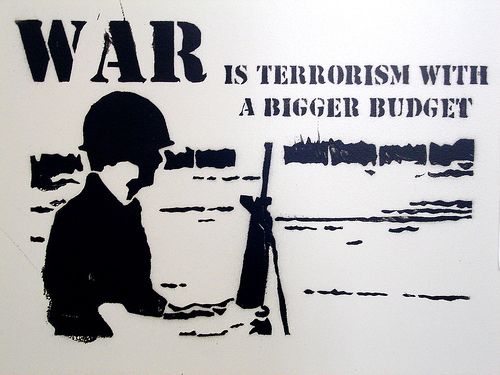
The War in Questions

Making Sense of the Age of Carnage

By Tom Engelhardt

Source: TomDispatch.com

My first question is simple enough: After 18-plus years of our forever wars, where are all the questions?

Almost two decades of failing American wars across a startlingly large part of the planet and I’d like to know, for instance, who’s been fired for them? Who’s been impeached? Who’s even paying attention?

I mean, if another great power had been so fruitlessly fighting a largely undeclared set of conflicts under the label of “the war on terror” for so long, if it had wasted trillions of taxpayer dollars with no end in sight and next to no one in that land was spending much time debating or discussing the matter, what would you think? If nothing else, you’d have a few questions about that, right?

Well, so many years later, I do have a few that continue to haunt me, even if I see them asked practically nowhere and, to my frustration, can’t really answer them myself, not to my satisfaction anyway. In fact, since 2001 — with the exception of the months leading up to the invasion of Iraq when America’s streets suddenly filled with hundreds of thousands of demonstrators asking a range of questions (“How did USA’s oil get under Iraq’s sand?” was a typical protest sign of that moment) — our never-ending wars have seldom been questioned in this country. So think of what follows not as my thoughts on the war in question but on the war in questions.

The Age of Carnage

In October 2001, in response to the 9/11 attacks, the administration of President George W. Bush launched a bombing campaign not just against al-Qaeda, a relatively small group partially holed up in Afghanistan, but the Taliban, an Islamist outfit that controlled much of the country. It was a radical decision not just to target the modest-sized organization whose 19 hijackers, most of them Saudis, had taken out almost 3,000 Americans with a borrowed “air force” of commercial jets, but in the phrase of the moment to “liberate” Afghanistan. These days, who even remembers that, by then, Washington had already fought a CIA-directed, Saudi-backed (and partially financed) war against the Soviet Union in that country for a full decade (1979-1989). To take on the Red Army then, Washington funded, armed, and supported extremist Islamist groups, some of which would still be fighting in Afghanistan (against us) in the twenty-first century.

In the context of that all-American war, a rich young Saudi, Osama bin Laden, would, of course, form al-Qaeda, or “the base.” In 1989, Washington watched as the mighty Red Army limped out of Afghanistan, the “bleeding wound” as its leader then called it. (Afghanistan wasn’t known as “the graveyard of empires” for nothing.) In less than two years, that second great power of the Cold War era would implode, an event that would be considered history’s ultimate victory by many in Washington. President Jimmy Carter’s national security adviser Zbigniew Brzezinski, the man who first committed the U.S. to its Afghan Wars, would, as last century ended, sum things up this way: “What is more important in world history? The Taliban or the collapse of the Soviet empire? Some agitated Moslems or the liberation of Central Europe and the end of the Cold War?”

Afghanistan itself would be left in ruins as Washington turned its attention elsewhere, while various local warlords fought it out and, in response, the extremist Taliban rose to power.

Now, let me jump ahead a few years. In 2019, U.S. air power expended more munitions (bombs and missiles) on that country than at any time since figures began to be kept in 2006. Despite that, during the last months of 2019, the Taliban (and other militant groups) launched more attacks on U.S.-and-NATO-trained-and-financed Afghan security forces than at any time since 2010 when (again) records began to be kept. And it tells you something about our American world that, though you could have found both those stories in the news if you were looking carefully, neither was considered worthy of major coverage, front-page headlines, or real attention. All these years later, it won’t surprise you to know that such ho-hum reporting is just par for the course. And when it comes to either of those two on-the-record realities, you certainly would be hard-pressed to find a serious editorial expression of outrage or much of anything else about them in the media.

At 18-plus years or, if you prefer to combine Washington’s two Afghan wars, 28-plus years, we’re talking about the longest American war in history. The Civil War lasted four years. The American part of World War II, another four. The Korean War less than four (though it never officially ended). The Vietnam War, from the moment the first significant contingent of U.S. advisors arrived, 14, and from the moment the first major U.S. troop contingents arrived, perhaps a decade. In the Trump era, as those air strikes rise, there has been a great deal of talk about possible “peace” and an American withdrawal from that country.  Peace, however, has now seemingly come to be defined in Washington as a reduction of American forces from approximately 12,000 to about 8,500 (and that’s without counting either private military contractors or CIA personnel there).

Meanwhile, of course, the war on terror that began in Afghanistan now stretches from the Philippines across the Greater Middle East and deep into the heart of Africa. Worse yet, it still threatens to expand into a war of some sort with Iran — and that, mind you, is under the ministrations of an officially “antiwar” president who has nonetheless upped American military personnel in the Middle East to record levels in recent years.

Of course, this is a story that you undoubtedly know fairly well. Who, in a sense, doesn’t? But it’s also a story that, so many years and so much — to use a word once-favored by our president — “carnage” later, should raise an endless series of disturbing and unnerving questions here. And that it doesn’t, should raise questions in itself, shouldn’t it?

Still, in a country where opposition to endless war seems constantly to falter or fade out amid a media universe in which Donald Trump’s latest tweet can top any war news, it seems potentially useful to raise some of those questions — at least the ones that occur to me — and perhaps for you to do the same. Isn’t it time, after all, for Americans to ask a few questions about war, American-style, in what might be thought of as the post-9/11 age of carnage?

In any case, here are six of mine to which, as I said, I don’t really have the answers. Maybe you do.

Here goes:

  1. When the Bush administration launched that invasion and occupation of Afghanistan in 2001 and followed it up with an invasion and occupation of Iraq in 2003, did we, in some curious fashion, really invade and occupy ourselves? Of course, in these years, across the Greater Middle East and Africa, the U.S. played a remarkable role in creating chaos in country after country, leading to failed states, displaced people in staggering numbers, economic disarray, and the spread of terror groups. But the question is: Did the self-proclaimed most exceptional and indispensable nation on the planet do a version of the same thing to itself in the process? After all, by 2016, the disarray in this country was striking enough and had spread far enough, amid historic economic inequality, social division, partisan divides, and growing anger, that Americans elected as president (if not quite by a majority) a man who had run not on American greatness but on American decline. He promised to make this country great again. (His declinist credentials were not much noted at the time, except among the heartland Americans who voted for him.) So, ask yourself: Would President Donald Trump have been possible if the Bush administration had simply gone after al-Qaeda on September 12, 2001, and left it at that? Since January 2017, under the tutelage of that “very stable genius,” the U.S. political (and possibly global economic) system has, of course, begun to crack open. Is there any connection to those forever wars?
  2. Has there ever been a truly great power in history, still at or near the height of its militarily prowess, that couldn’t win a war? Sure, great imperial powers from the Romans to the Chinese to the British sometimes didn’t win specific wars despite their seeming military dominance, but not a single one? Could that be historically unprecedented and, if so, what does it tell us about our moment? How has the country proclaimed by its leaders to have the finest fighting force the world has ever known won nothing in more than 18 years of unceasing global battle?
  3. How and why did the “hearts and minds” factor move from the nationalist left in the twentieth century to the Islamist right in the twenty-first? The anti-colonial struggles against imperial powers that culminated in America’s first great losing war in Vietnam (think of Korea as kind of a tie) were invariably fought by leftist and communist groups. And whatever the military force arrayed against them, they regularly captured — in that classic Vietnam-era phrase — “the hearts and minds” of what were then called “Third World” peoples and repeatedly outlasted far better armed powers, including, in the case of Vietnam, the United States. In a word, they had the moxie in such conflicts and it didn’t matter that, by the most obvious measures of military power, they were at a vast disadvantage. In the twenty-first century, similar wars are still being fought in a remarkably comparable fashion, Afghanistan being the most obvious.  Again, the weaponry, the money, everything that might seem to pass for the works has been the property of Washington and yet that ability to win local “hearts and minds” has remained in the hands of the rebels. But what I wonder about is how exactly that moxie passed from the nationalist left to the extremist religious right in this century and what exactly was our role, intended or not, in all this?
  4. When it comes to preparations for war, why can’t we ever stop? After all, when the Soviet Union collapsed and the Cold War ended in 1991, the United States essentially had no enemies left on the planet. Yet Washington continued essentially an arms race of one with a finish line so distant — the bomber of 2018, Earth-spanning weapons systems, and weaponry for the heavens of perhaps 2050 — as to imply eternity. The Pentagon and the military-industrial complex surrounding it, including mega-arms manufacturers, advanced weapons labs, university science centers, and the official or semi-official think tanks that churned out strategies for future military domination, went right on without an enemy in sight. In fact, in late 2002, preparing for his coming invasion of Iraq, George W. Bush had to cook up an “axis of evil” — Iran, Iraq, and North Korea, two of which were mortal enemies and the third unrelated in any significant way to either of them — as a justification for what was to come, militarily speaking. Almost 20 years later, investing as much in its military as the next seven countries combined, updating and upgrading its nuclear arsenal to the tune of $1.7 trillion in the coming decades (and having just deployed a new “low-yield” nuclear weapon), and still investing staggering sums in its planes, tanks, aircraft carriers, and the like, the U.S. military now seems intent (without leaving its forever wars) on returning to the era of the Cold War as well. Face-offs against Russia and China are now the military order of the day in what seems like a déjà-vu-all-over-again situation. I’m just curious, but isn’t it ever all over?
  5.  How can Washington’s war system and the military-industrial complex across the country continue to turn failure in war into success and endless dollars at home? Honestly, the one thing in America that clearly works right now is the U.S. military (putting aside those wars abroad). We may no longer invest in domestic infrastructure, but in that military and the giant corporate weapons makers that go with it? You bet! They are the true success stories of the twenty-first century if you’re talking about dollars invested, weaponry bought, and revolving doors greased. On the face of it, failure is the new success and few in this country seem to blink when it comes to any of that. How come?
  6. Why doesn’t the reality of those wars of ours ever really seem to sink in here?  This, to my mind, is at least partially a question about media coverage. Yes, every now and then (as with the Washington Post’s Afghanistan Papers last December), America’s forever wars briefly break through and get some attention. And yes, if you’re a war-coverage news jockey, you can find plenty of daily reports on aspects of our wars in the media. But isn’t it surprising how much of that coverage is essentially a kind of background hum, like Muzak in an elevator? Unless the president personally decides to drone assassinate an Iranian major general and prospective future leader of that country, our wars simply drone on, barely attended to (unless, of course, you happen to be in the U.S. military or a military spouse or child). Eighteen years of failed wars and so many trillions of dollars later, wouldn’t you have expected something else?

So those are my six questions, the most obvious things that puzzle me about what may be the strangest aspect of this American world of ours, those never-ending wars and the system that goes with them. To begin to answer them, however, would mean beginning to think about ourselves and this country in a different way.

Perhaps much of this would only make sense if we were to start imagining ourselves or at least much of the leadership crew, that infamous “Blob,” in Washington, as so many war addicts. War — the failing variety — is evidently their drug of choice and not even our “antiwar” president can get off it. Think of forever war, then, as the opioid not of the masses but of the ruling classes.


Tom Engelhardt is a co-founder of the American Empire Project and the author of a history of the Cold War, The End of Victory Culture. He runs TomDispatch.com and is a fellow of the Type Media Center. His sixth and latest book is A Nation Unmade by War.

Come Home, America: Stop Policing the Globe and Put an End to Wars-Without-End

By Jon W. Whitehead

Source: The Rutherford Institute

“Let us resolve that never again will we send the precious young blood of this country to die trying to prop up a corrupt military dictatorship abroad. This is also the time to turn away from excessive preoccupation overseas to the rebuilding of our own nation. America must be restored to a proper role in the world. But we can do that only through the recovery of confidence in ourselves…. together we will call America home to the ideals that nourished us from the beginning. From secrecy and deception in high places; come home, America. From military spending so wasteful that it weakens our nation; come home, America.”—George S. McGovern, former Senator and presidential candidate

I agree wholeheartedly with George S. McGovern, a former Senator and presidential candidate who opposed the Vietnam War, about one thing: I’m sick of old men dreaming up wars for young men to die in.

It’s time to bring our troops home.

Bring them home from Somalia, Afghanistan, Iraq and Syria. Bring them home from Germany, South Korea and Japan. Bring them home from Saudi Arabia, Jordan and Oman. Bring them home from Niger, Chad and Mali. Bring them home from Turkey, the Philippines, and northern Australia.

That’s not what’s going to happen, of course.

The U.S. military reportedly has more than 1.3 million men and women on active duty, with more than 200,000 of them stationed overseas in nearly every country in the world. Those numbers are likely significantly higher in keeping with the Pentagon’s policy of not fully disclosing where and how many troops are deployed for the sake of “operational security and denying the enemy any advantage.” As investigative journalist David Vine explains, “Although few Americans realize it, the United States likely has more bases in foreign lands than any other people, nation, or empire in history.”

Don’t fall for the propaganda, though: America’s military forces aren’t being deployed abroad to protect our freedoms here at home. Rather, they’re being used to guard oil fields, build foreign infrastructure and protect the financial interests of the corporate elite. In fact, the United States military spends about $81 billion a year just to protect oil supplies around the world.

The reach of America’s military empire includes close to 800 bases in as many as 160 countries, operated at a cost of more than $156 billion annually. As Vine reports, “Even US military resorts and recreation areas in places like the Bavarian Alps and Seoul, South Korea, are bases of a kind. Worldwide, the military runs more than 170 golf courses.”

This is how a military empire occupies the globe.

Already, American military servicepeople are being deployed to far-flung places in the Middle East and elsewhere in anticipation of the war drums being sounded over Iran.

This Iran crisis, salivated over by the neocons since prior to the Iraq War and manufactured by war hawks who want to jumpstart the next world war, has been a long time coming.

Donald Trump, Barack Obama, George W. Bush, Bill Clinton: they all have done their part to ensure that the military industrial complex can continue to get rich at taxpayer expense.

Take President Trump, for instance.

Despite numerous campaign promises to stop America’s “endless wars,” once elected, Trump has done a complete about-face, deploying greater numbers of troops to the Middle East, ramping up the war rhetoric, and padding the pockets of defense contractors. Indeed, Trump is even refusing to withdraw U.S. troops from Iraq in the face of a request from the Iraqi government for us to leave.

Obama was no different: he also pledged—if elected—to bring the troops home from Iraq and Afghanistan and reduce America’s oversized, and overly costly, military footprint in the world. Of course, that didn’t happen.

Yet while the rationale may keep changing for why American military forces are policing the globe, these wars abroad (in Iraq, Afghanistan, Pakistan, Syria, Yemen and now Iran) aren’t making America—or the rest of the world—any safer, are certainly not making America great again, and are undeniably digging the U.S. deeper into debt.

War spending is bankrupting America.

Although the U.S. constitutes only 5% of the world’s population, America boasts almost 50% of the world’s total military expenditure, spending more on the military than the next 19 biggest spending nations combined.

In fact, the Pentagon spends more on war than all 50 states combined spend on health, education, welfare, and safety.

The American military-industrial complex has erected an empire unsurpassed in history in its breadth and scope, one dedicated to conducting perpetual warfare throughout the earth.

Since 2001, the U.S. government has spent more than $4.7 trillion waging its endless wars.

Having been co-opted by greedy defense contractors, corrupt politicians and incompetent government officials, America’s expanding military empire is bleeding the country dry at a rate of more than $32 million per hour.

In fact, the U.S. government has spent more money every five seconds in Iraq than the average American earns in a year.

Future wars and military exercises waged around the globe are expected to push the total bill upwards of $12 trillion by 2053.

Talk about fiscally irresponsible: the U.S. government is spending money it doesn’t have on a military empire it can’t afford.

As investigative journalist Uri Friedman puts it, for more than 15 years now, the United States has been fighting terrorism with a credit card, “essentially bankrolling the wars with debt, in the form of purchases of U.S. Treasury bonds by U.S.-based entities like pension funds and state and local governments, and by countries like China and Japan.”

War is not cheap, but it becomes outrageously costly when you factor in government incompetence, fraud, and greedy contractors. Indeed, a leading accounting firm concluded that one of the Pentagon’s largest agencies “can’t account for hundreds of millions of dollars’ worth of spending.”

Unfortunately, the outlook isn’t much better for the spending that can be tracked.

A government audit found that defense contractor Boeing has been massively overcharging taxpayers for mundane parts, resulting in tens of millions of dollars in overspending. As the report noted, the American taxpayer paid:

$71 for a metal pin that should cost just 4 cents; $644.75 for a small gear smaller than a dime that sells for $12.51: more than a 5,100 percent increase in price. $1,678.61 for another tiny part, also smaller than a dime, that could have been bought within DoD for $7.71: a 21,000 percent increase. $71.01 for a straight, thin metal pin that DoD had on hand, unused by the tens of thousands, for 4 cents: an increase of over 177,000 percent.

That price gouging has become an accepted form of corruption within the American military empire is a sad statement on how little control “we the people” have over our runaway government.

Mind you, this isn’t just corrupt behavior. It’s deadly, downright immoral behavior.

Americans have thus far allowed themselves to be spoon-fed a steady diet of pro-war propaganda that keeps them content to wave flags with patriotic fervor and less inclined to look too closely at the mounting body counts, the ruined lives, the ravaged countries, the blowback arising from ill-advised targeted-drone killings and bombing campaigns in foreign lands, or the transformation of our own homeland into a warzone.

That needs to change.

The U.S. government is not making the world any safer. It’s making the world more dangerous. It is estimated that the U.S. military drops a bomb somewhere in the world every 12 minutes. Since 9/11, the United States government has directly contributed to the deaths of around 500,000 human beings. Every one of those deaths was paid for with taxpayer funds.

The U.S. government is not making America any safer. It’s exposing American citizens to alarming levels of blowback, a CIA term referring to the unintended consequences of the U.S. government’s international activities. Chalmers Johnson, a former CIA consultant, repeatedly warned that America’s use of its military to gain power over the global economy would result in devastating blowback.

The 9/11 attacks were blowback. The Boston Marathon Bombing was blowback. The attempted Times Square bomber was blowback. The Fort Hood shooter, a major in the U.S. Army, was blowback.

The assassination of Iranian General Qasem Soleimani by a U.S. military drone strike will, I fear, spur yet more blowback against the American people.

The war hawks’ militarization of America—bringing home the spoils of war (the military tanks, grenade launchers, Kevlar helmets, assault rifles, gas masks, ammunition, battering rams, night vision binoculars, etc.) and handing them over to local police, thereby turning America into a battlefield—is also blowback.

James Madison was right: “No nation could preserve its freedom in the midst of continual warfare.” As Madison explained, “Of all the enemies to public liberty war is, perhaps, the most to be dreaded because it comprises and develops the germ of every other. War is the parent of armies; from these proceed debts and taxes… known instruments for bringing the many under the domination of the few.”

We are seeing this play out before our eyes.

The government is destabilizing the economy, destroying the national infrastructure through neglect and a lack of resources, and turning taxpayer dollars into blood money with its endless wars, drone strikes and mounting death tolls.

Clearly, our national priorities are in desperate need of an overhauling.

At the height of its power, even the mighty Roman Empire could not stare down a collapsing economy and a burgeoning military. Prolonged periods of war and false economic prosperity largely led to its demise. As historian Chalmers Johnson predicts:

The fate of previous democratic empires suggests that such a conflict is unsustainable and will be resolved in one of two ways. Rome attempted to keep its empire and lost its democracy. Britain chose to remain democratic and in the process let go its empire. Intentionally or not, the people of the United States already are well embarked upon the course of non-democratic empire.

This is the “unwarranted influence, whether sought or unsought, by the military-industrial complex” that President Dwight Eisenhower warned us more than 50 years ago not to let endanger our liberties or democratic processes.

Eisenhower, who served as Supreme Commander of the Allied forces in Europe during World War II, was alarmed by the rise of the profit-driven war machine that emerged following the war—one that, in order to perpetuate itself, would have to keep waging war.

We failed to heed his warning.

As I make clear in my book Battlefield America: The War on the American People, there’s not much time left before we reach the zero hour.

It’s time to stop policing the globe, end these wars-without-end, and bring the troops home before it’s too late.

Rage Against the War Machine: An Interview with Peace Activist Cindy Sheehan

By Mnar Muhawesh

Source: Mint Press News

Some 2.7 billion dollars per day. That’s how much the U.S. government will spend next year to prop up the military and the more than 800 bases it maintains in over 70 countries. All in the name of national security. And despite that staggering figure, a majority of Americans feel that the wars in Iraq and Afghanistan were not even worth fighting, and they certainly have not made America safer.

That money is more than enough to pay for four years of college for every college student in this country, to fund food stamps and other social safety nets that help our most vulnerable, and to fund programs that would cut fossil-fuel emissions by 40 percent by 2035.

Despite this, there has been an utter failure by both the media and grassroots activists to address the growing waste and greed of the military-industrial complex.

An estimated 4 million people just took part in worldwide climate strikes that put the issue of climate breakdown at the forefront of the media conversation. Missing from this conversation, however, is an analysis of the role militarism and empire plays in driving the chaos. The U.S. military is the world’s largest polluter and emits more carbon dioxide than a hundred countries combined.

You see, America does not have a budget problem, it has a priorities problem; until we demand that our leaders prioritize our needs over those of corporations and those who profit off of war, our politicians will continue to pilfer taxpayer dollars by the trillions to fund forever wars that support building the largest empire history has seen.

Today, Donald Trump is the ugly face of the American Empire, and recently declared the country to be “locked and loaded” and ready to confront the Islamic Republic of Iran. And with conflicts in Iraq, Afghanistan and Syria (to mention only a few) ongoing, it feels like the cycle of war may never end.

The anti-war movement in the U.S., so strong under George W. Bush’s presidency, was effectively disarmed by his successor. Barack Obama put a friendly face on U.S. imperialism and, with the help of Hillary Clinton as his secretary of state, even managed to convince many so-called liberals and progressives to support devastating regime-change operations in Libya, Syria and Ukraine on humanitarian grounds. These interventions unleashed al-Qaeda and ISIS onto the Middle East and neo-Nazi rule on Russia’s borders. Obama expanded America’s wars, dropping over 25,000 bombs targeting seven different countries: Afghanistan, Iraq, Syria, Libya, Yemen, Somalia and Pakistan. He expanded drone wars, earning the nickname “Drone King,” and expanded U.S. bases across Africa under the guise of fighting the War on Terror.

While the Democratic Party and establishment-left mourned Obama’s exit from the White House, warning of a new era of fascism under President Trump, hundreds of thousands of outraged Americans took to the streets in protests against the new Republican president’s racism, misogyny, and xenophobia. This outrage gave birth to the Women’s March. But as these protests swelled, one couldn’t help wondering why there wasn’t any mobilization remotely on this scale in the previous eight years during Obama’s presidency?

This question crossed the mind of Cindy Sheehan, a longtime anti-war activist nicknamed “Peace Mom,” who contacted the organizers of the Women’s March — since one of the movement’s stated goals was to end violence against women — and asked them to make peace a central focus of the march.

But the response of a key organizer of the march showed just how little war and peace was a priority to establishment liberals: “I appreciate that war is your issue Cindy, but the Women’s March will never address the war issue as long as women aren’t free.”

Sheehan rejected the notion that women could be “free” without addressing war and empire. She countered the dismissive comment of the march organizer by stating that divorcing peace activism from women’s issues “ignored the voices of the [millions] of women of the world who are being bombed and oppressed by U.S. military occupation.”

It was clear that the anti-war movement needed to be reborn again, and who better than Sheehan herself could fit the bill?

Cindy grew up in California, where her father worked for the Lockheed corporation. A turning point in her life came in April 2004 after her son Casey was killed while on active service with the U.S. military in Iraq. She gained national attention after she staged an extended protest outside George W. Bush’s ranch in Crawford, Texas, demanding to meet him.

Since then she has tirelessly campaigned against war and violence abroad, being described as the “Rosa Parks of the peace movement.” Throughout her activism, she has taken a nonpartisan stance in speaking truth to power, calling out George W. Bush as the biggest terrorist in the world, but also traveling to Norway to protest Barack Obama’s Nobel Peace Prize. In 2012 she was the vice-presidential nominee of the Peace and Freedom Party.

Today, Cindy is the chief organizer of the upcoming Rage Against the War Machine protests in Washington, scheduled to take place on October 11.


Mnar Muhawesh is founder, CEO and editor in chief of MintPress News, and is also a regular speaker on responsible journalism, sexism, neoconservativism within the media and journalism start-ups.

The Forever War Is So Normalized That Opposing It Is “Isolationism”

By Caitlin Johnstone

Source: CaitlinJohnstone.com

After getting curb stomped on the debate stage by Tulsi Gabbard, the campaign for Tim “Who the fuck is Tim Ryan?” Ryan posted a statement decrying the Hawaii congresswoman’s desire to end a pointless 18-year military occupation as “isolationism”.

“While making a point as to why America can’t cede its international leadership and retreat from around the world, Tim was interrupted by Rep. Tulsi Gabbard,” the statement reads. “When he tried to answer her, she contorted a factual point Tim was making— about the Taliban being complicit in the 9/11 attacks by providing training, bases and refuge for Al Qaeda and its leaders. The characterization that Tim Ryan doesn’t know who is responsible for the attacks on 9/11 is simply unfair reporting. Further, we continue to reject Gabbard’s isolationism and her misguided beliefs on foreign policy. We refuse to be lectured by someone who thinks it’s ok to dine with murderous dictators like Syria’s Bashar Al-Assad who used chemical weapons on his own people.”

Ryan’s campaign is lying. During an exchange that was explicitly about the Taliban in Afghanistan, Ryan plainly said “When we weren’t in there, they started flying planes into our buildings.” At best, Ryan can argue that when he said “they” he had suddenly shifted from talking about the Taliban to talking about Al Qaeda without bothering to say so, in which case he obviously can’t legitimately claim that Gabbard “contorted” anything he had said. At worst, he was simply unaware at the time of the very clear distinction between the Afghan military and political body called the Taliban and the multinational extremist organization called Al Qaeda.

More importantly, Ryan’s campaign using the word “isolationism” to describe the simple common sense impulse to withdraw from a costly, deadly military occupation which isn’t accomplishing anything highlights an increasingly common tactic of tarring anything other than endless military expansionism as strange and aberrant instead of normal and good. Under our current Orwellian doublespeak paradigm where forever war is the new normal, the opposite of war is no longer peace, but isolationism. This removal of a desirable opposite of war from the establishment-authorised lexicon causes war to always be the desirable option.

This is entirely by design. This bit of word magic has been employed for a long time to tar any idea which deviates from the neoconservative agenda of total global unipolarity via violent imperialism as something freakish and dangerous. In his farewell address to the nation, war criminal George W Bush said the following:

“In the face of threats from abroad, it can be tempting to seek comfort by turning inward. But we must reject isolationism and its companion, protectionism. Retreating behind our borders would only invite danger. In the 21st century, security and prosperity at home depend on the expansion of liberty abroad. If America does not lead the cause of freedom, that cause will not be led.”

A few months after Bush’s address, Antiwar‘s Rich Rubino wrote an article titled “Non-Interventionism is Not Isolationism“, explaining the difference between a nation which withdraws entirely from the world and a nation which simply resists the temptation to use military aggression except in self defense.

“Isolationism dictates that a country should have no relations with the rest of the world,” Rubino explained. “In its purest form this would mean that ambassadors would not be shared with other nations, communications with foreign governments would be mainly perfunctory, and commercial relations would be non-existent.”

“A non-interventionist supports commercial relations,” Rubino contrasted. “In fact, in terms of trade, many non-interventionists share libertarian proclivities and would unilaterally obliterate all tariffs and custom duties, and would be open to trade with all willing nations. In addition, non-interventionists welcome cultural exchanges and the exchange of ambassadors with all willing nations.”

“A non-interventionist believes that the U.S. should not intercede in conflicts between other nations or conflicts within nations,” wrote Rubino. “In recent history, non-interventionists have proved prophetic in warning of the dangers of the U.S. entangling itself in alliances. The U.S. has suffered deleterious effects and effectuated enmity among other governments, citizenries, and non-state actors as a result of its overseas interventions. The U.S. interventions in both Iran and Iraq have led to cataclysmic consequences.”

Calling an aversion to endless military violence “isolationism” is the same as calling an aversion to mugging people “agoraphobia”. Yet you’ll see this ridiculous label applied to both Gabbard and Trump, neither of whom are isolationists by any stretch of the imagination, or even proper non-interventionists. Gabbard supports most US military alliances and continues to voice full support for the bogus “war on terror” implemented by the Bush administration which serves no purpose other than to facilitate endless military expansionism; Trump is openly pushing regime change interventionism in both Venezuela and Iran while declining to make good on his promises to withdraw the US military from Syria and Afghanistan.

Another dishonest label you’ll get thrown at you when debating the forever war is “pacifism”. “Some wars are bad, but I’m not a pacifist; sometimes war is necessary,” supporters of a given interventionist military action will tell you. They’ll say this while defending Trump’s potentially catastrophic Iran warmongering or promoting a moronic regime change invasion of Syria, or defending disastrous US military interventions in the past like Iraq.

This is bullshit for a couple of reasons. Firstly, virtually no one is a pure pacifist who opposes war under any and all possible circumstances; anyone who claims that they can’t imagine any possible scenario in which they’d support using some kind of coordinated violence either hasn’t imagined very hard or is fooling themselves. If your loved ones were going to be raped, tortured and killed by hostile forces unless an opposing group took up arms to defend them, for example, you would support that. Hell, you would probably join in. Secondly, equating opposition to US-led regime change interventionism, which is literally always disastrous and literally never helpful, is not even a tiny bit remotely like opposing all war under any possible circumstance.

Another common distortion you’ll see is the specious argument that a given opponent of US interventionism “isn’t anti-war” because they don’t oppose all war under any and all circumstances. This tweet by The Intercept‘s Mehdi Hasan is a perfect example, claiming that Gabbard is not anti-war because she supports Syria’s sovereign right to defend itself with the help of its allies from the violent extremist factions which overran the country with western backing. Again, virtually no one is opposed to all war under any and all circumstances; if a coalition of foreign governments had helped flood Hasan’s own country of Britain with extremist militias who’d been murdering their way across the UK with the ultimate goal of toppling London, both Tulsi Gabbard and Hasan would support fighting back against those militias.

The label “anti-war” can for these reasons be a little misleading. The term anti-interventionist or non-interventionist comes closest to describing the value system of most people who oppose the warmongering of the western empire, because they understand that calls for military interventionism which go mainstream in today’s environment are almost universally based on imperialist agendas grabbing at power, profit, and global hegemony. The label “isolationist” comes nowhere close.

It all comes down to sovereignty. An anti-interventionist believes that a country has the right to defend itself, but it doesn’t have the right to conquer, capture, infiltrate or overthrow other nations whether covertly or overtly. At the “end” of colonialism we all agreed we were done with that, except that the nationless manipulators have found far trickier ways to seize a country’s will and resources without actually planting a flag there. We need to get clearer on these distinctions and get louder about defending them as the only sane, coherent way to run foreign policy.

Our Reality Can Beat Up Your Reality. Spreading False News Stories on Iran

By Helen Buyniski

Source: Global Research

Twitter has declared victory over disinformation, deplatforming thousands of pro-Iranian Twitter accounts this week to coincide with US Secretary of State “Rapture Mike” Pompeo’s evidence-free declaration that Iran had attacked two oil tankers in the Gulf of Oman. But the mass deletion is merely an effort to distract from the implosion of two anti-Iran troll campaigns dedicated to smearing pro-peace Americans, both tacitly Twitter-approved. And there’s plenty more where those came from. As US media and politicians continues to hyperventilate about Russian bots, who’s the real troll-master?

Pompeo was out front with the blame hours after the attack, absent a shred of proof beyond unspecified “intelligence” and a few other dubious incidents in the Middle East that the US has previously pinned on Iran (also absent a shred of proof). But even mainstream media has initially been reluctant to take his word for it, mostly because the narrative is so improbable – Japan’s PM Shinzo Abe was in Tehran when it happened, promising to make the “utmost effort” to de-escalate tensions, when, as if on cue, one Japanese ship and another carrying Japanese cargo were hit? What are the odds?

When even CNN acknowledged that the attack “doesn’t appear to benefit any of the protagonists in the region,” and Bloomberg admitted “Iran has little to gain” from blowing up the ships of its esteemed guest, Pompeo clearly understood another route of influence was required. Who better to call in for reinforcements than Twitter, which has demonstrated time and again its willingness to serve the US’ preferred narrative with mass deplatformings? 4,779 accounts believed to be “associated or backed by Iran” were removed – less than an hour after Pompeo’s declaration of Iranian guilt – for nothing more than tweeting “global news content, often with an angle that benefited the diplomatic and geostrategic views of the Iranian state.” This was deemed “platform manipulation,” and therefore unacceptable.

One troll down, thousands more to go

Tweeting with an angle that benefits the diplomatic and geostrategic views of the American state, however, is perfectly acceptable – at least, it wasn’t Twitter that brought the “Iran Disinformation Project” crashing to a halt earlier this month. The State Department officially ended its @IranDisinfo influence operation after the social media initiative, ostensibly created to “counter Iranian propaganda,” went rogue, smearing any and all critics of Trump’s hawkish Iran policy as paid operatives of the Iranian government. Human rights activists, students, journalists, academics, even insufficiently-militant American propagandists at RFE/RL, Voice of America and other US-funded outlets were attacked by @IranDisinfo – all on the US taxpayer’s dime.

Congress only learned of the project in a closed-door hearing on Monday, when the State Department confessed the troll campaign had taken $1.5 million in taxpayers’ money to attack those same taxpayers – all in the name of promoting “freedom of expression and free access to information.” The group contracted to operate Iran Disinfo, E-Collaborative for Civic Education, is run by an Iranian immigrant and claims to focus on strengthening “civil society” and “democracy” back home, though its work is almost exclusively US-focused and its connections with pro-war think tanks like the Foundation for Defense of Democracies have alarmed congressional staffers.

“What rules are in place to prevent state-funded organization from smearing American citizens? If there wasn’t public outcry, would the Administration have suspended funding for Iran Disinfo?” Rep. Ilhan Omar (D-Minnesota) tweeted after the mea culpa meeting. While the State Department was long barred from directing government-funded propaganda at its own citizens, that rule was quietly repealed in 2013 with the passage of the Smith-Mundt Modernization Act, which gave its narrative-spinners free reign to run influence operations at home. And while the Pentagon is technically forbidden from running psychological operations (“psy-ops”) against American citizens, that rule goes out the window in case of “domestic emergencies” – and the domestic emergency declared by then-President George W. Bush days after the September 11 terror attacks remains in effect, 18 years later.

Trump’s favorite anti-Iran troll

Nor was the State Department’s trolling operation the only anti-Iran psy-op to be unmasked in recent weeks. Heshmat Alavi, an anti-Iranian columnist promoted by the Trump administration and published in Forbes, the Hill, and several other outlets, was exposed by the Intercept as a propaganda construct operated by the Mojahedin-e Khalq (MEK), a controversial Iranian exile group often called a cult that has only recently lobbied its way off the US’ terror list. The MEK is notorious for buying the endorsement of American political figures, and national security adviser John Bolton, Senator Bob Menendez (D-NJ), and former New York mayor Rudy Giuliani are among those who have spoken at its events.

Heshmat Alavi’s stories were used to sell Trump’s withdrawal from the Iran deal to the Washington Post and other more reputable outlets, as well as to promote the MEK as a “main Iranian opposition group” and viable option for post-regime-change leadership of Iran – even though it is very much fringe and hated by the majority of Iranians for fighting on the side of Iraq during the Iran-Iraq war of the 1980s. Indeed, Alavi’s relentless advocacy for the MEK may have scared off a few of the sites that initially published his work.

None of the editors who’d published Alavi’s work had ever spoken to him and none could provide the Intercept with any evidence that he was not, in fact, “a persona run by a team of people from the political wing of the MEK.” Defectors confirmed that Alavi is a small part of a massive US-directed propaganda campaign.

“We were always active in making false news stories to spread to the foreign press and in Iran,” a Canadian MEK defector told the Intercept, describing a comprehensive online propaganda operation run out of the group’s former base in Iraq that sought to control the narrative about Iran on Facebook and Twitter. Alavi may be gone, his account quietly suspended by Twitter in the wake of the Intercept’s unmasking and his stories pulled from Forbes and the Diplomat, but there are more where he came from. The Intercept delivered Twitter all the evidence they needed to take down the MEK’s trolling network, a swamp of “coordinated inauthentic behavior” in which Alavi was a prominent node, but the social network sat on its hands.

Friends funding fiends

Add to this toxic US-approved stew the Israeli astroturf operation Act.IL, which in 2018 took $1.1 million from Israel’s Ministry of Strategic Affairs to troll Americans critical of Israeli policies, including its hostility toward Iran. Initially founded to combat the Iran nuclear deal, the Ministry’s mission has pivoted to combating the Boycott, Divestment and Sanctions movement, for which it receives significant US funding (Israeli Lt-Gen Gabi Ashkenazi admitted in 2012 that American taxpayers contribute more to the country’s defense budget than Israeli taxpayers). Act.IL boasts it has gotten Americans fired from their jobs, and the app encourages users to accuse American students and journalists who support BDS of antisemitism, mass-report their posts, and otherwise engage in what would be called “coordinated inauthentic behavior” if any other country did it.

Act.IL is by no means the only Israeli trolling campaign aimed at American eyeballs, either. Psy-Group, the Israeli private intelligence company that infamously pitched a social media influence operation to the Trump campaign, ran a multi-pronged online smear operation to influence a local election in California in 2017 and has pitched dozens more. The Israel on Campus Coalition attacks pro-Palestinian student activists and professors through coordinated social media campaigns, while The Israel Project operates a network of Facebook groups whose admitted purpose is to smuggle pro-Israeli propaganda into users’ newsfeeds by concealing it among bland inspirational messages.

Such clear-cut deception by state-sponsored actors is a blatant violation of Facebook’s policies as they’ve been applied to other users, but the site claims the Israeli groups are kosher. Yet of the pro-Iran accounts deleted by Twitter, one “set” included 248 accounts “engaged with discussions related to Israel specifically” – these were shut down for nothing more than their country of origin, even as inauthentic accounts run by Israel were given carte-blanche to spew propaganda. Twitter and Facebook don’t mind being weaponized in the propaganda wars, as long as they’re working for the “right” side.

As 21st century wars are fought more and more in the informational sphere, the brightly-colored propaganda posters of the previous century have been replaced with relatively sophisticated social media influence operations. What Pompeo can’t accomplish by lying to the American public, the State Department will attempt to achieve through the slow and steady drip of disinformation.

US politicians, meanwhile, remain so fixated on the “Russian trolls stole the election!” narrative they’ve been flogging for the last three years that the Senate last week unanimously passed a bill to restrict entry to any foreign national convicted of “election meddling,” a toothless piece of legislative virtue-signaling that reveals their utter disconnection from reality. It’s more than a little ironic that they’d embrace and even pay for foreign meddling as long as they believe the trolls are working for them.

As Friedrich Nietzsche said,

“Whoever fights monsters should see to it that in the process he does not become a monster.” Or a troll.

Bullet Points: How Forever War Will End

By

Source: Another Day in the Empire

Forget a popular movement to end the wars.

As George W. Bush said during his murder spree in Afghanistan and Iraq, the antiwar movement at that time (far larger than what we have today) was little more than a “focus group” ignored by the state (with the exception of sending out their operatives to spy on the movement and create disorder and factionalism).

Most Americans are numb to decades of expensive and debilitating wars. They prefer not to think about it. The corporate propaganda media provides plenty of fluff and chaff to distract them—spiked with hate screeds against the president—and the idea of a popular movement to end the wars is now nearly impossible.

Like former dirty trickster Karl Rove famously said, the American people really have no choice but to sit back and watch the creative destructionists “make history.” Any serious effort to mobilize an antiwar movement would be disrupted. The state has perfected the dark art of killing democratic action through subversion.

Economic Armageddon. It’s breathing down our necks, thanks to federal spending out of control for decades, at least half of it going to the “defense” department and associated death merchants.

“The United States recorded a government debt equivalent to 105.40 percent of the country’s Gross Domestic Product in 2017,” Trading Economics points out. “Government Debt to GDP in the United States averaged 61.70 percent from 1940 until 2017, reaching an all-time high of 118.90 percent in 1946 [after participating in the worst act of organized carnage in human history] and a record low of 31.70 percent in 1981.”

According to research conducted by William D. Harding and Mandy Smithberger, the “final annual tally for war, preparations for war, and the impact of war come to more than $1.25 trillion, more than double the Pentagon’s base budget [of the $750 billion Trump budget].”

Last year, the official tally for the national debt was $21,500 trillion. Some believe this is a lowball figure. John Williams of shadowstats.com has shown that with unfunded liabilities, the debt is actually closer to $222 trillion, a staggering number virtually unknown to the American people. Most don’t even realize the average public unfunded liability is $2 million per household (piled atop personal debt, which is at an all-time high).

Obviously, somewhere along the line, and I’d have to say soon, there will be a “reset,” an economic collapse and reordering of the game (on terms beneficial to the bankers). Empires typically fall when they become unsustainable.

Russia and China. Both nations have their own problems and are less than friendly to individual rights, although Russia is far better than totalitarian China. It is now obvious both are working to find an exit to the domination of Federal Reserve fiat funny money scheme that rules international economies and trade around the world. The US has weaponized this system by slapping sanctions on disfavored nations and those it has decided to invade and destroy (and with the current rhetoric from both sides of the one-sided war party, it is obvious the political class and its corporate directors are itching for a fight).

This is, of course, insane. I really do think the hubris—the indispensable nation, the exceptional nation—is so thick these fools can’t see how easily it would be to turn the world into a radioactive cauldron. On the other hand, I do believe, at least in regard to nuclear annihilation, somewhat saner heads will prevail.

News flash. If there is a non-nuclear (or limited nuclear) war with each or both (see the 2001 Sino-Russian Treaty of Friendship), it will not turn out good for the US, which has corrupted its defensive military capacity with a manufactured terror-asymmetrical posture.

This approach is effective in subversion operations to destabilize countries, particularly in the Middle East and South Asia. As we have seen since the end of the Second World War, the United States appears to be incapable of winning wars. This no mistake and primarily benefits Eisenhower’s military-industrial complex with a host of related new “national security” industries in addition to the war merchant stalwarts (Boeing, General Dynamics, General Electric, Lockheed-Martin, Raytheon, etc.), all feeding at the trough. Forever war is a forever profit stream for the ruling elite and its political class.

So, the conclusion is either economic collapse or defeat in a more or less conventional war will halt the trajectory the US is taking now as it is pulled along in a neocon spell with a president that has at best a sixth grade understanding of the world. Both probable outcomes are unthinkable.

Who knows. Maybe the American people will get off their duffs and demand the wars and provocations leading to war end. This was done in the 1960s and early 70s, primarily due to the Vietnam War protest that began in response to military servitude imposed on teenagers. The state ended a military draft, although it retained its “selective service” registration of potential future bullet-stoppers.

The moral aspect was secondary.

Facebook Censorship of Alternative Media “Just the Beginning,” Says Top Neocon Insider

At a Berlin security conference, hardline neocon Jamie Fly appeared to claim some credit for the recent coordinated purge of alternative media.

By Max Blumenthal and Jeb Sprague

Source: Gray Zone

This month, Facebook and Twitter deleted the accounts of hundreds of users, including many alternative media outlets maintained by American users. Among those wiped out in the coordinated purge were popular sites that scrutinized police brutality and U.S. interventionism like The Free Thought Project, Anti-Media, Cop Block and journalists like Rachel Blevins.

Facebook claimed that these sites had “broken our rules against spam and coordinated inauthentic behavior.” However, sites like The Free Thought Project were verified by Facebook and widely recognized as legitimate sources of news and opinion. John Vibes, an independent reporter who contributed to Free Thought, accused Facebook of “favoring mainstream sources and silencing alternative voices.”

In comments published here for the first time, a neoconservative Washington insider has apparently claimed a degree of credit for the recent purge and promised more takedowns in the near future.

“Russia, China, and other foreign states take advantage of our open political system,” remarked Jamie Fly, a senior fellow and director of the Asia program at the German Marshall Fund. “They can invent stories that get repeated and spread through different sites. So we are just starting to push back. Just this last week Facebook began starting to take down sites. So this is just the beginning.”

Fly went on to complain that “all you need is an email” to set up a Facebook or Twitter account, lamenting the sites’ accessibility to members of the general public. He predicted a long struggle on a global scale to fix the situation, and pointed out that to do so would require constant vigilance.

Fly made these stunning comments to Jeb Sprague, who is a visiting faculty in sociology at the University of California-Santa Barbara and co-author of this article. The two spoke during a lunch break at a conference on Asian security organized by the Stiftung Wissenschaft und Politik in Berlin, Germany.

In the tweet below, Fly is the third person from the left who appears seated at the table.

The remarks by Fly — “we are just starting to push back” — seemed to confirm the worst fears of the alternative online media community. If he was to be believed, the latest purge was motivated by politics, not spam prevention, and was driven by powerful interests hostile to dissident views, particularly where American state violence is concerned.

Rise of a neocon cadre

Jamie Fly is an influential foreign policy hardliner who has spent the last year lobbying for the censorship of “fringe views” on social media. Over the years, he has advocated for a military assault on Iran, a regime change war on Syria, and hiking military spending to unprecedented levels. He is the embodiment of a neoconservative cadre.

Like so many second generation neocons, Fly entered government by burrowing into mid-level positions in George W. Bush’s National Security Council and Department of Defense.

In 2009, he was appointed director of the Foreign Policy Initiative (FPI), a rebranded version of Bill Kristol’s Project for a New American Century, or PNAC. The latter outfit was an umbrella group of neoconservative activists that first made the case for an invasion of Iraq as part of a wider project of regime change in countries that resisted Washington’s sphere of influence.

By 2011, Fly was advancing the next phase in PNAC’s blueprint by clamoring for military strikes on Iran. “More diplomacy is not an adequate response,” he argued. A year later, Fly urged the US to “expand its list of targets beyond the [Iranian] nuclear program to key command and control elements of the Republican Guard and the intelligence ministry, and facilities associated with other key government officials.”

Fly soon found his way into the senate office of Marco Rubio, a neoconservative pet project, assuming a role as his top foreign policy advisor. Amongst other interventionist initiatives, Rubio has taken the lead in promoting harsh economic sanctions targeting Venezuela, even advocating for a U.S. military assault on the country. When Rubio’s 2016 presidential campaign floundered amid a mass revolt of the Republican Party’s middle American base against the party establishment, Fly was forced to cast about for new opportunities.

He found them in the paranoid atmosphere of Russiagate that formed soon after Donald Trump’s shock election victory.

PropOrNot sparks the alternative media panic

A journalistic insider’s account of the Hillary Clinton presidential campaign, Shattered, revealed that “in the days after the election, Hillary declined to take responsibility for her own loss.” Her top advisers were summoned the following day, according to the book, “to engineer the case that the election wasn’t entirely on the up-and-up … Already, Russian hacking was the centerpiece of the argument.”

Less than three weeks after Clinton’s defeat, the Washington Post’s Craig Timberg published a dubiously sourced report headlined, “Russian propaganda effort helped spread ‘fake news.’” The article hyped up a McCarthyite effort by a shadowy, anonymously run organization called PropOrNot to blacklist some 200 American media outlets as Russian “online propaganda.”

The alternative media outfits on the PropOrNot blacklist included some of those recently purged by Facebook and Twitter, such as The Free Thought Project and Anti-Media. Among the criteria PropOrNot identified as signs of Russian propaganda were, “Support for policies like Brexit, and the breakup of the EU and Eurozone” and, “Opposition to Ukrainian resistance to Russia and Syrian resistance to Assad.” PropOrNot called for “formal investigations by the U.S. government” into the outlets it had blacklisted.

According to Craig Timberg, the Washington Post correspondent who uncritically promoted the media suppression initiative, Propornot was established by “a nonpartisan collection of researchers with foreign policy, military and technology backgrounds.” Timberg quoted a figure associated with the George Washington University Center for Cyber and Homeland Security, Andrew Weisburd, and cited a report he wrote with his colleague, Clint Watts, on Russian meddling.

Timberg’s piece on was PropOrNot was promoted widely by former top Clinton staffers and celebrated by ex-Obama White House aide Dan Pfeiffer as “the biggest story in the world.” But after a wave of stinging criticism, including in the pages of the New Yorker, the article was amended with an editor’s note stating, “The [Washington] Post… does not itself vouch for the validity of PropOrNot’s findings regarding any individual media outlet.”

PropOrNot had been seemingly exposed as a McCarthyite sham, but the concept behind it — exposing online American media outlets as vehicles for Kremlin “active measures” — continued to flourish.

The birth of the Russian bot tracker

By August, a new, and seemingly related initiative appeared out of the blue, this time with backing from a bipartisan coalition of Democratic foreign policy hands and neocon Never Trumpers in Washington. Called the Alliance for Securing Democracy (ASD), the outfit aimed to expose how supposed Russian Twitter bots were infecting American political discourse with divisive narratives. It featured a daily “Hamilton 68” online dashboard that highlighted the supposed bot activity with easily digestible charts. Conveniently, the site avoided naming any of the digital Kremlin influence accounts it claimed to be tracking.

The initiative was immediately endorsed by John Podesta, the founder of the Democratic Party think tank, Center for American Progress, and former chief of staff of Hillary Clinton’s 2016 presidential campaign. Julia Ioffe, the Atlantic’s chief Russiagate correspondent, promoted the bot tracker as “a very cool tool.”

Unlike PropOrNot, the ASD was sponsored by one of the most respected think tanks in Washington, the German Marshall Fund, which had been founded in 1972 to nurture the special relationship between the US and what was then West Germany.

Though the German Marshall Fund did not name the donors that sponsored the initiative, it hosted a who’s who of bipartisan national security hardliners on the ASD’s advisory council, providing the endeavor with the patina of credibility. They ranged from neocon movement icon Bill Kristol to former Clinton foreign policy advisor Jake Sullivan to ex-CIA director Michael Morrell.

Jamie Fly, a German Marshall Fund fellow and Asia specialist, emerged as one of the most prolific promoters of the new Russian bot tracker in the media. Together with Laura Rosenberger, a former foreign policy aide to Hillary Clinton’s 2016 campaign, Fly appeared in a series of interviews and co-authored several op-eds emphasizing the need for a massive social media crackdown.

During a March 2018 interview on C-Span, Fly complained that “Russian accounts” were “trying to promote certain messages, amplify certain content, raise fringe views, pit Americans against each other, and we need to deal with this ongoing problem and find ways through the government, through tech companies, through broader society to tackle this issue.”

Yet few of the sites on PropOrNot’s blacklist, and none of the alternative sites that were erased in the recent Facebook purge that Fly and his colleagues take apparent credit for, were Russian accounts. Perhaps the only infraction they could have been accused of was publishing views that Fly and his cohorts saw as “fringe.”

What’s more, the ASD has been forced to admit that the mass of Twitter accounts it initially identified as “Russian bots” were not necessarily bots — and may not have been Russian either.

“I’m not convinced on this bot thing”

A November 2017 investigation by Max Blumenthal, a co-author of this article, found that the ASD’s Hamilton 68 dashboard was the creation of “a collection of cranks, counterterror retreads, online harassers and paranoiacs operating with support from some of the most prominent figures operating within the American national security apparatus.”

These figures included the same George Washington University Center for Cyber and Homeland Security fellows — Andrew Weisburd and Clint Watts — that were cited as experts in the Washington Post’s article promoting PropOrNot.

Weisburd, who has been described as one of the brains behind the Hamilton 68 dashboard, once maintained a one-man, anti-Palestinian web monitoring initiative that specialized in doxxing left-wing activists, Muslims and anyone he considered “anti-American.” More recently, he has taken to Twitter to spout off murderous and homophobic fantasies about Glenn Greenwald, the editor of the Intercept — a publication the ASD flagged without explanation as a vehicle for Russian influence operations.

Watts, for his part, has testified before Congress on several occasions to call on the government to “quell information rebellions” with censorious measures including “nutritional labels” for online media. He has received fawning publicity from corporate media and been rewarded with a contributor role for NBC on the basis of his supposed expertise in ferreting out Russian disinformation.

Clint Watts has urged Congress to “quell information rebellions”

However, under questioning during a public event by Grayzone contributor Ilias Stathatos, Watts admitted that substantial parts of his testimony were false, and refused to provide evidence to support some of his most colorful claims about malicious Russian bot activity.

In a separate interview with Buzzfeed, Watts appeared to completely disown the Hamilton 68 bot tracker as a legitimate tool. “I’m not convinced on this bot thing,” Watts confessed. He even called the narrative that he helped manufacture “overdone,” and admitted that the accounts Hamilton 68 tracked were not necessarily directed by Russian intelligence actors.

“We don’t even think they’re all commanded in Russia — at all. We think some of them are legitimately passionate people that are just really into promoting Russia,” Watts conceded.

But these stunning admissions did little to slow the momentum of the coming purge.

Enter the Atlantic Council

In his conversation with Sprague, the German Marshall Fund’s Fly stated that he was working with the Atlantic Council in the campaign to purge alternative media from social media platforms like Facebook.

The Atlantic Council is another Washington-based think tank that serves as a gathering point for neoconservatives and liberal interventionists pushing military aggression around the globe. It is funded by NATO and repressive, US-allied governments including Saudi Arabia, Bahrain and Turkey, as well as by Ukrainian oligarchs like Victor Pynchuk.

This May, Facebook announced a partnership with the Atlantic Council’s Digital Forensic Research Lab (DFRLab) to “identify, expose, and explain disinformation during elections around the world.”

The Atlantic Council’s DFRLab is notorious for its zealous conflation of legitimate online dissent with illicit Russian activity, embracing the same tactics as PropOrNot and the ASD.

Ben Nimmo, a DFRLab fellow who has built his reputation on flushing out online Kremlin influence networks, embarked on an embarrassing witch hunt this year that saw him misidentify several living, breathing individuals as Russian bots or Kremlin “influence accounts.” Nimmo’s victims included Mariam Susli, a well-known Syrian-Australian social media personality, the famed Ukrainian concert pianist Valentina Lisitsa, and a British pensioner named Ian Shilling.

In an interview with Sky News, Shilling delivered a memorable tirade against his accusers. “I have no Kremlin contacts whatsoever; I do not know any Russians, I have no contact with the Russian government or anything to do with them,” he exclaimed. “I am an ordinary British citizen who happens to do research on the current neocon wars which are going on in Syria at this very moment.”

With the latest Facebook and Twitter purges, ordinary citizens like Shilling are being targeted in the open, and without apology. The mass deletions of alternative media accounts illustrate how national security hardliners from the German Marshall Fund and Atlantic Council (and whoever was behind PropOrNot) have instrumentalized the manufactured panic around Russian interference to generate public support for a wider campaign of media censorship.

In his conversation in Berlin with Sprague, Fly noted with apparent approval that, “Trump is now pointing to Chinese interference in the 2018 election.” As the mantra of foreign interference expands to a new adversarial power, the clampdown on voices of dissent in online media is almost certain to intensify.

As Fly promised, “This is just the beginning.”

How the American Media Was Destroyed

By Paul Craig Roberts

Source: PaulCraigRoberts.org

In my September 24 column, “Truth Is Evaporating Before Our Eyes,” https://www.paulcraigroberts.org/2018/09/24/truth-is-evaporating-before-our-eyes/ I used the destruction of the CBS news team that broke the Abu Ghraib story and the story of President George W. Bush’s non-performance of his Texas Air Force National Guard duties to demonstrate how accusations alone could destroy a Peabody Award winning, 26 year veteran producer of CBS News, Mary Mapes, and the established news anchor Dan Rather.

I have many times written that it was President Bill Clinton who destroyed the independent US media when he permitted 90 percent of the US media to be concentrated in six mega-corporations that were in the entertainment and other businesses and not in the news business. This unprecedented concentration of media was against all American tradition and destroyed the reliance that our Founding Fathers placed on a free press to keep government accountable to the people.

Until I read Mary Mapes book, Truth and Duty (St. Martin’s Press, 2005), I was unaware of how this monopolization of the media in violation of the Sherman Anti-trust Act and American tradition had proceeded to destroy honest reporting.

Here is what happened. The Texas Air National Guard was a place the elite placed their sons to avoid the Vietnam War draft. Copies of documents written by Lt. Col. Jerry B. Killian describing George W. Bush’s ability to jump the large waiting list hoping to avoid the war, Bush’s non-compliance with National Guard requirements and Bush’s unauthorized departure to another state were given to CBS. The CBS team worked for many months to confirm or discredit the documents. The information in the documents proved to be consistent with the interviews of people acquainted with George W. Bush’s time in the Texas National Guard.

It was a carefully prepared story, not a rushed one, and it fits all the information we now have of Bush’s non-performance.

The problem for the CBS news team, which might not have been realized at the time, was that the documents were copies, not originals that experts could authenicate as real beyond question. Therefore, although the documents were consistent with the testimony of others, no expert could validate the documents as they could originals.

The Republicans seized on this chink in the armor to turn the issue away from the truthfulness of the CBS 60 Minutes report to whether or not the copies were fakes.

CBS had two other problems. One was that Viacom, its owner, was not in the news business, but in the lobbying business in Washington wanting to enrich the company with legislative perks and regulatory permissions. Truthful news from CBS, exposing US torture in the face of the Bush regime’s denials and showing that Bush was too privileged to be held accountable by the Texas National Guard, was damaging Viacom’s highly paid lobbying effort.

When the right-wing bloggers took after CBS, the Viacom executives saw how to get rid of the troublesome CBS news team. Viacom executives refused to support their reporters and convened a kangeroo count consisting of Republicans to “investigate” the 60 Minutes story of Bush’s failure to comply with his obligations to the Texas National Guard.

Viacom wanted to get rid of the independent news constraint on its lobbying success, but Mary Mapes and her lawyers thought truth meant something and would prevail. Therefore, she subjected herself to the destructive process of watching the orchestrated destruction of her career and her integrity.

CBS’ other problem was that, with or without justification, CBS and Dan Rather were regarded in conservative Republican circles as liberal, a designation equivalent to a communist. For millions of Americans the controversy was about liberal CBS trying to harm George W. Bush and leave us exposed to Muslim Terrorism. In right-wing minds, Bush was trying to protect America from Muslim terrorists who blew up the World Trade Center and the Pentagon, and CBS was trying to smear President Bush.

Mary Mapes, Dan Rather, and the CBS news team were too focused on news to take into account the dangerous situation in which they were operating. Therefore, they walked into a trap that served Dick Cheney’s Middle Eastern wars, which served Halliburton and Israel, and into a trap that served conservative hatred of “liberal” news.

Why didn’t the American media defend CBS’ careful reporting? The answer is that this was a time when TV news media was dying. The Internet was taking over. The rest of the media saw in the demise of CBS a chance to gain that market and have a longer life.

So the rest of the media took up the fake news that 60 Minutes had presented a report based on fake documents. The media did not realize that they were signing their own death warants. Neither did the right-wing bloggers that the Republicans had sicced on CBS. Today, these bloggers are themselves shut off from being able to express any truth.

Truth in America is being exterminated, and the destruction of CBS news was the starting point. As Mary Mapes reports in her book, as soon as Viacom was entirely rid of 60 Minutes with the firing of the entire staff, on the very next day Viacom held a triumphant annual investor meeting. Chairman Sumner Redstone was awarded a a $56 million paycheck for 2004. Chief operating officers, Les Moonves and Tom Freston “each pocketed a whoopping fifty-two million for the year.”

And the CBS news team went without mortgage, car, or health insurance payments.

Mapes writes: “Just a few years ago, this kind of corporate executive largesse was unheard of. Now, these media Masters of the Universe have taken over the public airwares and they have one obligation: making a profit.” Ever a larger one, which requires protecting the government and the corporate advertisers from investigative reporting.

The consequence today is that the American media is totally unreliable. No reader can rely on any report, not even on a New York Times obituary.