Wokeness is a Product of Neoliberalism

Why don’t more people make this connection?

By Chad C. Mulligan

Source: The Hipcrime Vocab Substack

One thing I haven’t seen people point out anywhere else is how much the current atmosphere of “wokeness” is an outcome of neoliberalism.

Let me explain.

There was a lot of analysis written about neoliberalism back in the 1990s when it was still a relatively new phenomenon, having only been enshrined as the dominant economic paradigm in the 1980s. Now that neoliberalism has become simply the water in which we swim and the horizon upon which we gaze, we don’t even notice it anymore. The idea that there could be other ways to organize the economy and society has completely vanished from the discourse even on the nominal “Left”—so utterly complete has been its intellectual victory.

I can’t recall all the books and articles I read during that time, but a couple of standouts were One Market Under God by Thomas Frank and No Logo by Naomi Klein. Frank’s The Baffler magazine published a lot of good articles about neoliberalism back in those days, and Klein’s subsequent The Shock Doctrine is indispensable for understanding how neoliberalism took over the world.

One of the things that those analyses pointed out was the fact that neoliberalism derided governments as universally incompetent and inefficient and argued that only market competition could distribute goods and services effectively.

Furthermore, those markets had to be global in scope and free from “interference,” which was broadly defined as anything that hindered profit maximization including worker and environmental protections. This, in theory, would lead to ideal outcomes—or at least as close to ideal as they could be in a world of inherent scarcity.

As a corollary of this, neoliberals argued that democratic politics—the idea that citizens could express their wishes and desires via their elected representatives—was a hopelessly naive and outdated notion in the age of globalism. Rather, they argued that people’s preferences and desires would be more accurately reflected by how people spent their money in “free and open” markets. People’s spending patterns—aggregated and allocated by markets—would therefore be a better agent of social change than ineffective political action according to neoliberal theory1.

The One Big Market under neoliberalism, therefore, was seen not just a method for coordinating economic activities and allocating goods and services, but as the highest expression of people’s fundamental valuesWe were now expected to change the world thru shopping. As a result of this, you were expected to be an “ethical consumer.” You were exhorted to “spend your values.” Markets, neoliberals argued—and not popularly elected governments—were the true expression of the democratic will. As our choices at the voting booth began to narrow and seem more and more alike, we were told to vote with your dollar!

Here’s a concrete, real-world example. If you were concerned about dolphins being ensnared and killed in fishing nets used to dredge the ocean for tuna, the solution was not to ban the practice. No, the solution was to spend ethically on products labeled “dolphin safe.” Since consumers would express their preferences via buying dolphin safe tuna instead of the ones not so labeled, eventually the Invisible Hand of the Market would cause this practice to die out without a single government regulation. Similarly, if you wanted to support sustainable farming practices, you would spend preferentially on products labeled “organic” rather than the alternatives.

So in the neoliberal world view, the best way to bring about positive social change was by individuals spending their money in markets. That’s why in a modern shopping center you see all kinds of labels festooned on every conceivable product proclaiming how it is “responsibly sourced,” or how environmentally-friendly it is, or how the package is biodegradable, or how the farmers were fairly compensated, or whatever. You never saw that in the 1960s or 1970s—this change was ushered in by neoliberalism.

Now when you went to the grocery store it was no longer just to buy groceries—you had the obligation to save the world! (As if your life wasn’t stressful enough with the ever-longer working hours that were also the result of neoliberalism). A recurring theme of those analyses I read back in the day was the replacement of citizens with consumers.

(Of course, what’s to stop corporations from slapping any old claim onto their products? How can shoppers evaluate these claims? How can they possibly know what’s accurate and what’s not? Into this void stepped literally hundreds of different (private) certification agencies to try and make sure that these labels accurately reflected what they claimed. Thus, in the effort to avoid regulating markets, neoliberalism actually caused a proliferation of far more regulations and regulatory agencies than ever before. And often these privatized agencies have nonexistent oversight, poor standards and lax enforcement).

Another fundamental aspect of neoliberalism was the notion that competition would bring about ideal social outcomes. Therefore competition, neoliberals argued, had to be introduced into absolutely every aspect of human affairs. In this regard, neoliberalism a was really not just about economics, but was rather a radical totalitarian vision for remaking human society.

This extended even to social issues. For example, the philosophy behind “school choice” came from the notion that the problem with public schools was the lack of free market competition because schools were a state-owned monopoly. State-owned monopolies are the greatest possible evil under neoliberalism because they are not subject to market competition. By unleashing “choice,” schools would be forced to compete for students just like businesses compete for customers. This would make public education better, the thinking went, by eliminating bad schools and teachers and creating “lean and mean” educational institutions.

Even environmentalism has been colonized by neoliberalism. Instead of limiting the emission of fossil fuels, for example, new and exotic markets would be established so that polluters could trade opaque “carbon credits” in order to theoretically allocate pollution the same way we allocate any other resource under neoliberalism. This also demonstrates how neoliberalism is not anti-regulation or “small government” as is often portrayed, since creating these kinds of artificial markets takes massive amounts of government regulation and bureaucracy.

As this all-encompassing philosophy gradually took over the world, social protections were dismantled, regulations were abolished, and untrammeled, cutthroat competition was unleashed in every arena of life.

But it was Karl Polanyi who pointed out that such a vision of turning over society to anarchic markets with no protections and no refuge from its capricious dictates would lead to the “demolition of society.” No one could long withstand the never-ending whipsaws and bullwhips of “pure”relentless market competition—not consumers, not workers, and not even the businesses themselves! That’s why its has never existed, he said, and cannot exist.

So what actually happened in the real world due to unleashing this radical philosophy was an unprecedented wave of mergers, acquisitions, and consolidations in every sector of the economy, enabled by high finance (which was also “unleashed” thanks to neoliberalism).

You see, competition is expensive. It is also highly inefficientIt’s much more effective for parties to cooperate than to compete. That’s just game theory 101. It’s true of human affairs just as it is in nature. That’s why you see cooperation everywhere throughout the animal kingdom as Peter Kropotkin pointed out long ago. Any species where every single member was perennially locked in existential competition with every other member of the species would quickly die out, he said. Even where competition does exist in nature, it is in very limited in scope and in circumscribed contexts like mate choice.

Competition is also inherently unstable. You can’t just have an endless tournament going on forever and ever as free market theory depicts. Eventually there has to be a winner. Again, this is simply game theory 101. You can observe this everywhere you look.

So the current wave of consolidations and mergers in every sector of the economy can be seen as the logical outcome of neoliberal philosophy when applied to the real world as opposed to the world depicted in economic textbooks and think-tank policy papers. Want to know why the entire economy is dominated by a handful of mega-monopolies these days? That’s the reason why.

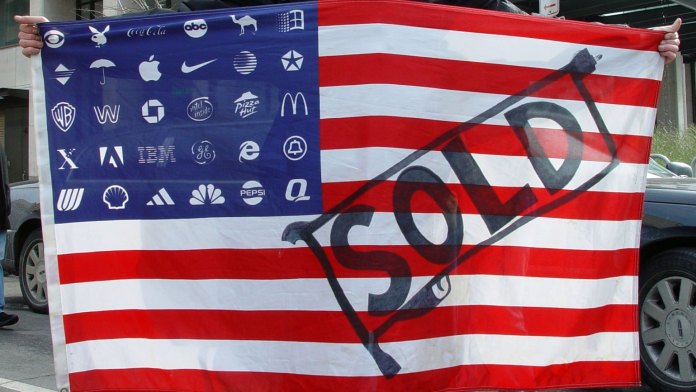
But getting back to our initial topic, here’s the point that’s absolutely critical: as a result of this neoliberal transformation, corporations had to portray themselves as agents of positive social change.

Read that again. And again and again and again until it sinks in.

This is what has lead to the rise of the modern “socially conscious” corporation and to so-called “woke capitalism.”

Think about it. Back in the pre-neoliberal 1960s, did any company bend over backwards to convey what it believed about absolutely anything? About any social issue whatsoever? No, because corporations weren’t expected to do that. Corporations were widely seen as anonymous entities devoid of values designed to make money by producing the goods and services consumers wanted. Back in the 1960’s—an era of rapid social change—no one cared about what IBM, Boeing, McDonalds, DuPont, General Electric, Coca Cola, General Motors, Prudential, Chevron, or any other big corporation thought about anything, much less the prevailing social issues of the day. That’s what politics was for! Businesses were expected to make money, full stop. Besides, how could a corporation really “think” anything? A corporation is a faceless bureaucratic enterprise composed of hundreds, or even thousands of individuals, each with their own personal set of values and beliefs. The very idea that a corporation could “believe” anything would have been seen as preposterous and absurd back then.

Spending money in “free” markets has subsequently become the only acceptable form of social protest or fomenting change under globalized neoliberalism—and not, for example, people banding together in popular movements to advocate for a better world. Government and politics have become passé and irrelevant—or so we’re told by those in charge. The sole option you have as a lone individual in the face of this relentless onslaught is to become an ethical consumer—in other words, to “spend your values.” Therefore, in order to meet this solemn obligation, you have to be sure that when you hand your money over to a corporation, that corporation reflects your values! That is a fundamental tenet of neoliberalism and its emphasis on markets—and not governments—as the highest arbiter of social values and preferences.

Yet very few commentators on the (fake) Left and the (pseudo) populist Right seem to grasp this. Instead they just shake their fists and rage.

So in order to get their hands on those precious “ethical” dollars, faceless bureaucratic corporations have to fashion themselves as “socially responsible.” As “ethical.” As being “positive change agents.” To that end they have launched wave after wave of PR campaigns designed to proclaim just how ethical and virtuous they are, from Amazon to Dove to Gillette, and every other big business has to follow suit.

Consider, for instance, those Dove advertisements that promised to let plus-size women believe they were beautiful—and publicly paraded them in their bras and panties in a commercial for cellulite-reducing cream. Or the Heineken “Worlds Apart” ad that showed people of disparate backgrounds and races coming together (eventually) over the beer. Or—to bring things back to the strategic positioning of carbonated sugar water as a proto-revolutionary product—the (thankfully short-lived) Kendall Jenner Pepsi spot that portrayed the soda as the means to bring Occupy-style protesters back into a grateful posture of consumer-abundance connoisseurship…

Believe in Something (The Baffler)

This also ties in with the “doing well by doing good” ethos of philanthropic capitalism as described by Anand Giridharadas in his book, Winners Take All. Once again, elected governments and politicians are portrayed as hopelessly inept and incompetent (sense a pattern?). In place of governments installed by the will of the people, therefore, “social entrepreneurs” will step into the void and solve the most pressing social problems of the day—and make a killing $$$ by doing so. This is portrayed as a “win-win” scenario in the media, which is owned and controlled by those same rich people (the fact that every single social problem seems to be getting exponentially worse has not deterred this policy approach in the slightest).

So if you wonder where all that cloying, patronizing Silicon Valley bullshit about “changing the world” and “making the world a better place” comes from—that’s where it comes from. It’s basically a form of neofeudalism in practice.

So the end result of all this is that under neoliberalism corporations are now obligated to portray themselves as ethical and moral in order to attract precious consumer dollars. Hence the rise of the modern “woke” corporation expressing it’s opinion on absolutely every hot-button issue of the day—from Black Lives Matter, to gay marriage, to the abortion debate, to transgender rights, to sexual harassment, to gun control, to multiculturalism, to whatever contentious wedge issue the political Right will dream up next.

And whether you like it or not, the people who tend to earn the most under globalized, technocratic monopoly capitalism really do strongly support cosmopolitan values like diversity, tolerance and inclusiveness. And since we are obligated to “spend our values” under neoliberalism, corporations have to cater to them—and to make sure that everyone knows about it. Thus they have to “officially” support things like Black Lives Matter. They have to speak out against discrimination against gay and transgender people. They have to be “antiracist.” They have to extol “empowering women and girls.” All because they need to attract the kinds of people who “spend their values,” and those values are more likely to be socially liberal for the kinds of people that corporations want to attract both as employees and consumers. That’s just the reality, and it’s not likely to change anytime soon.

And even though conservatives may not like it, socially regressive people and reactionaries tend to be poorer and less educated overall—and hence are less desirable as workers and consumers. That’s also just how it is. Therefore, corporations are “woke” based on a cynical, self-interested calculation of what will net them the most consumer dollars under neoliberal capitalism, and no amount of conservative grousing is going to change that. As a result, reactionaries and authoritarians are increasingly turning to politics to force their values upon people which they can’t enforce via the kinds of free market choices that they believe should dictate every other aspect of life.

When it became clear that the NFL supporters—largely white, male, and older—were outnumbered by the corporation’s brand loyalists—more diverse and younger—Nike went ahead and now even claims that it inaugurated the campaign because it believes that Kaepernick “is one of the most inspirational athletes of his generation.”

Believe in Something (The Baffler)

Of course, if we had a healthy and functioning political system none of this would be necessary. And it follows that if neoliberalism had not become the dominant social and economic paradigm of the twenty-first century there would be no such thing as “woke” capitalism in the first place.

So it’s truly amusing to watch the political Right rage to the heavens at the result of their own economic philosophy being applied in practice.

It’s also funny that, to my knowledge, no one appears to have made this connection. After all, why did corporations only relatively recently (i.e. after the 1990s) begin virtue signalling at every opportunity? It’s not just because everyone suddenly became “based” at approximately the same time. It’s the economic system, stupid!

Of course, it’s a win-win situation for political conservatives since they now have something to permanently complain about to rally people to their side, even though they are still just as pro-wealth and anti-worker as ever, and even though they still fervently believe in the most toxic tenets of neoliberalism (such as its contempt for democratically elected governments and its antipathy toward regulations and constraining the rich in any way). That’s the natural result of gutting civil society in favor of apotheosizing an all-powerful Market.

Of course, the bad news is that the end result of neoliberalism will probably be the rise of a twenty-first century form of fascist authoritarianism based on what I’m seeing in the media and across the political spectrum these days.

In conclusion, I find all of these “culture war” topics utterly inane and ridiculous (despite all the money you can make by endlessly bellyaching about them on Sub$tack). In a country where many citizens can’t even access basic health care, homelessness is endemic and rising, higher education is unaffordable, crime and suicide are rampant, people are mired in debt, wages have stagnated and mass shootings occur on a weekly basis2, I find it hard to get worked up over “wokeness” and “cancel culture.” And, as many besides me have pointed out, the idea that this cynical virtue signalling by mega-corporations means that they are in any way “left-of-center” by any reasonable definition of that term is absurd. After all, we’re talking about some of the most vile, sociopathic billionaires since the Gilded Age and some of the most brutal working conditions since the era of George Pullman. And the saddest thing is, we’ll never be able to unite to stop them since—thanks to neoliberalism—we will be kept perennially at each other’s throats while they continue to Tweet from their luxury yachts, penthouses, villas, and private jets about diversity and inclusiveness for ever and ever.

1 A good book about this is Undoing the Demos: Neoliberalism’s Stealth Revolution by Wendy Brown. Here’s an interview with the author.

2 It’s worth noting that I wrote this post before the latest massacre in Texas.
How big corporations are draining the life out of a sick America

If today’s companies were truly offering a fair return to the taxpayers who built their businesses, they’d be doing a lot more to ensure that all Americans have the means to support their families.

By Paul Buchheit

Source: Nation of Change

When Dr. Jonas Salk was asked about a patent on his polio vaccine in 1955, he said, “There is no patent. Could you patent the sun?” When Gilead Sciences recently developed an anti-Covid drug for about $12 per treatment, they set the price at $3,200.

As Republicans and business leaders decry the word ‘social’ as anti-American, they continue to promote the free-market “winner take all” philosophy that has caused over half of our nation to try to survive without adequate health care and life savings and job opportunities. Our richest corporations are much to blame. A review of the facts should make this clear.

They continue to cheat on taxes

After building their businesses on 70 years of taxpayer-funded research and development, six dominant tech companies (Apple, Amazon, Google, Microsoft, Facebook, and Netflix), which together are worth over $7 trillion, have avoided over a hundred billion dollars in taxes over the past decade.

The profits of some of the largest U.S. corporations are surging in this pandemic year of sickness and death. And the levels of fraud and deceit keep growing along with the profits. A shocking analysis by the Tax Justice Network concludes that “Multinational firms operating around the world are shifting over $1 trillion in profits every year to corporate tax havens.” A trillion dollars a year, lost to the people in need of jobs and food and housing.

They’ve rigged the system

Fifty years of lobbying against their own tax responsibilities has borne fruit for the big corporations. First of all, the corporate tax rate has dropped from about 35 percent to a low of 11 percent in 2019.

Secondly, the payroll tax has been used to make up the corporate shortfall. In the past fifty years the corporate percent of tax revenue from major sources has decreased from 23 percent to 7 percent. The payroll tax percent has increased from 24 percent to 39 percent. Corporations have drastically cut their taxes while putting more of the tax burden on workers.

It gets more insidious. In the past ten years Republicans have waged an anti-IRS campaign, slashing the budget of one of the most productive and cost-effective government agencies, and eliminating the positions of highly specialized employees who might have been expected to go after the largest corporations and the biggest cheaters.

And it gets personal. According to the IRS’ own Taxpayer Advocate, the average U.S. household pays $3,000 per year to make up for the delinquents and deadbeats.

Their greed reached new heights

With the 2017 corporate tax cuts came the lofty assurances that money would be freed up for new investment in jobs and R&D. So what happened? Hypocrisy happened. In the following year S&P 500 companies set a new record for buying back their stock to artificially boost stock prices for management and investors — a practice that was illegal until the Reagan years. While about a third of S&P companies are now curtailing stock buybacks in response to the pandemic, others have depleted so much of their funds that they have turned to the pandemic-inspired CARES Act for relief to “distressed industries.”

Start with the airlines. The Big Four spent $42.5 billion on buybacks between 2014 and 2019, and now they’re asking for $50 billion in bailout money. Delta CEO Ed Bastian had the audacity to say “the owners of a business deserve a return, too.” Boeing, which was actually borrowing money to buy back stock, is now asking for a $17 billion bailout from taxpayers.

Merck, whose 1950s slogan was “Medicine is for people, not for profits,” spent $10 billion on R&D in 2018 and $14 billion on share repurchases and dividends.

At Home Depot, according to the Roosevelt Institute and the National Employment Law Project, the money spent on buybacks could have boosted the average employee’s salary by $18,000 a year.

And fast food giants including KFC, Wendy’s, and Papa John’s, who, according to the New York Times, had spent great sums of money on buybacks, now need $145 billion of taxpayer funding to avoid mass layoffs.

They show disdain for the American worker

Stock buybacks are only part of the corporate trend to diminish the state of the worker. Automation is eliminating millions of jobs. The old argument that the loss of jobs to technology has always been followed by a new and better class of work becomes meaningless when the machines start doing our thinking for us. And when the changes are occurring at such a rapid pace. A McKinsey report states: “Those earlier workforce transformations took place over many decades, allowing older workers to retire and new entrants to the workforce to transition to the growing industries. But the speed of change today is potentially faster.” The speed of change is faster still because of the loss of jobs during the Covid pandemic.

Common arguments in favor of the tech companies are that (1) they’re making a lot of people rich, and (2) they’re providing all of us with remarkable products. Well, they’re making about 20% of Americans rich. And their products are a result of 70 years of taxpayer-funded research and development, much of it by government agencies. If today’s companies were truly offering a fair return to the taxpayers who built their businesses, they’d be doing a lot more to ensure that all Americans have the means to support their families.

Private gain must no longer be allowed to elbow out the public good

By Dirk Philipsen

Source: aeon

Adam Smith had an elegant idea when addressing the notorious difficulty that humans face in trying to be smart, efficient and moral. In The Wealth of Nations (1776), he maintained that the baker bakes bread not out of benevolence, but out of self-interest. No doubt, public benefits can result when people pursue what comes easiest: self-interest.

And yet: the logic of private interest – the notion that we should just ‘let the market handle it’ – has serious limitations. Particularly in the United States, the lack of an effective health and social policy in response to the coronavirus disease (COVID-19) outbreak has brought the contradictions into high relief.

Around the world, the free market rewards competing, positioning and elbowing, so these have become the most desirable qualifications people can have. Empathy, solidarity or concern for the public good are relegated to the family, houses of worship or activism. Meanwhile, the market and private gain don’t account for social stability, health or happiness. As a result, from Cape Town to Washington, the market system has depleted and ravaged the public sphere – public health, public education, public access to a healthy environment – in favour of private gain.

COVID-19 reveals a further irrational component: the people who do essential work – taking care of the sick; picking up our garbage; bringing us food; guaranteeing that we have access to water, electricity and WiFi – are often the very people who earn the least, without benefits or secure contracts. On the other hand, those who often have few identifiably useful skills – the pontificators and chief elbowing officers – continue to be the winners. Think about it: what’s the harm if the executive suites of private equity, corporate law and marketing firms closed down during quarantine? Unless your stock portfolio directly profits from their activities, the answer is likely: none. But it is those people who make millions – sometimes as much in an hour as healthcare workers or delivery personnel make in an entire year.

Simply put, a market system driven by private interests never has protected and never will protect public health, essential kinds of freedom and communal wellbeing.

Many have pointed out the immorality of our system of greed and self-centred gain, its inefficiency, its cruelty, its shortsightedness and its danger to planet and people. But, above all, the logic of self-interest is superficial in that it fails to recognise the obvious: every private accomplishment is possible only on the basis of a thriving commons – a stable society and a healthy environment. How did I become a professor at an elite university? Some wit and hard work, one hopes. But mostly I credit my choice of good parents; being born at the right time and the right place; excellent public schools; fresh air, good food, fabulous friends; lots of people who continuously and reliably provide all the things that I can’t: healthcare, sanitation, electricity, free access to quality information. And, of course, as the scholar Robert H Frank at Cornell University so clearly demonstrated in his 2016 book on the myth of the meritocracy: pure and simple luck.

Commenting on how we track performance in modern economies – counting output not outcome, quantity not quality, prices not possibilities – the US senator Robert F Kennedy said in 1968 that we measure ‘everything, in short, except that which makes life worthwhile’. His larger point: freedom, happiness, resilience – all are premised on a healthy public. They rely on our collective ability to benefit from things such as clean air, free speech, good public education. In short: we all rely on a healthy commons. And yet, the world’s most powerful metric, gross domestic product (GDP), counts none of it.

The term ‘commons’ came into widespread use, and is still studied by most college students today, thanks to an essay by a previously little-known American academic, Garrett Hardin, called ‘The Tragedy of the Commons’ (1968). His basic claim: common property such as public land or waterways will be spoiled if left to the use of individuals motivated by self-interest. One problem with his theory, as he later admitted himself: it was mostly wrong.

Our real problem, instead, might be called ‘the tragedy of the private’. From dust bowls in the 1930s to the escalating climate crisis today, from online misinformation to a failing public health infrastructure, it is the insatiable private that often despoils the common goods necessary for our collective survival and prosperity. Who, in this system based on the private, holds accountable the fossil fuel industry for pushing us to the brink of extinction? What happens to the land and mountaintops and oceans forever ravaged by violent extraction for private gain? What will we do when private wealth has finally destroyed our democracy?

The privately controlled corporate market has, in the precise words of the late economics writer Jonathan Rowe, ‘a fatal character flaw – namely, an incapacity to stop growing. No matter how much it grew yesterday it must continue to do so tomorrow, and then some; or else the machinery will collapse.’

To top off the items we rarely discuss: without massive public assistance, late-stage extractive capitalism, turbocharged by private interest and greed, would long be dead. The narrow kind of macroeconomic thinking currently dominating the halls of government and academia invokes a simpleminded teenager who variously berates and denounces his parents, only to come home, time and again, when he is out of ideas, money or support. Boeing, Goldman Sachs, Bank of America, Exxon – all would be bust without public bailouts and tax breaks and subsidies. Every time the private system works itself into a crisis, public funds bail it out – in the current crisis, to the tune of trillions of dollars. As others have noted, for more than a century, it’s a clever machine that privatises gains and socialises costs.

When private companies are back up and running, they don’t hold themselves accountable to the public who rescued them. As witnessed by activities since the 2008 bailouts at Wells Fargo, American Airlines and AIG, companies that have been rescued often go right back to milking the public.

By focusing on private market exchanges at the expense of the social good, policymakers and economists have taken an idea that is good under clearly defined and very limited circumstances and expanded it into a poisonous and blind ideology. Now is the time to assert the obvious: without a strong public, there can be no private. My health depends on public health. My freedom depends on social freedom. The economy is embedded in a healthy society with functional public services, not the other way around.

This moment of pain and collapse can serve as a wakeup call; a realisation that the public is our greatest good, not the private. Look outside the window to see: without a vibrant and stable public, life can quickly get poor, nasty, brutish and short.

The Five Stages of Collapse, 2019 Update

By Dmitry Orlov

Source: Club Orlov

Collapse, at each stage, is a historical process that takes time to run its course as the system adapts to changing circumstances, compensates for its weaknesses and finds ways to continue functioning at some level. But what changes rather suddenly is faith or, to put it in more businesslike terms, sentiment. A large segment of the population or an entire political class within a country or the entire world can function based on a certain set of assumptions for much longer than the situation warrants but then over a very short period of time switch to a different set of assumptions. All that sustains the status quo beyond that point is institutional inertia. It imposes limits on how fast systems can change without collapsing entirely. Beyond that point, people will tolerate the older practices only until replacements for them can be found.

Stage 1: Financial collapse. Faith in “business as usual” is lost.

Internationally, the major change in sentiment in the world has to do with the role of the US dollar (and, to a lesser extent, the Euro and the Yen—the other two reserve currencies of the three-legged globalist central banker stool). The world is transitioning to the use of local currencies, currency swaps and commodities markets backed by gold. The catalyst for this change of sentiment was provided by the US administration itself which sawed through its own perch by its use of unilateral sanctions. By using its control over dollar-based transactions to block international transactions it doesn’t happen to like it forced other countries to start looking for alternatives. Now a growing list of countries sees throwing off the shackles of the US dollar as a strategic goal. Russia and China use the ruble and the yuan for their expanding trade; Iran sells oil to India for rupees. Saudi Arabia has started to accept the yuan for its oil.

This change has many knock-on effects. If the dollar is no longer needed to conduct international trade, other nations no longer have hold large quantities of it in reserve. Consequently, there is no longer a need to buy up large quantities of US Treasury notes. Therefore, it becomes unnecessary to run large trade surpluses with the US, essentially conducting trade at a loss. Further, the attractiveness of the US as an export market drops and the cost of imports to the US rises, thereby driving up cost inflation. A vicious spiral ensues in which the ability of the US government to borrow internationally to finance the gaping chasm of its various deficits becomes impaired. Sovereign default of the US government and national bankruptcy then follow.

The US may still look mighty, but its dire fiscal predicament coupled with its denial of the inevitability of bankruptcy, makes it into something of a Blanche DuBois from the Tennessee Williams play “A Streetcar Named Desire.” She was “always dependent on the kindness of strangers” but was tragically unable to tell the difference between kindness and desire. In this case, the desire is for national advantage and security, and to minimize risk by getting rid of an unreliable trading partner.

How quickly or slowly this comes to pass is difficult to guess at and impossible to calculate. It is possible to think of the financial system in terms of a physical analogue, with masses of funds traveling at some velocity having a certain inertia (p = mv) and with forces acting on that mass to accelerate it along a different trajectory (F = ma). It is also possible to think of it in terms of hordes of stampeding animals who can change course abruptly when panicked. The recent abrupt moves in the financial markets, where trillions of dollars of notional, purely speculative value have been wiped out within weeks, are more in line with the latter model.

Stage 2: Commercial collapse. Faith that “the market shall provide” is lost.

Within the US there is really no other alternative than the market. There are a few rustic enclaves, mostly religious communities, that can feed themselves, but that’s a rarity. For everyone else there is no choice but to be a consumer. Consumers who are broke are called “bums,” but they are still consumers. To the extent that the US has a culture, it is a commercial culture in which the goodness of a person is based on the goodly sums of money in their possession. Such a culture can die by becoming irrelevant (when everyone is dead broke) but by then most of the carriers of this culture are likely to be dead too. Alternatively, it can be replaced by a more humane culture that isn’t entirely based on the cult of Mammon—perhaps, dare I think, through a return to a pre-Protestant, pre-Catholic Christian ethic that values people’s souls above objects of value?

Stage 3: Political collapse. Faith that “the government will take care of you” is lost.

All is very murky at the moment, but I would venture to guess that most people in the US are too distracted, too stressed and too preoccupied with their own vices and obsessions to pay much attention to the political realm. Of the ones they do pay attention, a fair number of them seem clued in to the fact that the US is not a democracy at all but an elites-only sandbox in which transnational corporate and oligarchic interests build and knock down each others’ sandcastles.

The extreme political polarization, where two virtually identical pro-capitalist, pro-war parties pretend to wage battle by virtue-signaling may be a symptom of the extremely decrepit state of the entire political arrangement: people are made to watch the billowing smoke and to listen to the deafening noise in the hopes that they won’t notice that the wheels are no longer turning.

The fact that what amounts to palace intrigue—the fracas between the White House, the two houses of Congress and a ghoulish grand inquisitor named Mueller—has taken center stage is uncannily reminiscent of various earlier political collapses, such as the disintegration of the Ottoman Empire or of the fall and the consequent beheading of Louis XVI. The fact that Trump, like the Ottoman worthies, stocks his harem with East European women, lends an eerie touch. That said, most people in the US seem blind to the nature of their overlords in a way that the French, with their Gilets Jaunes movement (just as an example) are definitely not.

Stage 4: Social collapse. Faith that “your people will take care of you” is lost.

I have been saying for some years now that within the US social collapse has largely run its course, although whether people actually believe that is an entire matter entirely. Defining “your people” is rather difficult. The symbols are still there—the flag, the Statue of Liberty and a predilection for iced drinks and heaping plates of greasy fried foods—but the melting pot seems to have suffered a meltdown and melted all the way to China. At present half the households within the US speak a language other than English at home, and a fair share of the rest speak dialects of English that are not mutually intelligible with the standard North American English dialect of broadcast television and university lecturers.

Throughout its history as a British colony and as a nation the US has been dominated by the Anglo ethnos. The designation “ethnos” is not an ethnic label. It is not strictly based on genealogy, language, culture, habitat, form of government or any other single factor or group of factors. These may all be important to one extent or another, but the viability of an ethnos is based solely on its cohesion and the mutual inclusivity and common purpose of its members. The Anglo ethnos reached its zenith in the wake of World War II, during which many social groups were intermixed in the military and their more intelligent members were allowed to become educated and to advance socially by the GI Bill.

Fantastic potential was unleashed when privilege—the curse of the Anglo ethnos since its inception—was temporarily replaced with merit and the more talented demobilized men, of whatever extraction, were given a chance at education and social advancement by the GI Bill. Speaking a new sort of American English based on the Ohio dialect as a Lingua Franca, these Yanks—male, racist, sexist and chauvinistic and, at least in their own minds, victorious—were ready to remake the entire world in their own image.

They proceeded to flood the entire world with oil (US oil production was in full flush then) and with machines that burned it. Such passionate acts of ethnogenesis are rare but not unusual: the Romans who conquered the entire Mediterranean basin, the barbarians who then sacked Rome, the Mongols who later conquered most of Eurasia and the Germans who for a very brief moment possessed an outsized Lebensraum are other examples.

And now it is time to ask: what remains of this proud conquering Anglo ethnos today? We hear shrill feminist cries about “toxic masculinity” and minorities of every stripe railing against “whitesplaining” and in response we hear a few whimpers but mostly silence. Those proud, conquering, virile Yanks who met and fraternized with the Red Army at the River Elbe on April 25, 1945—where are they? Haven’t they devolved into a sad little subethnos of effeminate, porn-addicted overgrown boys who shave their pubic hair and need written permission to have sex without fear of being charged with rape?

Will the Anglo ethnos persist as a relict, similar to how the English have managed to hold onto their royals (who are technically no longer even aristocrats since they now practice exogamy with commoners)? Or will it get wiped out in a wave of depression, mental illness and opiate abuse, its glorious history of rapine, plunder and genocide erased and the statues of its war heroes/criminals knocked down? Only time will tell.

Stage 5: Cultural collapse. Faith in “the goodness of humanity” is lost.

The term “culture” means many things to many people, but it is more productive to observe cultures than to argue about them. Cultures are expressed through people’s stereotypical behaviors that are readily observable in public. These are not the negative stereotypes often used to identify and reject outsiders but the positive stereotypes—cultural standards of behavior, really—that serve as requirements for social adequacy and inclusion. We can readily assess the viability of a culture by observing the stereotypical behaviors of its members.

• Do people exist as a single continuous, inclusive sovereign realm or as a set of exclusive, potentially warring enclaves segregated by income, ethnicity, education level, political affiliation and so on? Do you see a lot of walls, gates, checkpoints, security cameras and “no trespassing” signs? Is the law of the land enforced uniformly or are there good neighborhoods, bad neighborhoods and no-go zones where even the police fear to tread?

• Do random people thrown together in public spontaneously enter into conversation with each other and are comfortable with being crowded together, or are they aloof and fearful, and prefer to hide their face in the little glowing rectangle of their smartphone, jealously guarding their personal space and ready to regard any encroachment on it as an assault?

• Do people remain good-natured and tolerant toward each other even when hard-pressed or do they hide behind a façade of tense, superficial politeness and fly into a rage at the slightest provocation? Is conversation soft in tone, gracious and respectful or is it loud, shrill, rude and polluted with foul language? Do people dress well out of respect for each other, or to show off, or are they all just déclassé slobs—even the ones with money?

• Observe how their children behave: are they fearful of strangers and trapped in a tiny world of their own or are they open to the world and ready to treat any stranger as a surrogate brother or sister, aunt or uncle, grandmother or grandfather without requiring any special introduction? Do the adults studiously ignore each others’ children or do they spontaneously act as a single family?

• If there is a wreck on the road, do they spontaneously rush to each others’ rescue and pull people out before the wreck explodes, or do they, in the immortal words of Frank Zappa, “get on the phone and call up some flakes” who “rush on over and wreck it some more”?

• If there is a flood or a fire, do the neighbors take in the people who are rendered homeless, or do they allow them to wait for the authorities to show up and bus them to some makeshift government shelter?

It is possible to quote statistics or to provide anecdotal evidence to assess the state and the viability of a culture, but your own eyes and other senses can provide all the evidence you need to make that determination for yourself and to decide how much faith to put in “the goodness of humanity” that is evident in the people around you.

“It’s Crucial to Break Up Facebook”

By Asher Schechter

Source: ProMarket

Four decades ago, writes Tim Wu in the introduction to his recent book The Curse of Bigness, the United States and other countries entered into a sweeping experiment that radically transformed their economies and politics. The experiment in question consisted of abandoning most checks on anticompetitive conduct, thus allowing concentrated corporate power to grow undisturbed.

The result: an increasingly concentrated global economy marked by historic levels of inequality and extreme concentrations of economic and political power, with disaffected voters being lured by radical far-right nationalists across the West. “We have managed to recreate both the economics and politics of a century ago—the first Gilded Age,” Wu writes.

Now, he warns, liberal democracies risk making yet another grave historical error by ignoring the well-established link between the concentration of economic power and the rise of authoritarianism. That monopolization poses an existential threat to democracy has been widely known throughout history: Louis Brandeis famously referred to this threat as the “curse of bigness”; in Germany, the rise of fascism was partly facilitated by monopolists and industrial cartels.

Yet in recent decades, explained Wu in an interview with ProMarket, much of this history has been forgotten. The legacy of Brandeis, America’s leading defender against bigness, has been “neglected, almost forgotten,” along with the greater antimonopoly tradition that has been an integral part of US politics for over 200 years. Which is why he decided to write The Curse of Bigness, a slim book that is equal parts historical polemic and urgent call to action. 

Wu, the Julius Silver Professor of Law, Science and Technology at Columbia Law School and also the author of The Attention Merchants and The Master Switch, is perhaps best known for coining the term “net neutrality.” In his interview with ProMarket, he discussed the parallels between the monopolies of today and those of the first Gilded Age and explained why breaking up dominant companies is crucial, particularly when it comes to Facebook.

[This conversation has been edited and condensed for length and clarity]

Q: I want to start with Brandeis, who famously coined the phrase “curse of bigness.” In the book, you write that Brandeis “has been done a disservice.”

Yes, I think he has been. I think his economic vision has been forgotten. There are powerful ideas in it, very appealing in our times, very appealing through much of American history. So I wanted to try to do justice to and resurrect the Brandeisian strain of thought when it comes to economic policy.

Q: You point to many parallels between Brandeis’s time and ours, but one that especially haunts the book is the rise of neo-fascist movements around the world and the potential link between large business groups and aspiring authoritarians. Did you feel a certain sense of urgency in writing this book and making this link at this particular moment in time?

There is something alarming about the rise of extremist governments around the world. It has something to do with a sense of discontent as to how the economy functions for people, and that did give the writing of this a sense of a sense of urgency and a sense of a historic moment.

It’s a dangerous moment around the world and in the United States. I don’t think we have a complete understanding of what causes fascist uprisings, but I have a strong instinct, and I think many people do too, that there are economic origins to fascism that are very important and that, among other things, we really need to understand how to prevent people from turning to fascist, neo-nationalist, and extremist answers. I would suggest that has a lot more to do with economic policy than people think.

Q: That is something many of the “big is beautiful”-type arguments about private monopolies seem to ignore: the historical precedents of concentrated economic power contributing to the rise of authoritarian regimes.

I think that’s right. Also, it ignores [the fact] that there’s more to people’s lives than their lives as customers. People are also workers, and it’s one thing to face scale when you’re buying things and another thing to face scale when you’re an employee looking for a job and in a difficult bargaining position.

To take this further: I don’t like excessive pricing or price gouging, but the vision of antitrust over the last 40 years has been that the best of all possible worlds is one where you have relatively mild reductions in prices for consumer goods. Let’s just say there’s more to life than that. It’s not always clear that economics can get at it, but the focus on price in antitrust yields very narrow results.

“I don’t like excessive pricing or price gouging, but the vision of antitrust over the last 40 years has been that the best of all possible worlds is one where you have relatively mild reductions in prices for consumer goods. Let’s just say there’s more to life than that.”

Q: Unlike many people involved in the antitrust debate, even those that support vigorous enforcement, you don’t shy away from what Robert Pitofsky called the “political content of antitrust.” In fact, you seem to embrace it. What would you say is the political role of antitrust?

Ultimately, antitrust is a kind of constitutional check on private power. You can’t understand antitrust law without understanding its relationship with power. This is the centerpiece of the book and the original soul of antitrust law. It wasn’t so concerned with the details with price. It just had a sense that there needed to be some kind of outer limit on private power, much like there’s a limit on public power set by the constitution.

Q: What do you say to criticisms that you’re leading antitrust through uncharted waters, and that reinstilling political values into antitrust risks turning antitrust into a blunt political tool, much like what Trump is threatening to do with tech platforms?

I think this is confusing two meanings of the word “political.” There’s a narrow political sense in which a law can be used to punish your opponents or save your friends—consumer welfare antitrust can be used to do that already. But there’s also the broader sense of the law informed by constitutional values or concerns about power. That is also political, but in a much broader sense. That is the best sense in which the law has been enforced in the best moments of its history—the sense that a firm has become too powerful and too dominant to be tolerated in a land which calls itself free. It’s important not to confuse those two ideas of the term “political.”

Q: You compare the first Gilded Age to our own. Where do you see parallels between the monopolists of the Gilded Age, people like John D. Rockefeller and Andrew Carnegie, and present day dominant firms? Google and Facebook are not shooting workers, after all. 

There’s some traces of the same ideology. Peter Thiel is a prominent example: He calls his [ideology] libertarianism, but it’s not much different than 19th century social Darwinism, which worships the monopoly form and holds the idea that we should see our society as a winner-take-all, survival of the fittest, “The strong shall rule, the weak shall serve them” kind of undertaking. Google and Facebook have much kinder public faces, but—particularly with Facebook—I’m not sure underlying it they think that much differently.

There are other parallels as well, particularly levels of individualized personal wealth that the world has never seen before. In the concentration of wealth is a glorification of wealth, and almost a fetishization with accumulating amounts of money that no person could spend in their lifetime. A lot of projects in Silicon Valley get bent to the need for monstrous payouts and it ends up getting in the way of what would otherwise be good projects or better ways to run companies.

Obviously, as I explore in the book, the economic structure is also similar, where you have an overall economy dominated by fewer entities and greater levels of inequality.

Q: Another parallel seems to be this belief in the goodness of monopolies and the benefits they bring humanity. The ruthless robber barons, who threatened to crush rivals who didn’t submit to their will, genuinely believed they were doing the good, moral thing, for the betterment of humankind.

That’s right. But I think this has less to do with Silicon Valley and more to do with Wall Street today, this very fragmented morality, the idea that somehow the right thing to do is not exactly what we would usually call the ethical thing: It’s right to destroy your rivals, it’s right to lie and cheat so long as you get away with it.

“If you’re looking for the one big signal failure of the last 20 years, it’s got to be merger review. There has been an inexplicable allowance of so many industries to merge down to four or three players, sometimes two, sometimes even a monopoly. Europe is as guilty of this as the United States.”

Q: You write that the priority for neo-Brandeisian antitrust would be reforming the process of merger review. Why is merger review the top priority, and how should it be reformed?

If you’re looking for the one big signal failure of the last 20 years, it’s got to be merger review. There has been an inexplicable allowance of so many industries to merge down to four or three players, sometimes two, sometimes even a monopoly. Europe is as guilty of this as the United States. In many cases, it seems like the question was not how are we going to stop this [merger], but what kind of conditions are [merging companies] going to agree to, which is not the way merger review was intended. Merger review is not intended to be a big set of commitments that companies make, but rather the actual blocking of mergers. There’s been some recovery from that, particularly in the United States near the end of the Obama administration, but merger review has been in a crisis point.

It’s possible Congress could act and reaffirm that it meant what it said when it passed the 1950 Merger Act. It’s possible you could add greater burdens for larger mergers, or mergers that pass some structural threshold. Another way would be to open merger review to more public scrutiny. I understand some of the arguments in favor of secrecy, but I think that in the case of really big blockbuster mergers there’s just too much at stake. Having more public awareness and more groups involved would be good actually, given the important political consequences.

Q: What’s interesting about European antitrust is that although they’ve taken on several big cases in recent years, in terms of mergers European competition authorities don’t put up a lot of a fight. 

I agree. I think that Europe, if anything, has been worse than the United States for the last ten years. The beer merger of Anheuser-Busch InBev and SABMiller was inexplicably approved, creating a monopoly. Telecom mergers across Europe have been allowed, bringing multiple markets down to three [competitors].They allowed the Monsanto-Bayer merger—I’m not sure what they were thinking with that one.

Overall, I think consent decrees appeal to academic economists, but they have a bad track record. One problem with consent decrees is that you have the most talented attorneys and economists negotiating these on the government side, but once they’re done, they’re given to an enforcement bureau which is typically not heavily staffed. And sometimes it can be forgotten, and certainly not enforced with any kind of vigor.

Structural separation is self-executing. The blocking of mergers is self-executing. You don’t have to have the government constantly trying to make sure the thing is working. I think Europe has really gone down the wrong path in that direction.

Q: Another solution you explore in the book is breaking up dominant companies. One company you point to in this regard is Facebook—you call for breaking up Facebook, separating it from Instagram and WhatsApp. Why single out Facebook? And what would breaking up Facebook accomplish, considering its business model is at this point shared by the majority of online platforms?

I think it’s crucial to break up Facebook, particularly from WhatsApp and Instagram. In some ways, I think the burden should be on Facebook to explain why they shouldn’t be broken up.

Will that make a difference? I think it will. I have faith in improved competition. I don’t think there’s strong evidence of great efficiencies that come from having all of the major social networks under one roof. It’s hard to see any real loss of so-called efficiencies, at least ones that matter to consumers.

People are looking for somewhere to switch, but they don’t have anywhere to go. WhatsApp can easily be that platform, and its leadership has different values, or at least had different values before they left.

“I think it’s crucial to break up Facebook, particularly from WhatsApp and Instagram. In some ways, I think the burden should be on Facebook to explain why they shouldn’t be broken up.”

Q: In a recent post in Medium, you laid out ten antitrust cases the government should be investigating. Which ones would you say are the most pressing?

Someone has to stop the T-Mobile/Sprint merger. Maybe it will be the states, but someone has to stop that merger. I already mentioned the Facebook breakup, which I think is big and symbolically important.

I think the Justice Department actually is already working on this, but the Live Nation-Ticketmaster matter has been sitting there for a long time. It’s not the biggest industry, but it’s still a case with a lot of anticompetitive conduct.

And I would like to take a look back at the airline mergers and ask whether we should consider breaking down the triopoly. The state of the airlines is really unacceptable.

Q: It’s been roughly a year since the repeal of net neutrality. You, of course, famously coined the term net neutrality. What would you say is the importance of net neutrality, in terms of competition and the bigness debate?

It’s really a parallel discussion but the same issue, which is: When you have monopolies that don’t seem to be going anywhere, should they be completely unconstrained? Or should there be some rules as to how they conduct themselves? It’s always been a parallel to this question of antitrust, but they’re part of the same discussion. For some reason, we’ve moved in the direction of extreme, radical, laissez faire [responses] for all of these questions. But people are starting to move in different directions now, and the backlash is inevitable.

Why do corporate boards so overpay US CEOs?

By Sam Pizzigati

Source: Nation of Change

Back in 1999, near the dizzying height of the dot-com boom, no executive in Corporate America personified the soaring pay packages of America’s CEOs more than Jack Welch, the chief exec at General Electric. Welch took home $75 million that year.

What explained the enormity of that compensation? Welch didn’t claim any genius on his part. He credited his success, instead, to the genius of the free market.

“Is my salary too high?” mused Welch. “Somebody else will have to decide that, but this is a competitive marketplace.”

Translation: “I deserve every penny. The market says so.”

Top U.S. corporate execs today, on average, are doing even better than top execs in Welch’s heyday. In 1999, notes a just-released new report from the Economic Policy Institute, CEOs at the nation’s 350 biggest corporations pocketed 248 times the pay of average workers in their industries. Top execs last year averaged 312 times more.

What explains this growing generosity to America’s top corporate chiefs? Today’s apologists for over-the-top CEO compensation, like Jack Welch a generation ago, point to the market.

One leading critic of these apologists, the Dutch management scientist Manfred Kets de Vries, neatly summed up this market world view earlier this year: Big CEO pay packages “reflect market demands for a CEO’s unique skills and contribution to the bottom line.” Mega-million executive paychecks “merely represent the market forces of supply and demand.”

Or, as the University of Chicago’s Steven Kaplan puts it, “The market for talent puts pressure on boards to reward their top people at competitive pay levels in order to both attract and retain them.”

In the world that CEO cheerleaders like Kaplan inhabit, impartial, unbiased markets determine executive compensation. Corporate boards simply play by market rules. They pay their execs what the market says their execs deserve. If they don’t, they risk losing their executive talent.

American corporate leaders take scarcity – of CEO talent – as a given. How else, in a market economy, to explain rapidly rising CEO pay? If quality CEOs abounded, executive compensation would not be soaring. But that compensation is soaring, so qualified CEOs obviously must be few and far between – and totally deserving of whatever many millions they receive. Simple market logic.

And simply wrong. American corporations today confront no scarcity of executive talent. The numbers of people qualified to run multi-billion-dollar companies have never, in reality, been more plentiful. These numbers have been growing steadily over recent decades, in part because America’s graduate schools of business have been graduating, year after year, thousands of rigorously trained executives.

America’s first graduate school for executives, the Tuck School of Business at Dartmouth, currently boasts an alumni network over 10,000 strong. MBAs in the equally prestigious Harvard Business School alumni network total over 46,000. Add in the alumni from other widely acclaimed institutions and the available supply of executives trained at America’s top-notch business schools approaches several hundred thousand.

Just how many of these academically trained executives have the skills and experience really needed to run a Fortune 500 company? Let’s assume, conservatively, that only 1 percent of the alumni from the “best” business schools have enough skills and experience to run a big-time corporation.

That arithmetic would give Fortune 500 companies that go looking for a new CEO at least several thousand eminently qualified candidates. No supply shortage here.

Indeed, today’s business world is overflowing with eminently qualified CEO candidates, once you add in the grads from business schools abroad. INSEAD, perhaps the most prominent of these international schools, now has over 56,000 active alumni.

In the past, to be sure, American corporations seldom looked beyond the borders of the United States for executive talent. That tunnel vision made some sense. Executives inside the United States and executives outside worked in different business environments. Foreign executives could hardly be expected to succeed in an unfamiliar American marketplace, even if they did speak flawless English.

But today, in our celebrated “globalized” economy, that distinction between domestic and foreign executives no longer matters nearly as much. In dozens of foreign nations, in hundreds of foreign corporations, executives are competing in the same global marketplace as their American counterparts. They’re using the same technologies, studying the same market data, and strategizing toward the same business goals. Together, taken as a group, executives from elsewhere in the world constitute a huge new pool of talent for American corporations.

Pay consultants in the United States, for their part, do acknowledge the reality of this global marketplace for executive talent. In fact, they cite global competition as one important reason why executive pay in the United States is rising. American companies, the argument goes, now have to compete against foreign companies for executive talent, the argument goes. This competition is forcing up executive pay in the United States.

Really? What ever happened to market logic? If corporations all around the world paid their executives at comparable rates, market competition would certainly force up executive compensation worldwide. But corporations don’t all pay executives at comparable rates.

American executives take home far more compensation than their foreign counterparts, on average over triple the pay of execs in America’s peer nations. By classic market logic, any competition between highly paid American executives and equally qualified but more modestly paid international executives ought to end up lowering, not raising, the higher pay rates in the United States.

Why, after all, would an American corporation pay $50 million for an American CEO when a skilled international CEO could easily be had for one-fifth or even one-fiftieth that price?

We have here, in short, a situation that a deep, abiding faith in the “market” does not explain. In the executive talent marketplace, American corporations face plenty, not scarcity, yet the going rate for American executives keeps rising.

Has someone repealed the laws of supply and demand? How else could executive pay in the United States have ascended to such lofty levels?

Some analysts do have an alternate explanation to offer. Markets, they point out, still operate by supply and demand. But markets don’t set executive pay.

“CEOs who cheerlead for market forces wouldn’t think of having them actually applied to their own pay packages,” as commentator Matthew Miller has noted in the Los Angeles Times. “The reality is that CEO pay is set through a clubby, rigged system in which CEOs, their buddies on board compensation committees and a small cadre of lawyers and ‘compensation consultants’ are in cahoots to keep the millions coming.”

“CEO compensation,” agree Lawrence Michel and Jessica Schieder, the authors of the new Economic Policy Institute executive pay report, “appears to reflect not greater productivity of executives but the power of CEOs to extract concessions.”

If CEOs earned less, the pair add, we would see “no adverse impact on output or employment.” Instead, they go on, lower executive paychecks would mean higher rewards for corporate workers, since the huge paydays that go to CEOs today reflect “income that otherwise would have accrued to others.”

How could those “others,” the rest of us, best go about lowering CEO compensation? Michel and Schieder offer a variety of promising proposals, ranging from higher marginal income tax rates to higher corporate tax rates on companies with excessively wide CEO-to-worker compensation ratios.

And what might a reasonable CEO-to-worker pay ratio be? The new Economic Policy Institute research suggests one plausible goal. Back in 1965, Michel and Schieder calculate, America’s top execs only pulled down 20 times more pay than the nation’s average workers.

Neoliberal Defenestration and the Overton Window

By Stephen Martin

Source: CounterPunch

‘It is difficult to get Artificial Intelligence to understand something, when the Research and Development funding it depends upon its not understanding it’

Paraphrase of Upton Sinclair.

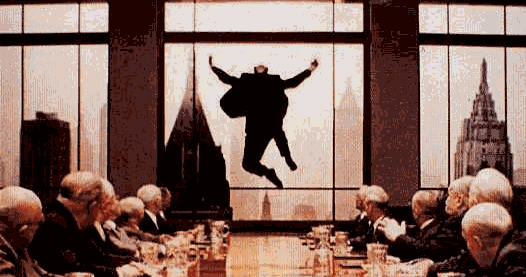
defenestration  (diːˌfɛnɪˈstreɪʃən)

n

the act of throwing a person or thing  out of a window

[C17: from New Latin dēfenestrātiō, from Latin de- + fenestra window

The freedictionary.com

‘If there is such a phenomenon as absolute evil, it consists of treating another human being as a thing

John Brunner ‘The Shockwave Rider

This small article a polemic against neoliberal hegemony; in particular the emerging issue of ‘surplus population’ as related to technological displacement in context of a free market, an issue purposive to such hegemony which as an ‘elephant growing in the panopticon’  i.e. not to be mentioned?

The central premise is that Artificial Intelligence (AI) + Robotics  comprise a nefarious as formulaic temptation to the elite of the ‘Technetronic era’ as Zbigniew Brzezinski put it: this consistent with a determinism as stems ontologically from ‘Empiricism’  form of a  ‘One Dimensionality’ as Marcuse phrased it over five Decades ago; and which thru being but mere simulacra, AI and Robotics represent an ontological imperative  potentially expropriated under pathology to denial of Kant’s concept of ‘categorical imperative’?  (That Kant did not subscribe to determinism is acknowledged). The neoliberal concepts of ‘Corporatism’ and ‘free market’ are powerful examples of this ‘one dimensionality’ which is clearly pathological, a topic notably explored by Joel Bakan concerning the pursuit of profit within a Corporatist framework.

– ‘One dimensionality in, one dimensionality out’– so it goes ontologically as to some  paraphrase of GIGO as trending alas way of ‘technological determinism’ towards an ‘Epitaph for Biodiversity’  as would be – way of ‘Garbage’ or ‘Junk’ un apperceived as much as ‘retrospection’ non occurrent indeed -and where ‘Farewell to the Working Class’ as André Gorz conceived to assume an entirely new meaning: -this to some denouement of  ‘Dystopian Nightmare’ as opposed to  ‘Utopian Dream’, alas; such the ‘Age of Leisure’  as ‘beckoning’ to be not for the majority or ‘Demos’,but rather  for the ‘technetronic elite’ and  their ‘AI’ and Robotics – such ‘leisure’ being as to a ‘freedom’ pathological and facilitated  by the absence of conscience as much as morality; such the ‘farewell’; such the defenestration of ‘surplus’ , such the ‘Age’ we ‘live’ within as to ‘expropriation’ and ‘arrogation’  to amount to  ‘Death by Panopticon’ such the ‘apotheosis’?

It is being so cheerful which keeps these small quarters going.

But digression.

–  It is a relatively small step from ‘the death of thought’ to ‘the death of Life’under Neoliberal Orthodoxy as proving to be the most toxic ideology ever knownsuch the hegemony as a deliberative, shift of the ‘ Overton Window’ currently occurring as to trend deterministic; such the mere necrotrophy as a ‘defenestration’ – and the ‘one percent’ but a deadly collective of parasitic orifice? For what is ‘Empiricism’ when implemented thru  AI and Robotic Technology in a Corporatist economy as but a ‘selective investment’  as to Research and Development by elite ‘private interests’,  which to a determinism so evidently entailing a whole raft of ‘consequence’ ; such the means, such the production, such the ‘phenomenology’ as ‘owned’ indeed? Under pathology, selectivity is impaired to point of ‘militarization’?

But foremost amongst said ‘raft’ of consequence – the concept of ‘classification’ as incorporates methodological reduction of the particular to a composite of generalities so typical of ‘Science’ as expropriated; the fruition thereof replicated not least thru ‘Consumerism’ – and ‘Lifestyle’ – as much as ‘Life’ reduced as much as abrogated to but correlation way  of ‘possession’ of ‘things’: this  as said replication expressed as much ‘thru’ Linnaeus as Marx  concerning ‘class’- and as results in concepts’ Incorporated’ such as the ‘Overton Window’ – as will be explored by way of ‘extrapolation’ below? The debasing of identity as a correlate of possessions as a necessary ‘abrogation’ by way of engineered ‘bio hack’ is only furthered, such the loss of dimensionality as a potential, by such as social media? An excellent multimedia illustration of such loss is found here.

It’s to be noted that for Empiricism the concept of ‘good’ and ‘evil’ entails an extra dimensionality  as ‘metaphysical’ – and that ‘Politics’ so deconstructed despite abuse under orthodoxy as to ‘mitigation’ remains as  ‘Moral Economics’ – this despite the  mitigative contention of neoliberal orthodoxy that there no morality in the ‘synonymy’; to a pragmatic as ‘Utilitarian’ point of a ‘Killing the Host’ prevailing at paradigmatic as much as Geopolitical level as but explicative of a ‘necrotrophy’; as much as the ‘defenestration’ as euphemism herein proposed this small article  would explicate?

Kudos to Michael Hudson for exposing, and continuing to expose, the ‘death of thought’ which Neoliberalism as an orthodoxy as but a mere ‘racket’ of ‘transfer of resources’ represents.

– Are we ‘on a roll’ here as much as ‘off the leash’ – such the rebellion ‘psycho political’; such the ‘CounterPunch’ by way of digital pamphleteering as ‘restricted code’ rejected evidenced by way of ‘alternative’?

‘Politics’ should mean a diversity biological as much as phenomenological; it should mean more than Empirical ‘utility’, by way of the extra dimensionality which Metaphysics represents; this, as much as ‘Democracy’ demands diversity; ‘thought permitted’ as evidencing same as much as questions allowed to be asked; while Corporatism as antithesis demands ‘line’, a homogeneity, a uniformity, an abrogation as to a contingency?

Whether ‘Empiricism’ as to Philosophy is ‘Essentialist’ or ‘Instrumentalist’ is as of much political relevance as the Medieval question ‘how many angels can dance upon the head of a needle?‘ – the tragic fact remaining in ‘Oceania’  become to Corporatism  is that the economic impact of (AI + Robotics) constitutes a ‘technological displacement’ which under a ‘one dimensionality’ as ‘Orthodox’  is as a ‘political impact’ at a quintessential or axiomatic level, such the ‘formulae’ as (=Ecocide) ‘completes’ under a determinism of hegemony as demands ‘whoredom’? AI and Robotics destroy the symbiotic relationship between production and consumption thru reducing the requirement for human labor as waged in the productive process; AI and Robotics thereby impact upon the distribution of resources as wage based. The fairy tale of compensatory employment opportunities is at best wishful thinking, at worst it is a purposively contrived propaganda?

‘Biodiversity’, alas, becoming more limited to a ‘Thanatos‘ of ‘Military Industrial Corporatist Complex’  as explicates the ‘Age of the Anthropocene’as of the ‘1%’ as funders of ‘hegemony’ such the transfer of resources?

‘As ‘we’ view the world so it becomes’, indeed – this as much as how ‘Others’, through hegemony as ‘Utilitarian’, would have it viewed – and that such a large part of ‘Currency’ as ‘it’  to the permit of ‘Hegemony’ which would control and issue views – such the window as ‘Overtonian’ as can be shifted?

How long before the ‘collateral damage’ concerning premature fatality and reduced life expectancy as evidenced in homelessness, withdrawal of social welfare, militarization of policing, drug abuse, including prescription of synthetic opioids, incarceration all as obscenities explicating the ‘cheapening of life’  becomes ‘formalised’ under neoliberal orthodoxy as euthanasia? To such an Overton Window would it at first be ‘voluntary’?

It was ‘Utilitarianism’ as gave the World the concept of ‘Panopticon’ back in the Eighteenth Century.

Apropos to such ‘Thanatos‘ identified:

Wherefore art thou ‘Eros’: as represented by checkout operator, bank teller, driver, warehouseman, barista, cook, secretary, journalist, lawyer, receptionist, ‘ human voice at the end of the line’ – such the insidious inroads being made consequent the advance of Empirical based Technology?

The ‘Litany’ of such ‘displacement/defenestration’ could go on, as it undoubtedly shall under prevailing Hegemony ‘Western’ as ‘Oceanic’ as much orthodox as ‘deadly’, such the invasive penetration of ‘one dimensionality’ as ‘technological displacement’ evidenced under neoliberal orthodoxy as entailing a transfer of resources to mere ‘Stateless Bastards’, such the point of a determinism as would prevail woeful?

Ponerological questions such as would not be asked commensurate:

Is the ultimate ‘stateless bastard’ satan?

Can ‘synonymy seen’ be’ revolutionary’?

‘Technological displacement’ under an ontology of ‘One Dimensionality’ aka‘Corporatism’ but a euphemism for ‘surplus population’; this as much as ‘Corporatism’ promotes the illusion of ‘Democracy’ by way of ‘mental cheating’; such the synonymy as ‘simulacra’ an ‘illusion’ denied – but ‘real’ under ‘doublethink’?

‘Trickle down economics’ is as real as much as ‘technological displacement’ to be compensated for in the ‘opening up of a whole new vista of opportunity’, such the death of thought as neoliberal orthodoxy represents some parallel of tales told by such as Horatio Alger to point of ‘illusion’ encouraged?

These small quarters would ‘rip a new one’ in Neoliberal Orthodoxy by way of polemic.

It remains a ‘big’ question under contemplation of the genius of Orwell and the highly perspicacious ratio of ‘1/15/84’ (hence the ‘one percent’) as to why, within an undoubtedly comprehensive as prescient Dystopian vision where ‘oligarchic collective’ a synonym of ‘technetronic elite’, he ‘permitted the currency’ of the ‘Prole’ as ‘84%’ to prevail as a presence rather than but a memory disappeared by way of ‘memory hole’?

Under neoliberal orthodoxy the political utility of the ‘Proles’ and in particular the ‘Lumpenproletariat’, alas, is as to but fear as a ‘stick’; a basis of control and manipulation same sense as Upton Sinclair explicated ‘carrot’ contingent by way of synonym seen: to wit;  accept control and manipulation as ‘rewarded’ or be ‘expelled’; be but as a ‘Prole’ subsisting and awaiting death, such the economic incarceration as ‘CAFO’ epitomises the cheapening of life under a hegemony as has corollary of alienation, marginalization and impoverishment wielded under Dystopian imperative; this to a ‘transfer of resources’ from ‘Eros‘ to ‘Thanatos‘ reinforced thru contingency of profit such the ‘ponerology’ of ‘Biodiversity’ reduced by way of paradigm Geopolitical?

To love Life is to loathe the deadly; such the philanthropy as would only be evidenced, such the irony, by the ‘ragged trousered’ as so reduced, such the divide et imperaevidenced?

-And so to ‘defenestration’ as ongoing 21stC. by way of ‘surplus population’ generated deterministically as to be dealt with ‘Utilitarian’ as much as the elimination of ‘Biodiversity’ such the ‘technetronic era’ as much as of Dystopia for Humanity as opposed to a Utopia for (AI + Robotics)?

In the annals of International Finance, in which ‘usury’ figures large as polymorphous(?), the power of (AI + Robotics) ‘growing’ as ‘metastasising’ –  as evidenced by the concept of ‘Dark Pools’, and in political manipulation to point of control and issue of currency  by algorithms, such as  infamously deployed by the now defunct Cambridge Analytica using data ‘supplied’ by Facebook are on the rise – such the ‘technetronic era’ furthered?

When neoliberal orthodoxy states Say hello to my little friend!‘ way of the militarization of ‘AI +Robotics” then a ‘defenestration’ form of ‘take all to hell’ will occur, such the shift of the ‘Overton Window’ in progress?

As to the ‘Overton Window’ as in title this small article; a fellow ‘CounterPuncher ‘sees thru it’ most apposite:

Overton described the evolution to broad public acceptance as a process that develops by degrees: “Unthinkable; Radical; Acceptable; Sensible; Popular; Policy.” The right used this model and stuck with it for 30 years to achieve its current dominance. Ideas like slashing unemployment insurance and welfare, privatizing crown corporations, gutting taxes on the wealthy, making huge cuts to social programs and signing “trade” deals that give corporations more power, were all “unthinkable” or “radical” in the beginning. But after 30 years of relentless promotion and the courting of politicians, all of these ideas are now public policy.

Murray Dobbin

– You see it is really quite ‘simple’ when boiled down, such the reductioad absurdumas ‘one dimensionality’ the result of Empiricism embraced to an exclusion of alternative, as ‘Evolution’ circumscribes as much as theoretically delineates?

‘The Talking Heads’ got it right regarding the consequences of neoliberal orthodoxy as concerns the masses and the ‘death of thought’ whereby a ‘Road to Nowhere’  becoming more ‘incorporative’?

Thru Empiricism as an ‘Ontology’, Man in process of nurturing a necrotrophy, such the orifice as existing to be stuffed to a ‘friction of the finitude’. Each ‘Billionaire’ as become so Empirically quantifiable as under such ‘neoliberal jungle’ such the paradigm of abrogation is as to to an obscene ‘transfer of resources’ whereby egocentricity a ‘Thanatos‘ as opposed to ‘Eros‘, and whereby in such land of the blind as a ‘Kingdom’, the ‘one eyed’ as ‘one dimensional’ as much as Empiricism lack any sense of empathy let alone mercy, and which AI and Robotics to epitomise?

Under such ‘paradigm’ of necrotrophy as debasement as much as abrogation it is as blessed to be a Prole? As Martin Luther so humorously said:

‘So our Lord God commonly gives riches to those gross asses to whom He vouchsafes nothing else’

The rationale for composing this small article is not to be pessimistic, rather such the pretension it is as to be a ‘gadfly’ against the manifestly ongoing cheapening of life thru which such a small minority profit from, and which yet remains mutable, as future submissions shall propose.

Colonizing the Western Mind

By Jason Hirthler

Source: CounterPunch

In Christopher Nolan’s captivating and visually dazzling film Inception, a practitioner of psychic corporate espionage must plant and idea inside a CEO’s head. The process is called inception, and it represents the frontier of corporate influence, in which mind spies no longer just “extract” ideas from the dreams of others, but seed useful ideas in a target’s subconscious. Inception is a well-crafted piece of futuristic sci-fi drama, but some of the ideas it imparts are already deeply embedded in the American subconscious. The notion of inception, of hatching an idea in the mind of a man or woman without his or her knowledge, is the kernel of propaganda, a black art practiced in the States since the First World War. Today we live beneath an invisible cultural hegemony, a set of ideas implanted in the mass mind by the U.S. state and its corporate media over decades. Invisibility seems to happen when something is either obscure or ubiquitous. In a propaganda system, an overarching objective is to render the messaging invisible by universalizing it within the culture. Difference is known by contrast. If there are no contrasting views in your field of vision, it’s easier to accept the ubiquitous explanation. The good news is that the ideology is well-known to some who have, for one lucky reason or another, found themselves outside the hegemonic field and are thus able to contrast the dominant worldview with alternative opinions. On the left, the ruling ideology might be described as neoliberalism, a particularly vicious form of imperial capitalism that, as would be expected, is camouflaged in the lineaments of humanitarian aid and succor.

Inception 1971

In a short span of time in the 1970s, dozens of think tanks were established across the western world and billions of dollars were spent proselytizing the tenets of the Powell Memo in 1971, which galvanized a counter-revolution to the liberal upswing of the Sixties. The neoliberal economic model of deregulation, downsizing, and privatization was preached by the Reagan-Thatcher junta, liberalized by the Clinton regime, temporarily given a bad name by the unhinged Bush administration, and saved by telegenic restoration of the Obama years. The ideology that underlay the model saturated academia, notably at the University of Chicago, and the mainstream media, principally at The New York Times. Since then it has trickled down to the general populace, to whom it now feels second nature. Today think tanks like the Heritage Foundation, the Brookings Institute, Stratfor, Cato Institute, American Enterprise Institute, Council on Foreign Relations, Carnegie Endowment, the Open Society Foundation, and the Atlantic Council, among many others, funnel millions of dollars in donations into cementing neoliberal attitudes in the American mind.

The ideological assumptions, which serve to justify what you could call neocolonial tactics, are relatively clear: the rights of the individual to be free of overreach from monolithic institutions like the state. Activist governments are inherently inefficient and lead directly to totalitarianism. Markets must be free and individuals must be free to act in those markets. People must be free to choose, both politically and commercially, in the voting booth and at the cash register. This conception of markets and individuals is most often formulated as “free-market democracy,” a misleading conceit that conflates individual freedom with the economic freedom of capital to exploit labor. So when it comes to foreign relations, American and western aid would only be given on the condition that the borrowers accepted the tenets of an (highly manipulable) electoral system and vowed to establish the institutions and legal structures required to fully realize a western market economy. These demands were supplemented with notions of the individual right to be free of oppression, some fine rhetoric about women and minorities, and somewhat more quietly, a judicial understanding that corporations were people, too. Together, an unshackled economy and an unfettered populace, newly equipped with individual rights, would produce the same flourishing and nourishing demos of mid-century America that had been the envy of humanity.

A False Promise

This ‘Washington Consensus’ is the false promise promoted by the West. The reality is quite different. The crux of neoliberalism is to eliminate democratic government by downsizing, privatizing, and deregulating it. Proponents of neoliberalism recognize that the state is the last bulwark of protection for the common people against the predations of capital. Remove the state and they’ll be left defenseless. Think about it. Deregulation eliminates the laws. Downsizing eliminates departments and their funding. Privatizing eliminates the very purpose of the state by having the private sector take over its traditional responsibilities. Ultimately, nation-states would dissolve except perhaps for armies and tax systems. A large, open-border global free market would be left, not subject to popular control but managed by a globally dispersed, transnational one percent. And the whole process of making this happen would be camouflaged beneath the altruistic stylings of a benign humanitarianism.

Globalists, as neoliberal capitalists are often called, also understood that democracy, defined by a smattering of individual rights and a voting booth, was the ideal vehicle to usher neoliberalism into the emerging world. Namely because democracy, as commonly practiced, makes no demands in the economic sphere. Socialism does. Communism does. These models directly address ownership of the means of production. Not so democratic capitalism. This permits the globalists to continue to own the means of production while proclaiming human rights triumphant in nations where interventions are staged. The enduring lie is that there is no democracy without economic democracy.

What matters to the one percent and the media conglomerates that disseminate their worldview is that the official definitions are accepted by the masses. The real effects need never be known. The neoliberal ideology (theory) thus conceals the neoliberal reality (practice). And for the masses to accept it, it must be mass produced. Then it becomes more or less invisible by virtue of its universality.

A Pretext for Pillage

Thanks to this artful disguise, the West can stage interventions in nations reluctant to adopt its platform of exploitation, knowing that on top of the depredations of an exploitative economic model, they will be asked to call it progress and celebrate it.

Washington, the metropolitan heart of neoliberal hegemony, has numerous methods of convincing reluctant developing nations to accept its neighborly advice. To be sure, the goal of modern colonialism is to find a pretext to intervene in a country, to restore by other means the extractive relations that first brought wealth to the colonial north. The most common pretexts for intervention depict the target nation in three distinct fashions.

First, as an economic basket case, a condition often engineered by the West in what is sometimes called, “creating facts on the ground.” By sanctioning the target economy, Washington can “make the economy scream,” to using war criminal Henry Kissinger’s elegant phrasing. Iran, Syria, and Venezuela are relevant examples here. Second, the West funds violent opposition to the government, producing unrest, often violent riots of the kind witnessed in Dara, Kiev, and Caracas. The goal is either to capsize a tottering administration or provoke a violent crackdown, at which point western embassies and institutions will send up simultaneously cries of tyranny and brutality and insist the leader step aside. Libya, Syria, and Venezuela are instructive in this regard. Third, the country will be pressured to accept some sort of military fettering thanks to either a false flag or manufactured hysteria over some domestic program, such as the WMD restrictions on Iraq, chemical weapons restrictions on Syria, or the civilian nuclear energy restrictions on Iran. Given that the U.S. traffics in WMDs, bioweapons, and nuclear energy itself, insisting others forsake all of these is perhaps little more than racially motivated despotry. But significant fear mongering in the international media will provide sufficient moral momentum to ram through sanctions, resolutions, and inspection regimes with little fanfare.

Schooling the Savages

Once the pretext is established, the appropriate intervention is made. There’s no lack of latent racism embedded in each intervention. Something of Edward Said’s Orientalism is surely at play here; the West is often responding to a crude caricature rather than a living people. One writer, Robert Dale Parker, described western views of Asia as little more than, “a sink of despotism on the margins of the world.” Iran is incessantly lensed through a fearful distrust of the ‘other’, those abyssal Persians. Likewise, North Korea is mythologized as a kingdom of miniature madmen, possessed of a curious psychosis that surely bears no relation to the genocidal cleansing of 20 percent of its population in the Fifties, itself an imperial coda to the madness of Hiroshima.

The interventions, then, are little different than the missionary work of early colonizers, who sought to entrap the minds of men in order to ensnare the soul. Salvation is the order of the day. The mission worker felt the same sense of superiority and exceptionalism that inhabits the mind of the neoliberal. Two zealots of the age peddling different editions of a common book. One must carry the gospel of the invisible hand to the unlettered minions. But the gifts of the enlightened interloper are consistently dubious.

It might be the loan package that effectively transfers economic control out of the hands of political officials and into the hands of loan officers, those mealy-mouthed creditors referred to earlier. It may be the sanctions that prevent the country from engaging in dollar transactions and trade with numberless nations on which it depends for goods and services. Or it might be that controversial UNSC resolution that leads to a comprehensive agreement to ban certain weapons from a country. Stipulations of the agreement will often include a byzantine inspections regime full of consciously-inserted trip wires designed to catch the country out of compliance and leverage that miscue to intensify confrontational rhetoric and implement even more far-reaching inspections.

Cracking the Shell

The benign-sounding structural adjustments of the West have fairly predictable results: cultural and economic chaos, rapid impoverishment, resource extraction with its attendant ecological ruin, transfer of ownership from local hands to foreign entities, and death from a thousand causes. We are currently sanctioning around 30 nations in some fashion; dozens of countries have fallen into ‘protracted arrears’ with western creditors; and entire continents are witnessing huge outflows of capital–on the order of $100B annually–to the global north as debt service. The profiteering colonialists of the West make out like bandits. The usual suspects include Washington and its loyal lapdogs, the IMF, World Bank, EU, NATO, and other international institutions, and the energy and defense multinationals whose shareholders and executive class effectively run the show.

So why aren’t Americans more aware of this complicated web of neocolonial domination? Italian communist Antonio Gramsci, who pioneered the concept of cultural hegemony, suggested that the ruling ideologies of the bourgeoisie were so deeply embedded in popular consciousness that the working classes often supported leaders and ideas that were antithetical to their own interests. Today, that cultural hegemony is neoliberalism. Few can slip its grasp long enough to see the world from an uncolored vantage point. You’ll very rarely encounter arguments like this leafing through the Times or related broadsheets. They don’t fit the ruling dogma, the Weltanschauung (worldview) that keeps the public mind in its sleepy repose.

But French-Algerian philosopher Louis Althusser, following Gramsci, believed that, unlike the militarized state, the ideologies of the ruling class were penetrable. He felt that the comparatively fluid zones of Ideological State Apparatuses (ISAs) were contexts of class struggle. Within them, groups might attain a kind of ‘relative autonomy’, by which they could step outside of the monolithic cultural ideology. The scales would fall. Then, equipped with new knowledge, people might stage an inception of their own, cracking open the cultural hegemony and reshaping its mythos in a more humane direction. This seems like an imperative for modern American culture, buried as it is beneath the hegemonic heft of the neoliberal credo. These articles of false faith, this ideology of deceit, ought to be replaced with new declarations of independence, of the mind if not the mainstream.


Jason Hirthler is a veteran of the communications industry and author of The Sins of Empire: Unmasking American Imperialism. He lives in New York City and can be reached at jasonhirthler@gmail.com.