Net Zero, the Digital Panopticon and the Future of Food 

By Colin Todhunter

Source: Off-Guardian

The food transition, the energy transition, net-zero ideology, programmable central bank digital currencies, the censorship of free speech and clampdowns on protest. What’s it all about? To understand these processes, we need to first locate what is essentially a social and economic reset within the context of a collapsing financial system.

Writer Ted Reece notes that the general rate of profit has trended downwards from an estimated 43% in the 1870s to 17% in the 2000s. By late 2019, many companies could not generate enough profit. Falling turnover, squeezed margins, limited cashflows and highly leveraged balance sheets were prevalent.

Professor Fabio Vighi of Cardiff University has described how closing down the global economy in early 2020 under the guise of fighting a supposedly new and novel pathogen allowed the US Federal Reserve to flood collapsing financial markets (COVID relief) with freshly printed money without causing hyperinflation. Lockdowns curtailed economic activity, thereby removing demand for the newly printed money (credit) in the physical economy and preventing ‘contagion’.

According to investigative journalist Michael Byrant, €1.5 trillion was needed to deal with the crisis in Europe alone. The financial collapse staring European central bankers in the face came to a head in 2019. The appearance of a ‘novel virus’ provided a convenient cover story.

The European Central Bank agreed to a €1.31 trillion bailout of banks followed by the EU agreeing to a €750 billion recovery fund for European states and corporations. This package of long-term, ultra-cheap credit to hundreds of banks was sold to the public as a necessary programme to cushion the impact of the pandemic on businesses and workers.

In response to a collapsing neoliberalism, we are now seeing the rollout of an authoritarian great reset — an agenda that intends to reshape the economy and change how we live.

SHIFT TO AUTHORITARIANISM

The new economy is to be dominated by a handful of tech giants, global conglomerates and e-commerce platforms, and new markets will also be created through the financialisation of nature, which is to be colonised, commodified and traded under the notion of protecting the environment.

In recent years, we have witnessed an overaccumulation of capital, and the creation of such markets will provide fresh investment opportunities (including dodgy carbon offsetting Ponzi schemes)  for the super-rich to park their wealth and prosper.

This great reset envisages a transformation of Western societies, resulting in permanent restrictions on fundamental liberties and mass surveillance. Being rolled out under the benign term of a ‘Fourth Industrial Revolution’, the World Economic Forum (WEF) says the public will eventually ‘rent’ everything they require (remember the WEF video ‘you will own nothing and be happy’?): stripping the right of ownership under the guise of a ‘green economy’ and underpinned by the rhetoric of ‘sustainable consumption’ and ‘climate emergency’.

Climate alarmism and the mantra of sustainability are about promoting money-making schemes. But they also serve another purpose: social control.

Neoliberalism has run its course, resulting in the impoverishment of large sections of the population. But to dampen dissent and lower expectations, the levels of personal freedom we have been used to will not be tolerated. This means that the wider population will be subjected to the discipline of an emerging surveillance state.

To push back against any dissent, ordinary people are being told that they must sacrifice personal liberty in order to protect public health, societal security (those terrible Russians, Islamic extremists or that Sunak-designated bogeyman George Galloway) or the climate. Unlike in the old normal of neoliberalism, an ideological shift is occurring whereby personal freedoms are increasingly depicted as being dangerous because they run counter to the collective good.

The real reason for this ideological shift is to ensure that the masses get used to lower living standards and accept them. Consider, for instance, the Bank of England’s chief economist Huw Pill saying that people should ‘accept’ being poorer. And then there is Rob Kapito of the world’s biggest asset management firm BlackRock, who says that a “very entitled” generation must deal with scarcity for the first time in their lives.

At the same time, to muddy the waters, the message is that lower living standards are the result of the conflict in Ukraine and supply shocks that both the war and ‘the virus’ have caused.

The net-zero carbon emissions agenda will help legitimise lower living standards (reducing your carbon footprint) while reinforcing the notion that our rights must be sacrificed for the greater good. You will own nothing, not because the rich and their neoliberal agenda made you poor but because you will be instructed to stop being irresponsible and must act to protect the planet.

NET-ZERO AGENDA

But what of this shift towards net-zero greenhouse gas emissions and the plan to slash our carbon footprints? Is it even feasible or necessary?

Gordon Hughes, a former World Bank economist and current professor of economics at the University of Edinburgh, says in a new report that current UK and European net-zero policies will likely lead to further economic ruin.

Apparently, the only viable way to raise the cash for sufficient new capital expenditure (on wind and solar infrastructure) would be a two decades-long reduction in private consumption of up to 10 per cent. Such a shock has never occurred in the last century outside war; even then, never for more than a decade.

But this agenda will also cause serious environmental degradation. So says Andrew Nikiforuk in the article The Rising Chorus of Renewable Energy Skeptics, which outlines how the green techno-dream is vastly destructive.

He lists the devastating environmental impacts of an even more mineral-intensive system based on renewables and warns:

“The whole process of replacing a declining system with a more complex mining-based enterprise is now supposed to take place with a fragile banking system, dysfunctional democracies, broken supply chains, critical mineral shortages and hostile geopolitics.”

All of this assumes that global warming is real and anthropogenic. Not everyone agrees. In the article Global warming and the confrontation between the West and the rest of the world, journalist Thierry Meyssan argues that net zero is based on political ideology rather than science. But to state such things has become heresy in the Western countries and shouted down with accusations of ‘climate science denial’.

Regardless of such concerns, the march towards net zero continues, and key to this is the United Nations Agenda 2030 for Sustainable Development Goals.

Today, almost every business or corporate report, website or brochure includes a multitude of references to ‘carbon footprints’, ‘sustainability’, ‘net zero’ or ‘climate neutrality’ and how a company or organisation intends to achieve its sustainability targets. Green profiling, green bonds and green investments go hand in hand with displaying ‘green’ credentials and ambitions wherever and whenever possible.

It seems anyone and everyone in business is planting their corporate flag on the summit of sustainability. Take Sainsbury’s, for instance. It is one of the ‘big six’ food retail supermarkets in the UK and has a vision for the future of food that it published in 2019.

Here’s a quote from it:

“Personalised Optimisation is a trend that could see people chipped and connected like never before. A significant step on from wearable tech used today, the advent of personal microchips and neural laces has the potential to see all of our genetic, health and situational data recorded, stored and analysed by algorithms which could work out exactly what we need to support us at a particular time in our life. Retailers, such as Sainsbury’s could play a critical role to support this, arranging delivery of the needed food within thirty minutes — perhaps by drone.”

Tracked, traced and chipped — for your own benefit. Corporations accessing all of our personal data, right down to our DNA. The report is littered with references to sustainability and the climate or environment, and it is difficult not to get the impression that it is written so as to leave the reader awestruck by the technological possibilities.

However, the promotion of a brave new world of technological innovation that has nothing to say about power — who determines policies that have led to massive inequalities, poverty, malnutrition, food insecurity and hunger and who is responsible for the degradation of the environment in the first place — is nothing new.

The essence of power is conveniently glossed over, not least because those behind the prevailing food regime are also shaping the techno-utopian fairytale where everyone lives happily ever after eating bugs and synthetic food while living in a digital panopticon.

FAKE GREEN

The type of ‘green’ agenda being pushed is a multi-trillion market opportunity for lining the pockets of rich investors and subsidy-sucking green infrastructure firms and also part of a strategy required to secure compliance required for the ‘new normal’.

It is, furthermore, a type of green that plans to cover much of the countryside with wind farms and solar panels with most farmers no longer farming. A recipe for food insecurity.

Those investing in the ‘green’ agenda care first and foremost about profit. The supremely influential BlackRock invests in the current food system that is responsible for polluted waterways, degraded soils, the displacement of smallholder farmers, a spiralling public health crisis, malnutrition and much more.

It also invests in healthcare — an industry that thrives on the illnesses and conditions created by eating the substandard food that the current system produces. Did Larry Fink, the top man at BlackRock, suddenly develop a conscience and become an environmentalist who cares about the planet and ordinary people? Of course not.

Any serious deliberations on the future of food would surely consider issues like food sovereignty, the role of agroecology and the strengthening of family farms — the backbone of current global food production.

The aforementioned article by Andrew Nikiforuk concludes that, if we are really serious about our impacts on the environment, we must scale back our needs and simplify society.

In terms of food, the solution rests on a low-input approach that strengthens rural communities and local markets and prioritises smallholder farms and small independent enterprises and retailers, localised democratic food systems and a concept of food sovereignty based on self-sufficiency, agroecological principles and regenerative agriculture.

It would involve facilitating the right to culturally appropriate food that is nutritionally dense due to diverse cropping patterns and free from toxic chemicals while ensuring local ownership and stewardship of common resources like land, water, soil and seeds.

That’s where genuine environmentalism and the future of food begins.

A New Aesthetic

By Damaris Zehner

Source: Resilience

There are all these good ideas – intensive agriculture, organic farming, permaculture, the local food movement. But why is most food still not grown this way, if it really is better? Why don’t farmers switch to sustainable land use methods? It seems to me there are at least four reasons.

First is the conservative nature of farming. Any activity that involves a large and long investment for an uncertain outcome is going to be conservative; no one wants to experiment when a year’s income is riding on the results. Farmers tend to stick to what has seemed to work. The psychology of previous investment plays a part in their choices as well. Once you’ve bought the huge combine, well, you have to use it.

Even when things don’t work so well, farmers will keep doing them if there are financial incentives to do so. This is the second reason. Government programs have tended to encourage big agribusinesses and have been less friendly to smaller, more varied farms.

Third, farmers love their machines. All Americans do. We fall every time for the promise that new technology will make our lives easier, more fun, more productive, and more sophisticated, and people with outdated technology, whether cell phones or tractors, get made fun of. Many people don’t have the time or the patience for more manual ways of working. I knew of a horse farmer who recently complained that he wouldn’t hire young men on his farm because they got impatient with the horses and, as he put it, just wanted to be roaring off with an internal combustion engine. (His workers were young women). These young men have become habituated to the speed and power made possible by fossil fuels and get rattled when asked to move more slowly.

Finally, there is an unconscious but still powerful motivation why farmers don’t want to stop spraying and switch to more natural methods of food production. It is a mistaken aesthetic that dictates how people see and judge the land around them, that tells us what looks beautiful and productive and “American” – that is, efficient, high-tech, and gleaming with the promise of the future. Perfect, undisturbed expanses of commodity crops, synchronized lines of combines churning through thousand-acre wheat fields, shiny factories, and brightly colored grocery stores are our proof that we are not a third-world nation, or Amish, or hippies – that we are still orthodox worshipers of the god of progress.

I don’t dispute the attraction of the aesthetic. Honestly, the land around here looks pretty good. Or at least it looks pretty. But the cost of those perfect fields and vast expanses of monoculture may be more than we can pay. Our aesthetics are as damaging to the environment as our greed or carelessness. So we need to move toward a new aesthetic.

Before we can do so, we need to ask ourselves: how much of the world are we responsible for tidying up? Nature is messy by our standards. A patch of disturbed earth becomes populated with a swirling mob of what we’d call weeds – dock, plantain, dandelion, mulberry, crabgrass, lamb’s quarters, and a hundred plants I don’t have a name for. And that bothers us. We spray, mow, and weed, in the process disturbing the natural succession of plants. We say that keeping our lawns, gardens, and fields as pure monoculture is more efficient and attractive. I drove with farmers past fields of soybeans shortly after the introduction of Round-Up herbicide, and they talked about how beautiful the thick carpet of identical plants is. They’re not wrong. The lush uniformity is beautiful. But I’m not sure we have the right to expect the same sort of beauty from nature that we can create within our houses. Should a farm field look like wall-to-wall carpeting? Should every molehill be leveled, every fence row scorched, whatever t cost, just because we think it looks nicer?

We have neighbors down the road whose property has been described as a doll’s house because of its detailed perfection. It’s a good description – they treat their two acres as if it were as entirely under their control as a doll’s house. The fences have lines of brown under them where the mower can’t reach and herbicide has been sprayed. Their lawn is grass only, no violets or dandelions. Their mature hardwood trees are all pollarded to be a matching height. It’s pretty, I suppose. It’s also horrifying as an illustration of their attitude toward natural beauty. To speak in hyperbolic terms, those friendly neighbors are conducting an all-out war on nature, with policies of scorched earth and ethnic cleansing, and the result is extreme totalitarianism. This stands in striking contrast to the permaculture sites I’ve visited, which look like a hodgepodge of annuals, perennials, weeds, and small creatures and don’t involve any mowing. I suspect that everyone’s first reaction to seeing permaculture in action is, in fact, “Why don’t they mow?” They have their reasons, and they have a different aesthetic.

I admit I like the cleanliness and order that humans impose. I’m all right with keeping my house clean, but I have to decide how far my household extends. If I find insects on my kitchen counter, I kill them. But should I kill the insects in my yard? All the insects in the world? Because if farmers adopt a policy of insect genocide, as most do, it’s going to have costs to the surroundings – which include me. When the summer crop-dusting airplanes fly overhead carpet-bombing bugs and weeds, I have to run to bring the laundry inside and shut the windows if it’s windy, which it usually is, because – call me a crazy tree-hugger – I prefer my sheets and towels to smell of fresh air and not the toxin du jour. That’s where my aesthetic differs from the farmers’.

Farmers around here will tell you that they are aiming for efficiency, and I do appreciate that harvesting crops is easier when the equipment is not clogged with morning glory vines and ragweed stalks. I also understand that weeds and other plants compete with the crops and lower farmers’ yields, so there is a financial as well as an aesthetic motivation for them to keep their fields clean. But there’s no question that these farmers are also driven by the false aesthetic of human-imposed purity. I watch while they grub out a small patch of trees that they had no problem maneuvering around, just so the field looks “clean.”

It’s a competitive aesthetic, too. People in this small community will gossip about and criticize landowners whose fields aren’t clean – I hear them every year talking about whose land isn’t yet sprayed, tilled, or ditched. People from out of our area have asked me when they’ve come over to visit, “Whose land is that down the road? It looks bad.” What they mean when they say that farmers are not keeping their land “clean” is that farmers are not leaving a toe-hold for nature on their property. Rabbits and deer have no right to a corridor of shelter; killdeer and quail have to keep packing up and moving as their surroundings are cut down; coyotes are shot. And once we’ve expunged the aborigines, we can live the mindless imperialist lifestyle we like.

I have some sympathy, I guess. I don’t want coyotes eating my goats or rabbits ruining my garden. But I have to ask the question again: how much of the natural world do we have the right to control at the same level that we control our houses and yards? If we are going to live in a better balance with nature than we do now, we have to change not only our acquisitiveness and our focus on profit and exploitation; we also have to learn to see beauty in what we now consider messiness.

HOW THE AMERICAN CULTURE OF CONVENIENCE IS KILLING US

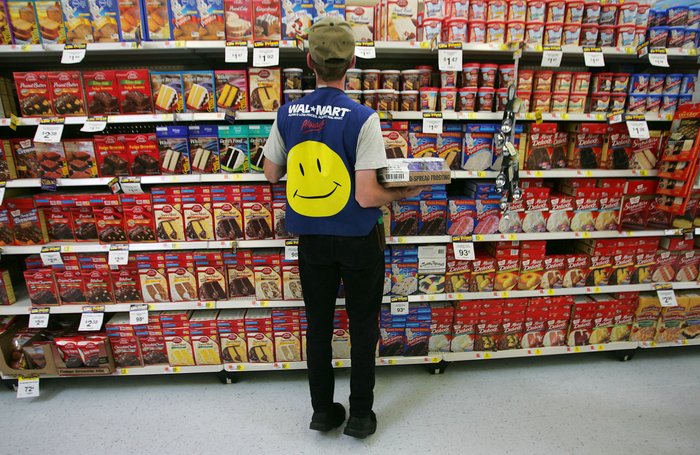
TROY, OH – MAY 11: An employee restocks a shelf in the grocery section of a Wal-Mart Supercenter May 11, 2005 in Troy, Ohio. Wal-Mart, America’s largest retailer and the largest company in the world based on revenue, has evolved into a giant economic force for the U.S. economy. With growth, the company continues to weather criticism of low wages, anti-union policies as well as accusations that it has homogenized America’s retail economy and driven traditional stores and shops out of business. (Photo by Chris Hondros/Getty Images)

By Daisy Luther

Source: Waking Times

In the United States, we are lucky to have massive convenience at our fingertips. I was talking to one of the instructors for the urban survival course, who is from Sweden, on a car ride. He was blown away by some of the things I told him about the levels of convenience and comfort in the United States. Things I completely took for granted don’t even exist there. I thought some of you might be interested in hearing about some of the insights we discussed.

Before I left for the course, I was walking my dogs a mile or two every day with my dogs, but that was about it. I thought it was enough but I learned during the field exercises that it wasn’t even close to the physicality required during an SHTF situation. But I digress. Let’s get back to convenience.

A caveat before people respond indignantly and tell me about all the inconvenience with which they deal every day: this is an opinion piece. Obviously many people in America still work out hard and have manual jobs. But when two-thirds of American adults and 30% of American children are overweight or obese, you have to see that you are not in the majority.

And it’s the majority here that I’m discussing. Between a combination of low-quality food and extremely sedentary lifestyles, the majority are killing themselves with convenience.

The American Culture of Convenience

The first thing that struck me when I landed in the Balkans was how different their lifestyle is from ours in the United States. But the longer I’ve been here, the more obvious it has become.

In the United States, depending on where you live, everything is dropped in your lap.

Food can be quickly acquired by shouting your order into a microphone and driving around a building, all without you having to leave your car. And if you live in a larger town or city, with the advent of services like GrubHub and DoorDash, the food delivered to your home is no longer the domain of pizza chains. You can have your choice of practically any restaurant in town brought right to your door within 45 minutes.

But it isn’t just about food. Instacart offers pick-up services from a wide variety of stores, including places like chain grocers, Wal-Mart, and Target. All you have to do is drive up, let them know by phone that you’ve arrived, and pop your trunk. Poof. Your shopping is done. In some cities, you can even use services like Instacart to have these things brought to your door.

Amazon has brought us practically anything else we could want with two-day shipping, regardless of where you live in the country. Gone are the days of scouring half a dozen stores to locate the whatchamacallit you needed. A quick search on Amazon and One-Click ordering and it’s yours within 48 hours and you never moved off your comfy chair.

If you need to go somewhere you don’t even have to drive yourself or take public transit. Uber or Lyft will happily send somebody to pick you up and drive you anywhere you need to go for a reasonable price, and you can watch the approach of your driver from the convenience of your phone.

Entire billion dollar industries are evolving to make our lives more convenient and easy every single day. Imagine how stunned our hunter-gatherer ancestors would be to discover we don’t even have to leave the house to be clothed and fed in epic abundance.

We don’t walk much, either.

And speaking of drive-thrus and driving to the store to get your Instacart packages, we drive everywhere. Part of this is because of the way suburbia is developed. It’s rare to live in a neighborhood where you can walk to the market, the bakery, and the wine store. So instead of walking to get our goods, we drive there, dash in, and get back in our cars. Those in big cities probably walk far more than those in suburbia, and for those in the country, it depends if they actually have a place to walk and whether they’re taking care of a large property.

And if we’re not walking to run our errands, we’re not carrying stuff. We get as close as possible with our cars if heavy groceries need to be lugged in and we carry as little as we can if we’re heading somewhere. When you walk the dogs, you might take your phone and some poop bags but you’re generally not taking it as a training opportunity and strapping on a pack.

Then there are the stairs.

Even two-story buildings in the United States have elevators much of the time because everything, by law, has to be easily accessible to every person. (And no, I’m not saying that people in wheelchairs need to try to haul themselves up the stairs. I’m discussing a trend.) But it goes even further than that. Adding elevators to your home is a growing trend in both the United States and Canada. New home builders are including elevators in the original design of some homes.

On the other hand, in Europe, they don’t have elevators in many buildings with fewer than five floors. I walked up and down more stairs in the past month than I have in the past year at home combined, and I live in a three-story house.

And the list of conveniences that would blow the minds of people I met in the Balkans goes on.

It’s an agoraphobic’s paradise in the United States.

You can get all sorts of mobile services that come to your door – everything from hairstyling to dog grooming. Other people mow our lawns, clean our homes, service our vehicles, and take care of us in general. There are even people who hire others to walk their dogs. Some people definitely need help with physical tasks but able-bodied people should be able to do a little yard work, shouldn’t we? Especially if we’re preparing for some kind of apocalypse.

In many areas, things are perfectly level, the sidewalks are carefully maintained (because who wants to ask for trouble in our litigious society), and a slight incline is considered a “hill” that people avoid to make their dog walk a little easier.

You can get meal kits brought to your door with every single ingredient you need to make a gourmet meal, right down to the seasonings accurately doled out in little packages. You can have fresh fruits and vegetables dropped off at your door by your local CSA. You can get subscription services of all types with the delivery of things like cosmetics, fitness gear, food from exotic locales, wine, candy, home decor items, socks, and dog paraphernalia.

Looking at it from the perspective of the area where I’ve been spending time, it’s simply mind-boggling that all of these riches are brought to you at the click of a button.

And it’s killing us.

As I mentioned earlier in this article, the obesity rate in the United States is staggering. A lot of it is our food. Thanks to subsidization by the USDA, many of the foods that are cheap are highly processed with low-quality ingredients. The NY Times reports:

At a time when almost three-quarters of the country is overweight or obese, it comes as no surprise that junk foods are the largest source of calories in the American diet. Topping the list are grain-based desserts like cookies, doughnuts and granola bars. (Yes, granola bars are dessert.)

That’s according to data from the federal government, which says that breads, sugary drinks, pizza, pasta dishes and “dairy desserts” like ice cream are also among Americans’ top 10 sources of calories.

What do these foods have in common? They are largely the products of seven crops and farm foods — corn, soybeans, wheat, rice, sorghum, milk and meat — that are heavily subsidized by the federal government, ensuring that junk foods are cheap and plentiful, experts say.

Between 1995 and 2010, the government doled out $170 billion in agricultural subsidies to finance the production of these foods, the latter two in part through subsidies on feed grains. While many of these foods are not inherently unhealthy, only a small percentage of them are eaten as is. Most are used as feed for livestock, turned into biofuels or converted to cheap products and additives like corn sweeteners, industrial oils, processed meats and refined carbohydrates. (source)

And even when we try to clean up our diets, foods are genetically modified, produce is doused in pesticides, and it’s packaged in all sorts of hormone-disrupting material that leaches in when you heat it up.

But it’s not just the crappy food. A lot of folks in the United States just do not get off their butts. And – I hate to say it – but I’m talking to a lot of people in the survival and preparedness world. Sitting at a keyboard or phone typing all day while Netflix plays in the background is sedentary to a deadly degree. On average Americans sit for 8.2 hours per day and this does not include the average 7-ish hours a day we’re sleeping.  And when we’re not sitting, it doesn’t mean we’re doing things that are good for us. We spend a great deal of time standing in line and driving in our cars. And the trend toward inactivity is only increasing.

Meanwhile, obesity contributes to many diseases such as:

  • High blood glucose (sugar) or diabetes.
  • High blood pressure (hypertension).
  • High blood cholesterol and triglycerides (dyslipidemia, or high blood fats).
  • Heart attacks due to coronary heart disease, heart failure, and stroke.
  • Bone and joint problems, more weight puts pressure on the bones and joints. This can lead to osteoarthritis, a disease that causes joint pain and stiffness.
  • Stopping breathing during sleep (sleep apnea). This can cause daytime fatigue or sleepiness, poor attention, and problems at work.
  • Gallstones and liver problems.
  • Some cancers.

The National Institute of Health is incredibly concerned about the future of overweight, sedentary Americans.

More recent evidence points to differential roles for body fat distribution patterns, in addition to excess overall adiposity, in elevating risk of many major chronic diseases. The large numbers of children entering adulthood overweight, together with increased weight gain in adulthood, portend an enormous burden in terms of human suffering, lost productivity, and health care expenditure in the coming decades. (source)

And – since it’s the purview of this website – imagine if the SHTF and you were too overweight and sedentary to go out and acquire the supplies you need to survive. Imagine what will happen when your medication runs out and you have a preventable disease brought on by your sedentary lifestyle. Imagine how your family will feel watching you suffer.

You need to add more movement to your life.

Unless you are among the 23% of Americans who meet the national exercise guidelines, you need to add more movement to your life. I suspect that there are a lot of people who believe they are disabled because getting started on a movement program is hard. It really does hurt, I know. But there’s a very good chance as you begin to move more it will become far easier. Don’t give in to it if your doctor says, “Oh, you’re disabled” and hands you a sticker for your car unless you really, truly are. If there’s even a glimmer of doubt in your mind, try to move just a few more steps each day. Instead of using the scooter to shop, push a cart to give yourself something to lean on. You aren’t training for a marathon – 10 extra steps a day will add up if you keep on pushing. But, MOVE.

The best way to increase movement is to decrease convenience. I don’t mean that you need to suddenly become a hunter-gatherer but you need to get off your duff. (To get started, check out this article or Bug Out Boot Camp and of course, always contact your doctor before beginning an exercise program. Blah, blah, blah.)

You need to carry heavy things instead of getting them delivered. You need to climb the stairs instead of taking the elevator or escalator. You need to actually go inside the store to do your shopping instead of sitting in your car, waiting for stuff to get loaded into your trunk. Park at the back of the parking lot, or better yet, at a store further away. Quit ordering from Amazon and buy things locally so you can walk around the store. Look for the hills and walk up and down them instead of avoiding them. If you want to eat restaurant food, go to the dad-gum restaurant. Find a place to walk to every day – maybe the post office, a coffee shop, or the dog park – and make it part of your routine.

It’s not unusual in other parts of the world to walk 8, 10, or even more miles, every single day. You don’t need to start there but maybe you should strive to get there. Once you’re in your groove, it should only take an hour or so to walk 4 miles. Using your feet as transportation is one of the healthiest things you can do.


The 4 Greatest Enemies of the State

By Gary Z McGee

Source: The Mind Unleashed

“It’s no measure of health to be well-adjusted to a profoundly sick society.” ~Krishnamurti

How do we know that our society is profoundly sick?

  • 1.) Our society pollutes the air it needs to breathe.
  • 2.) Our society pollutes the water it needs to drink.
  • 3.) Our society pollutes the food it needs to eat.
  • 4.) Our society pollutes the minds it needs to evolve with.

Any system that forces its people to breathe polluted air, drink polluted water, eat polluted food and then continue to do all the things that causes that pollution is a profoundly sick society.

It is in this fundamental way that human wellbeing itself has become the enemy of the state. Statism only functions with unhealthy, divided individuals. It cannot continue if people are healthy and connected. In short: statism fails when enough people achieve a sense of wellbeing despite it.

So, if wellbeing is the enemy of the state, then it stands to reason that anyone seeking wellbeing is also an enemy of the state. Just as those seeking health, vitality and freedom do well to be maladjusted to a profoundly sick society, those seeking wellbeing do well to become enemies of the state.

Freedom is the enemy of the state:

“State is the name of the coldest of all cold monsters. Coldly it lies; and this lie slips from its mouth: ‘I, the state, am the people.’” ~Nietzsche

Have no illusions, the curtailment of human freedom is the state’s business. At every turn the Goliath of the state rears its ugly head, checking the free movement of otherwise free individuals. It’s a monstrous Hydra of overreaching power, hellbent on keeping its people controlled, corralled, and contained under the illusion of security and safety, and under the rampant delusion of law and order.

No nation-state on the planet is genuinely free. All are falsely and insincerely “free.” They are only ever “free” inside the unhealthy box of their conditions. Therefore, they are not free. True freedom is allowing the free movement of people and allowing people to govern themselves under the guidance of the golden rule and the nonaggression principle.

So what is a free-range human to do in the face of such a monstrosity? Become David against Goliath. Become Heracles against Hydra. Become a well-armed lamb contesting all votes. Become lionhearted despite all cowards.

But before that, you must check yourself. You must become free. If you are not free, then you cannot be heroic. You must be free in order to gain the type of courage necessary to become. Full stop.

The golden rule is the enemy of the state:

“Live simply so that others may simply live.” ~Gandhi

Statism is the antithesis of the golden rule. Why is this? Because the state demands that you do unto each other as the state demands. This is the opposite of the golden rule.

The state tricks you into believing that the state is the people. But the state is not the people. It’s the illusion of a people. People are made up of individuals. Individuality is predicated upon freedom. Further freedom is predicated upon individuals allowing other individuals to be free. The state doesn’t allow individuals to be free. It only gives individuals “permission” to be free upon certain conditions, which is the illusion of freedom.

If freedom is the foundation of the golden rule, then consent is its backbone. Without consent there is only rape. Lest we allow rape, consent is paramount.

It’s simple: The difference between robbery and a good trade is consent. The difference between murder and assisted death is consent. The difference between rape and a healthy sexual encounter is consent. The difference between oppression and freedom is consent. The difference between coercion and voluntarism is consent. Consent is everything.

If I don’t want to trade my dollar for your twinkie and you steal my dollar anyway, that’s robbery, because I did not consent. If I don’t want to have sex with you but you have sex with me anyway, that’s rape, because I did not consent. If I feel that your arbitrary law is immoral and you force me to follow it anyway, that’s oppression, because I did not consent. If I don’t want to give up my money to your arbitrary tax system but you force me to do so anyway, that’s coercion, because I did not give my consent.

In order to be a healthy, responsible, moral, and just human being, you must allow others to give their consent. Otherwise, you are violating the golden rule.

If your values are based upon violence being the solution to problems, then your values violate the golden rule. If your values are based upon hindering the freedom of others, then your values violate the golden rule. If your values are based upon coercing people to give you money when they haven’t consented, then your values violate the golden rule.

Bottom line: if your values are based upon violating the golden rule, then your values are immoral, unjust and unhealthy.

Nonviolence is the enemy of the state:

“An eye for an eye makes the whole world blind.” But “When there is only a choice between cowardice and violence, I would advise violence.”~Gandhi

The state wants violent citizens so that it can control them. When people are nonviolent and compassionate toward each other the state doesn’t have an excuse to prevent freedom (though it will still make up excuses). When people are violent and intolerant toward each other the state has a reason to prevent freedom.

Nonviolence is the enemy of the state because the state’s solution to all problems is violence. When its citizenry comes up with nonviolent solutions it makes the state obsolete. But the state will always fight to maintain its overreaching power and control. So, in order not to become obsolete, it must maintain its violence.

The only thing that can prevent state violence is the people realizing that the state is not the people, and upon realizing this, choose to be nonviolent despite the violence of the state.

The flip side of this coin, however, is self-defense. The people must also wake up to the fact that they alone must defend themselves against violence. Whether that violence comes from an individual, a group of individuals, or from the state. The only time when violence is morally correct is in self-defense.

This can become a tricky psychological briar patch. But, basically, offensive violence is unhealthy and immoral (tyranny), whereas defensive violence is healthy and moral (justice). As Albert Camus said, “Absolute freedom mocks justice. Absolute justice denies freedom. To be fruitful, the two ideas must find their limits in each other.”

Peace is the enemy of the state:

“Never relinquish your ability to doubt, reflect, and consider other options –your rationality as an individual is your only protection against the madness that can overcome a group.” ~Robert Greene

If wellbeing, health, freedom, the golden rule, and nonviolence are all the enemy of the state, then what does that tell you?

Feel free to lose the wrestling match between your higher reasoning and your cognitive dissonance. I’ll wait here…

The bottom line is this: War is the only way any nation-state maintains itself. And yet love (peace, compassion, freedom, justice) is the only way humans can progressively evolve in a healthy way.

The state is always at war—with itself, with its citizens, with other states. There is no way out of its net of covert violence unless you leave it behind and become a free-range human. In order to be a lover of humanity one must become an enemy of the state.

The realization that in order to be a healthy, moral, and just human one must become an enemy of the state, is a tough pill to swallow. It’s not for the faint of heart. It will take counterintuitive reasoning to fully fathom it. It will require you to think outside of whatever box you’ve been conditioned to think inside of for most of your life. It will force you to unwash the brainwash. It will involve reprogramming your programming. It will demand that you question the profoundly sick society you were born into.

Most of all, it will require audacious courage in the face of comfortable cowardice. But, as Ralph Waldo Emerson wisely stated, “A man is to carry himself in the presence of all opposition. I ought to go upright and vital and speak the rude truth in all ways. Your goodness must have some edge to it—else it is none.”

James C. Scott’s Against the Grain

By chilke

Source: The HipCrime Vocab

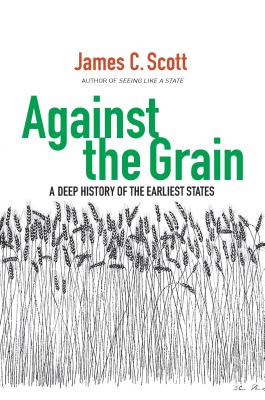
During my long discursion on the history of money, the academic James C. Scott published an important book called Against the Grain: A Deep History of the First States.

Regular readers will know that this has been a longstanding area of research (or obsession) of mine. I’ve referred to Scott’s work before, particularly Seeing Like A State, which I think is indispensable in understanding many of the political divisions of today (and why left/right is no longer a useful distinction). We’re in an era where much of the “left” is supporting geoengineering and rockets to Mars, and the “right” (at least the alt-right) is criticizing housing projects and suburban sprawl.

It’s unfortunate that Scott’s title is the same as another one of my favorite books on that topic by journalist Richard Manning: Against the Grain: How Agriculture Hijacked Civilization, another book I’ve referred to often. Manning’s book is not only a historical account about how the rise of grain agriculture led to war, hierarchy, slavery and sickness, but a no-hold-barred exploration of today’s grain-centric agribusiness model, where wheat, corn, soy and sugar are grown in mechanized monocultures and processed by the food industry into highly-addictive junk food implicated in everything from type two diabetes, to depression to Alzheimer’s disease (via inflammation):

Dealing with surplus is a difficult task. The problem begins with the fact that, just like the sex drive, the food drive got ramped up in evolution. If you have a deep, yearning need for food, you’re going to get along better than your neighbor, and over the years that gene is going to be passed on. So you get this creature that got fine-tuned to really need food, especially carbohydrates. Which brings us to the more fundamental question: can we ever deal with sugar? By making more concentrated forms of carbohydrates, we’re playing into something that’s quite addictive and powerful. It’s why we’re so blasted obese. We have access to all this sugar, and we simply cannot control our need for it—that’s genetic.

Now, can we gain the ability to overcome that? I’m not sure. You have to add to this the fact that there’s a lot of money to be made by people who know how to concentrate sugar. They have a real interest in seeing that we don’t overcome these kinds of addictions. In fact, that’s how you control societies—you exploit that basic drive for food. That’s how we train dogs—if you want to make a dog behave properly, you deprive him or give him food. Humans aren’t that much different. We just like to think we are. So as an element of political control, food and food imagery are enormously important.

The Scourge of Agriculture (The Atlantic)

Cancers linked to excess weight make up 40% of all US diagnoses, study finds (The Guardian)

Child and teen obesity spreading across the globe (BBC)

In that interview, Manning also makes this point which got so much attention in Yuval Noah Harari’s blockbuster, Sapiens (which came out years later):

…it’s not just human genes at work here. It’s wheat genes and corn genes—and how they have an influence on us. They took advantage of our ability to travel, our inventiveness, our ability to use tools, to live in a broad number of environments, and our huge need for carbohydrates. Because of our brains’ ability, we were able to spread not only our genes, but wheat’s genes as well. That’s why I make the argument that you have to look at this in terms of wheat domesticating us, too. That co-evolutionary process between humans and our primary food crops is what created the agriculture we see today.

As for the title, I guess Against the Grain is just too clever a title to pass up 🙂

I’m still waiting on the book from the library, but I have seen so many reviews by now that I’m not sure I’ll be able to add too much. What’s interesting to me is the degree to which the idea that civilization was a great leap backward from what we had before is starting to go mainstream.

The old, standard “Whig version” of universal progress is still pretty strong, though. Here’s one reviewer describing how it was articulated in the turn-of-the-century Encyclopedia Britannica:

The Encyclopaedia took its readers through a panorama of universal history, from “the lower status of savagery,” when hunter-gatherers first mastered fire; to the “middle status of barbarism,” when hunters learned to domesticate animals and became herders; to the invention of writing, when humanity “graduated out of barbarism” and entered history. Along the way, humans learned to cultivate grains, such as wheat and rice, which showed them “the value of a fixed abode,” since farmers had to stay near their crops to tend and harvest them. Once people settled down, “a natural consequence was the elaboration of political systems,” property, and a sense of national identity. From there it was a short hop—at least in Edwardian hindsight—to the industrial revolution and free trade.

Some unfortunate peoples, even entire continents such as aboriginal North America and Australia, might fall off the Progress train and have to be picked up by kindly colonists; but the train ran along only one track, and no one would willingly decline to board it…

What made prehistoric hunter-gatherers give up freedom for civilization? (The New Republic)

But, it turns out that the reality was quite different. In fact, hunter-gatherers resisted agriculture. Even where farmers and H-G’s lived side-by-side, the H-G’s (and herders) avoided farming as long as they could. When Europeans equipped “primitive” societies with seeds and hoes and taught them to farm, the natives threw away the implements and ran off into the woods. The dirt farmers of colonial America often ran away to go and live with the nomadic Indians, to the extent that strict laws had to be passed to prevent this (as documented in Sebastian Junger’s new book Tribe).

The shift to agriculture was in some respects…harmful. Osteological research suggests that domiciled Homo sapiens who depended on grains were smaller, less well-nourished and, in the case of women, more likely to be anaemic, than hunter-gatherers. They also found themselves vulnerable to disease and able to maintain their population only through unprecedentedly high birthrates. Scott also suggests that the move from hunting and foraging to agriculture resulted in ‘deskilling’, analogous to the move in the industrial revolution from the master tradesman’s workshop to the textile mill. State taxation compounded the drudgery of raising crops and livestock. Finally, the reliance on only a few crops and livestock made early states vulnerable to collapse, with the reversion to the ‘dark ages’ possibly resulting in an increase in human welfare.

Book Review: Against the Grain: A Deep History of the Earliest States by James C. Scott (London School of Economics)

So why did they do it? That is a question that nobody know the answer to, but it appears they stumbled into not because it was a better way of life, but due to some sort of pressures beyond their control. As Colin Tudge put it, “People did not invent agriculture and shout for joy; they drifted or were forced into it, protesting all the way.”Rather than taking up agriculture because it presented a better, more secure way of life as the Victorians thought (due to chauvinism and ignorance), it was actually much more unpleasant and much more work. Here’s a bit from Richard Manning’s book (pp. 23-24):

Why agriculture? In retrospect, it seems odd that it has taken archaeologists and paleontologists so long to begin answering this essential question of human history. What we are today–civilized city-bound, overpopulated, literate, organized, wealthy, poor, diseased, conquered, and conquerors–is all rooted in the domestication of plants and animals. The advent of farming re-formed humanity. In fact, the question “Why agriculture?” is so vital, lies so close to the core of our being that it probably cannot be asked or answered with complete honesty. Better to settle for calming explanation of the sort Stephen Jay Gould calls “just-so stories.”

In this case, the core of such stories is the assumption that agriculture was better for us. Its surplus of food allowed the leisure and specialization that made civilization. It’s bounty settled, refined, and educated us, freed us from the nasty, mean, brutish, and short existence that was the state of nature, freed us from hunting and gathering. Yet when we think about agriculture, and some people have thought intently about it, the pat story glosses over a fundamental point. This just-so story had to have sprung from the imagination of someone who never hoed a row of corn or rose with the sun for a lifetime of milking cows. Gamboling about plain and forest, hunting and living off the land is fun. Farming is not. That’s all one needs to know to begin a rethinking of the issue. The fundamental question was properly phrased by Colin Tudge of the London School of Economics: “The real problem, then, is not to explain why some people were slow to adopt agriculture but why anybody took it up at all when it is so obvioulsy beastly.” Research has supported Tudge’s skepticism.

Circumstances beyond their control must have played a role. Climate change is most commonly implicated. Overpopulation must have played a role, but this raises a chicken-and-egg problem: overpopulation is a problem created by agrarianism, so how could it have caused it?

One novel idea I explored earlier this year was Brian Hayden’s idea that the production of ever-increasing surpluses was part of a strategy by aggrandizing individuals in order to gain political power.

Periodic feasting events were ways to increase social cohesion and deal with uneven production in various climatic biomes–it was a survival strategy for peoples spread-out among a wide geographical area (mountains, plains, wetlands, riparian, etc.). If food was scarce in one area, resources could be pooled. Such feasting/resource pooling regimes were probably the earliest true “civilizations” (albeit before cities). It was also the major way to organize mass labor, and this lasted well into the historical period (both Egyptian and Mesopotamian texts testify to celebratory work feasts).

At these events, certain individuals would loan out surplus food and other prestige items in order to get people in debt to them. Cultural expectations meant that the debts would have to repaid and then some (i.e. with interest). These people would get their families and allies to work their fingers to the bone in order to produce big surpluses in societies where this was possible, such as horticultural and affluent forager societies. They would then become “Big Men”–tribal leaders without “official” status.

Would-be Big-Men would then try and outdo one another by throwing bigger feasts than their rivals. Competitive feasting provided an opportunity for aggrandizers to try and outdo one another in a series of power games and status jockeying. But the net effect such power games had across the society was to ramp up food production to unsustainable levels. This, in turn, led to intensification.

At these feasts, highly “prized” foodstuffs would be used by aggrandizers to lure people into debt and other lopsided obligations, as well as get people to work for them. Manning notes above how food has been traditionally used to control people. And, Hayden speculates, the foods used were probably ones with pleasurable or mind-altering effects. One common one was almost certainly alcohol.

He speculates that grains were initially grown not for flavor or for carbohydrates, but for fermentation. It’s fairly certain that alcohol consumption played a major role in feasting events, and it’s notable that the earliest civilizations were all big beer drinkers (Egypt, Mesopotamia, China, Mesoamerica). Most agricultural village societies around the world have some sort of beer drinking/fermentation ritual, as Patrick E. McGovern has documented. The first “recipe” ever written down was for beer brewing. Hayden speculates that early monoliths like Gobeckli Tepe and Stonehenge were built as places for such feasting events to take place, wedded to certain religious ideologies (all of them have astronomical orientations), and archaeology tends to confirm this. It’s notable that the earliest sites of domestication/agrarianism we know of are typically in the vicinity of these monoliths.

In other words, the root of this overproduction was human social instincts, and not just purely environmental or climatic factors. Is there some connection between plant/animal domestication and religious ideology? Is it any wonder that religious concepts in these societies transform to become very different from the animist/shamanic ones of hunter-gatherers? Flannery and Marcus point out that the establishment of a hereditary priesthood that constructs temples (replacing the shaman) is always a marker of the transition from an egalitarian society to a hierarchical one with hereditary leadership. Even in the Bible, king and temple arise more or less simultaneously (e.g. Saul/David/Solomon).

Scott’s book emphasizes the key role that cereal agriculture played in the rise of the early states.

It was the ability to tax and to extract a surplus from the produce of agriculture that, in Scott’s account, led to the birth of the state, and also to the creation of complex societies with hierarchies, division of labor, specialist jobs (soldier, priest, servant, administrator), and an élite presiding over them. Because the new states required huge amounts of manual work to irrigate the cereal crops, they also required forms of forced labor, including slavery; because the easiest way to find slaves was to capture them, the states had a new propensity for waging war. Some of the earliest images in human history, from the first Mesopotamian states, are of slaves being marched along in neck shackles. Add this to the frequent epidemics and the general ill health of early settled communities and it is not hard to see why the latest consensus is that the Neolithic Revolution was a disaster for most of the people who lived through it.

It’s worth noting that it wasn’t simply agriculture, but cereal production that relied on artificial irrigation that saw the rise of the first states. The need to coordinate all that labor, partition permanent plots of land, and resolve settlement disputes, must have led to the rise of an elite managerial class, as Ian Welsh points out:

Agriculture didn’t lead immediately to inequality, the original agricultural societies appear to have been quite equal, probably even more so than the late hunter-gatherer societies that preceded them. But increasing surpluses and the need for coordination which arose, especially in hydraulic civilizations (civilizations based around irrigation which is labor intensive and require specialists) led to the rise of inequality. The pharoahs created great monuments, but their subjects did not live nearly as well as hunter-gatherers.

The Right Stuff: What Prosperity Is and Isn’t (Ian Welsh)

And sedentism, as I’ve noted, is not so much a product of agriculture as a cause. Sedentary societies coexisted with high mobility for some time. Likely sedentary societies needed to be around for some time in order to build up the kind of surpluses aggrandizing elites needed to gain power. These probably started as “redistributor chiefs” who justified their role through a combination of martial leadership and religious ideology:

Sedentism does not have its origins in plant and animal domestication. The first stratified states in the Tigris and Euphrates Valley appeared ‘only around 3,100 BCE, more than four millennia after the first crop domestications and sedentism’. Sedentism has its roots in ecologically rich, preagricultural settings, especially wetlands. Agriculture co-existed with mobile lifestyles in which people gathered to harvest crops. Domestication itself is part of a 400,000 year process beginning with the use of fire. Moreover, it is not a process (or simply a process) of humans gaining increasing control over the natural world. People find themselves caring for dogs, creating an ecological niche for mice, ticks, bedbugs and other uninvited guests, and spending their lives ‘strapped to the round of ploughing, planting, weeding, reaping, threshing, grinding, all on behalf of their favorite grains and tending to the daily needs of their livestock’.

This was also noted in the Richard Manning interview, above:

…we always think that agriculture allowed sedentism, which gave people time to create civilization and art. But the evidence that’s emerging from the archeological record suggests that sedentism came first, and then agriculture. This occurred near river mouths, where people depended on seafood, especially salmon. These were probably enormously abundant cultures that had an enormous amount of leisure time—they just had to wait for the salmon runs to occur. There are some good records of those communities, and from the skeleton remains we can see that they got up to 95 percent of their nutrients from salmon and ocean-derived sources. Along the way, they developed highly refined art—something we always associate with agriculture.

Of course, agrarian societies using irrigation and plow-based agricuture in set plots are very different from horicultural societies practicing shifting cultivation. This is likley why early agricutural societies were rougly about as egalitarian as their predecessors, as Ian Welsh pointed out above. By the time the trap snapped shut, however, it was too late.

How agriculture grew on us (Leaving Babylon)

I’ve often wondered if, when certain humans learned how to domesticate, they used it as much on their fellow man as they did their animals. In this Aeon article, this passage really struck me:

When humans start treating animals as subordinates, it becomes easier to do the same thing to one another. The first city-states in Mesopotamia were built on this principle of transferring methods of control from creatures to human beings, according to the archaeologist Guillermo Algaze at the University of California in San Diego. Scribes used the same categories to describe captives and temple workers as they used for state-owned cattle.

How domestication changes species including the human (Aeon)

Indeed, the idea that humans domesticated themselves is another key concept in Harari’s Sapiens. Perhaps that domestication was much more “literal” than we have been led to believe. Perhaps human sacrifice was a way for early religious leaders to “cull” individuals who had undesirable traits from their standpoint: independence, aggression, a questioning attitude, etc. Indeed, hunter-gatherers do not like obeying orders from a boss. I wonder to what extent this process is still going on, especially in modern-day America with its schools, prisons, corporate cubicles, police, military, etc.:

Anthropologists and historians have put forward the ‘social control hypothesis’ of human sacrifice. According to this theory, sacrificial rites served as a function for social elites. Human sacrifice is proposed to have been used by social elites to display their divinely sanctioned power, justify their status, and terrorise underclasses into obedience and subordination. Ultimately, human sacrifice could be used as a tool to help build and maintain systems of social inequality.

How human sacrifice helped to enforce social inequality (Aeon)

And this is very relevent to our recent discussion of money: writing and mathematics were first used as methods of social control. As Janet Gleeson-White points out in this essay, accounting was our first writing technology. Money–and taxes–were an outgrowth of this new communications technology:

War, slavery, rule by élites—all were made easier by another new technology of control: writing. “It is virtually impossible to conceive of even the earliest states without a systematic technology of numerical record keeping,” Scott maintains. All the good things we associate with writing—its use for culture and entertainment and communication and collective memory—were some distance in the future. For half a thousand years after its invention, in Mesopotamia, writing was used exclusively for bookkeeping: “the massive effort through a system of notation to make a society, its manpower, and its production legible to its rulers and temple officials, and to extract grain and labor from it.”

Early tablets consist of “lists, lists and lists,” Scott says, and the subjects of that record-keeping are, in order of frequency, “barley (as rations and taxes), war captives, male and female slaves.” Walter Benjamin, the great German Jewish cultural critic, who committed suicide while trying to escape Nazi-controlled Europe, said that “there is no document of civilization which is not at the same time a document of barbarism.” He meant that every complicated and beautiful thing humanity ever made has, if you look at it long enough, a shadow, a history of oppression.

The Case Against Civilization (The New Yorker)

And the connection between writing and domestication/subjugation is powerfully made by this article from the BBC documenting the world’s oldest writing:

In terms of written history, this is the very remote past. But there is also something very direct and almost intimate about it too. You can see fingernail marks in the clay. These neat little symbols and drawings are clearly the work of an intelligent mind.

These were among the first attempts by our human ancestors to try to make a permanent record of their surroundings. What we’re doing now – my writing and your reading – is a direct continuation. But there are glimpses of their lives to suggest that these were tough times. It wasn’t so much a land of milk and honey, but porridge and weak beer.

Even without knowing all the symbols, Dr Dahl says it’s possible to work out the context of many of the messages on these tablets. The numbering system is also understood, making it possible to see that much of this information is about accounts of the ownership and yields from land and people. They are about property and status, not poetry.

This was a simple agricultural society, with a ruling household. Below them was a tier of powerful middle-ranking figures and further below were the majority of workers, who were treated like “cattle with names”. Their rulers have titles or names which reflect this status – the equivalent of being called “Mr One Hundred”, he says – to show the number of people below him.

It’s possible to work out the rations given to these farm labourers. Dr Dahl says they had a diet of barley, which might have been crushed into a form of porridge, and they drank weak beer. The amount of food received by these farm workers hovered barely above the starvation level. However the higher status people might have enjoyed yoghurt, cheese and honey. They also kept goats, sheep and cattle.

For the “upper echelons, life expectancy for some might have been as long as now”, he says. For the poor, he says it might have been as low as in today’s poorest countries.

Breakthrough in world’s oldest undeciphered writing (BBC)

So the earliest writing tends to confirm Scott’s account. And not just Scott’s account, but that of anthropologist James Suzman, who has simultaneously come out with a book about the disappearing way of life of the the !Kung San Bushmen of the Kalahari. This is also reviewed in the New Yorker article, above. These hunter-gatherers are going through today exactly what those people in the Near East experienced roughly 6-8000 years ago, giving us a window into history:

The encounter with modernity has been disastrous for the Bushmen: Suzman’s portrait of the dispossessed, alienated, suffering Ju/’hoansi in their miserable resettlement camps makes that clear. The two books even confirm each other’s account of that sinister new technology called writing. Suzman’s Bushman mentor, !A/ae, “noted that whenever he started work at any new farm, his name would be entered into an employment ledger, documents that over the decades had assumed great mystical power among Ju/’hoansi on the farms. The secrets held by these ledgers evidently had the power to give or withhold pay, issue rations, and determine an individual’s right to stay on any particular farm.”

Writing turned the majority of people into serfs and enabled a sociopathic elite to live well and raise themselves and their offspring above everyone else.

And here we are at the cusp of a brand new “information revolution” where literally our every thought and move can be monitored and tracked by a tiny centralized elite and permanently stored. And yet we’re convinced that this will make all our lives infinitely better! Go back and reread the above. I’m not so sure. I already feel like “cattle with a name” in our brave new nudged, credit-scored, Neoliberal world.

We’re also experiencing another period of rapid climate change and resource depletion, just like that experienced at the outset of the original coming of the state. We’re now doing exactly what they did: intensification, and once again it’s empowering a small sociopathic elite at the cost of the rest of us. And yet Panglossians confidently tell us we’re headed for a peaceful techno-utopia where all new discoveries will be shared with all of us instead of hoarded, and we’ll all live like gods instead of being exterminated like rats because we’re no longer necessary to the powers that be. Doubtless the same con (“We’ll all be better off!!!”) was played on the inhabitants of early states, too. Given the human social instincts noted above, let’s just say I’m not optimistic. Please pass the protein blocks.

Scott points out that the state is a very novel development, despite what we read in history books. We read about the history of states because states left written history, and we are their descendants. But that doesn’t mean most people lived under them. By Scott’s account, most humans lived outside of nation-states well into the 1500’s. A review of Jared Diamond’s The World Until Yesterday by Scott published a few years back in The London Review of Books was a foreshadowing of his current book (and may have even inspired it). In that review, he stated:

…Homo sapiens has been around for roughly 200,000 years and left Africa not much earlier than 50,000 years ago. The first fragmentary evidence for domesticated crops occurs roughly 11,000 years ago and the first grain statelets around 5000 years ago, though they were initially insignificant in a global population of perhaps eight million.

More than 97 per cent of human experience, in other words, lies outside the grain-based nation-states in which virtually all of us now live. ‘Until yesterday’, our diet had not been narrowed to the three major grains that today constitute 50 to 60 per cent of the world’s caloric intake: rice, wheat and maize. The circumstances we take for granted are, in fact, of even more recent vintage …Before, say, 1500, most populations had a sporting chance of remaining out of the clutches of states and empires, which were still relatively weak and, given low rates of urbanisation and forest clearance, still had access to foraged foods. On this account, our world of grains and states is a mere blink of the eye (0.25 per cent), in the historical adventure of our species.

Crops, Towns, Government (London Review of Books)

Why a leading political theorist thinks civilization is overrated (VOX)

Wither Collpase?

One of the more provocative ideas from Scott’s book is to question whether the withering away of state capacity–that is, a collapse–is really a bad thing at all!

We need to rethink, accordingly, what we mean when we talk about ancient “dark ages.” Scott’s question is trenchant: “ ‘dark’ for whom and in what respects”? The historical record shows that early cities and states were prone to sudden implosion.

“Over the roughly five millennia of sporadic sedentism before states (seven millennia if we include preagriculture sedentism in Japan and the Ukraine),” he writes, “archaeologists have recorded hundreds of locations that were settled, then abandoned, perhaps resettled, and then again abandoned.” These events are usually spoken of as “collapses,” but Scott invites us to scrutinize that term, too.

When states collapse, fancy buildings stop being built, the élites no longer run things, written records stop being kept, and the mass of the population goes to live somewhere else. Is that a collapse, in terms of living standards, for most people? Human beings mainly lived outside the purview of states until—by Scott’s reckoning—about the year 1600 A.D. Until that date, marking the last two-tenths of one per cent of humanity’s political life, “much of the world’s population might never have met that hallmark of the state: a tax collector.”

Book Review: Against the Grain: A Deep History of the Earliest States by James C. Scott (LSE)

Is the Collapse of Civilizations A Good Thing? (Big Think)

Indeed, is collapse even a relevant concept? What, really is collapsing?

We also need to think about what we apply the term ‘collapse’ to – what exactly was it that collapsed? Very often, it’s suggested that civilisations collapse, but this isn’t quite right. It is more accurate to say that states collapse. States are tangible, identifiable ‘units’ whereas civilisation is a more slippery term referring broadly to sets of traditions. Many historians, including Arnold Toynbee, author of the 12-volume A Study of History (1934-61), have defined and tried to identify ‘civilisations’, but they often come up with different ideas and different numbers. But we have seen that while Mycenaean states collapsed, several strands of Mycenaean material and non-material culture survived – so it would seem wrong to say that their ‘civilisation’ collapsed. Likewise, if we think of Egyptian or Greek or Roman ‘civilisation’, none of these collapsed – they transformed as circumstances and values changed. We might think of each civilisation in a particular way, defined by a particular type of architecture or art or literature – pyramids, temples, amphitheatres, for example – but this reflects our own values and interests.

[…]

States collapsed, civilisations or cultures transformed; people lived through these times and employed their coping strategies – they selectively preserved aspects of their culture and rejected others. Archaeologists, historians and others have a duty to tell the stories of these people, even though the media might find them less satisfactory. And writers who appropriate history for moral purposes need to think carefully about what they are doing and what they are saying – they need to make an effort to get the history as right as possible, rather than dumbing it down to silver-bullet theories.

What the idea of civilisational collapse says about history (Aeon)

Scott’s book gives us hope that the collapse of states, rather than being a bad thing, might lead to a flourishing of human freedom. In that, there is some hope. I’ll end with this thought from Scott’s review of Diamond:

Anthropology can show us radically different and satisfying forms of human affiliation and co-operation that do not depend on the nuclear family or inherited wealth. History can show that the social and political arrangements we take for granted are the contingent result of a unique historical conjuncture.


Government, Terrorism, Money, Education and Other Important Discussions

images

By Phillip J. Watt

Source: The Mind Unleashed

The elite power structure – which uses the monetary system, war, false flags and the monopolized media as their primary mechanisms of control – has infiltrated every major government of the Western World. How do we know this? It’s simple; if they hadn’t been hijacked, then governments would have already begun a process of revolutionizing the way in which our societies are organized so that it benefits all of us, not just a select few.

The US Presidential race and two of its candidates have shown a small amount of hope for real change in America, something that not just its citizens desperately need, but the entire world too. Once the game is changed in the US – so that the government no longer works for those in control of the multinational and banking corporations – it will undoubtedly reverberate around the world.

Clinton is obviously a mouthpiece of the status quo and therefore cannot be trusted to enact real change. After all, she is an oligarch. On the other hand, Sanders and Trump appear to be anti-establishment, but are they really? It’s difficult to really know, because they could be controlled opposition. Yet even if they are separate to the existing order, can we really trust that they’ll do the job that the world’s peoples, and the environment, truly need?

Actions always speak louder than words, so regardless of the rhetoric of Trump and Sanders, does their policy agenda actually align to the truths that have been exposed by the many independent social researchers who are doing a wonderful job for the betterment of humanity?

Read below and decide for yourself.

The Real Policies for Change

This list is by no means exhaustive, but it reflects the fundamental shifts that we should be implementing in the short term to move into a new era of health and prosperity for humanity, and the environment we inhabit. In other words, these changes are the first essential steps if we want to overcome the dysfunction and deception that plague the hearts and minds of the people, as well as the systems that guide our collective activity.

If a political party or politician does not discuss these topics in general, then they are not aligned to the changes that we need, and therefore true progress. This is most likely because of two reasons; ignorance and/or corruption.

In any case, the exact way forward in each area is of course open for debate, but there must be an open and transparent dialogue held among the people. Simply, we all need to understand not just the issues, but the potential solutions to them.

This is obviously happening within conscious circles and progressive movements, however it’s not yet active within the mainstream mentality. This is just more evidence which illustrates that our politicians have failed us; that’s because it’s their job to bring these issues to the light of day so that everybody can participate in their resolution, if they so choose.

1. Monetary Policy: The way the economy is designed must rid society from the saturation of debt, move beyond indebtment to the oligarchs, cease the creation of fake currency by banks, overcome economic slavery by making the currency supply one of value and guarantee that local economies prosper.

2. Taxation Policy: The tax burden put on the people and the evasion of tax by multinational corporations needs to be resolved. One such method is abolishing all taxes and implementing a 2% debit-transaction taxso that citizens pay less tax, all individuals and businesses pay their fair share and there is an abundance of revenue to heal the wounds of a decaying society.

3. Budgeting Policy: Government revenues must be effectively and efficiently utilized to ensure the development of robust social services, increased wealth equality, the eradication of poverty, widespread sustainable practices, appropriate national defense programs and necessary infrastructure.

4. Defense and Foreign Policy: With unjust wars and false flag terrorism being the norm of the 21st Century, any decision to go to war must be sanctioned by the people via referendum. The reasons must be transparentally documented and validated as based in truth. All events at home and abroad that impact the decision-making of defense and foreign relations must be subject to robust and open investigations. Because national security is the first priority, all international relations should be treated diplomatically as the first line of defense.

5. Media Policy: The way in which information is disseminated throughout society must not be managed by monopolies, or a government. Media must be an open source platform where independent investigations are implemented and presented without bias. Any monopoly on the media must be disassembled so that the populace has unrestricted access to all the information necessary for the health and well-being of each individual and the community as a whole.

6. Education Policy: The way in which our children are educated is an indoctrination into the status quo, particularly economically and politically. The education system must therefore ensure that all children exercise their right to gain access to information that will help them to grow into healthy, happy and honorable adults, as well as question the way in which we organize society so that we can evolve it in alignment with our needs.

7. Governmental Policy: The amalgamation of government and business needs to be dissected. Politicians and bureaucrats are servants of the people and therefore must be representative of the needs and wants of the people. Moreover, government intervention of individual liberty and the free market must be also reduced.

8. Energy Policy: There is no longer any need to rely on fossil fuels, so creating the energy that society needs must be replaced with renewable resources – such as solar, air, water, wave, plant and free-energy technologies. Energy must also be made cheaply available to the public.

9. Health Policy: All foods and so-called medicines which impact the long-term health of the people must be labelled appropriately. Health programs that support emotional, psychological, philosophical, physical, spiritual, social and behavioral vitality must also be deeply embedded into schooling and other educational platforms. Holistic and preventative approaches to dis-ease must also be brought to the forefront of health education instead of relying on a symptomatic and prescriptive medical framework.

10. Medicine Policy: The pharmaceutical monopolies must be transformed into meeting the needs of the people, not shareholders and their profits. All natural and cheap remedies to disease – such as plant-based medicines and meditation – must be fully documented and reincorporated back into health education.

11. Housing Policy: Every person has a right to live in safe, comfortable and affordable housing. No individual should be homeless, unless by choice. Employment and Housing Policy must also be designed to ensure that the purchase of land is affordable and achievable for all.

12. Food Policy: The damaging impacts of industrial agriculture on earth’s natural systems, as well as the erosion of local economies (which is the direct result of trade agreements that primarily benefit the multinationals), needs to be reversed. One such way is by replacing it with a localized/regionalized Permaculture model where individuals and communities are supported to grow their own produce. This will help to increase local employment, as well as reconnect people to nature, the food they eat and their health requirements. In addition, all foods must be properly labelled and contain no toxic ingredients. GMOs must also be abandoned and organic foods must be readily available.

13. Water Policy: All citizens have a right to access safe and clean water. They should be supported to capture their own water needs. Where this is not possible, no toxins such as fluoride will be added to the water supply.

14. Animal Policy: All animal agriculture systems must respect the health and happiness of those animals. They must not subject them to any conditions in which they consistently suffer. One particular approach would be to incorporate it into a widespread permaculture model, in which animals are treated humanely.

15. Environmental Policy: Any practice that is environmentally unsustainable and negatively impacts the health and diversity of our natural systems is to be transformed into the opposite. The increasing extinction of animal and plant life must be reversed, as well as the trends of deforestation, ocean acidification and desertification.

16. Drug Policy: The war-on-drugs has been an epic failure because it has generated more crime, addiction, mental health problems and sent the market underground. It has also stigmatized the natural right to explore one’s own body and consciousness. The therapeutic and developmental aspects of so-called illegal drugs must be holistically researched so that society can be educated on both their positive and negative impacts. All illegal substances must be made legal, as they have begun to do in some countries, and a thoroughly-informed society must have safe access to pure substances for their own therapeutic, developmental and leisurely needs.

17. Sovereignty Policy: All citizens have natural rights, some of which have eroded through the recent policies of Western Governments. One example is privacy and another is the right to protest. This stripping of our rights needs to immediately stop and all rights aligned with natural law are to be reintroduced. No flesh and blood person should be treated as a legal fiction that works for a corporation impersonating as a government. This means that no legislation can impede on the natural laws that all individuals have a right to exercise.

18. Immunization Policy: All vaccines must be robustly studied independent of the pharmaceutical industry and the results made available to the public. All previous disease and death resulting from vaccines must also be publicly available. None will contain any ingredients other than to immunize against a specific disease. In addition, no child or adult will be forced or coerced into taking vaccines; every person must have their natural right to choose intact.

19. Atmospheric Policy: All geoengineering and chemical spraying programs are to immediately cease. The impacts that these programs have already had on the health of humanity, as well as the environment, must be holistically investigated and reversed.

20. Social Security Policy: Pensioners, people with a disability and other persons who require financial support must be treated with respect and must be able to comfortably live above the poverty line. Where possible, they will be supported to increase their education, training and skills so that they reenter the workforce. There should also be widespread volunteering programs with inherent incentives so the knowledge, skills and services of the elderly can be utilized for the benefit of the community.

Further Thoughts

There are many more areas that need to evolve, but its important to focus on the priorities in such as short piece. No doubt, many of you reading this would have been shocked and confused by some of the information herein. You might have even rejected elements to it, because it might have seemed too conspiratorial or challenging to believe. That’s okay; every single one of us who have woken up to these realities felt the same the first time we heard them too.

In any case, if you’d like to do follow up research, the links provided above will help you to initiate the process. Go deep too; it’s only when we individually undertake our own independent and robust research that we can come to a solid understanding of the true state of the world. The tip of course is to not be fooled by the propaganda narratives of the matrix-media and ensure we undertake research through the independent channels and progressive social researchers.

Furthermore, the above plans of attack are designed for the short to mid term. This does not discount the deeper agenda of moving from an economy of scarcity, to one of abundance. There are many models to achieve this, such as several resource-based economies, but until we build the foundations and start moving in that direction we have to work with what’s in front of us, right now.

In addition, of course it’s necessary to build new systems outside of the existing model to make the old ones redundant, yet we still need to use the systems that we’ve got and aim to transform society from within. After all, a balanced and holistic approach, is always the right approach.

Final Thoughts

Never has a government exposed all of the above issues. They might touch on some of them to some degree, but unfortunately we don’t have so-called leaders who actually call out the real challenges that we collectively face. There’s no doubt that some politicians know about these actualities, but the reality is they don’t publicly disclose it in fear of losing their credibility, or their livelihood.

But things are changing. Not only are more and more people joining the awakening community by educating themselves and taking action in response to these dysfunctions, but there are also political parties forming who dare to expose these truths to their audience and design robust policies in response. One such group is The Australian Sovereignty Party (ASP); in fact, many of the links above will direct you to the policies they’ve designed to rectify the failures of past governments.

Many parties around the world could learn a thing or two from this political force.

If you’re Australian, I highly encourage you to read the policy material at their website and join if their ethos resonates with you. Any person from around the world can join as an affiliate member too, so anyone is more than welcome to sign up to learn about how a true political party works. In addition, share this article and the ASPs progressive policies among your friends and family so that the momentum builds to bring Australians (and others) up-to-date with a political outfit that actually represents the real needs of you, me and all of us.

If you also believe in transforming our world into a better place, then at the very least research their policies. I know you’ll be pleasantly surprised (view their website here and follow them on facebook here). Furthermore, following is an interview I did with the President of the ASP, Daniel Huppert. In it he discusses many of the issues found in this article and the ASPs policy response to them. Enjoy.


ABOUT THE AUTHOR

Phillip J. Watt lives in Australia. His written work deals with topics from ideology to society, as well as self-development. Follow him on Facebook or visit his website.