Jeff Bezos’s Corporate Takeover of Our Lives

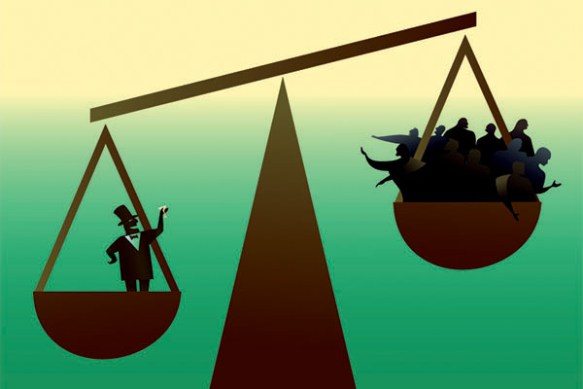
Illustration by Mike Faille

How Amazon’s relentless pursuit of profit is squeezing us all—and what we can do about it

By David Dayen

Source: In These Times

AMAZON IS AN ONLINE RETAILER. It also runs a marketplace for other online retailers. It’s also a shipper for those sellers, and a lender to them, and a warehouse, an advertiser, a data manager and a search engine. It also runs brick-and-mortar bookstores. And grocery stores.

There are over 100 million Amazon Prime subscribers in the United States—more than half of all U.S. households. Amazon makes 45 percent of all e-commerce sales. Amazon is also a product manufacturer; its Alexa controls two-thirds of the digital assistant market, and the Kindle represents 84 percentof all e-readers. Amazon created its own holiday, Prime Day, and the surge in demand for Prime Day discounts, followed by a drop afterward, skewed the nation’s retail sales figures with a 1.8% bump in July 2017.

Oh, it’s also a major television and film studio. Its CEO owns a national newspaper. And it runs a streaming video game company called Twitch. And its cloud computing business, Amazon Web Services, runs an astonishing portion of the Internet and U.S. financial infrastructure. And it wants to be a logistics company. And a furniture seller. It’s angling to become one of the nation’s largest online fashion designers. It recently picked up an online pharmacy and partnered with JPMorgan Chase CEO Jamie Dimon and Warren Buffett to create a healthcare company. And at the same time, it’s competing with JPMorgan, pushing Amazon Pay as a digital-based alternative to credit cards and Amazon Lending as a source of capital for its small business marketplace partners.

To quote Liberty Media chair John Malone, himself a billionaire titan of industry, Amazon is a “Death Star” moving its super-laser “into striking range of every industry on the planet.” If you are engaging in any economic activity, Amazon wants in, and its position in the market can distort and shape you in vital ways.

Elizabeth Warren’s proposal to break up Amazon, along with the FTC’s new oversight and investigation, has spurred a conversation on the Left about its overwhelming power. No entity has held the potential for this kind of dominance since the railroad tycoons of the first Gilded Age were brought to heel. Whether you share concerns about Amazon’s economic and political power or you just like getting free shipping on cheap toilet paper, you should at least know the implications of living in Amazon’s world—so you can assess whether it’s the world you want, and how it could be different.

BOOKSELLERS WERE THE FIRST TO FIND THEMSELVES AT THE TIP OF AMAZON’S SPEAR, at the company’s founding in 1994. Years of Amazon peddling books below cost shuttered thousands of bookstores. Today, Amazon sells 42 percent of all books in America.

With such a large share of the market, Amazon determines what ideas reach readers. It ruthlessly squeezes publishers on wholesale costs; in 2014, it deliberately slowed down deliveries of books published by Hachette during a pricing dispute. By stocking best-sellers over independents and backlist copies, and giving publishers less money to work with, Amazon homogenizes the market. Publishers can’t afford to take a chance on a book that Amazon won’t keep in its inventory. “The core belief of bookselling is that we need to have the ideas out there so we can discuss them,” says Seattle independent bookseller Robert Sindelar. “You don’t want one company deciding, only based on profitability, what choice we have.”

These issues in just the book sector are a microcosm of Amazon’s effect on commerce.

The term “retail apocalypse” took hold in 2017 amid bankruptcies of established chains like The Limited, RadioShack, Payless ShoeSource and Toys “R” Us. According to frequent Amazon critic Stacy Mitchell, “more people lost jobs in general-merchandise stores than the total number of workers in the coal industry” in 2017.

Amazon isn’t the only cause; private equity looting must share much of the blame, and a shift to e-commerce was always going to hurt brick-and-mortar stores. But Amazon transformed a diverse collection of website sales into one mammoth business with the logistical power to perform rapid delivery of millions of products and a strategy to underprice everyone. That transformation accelerated a decline going back to the Great Recession (and much earlier for booksellers). Analysts at Swiss bank UBS estimate that every percentage point e-commerce takes from brick-and-mortar translates into 8,000 store closures, and right now e-commerce only has a 16 percent market share.

Take Harry Copeland (or, as he calls himself, “Crazy Harry”) of Harry’s Famous Flowers in Orlando, Fla., at one time a 40-employee retail/wholesale business. Revenue at his operation has shrunk by half since 2008, equal to millions of dollars in gross sales. “The internet … killed us,” Harry says. “I was in a Kroger, this guy walks up and says, ‘I want to apologize. It’s so easy to go on the internet.’ I said, ‘I did your wedding, I did flowers for your babies, and you’re buying [flowers] on the internet?’ ” Even Harry’s own employees receive Amazon packages at the shop every day. In January, tired of the fight, Harry sold his shop after 36 years in business.

Amazon was particularly deadly to the original “everything stores,” the department stores like Sears and J.C. Penney that anchor malls. When the anchor stores shut down, foot traffic slows and smaller shops struggle. Retailers are planning to close more than 4,000 stores in 2019; the 41,201 retail job losses in the first two months of this year were the highest since the Great Recession.

Dead malls trigger not only blight but also property tax losses. The broader shift to online shopping also transfers economic activity from local businesses to corporate coffers, like Amazon’s headquarters in Seattle.

Some of these failed retail spaces have been scooped up, ironically, by Amazon’s suite of physical stores, such as Whole Foods. Amazon also skillfully pits cities against one another and wins tax breaks for its warehouse and data center facilities, starving local budgets even more.

Amazon, of course, argues it is the best friend small business ever had. Jeff Bezos’ 2019 annual letter indicated that 58% of all sales on the website are made by over 2 million independent third-party sellers, who are mostly small in size. In this rendering, Amazon is just a mall, opening its doors for the little guy to access billions of potential customers. “Third-party sellers are kicking our first-party butt,” Bezos exclaimed.

It was a line I repeated to several merchants, mostly to snickers. Take Crazy Harry. In late 2017, Amazon reached out with the opportunity for Harry’s Famous Flowers to sell through its website. Sales representatives promised instant success. “We went live in November,” he says. “I made three transactions, [including] one on Valentine’s Day and one on Christmas.” The closest delivery to his shop was 34 miles away. By the time Harry paid his $39.99 monthly subscription fee for selling on Amazon and a 15% cut of sales, his check came to $6.92. “The gas was $50,” he says.

It wasn’t hard to find the source of the trouble: When Harry searched on Amazon under “flowers in Orlando,” his shop didn’t come up. Without including his name in the search, there was no way for customers to find him. Before long, Harry closed his Amazon account.

Crazy Harry’s troubles could be a function of Amazon running a platform that’s too big to manage. Two million Americans, close to 1% of the U.S. population, sell goods on Amazon. “There’s so much at stake for these sellers,” says Chris McCabe, a former Amazon employee who now runs the consulting site eCommerceChris.com. “They’ve left jobs [to sell on Amazon]. They are supporting themselves and their families.”

Third-party sellers have been a great deal for Amazon—unsurprisingly, since Amazon sets the terms. Sellers pay a flat subscription fee and a percentage of sales, and an extra fee for “Fulfillment by Amazon,” for which Amazon handles customer service, storage and shipping through its vast logistics network. Fee revenue grew to nearly $43 billion in 2018, equal to more than one out of every four dollars that third-party sellers earned.

In other words, Amazon is collecting rent on every sale on its website. This strategy increases selection and convenience for customers, but the sellers, who have nowhere else to go, can get squeezed in the process. Once on the website, sellers are at the mercy of Amazon’s algorithmic placement in search results. They must also navigate rivals’ dirty tricks (like fake one-star reviews that sink sellers in search results) and counterfeit products. And if you get past all that, you must fight the boss level: Amazon, which has 138 house brands. Armed with all the data on sellers’ businesses, Amazon can easily figure out what’s hot and what can be cheaply produced, and then out-compete its own sellers with lower prices and prioritized search results.

Any failure to follow Amazon’s always-changing rules of the road can get a seller suspended, and in that case, Amazon not only stops all future sales, but refuses to release funds from prior sales. And all sellers must sign mandatory arbitration agreements that prevent them from suing Amazon. Several consultants I interviewed talked of sellers crying on the phone, finding themselves trapped after upending their lives to sell on Amazon.

WHILE RETAIL WORKERS LOSE JOBS, AMAZON PICKS UP SOME OF THE UNEMPLOYMENT SLACK, hiring personnel to assemble its packages, make its electronics, and deliver its goods, with a U.S. workforce of more than 200,000, and another 100,000 seasonal workers—though 2018 research from the Conference Board confirmed the jobs created by e-commerce companies like Amazon do not make up for the loss of millions of retail jobs.

Plus, the experience of being a cog in Amazon’s great machine is, shall we say, unhealthy. We know much about the horrors of being an Amazon warehouse worker in the United States. These workplaces are aggressively anti-union. Amazon sets quotas for how many orders are fulfilled, monitoring a worker’s every move. Poor performers may be fired, typically over email. The daily monotony and pressure to perform has pushed workers to suicidal despair. A Daily Beast investigation found 189 instances between October 2013 and October 2018 of 911 calls summoning assistance to deal with suicide attempts or other mental-health emergencies at Amazon warehouses. And even these grunt jobs are insecure; Amazon had to reassure people this year that it wouldn’t turn over all warehouse jobs to robots, even as it rolled out machines that box orders.

Amazon’s other jobs, while less scrutinized than the warehouse workers, can be just as brutal. Thousands of delivery drivers wear Amazon uniforms, use Amazon equipment and work out of Amazon facilities. But they are not technically Amazon employees; they work for outside contractors called delivery service partners. These workers do not qualify for the guaranteed $15 minimum wage Bezos announced to much fanfare last year.

Contracting work out lets Amazon dodge liability for poor labor practices, a trick used by many corporations. At one such contractor in the mid-Atlantic, TL Transportation, one former employee (who requested anonymity) described the work as “running, running, running, rushing. There was no break time.” According to pay stubs, TL built two hours of overtime into its base rate, which is illegal under U.S. labor law. Other workers reported they always worked longer than the time on their pay stubs. Driver Tyhee Hickman of Pennsylvania testified to having to urinate into bottles to maintain the schedule.

Amazon runs plenty of air freight these days as well, through an “Amazon Air” fleet of planes branded with the Amazon logo—but these are also contracted out. At Atlas Air, one of three cargo carriers with Amazon business, pilots have been working without a new union contract since 2011. Atlas pays pilots 30% to 60% below the industry standard, according to Captain Daniel Wells, an Atlas Air pilot and president of the Airline Professionals Association Teamsters Local 1224. Planes are understaffed. “We’ve been critically short of crews,” Wells says. “Everyone is scrambling to keep operations going.”

The go-go-go schedule leaves little time for mechanics; planes go out with stickers indicating deferred maintenance. One Atlas Air flight carrying Amazon packages crashed in Texas in February, killing three workers.

EVEN WHILE DRIVING WORKERS AT A FRENETIC PACE, Amazon doesn’t always deliver on its promise of convenience and efficiency. Many products no longer arrive in 48 hours under Prime’s guaranteed two-day shipping. It’s so challenging to reach customer service that Amazon sells a book on its website about how to do that. Whole Foods shoppers who have groceries delivered get bizarre food substitutions without warning.

Even as two-day shipping is creaking, Amazon has announced a move to one-day shipping, which will strain its systems even further while forcing competitors to adjust. Amazon’s one-day shipping announcement alone caused retail stocks to plummet on April 26, before any changes were implemented.

This feedback effect reveals how Amazon is not merely riding the wave of online retail’s convenience; only a company with ambitions as vast as Amazon’s could influence Fortune 500 business models across America.

Some retailers have given in. Walmart quickly announced its own next-day shipping. Kohl’s sells Amazon Echo devices. Target has bought up competitors to compete with Amazon on a larger scale. Call it concentration creep; one giant business triggers the need for others to get big, too. Corporate America is at once terrified of Amazon and reshaping itself to imitate it.

Take Amazon’s ever more sophisticated ploys to modify consumer behavior. With “personalized pricing,” Amazon uses the data of what someone has paid in the past to test what that person is willing to pay. The price of an item featured in the “buy” box on Amazon’s website may change multiple times per day, and can be tailored to individual shoppers. Amazon has charged more for Kindles based on a buyer’s location, and has steered people to higher-priced products where it makes a greater profit, rather than cheaper versions from outside sellers.

Now, even big-box stores have electronic price tags that retailers can “surge price” when demand increases. Amazon’s Whole Foods stores have become a testing ground for advancing this technique. Prices shown on electronic tags are tested, combined with discounts for Prime members, and relentlessly tweaked.

The potential damage to society from personalized pricing is significant, notes Maurice Stucke, a professor at the University of Tennessee. “It’s not just price discrimination, but also behavioral discrimination,” he says. “Getting people to buy things they might not have otherwise purchased, at the highest price they’re willing to pay.”

Amazon has plenty of options for this behavioral nudging, from listing a fake higher price and crossing it out to make it look like the customer is getting a deal, to its work on a facial recognition system using phone or computer cameras to authenticate purchases. With this tool, Amazon could theoretically read faces and increase prices when someone shows excitement about a product. Amazon has already licensed facial recognition software to local police units for criminal investigations, to outcry from privacy groups.

Then there’s Alexa, Amazon’s digital assistant, a powerful tool for manipulation. Alexa was designed to “be like the Star Trek computer,” said Paul Cutsinger, Amazon’s head of voice design education, at a developer conference earlier this year. Users can ask Alexa to play music and podcasts, answer questions, run health and wellness programs, set appointments, make purchases, even raise the temperature in the shower.

Psychologist Robert Epstein, who has pioneered research into search engine manipulation, has done preliminary studies on Alexa. “It looks like you can very easily impact the thinking and decision-making and purchases of people who are undecided,” Epstein says. “That unfortunately gives a small number of companies tremendous power to influence people without them being aware.” For example, Alexa can suggest a wine to go with the pizza you just ordered. It can also encourage you to set up a recurring purchase, the price of which may then go up based on Amazon’s list price.

The influence only increases as Alexa takes in more data. We know that Alexa is constantly watching and listening to users, transcribing what it hears and even transmitting some of that data back to a team of human listeners at Amazon, who “refine” the machine’s comprehension. The surveillance doesn’t only happen on Alexa, but in the smart home devices it integrates with, and on the website where Amazon tracks search and purchase activity. Amazon even has a Ring doorbell and in-home monitor, which sends information back to Amazon. There is no escape. “Devices all around us are watching everything we do, talking to each other, sharing data,” Epstein says. “We’re embedded in a surveillance network.”

EVEN AS IT’S INFLUENCING OUR BEHAVIOR, Amazon is transforming our physical world. José Holguín-Veras, a logistics and urban freight expert at Rensselaer Polytechnic Institute, estimates that in 2009, there was one daily internet-derived delivery for every 25 people. By 2017, he calculates, this had tripled. “The number of deliveries to households is now larger than the number of deliveries to commercial establishments,” Holguín-Veras says. “In skyscrapers in New York City where 5,000 people live, it’s 750 deliveries a day.”

Think of the difference between one trip to the grocery store for the week, and five or ten trips from the warehouse to your house. Our streets are too narrow and our traffic too plentiful to handle that additional traffic without crippling congestion. Plus, every idling car, and every extra delivery truck on the road, spews more carbon into the atmosphere. Our cities are not designed for the level of freight that instant delivery demands.

More deliveries also means more people staying indoors. “One thing I think about is how much we overlook the community and democracy value of running errands,” says Stacy Mitchell of the Institute for Local Self-Reliance. “These exchanges—chatting with someone in line, bumping into a neighbor on the street, talking with the store owner—may not be all that significant personally. But this kind of interaction pays off for us collectively in ways we don’t think about or measure or account for in policy-making.”

In These Times asked Frank McAndrew of Knox College, who has researched social isolation, whether Amazon’s perfect efficiency could be alienating. He wasn’t ready to make a definitive statement but did see some red flags. “I do think we’re sort of wired to interact with real people in face-to-face situations,” McAndrew says. “When most of our interactions take place virtually, or with Alexa, it’s not going to be satisfying.”

FOR MOST OF OUR HISTORY, Americans didn’t require a personal digital assistant to answer our every whim. Why are we now reordering our social and economic lives, so one man can accumulate more money than anyone in the history of the planet?

One answer is that Amazon has paid as much attention to capturing government as it has to captivating customers. Amazon’s lobbying spending is among the highest of any company in America. After winning a nationwide procurement contract, over 1,500 cities and states can buy office items through the Amazon Business portal; a federal procurement platform is on the way. Amazon Web Services has the inside track on a $10 billion cloud contract to manage sensitive data for the Pentagon, something it already does for the CIA. That’s part of the reason why Amazon moved its second headquarters (after an absurd, game show-style bidding war that gave the company access to valuable data on hundreds of cities’ planning decisions) to a suburb of Washington, D.C., the seat of national power.

Making the directors of the regulatory state dependent on your services is a genius move. What political figure would dare crack down on the behavior of a trusted partner like Amazon?

In fact, Amazon has relied on government largesse since day one. No sales taxes for online purchases gave it a pricing advantage over other sellers (while a 2018 Supreme Court ruling changed that, the damage had been done). No carbon taxes helped Amazon build energy-intensive businesses dependent on fossil fuels for transportation and server farms. A lack of antitrust enforcement created a path for Amazon to super-size into an e-commerce monopoly. Weak federal labor rules let Amazon stamp out collective bargaining and rely on independent contractors. Mandatory arbitration locked third-party sellers inside Amazon’s private appeals process. Favorable tax law allowed Amazon to apply annual losses in previous years to its past two tax returns, paying no federal taxes on billions in income.

Of course, these rules helped all corporate giants and made executives filthy rich, often at the expense of workers. But Amazon tests the laissez-faire system in unique ways. In a future where Amazon broadens its control over our lives such that citizens have nowhere else to shop, businesses have nowhere else to sell, workers have nowhere else to toil, and governments have no other way to function, then who actually holds the power in our society? Avoiding that dark future requires leaders with the political will to stop it.

Elizabeth Warren’s plan to break up Amazon would rein in what she sees as unfair competition by preventing Amazon from selling products while hosting a website platform for other sellers. Warren also suggests splitting off Whole Foods and the online retailer Zappos, which Amazon bought in 2017 and 2009, respectively.

Fostering competition is a good start, but regulation must also prevent Amazon from bullying suppliers and partners. Lawmakers must force Amazon to pay for the externalities associated with its carbon-intensive delivery network. The company must pay a living wage to its workers, including its so-called independent contractors. It must be accountable to the legal system rather than a corporate-friendly arbitration process. It must not profit from spying on its customers.

If Amazon has caused this much upheaval today, when online shopping is still only 16 percent of retail sales, the future is limitless and grim. We have time to reverse this transfer of power and make it our world instead of Amazon’s. It’s an opportunity we cannot afford to squander.

Iran goes for “maximum counter-pressure”

A U.S. Air Force B-52H Stratofortress aircraft assigned to the 20th Expeditionary Bomb Squadron taxis for takeoff on a runway at Al Udeid Air Base, Qatar, May 12, 2019. U.S. Air Force photo by Staff Sgt. Ashley Gardner

By Pepe Escobar

Source: Information Clearing House

Sooner or later the US “maximum pressure” on Iran would inevitably be met by “maximum counter-pressure”. Sparks are ominously bound to fly.

For the past few days, intelligence circles across Eurasia had been prodding Tehran to consider a quite straightforward scenario. There would be no need to shut down the Strait of Hormuz if Quds Force commander, General Qasem Soleimani, the ultimate Pentagon bête noire, explained in detail, on global media, that Washington simply does not have the military capacity to keep the Strait open.

As I previously reported, shutting down the Strait of Hormuz would destroy the American economy by detonating the $1.2 quadrillion derivatives market; and that would collapse the world banking system, crushing the world’s $80 trillion GDP and causing an unprecedented depression.

Soleimani should also state bluntly that Iran may in fact shut down the Strait of Hormuz if the nation is prevented from exporting essential two million barrels of oil a day, mostly to Asia. Exports, which before illegal US sanctions and de facto blockade would normally reach 2.5 million barrels a day, now may be down to only 400,000.

Soleimani’s intervention would align with consistent signs already coming from the IRGC. The Persian Gulf is being described as an imminent “shooting gallery.” Brigadier General Hossein Salami stressed that Iran’s ballistic missiles are capable of hitting “carriers in the sea” with pinpoint precision. The whole northern border of the Persian Gulf, on Iranian territory, is lined up with anti-ship missiles – as I confirmed with IRGC-related sources.

We’ll let you know when it’s closed

Then, it happened.

Chairman of the Chiefs of Staff of the Iranian Armed Forces, Major General Mohammad Baqeri, went straight to the point; “If the Islamic Republic of Iran were determined to prevent export of oil from the Persian Gulf, that determination would be realized in full and announced in public, in view of the power of the country and its Armed Forces.”

The facts are stark. Tehran simply won’t accept all-out economic war lying down – prevented to export the oil that protects its economic survival. The Strait of Hormuz question has been officially addressed. Now it’s time for the derivatives.

Presenting detailed derivatives analysis plus military analysis to global media would force the media pack, mostly Western, to go to Warren Buffett to see if it is true. And it is true. Soleimani, according to this scenario, should say as much and recommend that the media go talk to Warren Buffett.

The extent of a possible derivatives crisis is an uber-taboo theme for the Washington consensus institutions. According to one of my American banking sources, the most accurate figure – $1.2 quadrillion – comes from a Swiss banker, off the record. He should know; the Bank of International Settlements (BIS) – the central bank of central banks – is in Basle.

The key point is it doesn’t matter how the Strait of Hormuz is blocked.

It could be a false flag. Or it could be because the Iranian government feels it’s going to be attacked and then sinks a cargo ship or two. What matters is the final result; any blocking of the energy flow will lead the price of oil to reach $200 a barrel, $500 or even, according to some Goldman Sachs projections, $1,000.

Another US banking source explains; “The key in the analysis is what is called notional. They are so far out of the money that they are said to mean nothing. But in a crisis the notional can become real.  For example, if I buy a call for a million barrels of oil at $300 a barrel, my cost will not be very great as it is thought to be inconceivable that the price will go that high.  That is notional.  But if the Strait is closed, that can become a stupendous figure.”

BIS will only commit, officially, to indicate the total notional amount outstanding for contracts in derivatives markers is an estimated $542.4 trillion. But this is just an estimate.

The banking source adds, “Even here it is the notional that has meaning.  Huge amounts are interest rate derivatives. Most are notional but if oil goes to a thousand dollars a barrel, then this will affect interest rates if 45% of the world’s GDP is oil. This is what is called in business a contingent liability.”

Goldman Sachs has projected a feasible, possible $1,000 a barrel a few weeks after the Strait of Hormuz being shut down. This figure, times 100 million barrels of oil produced per day, leads us to 45% of the $80 trillion global GDP. It’s self-evident the world economy would collapse based on just that alone.

War dogs barking mad

As much as 30% of the world’s oil supply transits the Persian Gulf and the Strait of Hormuz. Wily Persian Gulf traders – who know better – are virtually unanimous; if Tehran was really responsible for the Gulf of Oman tanker incident, oil prices would be going through the roof by now. They aren’t.

Iran’s territorial waters in the Strait of Hormuz amount to 12 nautical miles (22 km). Since 1959, Iran recognizes only non-military naval transit.

Since 1972, Oman’s territorial waters in the Strait of Hormuz also amount to 12 nautical miles. At its narrowest, the width of the Strait is 21 nautical miles (39 km). That means, crucially, that half of the Strait of Hormuz is in Iranian territorial waters, and the other half in Oman’s. There are no “international waters”.

And that adds to Tehran now openly saying that Iran may decide to close the Strait of Hormuz publicly – and not by stealth.

Iran’s indirect, asymmetric warfare response to any US adventure will be very painful. Prof. Mohammad Marandi of the University of Tehran once again reconfirmed, “even a limited strike will be met by a major and disproportionate response.” And that means gloves off, big time; anything from really blowing up tankers to, in Marandi’s words, “Saudi and UAE oil facilities in flames”.

Hezbollah will launch tens of thousands of missiles against Israel. As Hezbollah’s secretary-general Hasan Nasrallah has been stressing in his speeches, “war on Iran will not remain within that country’s borders, rather it will mean that the entire [Middle East] region will be set ablaze. All of the American forces and interests in the region will be wiped out, and with them the conspirators, first among them Israel and the Saudi ruling family.”

It’s quite enlightening to pay close attention to what this Israel intel op is saying. The dogs of war though are barking mad.

Earlier this week, US Secretary of State Mike Pompeo jetted to CENTCOM in Tampa to discuss “regional security concerns and ongoing operations” with – skeptical – generals, a euphemism for “maxim pressure” eventually leading to war on Iran.

Iranian diplomacy, discreetly, has already informed the EU – and the Swiss – about their ability to crash the entire world economy. But still that was not enough to remove US sanctions.

War zone in effect

As it stands in Trumpland, former CIA Mike “We lied, We cheated, We stole” Pompeo – America’s “top diplomat” – is virtually running the Pentagon. “Acting” secretary Shanahan performed self-immolation. Pompeo continues to actively sell the notion the “intelligence community is convinced” Iran is responsible for the Gulf of Oman tanker incident. Washington is ablaze with rumors of an ominous double bill in the near future; Pompeo as head of the Pentagon and Psycho John Bolton as Secretary of State. That would spell out War.

Yet even before sparks start to fly, Iran could declare that the Persian Gulf is in a state of war; declare that the Strait of Hormuz is a war zone; and then ban all “hostile” military and civilian traffic in its half of the Strait. Without firing a single shot, no shipping company on the planet would have oil tankers transiting the Persian Gulf.


Unrealistically Great Expectations

By Charles Hugh Smith

Source: Of Two Minds

Our expectations have continued ever higher even as the pie is shrinking..

Let’s see if we can tie together four social dynamics: the elite college admissions scandal, the decline in social mobility, the rising sense of entitlement and the unrealistically ‘great expectations’ of many Americans.

As many have noted, the nation’s financial and status rewards are increasingly flowing to the top 5%, what many call a winner-take-all or winner-take-most economy.

This is the primary source of widening wealth and income inequality: wealth and income are disproportionately accruing to the top slice of earners and owners of productive capital.

This concentration manifests in a broad-based decline in social mobility: it’s getting harder and harder to break into the narrow band (top 5%) who collects the lion’s share of the economy’s gains.

Historian Peter Turchin has identified the increasing burden of parasitic elites as one core cause of social and economic collapse. In Turchin’s reading, economies that can support a modest-sized class of parasitic elites buckle when the class of elites expecting a free pass to wealth and power expands faster than what the economy can support.

The same dynamic applies to productive elites: as I have often mentioned, graduating 1 millions STEM (science, technology, engineering, math) PhDs doesn’t magically guarantee 1 million jobs will be created for the graduates.

Such a costly and specialized education was once scarce, but now it’s relatively common, and this manifests in the tens of thousands of what I call academic ronin, i.e. PhDs without academic tenure or stable jobs in industry.

This glut is a global: I’ve known many people with PhDs from top universities in the developed world who have struggled to find a tenured professorship or a high-level research position anywhere in the world.

In other words, what was once a surefire ticket to status, security and superior pay is no longer surefire.

No wonder wealthy parents are so anxious to fast-track their non-superstar offspring by hook or by crook.

There is an even larger dynamic in play. As I explained here recently, the economic pie is shrinking, not just the pie of gains that can be distributed but the pie of opportunity.

Would parents and students be so anxious about their prospects if opportunities abounded for average students? The narrowing of opportunities to secure a stable career and livelihood is driving the frenzy to get into an elite university.

As everyone seeks an advantage, there’s a vast expansion of people with advanced diplomas: what was once relatively scarce (and thus valuable) is no longer scarce and therefore no longer very valuable.

The soaring cost of the middle-class membership basics–home ownership, healthcare and access to college–has drastically reduced the number of households who can afford these basics.

Two generations ago, just about any frugal working-class household with two wage-earners could save up a down payment for a modest home and later, save enough to put their children through the local state college.

Now, even two relatively well-paid wage earners in Left and Right Coast urban areas cannot afford to buy a house or put their kids through college. They are lucky to afford the rent, never mind buying a house.

As the number of upper-middle class slots declines, expectations have risen.This manifests in two ways: a rising sense of entitlement, which broadly speaking is the belief that the material security of middle class life should be available without great sacrifice.

The second manifestation is is higher expectations of material life in general: not only should we all have access to healthcare, college and home ownership, we also “deserve” to eat out every day, own luxury brand items, take resort vacations, and so on.

In a recent pre-recording conversation with a podcast host, we were talking about the number of average workers who think very little (apparently) of buying a $15 breakfast and/or a $20 lunch for themselves every day, plus an expensive coffee or beverage. This contrasts with the “old school” expectations which reserved lunches in restaurants for executives with expense accounts or The Boss. Everyone else filled a thermos with coffee at home and packed a brown bag lunch (or kau-kau tin in Hawaii).

From this perspective, $25 a day is $125 a week or $6,250 annually (a 50-week year). That’s $12,500 annually for a two wage-earner household. Five years of foregoing this luxury yields a nest egg of $62,500, a down payment for a $300,000 house, or the full cost of a four-year university education for two students who attend the local state university and who live at home.

(Sidebar note: a kind person gave us a $50 gift certificate to a popular casual-dining breakfast-lunch cafe. I reckoned we’d get a nice chunk of change after ordering two basic sandwiches and one beer. The $50 didn’t cover the three items, much less the tip. I nearly fell out of my chair. Over $50 for two sandwiches and a beer? And yet the place is jammed with people young and old, and I wondered: is everyone here earning $200,000+ annually, i.e. a top 5% income? If not, how can they afford such a costly luxury?)

As I noted earlier this month in the blog, the Federal Reserve’s obsession with generating a “wealth effect” by inflating bubbles in stocks and housing have enriched owners of capital at the expense of the young.

But even if we set aside the perverse and destructive impact of this disastrous policy, the economy is changing in structural ways. Scarcity value is becoming, well, scarcer. Global competition has reduced the scarcity value of education, ordinary labor and capital, and so the gains flowing to these has declined accordingly.

Yet our expectations have continued ever higher even as the pie is shrinking. Common sense suggests realigning expectations with a realistic appraisal of what’s possible and what sacrifices are necessary is a good first step.

Bullet Points: How Forever War Will End

By

Source: Another Day in the Empire

Forget a popular movement to end the wars.

As George W. Bush said during his murder spree in Afghanistan and Iraq, the antiwar movement at that time (far larger than what we have today) was little more than a “focus group” ignored by the state (with the exception of sending out their operatives to spy on the movement and create disorder and factionalism).

Most Americans are numb to decades of expensive and debilitating wars. They prefer not to think about it. The corporate propaganda media provides plenty of fluff and chaff to distract them—spiked with hate screeds against the president—and the idea of a popular movement to end the wars is now nearly impossible.

Like former dirty trickster Karl Rove famously said, the American people really have no choice but to sit back and watch the creative destructionists “make history.” Any serious effort to mobilize an antiwar movement would be disrupted. The state has perfected the dark art of killing democratic action through subversion.

Economic Armageddon. It’s breathing down our necks, thanks to federal spending out of control for decades, at least half of it going to the “defense” department and associated death merchants.

“The United States recorded a government debt equivalent to 105.40 percent of the country’s Gross Domestic Product in 2017,” Trading Economics points out. “Government Debt to GDP in the United States averaged 61.70 percent from 1940 until 2017, reaching an all-time high of 118.90 percent in 1946 [after participating in the worst act of organized carnage in human history] and a record low of 31.70 percent in 1981.”

According to research conducted by William D. Harding and Mandy Smithberger, the “final annual tally for war, preparations for war, and the impact of war come to more than $1.25 trillion, more than double the Pentagon’s base budget [of the $750 billion Trump budget].”

Last year, the official tally for the national debt was $21,500 trillion. Some believe this is a lowball figure. John Williams of shadowstats.com has shown that with unfunded liabilities, the debt is actually closer to $222 trillion, a staggering number virtually unknown to the American people. Most don’t even realize the average public unfunded liability is $2 million per household (piled atop personal debt, which is at an all-time high).

Obviously, somewhere along the line, and I’d have to say soon, there will be a “reset,” an economic collapse and reordering of the game (on terms beneficial to the bankers). Empires typically fall when they become unsustainable.

Russia and China. Both nations have their own problems and are less than friendly to individual rights, although Russia is far better than totalitarian China. It is now obvious both are working to find an exit to the domination of Federal Reserve fiat funny money scheme that rules international economies and trade around the world. The US has weaponized this system by slapping sanctions on disfavored nations and those it has decided to invade and destroy (and with the current rhetoric from both sides of the one-sided war party, it is obvious the political class and its corporate directors are itching for a fight).

This is, of course, insane. I really do think the hubris—the indispensable nation, the exceptional nation—is so thick these fools can’t see how easily it would be to turn the world into a radioactive cauldron. On the other hand, I do believe, at least in regard to nuclear annihilation, somewhat saner heads will prevail.

News flash. If there is a non-nuclear (or limited nuclear) war with each or both (see the 2001 Sino-Russian Treaty of Friendship), it will not turn out good for the US, which has corrupted its defensive military capacity with a manufactured terror-asymmetrical posture.

This approach is effective in subversion operations to destabilize countries, particularly in the Middle East and South Asia. As we have seen since the end of the Second World War, the United States appears to be incapable of winning wars. This no mistake and primarily benefits Eisenhower’s military-industrial complex with a host of related new “national security” industries in addition to the war merchant stalwarts (Boeing, General Dynamics, General Electric, Lockheed-Martin, Raytheon, etc.), all feeding at the trough. Forever war is a forever profit stream for the ruling elite and its political class.

So, the conclusion is either economic collapse or defeat in a more or less conventional war will halt the trajectory the US is taking now as it is pulled along in a neocon spell with a president that has at best a sixth grade understanding of the world. Both probable outcomes are unthinkable.

Who knows. Maybe the American people will get off their duffs and demand the wars and provocations leading to war end. This was done in the 1960s and early 70s, primarily due to the Vietnam War protest that began in response to military servitude imposed on teenagers. The state ended a military draft, although it retained its “selective service” registration of potential future bullet-stoppers.

The moral aspect was secondary.

Why Are American Communities Dying?

By Tom Chatham

Source: Project Chesapeake

Most Americans who have been around for a while know life is nothing like it used to be. When someone wanted a job one was found with a little bit of searching. Today jobs are difficult to find, especially in small communities.

When I was growing up in the 70’s, there were several car dealers in my community. There were three tractor dealers and too many mom and pop stores to count. Today there are two used car dealers and the nearest tractor dealer is twenty miles away. So how is it that we now have more people, but fewer businesses to employ them?

A nations wealth is derived from having a product to sell. That wealth needs to circulate in towns and cities to compound the wealth effect and create jobs and businesses. When wealth is not created or it is siphoned off to other places, the wealth effect can not happen, and in many cases goes into reverse. A community needs a certain amount of service related jobs to function but it also needs some type of production jobs to bring in money from the outside. This can be mining , agriculture or manufacturing type jobs, but they must exist to insure a healthy economy.

America has two major problems today. A large amount of our production is done outside the country eliminating production jobs in local communities and many of the small local businesses that kept wealth within communities have been supplanted by large corporations that siphon wealth out of communities and send it to wall street.

In the past when a small business made profit, that profit was kept in the local community because that is where the owner lived. Now, that profit leaves the community never to be seen again. With less money to circulate within the community the businesses that depend on people spending their extra dollars, have fewer customers and eventually go out of business. With fewer jobs there is that much less money circulating and the economic situation spirals down until nothing is left.

These days corporate businesses and government jobs make up the major part of many local communities. In many cases if it were not for the government jobs, many communities would no longer exist. So what do you think would happen if the government suddenly no longer had money to pay those workers? What would happen if corporate profits dropped to the point where corporate stores decided to close and cut their losses?

To some extent we are seeing this happen now in many places. Corporate stores moved in and drove small local businesses out. Then when the profits dried up the corporate stores closed leaving the community with no jobs or products to buy. With no capital in the local communities to rebuild small businesses, the people simply drive to other areas to do their shopping.

The corporate cronies and government laggards control most of the money flowing through communities now and they want to keep it that way. Any attempt to rebuild local businesses is met with luke warm results. Any business that might make a difference is either killed outright or regulated into oblivion before it can get off the ground. The county where I live has all but abandoned local businesses. The bulk of their income comes from property taxes generated by vacation homes and retirement homes of retired government employees. As long as the government pensions and paychecks continue, they see no reason to change the status quo. The result is that the younger people leave as soon as they can and the average age of the population continues to get older. As with many places today, this area has no future.

Where I live is a microcosm of the nation. Corporate and government entities continue to siphon what little money there is out of communities and just as small communities are dying, the nation will soon follow if current trends do not change. A return to small local economics is the only way to reverse some of the damage and keep our communities livable. But, do not be deceived. There is no way to undo all of the damage that has been done and even if we survive, we will only be a shadow of what we once were as a nation.

Poor Folks

By Peter Van Buren

Source: We Meant Well

A guy on Facebook I don’t know wrote a version of what has become a kind of set-piece article in today’s America. Here’s a portion:

Losing The War of Attrition or How To Turn Any Normal Person Into A Broken, Angry Radical

You are one of the millions who are employed at minimum wage. Or you are one of the millions who are euphemistically called underemployed, or you are one of the millions with no job and no prospects. You are retired- how did that happen?- or disabled- why did that happen?- and trying to survive on Social Security.

You reach a point when you realize that getting ahead is no longer possible. After that you reach a point when you realize that holding on to what you have is no longer possible. Then you reach a point when you realize that replacing what has been lost or depleted is no longer possible.

I wrote a book about this five years ago called The Ghosts of Tom Joad. No one read it. Publishers in the process of turning me down mocked me for writing about “poor people” and seemed surprised there were poor people in America who weren’t black and living in ghettos. Well, hell, then Trump happened. Because people watching a way of life — a middle class existence where the rich have more but we had some — fall away are easy targets for demagogues. Always have been. Because before we dismissed things as whataboutism we used to study them as lessons from history. Other people’s’ mistakes. History shows very clearly this economic game we’re playing ends with everyone but a small handful at the top losing badly.

I concluded five years ago the game was already decided. Our society was already then like those photos of railroad tracks, where in the distance it seems like the two rails come together in a single point. That point is essentially feudalism, where a tiny minority owns almost everything and everyone else lives off whatever scraps they let us have. Like in the Middle Ages, where everyone farmed for the king as serfs. It’s worse than slavery, because slaves at least know they’re slaves and have the possibility, however small, of freedom. Maybe for their kids if not for themselves.

We are not at the singularity, but we are inexorably headed toward it. Five additional years of data has only made that clearer; five years ago we spoke of the 1%. That number no longer matters. The new figure is .1%, an even smaller group who owns even more.

And no, none of this is new Because Trump. Since 1980, the incomes of the very rich (the .1%) have grown faster than the economy, for about a 400% cumulative increase in wealth. The upper middle class (the 9.9%) has kept pace with the economy, while the other 90% of us, the middle class and the poor have fallen behind.

By the way, it is these numbers which sent Barack Obama and Hillary Clinton during the 2008 campaign to both use $250,000 as the upper limit of the middle class. They sounded misguided, but it was sort of true. They just were still lumping what we’re calling here the “Upper Middle Class” and the “Middle Class” together. Just words. At present in the U.S. we have three-and-a-half classes: The .1%%, the 9.9%, everyone else hanging on, plus some people way at the bottom with basically nothing.

But bad news for the 9.9% Since the they the most (the most the .1% does not yet have) they have the most to lose. At their peak, in the mid-1980s, people in this group held 35% of the nation’s wealth. Three decades later that had fallen 12%, exactly as much as the wealth of the 0.1% rose. And do understand the people at the top are constructing walls and throwing nails off the back of the truck to make sure no one can catch up with them. The goal of .1% is to eliminate the competition, the 9.9% below them. They’ll only effectively have it all when the ratio is down to two classes, the .1% and the 99.9%

We are kept in place via shiny objects (500 channels, more movies and Apple watches and drugs!) and curated divisions. The ever-increasingly sharp lines between say blacks and whites are a perfect tool. Keep the groups fighting left and right and they’ll never notice the real discrimination is up and down. Some groups just found down earlier and harder, but as long as a poor white man in south Kentucky thinks he has nothing in common with a poor black man in the South Bronx they will never work together, never even see the massive economic forces consuming both equally. Forces are even now hard at work to tell us the Republican party is for whites, POC head Democrat, and any third party is a Russian shill in place to hurt the candidate you favor.

Whether your housing is subsidized via a mortgage and that tax deduction or Section 8, you’re still on the spectrum of depending on the people really in charge to allow you a place to live. I do not see a way out of this, only maybe steps that can slow it down or cause it to speed up.

Very short version summary: People like you and I fell through the cracks; we weren’t supposed to end up here but the .1% hadn’t worked out the details so they got as much as they do now and we basically ended up with bigger crumbs than we should have, especially me lucking into a “career” with no real skills.

Our own kids may do OK with what we leave for them, but only if your son is a medical doctor will he have a decent shot at our lifestyle and only because of the “cartelization” of the profession by the AMA. The rest of our kids are unlikely to have any shot at what we ended up with.

Sorry, I’m not a more cheerful guy but these conclusions are based on a fair amount of honest study.

GIVE AMERICA’S ‘HELICOPTER PARENTS’ A BREAK

Hovering parents don’t need lectures. They need a more equal nation.

By Sam Pizzigati

Source: OtherWords

A good many of us aging baby boomers are having trouble relating to the “helicopter parents” of our modern age — those moms and pops constantly hovering over their kids, filling their schedules with enrichment activities of every sort, worrying nonstop about their futures.

Back in the middle of the 20th century, baby boomers didn’t grow up like that. We lived much more “free-range” childhoods. We pedaled our bikes far from hearth and home. We organized our own pick-up games. We spent — wasted! — entire summers doing little bits of nothing.

We survived. So did our parents. So why do parents today have to hover so much?

The standard explanation: Times have changed. Yes, today’s parents take a more intense approach to parenting. But they have no choice. The pressures of modernity make them do it.

Economists Matthias Doepke of Northwestern University and Fabrizio Zilibotti of Yale have followed all the debate over helicopter parenting, and they’re not jumping on this blame-modernity bandwagon. If the pace and pressures of our dangerous digital times are driving parents to hover, the pair points out, then we ought to see parents helicoptering across the developed world.

We’re not.

In fact, researchers have found significant differences in parenting styles from one modern industrial nation to another. Parents in some nations today have parenting styles as relaxed as anything aging baby boomers experienced back in the 1950s. In other nations, by contrast, parents seem as intense as today’s helicoptering norm in the United States.

How can we account for these differences?

Doepke and Zilibotti have a compelling explanation. Levels of helicopter parenting, they note, track with levels of economic inequality. The wider a society’s income gaps, the more parents hover.

The two countries most notorious for their helicopter parenting, China and the United States, just happen to sport two of the world’s deepest economic divides. And those more relaxed parenting days of mid-20th century America? They came at a time when the United States shared income and wealth much more equally than the United States does today.

What’s going on here? Why should economic inequality have any impact on parenting styles?

In severely unequal nations, the evidence suggests, childhoods have become high-stakes competitions. Only the “winners” go on to enjoy comfortable lives when they grow up. You either make it into the ranks of your nation’s elite or you risk struggling on a treadmill that never ends.

In more equal societies, you don’t have to matriculate at the “best” schools or score a high-status internship to live a dignified life. In societies with income and wealth more evenly distributed, broad swatches of people — not just elites — live comfortably. That leaves parents, as Doepke puts it, “more room to relax and let the kids just enjoy themselves.”

Parents in highly unequal nations can’t afford to relax. They have too much to do. They have to shape their kids into winners. But the competition their children face will always be rigged, because the already affluent in deeply unequal societies have more time and money to invest in that shaping.

Researchers Doepke and Zilibotti call for greater public investments in social services — like quality child care — to narrow the competitive advantage that wealth bestows upon affluent American families.

The investments they recommend would certainly help ease the pressure on working households. Would they be enough to get our parents more relaxed? Not likely, not so long as rewards keep concentrating in the pockets of the few at the expense of the many.

Our helicopter parents, in short, don’t need fixing. Our economic system does.

Survival of the Richest

All Are Equal, Except Those Who Aren’t

By Nomi Prins

Source: TomDispatch.com

Like a gilded coating that makes the dullest things glitter, today’s thin veneer of political populism covers a grotesque underbelly of growing inequality that’s hiding in plain sight. And this phenomenon of ever more concentrated wealth and power has both Newtonian and Darwinian components to it.

In terms of Newton’s first law of motion: those in power will remain in power unless acted upon by an external force. Those who are wealthy will only gain in wealth as long as nothing deflects them from their present course. As for Darwin, in the world of financial evolution, those with wealth or power will do what’s in their best interest to protect that wealth, even if it’s in no one else’s interest at all.

In George Orwell’s iconic 1945 novel, Animal Farm, the pigs who gain control in a rebellion against a human farmer eventually impose a dictatorship on the other animals on the basis of a single commandment: “All animals are equal, but some animals are more equal than others.” In terms of the American republic, the modern equivalent would be: “All citizens are equal, but the wealthy are so much more equal than anyone else (and plan to remain that way).”

Certainly, inequality is the economic great wall between those with power and those without it.

As the animals of Orwell’s farm grew ever less equal, so in the present moment in a country that still claims equal opportunity for its citizens, one in which three Americans now have as much wealth as the bottom half of society (160 million people), you could certainly say that we live in an increasingly Orwellian society. Or perhaps an increasingly Twainian one.

After all, Mark Twain and Charles Dudley Warner wrote a classic 1873 novel that put an unforgettable label on their moment and could do the same for ours. The Gilded Age: A Tale of Today depicted the greed and political corruption of post-Civil War America. Its title caught the spirit of what proved to be a long moment when the uber-rich came to dominate Washington and the rest of America. It was a period saturated with robber barons, professional grifters, and incomprehensibly wealthy banking magnates. (Anything sound familiar?) The main difference between that last century’s gilded moment and this one was that those robber barons built tangible things like railroads. Today’s equivalent crew of the mega-wealthy build remarkably intangible things like tech and electronic platforms, while a grifter of a president opts for the only new infrastructure in sight, a great wall to nowhere.

In Twain’s epoch, the U.S. was emerging from the Civil War. Opportunists were rising from the ashes of the nation’s battered soul. Land speculation, government lobbying, and shady deals soon converged to create an unequal society of the first order (at least until now). Soon after their novel came out, a series of recessions ravaged the country, followed by a 1907 financial panic in New York City caused by a speculator-led copper-market scam.

From the late 1890s on, the most powerful banker on the planet, J.P. Morgan, was called upon multiple times to bail out a country on the economic edge. In 1907, Treasury Secretary George Cortelyou provided him with $25 million in bailout money at the request of President Theodore Roosevelt to stabilize Wall Street and calm frantic citizens trying to withdraw their deposits from banks around the country. And this Morgan did — by helping his friends and their companies, while skimming money off the top himself. As for the most troubled banks holding the savings of ordinary people? Well, they folded. (Shades of the 2007-2008 meltdown and bailout anyone?)

The leading bankers who had received that bounty from the government went on to cause the Crash of 1929. Not surprisingly, much speculation and fraud preceded it. In those years, the novelist F. Scott Fitzgerald caught the era’s spirit of grotesque inequality in The Great Gatsby when one of his characters comments: “Let me tell you about the very rich. They are different from you and me.” The same could certainly be said of today when it comes to the gaping maw between the have-nots and have-a-lots.

Income vs. Wealth

To fully grasp the nature of inequality in our twenty-first-century gilded age, it’s important to understand the difference between wealth and income and what kinds of inequality stem from each. Simply put, income is how much money you make in terms of paid work or any return on investments or assets (or other things you own that have the potential to change in value). Wealth is simply the gross accumulation of those very assets and any return or appreciation on them. The more wealth you have, the easier it is to have a higher annual income.

Let’s break that down. If you earn $31,000 a year, the median salary for an individual in the United States today, your income would be that amount minus associated taxes (including federal, state, social security, and Medicare ones). On average, that means you would be left with about $26,000 before other expenses kicked in.

If your wealth is $1,000,000, however, and you put that into a savings account paying 2.25% interest, you could receive about $22,500 and, after taxes, be left with about $19,000, for doing nothing whatsoever.

To put all this in perspective, the top 1% of Americans now take home, on average, more than 40 times the incomes of the bottom 90%. And if you head for the top 0.1%, those figures only radically worsen. That tiny crew takes home more than 198 times the income of the bottom 90% percent. They also possess as much wealth as the nation’s bottom 90%. “Wealth,” as Adam Smith so classically noted almost two-and-a-half-centuries ago in The Wealth of Nations, “is power,” an adage that seldom, sadly, seems outdated.

A Case Study: Wealth, Inequality, and the Federal Reserve

Obviously, if you inherit wealth in this country, you’re instantly ahead of the game. In America, a third to nearly a half of all wealth is inherited rather than self-made. According to a New York Times investigation, for instance, President Donald Trump, from birth, received an estimated $413 million (in today’s dollars, that is) from his dear old dad and another $140 million (in today’s dollars) in loans. Not a bad way for a “businessman” to begin building the empire (of bankruptcies) that became the platform for a presidential campaign that oozed into actually running the country. Trump did it, in other words, the old-fashioned way — through inheritance.

In his megalomaniacal zeal to declare a national emergency at the southern border, that gilded millionaire-turned-billionaire-turned-president provides but one of many examples of a long record of abusing power. Unfortunately, in this country, few people consider record inequality (which is still growing) as another kind of abuse of power, another kind of great wall, in this case keeping not Central Americans but most U.S. citizens out.

The Federal Reserve, the country’s central bank that dictates the cost of money and that sustained Wall Street in the wake of the financial crisis of 2007-2008 (and since), has finally pointed out that such extreme levels of inequality are bad news for the rest of the country. As Fed Chairman Jerome Powell said at a town hall in Washington in early February, “We want prosperity to be widely shared. We need policies to make that happen.” Sadly, the Fed has largely contributed to increasing the systemic inequality now engrained in the financial and, by extension, political system. In a recent research paper, the Fed did, at least, underscore the consequences of inequality to the economy, showing that “income inequality can generate low aggregate demand, deflation pressure, excessive credit growth, and financial instability.”

In the wake of the global economic meltdown, however, the Fed took it upon itself to reduce the cost of money for big banks by chopping interest rates to zero (before eventually raising them to 2.5%) and buying $4.5 trillion in Treasury and mortgage bonds to lower it further. All this so that banks could ostensibly lend money more easily to Main Street and stimulate the economy. As Senator Bernie Sanders noted though, “The Federal Reserve provided more than $16 trillion in total financial assistance to some of the largest financial institutions and corporations in the United States and throughout the world… a clear case of socialism for the rich and rugged, you’re-on-your-own individualism for everyone else.”

The economy has been treading water ever since (especially compared to the stock market). Annual gross domestic product growth has not surpassed 3%in any year since the financial crisis, even as the level of the stock market tripled, grotesquely increasing the country’s inequality gap. None of this should have been surprising, since much of the excess money went straight to big banks, rich investors, and speculators.  They then used it to invest in the stock and bond markets, but not in things that would matter to all the Americans outside that great wall of wealth.

The question is: Why are inequality and a flawed economic system mutually reinforcing? As a starting point, those able to invest in a stock market buoyed by the Fed’s policies only increased their wealth exponentially. In contrast, those relying on the economy to sustain them via wages and other income got shafted. Most people aren’t, of course, invested in the stock market, or really in anything. They can’t afford to be. It’s important to remember that nearly 80% of the population lives paycheck to paycheck.

The net result: an acute post-financial-crisis increase in wealth inequality — on top of the income inequality that was global but especially true in the United States. The crew in the top 1% that doesn’t rely on salaries to increase their wealth prospered fabulously. They, after all, now own more than half of all national wealth invested in stocks and mutual funds, so a soaring stock market disproportionately helps them. It’s also why the Federal Reserve subsidy policies to Wall Street banks have only added to the extreme wealth of those extreme few.

The Ramifications of Inequality

The list of negatives resulting from such inequality is long indeed. As a start, the only thing the majority of Americans possess a greater proportion of than that top 1% is a mountain of debt.

The bottom 90% are the lucky owners of about three-quarters of the country’s household debt. Mortgages, auto loans, student loans, and credit-card debt are cumulatively at a record-high $13.5 trillion.

And that’s just to start down a slippery slope. As Inequality.org reports, wealth and income inequality impact “everything from life expectancy to infant mortality and obesity.” High economic inequality and poor health, for instance, go hand and hand, or put another way, inequality compromises the overall health of the country. According to academic findings, income inequality is, in the most literal sense, making Americans sick. As one study put it, “Diseased and impoverished economic infrastructures [help] lead to diseased or impoverished or unbalanced bodies or minds.”

Then there’s Social Security, established in 1935 as a federal supplement for those in need who have also paid into the system through a tax on their wages. Today, all workers contribute 6.2% of their annual earnings and employers pay the other 6.2% (up to a cap of $132,900) into the Social Security system. Those making far more than that, specifically millionaires and billionaires, don’t have to pay a dime more on a proportional basis. In practice, that means about 94% of American workers and their employers paid the full 12.4% of their annual earnings toward Social Security, while the other 6% paid an often significantly smaller fraction of their earnings.

According to his own claims about his 2016 income, for instance, President Trump “contributed a mere 0.002 percent of his income to Social Security in 2016.” That means it would take nearly 22,000 additional workers earning the median U.S. salary to make up for what he doesn’t have to pay. And the greater the income inequality in this country, the more money those who make less have to put into the Social Security system on a proportional basis. In recent years, a staggering $1.4 trillion could have gone into that system, if there were no arbitrary payroll cap favoring the wealthy.

Inequality: A Dilemma With Global Implications

America is great at minting millionaires. It has the highest concentration of them, globally speaking, at 41%. (Another 24% of that millionaires’ club can be found in Europe.) And the top 1% of U.S. citizens earn 40 times the national average and own about 38.6% of the country’s total wealth. The highest figure in any other developed country is “only” 28%.

However, while the U.S. boasts of epic levels of inequality, it’s also a global trend. Consider this: the world’s richest 1% own 45% of total wealth on this planet. In contrast, 64% of the population (with an average of $10,000 in wealth to their name) holds less than 2%. And to widen the inequality picture a bit more, the world’s richest 10%, those having at least $100,000 in assets, own 84% of total global wealth.

The billionaires’ club is where it’s really at, though. According to Oxfam, the richest 42 billionaires have a combined wealth equal to that of the poorest 50% of humanity. Rest assured, however, that in this gilded century there’s inequality even among billionaires. After all, the 10 richest among them possess $745 billion in total global wealth. The next 10 down the list possess a mere $451.5 billion, and why even bother tallying the next 10 when you get the picture?

Oxfam also recently reported that “the number of billionaires has almost doubled, with a new billionaire created every two days between 2017 and 2018. They have now more wealth than ever before while almost half of humanity have barely escaped extreme poverty, living on less than $5.50 a day.”

How Does It End?

In sum, the rich are only getting richer and it’s happening at a historic rate. Worse yet, over the past decade, there was an extra perk for the truly wealthy. They could bulk up on assets that had been devalued due to the financial crisis, while so many of their peers on the other side of that great wall of wealth were economically decimated by the 2007-2008 meltdown and have yet to fully recover.

What we’ve seen ever since is how money just keeps flowing upward through banks and massive speculation, while the economic lives of those not at the top of the financial food chain have largely remained stagnant or worse. The result is, of course, sweeping inequality of a kind that, in much of the last century, might have seemed inconceivable.

Eventually, we will all have to face the black cloud this throws over the entire economy. Real people in the real world, those not at the top, have experienced a decade of ever greater instability, while the inequality gap of this beyond-gilded age is sure to shape a truly messy world ahead. In other words, this can’t end well.


Nomi Prins, a former Wall Street executive, is a TomDispatch regular. Her latest book is Collusion: How Central Bankers Rigged the World (Nation Books). She is also the author of All the Presidents’ Bankers: The Hidden Alliances That Drive American Power and five other books. Special thanks go to researcher Craig Wilson for his superb work on this piece.