We’re Living in a Neofeudal Bubble

By Charles Hugh Smith

Source: Of Two Minds

If you listen to conventional economists, everything’s rosy: thanks to the expansion of alt-energy like wind and solar, energy is getting cheaper, batteries will power the new global economy, we’re getting smarter — just look at the rising number of advanced college degrees, wages are finally growing, inflation is trending down, household balance sheets and corporate profits are strong, debt loads are not an issue yet and GDP is rising.

All this happy news is backed by statistics, of course, but there’s one little problem: all the conventional cheerleaders are living in a bubble of like-minded elites who are insulated from the neofeudal realities of life in the real world.

Outside the bubble of wealthy, protected elites that generate the statistics and the “news,” the global economy is completely, totally neofeudal–and so is the American economy. What does neofeudal mean? It refers to a two-tiered socio-economic system in which an aristocracy owns the vast majority of the wealth and collects the lion’s share of the income, and uses this financial dominance to buy political and narrative dominance.

In a neofeudal arrangement, the machinery of governance protects and enforces elite dominance. Cartels and monopolies have free rein to price-fix and exploit, tax revenues flow freely to cartels, elite organizations such as family trusts get tax breaks, and so on.

In other words, “the market” is rigged and the government maintains the status quo.

Toiling away to enrich the aristocratic owners of capital are the serfs and peasants, who own a tiny shred of income-producing capital. Their primary assets–the family home and vehicles–are actually income streams for the wealthy who collect the mortgage and auto-loan interest paid by the serfs.

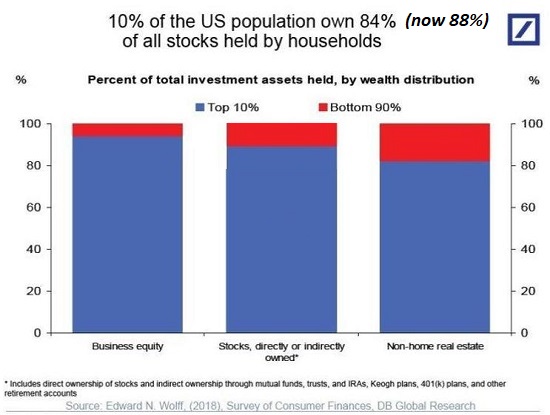
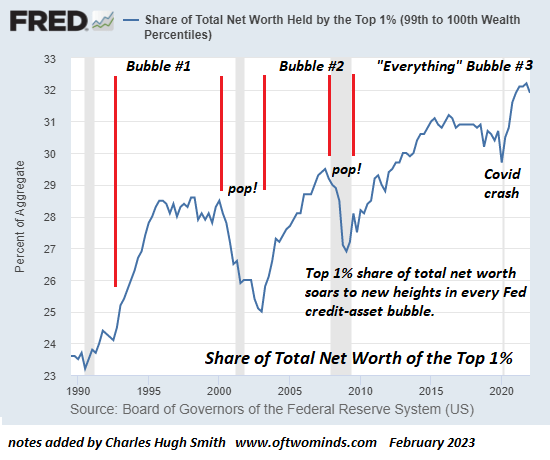
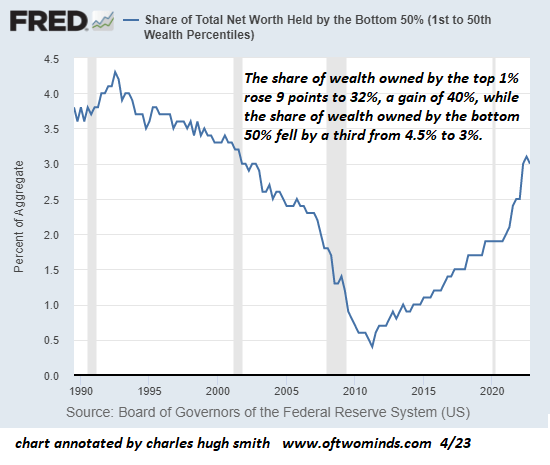
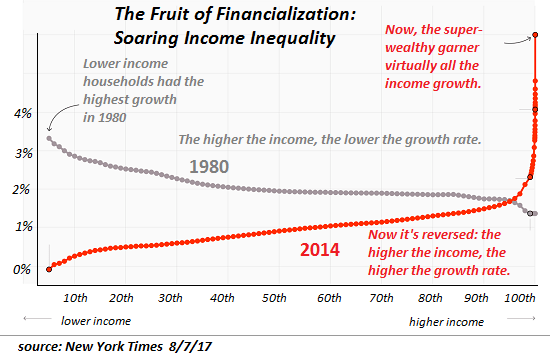
The core dynamic in neofeudalism is the already-wealthy increase their share of the wealth, and everyone else sees their meager share diminish. As the charts below show, the vast majority of financial gains generated by the US economy flow to the top 0.1% of households. The top 1%’s share has risen by 40% while the bottom 50%’s share of the wealth has slipped to 3%–essentially signal noise.

Social mobility is limited to the occasional serf clawing their way into the technocrat class, the top 5% who slavishly serve the interests of the financial aristocracy. This class lives in a self-contained, protected bubble: an echo chamber of privilege, residential enclaves, jetting around the world, and so on: everything’s great because we’re doing great.

Life is good in the bubble because there’s no homeless encampment a block away, there’s plenty of money coming in and our wealth–401Ks, inherited bonds and rental property, university pensions, corporate stock options, and so on–increases smartly, year after year and decade after decade.

The Wealthy Are Not Like You and Me–Our Terminally Stratified Society (8/3/23)

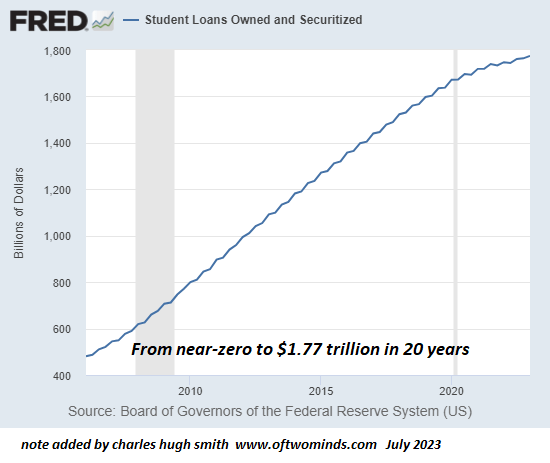
That all this wealth expansion is the result of unprecedented central bank intervention is left unsaid. As noted above, the role of the state and central bank is to maintain the status quo of the already-wealthy increasing their share of the national wealth and income, and loading more (very profitable) debt on the serfs. (See student loan debt chart below.)

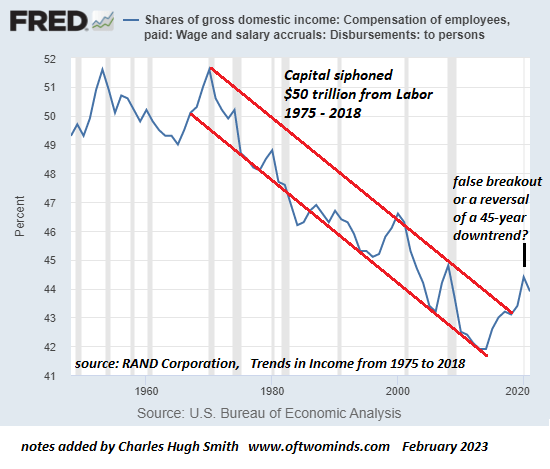
Outside the technocrats’ privileged bubble, wages’ share of the economy have been stripmined by the aristocracy for 45 years. Oh dear; could this be why I’m having such trouble finding low-wage reliable “help”?

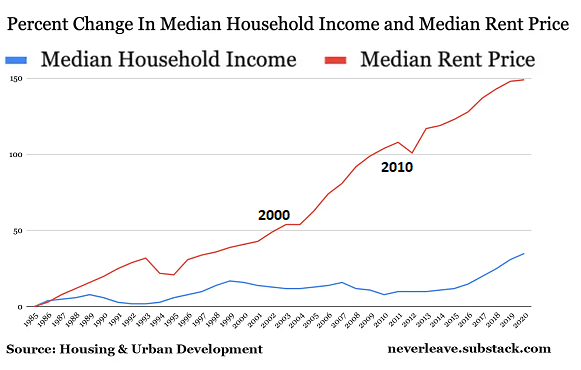
While wages inch up, costs of shelter, utilities, debt, vehicles, public transport, childcare and other essentials soar. Please glance at the chart of wages and rents below. This is neofeudalism in a nutshell. Wages have flatlined (or fallen when measured in purchasing power) while rent has steadily increased, eating away at the serfs’ disposable income.

Inside the technocrat class bubble, everything’s wunnerful. AI will boost profits (all of which flow to the aristocracy, so that’s wunnerful), energy’s getting cheaper and more abundant, and so on.

Oh, wait. Alt-energy only looks cheap because all the full lifetime costs have been ignored (i.e. externalized), and these modest additions to our vast hydrocarbon consumption aren’t actually replacing hydrocarbons, they’re simply adding more energy for us to consume.

Thousands of Old Wind Turbine Blades Pile Up in West Texas

Avangrid agrees to pay $48 million to terminate offshore wind deal

Models Hide the Shortcomings of Wind and Solar

In other words, conventional economists and the other technocrats maintain their privileged bubble by clinging to a delusionally disconnected-from-the-real-world mindset. There’s always a slew of academic papers or think-tank / corporate reports to bolster the inside-the-bubble confidence that everything’s great, because generating positive narratives that leave the neofeudal structure untouched in the primary industry of the technocrat class.

If you want to understand the neofeudal reality, study these charts. There are no rebuttals, there are only sputtering obfuscations: b-b-but the mission to Mars! Taylor Swift raked in a billion bucks! OnlyFans pulled in $5 billion! Stocks are rallying! Everything’s great!

Sure–if your dose of Delusional is high enough. Then you can go back to complaining about air travel delays, finding someone to repair your pool pump and bragging about how well your investments are doing.

Radicle and Rhizomati: Notes from a Folk Herbalist

By Lisa Fazio

Source: Resilience

Hierarchy

Power structures establish various systems to ensure the organisation of interrelationships and the distribution of resources throughout a group, community, or ecosystem. In human terms, these systems become our tribes, societies, and civilisations. The dominant power structure in the Western world at this time is capitalist, colonial, and hierarchical, with resources being distributed (or, more accurately, hoarded) from the top down.

Before capitalism, many of us who have descended from the nations of Europe have a cultural history of feudalism or some other social-ranking hierarchy. Feudal society is the rootstock of capitalism. One of the primary differences subsumed from this medieval power structure by early capitalism was the waged exchange of labour. The feudal peasants were non-waged, that is, not paid in monetary currency for their labourInstead, they were paid by an exchange of resources such as land, shelter, and farming rights. Both capitalist and feudal hierarchies were architected to direct and control the circulation of currency from those at the top, who are the elite and few, down to those at the bottom, who are the poor and many.

Capitalism depends on unrestrained growth and production, the manufacturing of material goods, and the extraction of resources to meet these ends. Colonisation, the imperious expansion of geographic, cultural, and political boundaries becomes requisite — with all its cruelty and overconsumption — as a result of this excessive and continuous reach to sustain the unsustainable.

When contemplating the quagmire of obstacles and institutions within our capitalist society that interfere with the equitable and just interchange of currency and access to resources, I find myself motivated to explore less oppressive economic, social, and political human relationships.

In doing so, I have become aligned with that ever-gallant and hopeful group of folks dismissed as unrealistic dreamers. We ‘dreamers’ always hold fast to the truth that the wilful designation of creation and power can be delineated into a network of horizontal or lateral functions that make greed, conquest, and competition unnecessary and invalid, except in extreme conditions.

In the words of Larry Wall, creator of Perl, the open-sourced computer programming language: ‘There is more than one way to do it.’ Perl, and Wall’s band of merry hackers, revolutionised the internet with a coding script that encourages other programmers to interject or hack, as they say in the business, their own design style and innovations that contribute to improvements and success for everyone using the network.¹ These internet wizards built the bridge between those of us who simply want to use the internet and those who actually understand it.

I personally am not remotely skilled in the exotic language of programming or the strange tongue of capitalist economics. As one called to the path along the hedges, in the woods, the fields, the gardens, and all the green, untamed and untrailed places, I have found another way to do things in learning the ways of the world beneath the dark shadows of treetops and in the soils with the rooted ones.

As a folk herbalist practising in the foothills of the Adirondack Mountains of New York State, I live remotely, keeping a distant participation to some degree (perhaps never enough?), in the mainstream rush and panic of daily life in the ‘real’ world of productivity, competition and corporate time sheets. My work with others, however, brings me into direct contact with the consequent ills, both physical and emotional, of life within the overworked, overstimulated and ‘red in tooth and claw’ system. My long hours and days gathering and growing the herbs to share with my clients, family, neighbours and friends feels like a different world or alternate reality in contrast to the interface I must make with the civilised world of offices, fluorescent lights and concrete. While I truly love all parts of my work, this polar interchange always clearly elucidates for me the distinct difference between the world of unruly winds and wild waters, and the tame and burning filaments of electricity enslaved within the lightbulb.

Much of my herbal work is spent with a shovel, basket and clippers as I dig and gather roots, leaves, flowers, bark and berries that are prepared into teas and other herbal formulations. I make every practical effort to harvest from local sources. This requires me to be tuned into to the seasonal cycles and growing patterns of wild plants. I also grow a variety of herbs in my own garden, and have become acutely tuned into conservation and ethical harvesting techniques that ensure the long-term survival and proliferation of our wild medicine plants.

This art and practice of traditional herbalism has deep roots into the history of every culture on earth. These roots have twisted, turned and intertwined throughout thousands of years of human civilisation, often being lost and forgotten as the quality of our communal engagements and our narrative with the world has placed humans on top of a hierarchy that centralises power into an above-ground, rootless, disembodied, hegemony.

That said, I think it’s important here to acknowledge that hierarchies occur naturally in wild communities, especially in herd animals, and that hierarchy is not always played out as an oppressive power structure. It can be an excellent tool for ensuring survival, protection and the health of a herd or community when based on consensus, synergy and cooperative principles.

Becoming radicle

Radicle: a rootlike subdivision, the portion of the embryo that gives rise to the root system of the plant
— biology-online.org 

Radicle describes the first part of the seed to emerge after germination that subsequently becomes the primary root. Radicles and the roots they become are a most powerful natural force that, as every city sidewalk knows, will crack and divide concrete. The soil depends upon these mighty revolutionaries to deeply move, turn and aerate the surface of the planet so that life can ascend from it. Plants ‘know’ that in order for productive growth to be sustained, they must first set their roots and begin to make contact with the vast and nutritious field of minerals and essential microbes within the substratum.

Plant roots have many different and effective growing styles, but my favourite are those that are rhizomatic. A rhizome is actually an underground stem that is rootlike; it spreads horizontally, sending out shoots and creating a lateral chain of connection where new sprouts can emerge.

Rhizomes are non-hierarchical and extremely resilient because even if you dig up one part, the other sections will continue to grow and proliferate. Rhizomes have no top or bottom, any point can be connected to any other. They can be broken off at any point and will always be able to start up again. Their network can be entered at any point; there is no central origin. And because there is no central regulatory force, rhizomes function as open systems where connections can emerge regardless of similarities or differences. Freedom of expression exists within a rhizome.

Rhizomes, therefore, are heterogeneous and can create multiplicities, or many different roots, that are sovereign but still in contact and communication with all other parts of the system. This is in contrast to, for instance, a tree, which has a central origin or trunk from which all of its roots and branches emerge. Disconnected from that source, they are no longer in direct contact with their growing system.

As author and storyteller Martin Shaw writes about ‘the rhizomatic universe’ in his book A Branch From the Lightening Tree:

The rhizome is a plant root system that grows by accretion rather than by separate or oppositional means. There is no defined center to its structure, and it doesn’t relate to any generative model. Each part remains in contact with the other by way of roots that become shoots and underground stems. We see that the rhizome is de-territorial, that it stands apart from the tree structure that fixes an order, based on radiancy and binary opposition.

Learning methods and cultural philosophies have been inspired and developed from the patterns observed within rhizomatic root systems. One such concept was introduced by philosopher Guilles Deleuze and psychoanalyst Felix Guattari. From their book on the subject, A Thousand Plateaus: Capitalism and Schizophrenia:

As a model for culture, the rhizome resists the organizational structure of the root-tree system, which charts causality along chronological lines and looks for the original source of ‘things’ and looks towards the pinnacle or conclusion of those ‘things.’ A rhizome, on the other hand, is characterized by ‘ceaselessly established connections between semiotic chains, organizations of power, and circumstances relative to the arts, sciences, and social struggles.’ Rather than narrativize history and culture, the rhizome presents history and culture as a map or wide array of attractions and influences with no specific origin or genesis, for a ‘rhizome has no beginning or end; it is always in the middle, between things, interbeing, intermezzo.’ The planar movement of the rhizome resists chronology and organization, instead favoring a nomadic system of growth and propagation.

In this model, culture spreads like the surface of a body of water, spreading towards available spaces or trickling downwards towards new spaces through fissures and gaps, eroding what is in its way. The surface can be interrupted and moved, but these disturbances leave no trace, as the water is charged with pressure and potential to always seek its equilibrium, and thereby establish smooth space.

Examples of rhizomatic patterns exist throughout the living world and include plants such as ginger, crabgrass, violets and, my favourite, wild sarsaparilla (Aralia nudicalis). In human terms we can see many examples of rhizomatic systems, such as we discussed above about Larry Wall and the internet, even amid the context of complex societal hierarchy. New economic and environmental models of power such as permaculture, bioregionalism, and re-localisation are designed to work as horizontal, cooperative, synergistic, and non-competitive systems.

The Rhizomati

Rhizome: A continuously growing horizontal underground stem that puts out lateral shoots and adventitious roots at intervals.
— Oxford English Dictionary online

Herbal medicines are, and always have been, a rhizomatic source of the equitable and lateral distribution of basic needs that seeks not to hoard, commercialise, and capitalise on healthcare or to dole it out only to those with access to the necessary currency. Herbs themselves have not escaped the thralls of patriarchal conquest. All of our modern medicine was founded on the insight gained from the common people and their unwritten relationship with the medicine of the plants. Many of the early European physicians gathered their knowledge from village herbalists, often women who could not read or write (as the patriarchy forbade them). These women are rarely even mentioned in the published literature of medical history. An example can be found in the book written by Dr William Withering (1774-1799), the man who is said to have ‘discovered’ the medicinal use of foxglove. The very first page of his book makes a short mention of a village wise woman who used it in a formula for dropsy: ‘I was told that it had been a long-kept secret by an old woman in Shropshire, who had sometimes made cures after the more regular practitioners had failed.’

The village healers were not elite or favoured by the ruling classes, and in fact were historically perceived as a threat. Their healing work was focused on the direct and intimate needs of their local community, which they frequently sought to empower and support. Traditional herbal medicine was not motivated by profit nor was it sanctioned by the overculture.

In our current times, herbal medicine and plant-based culture has re-emerged in many forms and I perceive it is in a major cycle of transformation. Many call it the ‘herbal renaissance’ and it’s not clear yet what the trajectory will be, as the world seemingly changes at the speed of light. However, the core values remain inextricably connected to the interdependent place-based character of the village healer and his or her reciprocal conversation with the wild and green world.

Our ancestors in healing, the long-ago plant people, were in service to their human community as well as the medicine allies they harvested from the hedges. These plant people often lived on the edge of town and worked as not only healers of physical sickness, but also practitioners of spirit, shamans of the village soul, and knowers of, or in old English ‘cunners’ of, the ‘wort’, or herb. Some were called wortcunners. Some were called magicians. Some were called witches. There are many different types of herbalists now and in the past. In ancient times — interestingly! — they were called the rhizomati, or by some sources, rhizotomoki, meaning ‘root gatherers’ or ‘root cutters’.

The rhizomati were rhizomatic practitioners of underground and lateral energy patternsas found in the plant kingdom. According to Christian tsch, ‘the rhizotomoki still spoke with the plant spirits…’ He adds: ‘These root-gatherers observed the gods sacred to the respective plant. They made use of the moon’s energy and knew the particular oath formulas for each plant. Witchcraft medicine belongs to the spiritual and cultural legacy of the rhizotomoki.’

tsch asserts, therefore, that ‘witchcraft medicine is wild medicine. It is uncontrollable, it surpasses the ruling order, it is anarchy. It belongs to the wilderness.’² Anarchy and wildness, in this sense, are not instances of chaos, mayhem, or lack of a system; rather, it is a system that is self-organised, organic, self-regulated, and impervious to oppressive external control mechanisms.

The rhizomati were carriers of traditional healing knowledge and have emerged at various points in time. In fact, as would a rhizome — going underground for a time andsprouting their legacy up to the surface in another place or time. Renowned modern-day herbalist David Hoffman has compared herbalists of our time to the Greek ‘rhizotomoi’ who held a very special place in the hierarchy of health-care practitioners during ancient times. He asserts that, now as then, herbal healers ‘breach so many realms.’

It is important to understand that the rhizotomoi were not merely the garden labourers that grew the plants, nor did they have the status of academic physicians who dispensed already prepared pills and formulas. Hoffman says: ‘They were people who knew the plants, knew where they grew, knew how to cultivate them, knew how to collect them appropriately, knew how to make the medicine, but then also knew how to use the medicine in the context of the people’s needs… they were herbalists.’

The legacy of these herbalists has carried their medicine bags into the vernacular, or kitchen, gardens of the past few hundred years in Europe and North America. Such gardens belonged to people of any class, and provided subsistence food and medicine to individuals and families. These communal plots were stewarded by the rhizomati and provided a local source of plants and seeds, were designed to meet the natural rhythms of the seasons, and were small enough to adapt to changing local conditions. They were places ‘in which “herb women” and rhizomati, root gatherers, are a key source of plant materials and seeds, and garden innovations are shared among peers—family, neighbors, friends—rather than distributed by a central authority.’³

Today’s root cutters, root gatherers, folk herbalists, plant charmers, and the like, face unknown challenges as the trail leads into the future of a global, capitalist economy. Herbal medicine has become increasingly mainstream and, will no doubt, continue to be commodified and profiteered at some level.

The overculture has made many recent bids to commercialise, exploit and restrict the use of plants by the people. There have been recent regulations enacted that limit the ability of herbalists to maintain home-based businesses, thereby restricting access to local products and serving the burgeoning corporate herbal industry.4

That is not to say that there is not a place in our health-care system for phyto-physicians that work with herbs allopathically. Plant-based preparations have already found a place in mainstream bio-medicine as a complementary modality, a method of prevention, and as a tool of synergy to potentise pharmaceutical protocols. However, this does not concede the necessity of the decentralised, community focused, and client-centred practice of folk herbalists. The modern rhizomati are a source of resilience and empowerment for our society and world, thanks to their interface with plants and people. This resilience will come not only at our resistance to capitalist exploits, but in our ability to establish rhizomatic, horizontal and local systems of vital sustenance, imagination, and community.

Change and dissent are enacted on even the simplest, most humane level when we just become aware of equitable alternatives to our dominant power structure. This I believe to be true well beyond the realms of herbal medicine practice. It has implications for our homes, businesses, communities local and beyond, schools, food production, the arts, and developing technologies. The key to the door of social justice and change is the knowledge that there are other ways to do it — as well as in the courage and innovation of those that are willing to imagine more than one possibility.

May the rhizomati live again and may we all rise rooted!

Footnotes
1. Silberman, Steve, Neurotribes, New York: Avery, 2015
2. Müller-Ebeling, Claudia, Christian Rätsch, and Wolf-Dieter Storl, Witchcraft Medicine: Healing Arts, Shamanic Practices, and Forbidden Plants, Rochester, Vermont Inner Traditions, 2003
3. ‘Vernacular Gardens’, Wyrtig.com, For gardeners with a sense of history, 2015. Accessed February 18, 2017
4. For more on these regulations or the cGMP laws: A Radicle blogspot. FDA cGMP compliance open source project. aradicle.blogspot.com, 2015. Accessed February 18, 2017

No Man’s Land

fence

By Steven Stoll

Source: Orion Magazine

A chainlink fence topped with razor wire surrounds fourteen acres of thistle and grass at East Forty-First Street between Long Beach Avenue and South Alameda Street in Los Angeles. These two city blocks occupy a transitional environment of sorts. In one direction the sight of small houses stretches for miles toward the Pacific Ocean, but turn around and the neighborhood becomes industrial, consisting of a textile factory, a scrap metal recycling company, trucking terminals, and warehouses. The tracks of the Southern Pacific Railroad run parallel to Long Beach Avenue. There are few trees or anything green and growing but the drought-resistant thistle.

In 1986, the City of Los Angeles acquired the land from a group of owners through eminent domain, but then folded plans to build a waste incinerator when the community resisted. The land ended up in the holdings of the Harbor Department. It had been two years since the uprising that followed the acquittal of four Los Angeles police officers, tried for beating Rodney King. Perhaps looking to make a gesture and lacking its own use for the site, the Harbor Department invited members of a local food bank to plant a community garden.

They did. Between 1994 and 2006 hundreds of families grew a profusion of food plants on what had been a blighted lot just a few years before. One visitor identified a hundred species, most of them native to Mexico and South America— chayote, guava, tomatillo, sapodilla, and sugarcane, in addition to maize, beans, avocados, bananas, and squashes. The South Central Farm was not misnamed: photographs show the land in robust cultivation, producing a wealth of food.

But in 2001, one of the prior owners filed a lawsuit against the city. The property had never been used to build the incinerator, and so, he argued, Los Angeles had no reason to seize it. The city settled the case in 2003 by selling the fourteen acres back to the prior owner.

In the ensuing confrontation a single absentee negated the sustained labor and improvements of 350 families, representing around a thousand people, now accused of squatting. They refused to leave. Lawyers filed briefs. Gardeners swore resistance. (One said, “Just think if we assemble, two from every family, and you know we’ll each grab a hoe, and no one will get past us.”) Movie stars showed up with camera crews. A foundation offered millions of dollars as a purchase price, which the owner rejected. A date was set for the forced removal of the stalwarts. On June 13, 2006, Los Angeles County Sheriffs arrested forty people. Bulldozers destroyed the farm. A decade later, the land remains vacant.

In the case of the South Central Farm, ownership for profit triumphed over use for subsistence, which, of course, is the way of the world. Nothing could be more ordinary than a landowner asserting his rights. And yet, just five centuries ago, what happened on those fourteen acres in south Los Angeles wouldn’t have made sense to anyone.

In 1500, no one sold land because no one owned it. People in the past did, however, claim and control territory in a variety of ways. Groups of hunters and later villages of herders or farmers found means of taking what they needed while leaving the larger landscape for others to glean from. They certainly fought over the richest hunting grounds and most fertile valleys, but they justified their right by their active use. In other words, they asserted rights of appropriation. We appropriate all the time. We conquer parking spaces at the grocery store, for example, and hold them until we are ready to give them up. The parking spaces do not become ours to keep; the basis of our right to occupy them is that we occupy them. Only until very recently, humans inhabited the niches and environments of Earth somewhat like parking spaces.

Ownership is different from appropriation. It confers exclusive rights derived from and enforced by the state. These rights do not come from active use or occupancy. Property owners can neglect land for years, waiting for the best time to sell it, even if others would put it to better use. And in the absence of laws protecting landscapes, the holders of legal title can mow down a rainforest or drain a wetland without regard to social and ecological cost. Not all owners are destructive or irresponsible, but the imperative to seek maximum profit is built into the assumptions within private property. Land that costs money must make money.

Champions of capitalism don’t see private property as a social practice with a history but as a universal desire—a nearly physical law—that amounts to the very expression of freedom. The economist Friedrich Hayek called it “the most important guarantee of freedom, not only for those who own property, but scarcely less for those who do not.” But Hayek never explained how buyers and sellers of real estate spread a blanket of liberty over their tenants. And he never mentioned the fact that the concept, far from being natural law, was created by nation-states—the notion that someone could claim a bit of the planet all to himself is relatively new.

Every social system falls into contradictions, opposing or inconsistent aspects within its assumptions that have no clear resolution. These can be managed or put off, but some of them are serious enough to undermine the entire system. In the case of private property, there are at least two—and they may throw the very essence of capitalism into illegitimacy.

The first of the system’s contradictions points to its origins. Land in the English countryside during the sixteenth century was regulated by feudal obligations so obscure and so thick that few people today can make sense of them. An English peasant could use a run of soil for a term of years or for her entire life, but it did not belong to her. Village elders, representatives of the local lord, and even the deacon of the church might have claimed an interest in how this or that field was planted. Everyone from monarch to serf received a different slice of the realm. These use rights could be exchanged only in very limited ways: a lord occupied his ancestral house and manor for as long as he lived, but he could not sell them.

All sorts of events caused the demise of feudalism. The Black Death of the fourteenth century killed so many millions that the labor market tipped in favor of those who survived. The spread of money gave things exchange value and made buying and selling easier. Food production increased during the sixteenth century, creating more calories for work and more commodities for trade. And an international wool market inspired lords to change common fields into sheep walks.

The problem was that lords could not put sheep where they wanted. They lived within the feudal assemblage of obligations and rights attached to social orders and scraps of landscape. Faced with declining returns and proliferating opportunities, they began to curse the old rules—they wanted land for themselves.

Enclosure is just what it sounds like: the physical and legal bounding of an area. In practice it meant the seizure of villages, common fields, and outlying forests and marshes. It allowed lords to evict former residents so that they could do new things with land. Sometimes it happened by agreement, with peasants giving in to demands they feared to contest; other times there was violence. In 1607 at least one thousand peasants tore up hedges in Northamptonshire and filled in ditches that demarcated property lines. The rebels made a statement: “Wee, as members of the whole, doe feele the smarte of these incroaching Tirants, which would grind our flesh upon the whetstone of poverty.” King James didn’t flinch from the whetstone. His forces killed forty insurgents and hanged their leader.

The king’s involvement tells us that grasping lords did not do this dirty work by themselves. Parliament legalized their land grab by granting them something that had never before existed in human history: ownership. Lords could now act without regard to tradition or the needs of residents. Some demolished whole communities. The word pauper dates from the seventeenth century to describe poor people who wandered the roads homeless, eating anything they could scavenge and turning up cold and wet at church doors. Peasants became workers as their only option for survival. Some stooped for a wage on the very land they once tilled as members of villages.

Enclosure created two things at once: private property and wage labor, the essential preconditions for capitalism. Like all social practices, private property has a degree of flexibility. Some of its advantages can and should be diffused among as many people as possible. By eliminating messy titles to land and its embeddedness in tradition, enclosure made possible a new measure of innovation and abundance. But that’s also the first of its contradictions. It generates wealth and unprecedented social power for some by making others poor and dependent.

All of this matters because enclosure never came to an end. It jumped continents and kept on going. The colonial wars for North America, in which Britain and then the United States seized land from hundreds of tribes, can be understood as a rolling dispossession—by purchase, treaty, and ejectment. Enclosure also took place in Australia and South Africa. Wherever nation-states became landowners they turned the commons into private property. The epicenter of enclosure today is Africa. A resident of the village of Dialakoroba, in Mali, which has lost thousands of acres to foreign investors, recently said this: “I do not know, in ten to twenty years, how people will live in our villages because there will be no land to till. . . . Everything has been sold to rich people in very opaque conditions.”

Private property’s second contradiction comes from the odd notion that land is a commodity, which is anything produced by human labor and intended for exchange. Land violates the first category, but what about the second? As the historian Karl Polanyi wrote, land is just another name for nature. It’s the essence of human survival. To regard it as an item for exchange “means to subordinate the substance of society itself to the laws of the market.”

Clearly, though, we regard land as a commodity and this seems natural to us. Yet it represents an astonishing revolution in human perception. Real estate is a legal abstraction that we project over ecological space. It allows us to pretend that a thousand acres for sale off some freeway is not part of the breathing, slithering lattice of nonhuman stakeholders. Extending the surveyor’s grid over North America transformed mountain hollows and desert valleys into exchangeable units that became farms, factories, and suburbs. The grid has entered our brains, too: thinking, dealing, and making a living on real estate habituates us to seeing the biosphere as little more than a series of opportunities for moneymaking. Private property isn’t just a legal idea; it’s the basis of a social system that constructs environments and identities in its image.

Advocates of private property usually fail to point out all the ways it does not serve the greater good. Adam Smith famously believed that self-interested market exchange improves everything, but he really offered little more than that hope. He could not have imagined mountains bulldozed and dumped into creeks. He could not have imagined Camden, New Jersey, and other urban sacrifice zones, established by corporations and then abandoned by them. Maximum profit is the singular, monolithic interest at the heart of private property. Only the public can represent all the other human and nonhuman interests.

Unbelievably, perhaps, the United States Congress has done this. Consider one of its greatest achievements: the Endangered Species Act (ESA) of 1973. The act nails the abstraction of real estate to the ground. When a conglomerate of California developers proposed a phalanx of suburbs across part of the Central Valley, they came face to face with their nemesis: the vernal pool fairy shrimp. In 2002, the Supreme Court upheld the shrimp’s status as endangered and blocked construction. It was a case in which the ESA diminished the sacred rights to property for the sake of tiny invertebrates, leaving critics of the law dumbfounded. But those who would repeal the ESA (and all the other environmental legislation of the 1970s) don’t appreciate the contradiction it helps a little to contain: the compulsion to derive endless wealth from a muddy, mossy planet.

Of course, in the era of climate change, those invaluable laws and the agencies they created now seem too limited in their scope and powers to take on the spectacular collision between Economy and Ecology now in motion. But maybe the most radical way we can treat the ownership of Earth—the single most subversive notion we can have about private property—is that it’s merely a social relationship, an agreement between people to behave in certain ways. It can be challenged, changed, and contained. Much of what holds failing social systems together is that those in power succeed in eliminating the mere thought that things could be otherwise.

Should private property itself be extinguished? It’s a legitimate question, but there is no clear pathway to a system that would take its place, which could amount to some kind of global commons. Instead I suggest land reform, not the extinguishing of property rights but their radical diffusion. Imagine a space in which people own small homes and gardens but share a larger area of fields and woods. Let’s call such legislation the American Commons Communities Act or the Agrarian Economy Act. A policy of this sort might offer education in sustainable agriculture keyed to acquiring a workable farm in a rural or urban landscape. The United States would further invest in any infrastructure necessary to move crops to markets.

Let’s give abandoned buildings, storefronts, and warehouses to those who would establish communities for the homeless. According to one estimate, there are ten vacant homes for every homeless person. Squatting in unused buildings carries certain social benefits that should be recognized. It prevents the homeless from seeking out the suburban fringe, far from transportation and jobs (though it’s no substitute for dignified public housing). Plenty of people are now planting seeds in derelict city lots. In Los Angeles, an activist named Ron Finley looks for weedy ground anywhere he can find it for what he calls “gangsta gardening,” often challenging absentee owners. In 2013, the California legislature responded to sustained pressure from urban gardeners like Finley and passed the Urban Agriculture Incentive Zones Act, which gives tax breaks to any owner who allows vacant land to be used for “sustainable urban farm enterprise.”

Squatting raises another, much larger question. To what extent should improvements to land qualify one for property rights? The suppression of traditional privileges of appropriation amounts to one of the most revolutionary changes in the last five hundred years. All through the centuries people who worked land they did not own (like squatters and slaves) insisted that their toil granted them title. The United States once endorsed this view. The Homestead Act of 1862 granted 160 acres to any farmer who improved it for five years. Western squatters’ clubs and local preemption laws also endorsed the idea that labor in the earth conferred ownership.

It’s worth remembering that there is nothing about private property that says it must be for private use. Conservation land trusts own vast areas as nonprofit corporations and invite the public to hike and bike. It’s not an erosion of the institution of property but an ingenious reversal of its beneficiaries. But don’t wait for a land trust to be established before you enjoy the fenced up beaches or forests near where you live. Declare the absentee owners trustees of the public good and trespass at will. As long as the land in question is not someone’s home or place of business, signs that say KEEP OUT can, in my view, be morally and ethically ignored. Cross over these boundaries while humming “This Land Is Your Land.” Pick wildflowers, watch sand crabs in the surf, linger on your estate. Violating absentee ownership is a long-held and honorable tradition.

The arrest of the South Central Farmers was deeply disturbing in Los Angeles. So much so that citizens began to call for other farms, in other locations throughout the city and county. Ten years later community gardens abound. More than a hundred of them are thriving, including the Stanford Avalon Community Garden, which was established by some of the very families evicted from the South Central Farm. It runs one mile long and 80 feet wide underneath power lines, on city property. There is space for 180 plots, each about 1,300 square feet. The farmers compete with each other for the greatest yields. They pay a small fee for a plot and absorb all the food into their households, to be eaten and sold.

Building this garden movement has not extinguished any of the rights of private or public landowners. But only sustained resistance and protest could have forced these entities to accommodate thousands of household farmers. Yet nothing could be more ordinary or more radical than the desire for autonomy from the tyranny of wages, a dream that persists in billions of humans striving in slums and factories, ready for their moment to reclaim the commons.


Steven Stoll is Professor of History at Fordham University, where he teaches environmental history and the history of capitalism and agrarian societies. He is the author of Larding the Lean Earth: Soil and Society in Nineteenth-Century America (2002) and The Great Delusion (2008), about the origins of economic growth in utopian science. His writing has appeared in Harper’s Magazine, Lapham’s Quarterly, and the New Haven Review. He is finishing a book about losing land and livelihood in Appalachia.

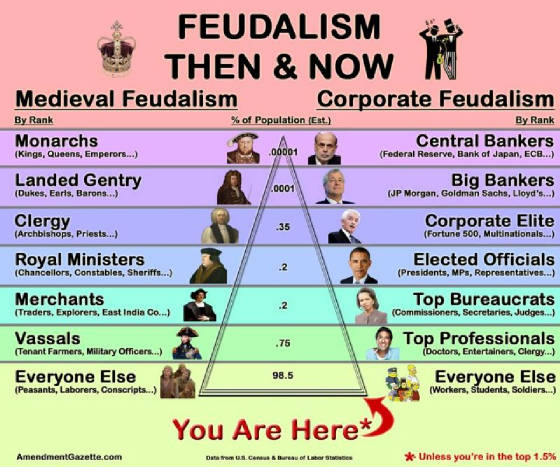
An Introduction to Technofeudalism Ascending

feudalism-then-and-now-hierarchy.jpg.w560h467

By SARTRE

Source: BATR.org

The future of the planetary Reign of Terror has never been clearer. The pattern for global governance has been set into motion and operates under a model that has been used throughout much of history. The modern day version of command and control can be effectively described as Technofeudalism. The purpose of this introduction is to provide an outline of the arguments used by Steven Yates, Ph.D. The link to this significant treatise is provided below. In addition News With Views maintains an extensive archives of Dr. Yates’ work. Invest the time to read the entire essay for a full understanding of the linkage behind Technofeudalis and the course for top down dominance.

Technofeudalism Ascending comprises nine sections. Dr. Yates provides the following preface.

My book Four Cardinal Errors (2011) introduced the idea of technofeudalism. Though a bit of a mouthful, this is the best term for the political economy towards which an intergenerational superelite has been directing as much of the world as possible for at least a century. This existence of this group, I argue, is the foremost political-economic reality of our times.

Their goal, I argued in Four Cardinal Errors, is to institute corporate controlled global governance: de facto world government, managed for private profit and for control over national governments and populations. Technofeudalism is the resulting political economy. While preserving some of the vocabulary and outward features of market capitalism, technofeudalism has almost nothing to do with free markets, or free enterprise, as generally understood. It is about instituting whatever policies, instigating whatever wars, bringing about whatever revolutions, and causing whatever levels of misery are deemed necessary for enforced mass compliance. Its tools include both neoliberal and neoconservative ideology, artificial scarcity, education reduced to job training, and fear induction through constant pontificating about “terrorism” amidst random and often-depraved acts of violence, reducing as many as possible to a status of permanently cash-strapped, mentally paralyzed subjects — living amidst the most advanced technology in human history, but equivalent to serfs (“owned” as de facto property by “their” governments, employers, etc., as in medieval feudal systems of old). Hence, the term technofeudalism.

Introduction:  Why Technofeudalism? (Technofeudalism is the best term for a kind of political economy that has been coming together very gradually for much of the past century, but accelerating in recent decades: it is technologically advanced but populations are controlled by various means and, in effect, made into serfs who are tied to whatever work they can find and to government programs. Technofeudalism is driven by those I call the superelite—a group of globalist-minded extended families whose primary motivation is wealth and power. It illustrates the primary problem of practical political philosophy and strategy: how to contain that minority in our midst that is drawn to power.)

  1. The End of History? (The collapse of the Soviet Union seemed to leave the world at a major turning point; Communism was dead, the combination of market capitalism and liberal democracy seemed to be catching on everywhere, and the U.S. was the sole superpower. It seemed conceivable that it really was, as Francis Fukuyama described, the end of history.)
  1. The Neoliberal Illusion.  (Things began to unravel almost at once, as trade deals such as NAFTA began to put an end to the largest financially independent middle class in history. Neoliberal ideology proved to have a dark side, as wealth began to be redistributed upward and millions of people ended up out of work.)
  1. Precariatization and the Destruction of the American Mind.  (Higher education faced multiple crises: rising radical left “scholarship” in the humanities, a rising corporate or business mindset in expanding administrations, the collapse of the academic job market creating conditions where control was possible, and the impoverishing of faculty via adjunctification, one species of the creation of a precariat — workers in an environment of part-time, temporary, and short term work. Liberal arts learning itself came under assault, as the thinking skills it provides threaten a political economy of power, domination, precarity, and corruption.)
  1. The Empire of Corruption.  (Ensuing decades have seen rising corruption and financial manipulation which eventually caused the 2008 meltdown and have brought about a steadily lowering of the standard of living in the U.S. Supreme Court decisions such as Citizens United ensure a bought-and-paid-for political class, and articles now appear in refereed journals indicating that the U.S. is now a plutocratic oligarchy.)
  1. The Global Corporatist Leviathan.  (If the present political system is plutocratic oligarchy, the correct term for the present economy is corporatism, with technofeudalism its broader political-economic-technocratic instrument. Poor education ensures a systematic confusion between capitalism and corporatism. Under corporatism, corporations are in the driver’s seat behind governments, as we can see from their latest effort to dominate a section of the world’s economy: the Trans-Pacific Partnership.)
  1. The New Serfdom.  (You are living in a feudal system when there is one set of rules for those with power and another set of rules for those without power, with only token representation. Technofeudalism emerges in that its subjects are technologically advanced serfs — surrounded by technology but tied to low-wage work or to a government-based support system.)
  1. “What Can We Do?”  (You can educate yourself on issues ranging from the possibilities of expatriation to that of peoples separating politically from empires, which may become possible as a very severe downturn, worse than the Great Recession — a Greater Depression — is almost certainly inevitable.)
  1. Preparing for the Greater Depression.  (The world is on the verge of having to face the realities of financialization that will bring on the Greater Depression. You can prepare by building proper skills now. It is conceivable that the global superelite is planning on a Greater Depression. You should prepare anyway.)
  1. Grounds for Hope: Real Sustainability and the Cycles of History.  (Technofeudalism will prove unsustainable. It may be put in place, but its structure and the mindset that gave rise to it will cause it to decay and eventually disintegrate. We have come this way before, as empires have risen and fallen before. This provides hope, in that with the collapse of the technofeudalist state, separation and the building of a world of small states will become possible — again if we begin to prepare now.)

This summary outline attempts to persuade the compelling case to review the entire critique. Filling in the connections and relationships to achieve the eternal objective of worldwide ascendancy in an age of technological supremacy, means that the return to a feudal society becomes the undeniable 21th century danger.

Technofeudalism is based upon herding marginal and unneeded humans into ghettos of subsistent serfdom existence. The technocrats who administer the process of dehumanization become the executioners of civilization. Utopia for the select, built on the misery of the masses is a future not worth living. This fact is exactly the objective of the globalist. Destroying resistance through marginalizing survival rules a feudal society. However, building the achievement of a renaissance culture is based upon the liberation of the human spirit and decentralization of authority.

The global elites depend on acquiesce of the masses to accept and adopt the tyrannical systems and indoctrination methods propagated by the technocratic matrix. Liberty is despised by authoritarians. Technofeudalism is the enemy of all human beings. Once armed with the knowledge of this threat, what will be the response of the populace targeted for slavery or extinction?