Risings and Fallings

By James Howard Kunstler

Source: Kunstler.com

In the corkscrewing anguish of the social sequester, with careers, savings, futures, and dreams whirling down the drain, voices rise above the din of conflicting statistics to ask: what is going on here? To some, it looks like a deliberate attempt to demolish what’s left of the economy for political advantage. Clouds of suspicion gather over the two medical superstars of the Daily Briefing show, Doctors Fauci and Birx, as they somewhat sheepishly revise their numbers for contagion and death downward and attempt to “balance” the formula of modeled projections versus mitigation efforts. Was the stay-at-home panic necessary, after all? Will it save the day or kill off modern life as we knew it?

Well, everyplace else in the world was shutting down, weren’t they? Did they all go off their rockers, too? At least a hundred doctors died in Italy heroically tending the stricken, so they say. South Korea, Taiwan, and Singapore opted for flat-out medical Gestapo action. Britain, Spain, France, and Germany about the same, but minus testing at the grand scale and tracing of contacts. Honestly, how is it possible the whole planet punked itself?

I certainly don’t know the answer to all this, though readers are twanging on me to declare the whole Covid-19 story “a hoax,” which I’m not ready to do. I do know this: America has become utterly intolerant of uncertainty. And in the absence of certainty, that age-old human cognitive skill called pattern recognition, which has made us such a successful species, kicks into high gear scanning the field-of-view for answers. Any string-of-dots that affords even the slimmest plausibility goes on the table for review, including a lot of stories tagged as “conspiracy theories.”

I know this, too: the financial side of the gasping global economy was running off the rails well before Covid-19 flew out of its bat-cave into somebody’s soup bowl… or out of China’s Wuhan virus lab, if that’s how you like it… or before it seeped out of the Bill and Melinda Gates Foundation’s ark of world-saving secrets. In the USA and Europe, finance had come to mostly eclipse every other human endeavor of wealth production ­– with the catch that finance actually didn’t produce any real wealth, it only winkled and swindled wealth (or the mere ghosts of wealth) with its asset-stripping magic, from the places where wealth once did truly dwell. Or else it ginned up abstruse rackets that attempted to replace the utility of money with sheer math. Or, when all else failed, it just resorted to plain old accounting fraud… until, finally, there was so much there not actually there, that the whole holographic fantasy flickered out.

The pre-Easter bear market rally on Wall Street has been a wonder, don’t you think? As the numbers of able-bodied people out-of-work rocketed up past ten million during the same period, the stock indexes shot up three, five, six percent a day? Say, what? You’re telling me that’s based on the prospect of magnificent earnings in the third quarter? With every business on God’s green earth writhing in the dust like squashed bugs? And every supply line for basic goods and the gazillion spare parts for everything… all choked off?

And meanwhile, the American public sequesters and festers, waiting for those $1,200 checks that will fix… everything! Let’s face it: this is a twilight zone between stupor and fury. Nobody is paying anything to anyone. All obligations are suspended: rents, mortgages, bills, loans, bets, and vigs, all up in the air somewhere, but definitely not moving to their assigned destinations. The velocity of money is zero and all the various new term facilities and structured vehicles conjured by the Federal Reserve and Congress amount to a mere shadow of money moving ­– even though they are represented by trillions of brand-new alleged dollars. For every ten points that the Standard & Poor’s rose this week, somewhere down the line as many hedge funders will be dribbled like so many basketballs to the hoop of judgment.

The nation now has the long Easter weekend to stew and ruminate over its fate with spring achingly vivid and beckoning beyond the grim, streaked windows of sequestering. Those little cans of Easter Spam with pineapple rings won’t offer much consolation, combined with the abject discovery that even Netflix only has so many sequels to Frozen for children going catatonic with ennui. Kids are generally not so excited by stock and bond markets, but that’s probably where the genuine melodrama picks up on Monday. The weeks ahead there will give the phrase down-to-earth a whole new meaning.

Power Grab

By Michael Krieger

Source: Liberty Blitzkrieg

I met a traveller from an antique land
Who said: Two vast and trunkless legs of stone
Stand in the desert. Near them, on the sand,
Half sunk, a shattered visage lies, whose frown,
And wrinkled lip, and sneer of cold command,
Tell that its sculptor well those passions read
Which yet survive, stamped on these lifeless things,
The hand that mocked them and the heart that fed:
And on the pedestal these words appear:
‘My name is Ozymandias, king of kings:
Look on my works, ye Mighty, and despair!’
Nothing beside remains. Round the decay
Of that colossal wreck, boundless and bare
The lone and level sands stretch far away

– Percy Shelley, Ozymandias

It didn’t take long for the most opportunistic, nefarious and corrupt actors in the U.S. to turn a pandemic crisis into another massive power grab attempt. We’ve seen it before; after 9/11 and also throughout the response to the financial crisis a decade ago. The irredeemable sociopaths who always make the big, important decisions used those crises to consolidate wealth and power. They’re going for it again.

There are many examples, but let me list a few:

– The EARN IT bill, by which senators are attempting to destroy widespread public use of encryption, i.e. private communications. (EFF)

– The White House and the CDC are asking Facebook, Google and other tech giants to give them greater access to Americans’ smartphone location data. (CNBC)

– The Justice Department has quietly asked Congress for the ability to ask chief judges to detain people indefinitely without trial during emergencies. (Politico)

– U.S. Senators are attempting to use the crisis as an opportunity to pull off a gigantic corporate coup. (Matt Stoller, BIG)

Then there’s the really big one, the Federal Reserve. An institution with more unaccountable power to shape and manipulate our world than any other, yet whose actions remain subject to virtually zero public debate.

While we’re at it…

I wrote about the scam that is the Federal Reserve last year in the post, Monetary Looting, and what they’re doing now makes those repo operations look like child’s play.

We often get distracted debating the implications of Fed actions, and in the process lose sight of the bigger picture. The real question we need to be asking is why do we allow a handful of unelected banker welfare agents the right to shape our entire world? It’s a crazy system, and until we start questioning the underlying premises of everything about our world, we’ll remain confused and subjugated.

That said, I remain more optimistic than ever that once we get through this crisis and a rough transition period, a far better era awaits on the other side. I say this because I believe this pandemic will shake enough people to such an extent they’ll emerge from it very different people with a more enlightened understanding of the world and their roles in it. An event like this can make people less conscious, or it can make them more conscious. I think humanity will expand its consciousness.

Of course, the future is not written in stone. Each and every one of us needs to grow up and step up if we’re going to build a better world. We each have our skillsets, so I ask everyone reading this to think about how they can repurpose their talents to the great work of ushering in a new era. I don’t do any of this to change the world. I can’t do that. I do this to inspire as many people as possible to change their own worlds. Then everything changes.

If I had to summarize where we’ve been and where I think we’re going, it would be with the following.

The world you lived in no longer exists, but the world to come has not yet been created. The worst people in society will attempt to create it in their image, but we can’t allow that. We must step up and create it ourselves. It’s entirely possible. Get to work.

Financial Feudalism

By Michael Krieger

Source: Liberty Blitzkrieg

“Happy 18th Birthday! Meet your new Daddy,” read one website advertisement. “Do you have strong oral skills? We’ve got a job for you!” cooed another.

A message on another billboard directed at the “daddies” was more blunt: “The alternative to escorts. Desperate women will do anything”…

SeekingArrangement was founded by Las Vegas tech tycoon Brandon Wade. Wade is apparently worth somewhere in the neighborhood of $40 million. His motto is, “Love is a concept invented by poor people”…

SA also markets itself as an antidote to student debt. In the U.S. and elsewhere, college students are enduring financial instability and hardship. Because of rising college fees and rent, and the lack of time available for work during studies, many women are extremely vulnerable to exploitation. “SeekingArrangement.com has helped facilitate hundreds of thousands, if not millions, of arrangements that have helped students graduate debt-free,” Wade boasts on the website. Promotional videos show young, beautiful women enrolled in “Sugar Baby University” — in classrooms, holding wads of cash, driving luxury cars, and discussing the pleasure and ease of being a sugar baby.

When signing up for an account, potential sugar babies are told, “Tip: Using a .edu email address earns you a free upgrade!”

TruthDig: Sugar-Coated Pimping

Watching politics unfold in the post-financial crisis era has been extraordinarily frustrating. While it’s been refreshing to observe the emergence of grassroots populism over the last few years, there’s a problematic lack of depth and clarity embedded in these burgeoning mass movements. Tens if not hundreds of millions of Americans now acknowledge that something’s deeply broken within the current paradigm, but we remain focused on identifying symptoms as opposed to understanding and rectifying the systemic nature of the problem.

Of course, there are numerous complexities when it comes to the administration of an imperial oligarchy, and our system didn’t emerge overnight. Perhaps the most fundamental mutation of the post WW2 era came in 1971 when the international convertibility of U.S. dollars into gold was severed. This is when the country began its long transformation from a largely industrial empire to a financial one. I’ve often highlighted how the purely fiat USD reserve currency is the most powerful weapon ever invented, and how the U.S. control of the global financial system is the true backbone of empire, but it’s equally important to understand how the predatory financial system is also used to subjugate Americans in their own country.

In order to understand how this works we need to dig into the most fundamentally important four letter word in any modern economy: Debt.

When most people consider the debilitating societal effects of excessive debt they tend to see it from one basic level. How the bottom half of the population essentially has no choice but to borrow in order to participate in the economy as constructed. This is because the cost of so many things has been inflated way beyond the capacity of most people to purchase them outright. Specifically, wage growth has failed to keep up with the soaring costs of fundamental things such as shelter, healthcare and higher education.

For instance, home prices have been rising faster than wages in 80% of U.S. markets, which means the higher cost tends to offset historically low mortgage rates. Low interest rates don’t really help such people, it just lets them maybe, barely purchase an intentionally inflated asset to live in by taking on a huge chunk of debt. An asset that could quickly become completely unaffordable should the economy turn down as it did a decade ago.

As such, you have multitudes taking on debt defensively just to keep going and avoid falling further down the socioeconomic scale. Debt doesn’t empower such people, rather, it turns them into modern day indentured servants endlessly stuck on a hamster wheel with little to no hope of getting off. This is not an accident, it’s a tried and tested tool which, when combined with incessant mass media propaganda, is an effective way of creating a submissive, confused and desperate underclass.

Many people understand this by now, but what’s far less understood, yet potentially more significant, is how the wealthy use debt.

When you own your primary home outright and you’ve got enough savings that healthcare premiums and paying for your kids college in cash doesn’t make a dent, debt becomes something else entirely. Debt’s no longer an albatross around your neck, instead it becomes a tool to increase wealth. Debt becomes leverage.

Much of the explosion in wealth inequality over the past several decades can be traced back to this systemic interclass weaponization of debt. If you’re very wealthy and connected, access to extremely cheap debt is virtually unlimited, and this access is used to make leveraged bets on all sorts of stuff, but primarily real estate and financial assets such as stocks and bonds. Hasn’t this always been the case you ask? Aren’t those with capital always extremely advantaged over those without it? Isn’t that the history of capitalism and America since the beginning? My answer would be yes and no.

The main difference between prior periods of history and, let’s say the 21st century, has been the vast increase in power of the financial services sector thanks to the Federal Reserve’s willingness to encourage and enable the insatiable reckless behavior of the speculator class. It’s no secret the Fed has been intentionally boosting assets across the FIRE sector such as real estate, stocks and bonds since the crisis. Those with the capital to ride the coattails of this irresponsible and undemocratic central planning rushed out to take on debt to buy these assets, thus multiplying the return on investment.

While the white-collar cubicle worker with enough extra income to diligently add to their retirement account over the past decade has done fine, bankers or hedge fund managers who took on massive leverage to amplify such bets made generational fortunes while creating nothing of value. It’s the way debt works for the financial services sector versus how it works for the average person in a world dominated by big finance and the central bankers who provide them unlimited welfare.

The same thing occurs within the corporate suite, as executives across industries have used access to extremely cheap debt to buyback stock and reward themselves handsomely despite creating nothing of societal value while doing so. It’s pure financial engineering. Nobody should become generationally wealthy this way, but it’s exactly what’s been happening. So you see, debt’s not just a means to subjugate a desperate bottom half of the population, it’s concurrently an effective tool to expand wealth and power at the top. 

Then there’s this.

When was the last time the bond market paid you to make an acquisition? As Max Keiser so eloquently puts it, this is interest rate apartheid.

But it’s even more pernicious than that. It’s still possible for regular wealthy people to take on too much leverage, make a mistake, and lose their fortunes — unless of course you’re an executive at major financial services firm. In that case you simply can’t lose, which was the primary lesson learned from the response to the financial crisis.

Not only were the titans of this industry not jailed, they walked away with their fortunes intact. The Federal Reserve and the U.S. government made this happen. It wasn’t an accident and it wasn’t to “save the economy;” that’s just nonsense talk for the confused masses. The entire point was to consolidate and further entrench the unaccountable power of those at the very top of the finance feudalism paradigm and signal they’ll also be bailed out for any future catastrophe they create.

Significantly, financial feudalism isn’t just interclass, it’s also intergenerational. The stock market and real estate crash of a decade ago was the market’s attempt to reset those assets more in line with median incomes, but central banks would have none of that. They determined asset prices needed to be re-inflated as much as possible as fast as possible, and these unelected banker stooges went about implementing this major policy decision of central economic planning with zero public debate. Young people entering the workforce had no savings and poor wage growth, so a generation was quickly priced out of homeownership while simultaneously stuck with an enormous pile of student debt. The results of all this are unsurprising.

The crisis facing this country is simmering and metastasizing under the surface of misleading aggregate economic data and record stock markets. While it’s tempting to focus on the symptoms, we’ll never confront and tackle any of this properly unless we understand the structure and how the game is really played. The system you’re living in isn’t capitalism or socialism, it’s financial feudalism. 

The Corporate Debt Bubble Is A Train Wreck In Slow Motion

By Brandon Smith

Source: Alt-Market.com

There are two subjects that the mainstream media seems specifically determined to avoid discussing these days when it comes to the economy – the first is the problem of falling global demand for goods and services; they absolutely refuse to acknowledge the fact that demand is going stagnant and will conjure all kinds of rationalizations to distract from the issue. The other subject is the debt bubble, the corporate debt bubble in particular.

These two factors alone guarantee a massive shock to the global economy and the US economy are built into the system, but I believe corporate debt is the key pillar of the false economy.  It has been utilized time and time again to keep the Everything Bubble from completely deflating, however, the fundamentals are starting to catch up to the fantasy.

For example, in terms of stock markets, which are now meaningless as an indicator of the health of the real economy, corporate stock buybacks have been the single most vital mechanism for inflation. Corporations buy their own stocks, often using cash borrowed from each other and from the Federal Reserve, in order to reduce the number of shares on the market and artificially boost the value of the remaining shares. This process is essentially legal manipulation of equities, and to be sure, it has been effective so far at keeping markets elevated.

The problem is that these same corporations are taking on more and more debt through interest payments in order to maintain the facade. Over the period of a decade, corporate debt has skyrocketed back to levels not seen since 2007, just before the credit crisis. The official corporate debt load now stands at over $10 trillion, and that’s not even counting derivatives exposure.  According to the Bank for International Settlements, the amount of derivatives still held by corporations stands at around $544 trillion in notional value (theoretical value), while the current market value is only around $10 trillion.  This is a massive discrepancy that can only lead to disaster.

In terms of debt-to-GDP, the credit cycle peak has spiked beyond any other peak in the past 40 years. This amount of borrowing always has consequences. Even if central banks were to intervene on a level similar to TARP, which saturated markets with $16 trillion in liquidity, the amount of cash needed is so immense and the economic returns so muted that such measures are ultimately a waste of time. The Federal Reserve fueled this bubble, and now there is no stopping it’s demise. Though, they’re behavior and minimal response to the problem suggests that they have no intention of stopping it anyway.

Currently, stock buybacks are set to decline this year, and I don’t think this is because corporations have decided they want to quit the tactic. They have to quit, because the amount of debt they are accumulating is is now outpacing their falling profits. Corporate profits peaked in the 3rd Quarter of 2018 and have been in decline ever since.  The Price-to-Earnings ratio as well as the Price-to-Sales ratio are now well above their historic peak during the dot-com bubble, meaning, stocks have never been more overvalued compared to the profits that corporations are actually bringing in.

As I warned back in 2018, Trump’s tax cuts were a gift to corporations, not average people, and that gift was designed to be squandered as there was no doubt that companies would pour all extra cash into stock buybacks instead of innovation and new jobs. This is exactly what happened.

While corporations, the Fed and Trump have been putting some effort into keeping stock markets from imploding, the real economy has been evaporating. Global import/exports are crashing, US manufacturing is in recession territory, US GDP is in decline (even according to rigged official numbers), US retail outlets are closing by the thousands, the poverty rate jumped in 30% of US counties in the past year, and high paying jobs are disappearing and being replaced with minimum wage service sector jobs.

To be sure, this process did not start under Trump, it’s been a slow motion train wreck for over a decade. But, it’s important to point out that Trump has done nothing to mitigate the crash and his obsession with the fraudulent stock market shows that he has no plans to try. The amount of time the tax cuts and debt increase bought was a couple of years. That’s it. With buybacks in decline, the question is what will keep the bubble afloat now? The Fed? That’s doubtful…

Global corporations with the most VISIBLE debt include:

AT&T with $180 billion

SoftBank with $154 billion

Apple with $136 billion

Verizon with $114 billion

Comcast with $112 billion

AbInbev with $110 billion

General Electric with $115 billion

Shell with $77 billion

Microsoft with $67 billion

Some companies, like Apple and Warren Buffet’s Berkshire Hathaway are holding extensive cash reserves, but most do not. Also, the level of cash reserves held by certain top corporations suggests they know something is on the horizon. Why hold piles of cash when the stock market is a “sure thing”? Unless, the debt bubble is about to collapse and cash will be needed to absorb the damage?

Stock buybacks, I believe, are the litmus test for how long the corporate world can hold out against the weight of the debt bubble. 2020 appears to be the year in which buybacks are set to crumble. Corporate profits degraded over 2019 and the slide is set to continue this year. This means profits are not going to come to the rescue and stave off the explosion of the debt structure (once again, the problems of demand and debt intertwine). All that is left is the Fed, as the “buyer of last resort” becomes the buyer of only import.

The list above, of course, does not include financial companies like JP Morgan and other banks that are suspected of harboring an extensive debt load and borrowing cash frantically through the Fed’s overnight repo markets.

These loans are now coming due, and the Fed has indicated it plans to tighten liquidity once again next month while returning to balance sheet cuts. Interest rates remain well above zero, which means the more companies borrow through repo markets, the more interest they will accrue. The Fed will have to institute a full QE program on the level of the TARP bailouts and cut interest rates to zero in order to end the constant repo liquidity threat and kick the can for a couple more years, and they’ve given no indication that they plan to do this in time to stop the current crash.

For now, Fed repo intervention has achieved little except keeping stocks at all-time highs. The rest of the economy is in disarray.

The real economy will start to drag down the establishment’s favorite distraction – The Dow, as this process continues. The big question is always one of timing. How long can the delusional euphoria keep the system levitated?

The situation is one of complacency and condition. If people are suddenly confronted with an enormous forest fire surrounding their city, they will ask “What can we do to save ourselves?” But what if people are surrounded by a forest fire for ten years and it hasn’t quite reached them yet? You warn them that the winds have finally changed and it is about to expand and take their homes and they will say “What forest fire?”

It’s hard to imagine a scenario in which there are no major shocks to the financial structure for the rest of the year. With the corporate system tapped out and no longer able to act as a support for the bubble, the fundamentals will start to take over again. Geopolitical events will also have a more visible effect. A whole year without escalation with Iran?  Without escalation with North Korea? Without a pandemic threat like the coronavirus going global? Without threats of a liquidity crisis as banks starve for more and more repo loans? I think not…

It’s important not to let complacency interfere with vigilance.  A slow motion train wreck is still ultimately a train wreck.  The damage can only be mitigated by removing one’s self from the train, and preparing for the fallout.  Do not think that simply because the system has been able to drag its nearly lifeless body along for ten years that this means all is well.  All bubbles collapse, and corporate debt has already sealed the fate of the Everything Bubble.

Neoliberal Economics Destroyed the Economy and the Middle Class

By Paul Craig Roberts

Source: PaulCraigRoberts.com

According to official US government economic data, the US economy has been growing for 10.5 years since June of 2009. The reason that the US government can produce this false conclusion is that costs that are subtrahends from GDP are not included in the measure. Instead, many costs are counted not as subtractions from growth but as additions to growth. For example, the penalty interest on a person’s credit card balance that results when a person falls behind his payments is counted as an increase in “financial services” and as an increase in Gross Domestic Product. The economic world is stood on its head.

It is aggregate demand that drives the economy. Payments made on a rise in interest rates on credit card balances from 19% to a 29% penalty rate reduce consumers’ ability to contribute to aggregate demand by purchasing goods and the services of doctors, lawyers, plumbers, electricians, and carpenters. Contrary to logic, the fee is magically counted in the “financial services” category as a contributor to GDP growth. The extortion of a fee that reduces aggregate demand lowers GDP, but builds paper wealth in the financial services sector.

GDP growth is also artificially inflated by counting as GDP abstract concepts that do not produce income streams. For example, for homeowners the US Department of Commerce estimates the rental values of owner-occupied housing, that is, the amount owners would be paying if they rented instead of owned their homes, and counts this imputed rent as GDP.

These and other absurdities have caused economist Michael Hudson to conclude correctly that the “financial reality of how the U.S. economy works is no longer captured in GDP statistics.”
https://michael-hudson.com/2019/10/asset-price-inflation-and-rent-seeking/

Today we have two economies. One is the real economy of production and consumption. The other is the financialized economy of paper wealth. The former is doing poorly, and the latter is doing well. The financialized economy is growing much faster than the real economy. Indeed, the real economy might not be growing at all.

Michael Hudson describes the difference. The stock market is at all time highs that have created massive wealth in financial assets for stock and bond owners. In the real economy the situation is totally different: “The Federal Reserve’s Report on the Economic Well-Being of U.S. Households in 2018 reports that 39% of Americans do not have $400 cash available for a medical or other emergency, and that a quarter of adults skipped medical care in 2018 because they could not afford it ( https://www.federalreserve.gov/publications/files/2018-report-economic-well-being-us-households-201905.pdf ). The latest estimates by the U.S. Government Accountability Office (GAO) report that nearly half (48 percent) of households headed by someone 55 and older lack any retirement savings or pension benefits ( https://www.aarp.org/retirement/retirement-savings/info-2019/no-retirement-money-saved.html ). Even in what the press calls an economic boom, most Americans feel stressed and many are chronically angry and worried. According to a 2015 survey by the American Psychological Association, financial worry is the “number one cause of stress in America today” ( https://www.apa.org/news/press/releases/2015/02/money-stress ).

The data is completely clear. The rich are becoming much richer, and the rest are becoming poorer. Michael Hudson explains:

“The creation and trading of property and financial assets at rising prices has been fueled by rising debt levels owed to the financial sector. This sector’s returns therefore are best seen not as real wealth on the asset side of the balance sheet, but as overhead on the liabilities side. And the process is multi-layered: income accruing to the financial wealth owned by the top 10 Percent is paid mainly by the bottom 90 percent in the form of rising debt service and other returns to financial and other property.

“In the textbook models of industrial capitalism’s mass production and consumption, an asset’s price is determined by its cost of production. If the price rises above this level, competitors will offer it cheaper. But in the financialized economy an asset’s price is determined by how much credit buyers can borrow to buy it, not by its cost of production. A home is worth as much as a bank will lend to a bidder.

“The engine of industrial capitalism and its consumer society is a positive feedback loop in which widely shared income growth, expanding consumption and markets generated yet more investment and growth. By contrast, the feedback loop of financial capitalism is an exponential growth of credit-driven debt, driving up asset prices and hence requiring yet more borrowing to buy homes, retirement income and other assets. Corporate management and investment today is mainly about obtaining capital gains for real estate, stocks and bonds than about earning income.

“We illustrate this by charting the flow of income and capital gains in the real estate sector to show the dominance of asset-price gains over net rental income – and how rental income is used up paying interest in our financialized economy. Likewise, corporate income is spent (and new debt taken on) largely for stock buybacks to raise share prices. The resulting dynamic is exponential and destabilizing.”

This dynamic is destabilizing, because as more of consumers’ discretionary income is drawn off to service mortgage, credit card, automobile and student debt and for compulsory health insurance, less is left to purchase the goods and services in the real economy. Consequently, credit-driven debt grows faster than the income that services it, and this impoverishes the 90%. However, for the 10%, money creation by the Federal Reserve in order to protect the balance sheets of the “banks too big to fail or jail” drives up the values of financial assets. As a result the distribution of income and wealth becomes hightly polarized.

Think about the many Americans who meet their living expenses by making only the minimum payment on their credit card balance. At 19% interest their debt grows monthly. Eventually they hit a credit card debt cap and can no longer use the card to cover their living expenses. But they have the burden of a large debt balance to service without an income stream capable of servicing it.

Think about the corporation that decapitalizes itself in order to produce short to intermediate term capital gains for shareholders and executives by indebting the firm in order to buy back the firm’s shares. The end result is that all income goes for debt service.

In a financialized economy, the only possible outcomes are debt forgiveness or collapse.

As Michael Hudson makes clear, the combination of nonsensical categories in the National Income and Product Accounts and a financialized economy means we have no accurate picture of the economy’s condition. Michael Hudson has a proposal for correcting these problems and making GDP accounting more accurate, but as ecological economists such as Herman Daly have made clear, GDP measurement also omits the external costs of production. This means that we do not know whether GDP is growing or declining. It is entirely possible that the ecological and social costs of an increase in GDP (as currently measured) are greater than the value of the increased output. (See Paul Craig Roberts, The Failure of Laissez-Faire Capitalism, https://www.amazon.com/Failure-Laissez-Faire-Capitalism/dp/0986036250/ref=sr_1_2?crid=16NHZEQ9G3JRW&keywords=paul+craig+roberts+books&qid=1576440032&s=books&sprefix=Paul+Craig%2Caps%2C173&sr=1-2 )

Perhaps the major way in which GDP is overstated is the exclusion of external or social costs. External or social costs are costs of producing a product that the producer does not incur but imposes on third parties or on the environment. For example, untreated sewage dumped into a stream imposes costs on people downstream. Runoff of chemical fertilizers from commercial farming produces dead zones in the Gulf of Mexico and toxic algal blooms such as Red Tide that result in massive fish kills, make seafood unsafe, cause human ailments and adversely impact the tourist trade of beach areas. The result is lost incomes, ruined vacations, health expenses, and none of these costs are born by the commercial farmers.

Real estate development produces massive external costs. Scenic views from existing properties are blocked, thus reducing their values. Construction noise and congestion impose costs on existing residents and reduces the quality of their lives. Water runoff problems are often created. Infrastructure has to be provided, such as larger highways to provide evacuation from hurricane-impacted areas, usually financed by taxpayers. If the global warming case is correct, the external cost of human economic activity can be the life of the planet.

Lakshmi Sarah in the May/June, 2019, issue of the Sierra Club magazine provides an excellent detailed account of the external costs of coal-fired power plants being built in India by the Indian conglomerate Tata with a loan from the International Finance Corporation, a branch of the World Bank. The ground water in the area has been ruined and is no longer drinkable. Farmers are no longer able to grow crops on half of the area farmland. Heated wastewater that is dumped into the Gulf of Kutch is destroying fishing. The ecology and the livelihoods of the population are essentially destroyed. None of these costs are born by the private power companies.

Tired of being doormats for capitalists and the World Bank, the residents of the affected provinces rebelled. They have succeeded in getting their case before the US Supreme Court. It seems that the International Finance Corporation is so accustomed to financing projects that produce large external costs that it overlooked its obligation to examine the environmental impact of the projects it finances. This oversight resulted in Indian farmers and fishermen getting their case before the US Supreme Court. The International Finance Corporation’s lawyers argued that the World Bank lending agency had “absolute immunity.” The Supreme Court said no and remanded the case to the circuit court to rule on the damages.

Perhaps the most surprising thing about this apparent victory for ordinary faraway little people in an American court against the World Bank, a principle instrument of American imperialism, is that the Trump administration appeared in court as a friend of the Indian farmers and fishermen. The US Solicitor General, represented by Jonathan Ellis, rejected the notion that international orgnizations have absolute immunity. The Establishment exists on its immunity. Here we see the ultimate reason that the ruling Establishment wants rid of Trump.

Already the senior staff of the International Finance Corporation have come to the realization that they have other responsibilities than just to shuffle money out the lending shute. If the Indian farmers and fishermen succeed in protecting themselves from ruination by external costs, perhaps Americans who suffer external costs will follow their lead.

Perhaps economists will also come to the realization that they owe us accurate GDP accounting and not fanciful accounts that serve elite wealth in the financialized economy.

The Economic Crash So Far: A Look At The Real Numbers

By Brandon Smith

Source: Alt-Market.com

There are many problems when attempting to track a faltering economy. For one, the people in government generally do not want the public to know when the system is in decline because this looks bad for them. They prefer to rig statistical indicators as much as possible and hope that no one notices. When the crash occurs, they then claim that “no one saw it coming” and the disaster “came out of nowhere”, so how could they be to blame?

I have even heard it argued that political leaders, including the president, have a “duty” to lie about the state of the economy because once they admit to the decline they will cause a panic and perpetuate the crisis. This is stupidity. If an economic system is in disrepair and is built on a faulty foundation, then the problems should be identified and fixed immediately. The weak businesses should be culled, not bailed out. The wasteful government spending should be cut, not increased. The downturn should not be hidden and prolonged for years or decades. In most cases, this only makes the inevitable crash far worse and more damaging.

Another factor, which some people might call “conspiracy theory” – but it has been proven time and time again in history – is that the money elites have a tendency to engineer economic disasters while deliberately hiding the real statistics from the public. Why? Well, if the real data was widely disseminated, then a crash would not be much of a surprise and the populace could be prepared for it. I suspect the elites hide the data because they WANT the crash to be a surprise. The bigger the shock, the bigger the psychological effect on the masses. This fear and confusion allows them to make changes in the power structure of a nation or of the entire world that they would not be able to accomplish otherwise.

The most rigged statistics tend to be the least important overall in analysis, but this does not stop the mainstream media and investors from hyper focusing on them. How many times have you told friends and family about the collapse in manufacturing or the explosion in consumer and corporate debt, only to hear them say, “But the stock market is at all-time highs!” Yes, even though stock markets are a meaningless trailing indicator, even though GDP stats are a complete fallacy, and even though jobless numbers do not include tens of millions of people out of work, these are the stats that the average person takes mental note of when consuming their standard 15 minutes of news per day.

While the issue of rigged statistics makes analysis of a crash difficult, a willfully ignorant citizenry makes reporting on the real data almost impossible. It’s sad to say, but a large number of people do not want to hear about negative information. They want to believe that all is well, and will delude themselves with fantasies of blind optimism and endless summers. Like the tale of “The Ant And The Grasshopper”, they are grasshoppers and they see anyone who focuses on the negative as “chicken littles” and “doom mongers”. In their minds they have all the time in the world, until they freeze and starve when winter comes.

When I encounter people who actually believe the manipulated numbers or buy into the stock market farce or simply don’t want to accept that a crash could happen in their lifetime, I always ask them to consider these questions: If the global economy is not on the verge of collapse, then why did central banks keep propping it up for the past ten years? And if central banks have been propping up the system, how much longer do you think they can do this? How much longer do you think they want to do it? What if one day they decide to let the entire house of cards tumble? What if such an event actually benefits them?

We’ve seen that a broken economy can be technically held together for a decade, but under the surface, the structure continues to rot. The bottom line is that even if the elites wanted to keep the system going for another ten years, and even if politicians continued to help them by pumping out false statistics, there is no way to hide the effects of crumbling fundamentals. We saw this during the crash of 2008, and now we’re seeing it again.

After nearly ten years of stimulus inflated the largest financial bubble in history (the Everything Bubble), the Federal Reserve and other central banks halted stimulus measures and tightened global liquidity. By the end of 2018, a new crash began, the implosion of the Everything Bubble had been triggered. All of this is still just an extension of the crash of 2008, which never really subsided; it was only slowed down through tens of trillions of dollars in central bank intervention. Now, the central banks have started an avalanche that cannot be stopped. But the fact of the matter is, they don’t really want to stop it.

Here are the indicators so far that prove a crash is happening in the U.S. while a majority of the public is oblivious:

GDP numbers are completely manipulated. Government spending of taxpayer dollars on a number of inflated programs, including continued spending on Obamacare, is added to GDP calculations. Without this fancy accounting, U.S. GDP growth would actually be negative, according to ShadowStats. But even with the juiced data, official GDP growth is still in decline, falling to 1.9% and well below the 3% growth we were supposed to see this year.

Official unemployment stats remain at all-time lows, which is commonly cited by the mainstream media, Donald Trump (he used to argue the opposite three years ago), and even the Federal Reserve in reference to the health and stability of the economy. What they do not mention much is the 95 million people not in the labor force and not counted because they have been unemployed for so long. When the media does mention this fact, they claim the number is “misleading”, that most of these people are students or retired, that the retirement age is decreasing and Baby Boomers are leaving the workforce sooner, and that the people who don’t have jobs are simply “not interested” in working. None of this is true.

The retirement age is increasing in the U.S., not decreasing, according the SS Administration. Current average retirement age is now 67, up from 65, almost the same as it was during the Great Depression.

Baby Boomers are not retiring at rates similar to ten years ago, and are in fact attempting to stay in the workforce due to the poor economy. Many of them are trying to come OUT of retirement just to make ends meet.

The labor participation rate remains near record lows.

Interestingly, the Bureau of Labor Statistics (BLS) house survey that is used to determine if people “want a job” assumes that if you are near retirement age and do not have a job, you are simply not interested in a job, and they count you as “non-participating”. However, if you DO have a job and you are near retirement age, they count you as participating. It’s a rather convenient assumption on the government’s part to claim that just because an unemployed person is near retirement age, that means they “don’t want a job”.

While there is surely a small percentage of the 95 million people not counted in the labor force that do not want a job, if unemployment stats counted U-6 measurements as they used to, the unemployment rate would be closer to 20%.

Another problem is the quality of jobs being created. U.S. manufacturing jobs, as well as higher wage jobs, are in steep decline. They have been replaced with low paying jobs in the service sector.

Real wages in the U.S. have not kept up with inflation. The average worker is now losing money overall as prices rise beyond the pace of their incomes.

As more and more Millennials say they cannot afford to buy a home, rental prices have skyrocketed in the past several years. The home ownership rate plunged starting in 2006 and has not recovered since.

U.S. manufacturing has fallen to levels not seen since the crash of 2008. U.S. factory orders have slumped in 2019.

U.S. Services PMI continues to falter since spring of this year. Job growth is now slowing and over 8,500 retail stores have been closed down already in 2019. Web-based retail is not picking up the slack, as online sellers like Amazon are suffering from falling profits.

Corporate profits overall have tumbled this year and projected future profits have been drastically adjusted to the downside.

Corporate debt, consumer debt and national debt are all at historic highs. Corporate cash flow is so tight that Federal Reserve repo purchases continue to run into high demand. This debt signal is one we saw in 2007, just before the credit crisis.

U.S. trucking and railroad freight continue to log steep declines in traffic and goods. This tells us what we already know: Even though consumer spending has increased recently, this does not mean people are buying more stuff or have more disposable income. What is really happening is inflation, or stagflation. Cost of living is going up. Debt payments are going up. Consumers are spending more on the same amount of stuff, or less stuff, and have less expendable income. U.S. consumers are being bled dry.

All of these factors and more show an economy in recession or depression (depending on what historic standards you use). In the darker corners of the investment world, the great hope is that the central banks will return to pumping trillions into the banking sector ($16 trillion during the TARP bailout dwarfs the $250 billion the Fed has recently pumped out in their repo markets). They hope that this will free up even more credit. Meaning, they believe only more debt will save the system from suffering.

I say, time is up on the debt party. More stimulus will not stall the crash that is already happening, and the Fed does not appear poised to print anywhere near what it did during the credit crisis, at least not in time to change the trend. The can has been kicked for the last time. The grasshopper mentality will not save people from the clear reality. Only preparation and planning will.

Now That We’ve Incentivized Sociopaths–Guess What Happens Next

By Charles Hugh Smith

Source: Of Two Minds

As long as central banks create and distribute trillions in conscience-free credit to conscience-free financiers and corporations, the incentives for sociopathy only increase.

“Sociopath” is a word we now encounter regularly in the mainstream media, but what does it mean? Here is a list of 16 traits, many of which are visible in lionized corporate and political leaders and entrepreneurs.

One key trait is a lack of moral responsibility or conscience; the sociopath feels no remorse if he/she takes advantage of people or exploits them.

Sociopaths are masters of superficial charm, intelligence and confidence, and adept at massaging or misrepresenting reality up to and including outright lying to persuade others or get their way.

Like all psychological syndromes (manic depression, autism, bipolar disorder, etc.), there is a wide spectrum of sociopathological traits, some of which may offer some adaptive benefits (and hence their continued presence in the human genome). In other words, an individual can have a few of the traits in greater or lesser proportions.

Thus the modern BBC Sherlock Holmes (played by Benedict Cumberbatch) describes himself as a “high-functioning sociopath” (though many contest this diagnosis of the original Holmes in Arthur Conan Doyle’s stories).

Anyone who has read Walter Isaacson’s biography of Steve Jobs can readily see manifestations of sociopathy in Jobs: his famous “reality distortion field,” his refusal to accept that he’d fathered a daughter, his lack of empathy, his wild emotional swings (from verbal abuse to weeping), his dietary extremes, his charm, so quickly turned on or off, his uneven parenting, and so on. His obsessive-compulsive behavior was also on full display. Yet Jobs is lauded and even worshiped as a genius and unparalleled entrepreneur. Was this the result of his sociopathological traits, or something that arose despite them?

The ledger of costs and benefits of Jobs’ output is weighted by the global benefits of the products he shepherded to market and the hundreds of billions of dollars in sales and net worth he generated for investors while the head of Apple. Though narcissistic in many ways (with the resulting negative effects on many of his intimates), Jobs was clearly focused on creating “insanely great” products that would benefit customers and users. Despite his sociopathological traits, there is no evidence he set out to deceive anyone with the objective of exploiting their good will or belief in his vision to skim billions of dollars from unwary investors.

But the ledgers of others manifesting sociopathy are far less beneficial, as the billions of dollars they generated were in essence a form of fraud.

The rise and fall of WeWork is a recent textbook example of sociopathy reaping enormous financial gains for the sociopaths without creating any actual value. There are plenty of media accounts of the founders’ excesses (including the goal of becoming the world’s first trillionaire), some of which we might have expected to raise flags in venture capitalists, board members, etc., but these traits were overlooked in the rush for all involved to garner billions of dollars in fees and net worth when WeWork went public.

This example (among many) illustrates that sociopathy is incentivized in our socio-political-economic system, and sociopathic “winners” are lionized as epitomes of ambitious success. (The entire charade of the stock market rising due to Federal Reserve-enabled stock buybacks is an institutionalized example of sociopathy.)

Correspondent Tom D. recently summarized the core dynamic and consequence of this systemic incentivization of sociopathy:

I’ve been a successful business owner, but I’m not a sociopath–I deliver value to my customers, my investors, and I don’t move forward if I see anyone being substantially hurt by my actions.

My peers and I look at organizations such as WeWorks, see the rewards reaped by the sociopathic leaders, and realize we are at a constitutional disadvantage working within such a system.

I could never conceive of taking a $700-900m payday at the expense of investors for whom I’ve generated no value whatsoever.

I simply could not do it.

If ‘out-sociopathing’ the sociopaths is what it takes to ‘succeed’ in todays business climate– I’ll fail.

So I don’t try.

From the sociopath’s standpoint, that’s probably a feature not a bug–one that helps keep effective competition out of the marketplace.

I wonder how much of civilizational decline is simply due to good people accepting their lot and opting out.

If the system incentivizes conscience-free sociopaths more than it incentivizes those creating real value, the system will eventually fall into the equivalent of Gresham’s law (“bad money drives out good money”): the con-men and fraudsters will drive out entrepreneurs with a conscience who create real value for customers, investors and society at large.

If we look at recent IPOs and compare them to the Apple IPO, it seems we’ve already reached that point. Apple went public as a highly profitable company. Uber, Lyft, Beyond Meat and WeWork (if their IPO fraud hadn’t been revealed) are all unprofitable, in some cases losing billions of dollars with little prospect for eventual profits.

Venture capital folks explain this by noting that the flood of central bank credit-money-creation has generated trillions of dollars of liquid capital seeking “the next big thing” that will “disrupt” existing models and therefore generate billions in profits.

This pinpoints one key source of the incentivization of sociopaths: central banks’ creation of trillions of dollars of conscience-free capital seeking a quick profit anywhere on the planet, by any means available.

Conscience-free capital is an easy mark for a conscience-free sociopath. It’s a marriage made in heaven, a perfect match.

Those with a conscience are essentially squeezed out of the system. The choice is binary: either play and lose or opt out.

I’ve written about “opting out” since 2009, since it was one of the few options available to commoners in the final decline of the Western Roman Empire. If we feel we’re at a systemic disadvantage, i.e. the system is rigged against us, opting out makes much more sense than sacrificing oneself in a fruitless battle to stay alive in a system that incentivizes amoral sociopaths.

If we consider what generates outsized success in our rapidly changing economy, we find a variety of factors supporting “winner take most” asymmetric gains. As economist Michael Spence has observed, those who develop new business models earn outsized gains because new forms of capital and labor that are scarce create the most value.

Many of these new business models disintermediate existing models, obsoleting entire layers of middlemen and management.

Netflix is a good example: the move from mailing CDs to streaming content obsoleted cable companies. Now Disney is disrupting Netflix by launching its own streaming service at $6.99 a month, offering content that cable subscribers had to pay $60+ a month to access via a “premium” cable add-on, most of which they didn’t even use.

In contrast, WeWork sold itself as a “tech innovator” when in fact it was simply a commercial real estate packager, leasing large spaces and chopping them up into small spaces with common areas and a few services.

How does our system incentivize sociopathy? By focusing exclusively on short-term gains reaped from IPOs (initial public offerings) and by blindly seeking “the next disruptor that will generate billions,” the system is easy prey for charming sociopaths who can tell a good (if not quite truthful) story.

The amoral sociopath with the story attracts amoral sociopaths in venture capital, banking and politics, as these fields are all focused on short-term, outsized, quickly skimmed gains, regardless of the consequences to investors or society at large.

What would change this incentivization of sociopathy? Ending the Federal Reserve’s delivery of trillions of dollars in conscience-free capital to sociopaths and limiting the VC-IPO flim-flam machine would be a start, but given Wall Street’s dependence on these profits and the millions the Street gives to political campaigns, this is politically unfeasible. Any such regulation that reaches Congress will be watered down or larded with loopholes.

There may be no way to excise the incentives for sociopathy, because the incentives all favor the sociopaths’ most fertile ground: the Federal Reserve’s money spigot of nearly free money for the most sociopathological financiers and corporations; amoral, conscience-free greed; the worship of short-term gains, regardless of consequences, and the extreme profitability of rigged games and The Big Con PR (“we’re only evil when it’s profitable, which is, well, all the time”.)

As long as central banks create and distribute trillions in conscience-free credit to conscience-free financiers and corporations, the incentives for sociopathy only increase, and the incentives for everyone else to opt out increase proportionately.

What happens next? The dead wood of sociopathy is ignited by a random lightning strike, and the entire financial system (and the economy it feeds) burns to the ground in an uncontrollable conflagration of blowback, consequence and karma.

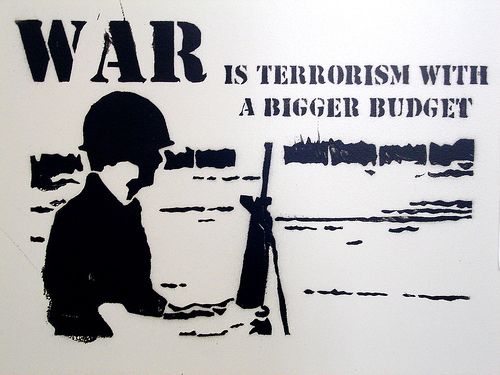
Bullet Points: How Forever War Will End

By

Source: Another Day in the Empire

Forget a popular movement to end the wars.

As George W. Bush said during his murder spree in Afghanistan and Iraq, the antiwar movement at that time (far larger than what we have today) was little more than a “focus group” ignored by the state (with the exception of sending out their operatives to spy on the movement and create disorder and factionalism).

Most Americans are numb to decades of expensive and debilitating wars. They prefer not to think about it. The corporate propaganda media provides plenty of fluff and chaff to distract them—spiked with hate screeds against the president—and the idea of a popular movement to end the wars is now nearly impossible.

Like former dirty trickster Karl Rove famously said, the American people really have no choice but to sit back and watch the creative destructionists “make history.” Any serious effort to mobilize an antiwar movement would be disrupted. The state has perfected the dark art of killing democratic action through subversion.

Economic Armageddon. It’s breathing down our necks, thanks to federal spending out of control for decades, at least half of it going to the “defense” department and associated death merchants.

“The United States recorded a government debt equivalent to 105.40 percent of the country’s Gross Domestic Product in 2017,” Trading Economics points out. “Government Debt to GDP in the United States averaged 61.70 percent from 1940 until 2017, reaching an all-time high of 118.90 percent in 1946 [after participating in the worst act of organized carnage in human history] and a record low of 31.70 percent in 1981.”

According to research conducted by William D. Harding and Mandy Smithberger, the “final annual tally for war, preparations for war, and the impact of war come to more than $1.25 trillion, more than double the Pentagon’s base budget [of the $750 billion Trump budget].”

Last year, the official tally for the national debt was $21,500 trillion. Some believe this is a lowball figure. John Williams of shadowstats.com has shown that with unfunded liabilities, the debt is actually closer to $222 trillion, a staggering number virtually unknown to the American people. Most don’t even realize the average public unfunded liability is $2 million per household (piled atop personal debt, which is at an all-time high).

Obviously, somewhere along the line, and I’d have to say soon, there will be a “reset,” an economic collapse and reordering of the game (on terms beneficial to the bankers). Empires typically fall when they become unsustainable.

Russia and China. Both nations have their own problems and are less than friendly to individual rights, although Russia is far better than totalitarian China. It is now obvious both are working to find an exit to the domination of Federal Reserve fiat funny money scheme that rules international economies and trade around the world. The US has weaponized this system by slapping sanctions on disfavored nations and those it has decided to invade and destroy (and with the current rhetoric from both sides of the one-sided war party, it is obvious the political class and its corporate directors are itching for a fight).

This is, of course, insane. I really do think the hubris—the indispensable nation, the exceptional nation—is so thick these fools can’t see how easily it would be to turn the world into a radioactive cauldron. On the other hand, I do believe, at least in regard to nuclear annihilation, somewhat saner heads will prevail.

News flash. If there is a non-nuclear (or limited nuclear) war with each or both (see the 2001 Sino-Russian Treaty of Friendship), it will not turn out good for the US, which has corrupted its defensive military capacity with a manufactured terror-asymmetrical posture.

This approach is effective in subversion operations to destabilize countries, particularly in the Middle East and South Asia. As we have seen since the end of the Second World War, the United States appears to be incapable of winning wars. This no mistake and primarily benefits Eisenhower’s military-industrial complex with a host of related new “national security” industries in addition to the war merchant stalwarts (Boeing, General Dynamics, General Electric, Lockheed-Martin, Raytheon, etc.), all feeding at the trough. Forever war is a forever profit stream for the ruling elite and its political class.

So, the conclusion is either economic collapse or defeat in a more or less conventional war will halt the trajectory the US is taking now as it is pulled along in a neocon spell with a president that has at best a sixth grade understanding of the world. Both probable outcomes are unthinkable.

Who knows. Maybe the American people will get off their duffs and demand the wars and provocations leading to war end. This was done in the 1960s and early 70s, primarily due to the Vietnam War protest that began in response to military servitude imposed on teenagers. The state ended a military draft, although it retained its “selective service” registration of potential future bullet-stoppers.

The moral aspect was secondary.