Trump’s Murder of Qassem Soleimani: Why We Must Stand Up to the Christianity of Brutality.

ISTANBUL, TURKEY – JANUARY 05: People hold posters showing the portrait of Iranian Revolutionary Guard Major General Qassem Soleimani and chant slogans during a protest outside the U.S. Consulate on January 05, 2020 in Istanbul, Turkey. Major General Qassem Soleimani, was killed by a U.S. drone strike outside the Baghdad Airport on January 3. Since the incident, tensions have risen across the Middle East. (Photo by Chris McGrath/Getty Images)

By Sander Hicks

Source: New York Megaphone

This is the investigation that prompted our publication to establish an online conference on Nonviolence, and the Legacy of Mahatma Gandhi, Oct. 2, 2020. It’s essential we understand how Pompeo and the GOP justify their violence in the name of Christianity. The future of nonviolence must stand apart from the “Christianity of Brutality.” That’s what Jesus would do.

Earlier this year, President Trump shocked the world by murdering a high-ranking Iranian government official. Pressured by Secretary Pompeo, Trump ordered the assassination of an Iranian general who enjoyed movie-star celebrity status in his home country, General Qassem Soleimani. The killing brought the world to the brink of a major new war. Among the many laws this act broke, it violated Iraqi sovereignty, as it took place in Iraq. It happened in the middle of the night on January 3rd, 2020, using an American MQ-6 Reaper drone.

Dexter Filkins, in the New Yorker, called the hit on Soleimani, “the most consequential act taken against the regime in Tehran in thirty years.” And that’s saying a lot, because the US has inflicted much suffering on Iran over time, from CIA coups, to pushing Iraq to kill a million Iranians in the “Iran-Iraq War,” to today’s harsh economic sanctions. Yet Iran has grown into an influential regional superpower able to stand toe-to-toe with US proxies, Israel and Saudi Arabia, to see through the hypocrisy and the posturing of the War on Terror.

Trump, earlier, wanted to re-open negotiations towards a new Nuclear Agreement with Iran. He was in contact with President Rhouhani. But killing the charismatic Soleimani shut down any chance of a new nuclear deal. Now the Iranians are free to develop their nuclear power capabilities, unhindered.

Trump was left to explain himself. How could the US President justify this attack?

Remember that one year ago, things were boiling over in Iraq/Iran. Various Iran-backed militias rioted in Baghdad and broke the windows at US consulates. An American contractor was killed and US officials feared another Benghazi, or a new Tehran-style Embassy hostage crisis like in 1979. The US Military and Trump responded by killing 25 Shi’a militia members. Pentagon top brass then offered killing Soleimani as an additional option but assumed Trump wouldn’t be so brash. That was like giving a pyromaniac teenager a set of matches and five gallons of gasoline.

Killing a foreign government official is illegal, according to US policy and international law. Trump, at first, asserted Soleimani had plans to target four U.S. embassies, a claim that his own Defense Secretary Esper was not able to substantiate.  It “seems to be totally made up,” said Congressman Justin Amash from Michigan.

On Twitter, Trump tried to give the last word by claiming that the US acted in self-defense because Soleimani posed an “imminent threat.” But Trump seemed unconvinced himself, as he tweeted that it “doesn’t really matter because of his horrible past.”

Ah, but it does matter.

Killing people is a crime, you see, and a lot of people think so. The US has written laws that restrain this kind of thing from coming out of the White House, as it does so much damage to the U.S.’s moral standing in the world. (If capitalism and imperialism haven’t mangled that reputation forever.)

Former DA Vincent Bugliosi, in his book The Prosecution of George W. Bush for Murder, showed that presidents could well go to prison for the extrajudicial killings and illegal wars they engage in. The Hague Convention of 1907 and the UN ban the killing of a foreign government official, outside of wartime. Even Thomas Jefferson, in a letter to James Madison, denounced “assassination, poison, perjury” as brutal statecraft, “held in just horror.”

In the wake of the killings of JFK and MLK and the targeted domestic killings of COINTEL-PRO, the US Congress convened the Church Committee and the House Select Committee on Assassinations in the mid and late ’70s. President Gerald Ford responded by issuing an executive order that has since become standard US policy. No US government employee “shall engage in, or conspire to engage in, political assassination.”

President Reagan affirmed and expanded this policy against assassination. But back at the Trump White House, the pressure to kill Soleimani came from evangelical Christian Secretary of State Mike Pompeo. CNN reported that White House insiders said Pompeo “was the one who made the case to take out Soleimani, it was him absolutely.” Pompeo also made a claim that Soleimani posed an “imminent threat,” but later backed off that claim, and instead explained that Soleimani had the “blood of American [soldiers]” on his hands from working with the Iraqi resistance.

At a loss for legal justification, Vice President Mike Pence stepped up with a “Hail Mary” kind of throw. He asserted that there may be a connection between Soleimani and “the 12 9/11 attackers.” (But Mike, there were 19 hijackers on 9/11.) Students of history will note that the NeoCon Right still invokes 9/11 when it’s desperate to justify a crime. 9/11 still has that power 20 years later. It’s like a myth that is eternal. If we allow it.


Who Was Qassem Soleimani

Millions of Iranians poured out into the streets for a three-day funeral in all top Iranian cities and towns. Hamed Ghashgavi in Tehran, told me, “General Soleimani, we know he was popular but none of us thought millions will mourn his death!”

Qassem Soleimani “had a command presence,” CIA Veteran John Maguire said. “He walked into the room and you could feel him.” Maguire had negotiated with Soleimani in Baghdad in 2004.

A native of the more tribal Southern Iranian province of Kerman, Soleimani was born in 1957. He fought at the front lines of the Iran/Iraq war, that nine-year slog fought with chemical weapon assaults, compliments of Iraq. The grinding agony, often in trenches, was compared to World War I. Inside Iran, the conflict is known as the “War of Holy Defense.” But the Reagan White House viewed the Iran/Iraq War as a chance to get aggressive and retaliate for the late 70’s hostage crisis. The US supported Iran‘s biggest rival, Saddam Hussein, as he invaded Iran. The USA gave Hussein several billions in economic aid and military training to help attack the nascent Islamic Republic.

The experience of Iraq invading Iran was deeply formative on young Soleimani, who lost many friends in the war. But Soleimani there became a legend known as “The Goat Burglar” for his talents at slipping behind enemy lines and coming back with live goats to feed his platoon. He regularly volunteered to fight at the front lines. He had a deep camaraderie with his fellows. Before battle, he would kiss each of them on the forehead and pray with them to be martyred.

From the end of the War, to 1997, Soleimani laid low, he didn’t get on well with President Rafsanjanhi. But sooner after that period, he rose to lead the elite “Quds” aka “Jerusalem” Force division of the Iranian Revolutionary Guard. His power grew, as did his closeness with Iranian Supreme Leader Ayatollah Khamenei. Gen. Petreaus once recalled that Soleimani told him, “You should know that I, Qassem Soleimani, control the policy for Iran with respect to Iraq, Lebanon, Gaza and Afghanistan.”

Soleimani as US Ally Against Terrorism

In the corporate US media, Soleimani’s death was brushed off. He was expendable. A “terrorist.”

But a deeper look past the demonization shows an interesting pattern. Soleimani had a history of working with the Americans. Every time he worked with the USA, it went well for the Americans. In the end, the USA just stabbed him in the back.

When 9/11 happened, the Bush/Cheney regime decided to target Afghanistan and its Taliban regime. Qassem Soleimani saw an opportunity to reduce terrorism in the land immediately to the east of Iran. Soleimani worked with the US attacking forces. He and Iranian diplomats shared intelligence with the US on Taliban positions. The Americans informed the Iranians about an al-Qa`ida agent hiding out in Mashhad in eastern Iran.  Soleimani was, “pleased with [the] cooperation,” and spoke at this time that “maybe it’s time to rethink our relationship with the Americans.”

It was not to be.

Bush and Cheney bowed to pressure from their Zionist wing and slapped the Iranians in the face with the “Axis of Evil” speech. It has been a long-standing policy of Israel to block any rapprochement between the US and Iran. Bush named Iran as a leading proponent of terrorism, despite its recent work against terrorism, with the Americans in Afghanistan. Soleimani felt betrayed.

Cut to 2014, and the US is back asking for Iran’s help, when US coalition forces are losing in Iraq. The jihadists were on the offensive, taking territory in Iraq, including the major city of Mosul. Iraq’s leading Shia cleric Ali al-Sistani, issued a call-to-arms to fight the Sunni extremists. Young Shia men volunteered by the thousands. Soleimani and his elite Quds Force helped organize them.

For the next three years, until 2017, Iran helped turn the tide there against ISIS and Al Nusra. On a number of occasions, Americans were hitting Islamic State targets from the air while General Soleimani directed ground forces against the militants.

At the same time, the US, Saudi Arabia, and Israel were working against Soleimani and Iran in Syria. The US had decided to work against the Ba’ath Arab Socialist, Bashar Assad, who sometimes enjoyed the support of Russia and Iran.

When Rep. Tulsi Gabbard (D-HI) flew to Syria in 2017, it was to better understand the Syrian civil war. She met Assad and top Syrian officials. In the street, Syrian citizens begged her to stop the US funding of ISIS. She returned to Congress and proposed HR 608, the Stop Arming Terrorists Act. Because at this point, the US was fighting ISIS in Iraq, but working with ISIS in Syria. On the ground in Tehran, in 2017 at the New Horizon conference, when I asked Saudis, Arabs, and other locals from the region, who is funding ISIS? People uniformly named either Saudi Arabia or the USA.

Pop Quiz. Name the only country that has consistently opposed the Islamic State and al-Qaeda?

The Answer? No, it’s not the USA. It’s Iran.

The History of the US/Iran Relationship: 

A Crash Course from 1953 to the Present

Iran is a regional superpower in a kind of local “cold war” against Saudi Arabia and Israel. There are a set of facts that no one should do without when trying to figure out the real history of the Iran/US relationship.  A deeper understanding of this history could begin to lay the groundwork to re-establish diplomatic ties, which have been suspended since the Islamic Revolution of 1979.

In 2000, even Madeline Albright recognized that the CIA’s brutal 1953 coup overthrew the democratically-elected progressive Iranian Prime Minister Mohammad Mossadegh, and replaced him with the fickle Iranian king, Reza Shah. With their SAVAK secret police, the Shahs repressed dissidents and communists, and so Islam became the legal method of resistance. When President Jimmy Carter allowed the ailing Shah to travel to the USA to receive healthcare, Ayatollah Khomeini called for a general strike in Iran and flew back to Iran from his exile in France. 98% of the population voted to replace the monarchy with the Islamic Republic, in a referendum vote.

Because of the US’s support of the Shah, the Islamic Revolution resulted in an unplanned take-over of the US embassy. 53 US hostages were kept for 444 days until they were released on the day of Ronald Reagan’s inauguration.

During the Iran/Iraq War, it’s worth noting that young Qassem Soleimani met the young Mahmoud Ahmadinejad, when both were fighting the Iraqi invasion. They would have a long, complicated relationship, as Adhmadinejad would go on to become elected President of Iran, from 2005 to 2013. His politics were “hardliner” compared to his successor, the more moderate Rouhani. Ahmadinejad may be most famous for his 2010 speech in front of the United Nations, in which he questioned the official story about 9/11.

Regarding 9/11/01, Iran was not involved, but US Allies were. The USA’s CIA Counterintelligence Database reports that two Mossad agents were among five Israelis arrested by NJ Police, on 9/11/01, for celebrating the attacks publicly, as they watched the World Trade Center burn. Held in custody for two months by FBI, Bush officials intervened and all five were released to go back to Israel. On Israeli television, they were celebrated as heroes.

15 of the 19 9/11 hijackers were Saudi, including two with ties to Saudi intelligence (Al Mihdhar and Al Hamzi). When Congress’s suppressed “28 Pages” of its own 9/11 Report were released in 2016, they documented Saudi funding of the 19 hijackers, from none other than US Ambassador from Saudi Arabia,  Prince Bandar bin Sultan (aka “Bandar Bush”). But even Bandar’s many appearances in the suppressed “28 Pages” have yet to prompt a grand jury investigation in US courts.

Later that month, in September 2001, General Wesley Clark, reported that a senior general inside the Pentagon told him, “Here’s the paper from the Office of the Secretary of Defense [Rumsfeld] outlining the strategy. We’re going to take out seven countries in five years.’ And he named them…ending with Iran.”

The Iraq War officially started in 2003 and phase one didn’t end until 2011. Similar to the 9/11 official story, the premise for the Iraq War was a loose set of assumptions and insinuations, not hard facts or evidence of Saddam Hussein’s weapons of mass destruction. Hussein’s overthrow and execution was another targeted killing on a grander scale, similar to that of Soleimani. The Bush/Cheney “War on Terror” was a colossal waste of money, even by the libertarian think tank Cato Institute. “A recent study…puts the cost of the War on Terror at roughly $5 trillion — a truly astonishing number. Even if one believes American efforts have made the nation marginally safer, the United States could have achieved far greater improvements in safety and security at far less cost through other means.”

In 2007, German news magazine Die Spiegel leaked that Vice President Dick Cheney had a secret plan to invade Iran next.

Barack Obama was elected as a symbol of hope and change, but his pick of Hillary Clinton as Secretary of State was tragic for Iran. Hillary Clinton removed the Iranian terrorist group MEK from the State Department’s “Terrorism Watch List” in 2012. The media crowed that the lobbyists had done it again, as MEK represents big money ex-patriate Iranians who would like to see violent regime change in Iran. MEK was once a bizarre culty Islamic splinter group, banished to Albania, and hated in Iran for backing Iraq in the Iran/Iraq War. But money changes everything, and now with lavish funding, these days the MEK throws huge gala events in DC and NYC and pays Rudy Giuliani and John Bolton to come speak.

After President Barack Obama jettisoned Hillary Clinton as Secretary of State, he did some ground-breaking work by working with moderate President Rouhani and signing the “Iran Nuclear Deal,” the JCPOA in 2015.

In 2017, with Trump in Office, Defense Secretary Jim Mattis and others routinely ignored the Trump White House’s multiple calls to pressure Iran militarily. Their belief was that Syria’s Assad had effectively won the Syrian civil war, thanks to Iran and Russia, and now the war on ISIS took priority. Mattis quit at the end of 2018 when Trump demanded US withdrawal from Syria.

In 2018, former Exxon CEO Rex Tillerson quit as Secretary of State, and Mike Pompeo succeeded him. Pompeo lost no time in focussing a target on his longtime nemesis, Qassem Soleimani. It started in April of 2019, with the shocking designation of Iran’s entire Revolutionary Guard (IRGC) as a “terrorist organization.” According to The Iran Agenda book by Reuters reporter Reese Erlich, the IRGC is a huge economic entity in Iran, and it controls about 10% of the entire Iranian economy. So declaring IRGC a terrorist organization would be like declaring Amazon a terrorist organization in the US.

But there were more than words in the declaration. The knives were coming out. “Bolton and Pompeo knew that that designation opened up the targeting aperture,” one former senior Trump administration official said.


War Powers

In 1973, Congress passed the War Powers Resolution. It requires the President to report to Congress whenever armed forces are introduced “into hostilities or into situations where imminent involvement in hostilities is clearly indicated,” and to terminate any hostilities after 60 days unless authorized by Congress.

But since 1973, Congress has done little to reclaim its constitutional responsibility to control the war machine. Professor Jack Goldsmith points out, “Our country has, quite self-consciously, given one person, the President, an enormous sprawling military and enormous discretion to use it in ways that can easily lead to a massive war.”

If there’s any one issue that may someday inspire a US Constitutional Convention, it may be the long history the USA has had with a “unitary executive” who abuses their powers to wage undeclared wars on smaller, weaker nations. Our system is running contrary to the spirit and the letter of the US Constitution. What happened in the Soleimani case is more than just the murder of one man. It shows that our current class of leadership, from Clinton to Trump, is so in love with violence, it crosses a line into contempt for the Constitution. The love of war is all.

What could possess their souls?


The Christianity of Brutality

The flaws of the American brand of evangelical Christianity led directly to Soleimani’s fiery death with nine others. The dominant religion in America birthed a bloody global trauma that caused the whole planet to smell the stench of World War III. However, any student of the New Testament will notice that Jesus actually stood against the nationalism and the exclusionary practices of the Jewish leadership. He called the Pharisees and Scribes, “vipers” and even worse, “lawyers.”

Jesus’s pivotal lesson about the Good Samaritan exposes the hypocrisy of the “purity” of the High Priests. They were so obsessed with purity, they wouldn’t help a man beaten up in the street. Their religion blinded them to the basic humanity in all of us. At a time of crisis, when we need something to unite us, religion could reveal an inner light within us all. The Good Samaritan story holds up the forgotten and hated people of our day.  The one who is hated most by society turns out to have the most heart. The outsider, the Samaritan ignores all the codes of the day and stops to care for the crushed and bloodied man. That’s the path. Actions of compassion and healing are the true way, not a religion of showiness, prestige, and power.

Mike Pompeo and the neoConservative Christians are super Pro-Israel, because their Christianity is based in the Old Testament, where God is oftentimes a violent, nationalistic force who favors his “Chosen People” in their many wars.  Pompeo has compared Trump to King Cyrus, and likes to dwell on the Book of Esther, in which the Jewish people commit genocide on the Iranians/Persians, killing over 5,000 in one fell swoop. (An event celebrated every year with the Jewish feast of Purim.)

The Old Testament also has eternal wisdom, great laws, and lessons in it, like “Thou Shalt Not Kill” from the Ten Commandments. The Wisdom literature, such as Psalms and Proverbs, show the universal conception of God, evolving into a more compassionate, loving vision over time. But to rely on the Old Testament as a true book of history is shaky ground. To base US Foreign Policy on it is ahistorical. Most of the Old Testament is war stories, in which genocide and exclusion are held up as ideals. A little-known fact is that some early Christians didn’t at first want to include the Old Testament in their Bible. They felt that the teachings of Christ were complete: be humble, be of service, make your life about truth, integrity, and nonviolence. These were so much more substantial than the old books, which had led directly to the superficial posturing of the Pharisees, and the “Simple Way” resistance of Jesus of Nazareth.

It seems that with the killing of Soleimani, something has hijacked the spirituality of a man like Mike Pompeo. He became a “born-again Christian” inside the super-powered pressure-cooker of West Point US Military Academy. It’s like someone only gave him half the story. The American right-wing wants the righteousness of religion without doing the real work of Jesus’s core command, “Love your enemies, and pray for those who persecute you.”

The story of the New Testament is really this: a young, passionate, former carpenter from the sticks, Jesus of Nazareth, picks up the oral traditions of  a “street rabbi.” Able to quote the prophets, see people’s problems, and inspire people to change, he becomes a traveling street preacher, able to talk about the love of God in a radical new way. He challenges the aristocracy of the high priests and denounces their rigidity and formalism. He gathers a wide range of people “from below.” He teaches and heals among the peasant and working classes (without excluding Roman soldiers). Drawing on the Wisdom literature, he expands and radicalizes his message, in a time in which occupied Palestine was seeking ways to resist the violence of the Roman Empire.  Influenced by the Zealots, and tempted by the lure of political power, Jesus ultimately rejected that path. He did consider it but rejected driving Rome out of Palestine with a sword. He even welcomed Pharisees at his gatherings and teaching sessions. His challenge to “love our enemies” was really a challenge to see that there is a light within all of us, including Americans, Israelis, and Iranians, and that it’s a common love of the truth. The historical Jesus never endorses killing people. He says we should “turn the other cheek” rather than retaliate with violence.

Essentially we have here an avatar, one of history’s most dynamic and radical figures, revered today in both Christianity, Buddhism, and Islam, because he opened up a new space of what is possible for humanity: living in a place of dialogue, a love for the Word, sharing, truth, eating together, healing each other, reveling in our common humanity, and working out problems without violence. That is the space of God.

The violent Christianity of Mike Pompeo feels about as authentic as his boss, Donald Trump, wielding a Bible like a weapon, as a vague warning to protestors and radicals fed up with racism and police brutality.

They need to look deeper, because 2000 years ago, Jesus would have been among those protestors. According to the book Rabbi Jesus by Bruce Chilton, when Jesus cleared the Temple in Jerusalem, he went in with an affinity group of 50-100 followers. It was an “Occupy the Temple” action, in which Jesus stood up to capitalism: the money-changers, animal-sellers, and merchants who had turned religion into a business. Jesus and crew literally pushed over the tables and set the doves free. It clarified Jesus’s work and became one of his last public acts of direct action.

In their zeal to make Christianity about violence and Old Testament rivalries against Iran, Pompeo and Trump totally miss the revolutionary spirituality of compassion for all beings and the essentially anti-capitalist message of Jesus. I am reminded of the young, rich kid who comes up to Jesus in the New Testament and says, “Hey, I have followed all the rules, but nothing is working for me!” So Jesus says, You must give up all your wealth, your power, your status, all you cling to, and get on the road with us, follow this path, be inside our movement, follow me. But the kid couldn’t do it because he was too attached: to luxury, to his self-concept, to his fragile and tender illusions, to a status quo of empire, class, and power.

It’s like that kid today is Mike Pompeo, and all the American Christians who do what he does. They want to follow Jesus, but can’t escape their formalism, their illusions, they can’t give up the habits of easy nationalism, their remote-control high tech violence, their sloganeering and stereotyping. Jesus says something truly radical – it’s not too late to turn around – give up all you have and follow me.

Instead the modern day Pharisees have been sending the FBI out to harass American activists.


Summer of 2019: FBI at My Front Door

I have been researching this article for six weeks, but I began to write the first draft on August 6, 2020. That date is actually the one year anniversary of the FBI visiting my home to stifle my international travel plans to advocate for peace with Iran. It seems that calling for peace has become something of a crime, in the time of Trump and Pompeo.

The FBI also visited such US dissidents as former Pentagon official Michael Malouf, and former US-Saudi diplomatic attaché Michael Springmann, and about fifteen others. What we all had in common was that we had previously attended the Iranian’s New Horizon conference, where dissidents from the USA and other countries were able to gather, share views, network, and brainstorm solutions to the problems of aggression, imperialism, and world peace.

When the FBI was at my house, they handed over a copy of a recent indictment of an American who had defected to Iran. But this situation had nothing to do with the New Horizon conference. The US Treasury, however, had sent the FBI to enforce their recent harsh economic sanctions against New Horizon. Four Iranians from New Horizon were sanctioned for hosting this  international think tank, a kind of “Davos of the Global South.”

The FBI home visit was a gross violation of my core rights to free speech, religion, and the right to peaceably assemble and tackle grievances. The Bill of Rights took a backseat to an obsession with killing. We had been planning to attend the next New Horizon in Beirut that Fall.

This was certainly a nadir for US activists, but shortly thereafter, there was a bit of a thaw, when in September 2019, President Trump fired his White House war-monger, John Bolton.  And then, the next month after that, the “mastermind” of the Trump White Houses’s sanctions on Iran, Sigal Pearl-Mandelker, resigned after being harassed by peace activists at a public event.


Against the Balance of Power, Towards the Balance of Peace

President Woodrow Wilson, once said, “Peace cannot…rest upon an armed balance of power.” Lasting peace, he maintained, required “not a balance of power, but a community of power; not organized rivalries, but an organized common peace.”

So instead of old religions, old rivalries, and old prejudices being given all of the power, what if the world could coalesce around a new vision, in which political assassination was banned, and just not required, because the balance of power was no longer based on violence.

The next step would be to map out a path to a place where we as one people on Earth can declare that war itself is simply out of date. How can we get to a place where we have outgrown it? The answer is to grow. We are close to being capable of global nonviolence. Gandhi said that the roots of nonviolence were already in the heart of all the world’s great religions.

The words of President Wilson ring true, “There is only one power to put behind the liberation of mankind, and that is…the power of the united moral forces of the world.”

“The power of the united moral forces of the world” is a power that peoples of all religions, and no religions, could get behind, support, and live.

Practical Proposals for Global Social Change

It’s time for a Truth and Reconciliation Conference around the murder of Qassem Soleimani. It will be a way to start to talk about the truth behind the “balance of power” and begin the healing among the peoples of the world.

So that’s why, this article is not just some investigative journalism about a criminal act, I have created a way for you to get involved, in an international dialogue, with Iranian and American activists, on Zoon, this Friday, on October 2, the International Day of NonViolence. From 4 PM to 9 PM, we will have political and spiritual speakers from Iran, and the USA, and other countries.

We will hold a global Truth and Reconciliation Conference, to talk about a global cultural shift, to change the entire system. We have a great bunch of speakers: everyone from Lt. Col. (Ret.) Lawrence Wilkerson, to radical priest Fr. John Dear, to Iranian film-maker Nader Talebzedeh.

Qassem Soleimani did not die in vain. He wanted to be a martyr. Now, let us work to have his death help to transform the world.


Come Celebrate Peace and Nonviolence, Celebrate Gandhi’s Birthday.

4PM – 9 PM Oct. 2 on Zoom. More Info:

https://www.newyorkmegaphone.com/oct-2-gandhi-nonviolence-day

The author of the article above wishes to acknowledge Porsché Mysticque Steele for her editorial work, and thanks also to C. Maupin for advice.
RAY McGOVERN: Catapulting Russian-Meddling Propaganda

By Ray McGovern

Source: Consortium News

The fresh orgy of anti-Russian invective in the lickspittle media (LSM) has the feel of fin de siècle. The last four reality-impaired years do seem as though they add up to a century. And no definitive fin is in sight, as long as most people don’t know what’s going on.

The LSM should be confronted: “At long last have you left no sense of decency?” But who would hear the question — much less any answer? The corporate media have a lock on what Americans are permitted or not permitted to hear. Checking the truth, once routine in journalism, is a thing of the past.

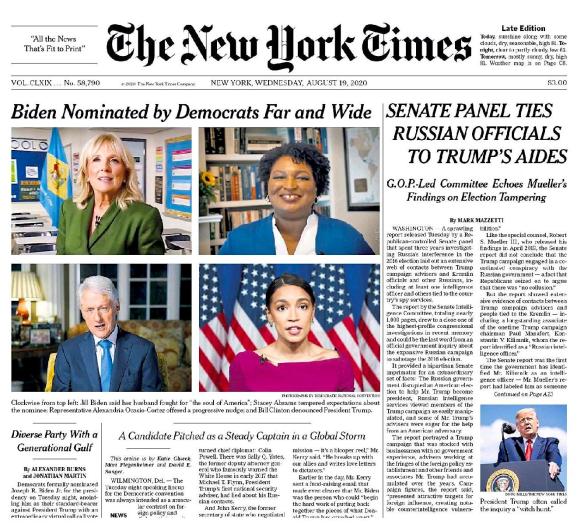
Thus the reckless abandon with which The New York Times is leading the current full-court press to improve on what it regards as Special Counsel Robert Mueller’s weak-kneed effort to blame the Russians for giving us Donald Trump. The press is on, and there are no referees to call the fouls.

The recent release of a 1,000-page, sans bombshells and already out-of-date report by the Senate Intelligence Committee has provided the occasion to “catapult the propaganda,” as President George W. Bush once put it.

As the the Times‘s Mark Mazzetti put it in his article Wednesday:

“Releasing the report less than 100 days before Election Day, Republican-majority senators hoped it would refocus attention on the interference by Russia and other hostile foreign powers in the American political process, which has continued unabated.”

Mazzetti is telling his readers, soto voce: regarding that interference four years ago, and the “continued-unabated” part, you just have to trust us and our intelligence community sources who would never lie to you. And if, nevertheless, you persist in asking for actual evidence, you are clearly in Putin’s pocket.

Incidentally, Mueller’s report apparently was insufficient, only two years in the making, and just 448 pages. The Senate committee’s magnum opus took three years, is almost 1,000 pages — and fortified. So there.

Iron Pills

Recall how disappointed the LSM and the rest of the Establishment were with Mueller’s anemic findings in spring 2019. His report claimed that the Russian government “interfered in the 2016 presidential election in sweeping and systematic fashion” via a social media campaign run by the Internet Research Agency (IRA) and by “hacking” Democratic emails. But the evidence behind those charges could not bear close scrutiny.

You would hardly know it from the LSM, but the accusation against the IRA was thrown out of court when the U.S. government admitted it could not prove that the IRA was working for the Russian government. Mueller’s ipse dixit did not suffice, as we explained a year ago in “Sic Transit Gloria Mueller.”

The Best Defense …

… is a good offense, and the Senate Intelligence Committee’s release of its study — call it “Mueller (Enhanced)” — and the propaganda fanfare — come at a key point in the Russiagate/Spygate imbroglio. It also came, curiously, as the Democratic Convention was beginning, as if the Republican-controlled Senate was sending Trump a message.

One chief worry, of course, derives from the uncertainty as to whether John Durham, the US Attorney investigating those FBI and other officials who launched the Trump-Russia investigation will let some heavy shoes drop before the election. Barr has said he expects “developments in Durham’s investigation hopefully before the end of the summer.”

FBI attorney Kevin Clinesmith already has decided to plead guilty to the felony of falsifying evidence used to support a warrant from the Foreign Intelligence Surveillance Court to surveillance to spy on Trump associate Carter Page. It is abundantly clear that Clinesmith was just a small cog in the deep-state machine in action against candidate and then President Trump. And those running the machine are well known. The president has named names, and Barr has made no bones about his disdain for what he calls spying on the president.

The cognoscenti and the big fish themselves may be guessing that Trump/Barr/Durham will not throw out heavier lines for former FBI Director James Comey, his deputy Andrew McCabe, CIA Director John Brennan, and Director of National Intelligence James Clapper, for example. But how can they be sure? What has become clear is that the certainty they all shared that Hillary Clinton would be the next president prompted them not only to take serious liberties with the Constitution and the law, but also to do so without taking rudimentary steps to hide their tracks.

The incriminating evidence is there. And as Trump becomes more and more vulnerable and defensive about his ineptness — particularly with regard to Covid-19 — he may summon the courage to order Barr and Durham to hook the big fish, not just minnows like Clinesmith. The neuralgic reality is that no one knows at this point how far Trump will go. To say that this kind of uncertainty is unsettling to all concerned is to say the obvious.

So, the stakes are high — for the Democrats, as well — and, not least, the LSM. In these circumstances it would seem imperative not just to circle the wagons but to mount the best offense/defense possible, despite the fact that virtually all the ammunition (as in the Senate report) is familiar and stale (“enhanced” or not).

Black eyes might well be in store for the very top former law enforcement and intelligence officials, the Democrats, and the LSM — and in the key pre-election period. So, the calculation: launch “Mueller Report (Enhanced)” and catapult the truth now with propaganda, before it is too late.

No Evidence of Hacking

The “hacking of the DNC” charge suffered a fatal blow three months ago when it became known that Shawn Henry, president of the DNC-hired cyber-security firm CrowdStrike, admitted under oath that his firm had no evidence that the DNC emails were hacked — by Russia or anyone else.

Henry gave his testimony on Dec. 5, 2017, but House Intelligence Committee chair Adam Schiff was able to keep it hidden until May 7, 2020.

Here’s a brief taste of how Henry’s testimony went: Asked by Schiff for “the date on which the Russians exfiltrated the data”, Henry replied, “We just don’t have the evidence that says it actually left.”

You did not know that? You may be forgiven — up until now — if your information diet is limited to the LSM and you believe The New York Times still publishes “all the news that’s fit to print.”  I am taking bets on how much longer the NYT will be able to keep Henry’s testimony hidden; Schiff’s record of 29 months will be hard to beat.

Putting Lipstick on the Pig of Russian ‘Tampering’

Worse still for the LSM and other Russiagate diehards, Mueller’s findings last year enabled Trump to shout “No Collusion” with Russia. What seems clear at this point is that a key objective of the current catapulting of the truth is to apply lipstick to Mueller’s findings.

After all, he was supposed to find treacherous plotting between the Trump campaign and the Russians and failed miserably. Most LSM-suffused Americans remain blissfully unaware of this, and the likes of Pulitzer Prize winner Mazzetti have been commissioned to keep it that way.

In Wednesday’s article, for example, Mazzetti puts it somewhat plaintively:

“Like the special counsel … the Senate report did not conclude that the Trump campaign engaged in a coordinated conspiracy with the Russian government — a fact that the Republicans seized on to argue that there was ‘no collusion’.”

How could they!

Mazzetti is playing with words. “Collusion,” however one defines it, is not a crime; conspiracy is.

‘Breathtaking’ Contacts: Mueller (Enhanced)

Mazzetti emphasizes that the Senate report “showed extensive evidence of contacts between Trump campaign advisers and people tied to the Kremlin,” and Sen. Mark Warner (D-VA), the intelligence committee’s vice chairman, said the committee report details “a breathtaking level of contacts between Trump officials and Russian government operatives that is a very real counterintelligence threat to our elections.”

None of that takes us much beyond the Mueller report and other things generally well known — even in the LSM. Nor does the drivel about people like Paul Manafort “sharing polling data with Russians” who might be intelligence officers. That data was “mostly public” the Times itself reported, and the paper had to correct a story that the data was intended for Russian oligarchs, when it was meant for Ukrainian oligarchs instead. That Manafort was working to turn Ukraine towards the West and not Russia is rarely mentioned.

Recent revelations regarding the false data given the FISA court by an FBI lawyer to “justify” eavesdropping on Trump associate Carter Page show the Senate report to be not up to date and misguided in endorsing the FBI’s decision to investigate Page. The committee may wish to revisit that endorsement — at least.

On the Steele Dossier, the committee also missed a ruling by a British judge against Christopher Steele, labeling his dossier an attempt to help Hillary Clinton get elected. Consortium News explained back in October 2017 that both CrowdStrike and Steele were paid for by the Democratic Party and Clinton campaign to push Russiagate.

Also missed by the intelligence committee was a document released by the Senate Judiciary Committee last month that revealed that Steele’s “Primary Subsource and his friends peddled warmed-over rumors and laughable gossip that Steele dressed up as formal intelligence memos.”

Smearing WikiLeaks

The Intelligence Committee report also repeats thoroughly debunked myths about WikiLeaks and, like Mueller, the committee made no effort to interview Julian Assange before launching its smears. Italian journalist Stefania Maurizi, who partnered with WikiLeaks in the publication of the Podesta emails, described the report’s treatment of WikiLeaks in this Twitter thread:

2. the description of #WikiLeaks‘ publishing activities by this #SenateIntelligenceCommittee‘s Report appears a true #EdgarHoover‘s disinformation campaign to make a legitimate media org completely radioactive

3. Clearly, to describe #WikiLeaks and its publishing activities the #SenateIntelligenceCommittee’s Report completely rely on #US intelligence community+ #MikePompeo’s characterisation of #WikiLeaks. There is not even any pretense of an independent approach

4. there are also unsubstantiated claims like:
– “[WikiLeaks’] disclosures have jeopardized the safety of individual Americans and foreign allies” (p.200)
– “WikiLeaks has passed information to U.S. adversaries” (p.201)

5. it’s completely false that “#WikiLeaks does not seem to weigh whether its disclosures add any public interest value” (p.200) and any longtime media partner like me could provide you dozens of examples on how wrong this characterisation [is].

Titillating

Mazzetti did add some spice to the version of his article that dominated the two top right columns of Wednesday’s Times with the blaring headline: “Senate Panel Ties Russian Officials to Trump’s Aides: G.O.P.-Led Committee Echoes Mueller’s Findings on Election Tampering.”

Those who make it to the end of Mazzetti’s piece will learn that the Senate committee report “did not establish” that the Russian government obtained any compromising material on Mr. Trump or that they tried to use such materials [that they didn’t have] as leverage against him.” However, Mazzetti adds,

“According to the report, Mr. Trump met a former Miss Moscow at a party during one trip in 1996. After the party, a Trump associate told others he had seen Mr. Trump with the woman on multiple occasions and that they ‘might have had a brief romantic relationship.’

“The report also raised the possibility that, during that trip, Mr. Trump spent the night with two young women who joined him the next morning at a business meeting with the mayor of Moscow.”

This is journalism?

Another Pulitzer in Store?

The Times appends a note reminding us that Mazzetti was part of a team that won a Pulitzer Prize in 2018 for reporting on Donald Trump’s advisers and their connections to Russia.

And that’s not the half of it. In September 2018, Mazzetti and his NYT colleague Scott Shane wrote a 10,000-word feature, “The Plot to Subvert an Election,” trying to convince readers that the Russian Internet Research Agency (IRA) had successfully swayed U.S. opinion during the 2016 election with 80,000 Facebook posts that they said had reached 126 million Americans.

That turned out to be a grotesquely deceptive claim. Mazzetti and Shane failed to mention the fact that those 80,000 IRA posts (from early 2015 through 2017, meaning about half came after the election), had been engulfed in a vast ocean of more than 33 trillion Facebook posts in people’s news feeds – 413 million times more than the IRA posts. Not to mention the lack of evidence that the IRA was the Russian government, as Mueller claimed.

In exposing that chicanery, prize-winning investigative reporter Gareth Porter commented:

“The descent of The New York Times into this unprecedented level of propagandizing for the narrative of Russia’s threat to U.S. democracy is dramatic evidence of a broader problem of abuses by corporate media … Greater awareness of the dishonesty at the heart of the Times’ coverage of that issue is a key to leveraging media reform and political change.”

Nothingburgers With Russian Dressing: the Backstory

“It’s too much; it’s just too much, too much”, a sedated, semi-conscious Robert Parry kept telling me from his hospital bed in late January 2018 a couple of days before he died. Bob was founder of Consortium News.

It was already clear what Bob meant; he had taken care to see to that. On Dec. 31, 2017 the reason for saying that came in what he titled “An Apology & Explanation” for “spotty production in recent days.” A stroke on Christmas Eve had left Bob with impaired vision, but he was able to summon enough strength to write an Apologia — his vision for honest journalism and his dismay at what had happened to his profession before he died on Jan. 27, 2018. The dichotomy was “just too much”.

Parry rued the role that journalism was playing in the “unrelenting ugliness that has become Official Washington. … Facts and logic no longer mattered. It was a case of using whatever you had to diminish and destroy your opponent … this loss of objective standards reached deeply into the most prestigious halls of American media.”

What bothered Bob most was the needless, dishonest tweaking of the Russian bear. “The U.S. media’s approach to Russia,” he wrote, “is now virtually 100 percent propaganda. Does any sentient human being read The New York Times’ or The Washington Post’s coverage of Russia and think that he or she is getting a neutral or unbiased treatment of the facts? … Western journalists now apparently see it as their patriotic duty to hide facts that otherwise would undermine the demonizing of Putin and Russia.”

Parry, who was no conservative, continued:

“Liberals are embracing every negative claim about Russia just because elements of the CIA, FBI and National Security Agency produced a report last Jan. 6 that blamed Russia for ‘hacking’ Democratic emails and releasing them to WikiLeaks.”

Bob noted that the ‘hand-picked’ authors “evinced no evidence and even admitted that they weren’t asserting any of this as fact.”

It was just too much.

Robert Parry’s Last Article

Bob posted his last substantive article on Dec. 13, 2017, the day after text exchanges between senior FBI officials Peter Strzok and Lisa Page were made public. (Typically, readers of The New York Times the following day would altogether miss the importance of the text-exchanges.)

Bob Parry rarely felt any need for a “sanity check.” Dec. 12, 2017 was an exception. He called me about the Strzok-Page texts; we agreed they were explosive. FBI Agent Peter Strzok was on Special Counsel Robert Mueller’s staff investigating alleged Russian interference, until Mueller removed him.

Strzok reportedly was a “hand-picked” FBI agent taking part in the Jan 2017 evidence-impoverished, rump, misnomered “intelligence community” assessment that blamed Russia for hacking and other election meddling. And he had helped lead the investigation into Hillary Clinton’s misuse of her computer servers. Page was Deputy Director Andrew McCabe’s right-hand lawyer.

His Dec. 13, 2017 piece would be his fourth related article in less than two weeks; it turned out to be his last substantive article.  All three of the earlier ones are worth a re-read as examples of fearless, unbiased, perceptive journalism. Here are the links.

Bob began his article on the Strzok-Page bombshell:

“The disclosure of fiercely anti-Trump text messages between two romantically involved senior FBI officials who played key roles in the early Russia-gate inquiry has turned the supposed Russian-election-meddling “scandal” into its own scandal, by providing evidence that some government investigators saw it as their duty to block or destroy Donald Trump’s presidency.?

“As much as the U.S. mainstream media has mocked the idea that an American ‘deep state’ exists and that it has maneuvered to remove Trump from office, the text messages between senior FBI counterintelligence official Peter Strzok and senior FBI lawyer Lisa Page reveal how two high-ranking members of the government’s intelligence/legal bureaucracy saw their role as protecting the United States from an election that might elevate to the presidency someone as unfit as Trump.”

Not a fragment of Bob’s or other Consortium News analysis made any impact on what Bob used to call the Establishment media. As a matter of fact, eight months later during a talk in Seattle that I titled “Russia-gate: Can You Handle the Truth?”, only three out of a very progressive audience of some 150 had ever heard of Strzok and Page.

And so it goes.

Lest I am accused of being “in Putin’s pocket,” let me add the explanatory note that we Veteran Intelligence Professionals for Sanity included in our most explosive Memorandum for President Trump, on “Russian hacking.”

Full Disclosure: Over recent decades the ethos of our intelligence profession has eroded in the public mind to the point that agenda-free analysis is deemed well nigh impossible. Thus, we add this disclaimer, which applies to everything we in VIPS say and do: We have no political agenda; our sole purpose is to spread truth around and, when necessary, hold to account our former intelligence colleagues.

We speak and write without fear or favor. Consequently, any resemblance between what we say and what presidents, politicians and pundits say is purely coincidental. The fact we find it is necessary to include that reminder speaks volumes about these highly politicized times.

Ray McGovern works with Tell the Word, a publishing arm of the ecumenical Church of the Saviour in inner-city Washington. A CIA analyst for 27 years, he served as Chief of the Soviet Foreign Policy Branch and as a downtown morning briefer of the President’s Daily Brief.

The Maxwell Family Business: Espionage

Ghislaine Maxwell is hardly the only Maxwell sibling to continue their father’s controversial work for intelligence, with other siblings carrying the torch specifically for Robert Maxwell’s sizable role in the PROMIS software scandal and subsequent yet related hi-tech espionage operations.

By Whitney Webb

Source: Unlimited Hangout

Many were surprised to learn earlier this month that the key co-conspirator in Jeffrey Epstein’s intelligence-linked sexual blackmail operation, Ghislaine Maxwell, had been in hiding in New England since Epstein’s arrest and subsequent “suicide” last summer. Her recent arrest, of course, has returned attention to the Epstein scandal and to Ghislaine’s ties to the entire operation, in which she played a central and crucial role, arguably more so than Epstein himself.

Ghislaine was first reported to be living in New England at the mansion of her alleged boyfriend Scott Borgeson on August 14th of last year. Though Maxwell is believed to have stayed there until purchasing the nearby New Hampshire home where she was arrested, attention from her presence on the East Coast was immediately and sensationally re-directed to the West Coast when, a day later on August 15ththe New York Post published a picture allegedly depicting Maxwell reading a book on “CIA operatives” at an In-N-Out Burger in Los Angeles, California. The photo was later revealed to have been photoshopped and a fake, but ultimately served its purpose in distracting from her actual location in New England.

While the media frenziedly covered the fake In-N-Out Burger photo, the appearance of an unexpected visitor nearby Borgeson’s mansion succeeded in largely slipping under the radar. On August 18th, Ghislaine’s sister Christine was spotted “packing up a number of bags” into a SUV just a few miles from Borgeson’s “secluded beachfront” home. Christine, who currently lives and works in Dallas, Texas, declined to comment on why she was visiting the exact area where Ghislaine was allegedly hiding at the time.

Out of the seven Maxwell siblings, Ghislaine Maxwell has undoubtedly received the bulk of media scrutiny both in recent years and arguably ever since the suspected homicide of the family patriarch, Robert Maxwell, in 1991. In the years since his death, Robert Maxwell’s close ties to Israeli intelligence and links to other intelligence agencies have been documented by respected journalists and investigators including Seymour Hersh and Gordon Thomas, among others.

While Ghislaine’s own ties to intelligence have since come to light in relation to her critical role in facilitating the Jeffrey Epstein sexual blackmail operation. Little, if any attention, has been paid to her siblings, particularly Christine and her twin sister Isabel, despite them having held senior roles at the Israeli intelligence front company that facilitated their father’s greatest act of espionage on Israel’s behalf, the sale of the bugged PROMIS software to the U.S. national laboratories at the heart of the country’s nuclear weapons system.

Not only that, but Christine and Isabel later became directly involved with technology-based business ventures that directly involved Ghislaine during the very period she worked with Epstein on behalf of Israeli and U.S. intelligence to ensnare powerful U.S. political and public figures in a sexual blackmail scheme involving minors. At the time, Ghislaine described her profession to a number of newspapers as “an internet operator.” Then, after this venture’s multi-million dollar sale to a competitor, Christine and Isabel became involved with successors to the PROMIS software scandal that were closely tied to U.S. intelligence and Israeli intelligence, respectively.

Ghislaine herself also became involved in these affairs, as did Jeffrey Epstein following his first arrest, as they began courting the biggest names in the U.S. tech scene, from Silicon Valley’s most powerful venture capital firms to its most well-known titans. This also dovetailed with Epstein’s investments in Israeli intelligence-linked tech firms and his claims of having troves of blackmail on prominent tech company CEOs during this same period.

With Ghislaine’s name and her ties to intelligence now inking their way back into the media sphere, detailing the decades-long course of these technology-focused espionage operations and their persistent ties to the Maxwell sisters demands the attention it deserves, as the need to air out the real Maxwell family business – espionage – is now greater than ever before.

Trap doors and Treason

One of the most brazen and successful operations conducted by Israeli intelligence on a global scale is undeniably its sale of a bugged software program to governments, corporations and major financial and scientific institutions around the world. That software program, known as the Prosecutor’s Information Management System or by its acronym PROMIS, was orginally created and marketed by Inslaw Inc., a company created by former NSA official Bill Hamilton and his wife Nancy.

In 1982, Inslaw leased its revolutionary PROMIS software to the U.S. Justice Department, then headed by arch neocon Edwin Meese III, Ronald Reagan’s most trusted advisor and who would later go on to advise Donald Trump following the 2016 election. The success of the software, which allowed integration of separate databases and information analysis on a previously unimaginable scale, eventually caught the attention of Rafi Eitan, the notorious and legendary Israeli spymaster and handler of the “most damaging spy” in American history, Jonathan Pollard. Eitan, at the time, was serving as the then-head of the now defunct Israel intelligence service known as Lekem, which focused specifically on espionage related to scientific and technical information and discoveries.

Eitan had first learned of PROMIS from Earl Brian. Brian was a long-time associate of Ronald Reagan who had previously worked for the CIA in covert operations and had been in charge of Reagan’s healthcare program when Reagan was governor of California. Brian often bragged of the nickname he had acquired in overseeing that health care initiative – “the man who walked over the dead.” In 1982, however, Brian was attempting to build a business empire, in which then-AG Ed Meese’s wife was a major investor, and he had first met Eitan while attempting to sell a healthcare system in Iran.

Brian divulged the efficacy of PROMIS, but – instead of praising its revolutionary approach to data analysis – expressed his frustration that the software enabled U.S. federal investigators to successfully track and target money laundering and other financial crimes. He also expressed frustration that he had been left out of the profits on PROMIS, the development of which he had followed closely for several years.

As their conversation wore on, Eitan and Brian hatched a plan to install a “trapdoor”, today more often referred to as a back door, into the software. They would then market PROMIS throughout the world, providing Israeli intelligence and allied elements of U.S. intelligence with a direct window into the operations of its enemies and allies while also netting Eitan and Brian massive profits for the sale of the software. Brian, of course, would also be able to use PROMIS to circumvent authorities investigating financial crimes.

According to the testimony of ex-Mossad official Ari Ben-Menashe, after a copy of PROMIS was obtained by Israeli military intelligence (via direct collusion with the U.S. Department of Justice), Ben-Menashe contacted an Israeli American programmer living in California on Eitan’s orders. That programmer then planted a “trapdoor” or back door into the software that would allow Lekem covert access to any database connected to a device on which the software was installed.

Once the back door was present, Brian attempted to use his company Hadron Inc to market the bugged PROMIS software around the world, though he first had tried to buy out Inslaw to do so. Unsuccessful, Brian turned to his close friend, then-Attorney General Ed Meese, and the Justice Department then abruptly refused to make the payments to Inslaw that had been stipulated by the contract, essentially using the software for free, which Inslaw claimed to be theft.

Meese’s actions would force Inslaw into bankruptcy and Inslaw subsequently sued the Justice Department, with a US court later finding that the Meese-led department “took, converted, stole” the software through “trickery, fraud and deceit.” With Inslaw out of the way, Brian sold the bugged software to Jordan’s and Iraq’s intelligence services, a major boon for Israel, and to a handful of companies. Despite this, Eitan was unsatisfied with Brian and Hadron and he quickly turned to the person he thought could most effectively market and sell PROMIS to governments of interest all over the world, Robert Maxwell.

First recruited as an asset of Israeli intelligence in the early 1960s, Maxwell’s standing with Israeli intelligence would strengthen considerably beginning in the early 1980s, when he purchased a web of Israeli companies, many of which were official “service providers” for the Mossad. One of these companies, a computer firm called Degem, had been used for years to provide cover to Mossad assassins that conducted kidnappings and murders in Latin America and Africa.

Through Degem and other Maxwell-owned companies based in Israel and elsewhere, Maxwell marketed PROMIS so successfully that Israeli intelligence soon had access to the innermost workings of innumerable governments, corporations, banks and intelligence services around the world. Many of Maxwell’s biggest successes came in selling PROMIS to dictators in Eastern Europe, Africa and Latin America. Following the sale and after Maxwell collected a handsome paycheck, PROMIS’ unparalleled ability to track and surveil anything – from cash flows to human movement – were used by these governments to commit financial crimes with greater finesse and used to hunt down and disappear dissidents. Israeli intelligence, of course, watched it all play out in real time.

In Latin America, for instance, Maxwell sold PROMIS to military dictatorships in Chile and Argentina, which were used to facilitate the mass murder that characterized Operation Condor as the friends and families of dissidents and so-called subversives were easily identified using PROMIS. PROMIS was so effective for this purpose that, just days after Maxwell sold the software to Guatemala, its US-backed dictatorship rounded up 20,000 “subversives” who were never heard from again. Of course, thanks to the back door in PROMIS, Israeli intelligence knew the identities of Guatemala’s disappeared before the victim’s own families. Israel was also intimately involved in the arming and training of many of the same Latin American dictatorships that had been sold the bugged PROMIS software.

Though Israeli intelligence found obvious use for the steady stream of sensitive and classified information, their biggest prize was yet to come – top secret government laboratories in the United States. Eitan tasked Maxwell with selling PROMIS to US labs in the Los Alamos complex, including Sandia National Laboratory, which was and is at the core of the US nuclear weapons system. Notably, the eventual sale of PROMIS to these laboratories by Maxwell occurred during the same period in 1984 when Eitan tasked one of Israel’s top experts in nuclear targeting with supervising Jonathan Pollard’s espionage of U.S. nuclear secrets on Israel’s behalf.

In order to plot how he would accomplish such a feat, Maxwell would meet with none other than Henry Kissinger, who told him that – in order to sell PROMIS to these sensitive laboratories – he needed to enlist the services of then-Senator for Texas John Tower, who was the head of the Senates’ Armed Services Committee at the time. Maxwell quickly struck a deal with Tower and then, using Mossad money, paid Tower $200,000 for his services, which included opening doors – not just to the Los Alamos complex, but also to the Reagan White House. Tower would arrange a trip for Maxwell to travel to Sandia National Laboratory, where he would market PROMIS. Unlike most other PROMIS sales, this one would not be handled by Degem, but a US-based company called Information on Demand.

It is worth noting that, despite Tower’s obvious and treasonous actions with respect to U.S. national security, another long-time “source” of Robert Maxwell, George H.W. Bush, would attempt to nominate Tower to serve as U.S. Secretary of Defense. When the Senate refused to confirm Tower, only then did Bush nominate Dick Cheney, who would then head the Pentagon and oversee the U.S.’ role in the First Gulf War. Not long after his failure to secure the nomination as Pentagon chief, Tower died in a suspicious plane crash soon after the equally suspicious death of Robert Maxwell.

Front Companies and FBI Cover-ups

Robert Maxwell purchased Information on Demand from its founder, Sue Rugge – a former librarian, through the Pergamon Group in 1982 – the very year plans were made by Rafi Eitan and Earl Brian to subvert PROMIS. Its offices were just a few doors down from the home of Isabel Maxwell and her first husband Dale Djerassi, son of the scientist credited with creating the birth control pill.

According to FBI files obtained by Inslaw Inc. via a FOIA request in the 1990s, San Francisco’s FBI opened an investigation into Information on Demand a year later in October 1983 and subsequently interviewed Rugge about the business and its activities. She told the FBI that the company’s sources “include over 250 computer data bases” and that company uses these to “locate single facts as well as provide answers to complex questions dealing with such areas as comprehensive marketing research, custom data summaries, sophisticated literature searching, current awareness service and global information capability.

One of these databases included Lockheed’s Dialog database and “the Defense Technical Center which is connected to the Department of Defense (DOD) which contains classified information. ” She asserted, however, that the company “has no password for access and further no need for access.” Elsewhere in the document, it notes that Information on Demand claimed not have any access to classified information “to the best of their knowledge” and “includes information concerning government and various available means of tapping government information databases.”

The FBI asked Rugge about one client of the company in particular, whose name and identifying information is redacted in its entirety, but notes that this mysterious client had worked with Information on Demand since at least 1973. Subsequent efforts by Inslaw Inc. and others to learn the identity of the redacted client have been unsuccessful since 1994.

Notably, just one month before the FBI opened an investigation into Information on Demand and interviewed Sue Rugge, another related Maxwell-owned firm, Pergamon International Information Corporation, had sent a letter to then-CIA Director Bill Casey, offering to provide the agency with access to patent databases. The only redacted portion of the letter is the identity of PIIC’s Executive Vice President, who had written the letter to Casey.

After Rugge had been interviewed, FBI interest in Information on Demand peaked soon after in June 1984, when a formal investigation was opened. This took place after two employees of Sandia National Laboratory who worked in technology transfer approached the Bureau over Information on Demand’s efforts to sell PROMIS to the laboratory. Those employees were compelled to contact the FBI after obtaining information from employees of the National Security Agency (NSA) regarding “the purchase of Information on Demand Inc. by one Robert Maxwell, the owner of Pergamon International.” The specific information on this purchase from the NSA is included in the report but redacted in its entirety. Two months later, one of the Sandia employees followed up with the Bureau, suggesting that the NSA and FBI jointly investigate Information on Demand, but was essentially stonewalled and told to take it up with FBI headquarters.

The FBI case file is coded as a foreign counter-intelligence investigation specifically, suggesting that the case was opened because the FBI was made aware of the alleged involvement of a foreign intelligence service in some aspect of Information on Demand’s activities that related specifically to the “dissemination, marketing or sale of computer software systems, including but not limited to the PROMIS computer software product.” It also noted that Maxwell himself had previously been the subject of a “security investigation” conducted by the FBI from 1953 until 1961, the year Maxwell was formally recruited as an Israeli intelligence asset.

In early August 1984, FBI headquarters and other higher-ups in the Ed Meese-led Department of Justice, which itself was complicit in the whole sordid PROMIS affair, ordered the New Mexico office to halt its investigation into Information on Demand, Maxwell and PROMIS. The cover-up, oddly enough, continues today, with the FBI still refusing to release documents pertaining to Robert Maxwell and his role in the PROMIS scandal.

Several months following the shuttering of the FBI investigation into Information on Demand, Robert Maxwell again returned to Sandia National Laboratories in February 1985, signing the contract for the sale of PROMIS and listing himself as President and CEO of Information on Demand. A few months later, he passed that role on to his daughter Christine, who served as the company’s president and CEO up until her father’s death in 1991, according to her résumé. Upon the collapse of his business empire shortly after his demise, which also resulted in the closure of Information on Demand, Christine created a company called Research on Demand that offered similar services and specialized “in Internet- and Big Data analytics-related market studies for companies in the Telecoms.”

In addition, Isabel Maxwell, who lived in close proximity to the company’s offices in Berkely, CA, told Haaretz that she had also worked for Information on Demand, which she refers to as “her sister’s company,” following her 1989 divorce from Dale Djerassi.

Recreating their Father’s Legacy

After the death of Robert Maxwell, in what most of his family and many of his biographers regard as a murder conducted by Israeli intelligence, his children began to pick up the pieces and sought to rebuild their father’s empire. Of his seven children, five took on different aspects of their father’s vast portfolio.

Kevin and Ian Maxwell took over much of his businesses (and the associated fall-out) and his murky network of interlocking companies, trusts and foundations spread throughout the world. Ghislaine, having already positioned herself in New York at her father’s behest to anchor his efforts to expand his empire and operations into Manhattan, began a sexual blackmail operation on behalf of Israeli intelligence alongside Jeffrey Epstein. Christine and Isabel, however, would take off where Maxwell’s intelligence-linked work with PROMIS and in technology had left off by cashing in on a new revolutionary technology, the Internet.

“We literally were trying to think about how to restart this whole business” that had collapsed after their father’s death, Christine Maxwell would later say of her decision to found, along with her husband Roger Malina, Isabel and Isabel’s then-husband David Hayden, their internet services company – the McKinley Group – in January 1992. Isabel would remember the decision similarly, telling Wired in 1999, that she and her sister had “wanted to circle the wagons and rebuild,” seeing McKinley as “a chance to recreate a bit of their father’s legacy.” In 2000, Isabel would tell The Guardian that her father would “love it [the internet] if he was still here.” “He was very prescient….He’d be in his element, he’d be having a blast, I’m sure he’d be thrilled to know what I’m doing now,” she told the UK-based publication while “throwing back her head and laughing loudly.” Notably, at that time, Isabel was leading Israeli software company with ties to Israeli military intelligence and powerful Israeli political players, including some who had previously worked directly under her father.

It’s not hard to see why Christine and Isabel saw the internet as their chance to expand upon and rebuild upon Robert Maxwell’s “legacy.” As previously mentioned, Christine, right up until her father’s death, had been president and CEO of the Robert Maxwell-owned Israeli intelligence front company, Information on Demand, where Isabel had also worked. Upon his death, Christine had founded a related company called Research on Demand, which specialized in “internet and big data analytics” for telecommunications firms, and would later overlap with the McKinley Group’s work. McKinley began as a directory with a rating system for websites, later transitioning into the Magellan search engine, all of which Isabel Maxwell told Cnet in 1997 were all Christine’s idea.

McKinley created what became known as the Magellan online directory, remembered as “the first site to publish lengthy reviews and ratings of websites.” Magellan’s “value-added content” approach attracted several large corporations, resulting in “major alliances” with AT&T, Time Warner, IBM, Netcom and the Microsoft Network [MSN] that were negotiated by Isabel Maxwell. Microsoft’s major alliance with McKinley came in late 1995, when Microsoft announced that Magellan would power the search option for the company’s MSN service. Time Warner first chose Magellan for its early web portal called Pathfinder and Magellan was on the homepage of the internet browser Netscape for much of the 1990s.

However, McKinley’s fortunes were troubled as its efforts to be the first search engine to go public fell through, igniting a stand-off between Christine Maxwell and Isabel’s husband that also resulted in the company’s essentially falling behind other market leaders both missing the window for a second IPO attempt and lagging behind in adding ad revenue to their business model. Excite, which was later acquired by AskJeeves, ultimately bought the McKinley Group and Magellan for 1.2 million shares of Excite stock in 1996, which was then valued at $18 million. It was allegedly Isabel Maxwell who made the deal possible, with Excite’s CEO at the time, George Bell, claiming she alone salvaged their purchase of McKinley.

Despite the company’s lackluster end, the Maxwell sisters and other stakeholders in the company, Ghislaine Maxwell among them, not only obtained a multi-million dollar payout from the deal, but also forged close connections with Silicon Valley high-rollers. Upon McKinley/Magellan’s sale, the overt ties of Christine and Isabel Maxwell to intelligence in both the U.S. and Israel would grow considerably.

A Family Affair

While the company is often framed as being a venture between Christine and Isabel Maxwell, McKinley Group and Magellan were much more than just the twin sisters’ business. For instance, a November 2003 article in The Evening Standard notes that Christine and Isabel launched the company with considerable help from their brother, Kevin Maxwell who the article described as being “consumed by an overwhelming desire to be his ‘dad reincorporated’” according to confidants. Another Evening Standard article from March 2001 cited report that “Kevin played a major role” in the company’s affairs.

In addition, at the time, The Sunday Times noted in November 2000 that Ghislaine Maxwell “had a substantial interest in Magellan” and netted a considerable sum following its sale to Excite in 1996. It also noted that Ghislaine, throughout the 1990s, had “been discreetly building up a business empire as opaque as her father’s” and that “she is secretive to the point of paranoia and her business affairs are deeply mysterious.” However, she would nonetheless describe “herself as an ‘internet operator’” even though “her office in Manhattan refuses to confirm even the name or the nature of her business.” A separate article in The Scotsman from 2001 also notes that Ghislaine “is extremely secretive about her affairs and describes herself as an internet operator.”

Exactly how involved Ghislaine Maxwell was involved in the McKinley Group and Magellan is unclear, though her decision to describe herself as an “internet operator” and her documented “substantial interest” in the company suggest that it was more than superficial. What is notable, however, is that Ghislaine’s time as an “internet operator” and her business interests in Magellan overlap directly with her time working alongside Jeffrey Epstein in an Israeli intelligence-linked sexual blackmail operation.

During this period of time, Ghislaine Maxwell and Jeffrey Epstein frequently had considerable overlap in their finances, with press reports from the time often asking whether Ghislaine’s expenses were paid by Epstein or through her access to the “lost Maxwell millions” that had been hidden in a web of murky, untraceable financial entities and allegedly “disappeared” following his 1991 death.

The latter is certainly a possibility as it was Ghislaine who was the first to walk into her late father’s office on the Lady Ghislaine following his death, where she “shredded all incriminating documents onboard,” according to journalist John Jackson who witnessed the scene. This would likely mean that she was quickly able to distinguish which documents were “incriminating” and was intimately aware of his more unsavory business activities. In addition, prior to his death, Robert Maxwell had provided Ghislaine with a “tailor-made” New York corporation called Maxwell Corporate Gifts, of which little is known. The corporation was reportedly intended to aid her in establishing a foothold in New York’s power base for Robert Maxwell’s planned expansion into New York society, a plan first set into motion following his purchase of the New York Daily News.

Notably, an article from The Evening Standard in 2001 makes an odd comment about a major source of income from Epstein during the 1990s, stating that “has made many millions out of his business links with the likes of Bill Gates, Donald Trump and Ohio billionaire Leslie Wexner, whose trust he runs.”  In addition, Epstein victim Maria Farmer noted in an interview that she overheard Ghislaine and Epstein discuss Bill Gates as though they knew him well in 1995. However, these mentions of Bill Gates here defies the official narrative about the Epstein-Gates relationship, which claims they first met in 2011.Given the “major alliance” between McKinley/Magellan and Microsoft that was forged in 1995-1996, it is certainly possible that Epstein’s pre-2001 “business links” with Bill Gates were, in fact, related to Ghislaine’s involvement and stake in Magellan. This is also supported by the fact that, as will be shown in Part 2 of this report, Magellan co-founder Isabel Maxwell had a personal relationship with Bill Gates and that he put her subsequent company, Israel-based CommTouch, “on the map” after a major investment that had been brokered between Gates and Isabel personally. Part 2 will also show how both Isabel and Christine’s overt involvement, with Israeli and U.S. intelligence, respectively, deepened after Magellan was sold to Excite in 1996.

Alleged Salas Family Assailant Previously Worked for US/Israeli Intelligence-Linked Firm

The alleged gunmen who killed the son of Esther Salas, the judge recently assigned to the Epstein-Deutsche Bank case, worked for a company of corporate spies and mercenaries with ties to intelligence and also to Deutsche Bank.

By Whitney Webb

Source: Unlimited Hangout

The news of the shooting of the husband and son of Esther Salas, the judge recently assigned to oversee the Jeffrey Epstein – Deutsche Bank case, caused shock and confusion while also bringing renewed scrutiny to the Epstein scandal just a week after Epstein’s main co-conspirator, Ghislaine Maxwell, was denied bail in a separate case.

The case Salas is set to oversee is a class action lawsuit brought by Deutsche Bank investors who allege that Deutsche Bank “failed to properly monitor customers that the Bank itself deemed to be high risk, including, among others, the convicted sex offender Jeffrey Epstein.” The case came after the New York state Department of Financial Services had settled with Deutsche Bank over the bank’s failure to cut ties with Epstein-linked accounts, resulting in Deutsche Bank paying a $150 million fine. Deutsche Bank, unlike other financial institutions, failed to close all of its accounts linked to Epstein until less than a month prior to his arrest last year, even though the bank had identified him as “high risk” years before.

Beyond the tragedy of Sunday’s shooting, which claimed the life of Salas’ only child, the quick discovery of the death of the main suspect, Roy Den Hollander, of a “self-inflicted” gunshot to the head before he could be arrested or questioned by authorities has led to speculation that there is more to the official narrative of the crime than meets the eye.

With law enforcement sources now claiming that Esther Salas was not the intended target of the attack and some media reports now suggesting that Den Hollander’s motive was related to his dislike of feminism, it appears there are efforts underway to distance Sunday’s tragic shooting from Salas’ recent assignment to the Epstein case, which occurred just four days before the tragic shooting.

The most likely reason for any such “damage control” effort lies in the fact that both U.S. law enforcement investigations and mainstream media reports have consistently downplayed the connections of Jeffrey Epstein’s sexual trafficking and financial crimes to intelligence agencies in the U.S. and Israel. Similarly, Roy Den Hollander previously worked for a New York firm has been described as a “private CIA” with ties to those countries’ intelligence agencies and, also, ties to Deutsche Bank.

A Private CIA

According to his website, Den Hollander once worked for Kroll Associates Moscow Office, where he “managed and upgraded Kroll’s delivery of intelligence and security in the former Soviet Union” from 1999 to 2000. A few years prior, Kroll had won a considerable bid from the Russian government to locate money allegedly “spirited out of the country by the directors of state enterprises when they realized that privatization was inevitable.” The Kroll executives in charge of the Russian portfolio prior to Den Hollander were E. Norbett Garrett, a former CIA station chief in Cairo and Kuwait, and Joseph Rosetti, former chief of security for IBM. During that period and prior to his hiring at Kroll, Den Hollender worked as a lawyer in Russia regarding “legal and business issues, including international financing and marketing” and married a Russian woman he met during his time there that he subsequently claimed was part of the “Russian mafia.”

Founded by Jules Kroll in 1972, Kroll Associates would later become known as the “CIA of Wall Street” and “Wall Street’s Private Eye” and was alleged to be an actual front for the CIA by French intelligence agencies, according to theWashington Post. Part of the reason for this nickname, which was once a boasting point for top Kroll executives, owes to the fact that the firm frequently hired former CIA and FBI officers, as well as former members of MI6 and Mossad. K2 Intelligence, the successor to Kroll Associates founded by Jules Kroll and his son Jeremy in 2009, has similar hiring practices, counting former FBI and NSA officials among its ranks alongside former high-ranking members of the Israel Defense Forces (IDF) and Shin Bet, Israel’s domestic intelligence agency. Kroll also boasted ties to the Bush family, with Jonathan Bush (George Bush Sr.’s brother) serving on its corporate advisory board, and Kroll was also employed by Bill Clinton’s first presidential campaign.

Though it is mainly involved in corporate security and investigations, Kroll has also frequently investigated targets of Washington foreign policy, including Saddam Hussein, and was also the company tapped to “reorganize” Enron in 2002. Kroll Associates also has long been a subject of scrutiny for those that question the official narrative on the attacks of September 11, 2001, given that the company was put in charge of security for the World Trade Center complex from 1993 bombing up through the 2001 attacks and has no shortage of ties to companies and individuals that profited from the attacks. Kroll itself experienced a “surge in business” following the events of 9/11, a day when its top executives all avoided going to work despite ostensibly providing security for the complex.

A similar “surge in business” for Kroll followed the 2003 U.S. invasion of Iraq after the company’s investigations into Saddam Hussein’s and the Bath Party’s finances had been used as partial justification for the military incursion. Kroll became a major provider of mercenaries along with companies like Blackwater and DynCorp to the U.S. invasion and subsequent occupation through its subsidiary Kroll Security International. Its clients included the United States Agency for International Development (USAID), which has long fronted for the CIA, and also provided mercenaries for the war in Afghanistan.

Kroll executives over the years have commented to the press on their reputation as a “private CIA” and have also noted the advantages of being a “private” as opposed to “public” intelligence agency. For instance, E. Norbett Garrett, the former CIA official turned Kroll executive, told The New Yorker in 2009 the following:

“Garrett explained the disparity between what Kroll could do and what the C.I.A. could in a place like Sudan. “They have to rely on public and covert sources,” he said. “But we can go straight to Salah Idris. He’s our client, after all. We can go straight to his friends. We can be manipulated, of course, shown incomplete information, and sometimes we have to walk away from a case if we don’t trust somebody. But we definitely have some advantages.”

Kroll Associates and the Epstein Network

Aside from Kroll Associates’ own role as a private intelligence firm, it is also worth pointing out that Jules Kroll had an odd meeting with Robert Maxwell, Ghislaine Maxwell’s father, shortly before his death, alleged by most Maxwell biographers and his family to have been a homicide. Roughly two weeks before his death, Kroll met with Maxwell at New York’s Helmsley Palace Hotel. According to a 1992 article in Vanity Fair, “Maxwell had ushered Kroll and two other men out onto the patio so that their conversation could not be overheard or bugged,” with Maxwell allegedly seeking to hire Kroll to uncover “people out to get him, to destroy his empire, to cripple him financially, and to destroy his life and business in any way they could.”

The article further notes that “the meeting broke up with Maxwell’s promising that he would send Kroll what he called “a memorandum of suspicions and unexplained events.” “Maxwell was working on this compendium,” said the  [anonymous] participant [in the meeting], “when he met his death.” Kroll Associates was never formally hired.”

Much more recently Kroll came under scrutiny after being hired by disgraced media mogul Harvey Weinstein alongside the “private Mossad for hire” firm Black Cube. Weinstein had been instructed to hire Black Cube by Ehud Barak, the former Israeli military intelligence head and Israeli Prime Minister with close ties to Jeffrey Epstein and a frequent visitor of Epstein’s residences. Weinstein hired Kroll to harass and cyberstalk women who had accused him of sexual assault. Weinstein was a one-time business partner of Jeffrey Epstein’s and the testimony of Epstein victim Maria Farmer strongly implies that Ghislaine Maxwell and Epstein “shared” women, and potentially underage girls, with the film producer. The Daily Beast later reported that Epstein had used his ties to Weinstein to impress and recruit potential victims and at least one of those victims landed a role in a film produced by a Weinstein-owned company due to Epstein’s ties to Weinstein.

In addition, Kroll’s long-time executive Vice President for Operations, James Bucknam, was previously chief adviser to former FBI director Louis Freeh and is now CEO of the Freeh Group. Freeh has since become notorious for having been hired by Epstein associate, lawyer Alan Dershowitz, to “investigate” the Epstein scandal, and was also involved in the cover-up of the Penn State child molestation and abuse scandal. Freeh was also director of the FBI when the Bureau declined to investigate accusations regarding Leslie Wexner, Ghislaine Maxwell and Jeffrey Epstein and their involvement in the sex trafficking of minors, first reported to the FBI in 1996 by Maria Farmer.

The Kroll – Deutsche Bank “Revolving Door”

After “retiring” from Kroll associates, Jules Kroll created a credit-rating agency, a field he had called just years earlier “a heck of a racket.” Named the Kroll Bond Rating Agency (KBRA), the firm was envisioned by Kroll as a “credit-rating agency on steroids,” but has failed to make a dent in the market shares of the so-called “Big Three” credit-rating agencies: Standard & Poor’s, Moody’s Investors Service, and Fitch Ratings.

Though it hasn’t managed to become a dominant force in credit ratings, KBRA has managed to be profitable and to have produced something of a “revolving door” between its senior management and Deutsche Bank executives. For instance, KBRA’s top executive in Europe, Mauricio Noé, had previously been a Managing Director of Deutsche Bank’s London branch. In another example, Vice President for Credit Structuring at Deutsche Bank in New York, Ian Ross, was previously employed by KBRA and Yee Cent Wong, managing director of KBRA for CMBS, was previously Vice President of the Credit Solutions Group at Deutsche Bank Securities. Another managing director of KBRA, Bill Baneky, had previously served as Deutsche Bank’s Vice President and National Relationship Manager. One of KBRA’s senior managing directors, Rosemary Kelley, is also a former Deutsche Bank Vice President, while another, Ken Kockenmeister, was Deutsche Bank’s Director for Large Loan Securitization and Underwriting.

While they may not be the “biggest” credit-rating agency, KBRA analysts and executives frequently speak to media outlets where they comment on the state of various businesses, Deutsche Bank among them. Given the amount of overlap between Deutsche Bank and KBRA, it is unsurprising that KBRA has lobbied in the press on Deutsche’s behalf. For instance, KBRA analyst Christopher Whalen told Business Insider in 2016 that “The problem with Deutsche Bank may be the end of Merkel’s career,” adding that “The question is does she want to be remembered for doing the right thing — which is to provide support for the bank and diffuse the situation — or does she want to be remembered for standing by when one of the largest banks in Europe failed?”

Jeffrey Epstein’s ties to Deutsche Bank go back decades, and potentially earlier. After working for Bear Stearns earlier in his career and then as a so-called “financial bounty hunter” with ties to intelligence-linked arms dealers and Wall Street, Epstein set up a Ponzi scheme with Steve Hoffenberg called Tower Financial, which collapsed in 1993 and subsequently landed Hoffenberg 20 years in prison. Epstein’s name, despite being a clear co-conspiractor, was suspiciously dropped from the case during the trial. Hoffenberg subsequently alleged that Epstein used his ill-gotten gains from Tower Financial alongside a series of suspect loans from Deutsche Bank to create his investment company.

Hoffenberg subsequently told The Observer the following:

“His lead bank is Deutsche Bank, Germany, that runs the lead on his financial trust company. They run the platform in the trading of the currencies for Epstein and with Epstein. He’s never disclosed to the investors that provide the money to Deutsche Bank his true legacy, that’s securities fraud.”

Following that point, Epstein’s financial activities, aside from his Deutsche Bank-enabled investment vehicle, were publicly conducted through Bear Stearns (until its 2008 collapse) and J.P. Morgan. When J.P. Morgan dropped Epstein as a client, he again turned to Deutsche Bank in 2013, becoming a client of the bank’s private wealth division in New York. Anti-money laundering compliance officers at the bank’s branches in New York and Florida subsequently flaggedEpstein’s accounts in 2015, in 2016 and again in 2019, creating suspicious activity reports regarding the movements of large amounts of funds tied to Epstein-linked accounts outside of the U.S.

However, the bank did not fully terminate their relationship with Epstein until June 2019, just a few weeks prior to his arrest last year. Epstein was believed to have dozens of accounts with the bank at one point and those accounts were shut down slowly over a period of several months beginning in late 2018.

Ties that Bind

The narrative emerging that Den Hollander was motivated to kill Esther Salas’ husband and sons due to his hatred of feminism is a rapid attempt to explain away a story that clearly warrants further investigation, albeit into avenues that mainstream media and powerful individuals in the public and private sectors prefer remain untouched.

As the heinous act targeting the Salas family has shown, individuals with a lot to lose are willing to go to the farthest extremes to keep the ties of Epstein to the financial sector and to intelligence out of sight and out of mind. Indeed, just last December, Epstein’s personal banker at Deutsche Bank, Thomas Bowers, the chief of Deutsche Bank’s Private Wealth Management division in New York from 2012 to 2015, was found dead in his home. His death was quickly ruled a suicide by hanging. Bowers had also signed off on “unorthodox” loans, not just for Epstein, but Donald Trump, who has his own ties to the Epstein scandal.

While some have been quick to point out that Trump (as well as his son-in-law Jared Kushner) could stand to lose from potential revelations in the Epstein-Deutsche Bank trial, there are other key power-brokers tied to both Epstein and Deutsche Bank who could also be feeling the heat. For instance, Lynn Forester de Rothschild, who became close to Epstein in the early 1990s and subsequently connected him to the Clinton White House and later to Alan Dershowitz, is intimately involved in the Deutsche Bank Microfinance Consortium.

Aside from Epstein’s use of the money, Deutsche Bank has been notorious for years as a cesspool of money launderingfor organized crime networks, paying $14.5 billion in fines in just seven years for official action taken against the bank by several governments. It is highly likely that the brutality of what happened outside the Salas family home on Sunday is more related to Deutsche Bank than Epstein, as numerous powerful individuals have ties to the embattled bank.

Even the recent move by Attorney General William Barr to remove SDNY District Attorney Geoffrey Berman from his post appears to be more related to Berman’s efforts to investigate Deutsche Bank than the Epstein scandal, as some have alleged. This is because Barr’s new pick for Berman’s old job counts Deutsche Bank among his former clients and notably defended the bank in a recent anti-money laundering probe, whereas Berman was investigating the bank (albeit for political reasons that took aim at the bank’s dealings with Trump).

While Epstein’s egregious and criminal actions targeting minors have now become public knowledge, in role in facilitating white collar crime, money laundering and financial frauds on behalf of corporations, governments and oligarchs remains sorely under-covered, despite his role in such activities preceding and continuing after his involvement in an intelligence-linked sexual blackmail operation.

It arguably remains one of the key components of the Epstein scandal, yet the most poorly understood and most under-investigated. If anything, the tragic events at the Salas family home on Sunday, and what appears to be a rapid yet shoddy cover-up of the shooter’s ties to Kroll Associates and actual motives, reveal that Epstein’s financial ties are more frightening to certain powerful individuals and institutions than his trove of sexual blackmail.

How Government and Media Are Prepping America for a Failed 2020 Election

FILE – In this May 6, 2019, file photo Microsoft CEO Satya Nadella delivers the keynote address at Build, the company’s annual conference for software developers in Seattle. Microsoft says it has detected more than 740 infiltration attempts by nation-state actors in the past year targeting U.S.-based political parties, campaigns and other democracy-focused organizations including think tanks and other non-profits. (AP Photo/Elaine Thompson, File)

Russia, China and Iran are already being blamed for using tech to undermine the 2020 election. Yet, the very technologies they are allegedly using were created by a web of companies with deep ties to Israeli intelligence.

By Whitney Webb

Source: Mint Press News

As World War II drew to a close in Europe, British philosopher Bertrand Russell wrote that “neither a man nor a crowd nor a nation can be trusted to act humanely or to think sanely under the influence of a great fear.”

Though numerous examples in the post-World War II era have proven Russell’s point, perhaps one of the best examples was the U.S. public’s willingness to swallow lie after lie about Saddam Hussein’s Iraq due to the climate of fear that followed the September 11 attacks. Those lies, propagated by dubious intelligence, government officials and a compliant media, resulted in catastrophes – large and small, both abroad and at home.

Today, an analogous narrative is being crafted by many of the same players – both in media and government – yet it has avoided scrutiny, even from independent media.

Over the past several months and with a renewed zeal in just the last few weeks, anonymous intelligence officials, dubious “experts” and establishment media outlets have crafted a narrative about the coming “chaos” of the 2020 election, months before it takes place. Per that narrative, certain state actors will use specific technologies to target the “American mind” in order to undermine the coming presidential election. The narrative holds that those efforts will be so successful that the U.S. will never recover as a democracy.

Though these anonymous government sources and their stenographers have already named the countries who will be responsible and the technologies they will use, they also admit that no evidence yet exists to back up these claims, meaning they are — at best — pure speculation.

Headlines such as “Hackers Are Coming for the 2020 Election — And We’re Not Ready,” “Basically Every US National Security Leader Is Warning About Foreign Interference In The 2020 Election,” and “U.S. intel agencies: Russia and China plotting to interfere in 2020 election” have become increasingly common, despite no available evidence, as have warnings that the American public is defenseless against the old scourge of “fake news” and the new scourge of “deep fakes.” Some media reports have gone so far to say that actual foreign meddling isn’t even necessary as merely the fear of foreign meddling could be enough to upend the American political system beyond repair.

Historically, the goal of such fear-inducing narratives has been the trading of civil liberties for increased security, or rather, the appearance of increased security. Yet, when the need for security is felt due to a fear that is based on government-driven speculation and not on evidence, the goal of that narrative is not about protecting the public from a real, tangible threat but instead about the consolidation of power by the very groups responsible for crafting it — in this case, the intelligence community and other key players in the national security state.

However, what is particularly odd about this narrative surrounding imminent “chaos” and meddling in the upcoming 2020 election is the fact that, not only have the instruments of said meddling been named and described in detail, but their use in the election was recently simulated by a company with deep ties to both U.S. and Israeli intelligence. That simulation, organized and run by the Israeli-American company Cybereason, ended with scores of Americans dead, the cancellation of the 2020 election, the imposition of martial law and a spike in fear among the American populace.

Many of the technologies used to create that chaotic and horrific scenario in the Cybereason simulation are the very same technologies that U.S. federal officials and corporate media outlets have promoted as the core of the very toolkit that they claim will be used to undermine the coming election, such as deep fakes and hacks of critical infrastructure, consumer devices and even vehicles.

While the narrative in place has already laid the blame at the feet of U.S. rival states China, Russia and Iran, these very technologies are instead dominated by companies that are tied to the very same intelligence agencies as Cybereason, specifically Israeli military intelligence.

With intelligence agencies in the U.S. and Israel not only crafting the narrative about 2020 foreign meddling, but also dominating these technologies and simulating their use to upend the coming election, it becomes crucial to consider the motivations behind this narrative and if these intelligence agencies have ulterior motives in promoting and simulating such outcomes that would effectively end American democracy and hand almost total power to the national security state.


Media, intelligence foreshadow tech-powered doom for 2020

Even though the 2020 U.S. election is still months away, a plethora of media reports over the past six months (and even before then) have been raising concern after concern about how the U.S. election is still so vulnerable to foreign meddling that such meddling is essentially an inevitability.

Part of the reason for the recent pick-up in fear mongering appears to have been the release of a joint statement issued by key members of the Trump administration last November. That statement, authored by Attorney General Bill Barr, Defense Secretary Mark Esper, acting DHS Secretary Kevin McAleenan, acting Director of National Intelligence Joseph Maguire, FBI Director Christopher Wray, NSA Director Gen. Paul Nakasone, and Cybersecurity and Infrastructure Security Agency (CISA) Director Christopher Krebs, claimed that foreign interference in 2020 was imminent despite admitting that there is no evidence of interference having taken place:

Our adversaries want to undermine our democratic institutions, influence public sentiment and affect government policies. Russia, China, Iran, and other foreign malicious actors all will seek to interfere in the voting process or influence voter perceptions. Adversaries may try to accomplish their goals through a variety of means, including social media campaigns, directing disinformation operations or conducting disruptive or destructive cyber-attacks on state and local infrastructure.

While at this time we have no evidence of a compromise or disruption to election infrastructure that would enable adversaries to prevent voting, change vote counts or disrupt the ability to tally votes, we continue to vigilantly monitor any threats to U.S. elections (emphasis added).”

Despite the key caveat of there being no evidence at the time the statement was issued, media reports used the statement to claim that foreign interference in 2020 was imminent, such as in these reports from BuzzFeed, ABC News, and Newsweek.

In addition to the reports that have cast the involvement of state actors — namely Russia, Iran and China — as assured despite no evidence, other reports have made the claim that this allegedly imminent interference will inevitably be successful, largely due to claims that the tactics used will rely heavily on technology that the U.S. can’t hope to successfully counter. CSO Online, an online news outlets that provides news, analysis and research on security and risk management, recently warned that “fixing America’s voting and election infrastructure problems is a long-term proposition, one that won’t be fixed in time for the election in November” while the New York Times warned of imminent chaos and that “stealthier” malevolent foreign actors had already created the foundation for “an ugly campaign season marred by hacking and disinformation.” Wired claimed last year that U.S. election security “is still hurting at every level.”

In another example, Rolling Stone published an article earlier this month with the headline “Hackers Are Coming for the 2020 Election — And We’re Not Ready,” which claims that “the reality is that: “We’ve made progress since the last election — but we’re much less secure than we should be.” The article goes on to say that claim that the goal isn’t necessarily to hack voting machines or change results, but “to merely create the impression of an attack as a way to undermine our faith in the electoral process.”

It continues:

The target is the minds of the American people,” says Joshua Geltzer, a former counterterrorism director on the National Security Council. “In some ways, we’re less vulnerable than we were in 2016. In other ways, it’s more.” Nearly every expert agrees on this: The worst-case scenario, the one we need to prepare for, is a situation that causes Americans to question the bedrock of our democracy — free and fair elections.”

Well before this type of rhetoric made its way into the U.S. media, Israeli intelligence-linked tech firm Cybereason claiming in a release on its website that “messing with a voter’s mind” would have a bigger impact than changing vote totals, even before the 2016 election. That release, published by Cybereason prior to the last presidential election, was authored by the company’s CEO, Lior Div, who used to lead offensive hacking operations against nation-states for Israeli military intelligence.

Notably, of all of these media reports, there is a clear consensus that one of the main tactics that will soon be used to meddle in the coming U.S. election will be the use of so-called “deep fakes.” Deriving its name from a combination of “deep learning” and “fake,” deep fakes involve video and audio that has been manipulated using artificial intelligence (AI) to create media that appears to be authentic, but is not. Concern about its use in the upcoming election has spurred not only a wealth of media reports on the matter but has prompted both the U.S. military and Congress to take action to limit its potential misuse.

One thing that stands out about the media narrative regarding election meddling and deep fakes is that several news organizations have published articles that state that deep fakes will be used to undermine the 2020 election, as opposed to stating that they could be used or that they are a phenomenon worthy of attention (though some reports have taken this more measured approach).

The reason for this level of confidence may owe to statements made by prominent U.S. intelligence officials last year, including those made by Dan Coats, the former Director of National Intelligence (DNI), who claimed in the 2019 Worldwide Threat Assessment for the U.S. Intelligence Community that deep fakes and other hi-tech forms of fake media would be used to disrupt the 2020 election. Coats specifically stated:

Adversaries and strategic competitors probably will attempt to use deep fakes or similar machine-learning technologies to create convincing—but false—image, audio, and video files to augment influence campaigns directed against the United States and our allies and partners.”

Since Coats made the warning, numerous media reports have promoted the concern with little scrutiny, representing just one of the numerous times in U.S. history where narratives first authored by U.S. intelligence are subsequently promoted heavily by U.S. media, even when the claim made by intelligence officials is speculative, as it is in this case. Indeed, the narratives being promoted with respect to the 2020 election involve many of the same intelligence agencies (American and Israeli) and media outlets who promoted claims that were later proven false about “weapons of mass destruction” in Iraq prior to the 2003 invasion, among other pertinent examples.

Notably, deep fakes figured prominently and was the tool most used by malevolent hackers in Cybereason’s 2020 election simulation, which saw both video and audio-only deep fakes used to spread misinformation on national and local TV channels in order to impersonate police officers and election officials and to create fake bomb threats by posing as the terror group Daesh (ISIS). Cybereason also happens to be a partner of the organization funding the most well-known creator and producer of deep fakes in the world, an organization that — much like Cybereason itself — is openly tied to Israeli intelligence.

Aside from deep fakes, other technologies weaponized in Cybereason’s election simulation have also been the subject of several media reports, such as the hacking of Internet of Things (IoT) devices and appliances and even the hacking of vehicles that have some form of internet connectivity.  In the Cybereason simulation, IoT hacks were used to cut power to polling stations and disseminate disinformation while vehicles were hacked to conduct terror attacks against civilians waiting in line to vote, killing several and injuring hundreds.

Most media reports have claimed that these technologies will be part of the coming “explosion” in cyber warfare in 2020 and do not specifically link them to imminent election meddling. Others, however, have made the link to the election explicit.


Naming the culprits in advance

In addition to the apparent consensus on how foreign meddling will occur during the 2020 election, there is also agreement regarding which countries will be responsible. Again, this is largely based on statements made by U.S. national security officials. For instance, the joint statement issued last November by the DOJ, DOD, DHS, DNI, FBI, NSA, and CISA regarding 2020 election security, states that “Russia, China, Iran, and other foreign malicious actors all will seek to interfere in the voting process or influence voter perceptions” before adding “at this time we have no evidence.”

Similarly, the 2019 Worldwide Threat Assessment for the U.S. Intelligence Community, written by then-Director of National Intelligence Dan Coats, names these same three countries in relation to imminent 2020 election interference and states that their interference in the 2020 election is “almost certain.” The assessment adds the following about each nation:

  • Russia: “Russia’s social media efforts will continue to focus on aggravating social and racial tensions, undermining trust in authorities, and criticizing perceived anti-Russia politicians.”
  • China: “China will continue to use legal, political, and economic levers—such as the lure of Chinese markets—to shape the information environment. It is also capable of using cyber attacks against systems in the United States to censor or suppress viewpoints it deems politically sensitive.”
  • Iran: “Iran, which has used social media campaigns to target audiences in both the United States and allied nations with messages aligned with Iranian interests, will continue to use online influence operations to try to advance its interests.”

Coats’ assessment was enough to spawn numerous stories on the imminent threat that these three nations pose to the 2020 election, with headlines such as “U.S. intel agencies: Russia and China plotting to interfere in 2020 election.”

The vast majority of warnings regarding future election interference have come from U.S. intelligence officials with a dubious record of trustworthiness and a history of using the media to spread propaganda and disinformation, most famously through Operation Mockingbird. Most — if not all — of the recent and numerous articles on imminent interference rely heavily on claims made by the two aforementioned government documents, documents crafted by U.S. intelligence agencies for public consumption, as well as claims made by anonymous U.S. officials.

A recent New York Times article, for example, titled “Chaos Is the Point’: Russian Hackers and Trolls Grow Stealthier in 2020,” is based almost entirely on “interviews with dozens of officials and experts,” though the only government official named in the article is Shelby Pierson, the intelligence community’s election threats executive. The most quoted experts named in the article are Ben Nimmo, formerly of the hawkish, NATO-funded Atlantic Council and now with Graphika, and Laura Rosenberger, director of the neoconservative-created Alliance for Securing Democracy. The article nonetheless cites “American officials” and “current and former officials” several times to make claims about imminent election interference that paint a bleak picture of the current election season.

A recent article from The Hill relies on the acting head of DHS, Chad Wolf, as its only source, citing Wolf’s claim that “we fully expect Russia to attempt to interfere in the 2020 elections to sow public discord and undermine our democratic institutions” amid other warnings that Wolf gave about Chinese and Iranian cyber threats to U.S. elections. Other articles, including one titled “Russia, China plan to adjust their tactics to hack, influence 2020 elections” cite only Shelby Pierson of the U.S. intelligence community as its source for that headline’s claim. Another titled “Russia isn’t the only threat to 2020 elections, says U.S. intel” cites only anonymous U.S. intelligence officials, as the headline suggests.

Though Russia and China have consistently been named as the most likely election meddlers, reports have also been drumming up the likelihood that Iran will emerge as 2020’s foreign meddler of choice, especially in the months prior to and weeks after the killing of Iranian General Qassem Soleimani by the Trump administration. A recent “informal poll” conducted by the Washington Post asked hawkish think tank fellows, employees at companies like Raytheon and current and former federal officials if Iran would likely retaliate against the U.S. via cyberattack. The Post ran the results of the poll under the headline “Get ready for serious cyberattacks from Iran, experts say.”

Despite the media’s numerous warnings of imminent and “serious” cyber-retaliation from Iran, the only cyberattack attributed to the country after Soleimani’s death was the vandalism of the Federal Depository Library Program website, a rather benign act that was nevertheless blasted across headlines such as “US government website hacked with pro-Iranian messages, image of bloodied Trump.” The U.S. government is quoted in that article as saying that “At this time, there is no confirmation that this was the action of Iranian state-sponsored actors.”

Also notably absent from media reports is the fact that WikiLeaks revealed in 2017 that the CIA had stockpiled a library of “stolen” cyberattack techniques produced in other nations, including Russia and Iran. Those revelations, part of the Vault 7 release, revealed that the CIA’s UMBRAGE group was capable of “misdirect[ing] attribution [for cyberattacks actually done by the CIA] by leaving behind the ‘fingerprints’ of the groups that the attack techniques were stolen from.” In other words, the CIA was more than capable of conducting “false flag” cyber attacks and blaming them on foreign actors.

Notably, one of the viruses being blamed on Iran for cyberattacks targeting the U.S. ahead of the 2020 election — called Shamoon — was “stolen” by the CIA’s UMBRAGE and cited in the WikiLeaks release.


Conflict of interest-ridden Microsoft “defends democracy”

Last year saw the tech behemoth Microsoft join the effort to blame foreign state actors, specifically Iran, for cyberattacks against the U.S. This helped to bolster assertions that had largely originated with a handful of U.S. intelligence officials and hawkish, neoconservative-aligned think tanks as media reports on Microsoft’s related claims treated the company as an independent private sector observer.

Yet, as MintPress investigations have revealed, Microsoft has clear conflicts of interest with respect to election interference. Its “Defending Democracy” program has spawned tools like “NewsGuard” and “ElectionGuard” that it claims will help protect U.S. democracy, but — upon closer examination — instead have the opposite effect.

Last January, MintPress exposed NewsGuard’s neoconservative backers and how special interest groups were backing the program in an effort to censor independent journalism under the guise of the fight against “fake news.” Subsequent investigations revealed the risk that Microsoft’s ElectionGuard poses to U.S. voting machines, which it claims to make more secure and how the platform was developed by companies closely tied to the Pentagon’s infamous research branch DARPA and Israeli military intelligence Unit 8200.

ElecionGuard software has since been adopted by numerous voting machine manufacturers and is slated to be used in some Democratic Primary votes. Notably, the push for the adoption of ElectionGuard software has been spearheaded by the recently created Cybersecurity and Infrastructure Security Agency (CISA), which is the federal agency tasked with overseeing election security and is headed by Christopher Krebs, a former high level Microsoft executive.

In recent months, Microsoft has also been at the center of claims that Iran attempted to hack U.S. presidential campaigns ahead of 2020 as well as claims that Iran plans to target the U.S. power grid and other critical infrastructure with cyberattacks.

Last October, Microsoft penned a blog post discussing a “threat group” it named Phosphorus that they “believe originates from Iran and is linked to the Iranian government.” The post went on to claim that Phosphorus attempted to target a U.S. presidential campaign, which later media reports claimed was President Trump’s re-election campaign. Microsoft concluded that the attempt was “not technically sophisticated” and ultimately unsuccessful, but felt compelled to disclose it and link it to Iran’s government.

Though it provided no evidence for the hack or its reasons for “believing” that the attack originated from Iran, media reports treated Microsoft’s declaration as proof that Iran had begun actively meddling in the 2020 election. Headlines such as “Iranian Hackers Target Trump Campaign as 2020 Threats Mount,” “Iran-linked Hackers Target Trump 2020 Campaign, Microsoft says”, “Microsoft: Iran government-linked hacker targeted 2020 presidential campaign” and “Microsoft Says Iranians Tried To Hack U.S. Presidential Campaign,” were blasted across the front pages of American media. None of the reports scrutinized Microsoft’s claims or noted the clear conflict of interest Microsoft had in making such claims due to its efforts to see its own ElectionGuard Software adopted nationwide.

Media reports also left out the fact that Microsoft is a major government contractor for the U.S. intelligence community and the Pentagon. Notably, the Trump campaign, which Microsoft said was the target of this attack, was later identified as the only major presidential campaign using Microsoft’s “AccountGuard” software, part of its dubious “Defending Democracy” program that also spawned NewsGuard and ElectionGuard. AccountGuard claims to protect campaign-linked emails and data from hackers.

Microsoft surfaced not long after, again claiming that Iran was maliciously targeting the United States’ civilian infrastructure. This subsequent claim was first published by Wired and later covered by other outlets. Those reports cite a single person, Microsoft security researcher Ned Moran, who claimed that an Iran-backed hacking group called APT33 was targeting the U.S. “physical control systems used in electric utilities, manufacturing, and oil refineries.”

“They’re trying to deliver messages to their adversaries and trying to compel and change their adversaries’ behavior,” Moran told Wired. Moran also stated that “Microsoft hasn’t seen direct evidence of APT33 carrying out a disruptive cyberattack rather than mere espionage or reconnaissance, it’s seen incidents where the group has at least laid the groundwork for those attacks (emphasis added).”


Cybereason helps craft the narrative

While U.S. intelligence officials and media outlets alike have been largely responsible for setting the narrative that imminent meddling will be conducted by Russia, China and Iran, key components of that narrative, particularly with respect to China and Iran, have been laid by Cybereason, a company that recently ran 2020 doomsday election simulations and that has close ties to the intelligence communities of both the U.S. and Israel.

Shortly after the killing of Iranian General Qassem Soleimani earlier this month, an operation conducted in concert with Israeli intelligence, Cybereason warned that Iran could imminently retaliate with a cyber threat and quoted its own employees who explained what and how Iran would likely target in retaliation. Cybereason’s CSO Sam Curry, who actively participated in the firm’s 2020 doomsday election simulations, stated:

 This means that Iran’s “forceful revenge” response is likely to be less about the flash and all about the bang. If you have connected systems that are responsible for kinetic world effects, like ICS systems and critical infrastructure around water, energy or vital services, it’s time to pay attention. Iran and the US are engaged in Cyber brinksmanship, which means that the gloves are off as Iran picks it’s targets (emphasis added).”

Cybereason also quoted visiting fellow for the National Security Institute and former advisor to the U.S. Secret Service (which participated in Cyberaeson’s election simulations), Anne Marie Zettlemoyer, who claimed that Iran could soon target Wall Street and critical U.S. infrastructure like the power grid:

 An attack against the financial systems can be devastating economically and weaken the confidence and viability of markets. However, we cannot ignore the physical consequences and manifestations that can come from a cyberattack, particularly against critical infrastructure like energy and industry control systems.”

Cybereason’s claims regarding Iran’s interest in “critical infrastructure” systems likely originated with Microsoft, the claims were then parroted by the media in several reports, many of which quoted Cybereason’s Sam Curry. Curry is also a contributor to major news outlets like Forbes where he writes about Iran’s cyber warfare capabilities. 

Notably, in Cybereason’s recent allegations against Iran, it states that “it’s clear that Iran has been preparing for future geopolitical conflict by gaining access to critical infrastructure and other important operations in the United States.” It backs these claims by citing an article authored by Curry for Forbes. Following Soleimani’s death, numerous media reports, including in the UK’s The Independent and ABC News, have cited Curry as an “expert” source in claiming that Iran would retaliate with cyberattacks.

Microsoft’s claims about foreign hackers and meddling — the evidence for which have never been made public but has been parroted as fact nonetheless — are frequently supported by Cybereason.

Last August, Microsoft claimed to have foiled Russian attempts at hacking two Republican-affiliated think tanks and, despite providing no evidence, Cybereason’s then-senior director of intelligence services Ross Rustici was quoted as an expert in several media reports as saying that such behavior was to be expected from Russia. In one such report, Rustici stated:

We’re very good at fighting the last war, but the Russians are very good at evolving their game. I suspect if they’re going to do a psychological operation around the elections, the way they do it will be different than what they did in 2016. How effective the defenses we’ve built for what they did in 2016 will be for those attacks is yet to be seen.”

None of the media reports quoting Rustici mentioned Cybereason’s ties to Israeli intelligence, referring to tech firms only a “Boston-based cybersecurity company” and similar variants. Cybereason’s Intelligence Group is stuffed with former and active members of U.S. and Israeli intelligence services and has released several reports about nation-state hacking with a focus on Russia and China.

Cybereason has also been at the forefront of claims that China has been engaged in aggressive cyberattacks against multinational companies that have also seen widespread coverage in U.S. media, despite the untransparent nature of the evidence for Cybereason’s claims.

In a story that received major coverage from outlets such as Fox News, Reuters, CNBC and others, Cybereason unveiled what it called “Operation Soft Cell,” an operation that stole mass troves of data from several global telecommunications companies. In each story, Cybereason is the sole source of the claim and declined to provide the name or location of any of the affected companies. The firm also claimed to have determined that the attack was likely perpetrated by someone “backed by a nation state, and is affiliated with China.” It further claimed to have debriefed and coordinated responses with U.S. intelligence.

In an article for Reuters, Cybereason stated that “this time as opposed to in the past we are sure enough to say that the attack originated in China” while Cybereason separately told CyberScoop that it had “found hacking tools such as a modified web shell and a remote access trojan that are commonly associated with, but not unique to, Chinese hackers.” Despite the incongruity, media reports laid the blame squarely on China, as seen in headlines such as “Chinese spies have been sucking up call records at multinational telecoms, researchers say.”

Prior to uncovering Operation Soft Cell, Cybereason had warned on its blogs in the months and years prior that China would imminently target U.S. companies. The revelation of Operation Soft Cell — which originated exclusively with Cybereason — has been used to build the case that China is openly engaged in cyberwarfare against its rival states, like the United States, and targeting “democracy itself.”


Best Known Deep Fake Creator is Funded by Israeli Intelligence

While the media, and even Cybereason itself, have helped lay the foundation to blame specific state actors for 2020 election meddling well ahead of the fact, it is worth revisiting Cybereason’s “Operation Blackout” election simulation and the tactics used by the “bad actors” in that scenario.

That simulation, discussed in detail in the first installment of this series, saw the weaponization of specific technologies, namely deep fakes, hacks of Internet of Things (IoT) devices and hacks of vehicles, in order to target the 2020 U.S. election, resulting in the cancellation of the election and the imposition of martial law.

Given the current narrative regarding what state actors are likely to meddle in the 2020 election — namely Russia, China and Iran — and the tactics they will allegedly use, it is important to explore the sources of the technologies weaponized per that narrative as well as in “Operation Blackout.”

Indeed, if there is any clear overlap between the creators of those technologies and the state actors being blamed in advance for their imminent use, it would certainly lend credibility to the claims promoted by U.S. intelligence, the media and companies like Microsoft and Cybereason.

Yet, upon closer examination, it becomes clear that the companies and state actors most involved in developing these technologies are the very ones claiming that Russia, China and Iran will use them to undermine the 2020 election.

Take for instance the use of deep fakes. Not only have numerous media reports focused on how deep fakes will be used to meddle in the 2020 elections, but Cybereason’s doomsday election simulation saw “bad actors” rely heavily on their use to spread disinformation and even make fake bomb threats. While much has been said of the coming election and deep fakes, remarkably few reports have bothered to look at the company best known for creating viral deep fakes.

Canny AI has garnered considerable media attention over the past few years for its persuasive deep fake videos that have frequently gone viral. In the last year alone, the tech firm’s viral deep fakes have included a controversial video of Mark Zuckerberg where the Facebook co-founder appears to be saying “Imagine this for a second: One man, with total control of billions of people’s stolen data, all their secrets, their lives, their futures,” as well as a video showing Richard Nixon giving a speech he never actually gave. More recently, Canny AI was behind the viral videos immediately prior to the 2019 U.K. general election that appeared to show Jeremy Corbyn and his rival Boris Johnson endorsing each other and another video that showed world leaders singing John Lennon’s “Imagine”:

Oddly, many of the media reports that discuss these viral videos fail to mention the role of Canny AI in creating these viral deep fakes and instead only mention the organization or artists with whom Canny AI partnered to create them. For instance, the Corbyn-Johnson videos were reported to have been produced by the group Future Advocacy and artist Bill Posters, but it was actually Canny AI that created those videos for that group. Similarly, the Nixon Speech deep fake was reported by several outlets as having been solely created by MIT’s Center for Advanced Virtuality. However, the Boston Globe noted that “the [MIT] team worked with Canny AI, an Israeli company that does Video Dialogue Replacement, and Respeecher, a Ukrainian startup specializing in speech-to-speech synthetic voice production” to create the video.

The Zuckerberg deep fake that Canny AI created led to lots of positive press for the company, with several media reports dubbing them as the company using “deep fakes for good” and that uses the controversial technology “responsibly.” The Zuckerberg deep fake has been cited as one of the main drivers behind Facebook’s new “deep fake” policy, which only bans some deep fake videos and has been criticized by U.S. lawmakers as insufficient. Notably, neither Facebook nor Facebook-owned Instagram ever took down Canny AI’s deep fake of Zuckerburg.

Given the concern over deep fakes in relation to the coming election and Canny AI standing out as the main producer of deep fakes that have gone viral over the past year, it is important to point out that Canny AI has ties to a state actor with a history of election meddling: the state of Israel.

Indeed, Canny AI is 100 percent funded by an Israeli start-up accelerator called Xcelerator, a joint venture between Tel Aviv University and Israeli intelligence agency Shin Bet (sometimes called Shabak). According to Start Up Nation Central, the Paul Singer-created organization that promotes Israeli technology start ups, Xcelerator-funded “start-ups participating in the program benefit from close mentoring from content and technology experts from the Shabak, experts from Tel Aviv University, and industry leaders. The connection to the Shabak also provides the entrepreneurs with ways to test the capabilities of their technologies and cooperation opportunities (emphasis added).”

In addition, Xcelerator is partnered not only with Israeli intelligence directly, but also with Cybereason, the very company that explored the use of deep fakes in the 2020 U.S. presidential election that saw the election cancelled and martial law declared as well as a company that itself has deep ties to Israeli intelligence. Other notable partners of Xcelerator include NEC Corp, which has intimate ties to top Cybereason investor Softbank; Check Point Technologies, which has ties to Israeli military intelligence Unit 8200; and the Israeli start-up accelerator Team8. In previous reports published by MintPress, Team8 was discussed in detail, particularly their recent hire of former director of the NSA and former head of U.S. Cyber Command Mike Rogers, and their close ties to Paul Singer’s Start Up Nation Central, which itself has deep ties to U.S. neoconservatives.

It is also worth noting that Xcelerator also backs an “anti-fake news” start-up called Cyabra, which has direct ties to Israel’s Mossad and offers its AI-driven “disinformation protection” to government agencies as well as politicians, particularly during election seasons. Two of Cyabra’s co-founders previously co-founded Psy-Group, which attempted to interfere in the 2016 U.S. election by weaponizing “fake news” and social media and later closed down its operations after U.S. government scrutiny into its activities began as part of the Mueller investigation.

Psy-Group also engaged in doxxing campaigns targeting Palesintian rights activists in the U.S. which were planned in conjunction with Ram Ben-Barak, the former deputy director of the Mossad who now advises Cyabra. Given that much of the concern ahead of the next election is related not only to deep fakes but also “fake news,” Cyabra’s rise and its clear ties to Mossad and the now defunct Psy-Group are important to note.

Furthermore, in examining the other technologies weaponized during Cybereason’s 2020 election simulation and cited in the aforementioned media narrative regarding 2020 meddling, a pattern similar to that of Canny AI emerges.

Indeed, the other technologies linked to these “bad actors” and foreign meddlers — namely hacking IoT devices and hacking vehicles — are also pioneered by companies with deep ties to Israeli military intelligence, specifically Unit 8200, and Israeli tech companies that have aggressively spied on U.S. government institutions in collusion with Israeli intelligence in the past, namely Comverse (now Verint) and Amdocs.


Hacking the Internet of Things

In Cybereason’s doomsday election simulation, another of the tactics used was the hacking of devices and appliances connected to the internet, often referred to as the Internet of Things (IoT) and which includes everything from smartphones to power grid infrastructure to city traffic lights.

While most reports on IoT hacks to date have focused on “lone wolf” or non-state-aligned actors, one company has stood out for its efforts to create a tool that would allow governments and intelligence agencies to hack these devices with ease. That company, called Toka, announced in 2018 that it planned to offer “a one-stop hacking shop for governments that require extra capability to fight terrorists and other threats to national security in the digital domain,” with “a special focus on [hacking] the so-called Internet of Things (IoT), covering tech like Amazon Echo, Nest connected home products, as well as connected fridges, thermostats and alarms.”

The Israel-based company, which raised $12.5 million within months of launching, has since been busy marketing its services to governments around the world, most recently France where it described its product portfolio as “empower[ing] governments, Intelligence, and law enforcement agencies to enhance Homeland Security with groundbreaking cyber-intelligence and operational capabilities” during an exposition in Paris last November.

Even though Toka openly markets the ability to hack private consumer devices to governments and law enforcement agencies around the world, the clear threat to privacy has gone ignored by media outlets as the company has garnered nearly no media attention since it launched nearly two years ago.

Yet, Toka is not only notable for what it offers but also for its founders and investors. Indeed, the co-founders of Toka have been described as an “all-star” team, largely because of the role of former Israeli Prime Minister and former head of Israeli military intelligence, Ehud Barak. Barak, in addition to co-founding the company, serves as its director and is also the chairman of the board of the controversial Israeli company Carbyne911, which markets software to emergency call centers in the United States. Interestingly, Cybereason’s 2020 doomsday election simulation also dealt with the hacking and weaponization of 911 call centers. Also of note is the fact that another of Carbyne911’s leadership team, former Unit 8200 commander Pinchas Buchris, is an adviser to Cybereason.

Toka’s top brass is a who’s who of former Israeli military and intelligence officials

In addition to Barak, Toka was co-founded by retired Brigadier General Yaron Rosen, former Chief of the IDF’s cyber staff, where he was “the lead architect of all [IDF] cyber activities” including those executed by Israeli military intelligence Unit 8200. Rosen, who now serves as Toka’s CEO, has stated that Toka’s technology will only be sold to countries allied with the U.S. and Israel, telling Forbes that “Russia, China and ‘other enemy countries’ would never be customers.”

Toka’s leadership and software architects are similarly tied into Israel’s national security state. Several — including the “architect” of its hacking software — previously worked for Israel’s Prime Minister’s Office and developed “offensive technologies” for Israel’s head of state and other top Toka employees and executives share numerous connections to Unit 8200, other divisions of Israeli military intelligence and Unit 8200-connected tech companies like Check Point Technologies.

Though Toka’s leadership team makes its ties to Israeli military intelligence abundantly clear, important connections also appear in examining Toka’s investors. One of the major investors in Toka is Dell technologies, one of the world’s largest technology companies that was founded by Michael Dell, a well-known pro-Israel partisan who has donated millions of dollars to the Friends of the IDF and one of the top supporters of the so-called “anti-BDS” bills that prevent publicly employed individuals or public institutions from supporting non-violent boycotts of Israel, even on humanitarian grounds. It goes without saying that a major technology company investing in a company that markets the hacking of that very technology (computers, IoT, smartphones, etc.) should be a red flag.

With a major foot in the door through its connections to Dell, whose products are used by the private and public sectors around the world, other investors in Toka again reveal its ties to Israel’s military intelligence and the same controversial Israeli tech companies that have aggressively spied on the U.S. government in the past — Amdocs and Comverse. For instance, Entrèe Capital, a venture capital fund that is one of Toka’s main investors, is managed by Aviad Eyal and Ran Achituv. The latter, who manages Entrée’s investment in Toka and sits on Toka’s board of directors, is the founder of the IDF’s satellite-based signals intelligence unit and also a former senior Vice President at both Amdocs and Comverse Infosys (Verint).

Another notable investor in Toka is the venture capital firm Andreesen Horowitz, which is advised by former Secretary of the Treasury Larry Summers, a close friend of the infamous pedophile Jeffery Epstein, whose own ties to Israeli military intelligence have been discussed in several MintPress reports. Epstein was also a close friend of Ehud Barak, co-founder and director of Toka, and invested at least $1 million in another company with close ties to Barak, Carbyne911. The remaining investors in Toka are Launch Capital, which is deeply tied to the Pritzker family — one of the wealthiest families in the U.S. with close ties to the Clintons and Obamas as well as the U.S.’ pro-Israel lobby, and Ray Rothrock, a venture capitalist who spent nearly three decades at VenRock, the Rockefeller family venture capital fund.


Unit 8200 – From Hacking Cars to Protecting Them?

Arguably the most disturbing aspect of Cybereason’s “Operation Blackout” election simulation was the hacking of vehicles that were then rammed into civilians waiting in line to vote at polling stations. In the simulation, this led to scores of dead Americans and hundreds of injuries.

As was the case with other technologies used to undermine the 2020 election in the simulation, this technology — the hacking of vehicles — is the bread and butter of an Israeli cybersecurity firm called Upstream Security that specializes in automobiles and boasts deep ties to the country’s military intelligence service.

Though vehicle hacking seemed out of left field when the 2020 election simulation took place last November, media reports about the imminent dangers of “car hacking” began to emerge just a month after the exercise took place, most of which cited a December 2019 report created by Upstream. Some of those reports have warned that car hacking could be used to undermine the coming U.S. election.

One report titled “Car Hacking Hits the Streets,” cites only Upstream’s report to claim that “In 2020, the connected-car market will reach a tipping point, with the majority of vehicles already connected to the Internet when sold in the United States, representing a large base of potential targets for attacks.” Another report, titled “New study shows just how bad vehicle hacking has gotten,” uses Upstream’s report (i.e. study) to claim that hacks of regular vehicles have exploded since 2016 and that most of the cars on U.S. roads today are vulnerable to hackers and that over 80 percent of those hacks occur remotely.

Neither report noted Upstream’s ties to Israeli military intelligence. Equally notable is the fact that both reports that covered the Upstream-written study say that only manufacturers can address the problem by partnering with a company like Upstream.

Lucky for Upstream, they have already partnered with a slew of auto manufacturers, including Hyundai, Volvo, Renault and even U.S. auto insurance giants like Nationwide, who now number among Upstream’s most important investors. The company’s original investors are Charles River Ventures, one of Cybereason’s first investors, and Israeli venture capital firm Glilot Capital.

Glilot Capital’s interest in Upstream is telling given the firm’s deep ties to Israel’s Unit 8200. Glilot was founded by two former Israeli military intelligence officers and has “a heavy focus on the cyber sector and the entrepreneurs who emerge from the elite Unit 8200,” according to the Jerusalem Post. Even the name of the firm is an homage to Unit 8200, as the unit’s main base is located in Glilot, near Herzliya.

“It’s as if Americans called a VC Fort Meade Capital [the US Army base in Maryland where the National Security Agency and the United States Cyber Command are headquartered], some VC names are meant to be symbolic, as in our case. Glilot is the home of several of the best intelligence and technology units in the IDF, it’s where we came from and it is where we find our best entrepreneurs,” Glilot Capital co-founder Arik Kleinstein told the Jerusalem Post in 2016.

Upstream is certainly the type of company that Glilot Capital is used to investing in. It was founded by two Israelis who both served in the IDF, with one of them serving in an elite intelligence unit. Upstream’s co-founders, Yoav Levy and Yonathan Appel, met while working at Check Point Technologies, the Unit 8200 alumni-founded company with deep ties to Israel’s military intelligence and military-industrial complex as well as the IoT hacking company Toka. Notably, Upstream recently partnered with the Japanese company Fujitsu, a longtime partner with Softbank — Cybereason’s main investor.

Softbank has also invested heavily in another Unit 8200-founded vehicle security start-up called Argus Cyber Security, a firm known for its numerous demonstrations showing how easy it is to hack vehicles. Argus is also backed by Nadav Zafrir, the former Unit 8200 commander who now runs Team8. Argus’ CEO Ofer Ben-Noon, a former captain in Unit 8200, told Forbes in 2014 that “Everything will be hacked in every single [car] brand. It will take time, it might be weeks, months, or a couple of years, but eventually it will happen.”

Since then, Unit 8200 alumni from Argus, Upstream and other Israeli automobile cybersecurity firms have shown media outlets around the world how much easier hacking vehicles has become in the years since Ben-Noon first made the claim. One such report from VICE includes a vehicle hacking demonstration, courtesy of a Unit 8200 alumni, and notes that “most cars today are susceptible to hacker attacks.”

Of course, Unit 8200 isn’t the only intelligence agency known to be experts at hacking vehicles. Indeed, in 2017, WikiLeaks revealed that the CIA was capable of hacking vehicles and exploring their use in committing “undetectable assassinations.”


“Bring down nations to their knees”

At the Tel Aviv Cybertech Conference in 2017, Israeli Prime Minister Benjamin Netanyahu stated the following:

Today warfare has changed dramatically…With a click of a button, you can bring down nations to their knees very rapidly if you so desire and if you’re willing to take the risks, because every system can be hacked. Our hospitals, our airplanes, our cars, our banks. The most important word here is our data banks, they can be hacked.”

Media reports and even members of the Israeli public and private sector have openly acknowledged that Israel’s intelligence apparatus — from Unit 8200 to the Mossad — remains directly linked to many of the private technology companies founded by its former members, especially in the field of cybersecurity. Though reports on the matter often praise this merging of Israel’s public and private spheres, they rarely acknowledge the documented corruption within Unit 8200, the unit’s dark past in recruiting felons and even pedophiles to join its ranks, or the danger posed by having companies directly linked to foreign intelligence being given access to the U.S. government’s most classified and sensitive systems and data.

The last omission is particularly troubling given that Israeli intelligence has not only been caught aggressively using private tech companies to spy on U.S. federal agencies and networks, but also intercepting the private communications of at least two U.S. presidents and using a notorious pedophile to sexually blackmail American politicians.

As was mentioned in the first installment of this series, Cybereason’s CEO Lior Div offers a clear example of this worrisome bridge between Israel’s public and private sector, as Div has openly stated that he views his work at Cybereason as a “continuation” of his service to Israeli military intelligence, where he led offensive cyberattacks against other nations.

Given Div’s past statements and his company’s clear ties to both Israeli and U.S. intelligence, Cybereason’s simulation of the 2020 U.S. election — which involved terrorist attacks and led to the election’s cancellation and the imposition of martial law — is highly concerning. This is particularly so considering that Cybereason’s investors have direct ties to individuals who would benefit from the election’s cancellation and also considering the clear narrative that has emerged in recent months regarding how the coming election will inevitably fall victim to tech-driven “chaos” in coming months.

The clear overlap between Cybereason’s simulation and the intelligence-driven media narrative is clear cause for concern, especially considering that the technologies that they highlight as ultimately upending the election are dominated by the very same intelligence agencies simulating and crafting that narrative.

The keyword that has been used to describe the end result of both Cybereason’s simulation and the prevailing media narrative regarding the 2020 election is “chaos,” chaos so imminent, widespread and unruly that it will shake American democracy to its core.

What has been left unsaid, however, is that a government’s solution to “chaos” is always the imposition of “order.” This means that — whatever “chaos” ultimately ensues prior to or on election day — will result in a government response that will do much more to crush freedom and undermine democracy than any act of foreign meddling has, be it real or imagined.

The Twilight of Liberty: the State Destroys Alternative Media

By Kurt Nimmo

Source: Another Day in the Empire

It should be obvious by now what the plan is for Julian Assange—psychological torture resulting in either a total breakdown or an untimely death, the latter supported by the psychopaths who claim they are our leaders. This psychological torture was noted, with standard corporate media disinterest, by Nils Melzer, an internationally recognized expert on torture treatment.

“Unless the UK urgently changes course and alleviates his inhumane situation, Mr. Assange’s continued exposure to arbitrariness and abuse may soon end up costing his life,” Melzer, UN special rapporteur on torture and other cruel, inhuman or degrading treatment, said in a statement last week.

Melzer demanded “that London immediately take measures to protect Assange’s health and dignity… However, what we have seen from the UK Government is outright contempt for Mr. Assange’s rights and integrity… Despite the medical urgency of my appeal, and the seriousness of the alleged violations, the UK has not undertaken any measures of investigation, prevention and redress required under international law.”

In America, the UK, and much of Europe, the financial elite and its political class consider truth-telling a cardinal sin, a crime punishable by death—not by lethal injection, but slowly and sadistically under a torture system tweaked by the CIA and put into action in rendition dungeons scattered around the world.

An article at Strategic Culture Foundation summarizes:

Assange has provided vital information to the international public which demonstrates systematic corruption by Washington and its allies. For telling the truth, he is now being persecuted, just as his whistleblowing colleagues, Chelsea Manning and Edward Snowden are. Manning has been repeatedly imprisoned in the US, while Snowden has had to seek asylum in Russia for fear of being summarily incarcerated as a “traitor” if he returns to the US.

In fact, all of us, those who look beyond the headlines and ferret out the truth, are half a dozen steps away from suffering Julian Assange’s fate.

The national security state and its political class plan to kill Assange, keep Chelsea Manning in prison and find a way to return Snowden to the US for a show trial and life behind bars (or execution).

It must, however, first salt the earth where truth is harvested. Thousands of blogs, similar to this one, and websites contradicting and disassembling approved narratives, will be targeted for extinction.

The Mueller investigation did not result in dethroning Donald Trump. The Clinton-DNC attack on a duly elected president, however, resulted in millions of easily duped Americans believing Russia somehow meddled in the 2016 election and will do it again in 2020.

According to corporate entities in “partnership” with the state (the true nature of fascism), Russia is not alone in its supposed hatred of democracy and the self-proclaimed exceptional nation-state.

“There is an undeclared war that Russia and China are waging against the United States and the West,” Jim Sciutto,  CNN’s chief national security correspondent and co-anchor of CNN Newsroom, told the Poynter Fellowship in Journalism Speaker Series in October. “China and Russia, over the last 10 years, have done a remarkably good job at this.”

This alleged manipulation of American voters, according to the state and its corporate propaganda media, is assisted by Russian agents and a countless number of mindless dupes unaware of Vladimir Putin’s desire to destroy America.

In 2016, Max Blumenthal wrote:

A shady website that claims “Russia is Manipulating US Opinion Through Online Propaganda” has compiled a blacklist of websites its anonymous authors accuse of pushing fake news and Russian propaganda. The blacklist includes over 200 outlets, from the right-wing Drudge Report and Russian government-funded Russia Today, to Wikileaks and an array of marginal conspiracy and far-right sites. The blacklist also includes some of the flagship publications of the progressive left, including Truthdig, Counterpunch, Truthout, Naked Capitalism, and the Black Agenda Report, a leftist African-American opinion hub that is critical of the liberal black political establishment.

“You can see in the current atmosphere, where anti-Russia hysteria has spread like typhoid, how readily-accepted such a notion would be by many. The reds are under our beds and the Russkies have taken over our airwaves,” wrote Daniel McAdams of The Ron Paul Institute for Peace & Prosperity wrote in 2017.

The Washington Post, owned by billionaire Jeff Bezos, rolled out the red carpet for the shadowy group, PropOrNot, and its baseless fact-devoid accusations of alternative media treason and complicity with Russia.

Bezos is working closely with the CIA on a $600 million internet-cloud deal to get the NSA, DoD, the National Reconnaissance Office, the National Geospatial-Intelligence Agency, and other government snoop-and-subvert operations interconnected.

The Alliance for Securing Democracy’s Hamilton 68 effort to destroy alternative media also has roots in the 2016 election loss of Hillary Clinton. Hamilton 68 is a project supported by the US State Department, the German Marshall Fund, and NATO. Neocon William Kristol and DNC operative John Podesta sit on its advisory board. The organization leans heavily on the Russian collusion fairy tale, thus lending to the conclusion alternative media is a Trojan horse that will help the “New Hitler” Putin destroy democracy.

I certainly don’t have a crystal ball to gaze into and read the future. However, it seems rather obvious what the outcome of all this feverish work to demonize truth-tellers and install gatekeepers on the internet will be.

First, high visibility “fake news” websites will feel the heat. This is already well underway with the persecution of Alex Jones for the crime of questioning Sandy Hook and promoting the Pizzagate conspiracy theory. Lawsuits aimed at Jones are intended to drive his operation into bankruptcy and hold him criminally responsible for questioning official narratives.

The takeaway here—questioning official narratives and positing counter-narratives is a risky business and you are advised not to engage in treasonous behavior with Russian agents if you value your freedom, ability to earn a living, and want to stay off a government terror list.

Second, the concerted effort to sanitize social media of heretical political expression is moving along at a fairly robust clip. Numerous activists and alternative websites and individuals—including the above mentioned McAdams—have been scrubbed since Hillary Clinton declared war on freedom of political expression, which she fallaciously and absurdly chalked up to malfeasance by Russia and the misbehavior of Deplorables.

Third, there will be “meddling by Russia” in the 2020 election regardless of the winner of the presidential teleprompter reader sweepstakes. This will be considered a national emergency and the floodgates will fly open to suffuse the population with scary stories of democracy lost to the autocrat Putin. Radical measures to stem the tide of subversion will be put forward and turned into law by the political class.

I have no idea what the outcome of this will be except to say many of us will be prevented from posting counter-narratives and unearthing hidden truths—historical, political, and economic. Earlier this year the FBI designated alternative media commentary as domestic terrorism.

“The FBI assesses these conspiracy theories very likely will emerge, spread, and evolve in the modern information marketplace, occasionally driving both groups and individual extremists to carry out criminal or violent acts,” the document states. It also goes on to say the FBI believes conspiracy theory-driven extremists are likely to increase during the 2020 presidential election cycle.

The FBI’s not talking about flat-earthers and UFOologists. It is targeting alternative media. The historical record—ignored by the propaganda media—of the FBI’s COINTELPRO operation to destroy political movements in the 1960s and 70s should be revisited. It is paradigmatic of the state and its subversion of opposition. For the FBI, terror is truth unshackled.

Again, I have no idea what will happen, but considering the emphasis placed on the destruction of the First Amendment—along with the Second and Fifth—and the manufactured hysteria of insidious Russian (and Chinese) subversion, and the credulity (or indifference) of the American people, it now appears the alternative media is in danger of extinction, at least on the internet.

It’s the DNC, Stupid: Democratic Party, Not Russia, Has Delegitimized the Democratic Process

By Elizabeth Vos

Source: Consortium News

Establishment Democrats and those who amplify them continue to project blame for the public’s doubt in the U.S. election process onto outside influence, despite the clear history of the party’s subversion of election integrity. The total inability of the Democratic Party establishment’s willingness to address even one of these critical failures does not give reason to hope that the nomination process in 2020 will be any less pre-ordained.

The Democratic Party’s bias against Sen. Bernie Sanders during the 2016 presidential nomination, followed by the DNC defense counsel doubling down on its right to rig the race during the fraud lawsuit brought against the DNC, as well as the irregularities in the races between former DNC Chairwoman Debbie Wasserman Schultz and Tim Canova, indicate a fatal breakdown of the U.S. democratic process spearheaded by the Democratic Party establishment. Influences transcending the DNC add to concerns regarding the integrity of the democratic process that have nothing to do with Russia, but which will also likely impact outcomes in 2020.

The content of the DNC and Podesta emails published by WikiLeaks demonstrated that the DNC acted in favor of Hillary Clinton in the lead up to the 2016 Democratic primary. The emails also revealed corporate media reporters acting as surrogates of the DNC and its pro-Clinton agenda, going so far as to promote Donald Trump during the GOP primary process as a preferred “pied-piper candidate.” One cannot assume that similar evidence will be presented to the public in 2020, making it more important than ever to take stock of the unique lessons handed down to us by the 2016 race.

Social Media Meddling

Election meddling via social media did take place in 2016, though in a different guise and for a different cause from that which are best remembered. Twitter would eventually admit to actively suppressing hashtags referencing the DNC and Podesta emails in the run-up to the 2016 presidential election. Additional reports indicated that tech giant Google also showed measurable “pro-Hillary Clinton bias” in search results during 2016, resulting in the alleged swaying of between 2 and 10 millions voters in favor of Clinton.

On the Republican side, a recent episode of CNLive! featured discussion of the Cambridge Analytica scandal, in which undecided voters were micro-targeted with tailored advertising narrowed with the combined use of big data and artificial intelligence known collectively as “dark strategy.” CNLive! Executive Producer Cathy Vogan noted that SCL, Cambridge Analytica’s parent company, provides data, analytics and strategy to governments and military organizations “worldwide,” specializing in behavior modification. Though Cambridge Analytica shut down in 2018, related companies remain.

The Clinton camp was hardly absent from social media during the 2016 race. The barely-legal activities of Clintonite David Brock were previously reported by this author to have included $2 million in funding for the creation of an online “troll army” under the name Shareblue. The LA Times described the project as meant to “to appear to be coming organically from people and their social media networks in a groundswell of activism, when in fact it is highly paid and highly tactical.” In other words, the effort attempted to create a false sense of consensus in support for the Clinton campaign.

In terms of interference in the actual election process, the New York City Board of Elections was shown to have purged over one hundred thousand Democratic voters in Brooklyn from the rolls before the 2016 primary, a move that the Department of Justice found broke federal law. Despite this, no prosecution for the breach was ever attempted.

Though the purge was not explicitly found to have benefitted Clinton, the admission falls in line with allegations across the country that the Democratic primary was interfered with to the benefit of the former secretary of state. These claims were further bolstered by reports indicating that voting results from the 2016 Democratic primary showed evidence of fraud.

DNC Fraud Lawsuit

The proceedings of the DNC fraud lawsuit provide the most damning evidence of the failure of the U.S. election process, especially within the Democratic Party. DNC defense lawyers argued in open court for the party’s right to appoint candidates at its own discretion, while simultaneously denying any “fiduciary duty” to represent the voters who donated to the Democratic Party under the impression that the DNC would act impartially towards the candidates involved.

In 2017, the Observer reported that the DNC’s defense counsel argued against claims that the party defrauded Sanders’ supporters by favoring Clinton, reasoning that Sanders’ supporters knew the process was rigged. Again: instead of arguing that the primary was neutral and unbiased in accordance with its charter, the DNC’s lawyers argued that it was the party’s right to select candidates.

The Observer noted the sentiments of Jared Beck, the attorney representing the plaintiffs of the lawsuit:

…“People paid money in reliance on the understanding that the primary elections for the Democratic nominee —nominating process in 2016 were fair and impartial, and that’s not just a bedrock assumption that we would assume just by virtue of the fact that we live in a democracy, and we assume that our elections are run in a fair and impartial manner. But that’s what the Democratic National Committee’s own charter says. It says it in black and white.”

The DNC defense counsel’s argument throughout the course of the DNC fraud lawsuit doubled down repeatedly in defense of the party’s right to favor one candidate over another, at one point actually claiming that such favoritism was protected by the First Amendment. The DNC’s lawyers wrote:

“To recognize any of the causes of action that Plaintiffs allege would run directly contrary to long-standing Supreme Court precedent recognizing the central and critical First Amendment rights enjoyed by political parties, especially when it comes to selecting the party’s nominee for public office.” [Emphasis added]

The DNC’s shameless defense of its own rigging disemboweled the most fundamental organs of the U.S. body politic.  This no indication that the DNC will not resort to the same tactics in the 2020 primary race,

Tim Canova’s Allegations

If Debbie Wasserman Schultz’s role as disgraced chairwoman of the DNC and her forced 2016 resignation wasn’t enough, serious interference was also alleged in the wake of two contests between Wasserman Schultz and professor Tim Canova in Florida’s 23rd congressional district. Canova and Wasserman Schultz first faced off in a 2016 Democratic primary race, followed by a 2018 general congressional election in which Canova ran as an independent.

Debacles followed both contests, including improper vote counts, illegal ballot destruction, improper transportation of ballots, and generally shameless displays of cronyism. After the controversial results of the initial primary race against Wasserman Schultz, Canova sought to have ballots checked for irregularities, as the Sun-Sentinel reported at the time:

“[Canova] sought to look at the paper ballots in March 2017 and took Elections Supervisor Brenda Snipes to court three months later when her office hadn’t fulfilled his request. Snipes approved the destruction of the ballots in September, signing a certification that said no court cases involving the ballots were pending.”

Ultimately, Canova was granted a summary judgment against Snipes, finding that she had committed what amounted to multiple felonies. Nonetheless, Snipes was not prosecuted and remained elections supervisor through to the 2018 midterms.

Republicans appear no more motivated to protect voting integrity than the Democrats, with The Nation reporting that the GOP-controlled Senate blocked a bill this week that would have “mandated paper-ballot backups in case of election machine malfunctions.”

Study of Corporate Power

A 2014 study published by Princeton University found that corporate power had usurped the voting rights of the public: “Economic elites and organized groups representing business interests have substantial independent impacts on U.S. government policy, while average citizens and mass-based interest groups have little or no independent influence.”

In reviewing this sordid history, we see that the Democratic Party establishment has done everything in its power to disrespect voters and outright overrule them in the democratic primary process, defending their right to do so in the DNC fraud lawsuit. We’ve noted that interests transcending the DNC also represent escalating threats to election integrity as demonstrated in 2016.

Despite this, establishment Democrats and those who echo their views in the legacy press continue to deflect from their own wrongdoing and real threats to the election process by suggesting that mere discussion of it represents a campaign by Russia to attempt to malign the perceptionof the legitimacy of the U.S. democratic process.

Hillary Clinton’s recent comments to the effect that Congresswoman Tulsi Gabbard is being “groomed” by Russia, and that the former Green Party Presidential candidate Dr. Jill Stein is a “Russian asset”, were soon echoed by DNC-friendly pundits. These sentiments externalize what Gabbard called the “rot” in the Democratic party outward onto domestic critics and a nation across the planet.

Newsweek provided a particularly glaring example of this phenomenon in a recent op-ed penned by columnist Naveed Jamali, a former FBI double agent whose book capitalizes on Russiagate. In an op-ed titled: Hillary Clinton Is Right. Tulsi Gabbard Is A Perfect Russian Asset – And Would Be A Perfect Republican Agent,” Jamali argued:

“Moscow will use its skillful propaganda machine to prop up Gabbard and use her as a tool to delegitimize the democratic process.” [Emphasis added]

Jamali surmises that Russia intends to “attack” our democracy by undermining the domestic perception of its legitimacy. This thesis is repeated later in the piece when Jamali opines: “They want to see a retreat of American influence. What better way to accomplish that than to attack our democracy by casting doubt on the legitimacy of our elections.” [Emphasis added]

The only thing worth protecting, according to Jamali and those who amplify his work (including former Clinton aide and establishment Democrat Neera Tanden), is the perception of the democratic process, not the actual functioning vitality of it. Such deflective tactics ensure that Russia will continue to be used as a convenient international pretext for silencing domestic dissent as we move into 2020.

Given all this, how can one expect the outcome of a 2020 Democratic Primary — or even the general election – to be any fairer or transparent than 2016?


Elizabeth Vos is a freelance reporter, co-host of CN Live! and regular contributor to Consortium News.