Is the United States a Failed Society?

The facts have become too dire to ignore any longer.
By Chad Mulligan

Source: Hipcrime Vocab

I’d like to pose a question I’ve been dancing around for the last couple of postsIs the United States a failed society?

That may seem overly dramatic, but please hear me out.

Recently, it has once again come to the attention of the news media that Americans are an order of magnitude more likely to die at every age than citizens of other advanced, wealthy, industrialized nations.

This was most recently expounded by a Financial Times correspondent named John Burn-Murdoch. The article itself is paywalled, but this Twitter thread contains all the relevant information:

https://threadreaderapp.com/thread/1641799698058035200.html

It makes for sobering reading. A lot of times the discussion just focuses on total life expectancy, that is, the number on the death certificate. That’s fallen too, but not as dramatically. But life expectancy differs at various ages. Yet, what the numbers invariably show is that, at every single age Americans are more likely to die than their counterparts in other wealthy industrialized nations.

For example, one in 25 five-year-olds in the United States will not live to see their fortieth birthday. That means a lot of parents are going to have to bury their children. But at every age, whether you’re twenty-five or fifty, your chances of dying are much higher in the United States than anywhere else. By age 29, the average American is four times more likely to die than a 29 year-old in another country. I’ve heard plenty of stories from people in their twenties and thirties talking about their high-school years like military veterans recounting their service during wartime (“fifteen in my class didn’t make it out.”). And those are just ordinary citizens!

In other words, growing up in the United States is extraordinarily deadly.

In fact, the social outcomes for the average American are worse than the most socially deprived areas of the United Kingdom like Blackpool—an area synonymous with industrial decline. At every single point along the income distribution, Americans are more likely to be hurt, injured, or killed than their peers in other wealthy, developed nations.

Furthermore, these trends are exclusively confined to the United States. Even Cuba, a relatively poor country under continuous sanctions by the United States since the nineteen-sixties, now has better health outcomes (e.g. life expectancy, infant mortality, chronic diseases). So, too, does China, which has overtaken the U.S. in a number of health metrics despite being the largest country in terms of total population.

The Atlantic’s Derek Thompson has called the United States “The Rich World’s Death Trap.” He interviews John Burn-Murdock here:

The bottom line is this: in many ways, your life chances are much, much lower in the United States than in any other wealthy, industrialized nation in the world. This is simply undeniable.

Which leads me to pose the question I asked above.

Peer Countries

Because this is such a fraught topic, it’s worthwhile to get some things out of the way. Certainly your life chances in the United States are better than many other parts of the world at the moment.

Some places are run by military dictatorships like North Korea or Myanmar. Some places are in outright civil war like Syria, Libya or Sudan. Some areas are in an active shooting war like Ukraine and Russia. Some countries have huge areas of absolute deprivation like sub-Saharan Africa, India, the Philippines or Afghanistan. Some countries have lost control over parts of their territory to drug gangs like Mexico, El Salvador, Peru and Ecuador. You’re certainly better off here than in many of those other countries.

So let’s just acknowledge that right off the bat. Of course, this raises questions about just how supposedly wonderful the current state of our world actually is, but that’s a topic for another time.

But I think it’s absolutely invalid to invoke those countries as a justification for the abysmal statistics listed above. Here’s why: the United States is at the absolute apex of the global economy, and has been since World War Two. We issue the world’s reserve currency. We have more billionaires than anywhere else. We are home to the largest and most powerful corporations in the world. No country in the world is more wealthy or powerful than the United States at the present moment.

This is the concept of peer nations. Those are the ones we should be judging ourselves against. You can use a number of indicators for this. The United States is a member of both the OECD and the G-7. In fact, it is the key member of these organizations. It is at peacetime. It is an electoral democracy. It has the world’s largest GDP. It is surrounded by the world’s two largest oceans and has benign neighbors to the north and the south. It has not had a war on its home soil since the 1860s.

Simply put, the United States has more resources at its disposal and more wherewithal to tackle social problems than anywhere else in the world.

So, unlike many other countries around the world, the United States has no excuse whatsoever for the sorry state of its citizenry, and comparing the United States to non-peer countries is no more than pathetic excuse-making in the face of damning evidence that the U.S. government simply chooses to ignore burgeoning social problems and leaves the majority of its citizens to fend for themselves.

What Else Is New?

Reading these facts, I’m wondering why any of this this is news to people. As far back as 2013 I noted the following:

Americans die younger and experience more injury and illness than people in other rich nations, despite spending almost twice as much per person on health care.

That was the startling conclusion of a major report released earlier this year by the U.S. National Research Council and the Institute of Medicine. It received widespread attention. The New York Times concluded: “It is now shockingly clear that poor health is a much broader and deeper problem than past studies have suggested.”

Why Is the United States So Sick? The director of a massive new study says: “It’s almost everything.” (Slate)

Also from 2013: The Surprising Reason Americans Are Far Less Healthy Than Others in Developed Nations (Alternet)

It received widespread attention all right, and then was promptly forgotten. But even earlier, in 2012, there was this report from The Lancet:

American teenagers have the highest rates of drug and alcohol abuse in the developed world. And they are far more likely to be killed by violence than peers in Europe. This lost generation, whose unemployment rate is 20 percent, leads the modern world in some of the most dangerous and irresponsible behaviors, according to a new study released by the Lancet medical journal.

U.S. teens worst in western world for binge-drinking, drugs and violent deaths (Daily Mail)

In 2019, husband-and-wife economists Angus Deaton and Anne Case coined the term “deaths of despair,” and noted that these were exclusively confined to the United States. In 2020, they published a book chronicling their grim studies with that same title. It, too, received a brief burst of attention in the media and then promptly disappeared down the memory hole just like everything else.

So this is old news. As Burn-Murdock’s article notes, the divergence between the U.S. and its peers has been continuously growing since around 1990, and has been getting even more acute in recent years.

The above podcast touts how “rich” we are compared with other nations using metrics like dollar income. But what does a high salary even mean when you are less likely to survive than other places? What are you supposed to do with that money, anyway—fill your oversized house with crap? As the saying goes, “you can’t take it with you.” This also belies the insanely high cost of everything in America, especially housing, which leads to 70 percent of Americans feeling financially stressed according to CNBC, despite how “rich” we supposedly are. According to Brookings, 44 percent of Americans earn low wages in this allegedly “rich” country.

And, as economist Dean Baker has noted, people in many other countries choose to take their additional “income” as leisure time, which may be another reason why they are so much healthier than we are. Americans work longer hours than anyone else, and at unusual times. The United States has a lousy work culture, with much less vacation or family leave time than other countries. Americans also take less vacation, work longer days, and retire later. Citizens of other countries also don’t have to pay for as many things out of their own pocket—from transportation, to retirement, to health care—due to a misguided fear of “socialism,” making income comparisons misleading. What sense does it make to earn a lot of money if you are lonely and isolated and have no time off to enjoy it? And much of that extra income is dedicated to cushioning ourselves from the fallout of a society decaying around us and positional goods to compete with everyone else.

My question is this: if the United States is not a failed society, then by what criteria should we judge success? Are context-free income statistics, GDP, and the number of billionaires really the appropriate measure for a good society rather than the well-being of the average citizen? People like to tout America’s so-called “innovation,” but one area we don’t seem to be innovating very much in is keeping our citizens healthy and alive.

The symptoms versus the disease

The reasons given for the above statistics are the usual ones: gun violence, drug overdoses, suicides, car crashes, metabolic diseases, and lack of access to basic and preventative health care compared to other nations.

But I want to distinguish the symptoms from the disease.

In medicine, doctors are taught to separate the symptoms from the disease. If a patient is suffering from a fever, jaundice, and swelling, for example; the fever, jaundice, and swelling aren’t what is making them ill. Instead, these are all symptoms caused by the disease which the patient is afflicted with, and it is the doctor’s job to determine what the disease is from the symptoms and try to cure it.

If that is the case, then what is the disease we are suffering from in this instance? In my opinion, it is this: American society is fundamentally rotten to the core.

We have effectively restructured our entire society as a lottery. Under this system, you’re entitled to precisely nothing except what you can claw free from the impersonal market casino rigged in favor the House. American society been transformed into a brutal winner-take-all tournament in the name of “meritocracy,” and most Americans seem to be okay with that.

At every point on their hierarchy, from the highest perch to the lowest, everyone is desperately trying to maintain their current position, hyperattuned to status, fearful of falling into the abyss, clawing each other’s eyes out to hold onto their small piece of the pie in a crabs-in-a-bucket scenario. “There is no such thing as society” has been elevated from a political statement to a a central guiding tenet where it’s every man for himself and the devil take the hindmost.

While other nations at least try to look after the welfare of all of their citizens, in America if you are not rich, successful or an entrepreneur, then your life is worth nothing. If you aren’t good enough, or don’t measure up, then you deserve to suffer. We actively hate the poor and think they should die. We talk about them like animalsAverage is over. The rich get richer. Winners take all.

Cutthroat capitalism is the order of the day. Your only task when you get up every morning is to get as much of the other guy’s money as possible into your own bank account by any means necessary for the next twenty-four hours and do it all over again the next day. There is no higher purpose. “Freedom” is defined as the ability for the rich to do whatever they like to the rest of us without consequence or sanction. It’s a world of predator and prey where you can either be one or the other—there is no other option.

Unlike in other countries, in the United States the government does not exist to help its citizens; rather, its primary role is to funnel money to a series of well-connected insiders feeding at various troughs. The rest of us are on our own. No one is on your side.

In every country, you need to educate your citizenry and keep them safe and healthy. That is the most basic task of any government, anywhere. In the United States, these tasks are delegated to predatory institutions designed to extract as much money as possible so that sticky-fingered middlemen can siphon off as vast amounts to feather their nests. A small sliver of executives in finance, education and health care get obscenely rich while the rest of the population struggles and is mired in debt, assuming they can even access those services at all. As a result, Americans pay wildly inflated prices for just about everything, from health care, to education, to energy, to entertainment and telecommunications. And the system cannot be changed because those insiders and middlemen fund the political campaigns and spend billions on highly effective propaganda. The rich people at the apex cynically strip-mine society for their benefit, while there are fewer paths than ever to a middle class lifestyle for the average person.

“Everything for myself and my immediate offspring; nothing for other people,” is the pervasive ethos: “I dont want pay for someone else’s (health care, education, fill-in-the blank).” But once that attitude becomes endemic, you no longer have anything even resembling a society anymore; you have only collection of individuals fending for themselves. As the title of a post from a few years back put it“I don’t know how to explain to you that you should care about other people.”

It is a nation of sociopaths where fellow citizens are seen as either enemies or competitors. The simple warmth of human kindness has been abolished. Americans walk around in a constant state of fear and high alertness like the prey animals they have become. Or else they have the thousand-yard-stare grazing in the aisles at Walmart. I’ve mentioned before how many Americans seem to be crazed and deranged, or zonked out on drugs, and don’t know how to behave around other people or show basic decency. People seem more and more desperate. I personally have witnessed many more acts of erratic behavior and dangerous driving lately, and have heard similar stories from other people. American society seems to be under more pressure than ever before, and people are cracking up left and right. It feels like a lot of people—even the supposedly “successful” ones—have basically checked out and are simply going through the motions.

The United States is a plantation society to the core. At a basic, fundamental level, American society is not set up not to deliver a good quality of life to it citizens, but rather for a small segment of hard, hard men to get unfathomably rich beyond the dreams of avarice, with the rest of us no more than insects to be stepped on in pursuit of that goal. And if some people happen to enjoy good lives anyway under that system, well, it’s more of an unintentional side-effect than a deliberate outcome. Perhaps you’re one of those hard men (or women), or hope to be. Good for you, I guess.

So I think that’s the fundamental reason for all of the above. That’s the disease, and everything else is merely a symptom—our refusal to properly fund universal health care; our built environment designed exclusively around cars and lack of public transportation; our fat and sugar-laden diets; our overcrowded prisons; our opioid-addicted homeless; our frayed social safety nets; our violent, trigger-happy cops; our extortionate education costs; our predatory financial institutions; our refusal to build affordable housing; and our propensity to shoot one another. American society is rotten to the core.

For example, even though our weekly mass shootings make international headlines, they don’t really have that much of an impact on life expectancy when you compare them against the size of the world’s third most populous nation, despite troubling statistics like these:

Last year (2022), two people died from gun violence in the United States every hour. In 2023, there have been at least 160 mass shootings across the US so far this year. There are 120 guns for every 100 Americans. No other nation has more civilian guns than people. About 44% of US adults live in a household with a gun, and about one-third personally own one.

How US gun culture stacks up with the world (CNN)

How many US mass shootings have there been in 2023? (BBC)

But that’s not the question we should be asking. The question we should be asking is this: what does this level of gun massacres and homicidal mania say about the nature of American society itself?

What does it say about American society that so many people have to turn to alcohol, opioids and other addictive drugs just to cope?

What does it say about America that it produces so many mentally-ill and broken people?

What does it say that Americans are so much fatter and sicker than people in other countries?

What does it say that we lock up more of our citizens than anywhere else in the world?

What does it say that our Surgeon General has described an epidemic of loneliness and isolation?

Americans are prickly and thin-skinned. They can’t bear any criticism of their nation, and will absolutely lose their minds at even the implication that they do not live in the best country on earth, despite mountains of evidence to the contrary (unless you are very wealthy). They will rationalize away all of the statistics listed above. Or else they will resort to immigrants as a way to shore up their fragile egos: “Everyone wants to move here!!!” Interestingly, according to the podcast above (-14:39), U.S. immigrants seem to live about as long as anyone else in the world. Perhaps it’s because immigrant communities tend to look after each other and manage to keep the toxic, every-man-for-himself individualism of mainstream American culture at arm’s length. Too bad for the rest of us, though.

In the end, the facts speak for themselves: By the standards that actually matter for the average individual, compared to peer nations, the United States is an objective failure.

Why is it like this? Some pessimists say that it’s been like this from day one and there’s nothing we can do about it. Perhaps they’re right. But the facts tell a different story. According to the data, it’s really only since 1990 that this yawning chasm in social outcomes has opened up in between the United States and the rest of the world. During the New Deal era, for instance, these gaps didn’t exist or actually favored Americans. The United States was able to accomplish big things like building the Hoover Dam and putting a man on the moon, and people didn’t hate and fear their own government. The U.S. was perceived very differently abroad.

Here’s what I think happened. Starting in the 1970s a small group of sociopathic men at the top of the hierarchy acquired the means and the tools to reshape the United States in their own image. They founded think-tanks. They funded economics departments and political campaigns. They bought up the media. They started television networks to promote their agenda. They packed the courts. They used the latest cutting-edge psychological research and techniques that had been developed in the service of advertising to remold the society like putty in their hands. Throughout the decade of the 1980s under Reagan, their plans ultimately came to fruition, and the transformation was compete by 1990 which is why the changes became apparent after then. Ever since, we’ve been living in the society that they have created. I’m skeptical that Americans were always inherently more sociopathic and antisocial than people everywhere else—I think to a large extent we’ve been made to be this way.

So we’re all living in the end result of that. And now that it has been accomplished, we see the ugly results everywhere around us, including increasing political radicalization and strife as the failure of this vision of society is becoming increasingly apparent but we seem to be incapable of envisioning an alternative or are too fearful of change. Instead, we seem to be doubling down. I fear it’s already too late to turn things around, and this is just the way American society will be forever now and things will just continue to get worse and worse for the vast majority of us. We will remain the (not so) rich world’s death trap, permanently.

I’ll conclude with this passage which I read years ago:

If I could paint the country in one broad stroke, I would say it’s a place where one concept of freedom – used to lobby for private interests and free markets – is at odds with another kind: the ability to lead a life you enjoy. Fewer and fewer seem privileged with this second kind. Not Trayvon Martin, who was a victim of a certain kind of racism which had, as its root, private property anxiety. Not the natural gas employee who has consigned himself to a life of doing something that he feels ought not to be done. Even I – who have managed to escape from time to time – always find, upon return, a cordial invitation to fall in line.

What I learned about freedom from hitchhiking around America (The Guardian)

As the above statistics show, not only are many of us not living lives we enjoy, but increasingly more and more of us aren’t living at all.
When America Became The Roman Empire: Wars, Social turmoil and Economic Decline

America has never been an empire. We may be the only great power in history that had the chance, and refused – preferring greatness to power and justice to glory

George W. Bush

By Timothy Alexander Guzman

Source: Silent Crow News

America is the modern-day Rome.  There are many lessons from the collapse of the Roman empire that America can learn from.  The fiasco of Trump supporters and various agitators from the Democratic Party who charged into the US capital building to prevent Joe Biden’s stolen election win from getting certified is the latest sign of America’s societal collapse.  The comparisons between the Roman Republic that became an empire, to America’s rise as a global super power is uncanny.  On various levels from its endless wars for world domination to the creation of a domestic police state, in many ways, America fits the criteria of being an empire.  Historical research suggests that Rome’s rise and their eventual downfall is the most accurate scenario that America is following.

Rome’s downfall was caused by a long chain of events.  It had severe financial problems that was caused by their ongoing wars so they overtaxed its citizenry causing inflation, thus allowing many to escape tax authorities into the countryside.  Then in the second century, there was a labor deficit when Rome’s expansion slowed down due to a shortage of imported slave labor they usually brought back from the lands they conquered resulting in the decline of agriculture and essential commercial production which had an impact on trade.  Rome had rampant corruption and political instability with internal coups of sitting emperors carried out by the Praetorian Guard who were the bodyguards to the sitting emperor as they used their power to decide who would be emperor and who would be removed and sometimes even murdered for political reasons.  All sounds similar to the Military-Industrial Complex and its power it holds within the American establishment.  There was even a civil war within Rome around the third century when the emperor at the time, Alexander Severus had been assassinated by his own troops while at a meeting with his military cabinet so that Maximus Thrax can become the next Roman emperor.  On a global scale, Rome had launched many wars  against Britannia (England/Wales), Gaul (France), Hispania (Spain), Achaea (Greece), Judea (Middle East) and others as its army eventually faltered in the face of its perceived enemies which were many.  Rome eventually collapsed under its own weight.  After the fall of Rome, several major empires throughout history were born including Great Britain, France, Spain, Portugal, the Ottomans and others that followed the same path and all of them eventually collapsed.

Wars for Empire

Washington has committed numerous actions around the world to spread it’s form of democracy through wars of aggression, regime change, covert operations to interfere in foreign elections and economic warfare by using its dollar reserve status to impose sanctions on nations to maintain its global empire.  The US military has troops stationed in more than 80 countries with proactive wars in Afghanistan, Syria and Iraq.  Now they have their sights on the oil-rich country of Venezuela and Iran.  For sure, Washington is getting ready to re-adjust its sights on Syria and Russia if Biden is successfully inaugurated on January 20th.  Today, the American empire has one of the largest military budgets in the world that has surpassed the next 10 countries combined.  Trump’s signed a defense bill worth more than $738 billion for 2020.  Rome also had an expensive military budget where emperors raised taxes that lead to inflation which put a strain on its economy.

Since World War II, the American citizenry became more patriotic especially during the Cold War against communism.  Like America, Rome’s citizenry was also patriotic but it came with a price of high-taxation to fund Rome’s military adventures around the world.  An interesting article from Smithsonian magazine Lessons in the Decline of Democracy From the Ruined Roman Republic’ by Jason Daley explained how Rome became a hegemonic power, but it came with their share of consequences.  Daley said that “the Roman people’s strong sense of patriotism was unique in the Mediterranean world. Like the United States after World War II, Rome, after winning the Second Punic War in 201 B.C. (the one with Hannibal and the elephants), became the world’s hegemon” and that “it lead to a massive increase in their military spending, a baby boom, and gave rise to a class of super-wealthy elites that were able to use their money to influence politics and push their own agendas”  which sounds like what’s happening in Washington D.C. today.  Wars of conquest and maintaining an army to defend its borders due to barbarian attacks put pressure on the Roman bureaucracy so it increased taxes on the people.

Washington always manages to find enough funds to support its Military-Industrial Complex and its continuous wars of destruction.  They manage to bail out the billionaires, its American corporations and institutions through the Federal Reserve bank’s printing press who basically creates money out of thin air.  The Federal Reserve and the government then puts the burden on the American people by raising taxes and creating inflation to support America’s wars abroad while poverty is increasing at home.  Military spending was a priority for Rome who disregarded public housing for its citizens or abandoned the maintenance and upkeep of its crumbling roads and aqueducts as the ‘super-wealthy elites’ became more influential in politics. In America, there is crumbling infrastructure problem where airports, bridges, roads and subways such as the New York City mass transit system is practically falling apart.

As time went by, the citizens of Rome had lost faith in their government as the social and economic impact of being a hegemonic power became problematic so many chose not to defend the empire due to government mismanagement of resources.  What is interesting is that Rome recruited solders from what was called “unemployed city mobs” or even foreigners who were looking for ways to earn money even if it meant going to war and risking their lives.  Similarly, in America, there has been a “poverty draft”,  meaning the military either drafted people up to the time of the Vietnam war or they recruited people from mostly impoverished neighborhoods while promising them a world of benefits and bonuses which most never do receive.  The wealthy elites almost never join the US military as they recruit men from poor or middle class backgrounds and newly arrived immigrants with promises of citizenship and other benefits for them and their families if of course they come back home in one piece.  There have been cases of immigrants who fought in U.S. wars abroad were still deported back to their countries of origin.

The Economics of Empire

During Rome’s last days, farming was literally done with forced slave labor on large estates called latifundia’s owned by ultra rich landowners.  The average farmer in Rome had to pay workers, so they could not compete.  Farmers could not produce the goods as cheaply and more efficiently as the rich landowners so they had to sell their farms and lay-off their workers creating massive unemployment levels because there were no jobs left.  High levels of crime and corruption also took hold in Rome.  Rome had depended on humans and animals for labor intensive purposes, but failed to find or even create new technologies to produce new goods efficiently.

In America, the automotive industry was once competitive, but today they cannot compete with Germany, Japan, South Korea and others who produce better quality cars.  The closure of manufacturing companies that produced goods and services have been shipped to other countries including China, Indonesia and others has impacted the middle class who depended on those jobs have joined the ranks of the unemployed.  With Washington’s thirst for war, high levels of unemployment and poverty are increasing across the nation where cities and towns are going bankrupt and breadlines are becoming the norm.  Investments in crucial industries and reducing government taxes on small businesses and manufacturers will give American companies an opportunity to produce better products, to create jobs and to compete economically.  But like Rome, America is interested in war and conquest, not in producing quality products such as televisions, appliances and cars it needs to compete internationally with the exception of its high tech companies such as Apple, Microsoft and others.

As the Federal Reserve Bank continues to print money to support the powers that be and give peanuts to the masses, they will cause inflation.  The dollar will lose its value.  Rome famously clipped coins adding less value to its purchasing power for its population causing inflationary prices in food and other necessities.

History Is Repeating Itself

Past empires usually destroyed themselves from within followed by fighting endless wars and imposing economic policies that impoverished its people leading to social and moral decay.  In Rome, alcoholism was a major problem, America has an opioid problem killing tens of thousands of people annually since the problem began.  Before the opioids crisis, they (America) had a heroin and crack epidemics that destroyed many communities.

Empires past and present should be thrown into the dustbins of history.  Peace and prosperity with respect to cultural and political differences should be the norm between all nations, but the global elites or the world order is the problem.  Rome collapsed due to its foreign and domestic wars that eventually lead to its social and moral decline while it slowly destroyed its own economy are the same policies that are pursued by Washington today.

The social turmoil between Democrat and Republican cultists in America will lead to some form of civil war coupled with a fragile economy followed by the consequences of the of Covid-19 lockdowns that will have a guaranteed policy of endless money printing no matter who sits at the White House.  All will have a devastating impact on the American people for decades to come.  There will also be a coming war on any of the following countries including Syria, Lebanon (Hezbollah) that will set the stage for a possible devastating wider war with Iran, Russia and China reflects on the reality that America resembles the Roman empire who chose the same path of self-destruction.

What’s the future of U.S. democracy? More inequality, polarization and violence

It might have been irrelevant whether Biden or Trump won this election. Yes, the problems are that bad

By Ramzy Baroud

Source: Information Clearing House

In January 2017, the Economist Intelligence Unit’s Democracy Index downgraded the state of democracy in the United States from “full democracy” to “flawed democracy.”

The demotion of a country that has constantly prided itself, not only on being democratic but also on championing democracy throughout the world, took many by surprise. Some U.S. pundits challenged the findings altogether.

However, judging by events that have transpired since, the accuracy of the EIU Index continues to demonstrate itself in the everyday reality of American politics: extreme political and cultural polarization; growing influence of armed militias and police violence; the mistreatment of undocumented immigrants, including children; the marginalization of the country’s minorities in mainstream politics, and so on.

The EIU’s Democracy Index has, finally, exposed the deteriorating state of democracy in the U.S. because it is based on 60 different indicators which, aside from traditional categories — i.e., the function of government — also include other indicators such as gender equality, civil liberties and political culture.

Judging by the number, diversity and depth of the above indicators, it is safe to assume that the outcome of the U.S. general elections this month will not have an immediate bearing on the state of American democracy. On the contrary, the outcome is likely to further fragment an already divided society and continue to turn the country’s state-run institutions — including the U.S. Supreme Court — into battlegrounds for political and ideological alliances.

While the buzzword throughout the election campaigns has been “saving American democracy,” the state of democracy in the U.S. is likely to worsen in the foreseeable future. This is because America’s ruling elites, whether Republicans or Democrats, refuse to acknowledge the actual ailments that have afflicted American political culture for many years.

Sadly, when the campaign of Sen. Bernie Sanders, former Democratic presidential candidate, insisted that massive structural adjustments were necessary at every level of government, he was dismissed by the Democratic establishment as unrealistic, and altogether “unelectable.”

Sanders was, of course, right, because the crisis in American democracy was not initiated by the election of Donald Trump in 2016. The latter event was a mere symptom of a larger, protracted problem.

These are some of the major issues that are unlikely to be effortlessly resolved by the outcome of the elections, and thus will continue to downgrade the state of democracy in the U.S.

The inequality gap: Income inequality, which is the source of socio-political strife, is one of the United States’ major challenges, spanning over 50 years. Inequality, now compounded with the COVID-19 pandemic, is worsening, affecting certain racial groups — African Americans, in particular — and women, more than others.

According to a study conducted by the Pew Research Center in February 2020, “income inequality in the US is the highest of all the G7 nations,” a major concern for 78 percent of Democrats and 41 percent of Republicans.

Political polarization: The large gap between the wealthy few and the impoverished many is not the only schism creating a wedge in American society. Political polarization — although, interestingly, it does not always express itself based on rational class demarcation — is a major problem in the U.S.

Both Republicans and Democrats have succeeded in making their case to enlist the support of certain strata of American society, while doing very little to fulfill the many promises the ruling establishments of these two camps often make during election campaigns.

For example, Republicans use a populist political discourse to reach out to working-class white Americans, promising them economic prosperity. Yet there is no evidence that the lot of working-class white American families has improved under the Trump Administration.

The same is true with Democrats, who have, falsely, long situated themselves as the champions of racial justice and fairer treatment of undocumented immigrants.

Militarization of society: With socio-economic inequality and political polarization at their worst, trust in democracy and the role of the state to fix a deeply flawed system is waning. This lack of trust in the central government spans hundreds of years, thus, the constant emphasis on the Second Amendment of the U.S. Constitution regarding “the right of the people to keep and bear arms.”

Indeed, U.S. society is one of the most militarized in the world. According to the FBI, two-thirds of all local terrorism in the US is carried out by right-wing militias, who are now more emboldened and angrier than ever before. According to an October Southern Poverty Law Center report, there are about 180 active anti-government paramilitary groups in the U.S.

For the first time in many years, talks of another “American Civil War” have become a daily discussion point in mainstream media.

It would be entirely unrealistic to imagine that democracy in the U.S. will be restored as a result of any given election. Without a fundamental shift in U.S. politics that confronts the underlying problems behind the socio-economic inequality and political polarization, the future carries yet more fragmentation and, quite possibly, worsening violence.

The coming weeks and months are critical in determining the future direction of American society. Alas, the current indicators are hardly promising.

We’re in the Thick of It Now – What Happens Next?

By Michael Krieger

Source: Liberty Blitzkrieg

It’s with an extremely heavy heart that I sit down to write today’s post. Although widespread civil unrest was easy to predict, it doesn’t make the situation any less sad and dangerous. We’re in the thick of it now, and how we respond will likely determine the direction of the country for decades to come.

If the combination of peaceful protesting, looting and violence witnessed across American cities over the past few days completely caught you off guard, you’re likely to come to the worst possible conclusion about what to do next. The knee-jerk response I’m already seeing from many is to crush the dissent by all means necessary, but that’s exactly how you give the imperial state and oligarchy more power. Power it will never relinquish.

The pressure cooker situation that erupted over the weekend has been building for five decades, but really accelerated over the past twenty years. After every crisis of the 21st century there’s been this “do whatever it takes mentality,” which resulted in more wealth and power for the national security state and oligarchy, and less resources, opportunities and civil liberties for the many. If anything, it’s surprising it took so long to get here, partly a testament to how skilled a salesman for the power structure Obama was.

The covid-19 pandemic, related societal lockdown and another round of in your face economic looting by Congress and the Federal Reserve merely served as an accelerant, and the only thing missing was some sort of catalyst combined with warmer weather. Now that the eruption has occurred, I hope cooler heads can prevail on all sides.

On the one hand, you can’t pillage the public so blatantly and consistently for decades while telling them voting will change things and not expect violence once people realize it doesn’t. On the other hand, street violence plays perfectly into the hands of those who would take the current moment and use it to advocate for a further loss of civil liberties, more internal militarization, and the emergence of an overt domestic police state that’s been itching to fully manifest since 9/11.

It’s my view we need to take the current moment and admit the unrest is a symptom of a deeply entrenched and corrupt bipartisan imperial oligarchy that cares only about its own wealth and power. If people of goodwill across the ideological spectrum don’t take a step back and point out who the real looters are, nothing’s going to improve and we’ll put another bandaid on a systemic cancer as we continue our longstanding march toward less freedom and more authoritarianism.

While we aren’t going to solve everything at once, something should be done as soon as possible to at least partially address current anger and frustration.

Clearly there’s a major problem when it comes to policing in America, particularly in poor inner-city communities. Let’s start by ending qualified immunity.

Qualified immunity, created by the Supreme Court in the 1970s, shields police and other government officials from liability in civil rights lawsuits when the illegality of their actions was not “clearly established” at the time of the offense.

Attorneys representing the families of Floyd, Ahmaud Arbery, and Breonna Taylor called for policing reforms—including rolling back qualified immunity—at a press conference today…

While it may seem like George Floyd’s right to not be choked to death by a police officer would be rather obvious, the fuzzy phrase “clearly established” has evolved over time to become a pedantic and unforgiving standard. Plaintiffs are often required to go fishing for cases that match their exact circumstances, lest their lawsuit get tossed. Last year, a 9th Circuit Court of Appeals panel granted qualified immunity to an officer who, without warning, shot a 15-year-old holding an airsoft gun. 

Ending qualified immunity may seem like a small thing, but it’s an important step toward adding some accountability to those in positions of power. As it stands, power at all levels in our society largely operates above the law. This applies to politicians, national security state operatives, CEOs, Wall Street, the police, and of course, Jeffrey Epstein. Those in positions to do the most damage to society are simultaneously most immune from the consequences of their actions. This is a core systemic problem in our country, so let’s take a small step and start with qualified immunity for police officers while the opportunity exists. From there we can turn our attention to the bigger fish.

I understand my message will likely fall on deaf ears, and I’m used to things not going the way I want them to. I have no idea where society will go from here, but I know we’re at a key inflection point in our nation’s history. We can begin to turn this thing around, or we can go totally off the deep end. Try to be as creative, constructive and conscious as possible during these trying times.

Nationwide Uprising Against Failed State Triggered By Police Killings

By Kevin Zeese and Margaret Flowers

Source: CounterCurrents.org

The nationwide uprising sparked by the murder of George Floyd and other recent racially-motivated events is a response to the bi-partisan failed state in which we live. It comes in the midst of the COVID19 pandemic and the largest economic collapse in the US in more than a century. These three crises have disproportionately impacted people of color and added to longterm racial inequality and injustice.

Black Lives Matter erupted six years ago when a police officer shot and killed Mike Brown in Ferguson, MO. Since that time, police have murdered approximately 1,100 people every year. The response of the government at all levels to the crisis of police killings has been virtually nonexistent. While people seek to avenge the death of George Floyd, the problems are much deeper and the changes needed are much broader.

The Root Of The Problem Is A Failed State

During the COVID19 pandemic, millionaires and billionaires have been bailed out by the government with trillions of dollars while working people were given a pittance of $1,200 per person and a short term increase in unemployment benefits for the more than 40 million people who have lost their jobs. Many workers who provide essential services have had to continue to work putting themselves and their communities at risk.

Urgently needed healthcare is out of reach for millions with no or skimpy health insurance resulting in people dying at home or not going to the hospital until their illness became serious. For this and other reasons, COVID19 is disproportionately impacting communities of color.

Glen Ford of Black Agenda Report puts the mass revolt in the context of the long history of white supremacy that has existed since Africans were brought to the United States. Chattel slavery was enforced by the earliest form of policing, with the first formal slave patrol created in the Carolina colonies in 1704. After the Civil War and a brief period of Reconstruction where African people could participate in civic life, Jim Crow followed with white racists, often allied with Southern police, inflicting terrorism against the Black population through lynchings and other means. Black people were arrested for laws like vagrancy and then punished by being forced to work picking cotton or other jobs. This new form of slavery continues as inmates are forced to work for virtually no pay in prisons, are leased out to dangerous jobs like meat processing, or are used as scabs.

George Floyd’s murder enraged people who have seen too many deaths as a result of police violence. The murder in broad daylight with cameras filming and scores of witnesses showed the impunity of police who are used to not being held accountable for their violence. During the uprising, police have used extreme violence and targeted people with cameras and the media even saying they were the problem.

The root of the problem is a failed state that does not represent the people and has a deep history of racism and inequality that are being magnified by the current crises. The failure to respond to these crises is resulting in an ungovernable country as the social contract has been broken.

Lawlessness among the wealth class, corruption of politicians by campaigns financed by the wealthiest with payoffs to their children and relatives has set the stage for no respect for the law. As one protester exclaimed, “Don’t talk to us about looting, you are the looters. You have been looting from black people. You looted from the Native Americans. Don’t talk to us about violence, you taught us violence.”

The Failed State Cannot Reform Itself

George Floyd’s final words, “I can’t breathe,” echoed the same words of Eric Garner, who was killed six years ago by a New York police officer. Although there were protests then, not much has changed. The system failed to respond.

Failure starts at the top. There have been years of inaction at all levels of government. The New York Times reports “The administration has largely dismantled police oversight efforts, curbing the use of federal consent decrees to overhaul local police departments. Mr. Barr has said that communities that criticize law enforcement may not deserve police protection, and Mr. Trump has encouraged officers not to be ‘too nice’ in handling suspects.”

Trump poured gasoline on the current fire with incendiary rhetoric promising ‘looting leads to shooting’ echoing racists of the past and promising to send in the US military if Democrats can’t stop the uprising. Trump has put the military on alert to deploy to civilian protests. He maintains power by dividing people praising armed protesters who demanded reopening the economy despite the pandemic and calling unarmed protesters against police violence “thugs”.

On Friday, the White House locked down on security alert because of protests. Trump responded by calling for MAGA protesters to come to the White House. They did not come but protests at the White House have continued to increase.

Both Republicans and Democrats are responsible for the current rebellion. Joe Biden has described himself as a ‘law and order’ Democrat from the beginning of his career. He was the primary architect of the federal mass incarceration of Black people and helped add hundreds of thousands of police with militarized equipment to urban communities. He courts police unions that defend killer cops. And Biden opposed the integration of schools.

The failure of leadership continues at the state and local levels with politicians closely tied to the Fraternal Order of Police, which aggressively defends police who kill civilians. Every city can point to a series of police killings with no prosecutions or acquittals and few convictions. Minneapolis is a city with a long history of race-based police violence. Indeed, violence against Indigenous peoples led to the formation of the American Indian Movement.  Tne Intercept summarizes some of the cases:

  • In 2015, the police killed Jamar Clark a  24-year-old black man. Protests lasted two weeks but led to no prosecution.
  • In 2016, Philando Castile, a 32-year-old black motorist, was killed in a Minneapolis suburb. More than two weeks of protest followed and two years later the officer was acquitted.
  • In 2017, Justine Ruszczyk, a 40-year-old white woman, approached a Minneapolis police car to report a sexual assault. The police officer, Mohamed Noor, who shot and killed her was sentenced to 12 years in prison, and her family was awarded a record $20 million settlement.
  • In 2018, body camera footage showed Minneapolis police chasing Thurman Blevins, a 31-year-old black man, and shooting him to death. Prosecutors refused to file charges against the officers who killed Blevins.

Protests have led to some changes but they haven’t solved the problem. Money has been spent on body cameras, which have rarely had any impact. Similarly, training on de-escalation and racial sensitivity has made little difference.

Over the last six years, cities have increased funding for police departments at the expense of health, education, and other underfunded urban programs. Rather than providing people with necessities, the government has relied on controlling neglected communities with an occupying police force. Some of the police are even trained by the Israeli occupiers.

Even in the midst of a pandemic and economic collapse, the government cannot give people access to healthcare, protect their jobs, suspend their rents or control food prices. As Rosa Miriam Elizalde writes in her comparison of the United States to Cuba, the difference is a matter of values. The United States government spends more than 60 percent of the discretionary budget on weapons and war. It should be no surprise that the government acted more quickly to suppress people with militarized police, thousands of National Guard troops, and curfews than it did to protect their lives when the pandemic and recession started.

Reform Is Not Enough: Defund The Police, Give Communities Control, Build Alternatives To Police

The country must look more deeply at policing. Retired police major, Neill Franklin, the executive director of the Law Enforcement Action Partnership told the Intercept, “We need a new paradigm of policing in the United States. It needs to be completely dismantled and reconstructed, not changing a policy here or there.”

The Minneapolis group, Reclaim the Block, wrote a statement calling on the city council to defund the police department. Last week, they made four demands of their city council:

  1. Never again vote to increase police funding.
  2. Propose and vote for a $45 million cut from MPD’s budget as the city responds to projected COVID19 shortfalls.
  3. Protect and expand current investment in community-led health and safety strategies.
  4. Do everything in their power to compel MPD and all law enforcement agencies to immediately cease enacting violence on community members.

This is an agenda that makes sense for cities across the country. A growing movement demands the defunding of police departments. It is evident that the way to reduce police violence is to fund alternative non-law enforcement approaches to conflict resolution, safety strategies, and mental health as well as investing in neglected communities.

Another growing movement calls for democratic community control of the police where communities elect a Civilian Police Accountability Council (CPAC). The critical difference between this and Civilian Police Boards is that the Accountability Council is democratically elected not appointed by the police chief or politicians who are allied with the police. Neill Franklin urges a national database of officers terminated for misconduct so they will not be hired by other police departments.

The New York Times reports that “in 2012, the civilian board in Minneapolis was replaced by an agency called the Office of Police Conduct Review. Since then, more than 2,600 misconduct complaints have been filed by members of the public, but only 12 have resulted in an officer being disciplined.”  The most severe censure was only a 40-hour suspension. Derek Chauvin, who killed George Floyd, has at least 17 misconduct complaints, none of which derailed his career, in nearly two decades with the Minneapolis Police Department.

Chauvin was involved in the fatal shooting in October 2006 when Senator Klobuchar was Minneapolis’ district attorney. Rather than prosecuting Chauvin, she sent the case to a grand jury that declined to indict Chauvin. In 2011, Chauvin was involved in a high-profile shooting of a Native American. He was placed on administrative leave but was reinstated to the force when no charges were brought. If democratic community control of the police were in place, it is highly likely Chauvin would have been removed as a police officer and George Floyd would still be alive.

Support for change is growing. Bus drivers refused to transport arrested protesters for the police in Minneapolis and New York. Payday Report wrote transit union leaders nationwide are instructing members not to cooperate with police in arresting protesters. And Universities are dropping their contracts with the Minneapolis Police Department.

Protests continue nationwide. Thus far escalating police violence and the use of the National Guard has failed to stop them. The government may use the military, although by law there are restrictions on that. There will be efforts to pacify the protests by political leaders and non-profits who will try to take over the leadership. These must be rejected.

To achieve the changes we need, people must stay in the streets and connect the problems we face to the demand for systemic changes. We will need to support each other as many are doing by distributing food and providing medical care, jail support and legal representation. We urge people to meet in assemblies to discuss what their goals are, their vision of how communities could be organized differently and what actions they can take.  We need to build confidence in each other that we can work together for the future we want. That is how we will get there.


Kevin Zeese and Margaret Flowers are directors of Popular Resistance

Is the U.S. Becoming a Third World Nation?

By Charles Hugh Smith

Source: Of Two Minds

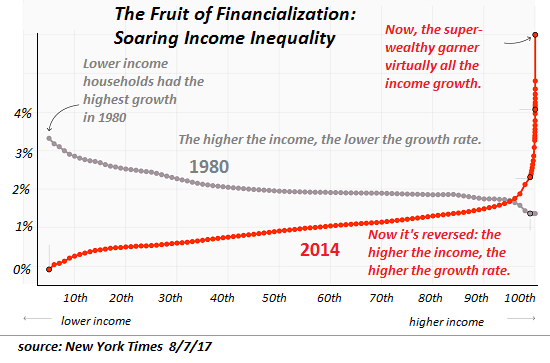
This is a chart of an informal kleptocracy which cloaks itself in the faux finery of democracy and a (rigged) “market” economy.

Back in the day, nations that didn’t qualify as either developed (First World) or developing (Second World) were by default Third World, impoverished, corrupt and what we now refer to as failed states–governments that were incapable of improving the lives of their people and the machinery of governance, generally as a result of corruption and self-serving elites, i.e. kleptocracies.

Is the U.S. slipping into Third World status? While many scoff at the very question, others citing the rise of homelessness, entrenched pockets of abject poverty and the decaying state of infrastructure might nod “yes.”

These are not uniquely Third World problems, they’re symptoms of a status quo that’s fast losing First World capabilities. What characterizes Third World/Failing States isn’t just poverty, crumbling infrastructure and endemic corruption; at a systems level these are the key dynamics in Third World/Failing States:

1. The status quo protects insiders at the expense of everyone else.

2. There is no real accountability; failure has no consequences, bureaucrats are never fired for incompetence, reforms are watered down or neutered by institutional sclerosis.

3. Pay-to-play is the most cost-effective way to influence policy or evade consequences.

4. The status quo is incapable of differentiating between complexity that serves the legitimate purposes of transparency and accountability and complexity that serves no purpose beyond guaranteeing insiders’ paper-shuffling jobs. As a consequence, complexity that adds no value chokes the economy and the government.

5. There are two sets of laws: one for insiders and the super-wealthy, and another harsher set for everyone else.

6. The super-wealthy fear nothing because the system functions to serve their interests.

7. The super-wealthy and state insiders control the media’s narratives and the machinery of governance to serve their interests. Reforms are in name only; the faces of elected officials change but nothing changes structurally.

8. Insiders, well-paid pundits and the technocrats serving the corporate and state elites believe the status quo is just fine because they’re doing fine; they are blind to the soaring inequality, systemic corruption, stupendous waste and the impossibility of real reform.

Does America’s status quo protect insiders at the expense of everyone else? Yes. As for the other seven characteristics: yes, yes, yes, yes, yes, yes and yes.

And lets’ not forget #9: the vast majority of the economic gains flow to the elite at the very top of the wealth-power pyramid: is this true in the U.S.? Definitively yes. Just look at this chart: this is a chart of an informal kleptocracy which cloaks itself in the faux finery of democracy and a (rigged) “market” economy.

That’s the very definition of a Third World failed state.

Related Video:

The USA Is Now a 3rd World Nation

By Charles Hugh Smith

Source: Of Two Minds

I know it hurts, but the reality is painfully obvious: the USA is now a 3rd World nation.

Dividing the Earth’s nations into 1st, 2nd and 3rd world has fallen out of favor; apparently it offended sensibilities. It has been replaced by the politically correctdeveloped and developing nations, a terminology which suggests all developing nations are on the pathway to developed-nation status.

What’s been lost in jettisoning the 1st, 2nd and 3rd world categories is the distinction between developing (2nd world) and dysfunctional states (3rd world), states we now label “failed states.”

But 3rd World implied something quite different from “failed state”: failed state refers to a failed government of a nation-state, i.e. a government which no longer fulfills the minimum duties of a functional state: basic security, rule of law, etc.

3rd World referred to a nation-state which was dysfunctional and parasitic for the vast majority of its residents but that worked extremely well for entrenched elites who controlled most of the wealth and political power. Unlike failed states, which by definition are unstable, 3rd World nations are stable, for the reason that they work just fine for the elites who dominate the wealth, power and machinery of governance.

Here are the core characteristics of dysfunctional but stable states that benefit the entrenched few at the expense of the many, i.e. 3rd Worldnations:

1. Ownership of stocks and other assets is highly concentrated in entrenched elites. The average household is disconnected from the stock market and other measures of wealth; only a thin sliver of households own enough financial/speculative wealth to make an actual difference in their lives.

2. The infrastructure of the nation used by the many is poorly maintained and costly to operate as entrenched elites plunder the funding to pad their payrolls, pensions and sweetheart/insider contracts.

3. The financial/political elites have exclusive access to parallel systems of transport, healthcare, education, etc. The elites avoid trains, subways, lenders, coach-class air transport, standard healthcare and the rest of the decaying, dysfunctional systems they own that extract wealth from the debt-serfs.

They fly on private aircraft, have their own healthcare and legal services, use their privileges to get their offspring into elite universities and institutions and have access to elite banking and lending services that are unavailable to their technocrat lackeys and enforcers.

4. The elites fund lavish monuments to their own glory disguised as “civic or national pride.” These monuments take the form of stadiums, palatial art museums, immense government buildings, etc. Meanwhile the rest of the day-to-day infrastructure decays in various states of dysfunction.

5. There are two classes that only interact in strictly controlled ways: the wealthy, who live in gated, guarded communities and who rule all the institutions, public and private, and the debt-serfs, who are divided into well-paid factotums, technocrat lackeys and enforcers who serve the interests of the entrenched elites and rest of the populace who own virtually nothing and have zero power.

The elites make a PR show of being a commoner only to burnish the absurd illusion that debt-serf votes actually matter. (They don’t.)

6. Cartels and quasi-monopolies are parasitically extracting the wealth of the nation for their elite owners and managers. Google: quasi-monopoly. Facebook: quasi-monopoly. Healthcare: cartel. Banking: cartel. National defense: cartel. National Security: cartel. Corporate mainstream media: cartel. Higher education: cartel. Student loans: cartel. I think you get the point: every key institution or function is controlled by cartels or quasi-monopolies that serve the interests of the few via parasitic exploitation of the powerless.

7. The elites use the extreme violence and repressive powers of the government to suppress, marginalize and/or destroy any dissent. There are two systems of “law”: one for the elites ($10 million penalties for ripping off the public for $10 billion, no personal liability for outright fraud) and one for the unprotected-unprivileged: “tenners” (10-year prison sentences) for minor drug infractions, renditions or assassinations (all “legal,” of course) and institutional forces of violence (bust down your door on the rumor you’ve got drugs, confiscate your car because we caught you with cash, so you must be a drug dealer, and so on, in sickening profusion).

8. Dysfunctional institutions with unlimited power to extract money via junk fees, licensing fees, parking tickets, penalties, late fees, etc., all without recourse. Mess with the extractive, parasitic bureaucracy and you’ll regret it: there’s no recourse other than another layer of well-paid self-serving functionaries that would make Kafka weep.

9. The well-paid factotums, bureaucrats, technocrat lackeys and enforcers who fatten their own skims and pensions at the expense of the public and slavishly serve the interests of the entrenched elites embrace the delusion that they’re “wealthy” and “the system is working great.” These deluded servants of the elites will defend the dysfunctional system because it serves their interests to do so.

The more dysfunctional the institution, the greater their power, so they actively increase the dysfunction at every opportunity.

The USA is definitively a 3rd World nation. Read the list above and then try to argue the USA is not a 3rd World nation. Try arguing against the facts displayed in this chart:

I know it hurts, but the reality is painfully obvious: the USA is now a 3rd World nation.