A Cover Up Of Epic Proportions Is Happening In East Palestine, Ohio

By Michael Snyder

Source: The Economic Collapse

If you want a perfect example of how corrupt our system of government has become, just look at the massive cover up that is going on in East Palestine, Ohio right now.  Federal, state and local officials are telling the public that everything is just fine when everything is obviously not just fine.  On February 3rd, a 50 car Norfolk Southern train derailed in East Palestine.  5 of the cars were carrying vinyl chloride which is an extremely hazardous substance that has been proven to cause several types of cancer.  Unfortunately, with the approval of Ohio Governor Mike DeWine, a decision was made on February 6th to conduct a “controlled burn” of the wreckage.  They knew that burning the vinyl chloride would create vast amounts of phosgene gas.  By now, most of you already know that phosgene gas was actually used as a chemical weapon in World War I.  The cloud of toxic chemicals that was created by the “controlled burn” was so large that it could literally be seen from space, and the long-term health problems that are being caused all over the east coast could stretch on for decades.

But Ohio Governor Mike Dewine doesn’t want to be blamed.

He is telling everyone from East Palestine to go back to their homes, and he insists that the water in the area is “safe to drink”

Do you believe him?

For those that are gullible enough to believe him, I have just one question for you…

Does this water look safe to drink to you?

Ohio Senator J.D. Vance wanted to see this for himself.

So he went down to a local creek in East Palestine, and this is what he discovered

Sadly, it isn’t just the water in East Palestine that has been polluted.

50 miles away in Pittsburgh, the water is exhibiting similar qualities

But the head of the Environmental Protection Agency says that there is nothing to be concerned about at all.

In fact, he says that he would actually “allow his own children to drink and bathe in public water” from East Palestine…

The head of the US Environmental Protection Agency has said he would allow his own children to drink and bathe in public water near the site of a train derailment and chemical spill in Ohio, so long as it had been tested and deemed safe by officials.

EPA Administrator Michael Regan visited the site of the East Palestine derailment on Thursday, seeking to reassure skeptical residents that the water is fit for drinking and the air is safe to breathe.

Nobody wants to see your children do that Michael Regan.

But we would love to see you down a tall, cool glass of tap water from a home right in the middle of East Palestine.

Unfortunately, the Biden administration is going to work relentlessly to downplay the severity of this crisis because they know that if they admitted the truth it would make them look bad to the voters.

And there is a presidential election coming up in less than two years.

Incredibly, the White House has even turned down a formal request for disaster relief for East Palestine…

The White House explained why it turned down Ohio Gov. Mike DeWine’s request for disaster relief this week in the aftermath of a derailment of a train hauling toxic chemicals.

A Biden administration official told Fox News Digital that it has provided extensive assistance to surrounding communities following the chemical release earlier this month in eastern Ohio. However, the official said the Federal Emergency Management Agency (FEMA), the agency that usually provides relief to communities hit by hurricanes and other natural disasters, isn’t best equipped to support the state’s current needs.

I was floored when I saw that.

We have just witnessed one of the greatest environmental disasters in the entire history of our country, and the Biden administration is not even willing to grant a request for disaster relief?

Ultimately, this is all about protecting the asses of the politicians and protecting the asses of the executives and shareholders of Norfolk Southern.

To the elite, it really doesn’t matter if the poor people of East Palestine all get cancer and die.

What matters is controlling the narrative, and up to this point the corporate media is doing a wonderful job of helping them do it.

The Fourth Turn, Turn, Turn

By Charles Hugh Smith

Source: Of Two Minds

The cycles of The Fourth Turning, Fischer and Turchin are all in alignment at this point in history..

The 1997 book The Fourth Turning: An American Prophecy proposed a cyclical pattern of four 20-year generations which culminate in a national crisis every 80 years. The book identifies these dates as Fourth Turnings: 1781 (Revolutionary War), 1861 (Civil War) and 1941 (global war). add 80 years and voila, 2021.

I use the term Fourth Turning generically to describe an existential crisis that decisively changes the course of national identity and history.

In other words, we don’t have to accept the book’s theory of generational dynamics to accept an 80-year cycle. There are other causal dynamics in play that also tend to cycle: the credit (Kondratieff) cycle, for example.

While each of the previous existential crises were resolved positively, positive outcomes are not guaranteed: dissolution and collapse are also potential outcomes.

David Hackett Fischer’s book The Great Wave: Price Revolutions and the Rhythm of History proposes another cycle: humans expand their numbers and consumption until they’ve exploited and depleted all available resources.

As resources become scarce, societies and economies unravel as humans do not respond well to rising prices generated by scarcities.

The unraveling continues until consumption is realigned with the resources available. In the past this meant either a mass die-off that drastically reduced human numbers and consumption (for example, The Black Plague), a decline in fertility that slowly reduced population to fit resources, mass migration to locales with more resources or the discovery and exploitation of a new scalable energy source that enabled a new cycle of rising consumption.

The 14th century Black Death reduce Europe’s population by roughly 40%, enabling depleted forests to regrow and depleted agricultural land to restore fertility.

Once the human population regained its numbers and consumption in the 17th century, wood was once again under pressure as the key source of energy, shipbuilding, housing, etc.

The development of steam power and the technologies of mining enabled the exploitation of coal, which soon replaced wood as the primary energy source.

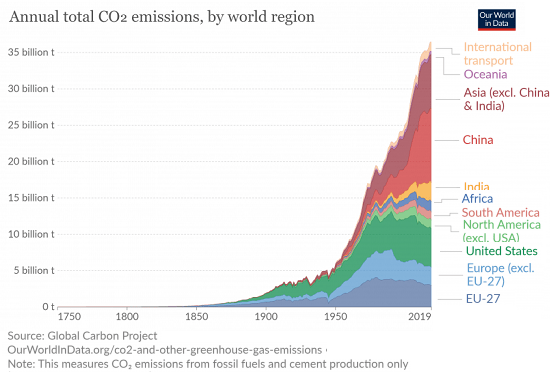
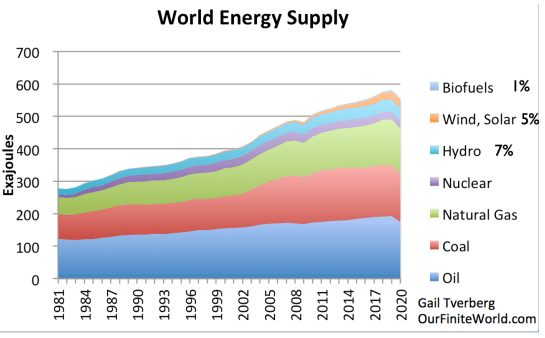
Oil and natural gas added to the energy humans could tap, followed (at a much more modest level) by nuclear power. Despite gargantuan investments, the recent push to develop solar and wind energy has yielded very modest results, as globally these sources provide about 5% of total energy consumption. (See chart below)

It’s self-evident that despite breezy claims of endless expansion of consumption, the global human population has now exceeded the resources available for practical extraction. Energy, fresh water, wild fisheries and fertile soils have all been exploited and the easy/cheap-to-extract resources have been depleted.

(The chart below of global CO2 emissions is a proxy for energy / resource consumption.)

So once again it’s crunch-time: either we proactively reduce consumption to align with available resources, or Nature will do it for us via scarcities.

Peter Turchin proposed another socio-economic cycle of 50 years in his book Ages of Discord: in the integrative stage, people find reasons to cooperate. In the disintegrative stage at the end of the cycle, people no longer find much common ground or reasons to cooperate. Political, social and financial extremes proliferate, culminating in a rolling crisis.

In Turchin’s analysis, the previous 50-year age of discord began around 1970, and the current era of discord began in 2020. Those who lived through the domestic terrorism, urban decay, stagflation and political/social/legal crises of the 1970s recall how inter-related crises dominated the decade.

In my analysis, the last period of discord in the 1970s was “saved” by the supergiant oil fields discovered in the 60s coming online in the late 1970s and early 1980s. That oil enabled a 40-year boom which is now ending, with no new scalable source of energy available to replace oil, much less enable an expansion of consumption.

In other words, the cycles of The Fourth Turning, Fischer and Turchin are all in alignment at this point in history. We have proliferating political, social and financial extremes and a forced transition to lower consumption to align with declining energy.

Turn, turn, turn. Right when we need to cooperate on transforming a high-consumption, bubble-dependent “waste is growth” Landfill Economy to declining consumption / Degrowth, we’re beset by discord and demographic pressures, as the promises made to the elderly back when it was expected that there would always be 5 workers per retiree cannot possibly be kept now that the worker-retiree ratio is 2-to-1 and there are no limits on healthcare spending for the elderly.

Humans are happy to expand their numbers and consumption and much less happy to consume less. They tend to start revolutions and wars in vain attempts to secure enough resources to maintain their profligate consumption and expansion.

Today’s extremes of wealth and income inequality are optimized to spark political discord and revolts. The wealthiest 20% will be able to pay higher prices, but the bottom 40% will not. The middle 40% will find their disposable income, i.e. their income left over after paying for essentials, will drop to near-zero.

When 80% of the populace are crunched financially, revolutions and the overthrow of governments follow.

As I’ve outlined in previous posts, global inequalities are widening as the Core exploits its built-in advantages at the expense of the vulnerable Periphery.

Core nations will be much better able to maintain their consumption at the expense of the Periphery nations, which will experience sharp declines in purchasing power and consumption.

Previous Fourth Turnings have been resolved one way or another within 5 to 7 years. If this Turning began in 2020, we can expect resolution by 2025 – 2027.

As I explained in my book Global Crisis, National Renewal, those nations that embrace Degrowth will manage the transition, while those that cling to the endless-expansion, bubble-dependent Waste Is Growth model will fail.

This is why I keep talking about making Plans A, B and C to preserve optionality and reduce financial commitments and consumption now rather than passively await crises over which we will have little direct control.

As I’ve endeavored to explain, those anticipating decades of time to adjust are overlooking the systemic fragilities of the current global financial/supply systems. Tightly bound systems of interconnected dependency chains have been optimized to work perfectly in an era of expansion. They’re not optimized to gradually adjust to contraction; they’re optimized to break and trigger domino-like breakdowns in interconnected chains.

We don’t control these macro-trends, we only control our response.

Consider the Chickens

Intelligence, ethics, and the inner lives of animals

By Rafia Zakaria

Source: The Baffler

I OWE CHICKENS AN APOLOGY. Not only have I been eating them until very recently, but I have refused to even consider the possibility of a chicken having any kind of inner life. This estimation was not made from a lack of interaction. As children, my twin brother and I purchased baby chicks from a street vendor. We did this unfazed by the fact that quite often, the chickens would die. Once, when we were nine, we had two that lived, a hen and a rooster. No one told us that we should probably get more hens. Not having any other female companions, the rooster exerted his attentions on the one chicken. She would lay an egg or two every day, much to our delight, but soon sickened and died. Then there was only an incel rooster who roamed our compound and terrorized the women. After a few ugly incidents, he was “given away” to one of the women who worked at our house. We were never told what happened to him, and I didn’t care. There is nothing worse than an incel rooster patrolling your house all day long.

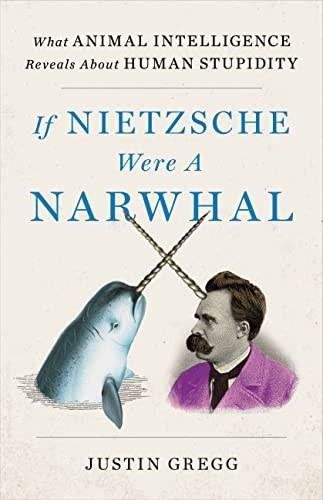
Now, so many years later, I’ve found my way to animal behaviorist Justin Gregg’s brilliant new book If Nietzsche Were a Narwhal: What Animal Intelligence Reveals About Human Stupidity. Gregg’s chicken coop is “a huge enclosed area” with high rafters, because as an animal scientist, he knows them to be jungle birds who need perches on which to sleep at night. But it is not only the magisterial heights of Gregg’s discussion of chickens that stayed with me. I was struck also by Gregg’s description of his chickens’ varied personalities, one anxious, another friendly, and so on; he tells us that these chickens do have inner lives and thus a consciousness of themselves as distinct from others. Instead of the feckless creatures I (and most people) assume them to be, chickens have just the sort of intelligence that is necessary for their own survival. They don’t think like humans, Gregg tells us, because they do not need to.

Intelligence, in Gregg’s explanation, does not exist in the way SATs or other IQ tests would have you believe. Those tests quantify a certain kind of ability to process information. People who do not do well on such tests may have other kinds of abilities that simply are not being measured. Intelligence is not one easily definable thing; engineers working on artificial intelligence cannot agree on a definition of it. But what humans have is a tendency to ask why things operate in a certain way. In Gregg’s terminology, humans are “why specialists,” a proclivity that in natural selection terms is no advantage and perhaps even a liability. A narwhal swimming around in the sea, for instance, would never have the kind of mental breakdown that the German philosopher pondering nihilism suffered toward the end of his life. Animal intelligence is practical and does not get caught up in abstract thought. By and large, animals make calculations based on what they can observe; ideas such as “causality,” which lie at the crux of human intelligence, are outside their capacity for thought.

Humans evolved to become why specialists. As Gregg tells it, 200,000 years ago, humans were hanging out with chimpanzees and exhibited no interest in the whys. They could make rudimentary tools and had some kind of assemblage of grunts that allowed for basic communication. He notes that roughly 40,000 years ago, cave paintings were created. Here were humans asking the whys; symbolic representation is an exclusively human thing.

Inability to be why specialists does not mean that animals are not capable of “metacognition,” the ability to be conscious of their own thinking or cognition. One of the most stunning examples in this book full of stunning examples is that of Natua, a dolphin at the Dolphin Research Center in Florida. An experiment was set up where Natua was exposed to two kinds of sounds, one a very high tone and one a very low tone. After hearing the sound, Natua had to choose between two paddles, one for the high and another for the low. If he chose correctly, he was given a fish for a reward. If he did not, he was sent for a long time-out, in that the experiment stopped. As the experiment progressed, the high tone sound came very close to the low sound such that they were nearly indistinguishable. At this point, Natua was unable to tell the difference; “he just started randomly pressing paddles,” Gregg writes. His behavior proved that some animals are capable of metacognition, the awareness that they do not know, or that their thinking about something is wrong.

It is no surprise that Gregg is pessimistic about how humans have used their abilities as why specialists, and he thinks that there is a chance that humans might not even survive over another century. The prospect of nuclear war and the climate crisis suggest, in Gregg’s view, that the end is possible. In the meantime, developing a consciousness of animals as beings who are capable of metacognition, of having individual personalities and so on, points to the need for a new ethics. This new set of basic premises would abandon the centering principle that the animal-human relationship must always be of one having dominion over the other.

But if you consider the continued resistance to the idea of animal rights, it is hard to be optimistic about the emergence of a new ethics of mutuality that eschews the dominion portion. Too many human rationalizations, attached to what we eat, what we wear, how we live, are predicated on the belief that we are the only feeling beings and that our actions upon animals are independent of consequences. If you know the fear of a chicken or a cow or a pig about to be slaughtered, you may look at your food in a different way. You might eschew fried chicken or beef or pork completely. If you understand that a horse being whipped is suffering terribly, is extremely scared and dissolute, you can also understand that there is a need for a radical expansion of mindfulness and a concomitant shrinking of power.

In the moral universe informed by Gregg’s argument, the survival of the human race is not an imperative for the planet because humans as a species have been far more disastrous for the world than others. “Prognostic myopia” keeps us horribly and condemnably in the moment, burning fossil fuels and trashing the oceans even though we know that it is terrible for the environment. This is a unique position among philosophers, a lot of whom have lately concerned themselves with questions of ethics and planetary survival. 

As a contrast to Gregg, the Oxford Associate Professor in Philosophy William MacAskill, in his What We Owe the Future, proposes “effective altruism” as a way to live ethically in times of climate crisis. If Gregg argues against human exceptionalism, MacAskill reduces humans to data points, where the survival of the most, and the most benefit to the planet, are guideposts to a present and future ethics. Using Gregg’s arguments, however, effective altruism is rendered meaningless. Even those who live sparingly on twenty-six thousand pounds a year, like MacAskill, are still a burdensome threat, unless we define their worth according to tiresome illusions of human exceptionalism.

If Nietzsche Were A Narwhal is the sort of critical look at human dominion that our world needs. A few years ago, Brown University environmental historian Bathsheba R. Demuth wrote Floating Coast: An Environmental History of the Bering Strait, a similarly groundbreaking look at the consequences of the extractive relationship humans have had with the environment. Just as Gregg reveals the risks of humans imagining their power over animals as shorn of consequences, Demuth reveals the consequences of human dominion over nature.

Thinkers and scientists like Gregg and Demuth are presenting readers with the urgent and pressing necessity for a new ethics. The unthinking, extractive, and dominant human treats animals as a lower form of existence, rather than a different form; we assess the environment based on what can be extracted from it. Like our means of communication, our means of travel, of treating disease, and so much else, our ethics need an urgent and pressing update that takes into consideration the understanding of animals. Factory farms, the constant consumption of animal products, and the greedy use of fossil fuels are the seeds of destruction.

I am not sure I could have offered the chicken and rooster of my childhood a deluxe chicken coop with high rafters, but an argument for better living conditions and the introduction of new companions for the rooster would have been easier if we had understood the first thing about the animals around us. I do not need to underscore the rapid pace at which our world is changing. If Nietzsche Were A Narwhal is a must-read because it explains how we can save the world only if we exist in symbiosis with the thinking, feeling creatures that have had the misfortune of sharing the planet with humans, who turn out not to be as intelligent as they believe themselves to be.

U.S. Government Likely Perpetrated Biggest-Ever Catastrophic Global Warming Event

By Eric Zuesse

Source: The Duran

On September 28th, the AP headlined “Record methane leak flows from damaged Baltic Sea pipelines” and reported that “Methane leaking from the damaged Nord Stream pipelines is likely to be the biggest burst of the potent greenhouse gas on record, by far. … Andrew Baxter, a chemical engineer who formerly worked in the offshore oil and gas industry, and is now at the environmental group EDF …  said, ‘It’s catastrophic for the climate.’” The article pointed out that methane “is 82.5 times more potent than carbon dioxide at absorbing the sun’s heat and warming the Earth.”

Russian President Vladimir Putin had been aiming ultimately (and maybe soon) to get the gas to Europe flowing again, and said to EU nations on September 16th, “Just lift the sanctions on Nord Stream 2, which is 55 billion cubic metres of gas per year, just push the button and everything will get going.”

Here is what U.S. President Joe Biden had already promised about that on February 7th:

If Germany — if Russia invades — that means tanks or troops crossing the — the border of Ukraine again — then there will be — we — there will be no longer a Nord Stream 2.  We will bring an end to it. 

Q    But how will you — how will you do that exactly, since the project and control of the project is within Germany’s control?

PRESIDENT BIDEN:  We will — I promise you, we’ll be able to do it

He had promised to cause permanently the end of Nord Stream if Russia invaded, which it did on February 24th. He fulfilled on that promise on September 27th.

Radek Sikorsky, who is a Member of the European Parliament and had been Poland’s Foreign Minister and is the husband of the famous writer against Russia Anne Applebaum, and has been affiliated with Oxford University, Harvard University, and NATO, tweeted on the day of the explosions, “Thank you, USA.” He also tweeted explanations: “All Ukrainian and Baltic sea states have opposed Nordstream’s construction for 20 years. Now $20 billion of scrap metal lies at the bottom of the sea, another cost to Russia of its criminal decision to invade Ukraine.” And: “Nordstream’s only logic was for Putin to be able to blackmail or wage war on Eastern Europe with impunity.”

Furthermore on September 27th, Germany’s Spiegel magazine reported that, as Reuters put it, “The U.S. Central Intelligence Agency (CIA) had weeks ago warned Germany about possible attacks on gas pipelines in the Baltic Sea” 

On September 28th, SouthFront headlined “No Way Back for Europe” and reported

It is reasonably suspected that the pipeline was blown up by the special services of the United States in order to finally stop the gas supplies to Germany from Russia.

On September 27, a detachment of warships led by the US amphibious assault ship USS Kearsarge reported on the completion of their tasks in the area of the alleged sabotage in the Baltic Sea and headed for the North Sea.

Since the beginning of September, suspicious activity by anti-submarine helicopters of the US Navy has been observed in the area. In the last few days, reconnaissance activities of NATO aircraft have significantly intensified in the Baltic Sea area. In particular, a US Boeing E-3 Sentry reconnaissance aircraft was on constant patrol over the Baltic States, and a US Joint STARS was spotted over Germany and Poland.

—————

Investigative historian Eric Zuesse’s new book, AMERICA’S EMPIRE OF EVIL: Hitler’s Posthumous Victory, and Why the Social Sciences Need to Change, is about how America took over the world after World War II in order to enslave it to U.S.-and-allied billionaires. Their cartels extract the world’s wealth by control of not only their ‘news’ media but the social ‘sciences’ — duping the public.

Make Sure You Download the Latest Ministry of Propaganda Updates

By Charles Hugh Smith

Source: Of Two Minds

It’s time once again to check for Ministry of Propaganda updates, which like Windows and iOS is constantly being updated to counter new threats and enhance the user experience (heh).

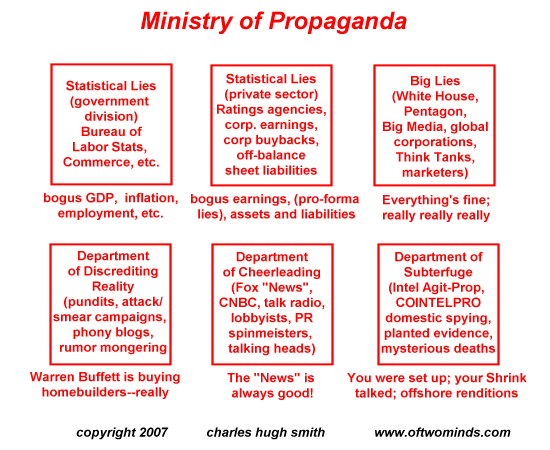
Much like the other operating systems that underpin our daily lives, the core functions of the MoP don’t change much. My chart from 2007 remains an instructive summary of MoP operations, with the only changes being Mr. Buffett is now buying oil companies and social media corporations are now major media players.

The core mission of the Ministry of Propaganda isn’t just to push a desirable narrative–it’s to mystify the underlying dynamics of a system that benefits the few at the expense of the many by promoting a self-serving worldview (weltanschauung) that explains how the world works in a way that protects the interests of those in power.

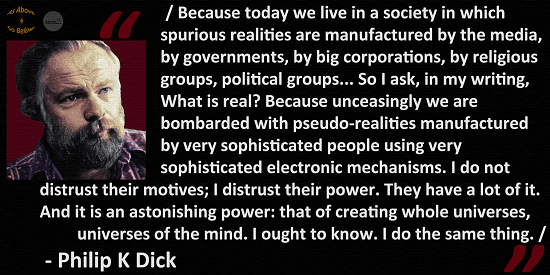
As science fiction author Philip K. Dick explains in the quote below, the MoP narrative isn’t just a cloak thrown over the underlying dynamics, it’s the creation of an entire universe / worldview, including contexts for understanding what’s going on, establishing what’s valuable and what isn’t, and what behaviors enhance status and which ones marginalize us.

The Ministry of Propaganda isn’t monolithic: various factions compete to push their self-serving narratives. As Dick noted, this includes governments, corporations, religious and political groups, each of which understands that once the populace accepts their worldview, their power is cemented in realms far above mere force.

A key mechanism in establishing a dominant worldview is the think-tank or equivalent self-serving body claiming authority over what’s true / false and important / unimportant. This can be authority over the “correct” interpretation of spiritual texts, economic policies, healthcare “standards of care,” geopolitical goals, etc.

Since humans are innately social, status-striving beings, hierarchies of authority and power are the air we breathe. Those who establish themselves as authorities don’t just gain power, they cement their power on the basis of their authority rather than on loyalty or competence.

The enormous powers of social media and traditional media to promote claims of authority have generated a deranging snarl of conflicting agendas and narratives. Various centers of power collaborate on pushing worldviews that benefit their interests, but this isn’t entirely coherent. The one thing all participants in the Ministry of Propaganda agree on is our power is deserved and must be defended against all threats, which includes hostile entities inside and outside the national borders.

This fragmented, constantly shifting cacophony of competing authorities is destabilizing. As the tectonic plates of worldviews collide, the edges crumble and people naturally seek the safety of some core set of beliefs, in effect “circling the wagons” in an attempt to restore some internal stability.

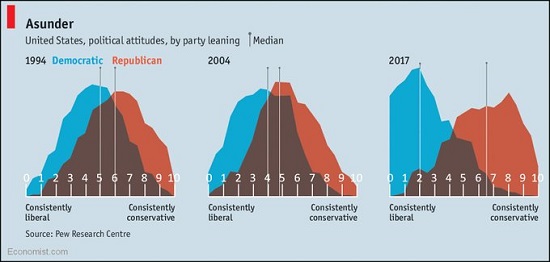
We see this in the intense political polarization of this era (see chart below). To make sense of the competing claims of authority, we reduce the perimeter of what’s defendable, putting more of the world into “outside enemies” (them) and reserving the “safe, trusted place” for fewer of “us.”

With so many competing factions in the Ministry of Propaganda, there’s a proliferation of propaganda such that there is literally nothing left but PR. In a universe constructed of nothing but agit-prop and PR, we all have our favorites examples. James Bond picks up his Nokia phone. Even though nobody’s seen a Nokia phone in ages, if you want to be cool like Bond, go buy a Nokia phone.

Marketing is the MoP’s entire universe. Everybody’s selling something to gain or maintain power, status, mindshare or the ultimate prize, the dominant worldview.

To ease the confusion, please download the latest updates from the Ministry. These updates replace all that misinformation, misdirection, and blatant marketing with the, ahem, facts, or the correct interpretation of the facts. (We had to destroy the village in order to save it. OK, got it.)

While it’s fun to sort all the propaganda into various boxes, we would do well to look for what all the marketers / MoP players seek to mystify. In my analysis, what must be mystified at all costs boils down to the unsustainability of 1) the current consumption of resources, 2) the current method of creating capital so the few can buy up the planet’s most valuable assets, 3) neocolonialism, the modern replacement for the old model of occupation and exploitation by force, and 4) neofeudalism, the economic / social /political arrangement in which the majority of the populace are modern-day serfs with extremely limited agency and power which they are told is limitless.

“You can be anything you choose to be!” Or at least your digital avatar can do so, and that’s practically as good as actually having agency and power in the real world. Or so we’re told, mindlessly, endlessly without pause or respite.

More on these topics in the coming weeks.

Our Challenge Is To Transcend Our Evolutionary Ape Heritage

By Caitlin Johnstone

Source: CaitlinJohnstone.com

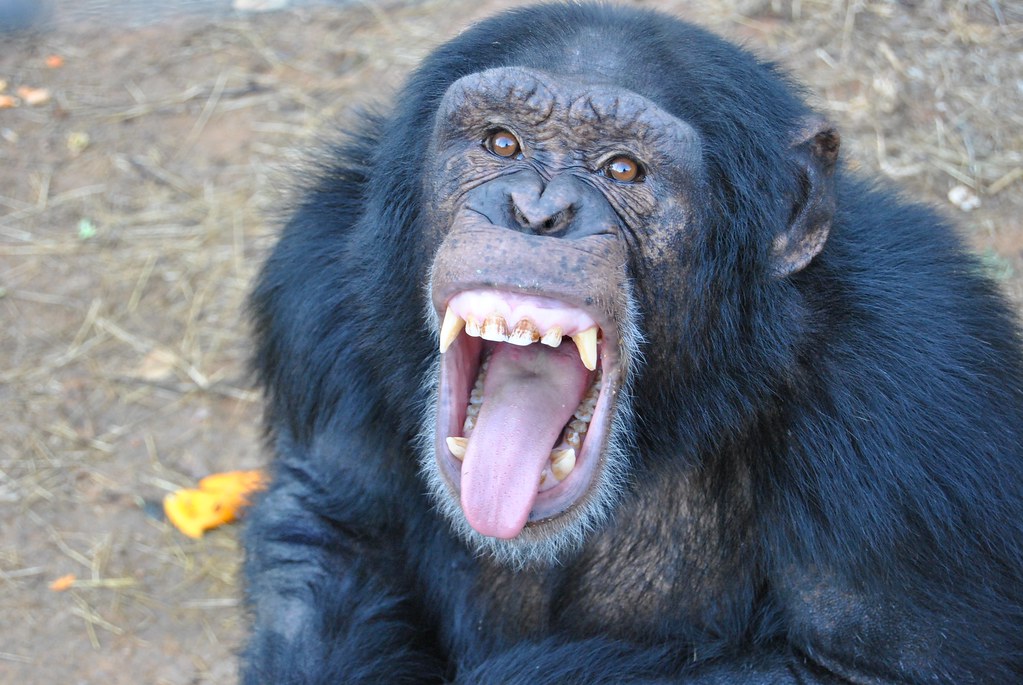
Did you know chimpanzees hunt smaller primates for food?

They do. They’re actually very skillful hunters due to their size, their strength, and especially their intelligence. They coordinate their attacks, working together to cut off the escape routes of their prey to greatly increase their success rate. Scientists have even frequently observed them using crude spears to kill a small primate species called the lesser bush baby for their meat.

One of the many interesting things about this behavior in our primate cousins is that they are so good at hunting they can become victims of their own success, wiping out entire populations of prey in their area. Red colobus monkeys have been hunted to the brink of local extinction in Uganda by chimpanzees hungry for a quick protein fix, solely because they’ve been gobbling up those delicious little guys faster than they can reproduce.

Sound familiar?

The tendency of homo sapiens to overburden our ecosystem with our consumption is not unique to us, and is not new. In fact, it looks like we’ve been on this trajectory toward ecocide since our ancient evolutionary ancestors began evolving extra brain matter.

And it is possible to just stop there and conclude that we are no different from our chimp relatives in this sense. That we will simply keep overhunting the red colobus monkey until there are none left, that we will keep depleting and destroying our biosphere until it can no longer sustain life. That the human brain differs from the chimpanzee’s only in intelligence, not in wisdom. That we are in essence no different from the cyanobacteria at the dawn of the Proterozoic Era, a new species showing up on the scene and causing a mass extinction event in an ecosystem overburdened by their rapid flourishing.

You do also however have the option of openness to the possibility that maybe, just maybe, our species is destined for greater things. That maybe, just maybe, we have within us the capacity to transcend the mindless patterning of our evolutionary ancestors and move into a mindful relationship with this planet and its life forms. That maybe, just maybe, this whole human adventure doesn’t need to end in disaster after all.

From what I can tell, the only people who find this idea outlandish are those who have never experienced a great unpatterning of their own. Who have never healed the wounds of their past and transcended the unwholesome mental habits which were given to them by their conditioning. To anyone who has experienced a dramatic transformation from dysfunction into health, it’s obvious that any human could potentially go through such transformations as well. Or even all humans.

It is possible that our descendents will look back on humanity’s existence on this planet from prehistoric times up until this crucial present moment as a kind of bridge between animal life and a new terrestrial expression that isn’t driven by the unconscious conditioning patterns that have driven the movements of every species on this planet from the very first single-celled organisms onward. That what we’re experiencing right now at this critical juncture is what it looks like before the emergence of the Earth’s first conscious species.

An unconscious human is one driven compulsively by deep-seated mental habits they don’t really see and can’t do much to control, so they’ll often find themselves engaged in unwholesome behavior patterns like addiction, unkindness, greed and neurosis, and making the same mistakes over and over for reasons they don’t quite understand.

A conscious human is one who doesn’t have unseen conditioning pulling the strings from behind the scenes in their subconscious mind, because they have done their work and drawn their inner demons into the light of consciousness where they can be healed. They are therefore able to move through life deliberately and in the interest of what’s best, rather than compulsively and in a way that spreads trauma to others.

A conscious humanity would mean that this way of functioning blossoms throughout the entire species.

Doesn’t it kind of look like that might be what’s happening? Like all the chaos and confusion of these strange times could simply be the birth pangs of a species whose relationship with consciousness is about to take a dramatic pivot? The increasingly shrill mass media narratives rapidly approaching white noise saturation? The increasingly widespread awareness that our society’s rules are made up and we can change them whenever we want? The mysterious increase in incidents of spiritual awakening as reported by teachers of enlightenment? Just how goddamn weird everything’s been getting these last few years?

I think it’s possible. I think it’s possible we are moving as a species toward an adaptation that will enable us to survive in a situation which is very different from the one we first emerged in, as every species eventually does if it doesn’t go extinct. If this is indeed what is happening, it stands to reason that it will be an adaptation that prevents us from wiping ourselves out via ecocide or nuclear war, and that a collective movement into consciousness is what that adaptation will look like.

A conscious species would be able to work in cooperation with its ecosystem, rather than compulsively consuming it due to primitive impulses to obtain and dominate and egoic impulses to be rich and have more. A conscious species would be able to convert civilization from competition-based models into collaboration-based models, where rather than trying to climb over each other to get ahead we all work together to make sure everyone has what they need to live. A conscious species would no longer see the sense in dividing itself up into separate competing nation-states which brandish armageddon weapons at each other out of fear and greed.

The more I learn about humanity, and the more I learn about myself, the more possible such a world appears to be. Sure the world’s a chaotic and distressing mess right now, but so is childbirth. However bad things get for us, as long as we’re still alive our problems are nothing that can’t be fixed with a collective movement into consciousness.

Anyway. That’s my pet theory right now. And the cool thing about my theory is that if you like it too, you don’t have to wait for it to come true. You can start becoming more conscious on your own right now and leading the charge for the rest of us. Investigate your true nature, heal your wounds, be responsible with your actions, and begin working to coax all your endarkened bits into the light.

And then hopefully the rest will follow. If they don’t, worst-case scenario is you wind up a lot more happy and functional than you otherwise would have been, because you brought so much more consciousness to your inner processes and your habits of perception and cognition.

This is where the real adventure is at, in my opinion. This is where the rubber meets the road.

I will meet you there.

Pouring Poison and Planting Seeds of Dependency

By Colin Todhunter

Source: Off-Guardian

Do you remember the iconic Union Carbide image from the 1950s or early 1960s? The one with the giant hand coming from the sky, pouring pesticides onto Indian soil.

The blurb below the image includes the following:

Science helps build a new India – India has developed bold new plans to build its economy and bring the promise of a bright future to its more than 400 million people. But India needs the technical knowledge of the western world. For example working with Indian engineers and technicians, Union Carbide recently made available its fast scientific resource to help build a chemicals and plastics plant near Bombay. Throughout the free world, Union Carbide has been actively engaged in building plants for the manufacture of chemicals, plastics, carbons, gases and metals.”

In the bottom corner is the Union Carbide logo and the statement ‘A HAND IN THINGS TO COME’.

This ‘hand of god’ image has become infamous. Union Carbide’s ‘hand in things to come’ includes the gas leak at its pesticides plant in Bhopal in 1984. It resulted in around 560,000 injured (respiratory problems, eye irritation, etc), 4,000 severely disabled and 20,000 dead.

As for the chemical-intensive agriculture it promoted, we can now see the impacts: degraded soils, polluted water, illness, farmer debt and suicides (by drinking pesticides!), nutrient-dense crops/varieties being side-lined, a narrower range of crops, no increase in food production per capita (in India at least), the corporate commodification of knowledge and seeds, the erosion of farmers’ environmental learning, the undermining of traditional knowledge systems and farmers’ dependency on corporations.

Whether it involves the type of ecological devastation activist-farmer Bhaskar Save outlined for policy makers in his 2006 open letter or the social upheaval documented by Vandana Shiva in the book The Violence of the Green Revolution, the consequences have been far-reaching.

And yet – whether it involves new genetic engineering techniques or more pesticides –  there is a relentless drive by the agritech conglomerates to further entrench their model of agriculture by destroying traditional farming practices with the aim of placing more farmers on corporate seed and chemical treadmills.

These corporations have been pushing for the European Commission to remove any labelling and safety checks for new genomic techniques. The European Court of Justice ruled in 2018 that organisms obtained with new genetic modification techniques must be regulated under the EU’s existing GMO laws. However, there has been intense lobbying from the agriculture biotech industry to weaken the legislation, aided financially by the Gates Foundation.

Since 2018, top agribusiness and biotech corporations have spent almost €37 million lobbying the European Union. They have had 182 meetings with European Commissioners, their cabinets and director generals. More than one meeting a week.

In recent weeks, Syngenta (a subsidiary of ChemChina) CEO Erik Fyrwald has come to the fore to cynically lobby for these techniques.

But before discussing Fyrwald, let us turn to another key agribusiness figure who has been in the news. Former Monsanto chairman and CEO Hugh Grant recently appeared in court to be questioned by lawyers on behalf of a cancer patient in the case of Allan Shelton v Monsanto.

Shelton has non-Hodgkin lymphoma and is one of the 100,000-plus people in the US claiming in lawsuits that exposure to Monsanto’s Roundup weedkiller and its other brands containing the chemical glyphosate caused their cancer.

His lawyers argued that Grant was an active participant and decision-maker in the company’s Roundup business and should be made to testify at the trial.

Why not? After all, he did make a financial killing from peddling poison.

Bayer acquired Monsanto in 2018 and Grant received an estimated $77 million post-sale payoff. Bloomberg reported in 2017 that Monsanto had increased Grant’s salary to $19.5 million.

By 2009, Roundup-related products, which include genetically modified seeds developed to withstand glyphosate-based applications, represented about half of Monsanto’s gross margin.

Roundup was integral to Monsanto’s business model and Grant’s enormous income and final payoff.

Consider the following quote from a piece that appeared on the Bloomberg website in 2014:

Chairman and Chief Executive Officer Hugh Grant is focused on selling more genetically modified seeds in Latin America to drive earnings growth outside the core US market. Sales of soybean seeds and genetic licenses climbed 16%, and revenue in the unit that makes glyphosate weed killer, sold as Roundup, rose 24%.”

In the same piece, Chris Shaw, a New York-based analyst at Monness Crespi Hardt & Co, is reported as saying “Glyphosate really crushed it” – meaning the sales of glyphosate were a major boost.

All fine for Grant and Monsanto. But this has had devastating effects on human health. ‘The Human Cost of Agrotoxins. How Glyphosate is killing Argentina’, which appeared on the Lifegate website in November 2015, serves as a damning indictment of the drive for “earnings growth” by Monsanto. Moreover, in the same year, some 30,000 doctors in that country demanded a ban on glyphosate.

The bottom line for Grant was sales and profit maximisation and the unflinching defence of glyphosate, no matter how carcinogenic to humans it is and, more to the point, how much Monsanto knew it was.

Noam Chomsky underlines the commercial imperative:

… the CEO of a corporation has actually a legal obligation to maximize profit and market share. Beyond that legal obligation, if the CEO doesn’t do it, and, let’s say, decides to do something that will, say, benefit the population and not increase profit, he or she is not going to be CEO much longer –  they’ll be replaced by somebody who does do it.”

Syngenta’s CEO is cut from the same cloth as Grant. While Monsanto’s crimes are well documented, Syngenta’s transgressions are less well publicised.

In 2006, writer and campaigner Dr Brian John claimed:

GM Free Cymru has discovered that Syngenta, in its promotion of GM crops and foods, has been involved in a web of lies, deceptions and obstructive corporate behaviour that would have done credit to its competitor Monsanto.”

Some weeks ago, Fyrwald called for organic farming to be abandoned. In view of the food crisis, brought on by the war in Ukraine, he claimed rich countries had to increase their crop production – but organic farming led to lower yields. Fyrwald also called for gene editing to be at the heart of the food agenda in order to increase food production.

He stated:

“The indirect consequence is that people are starving in Africa because we are eating more and more organic products.”

In response, Kilian Baumann, a Bernese organic farmer and president of the Swiss Small Farmers’ Association, called Fyrwald’s arguments “grotesque”. He claimed Fyrwald was “fighting for sales”.

Writing on the GMWatch website, Jonathan Matthews says the Russian invasion of Ukraine seems to have emboldened Fyrwald’s scaremongering.

Matthews states:

Fyrwald’s comments reflect the industry’s determination to undermine the European Union’s Farm to Fork strategy, which aims by 2030 not just to slash pesticide use by 50% and fertilizer use by 20% but to more than triple the percentage of EU farmland under organic management (from 8.1% to 25%), as part of the transition towards a ‘more sustainable food system’ within the EU’s Green Deal.”

He adds:

Syngenta view[s] these goals as an almost existential threat. This has led to a carefully orchestrated attack on the EU strategy.”

The details of this PR offensive have been laid out in a report by the Brussels-based lobby watchdog Corporate Europe Observatory (CEO): A loud lobby for a silent spring: The pesticide industry’s toxic lobbying tactics against Farm to Fork.

Mathews quotes research that shows GM crops have no yield benefit. He also refers to a newly published report that draws together research clearly showing GM crops have driven substantial increases – not decreases – in pesticide use. The newer and much-hyped gene-edited crops look set to do the same.

Syngenta is among the corporations criticised by a report from the UN for “systematic denial of harms” and “unethical marketing tactics”. Matthews notes that selling highly hazardous pesticides is actually at the core of Syngenta’s business model.

According to Matthews, even with the logistical disruptions to maize and wheat crops caused by the war in Ukraine, there is still enough grain available to the world market to meet existing needs. He says the current price crisis (not food crisis) is a product of fear and speculation.

Matthews concludes:

If Erik Fyrwald is really so concerned about hunger, why isn’t he attacking the boondoggle that is biofuels, rather than going after organic farming? The obvious answer is that the farmers being subsidised to grow biofuels are big consumers of agrichemicals and, in the US case, GMO seeds – unlike organic farmers, who buy neither.”

Fyrwald has a financial imperative to lobby for particular strategies and technologies. He is far from an objective observer. And he is far from honest in his appraisal – using fear of a food crisis to push his agenda.

Meanwhile, the sustained attacks on organic agriculture have become an industry mainstay, despite numerous high-level reports and projects indicating it could feed the world, mitigate climate change, improve farmers’ situations, lead to better soil, create employment and provide healthier and more diverse diets.

There is a food crisis but not the one alluded to by Fyrwald –  denutrified food and unhealthy diets that are at the centre of a major public health crisis, a loss of biodiversity which threatens food security, degraded soils, polluted and depleted water sources and smallholder farmers, so vital to global food production (especially in the Global South), squeezed off their land and out of farming.

Transnational agribusiness has lobbied for, directed and profited from policies that have caused much of the above. And what we now see is these corporations and their lobbyists espousing (fake) concern (a cynical lobbying tactic) for the plight of the poor and hungry while attempting to purchase EU democracy to the tune of €37 million. Cheap at the price considering the financial bonanza that its new patented genetic engineering technologies and seeds could reap.

Various scientific publications show these new techniques allow developers to make significant genetic changes, which can be very different from those that happen in nature. These new GMOs pose similar or greater risks than older-style GMOs.

By attempting to dodge regulation as well as avoid economic, social, environmental and health impact assessments, it is clear were the industry’s priorities lie.

Unfortunately, Fyrwald, Bill Gates, Hugh Grant and their ilk are unwilling and too often incapable of viewing the world beyond their reductionist mindsets that merely regard seed/chemical sales, output-yield and corporate profit as the measuring stick of success.

What is required is an approach that sustains indigenous knowledge, local food security, better nutrition per acre, clean and stable water tables and good soil structure. An approach that places food sovereignty, local ownership, rural communities and rural economies at the centre of policy and which nurtures biodiversity, boosts human health and works with nature rather than destroying these.

Fyrwald’s scaremongering is par for the course – the world will starve without corporate chemicals and (GM) seeds, especially if organics takes hold. This type of stuff has been standard fare from the industry and its lobbyists and bought career scientists for many years.

It flies in the face of reality, not least how certain agribusiness concerns have been part of a US geopolitical strategy that undermines food security in regions across the world. These concerns have thrived on the creation of dependency and profited from conflict. Moreover, there is the success of agroecological approaches to farming that have no need for what Fyrwald is hawking.

Instead, the industry continues to promote itself as the saviour of humanity – a hand of god powered by a brave new techno-utopian world of corporate science, pouring poison and planting seeds of corporate dependency with the missionary zeal of Western saviourism.

“Genetically Edited” Food – The next stage of the Great Reset?

By Kit Knightly

Source: Off-Guardian

The Queen’s Speech was interesting this year.

For all the people outside the UK who don’t understand what the “Queens Speech” actually is, it’s a farcical state occasion in which the Queen (or, in this case, Prince Charles since her majesty is ill/secretly dead/having “mobility issues”) makes a speech about what “her government” intends to do for the next 12 months.

Of course, the Queen doesn’t actually write the speech, or have any input on its content, or have any control at all over what “her” government intends to do. She’s just a mouthpiece in a big gold hat.

It’s the UK equivalent of the State of the Union, only done in Halloween costumes made out of shiny stolen rocks.

The whole thing is nothing but a grand, gilt statement of intent from the British Deep State, wrapped in mink and draped in medals they never earned. It’s a joke, but it is worth listening to.

Or, if you have a sensitive stomach, you can just read the full text the next day on the UK government’s website (that’s what I do).

A lot of the content is entirely predictable.

More money to Ukraine, with a promise the UK will “lead the way in championing security around the world”. More online censorship via the “Online Safety Bill”. A compulsory register for homeschooled children via the “Schools Reform Bill”.

There’s also mention of “securing the constitution” by introducing the UK’s own “Bill of Rights”. We broke down that particular Trojan Horse back in February.

But the part I found most interesting is the stated plan to “encourage agricultural and scientific innovation at home” via the proposed Genetic Technology (Precision Breeding) Bill.

The proposed bill (which, for some reason is not available through the parliament website) follows on from DEFRA’s announced “loosened regulation” of genetic research back in January.

To quote the National Institute of Agricultural Botany (NIAB), the legislation would “take certain precision breeding techniques out of the scope of restrictive GMO rules”.

Essentially, this would see new “gene-edited” foods as distinct from old-fashioned “genetically modified” foods, and therefore not subject to the same rules and oversight.

The claimed distinction is that gene editing, as opposed to genetic modification, doesn’t introduce DNA from other species. Therefore, in effect, is merely speeding up what could potentially naturally happen over time.

Now, you might think this is just semantics, and that such a law will just provide a loophole for ALL “genetically modified” foods to simply rebrand themselves as “genetically edited” foods, and thereby avoid regulation. But that is disgustingly cynical and shame on you for even thinking it.

All in all, this is pretty on-message stuff, and not especially surprising. What’s noteworthy is – by pure happenstance, I’m sure – it appears to coincide with a renewed push on the GM food front in other countries all over the world.

In December 2021, Switzerland added an amendment to its moratorium on GMO crops, permitting the use of certain “gene editing” techniques.

Last month, Egypt announced their new strain of GM wheat. Just two days ago, Ethiopia’s National Agricultural Biotechnology Research Center announced they had researched, and the country will now be growing, genetically modified cotton and maize.

Despite Russia’s sweeping ban on the cultivation and/or importing of genetically modified crops, they have nonetheless created a 111 billion Ruble project to create up to 30 varieties of genetically edited plants and farm animals.

Britain’s deregulation of GM food is always described as a “post-Brexit” move – with the EU chided around the world for its “precautionary principle” on GM crops – and yet as long ago as last April, the EU was calling for a “rethink” on GM crops.

In fact, just today, European Biotechnology Magazine reports:

The EU Commission has launched its final consultation on the deregulation of new breeding techniques in agriculture

WHY THIS? WHY NOW?

So, we’re seeing a sudden increase in the variety of GM crops available and a simultaneous push for deregulation of the industry in Western nations.

Why would they be doing this now?

Well, there is a food crisis.

Or, more accurately, they have just created a food crisis. And as the cliched Hegelian dialectic inevitably goes, their manufactured “problem” is now in need of their contrived “solution”.

We should expect to see genetic engineering pitched as a solution to our food crisis in the very near future…like yesterday. Or indeed, two months ago.

That’s how fast they work now, with barely a pretence at concealing the plan. Spitting out the answer so fast they make it obvious they knew the question beforehand.

On March 15th, when the “special operation” in Ukraine was less than 3 weeks old, the Time was already headlining:

War forces farmers to think again about GM crops

…and reporting:

Genetic modification could make Britain’s food system less susceptible to geopolitical turmoil

A week later Verdict published an article titled “Improving food self-sufficiency with GM crops during geopolitical crises”

Last week, the Times of Israel asked:

Can gene editing help farmers satisfy the rising demand for food?

Four days ago, the Manila Times published an article titled “In times of food scarcity: Revisiting genetically modified crops”.

Two days ago (so before the Queen’s speech specifically mentioning the gene editing bill), Scotland’s Press & Journal ran an opinion piece headlined: “Scottish Government must lift GM crop ban to ease cost of living crisis”.

Yesterday, the “information services” company IHS Markit published an article on GM regulation in Europe, in which they claimed:

The Ukraine-Russia conflict has demonstrated the fragility and vulnerability of global and European food supply chains. Around the world, governments in leading agricultural-producing countries are now catching up with the United States, both to better legislate gene-edited (GE) products, as well as differentiate them from the older Genetically Modified Organism (GMO) technology, and its negative connotations to some consumers, commentators, farmers, retailers, politicians and lawmakers.

And just today, the Genetic Literacy Project published an article by Ukrainian-Canadian David Zaruk, railing against the EU’s “precautionary principle” on GMOs and calling for an embracing of “new technology” to prevent widespread hunger and increase food sovereignty.

It goes on and on and on.

…LET’S NOT FORGET CLIMATE CHANGE, GUYS

Of course, it’s not all about the food crisis – giving corporate giants free rein to genetically alter all the food we eat will also be good for the planet. They talk about that a lot recently.

On February 8th this year, the University of Bonn published a new study claiming “Genetic engineering can have a positive effect on the climate”

On February 24th this year, the Cornell-based NGO “Alliance for Science” published an article claiming “GMOs could shrink Europe’s climate footprint”, based on the study mentioned above.

In a response to the Queen’s Speech, the UK’s National Institute of Agriculture and Botany claimed that genetic modification will make farming “more sustainable”.

In a reminder we’re not just talking about crops but genetically engineering livestock as well, in February Deutsche Welle suggested that genetically altered “Climate sheep and eco pigs could combat global heating”.

Three weeks ago, Stuff.NZ asked simply:

Can GM save the planet?”

The narrative is clearly set: Genetically engineered food will save us all from the food crisis, and global warming too. Plus anything else they can think of.

THE KNIVES ARE OUT FOR ORGANICS

Not content with the semi-constant fluffing of the GM business, the MSM are also turning their guns on organic farming and giving it both barrels.

The Wall Street Journal reports:

Ukraine Crisis Reveals the Folly of Organic Farming: As food prices skyrocket, the world needs to admit it can’t live without modern, efficient agriculture.

The Telegraph blames organic farming policies for tipping Sri Lanka into bloody chaos”

The “Allliance for Science” article mentioned above goes out of its way to criticise the EU’s pro-organic “farm to fork” plans, claiming “[organic farming] has lower yields and would be associated with increases in global [greenhouse gas] emissions by causing land-use changes elsewhere”.

Meanwhile, Erik Fyrwald, the CEO of the Swiss agrochemicals group Syngenta (so possessing somewhat of a conflict of interests), told Swiss newspaper NZZ am Sonntag that the West must “stop organic farming to help future food crisis”, adding that organic farming is worse for the planet, because ploughing up fields releases more carbon dioxide into the atmosphere.

We already saw wellness “cults” accused of peddling “anti-vax conspiracy theories” last year, this will easily extend to organic farmers and their customers.

NOTE: In an interesting (again, probably totally accidental) parallel, the currently simmering “Bird Flu outbreak” has also hit organic and free-range farmers hard, with one (sponsored) Guardian article asking if “year-round” bird flu could spell “the end of free-range eggs”.

CONCLUSION

Having just seen how the Covid19 “vaccine” campaign unfolded, it’s not hard to see how the pro-GM push will go from here. Genome-edited crops and farm animals are going to become the new “settled science”.

They will be sold to the public as cheapermore nutritious, better for the environment and good for “preventing future pandemics” (yes, they literally did say that already).

Naturally, anyone who resists the push for gene-edited food, and/or mourns the planned death of organic farming, will be accused of “questioning the science”.

Eating British GM foods will be “doing your part” and “helping Ukraine”, while people who want more expensive organic products will be deemed “unpatriotic” or “selfish”.

Just as we saw Covid sceptics denounced as spreading “Russian disinformation”, despite Russia’s willing complicity in the Covid lie, those who argue against genome-edited food will be said to be “sharing Russian talking points” or “doing Putin’s work for him” despite Russia being well onboard the gene-editing train.

It all gets very predictable from there. Organic farmers will probably be “anti-vaxxer conspiracy theorist Russian spies” by the end of the summer.

…This probably explains why Bill Gates was buying up so much farmland last year, too.