The End of American “Exceptionalism”?

Failing banks, inflation, soaring interest rates and the flight from the petrodollar could become a disaster for ordinary Americans
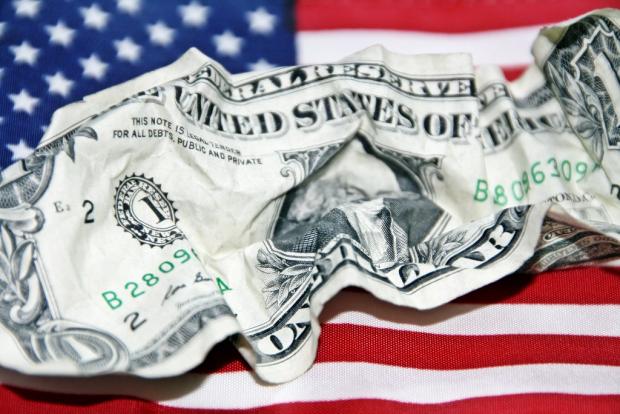
Dollar” by Images_of_Money is licensed under CC BY 2.0.

By Philip Giraldi

Source: FreePress.org

Watching a once great nation commit suicide is not pretty. President Joe Biden does not seem to understand that his role as elected leader of the United States is to take actions that directly or indirectly benefit the folks who voted for him as well as the other Americans who did not do so. That is how a constitutional democracy is supposed to work. Instead, Biden and the gang of introverts and neocon war criminals that the has surrounded himself with have done everything that can to inflict fatal damage on the economy through rash initiatives both overseas and at home. A spending spree to buy support from the bizarre constituencies that make up the Democrat Party base while also fighting an undeclared war in Europe have meant that nearly two trillion dollars has been added to the national debt under Biden’s rule, a debt that was already unsustainable at nearly $30 trillion, larger than the United States’ gross national product. Plans to cancel student loan debts will add hundreds of billions of dollars more to the red ink.

And those actions undertaken overseas, to include continuing to expand the war in Ukraine against Russia, will do immeasurable more damage. Consider how the Democratic Party has long had it in for Russian Federal President Vladimir Putin, dating back to when Putin took power in 2000 and started kicking out the western scallywags who were looting his country. Subsequently, false intelligence and other innuendoes were contrived by Hillary Clinton and her team in 2016 to implicate Donald Trump as a Russian stooge who was secretly working for Putin. When that didn’t work and Trump was elected, the Russians were accused by the media and Democrats of willy-nilly interfering in US elections more generally speaking, a much-exaggerated claim in contrast to the overwhelming silence surrounding the real electoral and policy interference, which has been coming from Israel and its fifth column inside the United States, who, not coincidentally, are the chief proponents of the war against Russia.

Placing a target on Vladimir Putin’s back appears to have an unfortunate consequence which Biden has yet to wake up to, namely the fact that the United States now has what might be described as a Ponzi scheme faux economy which is very vulnerable, particularly as much of the world has become disenchanted with the US style of global leadership. Note for example the recent state visit by French President Emmanuel Macron to Beijing, where he embraced a “global strategic partnership with China” to bring about a “multipolar” world, freed of “blocs” that is not sheltering behind “Cold War mentality.” Macron also criticized the “extraterritoriality of the US dollar.”

And threats made by the Bidens against both China and Russia have accomplished little beyond drawing the two major political and military powers closer together. Beijing and Moscow entered into a trade agreement in their own currencies in 2014 and have openly taken steps to challenge US dominance of international currency exchanges, creating instead a global multipolar trading environment. Europe aside, many nations are now eager to cut the tie that binds, which is the decades long American dominance of international financial mechanisms and also the general use of dollars to pay for oil and other energy supplies. The widespread use of petrodollars enables the buffoonish Janet Yellen at the US Treasury and the Federal Reserve banks to print unlimited unbacked fiat currency, knowing that there will always be a market for it.

Which brings us back to the Ukraine war, pursued “until we win” by Biden and his somnolent Secretary of State Antony Blinken. One of the first moves when Russia intervened in Ukraine was to block and eventually confiscate Russia’s 300 billion dollars-worth of foreign reserves in banks in the US and Europe. That sent a shock wave across currency markets all around the world. Biden and Yellen had weaponized the US’s own national currency, which hitherto had been an untouchable step in international relations for nations that were not actually at war. Countries like China and India with large economies then realized that the US Treasury Department and the dominance of the dollar as an exchange currency had now become a weapon of war and a serious threat to the economies of all other nations.

As a consequence, the US Dollar is right now being rejected by many nations as the world’s reserve currency. Some nations all over the world have agreed to use the Chinese Yuan and Indian Rupee for any-and-all international currency transactions. Saudi Arabia continues to use the petrodollar but does not demand it. Recently, Saudi Crown Prince Mohammed bin Salman and Chinese President Xi Jinping agreed to permit the Saudis to sell oil to China in Yuan. Saudi Arabia, the world’s largest oil exporter, is now allowing multiple currencies to be used to purchase its oil, a major attack on the primacy of the US dollar and it also has accepted Chinese mediation to mend fences with the US and Israel’s arch enemy Iran. And the Saudis have even more recently refused a Biden Administration request that it start pumping more oil to reduce energy costs, signaling that the shift is both political and economic in nature. Japan, a major economy, has also started purchasing oil and gas directly from Russia against the US imposed energy embargo while Brazil, another major economy, has agreed to use the Yuan in its increasing trade with China. As fewer nations utilize the US dollar, America’s ability to export and ignore its burgeoning domestic debt and inflation to other countries is being diminished.

This might have a decisive impact on the US currency as the drive to break with the petrodollar continues to grow and could produce something like a “perfect storm” impacting on the US economy. It threatens to drastically lower the standards of living of nearly all Americans within the next several years as the dollar loses value and purchasing power. As the US economy is heavily interconnected with many European economies, Europe is also likely to be a victim of the coming disaster.

The good news, of course, is that the United States will no longer be able to afford its endless wars and international interventions. Lacking its economic power, it will no longer be able to declare itself “exceptional” and the enforcer of a “rules based international order.” It would mean an ending of the funding of developments like the Ukraine proxy war and the troops will have to come home from places like Syria and Somalia. And it might even mark the ending of sending billions of dollars annually to a wealthy Israel.

Ending dollar supremacy would inevitably have an immediate impact on what passes for US foreign policy, making it more difficult for Washington to initiate and sustain Treasury Department sanctions on countries like Iran and North Korea. It could also create economic turmoil for many countries until the situation resolves itself by producing greater volatility in currency markets worldwide. The Federal Reserve Bank will no doubt respond to the unfolding crisis by acting as it always does by raising interest rates to astronomical levels, thereby hurting most the Americans who can least afford the shock therapy.

And it did not have to turn out this way. It could have been avoided. If the US, which had no horse in the race, had left Ukraine alone Vladimir Putin would not have become a symbol of defiance against the “Rules Based International Order” and he would not have worked with China to establish multipolarity in the way the financial world operates. Instead, we have a situation where Europe is being de-industrialized due to soaring energy prices and Washington’s destruction of the Nord Stream pipelines while the US is potentially confronting economic disaster as the dollar’s relevance to international trade sinks. The ultimate irony is that Russia, and also the US/Israeli arch enemy Iran, are by comparison doing quite well economically as they sell their oil and gas to anyone in any currency. One has to conclude that when US Treasury Secretary Janet Yellen recently made her secret trip to Kiev to promise the despicable Volodymyr Zelensky billions of taxpayer dollars the United States might just have been better served if she had stayed in Washington and made some minimal effort to address the mounting economic problems confronting us here at home.
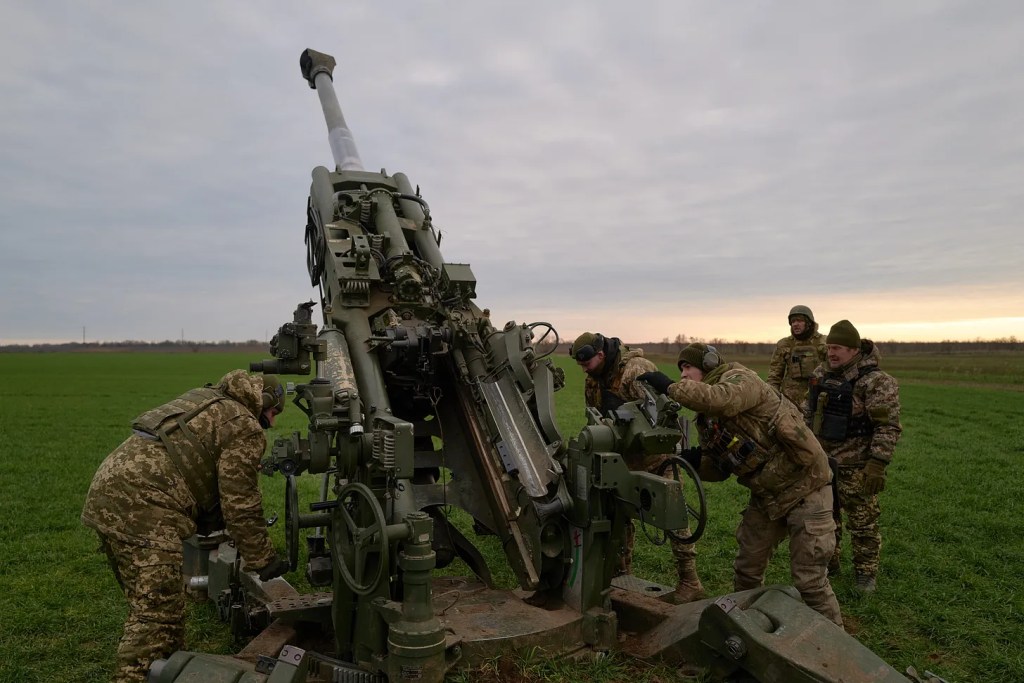
‘NATO’s mission’ leaves Ukraine destroyed

“We are carrying out NATO’s mission.” As Ukraine’s defense minister acknowledges the proxy war, NATO proxy warriors disregard the toll.

(Pierre Crom/Getty Images)

By Aaron Maté

Source: Aaron Maté Substack

Unveiling its latest military assistance package to Ukraine – at $3.75 billion, the largest to date — the White House declared that US weapons are intended “to help the Ukrainians resist Russian aggression.”

For their part, Ukrainians on the receiving end see it differently.

“We are carrying out NATO’s mission,” Ukrainian Defense Minister Oleksii Reznikov said in an interview. “They aren’t shedding their blood. We’re shedding ours. That’s why they’re required to supply us with weapons.” Repeating a rationale offered by his US sponsors in previous wars, including the invasion of Iraq, Reznikov added that Ukraine “is defending the entire civilized world.”

Receiving an endless supply of weapons from NATO countries that shed no blood of their own — all to fulfill their “mission” — is an apt description of Ukraine’s role in the US-led proxy war against Russia. And as one of its staunchest champions, Sen. Lindsey Graham, cheerfully predicted in July, that mission is using Ukraine to “fight to the last person.”

For Ukraine, the costs of fulfilling NATO’s mission are spelled out by former US cabinet secretaries Condoleezza Rice and Robert Gates. Today, the pair write, Ukraine’s “economy is in a shambles, millions of its people have fled, its infrastructure is being destroyed, and much of its mineral wealth, industrial capacity and considerable agricultural land are under Russian control. Ukraine’s military capability and economy are now dependent almost entirely on lifelines from the West — primarily, the United States.”

Rather than seeing Ukraine’s war-ravaged, Russian-occupied, Western-dependent condition as a reason to seek a negotiated end, Rice and Gates in fact regard diplomacy as an outcome to avoid.

“Absent another major Ukrainian breakthrough and success against Russian forces, Western pressures on Ukraine to negotiate a cease-fire will grow as months of military stalemate pass,” they warn. This result would be “unacceptable”, Rice and Gates conclude, because “any negotiated cease-fire would leave Russian forces in a strong position to resume their invasion whenever they are ready.” That is one possibility. Another possibility, unmentioned by the authors, is that a negotiated cease-fire leads to a permanent one. This would entail finally addressing the grievances of Ukraine’s ethnic Russian population – the proximate cause of the post-2014 Donbas war that preceded Russia’s invasion — as well as addressing Russia’s longstanding security concerns about NATO expansion and advanced weaponry on its borders.

On the latter issue, the Kremlin is far from the only advocate. “One of the essential points we must address — as President Putin has always said — is the fear that NATO comes right up to its doors, and the deployment of weapons that could threaten Russia,” French President Emmanuel Macron said last month.

Macron’s comments “appeared to go beyond anything the United States has offered” Russia, the New York Times noted. Unstated by the Times is why such an offer has yet to materialize: as defined by multiple senior US officials right up to President Biden, “NATO’s mission” is not to defend Ukraine, but to use it as a proxy to “weaken” or even cause regime change in neighboring Russia.

Accordingly, the prospect of a negotiated cease-fire must be negated. The US and its allies, Rice and Gates argue, must “urgently provide Ukraine with a dramatic increase in military supplies and capability.” A failure to do so, they warn, could lead to a scenario where “more is demanded of the United States and NATO.” For now, this can thankfully be avoided, because the US enjoys “a determined partner in Ukraine that is willing to bear the consequences of war so that we do not have to do so ourselves in the future.” For proxy warriors, there is indeed no better “partner” than one “willing to bear the consequences of war” fueled from afar.

As a gage of their commitment to Ukraine’s sovereignty and well-being, consider the merits of Rice and Gates’ attempts to appeal to international law. The US, they write, “has learned the hard way — in 1914, 1941 and 2001 — that unprovoked aggression and attacks on the rule of law and the international order cannot be ignored.” Apparently, the US did not learn the same lesson from invading dozens of countries since 1914 – including under the Bush administration, where the authors played instrumental roles in multiple acts of unprovoked aggression, such as the invasion of Iraq. Gates, who carried on as Defense Secretary under President Obama, continued this legacy by overseeing the US bombing campaign that helped topple Libya’s government.

Predictably, Ukrainian soldiers that “bear the consequences of war” are facing heavy losses. Speaking to Newsweek, retired U.S. Marine Corps Colonel Andrew Milburn, who has trained and led Ukrainian forces for the private mercenary firm Mozart Group, reports that in the battle for Bakhmut, Ukraine has been “taking extraordinarily high casualties. The numbers you are reading in the media about 70 percent and above casualties being routine are not exaggerated.”

Ukraine is now “taking high casualties on the Bakhmut-Soledar front, quickly depleting the strength of several brigades sent there as reinforcements in the past month,” the Wall Street Journal reports. “Western—and some Ukrainian—officials, soldiers and analysts increasingly worry that Kyiv has allowed itself to be sucked into the battle for Bakhmut on Russian terms, losing the forces it needs for a planned spring offensive as it stubbornly clings to a town of limited strategic relevance.” According to one battlefield Ukrainian commander, “the exchange rate of trading our lives for theirs favors the Russians. If this goes on like this, we could run out.”

The prevailing indifference to Ukraine’s death toll was recently underscored when Ursula von der Leyen, the European Commission president, made the mistake of acknowledging it. In a speech, von der Leyen noted that Ukraine has lost 20,000 civilians and 100,000 troops since Russia’s February invasion. The Ukrainian military responded by complaining that this was “classified information,” prompting von der Leyen’s office to edit out the figure from video of her remarks.

Meanwhile, the prevailing rejection of diplomacy has even led one of its staunchest European advocates to effectively renounce it. In an interview with Germany’s Die Zeit, former German Chancellor Angela Merkel claimed that the 2015 Minsk II accords – the internationally backed framework for ending the post-2014 Donbas civil war, premised on granting limited autonomy to Russia-allied eastern Ukrainians – was a ruse.

Minsk, Merkel explained, “was an attempt to give Ukraine time.” And it did so successfully: Ukraine “used this time to get stronger, as you can see today. The Ukraine of 2014/15 is not the Ukraine of today… And I very much doubt that the NATO countries could have done as much then as they do now to help Ukraine.”

Merkel, whose government helped broker Minsk, was one of the few NATO leaders to develop a cooperative relationship with Russian President Vladimir Putin. Her comments follow a similar admission from the Ukrainian leader who signed Minsk, Petro Porosenko. “We had achieved everything we wanted,” Poroshenko said in May 2022. “Our goal was to, first, stop the threat, or at least to delay the war – to secure eight years to restore economic growth and create powerful armed forces.” (emphasis added)

The claim by Merkel that Minsk was not intended to make peace, but “to give Ukraine” time to “get stronger” for war has been greeted by Putin and his supporters as confirmation that NATO cannot be trusted to uphold its agreements. (A takeaway newly bolstered by Joe Biden’s recent admission that, despite his campaign promises, the Iran nuclear deal is “dead”).

An alternative explanation is that Merkel is disingenuously attempting to appease pro-war hawks in Germany and beyond, as Moon of Alabama argues. Nicolai Petro, author of the indispensable new book “The Tragedy of Ukraine,” concurs with that interpretation, as he told me in a recent interview. The German and France-brokered Minsk process, Petro argues, were “good faith efforts to bring the hostilities to an end, at least to accomplish a ceasefire from which then further negotiations could be pursued.” The main obstacle, in Petro’s view, came from Ukraine’s far-right Ukrainian nationalists and their allies in Washington, “who basically dismissed the Minsk accords as a non-starter,” and unrealistically sought Ukraine’s complete recapture not only of the Donbas but Crimea as well.

Whether Merkel was being sincere or not, her comments reflect the fact that the aims of the Ukrainian far-right and their DC allies now dominate the NATO states, with voices for peace marginalized and diplomacy shunned.

And now, nearly one year into Russia’s invasion, the proxy war’s NATO cheerleaders have no interest in stopping the bloodshed, despite the open recognition that their mission is helping destroy the country that they claim to defend.

U.S.-led Imperialism is the World’s Leading Purveyor of Chaos

The western capitalist axis of domination is responsible for most of the world’s crises. The crisis of legitimacy extends from the UK to Japan, and U.S. imperialism is involved in every new catastrophe.

By Danny Haiphong

Source: Black Agenda Report

To say that the West, currently led by the dictates of U.S. imperialism, is in trouble would be an understatement. U.K. Prime Minister Boris Johnson resigned on July 7th amid an escalating political crisis of legitimacy . Three weeks before Johnson announced his departure, Emmanuel Macron’s so-called centrist alliance lost its parliamentary majority in France. U.S. President Joe Biden continues to face his own crisis of legitimacy in the form of declining favorability ratings and public humiliation from Democratic loyalists such as Debra Messing . For the West, political crisis is undergirded by an unprecedented level of system chaos which has given the vast majority of workers and oppressed people little confidence in the future.

That chaos was compounded by the murder of Japan’s former Prime Minister, Shinzo Abe on July 7th. Abe was an imperialist, a neoliberal, and the highest expression of what it means to be a puppet of the American Empire . Abe’s so-called Liberal Democratic Party (LDP) was a literal creation of the Central Intelligence Agency (CIA). Other detestable qualities of Abe include his worship of Japan’s fascist war criminals, his membership in the fascist cult Nippon Kaigi, and his unapologetic defense of Japan’s history of brutalizing and super exploiting “comfort women” from its colonies. Most important to the United States, however, was Abe’s unquestionable loyalty to the New Cold War and the military encirclement of China.

Abe’s murder and the attendant political crises in the West are a clear demonstration that U.S.-led imperialism is the world’s leading purveyor of chaos in the world. At the economic base, the U.S. and the E.U. continue to prolong their proxy war with Russia through massive arms transfers and sanctions that have boomeranged back to spur shortages and inflation. Inflation has come with political costs. Already unpopular capitalist regimes in the West are finding themselves increasingly exposed as incapable of addressing the rising cost of living. It doesn’t help matters that the so-called military superiority of the United States and its imperialist partners is also being challenged by Russia’s successful special military operation in Ukraine.

Thanks to the U.S. obsession with NATO expansion, the future is bleak for Ukraine’s U.S.-backed coup government established in 2014. Russia’s special military operation in Ukraine has made immense progress in the Donbass region. An already fragile and privatized vassal Ukrainian economy can only look forward to more pain once the U.S. and its junior partners in NATO come looking for repayment on its exorbitant aid packages. And Ukraine is just the beginning. The recent admission of Sweden and Finland into NATO is yet another declaration of war with Russia which opens the door to future conflicts even more destructive than the ongoing U.S. proxy war in Ukraine.

It is an undeniable fact that chaos follows U.S. imperialism wherever it goes. In Latin America, stability exists only where leftist governments have secured sufficient sovereignty . In Africa, the spread of the U.S. Africa Command (AFRICOM) has led to widespread destabilization and political insecurity in the aftermath of the U.S.-NATO-AFRICOM invasion of Libya in 2011. In Asia, U.S. militarism has facilitated war in the West and attempted to organize a coalition of vassal states against China in the East. U.S. meddling in Taiwan has created a dumping ground for defense contractors and prompted Joe Biden to articulate on three occasions that the U.S. is willing to militarily intervene to “defend” the island , a guaranteed nuclear exchange scenario.

U.S. militarism is the principal barrier to political stability around the world which is a prerequisite to addressing global challenges such as climate change and poverty. U.S. and E.U. sanctions murder thousands of people in poorer, non-white countries. U.S.-sponsored color revolutions and “soft power” maneuvers are preludes to regime change. So-called U.S. “soft power” strengthens the most reactionary forces in the world. The far right and fascistic Contras in Latin and Central America ISIS in West Asia, and the Azov Regiment in Ukraine are all outgrowths of U.S. interference disguised as “soft power.”

A dialectical relationship exists between the U.S.’s domestic and foreign policy. U.S. imperialism is an advanced stage in the system of capitalism predicated upon slavery, colonialism, and racism. Jayland Walker’s brutal murder at the hands of Akron police is a near daily occurrence in the United States. Black Americans and Indigenous peoples have been subject to the cruelest forms of racist violence for centuries. The U.S.’s endless wars are an expression of this violence turned toward imperialist ends.

The chickens of chaos have come home to roost. The Euro-American imperialist world order is suffering from terminal contradictions. Political instability reigns supreme. Another economic crisis is said to be looming but is more than likely already here. Imperialist wars no longer hold any prospect for any real “victory” without serious consequences for the war-maker.

While material conditions are pregnant with possibilities, there is no organized and independent left challenge to the supremacy of U.S. capital and its armed guards of the state. That is the task ahead of the people’s movement residing in the belly of the imperialist beast. In the face of the unprecedented chaos produced by its leading purveyor, the United States, this is no doubt the most difficult one that the working class and oppressed in the long and storied history of resistance. But such a task is not a choice. It is forced upon us by the weight of imperialism bearing down on our necks.

We must not rest until we get the boot off by any means necessary.

Danny Haiphong’s work can be followed on Twitter @SpiritofHo and Telegram at The Haiphong Press. You can support Danny on Patreon by clicking this link. You can contact him at haiphongpress@protonmail.com. 

Without admitting it, we are already converted to transhumanism

On October 18, 2019, i.e. before the alert was issued against Covid-19, a few personalities participated in a role-playing game simulating this epidemic. This event was funded by the Bill & Melinda Gates Foundation.

By Thierry Meyssan

Source: Voltairenet.org

The world is changing very fast. During the Covid epidemic, money has been concentrated in a few hands. The new oligarchs are transhumanists. Without realising it, we have already accepted their ideology and are beginning to put it into practice. Western doctors have given up trying to cure this disease and it seems obvious to us to bet everything on messenger RNA. It does not matter that this strategy is fatal. Henceforth, this is how we think.

The containment, due to the political reaction to Covid-19, favoured a global redistribution of wealth in favour of a few Internet players (Microsoft, Alphabet…). At the same time, investment funds (Vanguard, Blackrock, etc.), which were already managing astronomical sums and could impose their interests on states, became the property of a few families. There are now stratospheric wealth gaps between a few super-billionaires and the people.

The middle classes, which had been slowly eroding since the fall of the USSR and the beginning of economic globalisation, are gradually disappearing. In practice, democratic systems cannot withstand these sudden and gigantic wealth gaps.

As always in periods of change in political systems, the social class that aspires to power imposes its point of view. In this case, transhumanism. The idea that scientific progress will enable a transformation of human biology to the point of overcoming death. Almost all of the world’s fifty largest fortunes seem to subscribe to this fantasy. For them, technology will replace many people in the same way that science has replaced superstition.

In order to impose their new Doxa, these very large fortunes are starting to control what we think and to force us to act according to this new ideology. The most recent phenomenon is precisely our reaction to the Covid-19 pandemic. Historically, in all previous epidemics without exception, doctors sought to cure the sick. That was the old world. In the new transhumanist world, no one is to be cured, all are to be protected with a new technology, messenger RNA. Most developed states forbid their doctors to treat their patients and their pharmacists to sell drugs that might help them (hydroxychloroquine, ivermectin, etc.). A leading medical journal, The Lancet, even published an article claiming that an old drug used by millions of people was killing Covid patients who took it. The Internet giants censor accounts that promote it. Everything must be done to make messenger RNA the one and only option.

I am not a doctor. I don’t know what these products are worth. I’m just a man who observes the way in which a debate is closed before it has begun. I am not interfering in the scientific debate, but I am observing the closure of the debate.

The messenger RNA case against doctors is not over, however. President Joe Biden held a virtual global summit on September 22, 2021 to distribute 500 million packets of messenger RNA ’vaccine’. To everyone’s surprise, the states that were to be the recipients of this gift boycotted the summit. They do not believe that messenger RNA is a solution for them [1].

To understand them, all you need is a calculator: the states that went all in on messenger RNA had 20 to 25 times more deaths per million population than those that allowed care by doctors.

Transhumanism already fascinates us because we don’t ask about the ban on Covid care. It does not have the same influence outside the West.

In the past, vaccination consisted of inoculating a small portion of a disease so that the body learns to defend itself against it. Since Covid-19, messenger RNA has been equated with vaccination, yet it is not a vaccine in the classical sense.

PROPAGANDA

History has shown us that in order to impose a new regime, you must first get people to act in accordance with a new ideology. Once the subjects have started to comply, it becomes very difficult for them to back down. The game is up. This is called propaganda. Propaganda is not about controlling discourse, but about using it to change behaviour [2].

As we have all given up on experimenting with Covid care, we have all signed up to messenger RNA and now the health pass. We are ripe to enter this new regime. It is absurd to call it a “dictatorship”; an old world concept. We do not yet know what this new regime will be, yet we are already building it.

States are threatened by the very large fortunes mentioned above, which are generally much more powerful than they are. States have mainly fixed costs and very little room for manoeuvre. On the contrary, the new very large fortunes can withdraw their investments here at any time and take them there. Very few Sovereign Wealth Funds can compete with them and thus still be independent of them.

The corporate media refuse to question the ban on care for Covid-19. They devote all their energy to promoting messenger RNA.

THE CORPORATE MEDIA

The corporate media have been very active in this project. For a long time, but especially since the end of the Cold War, journalism has defined itself as a search for ’objectivity’, even though it is known to be impossible.

In court, witnesses are not asked to be ’objective’. But they are required to “tell the Truth, the whole Truth and nothing but the Truth”. It is known that each person has only perceived a part of the Truth according to his or her own condition. Thus, in an accident involving a pedestrian and a car, most of the pedestrian witnesses agree with the pedestrian, while most of the motorist witnesses say that the car was in the right. It is only the sum of the evidence that tells us what happened.

The corporate media reacted to the influx of new actors into their profession (blogs and social networks) first by trying to disqualify them: these people are touching, but they are not trained enough to compare themselves to us. Professional journalists have made a distinction between freedom of expression (for all) and freedom of the press (for them alone). One thing leading to another, they have set themselves up as schoolmasters, the only ones capable of giving good and bad marks to those who try to imitate them. To do this, they imagined that they would check their assertions (fact check) as if their work were comparable to a television game show.

Worried that politicians would side with their constituents rather than the very rich, the corporate media have extended fact checking to their political guests. There are countless programmes where a leader is subjected to editorial fact-checking. Political discourse, which should be an analysis of society’s problems and how to solve them, is reduced to a series of figures that can be checked against statistical yearbooks.

The corporate media have asserted themselves first as a ’Fourth Estate’ and then, after absorbing the others, as the main Estate. This notion comes from the 18th century British politician and philosopher, Edmund Burke. The ’Fourth Estate’ was constituted alongside the Spiritual, the Temporal and the Commons (the simple people). Burke, in the name of his liberal conservatism, did not dispute its legitimacy. Today everyone can see that it is not based on a value, but on the money of its owners.

The choice of subjects covered by the corporate media is constantly shrinking. It is slowly moving away from analysis and concentrating on verifiable data only.

Twenty years ago, for example, newspapers that challenged my work would present it summarily and then immediately disqualify it as ’conspiratorial’. Today, they no longer dare to summarise my theses, because they have no way of ’fact-checking’ them. So they just classify me as ’unreliable’. Faced with younger, non-professional journalists, the corporate media limit themselves to insults. As a result, there is a growing gap between them.

This phenomenon is particularly evident with the ’yellow vests’, ordinary citizens who were protesting against this sociological evolution of the world even before containment allowed it to triumph. I remember a debate on a 24-hour news channel where a member of parliament asked a yellow vest what allowance would satisfy the protesters, while the yellow vest replied, “We don’t need allowances, we want a fairer system.” The corporate media quickly removed individuals who, like this lady, were thinking about the problems of society and replaced them with others who were making concrete and immediate demands. They did everything to censor their thinking.

In the past, the Church published a list of books that were forbidden to the faithful. Today, on the contrary, they try to publish a list of reliable sources, even to determine a priori the Truth.

GOOD AND BAD GRADES

Another solution envisaged by the new ruling elite is to re-establish the Index librorum prohibitorum. In the past, the Church – which was not only a community of believers but also a political power – published a list of books that were censored for all but its clerics. It wanted to protect the People from the errors and lies of the protesters. This only lasted for a while. In the backlash, the believers deprived the Church of its political power.

Former Nato and Bush Administration officials set up a New York-based company, NewsGuard, to compile a list of unreliable websites (including ours) [3]. Or NATO, the European Union, Bill Gates and a few others have created CrossCheck, which finances, among other things, Les Décodeurs du Monde [4]. It seems that the exponential multiplication of information sources has ruined this project.

A more recent method consists in defining a priori, not who is reliable, but what the Truth is.

The French president, Emmanuel Macron, has just set up a “Mission against disinformation and conspiracy”, its president, the sociologist Gérald Bronner, considers that the State should set up a body to establish the Truth on the basis of “scientific consensus”. He considers it unacceptable that the word of “a university professor is equivalent to that of a yellow vest” [5].

This method is not new. In the 17th century, Galileo claimed that the Earth revolved around the Sun and not the other way round. Gérald Bronner’s predecessors opposed him with various passages from the Holy Scriptures, which were then considered a revealed source of knowledge. Then the ’scientific consensus’ led to his condemnation by the Church.

The history of science is full of examples of this type: almost all the great discoverers were opposed by the ’scientific consensus’ of their time. Most of the time their ideas were not able to triumph with demonstrations, but with the death of their opponents: the leaders of the “scientific consensus”.

Translation:
Roger Lagassé

7 lies about Afghanistan

A scene of panic at Kabul airport as former CIA collaborators try to escape the revenge of the Afghan people.

In covering the fall of Kabul, the Western media are mindlessly repeating seven lies of Western propaganda. By misrepresenting the history of Afghanistan, they mask the crimes committed in that country and make it impossible to foresee the fate that Washington has written for it. And if the Taliban were not the most wicked…

By Thierry Meyssan

Source: Voltairenet.org

French President Emmanuel Macron and US President Joe Biden addressed their nation on the capture of Kabul by the Taliban on August 15, 2021.

1.- THE AFGHAN WAR IS NOT A RESPONSE TO 9/11, IT WAS PLANNED BEFORE THE ATTACKS

According to these two politicians, the sole purpose of the US invasion of Afghanistan in 2001 was to “pursue those who attacked us on September 11, 2001, and to ensure that al-Qaeda could not use Afghanistan as a base for further attacks. » [1]

Joseph Goebbels, the Propaganda Minister of the Third Reich, is said to have said that “A lie repeated ten times remains a lie; repeated ten thousand times, it becomes the truth.” But the facts are stubborn and, whatever Mr Macron and Mr Biden may think, the 2001 war was decided in mid-July 2001, when the Berlin negotiations between the United States and the United Kingdom on the one hand and the Taliban, not the Afghan government, on the other failed. Pakistan and Russia were observers at these secret talks. The Taliban delegation entered Germany in violation of the UN Security Council’s travel ban. After the failure of these negotiations, Pakistani Foreign Minister Naiz Naik returned to his country and sounded the alarm. Pakistan then looked for new allies. It offered China a gateway to the Indian Ocean (what we see today with the ’Silk Road’). The United States and the United Kingdom began to amass their troops in the area: 40,000 men in Egypt and almost the entire British fleet in the Arabian Sea. It was only after this arrangement was put in place that the attacks of September 11th took place.

2. AL-QAEDA IS NOT A THREAT FOR THE ANGLO-SAXONS, BUT AN INSTRUMENT

According to President Biden: “Our mission to reduce the terrorist threat of al-Qaeda in Afghanistan and to kill Osama bin Laden has been a success.

However, it was the director of France’s foreign secret services, Alexandres de Marenches, who proposed to his US counterpart within the framework of the Pinay Circle [2] to provoke a Soviet intervention in Afghanistan in order to trap them there [3]. President Carter’s National Security Advisor, Zbigniew Brzeziński, sought out anti-communist billionaire Osama Bin Laden in Beirut and asked him to lead Arab mercenaries in a terrorist campaign against the Afghan communist government [4]. Bin Laden was in Beirut to meet with former Lebanese President Camille Chamoun, a member of the World Anti-Communist League [5]. Washington chose Bin Laden for two reasons: First, he was a member of a secret society, the Muslim Brotherhood, which allowed him to recruit fighters; second, he was one of the heirs to the largest construction company in the Arab world. As such, he had the men and know-how to turn the underground rivers of the Hindu Kush into military communication routes.

Later, the same Osama bin Laden served as a military adviser to the Bosnian president, Alija Izetbegović, in 1992-94. His fighters followed him there. They abandoned the name “Mujahideen” for the “Arab Legion”. His camp was visited by Russian commandos, who were taken prisoner there. However, before they were arrested, they had time to search his command room and found that all the military documents were written in English and not in Arabic. [6]

Later still, Osama Bin Laden used his fighters for one-off operations. He solicited them by choosing them according to his needs from his “roster”, in Arabic “Al-Qaeda” (القاعدة).

It is therefore indisputable that Osama Bin Laden was for many years an agent of the United States. However, the latter claim that he turned against them, which nothing, absolutely nothing, proves. In any case, Osama bin Laden was seriously ill. He needed daily care in a sterile room. He was therefore taken care of in the American hospital in Dubai in July 2001, as revealed by Le Figaro [7]. This information was denied by the said hospital, but was confirmed to me by Sheikh Khalifa bin Zayed Al Nahyane (the current President of the United Arab Emirates) who assured me that he had visited him there in the presence of the local CIA chief of staff. Finally, Osama bin Laden was treated at the military hospital in Rawalpindi (Pakistan) [8] where he died in December 2001. His funeral took place in Afghanistan, attended by two representatives of the British MI6 who wrote a report on the matter.

Also indisputably opposing the theory that Osama bin Laden had turned against his CIA employers was the fact that until 1999 – i.e. after the attacks attributed to him against the Khobar Towers in Saudi Arabia and the US embassies in Nairobi (Kenya) and Dar es Salaam (Tanzania) – he had a public relations office in London. It was from this office that he launched his Call to Jihad against Jews and Crusaders.

The fact that for ten years we have heard and seen recordings of people claiming to be Osama Bin Laden only deceives those who want to believe: the Swiss experts of the Dalle Molle Institute of Perceptive Artificial Intelligence, which at the time was used by the big banks in sensitive cases, were formal. These recordings are forgeries (including the one released by the Pentagon in which he claims responsibility for the 9/11 attacks) and do not correspond to the real Bin Laden. If facial and voice recognition was a speciality at the time, it is now a common technique. You can check for yourself with software that is available everywhere.

After Bin Laden’s death, Ayman al-Zawahiri became the emir of Al Qaeda. He still holds this position. The latter – who had supervised the assassination of Egyptian President Anwar Sadat – lived for several years after 2001 in the US embassy in Baku (Azerbaijan). [9] He was, at least in that period, the only person who could be considered a terrorist. He was, at least during this period, protected by the US Marines. His current whereabouts are unknown, but there is no reason to believe that he is no longer under US protection.

3- THE US DOES NOT FOCUS ON “COUNTER-TERRORISM”, BUT FUNDS AND ARMS TERRORISM

President Biden explained at length, during his speech on the fall of Kabul, that the United States was not there to build states, but only to fight terrorism.

The phrase ’fight against terrorism’ has been repeated for twenty years, but that does not make it more meaningful. Terrorism is not a flesh-and-blood opponent. It is a method of combat. All the world’s armies can use it in certain circumstances. During the Cold War, the two blocs used it extensively against each other.

Since President George W. Bush (the son) declared the ’war on terror’ (i.e. the ’war on war’), the use of this military technique has been increasing. Westerners first think of attacks in a few large cities, but the worst has been achieved with the creation of small terrorist states in the wider Middle East up to the sinister ’Islamic State of the Levant’ (Daesh) and now the Islamic Emirate of Afghanistan.

Afghans, Iraqis, Libyans and Syrians initially believed the US narrative of events, but they are under no illusion. After 20 years of war, they have understood that the United States does not want to do any good. Washington does not fight terrorism, but creates, finances and arms groups that practice terrorism.

4- THE TALIBAN DID NOT FIGHT A WAR, THEY TOOK WHAT THE US GAVE THEM

Presidents Macron and Biden are playing dumb about the Taliban’s “takeover of Kabul”. According to them, “Afghan political leaders have given up and fled the country. The Afghan army has collapsed, sometimes without even trying to fight. But how did they flee, if not with Western military aircraft? And the Afghan army did not “sometimes seek to fight”, it was the other way round: it only “sometimes” sought to fight. The Afghan borders were among the most secure in the world. US soldiers recorded everyone’s identity with electronic means, including iris recognition.

The Afghan army consisted of 300,000 men – more than the French armies – who were very well trained by the US, France and others. It was over-equipped with sophisticated equipment. All its infantry had body armour and night vision systems. It had a very capable air force. In contrast, the Taliban has no more than 100,000 men, which is three times less. They are hooligans in sandals and armed with Kalashnikovs. They had no air force – they suddenly have one today with trained pilots from who knows where -. If there had been fighting, they would have been defeated for sure.

The regime change was decided under President Donald Trump. It was to take place on May 1st. But President Joe Biden changed that timetable to change history. He used the delay to set up military bases in the neighbouring countries and send at least 10,000 mercenaries. He has mobilised the Turkish army, which is already present in the country, but which no one is talking about. The latter has already recruited at least 2,000 jihadists living in Idleb (Syria) and continues to hire them.

It is important to remember that during the war against the Soviets, the Turkish president, Recep Tayyip Erdoğan, was already a member of the Muslim Brotherhood and the leader of a militia, the Millî Görüş (the one that today opens mosques in Germany and France). It was in this double capacity that he came to kneel before Gulbuddin Hekmatyar, the Afghan leader of the Muslim Brotherhood and future Prime Minister. Hekmatyar subsequently pledged allegiance to al-Qaeda, which did not prevent him from running in the 2019 Afghan presidential election under US protection.

The allies began repatriating their nationals several months ago. They thought they would have time before September 11th, or at worst before midnight on August 30th. But Washington decided otherwise by choosing August 15th, the date of India’s bank holidays. This was a warning to New Delhi, which does not appreciate the fact that President Ghani’s Pashtuns are being replaced by those of Emir Akhundzada, even though they support other ethnic groups.

The scenes of panic we saw at Kabul airports reminded us of those in Saigon during the US defeat in Vietnam. It is indeed quite the same. The Afghans clinging to the aircraft are not mostly translators from Western embassies, but agents of “Operation Omega” set up under President Obama [10] . They are members of the Khost Protection Force (KPF) and the National Directorate of Security (NDS), counter-insurgency auxiliaries, like the Vietnamese of “Operation Phoenix”. They were responsible for torturing and killing Afghans opposed to the foreign occupation. They committed so many crimes that the Taliban were like choirboys [11].

Soon we will see a completely different landscape in Afghanistan.

5. THE US DID NOT LOSE AFGHANISTAN TO CHINA, BUT FORCED CHINESE COMPANIES TO ACCEPT ITS PROTECTION

The US has not lost anything in Afghanistan because it does not want to establish peace there. They don’t care about the one million deaths they have caused there in 20 years. They just want that region to be unstable, that no government can control the exploitation of the natural resources there. They want companies, from whatever developed country, to be able to exploit them only by accepting their protection.
This is the Hollywood-popularised scheme of the globalised world, protected by a compound, with special forces going abroad to monitor exploitation sites in wilderness areas.

This strategy was developed by Donald Rumsfeld, George W. Bush’s Secretary of Defense, and Admiral Arthur Cebrowski, who had already computerized the US military. On September 11, 2001, it became the way of thinking of the US military staff. It was popularised by Cebrowski’s deputy, Thomas Barnett, in his book The Pentagon’s New Map [12].

It was this paradigm shift that President Bush called ’War Without End’. By this he meant that the US would forever be fighting terrorism, or rather forever instrumenting terrorist groups to prevent political organisation in these regions.

Yes, Chinese companies are already mining in Afghanistan, but from now on they will have to pay a price to the US or be subjected to terrorist attacks. So what if it’s a racket?

6- WESTERNERS DO NOT DEFEND THE ENLIGHTENMENT AGAINST OBSCURANTISM, BUT RATHER INSTRUMENTALISE IT

The first lady of the United States, Laura Bush, made us all cry by telling us the story of little girls massacred by the Taliban because they dared to wear nail polish. But the truth is quite different.

When President Carter, Zbigniew Brzeziński and Alexandre de Marenches supported the Afghan Islamists in 1978, they were fighting the communists who were opening schools for girls. Because for them the fight against the USSR’s allies came before human rights. Similarly today, President Biden and his Secretary of State Antony Blinken support the Taliban because, for them, controlling access to the natural wealth of the wider Middle East comes before human rights. And they are doing the same in Iraq, Libya and Syria.

The US has not only supported Islamists in war-torn countries. For example, it put General Muhammad Zia-ul-Haq, a member of the Muslim Brotherhood, in power in Pakistan to use his country as a rear base for anti-Soviet fighters. He overthrew democracy, hanged President Zulfikar Ali Bhutto and re-established Sharia law. President Bhutto’s daughter, Benazir Bhutto, who was Pakistan’s prime minister in the 1990s, was also assassinated by the Taliban.

There is no need to go back over the crimes of the Western counter-insurgency, the panic of their collaborators at Kabul airports is enough.

If Islamism and secularism have been used to manipulate the Afghans and to smoke out the West, political life in Afghanistan is not based on these concepts, but first and foremost on ethnic divisions. There are about fifteen of them, the largest of which, the Pashtuns, are also strongly represented in Pakistan. It is still a tribal country and not yet a nation. Other ethnic groups are supported by other countries in the region because they are also present there.

7- FRANCE HAS NOT ALWAYS SUPPORTED US CRIMES IN AFGHANISTAN, BUT ONLY SINCE PRESIDENT SARKOZY

According to President Emmanuel Macron: “President Jacques Chirac, as early as October 2001, decided that France should participate in international action, in solidarity with our American friends and allies who had just suffered a terrible attack on their soil. With a clear objective: to combat a terrorist threat that was directly targeting our territory and that of our allies from Afghanistan, which had become the sanctuary of Islamist terrorism”. [13]

It is a distracting way to erase a characteristic French conflict. In October 2001, President Chirac violently opposed the participation of the French army in the Anglo-Saxon occupation of Afghanistan. He only authorised deployment under UN Security Council Resolution 1386. The French soldiers were indeed under the orders of Nato, but as part of the International Security and Assistance Force (ISAF). They were only involved in reconstruction assistance. They did not take prisoners, but eventually arrested fighters and immediately handed them over to the Afghan government. It was President Nicolas Sarkozy who changed this status and made France complicit in the crimes of the United States. It is because of this change that France is currently exfiltrating members of the Khost Protection Force (KPF) and the National Directorate of Security (NDS). And it will probably pay the price.

France Neoliberal Macron: Vanguard of a Covid Global Corporate Dictatorship?

By Gilbert Mercier

Source: News Junkie Post

Liberte-Egalite-Fraternite: under Macron’s pass sanitaire guillotine?

For the few of us who are students of history, and its aficionado travelers, meaning those who muse and wonder, at times, about how significant figures of the past would view our often dire predicament, it is rather obvious that, for example, the founding fathers of the French Revolution such as Danton, Mirabeau, St Just, and Robespierre would be shocked and angry by what has recently happened to their Republic. Even France’s last great statesman General de Gaulle, if alive today, would have likely been deeply enraged by the state of affairs in a country he loved and fought for with his heart and soul.

In the era of President Emmanuel Macron, who is merely a cynical actor, figurehead, and France’s public relation person in chief passing for a statesman, but who truly is a loyal servant of global corporatism, our revolution’s founders, as well as the subsequent republics’ principles, like the one of the Fifth Republic of de Gaulle, have been insulted, slapped in the face, and assaulted by some sort of insidious and limp dictatorship, under the cover of a health crisis. A complex authoritarian strategy using the pretense of shielding French citizens, often against their will, in this new lucrative conceptual war.

This war on a virus is even more advantageous than the previous conceptual one: the war on terror. In General Macron’s war, syringes are the weapons delivery system of choice, needles like billions of little worker bees at the ready to jab you for an invitation to control freedom, and a moderate slice of happiness: the joy once you have obtained the French COVID pass Sanitaire to go to museums, movie theaters, inside restaurants, and avoid wearing masks outdoor.

French citizens should be aware that the very motto of our dear Republic, Liberte-Egalite-Fraternite is under the assault of king Ubu Macron and could, without a strong popular resistance, be decapitated by the cold blade of Macron’s virtual guillotine. In a form of dictatorial grab of power for the benefit of big biotech and big pharmaceutical companies. Macron’s pernicious pass sanitaire, just approved by France Assemblee Nationale, is a power grab by global corporate imperialism. Of course, all of it done with a wink, a tan and a smile! All of it done for the greater good of ungrateful “Gaullois refractaire” French citizens, in the continuity of the pesky Gilets Jaunes. Science lover poseur Macron, an enlightened modern day Julius Cesar, is bent on defeating obscurantism armed only with syringes to deliver his brand of salvation thru vaccines. Those who have been in the forefront of the street protest in France to resist this hybrid neoliberal dictatorship personified by Macron are the still active Gilets Jaunes.

From war on terror to war on virus: maximum profit for big tech & pharma

Forget about the good old so-called war-on-terror, fading slightly since its start in September 2001 but still a nice little threat in the background, big enough to keep the military-industrial complex flush with cash. A new conceptual global war was needed: the global war on COVID virus came at the right time. This one is even more promising, as it potentially concern the entire world population or 7.5 billion people. The COVID war has also been an easy sell for the general population, as it can be viewed as a war of necessity with humans “all in it together.” It can also provide an astronomical stream of revenue by making vaccination mandatory. In terms of profit from pandemics, vaccine companies have not been the only beneficiaries of this COVID gold rush.

Big tech companies have racked up billions of dollars at a furious pace since March 2020 and the various restrictive measures of lock-downs and curfews. The likes of Amazon, Zoom and streaming media have handsomely benefited from the imposed partial move to a virtual world. As matter of fact, worldwide stock markets have become junkies to this trend: addicted to the war on COVID benefits.

Needless to say, this vast stream of income is also potentially endless because of the virus mutation into different variants. One loses track of this Greek alphabet catalogue. It was Alpha first or the English variant, then Beta or the Brazilian one, more contagious than the rhythm of Samba, and now it is the Delta variant originally called Indian mutation. As the virus mutates, as they all do, it could potentially take us all the way to Omega, the last letter of the Greek alphabet. The side effect of the Delta variant’s rapid spread has been to allow Macron, and soon many others, head-of-states or figureheads, to tighten back the screw on fundamental liberties.

Rule by decree, states of emergency, arbitrary measures, absurd,or not, are a form of abuse of power that neoliberals like Macron are really enjoying. It is an insidious form of dictatorship under a benevolent disguise of the enlightened rulers forcing their citizenry’s behavior. In France a law is about to pass, in parliament, to make vaccine for healthcare workers across board mandatory. If they do not comply by September 15, 2021, they will be fired. In the case of France, this should be viewed as a prelude to mandatory vaccination for the entire population.

Killing personal freedom and liberties

In France, government controlled mainstream media, critiques rightly calling the Macron administration’s sweeping COVID policies a “dictature sanitaire” or healthcare dictatorship have been labeled conspiracy theorists. This is pure disinformation, as what defines a dictatorship, semantically speaking, is a government, elected or not, forcing policies on its citizens. It is done under the premise that it is an action for the benefit of the common good, but nonetheless it is the exercise of authoritarian power on a population.

Through the COVID-19 pandemics, governments have learned that, if fear and paranoia were prevalent enough, and they run a lot of polls in their respective population, any dictatorial measures could be implemented without risking much social turmoil. A great majority of people did, and would likely comply again to other lock-downs, wearing masks outdoors, curfews, but without much protest. Now the final frontier is mandatory vaccination from 12 years-old on, which will give you some sort of health passport. If approved. this pass would give people the right to live almost free. This new type of passport, given to you as a reward to your obedience, will give you access to a mythical promised land often called by Macron “the return of the happy days!”

COVID fear mongering: subterfuge to hide climate collapse threat

There is no doubt, for any rational minds, that contesting the reality of the COVID pandemic is pure conspiracy theory. More than that, it is full blown lunacy! There are two radical anti-vaxers thought processes here: firstly, deny the existence of the pandemic entirely; secondly, which might be even more disturbing, an unshakable belief that the virus was man made, and released on purpose by the like of Fauci, Bill Gates, and a hand full of mad scientists. And, of course, here’s the icing on the cake: they’re all acting on behalf of a cabal of globalist pedophiles. These are the kinds of conspiracy theories that currently get you banned on social media.

As much as they are colorfully insane, this type of COVID-19 conspiracy theory denials are not, in essence, any worse than climate change crisis denial. The difference being that your average run of the mill climate change denier won’t get banned on social media. The nature of the capitalist global corporatism system, where neoliberals like Macron are leading figures, is not to create a crisis from scratch, which is either an impossible or very challenging task, but instead to take advantage of crisis either to further general policy goals, or in most cases benefit punctually from them like an opportunistic predator. This predatory aspect is after all the very nature of capitalism.

Besides the numerous advantages that Macron, his political colleagues and their patrons from the billionaire class have found in the COVID crisis, as explained above, not only huge financial gains for pharmaceutical companies, but also for tech companies involved in this sort of forced quantum leap to the virtual world. In brief, this has been a chance to brutally shock the global economy. Not to make it more equal or sustainable, but quite exactly the opposite: COVID has been an opportunity to concentrate wealth even more in fewer hands with a net result of more social inequality.

Because in today’s press one story is always used to hide another, the pandemic has been also a blessed opportunity to hide, not the proverbial 800-pound gorilla in the room, but instead the 10,000-ton Godzilla wrecking the planet: Godzilla, in this case, being the growing certainty of an upcoming global climate collapse.

Of the “Liberte-Egalite-Fraternite” motto of the French revolution, all the great values have been trampled and gutted. With lock-downs, curfews, mandatory masks and vaccine, Liberte is now gone. In the era of Macron, a former investment banker, nobody can talk about Egalite in a country which is on its way to become almost as unequal as the United States; and last but not least, how could anyone see any Fraternite left? The community sense of brotherhood died quite sometime ago in France. There is no brotherhood left, no deep sense of connection within the nation, we are not “all in this together”.

In reality, there is only all of us, common men and women worldwide, against the billionaire class that controls the levers of the global corporate imperialist machines, with their political servant facilitators acting as heads of state. The specific names within the political class are of little significance, since they represent the identical interests. It’s a bit like the names given to the COVID variants. The Delta variant, portrayed as the top threat right now, started more modestly as India’s mutation. Who knows, perhaps in some billionaire class circles, Emmanuel Macron is just called factor X, LV or MANU.

Wall Street, Banks, and Angry Citizens

The Inequality Gap on a Planet Growing More Extreme

By Nomi Prins

Source: TomDispatch.com

As we head into 2019, leaving the chaos of this year behind, a major question remains unanswered when it comes to the state of Main Street, not just here but across the planet. If the global economy really is booming, as many politicians claim, why are leaders and their parties around the world continuing to get booted out of office in such a sweeping fashion?

One obvious answer: the post-Great Recession economic “recovery” was largely reserved for the few who could participate in the rising financial markets of those years, not the majority who continued to work longer hours, sometimes at multiple jobs, to stay afloat. In other words, the good times have left out so many people, like those struggling to keep even a few hundred dollars in their bank accounts to cover an emergency or the 80% of American workers who live paycheck to paycheck.

In today’s global economy, financial security is increasingly the property of the 1%. No surprise, then, that, as a sense of economic instability continued to grow over the past decade, angst turned to anger, a transition that — from the U.S. to the Philippines, Hungary to Brazil, Poland to Mexico — has provoked a plethora of voter upheavals. In the process, a 1930s-style brew of rising nationalism and blaming the “other” — whether that other was an immigrant, a religious group, a country, or the rest of the world — emerged.

This phenomenon offered a series of Trumpian figures, including of course The Donald himself, an opening to ride a wave of “populism” to the heights of the political system. That the backgrounds and records of none of them — whether you’re talking about Donald Trump, Viktor Orbán, Rodrigo Duterte, or Jair Bolsonaro (among others) — reflected the daily concerns of the “common people,” as the classic definition of populism might have it, hardly mattered. Even a billionaire could, it turned out, exploit economic insecurity effectively and use it to rise to ultimate power.

Ironically, as that American master at evoking the fears of apprentices everywhere showed, to assume the highest office in the land was only to begin a process of creating yet more fear and insecurity. Trump’s trade wars, for instance, have typically infused the world with increased anxiety and distrust toward the U.S., even as they thwarted the ability of domestic business leaders and ordinary people to plan for the future. Meanwhile, just under the surface of the reputed good times, the damage to that future only intensified. In other words, the groundwork has already been laid for what could be a frightening transformation, both domestically and globally.

That Old Financial Crisis

To understand how we got here, let’s take a step back. Only a decade ago, the world experienced a genuine global financial crisis, a meltdown of the first order. Economic growth ended; shrinking economies threatened to collapse; countless jobs were cut; homes were foreclosed upon and lives wrecked. For regular people, access to credit suddenly disappeared. No wonder fears rose. No wonder for so many a brighter tomorrow ceased to exist.

The details of just why the Great Recession happened have since been glossed over by time and partisan spin. This September, when the 10th anniversary of the collapse of the global financial services firm Lehman Brothers came around, major business news channels considered whether the world might be at risk of another such crisis. However, coverage of such fears, like so many other topics, was quickly tossed aside in favor of paying yet more attention to Donald Trump’s latest tweets, complaints, insults, and lies. Why? Because such a crisis was so 2008 in a year in which, it was claimed, we were enjoying a first class economic high and edging toward the longest bull-market in Wall Street history. When it came to “boom versus gloom,” boom won hands down.

None of that changed one thing, though: most people still feel left behind both in the U.S. and globally. Thanks to the massive accumulation of wealth by a 1% skilled at gaming the system, the roots of a crisis that didn’t end with the end of the Great Recession have spread across the planet, while the dividing line between the “have-nots” and the “have-a-lots” only sharpened and widened.

Though the media hasn’t been paying much attention to the resulting inequality, the statistics (when you see them) on that ever-widening wealth gap are mind-boggling. According to Inequality.org, for instance, those with at least $30 million in wealth globally had the fastest growth rate of any group between 2016 and 2017. The size of that club rose by 25.5% during those years, to 174,800 members. Or if you really want to grasp what’s been happening, consider that, between 2009 and 2017, the number of billionaires whose combined wealth was greater than that of the world’s poorest 50% fell from 380 to just eight. And by the way, despite claims by the president that every other country is screwing America, the U.S. leads the pack when it comes to the growth of inequality. As Inequality.org notes, it has “much greater shares of national wealth and income going to the richest 1% than any other country.”

That, in part, is due to an institution many in the U.S. normally pay little attention to: the U.S. central bank, the Federal Reserve. It helped spark that increase in wealth disparity domestically and globally by adopting a post-crisis monetary policy in which electronically fabricated money (via a program called quantitative easing, or QE) was offered to banks and corporations at significantly cheaper rates than to ordinary Americans.

Pumped into financial markets, that money sent stock prices soaring, which naturally ballooned the wealth of the small percentage of the population that actually owned stocks. According to economist Stephen Roach, considering the Fed’s Survey of Consumer Finances, “It is hardly a stretch to conclude that QE exacerbated America’s already severe income disparities.”

Wall Street, Central Banks, and Everyday People

What has since taken place around the world seems right out of the 1930s. At that time, as the world was emerging from the Great Depression, a sense of broad economic security was slow to return. Instead, fascism and other forms of nationalism only gained steam as people turned on the usual cast of politicians, on other countries, and on each other. (If that sounds faintly Trumpian to you, it should.)

In our post-2008 era, people have witnessed trillions of dollars flowing into bank bailouts and other financial subsidies, not just from governments but from the world’s major central banks. Theoretically, private banks, as a result, would have more money and pay less interest to get it. They would then lend that money to Main Street. Businesses, big and small, would tap into those funds and, in turn, produce real economic growth through expansion, hiring sprees, and wage increases. People would then have more dollars in their pockets and, feeling more financially secure, would spend that money driving the economy to new heights — and all, of course, would then be well.

That fairy tale was pitched around the globe. In fact, cheap money also pushed debt to epic levels, while the share prices of banks rose, as did those of all sorts of other firms, to record-shattering heights.

Even in the U.S., however, where a magnificent recovery was supposed to have been in place for years, actual economic growth simply didn’t materialize at the levels promised. At 2% per year, the average growth of the American gross domestic product over the past decade, for instance, has been half the average of 4% before the 2008 crisis. Similar numbers were repeated throughout the developed world and most emerging markets. In the meantime, total global debt hit $247 trillion in the first quarter of 2018. As the Institute of International Finance found, countries were, on average, borrowing about three dollars for every dollar of goods or services created.

Global Consequences

What the Fed (along with central banks from Europe to Japan) ignited, in fact, was a disproportionate rise in the stock and bond markets with the money they created. That capital sought higher and faster returns than could be achieved in crucial infrastructure or social strengthening projects like building roads, high-speed railways, hospitals, or schools.

What followed was anything but fair. As former Federal Reserve Chair Janet Yellen noted four years ago, “It is no secret that the past few decades of widening inequality can be summed up as significant income and wealth gains for those at the very top and stagnant living standards for the majority.” And, of course, continuing to pour money into the highest levels of the private banking system was anything but a formula for walking that back.

Instead, as more citizens fell behind, a sense of disenfranchisement and bitterness with existing governments only grew. In the U.S., that meant Donald Trump. In the United Kingdom, similar discontent was reflected in the June 2016 Brexit vote to leave the European Union (EU), which those who felt economically squeezed to death clearly meant as a slap at both the establishment domestically and EU leaders abroad.

Since then, multiple governments in the European Union, too, have shifted toward the populist right. In Germany, recent elections swung both right and left just six years after, in July 2012, European Central Bank (ECB) head Mario Draghi exuded optimism over the ability of such banks to protect the financial system, the Euro, and generally hold things together.

Like the Fed in the U.S., the ECB went on to manufacture money, adding another $3 trillion to its books that would be deployed to buy bonds from favored countries and companies. That artificial stimulus, too, only increased inequality within and between countries in Europe. Meanwhile, Brexit negotiations remain ruinously divisive, threatening to rip Great Britain apart.

Nor was such a story the captive of the North Atlantic. In Brazil, where left-wing president Dilma Rouseff was ousted from power in 2016, her successor Michel Temer oversaw plummeting economic growth and escalating unemployment. That, in turn, led to the election of that country’s own Donald Trump, nationalistic far-right candidate Jair Bolsonaro who won a striking 55.2% of the vote against a backdrop of popular discontent. In true Trumpian style, he is disposed against both the very idea of climate change and multilateral trade agreements.

In Mexico, dissatisfied voters similarly rejected the political known, but by swinging left for the first time in 70 years. New president Andrés Manuel López Obrador, popularly known by his initials AMLO, promised to put the needs of ordinary Mexicans first. However, he has the U.S. — and the whims of Donald Trump and his “great wall” — to contend with, which could hamper those efforts.

As AMLO took office on December 1st, the G20 summit of world leaders was unfolding in Argentina. There, amid a glittering backdrop of power and influence, the trade war between the U.S. and the world’s rising superpower, China, came even more clearly into focus. While its president, Xi Jinping, having fully consolidated power amid a wave of Chinese nationalism, could become his country’s longest serving leader, he faces an international landscape that would have amazed and befuddled Mao Zedong.

Though Trump declared his meeting with Xi a success because the two sides agreed on a 90-day tariff truce, his prompt appointment of an anti-Chinese hardliner, Robert Lighthizer, to head negotiations, a tweet in which he referred to himself in superhero fashion as a “Tariff Man,” and news that the U.S. had requested that Canada arrest and extradite an executive of a key Chinese tech company, caused the Dow to take its fourth largest plunge in history and then fluctuate wildly as economic fears of a future “Great Something” rose. More uncertainty and distrust were the true product of that meeting.

In fact, we are now in a world whose key leaders, especially the president of the United States, remain willfully oblivious to its long-term problems, putting policies like deregulation, fake nationalist solutions, and profits for the already grotesquely wealthy ahead of the future lives of the mass of citizens. Consider the yellow-vest protests that have broken out in France, where protestors identifying with left and right political parties are calling for the resignation of neoliberal French President Emmanuel Macron. Many of them, from financially starved provincial towns, are angry that their purchasing power has dropped so low they can barely make ends meet.

Ultimately, what transcends geography and geopolitics is an underlying level of economic discontent sparked by twenty-first-century economics and a resulting Grand Canyon-sized global inequality gap that is still widening. Whether the protests go left or right, what continues to lie at the heart of the matter is the way failed policies and stop-gap measures put in place around the world are no longer working, not when it comes to the non-1% anyway. People from Washington to Paris, London to Beijing, increasingly grasp that their economic circumstances are not getting better and are not likely to in any presently imaginable future, given those now in power.

A Dangerous Recipe

The financial crisis of 2008 initially fostered a policy of bailing out banks with cheap money that went not into Main Street economies but into markets enriching the few. As a result, large numbers of people increasingly felt that they were being left behind and so turned against their leaders and sometimes each other as well.

This situation was then exploited by a set of self-appointed politicians of the people, including a billionaire TV personality who capitalized on an increasingly widespread fear of a future at risk. Their promises of economic prosperity were wrapped in populist platitudes, normally (but not always) of a right-wing sort. Lost in this shift away from previously dominant political parties and the systems that went with them was a true form of populism, which would genuinely put the needs of the majority of people over the elite few, build real things including infrastructure, foster organic wealth distribution, and stabilize economies above financial markets.

In the meantime, what we have is, of course, a recipe for an increasingly unstable and vicious world.

Western Elites Decrying ‘Populism’ Betrays Fear of Democracy

By Finian Cunningham

Source: Strategic Culture Foundation

A new dreaded word has entered into official Western media speak: “Populism”. Political parties and governments which are deemed to be illegitimate are invariably labeled with the prefix “populist”. There is a vague implication that “populist” parties are imbued with disreputable politics of xenophobia, racism, nationalism and even fascism.

But who is doing the “deeming” here? It is establishment political parties and politicians who have the advantage of establishment news media organizations conveying their words and terminology.

Take French President Emmanuel Macron. He may have coined a new political party, En Marche, but he is nevertheless a politician very much of the prevailing Western establishment. He is pro-European Union as it currently operates, albeit with reforming tweaks; he is pro-NATO, pro-Atlanticist; and pro-neoliberal economic policies.

Recently, Macron decried the rise of “populist” parties across Europe. He compared them to the spread of “leprosy” and claimed they were posing a morbid threat to the conventional order of politics. Macron was referring in particular to the new coalition government in Italy, comprising the anti-establishment Five Star Movement and the League.

The French leader could also have been referring to any number of governments as seen in Austria, Hungary and other Central European states which, like the new Italian government, have challenged the EU’s official stance overEU irregular migration into the bloc.

In this context, the word “populist” as used by Macron and other establishment politicians has the connotation of “racist” or “inhumane” owing to the opposition towards the uncontrolled influx of people from outside Europe.

The “populist” prefix is often used alongside the term “far-right”. Again, the implication is that somehow the largely newcomer parties are something that should be abhorred because they are tarnished with alleged proclivities towards fascism and authoritarianism.

To reinforce that implied demonization, it is often cited by Western establishment politicians and media that the “populist” parties in Europe are aligned with Russian President Vladimir Putin, if not stealthily bankrolled by the Kremlin.

American President Donald Trump also qualifies as “populist” according to the US political and media establishment. Again, the word is loaded to infer a uniquely noxious quality in the Trump presidency and his supporters, in the same way that Democrat presidential rival Hillary Clinton once haughtily denigrated Trump and his voter base as “deplorable”. It’s a way of sanitizing the establishment from any past, and far greater, sins.

The P-word does not always mean “rightwing nationalism”. The recent elected Mexican President, Andrés Manuel Lopez Obrador, has been described in Western media as a “leftwing populist”.

In Italy, the main ruling coalition party, the Five Star Movement, headed by Luigi Di Maio, is associated with leftwing social policy.

Parties and politicians deemed to be “populist” are eclectic and defy an easy categorization, as their detractors would perhaps like to assign them. Certainly, there is a strong common stance of being opposed to uncontrolled immigration. But it is too simplistic to explain such a stance as merely xenophobic or racist.

There are legitimate and reasonable concerns that the issue of large-scale immigration has been exploited by ruling establishments and their ideological backers as a way to undermine national sovereignty and workers’ rights, from the consequent lowering of wages and employment conditions.

There is also the legitimate concern in Europe that the migration phenomenon has been largely created by illegal wars pursued by the US and its European NATO allies. Why should European member states and ordinary taxpayers have to incur financial and cultural integration problems that have been largely manufactured by ruling elites who have never been held to account for their criminal wars?

So-called populist parties are also opposed to the seemingly slavish adherence by the European political establishment to neoliberal capitalism. There is a legitimate popular backlash to economic policies which are oppressive and destructive, and whose sole priority seems to be satisfying the profits of Big Business and transnational capital. Why should European governments be held in hock to fiscal rules and debt limitations set arbitrarily by institutions seemingly under the diktat of private banks?

There are several fundamental issues that form a groundswell of popular opposition towards the conventional ways of governance, both in Europe and the US. The failings of neoliberal capitalism and its rich-get-richer racket is surely top of the grievance list. So too is relentless, irrational militarism by Western governments, unleashing illegal wars and massive refugee problems, as well as stoking unnecessary hostility towards other powers like Russia, China, Iran and North Korea.

The conventional politics, that is, the ruling establishments and their dutiful news media, are increasingly seen as incompetent, if not bankrupt. The establishment across Western countries has lost legitimacy and “moral authority” in the eyes of masses of people. That dwindling authority of the ruling class in Western states is the real, morbid concern.

One factor for this is the growth of global communications and “alternative” media sources, which Western publics are availing of to inform themselves independently from the old information monopolies that served the established order. That is why the “problem” of alleged “Russian influence” has been invented. In a desperate gambit to distract the masses from noticing the real problem, which is the crumbling of legitimacy for the Western establishment and its obedient political parties.

The looming fear among the ruling order is the ever-growing dissent among the populace. It is a fear of their own inherent failing and impending doom in the face of democratic challenge to power.

It is not so much that Trump or the new Italian government or Hungarian leader Viktor Orban, and so on, represent a vanguard for renewed democracy. These changes are merely symptoms of a deeper popular opposition to the established way of conducting politics – the order that has prevailed for most of the seven-decade period following the Second World War.

There has always been a wariness among ruling elites on both sides of the Atlantic towards a genuine democratic order breaking out, as Noam Chomsky discusses in his book ‘Deterring Democracy’. Western elites have typically viewed the masses as “rabble rousers” who are deemed to be “incapable” of governing society in the “proper way” that benefits the elites, protects their profits and property, and safeguards their imperial war-making overseas.

This underlying tension about the control of political power in Western societies encapsulates the present historical juncture where the word “populist” is being increasingly deployed. It is a term of disparagement by a failing Western establishment. What the failed order is trying to do is divert genuine popular challenge by painting it as something uncouth, vulgar, noxious, or manipulated by foreign enemies like Russia.

As American political analyst Randy Martin notes: “Populism is a convenient term for those in power who seek to isolate those who would want to share, or worse, take that power.”

When you think of the original meaning of the word – “the people” – it is starkly revealing what is really at stake for those elites who wield the “populist” term as a disparagement.