Why ‘Conspiracy Theories’ & Spirituality Are Intimately Connected

By Joe Martino

Source: Collective Evolution

Is it considered ‘not spiritual’ to talk about an elite or cabal running our world? This has become a commonplace today, and there is a great deal of ridicule that comes when people feel looking at the truth of what is playing out in our world is ‘crazy’ or a ‘negative’ thing to do. In fact, the ‘negative’ label on conspiracy theories we place is one of the biggest spiritual bypasses we can do. Let’s dive into this.

The truth is, understanding the way our world truly functions and consciousness evolution (spirituality) go hand in hand. Why? Because it is all part of life here. It is not separate! You don’t have spirituality on one side and conspiracies or truth on the other. It’s all interconnected in our life and human experience. And it’s time to bring them together.

The Challenge

This isn’t true 100% of the time of course, but in a lot of cases, we see those in the truth-seeking realm feel consciousness or spirituality is airy fairy and has no place in the big picture and is just a new age distraction. On the flip side, we see those engaged in spirituality-seeking feel conspiracy/truth-seeking people are crazy and negative. While there is truth to some extent in both cases, there is a lot more to the discussion and a very important purpose for both.

You’ve probably experienced it at some point, it’s believable that GMO’s are unhealthy and corporations are using them to make money in a number of ways but it’s damaging to people and the environment, but yet there is no possible way that’s happening with vaccines… or that 9/11 was an inside job. Let me be the first to say, there are a number of conspiracy theories that have no backing, no facts, are far-reaching and in many cases don’t even help us along our journey. But this is not the case with many, in fact, the amount of evidence is often staggering and it’s simply that we don’t want to believe it.

I’m writing this because I’m calling for an end of the reduction of conversation to ‘that’s crazy’ ‘that’s fake news’ ‘that’s a conspiracy’ etc. as it does nothing but maintain division, a lack of awareness and a misinformed world that can’t thrive. Time and time again what is often called ‘conspiracy’ turns out to be true only a few months or a year later. We can end this cycle by learning and choosing to listen instead of dismissing, then checking in with our hearts/souls about what role this is playing in our experience so we can dissolve the need for the cabal.

Why They Go Hand In Hand

Some of us view spirituality as learning techniques to feel good, as ways to cope with life and the challenges we have in our modern world. Some view it as a means to begin to feel better about the prospect of death. Others view it as a way to explore what’s beyond the physical and who we truly are.

From a conspiratorial side, when we’re talking about digging past mainstream media to find out what’s really going on in our world, some view it as a way to disempower the elite that does not have humanities best interests at heart. Others view it as a way to take back our power. Some see it as a way to uncover the truth of how our world truly works so we can begin to thrive. Some react to these truths with wanting revenge or justice, this is an important thing to note as this is where the spirituality comes in.

So it appears we have ‘two sides’ as we often like to do within ego states of consciousness. But what role does the elite and cabal play in our experience? How has that served to suppress our spirituality and why has it all happened? The two are intimately connected because part of the game we are playing on earth here is that we have to uncover what has been happening in our reality and remember who we truly are. This is a spiritual journey, that involves understanding the players in the game and the roles they play.

I’ve been running a conscious media and education company for 9.5 years now. Our mission is to bridge the gap between truth-seeking and spirituality via exploring a shift in consciousness taking place on our planet. We understand that both are part of one big picture in life and you can only go so far in each before you MUST bring in the other to deepen your understanding.

During the 9.5 years since I started Collective Evolution, I have seen thousands of people go through various stages of discovering and learning, both in truth-seeking and spirituality, that has sent them on different paths. Some begin to discover our food system is rigged for a lack of health and they begin eating cleaner. This leads them to understand our entire world is ‘rigged against us’ and suddenly there is a shift in how they see the world. I have seen others attend a yoga class and this begins a journey into connecting with self deeply.

But in both cases, I often see an identity form. The yogi becomes identified as a ‘spiritual person,’ dresses a certain way, talks a certain way and may refuse to look at anything the ‘truth-seekers’ are saying because they don’t want to fall into that crowd. The truth-seekers are often angry, pissed off at the world, call everyone else sheeple and think the elite need to die in prisons. They might look at the ‘yogi’ or ‘spiritual’ crowd as having fallen into pseudo-scientific new age deception because they look at consciousness and spirituality.

Then there are those who have journeyed beyond that stage and are simply authentic and understand how both ingredients, truth-seeking and spirituality, are one in the same and part of the journey. They are both a part of this game we call life and if we truly want to evolve, move forward, remove the cabal and so forth, we must see the truth and learn why it was there in the first place for our own evolution in consciousness.

It’s A Role!

Remember, what the cabal and elite are doing isn’t negative in the big picture scheme of things. To our mind it might be, but not to our souls. This is why you must connect deeply with self to overcome the vengeful hateful view the mind creates when we observe them.

What they are doing simply is. And for our souls, it is the journey we asked for to challenge ourselves to remember who we truly are in a very disconnected system. The cabal, are just souls having an experience too, and we all agreed on this together. This doesn’t mean we accept what they are doing in the physical and just take it, no, it simply means we must evolve our consciousness and overcome the need for them for it to stop.

How does that look or happen? We must understand why it’s there by going beyond the judgement and the emotion and see what the trap it creates for us. With that understanding, we no longer can get trapped in the angry, hateful emotions that hold this world in place and instead we choose, from a consciousness point of view, to create a different world. This not only affects collective consciousness and helps others awaken, but we then now can create a new world, both physically and consciously, that comes from a higher state of consciousness and not one that is built in fear, anger and judgement of the old one. Remaining in that old state will only create more of the same world.

Again, I feel it is very important to listen to the podcast episode on this one as it goes into deep detail about this.

Final Thoughts

If you find yourself viewing matters in either of these polarized lights, challenge yourself to ask why? Why have this opposition to either side and why are we coloring things as positive or negative in the first place? What is that showing us about ourselves? Our fear of looking at our own ‘darkness?’ Collective ‘darkness?’ In many ways, what the elite/cabal are doing is just a reflection of our own journeys on a macro scale. It’s reflecting humanity’s current state of consciousness as we awaken to the truth. Change Starts Within.

25 Families Own $1.1 Trillion Between Them as the Global Wealth Inequality Gap Grows

Using data from their list Forbes has produced a list of the top 25 richest families in the world. Together they are worth over $1.1 trillion, or the entire GDP of Indonesia.

By  Rosa Tressell and Dr. Leon Tressell

Source: SouthFront

Once a family-owned business Forbes is well known for producing their annual list of the world’s richest billionaires. Launched in 1982 the original list ranked the top 400 Americans by net worth. Only 13 billionaires were included in that list, and their combined worth was the equivalent of 2.8% of GDP. In an era where “Greed is Good”, the list became wildly popular, by 2000 the combined net worth of the top 400 equated to 12.2% of US GDP. So prestigious became the list that an ex-employee of Forbes has claimed that Donald J Trump inflated his personal wealth to be included.

This year more than 2,200 billionaires made the Forbes list with a combined value of $9.1 trillion, or half the GDP of the US. Amazon CEO, Jeff Bezos, topped the list this year as his fortune rose to £112 billion making him the first centi-billionaire. His wealth is now equal to that of 2.3 million Americans. This has allowed him to dethrone Bill Gates, founder of Microsoft, worth just $90 billion.

Using data from their list Forbes has produced a list of the top 25 richest families in the world. Together they are worth over $1.1 trillion, or the entire GDP of Indonesia. The richest clan is the Walton family who own the ubiquitous Walmart chain in America. They have a total family wealth of £152 billion and several family members are on the list of billionaires as individuals. The Koch Brothers, of Koch Industries, are ranked second with £98.7 billion. The third spot, with $90 billion to their name, is taken by another American family, the Mars family, known for their various sweet treats.

In comparison to the billionaires list this list is a measure of families who have inherited and grown their wealth over generations. The billionaires list is dominated by Americans in certain fields; technology, finance, entertainment and sport. It lauds entrepreneurism and promotes the self-made man (and small handful of women). The family fortunes list on the other hand reveals a more historical route for making money. Whilst Jeff Bezos has shot to the top of the list based largely on the astonishingly over valued share price of Amazon stock, the family fortunes are centered on the production and purveyance of goods.

Many of the families on the list started making their fortunes in the late nineteenth century. These are: Cargill Industries (agricultural conglomerate); Boehringer Ingelhelm (pharmaceuticals); Cox Enterprises (communications); Hyatt Hotels (hotels); SC Johnson (household goods); Roche (pharmaceuticals); and the Hearst Corporation (media). Meanwhile the Van Damme/De Spoelberch/De Mevius family (ranked fourth with a fortune of $54.1 billion) have been brewing quality Belgian beer, like Stella Artois, dating back centuries.

The production and purveyance of quality high end goods as a means to fortune is evident as BMW (the Quandt family), Chanel (the Wertheimer family) and Hermes (the Dumas family) find these families all ranked in the top ten.

Reliance Industries is the fist non-Western entry. A Mumbai-based energy conglomerate, it was founded by Dhirubhai Ambani in 1957 and is now worth $43.4 billion. It was his ambition to be the world’s richest man. However, following his untimely death there was a very public and acrimonious dispute between his two sons revolving around the inheritance. The widow eventually brokered a settlement and the family fortune goes on, but it does show how easily a family fortune can be dissipated.

In addition to Walmart there are two other families that have made their fortunes in retail. The Albrecht Brothers who founded Aldi are ranked 11th with a $38.8 billion fortune followed at twelfth by the Mulliez family who founded Auchan, France’s equivalent of Walmart. At thirteenth spot, with a fortune of £34 billion, is the Kwok family. They started in business as a grocery wholesaler but they really made their money when they moved into Hong Kong real estate in the 1970s. Similarly the Lee family from South Korea began as grocery exporters but have made their fortune as the worlds largest producers of smart phones with their company Samsung.

There is some methodology to the list that requires explanation. Bloomberg’s categorisation of family wealth is based on reliable, sourced documentation. They add up family members assets, including stakes in public and private companies, real estate, art and cash, and takes into account debts. It excludes first-generation fortunes and those in the hands of a single heir. It also excludes those who have derived their fortune from the state. This explains why there are no Chinese families on the list and only three from the Asian region. As newly found wealth is handed down this looks set to change.

The Forbes list also excludes members of royal families and dictators who derive their fortunes entirely as a result of their position of power. Nor do they value those holding fortunes in trust for their nations. So, despite being worth untold billions, families like the royal family of Brunei or the British monarchs are absent. Quantifying this wealth is difficult. For example, Buckingham Palace alone would be valued in excess of $5 billion, however there would certainly be conflict with Parliament if the Queen wanted to sell it!

Many billionaires positively don’t want to be on the list. They don’t want the publicity for their families with the increased risk of kidnapping, being hit up for money, questions from the tax man or even from law enforcement. Kenichi Shinoda, current Kingpin of the Yakuza, is rumoured to be worth billions but is known to keep a low financial profile. There is also plenty of Western media speculation that the President of Russia, Vladimir Putin, is actually the world’s richest man. The Bush family have amassed a vast fortune, and there are allegations that much of it has been amassed behind the political scenes in various CIA backed gun and drug running operations.

Calculations of wealth, for individuals or families, can be obfuscated by the numerous off shore arrangements that exist today. Historically, many of the world’s largest landowners are not officially registered as a result of having held title to the land for centuries. In addition trusts, foundations and “charities” allows for the ownership and management of assets in a more private manner. Wealthy families pay professionals a healthy wage to minimise their exposure to the taxman – especially avoidance of inheritance tax.

Absent from the list are the giant banking families, the Rockefellers, the Morgans and the Rothschilds; famed for being on every conspiracy theory list as powers behind the scene. The report says that their fortunes are too diffuse and diversified to correctly value. Other families suspected of wielding their riches for their own political and social agendas include the DuPonts, the Astors, the Bundys and the Freemans, to name a few. Families that like to keep their immense fortunes and their activities confidential.

To have such wealth is naturally to have much power. Certain families, like the Bushes and the Kennedys used their cash to enter politics. The Koch Brothers have already pledged $400 million to the Republicans for the 2018 mid-term elections and their support was seen as instrumental in securing Donald J Trump’s election victory. The Walmart Family Foundation is one of America’s largest political donors, and is described as a “heavy hitter” from the Centre of Responsive Politics. Economic advantage is translated into legislative favours via lobbying and campaign donations. For example, one Arkansas Congresswoman who supported the repeal of an estate tax received $83,650 from the Walton Family Foundation and  now works for them as a lobbyist. This exemplifies the corrupt relationship between economic and democratic inequality and is indicative of a system where the majority feel their voice is irrelevant.

Capitalism is built on an idea that a rising tide lifts all ships. We are supposed to look up to these rich families as examples of our betters. Underlying the lists that Forbes assembles is a worshiping of the rich. Underpinning the American dream is that its possible for anyone or any family to make it (onto the list). However, even Scrooge McDuck must be envious of the enormous fortunes of these families. As the wealth inequality gap grows within countries, especially the Western nations, there is the risk that the social fabric is coming apart at the seams. When 40% of Americans have less then $500 in savings the material basis for living the Dream is seriously compromised. Indeed, this could all turn just as easily into anger as people see that the six individual Walmart heirs alone have more wealth than the bottom 30% of the US population, and they ask themselves is this fair?

This report confirms accelerating trends towards further wealth disparity. Reports by Oxfam have shown a gaping chasm of global inequality. In 2017 3.7 billion people saw no increase in their wealth, whilst 82% of the wealth created went to the top 1%.

According to the World Inequality Report 2018:

If established trends in wealth inequality were to continue, the top 0.1% alone will own more wealth than the global middle class by 2050.

Donald Trump’s ambition to be included on the list displays his naked ambition for money, power and success. In his school of market economics, of dog eat dog, this trend is only the logic of the market. It is seen as aspirational by those at the top and by magazines like Forbes. However, even the 1% at Davos earlier this year had wealth inequality on the agenda. As the social fabric tears, political and social instability will increase. The Brexit vote, driven by the anger of the dispossessed English working class, for example, has turned the UK’s traditional stability on its head.  Anger is brewing below the surface everywhere and the probability of social and political uprisings throughout the globe are increasing.


What’s Wrong with the Economy: 9 Toxic Dynamics

By Charles Hugh Smith

Source: Of Two Minds

These nine dynamics are mutually reinforcing.

Beneath the surface signals of an eternally rising stock market and expanding GDP, we all sense something is deeply, systemically wrong with the U.S. economy. These nine structural dynamics generate secondary dynamics, all of which are toxic to social mobility, sustainable prosperity, accountability and democracy:

1. The financialization of the economy, which transformed services, credit, risk and labor into commodities that could be traded globally. Financialization generates enormously asymmetric returns: those with access to low-cost credit, global markets and expertise in finance collect the lion’s share of gains in income and wealth.

2. The technological transformation of the economy, which has placed a substantial scarcity premium on specific tech/managerial/communication skills and devalued ordinary labor and capital. As a result, the majority of gains in wealth and income flow to those with the scarce skills and forms of capital, leaving little for ordinary labor and capital.

3. The end of cheap fossil fuels. The fracking boom/bubble has obscured the long-term secular trend: the depletion of cheap-to-access and process oil. As many analysts have observed (Nate Hagens, Gail Tverberg, Richard Heinberg, Chris Martenson et al.), the global economy only grows if energy and credit are both cheap.

4. Globalization, which transformed the developing world into the environmental dumping ground of the wealthy nations and enabled the owners of capital to offshore waste and labor.

5. The destructive consequences of “growth at any cost” are piling up. “Growth” is the one constant of all existing political-economic systems, and none of the current Modes of Production (i.e. the structures that organize production, consumption, the economy and society) recognize that “growth” is not sustainable.

The first two dynamics drive three other dynamics that have hollowed out the productive economy:

6. The dominance of debt-funded speculation as the means of “getting ahead” as opposed to producing products and services of intrinsic value that serve the core needs of communities.

7. The economy’s gains in income and wealth are concentrated in the very top of the wealth-power pyramid: the top 5%–entrepreneurs, professionals and technocrats, etc., and within this class, most of the gains go to the top 1/10th of 1% –the existing owners of wealth, and financiers/speculators with access to cheap credit.

The net result is the bottom 95% have few opportunities to “get ahead” outside of gambling in the asset bubbles du jour: the stock and housing market. While the average middle class household may be able to borrow enough to speculate in the housing bubble, two factors limit the odds of success for ordinary investors/gamblers:

A. The gains in housing are concentrated in specific markets; outside these hot markets, gains are modest.

B. Asset bubbles eventually pop, leaving those still owning the assets with losses. The risks are thus intrinsic and high. The average investor/gambler lacks the experience needed to recognize the bubble has stopped expanding and exit the market before ll the other speculators rush for the narrowing exit.

8. The devaluation of ordinary labor and capital means the bottom 60% of the economy that lacks the requisite skills with a scarcity premium in the Emerging Economy have lost easy access to the ladder of social mobility.

9. The concentration of wealth and power in the hands of the self-serving few corrupts the economy and democracy. The U.S. economy is dominated by insider and elite rackets, skims, scams and cartels/quasi-monopolies, all of which corrupt the economy by creating perverse incentives for exploitation and gaming the system to benefit the few at the expense of the many.

This corruption in service of maximizing private/personal gains at the expense of the system itself also corrupts the mechanisms of governance, which are now little more than cloaking devices that protect insiders and elites from scrutiny and consequences.

The 20% above the bottom 60% may appear to have some access to social/economic mobility, but this is largely an artifact of the bubble economy since 2009. Once the bubble deflates, the illusion of social mobility for the “middle class” between the bottom 60% and the upper 20% vanishes.

The “upper middle class” between the bottom 80% and the top 5% is being squeezed by the over-production of elites, i.e. the over-abundance of those with college degrees and the relative scarcity of secure jobs within the top 5%. As a result, credential inflation is rampant, with Masters Degrees replacing Bachelors Degrees as the default for a white-collar job, and PhDs replacing Masters diplomas as the new default for positions that lack security and upward mobility.

In other words, the number of people who qualify for and desire a slot in the elite class (top 5%) far exceeds the number of slots available. As Peter Turchin has explained, this competition generates social disorder at the top of economic heap as the top 20% fight over the few positions open in the top 5%. The disgruntled, frustrated losers far outnumber the relatively few winners.

These nine dynamics are mutually reinforcing, meaning that each dynamic strengthens one or more of the others, reinforcing each other so the sum of the nine is far more powerful than a mere addition might suggest.

The New Aristocracy (the top 9.9%) (The Atlantic)


Inequality Social Dysfunction and Misery

By Graham Peebles

Source: Dissident Voice

Year on year the economic divisions and sub-divisions in the world deepen, the associated social ills increase: The rich, comfortable, and the very extremely rich keep getting richer, and the rest, well, whilst some may be raised up out of crippling poverty into relative poverty, the majority of people continue to live under a blanket of economic insecurity and largely remain where they are.

Straddling the global ladder of economic and social division sit the Multi-Billionaires (there are now 2,208 billionaires), 42 of whom (down from 61 in 2016), according to a recent report by Oxfam, own the same amount of wealth as the poorest half of humanity combined. Together with their lesser cohorts this coterie of Trillionaires sucked up “eighty-two percent of the wealth generated [in the world] last year…while the 3.7 billion people who make up the poorest half of the world saw no increase in their wealth.”

The defining challenge of our time

Income and wealth inequality is not simply a monetary issue, it is a complex social crisis that supports and strengthens notions of superiority and inferiority, and was described by President Barak Obama in 2013 as “the defining challenge of our time.”

Today’s obscene levels of inequality are the result of the Neo-Liberal economic system. This extreme form of capitalism took hold first in America and Britain in the early 1980s when Reagan and Thatcher ruled, workers’ rights were trampled on, ‘society’ was a dirty word and community responsibility was abandoned to selfishness and greed. With the aid of the World Bank and the IMF, Neoliberalism swiftly spread throughout the world, polluting life in every city, town and village with its divisive, cruel ideology. Commercialization and competition are key principles and have infiltrated every area of contemporary life; everything and everyone is seen as a commodity, and the size of ones bank account determines the level of health care, education and housing available, as well as one’s access to culture and freedom to travel.

Social injustice is inherent in the system, as is inequality, which is itself a major form of injustice. Inequality strengthens deep-seated social imbalances based on class and social standing, and in a world where everything is classified, commercialized and priced; i.e., attributed value, external wealth and position have become the common criteria for determining the internal worth of a human being. Comparison and imitation follow, individuality is perverted and fear fostered; fear of inadequacy, fear of failure, fear of not being loved, because not ‘deserving’ love, not being able to ‘afford’ love. Resentment, anger and self-loathing are fed, leading to a range of mental health issues, including anxiety, depression and drug and alcohol addiction.

Happiness and inequality

The impact of financial inequality on the health and well being of society has been extensively studied by Richard Wilkinson; British co-author of Spirit Level, Professor Emeritus of Social Epidemiology at the University of Nottingham. In order to establish national levels of inequality Wilkinson and his team used a benchmark based on how much richer the top 20% is to the bottom 20%: Japan and Scandinavia (Finland, Norway, Sweden, Denmark) came out most equal, and now, Slovenia and the Czech Republic have moved towards this group. Israel, New Zealand, Australia, Britain, Portugal and USA were found to have the greatest levels of inequality, and by some margin. Recent data suggests that Russia, South Africa and Turkey should now be added to the most unequal pile. Germany, Spain and Switzerland sit somewhere in the middle.

Data relating to a range of social issues was examined: The most unequal countries were found to have lower life expectancy than more equal societies, higher infant mortality, many more homicides, larger prison populations (by 10-15 times), applied longer sentences; had higher teenage pregnancies, lower mathematic/literacy levels, more obesity, less social mobility, and, according to The World Value Survey, a great deal less trust. In more equal countries, like Sweden and Norway, around 65% of people trust others, whereas in unequal societies like America a mere 15% admitted to trusting their fellow citizens.

In all areas, countries with high levels of inequality did worse, in many cases much worse, than more equal nations. Mental health, for example, (figures from the World Health Organization): In Japan around 8% of the population suffers from some form of mental health issue, compared to 30% in America. Children are considerably healthier in more equal countries – based on UNICEF’s Index of Child Well-Being – and feel a good deal happier. Wilkinson concludes, “What we’re looking at is general social dysfunction related to inequality. It’s not just one or two things that go wrong, it’s most things.”

Look to Scandinavia

If one of the primary purposes of any socio-economic system is to create environments in which human beings can grow and live happily together, then the nations suffering under the shadow of inequality need to learn from Sweden, Norway, Denmark and Finland, which are not just the least unequal, they are also the happiest countries in the world. Throughout Scandinavia public services – education (which is probably the best in the world), health care and housing, are valued, and taxes levied in order to fund them properly; there are greater levels of social justice, this allows for trust to develop, and where there is trust relationships flower. The extremes of staggering wealth and stifling poverty don’t exist as they do in the more unequal parts of the world; social mobility is greater and the dream of betterment more realistic, as Richard Wilkinson says, “if Americans want to live the ‘American dream’ they should go and live in Denmark.”

The first duty of government is to protect the people; this involves not only dealing with terrorism and the like, but requires the development of socio-economic policies that contribute to the creation of a healthy harmonious environment. By supporting extreme inequality (which has been shown to fuel a range of social issues) governments in the more unequal countries are totally failing in this fundamental duty. Politicians, who in many cases rely on big business and wealthy benefactors for their funding, are either blind to, or negligent of, the inherent faults of the current system, and the unhealthy, negative way of life it supports.

The case for fundamental change in the economic order, and a shift away from the destructive values it promotes is becoming irrefutable; however, change occurs only gradually and resistance is great. In the meantime, governments (particularly in the most unequal states) need to acknowledge the connection between the dysfunction and disease within society and their socio-economic methodology, which is literally making people ill, as well and poisoning the natural world. They need to invest properly in public services, address wage differences, ban bonuses, introduce progressive tax reform, and, unlike America and France which are taking retrograde steps by designing tax codes which will fuel inequality, look to the Scandinavian countries and learn from their example.

For too long socio-economic systems have been designed and maintained to cater to the desires and interests of a privileged few, while the majority live inhibited lives under the shadow of financial uncertainty. For harmonious societies to evolve this long-standing injustice needs to be addressed and a degree of balance found. This requires that those whose table is full to overflowing share some of their bounty, so that all may have enough, not excess, enough.

As a wise man has said, “The rich must give up what they want, so that the poor can have what they need.” What the rich and comfortable must give up is greed (another car, another house, more designer clothes, etc.), what the rest need is freedom from economic insecurity and the fear of destitution, freedom from exploitation and dependency; secure, comfortable, and well-designed accommodation, and access to good education, health care and culture. Such essential needs are the rights of all; when made manifest they go a long way towards establishing social justice, and where there is social justice, functional, compassionate communities do evolve, conflict is reduced and collective harmony is cultivated.

Monuments to the Ego

By

Source: CounterPunch

Some rich bourgeoisie newcomers have perpetrated yet the latest in a series of atrocities upon the small valley where we live, entailing an assault on the sensibilities of virtually everyone and everything living there. Adding insult to injury, this has all been done with apparent utter disregard for us, our neighbors, our dirt road, the wildlife, the native vegetation, and everything sacred and beautiful.

The newcomers scalped the hillside they’ve occupied, smoothed out the offending topographic wrinkles, tore up all the untidy native shrubs, hacked a bench in the slope, erected a large garish pole barn, chiseled out an impractically steep access road, covered every flat or otherwise traversed surface with thick coats of coarse and fine gravel, revegetated the raw soil with non-native plants, propagated massive amounts of weeds, and displaced the deer and elk…meanwhile afflicting all of the neighbors below their lofty perch with the endless noise of heavy equipment suited for construction of interstate highways and a ceaseless caravan of over-sized dump trucks kicking up billowing clouds of dust while assaulting us with their jake brakes. And, no doubt, these naïve newcomers will panic when they realize that mountain lions and bears prowl the ridge where they live, with resulting fatal consequences for any large carnivore ranging nearby.

Perhaps not surprisingly, one of the favorite pastimes among us and other long-term residents is grousing about the rich newcomers, especially the ugly monstrosities they’ve built in highly-visible places. Our nearest neighbor, a salt-of-the earth kind of guy, has a talent for naming the $1 million-plus edifices, including The Ugly House, The Chicken Coop, The Atrocity, and, most recently, The Abortion Clinic.  But the most compelling comment was delivered by yet another long-time neighbor, who billed all of these overbuilt ugly piles with-a-view as simply “monuments to the ego.”

Ego and Egotism…

Ego is an interesting concept upon which to hang the rapine pillaging in our little valley…as well as throughout the human-occupied world. Freud and Buddha would have us believe that all humans have an ‘ego’ (Anatta to the Buddhists), whether as a literal reality or simply as a useful partitioning of the psyche. By these conceptions, ego entails a way of orienting to the world that engenders survival and practical action by the ‘self’.

But, importantly, Freud allows for a curbing effect of the super-ego that embodies ethical concerns and cultural constraints, usually in service of some greater collective good. Likewise, Buddhists distinguish between the Small Self, entailing ego-based motivations, and the Greater Self that, like the super-ego, embodies evolution towards a maturity manifesting compassion and cognizance of connection with other beings. In both instances, ego unchecked by the super-ego or by evolution towards a Greater Self manifests as greed, selfishness, arrogance, fear, and hedonism, with resulting indifference, dishonesty, ruthlessness, and even cruelty exhibited towards others—especially others who are alien or otherwise different.

And Our Moral Universe

Another way of framing all of this is through the lens of moral universes. A person driven wholly by crass motivations originating in the brainstem and ego has a moral universe collapsed into the cesspit of Small Self. This is to say, essentially no moral universe. Expanding outward from this problematic condition are those who deploy notions of fairness, obligation, concern, and benevolence only to family members—as in the Mafia. Next beyond are those with a moral orientation that additionally encompasses those who are of identical or similar identity—national, tribal, ethnic, racial, gender, or the like. And, at the doorstep of enlightenment and transcendence, are those who extend moral concerns and deportment towards all humans—even towards non-human sentient beings.

Scholars such as Peter Singer and Shalom Schwartz have expounded on the importance of an every-expanding moral universe to the welfare and dignity of all humans, even of non-humans with varying degrees of manifest sentience. A world comprised solely of ego-driven humans operating with little restraint or related regard for the effects of their actions on others would be a truly horrific, eventually uninhabitable, place. As Steven Pinker has argued, our small Earth has become a more hospitable and charitable place largely because ever more people are regarding ever more beings of ever greater difference with ever more benevolence, despite what one might think reading vitriolic trash published in outlets such as Breitbart.

The Larger Psycho-Sociological Context

In the end, though, unchecked egotism and all the ills that flow from it flourishes only to the extent that such a condition is sanctioned, even encouraged, by culture, society, and institutions. People obviously shape all of these derivations of basic human behaviors, but human behaviors are in turn powerfully shaped by the higher-order social-psychological phenomena within which they are embedded, creating the potential for powerfully wicked—or powerfully benevolent—synergies.

Of relevance here, culture, society, and institutions ineluctably invoke the nature of our somewhat benighted nation and the more overtly benighted nature of the individualistic capitalist enterprise we have so enthusiastically embraced and codified.

Contradictions of Capitalism

Neoconservatives and their lapdog economists would have us believe that unchecked unfettered capitalism under-girds the best of all possible worlds. Moreover, freely but selectively quoting the likes of John Locke and Adam Smith, they would further have us believe that unbridled greed and unqualified self-interest, channeled by the invisible hand of free markets, is the surest means of furthering the well-being of all humans. Indeed, the Princes of Capitalism who run amuck on Wall Street proudly and unabashedly profess their greed and fundamental disregard for others, assuming that we who hear such professions somehow know it ends well for the rest of us due to the transformative magic of markets.

Never mind peoples’ unequal access to markets. Never mind inequalities in power and privilege. Never mind unequal access to information. Never mind the fundamentally irrational behavior of humans. Never mind the distorting effects of artificial demand created by manipulative advertising. Never mind the chronic gross distortion of markets by hidden (or not so hidden) subsidies created by power elites beholden to wealth elites. Never mind…ad nauseam. We have no free markets.

Despotism…

In the end, people who are wealthy or powerful become ever more wealthy and powerful at the expense of everyone else. Despotism reigns in the sense that an ever smaller minority of people amass an ever greater portion of values, while everyone else becomes comparatively more impoverished. It is no coincidence that we have seen a trend, not only in the United States, but in most developed or developing countries, towards the amassing of more and more wealth in the hands of a mere 1%—even 0.1%—of the populace.

As the radical thinker and economist Charles Eisenstein pithily observed, the modern business enterprise operates on the basis of shifting costs onto others as a normal part of making profits; in other words, by privatizing profits while socializing costs. Put another way, profits—the fundamental underpinning of the capitalist enterprise—are axiomatically created by passing as many costs as possible onto the affected human community, the natural environment, and future generations, often in ways that are fundamentally destructive. The French economist Thomas Piketty offered a complementary argument in his book Capital in the Twenty-First Century, holding that ‘trickle down’ from wealth elites to the comparatively impoverished masses is, in reality, inconsequential and little more than cover for this despotic capitalist enterprise.

And the Problem of Externalities

But concern about the imperfections and problematics of capitalism are not limited to radical or revisionary economists. Indeed, the likes of John Locke and Adam Smith were acutely aware that, despite the hidden hand of markets, the monetary capitalist systems they championed would generate social costs and income inequalities that required rectification by governments.

Some of these social costs have been termed ‘externalities’ by succeeding generations of economists—an externality being a cost or benefit generated by a private economic transaction or activity, but incurred by those who did not chose to partake of the outcome. Classic examples of such externalities include air and water pollution, spillover effects of development on surrounding property values, and the loss of finite biota caused by profit-making enterprises.

Our society has, reasonably enough, responded to these sorts of externalities with laws that zone development, control pollution, and protect endangered species. Whether overtly or tacitly, most people realize that we do, in fact, live in community where considerations of the commonwealth occasionally weigh heavily in the scale of considerations. Indeed, every credible economic or political philosopher or theorist since Locke and Smith and afterwards, Marx, has viewed capitalism and property, not as ends in themselves, but rather as candidate means (dubious means, in the case of Marx) of uplifting humanity and enhancing the well-being and dignity of all—of promoting a flourishing commonwealth; something that many contemporary politicians, economists, and bourgeois capitalists seem to miss.

As it is, the pervasive systemic problem of privatized profits and socialized costs remains, especially in a society such as ours that is wedded to the justifying myth of capitalism and, in the minds of some, the virtues of unchecked greed and individualism—and where those who profit so much from displacing the costs of their activities onto society hold such sway over politicians. This insidious system continues to spawn the sorts of people who show up in our little valley with ill-gotten (by definition) wealth to manifest their ego in various physical obscenities.

Property…

The notion of ‘property’ is yet another pillar of Smith’s capitalism that factors into on-going devastation of the natural world by societies that have succumbed to the capitalist premise. More to the point, private property rights plays a central role in not only the unfolding ecological holocaust, but also in simultaneously catalyzing and justifying damage to human communities.

On the face of it, ‘property’ seems a benign or even beneficial concept. The term is generally understood in reference to anything owned or possessed by someone. Adam Smith even advanced the notion that one’s own labor and physical body are property held, by right of ‘natural law’, exclusively by the salient embodied person. Yet the notion of property has, in fact, been extended to possession of one human by another, most egregiously in the form of overt slavery, but historically (and, in places, still) even in application to dependent children and adult women.

And Its Problems

These latter extensions to other humans highlight an intrinsic, even potentially fatal, problem with the notion of ‘property’. Relegation of anything to the category of property constitutes the ultimate instrumentalization and related erasure of intrinsic worth. Through this, property has no rights, no prerogatives, and no claim to considerations of well-being and health.

Relegation of inanimate physical objects to the category of property is perhaps not problematic, but any application to another life form, especially one with plausible sentience immediately raises moral questions. Does a dog deserve consideration of its health and well-being, despite being property? Some people would say ‘no’, but our society has answered a resounding ‘yes’ through the passage, for example, of animal welfare laws and even serious consideration of whether chimpanzees deserve rights. But, then, do elk and bears and lions deserve consideration of their welfare? Do ecosystems have ‘health’ and, if so, do even these abstract entities warrant moral concern, especially when it comes to fostering and preserving ‘health’?

I hold that the manner in which a person orients to such issues offers a profound commentary on their ego maturity and moral universe—Small versus Greater. And, in fact, orientations towards living property end up being entangled with precepts of capitalism and consideration of ‘the other’ in choices people make regarding their use of property, specifically whether they care at all about the negative impacts their choices may have on others, whether human, animal, vegetal, or even spiritual. People with small souls and a small moral universe will probably not give a damn, and even actively resist any societal requirements that they be held accountable for the harm they cause, often by deploying the justifying rhetoric of libertarianism and the primacy of individual freedom.

Inanities of Property Rights

All of this comes to a head in considerations of private property rights, although it is worth first noting that property can be held privately, publicly, or communally, and also simply by societal consent without rising to the level of a ‘right’. But there are some ideologues and yahoos (not mutually exclusive) who hold that the only credible sort of property is private, and that all private property is axiomatically held by the owner as a ‘right’.

Such simple-minded constructions hardly pass the laugh test. On the face of it, public property has more intrinsic merit than private property simply because it is held in trust to explicitly serve the greater good of society. The same could be said for communal property, but with ‘the greater good’ reckoned at the scale of a given community.

Insofar as being a ‘right’ is concerned, Debbie Becher cogently observed in a 2015 article that “…social theorists have long understood that property is not the ownership of a thing or a set of individual rights, but a set of social agreements about what ownership entails…Property rules involve government intimately not only in creating value but also in determining who deserves which valuable resources.”

Notice ‘social agreements’, the role of ‘government’, and the invocation of ‘deserve’. None of this bespeaks a ‘right’ in the conventional sense that we think of such things, especially in application to human health and happiness (see my article on Human Dignity and Micheline Ishay’s book The History of Human Rights), although our society paradoxically—even perversely—holds that rights attach to our property but not to our health. In fact, property is held solely by the consent of society and ultimately (whether acknowledged or not) in service of promoting the commonwealth of human well-being and dignity.

Rich and Not-So-Rich Yahoos

Yet our country is filled with people who think that they not only have an absolute right to their property, but that this supposed ‘right’ gives them the prerogative to mete out use, abuse, destruction, and harm without restraint or consideration of impacts on other humans—much less impacts on other sentient beings, and certainly not impacts on the health and wholeness of the ecosystems they exploit.

Such seems to be the case with our new neighbors wreaking havoc upstream in yet the latest exhibition of stunted moral development by newly-arrived rich folk. Although these people are by no means the only ones.

Metamorphosis?

We all suffer sooner or later living in a world of unchecked greed, selfishness, and self-centeredness—understood by some to be the equivalent of ‘individualism’. This is especially true in a country such as ours where simple-minded conceptions of capitalism and private property encourage, if not sanctify, abusive relations with the land, other people, and other life forms. Under such auspices, people are prone to the fallacy of conflating ‘freedom’ with possession, which can never lead to contentment.

No doubt, most of us want the greatest scope of free choice possible, as well as assurance that the physical goods we depend upon and hold dear will be secure from depredation. Yet, more assuredly, I would hold that most of us—albeit inchoately—want to be part of a commonwealth of human dignity. Inescapably, such a commonwealth requires that we curb our actions out of respect for others and with due consideration of harm we may cause. Sadly, our society seems to be exhibiting less rather than more of such dignified self-restraint.

There are perhaps only a few ways that the current death spiral of our living Earth can be checked. The spiritually dead look to technological fixes. A highly virulent and contagious disease specific to humans might save the rest of life on this planet, but only through erasure of our species. More hopefully, we humans might evolve towards greater benevolence, generosity, and concern, not only for other humans, but for all of life.

But such evolution depends on the rapid expansion of our collective moral universe beyond the frontiers of humankind. To do so, though, requires that we transcend our delusional fixation with patently destructive ideologies, of which capitalism and private property rights are currently one of the most potent. Closer to home for me, I hope to live long enough to see the end of people scraping, gouging, chiseling, hacking, tearing, and uprooting the naked living Earth simply to build yet another monument to their ego.

The U.S. Economy In Two Words: Asymmetric Gains

By Charles Hugh Smith

Source: Of Two Minds

The Status Quo is in trouble if the bottom 95% wake up to the asymmetric gains that are the only possible output of our hyper-financialized economy.

The core dynamic of the U.S. economy in this era is asymmetric gains: the gains in income, wealth and power are increasingly concentrated in the top slice of the economy and society, while the income, wealth and power of the majority stagnate or decline.

The Status Quo must paper over this widening gulf with threadbare narratives that no longer match reality: for example, we’re an ownership society. We sure are: the vast majority of the nation’s productive assets are owned by the top 5%.

The U.S. economy has changed, but the transformation is largely invisible to the average participant and conventional economist. The previous iteration of the economy expired in the 1970s, an era of stagflation (stagnant growth and rising inflation that eroded the purchasing power of most households), higher energy costs and increasing global competition, an era in which the “external costs” of industrial-scale pollution finally came home to roost and the early stages of digital technologies began impacting human labor.

Stocks and bonds were destroyed in the 1970s. Investing capital in industrial production no longer generated outsized profits.

The 1980s ushered in a New Economy based on financial magic: the outsized profits flowed to those with access to credit and the tools of financialization: buying assets with borrowed money, selling the assets off in the global marketplace and reaping enormous gains by producing no goods or services.

We now inhabit a hyper-financialized economy in which the only way to get ahead is to speculate. For the middle class, this means speculating in housing: if you hit the jackpot and your house soars in value, then leverage this new wealth into the cash needed to buy a second property–or extract the equity to fund a more luxe lifestyle.

Entrepreneurs seek to generate “value” only as a means of cashing out via an initial public offering or selling their company to a global corporation. The “value” sought now is the perception of value–the magic of future promise that boosts valuations into the millions, or better yet, billions.

How many entrepreneurs are looking forward to owning their company ten years hence? Very few, as “the long haul” has no value in a hyper-financialized economy. If you don’t cash out in six months, your Big Idea might be worthless, leapfrogged by some other Big Idea.

In a hyper-financialized economy, hype is the most valuable skill. Those who can raise $100 million in capital for a fancy juicer win, as do those who sell the Big Idea to global corporations desperate not to miss out on the Next Big Thing.

In a hyper-financialized economy, future income is pulled into the present and monetized to benefit the top dogs. We borrow from the future to fund the inefficiencies of today. It’s a great system, and the Status Quo has the answer to everything: the government can never go broke because all it has to do is print more money.

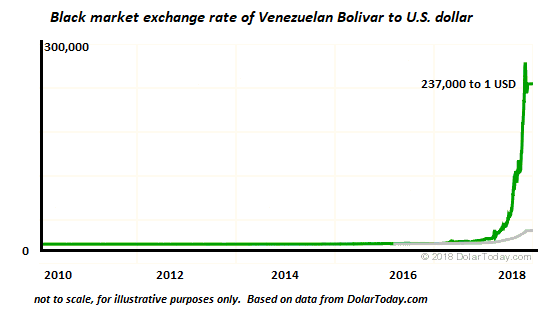
What a swell idea. Isn’t that what Venezuela has done for the past decade? And how did that work for them? If you think that destroying the purchasing power of “money” is a winner, then by all means, go on believing that the government can never go broke because all it has to do is print more money.

Here’s my favorite chart of asymmetric gains. The vast majority of the gains reaped since the 2008-09 Global Financial Meltdown have flowed to the top .1%. This is not a bug, it is a feature of hyper-financialization. Indeed, it is the only possible output of the current system.

Meanwhile, the bottom 95% live in an economy where wages go nowhere and costs are soaring. The financial media cheers when wages (supposedly) rise by 2%, but nobody dares measure the impact of rising costs in services such as healthcare and higher education.

The Status Quo is in trouble if the bottom 95% wake up to the asymmetric gains that are the only possible output of our hyper-financialized economy. Hype and propaganda are the key tools of the present era, as these are required to disconnect perception from reality. How long the disconnect will last is anyone’s guess, but when the two reconnect, all that is solid now will melt into thin air.


Assets of world’s “high net wealth” millionaires surged to $70 trillion in 2017

By Barry Grey

Source: WSWS.org

The concentration of the planet’s wealth in the hands of a narrow financial elite is growing by leaps and bounds. A new report published Tuesday reveals that the wealth of the world’s 18.1 million “high net worth individuals”—those having investable assets of $1 million or more—shot up by 10.6 percent last year to top $70 trillion for the first time ever.

The “World Wealth Report 2018,” issued by the consulting firm Capgemini, revealed that the combined wealth of the world’s millionaires rose for the sixth consecutive year in 2017 to reach $70.2 trillion. It is on target to surpass $100 trillion by 2025.

Capgemini defines a high net wealth individual (HNWI) as someone with assets above $1 million, excluding his or her primary residence, collectibles, consumables and consumer durables. This defines a wealthy elite that owns more than $1 million in stocks, bonds, real estate or other investments.

The number of HNWIs grew almost 10 percent, or 1.6 million. The United States, Japan, Germany and China are the four largest markets for millionaires, accounting for 61 percent of the world’s HNWIs. The US tops the list with 5.3 million HNWIs, a 10 percent increase from 2016.

However, the Asia-Pacific region has most of these millionaires overall and accounted for the bulk of the increase in both the number of HNWIs (74.9 percent of the total) and the rise in their global wealth (68.8 percent). Economic inequality appears to be rising faster in this region than any other. Japan saw a 9 percent increase in HNWI millionaires, China an 11 percent rise and India a stunning 20 percent increase.

The financial oligarchy itself resides within what the report calls “ultra-high net wealth individuals,” those with $30 million or more in investable assets. They comprise only 1 percent of HNWIs, or 174,000 individuals, but they account for a vastly disproportionate share of the overall wealth of HNWI millionaires, as well as the increase in HNWI wealth. These ultra-HNWIs own some 35 percent of total NHWI wealth. In 2017, their ranks grew by 11.2 percent and their wealth by 12 percent, reaching $24.5 trillion.

The main factor driving the rapid enrichment of the financial aristocracy is the record rise in stock prices. “High net worth individuals around the world enjoyed investment returns above 20 percent for the second year in a row,” Anirban Bose, head of Capgemini’s financial services global strategic business unit, wrote in the report’s preface. The report noted that global market capitalization grew 21.8 percent in 2017.

The stock market has served as the primary mechanism for central banks and governments around the world to increase the wealth of the financial oligarchy, which dominates the world economy and all of the official institutions of society and dictates the policies of governments. For decades, the central banks, led by the US Federal Reserve, working in tandem with governments of the nominal “left” no less than the right, have deliberately engineered a vast transfer of wealth from the working class to the ruling elite by pursuing policies designed to pump up the financial markets.

These polices have been intensified since the 2008 financial crash. The Fed and the US government, first under Bush and then Obama, responded to the Wall Street meltdown by enacting measures to ensure that the oligarchs recouped all of their losses and were able to exploit the crisis to further enrich themselves. In addition to bailing out the banks and hedge funds with trillions of dollars in tax-payer money, they provided virtually free credit to Wall Street by means of near-zero interest rates and used “quantitative easing”—a euphemism for money-printing—to offload the banks’ bad loans onto the Fed’s balance sheet.

From the low-point of the post-crash recession in March 2009 to the present, US stock prices have risen four-fold, stoking a similar stock bonanza internationally.

This stock market boom and the entire process of social plunder have depended on the suppression of working class opposition and a savage attack on workers’ living standards by means of austerity and wage-cutting. The throttling of the class struggle has been contracted out to the trade unions, the industrial police agencies of the ruling class.

One of the most significant findings in the Capgemini report is that the total financial wealth of the world’s HNWIs more than doubled between 2008 and 2017, rising from $32.8 trillion to $70.2 trillion. This same period has seen, in the world inhabited by the vast majority of humans, a growth of poverty, hunger, homelessness, disease and, in the United States, a decline in life expectancy, a surge in infant and maternal mortality, and record rates of suicide and drug addiction.

This attack has continued and intensified under Trump, as well as governments in Europe, Latin America and Asia. Just last week the Federal Reserve raised interest rates and announced a tightening of monetary policy in response to the growth of workers’ strikes and protests. The oligarchy is petrified that lower unemployment and a tight labor market will encourage a militant wages movement that would undercut the entire basis of the stock market surge. It is moving to slow the economy and drive up unemployment.

To place the wealth of the world’s multi-millionaires and billionaires in perspective, the total of $24.5 trillion owned by “ultra-high net wealth individuals” is almost one-fifth of the world gross domestic product of $135 trillion.

$24.5 trillion is more than the GDP of the United States. It is more than the combined GDPs of the next three countries—China, Japan and Germany.

Just the global increase in ultra-HNWI wealth in 2017, $2.6 trillion, is larger than the GDPs of countries such as Italy, Brazil, Canada and Russia.

What could this money be used for were it not squandered to satisfy the demands of the rich and the super-rich for mansions, private jets and yachts? To give an example, the United Nations estimates it would cost $30 billion a year to eradicate world hunger. That means the money currently controlled by the world’s ultra-HNWIs could eliminate world hunger for 817 years.

The “World Wealth Report 2018” is only the latest in a wave of studies documenting the ever tightening grip of a tiny financial oligarchy and its ultra-wealthy periphery over the world’s resources. Wealth concentration on such a scale makes it impossible to seriously address a single social issue. The staggering diversion of resources into private wealth accumulation by the financial oligarchy starves society of the resources it needs to deal with the most basic problems.

The working class has no choice but to confront head-on the problem of economic inequality. The financial elite enforces its social interests through the wholesale buying of political parties and politicians, making democracy under capitalism nothing but a hollow shell. Any attempt within the framework of the profit system to carry out a modest reallocation of resources to ensure that all people had the basic rudiments of nutrition, health care and education would provoke a furious response from the oligarchy, which has at its disposal not only the courts, politicians and mass media, but, even more decisively, the police and the army.

When social reform becomes impossible, social revolution becomes inevitable. There is no avoiding the conclusion that it is necessary to expropriate the wealth of the financial oligarchs.

Twelve Tips For Making Sense Of The World

By Caitlin Johnstone

Source: CaitlinJohnstone.com

In an environment that is saturated with mass media propaganda, it can be hard to figure out which way’s up, let alone get an accurate read on what’s going on in the world. Here are a few tips I’ve learned which have given me a lot of clarity in seeing through the haze of spin and confusion. Taken separately they don’t tell you a lot, but taken together they paint a very useful picture of the world and why it is the way it is.

1. It’s always ultimately about acquiring power.

In the quest to understand why governments move in such irrational ways, why expensive, senseless wars are fought while homeless people die of exposure on the streets, why millionaires and billionaires get richer and richer while everyone else struggles to pay rent, why we destroy the ecosystem we depend on for our survival, why one elected official tends to advance more or less the same harmful policies and agendas as his or her predecessor, people often come up with explanations which don’t really hold water.

The most common of these is probably the notion that all of these problems are due to the malignant influence of one of two mainstream political parties, and if the other party could just get in control of the situation all the problems would go away. Other explanations include the belief that humans are just intrinsically awful, blaming minorities like Jews or immigrants, blaming racism and white supremacy, or going all the way down wild and twisted rabbit holes into theories about reptilian secret societies and baby-eating pedophile cabals. But really all of mankind’s irrational behavior can be explained by the basic human impulse to amass power and influence over one’s fellow humans, combined with the fact that sociopaths tend to rise to positions of power.

Our evolutionary ancestors were pack animals, and the ability to rise in social standing in one’s pack determined crucial matters like whether one got first or last dibs on food or got to reproduce. This impulse to rise in our pack is hardwired deeply into our evolutionary heritage, but when left unchecked due to a lack of empathy, and when expanded into the globe-spanning 7.6 billion human pack we now find ourselves in due to ease of transportation and communication, it can lead to individuals who will keep amassing more and more power until they wield immense influence over entire clusters of nations.

2. Money rewards sociopathy.

The willingness to do anything to get ahead, to claw your way to the top, to betray whomever you need to, to throw anyone under the bus, to step on anyone to pass them in the rat race, will be rewarded in our current system. Being willing to underpay employees, cheat the legal system, and influence legislators will be rewarded exponentially more. People with a sense of empathy are often unwilling to do such things, whereas sociopaths and psychopaths are. About four percent of the population are sociopaths, and about one percent are psychopaths, with some five to fifteen percent falling somewhere along the borderline. The less empathy you have, the further you are willing to go, and the further up the ladder you can climb.

3. Wealth kills empathy.

If that weren’t bad enough, studies have shown that controlling large amounts of wealth actually destroys one’s sense of compassion for one’s fellow man. When you are able to use wealth to obtain everything from security to loyalty to personal relationships, you no longer have to be tuned in to the brain’s empathy center the rest of humanity depends on to get an accurate reading on what’s going on with the people we’re surrounded by. Most people need to be constantly feeling around their families, coworkers, employers, friends and acquaintances in order to ensure their own safety, social standing and security, whereas a wealthy person can simply purchase those things. Being born into wealth or having it for a long time can prevent that sense of empathy from being as strong as it is in the rest of the population.

4. Money is power.

2014 Princeton study showed that ordinary Americans have essentially zero influence over their nation’s policy and behavior regardless of how they vote, while wealthy Americans have a great deal of influence. This is because the ability to use corporate lobbying and campaign donations effectively amounts to the legalized bribery of elected officials, which means that money translates directly into political power. This creates a ruling class which is naturally incentivized to use their influence to increase their own wealth while decreasing everyone else’s, because since power is relative, the less money everyone else has the more power the ruling class has.

This is why billionaires keep hoarding more and more wealth while using legalized bribery to stifle economic justice legislation. It isn’t because they want to be able to buy thousands of luxury cars or dozens of private jets; they can only use one at a time the same as everyone else. They hoard wealth to keep the rest of the population from having it. Because money equals power, spreading wealth around would be tantamount to making everyone king, and because power is relative, making everyone king would mean that no one is king.

Rulers, historically, do not give up power easily, and this elite wealthy class is no exception. Hence all their aggressive attempts to suppress any movement against the status quo from the unwashed masses.

5. This same ruling class controls the media.

It’s common knowledge that most media is controlled by plutocrats, whether it’s the old money plutocrats who control the legacy media or the new money Silicon Valley plutocrats who control much of the new media. Media control is an essential component of rule; this has always been the case, since the days when kings would order dissident books burned and bishops would torture dissident orators to death. This is why the first thing a new plutocrat does as soon as rising to a certain level of wealth is start buying up media influence, like Jeff Bezos did when he bought the Washington Post in 2013. Bezos bought WaPo not because he is a stupid businessman who thought newspapers were about to make a lucrative resurgence, but because he is a brilliant businessman who knows that the status quo he is building his empire upon requires a propaganda firm that the public will trust and believe.

6. People are always manipulating each other.

Cultivating an acute awareness of when you are being manipulated, and considering whether someone might have a motive to do so, is an essential component to making sense of the world.

It is very rare to encounter someone who won’t try to manipulate you in any way. Generally people you’ll encounter in your life will try to influence the way you perceive them and your relationship to them, they’ll try to pull you in in some ways and push you out in others, try to hook you up to their personal agendas and goals and shape you in a way that fits with their shape. There’s nothing inherently malevolent in such behavior, it’s just what people do and what they always have done. Again, humans are social creatures, and we do what we can to increase our standing within our social circles.

The big problem is when skillful manipulators find their way into positions of large-scale influence like government or media. Unfortunately, these are the types who tend to get elevated into such positions, because they can manipulate their way in, and generally they do so for reasons of personal ambition rather than altruism. These skillful manipulators form an essential echelon of the ruling class’ loyal servants, and are the minds behind the pro-establishment narratives you’ll suddenly see circulated from think tanks to media platforms to the establishment lackeys on Capitol Hill.

7. Society is made of narrative.

Most of human experience is filtered through our mental stories about it, from our sense of self, to our ideas about who we are, to our beliefs about how we’re supposed to behave in society, to what money is and how it works, to where power exists and who we’re supposed to obey. All of these things are purely conceptual constructs which only exist in the realm of thought; a “dollar” exists to the extent that we’ve all agreed to pretend it’s a real thing and that it has a certain amount of purchasing power. At any time we could collectively decide to change the rules about how power functions or what money is and how it operates, and then instantly the rule of the elite class would be over without anyone firing a shot. It really would be that simple.

That’s how powerful a force narrative is, which is why the ruling plutocrats fight so hard to keep us from seizing control of it. This is why whistleblowers and outlets like WikiLeaks are aggressively and constantly smeared and demonized in the corporate media; if they can create suspicion of truth-tellers then they can keep them from being trusted, and thus keep them from being believed. This tool has been used to minimize the impact of everything from on the ground reports of what’s happening in Syria to leak drops from Edward Snowden; if you can create enough suspicion of someone it doesn’t matter if they’re speaking 100 percent truth; nobody will believe them, and thus the dominant narrative will remain the same.

Maintaining an awareness that there is always an unending battle to control the narrative and manipulate it to advance plutocratic interests is an essential part of understanding the world.

8. The lines between nations are imaginary.

Those lines drawn on the map between countries are pure narrative as well; they’re only as real as the collective public agrees to pretend they are. The ruling elites know this and exploit this. They don’t think in terms of nations and governments, they think in terms of individuals and groups of individuals.

Key strategic region in the Middle East? No need to take over the whole country, just flood it with extremist groups who are loyal to your agendas and control its oil fields. Primo naval real estate in the southern hemisphere? No need to annex it and plant your country’s flag there, just secure enough influence over the important moving parts using corporate contracts, trade agreements, military/intelligence treaties and secret deals and you can use it however you want.

This is why I am dismissive of arguments that “Israel controls America” or “America controls Europe”. There is no “Israel” or “America”; they’re made-up ideas which rulers once upon a time treated as real, but in the modern days of nationless plutocracy they no longer do. There are individuals, there are corporations, there are government agencies, there are factions and groups, and these are what the ruling elites deal with. Governmental structures are only tools which are used by the ruling elites for the purpose of manipulation, control, and military violence, and they only do so insofar as it is useful. The idea of real nations and governments is a cutesy fairy tale sold to the masses so they won’t see the manipulations.

9. Powerful forces are naturally incentivized to collaborate with each other toward mutual interests.

You can be a low-grade millionaire and still live like a relatively normal civilian, but once you start obtaining giant amounts of wealth control you need to start collaborating with existing power structures or they’ll snuff you out to prevent you from rocking their boat, because again, money equals power. This is why Jeff Bezos contracts with the CIA and sits on a Pentagon advisory board, and it’s why Facebook and Google collaborate extensively with government agencies; they never would have been allowed to grow to their size if they had not. Plutocratic dynasties which have been in place since long before Amazon, Facebook and Google figured this out many generations ago, and have agreed to push forward in a direction of mutual interest that doesn’t upset the status quo that their wealth is built upon.

This is extremely true of the west, where an effective empire has been created by a complex transnational alliance of mostly western plutocrats, but it is true outside of that empire as well; there are power alliances to be found everywhere that there is power.

10. There is an immense amount of wealth that can be grabbed in the chaos of war and conflict.

In the same way that existing power structures are naturally incentivized to quash any emerging power which would upset their status quo, alliances of power structures push to crush non-aligned power structures the world over. Whenever you see the tight western alliances and their media propaganda arms attacking the interests of Russia, China, Syria, Iran, Venezuela etc., you are seeing an alliance of power structures working to disrupt the interests of another alliance of power structures in order to absorb their assets.

The chaotic, Wild West environments that these conflicts create allow for an amount of underhanded looting and pillaging that you could never get away with in your own country, in the exact same way the colonialists and conquistadors of old could never have gotten away with brazenly grabbing gold, land and slaves from their fellow Europeans in Madrid or Rome but were given no legal trouble in the new world. The colonialists and conquistadors pushed into the Americas, Africa and Asia on the pretense of spreading Christianity and civilization; modern day conquerers push into non-aligned power structures on the pretense of spreading freedom and democracy in precisely the same way.

This chaos doesn’t require direct military conflict to be profitable; the uncritical enmity against Russia that the western plutocratic alliance has manufactured with its media control has allowed them to be blamed for everything from incriminating WikiLeaks documents to a corporate raid by Ukrainian oligarchs without any questions asked. Anyone who has ever had to deal personally with a sociopath knows how much they love to exploit the gray areas that chaotic situations give them, and geopolitical conflicts create those situations in spades.

11. The neocons are always wrong.

This one’s really easy. If you ever want to be on the right side of history for a foreign policy debate, look at what Bush-era PNAC neocons like John Bolton and Bill Kristol are saying about it, and take the opposite position. Neocon thought leaders have been loudly and catastrophically wrong about everything since the turn of the century, from Afghanistan to Iraq to Libya to Syria, and they’re not about to start being right now.

12. The push towards truth always starts with yourself.

You can’t out-manipulate seasoned manipulators. The main error most people make when trying to deal with a sociopath is to try and manipulate them back. Don’t even try. They have years of experience on you because they literally have done nothing else. While you were laughing and crying and worrying and connecting and relating to people, they were working out how to play humans like Garry Kasparov worked out how to play chess. And when you have literal teams of sociopaths collaborating together to amass power, you my dear child, do not have a chance. Don’t play their game. You will lose.

The only way to win this is to set your compass resolutely to “true.” Always be honest with yourself. Find all the different ways that you are manipulating others and see them and acknowledge them. Find your tribal allegiances and your desire to be right, and tip your hat to their existence. The more self-aware we are, the less levers we have to be manipulated by. If you are blindly partisan or loyal to a particular faction, that makes you gullible to propaganda because your wishful thinking and your desire to be right come into play. Get honest with yourself about who you are and what you want, and you will start to become an un-playable piece on the board.

If we can’t beat these bastards with truth, we don’t deserve to win.