10 Promising Signs That The Insidious Mind Control Matrix The Elite Have Created Is Starting To Crumble

By Michael Snyder

Source: Activist Post

Are we witnessing the start of some sort of a mass awakening in the Western world? For years, I have been writing about the extremely complex systems that are designed to shape and control what we think. Today, the vast majority of the “news” and “entertainment” that most of us consume is controlled by just a very small handful of immensely powerful corporations. And of course those corporations are ultimately owned and controlled by the elite of the world. To a very large degree, the elite have been able to determine what we focus on, what we think about current events, and how we feel about the world around us. For such a long time, most of the population would take whatever narratives that were pushed upon them by their corporate overlords as the gospel truth, and that always greatly frustrated me. Fortunately, there are indications that times are changing.

In order for any society to function effectively, there must be a high level of trust.

Unfortunately for the elite, we simply do not trust them anymore.

Trust in our politicians has fallen to an all-time low.

Trust in the media has fallen to an all-time low.

Trust in our corporations has fallen to an all-time low.

Trust in our health care system has fallen to an all-time low.

Trust in our education system has fallen to an all-time low.

Trust in the tech industry has fallen to an all-time low.

We no longer are buying into the crap that they keep shoveling our way.

And that is a really, really good thing.

It is morally wrong for them to try to control what we think.  It is absolutely imperative that we all learn to think for ourselves, because that is the only way that we will ever be truly free.

I have been writing about this stuff for years and years, and a number of recent trends have given me hope that people are starting to wake up on a widespread basis.  The following are 10 promising signs that the insidious mind control matrix the elite have created is starting to crumble…

#1 According to a recent Gallup survey, only 16 percent of U.S. adults have “a great deal” or “quite a lot” of confidence in newspapers and only 11 percent of U.S. adults have “a great deal” or “quite a lot” of confidence in television news.

#2 All over the Internet I am seeing article after article speaking out against the World Economic Forum.  That is an incredibly hopeful sign.

#3 In the Netherlands, a new government plan would “cut fertilizer use and reduce livestock numbers so drastically that it will force many farms out of business”.  This plan is deeply evil, but the massive farmer protests that have been sparked as a result are a really beautiful thing.

#4 After being arrested, a British man was told this: “Someone has been caused anxiety based on your social media post. And that is why you’re being arrested”.  But the good news is that there has been a tremendous backlash on social media and so far the video of his arrest has already been viewed more than 2 million times.

#5 As more people on the West Coast wake up, the exodus out of the state of California is rapidly becoming a stampede.

#6 Despite all of the spin from the Biden administration, 66 percent of Americans say that they believe that we are either in a recession or a depression right now.

#7 Joe Biden’s overall approval rating has fallen to an all-time low of 36 percent.

#8 Joe Biden’s economic approval rating has fallen to an all-time low of 30 percent.

#9 A recent CNN poll discovered that a whopping 75 percent of Democratic and Democratic-leaning voters actually want their party to nominate someone other than Biden in 2024.

#10 According to a recent Pew Research survey, only 24 percent of U.S. adults are satisfied with the current state of the country.

Almost all of us can see that our society is on the wrong track, and that is the first step in getting back on the right track.

As time rolls along, I believe that more and more of us will wake up.

And in the end I believe that the current “world order” that the Western elite have tried so hard to establish will fall.

That process will be incredibly chaotic, but the end result will be worth it.

Before I end this article, there is one more thing that I wanted to mention.

According to scientists, we just experienced the shortest day ever recorded

The shortest day on record has been broken by the planet Earth. On June 29, 2022, the planet completed its entire rotation in just 1.59 milliseconds, or slightly more than one thousandth of a second, less time than it typically takes for a 24-hour rotation.

Recently, the Earth has been moving quicker. Since the 1960s, 2020 marked the shortest month on record for the planet. On July 19 of that year, 1.47 milliseconds shorter than a typical 24-hour day, scientists recorded the shortest day so far.

Are the days being shortened?

I often tell people that it feels like the days are going by faster than ever, but I thought that it was just my imagination.

I have been told that as we get older it can seem like time is passing more quickly, and without a doubt 2022 seems like it is the fastest year yet.

It is hard to believe that the beginning of August is already here.

2023 will arrive before we know it, and I believe that 2023 will be a year that changes everything.

I know that there are a lot of bad things that are happening right now, and a lot of my articles tend to focus on those bad things.

But the truth is that there are a lot of good things happening too.

In fact, there is no other time in all of human history that I would have rather lived than right now.

It is when times are the darkest that the greatest heroes are needed, and the years ahead will provide plenty of opportunities for you to be the kind of hero that you were always meant to be.

Livelihoods in a Degrowth Economy

By Charles Hugh Smith

Source: Of Two Minds

Let’s consider livelihood options in an unsustainable economy of extremes that are unraveling, an economy that is being forced to transition to Degrowth.

Nassim Taleb’s book Antifragile explains the differences between fragile systems (systems that cannot survive instability), resilient systems (systems that can survive instability and stay the same) and antifragile systems (systems that adapt and emerge stronger).

The ideal way of life is antifragile: resilient enough to survive adversity and adaptable enough to evolve solutions to whatever comes our way.

The key antifragile traits are adaptability and rapid, flexible evolution. Adversity puts selective pressure on organisms: only those organisms which adapt successfully survive.

The more antifragile our livelihood and way of life, the better prepared we will be to recognize and pursue opportunities.

An unsustainable, unstable economy puts a great deal of pressure on its participants. Only those with the skills and agency to move, adapt and experiment will emerge stronger.

Adaptability requires agency. Those without much control are stuck with the consequences of others’ decisions and actions.

In my experience, self-reliance is integral to an antifragile way of life.Self-reliance and self-sufficiency are similar but not identical.

Self-sufficiency means reducing our dependence on resources provided by others: growing our own food, doing our own repairs, etc. Self-sufficiency can also be understood as shortening dependency chains.

Compare being dependent on food shipped thousands of miles to relying mostly on food grown within 50 miles of home. There are so many ways long supply chains can break down because the entire system breaks down if even one link in the dependency chain breaks.

Total self-sufficiency isn’t practical. We all rely on industrial production of metals, tools, plastics, fertilizers, etc. But reducing our dependence on systems that are fragile by consuming less and wasting nothing increases our antifragility.

Self-reliance is being able to take care of oneself, being independent in thought and action, and maintaining control of decision-making–what I’ve been calling agency.

Self-reliance means being able to go against the crowd. This requires independence and confidence in one’s inner compass.

Being able to take care of oneself means drawing upon inner resources, being able to identify the essentials of a situation and coming up with solutions that are within reach.

Since households with multiple incomes are far more resilient than households with all their eggs in one basket, our goal is to develop income streams that we control. The ownership is more important than the scale of the income. A modest income we control is far more antifragile than a larger income we have little control over.

Developing income streams is easier if we approach the task with an entrepreneurial mindset.

This mindset looks at work in terms of markets, unmet demand, pricing power, networks of trustworthy peers, trial and error (experiments), optimizing new skills, seeking mentors, learning to make clear-eyed assessments of what’s working and what isn’t, and then acting decisively on the conclusions.

All these skills can be developed. They are very useful in navigating unstable conditions because they prepare us to act decisively rather than passively await others to decide what happens to us.

Some skills can be applied to virtually every field: project management, bookkeeping, working well with others, computer skills and communicating clearly. Being a fast learner is valuable in every field.

In my books and blog posts, I’ve covered the difference between tradable work–work that can be done anywhere–and untradable work, work that can only be done locally. Having skills that are untradable is advantageous, as the competition is local rather than global.

Skills that can’t be automated are also advantageous. Robots are optimized for repetitive tasks and factory / warehouse floors with sensors. They are not optimized for tasks that must be figured out on the fly and that require multiple skills.

Who fixes the robot when it fails out in the field? Another robot? Who replaces the dead battery in the drone? Another drone? The point is there are real-world limits on robotics, artificial intelligence, machine learning and automation that proponents gloss over or ignore.

Those with multiple skills who can problem-solve on the fly will continue to be valuable.

The models of work are changing, and this offers a wider range of options which is especially valuable to those emerging from burnout.

Combining various kinds and modes of work is called hybrid work. This could be mixing work from home (remote work) with occasional visits to an office, or it could be mixing a part-time job with self-employment.

I’ve written about one example in Japan called Half Farmer, Half X, where young urban knowledge workers move to the countryside to pursue small-scale farming while keeping a part-time, high-pay tech job they do online. Since the cost of living is so much lower in the countryside, these hybrid workers don’t need to work many hours remotely to cover their expenses, nor do they need their small-scale farming to be highly profitable.

Not all work is paid. Indeed, only a slice of human work globally is paid. The work that gives us the greatest fulfillment may well be unpaid or poorly paid. We may have to do some work to pay the bills while looking forward to the work we do that doesn’t earn much money.

Personally, I have always been drawn to both knowledge work and hands-on work. I worked my way through my university with a part-time job in construction. This was the ideal mix for my enthusiasms. Whenever I’ve been limited to one or the other, I feel dissatisfied. For me, hybrid work means having both knowledge work and hands-on physical labor, and having control of both.

Many people believe they need additional credentials to expand their opportunities. The alternative is to accredit yourself.

Since I’m enthusiastic about working with fruit trees and vegetable gardens, let’s say I decide to offer my services to potential customers.

One avenue is to spend money and time to get a certificate in horticulture. Alternatively, I could take photos of my own yard to document the trees I planted and how fast they’ve grown under my care. In other words, I could accredit myself, providing direct evidence of my skills and experience.

Employers have learned that completing a credential doesn’t mean the graduate will be productive. The diploma doesn’t prove the graduate learned much or has what it takes to work well with others.

The diploma actually tells us very little about the graduate. We learn much more from someone who accredits themselves by documenting projects they’ve completed.

The only real source of prosperity is improving productivity: doing more with fewer resources and labor. Economists expected the adoption of computers and the Internet to boost productivity. Instead, productivity gains have been extremely modest, 1% or 2% per year, far lower than the 10% annual gains achieved during industrialization.

This productivity paradox has puzzled economists for decades. One reason why the productivity of knowledge work ((white-collar work) has barely improved when compared to factory productivity (blue-collar work) is the methodical optimization of tasks is more difficult to apply to knowledge work. Much of this work is done by rule of thumb and what was passed down by senior workers.

There are a number of reasons for this. One is it’s easier to study the assembly of products than it is to break down the production of services.

Another is that many fields of knowledge work are so new that it’s difficult to optimize tasks because they’re constantly changing.

A third factor is that we’ve been wealthy enough to waste labor and capital on unproductive bureaucratic friction. Just as we waste water when it’s abundant and free, we also waste energy and money when they’re abundant.

In Global Crisis, National Renewal I describe the changes in the process of obtaining a building permit in the past 40 years.

In the early 1980s, I could submit a set of plans for a modest house in the morning and pick up the approved plans and building permit that afternoon. Now the process takes many months, even though the house being built hasn’t changed much at all. What changed was the permit approval process became terribly inefficient.

Since there’s few incentives to improve efficiencies in bureaucracies, it now takes a decade or longer to approve a bridge or landfill While the number of professors and doctors has increased modestly, the number of university and hospital administrators has soared.

Now that energy will no longer be cheap over the long term, incentives to improve the productivity of knowledge work will increase.

Unsustainable economies are prone to sudden changes in finance and the availability of essentials. We’re accustomed to predictable stability, and so few are prepared to respond effectively to instability.

If our lives only work when things are stable, our way of life is fragile. Recall Sun Tzu’s advice: “If a battle cannot be won, do not fight it.” If we’re only prepared for everything to stay the same, we’re fighting a battle we can’t win. We want to be prepared for sudden changes and scarcities by planning ahead and being flexible, nimble and responsive.

One facet of being antifragile is having a buffer or cushion against sudden shocks. In a 2018 interview, Nassim Taleb said, “Money can’t buy happiness, but the absence of money can cause unhappiness. Money buys freedom… to choose what you want to do professionally.”

Taleb went on to note that it takes great discipline to keep enough money stashed to give us the freedom to maintain our agency when faced with adversity. Self-reliance requires a buffer so we have time to figure out solutions and the means to pursue them.

In my experience, our willingness to consider all options, our ability to make careful decisions and take decisive action are just as important as a cushion of cash. Cash widens our options, but if we’re frozen by inexperience and fear then our options are severely limited.

The wider our range of skills, the greater our opportunities to add value. The basic needs of human life must be met and so those who can meet those needs will always be valued. This range of skills is also a buffer because it gives us more options in adversity.

How much money do we need as a cushion? The less we need, the lighter our expenses and the more options we have. If we need $10,000 a month just to pay our basic expenses, that demands a large cushion. If we’ve simplified and downsized our way of life so $1,000 a month is enough to keep us going, our cushion can be much smaller.

In other words, frugality, self-reliance and simplicity are key parts of antifragility, for they lower the cost of freedom. Money can lose its value in crisis, but our buffer of skills and self-reliance cannot be taken from us or devalued by a global crisis.

One final consideration is timing. The sooner we start preparing for degrowth, the better off we’ll be. A Chinese proverb captures this succinctly: By the time you’re thirsty, it’s too late to dig a well.

Can a Nation Prosper as its Institutions Fail?

By Charles Hugh Smith

Source: Of Two Minds

Economists focus on what can be easily measured: sales, profits, prices, tax revenues, etc. Since the decay and failure of institutions isn’t easily quantified, this decay doesn’t register in the realm of economics. Since it isn’t measured, it doesn’t exist.

But institutional decay and failure is all too real, and it begs the question: how can a society and economy thrive if its core institutions fail? The short answer is they cannot thrive, as institutions are the foundations of the social and economic orders.

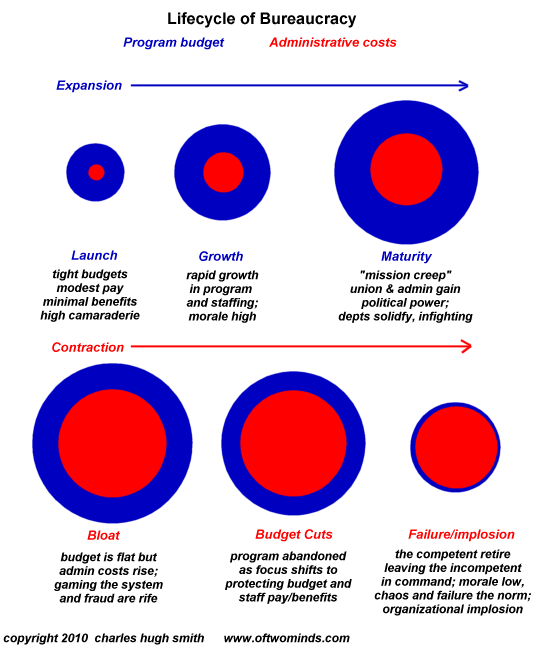
As I explain in my new book, Global Crisis, National Renewal, the conventional view has a naive faith that “great leaders” can reverse institutional rot. This faith overlooks the systemic sources of institutional decay and failure which are outlined in the graphic below, The Lifecycle of Bureaucracy, a.k.a. institutions.

Leaders are constrained by the nature of centralized organizations and the incentive structure that slowly shifts from rewarding efforts to further the institution’s core mission to self-service and protecting an ossified, failing institution from outside scrutiny and reform.

As Samo Burja explains in his insightful essay, Why Civilizations Collapse, those inside institutions are by design so compartmentalized that few (if any) even recognize the institution is failing. As long as everything is glued together in each little compartment, no one grasps the entire institution has lost its way. And since no one recognizes it, no one attempts to save it.

Institutions end up advancing caretaker managers who excel at the political game of rising to the top of a sprawling institution. When the decay (or budget cuts) finally trigger a crisis, the institution has been stripped of visionaries with a bold grasp of what’s needed to restore the focus on the core mission and institute new incentives. The bold leaders quit in disgust or were sent to bureaucratic Siberia as potential threats to the status quo.

The problem is institutions fail by the very nature of their centralized design. The organization is centralized so directives flow down the chain of command, and every branch is compartmentalized to limit the power of each department and employee to disrupt the orderly flow of top-down directives.

Within this compartmentalized, top-down structure, the incentives are to follow procedures rather than get results. The rewards go to those who dutifully follow procedures rather than to those who raise the alarm about the loss of transparency, effectiveness and focus on fulfilling the mission.

The path of least resistance is to protect the existing structure and add more compartments, i.e. “mission creep.” Rather than focus on the dissipation of resources and the decline of the core mission, leaders add “feel good” missions and PR promotions of phony reforms and initiatives that bleed more resources from the core mission.

Consider the institution of democracy, which has been corrupted into an invitation-only auction of state favors and rentier skims. Democracies have another fatal flaw: politicians win re-election by promising virtually everyone something for nothing: more benefits and entitlements and lower taxes. The gap between higher costs and declining revenues will be filled by government borrowing.

All this additional borrowing will supposedly be paid by the magic of “growth”, which will expand tax revenues at a rate that exceeds the cost of borrowing.

But demographics, resource depletion and the diminishing returns of a consumer economy fueled by rapidly expanding public and private debt have sapped “growth” in fundamental ways. Ironically, borrowing and spending more to spur “growth” only hastens the diminishing returns of increasing debt to fund consumption today.

Democracies are thus optimized for rapid “growth” and are ill-suited to transition to DeGrowth, i.e. less of everything for the vast majority of the citizenry as resources become scarce and debt eats the economy alive. (DeGrowth could work to everyone’s benefit, which is the point of Global Crisis, National Renewal.)

Central banking is another failing institution. When faced with fiscal crises, central states/banks inevitably succumb to the temptation to print/borrow currency in whatever sums are needed to fill the shortfall of the moment, i.e. political expediency. This profligate creation of currency seems to be magic at first; everyone accepts the “new money” at the current value. But eventually gravity takes hold and the currency’s purchasing power declines, as the real economy (the production of goods and services) grows at rates far below the expansion of credit and currency.

Even the greatest empires in human history have been unable to resist the “easy” solution of devaluing currency as the means of fulfilling all the promises that were made in more prosperous times.

The progression of centralized power slowly but surely replaces the self-organizing, resilient, decentralized structures of civil society with tightly bound hierarchical centralized structures that are increasingly ineffective, increasingly costly and increasingly fragile, i.e. increasingly prone to failure or collapse.

The irony of institutional decay and failure is everyone inside is so busy following procedures that nobody notices the decay until the whole worm-eaten structure collapses. Look no farther than financialized asset bubbles, healthcare and education for examples of institutions in run-to-failure decline.

We are in effect so busy arranging the beach umbrellas per our instructions that we don’t notice the approaching tsunami. Can a nation prosper as its institutions decay and collapse? Only in the fantasies and magical thinking of the delusional.

Why Don’t People “Trust The Science?” Because Scientists Are Often Caught Lying

By Brandon Smith

Source: Alt-Market.us

There has been an unfortunate shift in Western educational practices in the past few decades away from what we used to call “critical thinking.” In fact, critical thinking was once a fundamental staple of US colleges and now it seems as though the concept doesn’t exist anymore; at least not in the way it used to. Instead, another form of learning has arisen which promotes “right thinking”; a form of indoctrination which encourages and rewards a particular response from students that falls in line with ideology and not necessarily in line with reality.

It’s not that schools directly enforce a collectivist or corporatist ideology (sometimes they do), it’s more that they filter out alternative viewpoints as well as facts and evidence they do not like until all that is left is a single path and a single conclusion to any given problem. They teach students how to NOT think by presenting thought experiments and then controlling the acceptable outcomes.

For example, a common and manipulative thought experiment used in schools is to ask students to write an “analysis” on why people do not trust science or scientists these days. The trick is that the question is always presented with a built-in conclusion – That scientists should be trusted, and some people are refusing to listen, so let’s figure out why these people are so stupid.

I have seen this experiment numerous times, always presented in the same way. Not once have I ever seen a college professor or public school teacher ask students: “Should scientists today be trusted?”

Not once.

This is NOT analysis, this is controlled hypothesis. If you already have a conclusion in mind before you enter into a thought experiment, then you will naturally try to adjust the outcome of the experiment to fit your preconceived notions. Schools today present this foolishness as a form of thinking game when it is actually propaganda. Students are being taught to think inside the box, not outside the box. This is not science, it is anti-science.

Educational programming like this is now a mainstay while actual science has taken a backseat. Millions of kids are exiting public schools and universities with no understanding of actual scientific method or science in general. Ask them what the equations for Density or Acceleration are, and they’ll have no clue what your are talking about. Ask them about issues surrounding vaccination or “climate change”, and they will regurgitate a litany of pre-programmed responses as to why the science cannot be questioned in any way.

In the alternative media we often refer to this as being “trapped in the Matrix,” and it’s hard to think of a better analogy. People have been rewarded for so long for accepting the mainstream narrative and blindly dismissing any other information that when they are presented with reality they either laugh at it arrogantly or recoil in horror. The Matrix is so much more comfortable and safe, and look at all the good grades you get when you say the right things and avoid the hard questions and agree with the teacher.

Given the sad state of science in the West these days surrounding the response to covid as well as the insane and unscientific push for forced vaccinations, I thought it would be interesting to try out this thought exercise, but from an angle that is never allowed in today’s schools:

Why don’t people trust the science and scientists anymore?

This is simple: Because many scientists have been caught lying and misrepresenting their data to fit the conclusions they want rather than the facts at hand. Science is often politicized to serve an agenda. This is not conspiracy theory, this is provable fact.

That’s not to say that all science is to be mistrusted. The point is, no science should be blindly accepted without independent examination of ALL the available facts. This is the whole point of science, after all. Yes, there are idiotic conspiracy theories out there when it comes to scientific analysis, but there are a number of scams in the world of science as well.

The usual false claim is that the average person is ignorant and that they don’t have the capacity to understand scientific data. I do find it interesting that this is the general message of the trust-science thought experiment. It fits right in line with the mainstream and government narrative that THEIR scientists, the scientists they pay for and that corporations pay for, are implicitly correct and should not be questioned. They are the high priests of the modern era, delving into great magics that we dirty peasants cannot possibly grasp. It is not for us to question “the science”, it our job to simply embrace it like a religion and bow down in reverence.

Most people have the capacity to sift through scientific data as long as it’s transparent. When the facts are obscured or spun or omitted this causes confusion, and of course only the establishment scientists can untangle the mess because they are the ones that created it. Let’s look at a couple of examples directly related to human health…

GMO Crops And The Corporate Money Train

The propaganda surrounding Genetically Modified Organisms is relentless and pervasive, with the overall thrust being that they are perfectly safe and that anyone who says otherwise is a tinfoil hat crackpot. And certainly, there a hundreds if not thousands of studies which readily confirm this conclusion. So, case closed, right?

Not quite. Here is where critical thinking is so useful and where reality escapes the indoctrinated – Who paid for these studies, and do they have a vested interest in censoring negative data on GMOs?

Well, in the vast majority of cases GMO studies are funded by two sources – GMO industry giants like Monsanto, Dupont and Syngenta, or, government agencies like the FDA and EPA. Very few studies are truly independent, and this is the problem. Both the government and corporations like Monsanto have a vested interest in preventing any critical studies from being released on GMO’s.

Monsanto has been caught on numerous occasions hiding the dangerous health effects of its products, from Agent Orange to the RGBH growth hormone used in dairy cows. They have been caught compiling illegal dossiers on their critics. The industry has been caught multiple times paying off academics and scientists to produce studies on GMOs with a positive spin and even to attack other scientists that are involved in experiments that are critical of GMOs. Research shows that at least half of all GMO studies are funded by the GMO industry, while the majority of the other half are funded by governments.

There has also long been a revolving door between GMO industry insiders and the FDA and EPA; officials often work for Monsanto and then get jobs with the government, then go back to Monsanto again. The back scratching is so egregious that the government even created special legal protections for GMO companies like Monsanto under what is now known as the Monsanto Protection Act (Section 735 of Agricultural Appropriations Bill HR 993) under the Obama Administration in 2013. This essentially makes GMO companies immune to litigation over GMOs, and the same protections have been renewed in different bills ever since.

Beyond the revolving door, the government has approved many GMO products with little to no critical data to confirm their safety. Not only that, but in most cases the government has sovereign immunity from litigation, even if they’ve been negligent. Meaning, if any of these products is proven to cause long term health damage the government cannot be sued for approving them unless there are special circumstances.

If they could be held liable, you would be damn sure the FDA would be running every conceivable test imaginable to make sure GMOs are definitively safe without any bias attached, but this is not the case. Instead, the government actively propagandizes for GMO companies and uses hired hatchet men to derail any public criticism.

I, for one, would certainly like to know for sure if GMOs are harmful to the human body in the long term, and there is certainly science to suggest that this might be the case. There have been many situations in which specific GMO foods were removed from the market because of potentially harmful side effects. Endogenous toxins of plants with modified metabolites are a concern, along with “plant incorporated protectants” (plants designed to produce toxins which act as a pesticides).

There is data that tells us to be wary, but nothing conclusive. Why? Because billions of dollars are being invested by corporations into research designed to “debunk” any notion of side effects. If the same amount of funding was put into independent studies with no bias, then we might hear a different story about the risks of GMOs. All the money is in dismissing the risks of GMOs; there’s almost no money in studying them honestly.

The science appears to be rigged to a particular outcome or narrative, and that is lying. Science is supposed to remain as objective as possible, but how can it be objective when it is being paid for by people with an agenda? The temptation to sell out is extreme.

Covid Vaccines And The Death Of Science

I bring up the example of GMO’s because I think it is representative of how science can be controlled to produce only one message while excluding all other analysis. We don’t really know for sure how dangerous GMOs are because the majority of data is dictated by the people that profit from them and by their friends in government. The lack of knowing is upheld as proof of safety – But this is not scientific. Science and medicine would demand that we err on the side of caution until we know for sure.

The same dynamic exists in the world of covid vaccines. Big Pharma has a vested interest in ensuring NO negative information is released about the mRNA vaccines because there is a perpetual river of money to be made as long as the vax remains approved for emergency use by the FDA. It may be important to note that the FDA has said it will take at least 55 YEARS to release all the data it has on the Pfizer covid vaccines, which suggests again that there is a beneficial collusion between the government and corporate behemoths.

In the meantime, anyone that questions the efficacy or safety of the vax is immediately set upon by attack dogs in the media, most of them paid with advertising dollars from Big Pharma. These attacks are not limited to the alternative media; the establishment has also gone after any scientist or doctor with questions about vaccine safety.

There are clear and openly admitted ideological agendas surrounding covid science which have nothing to do with public health safety and everything to do with political control. When you have the head of the World Economic Forum applauding the covid pandemic as a perfect “opportunity” to push forward global socialist centralization and erase the last vestiges of free markets and individual liberty, any rational person would have to question if the covid science is also being rigged to support special interests.

Luckily, the covid issue is so massive that it is impossible for them to control every study. Instead, the establishment ignores the studies and data they don’t like.

The virus is being hyped as a threat to the majority of the public and as a rationale for 100% vaccination rates, by force if needed. Yet, the median Infection Fatality Rate of covid is only 0.27%. This means that on average 99.7% of the population at any given time has nothing to fear from the virus. This is confirmed by dozens of independent medical studies, but when was the last time you heard that number discussed by mainstream government scientists like Anthony Fauci?

I’ve never heard them talk about it. But how is it scientific to ignore data just because it doesn’t fit your political aims? Again, deliberate omission of data is a form of lying.

What about the multiple studies indicating that natural immunity is far superior in protection to the mRNA vaccines? What about the fact that the countries with the highest vaccination rates also have the highest rates of infections and their hospitalizations have actually increased? What about the fact that the states and countries with the harshest lockdown and mask mandates also have the highest infection rates? What about the fact that the average vaccine is tested for 10-15 years before being approved for human use, while the covid mRNA vaccines were put into production within months? That is to say, there is NO long term data to prove the safety of the covid vax.

These are easily observable scientific facts, but we never hear about them from corporate scientists or government scientists like Fauci? Instead, Fauci argues that criticism of his policies is an attack on him, and attacking him is the same as “attacking science.” In other words, Fauci believes HE IS the science.

And doesn’t that just illustrate how far science has fallen in the new millennium. Real scientists like Kary Mullis, the inventor of the PCR test, call Fauci a fraud, but they are ignored while Fauci is worshiped. I can’t even get into climate change “science” here, I would have to write an entire separate article about the fallacies perpetrated by global warming academics (did you know that global temperatures have only increased by 1 degree Celsius in the past century? Yep, just 1 degree according to the NOAA’s own data, yet, institutions like the NOAA continue to claim the end of the world is nigh because of global warming).

The stringent bottleneck on science today reminds me of the Catholic church under Pope Innocent III when church authorities forbade common people from owning or reading a bible. These laws remained in effect well into the 13th century. Instead, the peasants were to go to church and have the texts read to them by specific clergy. Often the bible readings were done in Latin which most people did not speak, and interpreted however the church wished.

It was only the invention of the printing press in the 1400s that changed the power dynamic and allowed bibles to be widely distributed and information to spread without church oversight. Much like the creation of the internet allows the public to access mountains of scientific data and methodologies at their fingertips. The free flow of information is an anathema according to the establishment; they argue that only they have the right to process information for public consumption.

Cultism requires excessive control of data and the complete restriction of outside interpretations. As information becomes openly available the public is then able to learn the whole truth, not just approved establishment narratives.

Science is quickly becoming a political religion rather than a bastion of critical thought. Conflicting data is ignored as “non-science” or even censored as “dangerous.” Government and corporate paid studies are treated as sacrosanct. Is it any wonder that so many people now distrust the science? Any reasonable person would have questions and suspicions. Those who do not have been indoctrinated into a cult they don’t even know they are a part of.

The end of childhood play

By Brian Kaller

Source: resilience

Recorded history is the history of adults–generals, statesmen, explorers and scientists–but all of those adults began their path as children. And running beneath this official history is the unofficial history of childhood games and rituals, many of which were passed down for generations; children inhabited a separate universe of traditions, contests, solemn rituals and codes of honour, like a Viking horde living in your house unnoticed. It was in this world that every future general first learned to lead, every future scientist first turned over logs to delight in the tiny nightmares underneath, and every future explorer first plucked up the courage to enter the haunted woods. Elderly people here in Ireland, who grew up without electricity or many cars, still remember the feral exploration and creative play that was once the birthright of every child.

“Children today don’t have to think much about games given to them – we made up our own,” said one elder. “We played spin the top, marbles, hoop the hoop, hop scotch, conkers, kick the can, scut the whip, jackstones, and box the fox. Hop scotch has survived to some extent, but only among girls … Even when the dark evenings closed in we played ‘Battle In, Battle Out,’ and ‘Jack jack show the light.’”

The games varied widely from person to person; villages only a few miles away could apparently have very different game-traditions. City streets, perhaps because they drew families from so many rural villages, seem to have been a vast melting pot of such games; when British novelist Norman Douglas published his whimsical overview of the children’s games of London in 1916, he spent dozens of pages–most of the book–just listing games. Not dozens of games, mind you–dozens of pages of lists of games, any of which could be as complex as any video game today and most of which were known to most children.

The games, rhymes, and rituals children invented were so ubiquitous, and so often out of sight of adults, that they were little remarked upon or recorded, and only now, when they have almost disappeared, can we look back and see how remarkable they were. In the 1950s the husband-and-wife team of Peter and Iona Opie interviewed children on playgrounds around the UK and found that, instead of being silly and spontaneous, children’s rhymes and stories actually preserved historical traditions their parents had lost.

“Boys continue to crack jokes that Swift collected from his friends in Queen Anne’s time,” Opie wrote. “They ask riddles which were posed when Henry VIII was a boy. . . . They learn to cure warts . . . after the manner which Francis Bacon learned when he was young. . . . They rebuke one of their number who seeks back a gift with a couplet known in Shakespeare’s day. . . . and they are [perpetuating stories] which were gossip in Elizabethan times.” They re-discovered the observation of Queen Anne’s physician John Arbuthnot, who said that “nowhere was tradition preserved pure and uncorrupt but amongst school-boys, whose games and plays are delivered down invariably from one generation to another.”

This is especially remarkable since most of these rituals were not taught by parents or grandparents, who might have learned them decades earlier, but by other children who could only have known them for a few years. Since they were re-transmitted over years rather than decades, their transmission signal should have decayed more quickly. Instead, the children proved stronger at retaining historical knowledge than most adults–not in the sense of reciting facts, but in treasuring their past.

Some of their superstitions, like a blister as proof of lying, date back at least to the 1500s, and they chanted a rhyme that apparently dates back to the era of France’s Henry IV in 1610. Most interestingly, country children still wore oak leaves or an acorn in their button-holes on 29 May to remember the return of Charles II in 1651–and could explain why they did so–at a time when few adults remembered the date.

Keep in mind, also, that few people were writing in the 1500s, most writing was not about children’s games, and much of what was written then has been lost–so if a ritual was first recorded in the 1500s, it could well be much older. Oral traditions can endure for thousands or even tens of thousands of years; Australian Aborigines have traditions about the sea level changing that seem to date from the last Ice Age. No one knows if any children’s rhymes and games date back so far, but Douglas believed that one chant stretched back to the time of Nero, and the Opies seemed to agree.

Their games and rituals were still very local, even in the 1950s when mass media was already washing away the local cultures of villages and neighbourhoods. “While some children roll eggs at Easter,” the Opies wrote, “or nettle the legs of classmates on the 29th of May, or leave little gifts on people’s doorsteps on St. Valentine’s Day, or act under the delusion that they are above the law on a night in November, other children, sometimes living only the other side of a hill, will have no knowledge of these activities.”

Here, too, Ireland held onto this heritage later than most countries, and a radio documentary of children playing in a Dublin school-yard in 1977 showed them using their own complicated musical chants. They weren’t all local traditions–one chant cited Shirley Temple, “the girl with the curly hair”–but even that showed the staying power of these songs, as this was two generations after she had been famous.

The Opies also noted that children spontaneously adopted a “code of oral legislation”–cultural institutions for testing truthfulness, swearing affirmation, making bets and bargains, and determining the ownership of property–the adult legal code in miniature. These codes universally included a practice absent from adult law, however–that of asking for respite, what we recognize as “calling time out,” and what today’s children reportedly call “pause,” a usage imported from video games.

“Throughout history, bands of children gathered and roamed city streets and countrysides, forming their own societies each with its own customs, legal rules and procedures, parodies, politics, beliefs, and art,” the blog Carcinisation pointed out. “With their rhymes, songs, and symbols, they created and elaborated the meaning of their local landscape and culture, practicing for the adult work of the same nature. We are left with only remnants and echoes of a once-magnificent network of children’s cultures, capable of impressive feats of coordination.”

This seems to have been true of all human cultures–anthropologists report it in hunter-gather tribes, and Zechariah 8:5 said that “the streets of the city shall be full of boys and girls playing.” Certainly it was true among people I knew in Ireland or the USA in living memory. To see how recently outdoor play was assumed, look at a map of most American cities; anything built before World War II is typically a grid for easy transport, but post-war suburban streets curl like tossed spaghetti and end in cul-de-sacs in order to do the opposite, to slow and discourage traffic to be “safe for families.” The sprawl that covers much of America looks the way it does because it was made to be safe for children to play in the street–which in 1945 was exactly what they would be doing.

If the returning GIs who first moved into these homes could be transported to the present day, however, they would be puzzled. Aside from the fact that the future never happened–no flying cars or robot butlers–the most glaring difference would be the absence of any children. To a time traveler it would seem like the beginning of a Twilight Zone episode, and they’d would demand to know what happened–was there a plague? An alien invasion? Are the children grown from pods now? Are they marched to an altar and sacrificed to a dark god? Or is this some horrific science-fiction future where children grow up staring at glowing rectangles, and are drugged when they get restless?

“Even the idea of a children’s game seems to be slipping from our grasp,” Neil Postman wrote in 1982. “A children’s game, as we used to think of it, requires no instructors or umpires or spectators; it uses whatever space and equipment are at hand; it is played for no other reason than pleasure. . . . Who has seen anyone over the age of nine playing Jacks, Johnny on the Pony, Blindman’s Buff, or ball-bouncing rhymes? . . . Even Hide-and-Seek, which was played in Periclean Athens more than two thousand years ago, has now almost completely disappeared from the repertoire of self-organized children’s amusements. Children’s games, in a phrase, are an endangered species.”

The decline began a few generations ago, when television steamrolled over children’s cultural traditions, and that screen has now multiplied into a billion hand-held ones. When children everywhere carry all the world’s pornography in their pocket, as well as electronic games psychologically designed to addict people as powerfully as heroin, few future leaders will organise their mates, and few budding scientists will turn over any logs. Moreover, children today grow up under effective house arrest, as local ordinances, paranoid neighbours and police conspire to prohibit children from venturing far outside. They grow up learning no lessons, organising no peers, and exploring no territory, unless it be shifting electrons around a screen, and the screen becomes their world.

This unnatural state takes all the power of modern society to maintain, and it does not have to be inevitable or permanent; even now some parents keep their children unplugged and gather with other parents who do the same. If they don’t live near the country themselves, they might visit family who do. They teach small children some games from old books, and let the children take it from there. How this guerrilla action proceeds will depend on the situation, but it needs to be done. Otherwise, today’s children will live in a country filled with the most dependent and least self-sufficient humans who ever lived, polarised and paralysed by their screens, and facing a difficult future. We will need a new generation of people who can strategise, negotiate, and work together again, and to do that we need children to experience childhood once more.

THE WAY OF THE MASTER: LIFE AS APPRENTICESHIP

By Gary Z McGee

Source: Waking Times

“It is the height of selfishness to merely consume what others create and to retreat into a shell of limited goals and immediate pleasures. Alienating yourself from your inclinations can only lead to pain and disappointment in the long run, and a sense that you have wasted something unique.” ~Robert Greene

How do you become a prime mover? How do you become more self-determined, more self-aware, more responsible for your lot in life? How do you become your own boss, fully volitional, fully responsible, fully engaged, with more creativity, more adaptability, and more courage? How do you become a master?

It begins with self-apprenticeship. You must create your own momentum. Don’t be afraid of becoming an autodidact. Read a lot. Connect the dots. Seek out the shoulders of giants, not just to learn, but to see further than they did. Seek help, expertise, guidance, and wisdom from others, but then you must take responsibility for your own improvement. Take a leap of courage out of faith. Create a scaffold of knowledge. Its foundation is curiosity. Stay curious. Be Curiosity. As Joseph Campbell said, “follow your bliss.”

Mobilize your mind:

“Those who cannot change their minds cannot change anything.” ~George Bernard Shaw

The immobilized mindset is a handicap. Living a full life requires movement. What does not move is dead. Let the mind move, let the mind flow, let the mind grow.

Don’t let your mind settle. A settled mind is a closed mind. A settled mind tricks you into believing that you have figured things out. It inadvertently sacrifices reason for anti-reason. It uses anti-reason to buttress itself against new knowledge.

Remember: knowledge is always your master. Don’t let your ego fool you. One does not master knowledge; one only learns it. The mind is simply too fallible, too inflexible, too imperfect to become a master of knowledge. True self-mastery is understanding that knowledge will always be your master.

Which is all the more reason to keep your mind active, fluid, flexible, and mobile. Don’t get comfortable. Take risks. Embrace change. It’s when you fight against change, when you deny it, repress it, ignore it, or rage against it that you suffer unnecessarily. When you embrace change, however, you’re in flow with it, dancing, flexible, and empowered, even when it hurts. Especially when it hurts. Because you know, pain is information. Pain is a teacher. Pain is a guide. Pain is merely procrastinating power. In the long run it will make you stronger.

The ability to loosen your mind, to alter your perspective, to reimagine imagination is one of the most amazing powers you have as a human being. Cultivate it through mindfulness. Activate it through No-mind. Avoid fixation. Avoid attachment. Avoid belief. Ponder what is absent to create a flexible open-mindedness that can persistently overcome itself.

As Jeremy Hammond said, “Your mind is programmable—and if you’re not programming it then someone else will program it for you.”

Embrace the almighty metaphor:

“As our eyes grow accustomed to sight, they armor themselves against wonder.” ~Leonard Cohen

Reality is a great mystery. Honor it. Let it continually fill you with awe. Don’t seek certainty. Just seek. Be with the curiosity. Be hunger. Be love. Be on the edge of your seat, flabbergasted and entranced, astounded and gobsmacked, dumbfounded and engaged, detached and aloof with the interconnectedness of all things.

Certainty is the creativity killer. Certainty murders mystery. Certainty cripples mastery. Avoid it at all costs. Being certain gets you nowhere but stuck in a box, closed off in a mental paradigm, stifled by a tiny comfort zone, or blocked by an inflexible boundary. It puts eye guards on when peripheral vision is needed.

Employ strategies of awe. Plant a maze in your mind and watch it grow into a labyrinth. Explore it. Transform your eyes into Over Eyes, your mind into No-mind, your soul into Soul Craft. Transform your life into a Hero’s Journey. Confront threshold guardians. And when your mind becomes fixed and settled, strategically plant a minefield in the mind field. Then sit back and enjoy the explosion, as your mind is blown into new ways of seeing the world.

Everything in life is Metaphor. From shapeshifting comes worldmaking. Life becomes art, and art becomes life. Forget genes. Forget memes. Carry mythemes and astonish the world.

Embolden what makes you unique:

“I would rather be a man of paradoxes than a man of prejudices.” ~Rousseau

Carl Jung stressed that an individual’s proper goal is wholeness, not perfection. You will never be perfect, but you will always be unique. Let notions of perfection roll off you like water off a duck’s back. Then double down on your uniqueness.

Real power is emboldened uniqueness. Uniqueness is true power. Everything else is moonshine. Everything else is smoke and mirrors. Focus on what makes you unique, what makes you come alive. Split the smoke. Shatter the mirrors. Let your authenticity boldly blast through it all.

You are a slice of Fate. You might be made up of the same ingredients as other slices of Fate, but your slice is arranged in a way that has never occurred before nor will it ever be repeated. You are a one-time phenomenon. You are beyond a force of Nature. You are a force of Fate. Use it. Fuel yourself with it. Be the tip of the spear and pierce through your life with purpose and meaning.

Becoming who you really are is shedding the skin of who you were conditioned to be by culture and then embracing the new skin of your reconditioning. It’s shaving away the superfluous and embracing the numinous.

When you are able to do this, you unleash your calling, your inner voice, your primal howl. This voice is intuitive, inquisitive, and hungry to be heard. If you listen intently, you will feel your own potential and your deepest longing to create and express your own uniqueness. This uniqueness is your life’s purpose. But it isn’t there for a reason. You must give it a reason to empower you.

Use probability to stay ahead of the curve:

“Consider nothing impossible, then treat possibilities as probabilities.” ~Charles Dickens

Truth or delusion is both a tripwire and a balancing wire. Either way you go, it is precarious. One man’s truth is another man’s delusion. Fortunately, there is validity and probability that you can use as a benchmark, as a way to measure what is more likely to be true.

A good rule of thumb, when faced with potential invalidity, is to ask: “Sure, it’s possible, but is it probable?” True mastery comes more from embracing and being fascinated by mystery and less from intellectualizing and labeling it. It’s more of a detached obliteration of “baskets” than a codependent clinging to them.

The key is to keep your eggs free of all baskets. Don’t settle on any single bedrock of thought. As Aristotle said, “It is the mark of an educated mind to be able to entertain a thought without accepting it.” Just flow through it all. Keep questioning. Keep swimming. Keep searching. Use probability as your Occam’s Razor.

Because nobody is off the hook for being wrong. The best we can do is get better at recognizing the hook for what it is so that we are less likely to get dragged away by it. By developing and practicing disciplined strategies for cutting the line and negotiating the hook before the Fisherman of Closemindedness can reel us into his Boat of Dogmatism.

Real mastery sharpens itself against probability. Keep using the sound tools of logic, reasoning, and probability. Keep deflating self-important seriousness into authentic sincerity. Have fun with it. Laugh at it. Play with it. Tease it. Dance with it. Reimagine it in ways that shock your soul into heightened awareness. Shoot yourself in the foot before someone else does, or before the passage of time deems your work outdated or uncouth.

Ever tried. Ever wrong. No matter. Try again. Be wrong again. Be wrong better. This will keep you ahead of the curve. It will keep you sharp against entropy. As it turns out, you are more likely to be right by admitting that you are more likely wrong than by declaring that you are absolutely right.

Allow healthy skepticism and an intimacy with probability to become your shifting bedrock, your foundational quicksand, your liberated measuring tool. This is the apprenticeship. When you are free to swim in the waters of uncertainty rather than remain chained to the pillars of certitude, you are more likely to achieve mastery.

When Everything Is Artifice and PR, Collapse Beckons

By Charles Hugh Smith

Source: Of Two Minds

The notion that consequence can be as easily managed as PR is the ultimate artifice and the ultimate delusion.

The consequences of the drip-drip-drip of moral decay is difficult to discern in day-to-day life. It’s easy to dismiss the ubiquity of artifice, PR, spin, corruption, racketeering, fraud, collusion and narrative manipulation (a.k.a. propaganda) as nothing more than human nature, but this dismissal of moral decay is nothing more than rationalizing the rot to protect insiders from the sobering reality that the entire system is unraveling and heading for its final reckoning: collapse.

We’ve become so accustomed to the excesses of marketing that we’ve lost the ability to recognize the difference between “science” that’s been carefully designed to reach a pre-planned conclusion and science that accepts the outcome, even if it harms well-funded interests.

The vast expanses of ignorance greatly aid this artifice. Even though high school physics, chemistry and biology are sufficient to tease apart the vast majority of rigged experiments, trials and studies, few Americans have the interest or fortitude to read Phase III trial results, etc. critically, and so the corporate media can trumpet bogus results without fear of exposure: all the statistical tricks and gimmicks are passed off as “science” to the distracted and gullible.

And if someone dares to examine the results critically, then those benefiting from the ignorance make the results “secret” until the year 2929. And that’s the entire game in a nutshell: maximizing private gain from artifice, PR, spin, corruption, racketeering, fraud, collusion and narrative manipulation, all masked by an putrid spew of virtue-signaling and PR.

Every institution that was once trustworthy has been debauched to maximize private gain: higher education, science, medicine, national defense–the list includes virtually every sector and industry in America. Nothing can be trusted because somebody behind the scenes is spinning the story and data to mask their self-interest, their immense gains and the carefully contrived structure of diverting investigation and eliminating transparency, competition and accountability.

Our technocratic obsession denies the existence of the moral universe, reducing the world to techno-gimmicks (electric air taxis for everyone!), techno-fantasies (fusion reactors on every corner!) and techno-distractions (which billionaire will be the first on Mars?), as if a nation and society hurtling toward moral, social, civic and economic collapse can be saved by some “innovation” that beneath the surface is nothing more than another profiteering monopoly or cartel.

Many people fear collapse, but quality, service and reliability have already collapsed. The washing machine that two generations ago was designed and built to last 25 years now breaks down after a few years–so sorry, the motherboard failed. That will cost you almost as much as new washer, and so the manufacturer, bank and retailer win because the weary, clueless consumer will do the easy thing and buy a new, expensive appliance on credit. The “old” appliance (brand-new by previous standards) is hauled off to the landfill, the ultimate destination of everything in our Landfill Economy of poorly made junk.

Service would be hauled to the landfill as well if it was tangible. Alas, it is simply maddening, as nothing works and Kafkaesque bureaucracies have so much power that they are immune to transparency, competition and accountability. their websites don’t work, they botch the most basic transactions and they perpetuate incorrect information, but too bad–there is no recourse.

Big Tech is equally impervious to transparency, competition and accountability. Your “crime” is never explained, and there is no recourse, for the Machine has no judiciary or human contact: you query the Machine knowing full well that you will never extract anything remotely fair or just from its algorithmic monstrosity.

Technology doesn’t extinguish moral decay or eliminate the stench of self-serving artifice, PR, spin, corruption, racketeering, fraud, collusion and narrative manipulation. Technology only enhances the potential for profiteering under the tissue-thin guise of “innovation,” “technological advance” and the threadbare delusions of a populace that has watched too many contrived narratives in which technology saves the day.

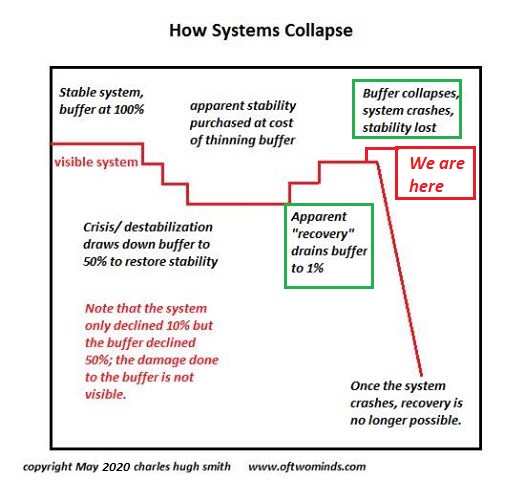
The moral buffers have already thinned; there is nothing left to tap. There is nothing left in what actually matters: social cohesion, moral legitimacy, civic virtue–all stripped, depleted, gone.

Drones and robots won’t save us from collapse. Neither will fusion reactors, electric air taxis, billionaires in space, missions to Mars, algae-based meat or any of the other thousand “innovations” those profiting from moral rot promote in the hopes that the banquet of consequences being served can be swept away by more gimmicks, more artifice, more delusions, more fantasies, more PR, more spin and more narrative control.

Collapse can’t be gimmicked away. The notion that consequence can be as easily managed as PR is the ultimate artifice and the ultimate delusion.

America Is Now a Kleptocrapocracy

By Charles Hugh Smith

Source: Of Two Minds

I’ve coined a new portmanteau word to describe America’s descent: kleptocrapocracy, a union of kleptocracy (a nation ruled by kleptocrats) and crapocracy, a nation drowning in a moral sewer of rampant self-interest in which the focus is cloaking all the skims, scams, rackets and bezzles in some virtuous-sounding garb, a nation choking on low-quality junk ceaselessly hawked by robocalls, spam, phishing and Big Tech manipulation.

It’s little wonder trust has collapsed in America: the only thing we can trust is whatever’s being pitched is deceptively packaged to mask the self-interest and profiteering of the perps.

The stench from the decomposing carcasses of once-trusted institutions is everywhere. Insiders and the marketers they pay to cloak their grifting are banking bennies at the expense of hapless debt-serfs who fell for the scam. You need these three costly medications, and then when the side-effects kick in, you need six more to counteract the first three, and so on. But trust us; your “health” (heh) is our only concern. Uh, sure.

Why do state universities need to market themselves like a roto-rooter service? Maybe because they’re both working the sewers: state universities are exploiting the student loan sewers, desperate to recruit another batch of debt-serfs who fell for the 3-card monte game in which a lifetime of debt is exchanged for a credential of dubious value.

The competition for the remaining pool of debt-serfs is heating up, so like everything else in America, the game is now all about marketing, virtue-signaling, exploiting Big Tech manipulation, and so on.

Doing something useful is now for chumps. The opportunities in America are all about getting rich by doing, well, nothing: skimming 20% “guaranteed” returns in DeFi, mining cryptos, trading stablecoins, selling volatility, etc.–getting rich and then living large on the sweat of the chumps who are still working (poor deluded fools!).

The obvious goal here is for everyone to get in on trading stablecoins, buying rentals with DeFi, churning meme stocks, etc. Why should anyone lower themselves to doing something useful anymore? Why bother?

Labor has been degraded for decades in speculative-frenzy America. Why work when the Fed has our backs and all those newly issued trillions are up for grabs? Doing something useful is for chumps.

Nobody seems to ask what happens when we’re all minting fortunes off speculative churn and there’s nobody filling potholes, stocking shelves or carrying bags of QuikCrete to customers’ trucks.

And while we’re on the subject of sewage: if America’s security services and Big Tech oligarchies track everything and everyone, why are we drowning in robocalls, spam, SMS-spam (smishing), etc.? Couldn’t the NSA/CIA track the spammers and robo-callers down and rendition them (warrantlessly, of course) to a hellhole camp in an unnamed country?

Of course they could. But the ruination of everyday life is of no concern to the kleptocrats (fly with me to the stars!) or our dysfunctional government, which has become nothing more than an invitation-only auction of favors that elevates the relentless pursuit of self-interest and profiteering to new kleptocratic heights.

Please don’t make the mistake of expecting anything to work properly in America. The components are garbage, the parts are on back-order, the people who knew how to make the kludgy mess function just quit in disgust, and we’ll have to get back to you about your request, as our service staff just left to launch an OnlyFans site.

I don’t want to work, I’m minting money speculating, but gol-darn it, I want everyone else to wait on me and meet my needs for low, low quality goods and services at not-so-low prices, and if I’m not treated well enough by everyone earning chump-change, then I’ll freak out, and if that doesn’t pan out, I’ll blame it all on my meds. Accountability is like work–only for chumps.

Trust me, everything’s going great and we’re all going to get wealthier and wealthier until we won’t be able to take it any more, it will be so great. I hope everyone here is hungry because the banquet of consequences is being served.