Where is Neo When We Need Him — Paul Craig Roberts

images

By Paul Craig Roberts

Source: PaulCraigRoberts.org

In The Matrix in which Americans live, nothing is ever their fault. For example, the current decline in the US stock market is not because years of excessive liquidity supplied by the Federal Reserve have created a bubble so overblown that a mere six stocks, some of which have no earnings commiserate with their price, accounted for more than all of the gain in market capitalization in the S&P 500 prior to the current disruption.

In our Matrix existence, the stock market decline is not due to corporations using their profits, and even taking out loans, to repurchase their shares, thus creating an artificial demand for their equity shares.

The decline is not due to the latest monthly reporting of durable goods orders falling on a year-to-year basis for the sixth consecutive month.

The stock market decline is not due to a week economy in which after a decade of alleged economy recovery, new and existing home sales are still down by 63% and 23% from the peak in July 2005.

The stock market decline is not due to the collapse in real median family income and, thereby, consumer demand, resulting from two decades of offshoring middle class jobs and partially replacing them with minimum wage part-time Walmart jobs without benefits that do not provide sufficient income to form a household.

No, none of these facts can be blamed. The decline in the US stock market is the fault of China.

What did China do? China is accused of devaluing by a small amount its currency.

Why would a slight adjustment in the yuan’s exchange value to the dollar cause the US and European stock markets to decline?

It wouldn’t. But facts don’t matter to the presstitute media. They lie for a living.

Moreover, it was not a devaluation.

When China began the transition from communism to capitalism, China pegged its currency to the US dollar in order to demonstrate that its currency was as good as the world’s reserve currency. Over time China has allowed its currency to appreciate relative to the dollar. For example, in 2006 one US dollar was worth 8.1 Chinese yuan. Recently, prior to the alleged “devaluation” one US dollar was worth 6.1 or 6.2 yuan. After China’s adjustment to its floating peg, one US dollar is worth 6.4 yuan. Clearly, a change in the value of the yuan from 6.1 or 6.2 to the dollar to 6.4 to the dollar did not collapse the US and European stock markets.

Furthermore, the change in the range of the floating peg to the US dollar did not devalue China’s currency with regard to its non-US trading partners. What had happened, and what China corrected, is that as a result of the QE money printing policies currently underway by the Japanese and European central banks, the dollar appreciated against other currencies. As China’s yuan is pegged to the dollar, China’s currency appreciated with regard to its Asian and European trading partners. The appreciation of China’s currency (due to its peg to the US dollar) is not a good thing for Chinese exports during a time of struggling economies. China merely altered its peg to the dollar in order to eliminate the appreciation of its currency against its other trading partners.

Why did not the financial press tell us this? Is the Western financial press so incompetent that they do not know this? Yes.

Or is it simply that America itself cannot possibly be responsible for anything that goes wrong. That’s it. Who, us?! We are innocent! It was those damn Chinese!

Look, for example, at the hordes of refugees from America’s invasions and bombings of seven countries who are currently overrunning Europe. The huge inflows of peoples from America’s massive slaughter of populations in seven countries, enabled by the Europeans themselves, is causing political consternation in Europe and the revival of far-right political parties. Today, for example, neo-nazis shouted down German Chancellor Merkel, who tried to make a speech asking for compassion for refugees.

But, of course, Merkel herself is responsible for the refugee problem that is destabilizing Europe. Without Germany as Washington’s two-bit punk puppet state, a non-entity devoid of sovereignty, a non-country, a mere vassal, an outpost of the Empire, ruled from Washington, America could not be conducting the illegal wars that are producing the hordes of refugees that are over-taxing Europe’s ability to accept refugees and encouraging neo-nazi parties.

The corrupt European and American press present the refugee problem as if it has nothing whatsoever to do with America’s war crimes against seven countries. I mean, really, why should peoples flee countries when America is bringing them “freedom and democracy?”

Nowhere in the Western media other than a few alternative media websites is there an ounce of integrity. The Western media is a Ministry of Truth that operates full-time in support of the artificial existence that Westerners live inside The Matrix where Westerners exist without thought. Considering their inaptitude and inaction, Western peoples might as well not exist.

More is going to collapse on the brainwashed Western fools than mere stock values.

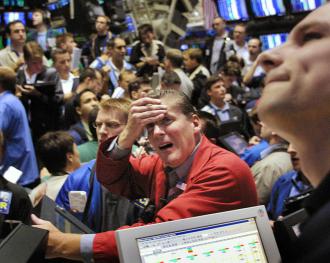
Wall Street Panic

panicked trader

By Mike Whitney

Source: Counterpunch

“Not only is the equity market at the second most overvalued point in U.S. history, it is also more leveraged against probable long-term corporate cash flows than at any previous point in history.”

— John P. Hussman, Ph.D. “Debt-Financed Buybacks Have Quietly Placed Investors On Margin“, Hussman Funds

“This year feels like the last days of Pompeii: everyone is wondering when the volcano will erupt.”

— Senior banker commenting to the Financial Times

Last Friday’s stock market bloodbath was the worst one-day crash since 2008. The Dow Jones dropped 531 points, while the S&P 500 fell 64, and the tech-heavy Nasdaq slid 171. The Dow lost more than 1,000 points on the week dipping back into the red for the year. At the same time, commodities continued to get hammered with oil prices briefly dropping below the critical $40 per barrel mark. More tellingly, the market’s so called “fear gauge” (VIX) skyrocketed to a 2015 high indicating more volatility to come.  The VIX has remained at unusually low levels for a number of years as investors have grown more complacent figuring the Fed will intervene whenever stocks fall too far. But last week’s massacre cast doubts on  the Central Bank’s intentions. Will the Fed ride to the rescue again or not? To the vast majority of institutional investors, who now base their buying decisions on Fed policy rather than market fundamentals, that is the crucial question.

Ostensibly, last week’s selloff  was triggered by China’s unexpected decision to devalue its currency, the juan.   The announcement confirmed that the world’s second biggest economy is rapidly cooling off increasing the likelihood of a global slowdown. Over the last decade, China has accounted  “for a third of the expansion in the global economy,… almost double the contribution of the US and more than triple the impacts of Europe and Japan.” Fears of a slowdown were greatly intensified on Friday when a survey showed that manufacturing in China shrank at the fastest pace since the recession in 2009. That’s all it took to put the global markets into a nosedive. According to the World Socialist Web Site:

“The deceleration of growth in China, reflected in figures on production, exports and imports, business investment and producer prices, is fueling a near-collapse in so-called “emerging market” economies that depend on the Chinese market for exports of raw materials. The past week saw a further plunge in stock prices and currency rates in Russia, Turkey, Brazil, South Africa and other countries. These economies are being hit by a massive outflow of capital, placing in doubt their ability to meet debt obligations.”

(“Panic sell-off on world financial markets”, World Socialist Web Site)

While a correction was not entirely unexpected following a 6-year long bull market, the sudden drop in equities does have analysts rethinking the effectiveness of the Fed’s monetary policies which have had little impact on personal consumption, retail spending, wages, productivity, household income, or economic growth all of which remain weaker than they have been following any recession in the post war era.  For all intents and purposes, the plan to inflate asset prices by dropping rates to zero and injecting trillions in liquidity into the financial system has been an abject failure.   GDP continues to hover at an abysmal 1.5% while  signs of a strong, self sustaining recovery are nowhere to be seen. At the same time, government and corporate debt continue to balloon at a near-record pace draining capital  away from productive investments that could lay the groundwork for higher employment and stronger growth.

What’s so odd about last week’s market action is that the bad news on China put shares into a tailspin instead of sending them into the stratosphere which has been the pattern for the last four years. In fact, the reason volatility has stayed so low and investors have grown so complacent is because every announcement of bad economic data has been followed by cheery promises from the Fed to keep the easy-money sluicegates open until the storm passes.  That hasn’t been the case this time, in fact, Fed chair Janet Yellen hasn’t even scrapped the idea of jacking up rates some time in September which is almost unthinkable given last week’s market ructions.

Why? What’s changed?   Surely, Yellen isn’t going to sit back and let six years of stock market gains be wiped out in a few sessions, is she?  Or is there something we’re missing here that is beyond the Fed’s powers to change? Is that it?

My own feeling is that China is not the real issue. Yes, it is the catalyst for the selloff, but the real problem is in the credit markets where the spreads on high yield bonds continue to widen relative to US Treasuries.

What does that mean?

It means the price of capital is going up, and when the price of capital goes up, it costs more for businesses to borrow. And when it costs more for businesses to borrow, they reduce their borrowing, which decreases the demand for credit. And when the demand for credit decreases in a credit-based system, then there’s a corresponding slowdown in business investment which impacts stock prices and growth. And that is particularly significant now, since the bulk of corporate investment is being diverted into stock buybacks. Check out this excerpt from a post at Wall Street on Parade:

“According to data from Bloomberg, corporations have issued a stunning $9.3 trillion in bonds since the beginning of 2009. The major beneficiary of this debt binge has been the stock market rather than investment in modernizing the plant, equipment or new hires to make the company more competitive for the future. Bond proceeds frequently ended up buying back shares or boosting dividends, thus elevating the stock market on the back of heavier debt levels on corporate balance sheets.

Now, with commodity prices resuming their plunge and currency wars spreading, concerns of financial contagion are back in the markets and spreads on corporate bonds versus safer, more liquid instruments like U.S. Treasury notes, are widening in a fashion similar to the warning signs heading into the 2008 crash. The $2.2 trillion junk bond market (high-yield) as well as the investment grade market have seen spreads widen as outflows from Exchange Traded Funds (ETFs) and bond funds pick up steam.” (“Keep Your Eye on Junk Bonds: They’re Starting to Behave Like ‘08 “, Wall Street on Parade)

As you can see, the nation’s corporations don’t borrow at zero rates from the Fed. They borrow at market rates in the bond market, and those rates are gradually inching up. And while that hasn’t slowed the stock buyback craze so far,  the clock is quickly running out. We are fast approaching the point where debt servicing, shrinking revenues, too much leverage, and higher rates will no longer make stock repurchases a sensible option, at which point stocks are going to fall off a cliff. Here’s more from Andrew Ross Sorkin at the New York Times:

“Since 2004, companies have spent nearly $7 trillion purchasing their own stock — often at inflated prices, according to data from Mustafa Erdem Sakinc of the Academic-Industry Research Network. That amounts to about 54 percent of all profits from Standard & Poor’s 500-stock index companies between 2003 and 2012, according to William Lazonick, a professor of economics at the University of Massachusetts Lowell.”

You can see the game that’s being played here. Mom and Pop investors are getting fleeced again. They’ve been lending trillions of dollars to corporate CEOs (via bond purchases) who’ve taken the money, split it up among themselves and their wealthy shareholder buddies, (through buybacks and dividends neither of which add a thing to a company’s productive capacity) and made out like bandits.  This, in essence, is how stock buybacks work. Ordinary working people stick their life savings into bonds (because they were told “Stocks are risky, but bonds are safe”.) that offer a slightly better return than ultra-safe, low-yield government debt (US Treasuries) and, in doing so, provide lavish rewards for scheming executives who use it to shower themselves and their cutthroat shareholders with windfall profits that will never be repaid. When analysts talk about “liquidity issues” in the bond market, what they really mean is that they’ve already divvied up the money between themselves and you’ll be lucky if you ever see a dime of it back. Sound familiar?

Of course, it does. The same thing happened before the Crash of ’08. Now we are reaching the end of the credit cycle which could produce the same result. According to one analyst:

“There’s been worrying deterioration in the overall global demand picture with the continuation of EM (Emerging Markets) FX (Currency Markets) onslaught, deterioration in credit metrics with rising leverage in the US as well as outflows in credit funds in conjunction with significant widening in credit spreads…..The goldilocks period of “low rates volatility-stable carry trade environment of the last couple of years is likely coming to an end.”

(“Credit: Magical Thinking“, Macronomics)

In other words, the good times are behind us while hard times are just ahead. And while the end of the credit cycle doesn’t always signal a stock market crash, the massive buildup of leverage in unproductive financial assets like buybacks suggest that equities are in line for a serious whooping. Here’s more from Bloomberg:

“Credit traders have an uncanny knack for sounding alarm bells well before stocks realize there’s a problem. This time may be no different. Investors yanked $1.1 billion from U.S. investment-grade bond funds last week, the biggest withdrawal since 2013, according to data compiled by Wells Fargo & Co…..

“Credit is the warning signal that everyone’s been looking for,” said Jim Bianco, founder of Bianco Research LLC in Chicago. “That is something that’s been a very good leading indicator for the past 15 years.”

Bond buyers are less interested in piling into notes that yield a historically low 3.4 percent at a time when companies are increasingly using the proceeds for acquisitions, share buybacks and dividend payments. Also, the Federal Reserve is moving to raise interest rates for the first time since 2006, possibly as soon as next month, ending an era of unprecedented easy-money policies that have suppressed borrowing costs….

“Unlike the credit market, the equity market well into 2008 was very complacent about the subprime crisis that led to a full blown financial crisis,” the analysts wrote…..

So if you’re very excited about buying stocks right now, just beware of the credit traders out there who are sending some pretty big warning signs.”  (“U.S. Credit Traders Send Warning Signal to Rest of World Markets”, Bloomberg)

It’s worth noting that the above article was written on August 14, a week before the stock market blew up. But credit was “flashing red” long before stock traders ever took notice.

But that’s beside the point. Whether the troubles started with China or the credit markets, probably doesn’t matter. What matters is that the system about to be put-to-the-test once again because the appropriate safeguards haven’t been put in place, because bubbles are unwinding, and because the policymakers who were supposed to monitor and regulate the system decided that they were more interested in shifting  wealth to their voracious colleagues on Wall Street than building a strong foundation for a healthy economy. That’s why a simple correction could turn into something much worse.

NOTE: As of posting time, Sunday night, the Nikkei Index is down 710, Shanghai down 296, HSI down 1,031. US equity futures are all deep in the red

MIKE WHITNEY lives in Washington state. He is a contributor to Hopeless: Barack Obama and the Politics of Illusion (AK Press). Hopeless is also available in a Kindle edition. He can be reached at fergiewhitney@msn.com.

Sumerian Economics

sumerian-king-list

By Peter Lamborn Wilson

Source: Reality Sandwich

Public secret: everyone knows but no one speaks. Another kind of public secret: the fact is published but no one pays attention.

A cuneiform tablet called The Sumerian King List states that “kingship first descended from heaven in the city of Eridu,” in the south of Sumer. Mesopotamians believed Eridu the oldest city in the world, and modern archaeology confirms the myth. Eridu was founded about 5000 BC and disappeared under the sand around the time of Christ.

Eridu’s god Ea or Enki (a kind of Neptune and Hermes combined) had a ziggurat where fish were sacrificed. He owned the ME, the fifty-one principles of Civilization. The first king, named “Staghorn,” probably ruled as Enki’s high priest. After some centuries came the Flood, and kingship had to descend from heaven again, this time in Uruk and Ur. Gilgamesh now appears on the list. The flood actually occurred; Sir Leonard Wooley saw the thick layer of silt at Ur between two inhabited strata.

Bishop Ushher once calculated according to the Bible that the world was created on October 19th 4004 BC at 9 o’clock in the morning. This makes no Darwinian sense, but provides a good date for the founding of the Sumerian state, which certainly created a new world. Abraham came from Ur of the Chaldees; Genesis owes much to the Enuma Elish (Mesopotamian Creation Myth). Our only text is late Babylonian but obviously based in a lost Sumerian original. Marduk the wargod of Babylon has apparently been pasted over a series of earlier figures beginning with Enki.

Before the creation of the world as we know it a family of deities held sway. Chief among them at the time, Tiamat (a typical avatar of the universal Neolithic earth goddess) described by the text as a dragon or serpent, rules a brood of monsters and dallies with her “Consort” (high priest) Kingu, an effeminate Tammuz/Adonis prototype. The youngest gods are dissatisfied with her reign; they are “noisy,” and Tiamat (the text claims) wants to destroy them because their noise disturbs her slothful slumber. In truth the young gods are simply fed up with doing all the shitwork themselves because there are no “humans” yet. The gods want Progress. They elect Marduk their king and declare war on Tiamat.

A gruesome battle ensues. Marduk triumphs. He kills Tiamut and slices her body lengthwise in two. He separates the halves with a mighty ripping heave. One half becomes sky above, the other earth below.

Then he kills Kingu and chops his body up into gobs and gobbets. The gods mix the bloody mess with mud and mold little figurines. Thus humans are created as robots for the gods. The poem ends with a triumphalist paean to Marduk, the new king of heaven.

Clearly the Neolithic is over. City-god, war-god, metal-god, vs. country-goddess, lazy goddess, garden goddess. The creation of the world equals the creation of civilization, separation, hierarchy, masters and slaves, above and below. Ziggurat and pyramid symbolizes the new shape of life.

Combining Enuma elish and the King List we get an explosive secret document about the origin of civilization not as gradual evolution towards inevitable future, but as violent coup, conspiratorial overthrow of primordial rough-egalitarian Stone Age society by a crew of black magic cult cannibals. (Human sacrifice first appears in the archaeological record at Ur III. Similar grisly phenomena in the first few Egyptian dynasties.)

About 3100 writing was invented at Uruk. Apparently you can witness the moment in the strata: one layer no writing, next layer writing. Of course writing has a prehistory (like the State). From ancient times a system of accounting had grown up based on little clay counters in the shapes of commodities (hides, jars of oil, bars of metal, etc.) Also glyptic seals had been invented with images used heraldically to designate the seals’ owners. Counters and seals were pressed into slabs of wet clay and the records were held in Temple archives-probably records of debts owed to the Temple. (In the Neolithic Age the temples no doubt served as redistribution centers. In the Bronze Age they began to function as banks.)

As I picture the invention of real writing took place within a singly brilliant family of temple archivists over three or four generations, say a century. The counters were discarded and a reed stylus was used to impress signs in clay, based on the shapes of the old counters, and with further pictograms imitated from the seals. Numbering was easily compacted from rows of counters to number-signs. The real break-through came with the flash that certain pictographs could be used for their sound divorced from their meaning and recombined to “spell” other words (especially abstractions). Integrating the two systems proved cumbersome, but maybe the sly scribes considered this an advantage. Writing needed to be difficult because it was a mystery revealed by gods and a monopoly of the New Class of scribes. Aristocrats rarely learned to read and write — a matter for mere bureaucrats. But writing provided the key to state expansion by separating sound from meaning, speaker from hearer, and sight from other senses. Writing as separation both mirrors and reinforces separation as “written,” as fate. Action-at-a-distance (including distance of time) constitutes the magic of the state, the nervous system of control. Writing both is and represents the new “Creation” ideology. It wipes out the oral tradition of the Stone Age and erases the collective memory of a time before hierarchy. In the text we have always been slaves.

By combining image and word in single memes or hieroglyphs the scribes of Uruk (and a few years later the pre-dynastic scribes of Egypt) created a magical system. According to a late syncretistic Greco-Egyptian myth, when Hermes-Toth invents writing he boasts to his father Zeus that humans never need forget anything ever again. Zeus replies, “On the contrary my son, now they’ll forget everything.” Zeus discerned the occult purpose of the text, the forgetfulness of the oral/aural, the false memory of the text, indeed the lost text. He sensed a void where others saw only a plenum of information. But this void is the telos of writing.

Writing begins as a method of controlling debt owed to the Temple, debt as yet another form of absence. When full-blown economic texts appear a few strata later we find ourselves already immersed in a complex economic world based on debt, interest, compound interest, debt peonage as well as outright slavery, rents, leases, private and public forms of property, long distance trade, craft monopolies, police, and even a “money-lenders bazaar.” Not money as we understand it yet, but commodity currencies (usually barley and silver), often loaned for as much as 33 1/3rd % per year. The Jubilee or periodic forgiveness of debts (as known in the Bible) already existed in Sumer, which would have otherwise collapsed under the load of debt.

Sooner or later the bank (i.e. the temple) would solve this problem by obtaining the monopoly on money. By lending at interest ten or more times its actual assets, the modern bank simultaneously creates debt and the money to pay debt. Fiat, “let it be.” But even in Sumer the indebtedness of the king (the state) to the temple (the bank) had already begun.

The problem with commodity currencies is that no one can have a monopoly on cows or wheat. Their materiality limits them. A cow might calve, and barley might grow, but not at rates demanded by usury. Silver doesn’t grow at all.

So, the next brilliant move, by King Croesus of Lydia (Asia Minor, 7th century BC) was the invention of the coin, a refinement of money just as the Greek alphabet (also 7th cen.) was a refinement of writing. Originally a temple token or souvenir signifying one’s “due portion” of the communal sacrifice, a lump of metal impressed with a royal or temple seal (often a sacrificial animal such as the bull), the coin begins its career with mana, something super-natural, something more (or less) than the weight of the metal. Stage two, coins showing two faces, one with image, the other with writing. You can never see both at once, suggesting the metaphysical slipperiness of the object, but together they constitute a hieroglyph, a word/image expressed in metal as a single meme of value.

Coins might “really” be worth only their weight in metal but the temple says they’re worth more and the king is ready to enforce the decree. The object and its value are separated; the value floats free, the object circulates. Money works the way it works because of an absence not a presence. In fact money largely consists of absent wealth-debt — your debt to king and temple. Moreover, free of its anchor in the messy materiality of commodity currencies, money can now compound unto eternity, far beyond mere cows and jars of beer, beyond all worldly things, even unto heaven. “Money begets money,” Ben Franklin gloated. But money is dead. Coins are inanimate objects. Then money must be the sexuality of the dead.

The whole of Greco-Egypto-Sumerian economics compacts itself neatly into the hieroglyphic text of the Yankee dollar bill, the most popular publication in the history of History. The owl of Athena, one of the earliest coin images, perches microscopically on the face of the bill in the upper left corner of the upper right shield (you’ll need a magnifying glass), and the Pyramid of Cheops is topped with the all-seeing eye of Horus or the panopticonical eye of ideology. The Washington family coat of arms (stars and stripes) combined with imperial eagle and fasces of arrows, etc.; a portrait of Washington as Masonic Grand Master; and even an admission that the bill is nothing but tender for debt, public or private. Since 1971 the bill is not even “backed” by gold, and thus has become pure textuality.

Hieroglyph as magic focus of desire deflects psyche from object to representation. It “enchains” imagination and defines consciousness. In this sense money constitutes the great triumph of writing, its proof of magic power. Image wields power over desire but no control. Control is added when the image is semanticized (or “alienated”) by logos. The emblem (picture plus caption) gives desire or emotion an ideological frame and thus directs its force. Hieroglyph equals picture plus word, or picture as word (“rebus”), hence hieroglyph’s power and control over both conscious and unconscious — or in other words, its magic.

Overcoming the American Dream

george-carlin-american-dream

By Frank Castro

Source: The Hampton Institute

“Anyone who has ever struggled with poverty knows how extremely expensive it is to be poor.” – James Baldwin
My house sat tucked a mile deep, wrapped in 500 acres of sprawling oaks and towering pines. Dense thickets crisscrossed the land like formidable barricades protecting masses of forests from the intrusions of bored, yet curious children. They would leave you picking daggers from your sides and forearms if you journeyed too far. I grew up in a remote place called Farmhaven, the midway point between Canton and Carthage, Mississippi. Driving through you would never know you were somewhere with a name. Farmhaven is one of those places marked by only an intersection and a road that always goes somewhere else. It is here though, with my father and my brother, in the heart of the South, that I learned the most important lesson life could teach me.

When I was very young the world was a place of limitless potential. Like a naïve summer breeze still clinging to the fantasy that winter will never come, I was no different than most children who believe the world is theirs. You do not have to be rich to dream such dreams. A swift run and leap off the South end of our porch, where the ground was soft and the magnolia leaves puddled, was all it took. With my arms stretched wide I pretended to be a fighter pilot leaving the deck of an aircraft carrier. I never really knew or cared what fighter pilots do; I just wanted to see the world through a bird’s eyes. It was my own American Dream. And the further from the porch I landed, the more I believed I would someday soar.

It’s probably not an unfamiliar story. After all, in children imagination abounds. About this time we start being told to follow our dreams, as if the world were built in such a way that the realization of all our dreams is possible. Certainly that’s what I believed, that people just out to make the imagined real. Life is not without a cruel sense of irony though, and elders rarely mention to adolescents the kind of world in which we live. They shield us from it, understandably not wanting to damage the authenticity and fragility of our youthful ambition. But reality will come knocking. It always does. It will come to tell us that the world has been built in such a way that our dreams will be withheld from us, that the joys of making them real cannot be ours, but rather, with and atop our backs, they must be forfeited to erect someone else’s.

This is the price of poverty.
Knock, Knock

“Capitalism is cruel and heartless and tears people apart, mentally, physically and socially.” - Susan Rosenthal

My father taught me the value of work. For all his faults, I could never question how hard he labored to provide for my brother and me, or how determined he was to instill in us a love for building with our own hands. He tried to teach us how to work the land. We plowed and planted. We built homes for our chickens, turkeys, and ducks. We constructed wooden and wire fences for rotating our goats and horses from one field to another. During the winter months when our grazing fields turned to tundra, I hoisted buckets of feed to the troughs I had built. My brother and I became so proficient with our hands that often my father would drop us off in the woods with supplies and expect a job to be done when he returned with lunch.

But neither our farm nor all the work we put into it was ever what kept a roof over our heads. Even after the fruits of our labor yielded plates for our table, we still needed money. I knew this all too well, even as a seven year old. My room was in the middle of our house. You could not get from the kitchen to the living room without first walking through it. Often a door was left cracked open, not intentionally, but because door frames shift with age and require a firm snug to be pulled completely shut. Through the years while I had a step-mother I heard my father and her argue about bills when the doors where ajar. Always more bills. They both worked in addition to our farm. She worked at a cigarette store. His job always changed. And still it was never enough. Sometimes they got loud. Her voice screeched. His slurred. And mine would make lists in my head of everything I was going to do the next day to make it all better.

I began doing my own laundry about that time because I wanted my step-mother to stay. My child’s mind thought it would make a difference. She left after a few more years though, and when it happened I really could not blame her. My father had begun turning to his bottles more often than he turned to her. When he got drunk enough one night to put a shotgun to my brother’s head, she lost all composure. Refrigerator doors flung open. Voices thundered. Walls shook. Glass bottles clanked and flew further off the porch than I ever had, exploding all over the lawn - just like my family, exploding. My screams were equal only to my tears. Every little list I had made in my head was useless. The gun landed in the yard too after my step-mother snatched it. My brother and I spent that night in the shadow of two people we loved parting ways forever. Soon we lost the farm… and our father too.

I never soared into those magnolia leaves again. In the years to come dreams of a family and a home where I belonged replaced all desire to fly.

Not till much later did I realize that nothing I did then would have made a significant difference. Neither my brother nor I held fault for our poverty and, despite his drinking, it was not entirely my father’s fault either. Addiction, I learned, is most often endemic of a society that generates addicts. Something bigger loomed, something far more pervasive and far-reaching than the lives of a few backwoods Mississippians. Reflecting on how expensive poverty had been for my family, asking why I was poor and why were we ripped apart, I found myself on an inescapable trajectory to discover the origins of inequality.
Their Gluttony Is Our Starvation

“The class which has the power to rob upon a large scale has also the power to control the government and legalize their robbery.” - Eugene V. Debs

My family’s farm was bought by a group of wealthy men who wanted a hunting resort. For the majority of the year our old home sits empty and rotting. It is a reminder that in the halls of country clubs and on the decks of overpriced yachts, poverty is, in the most acute sense of the word, the abundant currency of the rich. Their very existence is predicated on the existence of the poor.

This is not a fact we like to grapple with in America. Here everybody believes they can get rich. We believe the realization of ALL of our dreams is possible. We call this belief the American Dream, and it has been incredibly successful at stifling plausible attempts at equality outside the capitalist framework. To paraphrase John Steinbeck, socialism never took root in America because the poor see themselves not as an exploited proletariat but as temporarily embarrassed millionaires. It is the worst sort of fabrication because it makes us believe the preposterous - my family could have our house, our farm, a decent living with ample food, and an environment where addiction would stymy, while simultaneously rich folks could use it all to shoot animals for sport.

If it sounds ridiculous, it’s because it is.

Under capitalism one party was always going to lose, and generally the party which loses is the one with significantly less money. Our socioeconomic realities are structured this way. “Losers” are a necessity for capitalism’s survival. My family’s misfortune was a microcosm of structured events that play out against billions of poor people in orchestrated symphony every day. They (we) find ourselves in battles with people, organizations, and nations who have enormous financial capabilities, and therefore power, and because our global political system was built around empowering the moneyed class, before the battle ever starts our circumstances are engineered for defeat. Scaled up or down, this predisposition between those with power and those without is consistent. It is why my family lacked the financial agency over our lives to survive. But it is also why entire poor communities are displaced and gentrified by wealthy developers, or entire swaths of the planet are exploited by wealthy nations and their corporations. Where ever we are, our struggles are connected.

The American Dream then has at least two primary functions. Its first is to generate a mythology around itself which can effectively negate the reality that within capitalism not everybody can realize their dreams, that there must be an oppressed class. Such a mythology atomizes people from collective struggle. It induces a form of hyper individualism often seen in the “Boot-Strap Myth,” or the idea that anybody of little means, with hard work and determination, can lift themselves to the highest rungs of bourgeoisie society (the richest of the rich). By focusing on individual stories of capitalist success, the Bill Gates and Sam Waltons of the world, the vast poverty and suffering required for the emergence of massive fortunes is left out of the picture. One can point to Gates and believe their own ascendance is possible without understanding its possibility is predicated on the systematic exploitation of tens of thousands of workers in mines and factories across the globe. And more importantly, focus on the few success stories of the super-rich invisibilizes the structure which keeps wealth within their hands at the direct expense of the poor and makes it beyond examination or reproach.

A second primary function of the American Dream is to facilitate an overpowering sense of entitlement through exploitive competition. It cleaves us from cooperative modes of thinking and existing by constantly pitting us against each other. Through competing with fellow human beings for the necessities of life - work, housing, education, affection, nourishment, social belonging, etc. - an individual is conditioned to accept that competition is the natural state of human existence, and therefore competition necessitates winners and losers. Here, belief of capitalist mythology graduates into acceptance of capitalist power structures, and then finally into the endorsement and full-fledged participation in them. The latter is crucial, for in order to amass a huge fortune a person has to endorse a sort self-maximizing choice which, in their minds, justifies widespread exploitation. At this point it is believed that “losers” (the exploited) are inevitable, thus the more losers, or the greater number of exploited, the richer (and fewer) the winners. If you play the game ruthlessly enough to win, or even thrive, the logic follows that you are entitled to all the rewards and privileges expropriated from the oppressed.

With little doubt, I imagine the men who bought our farm thought nothing of it. In their minds having the money for it was the only requisite needed, and since they had played by the rules of capitalism well enough to be rewarded with the money needed to purchase it, they were “entitled” to it. But it was never their home. They had never toiled in the fields for crops. They had never spent a birthday or Christmas Eve in the house. They had never fished the ponds. They had never run around the yard filling the trees with laughter, or fed the hummingbirds from the clotheslines. They had never made peace with the bees that burrowed into the oak joists beneath the porch. They had never labored with an axe to stock firewood or climbed beneath the house and wrapped the pipes for winter. They knew nothing of the land or the house but its acreage and price. And that was enough, because the memories of children don’t fetch power when money talks.
Poverty Is a Weapon of Mass Destruction

“You cannot call a society which has 3.5 million homeless and 18.5 million vacant homes civil. That’s violent and morally bankrupt.” - Frank Castro

Poverty is a weapon of mass destruction. We just do not see it that way because we have a very limited understanding of what violence looks like. Statistics paint a broad picture, like the fact that 7.7 million people die of hunger every year (21,000 a day), or the fact that 3.5 Americans remain homeless despite 18.5 million vacant homes; but unless we know those individuals’ stories, and they resonate with us in some way, a culture of competition and entitlement keeps us preoccupied with trying to realize our own ambitions - or resolve our own problems. Whatever the reason, often we are concerned more with ourselves than our collective struggle.

Myths like the American Dream condition us to accept that an elite minority profiting off widespread misery is the way of the world. But remember, the hungry don’t choose to starve, and few houseless people choose homelessness. They are starved and put on the streets by a system which structurally denies them access to food and shelter. If we are to get a realistic picture of how destructive global capitalism is, it requires a broader and deeper understanding of violence.

In 2013, Peter Joseph tried reframing the parameters of violence:

“If I put a gun to someone’s head, say, a 30-year-old healthy male, pull the trigger, and kill him, assuming an average life expectancy of, say, 84, you can argue that possibly 54 years of life [were] stolen from that person in a direct act of violence.
However, if a person is born into poverty in the midst of an abundant society where it is statistically proven that it would hurt no one to facilitate meeting the basic needs of that person and yet they die at the age of 30 due to heart disease, which has been found to statistically relate to those who endure the stress and effects of low socioeconomic status, is that death, the removal of those 54 years once again, an act of violence? And the answer is “Yes, it is.” You see, our legal system has conditioned us to think that violence is a direct behavioral act. The truth is that violence is a process, not an act, and it can take many forms. You cannot separate any outcome from the system by which it is oriented.”

***Distributed equally, the grains produced throughout the world would provide each person 3,600 calories per day . The average person requires 2,000 calories a day to maintain a healthy diet.

If we can understand the scenario Peter explains as a process of violence multiplied by millions of starving and homeless people, then little more evidence is needed to indict and convict capitalism as the sadistic, murderous, and megalomaniacal system it is. Contrary to what the Boot Straps Myth and the American Dream tell us, poverty sits infinitely more on the shoulders of structures we are born into than it does personal choice, ambition, or determination. If more understood this, perhaps then finally the lie that billions like me were born into poverty because our parents were lazy, untalented, or lack the ambition to succeed, could die.
Dream Differently

“You have to act as if it were possible to radically transform the world. And you have to do it all the time.” - Angela Davis

When poverty consumed my family it destroyed any understanding of unity I had. To this day my dream remains to rediscover what family means for me, what it will look and feel like; but through the pain and the loss this much has become clear: There is no room left for “America” in my dreams. I imagine a world where families are no longer faced with the looming pistol of starvation and homelessness. No borders, rules, or regulations will rip our homes from us. No person or institution will dangle over us the future we strive toward like a tree that grows inches with every stretch for fruit. Instead we will live in cooperation with each other, a cooperation which builds beyond blood and yields families the breadth of communities. I have survived this long by doing what most people with dreams do - by continuing to live every day to make them reality. And while I struggle every day to keep mine alive, I am inspired by the building happening all around me, and by the friends who have been my family.

My story is only one of billions across the globe though - one among a sea of poverty’s victims. Ensuring billions more are not to follow suit requires shedding America’s myths. When we tell children to follow their dreams without empowering them to envision a world beyond global capitalism, and beyond America, we limit them to the possibilities afforded through oppression. We preclude the possibility of starting our lives with visions of a world that centers liberation, cooperation, love, and justice.

As Wolfi Landstreicher once said, “If one loves life, if one wants to expand and flourish, it is absolutely necessary to free desire from the channels to constrain it, to let it flood our minds and hearts with passion that sparks the wildest dreams. Then one must grasp these dreams and from them hone a weapon with which to attack this reality, a passionate rebellious reason capable of formulating projects aimed at the destruction of that which exists and the realization of our most marvelous desires. For those of us who want to make our lives our own, anything less would be unrealistic.”

To us then has fallen the challenge of taking back the power of imagination, of dreaming beyond ourselves and beyond America.

Utopia: The Final Frontier

Spock_vulcan-salute

By Sadie Doyle

Source: The Baffler

Leonard Nimoy, who passed away this past Friday, was less an actor than an icon, an ever-present figure and a seemingly universal pop-culture touchstone. What struck me, upon hearing the news of his death, was that I’d somehow assumed he couldn’t die. It seemed as if Leonard Nimoy had always been there, in one form or another—as Spock, as himself on the best episodes of The Simpsons, as the man singing that ridiculously earworm-y theme song to the animated Hobbit movie—and I’d believed he always would be.

Not bad, for a guy whose biggest claim to fame was a TV show that was cancelled after three seasons. Despite his understandable discomfort with being identified solely with Star Trek (his first memoir was entitled I Am Not Spock, after all), it’s Spock, and Star Trek, that will be Leonard Nimoy’s most lasting legacy.

The role also explains much of the emotional hold he had on fans: he was the purest and clearest symbol of Star Trek’s utopian vision. Spock was an icon of perfectible human nature existing in a perfected world.

The Star Trek universe’s political vision is fun in part because it’s so massively impractical. The reasons I adored it as a child are the same reasons I find it so charming today. To start with, Star Trek is explicitly post-capitalist. No one worries about money; the characters seem to show up to work simply because they like being there. And the one alien species that does operate on a capitalist structure, the Ferengi, are villains. Yet the Federation is entirely devoid of the problems anti-capitalists face now: no one gets stuck with a crap job on the spaceship, because all of the “bad” jobs (factory labor, secretarial work, cleaning the Holodeck) are automated. No one has to worry that sharing resources will deprive them of things they want; in the Federation, everyone is comfortably middle-class, if not rich.

Needless to say, this is impossible. As ecofeminists like Vandana Shiva and Maria Mies have repeatedly affirmed, affluent, technologically enabled Western lifestyles simply can’t be universalized. (See, for instance, this excerpt from their book Ecofeminism (PDF). In the real world, at least, the Earth is a closed system. There’s only so much stuff we can use. Western ideas of “comfort” or affluence depend on Westerners using up vastly disproportionate amounts of that stuff, which depends on global capitalism, which depends on strategically impoverishing other countries and using them as a source of exploited labor. We can create a world where no one is poor, but never a world where everyone is rich; the Earth simply can’t produce enough to support that level of consumption.

But you know what solves the problem of the Earth as closed system? Spaceships, that’s what. In Star Trek, there is infinite Stuff, and whatever you don’t have, you just find on a new planet, or get from the replicator. Poverty and exploitation are things of the past, because their fundamental cause—competition for limited resources—simply doesn’t exist.

Star Trek’s perfect social reality is nothing next to its vision of perfect people. It’s not so much that Star Trek is dorky—although every character on those shows is deeply dorky—as that it lacks the necessary conditions for coolness to arise. There’s no counterculture; the culture is already perfect, so who’d want to counter it? There’s no youthful rebellion—even Wesley Crusher, the much-abhorred teenage pipsqueak of Star Trek: The Next Generation, hangs out mostly with his mom—because there’s nothing to rebel against.

If the Federation can seem humorless, it’s only because the keenest humor, as Freud reminds us, arises from hostility; in Star Trek, interpersonal hostility has been replaced with an all-encompassing sweetness, a sense that, although the characters on the Enterprise may chafe each other occasionally, they’re ultimately friends, making common cause in the best of all possible worlds.

Which brings us to Spock, and to Nimoy. Though Spock is half Vulcan—and, as such, treated to some of the show’s few explicit acknowledgements that racism might not just disappear, via McCoy’s frequent references to him as a “green-blooded goblin”—he was also Star Trek’s clearest statement of what a perfected human might be. His character is cleansed of hatred, fear, greed, and self-destructive impulses, just as the show’s universe is cleansed of oppression. He is a strict rationalist; the show, likewise, puts its faith in science to resolve all practical and emotional problems. If someone is getting on Spock’s nerves, he merely remarks that their actions are “highly illogical.” If something threatens his life, he’s more likely to call it “fascinating” than panic or run away.

Try to visualize Spock yelling at someone in rush-hour traffic. Visualize Spock in the midst of an acrimonious divorce, or picking a pointless fight with a friend after a rough day at work. You can’t. Those are the parts of human nature that are ugly and hard to manage, the parts that we don’t like, and that others don’t like about us. Spock has none of them.

Ridding ourselves of hostility and irrationality is just as impossible as everything else in Star Trek. Nimoy’s great gift as an actor was to make it seem plausible: With his seriousness, with his stillness, with the reserves of humor we could always sense glinting just under the surface (that eyebrow!), he made Spock a real person, and so gave our ideal selves form. That gift made him the most beloved character in one of our most beloved stories. And Star Trek granted him his own measure of immortality. Leonard Nimoy couldn’t stay with us forever. But Spock can.

Screen Shot 2015-02-28 at 7.51.46 PM

Life in the Algorithm

images

By Douglas Haddow

Source: Adbusters

The searches we make, the news we read, the dates we go on, the advertisements we see, the products we buy and the music we listen to. The stock market. The surveillance society. The police state, and the drones. All guided by a force we never see and few understand.

A series of calculation procedures that come together to constitute capitalism’s secret ingredient — the all holy algorithm, that which binds and optimizes. Those strange numerical gods who decide whether or not you’re a terrorist and what kids’ toy is going to set the market on fire this Christmas. But what are they, where did they come from and how did they get so powerful?

Algorithms are not new. You can trace their origin all the way back to a 9th century Persian mathematician by the name of Muhammad ibn Musa al–Khwarizmi (Algoritmi in Latin) from whom the word derives its name. Then there was Abu Yusaf Ya’qub ibn Ishaq al–Kindi, a contemporary of al–Khwarizmi’s at Baghdad’s House of Wisdom. He discovered and developed the science of frequency analysis, or code–breaking, providing a basis for code breaker Alan Turing to develop his Turing Machine, the theoretical prototype for the 9 billion devices currently sending and receiving signals through the Internet.

When we talk about algorithms, when they come up in conversation, often tied to latent and emerging fears, we’re not talking about the mathematical models behind them, we’re talking about the models that the models were modeled on. Most people have never heard of a polytope, Boolean Logic or the Hirsch Conjecture. But everyone has a credit score, whether they like it or not.

If we want to interrogate the true nature of these numbers, the wizard behind the ghost in the machine, we need to look no further than Adam Smith, that dour Scot who lived with his mum and accidentally created the modern world.

Smith was neither a modernist nor a cosmopolitan. He was an absent’minded hermit who never married, had few friends, suffered from alternating fits of depression and hypochondria, travelled outside Britain on just one occasion and demanded that all his personal writing be burned upon his death. He was the supreme king of unintended consequences, a humble and misunderstood moral philosopher who became the patron saint of greed.

Most famously, and most tragically, Smith was an ambitious writer who got a bit flowery with his language on occasion, and, as a result, his entire legacy was reduced to two words: invisible and hand. As in, the Invisible Hand — that mysterious market force that secretly and surreptitiously guides all our actions and decisions. Or so we’ve been told.

In The Wealth of Nations, the blueprint for what became known as capitalism, Smith drops the phrase but once. It’s situated in a rather dry discussion on trade policy and is used as a metaphor in a straightforward critique of mercantilism’s excessive restrictions.

And that’s it. Just a cursory metaphor used for poetic flourish in an otherwise obscure and forgettable passage. And for the 150 years that followed the book’s publication, that’s exactly what it was — obscure and forgotten. Smith didn’t mention it, his contemporaries didn’t mention it, nor did his critics. Nary a soul on Earth repeated those two words or paid them any heed.

That is, until 1948, when everything changes.

If you look at a Google NGRAM chart of “invisible hand,” you’ll see that there was little to no interest in the phrase up until the 1930s and ’40s, at which point it begins to bubble up a bit, gaining traction in a few peripheral spheres here and there. Then in ’48, Chicago School economist Paul Samuelson writes a book called Economics: An Introductory Analysis, which would go on to become the best–selling economics book of all time.

In his book, Samuelson grabs hold of Smith’s wordplay and freebases meaning from it until a mere metaphor mutates into the economic doctrine that would define the shape and form of global finance for the remainder of the century, and beyond.

“Every individual, in pursuing only his own selfish good, was led, as if by an invisible hand, to achieve the best good for all, so that any interference with free competition by government was almost certain to be injurious,” writes Samuelson. And with that, not only is it justifiable to be callous in the pursuit of wealth, your callousness will somehow, vis–à–vis the invisible hand, uplift those you trample on your way to the top.

Picture Gordon Gekko, hair trickling with high–end product, walking with the gait of limitless sprezzatura, saying, “Greed is right, greed works. Greed clarifies, cuts through and captures the essence of the evolutionary spirit. Greed, in all of its forms; greed for life, for money, for love, knowledge has marked the upward surge of mankind.”

Samuelson would later go on to regret the liberties he took with Smith’s words, but the meme had already been injected into the passive hive mind of economics. What followed was a long and tangled game of economic telephone wherein Smith’s fatalistic conceit gradually took on mythical qualities. From turn of phrase to doctrine, from doctrine to dogma, from dogma to metaphysical law. The invisible hand became the celestial justification of the free market and the economic rationalist’s negation of anything that stood in its way.

Austrian economist Friedrich Hayek even went so far as to develop an entire theory of human interaction based on the myth. It was called Catallactics, and proposed that we did not live within an economy, but rather, a Catallaxy — a complex and self–organizing system in which every individual sent out a constant stream of complex signals that mixed to create overall market behavior.

Knowledge, Hayek argued, was distributed on an individual level, each person containing their own fraction of the whole.

The vast repository of human knowledge was inherently decentralized. Because of this, no central body or government agency could ever hope to contain enough of it to know what was really going on. But if allowed to move freely without meddling, these messages would come together to create order and equilibrium in the market.

This, he argued, is why the government should never meddle in the market. And why order could never be “planned,” and was instead “brought about by the mutual adjustment of many individual economies in a market.” As long as the signals, our private info–snowflakes, could float freely, the market would reach equilibrium.

Through Hayek, dogma became revelation — the invisible hand was not merely a magical presence promising equilibrium, it was also pointing us toward a not–too–distant utopia. And if we didn’t follow the hand? Oppression and despair would follow mankind into a dark hole of tyranny.

Hayek’s ideas spread swiftly through a series of think tanks connected to his economic clique, The Mont Pelerin Society, which counted Karl Popper, Ludwig von Mises and, of course, who else but Milton Friedman among its members. Together they successfully launched what we now call “neoliberalism” into the political consciousness.

Neoliberalism found its champions in Margaret Thatcher and Ronald Reagan. Thatcher regularly corresponded with Hayek and used the slogan There Is No Alternative (TINA) to explain her affection for its concepts. Reagan hired Friedman to be his economic advisor. And together they carried out an economic revolution that smashed trade unions and deregulated and privatized anything and everything that could be guillotined. From this axis of Anglos, it spread to other parts of the Commonwealth, then to Europe, Asia, South America and beyond.

But no matter how much they stripped away government meddling, somehow the “abstract signals” still weren’t getting through. The hand remained clenched and crises endemic. Asia, Argentina, the Eurozone, the 2008 meltdown, the flash crash. The market continually failing to magically self–correct and achieve equilibrium.

The faithful kept their faith and stuck to the program. The crisis, both economic and existential, were met with a recommitment to the faith in the form of austerity and technology and the dream persisted.

The problem was obvious to anyone outside the neoliberal thought–bubble: the invisible hand wasn’t real and it didn’t exist. It never had existed. It wasn’t just invisible, but immaterial, made from the twisted fantasies of economists obsessed with achieving an impossible “equilibrium.” You couldn’t touch it, and it couldn’t touch you.
Until now.

In 2010, when the Dow Jones Industrial dropped 1000 points in under a minute, the biggest one–day point decline in history, it received far less attention then it deserved, because everything returned to normal a few seconds later. Now, miniature flash crashes occur constantly throughout the day. But this crash was a turning point, demonstrating that something had changed. That something was that the neoliberals had achieved what communists, socialists and Christians never could: they made their god real, and in doing so, achieved their utopia. They just didn’t let the rest of us in on it.

The critical flaw in Hayek’s vision of the hand was that a “central body” could never gather enough information. We know this to be untrue, and with big data and the analysis and manipulation of that data through algorithmic equation, the missing link between money and the machine was discovered.

The searches we make, the news we read, the dates we go on, the advertisements we see, the products we buy and the music we listen to. The stock market … All informed by this marriage between mathematics and capital, all working together in perfect harmony to achieve a singular goal — equilibrium. But it’s a curious sort of equilibrium. Less to do with the relationship between supply and demand, and more about the man and the market.

All these algorithms we encounter throughout the day, they’re working toward a greater goal: solving problems and learning how to think. Like the advent and rise of high–frequency trading, they’re part of an optimization trend that leads to a strange brand of perfection: automated profit.

And their current day use, no matter how impressive the specs, is still rooted in 7th century code–breaking. Only now it’s about breaking our individual codes. Throughout the day we send out thousands of our own individual abstract signals and the algorithms figure out how best to streamline our existence into the market’s needs. We’re all just cyphers waiting to get cracked.

This is not the stuff of Orwell and Huxley, but Amazon and the NSA.

There is an overwhelming feeling of inevitability surrounding all of this. With computational capacity still threatening to double every two years, the algorithmic estate will continue to expand and become more sophisticated. All of this development, testing and research is leading to a predictable outcome. Given that they are leading investment and research in the sector, Wall Street financiers will develop the world’s first fully functioning Artificial Intelligence.

If any of this feels inevitable, it’s because it was designed to make us feel that way. If the algorithms that organize the world of money were turned on their head and used to analyze the defects in their guiding philosophy, they would shred it all on one razor sharp fact: the world beyond the market is still a real one. And no matter how sophisticated the math, how brilliant the AI, we will always be living in it.

Outside of The Wealth of Nations, Smith employed the Invisible Hand concept on only two other occasions. Once in his Theory of Moral Sentiments, where he slags off the rich, and the other in the History of Astronomy, where he says:

For it may be observed, that in all Polytheistic religions, among savages, as well as in the early ages of Heathen antiquity, it is the irregular events of nature only that are ascribed to the agency and power of their gods. Fire burns, and water refreshes; heavy bodies descend, and lighter substances fly upwards, by the necessity of their own nature; the invisible hand of Jupiter was never apprehended to be employed in those matters.

These days, the “savages” kick back, polish their yachts and let the machines do their thinking for them. Their god is a primitive and cruel one. Worse yet, it lacks imagination. The future it sees is just an optimized version of the present. Everything that falls within its gaze is predictable, because mathematical sequences are predictable. What remains to be seen is whether or not human beings are as predictable as the machines think we are.

Zombie Apocalypse and the Politics of Artificial Scarcity

By Colin Jenkins

Source: The Hampton Institute

cdc_zombie_attacksDystopian narratives have long been an alluring and thought-provoking form of entertainment, especially for those who take an interest in studying social and political structures. From classics like Nineteen Eighty-Four and Brave New World to the current hit, The Hunger Games, these stories play on our fears while simultaneously serving as warning signs for the future.

Their attractiveness within American society is not surprising. Our lives are driven by fear. Fear leads us to spend and consume; fear leads us to withdraw from our communities; and fear leads us to apathy regarding our own social and political processes. This fear is conditioned as much as it is natural. The ruling-class handbook, Machiavelli’s The Prince, made it clear: “Since love and fear can hardly exist together, if we must choose between them, it is far safer to be feared than loved.”

The idea of apocalypse is a central tenet of human society. We’ve been taught about Armageddon, Kali Yuga, Judgement Day, Yawm ad-Dīn, nuclear holocaust, the end times, the four horsemen, and the Sermon of the Seven Suns. Hierarchical societal arrangements leave us feeling powerless. Exploitative systems like capitalism leave us feeling hopeless. And the widespread deployment of fear ultimately keeps us in our place, and out of the business of those who own our worlds.

The last half-century has brought us the zombie apocalypse – a fictional world where the human race has largely been transformed into a brainless, subhuman hoard of flesh-eaters, with only a few random survivors left to carve out any semblance of life they can find in a barren landscape. The emergence and immense popularity of the TV show The Walking Dead is the latest, and perhaps most influential, piece in a long line of narratives centered within themes of survival, human interaction, and scarcity.
Human Nature and Interaction

Behind all political battles, social critiques, and theoretical inquiries lies the most fundamental question: when left to our own accord, how will we interact with one another? How one answers this question usually goes a long way to how one perceives the world, and how issues are viewed and opinions are formed. To our dismay, potential answers are typically presented in dualities. Are we good or evil? Competitive or cooperative? Generous or greedy? Violent or peaceful?

A common theme among religion has been that human beings are “born into sin” and heavily influenced by “evil forces” to do harmful things. One who embraces this theme will tend to have less faith in humanity than one who does not. For, if we really are engaging in a daily struggle to resist the powers of evil, it is reasonable to assume that evil will take hold of many. How can we trust anyone who, at a moment’s notice, could potentially lose the ability to act on their own conscience? The common theme of our dominant economic system – capitalism – is that human beings are inherently competitive and self-centered. When combined, it is easy to see how such ideologies may create intensely authoritative and hierarchical systems. After all, people who are influenced by strong and evil metaphysical forces while also being drawn toward callous, self-interest certainly cannot be trusted with free will.

This lesson is drilled deep into our psyches with each episode of The Walking Dead, where the potential threat of flesh-eating zombie hoards become an afterthought to the clear and present danger of “evil” humans who are out to get one another. Whether it’s a sadistic governor charming an entire town with violent gladiator events, an outlaw gang with the obligatory pedophile, or a pack of hipster cannibals salivating at the thought of eating their next visitor, the intended theme is clear – human beings are not capable of co-existing, even in a world where they rarely interact.

But is this idea accurate? Are we really drawn toward conflict? Must we compete with one another to survive? Is it appropriate to apply Darwin’s evolutionary theories in a social sense where the “fit” are meant to gain wealth and power over the “weak”? Or are we, as Peter Kropotkin theorized in his classic Mutual Aid, more inclined to mimic most other species on Earth, which have been observed over the course of centuries to exhibit “Mutual Aid and Mutual Support carried on to an extent which made me suspect in it a feature of the greatest importance for the maintenance of life, the preservation of each species, and its further evolution?”

There is ample evidence that we are drawn to cooperation. “Caring about others is part of our mammalian heritage, and humans take this ability to a high level,” explains neuroscientist Sandra Aamodt. “Helping other people seems to be our default approach, in the sense that we’re more likely to do it when we don’t have time to think a situation through before acting. After a conflict, we and other primates-including our famously aggressive relatives, the chimpanzees-have many ways to reconcile and repair relationships.” Studies have shown that in the first year of life, infants exhibit empathy toward others in distress. Evolutionary Anthropologist Michael Tomasello has put “the concept of cooperation as an evolutionary imperative to the test with very young children, to see if it holds for our nature and not just our nurture. Drop something in front of a two-year-old, he finds, and she is likely to pick it up for you. This is not just learned behavior, he argues. Young children are naturally cooperative.”

So, if we are truly inclined to cooperate with one another, why is there so much division and turmoil in the world? The answer to this question may be found by assessing not only the mechanisms of capitalism, but more importantly in the creation of artificial scarcity as a means to maintain hierarchies.
Capitalism and Artificial Scarcity

It is no secret that capitalism thrives off exploitation. It needs a large majority of people to be completely reliant on their labor power. It needs private property to be accessible to only a few, so that they may utilize it as a social relationship where the rented majority can labor and create value. It needs capital to be accessible to only a few, so that they may regenerate and reinvest said capital in a perpetual manner. And it needs a considerable population of the impoverished and unemployed – “a reserve army of labor,” as Marx put it – in order to create a “demand” for labor and thus make such exploitative positions “competitive” to those who need to partake in them to merely survive. It needs these things in order to stay intact – something that is desirable to the 85 richest people in the world who own more than half of the world’s entire population (3.6 billion people).

But wealth accumulation through alienation and exploitation is not enough in itself. The system also needs to create scarcity where it does not already exist. Even Marx admitted that capitalism has given us the productive capacity to provide all that is needed for the global population. In other words, capitalism has proven that scarcity does not exist. And, over the years, technology has confirmed this. But, in order for capitalism to survive, scarcity must exist, even if through artificial means. This is a necessary component on multiple fronts, including the pricing of commodities, the enhancement of wealth, and the need to inject a high degree of competition among people (who are naturally inclined to cooperation).

Since capitalism is based in the buying and selling of commodities, its lifeblood is production. And since production in a capitalist system is not based on need, but rather on demand, it has the tendency to produce more than it can sell. This is called overproduction. Michael Roberts explains:

Overproduction is when capitalists produce too much compared to the demand for things or services. Suddenly capitalists build up stocks of things they cannot sell, they have factories with too much capacity compared to demand and they have too many workers than they need. So they close down plant, slash the workforce and even just liquidate the whole business. That is a capitalist crisis.

When overproduction occurs, it must be addressed. There are multiple ways to do this. Marx addressed three options: “On the one hand by enforced destruction of a mass of productive forces; on the other, by the conquest of new markets, and by the more thorough exploitation of the old ones.” Another is through the destruction of excess capital and commodities. Whichever measure is taken, it is paramount that the economy must emerge from a starting point that is different from the ending point where the crisis began. This is accomplished through creating scarcity, whether in regards to labor, production capacity, or commodities and basic needs.

Maintaining scarcity is also necessary for wealth enhancement. It is not enough that accumulation flows to a very small section of the population, but more so that a considerable portion of the population is faced with the inherent struggles related to inaccessibility. For example, if millions of people are unable to access basic needs such as food, clothing, shelter, and healthcare, the commodification of those needs becomes all the more effective. On the flip side, the mere presence of accessibility – or wealth – which is enjoyed by the elite becomes all the more valuable because it is highly sought after.

In this sense, it is not the accumulation of personal wealth that creates advantageous positions on the socioeconomic ladder; it’s the impoverishment of the majority. Allowing human beings access to basic necessities would essentially destroy the allure (and thus, power) of wealth and the coercive nature of forced participation. This effect is maintained through artificial scarcity – the coordinated withholding of basic needs from the majority. These measures also seek to create a predatory landscape – something akin to a post-apocalyptic, zombie-filled world where manufactured scarcity pits poor against poor and worker against worker, all the while pulling attention away from the zombie threat.
Control through Commodification

A crucial part of this process is commodification – the “transformation of goods and services, as well as ideas or other entities that normally may not be considered goods, into commodities” that can be bought, sold, used and discarded. The most important transformation is that of the working-class majority who, without the means to sustain on their own, are left with a choice between (1) laboring to create wealth for a small minority and accepting whatever “wages” are provided, or (2) starving.

In The Socioeconomic Guardians of Scarcity, Philip Richlin tells us that:

“When society deprives any community or individual of the necessities of life, there is a form of violence happening. When society commodifies the bare necessities of life, they are commodifying human beings, whose labor can be bought and sold. Underneath the pseudo-philosophical rationalizations for capitalism is a defense of wage slavery. For, if your labor is for sale, then you are for sale.”

We are for sale, and we sell ourselves everyday – in the hopes of acquiring a wage that allows us to eat, sleep, and feed our families. In the United States, the 46 million people living in poverty haven’t been so lucky. The 2.5 million who have defaulted on their student loans have been discarded. The 49 million who suffer from food insecurity have lost hope. The 3.5 million homeless are mocked by 18.6 million vacant homes. And the 22 million who are unemployed or underemployed have been deemed “unfit commodities” and relegated to the reserve army of labor.

The control aspect of the commodification of labor comes in its dehumanizing effect – an effect that was commonly recognized among 18th and 19th century thinkers. One of those thinkers, Wilhelm Von Humboldt, when referring to the role of a wage laborer, explained “as whatever does not spring from a man’s free choice, or is only the result of instruction and guidance, does not enter into his very nature; he does not perform it with truly human energies, but merely with mechanical exactness, suggesting that “we may admire what he (the laborer) does, but we despise what he is,” because he is essentially not human.

The worker, in her or his role in the capital-labor relationship, exists in a position of constant degeneration. This is especially true with the onset of mass production lines and the division of labor – both of which are inevitable elements within this system. “As the division of labor increases, labor is simplified,” Marx tells us. “The special skill of the worker becomes worthless. He becomes transformed into a simple, monotonous productive force that does not have to use intense bodily or intellectual faculties. His labor becomes a labor that anyone can perform.” As automation and technology progress, such specialized task-mastering even seeps into what was once considered “skilled” labor, thus broadening its reach.

In this role, workers are firmly placed into positions of control within a highly authoritative and hierarchical system.
A World beyond Profit

Dystopian narratives are no longer fiction. From birth, we are corralled into a system that scoffs at free will, stymies our creative and productive capacities, and leaves us little room to carve our own paths. The constructs directed from above are designed to strip us of our inclination to care and cooperate, and make us accept the need to step over one another to get ahead. This is not our nature. Whether we’re talking about Kropotkin’s studies in “the wild” or Tomasello’s experience with children, observable evidence tells us we’ve been duped.

Another world is not just possible; it is inevitable if we are to exist in the long-term. In Post-Scarcity Anarchism, Murray Bookchin offers a glimpse into this world not constructed on labor, profit, and artificial scarcity:

“It is easy to foresee a time, by no means remote, when a rationally organized economy could automatically manufacture small “packaged” factories without human labor; parts could be produced with so little effort that most maintenance tasks would be reduced to the simple act of removing a defective unit from a machine and replacing it by another-a job no more difficult than pulling out and putting in a tray. Machines would make and repair most of the machines required to maintain such a highly industrialized economy. Such a technology, oriented entirely toward human needs and freed from all consideration of profit and loss, would eliminate the pain of want and toil-the penalty, inflicted in the form of denial, suffering and inhumanity, exacted by a society based on scarcity and labor.”

The barren landscape for which we’ve been placed has a future beyond Hershel’s overrun farm, the confines of a prison, the Governor’s creepy town of Woodbury, and the trap known as Terminus. It has a future beyond the artificial constructs of capitalism and hierarchy. Human nature is talking to us… and we’re starting to listen.

Corporatism Stifles Innovation

Corporatism-630-360

By James Hall

Source: BATR.org

For an economy to grow and create actual wealth, innovation is a bedrock component in the development of enhanced prosperity. Prosperity is an intriguing concept. Simply making and accumulating money falls short of establishing a successful economic model. This recent report illustrates a prime example. Facebook stock soars, as company briefly passes IBM in market value. “By most measures, Facebook is dwarfed by IBM: With about 7,000 employees, ten-year-old Facebook is on track to garner $12 billion in sales this year. The 103-year-old IBM has more than 400,000 workers and sold almost $100 billion of computer hardware and software in 2013.”

Is Facebook a shining star of innovation? Or is it the product of a society, which has given up on working towards a successful economy, whereby a prosperous middle class partakes in the engine of continued and shared affluence? Conversely, is IBM an innovated inventor, or is it a dinosaur of a previous era?

However, you answer such questions, Edmund Phelps in an opinion article, Corporatism not capitalism is to blame for inequality argues that tangible innovation is in decline.

“Innovation tailed off between 1940 and about 1970, while the top decile’s share of wealth and income began rising in the 1970s.

The causation runs the other way: losses of dynamism have tended to sharpen wealth inequality because it hits workers of modest means more than it hurts the wealthy. Developing new products is labour-intensive. So is producing the capital goods needed to make them. These jobs disappear when innovation stalls.”

An explanation of The Rise and Fall of Western Innovation, addresses the plight of economic reality. “It is undeniable that the U.S. economy is not delivering the steadily improving wages and living standards the nation’s residents expect.”

Mass Flourishing is meant to be Edmund Phelps’s chef d’oeuvre, the capstone to a half century of research into the sources of national wealth.

A decline in the pace of innovation threatens prosperity, in the U.S. and everywhere else.

The main cause of this decline, according to Phelps, is corporatism—the inevitable tendency of businesses, workers, and other interests to band together to protect what they have. In modern economies, he says, corporations, unions, and other interests turn government into an agency for forestalling change and preserving the status quo.”

The noted economic expert and academic Robert J. Shiller, in his article, Why Innovation Is Still Capitalism’s Star, provides a critique of “Mass Flourishing: How Grassroots Innovation Created Jobs, Challenge and Change”.

“Professor Phelps discerns a troubling trend in many countries, however, even the United States. He is worried about corporatism, a political philosophy in which economic activity is controlled by large interest groups or the government. Once corporatism takes hold in a society, he says, people don’t adequately appreciate the contributions and the travails of individuals who create and innovate. An economy with a corporatist culture can copy and even outgrow others for a while, he says, but, in the end, it will always be left behind. Only an entrepreneurial culture can lead.”

Jared Bernstein does not agree as stated in a response to Professor Shiller in ‘Does the Government Stifle Innovation? I Don’t See It (To the Contrary…)’. “My points are that a) many important innovations have involved government support somewhere along the way, and b) while one could and should worry about waste in this area, I’ve not seen evidence, nor does Shiller provide any, of stifling. …”.

Well, that viewpoint sure sound like Obama’s infamous endorsement of a government corporatism model, “If you’ve got a business — you didn’t build that. Somebody else made that happen.”

When examining the way corporate transnational businesses operate in the real world, their lack of internal in-house innovation is notorious. These gigantic corporatist carnivores excel at mergers and accusations in the quest of monopolization of markets. In these endeavors, their best friend is government cronyism and favoritism.

The essay, Blaming Capitalism for Corporatism, makes an important point.

“In various ways, corporatism chokes off the dynamism that makes for engaging work, faster economic growth, and greater opportunity and inclusiveness. It maintains lethargic, wasteful, unproductive, and well-connected firms at the expense of dynamic newcomers and outsiders, and favors declared goals such as industrialization, economic development, and national greatness over individuals’ economic freedom and responsibility. Today, airlines, auto manufacturers, agricultural companies, media, investment banks, hedge funds, and much more has at some point been deemed too important to weather the free market on its own, receiving a helping hand from government in the name of the “public good.”

Here within dwells the essential dilemma, defining the genuine “Public Good“. Government often acts according to Mr. Bernstein’s idea of progress, especially in technological terms. Focus on the notion – “economically important” – and the language filter that translates into a benefit for the Corporatocracy matrix.

“While “entrepreneurial culture” will always be essential, many innovations that turned out to be economically important in the US have government fingerprints all over them. From machine tools, to railroads, transistors, radar, lasers, computing, the internet, GPS, fracking, biotech, nanotech—from the days of the Revolutionary War to today—the federal government has supported innovation often well before private capital would risk the investment.”

Corporatism invents methods of greater control and market dominance for select elitist beneficiaries. When government provides seed money to fund research projects, pure science is seldom the objective. As examined in the essay, How Government Did (and Didn’t) Invent the Internet, Harry McCracken writes: (I’m even prepared to believe that if the Internet hadn’t been invented at DARPA, the private sector would have stepped in and done the job. But we’ll never know for sure, since it was invented at DARPA.)

Thus, the paradox most people are unable to see beyond the guise of “so called” progress. Is government involvement or outright development of transhumanist futuristic technology a valid form of innovation or is it the terminal scourge of central planning and a controlled economy? Surely, under such a system, the “Mass Flourishing” of sharing the wealth, will no longer be an issue among the “useless eaters”, designated for extinction.

– See more at: http://www.batr.org/corporatocracy/073014.html#sthash.RFUeioGh.dpuf