Social Media and the Society of the Spectacle

By Kenn Orphan

Source: CounterPunch

“The reigning economic system is a vicious circle of isolation. Its technologies are based on isolation, and they contribute to that same isolation. From automobiles to television, the goods that the spectacular system chooses to produce also serve it as weapons for constantly reinforcing the conditions that engender “lonely crowds.”

― Guy Debord, The Society of the Spectacle

“The conscious and intelligent manipulation of the organized habits and opinions of the masses is an important element in democratic society. Those who manipulate this unseen mechanism of society constitute an invisible government which is the true ruling power of our country. We are governed, our minds are molded, our tastes formed, our ideas suggested, largely by men we have never heard of. This is a logical result of the way in which our democratic society is organized. Vast numbers of human beings must cooperate in this manner if they are to live together as a smoothly functioning society.”

― Edward Bernays, Propaganda

“We think we’re searching Google; Google is actually searching us. We think that these companies have privacy policies; those policies are actually surveillance policies. We’re told that if we have nothing to hide, then we have nothing to fear. The fact is, what they don’t tell us and what we are forgetting, that if you have nothing to hide, then you are nothing, because everything about us that makes us our unique identities, that gives us our individual spirit, our personality, our sense of freedom of will, freedom of action, our sense of our right to our own futures, that’s what comes from within. Those are our inner resources. That’s our private realm. And it’s intended to be private for a reason, because that is how it grows and flourishes and turns us into people who assert moral autonomy—an essential element of a flourishing, democratic society.”

― Shoshana Zuboff, author of Master or Slave: The Fight for the Soul of Our Information Civilization 

“Under observation, we act less free, which means we effectively are less free.”

― Edward Snowden

Recently I was rereading some of Guy Debord’s The Society of the Spectacle. I was reminded of how essential this work by the late French Marxist philosopher is to today’s age of social media. Debord’s understanding of how the forces of capital shape our collective experiences and thoughts speaks to our time where algorithms dominate the trajectory of the psyche against a craven backdrop of what political philosopher Sheldon Wolin has described as “inverted totalitarianism.”

Every day we are bombarded with the imagery of empire and capital. It is relentless. Our minds have become both a marketplace and a commodity to be traded. And it is a lucrative industry with Facebook and Google as prime examples. Their data collection and surveillance typify a conjoining of the state and capitalist economy; and they have carved out insidious new spaces in the human brain to coerce self-imposed censorship and conformity to the prevailing consumerist global order.

This social conditioning is a process which requires mass compliance. The infamous propagandist for industry and vaunted “father of public relations” Edward Bernays understood that. It takes time to manipulate the multilayered strata of the human psyche, especially in regard to large populations of people. But history is replete with tragic examples of its successful implementation by powerful interests. Today those interests lie squarely with capital and empire; but the effects are the same, distraction, censorship, alienation, coerced, compliance with the norms of the status quo and the numbing of the critical mind.

Debord said, “Such a perfect democracy constructs its own inconceivable foe, terrorism. Its wish is to be judged by its enemies rather than by its results. The story of terrorism is written by the state and it is therefore highly instructive. The spectating populations must certainly never know everything about terrorism, but they must always know enough to convince them that, compared with terrorism, everything else seems rather acceptable, or in any case more rational and democratic.” This profound observation is even more important today. The state, via mass media, informs us of the villains and phantoms they believe we should fear. Other, far more destructive, deadly and oppressive threats such as the continued proliferation of nuclear arms, catastrophic climate change, collapse of ecosystems, dangers to public health from industrial pollutants, vastly unequal, racist and brutal economic and legal systems, militarism or plutocratic tyranny can then be relegated as non-issues, or at least lesser ones.

Most people on the planet will not suffer or die from a terrorist attack, but they are very likely to be severely affected by the other issues mentioned above. Imagery on portable screens that virtually everyone in the West and around the world has access to communicates messages that may speak to some of these dire or existential problems, but they do so in an abstract manner that divorces the observer from the subject.

As Debord observed, this kind of culture of spectacle informs our personal relationships as well. Whether one is “present” on social media or not has become a sort of litmus test of ones presence in life itself. “Likes” or emojis have replaced and truncated language to such an extent that now older forms of communication are often looked at with novelty, suspicion, or even disgust. What’s more is that emojis in social media, particularly Facebook, have been employed all too often as tools of ridicule or even harassment of weak or vulnerable people. But what is perhaps the most striking about the current social media age is its repetitive narrative of self-aggrandizement. One so repetitive and hypnotic that it almost appears invisible. The “selfie” and “status update” are examples of the unending drive of social media to create a false sense of self to present to the world. Of course this self must conform and be well adjusted to consumerist society in one form or another lest it be tagged for “mental health issues,” subversive thought or behavior, or simply be rendered unnoticed or unimportant by society in general.

Indeed, I am certain Debord would be horrified at the age of social media. At no other time in human history has there been a greater confluence of authoritarian dominance or social control implemented in such an intimate and ubiquitous manner. Unlike Debord’s time, social media provides a new medium to not only socially condition the masses but for the corporate state to gather what was once private information about those masses via their personally owned devices and apps.

That it masquerades as a form of democracy is equally disturbing, especially since at its core it represents the policing of thought and dampening of dissent. He wrote as if penning a prophecy: “The spectator’s consciousness, imprisoned in a flattened universe, bound by the screen of the spectacle behind which his life has been deported, knows only the fictional speakers who unilaterally surround him with their commodities and the politics of their commodities. The spectacle, in its entirety, is his “mirror image.””

This spectacle reigns supreme in today’s social media culture. It is essential to its formulation and operating guidelines. Under such a paradigm history must be sterilized of analysis and ultimately atomized into unrelated instances to make an eternal present, divorced from any transformative potential. Therefore corporations and industries which have long records of polluting the environment or lying to the public about the safety of their products can continue to expand and even be celebrated by the corporate owned media. Religious institutions with long histories of abuse, patriarchy and repression can maintain their status as trusted institutions. The military can repeat the lie over and over that it is noble despite a history drenched in the blood of well documented atrocities and ongoing crimes. The United States and many other nations can keep calling themselves democracies despite quite obvious facts that strongly refute that designation. The mere notion of revolution then is made to be farcical or even dangerous. After all, how could revolution ever be seen as necessary within a democracy?

Social media does not necessarily signal the death of democratic freedom, but in its current form and under the aegis of capital it is certainly a nail in its coffin. This is because under such circumstances it is incapable of being anything other than a means for capital accumulation for the corporate state and a platform for its narrative, and it will do this through ever more invasive, censorial and repressive means. As Edward Snowden pointed out, people are less free when they feel that they are being observed. This is especially so when the observer is the state. Several studies have indicated that there is a sharp decline in certain online searches among the general public following any indication that government agencies are logging those searches, even if those citizens have not committed any crime. And the chilling effect is not unfounded. One incident involved an innocent couple who were visited by counter-terrorism police after searching Google for pressure cookers and backpacks. Since the internet has become the world’s public library, the implications for democracy are as dire as they are clear.

Unplugging from any of this isn’t easy, nor is it necessarily virtuous, but there are ways to divest from its social control personally and collectively. There are also ways to use it which defy its dominant algorithms. Détournement, which merely means rerouting or hijacking in French, is one of those ways. This involves inverting the imagery or messages of capital and empire to illustrate and even amplify their mendacity. It has a long history of effective use in bending the dominant narrative to one which reflects reality.

All of this is not to say that technology or social media are inherently bad, but to recognize that much of it has become a vehicle for a rather pernicious authoritarianism. And its danger lies in the fallacy of its benign appearance. Whether it be Google maps or one of countless other “helpful” apps one uses on a daily basis, surveillance capital becomes a means of controlling behavior, transactions, choices, as well as determining which members of society present a threat to the order. In other words, conformity is strongly reinforced while any form of dissent is rendered dangerously subversive. But although the algorithmic maps to our collective psyche are being endlessly drawn by programmers and their corporate and state masters, we still have the agency to navigate these landscapes with our eyes open. And indeed, the best tool we possess will always be that critically informed dissent the powerful so fear the most.

Why Are American Communities Dying?

By Tom Chatham

Source: Project Chesapeake

Most Americans who have been around for a while know life is nothing like it used to be. When someone wanted a job one was found with a little bit of searching. Today jobs are difficult to find, especially in small communities.

When I was growing up in the 70’s, there were several car dealers in my community. There were three tractor dealers and too many mom and pop stores to count. Today there are two used car dealers and the nearest tractor dealer is twenty miles away. So how is it that we now have more people, but fewer businesses to employ them?

A nations wealth is derived from having a product to sell. That wealth needs to circulate in towns and cities to compound the wealth effect and create jobs and businesses. When wealth is not created or it is siphoned off to other places, the wealth effect can not happen, and in many cases goes into reverse. A community needs a certain amount of service related jobs to function but it also needs some type of production jobs to bring in money from the outside. This can be mining , agriculture or manufacturing type jobs, but they must exist to insure a healthy economy.

America has two major problems today. A large amount of our production is done outside the country eliminating production jobs in local communities and many of the small local businesses that kept wealth within communities have been supplanted by large corporations that siphon wealth out of communities and send it to wall street.

In the past when a small business made profit, that profit was kept in the local community because that is where the owner lived. Now, that profit leaves the community never to be seen again. With less money to circulate within the community the businesses that depend on people spending their extra dollars, have fewer customers and eventually go out of business. With fewer jobs there is that much less money circulating and the economic situation spirals down until nothing is left.

These days corporate businesses and government jobs make up the major part of many local communities. In many cases if it were not for the government jobs, many communities would no longer exist. So what do you think would happen if the government suddenly no longer had money to pay those workers? What would happen if corporate profits dropped to the point where corporate stores decided to close and cut their losses?

To some extent we are seeing this happen now in many places. Corporate stores moved in and drove small local businesses out. Then when the profits dried up the corporate stores closed leaving the community with no jobs or products to buy. With no capital in the local communities to rebuild small businesses, the people simply drive to other areas to do their shopping.

The corporate cronies and government laggards control most of the money flowing through communities now and they want to keep it that way. Any attempt to rebuild local businesses is met with luke warm results. Any business that might make a difference is either killed outright or regulated into oblivion before it can get off the ground. The county where I live has all but abandoned local businesses. The bulk of their income comes from property taxes generated by vacation homes and retirement homes of retired government employees. As long as the government pensions and paychecks continue, they see no reason to change the status quo. The result is that the younger people leave as soon as they can and the average age of the population continues to get older. As with many places today, this area has no future.

Where I live is a microcosm of the nation. Corporate and government entities continue to siphon what little money there is out of communities and just as small communities are dying, the nation will soon follow if current trends do not change. A return to small local economics is the only way to reverse some of the damage and keep our communities livable. But, do not be deceived. There is no way to undo all of the damage that has been done and even if we survive, we will only be a shadow of what we once were as a nation.

Stick to the Plan

Illustration by Mike Faille

Reclaiming central planning from the clutches of corporations

By Brendan James

Source: The Baffler

What do you think the Russians talk about in their councils of state—Karl Marx? They get out their linear programming charts, statistical decision theories, minimax solutions, and compute the price-cost probabilities of their transactions and investments, just like we do.

–CCA Chairman Arthur Jensen, Network

WHAT DO JEFF BEZOS AND JOSEPH STALIN have in common? A certain supervillain chic. Cold-blooded austerity. Iron discipline. A penchant for back-breaking output targets. A healthy appetite for terror.

Yet perhaps their most surprising overlap is that the General Secretary and the chairman of Amazon, Inc. built two of history’s largest centrally planned economies. Then again, maybe it’s not so surprising: What embodies the trademark Bezos-ethos of “Get Big Fast” better than the Five-Year Plan? Thanks to its cutting-edge logistics and coordinated supply chains, Amazon last year clocked a GDP of $230 billion[*]. To Jared Kushner’s recent demand that “the government should be run like a great American company,” let all communists raise a fist of solidarity!

In fact, write Leigh Phillips and Michal Rozworski in The People’s Republic of Walmart, Amazon is just one of thousands of firms, big and small, that centrally plan their inputs and outputs. Of the top hundred global economies, around sixty-nine of them are businesses, not countries; most, if not all, are internally planned. (Sears, which over the last decade broke its firm into an “internal market” of competing units thanks to CEO and Ayn Rand-devotee Eddie Lampert, is conspicuously absent from this list.) Despite the collapse of the USSR and the global gospel of markets that spread in its wake, it seems planning is still working all around us.

The problem is that planning is not working for most of us. Yes, automation and “Big Data” have conjured cheaper goods for consumers—unfortunately, most consumers are also laborers who remain ruthlessly exploited. As the promise of new technology expands each day, workers sleep while standing or collapse from heat exhaustion. Planning, once a revolutionary tool meant to reduce labor time and eliminate exploitation, has become just another vulgar mechanism for maximizing the profits of unelected, authoritarian, union-busting, planet-cooking, superrich vampires. The People’s Republic of Walmart makes the case that the left should reclaim the radical demand for a democratically planned economy and repurpose this corporate apparatus for the flourishing of all. Far from a dry pamphlet on logistics theory, the book raises crucial questions about justice, technology, and our capacity to build a new world in the face of economic and climate catastrophe.

The planned economy was supposed to have gone extinct three decades ago. The Soviet Union gasped its last breath, American capitalism sprayed a bottle of Cristal, European social democracy ordered another latte, and China pressed a big button labeled “Market Socialism.” But if you really put the time in, you could probably get a wonk from the Hoover Institution to grudgingly accept that government planning still beats the market in the realm of certain public services, such as health care or fire departments. The knives come out, though, when this approach is proposed for things like housing, pharmaceuticals, energy, or, heaven forbid, consumer goods in general.

What may surprise newcomers, however, is that many self-described Marxists are wary of planning, too. Despite being thanked in Phillips and Rozworski’s acknowledgements, Bhaskar Sunkara, editor of the left-wing magazine Jacobinidentifies as a market socialist. In a 2013 essay sketching an agenda for the left, Jacobin’s executive editor Seth Ackerman conceded that markets are necessary, so perhaps we’d best just find a way to socialize them. Vivek Chibber, professor of sociology and, along with Sunkara, one of several co-authors of The ABCs of Socialismdismisses planning as a dead-end: “We can want planning to work, but we have no evidence that it can.” One of the left’s “worst legacies” has been to “identify socialism with central planning.” Market socialism, we’re told, is communism for grown-ups.

Everyone from the market socialist to the Austrian economist has taken one side of an incredibly sexy academic exchange known as the “socialist calculation debate.” The argument should be familiar: market transactions provide producers with essential information about what consumers and other producers need, and therefore how much to make. To try and calculate (that is, plan) this galaxy of interdependent inputs and outputs is impossible in a fluid economy. It’s a matter of information, you fool. And like it or not, market prices are the best way to collect the information we need to map out supply and demand.

A rich tradition of heterodox economics, mathematics, and computer science has materialized to answer this problem of calculation. But it is modern processing power, dwarfing the bandwidth available in the twentieth century, that truly rebukes the argument above. Consider computer scientist and economist Paul Cockshott who, in about two minutes, using only university equipment, claims to have run models that were able to optimize an economy “roughly the size of Sweden.” You get the feeling that the mammoth data centers at Amazon, Ford, or Foxconn might be capable of even more impressive calculations. And besides, to insist communist theory prove some perfect equation is either disingenuous or missing the point. The question is not whether planning is mathematically pristine, but whether it can allocate better than the market.

The answer, to return to the material world, is yes it can. It’s true that under capitalism firms plan internally but compete with each other, a dance that keeps companies innovating new ways to capture surplus and, sometimes, inadvertently benefit regular people. This dynamic would not occur naturally in a planned economy; one cannot just seize Amazon or Walmart, socialize it, and call it a day. Phillips and Rozworski apparently recognize this (there is an entire chapter in The People’s Republic of Walmart titled “Nationalization Is Not Enough”) and point to an interesting line of thought from economist J. W. Mason: Banks tend to operate as a privatized Gosplan, where the slush fund of finance capital flows to whichever firm a group of Brooks Brothers-clad planners decide deserves investment, regardless of profitability. Market competition, in other words, is hardly the divine engine of innovation if so many firms are, as Mason writes, “born new each day by the grace of those financing it.”

Even so, could planning replicate the market’s capacity to innovate? Ford’s former CEO Mark Fields certainly seemed to think so, declaring in 2016 that his company would soon “be able to use analytics to anticipate people’s needs, as opposed to people trying to tell us what they want.” And to the perennial taunt of the lizard-brained conservative—“I love seeing idiot millennials protest capitalism on their Apple-made IPHONES”—one may point out it was largely the market-immune Pentagon and Department of Energy, not Apple, that developed the batteries, algorithms, touch screens, and microprocessors our right-wing friend uses to tweet about the Muslim Caravan. Once again, none of this is to celebrate the actual decisions or practitioners of planning as it exists under capitalism, but to recognize its power and how else it might be put to use.

So much for feasibility. Still, the left has good reason to harbor deeper techno-skepticism. When most of us hear the phrase “data collection,” we think not so much of social justice but of Facebook selling our personal information, NSA surveillance, and racist models of “predictive” policing. In Automating Inequality, Virginia Eubanks catalogs state policies that placed welfare applications, housing allocation, and child welfare investigations under algorithmic control. The results have been catastrophic for the poor and working class, of every race and gender. Algorithms, after all, are written by humans, and prejudices operate just as easily in digital form as they do in twentieth century analog—perhaps even more so. Phillips and Rozworski acknowledge this reality and rightfully urge vigilance. If planning is to make use of such technology, we must make sure not to bake this poison into the cake.

But hope lies in the very recognition that technology is a political construct, rather than some transcendental, neutral force. If we can program the reinforcement of hierarchies, we can certainly work to program their destruction. (There’s already encouraging research as to how to account for problems such as “disparate impact.”) As Eubanks writes, “if there is to be an alternative, we must build it on purpose, brick by brick and byte by byte.”

Beyond algorithmic justice, the real specter haunting socialism is, naturally, the Union of Soviet Socialist Republics, whose record in planning was less than exemplary. While capital-C Communism brought about modern industry, literacy, and social security, Phillips and Rozworski don’t deny the ultimate failure of the Soviet experiment. The October Revolution was contorted and compromised by a world war, a civil war, imperialist invasion, economic backwardness, another world war, and a half-century of military competition with the United States. For the sake of the revolution, democracy was indefinitely postponed. Even if Soviet and East German firms were just as or more efficient than their Western counterparts, this arrangement still resulted in workers resisting work and managers lying about output, i.e., bad information. (In a particularly cruel irony, Gosplan bureaucrats even took to sabotaging new computerized approaches to planning, lest they personally lose their political clout. Their unlikely co-conspirators were “reform” minded crypto-capitalists who worried the algorithms would actually succeed, leaving planning in place forever!)

For Phillips and Rozworski, it wasn’t communist planning that led to authoritarianism and disaster, but authoritarianism and disaster that led to bad planning. “Democracy,” they write, “is not some abstract ideal tacked on to all this, but essential to the process.”

A few years ago. Francis Spufford’s novel Red Plenty cast the very idea of Soviet planning as its hero, wherein it falls from grace, as all tragic heroes do. There’s no need to understate that tragedy, but it ispossible to overstate it. Let’s not forget what happened after the victorious arrival of the market in the former USSR: production of consumer goods, industrial output, and human life expectancy all cratered. A new class of homeless citizens emerged, frozen to death in streets, alleyways, and parks. We often discuss the millions of deaths in the Stalinist 1930s. We don’t discuss the millions of deaths in the post-Communist 1990s. Unsurprisingly, recent polling revealed that a majority of those surveyed in Russia still regret the collapse of the USSR and its planned economy. (In 1996 they nearly voted in Communist presidential candidate Gennady Zyuganov until—get this—right-wing hucksters colluded with a hostile foreign government to help install a widely unpopular and corrupt buffoon through a media campaign that peddled rank propaganda.) The Soviet experience was a lesson, all right, but not quite the one many smug market fetishists would have us believe.

And if all that can happen to a superpower, imagine what faced Chile, the would-be socialist alternative to Soviet technocracy: in 1970, buoyed by the support of the working class, Marxist president Salvador Allende was elected and set about building a nation-wide, participatory planning network. This novel approach was predictably stymied by a U.S. economic blockade and finally snuffed out by a CIA-backed military coup in 1973. Still, the pioneering spirit of this moment was poignantly captured by Eden Medina in her wonderful study Cybernetic Revolutionaries. What happened next is a depressing cliché: Chileans were placed under the rule of a distinctly not-left-wing dictatorship and enrolled as fresh test subjects in the mad laboratory of the market.

How will that same market treat the workers of tomorrow who fall victim to imminent waves of automation? Is the market really compatible long-term with progressive policy goals like universal basic income, or full employment? Will the market really permit the end of mass incarceration? Then there’s the C-word: last month we learned that potentially catastrophic climate change is now beyond prevention, and that even if we swore off carbon tomorrow, by 2099 the Arctic will still be 5°C hotter. The expression “glacial pace” doesn’t quite mean what it used to. In light of this, The Atlantic, official mouthpiece for the death god Nyarlathotep, predictably suggests that “any realistic plan to decarbonize the U.S. economy will almost surely require the sort of commercial technological breakthroughs that tend to come from private entrepreneurs.” Not to be outdone, the New York Times last month published an op-ed titled—no shit—“Can Exxon Mobil Protect Mozambique From Climate Change?

It doesn’t have to be this way. Converting industries to renewable energy, Phillips and Rozworski argue, is wholly within the power of America, India, and China. But, wouldn’t you know it, the principles of commerce just aren’t incentivizing them fast enough! Carbon-free agriculture is a trickier feat, but certainly less tricky as a state-sponsored venture freed from market meddling, à la Sputnik or the Manhattan Project. Climate reporter Kate Aronoff suggests: “If you create a successful drive to nationalize [the fossil fuel industry] or rapidly scale back their power that will create a real precedent for other industries . . . then you can nationalize Monsanto. Have that be the crux of a populist demand of a climate movement.” There are different schools on the left when it comes to ecology (Phillips, science writer by day, has been criticized for consumerist, growth-happy “ecomodernism”), but one hopes we can all agree that smashing the existing energy market is a necessary step.

More than any other crisis of capitalism, ecological calamity is the most self-evident reason to abandon the dumb, short-sighted, animal logic of the market for a rational and humane plan. It has been, to quote the superior critique of capital, Gremlins 2, “a complete failure of management.” And if the history of capitalist crises is any guide, the odds are that climate change will produce a bigger, bulkier, more controlling state no matter what. Before things really start to crack up, we may want to pick whether that state runs on egalitarian principles or the fascist death drive. Does anyone who doesn’t own a yacht called Fountainhead truly want to cede that decision to the invisible hand of the market?

To their credit, Phillips and Rozworksi return throughout the book to the necessity of mass mobilization. Planning is not One Weird Trick to Achieve Socialism. Unless we simply want state-capitalist profit optimization, the real thing will require continuous and brutal class struggle. It will require experimentation, failure and, as Marv Alpert once said, tenacious defense. Any hope of success lies in a rejuvenated, robust and, yes, global people’s movement to shatter the political, legal and physical barricades put up by governments and capital. But planning must be part of the agenda.

Here the cybernetic concept of feedback is useful: the very idea of a plan, of giving everyone control of their own lives, is just the kind of revolutionary notion that can energize, inspire, and keep such a movement alive. The final line of Spufford’s Red Plenty need not be read as the end of a dream, but the real beginning of history: “Can it be, can it be, can it ever be otherwise?”

Hope for the best, of course. And plan for the worst.

Decriminalizing the Drug War?

Calculating the Damage from a Century of Drug Prohibition

By Alfred W. McCoy

Source: TomDispatch.com

We live in a time of change, when people are questioning old assumptions and seeking new directions. In the ongoing debate over health care, social justice, and border security, there is, however, one overlooked issue that should be at the top of everyone’s agenda, from Democratic Socialists to libertarian Republicans: America’s longest war. No, not the one in Afghanistan. I mean the drug war.

For more than a century, the U.S. has worked through the U.N. (and its predecessor, the League of Nations) to build a harsh global drug prohibition regime — grounded in draconian laws, enforced by pervasive policing, and punished with mass incarceration. For the past half-century, the U.S. has also waged its own “war on drugs” that has complicated its foreign policy, compromised its electoral democracy, and contributed to social inequality. Perhaps the time has finally come to assess the damage that drug war has caused and consider alternatives.

Even though I first made my mark with a 1972 book that the CIA tried to suppress on the heroin trade in Southeast Asia, it’s taken me most of my life to grasp all the complex ways this country’s drug war, from Afghanistan to Colombia, the Mexican border to inner-city Chicago, has shaped American society. Last summer, a French director doing a documentary interviewed me for seven hours about the history of illicit narcotics. As we moved from the seventeenth century to the present and from Asia to America, I found myself trying to answer the same relentless question: What had 50 years of observation actually drilled into me, beyond some random facts, about the character of the illicit traffic in drugs?

At the broadest level, the past half-century turns out to have taught me that drugs aren’t just drugs, drug dealers aren’t just “pushers,” and drug users aren’t just “junkies” (that is, outcasts of no consequence). Illicit drugs are major global commodities that continue to influence U.S. politics, both national and international. And our drug wars create profitable covert netherworlds in which those very drugs flourish and become even more profitable. Indeed, the U.N. once estimated that the transnational traffic, which supplied drugs to 4.2% of the world’s adult population, was a $400 billion industry, the equivalent of 8% of global trade.

In ways that few seem to understand, illicit drugs have had a profound influence on modern America, shaping our international politics, national elections, and domestic social relations. Yet a feeling that illicit drugs belong to a marginalized demimonde has made U.S. drug policy the sole property of law enforcement and not health care, education, or urban development.

During this process of reflection, I’ve returned to three conversations I had back in 1971 when I was a 26-year-old graduate student researching that first book of mine, The Politics of Heroin: CIA Complicity in the Global Drug Trade. In the course of an 18-month odyssey around the globe, I met three men, deeply involved in the drug wars, whose words I was then too young to fully absorb.

The first was Lucien Conein, a “legendary” CIA operative whose covert career ranged from parachuting into North Vietnam in 1945 to train communist guerrillas with Ho Chi Minh to organizing the CIA coup that killed South Vietnamese President Ngo Dinh Diem in 1963. In the course of our interview at his modest home near CIA headquarters in Langley, Virginia, he laid out just how the Agency’s operatives, like so many Corsican gangsters, practiced the “clandestine arts” of conducting complex operations beyond the bounds of civil society and how such “arts” were, in fact, the heart and soul of both covert operations and the drug trade.

Second came Colonel Roger Trinquier, whose life in a French drug netherworld extended from commanding paratroopers in the opium-growing highlands of Vietnam during the First Indochina War of the early 1950s to serving as deputy to General Jacques Massu in his campaign of murder and torture in the Battle of Algiers in 1957. During an interview in his elegant Paris apartment, Trinquier explained how he helped fund his own paratroop operations through Indochina’s illicit opium traffic. Emerging from that interview, I felt almost overwhelmed by the aura of Nietzschean omnipotence that Trinquier had clearly gained from his many years in this shadowy realm of drugs and death.

My last mentor on the subject of drugs was Tom Tripodi, a covert operativewho had trained Cuban exiles in Florida for the CIA’s 1961 Bay of Pigs invasion and then, in the late 1970s, penetrated mafia networks in Sicily for the U.S. Drug Enforcement Administration. In 1971, he appeared at my front door in New Haven, Connecticut, identified himself as a senior agent for the Treasury Department’s Bureau of Narcotics, and insisted that the Bureau was worried about my future book. Rather tentatively, I showed him just a few draft pages of my manuscript for The Politics of Heroin and he promptly offered to help me make it as accurate as possible. During later visits, I would hand him chapters and he would sit in a rocking chair, shirt sleeves rolled up, revolver in his shoulder holster, scribbling corrections and telling remarkable stories about the drug trade — like the time his Bureau found that French intelligence was protecting the Corsican syndicates smuggling heroin into New York City. Far more important, though, through him I grasped how ad hoc alliances between criminal traffickers and the CIA regularly helped both the Agency and the drug trade prosper.

Looking back, I can now see how those veteran operatives were each describing to me a clandestine political domain, a covert netherworld in which government agents, military men, and drug traders were freed from the shackles of civil society and empowered to form secret armies, overthrow governments, and even, perhaps, kill a foreign president.

At its core, this netherworld was then and remains today an invisible political realm inhabited by criminal actors and practitioners of Conein’s “clandestine arts.” Offering some sense of the scale of this social milieu, in 1997 the United Nations reported that transnational crime syndicates had 3.3 million members worldwide who trafficked in drugs, arms, humans, and endangered species. Meanwhile, during the Cold War, all the major powers — Britain, France, the Soviet Union, and the United States — deployed expanded clandestine services worldwide, making covert operations a central facet of geopolitical power. The end of the Cold War has in no way changed this reality.

For over a century now, states and empires have used their expanding powers for moral prohibition campaigns that have periodically transformed alcohol, gambling, tobacco, and, above all, drugs into an illicit commerce that generates sufficient cash to sustain covert netherworlds.

Drugs and U.S. Foreign Policy

The influence of illicit drugs on U.S. foreign policy was evident between 1979 and 2019 in the abysmal failure of its never-ending wars in Afghanistan. Over a period of 40 years, two U.S. interventions there fostered all the conditions for just such a covert netherworld. While mobilizing Islamic fundamentalists to fight the Soviet occupation of that country in the 1980s, the CIA tolerated opium trafficking by its Afghan mujahedeen allies, while arming them for a guerrilla war that would ravage the countryside, destroying conventional agriculture and herding.

In the decade after superpower intervention ended in 1989, a devastating civil war and then Taliban rule only increased the country’s dependence upon drugs, raising opium production from 250 tons in 1979 to 4,600 tons by 1999. This 20-fold increase transformed Afghanistan from a diverse agricultural economy into a country with the world’s first opium monocrop — that is, a land thoroughly dependent on illicit drugs for exports, employment, and taxes. Demonstrating that dependence, in 2000 when the Taliban banned opium in a bid for diplomatic recognition and cut production to just 185 tons, the rural economy imploded and their regime collapsed as the first U.S. bombs fell in October 2001.

To say the least, the U.S. invasion and occupation of 2001-2002 failed to effectively deal with the drug situation in the country. As a start, to capture the Taliban-controlled capital, Kabul, the CIA had mobilized Northern Alliance leaders who had long dominated the drug trade in northeast Afghanistan, as well as Pashtun warlords active as drug smugglers in the southeastern part of the country. In the process, they created a post-war politics ideal for the expansion of opium cultivation.

Even though output surged in the first three years of the U.S. occupation, Washington remained uninterested, resisting anything that might weaken military operations against the Taliban guerrillas. Testifying to this policy’s failure, the U.N.’s Afghanistan Opium Survey 2007 reported that the harvest that year reached a record 8,200 tons, generating 53% of the country’s gross domestic product, while accounting for 93% of the world’s illicit narcotics supply.

When a single commodity represents over half of a nation’s economy, everyone — officials, rebels, merchants, and traffickers — is directly or indirectly implicated. In 2016, the New York Times reported that both Taliban rebels and provincial officials opposing them were locked in a struggle for control of the lucrative drug traffic in Helmand Province, the source of nearly half the country’s opium. A year later, the harvest reached a record 9,000 tons, which, according to the U.S. command, provided 60% of the Taliban’s funding. Desperate to cut that funding, American commanders dispatched F-22 fighters and B-52 bombers to destroy the insurgency’s heroin laboratories in Helmand — doing inconsequential damage to a handful of crude labs and revealing the impotence of even the most powerful weaponry against the social power of the covert drug netherworld.

With unchecked opium production sustaining Taliban resistance for the past 17 years and capable of doing so for another 17, the only U.S. exit strategy now seems to be restoring those rebels to power in a coalition government — a policy tantamount to conceding defeat in its longest military intervention and least successful drug war.

High Priests of Prohibition

For the past half-century, the ever-failing U.S. drug war has found a compliant handmaiden at the U.N., whose dubious role when it comes to drug policy stands in stark contrast to its positive work on issues like climate change and peace-keeping.

In 1997, the director of U.N. drug control, Dr. Pino Arlacchi, proclaimed a 10-year program to eradicate all illicit opium and coca cultivation from the face of the planet, starting in Afghanistan. A decade later, his successor, Antonio Maria Costa, glossing over that failure, announced in the U.N.’s World Drug Report 2007 that “drug control is working and the world drug problem is being contained.” While U.N. leaders were making such grandiloquent promises about drug prohibition, the world’s illicit opium production was, in fact, rising 10-fold from just 1,200 tons in 1971, the year the U.S. drug war officially started, to a record 10,500 tons by 2017.

This gap between triumphal rhetoric and dismal reality cries out for an explanation. That 10-fold increase in illicit opium supply is the result of a market dynamic I’ve termed “the stimulus of prohibition.” At the most basic level, prohibition is the necessary precondition for the global narcotics trade, creating both local drug lords and transnational syndicates that control this vast commerce. Prohibition, of course, guarantees the existence and well-being of such criminal syndicates which, to evade interdiction, constantly shift and build up their smuggling routes, hierarchies, and mechanisms, encouraging a worldwide proliferation of trafficking and consumption, while ensuring that the drug netherworld will only grow.

In seeking to prohibit addictive drugs, U.S. and U.N. drug warriors act as if mobilizing for forceful repression could actually reduce drug trafficking, thanks to the imagined inelasticity of, or limits on, the global narcotics supply. In practice, however, when suppression reduces the opium supply from one area (Burma or Thailand), the global price just rises, spurring traders and growers to sell off stocks, old growers to plant more, and new areas (Colombia) to enter production. In addition, such repression usually only increases consumption. If drug seizures, for instance, raise the street price, then addicted consumers will maintain their habit by cutting other expenses (food, rent) or raising their income by dealing drugs to new users and so expanding the trade.

Instead of reducing the traffic, the drug war has actually helped stimulate that 10-fold increase in global opium production and a parallel surge in U.S. heroin users from just 68,000 in 1970 to 886,000 in 2017.

By attacking supply and failing to treat demand, the U.N.-U.S. drug war has been pursuing a “solution” to drugs that defies the immutable law of supply and demand. As a result, Washington’s drug war has, in the past 50 years, gone from defeat to debacle.

The Domestic Influence of Illicit Drugs

That drug war has, however, incredible staying power. It has persisted despite decades of failure because of an underlying partisan logic. In 1973, while President Richard Nixon was still fighting his drug war in Turkey and Thailand, New York’s Republican governor, Nelson Rockefeller, enacted the notorious “Rockefeller Drug Laws.” Those included mandatory penalties of 15 years to life for the possession of just four ounces of narcotics.

As the police swept inner-city streets for low-level offenders, annual prison sentences in New York State for drug crimes surged from only 470 in 1970 to a peak of 8,500 in 1999, with African-Americans representing 90% of those incarcerated. By then, New York’s state prisons held a previously unimaginable 73,000 people. During the 1980s, President Ronald Reagan, a conservative Republican, dusted off Rockefeller’s anti-drug campaign for intensified domestic enforcement, calling for a “national crusade” against drugs and winning draconian federal penalties for personal drug use and small-scale dealing.

For the previous 50 years, the U.S. prison population had remained remarkably stable at just 110 prisoners per 100,000 people. The new drug war, however, doubled those prisoners from 370,000 in 1981 to 713,000 in 1989. Driven by Reagan-era drug laws and parallel state legislation, prison inmates soared to 2.3 million by 2008, raising the country’s incarceration rate to an extraordinary 751 prisoners per 100,000 population. And 51% of those in federal penitentiaries were there for drug offenses.

Such mass incarceration has led as well to significant disenfranchisement, starting a trend that would, by 2012, deny the vote to nearly six million people, including 8% of all African-American voting-age adults, a liberal constituency that had gone overwhelmingly Democratic for more than half a century. In addition, this carceral regime concentrated its prison populations, including guards and other prison workers, in conservative rural districts of the country, creating something akin to latter-day “rotten boroughs” for the Republican Party.

Take, for example, New York’s 21st Congressional District, which covers the Adirondacks and the state’s heavily forested northern panhandle. It’s home to 14 state prisons, including some 16,000 inmates, 5,000 employees, and their 8,000 family members — making them collectively the district’s largest employer and a defining political presence. Add in the 13,000 or so troops in nearby Fort Drum and you have a reliably conservative bloc of 26,000 voters (and 16,000 non-voters), or the largest political force in a district where only 240,000 residents actually vote. Not surprisingly, the incumbent Republican congresswoman survived the 2018 blue wave to win handily with 56% of the vote. (So never say that the drug war had no effect.)

So successful were Reagan Republicans in framing this partisan drug policy as a moral imperative that two of his liberal Democratic successors, Bill Clinton and Barack Obama, avoided any serious reform of it. Instead of systemic change, Obama offered clemency to about 1,700 convicts, an insignificant handful among the hundreds of thousands still locked up for non-violent drug offenses.

While partisan paralysis at the federal level has blocked change, the separate states, forced to bear the rising costs of incarceration, have slowly begun reducing prison populations. In a November 2018 ballot measure, for instance, Florida — where the 2000 presidential election was decided by just 537 ballots — voted to restore electoral rights to the state’s 1.4 million felons, including 400,000 African-Americans. No sooner did that plebiscite pass, however, than Florida’s Republican legislators desperately tried to claw backthat defeat by requiring that the same felons pay fines and court costs before returning to the electoral rolls.

Not only does the drug war influence U.S. politics in all sorts of negative ways but it has reshaped American society — and not for the better, either. The surprising role of illicit drug distribution in ordering life inside some of the country’s major cities has been illuminated in a careful study by a University of Chicago researcher who gained access to the financial records of a drug gang inside Chicago’s impoverished Southside housing projects.  He found that, in 2005, the Black Gangster Disciple Nation, known as GD, had about 120 bosses who employed 5,300 young men, largely as street dealers, and had another 20,000 members aspiring to those very jobs. While the boss of each of the gang’s hundred crews earned about $100,000 annually, his three officers made just $7.00 an hour, his 50 street dealers only $3.30 an hour, and their hundreds of other members served as unpaid apprentices, vying for entry-level slots when street dealers were killed, a fate which one in four regularly suffered.

So what does all this mean? In an impoverished inner city with very limited job opportunities, this drug gang provided high-mortality employment on a par with the minimum wage (then $5.15 a hour) that their peers in more affluent neighborhoods earned from much safer work at McDonald’s. Moreover, with some 25,000 members in Southside Chicago, GD was providing social order for young men in the volatile 16-to-30 age cohort — minimizing random violence, reducing petty crime, and helping Chicago maintain its gloss as a world-class business center. Until there is sufficient education and employment in the nation’s cities, the illicit drug market will continue to fill the void with work that carries a high cost in violence, addiction, imprisonment, and more generally blighted lives.

The End of Drug Prohibition

As the global prohibition effort enters its second century, we are witnessing two countervailing trends. The very idea of a prohibition regime has reached a crescendo of dead-end violence not just in Afghanistan but recently in Southeast Asia, demonstrating the failure of the drug war’s repression strategy. In 2003, Thai Prime Minister Thaksin Shinawatra launched a campaign against methamphetamine abuse that prompted his police to carry out 2,275 extrajudicial killings in just three months. Carrying that coercive logic to its ultimate conclusion, on his first day as Philippine president in 2016, Rodrigo Duterte ordered an attack on drug trafficking that has since yielded 1.3 million surrenders by dealers and users, 86,000 arrests, and some 20,000 bodies dumped on city streets across the country. Yet drug use remains deeply rooted in the slums of both Bangkok and Manila.

On the other side of history’s ledger, the harm-reduction movement led by medical practitioners and community activists worldwide is slowly working to unravel the global prohibition regime. With a 1996 ballot measure, California voters, for instance, started a trend by legalizing medical marijuana sales. By 2018, Oklahoma had become the 30th state to legalize medical cannabis. Following initiatives by Colorado and Washington in 2012, eight more states to date have decriminalized the recreational use of cannabis, long the most widespread of all illicit drugs.

Hit by a surge of heroin abuse during the 1980s, Portugal’s government first reacted with repression that, as everywhere else on the planet, did little to stanch rising drug abuse, crime, and infection. Gradually, a network of medical professionals across the country adopted harm-reduction measures that would provide a striking record of proven success. After two decades of this ad hoc trial, in 2001 Portugal decriminalized the possession of all illegal drugs, replacing incarceration with counseling and producing a sustained drop in HIV and hepatitis infections.

Projecting this experience into the future, it seems likely that harm-reduction measures will be adopted progressively at local and national levels around the globe, while various endless and unsuccessful wars on drugs are curtailed or abandoned. Perhaps someday a caucus of Republican legislators in some oak-paneled Washington conference room and a choir of U.N. bureaucrats in their glass-towered Vienna headquarters will remain the only apostles preaching the discredited gospel of drug prohibition.

Poor Folks

By Peter Van Buren

Source: We Meant Well

A guy on Facebook I don’t know wrote a version of what has become a kind of set-piece article in today’s America. Here’s a portion:

Losing The War of Attrition or How To Turn Any Normal Person Into A Broken, Angry Radical

You are one of the millions who are employed at minimum wage. Or you are one of the millions who are euphemistically called underemployed, or you are one of the millions with no job and no prospects. You are retired- how did that happen?- or disabled- why did that happen?- and trying to survive on Social Security.

You reach a point when you realize that getting ahead is no longer possible. After that you reach a point when you realize that holding on to what you have is no longer possible. Then you reach a point when you realize that replacing what has been lost or depleted is no longer possible.

I wrote a book about this five years ago called The Ghosts of Tom Joad. No one read it. Publishers in the process of turning me down mocked me for writing about “poor people” and seemed surprised there were poor people in America who weren’t black and living in ghettos. Well, hell, then Trump happened. Because people watching a way of life — a middle class existence where the rich have more but we had some — fall away are easy targets for demagogues. Always have been. Because before we dismissed things as whataboutism we used to study them as lessons from history. Other people’s’ mistakes. History shows very clearly this economic game we’re playing ends with everyone but a small handful at the top losing badly.

I concluded five years ago the game was already decided. Our society was already then like those photos of railroad tracks, where in the distance it seems like the two rails come together in a single point. That point is essentially feudalism, where a tiny minority owns almost everything and everyone else lives off whatever scraps they let us have. Like in the Middle Ages, where everyone farmed for the king as serfs. It’s worse than slavery, because slaves at least know they’re slaves and have the possibility, however small, of freedom. Maybe for their kids if not for themselves.

We are not at the singularity, but we are inexorably headed toward it. Five additional years of data has only made that clearer; five years ago we spoke of the 1%. That number no longer matters. The new figure is .1%, an even smaller group who owns even more.

And no, none of this is new Because Trump. Since 1980, the incomes of the very rich (the .1%) have grown faster than the economy, for about a 400% cumulative increase in wealth. The upper middle class (the 9.9%) has kept pace with the economy, while the other 90% of us, the middle class and the poor have fallen behind.

By the way, it is these numbers which sent Barack Obama and Hillary Clinton during the 2008 campaign to both use $250,000 as the upper limit of the middle class. They sounded misguided, but it was sort of true. They just were still lumping what we’re calling here the “Upper Middle Class” and the “Middle Class” together. Just words. At present in the U.S. we have three-and-a-half classes: The .1%%, the 9.9%, everyone else hanging on, plus some people way at the bottom with basically nothing.

But bad news for the 9.9% Since the they the most (the most the .1% does not yet have) they have the most to lose. At their peak, in the mid-1980s, people in this group held 35% of the nation’s wealth. Three decades later that had fallen 12%, exactly as much as the wealth of the 0.1% rose. And do understand the people at the top are constructing walls and throwing nails off the back of the truck to make sure no one can catch up with them. The goal of .1% is to eliminate the competition, the 9.9% below them. They’ll only effectively have it all when the ratio is down to two classes, the .1% and the 99.9%

We are kept in place via shiny objects (500 channels, more movies and Apple watches and drugs!) and curated divisions. The ever-increasingly sharp lines between say blacks and whites are a perfect tool. Keep the groups fighting left and right and they’ll never notice the real discrimination is up and down. Some groups just found down earlier and harder, but as long as a poor white man in south Kentucky thinks he has nothing in common with a poor black man in the South Bronx they will never work together, never even see the massive economic forces consuming both equally. Forces are even now hard at work to tell us the Republican party is for whites, POC head Democrat, and any third party is a Russian shill in place to hurt the candidate you favor.

Whether your housing is subsidized via a mortgage and that tax deduction or Section 8, you’re still on the spectrum of depending on the people really in charge to allow you a place to live. I do not see a way out of this, only maybe steps that can slow it down or cause it to speed up.

Very short version summary: People like you and I fell through the cracks; we weren’t supposed to end up here but the .1% hadn’t worked out the details so they got as much as they do now and we basically ended up with bigger crumbs than we should have, especially me lucking into a “career” with no real skills.

Our own kids may do OK with what we leave for them, but only if your son is a medical doctor will he have a decent shot at our lifestyle and only because of the “cartelization” of the profession by the AMA. The rest of our kids are unlikely to have any shot at what we ended up with.

Sorry, I’m not a more cheerful guy but these conclusions are based on a fair amount of honest study.

The ‘Hidden Mechanisms’ That Help Those Born Rich to Excel in Elite Jobs

When two sociologists interviewed highly paid architects, TV producers, actors, and accountants, they encountered work cultures that favor the already affluent.

By Joe Pinsker

Source: The Atlantic

Over the past five years, the sociologists Daniel Laurison and Sam Friedman have uncovered a striking, consistent pattern in data about England’s workforce: Not only are people born into working-class families far less likely than those born wealthy to get an elite job—but they also, on average, earn 16 percent less in the same fields of work.

Laurison and Friedman dug further into the data, but statistical analyses could only get them so far. So they immersed themselves in the cultures of modern workplaces, speaking with workers—around 175 in all—in four prestigious professional settings: a TV-broadcasting company, a multinational accounting firm, an architecture firm, and the world of self-employed actors.

The result of this research is Laurison and Friedman’s new book, The Class Ceiling: Why It Pays to Be Privileged, which shows how the customs of elite workplaces can favor those who grew up wealthier. The authors describe a series of “hidden mechanisms”—such as unwritten codes of office behavior and informal systems of professional advancement—that benefit the already affluent while disadvantaging those with working-class backgrounds.

In January, shortly before the book’s U.K. release, I interviewed Laurison, a professor at Swarthmore College, who told me that while England’s class politics do differ from those of the U.S., his and Friedman’s findings about “money, connections, and culture” broadly apply to Americans as well. This conversation has been edited for length and clarity.

Joe Pinsker: In the book, you write about a financial cushion available to certain college graduates that you refer to as “the bank of mom and dad.” How does this work, and what are its consequences for who gets a chance at certain jobs?

Daniel Laurison: I think the image that we have—or the ideology, if you want to be political about it—is once you’re 18 or so, you make your own way and your class origin is not an important part of how your career goes from there. But what my co-author Sam and I found was, that’s not at all true.

In the book, we talked about people pursuing acting, which is a very contingent, hard path to pursue. Most people, when they start, aren’t making most of their money from acting, and so people who are able to rely on their parents to help them are much more able to pursue acting fully, because they don’t have to worry about maintaining a regular, full-time job just to eat and live.

That’s the starkest example in the book, but there are lots of other ways that having money from your parents can make a difference in your career. In the U.K., if you work in London, you’re likely to earn a lot more, and you’re more likely to be at the center of your field. And living in London is very expensive. So a lot of people who are living in London got some help from their parents to make a down payment on a house or some help with the rent, which was the case in fields other than acting, too. And the other place I think parents’ help makes a big difference is in who can take unpaid or very low-paid internships, which are the entry points for lots of high-status, high-paid careers.

Pinsker: And once people get these sorts of jobs, you write about the importance of “sponsorship”—basically, when some senior employee informally takes someone younger under their wing and helps them advance through the company. What did you notice about how those systems of sponsorship worked?

Laurison: I think that a lot of people, on some level what they think they’re doing when they sponsor young co-workers is spotting talent—they called it “talent-mapping” in the accounting firm we studied. But a lot of people we talked to were also able to reflect and say, “Part of why I was excited about that person, probably, is because they reminded me of a younger version of myself.” The word we use in sociology is homophily—people like people who are like themselves.

One of the big ideas of the book, for me, is it’s really hard for any given individual in any given situation to fully parse what’s actual talent or intelligence or merit, and what’s, Gosh, that person reminds me of me, or I feel an affinity for them because we can talk about skiing or our trips to the Bahamas. Part of it is also that what your criteria are for a good worker often comes from what you think makes you a good worker.

Pinsker: In the workplaces you studied, who tended to lose out in these systems of sponsorship?

Laurison: In three of the four fields we studied, it was poor and working-class people, and also women and people of color. There are lots of axes along which homophily can cloud senior people’s judgment about who’s meritorious.

Pinsker: You also talk a lot about the unwritten codes of behavior that can shape who advances and who doesn’t at certain workplaces. What’s an example of how that played out?

Laurison: Probably the best example of this is the television-production firm we studied. The name that we gave to the culture there was “studied informality”—nobody wore suits and ties, nobody even wore standard business casual. People were wearing sneakers and all kinds of casual, fashionable clothes. There was a sort of “right” way to do it and a “wrong” way to do it: A number of people talked about this one man—who was black and from a working-class background—who just stood out. He worked there for a while and eventually left. He wore tracksuits, and the ways he chose to be casual and fashionable were not the ways that everybody else did.

There were all kinds of things, like who puts their feet up on the table and when they do it, when they swear—things that don’t seem like what you might expect from a place full of high-prestige, powerful television producers. But that was in some ways, I think, more off-putting and harder to navigate for some of our working-class respondents than hearing “just wear a suit and tie every day” might have been. The rules weren’t obvious, but everybody else seemed to know them.

Pinsker: And trying to figure that out comes at an emotional and psychological cost, no?

Laurison: For a lot of people from poor and working-class or lower-middle-class backgrounds, being in these environments felt like you had to put on a performance all day. They didn’t feel at home and comfortable in their work environment—even people who had been quite successful, who had gotten toward the top of their occupations.

Part of that is because folks are comfortable in the culture, the class, the location, the people who they grew up with. And working in an occupation or professional culture that is radically different in some ways than what your family knows and does is challenging. But one way to address this is to change workplace cultures to be closer to what poor and working-class people—and women, racial and ethnic minorities, and other historically excluded groups—bring rather than just trying to teach those “others” how to adapt.

Pinsker: In the book, it was jarring to see over and over how invisible all of these processes tend to be, and how this obscures the way that people actually get and then excel in elite jobs. Some people you talked to clearly downplayed the help they’d gotten—what do you think was behind that?

Laurison: In both the U.S. and the U.K., there’s a really strong, widely shared implicit belief—in the U.S., it’s the American dream—that success and worth are nearly identical, that if you are really rich, you must be really smart and hardworking, and if you are poor, you must have messed up in some really big way. People want to believe that they got where they are because they’re smart and talented. And that’s often true to some extent, but it’s also true that there’s any number of people who are probably equally smart and talented who are not in their positions, because of the barriers that are erected. It’s hard to sit with the idea that maybe somebody else deserves to be where they are more than they do, and I think almost everybody wants to be able to tell a story of making it on their own.

A lot of the book is about the barriers that exist, but you can take that argument too far. I wouldn’t say that most of the really successful people we interviewed were bad at their jobs. But I think, for a lot of people, examining the ways that privileges you have are unearned is the same thing as saying “You are bad” or “You don’t deserve anything,” because we’ve got this deep connection between ideas of worth and ideas of success.

Pinsker: Having finished a research project like this, what do you think needs to change about the way these workplaces function? Do you think there are things that companies could do better?

Laurison: On one level, as long as access to education and jobs is unequal in terms of race, in terms of class, you’re not going to have equal representation of all the parts of society in many prestigious or exclusive occupations. So in a way, it’s about much bigger questions than a single company can deal with.

At the same time, I think there really are things that companies can do. You can affirmatively try to hire the people who don’t look like the people who are already there in terms of their race, gender, class origin, and other statuses. And you can try to think about what expectations or cultures at your firm are not really about the outcomes your firm needs to pay the most attention to.

To give an example from my own work, I know that in colleges and universities, students from poor and working-class backgrounds are much less likely to feel comfortable going to office hours than everybody else. So I require everybody, of any class background, to come talk to me, in an effort to make office hours open to everybody. I think there are analogies in other fields—there are unwritten rules where we can figure out what the norms are and then be explicit about them.

But still, there’s this larger question of how much inequality there is in the first place. If it wasn’t possible for somebody to make 10 times, 15 times what someone else does at the same organization, then it would matter a lot less how far people got in different organizations in terms of their earnings. And the broader context of the book is that part of what legitimizes big inequalities is the belief that outcomes are meritocratic.

A belief in meritocracy is not only false: it’s bad for you

By Clifton Mark

Source: Aeon

‘We are true to our creed when a little girl born into the bleakest poverty knows that she has the same chance to succeed as anybody else …’ Barack Obama, inaugural address, 2013

‘We must create a level playing field for American companies and workers.’ Donald Trump, inaugural address, 2017

Meritocracy has become a leading social ideal. Politicians across the ideological spectrum continually return to the theme that the rewards of life – money, power, jobs, university admission – should be distributed according to skill and effort. The most common metaphor is the ‘even playing field’ upon which players can rise to the position that fits their merit. Conceptually and morally, meritocracy is presented as the opposite of systems such as hereditary aristocracy, in which one’s social position is determined by the lottery of birth. Under meritocracy, wealth and advantage are merit’s rightful compensation, not the fortuitous windfall of external events.

Most people don’t just think the world should be run meritocratically, they think it is meritocratic. In the UK, 84 per cent of respondents to the 2009 British Social Attitudes survey stated that hard work is either ‘essential’ or ‘very important’ when it comes to getting ahead, and in 2016 the Brookings Institute found that 69 per cent of Americans believe that people are rewarded for intelligence and skill. Respondents in both countries believe that external factors, such as luck and coming from a wealthy family, are much less important. While these ideas are most pronounced in these two countries, they are popular across the globe.

Although widely held, the belief that merit rather than luck determines success or failure in the world is demonstrably false. This is not least because merit itself is, in large part, the result of luck. Talent and the capacity for determined effort, sometimes called ‘grit’, depend a great deal on one’s genetic endowments and upbringing.

This is to say nothing of the fortuitous circumstances that figure into every success story. In his book Success and Luck (2016), the US economist Robert Frank recounts the long-shots and coincidences that led to Bill Gates’s stellar rise as Microsoft’s founder, as well as to Frank’s own success as an academic. Luck intervenes by granting people merit, and again by furnishing circumstances in which merit can translate into success. This is not to deny the industry and talent of successful people. However, it does demonstrate that the link between merit and outcome is tenuous and indirect at best.

According to Frank, this is especially true where the success in question is great, and where the context in which it is achieved is competitive. There are certainly programmers nearly as skilful as Gates who nonetheless failed to become the richest person on Earth. In competitive contexts, many have merit, but few succeed. What separates the two is luck.

In addition to being false, a growing body of research in psychology and neuroscience suggests that believing in meritocracy makes people more selfish, less self-critical and even more prone to acting in discriminatory ways. Meritocracy is not only wrong; it’s bad.

The ‘ultimatum game’ is an experiment, common in psychological labs, in which one player (the proposer) is given a sum of money and told to propose a division between him and another player (the responder), who may accept the offer or reject it. If the responder rejects the offer, neither player gets anything. The experiment has been replicated thousands of times, and usually the proposer offers a relatively even split. If the amount to be shared is $100, most offers fall between $40-$50.

One variation on this game shows that believing one is more skilled leads to more selfish behaviour. In research at Beijing Normal University, participants played a fake game of skill before making offers in the ultimatum game. Players who were (falsely) led to believe they had ‘won’ claimed more for themselves than those who did not play the skill game. Other studies confirm this finding. The economists Aldo Rustichini at the University of Minnesota and Alexander Vostroknutov at Maastricht University in the Netherlands found that subjects who first engaged in a game of skill were much less likely to support the redistribution of prizes than those who engaged in games of chance. Just having the idea of skill in mind makes people more tolerant of unequal outcomes. While this was found to be true of all participants, the effect was much more pronounced among the ‘winners’.

By contrast, research on gratitude indicates that remembering the role of luck increases generosity. Frank cites a study in which simply asking subjects to recall the external factors (luck, help from others) that had contributed to their successes in life made them much more likely to give to charity than those who were asked to remember the internal factors (effort, skill).

Perhaps more disturbing, simply holding meritocracy as a value seems to promote discriminatory behaviour. The management scholar Emilio Castilla at the Massachusetts Institute of Technology and the sociologist Stephen Benard at Indiana University studied attempts to implement meritocratic practices, such as performance-based compensation in private companies. They found that, in companies that explicitly held meritocracy as a core value, managers assigned greater rewards to male employees over female employees with identical performance evaluations. This preference disappeared where meritocracy was not explicitly adopted as a value.

This is surprising because impartiality is the core of meritocracy’s moral appeal. The ‘even playing field’ is intended to avoid unfair inequalities based on gender, race and the like. Yet Castilla and Benard found that, ironically, attempts to implement meritocracy leads to just the kinds of inequalities that it aims to eliminate. They suggest that this ‘paradox of meritocracy’ occurs because explicitly adopting meritocracy as a value convinces subjects of their own moral bona fides. Satisfied that they are just, they become less inclined to examine their own behaviour for signs of prejudice.

Meritocracy is a false and not very salutary belief. As with any ideology, part of its draw is that it justifies the status quo, explaining why people belong where they happen to be in the social order. It is a well-established psychological principle that people prefer to believe that the world is just.

However, in addition to legitimation, meritocracy also offers flattery. Where success is determined by merit, each win can be viewed as a reflection of one’s own virtue and worth. Meritocracy is the most self-congratulatory of distribution principles. Its ideological alchemy transmutes property into praise, material inequality into personal superiority. It licenses the rich and powerful to view themselves as productive geniuses. While this effect is most spectacular among the elite, nearly any accomplishment can be viewed through meritocratic eyes. Graduating from high school, artistic success or simply having money can all be seen as evidence of talent and effort. By the same token, worldly failures becomes signs of personal defects, providing a reason why those at the bottom of the social hierarchy deserve to remain there.

This is why debates over the extent to which particular individuals are ‘self-made’ and over the effects of various forms of ‘privilege’ can get so hot-tempered. These arguments are not just about who gets to have what; it’s about how much ‘credit’ people can take for what they have, about what their successes allow them to believe about their inner qualities. That is why, under the assumption of meritocracy, the very notion that personal success is the result of ‘luck’ can be insulting. To acknowledge the influence of external factors seems to downplay or deny the existence of individual merit.

Despite the moral assurance and personal flattery that meritocracy offers to the successful, it ought to be abandoned both as a belief about how the world works and as a general social ideal. It’s false, and believing in it encourages selfishness, discrimination and indifference to the plight of the unfortunate.

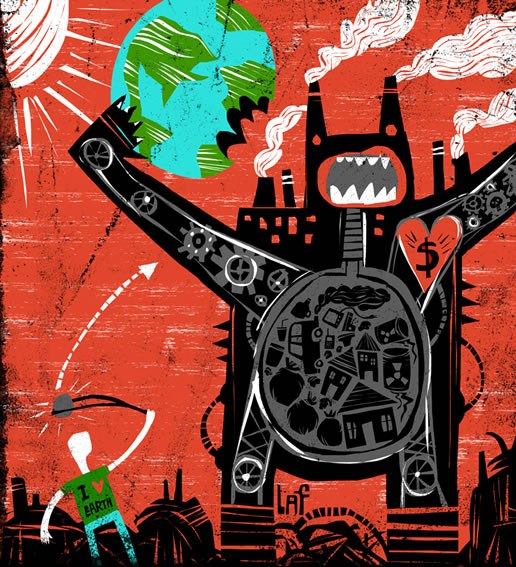
Capitalism, Empire, and the Infernal Gloom Machine

By Jason Holland

Source: Dissident Voice

Depression is built into this machine and the evidence is plastered on the morose faces of people caught in the clutches of its business as usual activities. Depression is found in the insurmountable debts we owe for spending a lifetime of preparation and labor to serve the machine. In addition to debt, the machine awards us for our servitude with trinkets, gadgets, doodads and gizmos that provide a moment of hollow amusement and then sit on shelves in garages and decay. They represent the planned obsolescence of the human heart. The sacrifice paid for our fetish with materialism is the actual quality of our lives.

The gloom machine tells us the quality of our lives is defined by the machine in the driveway, and the machine that flushes away our excrement, and the machine that chills the tortured slaughtered animal flesh for later consumption, and the machine that flashes pornographic images and supplies numbers detailing how much we are liked by our so called friends. But to us humans it seems that quality of life is more appropriately measured in the amount of disposable time we have to pursue that which we want, and the quality of the community around us, and living without being chronically stressed with threats of being displaced from the land upon which we live for not working hard enough for the machine.

Depression is waking up at 6 in the morning in darkness to sit in traffic for an hour to arrive at a job that we don’t want to be at, only to serve the machinations of people with nothing but greed in their overstuffed bellies. And we go to these jobs so that we can pay rents that are unaffordable, and to service debt we’ll never escape, and we go home in darkness to our lonely lives in places where community is absent with a view of an equally lonely tree or a man-made retention pond which is an upgrade over the view of staring directly at your neighbor’s domicile. Depression is the realization there is no vacation on the horizon, no respite, just more of the same. Depression is knowing that such a life is better than many others have it.

Depression is recognizing the cynics were right about this society, that Cohen spoke truth when he sullenly moaned:

Everybody knows that the dice are loaded
Everybody rolls with their fingers crossed
Everybody knows the war is over
Everybody knows the good guys lost
Everybody knows the fight was fixed
The poor stay poor, the rich get rich
That’s how it goes
Everybody knows

Depression is watching art die. The surrealist, the bohemian, the rock ’n roll, and the anti-authoritarian soul has lain down and pledged fealty to the dollar. For money, they’re now all willing to become ready made predictable cubes to be packaged and sold in plastic wrap placed in cleverly designed boxes which deliver to the depressed public what they want, more of something that’s pretty on the outside and vacant within. We are left with monthly subscriptions of more tales of self aggrandizement for the throngs of temporarily embarrassed millionaires.

Depression is watching the worst of us rise to legitimacy and awarded iniquitous riches for it. The popular is depressive, musical hack Cardi B sings about her money money money and she is loved. Jordan Peterson sells cheap self help stolen from better written material decades ago amalgamated with misogyny and dictates of hierarchal subjugation and becomes wildly popular. Trump purveys hatred of people of color and a love of authoritarianism and the depressive people, oh do they eat it up. This is sickness, depressive sickness.

Depression is acceptance of the violent now. The grossly unhappy men with their armaments spread their gloom and horror across the planet and claim righteousness for doing so. Depression is watching society applaud murderous hearts for their crimes who don badges and camouflage and have holidays to celebrate their violent history, while villains are made of those who simply don’t want to stand up for songs of oppression. Thank you for your service to the machine.

Depression is watching notions of resistance and revolution take form in slightly altered subservience. The great reformation desired now is for a “green new deal” that doesn’t come close to mitigating the impending culling of humanity from soon to be ecological catastrophes. Their plans offer only more endless work at the behest of the gloom machine while promising healthcare that will never happen, less debt it will also never deliver, and affordable housing that still won’t solve homelessness. They don’t want to break the machine, just tweak it, and they lack the ability to do that even. Never have I borne witness to such eager slaves and such depressive aspirations. The people seem to adore their cubicle lives, their environmental destruction, their corporations, their debts, their corrupt leaders, their prisons, their banks, and their taxes.

They want to continue to be put to work under the thumb of the status quo western civilization authoritarian mind and this is all the depressed mentally dominated masses can think of as a possible improvement. Instead of wanting to taste real liberty and be actual equals, their dreams are limited to being better treated servants. The gloom machine chugs along fueled with dimwitted ideas sold by boxed-in thinkers without any possibility of escaping the darkness, rather simply offering a more cushy seat for viewing the end of everything.

The machine bellows out demanding more, more, you owe me more, and somehow those wearing red, white, and blue agree and celebrate the demands of the machine. These debts we owe are servitude. The numbers held in digital machines are immoral which demand one must wake up to a dreary existence to do more of what is killing our souls along with the flora and fauna around us.

Depression is the downtrodden plebs who celebrate their corrupt democracy, which is in reality a thinly veiled oligarchy that should be obvious to all. They prop up a system of voting that allows the election of the presidency, a position that shouldn’t exist in the first place in an egalitarian society, to be awarded to candidates who don’t capture the most votes. What little democracy there is in a representative system is lost in totality when the winner of elections need not win the majority of votes. The gloom machine is straight up tyranny.

A non-depressed society would reject being served faux democracy. They’d reject a system absent of reason or compassion and disdain would be for ideas of continuing to support such a destructive way of being. But instead, within the gloom machine shame is reserved for those who don’t want to take part in the busted system, and it venerates those who cast votes for imperialist conquerers and planet destroyers, and those voters are lauded as doing their civic duty for taking part in open public corruption.

Depression is the insincere know it all crowd who are incapable of honest debate and have rarely endeavored to open a book of substance or engage in critical thought, but they know trivialities which they mistake as facts and wisdom. They know arrogance well and emanate it with aplomb. They know how to believe all they see in the corporatized media, but thinking without boundaries or limitations is beyond their capacity. This is not even depression, this is tragedy.

Depression is watching the trees be plowed down for more tract housing, a portion of which will sit empty for years because no one can afford to move there, and even if they could it’s a heinous boring life that awaits which is only significantly better compared to being homeless. Depression is knowing this is the reason why we are rapidly destroying our habitable environment and commencing a 6th mass extinction event which is now accelerating.

Depression is to know there is nothing we can do to stop the country we live in from mercilessly killing innocent people all over the world for no reason other than more economic expansion and our sadistic ideas of exceptionalism that entail spreading pain and hardship so a few elites can have more of what they already have more than enough of.

Depression is the powerlessness to change anything of significance. There is no other way they say other than the desolate gloom machine, they say this is how it must be. And so we remain here waiting for the horror that is soon to approach us all as the gloom descends in ever quickening waves.

A zombified indoctrinated populace can see no other way than capitalism and beating each other over the heads to satiate egos in needless competition that is unnecessary for survival and deleterious to the common good. Capitalism is the primary tool of empire, and a word that should be synonymous with depression. It’s the accumulation of resources in an effort to gain more power in man-made markets to leverage that power over other people and get them to do what the person with the most power desires. Capitalism’s depressing ideology is defined by the lecherous desire for more for the sake of it so the winner can pound their simian chest in victorious celebration of the devastation they’ve created.

Capitalism is inherently unsustainable due the way it allows power to coalesce via the leveraging abilities given to money to buy land, the means of production, elections, and advertising. It allows the whims of the few to overrun the needs of the many where those with the worst intentions aspire to gain more than others because they will attempt to fill the void in their hearts with self importance expressed via power over others. This is why it cannot be used.

If there is no central currency or advantage to collecting huge amounts of resources then the motivation to hoard would evaporate, as those resources would simply rot or become a burden to maintain. There’s no fun in that kind of hoarding. The “fun” comes to the simpleton power seeker when they acquire power to make others do what they want and thus gain the ephemeral validation they so desperately seek.

If one runs the math on players competing for money at different rates of gain over a certain amount of time, there will be a doubling effect which becomes exponential. And this effect will accelerate as it plunders along due to gains in leverage which allows for ever greater amounts of money to be made at faster rates. Eventually it always ends the way a game of monopoly ends, someone has all the power and everyone else is subservient to that entity/person.

These dour thoughts manifest from the recognition of the stranglehold empire has over our lives. The depression is the result of the myriad of expectations I can’t let go of that wants to see a kinder more egalitarian and sustainable world emerge while knowing how unlikely it is. Our collective depression is rooted in the foundations of social hierarchy and its economic tools of control, and understanding what a perfect trap it is, and so it goes, and everyone doesn’t know, but they feel it, though.