That Change You Requested…?

By James Howard Kunstler

Source: Kunstler.com

All the previous incidents of white cops killing blacks were just too ambiguous to seal the deal. Michael Brown in Ferguson, Missouri (a murky business); Tamir Rice in Cleveland (waving the BB gun that looked like a .45 automatic); Trayvon Martin (his killer George Zimmerman was not a cop and was not “white”); Eric Garner, Staten Island (black policewoman sergeant on the scene didn’t stop it); Philandro Castile, Minneapolis, (the cop was Hispanic and the vic had a gun). Even the recent February killing of jogger Ahmaud Arbery in Brunswick, Georgia, had some sketchy elements (did Arbery try to seize the shotgun?) — YouTube has scrubbed the video (?) — and then it took months for the two white suspects (not cops) to be arrested.

The George Floyd killing had none of those weaknesses. Plus, the video presented a pretty much universal image of oppression: a man with his knee on another man’s neck. Didn’t that say it all?  You didn’t need a Bob Dylan song to explain it. The Minneapolis police dithered for four days before charging policeman Derek Chauvin with Murder 3 (unpremeditated, but with reckless disregard for human life). The three other cops on the scene who stupidly stood by doing nothing have yet to be charged. Cut it, print it, and cue the mobs.

The nation was already reeling from the weird twelve-week Covid-19 lockdown of everyday life and the economic havoc it brought to careers, businesses, and incomes. In Minnesota, the stay-at-home order was just lifted on May 17, but bars and restaurants were still closed until June. Memorial Day, May 25, was one of the first really balmy days of mid-spring, 78 degrees. People were out-and-about, perhaps even feeling frisky after weeks of dreary seclusion. So, once the video of George Floyd’s death got out, the script was set: take it to the streets!

Few Americans were unsympathetic to the protest marches that followed. Remorse, censure, and tears flowed from every official portal, from the mouth and eyes of every political figure in the land. The tableau of Officer Chauvin’s knee on Mr. Floyd’s neck was readymade for statuary. Indeed, there are probably dozens of statues extant in the world of just such a scene expressing one people’s oppression over another. And yet the public sentiments early-on after the George Floyd killing had a stale, ceremonial flavor: The people demand changeEnd systemic racismNo justice, no peace! How many times have we seen this movie?

What is changing — and suddenly — is that now it’s not just black people who struggle to thrive in the USA, but everybody else of any ethnic group who is not a hedge fund veep, an employee of BlackRock Financial, or a K-Street lobbyist — and even those privileged characters may find themselves in reduced circumstances before long. The prospects of young adults look grimmest of all. They face an economy so disordered that hardly anyone can find something to do that pays enough to support the basics of life, on top of being swindled by the false promises of higher education and the money-lending racket that animates it.

So, it’s not surprising that, when night falls, the demons come out. Things get smashed up and burned down. And all that after being cooped up for weeks on end in the name of an illness that mostly kills people in nursing homes. Ugly as the ANTIFA movement is, it’s exactly what you get when young people realize their future has been stolen from them. Or, more literally, when they are idle and broke and see fabulous wealth all around them in the banks’ glass skyscrapers, and the car showrooms, and the pageants of celebrity fame and fortune on the boob tube. They are extras in a new movie called The Fourth Turning Meets the Long Emergency but they may not know it.

Hungry for change? You won’t have to wait long. This society may be unrecognizable in a few months. For one thing, there’s a good chance that the current violence in the streets won’t blow over as it has before. There hasn’t been such sudden, massive unemployment before, not even in the Great Depression — and we’re not even the same country that went through that rough episode. Just about every arrangement in contemporary life is on-the-rocks one way or another. Big business, small business, show business… it’s all cratering. The great big secret behind all that is not that capitalism failed; it’s that the capital in capitalism isn’t really there anymore, at least not in the amounts that mere appearances like stock valuations suggest. We squandered it, and now our institutions are straining mightily to pretend that “printing” money is the same as capital. (It’s just more debt.) Note, the stock markets are up this morning at the open! Go figure….

Change? We’re getting it good and hard, and not at a rate we were prepared for. It’s hugely disorienting. It produces friction, heat, and light, which easily becomes violence. There’s, for sure, plenty we can do to make new arrangements for American life without becoming communists or Nazis, but a lot of activities have to fail before we see how that could work. The overburden of obsolete complexity is crushing us, like Derek Chauvin’s knee on George Floyd’s neck. They were both, in their way, common men, caught in the maelstrom of metaphor. That proverbial long, hot summer we’ve heard about for so long…? It’s here.

Revolution Is Inevitable and Necessary

By Jason Holland

Source: Dissident Voice

None are so hopelessly enslaved, as those who falsely believe they are free. The truth has been kept from the depth of their minds by masters who rule them with lies. They feed them on falsehoods till wrong looks like right in their eyes.

— Johann Wolfgang von Goethe, Bk. II, Ch. 5; source: Die Wahlverwandtschaften, Hamburger Ausgabe, Bd. 6 (Romane und Novellen I), dtv Verlag, München, 1982, p. 397 (II.5).

I keep plotting a revolution no one else seems to be interested in having. So be it. I’ll have my solitary revolution. There will be no pink hats, guillotines, or marches, just me and a bitter jaded middle finger saluting towards the firmaments in utter rejection of most what this society represents. Although I hold no lasting contempt for anyone in this society because I understand we all have fallen into cultural traps and have done things that we believed we had to do so that we could be accepted, or just to be allowed to sleep indoors somewhere and be fed; we’ve had to commodify and sell out pieces of ourselves to serve the desires of those in a system of power who sanction and control the flow of money backed by military forces and institutions of incarceration, and this way of being was set into motion a long time ago, but it doesn’t have to continue if that’s not what we really desire, but for right now it’s close to all we know.

So, it does seem a revolution of sorts is inevitable due to inequality reaching grotesque heights of avarice where there is no longer any excuse for the wealthy to hide behind in order to explain why it is they have so much and others have so little. However, this just emphasizes the point that this population is largely not wise enough yet to create a revolution worth having, because a more enlightened culture would have taken a stand a long time ago before things became an emergency. Every second we acquiesce to power and don’t push for something radically better we compound an already grim situation. Globally there seems to be a majority who don’t understand what it is to be free, they merely fight to be better treated servants. So it’s highly likely their coming revolution will be a flailing inchoate attempt at something marginally better than what is here now and won’t set out to correct much, if any, of the underlying structural problems.

Consequently, the odds are the revolution we’ll end up with will circle directly back to where we are now or worse in no time at all. But my critiques and frustrations are mine, not a concern for the coming revolution. I must remember it’s their revolution, not mine. I’m not invited to theirs — well, that’s not entirely true.  I just have to ignore most of what I believe to be true, then I’m invited. As things are, I have only a single pathetic pity party scheduled as an event to prove my revolution ever existed, but I should be appreciative of what I have and cease bemoaning what I do not.

So this is where I will make my stand. The beginning and likely end of my revolution of one. In reality my revolution is simply a rough translation through the English language describing my light of truth within, which I’ve gone to great pains to keep safe, dry, and burning from a clean source of fuel. Probably all done in futility except to selfishly inoculate my own mind from the lurking darkness of the culture cave; still, a lingering desire remains to light a path out for others to follow who have become stuck watching dark Platonic shadows flicker across the walls.

With that said, here’s the path I’m lighting with argumentation and I believe it to be a solid one.  We, as in the we consisting of the global middle/lower classes of the entire planet, aka the 99%, are not a free people now nor have ever truly been free while living in the bounds of a social hierarchy. While many a winsome word has been applied to parchment declaring this or that people free, unfortunately soon thereafter the founding document is handed over to record keepers to energize the narratives of posterity while the same ole domination and ownership-driven society meters out the same ole grind. The reward and punishment operant conditioning culture is uniformly applied and chosen specifically to keep people compliant, reactive, and rutted into perpetual business as usual subservience to authoritative forces.

Constitutions supply grandiose ideas which are undermined by underlying conditional legislature where the original words are made into feckless futile notions that allows the ruling authority to do all the draconian bullshit they’ve always done with prettier sounding words. The powers that be couch authoritarian ideas in language that sometimes sounds reasonable on the surface but ultimately leads people to a deleterious state of believing they are free when they are nothing close to any working definition of freedom. Freedom is a condition which is now only possible within our own minds, but our physical bodies are fodder for the whims of a class of people who clearly believe themselves superior to just about everyone else.

Those causing the most damage are simply playing out a cultural role that’s a legacy of deceit passed down from one generation to the next, and each falling prey to traps of chasing after things; endless shiny carrots on shiny sticks. And not just chasing, but lusting, demanding, an obsessive hedonistic pursuit wanting total ego domination at any macabre cost. Pure obsession with the chase. While irony sits on many of their own bookshelves as Melville’s whale tale of wisdom lies fallow and ignored serving only as bookcase filler to give guests the impression they’re well read.

The ego-driven mind thinks primarily in the language of temporal imperatives. Short term must do this, must do that kind of thinking where all thought is disseminated through a lens of self importance with agendas to accomplish to validate that self importance. And if it thinks itself important enough it will eventually see itself as messianic. After they have assumed role of savior it’s just logically congruent that the ruling class allocate all the resources they desire for themselves so they can help all the people they will eventually save, and they need deep pockets to be the inspiration for the entire world.

Over time the ruling class creates rules and cultural dogmas that they claim are for the good of the people, but oddly enough their beliefs always result in making them richer and giving them more power. What an odd purported symbiosis they have dreamed up. The surest sign of being under an authoritarian power is when they make it really difficult to live independent of them. They demand you be hooked up to their electrical grid, pay taxes to live on the land, and hooked into the public water system. Total forced dependency on their system and it is barely noticed yet subtly removing choice and creating an artificial cage. Creating dependency is the best way to control people, and tyranny is then accepted under the umbrella of the common good, so the messianic ones can provide shelter from the storm while, of course, the common person sacrifices most of their free will in the process in a Faustian bargain which is the default role we are thrust into in this world of imperial forces.

Social hierarchies hold their grip on power in increasingly sophisticated ways. They’ve mostly advanced past public executions to keep people in line. They’ve learned it’s far more effective to manipulate minds into believing all are equals and free, and stoke the fear response towards something external that threatens that equality and freedom. It’s become understood by hierarchy that if the ruling power is perceived as the threat they are far more likely to be ousted from that power, so the engines of power must diffuse the blame of their actions lest they be held responsible for the tyranny they impose.

So semi-plausible sounding fears are brought to the forefront so they can provide you with adequate safety, which gives them the power to deprive you of the liberty they are telling you they are protecting, since you know they care so much about you. The gas-lighting of the masses creates reactionary conditioning that puts people in a state where they no longer trust their own mind and become prone to believing all the fears power claims are real. And fear is then used as a prod to move the human animal in a chosen direction power wishes.

Revolution of a real kind, one where our relationship to power radically changes, will be a series of progressions in pulling our minds out of this culture trap. Change will come in relation to how well we come to understand the implications of centralized power and ultimately integrate that knowledge into how we live. Further, how well we learn to work together cooperatively in a voluntary manner will correlate  directly to how likely it is our species survives past the next hundred years. But curing ourselves of  these brutal mental afflictions is not an easy path to traverse. However, I’ll argue a radical change is needed if we want to once again have human lives worth living with real choice and agency over our own mind, body, and time.

Re-Opening the Economy Won’t Fix What’s Broken


By Charles Hugh Smith

Source: Of Two Minds

Re-opening a fragile, brittle, bankrupt, hopelessly perverse and corrupt “normal” won’t fix what’s broken.

The stock market is in a frenzy of euphoria at the re-opening of the economy. Too bad the re-opening won’t fix what’s broken. As I’ve been noting recently, the real problem is the systemic fragility of the U.S. economy, which has lurched from one new extreme to the next to maintain a thin, brittle veneer of normalcy.

Fragile economies cannot survive any impact with reality that disrupts the distortions that are keeping the illusion of “growth” from shattering. For the past two decades, every collision with reality cracked the illusion, and the “fix” was to duct-tape the pieces together with new extremes of money-creation, debt, risk and speculative excess.

While the stock market has soared, the real world falls apart. If your region needs a new bridge built, count on about 20 years to get all the “stakeholders” to agree and get the thing actually built. Count on the cost quintupling from $500 million to $2.5 billion. Count on corners being cut as costs skyrocket, so those cheap steel bolts from China that are already rusting before the bridge is even finished? Oops. Replacing them will add millions to the already bloated budget.

Want to add a passenger stop on an existing railroad line? Count on 20 years to get it done. The complexity thicket of every regulatory agency with the power to say “no” basically guarantees the project will never get approved, because every one of these bureaucracies justifies its existence by saying “no.” Sorry, you need another study, another environmental review, and so on.

Need a new landfill? I hope you started the process 15 years ago, so you’ll get approval in only five more years. Every agency with the power to say “no” will stretch out the approval, so they have guaranteed “work” for another decade or two.

Did your subway fares double? Was the excuse repairing a crumbling system? Did the work get done on budget and on time? You must be joking, right? All the fare increase did was cover the costs of skyrocketing salaries, pensions and administrative costs. Repairs to the tracks and cars– that’s extra. Let’s float a $1 billion bond so nobody have to tighten their belts, and have riders pay for it indirectly, through higher taxes to pay the exorbitant costs of 20 years of interest on the bond.

Have you been thrown off your bicycle by the giant potholes in the city’s “bike lanes”? The city reluctantly admits that these streets that haven’t been maintained for decades–yes, decades. The city once paid for street maintenance out of its general budget, but alas, that’s been eaten up by skyrocketing salaries, pensions and administrative costs, so now we need to float $100 million bond to fund filling potholes. If all goes according to plan (ha-ha), we should be able to re-pave the streets that have been crumbling for 20 years in… the next 20 years.

These real-world examples are just four of thousands of manifestations of a broken system. Rather than make tough choices that drain power and wealth from vested interests, we simply borrow more money, in ever increasing amounts, to keep the entrenched interests and elites happy.

There are two “solutions” in the status quo: dump the debt on taxpayers or on powerless debt-serfs–for example, college students. (See chart below of the $1.6 trillion that’s stripmining student debt-serfs.) Who benefits from selling all the municipal bonds, bundled student loans, etc. to investors starving for a yield above 0.1%? Wall Street, of course.

The problem is that while debt has soared, productivity and earned income have stagnated. The statistical narrative has been ruthlessly gamed to hide the erosion of living standards, but even with the bogus “low inflation” of official statistics, wages for the bottom 95% have stagnated for decades.

Measures of productivity have also been gamed to mask the ugly reality that the vast majority of the U.S. economy is stagnating under the weight of interest payments on debt, mal-investments in speculative gambles, higher junk fees and taxes, crushing regulatory compliance, high costs imposed by monopolies and cartels and a well-cloaked decline in the quality of just about everything the bottom 95% uses or owns.

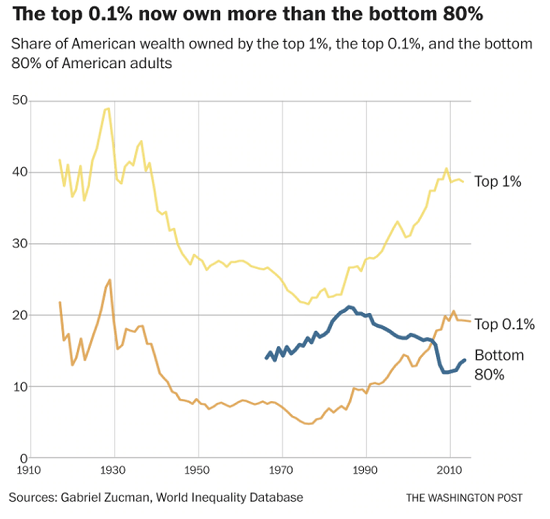
What little productivity gains have been made have been skimmed by the top 5%. Coupled with the Federal Reserve’s single-minded goosing of the one signaling device it controls, the stock market, the top 0.1% in America own more wealth than the bottom 80%.

If productivity stagnates and winners take all, the wages of the bottom 95% cannot rise. Real wealth is only created by increases in the productivity of labor and capital; everything else is phantom wealth.

The only way stagnant incomes can support more debt is if interest rates decline. Presto, the Fed dropped interest rates to near-zero a decade ago. Of course you and I can’t actually borrow millions for 0.1%; that privilege is reserved for financiers and other financial parasites and predators.

Debt-serfs were able to refinance their crushing mortgages to save a few bucks, and so they can afford to 1) take on more debt and 2) pay higher taxes to fund the ballooning public debt.

Every one of these extremes has increased the systemic fragility of the American economy. This fragility is reflected in the impoverishment of the bottom 95%, the thin line between solvency and bankruptcy, the decay of public trust in institutions run for the benefit of entrenched interests, and the quickening erosion of America’s social contract.

Re-opening a fragile, brittle, bankrupt, hopelessly perverse and corrupt “normal” won’t fix what’s broken.


The Covid-19 Chronicles: USA

By Gunnar Ulson

Source: Land Destroyer

The US is claimed to be hardest hit by Covid-19 with, at the time of writing, over 80,000 deaths attributed to the virus. The nation is also suffering from socioeconomic disaster as lockdowns have driven millions of Americans into not only unemployment, but predictable poverty and hunger as a result.

The crisis has been pounced upon by special interests to help propel various sociopolitical and economic agendas rather than confront and overcome the crisis, leading many to suspect the crisis itself has been deliberately overblown.

Health Impact

At face value the US would seem to be hit by an unprecedented health crisis. Hysteria spread by the mass media focusing on the numbers of infected and dead are provided to a panicked public without context.

Indeed, over 80,000 people have so far died with infections at nearly 1.5 million (confirmed).

Yet a quick look at basic statistics provided by the US government’s own Center for Disease Control (CDC) shows that Covid-19’s impact on human health including total deaths has not even surpassed recent flu season burdens. For example, according to the CDC’s website, the 2017-2018 flu season (running from December 2017 to March 2018) left anywhere between 46,000 to 95,000 dead.

Deaths attributed to Covid-19 have been recorded for 2 full months longer with questionable methods used to attribute Covid-19 as the cause for death.

The death rate has been reported at anywhere between 1% to as high as 5% to 6%. Missing from these seemingly concerning numbers is the fact that widespread testing has not been undertaken. The few instances where it has been done has shown that the number of infected is many times higher than official reports. This means that the death rate is much lower and more comparable to the annual flu than any sort of novel and particularly dangerous pathogen.

Testing in California and New York have revealed that in these states alone millions are likely to have been infected by Covid-19 and simply showed little to no symptoms.

A CBS article titled, “Study shows 13.9% of people tested in New York state have coronavirus antibodies, Cuomo says,” admits:

New York’s first survey of coronavirus antibodies shows that 13.9% of those tested in the state had coronavirus antibodies in their system, meaning they have contracted and recovered from the virus, New York Governor Andrew Cuomo said Thursday. That suggests that 2.7 million people have been infected statewide.

In other words, there are likely more people infected in New York state alone than infected nationwide according to “official” reports.

If information regarding how widespread Covid-19 actually is and how dangerous it is or isn’t, is not accurate, how can the United States formulate appropriate measures to respond to the outbreak?

Measures

Despite what appears to be nothing more than a bad cold or flu, the US has ground its society to a halt with lockdowns and social distancing measures.

“Non-essential” occupations have been encouraged to work from home or to not work at all. The food and beverage industry for example, the second largest employer in the United States, has been ground to a halt with employees furloughed for what has now been weeks or even months. Many of these employees do not expect to return to work until at least June.

In Los Angeles, county officials have extended “stay at home” measures for another 3 months meaning that people will have been shut in for nearly half a year if and when in late August people are allowed to return to their normal lives!

Social distancing is being enthusiastically enforced by police around the nation. In New York City, in order to “protect” people, those not practicing social distancing have been beaten, tased and even arrested. The physical and legal damage done “saving” the public from Covid-19 appears to be more extreme than the actual threat of Covid-19 itself.

Since most New Yorkers (and most people around the entirety of the United States) likely have been infected by the virus anyway, social distancing and lockdowns are more of a psychological exercise than one of isolating the pathogen and stopping its spread, an exercise aimed at addressing public panic, but public panic deliberately fuelled by the media and the government.

Socioeconomic Impact

For the United States, a nation’s whose economy was already in steep decline and losing ground to emerging economies around the globe, most notably China, these lockdowns amount to a self-inflicted mortal wound no conceivable plan of action can reverse.

Had Covid-19 been the deadly pathogen many may believe it is owed to mass media misinformation, the United States stood ill-prepared for it. This was not merely the doing of the current US administration, but a problem known for well over a decade with US presidents from George Bush Jr. to Barack Obama to current US President Donald Trump taking turns ignoring it.

The New York Times reported that things like ventilator shortages were known for at least 13 years and instead of rectifying the problem, large biomedical corporations were allowed by the US government to buy out small contractors tasked with fixing the shortage and ending programs to develop cheap ventilators in order to maintain artificial scarcity and the high prices (and profits) associated with it.

While Covid-19 appears to be far less dangerous than claimed by the mass media, the impact of measures taken by the US government and local state governments has created what is a disaster now being compared to the Great Depression.

Rather than rectifying it by simply rolling back lockdowns and social distancing measures, or even finding ways to aid the millions left unemployed, special interests are taking turns exploiting the crisis by blaming political opponents or even international competitors (like China). They are also looking for ways to cash in, with America’s deeply corrupt pharmaceutical industry being the most prominent example already teeing up massive profiteering by offering “vaccines” to solve Covid-19 fears.

The US, rather than uniting and overcoming whatever Covid-19 actually is, be it a pathogen or an unprecedented wave of widespread panic, has instead allowed itself to become divided and distracted, as well as exposed to the very worst sort of socioeconomic predators lurking amid America’s economic and political landscape.

It is difficult to predict what will happen in the weeks, months and even years to come regarding the state of America socioeconomically considering just how widespread and deep the damage being done now is. A nation as large as the United States plunging so quickly has never historically boded well for that nation nor the world it finds itself free falling in. The US already faced many challenges regarding its decline both at home economically and abroad geopolitically.

Covid-19 has simply exposed and accelerated the process, compounding an already uncertain future with a new degree of damage, danger and desperation.

Private gain must no longer be allowed to elbow out the public good

By Dirk Philipsen

Source: aeon

Adam Smith had an elegant idea when addressing the notorious difficulty that humans face in trying to be smart, efficient and moral. In The Wealth of Nations (1776), he maintained that the baker bakes bread not out of benevolence, but out of self-interest. No doubt, public benefits can result when people pursue what comes easiest: self-interest.

And yet: the logic of private interest – the notion that we should just ‘let the market handle it’ – has serious limitations. Particularly in the United States, the lack of an effective health and social policy in response to the coronavirus disease (COVID-19) outbreak has brought the contradictions into high relief.

Around the world, the free market rewards competing, positioning and elbowing, so these have become the most desirable qualifications people can have. Empathy, solidarity or concern for the public good are relegated to the family, houses of worship or activism. Meanwhile, the market and private gain don’t account for social stability, health or happiness. As a result, from Cape Town to Washington, the market system has depleted and ravaged the public sphere – public health, public education, public access to a healthy environment – in favour of private gain.

COVID-19 reveals a further irrational component: the people who do essential work – taking care of the sick; picking up our garbage; bringing us food; guaranteeing that we have access to water, electricity and WiFi – are often the very people who earn the least, without benefits or secure contracts. On the other hand, those who often have few identifiably useful skills – the pontificators and chief elbowing officers – continue to be the winners. Think about it: what’s the harm if the executive suites of private equity, corporate law and marketing firms closed down during quarantine? Unless your stock portfolio directly profits from their activities, the answer is likely: none. But it is those people who make millions – sometimes as much in an hour as healthcare workers or delivery personnel make in an entire year.

Simply put, a market system driven by private interests never has protected and never will protect public health, essential kinds of freedom and communal wellbeing.

Many have pointed out the immorality of our system of greed and self-centred gain, its inefficiency, its cruelty, its shortsightedness and its danger to planet and people. But, above all, the logic of self-interest is superficial in that it fails to recognise the obvious: every private accomplishment is possible only on the basis of a thriving commons – a stable society and a healthy environment. How did I become a professor at an elite university? Some wit and hard work, one hopes. But mostly I credit my choice of good parents; being born at the right time and the right place; excellent public schools; fresh air, good food, fabulous friends; lots of people who continuously and reliably provide all the things that I can’t: healthcare, sanitation, electricity, free access to quality information. And, of course, as the scholar Robert H Frank at Cornell University so clearly demonstrated in his 2016 book on the myth of the meritocracy: pure and simple luck.

Commenting on how we track performance in modern economies – counting output not outcome, quantity not quality, prices not possibilities – the US senator Robert F Kennedy said in 1968 that we measure ‘everything, in short, except that which makes life worthwhile’. His larger point: freedom, happiness, resilience – all are premised on a healthy public. They rely on our collective ability to benefit from things such as clean air, free speech, good public education. In short: we all rely on a healthy commons. And yet, the world’s most powerful metric, gross domestic product (GDP), counts none of it.

The term ‘commons’ came into widespread use, and is still studied by most college students today, thanks to an essay by a previously little-known American academic, Garrett Hardin, called ‘The Tragedy of the Commons’ (1968). His basic claim: common property such as public land or waterways will be spoiled if left to the use of individuals motivated by self-interest. One problem with his theory, as he later admitted himself: it was mostly wrong.

Our real problem, instead, might be called ‘the tragedy of the private’. From dust bowls in the 1930s to the escalating climate crisis today, from online misinformation to a failing public health infrastructure, it is the insatiable private that often despoils the common goods necessary for our collective survival and prosperity. Who, in this system based on the private, holds accountable the fossil fuel industry for pushing us to the brink of extinction? What happens to the land and mountaintops and oceans forever ravaged by violent extraction for private gain? What will we do when private wealth has finally destroyed our democracy?

The privately controlled corporate market has, in the precise words of the late economics writer Jonathan Rowe, ‘a fatal character flaw – namely, an incapacity to stop growing. No matter how much it grew yesterday it must continue to do so tomorrow, and then some; or else the machinery will collapse.’

To top off the items we rarely discuss: without massive public assistance, late-stage extractive capitalism, turbocharged by private interest and greed, would long be dead. The narrow kind of macroeconomic thinking currently dominating the halls of government and academia invokes a simpleminded teenager who variously berates and denounces his parents, only to come home, time and again, when he is out of ideas, money or support. Boeing, Goldman Sachs, Bank of America, Exxon – all would be bust without public bailouts and tax breaks and subsidies. Every time the private system works itself into a crisis, public funds bail it out – in the current crisis, to the tune of trillions of dollars. As others have noted, for more than a century, it’s a clever machine that privatises gains and socialises costs.

When private companies are back up and running, they don’t hold themselves accountable to the public who rescued them. As witnessed by activities since the 2008 bailouts at Wells Fargo, American Airlines and AIG, companies that have been rescued often go right back to milking the public.

By focusing on private market exchanges at the expense of the social good, policymakers and economists have taken an idea that is good under clearly defined and very limited circumstances and expanded it into a poisonous and blind ideology. Now is the time to assert the obvious: without a strong public, there can be no private. My health depends on public health. My freedom depends on social freedom. The economy is embedded in a healthy society with functional public services, not the other way around.

This moment of pain and collapse can serve as a wakeup call; a realisation that the public is our greatest good, not the private. Look outside the window to see: without a vibrant and stable public, life can quickly get poor, nasty, brutish and short.

Why Assets Will Crash

By Charles Hugh Smith

Source: Of Two Minds

This is how it happens that boats that were once worth tens of thousands of dollars are set adrift by owners who can no longer afford to pay slip fees.

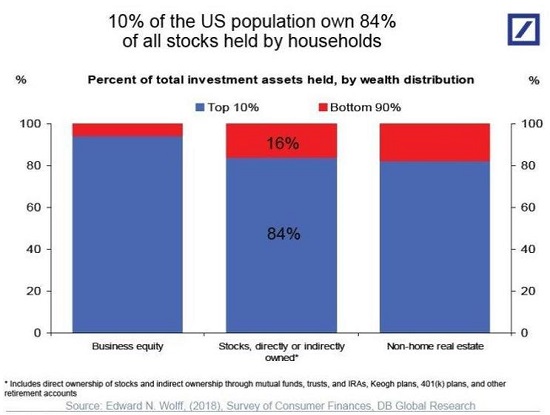
The increasing concentration of the ownership of wealth/assets in the top 10% has an under-appreciated consequence: when only the top 10% can afford to buy assets, that unleashes an almost karmic payback for the narrowing of ownership, a.k.a. soaring wealth and income inequality: assets crash.

Most of you are aware that the bottom 90% own very little other than their labor (tradeable only in full employment) and modest amounts of home equity that are highly vulnerable to a collapse of the housing bubble. (The same can be said of China’s middle class, only more so, as 75% of China’s household wealth is in real estate, more than double the percentage of wealth held in housing in U.S. households.)

As the chart illustrates, the top 10% own 84% of all stocks, over 90% of all business equity and over 80% of all non-home real estate. The concentration of ownership of assets such as vintage autos, collectibles, art, pleasure craft and second homes in the top 10% is likely even greater.

The more expensive the asset, the greater the concentration of ownership, as the top 5% own roughly 2/3 of all wealth, the top 1% own 40% and the top 0.1% own 20%. In other words, the more costly the asset, the narrower the ownership. (Total number of US households is about 128 million, so the top 5% is around 6 million households and the top 1% is 1.2 million households.)

This means the pool of potential buyers is relatively small, even if we include global wealth owners.

Since price is set on the margins, and assets like houses are illiquid, then we can anticipate all the markets for assets owned solely by the wealthy to go bidless–yachts, collectibles, vacation real estate–because the pool of buyers is small, and if that pool gets cautious due to a drop in net worth/unearned income, there won’t be any buyers except at the margins, at incredible discounts.

As we know, in a neighborhood of 100 homes currently valued ar $1 million each, when a desperate seller accepts $500,000, the value of the other 99 homes immediately drops to $500,000.

Since few of the current bubble-era asset valuations are supported by actual income fundamentals, then the sales price boils down to a very small number of potential buyers and what they’re willing to pay.

Houses have a value based on rent, of course, but rents will drop very quickly for the same reason: prices are set on the margins. The most desperate landlords will drop rents and re-set the rental market from the margins. If demand plummets (which it will as people can no longer afford rents in hot urban markets once they lose their jobs), then vacancies will soar and rents will crash as a few desperate landlords will take $1200/month instead of $2500/month.

Due to the multi-year building boom of multi-family buildings in hot job markets (which inevitably leads to an over-supply once the boom ends), there are now hundreds of vacancies where there were once only a few dozen, and thousands where there were previously only hundreds.

As millions of wait staff, bartenders, etc. who made good money in tips find their jobs have vanished, all the urban hotspots will see mass out-migration: Seattle, Portland, the S.F. Bay Area, L.A., NYC, Denver, etc. as demand for rentals will evaporate and rents will be set on the margins by the most desperate landlords. Everyone holding out for the previous bubble-era rent will have $0 income as their units are vacant.

Tech start-ups and Unicorns are melting like ice cubes in Death Valley, and tech-sector layoffs are already in the tens of thousands. This wave of highly paid techies losing their jobs will become a tsunami, further reducing the pool of people who can afford rents of $2,500 to $3,000 for a studio or one-bedroom apartment.)

The concentration of ownership generates a self-reinforcing feedback that further depresses prices: since the top 10% own most of the assets of the nation, they are most prone to a reversal of “the wealth effect.” As their assets soared in value, the top 10% felt wealthier and more confident in future gains, enabling them to borrow and spend freely on second homes, pleasure craft, new vehicles, collectibles, luxury travel, etc.

Once even one class of assets plummets in value–for example, the recent decline in the stock market– the wealth effect reverses and the top 10% feel poorer and less confident about future gains, and thus less enthused about borrowing and spending. The demand for other costly assets quickly evaporates, further reducing the wealth of the “ownership class,” which further reduces their desire and ability to buy bubble-era assets.

The high-priced assets owned by the top 10% will be the assets least in demand due to their high cost and potential for enormous losses: nothing loses value faster in a recession that narrowly owned assets such as vintage cars, art, vacation homes, yachts, etc.

Once assets start sliding in value, the reverse wealth effect quickly dries up demand for all asset classes with narrow ownership. Since these assets are illiquid–that is, the market for them is thin, with buyers few and far between–the prices are set by a very shallow pool of buyers and desperate sellers.

Consider a pleasure craft that retails new for $120,000. In the boom era of rising stocks and housing, a used boat might fetch $65,000. But as the wealth of the small pool of households able to buy and maintain a costly craft evaporates, the number of qualified buyers evaporates, too.

The seller might be aghast by an offer of $35,000 and reject it angrily. Six months later, he’s praying someone will take it off his hands for $15,000, and in another six months, he’ll accept $500 just to get out from underneath the insurance, slip-rental and licencing fees.

This is how it happens that boats that were once worth tens of thousands of dollars are set adrift by owners who can no longer afford to pay slip fees, and vacation homes are abandoned and auctioned off for overdue property taxes: the market for these luxuries dries up and blows away, i.e. goes bidless–there are no buyers at any price.

Once housing and real estate valuations fall, that will trigger a decline in the value of all other costly, narrowly owned assets, which will reinforce the reverse wealth effect.

This is the systemic payback for concentrating ownership of assets in the hands of the few: when their bubble-era priced assets plummet in value, the bottom falls out of all assets with narrow ownership. The price of superfluous assets such as boats, vintage cars, collectibles, art and vacation homes can quickly fall to a fraction of bubble-era valuations, destroying much of what was always fictional capital.

(For more on the intrinsic fragility of a system that concentrates ownership in the hands of the few, please read Our Inevitable Collapse: We Can’t Save a Fragile Economy With Bailouts That Increase Fragility May 1, 2020.)

The Federal Reserve reckons it can “save” the bubble-era valuations of junk bonds by being the “buyer of last resort,” but it will end up being the “only buyer,” effectively making the system even more fragile and prone to collapse.

The public will eventually have to decide if the nation’s central bank should be bailing out assets owned by the financial elite while the upper-middle class watches its assets collapse in value.

Corporate Looting as ‘Rescue Plan,’ Robber Barons as ‘Saviors’

By Joshua Cho

Source: FAIR.org

For a perfect illustration of how corporate media function as ruling class propaganda, watch how they spin a titanic upward redistribution of wealth as a “rescue plan” for the US economy, and paint a robber baron like US Treasury Secretary Steve Mnuchin as a “savior” of the American public.

In discussions of the (officially) estimated $2.2 trillion Coronavirus Aid, Relief and Economic Security (CARES) Act—the largest government spending program in US history—before it was signed into law on March 27, corporate media largely abandoned the pretense of serving as watchdogs on behalf of the public in order to advocate for protecting and enriching the fortunes of their owners.

Instead of scrutinizing the bill as the robbery in progress that it is—as an understandable story with identifiable victims and victimizers—corporate media sold the CARES Act as an urgent necessity required to combat the coronavirus pandemic for everyone. Like the previous corporate bailout during the Great Recession (Extra!, 1/09), corporate media avoided raising questions about the necessity of having the government bail out large corporations, or whether the bill could be restructured to serve people rather than profits.

According to the Committee for a Responsible Budget, while the CARES Act dedicated $290 billion in direct payments to people and $260 billion in expanded unemployment benefits, it dedicated $300 billion in tax breaks and $875 billion in loans to big and small businesses—more than two dollars for corporations for every dollar for people, in other words.

When corporate media reported on negotiations and deliberations over the CARES Act, they either hailed it as a bipartisan achievement, or else shamed politicians who accurately pointed out that it overwhelmingly benefited corporations at the expense of workers. On the day the CARES Act was signed into law, NPR (3/27/20) praised the bill as “the largest rescue package in American history and a major bipartisan victory for Congress.”

Reporting in real-time, the Washington Post (3/24/20) spun the CARES Act as an attempt to “address the coronavirus crisis,” with the aim of “flooding the economy with capital to revive businesses and households.” When there was Democratic pushback over the Senate GOP bill for being “disproportionately tilted toward helping companies,” the Post described this as “partisan rancor and posturing on Capitol Hill” that blocked “the rescue bill.” The Post concern-trolled those who supported better legislation, and derided House Democrats’ putative attempts to chart their own “competing piece of legislation,” because “it could take even longer to arrive at a bipartisan consensus that can pass both chambers and get signed into law.”

The New York Times (3/22/20) made it clear that protecting workers and imposing conditions on handing out trillions in taxpayer dollars were frivolous reasons to oppose the legislation, as the Times cast Senate Democrats as villains for ostensibly opposing the bill because it “failed to adequately protect workers or impose strict enough restrictions on bailed-out businesses.” The Times described the “party-line vote” as a “stunning setback” for both the Trump administration’s “ambitious timeline” and “the rescue package,” and warned Democrats that they “risked a political backlash” if “they are seen as obstructing progress on a measure that is widely regarded as crucial to aid desperate Americans and buttress a flagging economy.”

The Times also drew parallels to the “spectacle in 2008,” when the House defeated a “$700 billion Wall Street bailout that aimed to stabilize the financial system amid a global meltdown.” Even in 2020, the Times is still spinning the upward redistribution of wealth from taxpayers to the big banks that caused the crisis as an ostensible success that saved what corporate media consider to be “the economy” (Extra!, 10/10).

Days later, the Times’ “As Coronavirus Spread, Largest Stimulus in History United a Polarized Senate” (3/26/20) spun the 96-to-0 Senate vote in favor of the bill as a heroic bipartisan compromise on legislation “intended to get the nation through the crippling economic and health disruptions being inflicted on the world by the coronavirus.” The Times leaned into corporate media’s civility fetish designed to demobilize opposition to the Trump regime (FAIR.org, 8/1/18, 12/22/19) when it depicted Democratic opposition to Senate Republicans’ “corporate giveaway” legislation as politically reckless and harmful to the country’s interests:

It was a shocking and politically perilous decision in the middle of a paralyzing national crisis, a moment when lawmakers are traditionally expected to put aside differences for the good of the country, or face a political backlash.

By contrast, in the false balance endemic in news coverage in the Trump era, the Times portrayed Senate Republicans as reasonable leaders who were “willing to momentarily abandon their small-government zeal” in the interest of “sealing a quick deal with Democrats” (GQ, 12/10/19; Washington Post, 4/27/12). Though the legislation didn’t include a necessary suspension of rent, utility and mortgage payments, or guarantee monthly payments, as advised by many economists, the Times spun it as a legislative victory for Senate Democrats:

In the end, Democrats won what they saw as significant improvements in the measure through their resistance, including added funding for healthcare and unemployment, along with more direct money to states. A key addition was tougher oversight on the corporate bailout fund, including an inspector general and congressionally appointed board to monitor it, disclosure requirements for businesses that benefited, and a prohibition on any of the money going to Mr. Trump’s family or his properties — although they could still potentially benefit from other provisions.

The problem with this triumphant Democratic ResistanceTM narrative is that it happens to be false. Politico’s report (3/26/20) on the negotiations over what it also hailed as a “rescue package” revealed that the final bill largely reflected the Senate Republicans’ “unemployment insurance and direct payments schemes” as “originally outlined,” with Sen. Mitch McConnell claiming that the CARES Act was a bill that was “largely, not entirely but largely, produced by Republicans in consultation with the Democratic minority.”

The Democratic leadership’s lack of concern with proper oversight of the bailout funds was also exposed when Speaker Nancy Pelosi chose her first-term congressmember friend Donna Shalala as part of the five-member oversight panel, despite her numerous conflicts of interest, evident lack of expertise or reported interest in the job (American Prospect, 4/18/20).

The American Prospect’s David Dayen has done some of the best reporting on the CARES Act, and he’s observed (3/25/20) how means-testing the $1,200 stimulus payments by basing it off IRS data in 2018 and 2019 was designed to limit the number of Americans who can receive it. The miserly one-time $1,200 stimulus payment will primarily reach Americans who already have direct deposit information on file with the IRS, with the unbanked (who happen to be the poorest) having to wait up to four months for paper checks, and who will be lucky to remain at the same address during that time without a suspension of rent payments.

While Democratic leaders like Pelosi opposed emergency universal basic income—and delayed payments to set up a bureaucracy ostensibly dedicated to make sure wealthy Americans don’t get anything—the richest Americans are in fact receiving an average stimulus payment of $1.7 million in the form of a millionaire tax cut.

Dayen has noted how the official “$500 billion” provided by the CARES Act to bailout large corporations is actually underreporting the enormity of the federal government’s corporate giveaway, as Trump regime officials like Larry Kudlow and Steve Mnuchin admitted their intent to leverage the Federal Reserve’s emergency lending authority to turn $500 billion into a $4.5 trillion money cannon aimed at large corporations.

What was in actuality a $6 trillion spending package had few conditions attached to the largesse given to large corporations, as the money can still go to mergers, executive compensation and paying dividends to shareholders, with no requirement that they keep employing workers to receive this handout.

It’s hard to overstate the injustice and scale of this upward redistribution of wealth. Commenting on 2008’s bailout, economist Richard Wolff (Guardian, 11/4/13) pointed out how funding the bailout through borrowing money effectively transfers wealth upward from regular taxpayers to rich bondholders, because the government is borrowing money from—and paying interest to—large corporations and the rich that it could have taxed them for instead. Rather than letting shareholders be wiped out first, according to the ostensible rules of capitalism—where they are supposed to bear the risk, instead of the government—the government is shoveling money to tax-dodging corporations like Boeing who admit to not needing these funds.

By borrowing the money for a program that prioritizes saving the rich, rather than printing money to fund an emergency universal basic income for the people like Rep. Rashida Tlaib’s proposal, the government is effectively paying the rich for saving them. The fact that these viable alternative stimulus proposals weren’t enacted is inexcusable. Especially when the Federal Reserve is hinting its willingness to increase the money supply by buying unlimited debt to fund the CARES Act, the fact that the necessary funds magically appear to fund corporate bailouts instead of necessary social programs (like Medicare for All) exposes the “How are you going to pay for it?” talking point as a fraud (Extra!, 6/12).

Pam and Russ Martens of Wall Street on Parade (3/26/20) observed how the CARES Act also allows the Fed to create “Special Purpose Vehicles” and hide this money from their balance sheets, allowing them to avoid the FOIA requests used to the expose the enormity of the $29 trillion bailout from 2008, in addition to repealing public meeting and recordkeeping requirements for Fed-related programs. This allows the Fed to evade transparency and accountability by holding meetings in secret.

But when corporate media aren’t busy spinning massive corporate robbery of taxpayer money as a rescue package for “the economy,” they’re busy spinning robber barons like Mnuchin as heroic “saviors” instead. Reuters’ “This Is No 2008: Mnuchin Borrows From Paulson’s Economic Crisis Playbook” (3/20/20) depicted Mnuchin as an unlikely hero thrust into the role of solving the US’ economic woes, as they reported:

US Treasury Secretary Steven Mnuchin has stepped into the breach as the Trump administration’s point man to rescue the economy from coronavirus devastation, taking on the role his former Goldman Sachs boss, Hank Paulson, played over a decade ago.

Mnuchin has closely followed the financial crisis playbook used by Paulson when he led the Treasury Department in 2008, reactivating Federal Reserve credit market backstops and asking Congress for $1 trillion to prop up companies and consumers as the economy grinds to a halt due to the spread of the virus.

Apparently, for Reuters, there is only one “playbook” to be followed for all economic crises: massive taxpayer-funded giveaways to large corporations, and crumbs for everyone else. The report contained praise from official sources praising Mnuchin for being “pragmatic” and “rising to the occasion,” with few questions beyond whether he can succeed in his noble mission, as Reuters wondered whether Mnuchin can “strong-arm executives or influence President Donald Trump to take the drastic steps the unprecedented crisis may demand.” Whether Mnuchin and the Trump regime are actually trying to “rescue the economy” is apparently unquestionable, even though Mnuchin would dismiss record-breaking levels of unemployment as “not relevant” only a few days later (Common Dreams, 3/26/20).

The Wall Street Journal’s “How Mnuchin Became Washington’s Indispensable Crisis Manager” (3/31/20) also peddled this fictitious savior narrative when it reported that “Mnuchin has become Washington’s indispensable deal-maker in trying to keep the crisis from throwing the world’s largest economy into the deepest downturn since the Great Depression,” while shepherding “a pair of rescue bills through Congress.”

The Journal depicted Mnuchin’s ability to retain Trump’s confidence while working with Democrats as something that will be “all the more needed in the weeks ahead as the pandemic is expected to worsen,” in order to “get things done in partisan Washington.” Those “skills” didn’t seem to manifest when additional funding for state and local governments, and expanded food stamp benefits needed to rescue people, were left out of the “Phase 3.5” coronavirus legislation last week (Intercept, 4/22/20).

The Washington Post’s “The Dealmaker’s Dealmaker: Mnuchin Steps In as Trump’s Negotiator, but President’s Doubts Linger With Economy in Crisis” (3/27/20) also praised Mnuchin’s efforts to “bridge divides” and forge bipartisan “agreements.” While to the Post’s credit, the piece noted how the “Treasury Department’s demands have often appeared to represent the interests of big business rather than workers,” its overall thrust was encapsulated by its subhead: “Can his economic rescue plan quickly stabilize an economy headed toward calamity?”

The New York Times’ “How Powell and Mnuchin Became the Duo in Charge of Saving the Economy” (3/31/20) reported on Mnuchin’s “vital partnership” with Fed chair Jerome Powell, echoed the “unlikely hero” narrative, and described their efforts as “critical not only to workers and businesses,” but also to Trump’s “re-election” chances:

The coronavirus poses the most significant economic threat since at least 2008, thrusting Mr. Mnuchin and Mr. Powell into key roles in determining whether the United States economy suffers a short, manageable slowdown or enters a deep and painful recession.

When the Times briefly acknowledged concerns about the massive concentration in power and newfound influence in Powell and Mnuchin’s hands, and questions about the integrity of the “oversight” process, it treated the CARES Act favoring big corporations over workers as a hypothetical scenario, rather than a plain fact.

In a unique situation where workers and small business owners have the shared interest in not being wiped out by the pandemic, how else does one characterize the disproportionately stricter conditions placed on small businesses to retain workers to receive bailout money—while big corporations have no such limitations—except as a plan to save big corporations over workers? The Times’ later reports (4/22/20, 4/26/20) on big corporations receiving bailout money intended for small businesses, and receiving concierge service for coronavirus aid at their expense, should’ve been predictable—as it was to some observers in real time (American Prospect, 3/25/20).

Throughout this coverage, it’s quite telling who counts as “the economy” and what measures are considered “necessary” or “adequate,” because it reveals who corporate media consider to be disposable (working class America), and who needs “saving” (large corporations and the American oligarchy). With the CARES Act, corporate media reversed the narrative in a truly Orwellian fashion, portraying corporate looting of the Treasury as necessary to “rescue the economy,” while the main questions regarding “savior” officials like Mnuchin are whether his plans to “save the economy” can succeed. When 26 million Americans lost their jobs between March 18 and April 22, while the wealth of US billionaires increased by $308 billion (more than 10%), there’s no other way to look at corporate media spin as anything but ruling class propaganda to legitimize saving capital while letting people die (In These Times, 4/6/20).

What Does the Bill and Melinda Gates Foundation Want?

By Bill Willers

Source: Dissident Voice

There’s an interview of Bill Gates in which Gates reveals more than he might have intended. Rosemary Frei details many of the Orwellian aspects of Gates’ plans. In particular, consider these comments by Gates from disparate parts of the interview:

It’s [Covid19] quite infectious, way more infectious than MERS or SARS were. It’s not as fatal as they were ….. Nothing like this has ever happened to the economy in our lifetimes. But money — ya know — bringing the economy back and doing money — that’s more of a reversible thing than bringing people back to life. So we’re going to take the pain in the economic dimension — huge pain — in order to minimize the pain in the disease and death dimensions.

Gates is misleading. To admit that Covid19 is “not as fatal” as MERS or SARS is to state that it is less virulent — that the clinical symptoms are not as serious. “More infectious” only means more transmissible, which says nothing about the presence or absence of illness symptoms. So, what is arguably nothing more than a bad flu season is being used to justify the crashing of the economy. Who, exactly, is the “we” in Gates’ “We’re going to take the pain in the economic dimension”? Certainly not billionaire Gates. And wouldn’t “We’re going to…..” indicate that he was involved in the lockdown decision?

Out in the land, countless millions of Americans are seeing their lives put to a ruin beyond salvage. Thousands of small businesses — a life’s work for many — will not survive. In Spring of 2016, mainstream media was reporting that 40% of Americans were unable to come up with $400 to cover an emergency situation. Such a lack of financial cushion is to be barely above outright poverty. Imagine their terror now that their meager income has been further diminished by the lockdown. Gates, a tech genius, either does not comprehend the level of tragedy he advocates, or he does not care. It is no secret that extreme dread, when prolonged, is disastrous to one’s health.

Without detailed research one could not prove that many more Americans will die as a result of the lockdown than of Covid-19, but considering the countless ripple effects throughout the many interdependencies within a complex civilization, reason and experience lead one quickly to that conclusion. There will be mass anxiety, depression, seeking the respite from pain provided by alcohol, frayed nerves leading to violence, and sheer desperation driving many to consider crime in a last ditch effort to hold body and soul together.

Within the interview, Gates drops a bomb: “Eventually, what we’ll have to have is certificates of who’s a recovered person, who’s a vaccinated person, because you don’t want people moving around the world, where you have some countries that won’t have a control sadly.” What kind of “certificates”? What he actually has in mind may be revealed in a report of this past December that the Bill and Melinda Gates Foundation was funding research at MIT in the development of a “Tattoo ID”, to be injected with vaccinations and available for anonymous detection. In time, the failure to have the appropriate identifying tattoo for any given year, and for any given virus officially declared dangerous, would most certainly be used to control individual freedom of movement. This should trigger every thinking person’s attention, particularly as it is reported that Gates refused to have his own children vaccinated.

Ernst Wolff is a German journalist focused on international finance and its ramifications. His March 20, 2020 interview (Here posted March 30 with English subtitles) is worth viewing. He reports that funding and control for the World Health Organization (WHO) began a shift in the 1970s from nation states to the pharmaceutical industry and private foundations. In time, major support was coming from the Bill and Melinda Gates Foundation. Now, Gates’ power within the WHO is unmatched, having given him the status akin to that of a head of state, not only at the WHO, but also at the G20, a collective of world leaders concerned with issues of global importance. At the same time, it is startling that Event201, a “pandemic exercise” hosted by the World Economic Forum and the Bill and Melinda Gates Foundation, took place a scant four months before the Covid19 outbreak and the lockdown decision.

The fact that Gates acknowledged that Covid19 is not as virulent as other viruses of recent history is by itself reason to view the extreme move of economic lockdown, and the isolation of individuals, with suspicion, as is the absence on mainstream media of the voices of dissenting epidemiologists of impeccable reputation. There is also the Coalition for Epidemic Preparedness Innovations, of which the Bill and Melinda Gates Foundation is an “investor and partner”. Its mission: “to stimulate and accelerate the development of vaccines against emerging infectious diseases and enable access to these vaccines for people during outbreaks.”

Bill Gates, with a personal fortune nearly a tenth of a trillion dollars, has placed himself at the forefront of decision-making regarding viral epidemics. His stated interest is the production of vaccines. With a world induced to his way of thinking, the stage is set for acceptance of annual mass vaccinations, a situation that would insure profits for the pharmaceutical industry that are not only astronomical, but also certain to be perpetual. In any given year, a new viral “strain” could, as with Covid19, be given a catchy title, and its death statistics, whether genuine or forged, drilled by media to instill mass dread. In certain situations, vaccination might be made mandatory — in the interest of humanity, of course. In any event, when WHO speaks, it is Bill Gates’ voice, and the interests of the Bill and Melinda Gates Foundation, that are being heard.