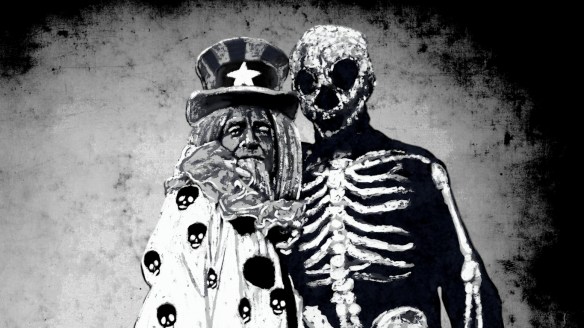
How big corporations are draining the life out of a sick America

If today’s companies were truly offering a fair return to the taxpayers who built their businesses, they’d be doing a lot more to ensure that all Americans have the means to support their families.

By Paul Buchheit

Source: Nation of Change

When Dr. Jonas Salk was asked about a patent on his polio vaccine in 1955, he said, “There is no patent. Could you patent the sun?” When Gilead Sciences recently developed an anti-Covid drug for about $12 per treatment, they set the price at $3,200.

As Republicans and business leaders decry the word ‘social’ as anti-American, they continue to promote the free-market “winner take all” philosophy that has caused over half of our nation to try to survive without adequate health care and life savings and job opportunities. Our richest corporations are much to blame. A review of the facts should make this clear.

They continue to cheat on taxes

After building their businesses on 70 years of taxpayer-funded research and development, six dominant tech companies (Apple, Amazon, Google, Microsoft, Facebook, and Netflix), which together are worth over $7 trillion, have avoided over a hundred billion dollars in taxes over the past decade.

The profits of some of the largest U.S. corporations are surging in this pandemic year of sickness and death. And the levels of fraud and deceit keep growing along with the profits. A shocking analysis by the Tax Justice Network concludes that “Multinational firms operating around the world are shifting over $1 trillion in profits every year to corporate tax havens.” A trillion dollars a year, lost to the people in need of jobs and food and housing.

They’ve rigged the system

Fifty years of lobbying against their own tax responsibilities has borne fruit for the big corporations. First of all, the corporate tax rate has dropped from about 35 percent to a low of 11 percent in 2019.

Secondly, the payroll tax has been used to make up the corporate shortfall. In the past fifty years the corporate percent of tax revenue from major sources has decreased from 23 percent to 7 percent. The payroll tax percent has increased from 24 percent to 39 percent. Corporations have drastically cut their taxes while putting more of the tax burden on workers.

It gets more insidious. In the past ten years Republicans have waged an anti-IRS campaign, slashing the budget of one of the most productive and cost-effective government agencies, and eliminating the positions of highly specialized employees who might have been expected to go after the largest corporations and the biggest cheaters.

And it gets personal. According to the IRS’ own Taxpayer Advocate, the average U.S. household pays $3,000 per year to make up for the delinquents and deadbeats.

Their greed reached new heights

With the 2017 corporate tax cuts came the lofty assurances that money would be freed up for new investment in jobs and R&D. So what happened? Hypocrisy happened. In the following year S&P 500 companies set a new record for buying back their stock to artificially boost stock prices for management and investors — a practice that was illegal until the Reagan years. While about a third of S&P companies are now curtailing stock buybacks in response to the pandemic, others have depleted so much of their funds that they have turned to the pandemic-inspired CARES Act for relief to “distressed industries.”

Start with the airlines. The Big Four spent $42.5 billion on buybacks between 2014 and 2019, and now they’re asking for $50 billion in bailout money. Delta CEO Ed Bastian had the audacity to say “the owners of a business deserve a return, too.” Boeing, which was actually borrowing money to buy back stock, is now asking for a $17 billion bailout from taxpayers.

Merck, whose 1950s slogan was “Medicine is for people, not for profits,” spent $10 billion on R&D in 2018 and $14 billion on share repurchases and dividends.

At Home Depot, according to the Roosevelt Institute and the National Employment Law Project, the money spent on buybacks could have boosted the average employee’s salary by $18,000 a year.

And fast food giants including KFC, Wendy’s, and Papa John’s, who, according to the New York Times, had spent great sums of money on buybacks, now need $145 billion of taxpayer funding to avoid mass layoffs.

They show disdain for the American worker

Stock buybacks are only part of the corporate trend to diminish the state of the worker. Automation is eliminating millions of jobs. The old argument that the loss of jobs to technology has always been followed by a new and better class of work becomes meaningless when the machines start doing our thinking for us. And when the changes are occurring at such a rapid pace. A McKinsey report states: “Those earlier workforce transformations took place over many decades, allowing older workers to retire and new entrants to the workforce to transition to the growing industries. But the speed of change today is potentially faster.” The speed of change is faster still because of the loss of jobs during the Covid pandemic.

Common arguments in favor of the tech companies are that (1) they’re making a lot of people rich, and (2) they’re providing all of us with remarkable products. Well, they’re making about 20% of Americans rich. And their products are a result of 70 years of taxpayer-funded research and development, much of it by government agencies. If today’s companies were truly offering a fair return to the taxpayers who built their businesses, they’d be doing a lot more to ensure that all Americans have the means to support their families.

America’s Death March

By Chris Hedges

Source: Mint Press News

The terminal decline of the United States will not be solved by elections. The political rot and depravity will continue to eat away at the soul of the nation, spawning what anthropologists call crisis cults — movements led by demagogues that prey on an unbearable psychological and financial distress. These crisis cults, already well established among followers of the Christian Right and Donald Trump, peddle magical thinking and an infantilism that promises — in exchange for all autonomy — prosperity, a return to a mythical past, order and security. The dark yearnings among the white working class for vengeance and moral renewal through violence, the unchecked greed and corruption of the corporate oligarchs and billionaires who manage our failed democracy, which has already instituted wholesale government surveillance and revoked most civil liberties, are part of the twisted pathologies that infect all civilizations sputtering towards oblivion. I witnessed the deaths of other nations during the collapse of the communist regimes in Eastern Europe and later in the former Yugoslavia. I have smelled this stench before.

The removal of Trump from office will only exacerbate the lust for racist violence he incites and the intoxicating elixir of white nationalism. The ruling elites, who first built a mafia economy and then built a mafia state, will continue under Biden, as they did under Trump, Barack Obama, George W. Bush, Bill Clinton and Ronald Reagan, to wantonly pillage and loot. The militarized police will not stop their lethal rampages in poor neighborhoods. The endless wars will not end. The bloated military budget will not be reduced. The world’s largest prison population will remain a stain upon the country. The manufacturing jobs shipped overseas will not return and the social inequality will grow. The for-profit health care system will gouge the public and price millions more out of the health care system. The language of hate and bigotry will be normalized as the primary form of communication. Internal enemies, including Muslims, immigrants and dissidents, will be defamed and attacked. The hypermasculinity that compensates for feelings of impotence will intensify. It will direct its venom towards women and all who fail to conform to rigid male stereotypes, especially artists, LGBTQ people and intellectuals. Lies, conspiracy theories, trivia and fake news — what Hannah Arendt called “nihilistic relativism” — will still dominate the airwaves and social media, mocking verifiable fact and truth. The ecocide, which presages the extinction of the human species and most other life forms, will barrel unabated towards its apocalyptic conclusion.

“We run heedlessly into the abyss after putting something in front of us to stop us seeing it,” Pascal wrote.

The worse it gets — and it will get worse as the pandemic hits us in wave after deadly wave with an estimated 300,000 Americans dead by December and possibly 400,000 by January — the more desperate the nation will become. Tens of millions of people will be thrown into destitution, evicted from their homes and abandoned. Social collapse, as Peter Drucker observed in Weimar Germany in the 1930s, brings with it a loss of faith in ruling institutions and ruling ideologies. With no apparent answers or solutions to mounting chaos and catastrophe — and Biden and the Democratic Party have already precluded the kind of New Deal programs and assault on oligarchic power that saved us during the Great Depression — demagogues and charlatans need only denounce all institutions, all politicians, and all political and social conventions while conjuring up hosts of phantom enemies. Drucker saw that Nazism succeeded not because people believed in its fantastic promises, but in spite of them. Nazi absurdities, he pointed out, had been “witnessed by a hostile press, a hostile radio, a hostile cinema, a hostile church, and a hostile government which untiringly pointed out the Nazi lies, the Nazi inconsistency, the unattainability of their promises, and the dangers and folly of their course.” Nobody, he noted, “would have been a Nazi if rational belief in the Nazi promises had been a prerequisite.” The poet, playwright and socialist revolutionary Ernst Toller, who was forced into exile and stripped of his citizenship when the Nazis took power in 1933, wrote much the same in his autobiography: “The people are tired of reason, tired of thought and reflection. They ask, what has reason done in the last few years, what good have insights and knowledge done us.” After Toller committed suicide in 1939, W.H. Auden in his poem “In Memory of Ernst Toller” wrote:

We are lived by powers we pretend to understand:
They arrange our loves; it is they who direct at the end
The enemy bullet, the sickness, or even our hand.

The poor, the vulnerable, those who are not white or not Christian, those who are undocumented or who do not mindlessly repeat the cant of a perverted Christian nationalism, will be offered up in a crisis to the god of death, a familiar form of human sacrifice that plagues sick societies. Once these enemies are purged from the nation, we are promised, America will recover its lost glory, except that once one enemy is obliterated another takes its place. Crisis cults require a steady escalation of conflict. This is what made the war in the former Yugoslavia inevitable. Once one stage of conflict reaches a crescendo it loses its efficacy. It must be replaced by ever more brutal and deadly confrontations. The intoxication and addiction to greater and greater levels of violence to purge the society of evil led to genocide in Germany and the former Yugoslavia. We are not immune. It is what Ernst Jünger called a “feast of death.”

These crisis cults are, as Drucker understood, irrational and schizophrenic. They have no coherent ideology. They turn morality upside down. They appeal exclusively to emotions. Burlesque and celebrity culture become politics. Depravity becomes morality. Atrocities and murder become heroism. Crime and fraud become justice. Greed and nepotism become civic virtues. What these cults stand for today, they condemn tomorrow. At the height of the reign of terror on May 6, 1794 during the French Revolution, Maximilien Robespierre announced that the Committee for Public Safety now recognized the existence of God. The French revolutionaries, fanatical atheists who had desecrated churches and confiscated church property, murdered hundreds of priests and forced another 30,000 into exile, instantly reversed themselves to send to the guillotine those who disparaged religion. In the end, exhausted by the moral confusion and internal contradictions, these crisis cults yearn for self-annihilation.

The French sociologist Emile Durkheim in his classic book “On Suicide” found that when social bonds are shattered, when a population no longer feels it has a place or meaning in a society, personal and collective acts of self-destruction proliferate. Societies are held together by a web of social bonds that give individuals a sense of being part of a collective and engaged in a project larger than the self. This collective expresses itself through rituals, such as elections and democratic participation or an appeal to patriotism, and shared national beliefs. The bonds provide meaning, a sense of purpose, status and dignity. They offer psychological protection from impending mortality and the meaninglessness that comes with being isolated and alone. The breaking of these bonds plunges individuals into deep psychological distress. Durkheim called this state of hopelessness and despair anomie, which he defined as “ruleless-ness.”

Ruleless-ness means the norms that govern a society and create a sense of organic solidarity no longer function. The belief, for example, that if we work hard, obey the law and get a good education we can achieve stable employment, social status and mobility along with financial security becomes a lie. The old rules, imperfect and often untrue for poor people of color, nevertheless were not a complete fiction in the United States. They offered some Americans — especially those from the white working and middle class — modest social and economic advancement. The disintegration of these bonds has unleashed a widespread malaise Durkheim would have recognized. The self-destructive pathologies that plague the United States — opioid addiction, gambling, suicide, sexual sadism, hate groups and mass shootings — are products of this anomie. So is our political dysfunction. My book, “America: The Farewell Tour,” is an examination of these pathologies and the widespread anomie that defines American society.

The economic structures, even before the pandemic, were reconfigured to mock faith in a meritocracy and the belief that hard work leads to a productive and valued role in society. American productivity, as The New York Times pointed out, has increased 77 percent since 1973 but hourly pay has grown only 12 percent. If the federal minimum wage was attached to productivity, the newspaper wrote, it would be more than $20 an hour now, not $7.25. Some 41.7 million workers, a third of the workforce, earn less than $12 an hour, and most of them do not have access to employer-sponsored health insurance. A decade after the 2008 financial meltdown, the Times wrote, the average middle class family’s net worth is more than $40,000 below what it was in 2007. The net worth of black families is down 40 percent, and for Latino families the figure has dropped 46 percent. Some four million evictions are filed each year. One in four tenant households spends about half its pretax income on rent. Each night some 200,000 people sleep in their cars, on streets or under bridges. And these stark figures represent the good times Biden and the Democratic Party leaders promise to restore. Now, with real unemployment probably close to 20 percent — the official figure of 10 percent excludes those furloughed or those who have stopped looking for work — some 40 million people are at risk of being evicted by the end of the year. An estimated 27 million people are expected to lose their health insurance. Banks are stockpiling reserves of cash to cope with the expected wave of bankruptcies and defaults on mortgages, student loans, car loans, personal loans and credit card debt. The ruleless-ness and anomie that defines the lives of tens of millions of Americans was orchestrated by the two ruling parties in the service of a corporate oligarchy. If we do not address this anomie, if we do not restore the social bonds shattered by predatory corporate capitalism, the decay will accelerate.
This dark human pathology is as old as civilization itself, repeated in varying forms in the twilight of ancient Greece and Rome, the finale of the Ottoman and Austro-Hungarian empires, revolutionary France, the Weimar Republic and the former Yugoslavia.

The social inequality that characterizes all states and civilizations seized by a tiny and corrupt cabal — in our case corporate — leads to an inchoate desire by huge segments of the population to destroy. The ethnic nationalists Slobodan Milošević, Franjo Tudjman, Radovan Karadžić and Alija Izetbegović in the former Yugoslavia assumed power in a similar period of economic chaos and political stagnation. Yugoslavs by 1991 were suffering from widespread unemployment and had seen their real incomes reduced by half from what they had been a generation before. These nationalist demagogues sanctified their followers as righteous victims stalked by an array of elusive enemies. They spoke in the language of vengeance and violence, leading, as it always does, to actual violence. They trafficked in historical myth, deifying the past exploits of their race or ethnicity in a perverse kind of ancestor worship, a mechanism to give to those who suffered from anomie, who had lost their identity, dignity and self-worth, a new, glorious identity as part of a master race. When I walked through Montgomery, Alabama, a city where half of the population is African-American, with the civil rights attorney Bryan Stevenson a few years ago, he pointed out the numerous Confederate memorials, noting that most had been put up in the last decade. “This,” I told him, “is exactly what happened in Yugoslavia.”

A hyper-nationalism always infects a dying civilization. It feeds the collective self-worship. This hyper-nationalism celebrates the supposedly unique virtues of the race or the national group. It strips all who are outside the closed circle of worth and humanity. The world instantly becomes understandable, a black and white tableau of them and us. These tragic moments in history see people fall into collective insanity. They suspend thought, especially self-critical thought. None of this is going away in November, in fact it will get worse.

Joe Biden, a shallow, political hack devoid of fixed beliefs or intellectual depth, is an expression of the nostalgia of a ruling class that yearns to return to the pantomime of democracy. They want to restore the decorum and civic religion that makes the presidency a form of monarchy and sacralizes the organs of state power. Donald Trump’s vulgarity and ineptitude is an embarrassment to the architects of empire. He has ripped back the veil that covered our failed democracy. But no matter how hard the elites try this veil cannot be restored. The mask is off. The façade is gone. Biden cannot bring it back.

Political, economic and social dysfunction define the American empire. Our staggering inability to contain the pandemic, which now infects over 5 million Americans, and the failure to cope with the economic fallout the pandemic has caused, has exposed the American capitalist model as bankrupt. It has freed the world, dominated by the United States for seven decades, to look at other social and political systems that serve the common good rather than corporate greed. The diminished stature of the United States, even among our European allies, brings with it the hope for new forms of government and new forms of power.

It is up to us to abolish the American kleptocracy. It is up to us to mount sustained acts of mass civil disobedience to bring down the empire. It poisons the world as it poisons us. If we mobilize to build an open society, we hold out the possibility of beating back these crisis cults as well as slowing and disrupting the march towards ecocide. This requires us to acknowledge, like those protesting in the streets of Beirut, that our kleptocracy, like Lebanon’s, is incapable of being salvaged. The American system of inverted totalitarianism, as the political philosopher Sheldon Wolin called it, must be eradicated if we are to wrest back our democracy and save ourselves from mass extinction. We need to echo the chants by the crowds in Lebanon calling for the wholesale removal of its ruling class — kulyan-yani-kulyan — everyone means everyone.

That Change You Requested…?

By James Howard Kunstler

Source: Kunstler.com

All the previous incidents of white cops killing blacks were just too ambiguous to seal the deal. Michael Brown in Ferguson, Missouri (a murky business); Tamir Rice in Cleveland (waving the BB gun that looked like a .45 automatic); Trayvon Martin (his killer George Zimmerman was not a cop and was not “white”); Eric Garner, Staten Island (black policewoman sergeant on the scene didn’t stop it); Philandro Castile, Minneapolis, (the cop was Hispanic and the vic had a gun). Even the recent February killing of jogger Ahmaud Arbery in Brunswick, Georgia, had some sketchy elements (did Arbery try to seize the shotgun?) — YouTube has scrubbed the video (?) — and then it took months for the two white suspects (not cops) to be arrested.

The George Floyd killing had none of those weaknesses. Plus, the video presented a pretty much universal image of oppression: a man with his knee on another man’s neck. Didn’t that say it all?  You didn’t need a Bob Dylan song to explain it. The Minneapolis police dithered for four days before charging policeman Derek Chauvin with Murder 3 (unpremeditated, but with reckless disregard for human life). The three other cops on the scene who stupidly stood by doing nothing have yet to be charged. Cut it, print it, and cue the mobs.

The nation was already reeling from the weird twelve-week Covid-19 lockdown of everyday life and the economic havoc it brought to careers, businesses, and incomes. In Minnesota, the stay-at-home order was just lifted on May 17, but bars and restaurants were still closed until June. Memorial Day, May 25, was one of the first really balmy days of mid-spring, 78 degrees. People were out-and-about, perhaps even feeling frisky after weeks of dreary seclusion. So, once the video of George Floyd’s death got out, the script was set: take it to the streets!

Few Americans were unsympathetic to the protest marches that followed. Remorse, censure, and tears flowed from every official portal, from the mouth and eyes of every political figure in the land. The tableau of Officer Chauvin’s knee on Mr. Floyd’s neck was readymade for statuary. Indeed, there are probably dozens of statues extant in the world of just such a scene expressing one people’s oppression over another. And yet the public sentiments early-on after the George Floyd killing had a stale, ceremonial flavor: The people demand changeEnd systemic racismNo justice, no peace! How many times have we seen this movie?

What is changing — and suddenly — is that now it’s not just black people who struggle to thrive in the USA, but everybody else of any ethnic group who is not a hedge fund veep, an employee of BlackRock Financial, or a K-Street lobbyist — and even those privileged characters may find themselves in reduced circumstances before long. The prospects of young adults look grimmest of all. They face an economy so disordered that hardly anyone can find something to do that pays enough to support the basics of life, on top of being swindled by the false promises of higher education and the money-lending racket that animates it.

So, it’s not surprising that, when night falls, the demons come out. Things get smashed up and burned down. And all that after being cooped up for weeks on end in the name of an illness that mostly kills people in nursing homes. Ugly as the ANTIFA movement is, it’s exactly what you get when young people realize their future has been stolen from them. Or, more literally, when they are idle and broke and see fabulous wealth all around them in the banks’ glass skyscrapers, and the car showrooms, and the pageants of celebrity fame and fortune on the boob tube. They are extras in a new movie called The Fourth Turning Meets the Long Emergency but they may not know it.

Hungry for change? You won’t have to wait long. This society may be unrecognizable in a few months. For one thing, there’s a good chance that the current violence in the streets won’t blow over as it has before. There hasn’t been such sudden, massive unemployment before, not even in the Great Depression — and we’re not even the same country that went through that rough episode. Just about every arrangement in contemporary life is on-the-rocks one way or another. Big business, small business, show business… it’s all cratering. The great big secret behind all that is not that capitalism failed; it’s that the capital in capitalism isn’t really there anymore, at least not in the amounts that mere appearances like stock valuations suggest. We squandered it, and now our institutions are straining mightily to pretend that “printing” money is the same as capital. (It’s just more debt.) Note, the stock markets are up this morning at the open! Go figure….

Change? We’re getting it good and hard, and not at a rate we were prepared for. It’s hugely disorienting. It produces friction, heat, and light, which easily becomes violence. There’s, for sure, plenty we can do to make new arrangements for American life without becoming communists or Nazis, but a lot of activities have to fail before we see how that could work. The overburden of obsolete complexity is crushing us, like Derek Chauvin’s knee on George Floyd’s neck. They were both, in their way, common men, caught in the maelstrom of metaphor. That proverbial long, hot summer we’ve heard about for so long…? It’s here.

Revolution Is Inevitable and Necessary

By Jason Holland

Source: Dissident Voice

None are so hopelessly enslaved, as those who falsely believe they are free. The truth has been kept from the depth of their minds by masters who rule them with lies. They feed them on falsehoods till wrong looks like right in their eyes.

— Johann Wolfgang von Goethe, Bk. II, Ch. 5; source: Die Wahlverwandtschaften, Hamburger Ausgabe, Bd. 6 (Romane und Novellen I), dtv Verlag, München, 1982, p. 397 (II.5).

I keep plotting a revolution no one else seems to be interested in having. So be it. I’ll have my solitary revolution. There will be no pink hats, guillotines, or marches, just me and a bitter jaded middle finger saluting towards the firmaments in utter rejection of most what this society represents. Although I hold no lasting contempt for anyone in this society because I understand we all have fallen into cultural traps and have done things that we believed we had to do so that we could be accepted, or just to be allowed to sleep indoors somewhere and be fed; we’ve had to commodify and sell out pieces of ourselves to serve the desires of those in a system of power who sanction and control the flow of money backed by military forces and institutions of incarceration, and this way of being was set into motion a long time ago, but it doesn’t have to continue if that’s not what we really desire, but for right now it’s close to all we know.

So, it does seem a revolution of sorts is inevitable due to inequality reaching grotesque heights of avarice where there is no longer any excuse for the wealthy to hide behind in order to explain why it is they have so much and others have so little. However, this just emphasizes the point that this population is largely not wise enough yet to create a revolution worth having, because a more enlightened culture would have taken a stand a long time ago before things became an emergency. Every second we acquiesce to power and don’t push for something radically better we compound an already grim situation. Globally there seems to be a majority who don’t understand what it is to be free, they merely fight to be better treated servants. So it’s highly likely their coming revolution will be a flailing inchoate attempt at something marginally better than what is here now and won’t set out to correct much, if any, of the underlying structural problems.

Consequently, the odds are the revolution we’ll end up with will circle directly back to where we are now or worse in no time at all. But my critiques and frustrations are mine, not a concern for the coming revolution. I must remember it’s their revolution, not mine. I’m not invited to theirs — well, that’s not entirely true.  I just have to ignore most of what I believe to be true, then I’m invited. As things are, I have only a single pathetic pity party scheduled as an event to prove my revolution ever existed, but I should be appreciative of what I have and cease bemoaning what I do not.

So this is where I will make my stand. The beginning and likely end of my revolution of one. In reality my revolution is simply a rough translation through the English language describing my light of truth within, which I’ve gone to great pains to keep safe, dry, and burning from a clean source of fuel. Probably all done in futility except to selfishly inoculate my own mind from the lurking darkness of the culture cave; still, a lingering desire remains to light a path out for others to follow who have become stuck watching dark Platonic shadows flicker across the walls.

With that said, here’s the path I’m lighting with argumentation and I believe it to be a solid one.  We, as in the we consisting of the global middle/lower classes of the entire planet, aka the 99%, are not a free people now nor have ever truly been free while living in the bounds of a social hierarchy. While many a winsome word has been applied to parchment declaring this or that people free, unfortunately soon thereafter the founding document is handed over to record keepers to energize the narratives of posterity while the same ole domination and ownership-driven society meters out the same ole grind. The reward and punishment operant conditioning culture is uniformly applied and chosen specifically to keep people compliant, reactive, and rutted into perpetual business as usual subservience to authoritative forces.

Constitutions supply grandiose ideas which are undermined by underlying conditional legislature where the original words are made into feckless futile notions that allows the ruling authority to do all the draconian bullshit they’ve always done with prettier sounding words. The powers that be couch authoritarian ideas in language that sometimes sounds reasonable on the surface but ultimately leads people to a deleterious state of believing they are free when they are nothing close to any working definition of freedom. Freedom is a condition which is now only possible within our own minds, but our physical bodies are fodder for the whims of a class of people who clearly believe themselves superior to just about everyone else.

Those causing the most damage are simply playing out a cultural role that’s a legacy of deceit passed down from one generation to the next, and each falling prey to traps of chasing after things; endless shiny carrots on shiny sticks. And not just chasing, but lusting, demanding, an obsessive hedonistic pursuit wanting total ego domination at any macabre cost. Pure obsession with the chase. While irony sits on many of their own bookshelves as Melville’s whale tale of wisdom lies fallow and ignored serving only as bookcase filler to give guests the impression they’re well read.

The ego-driven mind thinks primarily in the language of temporal imperatives. Short term must do this, must do that kind of thinking where all thought is disseminated through a lens of self importance with agendas to accomplish to validate that self importance. And if it thinks itself important enough it will eventually see itself as messianic. After they have assumed role of savior it’s just logically congruent that the ruling class allocate all the resources they desire for themselves so they can help all the people they will eventually save, and they need deep pockets to be the inspiration for the entire world.

Over time the ruling class creates rules and cultural dogmas that they claim are for the good of the people, but oddly enough their beliefs always result in making them richer and giving them more power. What an odd purported symbiosis they have dreamed up. The surest sign of being under an authoritarian power is when they make it really difficult to live independent of them. They demand you be hooked up to their electrical grid, pay taxes to live on the land, and hooked into the public water system. Total forced dependency on their system and it is barely noticed yet subtly removing choice and creating an artificial cage. Creating dependency is the best way to control people, and tyranny is then accepted under the umbrella of the common good, so the messianic ones can provide shelter from the storm while, of course, the common person sacrifices most of their free will in the process in a Faustian bargain which is the default role we are thrust into in this world of imperial forces.

Social hierarchies hold their grip on power in increasingly sophisticated ways. They’ve mostly advanced past public executions to keep people in line. They’ve learned it’s far more effective to manipulate minds into believing all are equals and free, and stoke the fear response towards something external that threatens that equality and freedom. It’s become understood by hierarchy that if the ruling power is perceived as the threat they are far more likely to be ousted from that power, so the engines of power must diffuse the blame of their actions lest they be held responsible for the tyranny they impose.

So semi-plausible sounding fears are brought to the forefront so they can provide you with adequate safety, which gives them the power to deprive you of the liberty they are telling you they are protecting, since you know they care so much about you. The gas-lighting of the masses creates reactionary conditioning that puts people in a state where they no longer trust their own mind and become prone to believing all the fears power claims are real. And fear is then used as a prod to move the human animal in a chosen direction power wishes.

Revolution of a real kind, one where our relationship to power radically changes, will be a series of progressions in pulling our minds out of this culture trap. Change will come in relation to how well we come to understand the implications of centralized power and ultimately integrate that knowledge into how we live. Further, how well we learn to work together cooperatively in a voluntary manner will correlate  directly to how likely it is our species survives past the next hundred years. But curing ourselves of  these brutal mental afflictions is not an easy path to traverse. However, I’ll argue a radical change is needed if we want to once again have human lives worth living with real choice and agency over our own mind, body, and time.

Nationwide Uprising Against Failed State Triggered By Police Killings

By Kevin Zeese and Margaret Flowers

Source: CounterCurrents.org

The nationwide uprising sparked by the murder of George Floyd and other recent racially-motivated events is a response to the bi-partisan failed state in which we live. It comes in the midst of the COVID19 pandemic and the largest economic collapse in the US in more than a century. These three crises have disproportionately impacted people of color and added to longterm racial inequality and injustice.

Black Lives Matter erupted six years ago when a police officer shot and killed Mike Brown in Ferguson, MO. Since that time, police have murdered approximately 1,100 people every year. The response of the government at all levels to the crisis of police killings has been virtually nonexistent. While people seek to avenge the death of George Floyd, the problems are much deeper and the changes needed are much broader.

The Root Of The Problem Is A Failed State

During the COVID19 pandemic, millionaires and billionaires have been bailed out by the government with trillions of dollars while working people were given a pittance of $1,200 per person and a short term increase in unemployment benefits for the more than 40 million people who have lost their jobs. Many workers who provide essential services have had to continue to work putting themselves and their communities at risk.

Urgently needed healthcare is out of reach for millions with no or skimpy health insurance resulting in people dying at home or not going to the hospital until their illness became serious. For this and other reasons, COVID19 is disproportionately impacting communities of color.

Glen Ford of Black Agenda Report puts the mass revolt in the context of the long history of white supremacy that has existed since Africans were brought to the United States. Chattel slavery was enforced by the earliest form of policing, with the first formal slave patrol created in the Carolina colonies in 1704. After the Civil War and a brief period of Reconstruction where African people could participate in civic life, Jim Crow followed with white racists, often allied with Southern police, inflicting terrorism against the Black population through lynchings and other means. Black people were arrested for laws like vagrancy and then punished by being forced to work picking cotton or other jobs. This new form of slavery continues as inmates are forced to work for virtually no pay in prisons, are leased out to dangerous jobs like meat processing, or are used as scabs.

George Floyd’s murder enraged people who have seen too many deaths as a result of police violence. The murder in broad daylight with cameras filming and scores of witnesses showed the impunity of police who are used to not being held accountable for their violence. During the uprising, police have used extreme violence and targeted people with cameras and the media even saying they were the problem.

The root of the problem is a failed state that does not represent the people and has a deep history of racism and inequality that are being magnified by the current crises. The failure to respond to these crises is resulting in an ungovernable country as the social contract has been broken.

Lawlessness among the wealth class, corruption of politicians by campaigns financed by the wealthiest with payoffs to their children and relatives has set the stage for no respect for the law. As one protester exclaimed, “Don’t talk to us about looting, you are the looters. You have been looting from black people. You looted from the Native Americans. Don’t talk to us about violence, you taught us violence.”

The Failed State Cannot Reform Itself

George Floyd’s final words, “I can’t breathe,” echoed the same words of Eric Garner, who was killed six years ago by a New York police officer. Although there were protests then, not much has changed. The system failed to respond.

Failure starts at the top. There have been years of inaction at all levels of government. The New York Times reports “The administration has largely dismantled police oversight efforts, curbing the use of federal consent decrees to overhaul local police departments. Mr. Barr has said that communities that criticize law enforcement may not deserve police protection, and Mr. Trump has encouraged officers not to be ‘too nice’ in handling suspects.”

Trump poured gasoline on the current fire with incendiary rhetoric promising ‘looting leads to shooting’ echoing racists of the past and promising to send in the US military if Democrats can’t stop the uprising. Trump has put the military on alert to deploy to civilian protests. He maintains power by dividing people praising armed protesters who demanded reopening the economy despite the pandemic and calling unarmed protesters against police violence “thugs”.

On Friday, the White House locked down on security alert because of protests. Trump responded by calling for MAGA protesters to come to the White House. They did not come but protests at the White House have continued to increase.

Both Republicans and Democrats are responsible for the current rebellion. Joe Biden has described himself as a ‘law and order’ Democrat from the beginning of his career. He was the primary architect of the federal mass incarceration of Black people and helped add hundreds of thousands of police with militarized equipment to urban communities. He courts police unions that defend killer cops. And Biden opposed the integration of schools.

The failure of leadership continues at the state and local levels with politicians closely tied to the Fraternal Order of Police, which aggressively defends police who kill civilians. Every city can point to a series of police killings with no prosecutions or acquittals and few convictions. Minneapolis is a city with a long history of race-based police violence. Indeed, violence against Indigenous peoples led to the formation of the American Indian Movement.  Tne Intercept summarizes some of the cases:

  • In 2015, the police killed Jamar Clark a  24-year-old black man. Protests lasted two weeks but led to no prosecution.
  • In 2016, Philando Castile, a 32-year-old black motorist, was killed in a Minneapolis suburb. More than two weeks of protest followed and two years later the officer was acquitted.
  • In 2017, Justine Ruszczyk, a 40-year-old white woman, approached a Minneapolis police car to report a sexual assault. The police officer, Mohamed Noor, who shot and killed her was sentenced to 12 years in prison, and her family was awarded a record $20 million settlement.
  • In 2018, body camera footage showed Minneapolis police chasing Thurman Blevins, a 31-year-old black man, and shooting him to death. Prosecutors refused to file charges against the officers who killed Blevins.

Protests have led to some changes but they haven’t solved the problem. Money has been spent on body cameras, which have rarely had any impact. Similarly, training on de-escalation and racial sensitivity has made little difference.

Over the last six years, cities have increased funding for police departments at the expense of health, education, and other underfunded urban programs. Rather than providing people with necessities, the government has relied on controlling neglected communities with an occupying police force. Some of the police are even trained by the Israeli occupiers.

Even in the midst of a pandemic and economic collapse, the government cannot give people access to healthcare, protect their jobs, suspend their rents or control food prices. As Rosa Miriam Elizalde writes in her comparison of the United States to Cuba, the difference is a matter of values. The United States government spends more than 60 percent of the discretionary budget on weapons and war. It should be no surprise that the government acted more quickly to suppress people with militarized police, thousands of National Guard troops, and curfews than it did to protect their lives when the pandemic and recession started.

Reform Is Not Enough: Defund The Police, Give Communities Control, Build Alternatives To Police

The country must look more deeply at policing. Retired police major, Neill Franklin, the executive director of the Law Enforcement Action Partnership told the Intercept, “We need a new paradigm of policing in the United States. It needs to be completely dismantled and reconstructed, not changing a policy here or there.”

The Minneapolis group, Reclaim the Block, wrote a statement calling on the city council to defund the police department. Last week, they made four demands of their city council:

  1. Never again vote to increase police funding.
  2. Propose and vote for a $45 million cut from MPD’s budget as the city responds to projected COVID19 shortfalls.
  3. Protect and expand current investment in community-led health and safety strategies.
  4. Do everything in their power to compel MPD and all law enforcement agencies to immediately cease enacting violence on community members.

This is an agenda that makes sense for cities across the country. A growing movement demands the defunding of police departments. It is evident that the way to reduce police violence is to fund alternative non-law enforcement approaches to conflict resolution, safety strategies, and mental health as well as investing in neglected communities.

Another growing movement calls for democratic community control of the police where communities elect a Civilian Police Accountability Council (CPAC). The critical difference between this and Civilian Police Boards is that the Accountability Council is democratically elected not appointed by the police chief or politicians who are allied with the police. Neill Franklin urges a national database of officers terminated for misconduct so they will not be hired by other police departments.

The New York Times reports that “in 2012, the civilian board in Minneapolis was replaced by an agency called the Office of Police Conduct Review. Since then, more than 2,600 misconduct complaints have been filed by members of the public, but only 12 have resulted in an officer being disciplined.”  The most severe censure was only a 40-hour suspension. Derek Chauvin, who killed George Floyd, has at least 17 misconduct complaints, none of which derailed his career, in nearly two decades with the Minneapolis Police Department.

Chauvin was involved in the fatal shooting in October 2006 when Senator Klobuchar was Minneapolis’ district attorney. Rather than prosecuting Chauvin, she sent the case to a grand jury that declined to indict Chauvin. In 2011, Chauvin was involved in a high-profile shooting of a Native American. He was placed on administrative leave but was reinstated to the force when no charges were brought. If democratic community control of the police were in place, it is highly likely Chauvin would have been removed as a police officer and George Floyd would still be alive.

Support for change is growing. Bus drivers refused to transport arrested protesters for the police in Minneapolis and New York. Payday Report wrote transit union leaders nationwide are instructing members not to cooperate with police in arresting protesters. And Universities are dropping their contracts with the Minneapolis Police Department.

Protests continue nationwide. Thus far escalating police violence and the use of the National Guard has failed to stop them. The government may use the military, although by law there are restrictions on that. There will be efforts to pacify the protests by political leaders and non-profits who will try to take over the leadership. These must be rejected.

To achieve the changes we need, people must stay in the streets and connect the problems we face to the demand for systemic changes. We will need to support each other as many are doing by distributing food and providing medical care, jail support and legal representation. We urge people to meet in assemblies to discuss what their goals are, their vision of how communities could be organized differently and what actions they can take.  We need to build confidence in each other that we can work together for the future we want. That is how we will get there.


Kevin Zeese and Margaret Flowers are directors of Popular Resistance

Re-Opening the Economy Won’t Fix What’s Broken


By Charles Hugh Smith

Source: Of Two Minds

Re-opening a fragile, brittle, bankrupt, hopelessly perverse and corrupt “normal” won’t fix what’s broken.

The stock market is in a frenzy of euphoria at the re-opening of the economy. Too bad the re-opening won’t fix what’s broken. As I’ve been noting recently, the real problem is the systemic fragility of the U.S. economy, which has lurched from one new extreme to the next to maintain a thin, brittle veneer of normalcy.

Fragile economies cannot survive any impact with reality that disrupts the distortions that are keeping the illusion of “growth” from shattering. For the past two decades, every collision with reality cracked the illusion, and the “fix” was to duct-tape the pieces together with new extremes of money-creation, debt, risk and speculative excess.

While the stock market has soared, the real world falls apart. If your region needs a new bridge built, count on about 20 years to get all the “stakeholders” to agree and get the thing actually built. Count on the cost quintupling from $500 million to $2.5 billion. Count on corners being cut as costs skyrocket, so those cheap steel bolts from China that are already rusting before the bridge is even finished? Oops. Replacing them will add millions to the already bloated budget.

Want to add a passenger stop on an existing railroad line? Count on 20 years to get it done. The complexity thicket of every regulatory agency with the power to say “no” basically guarantees the project will never get approved, because every one of these bureaucracies justifies its existence by saying “no.” Sorry, you need another study, another environmental review, and so on.

Need a new landfill? I hope you started the process 15 years ago, so you’ll get approval in only five more years. Every agency with the power to say “no” will stretch out the approval, so they have guaranteed “work” for another decade or two.

Did your subway fares double? Was the excuse repairing a crumbling system? Did the work get done on budget and on time? You must be joking, right? All the fare increase did was cover the costs of skyrocketing salaries, pensions and administrative costs. Repairs to the tracks and cars– that’s extra. Let’s float a $1 billion bond so nobody have to tighten their belts, and have riders pay for it indirectly, through higher taxes to pay the exorbitant costs of 20 years of interest on the bond.

Have you been thrown off your bicycle by the giant potholes in the city’s “bike lanes”? The city reluctantly admits that these streets that haven’t been maintained for decades–yes, decades. The city once paid for street maintenance out of its general budget, but alas, that’s been eaten up by skyrocketing salaries, pensions and administrative costs, so now we need to float $100 million bond to fund filling potholes. If all goes according to plan (ha-ha), we should be able to re-pave the streets that have been crumbling for 20 years in… the next 20 years.

These real-world examples are just four of thousands of manifestations of a broken system. Rather than make tough choices that drain power and wealth from vested interests, we simply borrow more money, in ever increasing amounts, to keep the entrenched interests and elites happy.

There are two “solutions” in the status quo: dump the debt on taxpayers or on powerless debt-serfs–for example, college students. (See chart below of the $1.6 trillion that’s stripmining student debt-serfs.) Who benefits from selling all the municipal bonds, bundled student loans, etc. to investors starving for a yield above 0.1%? Wall Street, of course.

The problem is that while debt has soared, productivity and earned income have stagnated. The statistical narrative has been ruthlessly gamed to hide the erosion of living standards, but even with the bogus “low inflation” of official statistics, wages for the bottom 95% have stagnated for decades.

Measures of productivity have also been gamed to mask the ugly reality that the vast majority of the U.S. economy is stagnating under the weight of interest payments on debt, mal-investments in speculative gambles, higher junk fees and taxes, crushing regulatory compliance, high costs imposed by monopolies and cartels and a well-cloaked decline in the quality of just about everything the bottom 95% uses or owns.

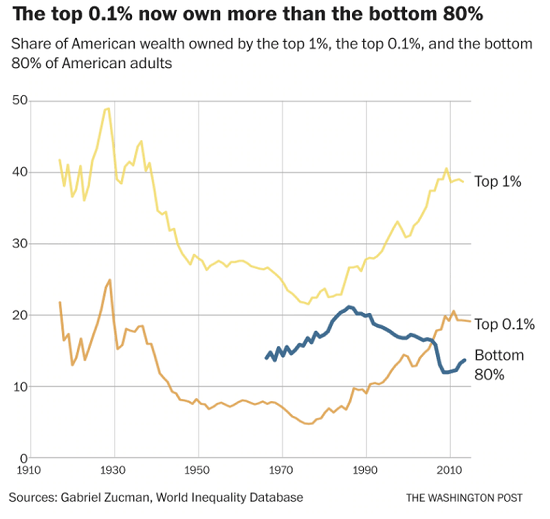
What little productivity gains have been made have been skimmed by the top 5%. Coupled with the Federal Reserve’s single-minded goosing of the one signaling device it controls, the stock market, the top 0.1% in America own more wealth than the bottom 80%.

If productivity stagnates and winners take all, the wages of the bottom 95% cannot rise. Real wealth is only created by increases in the productivity of labor and capital; everything else is phantom wealth.

The only way stagnant incomes can support more debt is if interest rates decline. Presto, the Fed dropped interest rates to near-zero a decade ago. Of course you and I can’t actually borrow millions for 0.1%; that privilege is reserved for financiers and other financial parasites and predators.

Debt-serfs were able to refinance their crushing mortgages to save a few bucks, and so they can afford to 1) take on more debt and 2) pay higher taxes to fund the ballooning public debt.

Every one of these extremes has increased the systemic fragility of the American economy. This fragility is reflected in the impoverishment of the bottom 95%, the thin line between solvency and bankruptcy, the decay of public trust in institutions run for the benefit of entrenched interests, and the quickening erosion of America’s social contract.

Re-opening a fragile, brittle, bankrupt, hopelessly perverse and corrupt “normal” won’t fix what’s broken.


Private gain must no longer be allowed to elbow out the public good

By Dirk Philipsen

Source: aeon

Adam Smith had an elegant idea when addressing the notorious difficulty that humans face in trying to be smart, efficient and moral. In The Wealth of Nations (1776), he maintained that the baker bakes bread not out of benevolence, but out of self-interest. No doubt, public benefits can result when people pursue what comes easiest: self-interest.

And yet: the logic of private interest – the notion that we should just ‘let the market handle it’ – has serious limitations. Particularly in the United States, the lack of an effective health and social policy in response to the coronavirus disease (COVID-19) outbreak has brought the contradictions into high relief.

Around the world, the free market rewards competing, positioning and elbowing, so these have become the most desirable qualifications people can have. Empathy, solidarity or concern for the public good are relegated to the family, houses of worship or activism. Meanwhile, the market and private gain don’t account for social stability, health or happiness. As a result, from Cape Town to Washington, the market system has depleted and ravaged the public sphere – public health, public education, public access to a healthy environment – in favour of private gain.

COVID-19 reveals a further irrational component: the people who do essential work – taking care of the sick; picking up our garbage; bringing us food; guaranteeing that we have access to water, electricity and WiFi – are often the very people who earn the least, without benefits or secure contracts. On the other hand, those who often have few identifiably useful skills – the pontificators and chief elbowing officers – continue to be the winners. Think about it: what’s the harm if the executive suites of private equity, corporate law and marketing firms closed down during quarantine? Unless your stock portfolio directly profits from their activities, the answer is likely: none. But it is those people who make millions – sometimes as much in an hour as healthcare workers or delivery personnel make in an entire year.

Simply put, a market system driven by private interests never has protected and never will protect public health, essential kinds of freedom and communal wellbeing.

Many have pointed out the immorality of our system of greed and self-centred gain, its inefficiency, its cruelty, its shortsightedness and its danger to planet and people. But, above all, the logic of self-interest is superficial in that it fails to recognise the obvious: every private accomplishment is possible only on the basis of a thriving commons – a stable society and a healthy environment. How did I become a professor at an elite university? Some wit and hard work, one hopes. But mostly I credit my choice of good parents; being born at the right time and the right place; excellent public schools; fresh air, good food, fabulous friends; lots of people who continuously and reliably provide all the things that I can’t: healthcare, sanitation, electricity, free access to quality information. And, of course, as the scholar Robert H Frank at Cornell University so clearly demonstrated in his 2016 book on the myth of the meritocracy: pure and simple luck.

Commenting on how we track performance in modern economies – counting output not outcome, quantity not quality, prices not possibilities – the US senator Robert F Kennedy said in 1968 that we measure ‘everything, in short, except that which makes life worthwhile’. His larger point: freedom, happiness, resilience – all are premised on a healthy public. They rely on our collective ability to benefit from things such as clean air, free speech, good public education. In short: we all rely on a healthy commons. And yet, the world’s most powerful metric, gross domestic product (GDP), counts none of it.

The term ‘commons’ came into widespread use, and is still studied by most college students today, thanks to an essay by a previously little-known American academic, Garrett Hardin, called ‘The Tragedy of the Commons’ (1968). His basic claim: common property such as public land or waterways will be spoiled if left to the use of individuals motivated by self-interest. One problem with his theory, as he later admitted himself: it was mostly wrong.

Our real problem, instead, might be called ‘the tragedy of the private’. From dust bowls in the 1930s to the escalating climate crisis today, from online misinformation to a failing public health infrastructure, it is the insatiable private that often despoils the common goods necessary for our collective survival and prosperity. Who, in this system based on the private, holds accountable the fossil fuel industry for pushing us to the brink of extinction? What happens to the land and mountaintops and oceans forever ravaged by violent extraction for private gain? What will we do when private wealth has finally destroyed our democracy?

The privately controlled corporate market has, in the precise words of the late economics writer Jonathan Rowe, ‘a fatal character flaw – namely, an incapacity to stop growing. No matter how much it grew yesterday it must continue to do so tomorrow, and then some; or else the machinery will collapse.’

To top off the items we rarely discuss: without massive public assistance, late-stage extractive capitalism, turbocharged by private interest and greed, would long be dead. The narrow kind of macroeconomic thinking currently dominating the halls of government and academia invokes a simpleminded teenager who variously berates and denounces his parents, only to come home, time and again, when he is out of ideas, money or support. Boeing, Goldman Sachs, Bank of America, Exxon – all would be bust without public bailouts and tax breaks and subsidies. Every time the private system works itself into a crisis, public funds bail it out – in the current crisis, to the tune of trillions of dollars. As others have noted, for more than a century, it’s a clever machine that privatises gains and socialises costs.

When private companies are back up and running, they don’t hold themselves accountable to the public who rescued them. As witnessed by activities since the 2008 bailouts at Wells Fargo, American Airlines and AIG, companies that have been rescued often go right back to milking the public.

By focusing on private market exchanges at the expense of the social good, policymakers and economists have taken an idea that is good under clearly defined and very limited circumstances and expanded it into a poisonous and blind ideology. Now is the time to assert the obvious: without a strong public, there can be no private. My health depends on public health. My freedom depends on social freedom. The economy is embedded in a healthy society with functional public services, not the other way around.

This moment of pain and collapse can serve as a wakeup call; a realisation that the public is our greatest good, not the private. Look outside the window to see: without a vibrant and stable public, life can quickly get poor, nasty, brutish and short.

Why Assets Will Crash

By Charles Hugh Smith

Source: Of Two Minds

This is how it happens that boats that were once worth tens of thousands of dollars are set adrift by owners who can no longer afford to pay slip fees.

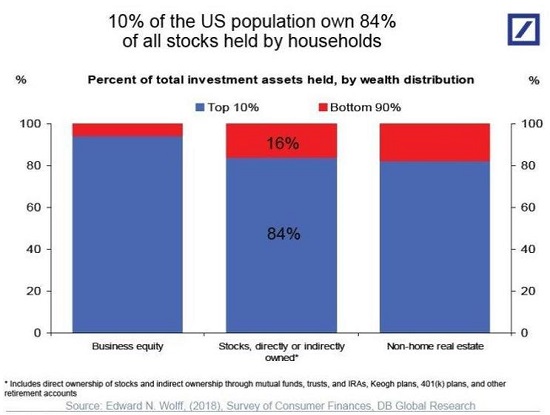
The increasing concentration of the ownership of wealth/assets in the top 10% has an under-appreciated consequence: when only the top 10% can afford to buy assets, that unleashes an almost karmic payback for the narrowing of ownership, a.k.a. soaring wealth and income inequality: assets crash.

Most of you are aware that the bottom 90% own very little other than their labor (tradeable only in full employment) and modest amounts of home equity that are highly vulnerable to a collapse of the housing bubble. (The same can be said of China’s middle class, only more so, as 75% of China’s household wealth is in real estate, more than double the percentage of wealth held in housing in U.S. households.)

As the chart illustrates, the top 10% own 84% of all stocks, over 90% of all business equity and over 80% of all non-home real estate. The concentration of ownership of assets such as vintage autos, collectibles, art, pleasure craft and second homes in the top 10% is likely even greater.

The more expensive the asset, the greater the concentration of ownership, as the top 5% own roughly 2/3 of all wealth, the top 1% own 40% and the top 0.1% own 20%. In other words, the more costly the asset, the narrower the ownership. (Total number of US households is about 128 million, so the top 5% is around 6 million households and the top 1% is 1.2 million households.)

This means the pool of potential buyers is relatively small, even if we include global wealth owners.

Since price is set on the margins, and assets like houses are illiquid, then we can anticipate all the markets for assets owned solely by the wealthy to go bidless–yachts, collectibles, vacation real estate–because the pool of buyers is small, and if that pool gets cautious due to a drop in net worth/unearned income, there won’t be any buyers except at the margins, at incredible discounts.

As we know, in a neighborhood of 100 homes currently valued ar $1 million each, when a desperate seller accepts $500,000, the value of the other 99 homes immediately drops to $500,000.

Since few of the current bubble-era asset valuations are supported by actual income fundamentals, then the sales price boils down to a very small number of potential buyers and what they’re willing to pay.

Houses have a value based on rent, of course, but rents will drop very quickly for the same reason: prices are set on the margins. The most desperate landlords will drop rents and re-set the rental market from the margins. If demand plummets (which it will as people can no longer afford rents in hot urban markets once they lose their jobs), then vacancies will soar and rents will crash as a few desperate landlords will take $1200/month instead of $2500/month.

Due to the multi-year building boom of multi-family buildings in hot job markets (which inevitably leads to an over-supply once the boom ends), there are now hundreds of vacancies where there were once only a few dozen, and thousands where there were previously only hundreds.

As millions of wait staff, bartenders, etc. who made good money in tips find their jobs have vanished, all the urban hotspots will see mass out-migration: Seattle, Portland, the S.F. Bay Area, L.A., NYC, Denver, etc. as demand for rentals will evaporate and rents will be set on the margins by the most desperate landlords. Everyone holding out for the previous bubble-era rent will have $0 income as their units are vacant.

Tech start-ups and Unicorns are melting like ice cubes in Death Valley, and tech-sector layoffs are already in the tens of thousands. This wave of highly paid techies losing their jobs will become a tsunami, further reducing the pool of people who can afford rents of $2,500 to $3,000 for a studio or one-bedroom apartment.)

The concentration of ownership generates a self-reinforcing feedback that further depresses prices: since the top 10% own most of the assets of the nation, they are most prone to a reversal of “the wealth effect.” As their assets soared in value, the top 10% felt wealthier and more confident in future gains, enabling them to borrow and spend freely on second homes, pleasure craft, new vehicles, collectibles, luxury travel, etc.

Once even one class of assets plummets in value–for example, the recent decline in the stock market– the wealth effect reverses and the top 10% feel poorer and less confident about future gains, and thus less enthused about borrowing and spending. The demand for other costly assets quickly evaporates, further reducing the wealth of the “ownership class,” which further reduces their desire and ability to buy bubble-era assets.

The high-priced assets owned by the top 10% will be the assets least in demand due to their high cost and potential for enormous losses: nothing loses value faster in a recession that narrowly owned assets such as vintage cars, art, vacation homes, yachts, etc.

Once assets start sliding in value, the reverse wealth effect quickly dries up demand for all asset classes with narrow ownership. Since these assets are illiquid–that is, the market for them is thin, with buyers few and far between–the prices are set by a very shallow pool of buyers and desperate sellers.

Consider a pleasure craft that retails new for $120,000. In the boom era of rising stocks and housing, a used boat might fetch $65,000. But as the wealth of the small pool of households able to buy and maintain a costly craft evaporates, the number of qualified buyers evaporates, too.

The seller might be aghast by an offer of $35,000 and reject it angrily. Six months later, he’s praying someone will take it off his hands for $15,000, and in another six months, he’ll accept $500 just to get out from underneath the insurance, slip-rental and licencing fees.

This is how it happens that boats that were once worth tens of thousands of dollars are set adrift by owners who can no longer afford to pay slip fees, and vacation homes are abandoned and auctioned off for overdue property taxes: the market for these luxuries dries up and blows away, i.e. goes bidless–there are no buyers at any price.

Once housing and real estate valuations fall, that will trigger a decline in the value of all other costly, narrowly owned assets, which will reinforce the reverse wealth effect.

This is the systemic payback for concentrating ownership of assets in the hands of the few: when their bubble-era priced assets plummet in value, the bottom falls out of all assets with narrow ownership. The price of superfluous assets such as boats, vintage cars, collectibles, art and vacation homes can quickly fall to a fraction of bubble-era valuations, destroying much of what was always fictional capital.

(For more on the intrinsic fragility of a system that concentrates ownership in the hands of the few, please read Our Inevitable Collapse: We Can’t Save a Fragile Economy With Bailouts That Increase Fragility May 1, 2020.)

The Federal Reserve reckons it can “save” the bubble-era valuations of junk bonds by being the “buyer of last resort,” but it will end up being the “only buyer,” effectively making the system even more fragile and prone to collapse.

The public will eventually have to decide if the nation’s central bank should be bailing out assets owned by the financial elite while the upper-middle class watches its assets collapse in value.