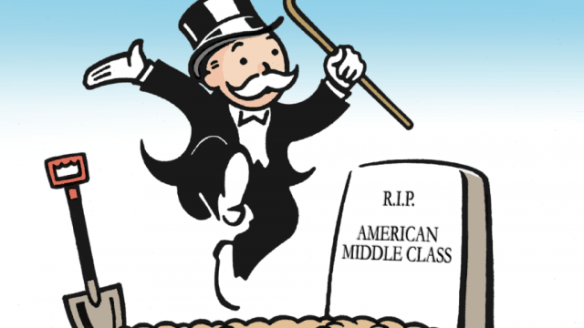
The Top 10% Is Doing Just Fine, The Middle Class Is Dying on the Vine

By Charles Hugh Smith

Source: Of Two Minds

Please study these charts as a means of understanding the inevitability of economic stagnation and a revolt of the decapitalized middle class.
I’ve been covering the decline of America’s middle class for over a decade with charts, data and commentary on the social depression that has accompanied the decline.

While there are many mutually reinforcing dynamics in this 45-year decline–demographics, global energy costs, financialization and globalization, to name a few– one term describes the accelerating erosion of America’s middle class: decapitalization.

To understand decapitalization, we need to start with the fundamentals of any economy between labor (wages) and capital and between investment and speculation. Although it’s tempting to oversimplify and demonize one or the other of these basics (speculators bad! etc.), they each provide an essential role in a healthy economy, one which is in dynamic equilibrium, a state analogous to a healthy ecosystem with constantly changing interactions of numerous species, individuals and inputs (weather, etc.). This variability enables the order of fluctuations (to use Ilya Prigogine’s profound phrase), a dynamic stability / equilibrium.

If labor’s share of the economy drops too low, the workforce cannot consume enough to support their households and the economy as a whole. If capital can no longer earn an attractive return, investment dries up and production stagnates. If speculators are not allowed to take on risk, liquidity dries up and risk crushes investment. But if speculation becomes the foundation of the economy’s “growth,” then the inevitable collapse of speculative bubbles will crash the economy.

In modern social-capitalist systems, the core stabilizer of the system is the wage-earning middle class which provides the stable workforce driving production and the stable pool of consumers needed to borrow money and consume enough to soak up the production of goods and services at a profit to producers.

Without a stable, dominant middle class, capital has few opportunities to invest in productive capacity. Without a stable, dominant middle class, the economy stagnates and is prone to collapse as it is far from equilibrium.

The process of middle class decline is best explained as decapitalization because the middle class is fundamentally a means of transforming labor into capital via savings and investment. The traditional ladder of social mobility from the working class to the middle class is one of capitalizing work: time and savings are invested in higher education, in effect capitalizing future labor by increasing productivity.

Capital isn’t limited to cash, land or tools; in an information economy, knowledge and skills are also capital, as is the social capital of social networking and relationships formed with mentors, suppliers, lenders, colleagues, investors, etc.

The second way to capitalize work is to save earnings and invest the savings in assets that produce income or gain value: a house, land, rental property, small business and income-producing financial assets such as bonds or dividend-paying stocks.

Thrift, investing, long-term planning and deferred consumption are all essential to capitalizing work by turning that labor into income-producing assets. As the household’s ownership of these assets that yield unearned income rises, so does their income and wealth. These increase the financial security of the household and build a nestegg which can be passed down to the next generation, improving their security via inheritance of income-producing assets.

As long as productivity is increasing the value of their labor, the middle class can leverage future earnings into assets by borrowing money to invest in assets: to buy a house, a mortgage is borrowed against future earnings. As long as the mortgage is a fixed-interest loan and income can be expected to rise with productivity, then this is a win-win situation: capital earns a predictable, low-risk return from the mortgage and the middle class household has stake in a family home, an asset which acts as a savings mechanism as the mortgage slowly pays down the debt and increases the household’s home equity–a form of savings.

The processes of decapitalization have upended this entire structure. In the systems context outlined above, our economy is out of balance and far from equilibrium and thus prone to collapse.

For the bottom 90%, which of course includes the middle class however you define it, it’s increasingly difficult to capitalize labor into capital. There are a number of factors driving this decapitalization:

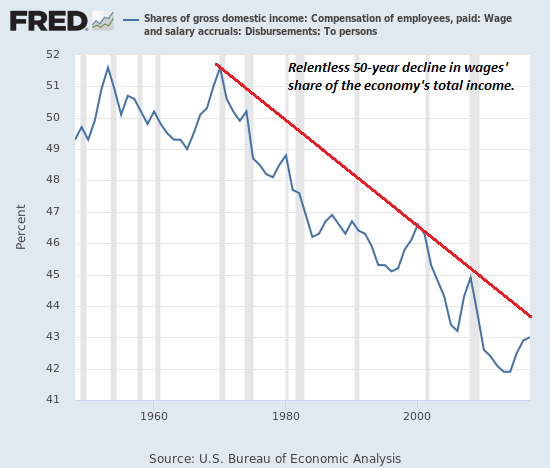
1. Wages’ share of the national income has continued a five-decade downtrend. (See chart below) National income since 1973 has shifted from labor (wages) to capital and more specifically, to debt and speculative gaming of the system, a.k.a. financialization.

Total household income in the U.S. in 2018 was $17.6 trillion. The decline in wages’ share of the national income from 1973 to 2018 is about 8.5%, which equals $1.5 trillion, the sum shifted from labor to capital every year. (See chart below)(source: https://www.statista.com/statistics/216756/us-personal-income/)

No, this is not a typo. As this RAND report documents, $50 trillion has been siphoned from labor (the lower 90% of the workforce) to the Financial Aristocracy and their technocrat lackeys (the top 10%) who own the vast majority of the capital (see charts below): Trends in Income From 1975 to 2018.

2. Within the workforce, wages have shifted to the top 10% who now earn 50% of all taxable income. (See RAND chart below) Financialization and globalization have decapitalized the skills of entire sectors of the workforce as automation and offshoring reduced the human capital of workers’ skills and experience and the value of their social capital. When the entire industry is offshored, skills and professional relationships lose their market value.

In a fully globalized economy, every worker producing tradable goods/services is competing with the entire global workforce, a reality that reduces wages in high-cost developed nations such as the U.S.

Financialization has heavily rewarded workers with specialized gaming the financial system skills and devalued every other skill as only the skills of financialization are highly profitable in a globalized, financialized economy.

3. As the high-wage jobs and capital shifted to coastal urban centers, middle class owners of homes and capital elsewhere saw the value of their assets decline. If a home valued at $100,000 in the late 1990s is now worth $150,000, the owners lost ground even with “official” inflation. In terms of real-world purchasing power, their home actually lost significant value in the past 23 years.

Meanwhile, middle class owners who bought their home in a coastal hot-spot for $100,000 23 years ago are now enjoying home valuations close to $1 million. Homes, along with every other asset, have been shifted into a casino where almost everyone is sorted into winners and losers, less often by skill and more often by luck.

For those who were too young to buy in 1997, sorry–the opportunity to buy a home for three times average middle class income is gone. The lucky generation who bought in the late 1990s in booming coastal magnets for global capital joined the top 10% and their colleagues in less desirable regions lost ground.

4. As capital siphoned off income and appreciation from labor (human and social capital), the gains accruing to capital accelerated. Those who already owned income-producing assets reaped both income and asset appreciation gains as yields on savings collapsed to near-zero as the Federal Reserve and other central banks dropped yields to near-zero in 2009 and kept them low for the following 13 years.

This had two devastating effects on the middle class: hundreds of billions of dollars that once flowed to savers and money markets disappeared, swallowed by the banks as a direct (and intentional) effect of the Fed’s ZIRP (zero-interest rate policy).

Since the Fed destroyed low-risk yields, anyone seeking any real yield (i.e. above inflation) would have to enter the casino and compete with hedge funds, insiders and the Financial Aristocracy. Very few middle class workers have the skills and experience to beat the pros in the casino, and so income and wealth accrued to those who already owned capital.

This is a key reason why the rich got richer and the poor got poorer. Those with capital accrued the majority of gains in income and wealth, leaving the bottom 90% in the dust.

A recent Foreign Affairs essay Monopoly Versus Democracy included these stunning statistics:

Ten percent of Americans now control 97 percent of all capital income in the country. Nearly half of the new income generated since the global financial crisis of 2008 has gone to the wealthiest one percent of U.S. citizens. The richest three Americans collectively have more wealth than the poorest 160 million Americans. (emphasis added.)

The 3% of income from capital collected by the bottom 90%–which includes the middle class– is basically signal noise: the middle class collects inconsequential crumbs of income from capital.

Prior to the Fed’s ZIRP and financialization of the economy, the middle class could both collect income from capital they owned and they could afford to acquire assets that yielded low-risk solid returns. Now they can do neither. Even worse, the puchasing power of their labor continues to decline, leaving them less able to save and buy assets.

This is why The Top 10% Is Doing Just Fine, The Middle Class Is Dying on the Vine. Please study these charts as a means of understanding the inevitability of economic stagnation and a revolt of the decapitalized middle class.


Viral Inequality: From Jeff Bezos to the struggle of Indian Farmers

Billionaires have profited enormously from lockdown, whilst mega corporations are buying out and shutting down independent stores and farms.

By Colin Todhunter

Source: OffGuardian

According to a new report by Oxfam, ‘The Inequality Virus’, the wealth of the world’s billionaires increased by $3.9tn (trillion) between 18 March and 31 December 2020. Their total wealth now stands at $11.95tn.

The world’s 10 richest billionaires have collectively seen their wealth increase by $540bn over this period. In September 2020, Jeff Bezos could have paid all 876,000 Amazon employees a $105,000 bonus and still be as wealthy as he was before COVID.

At the same time, hundreds of millions of people will lose (have lost) their jobs and face destitution and hunger. It is estimated that the total number of people living in poverty could have increased by between 200 million and 500 million in 2020. The number of people living in poverty might not return even to its pre-crisis level for over a decade.

Mukesh Ambani, India’s richest man and head of Reliance Industries, which specialises in petrol, retail and telecommunications, doubled his wealth between March and October 2020. He now has $78.3bn. The average increase in Ambani’s wealth in just over four days represented more than the combined annual wages of all of Reliance Industries’ 195,000 employees.

The Oxfam report states that lockdown in India resulted in the country’s billionaires increasing their wealth by around 35 per cent. At the same time, 84 per cent of households suffered varying degrees of income loss. Some 170,000 people lost their jobs every hour in April 2020 alone.

The authors also noted that income increases for India’s top 100 billionaires since March 2020 was enough to give each of the 138 million poorest people a cheque for 94,045 rupees.

The report went on to state:

…it would take an unskilled worker 10,000 years to make what Ambani made in an hour during the pandemic…and three years to make what Ambani made in a second.”

During lockdown and after, hundreds of thousands of migrant workers in the cities (who had no option but to escape the country’s avoidable but deepening agrarian crisis) were left without jobs, money, food or shelter.

It is clear that COVID has been used as cover for consolidating the power of the unimaginably rich. But plans for boosting their power and wealth will not stop there. One of the most lucrative sectors for these people is agrifood.

More than 60 per cent of India’s almost 1.4 billion population rely (directly or indirectly) on agriculture for their livelihood. Aside from foreign interests, Mukesh Ambani and fellow billionaire Gautam Adani (India’s second richest person with major agribusiness interests) are set to benefit most from the recently passed farm bills that will lead to the wholesale corporatisation of the agrifood sector.

CORPORATE CONSOLIDATION

A recent article on the grain.org website, ‘Digital control: how big tech moves into food and farming (and what it means)’, describes how Amazon, Google, Microsoft, Facebook and others are closing in on the global agrifood sector while the likes of Bayer, Syngenta, Corteva and Cargill are cementing their stranglehold.

The tech giants entry into the sector will increasingly lead to a mutually beneficial integration between the companies that supply products to farmers (pesticides, seeds, fertilisers, tractors, drones, etc) and those that control the flow of data and have access to digital (cloud) infrastructure and food consumers. This system is based on corporate centralisation and concentration (monopolisation).

Grain notes that in India global corporations are also colonising the retail space through e-commerce. Walmart entered into India in 2016 by a US$3.3 billion take-over of the online retail start-up Jet.com which, in 2018, was followed by a US$16 billion take-over of India’s largest online retail platform Flipkart. Today, Walmart and Amazon now control almost two-thirds of India’s digital retail sector.

Amazon and Walmart are using predatory pricing, deep discounts and other unfair business practices to lure customers towards their online platforms. According to Grain, when the two companies generated sales of over US$3 billion in just six days during a Diwali festival sales blitz, India’s small retailers called out in desperation for a boycott of online shopping.

In 2020, Facebook and the US-based private equity concern KKR committed over US$7 billion to Reliance Jio, the digital store of one of India’s biggest retail chains. Customers will soon be able to shop at Reliance Jio through Facebook’s chat application, WhatsApp.

The plan for retail is clear: the eradication of millions of small traders and retailers and neighbourhood mom and pop shops. It is similar in agriculture.

The aim is to buy up rural land, amalgamate it and roll out a system of chemically-drenched farmerless farms owned or controlled by financial speculators, the high-tech giants and traditional agribusiness concerns. The end-game is a system of contract farming that serves the interests of big tech, big agribusiness and big retail. Smallholder peasant agriculture is regarded as an impediment to be replaced by large industrial-scale farms.

This model will be based on driverless tractors, drones, genetically engineered/lab-produced food and all data pertaining to land, water, weather, seeds and soils patented and often pirated from peasant farmers.

Farmers possess centuries of accumulated knowledge that once gone will never be got back. Corporatisation of the sector has already destroyed or undermined functioning agrarian ecosystems that draw on centuries of traditional knowledge and are increasingly recognised as valid approaches to secure food security.

And what of the hundreds of millions to be displaced in order to fill the pockets of the billionaire owners of these corporations? Driven to cities to face a future of joblessness: mere ‘collateral damage’ resulting from a short-sighted system of dispossessive predatory capitalism that destroys the link between humans, ecology and nature to boost the bottom line of the immensely rich.

IMPERIAL INTENT

India’s agrifood sector has been on the radar of global corporations for decades. With deep market penetration and near saturation having been achieved by agribusiness in the US and elsewhere, India represents an opportunity for expansion and maintaining business viability and all-important profit growth. And by teaming up with the high-tech players in Silicon Valley, multi-billion dollar data management markets are being created. From data and knowledge to land, weather and seeds, capitalism is compelled to eventually commodify (patent and own) all aspects of life and nature.

Foreign agricapital is applying enormous pressure on India to scrap its meagre (in comparison to the richer nations) agricultural subsidies. The public distribution system and publicly held buffer stocks constitute an obstacle to the profit-driven requirements of global agribusiness interests.

Such interests require India to become dependent on imports (alleviating the overproduction problem of Western agricapital – the vast stocks of grains that it already dumps on the Global South) and to restructure its own agriculture for growing crops (fruit, vegetables) that consumers in the richer countries demand. Instead of holding physical buffer stocks for its own use, India would hold foreign exchange reserves and purchase food stocks from global traders.

Successive administrations have made the country dependent on volatile flows of foreign capital via foreign direct investment (and loans). The fear of capital flight is ever present. Policies are often governed by the drive to attract and retain these inflows. This financialisation of agriculture serves to undermine the nation’s food security, placing it at the mercy of unforeseen global events (conflict, oil prices, public health crises) international commodity speculators and unstable foreign investment.

Current agricultural ‘reforms’ are part of a broader process of imperialism’s increasing capture of the Indian economy, which has led to its recolonization by foreign corporations as a result of neoliberalisation which began in 1991. By reducing public sector buffer stocks and introducing corporate-dictated contract farming and full-scale neoliberal marketisation for the sale and procurement of produce, India will be sacrificing its farmers and its own food security for the benefit of a handful of unscrupulous billionaires.

As independent cultivators are bankrupted, the aim is that land will eventually be amalgamated to facilitate large-scale industrial cultivation. Indeed, a recent piece on the Research Unit for Political Economy site, ‘The Kisans Are Right: Their Land Is At Stake‘, describes how the Indian government is ascertaining which land is owned by whom with the ultimate aim of making it easier to eventually sell it off (to foreign investors and agribusiness). Other developments are also part of the plan (such as the Karnataka Land Reform Act), which will make it easier for business to purchase agricultural land.

India could eventually see institutional investors with no connection to farming (pension funds, sovereign wealth funds, endowment funds and investments from governments, banks, insurance companies and high net worth individuals) purchasing land. This is an increasing trend globally and, again, India represents a huge potential market. The funds have no connection to farming, have no interest in food security and are involved just to make profit from land.

The recent farm bills – if not repealed – will impose the neoliberal shock therapy of dispossession and dependency, finally clearing the way to restructure the agri-food sector. The massive inequalities and injustices that have resulted from the COVID-related lockdowns are a mere taste of what is to come.

The hundreds of thousands of farmers who have been on the streets protesting against these bills are at the vanguard of the pushback – they cannot afford to fail. There is too much at stake.

Raskolnikov’s Dream Come True

By Edward Curtin

Source: Behind the Curtain

“Something is happening here,
But you don’t know what it is,
Do you, Mr. Jones?”
— 
Bob Dylan, Ballad of A Thin Man

It’s hard.

Life today seems like a dream, doesn’t it?  Surreal to the point where everything seems haunted and betwixt and between, or this against that, or that and this against us.

Something.

Or a Luis Buñuel film.  The logic of the irrational. Surrealistic.  A film made to draw us into an ongoing nightmare.  Hitchcock with no resolution. Total weirdness, as Hunter Thompson said was coming before he blew his brains out.  A life movie made to hypnotize in this darkening world where reality is created on screens, as Buñuel said of watching movies:

This kind of cinematographic hypnosis is no doubt due to the darkness of the theatre and to the rapidly changing scenes, lights, and camera movements, which weaken the spectator’s critical intelligence and exercise over him a kind of fascination.

Here we are in Weirdsville, USA where most people, whether of the left, right, or center, are hypnotized by the flickering screens.

That’s what movies do.

That’s what long planned psychological operations do.

That’s what digital technology allows corrupt rulers and the national security state with its Silicon Valley partners in crime to do.

We now live in a screen world where written words and logic are beside the point. Facts don’t matter. Personal physical experience doesn’t matter.  Clear thinking doesn’t matter. Hysterical reactions are what matter.  Manipulated emotions are what matter.  Saying “Fuck You” is now de rigueur, as if that were the answer to an argument.

It’s all a movie now with the latest theatrical performance having been the January 6, 2021 stage show filmed at the U.S. Capital.  A performance so obvious that it isn’t obvious for those hypnotized by propaganda, even when the movie clearly shows that the producers arranged for the “domestic terrorists” to be ushered into the Capital.  They let the “Nazis” in on Dr. Goebbels orders.  Thank God Almighty they were beaten back before they seized power in their Halloween costumes.

Now who could have given that order to the Capital and D.C. police, Secret Service, National Guard, and the vast array of militarized Homeland Security forces that knew well in advance of the January 6 demonstration?

Who gave the stand-down orders on September 11, 2001, events that were clearly anticipated and afterwards were described by so many as if they were a movie?  Surreal. Dreamlike.

As with the events of September 11, 2001 and the subsequent anthrax attacks, the recently staged show at the Capital that the mainstream media laughingly call an attempted coup d’état will result in a new “Patriot Act” aimed at the new terrorists – domestic ones – i.e. anyone who dissents from the authoritarian crackdown long planned and underway; anyone who questions the vast new censorship and the assault on the First Amendment; anyone who questions the official narrative of Covid-19 and the lockdowns; anyone who suggests that there are linkages between these events, etc.

Who, after all, introduced the Omnibus Counterterrorism Act in 1995 that became the template for the Patriot Act in 2001 that was passed into law after September 11, 2001?  None other than former Senator Joseph Biden. Remember Joe?  He has a new plan.

Of course, the massive Patriot Act had been written well before that fateful September day and was ready to be implemented by a Senate vote of 98-1, the sole holdout being Democratic Senator Russ Feingold of Wisconsin.  In the House of Representatives the vote was 357-66.

For those familiar (or unfamiliar)  with history and fabricated false flags, they might want also to meditate on the Gulf of Tonkin Resolution in 1964 that gave Lyndon Johnson his seal of approval to escalate the war against Vietnam that killed so many millions. The vote for that fake crisis was 416-0 in the House and 88-2 in the Senate.

In the words of Mark Twain:

Suppose you were an idiot, and suppose you were a member of Congress; but I repeat myself.

Harry Houdini, the magical performer who was able to escape from any trap, any nightmarish enclosure, any lockdown, once said, “It’s still an open question, however, as to what extent exposure really hurts a performer.”

The question has been answered.  It doesn’t hurt at all, for phony events still mesmerize millions who are eager to suspend their disbelief for the sake of a sad strand of hope that their chosen leaders – whether Biden or Trump – are levelling with them and are not playing them for fools. To accept that Trump and Biden are scripted actors in a highly sophisticated reality TV movie is a bit of “reality” too hard to bear.  Exposing them and their minions doesn’t hurt at all.  There’s no business but show business.

Houdini knew well the tricks used to deceive a gullible audience hypnotized by theatrics. “A magician is only an actor,” he said, “an actor pretending to be a magician.”  This is a perfect description of the charlatans who serve as presidents of the United States.

Life today seems like a dream, doesn’t it?

“Will wonders ever cease,” said Houdini, as he closed his shows.

When I was a child I had a repetitive dream that I was trapped in a maze.  Trying to escape, all I could hear as I tried desperately to find an exit was a droning sound.  Droning without end.  The only way I could escape the maze was to wake up – literally.  But this dream would repeat for many years to the point where I realized my dreams were connected to my actual family and life in the U.S.A.

Then, when I was later in the Marines and felt imprisoned and was attempting to get out as a conscientious objector, the dream changed to being trapped in the Marines, or the prison I was expecting if they didn’t let me go. Even when I got out of the Marines and was not in prison, the dreams that I was continued.

It took me years to learn how to escape.

I mention such dreams since they seem to encapsulate the feelings so many people have today. A sense of being trapped in a senseless social nightmare. Prisoners. Lost in a horror movie like Kafka’s novel The Castle in which the protagonist K futilely seeks to gain access to the rulers who control the world from their castle but can never reach his goal.

But these are dreams and The Castle is fiction.

On a conscious level, however, many people continue to rationalize their grasp of what is going on in the United States as if what they take to be reality is not fiction. Trump supporters –despite what are seen by them as his betrayals when he said on January 7 that “The demonstrators who infiltrated the Capitol have defiled the seat of American democracy….My focus now turns to ensuring a smooth, orderly and seamless transition of power. This moment calls for healing and reconciliation.” – still cling to the belief that he is the man they believe in and was going to “clean the swamp” but was sabotaged by the “deep state.” Biden supporters, driven by their obsessive hatred for Trump and the ongoing delusions that the Democratic Party, like the Republican, is not thoroughly corrupt, look forward to the Biden presidency and the new normal when he can “build back better.”  For both groups true faith never dies. It’s very touching.

As I have written before, if the Democrats and the Republicans are at war as is often claimed, it is only over who gets the larger share of the spoils. Trump and Biden work for the same bosses, those I call the Umbrella People (those who own and run the country through their intelligence/military/media operatives), who produce and direct the movie that keeps so many Americans on the edge of their seats in the hope that their chosen good guy wins in the end.

It might seem as if I am wrong and that because the Democrats and their accomplices have spent years attempting to oust Trump through Russia-gate, impeachment, etc. that what seems true is true and Trump is simply a crazy aberration who somehow slipped through the net of establishment control to rule for four years.  A Neo-Nazi billionaire who emerged from a TV screen and a golden tower high above the streets of New York.

This seems self-evident to the Democrats and the supporters of Joseph Biden, and even to many Republicans.

For Trump’s supporters, he seems to be a true Godsend, a real patriot who emerged out of political nowhere to restore America to its former greatness and deliver economic justice to the forgotten middle-Americans whose livelihoods have been devastated by neo-liberal economic policies and the outsourcing of jobs.

Two diametrically opposed perspectives.

But if that is so, why, despite Trump and Biden’s superficial differences – and Obama’s, Hillary Clinton’s and George W. Bush’s for that matter – have the super-rich gotten richer and richer over the decades and the war on terror continued as the military budget has increased each year and the armament industries and the Wall Street crooks continued to rake in the money at the expense of everyone else?  These are a few facts that can’t be disputed. There are many more. So what’s changed under Trump?  We are talking about nuances, small changes.  A clown with a big mouth versus traditional, “dignified” con men.

Trump’s followers were betrayed the day he was sworn in, as Biden’s will be shortly unless they support a crackdown on civil rights, the squelching of the First Amendment, and laws against dissent under the aegis of a war against domestic terrorism.

I’m afraid that is so.  Censorship of dissent that is happening now will increase dramatically under the Biden administration.

Now we have the “insurrection,” also known as an attempted “coup d’état,” with barbarians breaching the gates of the sacred abode of the politicians of both parties who have supported bloody U.S. coups throughout the world for the past seventy plus years. Here is another example of history beginning as tragedy and ending as farce.

But who is laughing?

If you were writing this script as part of long-term planning, and average people were getting disgusted from decades of being screwed and were sick of politicians and their lying ways, wouldn’t you stop the reruns and create a new show?

Come on, this is Hollywood where creative showmen can dazzle our minds with plots so twisted that when you leave the theater you keep wondering what it was all about and arguing with your friends about the ending. So create a throwback film where the good guy versus the bad guy was seemingly very clear, and while the system ground on, people would be at each other’s throats over the obvious differences, even while they were fabricated or were minor. This being the simple and successful age-old strategy of divide and conquer

I realize that it is very hard for many to entertain the thought that Trump and Biden are not arch-enemies but are players in a spectacle created to confound at the deepest psychological levels.  I am not arguing that the Democrats didn’t want Hillary Clinton to win in 2016.  I am saying they knew Trump was a better opponent, not only because they could probably defeat him and garner more of the spoils, but because if he possibly won he was easily controlled because he was compromised.  By whom?  Not the Democrats, but the “Deep State” forces that control Hillary Clinton and all the presidents.  A compromised and corrupt lot.

The Democrats and Republicans were not in charge in 2016 or in 2020.  Their bosses were.  The Umbrella people.  Biden will carry out their orders, and while everyone will conveniently forget what actually happened during Trump’s tenure, as I previously mentioned, they will only remember how the Democrats “tried” to oust this man in the black hat, while Biden will carry on Trump’s legacy with minor changes and a lot of PR. He will seem like a breath of fresh air as he continues and expands the toxic policies of all presidents.  So it goes.

Throughout these recent days that the corporate mainstream media have devoted to this Trump/Biden saga, Julian Assange, a truth teller if ever there were one, remains tortured and locked up in an English high-security prison cell.  His plight has been a minor note at best for the corporate media that is focused on the American “coup d’état.” The spectacle rolls on as an innocent journalist who exposed the vast murderous crimes of the American government is left to slowly die in a horrible prison cell. A man who, if free, could report the truth of this current charade and expose the bloody underside of this magic show.

Long ago in Russia, another dissident, Fyodor Dostoevsky, was also sentenced on trumped up charges to prison and exile in Siberia for being “freethinking” and a socialist enemy of the state. When he was finally released, he wrote a novel that was published in 1866.  It was Crime and Punishment, a masterpiece about a man named Rodian Romanovich Raskolnikov who, like Dostoevsky, is sentenced to exile and imprisonment in Siberia.  In Raskolnikov’s case, it was for killing an old woman pawnbroker to see if he was “above the common ruck.” The story explores Raskolnikov’s dual consciousness and the right to murder; prideful intellect versus compassion; rationalism versus spiritual values; freedom versus determinism; the individual versus the state.

Like Nietzsche twenty years later, Dostoevsky sent out a warning long ago about the terrifying consequences that would follow in the wake of certain forms of thinking that would result in nihilism. To be “above the common ruck” and murder at will; to play with people as though they were what Raskolnikov calls the woman he murders – “louses”; to create divided minds in a game of social schizophrenia through antitheses that conceal the magician’s devious truths.

At the end of Crime and Punishment, Raskolnikov, while still in Siberian prison exile, feels that he, like Lazarus, has been raised from the dead.  He realizes that there is a solution to his split mind and that he has found it as he transitions “from one world into another…his initiation into a new, unknown life.”

But such a resolution that I will not divulge is preceded by a very strange dream, one that rings a bell today when life seems like a dream with something happening here but you don’t know what it is, do you, Mr. Jones?

When he [Raskolnikov] was better, he remembered the dreams he had had while he was feverish and delirious.  He dreamt that the whole world was condemned to a terrible strange new plague that had come to Europe from the depths of Asia.  Everyone was to be destroyed except a few chosen ones.  Some sort of new microbe was attacking people’s bodies, but these microbes were endowed with intelligence and will.  Men attacked by them became instantly furious and mad.  But never had men considered themselves so intellectual and so completely in possession of the truth as these sufferers, never had they considered their decisions, their scientific conclusions, their moral convictions so infallible.  Whole villages, whole towns and peoples were driven mad by the infection.  Everyone was excited and did not understand one another.  Each thought that he alone had the truth and was wretched looking at the others, beat himself on the breast, wept, and wrung his hands.  They did not know how to judge and could not agree what to consider evil and what good; they did not know who to blame, who to justify….The alarm bells kept ringing all day long in the towns; men rushed together, but why they were summoned and who was summoning them no one knew….The plague spread and moved further and further.  Only a few men could be saved in the whole world.  They were a pure chosen people, destined to found a new race and a new life, to renew and purify the earth, but no one had seen these men, no one had heard their words and their voices.

Have you?

The Top 10%’s Bubble Is About to Burst

By Charles Hugh Smith

Source: Of Two Minds

When the top 10%’s bubble pops in 2021, the loss of illusions/delusions of security and wealth will be shattering to all those who believed artifice and illusory “wealth” were real.

A great many people are living in bubbles that are about to pop. The largest bubble is the one inhabited by people who complacently believe in time travel, i.e. that the world of 2019 is about to replace the nightmare of 2020 and we can all go back to our carefree debt-funded consumption frenzy and illusions of ever-greater wealth forever and ever.

The greater one’s sense of security, the more durable the bubble. Those in America’s top 10% who have reaped virtually all the gains in income and wealth of the past 20 years live in a bubble that they view as unbreakable: no matter what problems arise, their personal income and wealth is secured by the government, central bank, etc.

Put another way, the top 10% are confident their position atop the wealth-power pyramid is secure no matter what happens. Any dip in stocks, bonds, real estate, bat guano futures, etc. that causes their personal wealth to decline (horrors!) will be instantly bought because the Federal Reserve will print another couple trillion dollars and funnel it into risk assets, as it has done for the past 20 years.

Any spot of bother in the gravy trains that fund the top 10%–local and state government, universities, Big Tech, Big Pharma, Department of Defense, Wall Street, hedge funds, venture capital, etc.– will be doused with trillions of dollars borrowed or printed into existence by the Treasury or Fed. No matter what spot of bother arises, the solution–more trillions–is just a few keystrokes away.

The top 10% are supremely confident in the godlike powers of these agencies and solutions: the idea that these “solutions” become insoluble problems does not compute, just as a decline in asset valuations that doesn’t rebound within three weeks thanks to Fed intervention is firmly outside the realm of possibility.

The top 10% are also supremely confident in the rightness of their position atop the heap. That their position atop the heap is largely the result of a web of privilege and a long run of extraordinarily good fortune does not enter their bubble at all; in their bubble, their wealth, status, prestige and income are all the result of hard work and merit.

While this is certainly true for some, it is not true for all, and even those who scraped their way to the top the hard way do not recognize that their success over the past 20 years (and arguably the past 50 years) has been largely the result of a financialized rising tide raising all boats. In a Bull Market in virtually everything (except commodities), everyone is a hard-working genius who got it all via merit.

On top of this myopic belief that their success is all the result of their own endeavors rather than a tide of financialization, the top 10% are equally blind to the toxic consequences of the wealth/income inequality that has so richly benefited the few at the expense of the many. The idea that the bottom 90% might rebel against the financial / political system that has favored the already-wealthy for a generation is outside the top 10%’s realm of possibility.

But tides do not run in one direction forever, and a revolt against the unprecedented inequality that heavily favors the top 10% is not “impossible,” it’s a certainty. The top 10% are accustomed to being admired and respected for their accomplishments, expertise, wise investing and professional acumen. They are accustomed to viewing themselves as the essential technocrat class that keeps the U.S. system functioning.

The problem with this self-congratulatory perspective is the U.S. system is now in thrall to process rather than results. The technocrat class has been trained to follow needlessly complex procedures and compliance processes as the path to professional advancement while avoiding accountability for the increasingly dismal results of America’s bloated, sclerotic, insider-dominated systems.

All this needless complexity will be jettisoned once printing/borrowing trillions become the problem rather than the solution. The bottom 90% will demand not just a fairer distribution of income and wealth, they will also demand a system that actually functions for the greater social good rather than for insiders, parasites, leeches and technocrat processors who declare victory not from results but from their success in following approved processes / narratives.

Once costs must be cut and results take precedence over process, much of the technocrat class will find itself replaced by automated software. Those that remain will be valued for getting results by whatever means are available, up to and including ignoring all compliance procedures and bureaucratic box-ticking.

The top 10%–the rentier-technocrat class–will find the bottom 90% can no longer pay their rent, insurance, etc.–all the “services” that employ and enrich the top 10%. In other words, the losses as unproductive complexity unravels will finally fall on the top 10%, many of whom have been protected from exposure to market forces and risk.

Lastly, the top 10%’s ownership of assets will be crushed by asset deflation as insolvency can no longer be papered over by liquidity. Assets that are the foundation of top 10% wealth (that the bottom 90% own very little of) will go bidless as phantom wealth dissipates into the thin air from whence it came.

The top 10% reckon they’re untouchable, safe and protected in their asset lifeboats, and the sinking of the 90% won’t affect them. The top 10%’s bubble is about to burst. Not only will their lifeboats prove unstable, every level of government will come after whatever is left as taxes will soar on virtually every form of income and wealth.

Unlike the bottom 60%, who have few illusions about the rampant unfairness and predation of real-world America, the top 10%’s bubble is 90% illusion seasoned with 10% absolute delusion. The comfortable are about to experience some of the discomfort that is everyday life for the bottom 60%, and an increasing percentage of the next 30% who still aspire to fantasies of middle-class security will find social mobility is an escalator down.

We cannot print wealth, or borrow it into existence. All we can print/borrow is artifice, phantom representations of illusory “wealth” that will vanish into thin air, in a reverse of how the “money” was created–out of thin air.

When the top 10%’s bubble pops in 2021, the loss of illusions/delusions of security and wealth will be shattering to all those who believed artifice and illusory “wealth” were real. What’s real is the tide of financialization and globalization reversed over a year ago. The tide is now running out, but few loading their “wealth” into lifeboats have noticed–yet.

Global billionaire wealth tops $10 trillion as COVID-19 deaths mount

By Jacob Crosse

Source: WSWS.org

The collective wealth of the world’s 2,189 billionaires has risen to $10.2 trillion, an increase of nearly $1.3 trillion in the past three years, according to a new report by the Swiss bank UBS and PricewaterhouseCoopers. The unprecedented surge in wealth takes place amidst a global pandemic that has killed more than one million people worldwide, including more than 215,000 in the United States alone.

The report, “Riding the Storm,” is based on data from 43 markets, including interviews with 60 billionaires, accounting for around 98 percent of global billionaire wealth. It sums up the results: “Most of the decade was a time of exceptional prosperity for billionaires regardless of sector…”

The US continues to have the largest concentration of billionaire wealth, accounting for 36 percent of the world’s total, or $3.6 trillion. China ranked second with $1.6 trillion and saw the largest growth over the decade, by 1,146 percent.

Third was Germany, where billionaire wealth totaled $594.9 billion, an increase of 175 percent from 2009’s $216.1 billion. While fourth in terms of billionaire wealth at $467.6 billion, Russia saw the smallest growth by percentage, 80 percent, from $260.2 billion in 2009 to $467.6 billion in 2020.

The $10.2 trillion amassed by less than .0003 percent of the global population is more than the estimated 2020 Gross Domestic Product of every country on the planet except for the US and China. The staggering total hoarded by less than 2,200 people, or about the number of COVID-19 deaths in the US within the last 72 hours, surpasses the previous high of $8.9 trillion recorded in 2017.

For a household earning the average US median income, it would take over 16 million years to accumulate $1 trillion, not even enough to cover what has been collectively usurped from global society in less than three years. Joel Berg, CEO of Hunger Free America, has calculated the cost of ending hunger in the US at $25 billion, which could be done 400 times over with $1 trillion.

The billionaires who have increased their wealth the most, according to the authors, are in the “technology, healthcare and industrial sectors,” including Amazon CEO Jeff Bezos, Tesla CEO Elon Musk, and Facebook CEO Mark Zuckerberg. The report states: “During 2018, 2019 and the first seven months of 2020, technology billionaires’ total wealth rose by 42.5% to USD 1.8 trillion, supported by the surge in tech shares.”

The surge in technology and medical shares was buoyed by unlimited cash from the Federal Reserve, included as part of the $2.2 trillion CARES Act passed at the end of March in a near-unanimous vote by both Democrats and Republicans.

This financial bailout made a “big difference” in the fortunes of billionaires, with the authors writing: “Billionaire wealth is loosely correlated with equity markets, due to holdings in listed companies, and a few weeks makes a big difference. From the end of March, governments’ huge fiscal and quantitative easing packages drove a recovery in financial markets. By the end of July 2020, billionaire wealth was back above its 2019 level.”

Particularly obscene is the surge in wealth of billionaires in the health care industry, in the midst of a deadly global pandemic. The authors write, “Healthcare billionaires’ total wealth increased by 50.3% to $658.6 billion, boosted by a new age of drug discovery and innovations in diagnostics and medical technology, as well as latterly COVID-19 treatments and equipment.”

The report adds: “The number of tech billionaires grew from 68 in 2009 to 234 in 2020, while the number of healthcare billionaires grew from 48 to 167. Tech and healthcare billionaires’ total wealth both multiplied by four times – from $321.3 billion to $1.3 trillion for tech and from $120.8 billion to $482.9 billion for healthcare.”

And what are these “pandemic profiteers” spending their fortunes on? To get some idea, Christie’s auction house in New York held its latest online auction, “20th Century Evening Sale” live-streamed from the Rockefeller Center in New York on October 6. In one night, the world’s wealthiest spent over $340 million on 59 different 20th and 21st century art pieces. The auction also featured the most expensive dinosaur skeleton ever sold, a fossilized Tyrannosaurus rex, for $27.5 million.

The massive concentration of wealth is a decades’ long and bipartisan policy of redistribution to the rich. The Institute for Policy Studies measured the tax obligations of America’s billionaires as a percentage of their wealth between 1980 and 2018 and found that it had decreased 79 percent. Over the last 20 years, the growth in US billionaire wealth has been 200 times greater than the growth in median wealth.

While the billionaires are richer than ever, the response of the ruling class to the pandemic has produced a massive social catastrophe for the working class. In the United States, tens of millions are unemployed and being cut off of all benefits, facing poverty, homelessness and hunger.

Earlier reports found that the 643 wealthiest Americans increased their wealth by a staggering $845 billion between March 18 and September 15. During that same time, over 62 million people in the US applied for unemployment benefits. An estimated 10.5 million jobs were eliminated, with major companies such as Disney, United Airlines, and Cineworld announcing tens of thousands additional layoffs in the last week.

Inflation Is Stealth Austerity

By Charles Hugh Smith

Source: Of Two Minds

Rather than decry austerity, which demands an open political discussion of trade-offs, we should decry inflation’s stealthy reduction of purchasing power.

Austerity–bad. Inflation–good. Oh wait–they’re the same thing: both are a reduction in purchasing power. The only difference is a reduction via austerity is upfront while inflation is a stealth reduction, obfuscated by “official” distortions and Federal Reserve mumbo-jumbo.

Consider $1,200 in wages, unemployment, stimulus, Social Security payment, etc. If this payment gets cut by 10%–$120–as a result of austerity, pay cut, reduction in hours worked, etc., recipients scream bloody murder.

But if inflation reduces the purchasing power of the $1,200 by 10%, nobody does anything but grumble that “prices keep rising while my income stays the same.” This is the classic boiled frog syndrome: inflation is like the heat being turned up so gradually that the poor frog doesn’t realize he’s about to expire.

Inflation is stealthy because the loss of purchasing power is difficult to monitor. Your $1,200 only buys what $1,080 bought in the recent past; 10% inflation reduced your income exactly the same as if austerity had subtracted the $120 upfront.

Governments and central banks love inflation because the theft goes unnoticed. The public tolerates inflation because it’s easy to passively accept this erosion in their standard of living and difficult to generate the political heat that an outright cut would spark.

Though it’s being openly engineered by the Federal Reserve, inflation appears to be a force nobody controls–unlike austerity which is so clearly a political decision. If Inflation robbed 10% of everyone’s income overnight, people might be roused from their passivity to protest.

But since the theft occurs slowly–what’s 1% a month?–and unevenly across a spectrum of goods and services, this theft doesn’t rouse the same political storm as upfront austerity.

Inflation is a form of sacrifice that few recognize as sacrifice. It seems like everyone’s income is eroded equally, but this isn’t true: the wealthy closest to the Fed’s money spigots are earning multiples of inflation from asset inflation, stock buybacks, etc. Inflation is a pinprick to the wealthy and a stilletto in the kidneys of the bottom 95%.

To the political Aristocracy, inflation is wonderful because they don’t need to ask anyone to sacrifice 10% of their income as they do with austerity; they just steal the 10% a dribble at a time and throw up their hands as if inflation is some mystery force completely beyond their control.

Ironically, austerity–an honest, upfront political decision and sacrifice–is decried, while the dishonest, stealth cut of inflation is passively accepted, even as the Federal Reserve has made a cloaked political decision to reduce the purchasing power of everyone’s income except for the New Nobility (the top 0.1%) that the Fed slavishly serves.

Rather than decry austerity, which demands an open political discussion of trade-offs, we should decry inflation’s stealthy reduction of purchasing power, a Fed policy that benefits the few at the expense of the many.

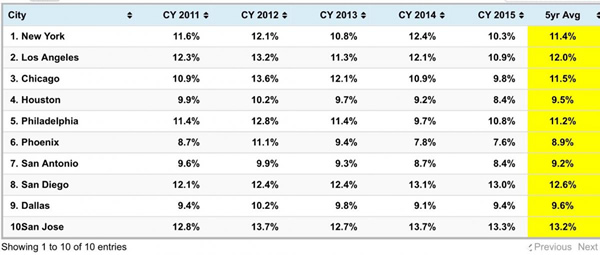
Here is the Chapwood Index of inflation, which carefully measures “apples to apples” costs of essential goods and services in each city:

As inflation erodes purchasing power, workers’ share of the economy has declined dramatically– a double-whammy of declining purchasing power and standard of living.


The Fed Has Loaned $1.2 Billion from its TALF Bailout Program to a Tiny Company with Four Employees

By Pam Martens and Russ Martens

Source: Wall Street on Parade

Every Wall Street bailout program that the Fed has created since September 17 of last year has, according to the Fed, been ostensibly created to somehow help the average American.

According to the Fed’s Term Sheet for the Term Asset-Backed Securities Loan Facility (TALF), it’s going to “help meet the credit needs of consumers and businesses by facilitating the issuance of asset-backed securities.” Not to put too fine a point on it, but asset-backed securities and related derivatives are what blew up Wall Street in 2008, creating the worst economic downturn, at that point, since the Great Depression.

According to the Fed’s most recent H.4.1 filing, it has loaned a total $11.1 billion from TALF. Eleven percent of that money, $1.2 billion, went to a company that has 4 employees (outside of clerical workers) according to its filing with the SEC.

Read the rest of the article.

An Unprecedented 1,640 CEOs Departed in 2019; Now Execs Are Dumping Stock at Highest Pace Since 2006

By Pam Martens and Russ Martens

Source: Wall Street on Parade

A rather fascinating picture is emerging that suggests that things were not as rosy in the U.S. economic landscape prior to the pandemic as President Donald Trump and his Director of the National Economic Council, Larry Kudlow, would have the public believe.

Challenger, Gray & Christmas, Inc. has been tracking CEO departures for the past 12 years. Its Vice President, Andrew Challenger, called the numbers for 2019 “staggering.” It was the highest number since their surveys began in 2002. A total of 1,640 CEOs headed for the exits last year. That was 156 more CEOs than those who left their post in 2008 – the year that Wall Street blazed a scorched earth trail through the U.S. economy.

The number of CEOs that did not leave on their own accord last year was 101 out of the 1,640. According to the study, 15 CEOs left over allegations of professional misconduct; 20 left amid a scandal, “typically under investigations for financial wrongdoing or other legal issues”; 24 saw their positions terminated; 39 left due to a merger or acquisition; 3 left due to bankruptcy.

CEOs of old, established companies have the clearest view of what is happening in the overall economy. They can compare sales growth to prior years and prior decades. They can spot negative or positive trends in the economy far ahead of the economic reports that the federal government releases to the public.

When an outsized number of CEOs decide to cash out their stock options, grab their golden parachutes, and flee their corner offices – something smells.

On top of that fishy smell comes a report from TrimTabs Investment Research that corporate insiders have reaped more than $50 billion in stock sales since May, putting insider selling on a pace not seen since 2006 – two years before the stock market and economic crash of 2008.

The above two reports on corporate executive behavior are compatible with Wall Street On Parade’s reports that show that the current financial crisis began in the fall of 2019 – months before the first case of COVID-19 had emerged anywhere in the world. What triggered the financial crisis? The same kind of liquidity crisis on Wall Street that ushered in the crisis of 2008. (See Wall Street’s Financial Crisis Preceded COVID-19: Chart and Timeline and our archive of more than 100 articles on the financial crisis of 2019/2020 here.)

Why does it matter when the financial crisis began? It’s critically important for the following reasons.

First, the U.S. national debt has exploded to $26.69 trillion. To wrap your mind around this explosion of the national debt, you need some historical perspective. At the beginning of the Bill Clinton Presidency in January 1993, the U.S. national debt stood at $4 trillion. At that point, the United States was more than 200 years old. During that 200 years, the U.S. had financed the Revolutionary War, the Civil War, World Wars I and II and the Vietnam War. The country had also been through the greatest economic collapse in its history, the Great Depression, which required a multitude of fiscal spending programs.

It took more than two centuries for the U.S. national debt to reach $4 trillion but in just the past 27 years the national debt has grown by more than $22 trillion – more than a five-fold increase in less than three decades.

This staggering amount of debt puts the nation at risk of a future credit downgrade and cripples its ability to adequately deal with the financial struggles of its citizens during the worst health and financial crisis in a century.

One of the key reasons for this mushrooming debt was the Wall Street financial crisis of 2008 which required massive fiscal spending to keep the economy from sinking into a depression.

But no serious steps were taken by Congress to reform Wall Street. Derivatives remain largely unregulatedDark Pools are still trading in darkness. Wall Street continues to pay credit rating agencies to rate their toxic debt piles. Off balance sheet casinos run rampant at the largest Wall Street banks. Obscene pay for performance via stock options continues to incentive CEOs and CFOs to massage earnings.

The biggest unaddressed problem is the critical need to restore the Glass-Steagall Act. All of the dangers cited above can, and do, bring down an entire financial institution as we learned in 2008. But with the restoration of the Glass-Steagall Act, the giant, federally-insured, deposit-taking banks would be completely separated from the Wall Street casino investment banks.

This handful of mega banks that hold the majority of deposits in this country are too critical to keeping credit flowing to businesses and consumers to be run by the Wall Street bet-the-ranch mentality. These banks are simply too big to be bailed out again.

When Citigroup was disintegrating from all of the evils mentioned above from 2007 to 2010, this is what it took to resuscitate its sinking hull: $45 billion in capital infusions from the U.S. Treasury; over $300 billion in asset guarantees from the federal government; the Federal Deposit Insurance Corporation (FDIC) guaranteed $5.75 billion of its senior unsecured debt and $26 billion of its commercial paper and interbank deposits; and the Federal Reserve secretly, with no authorization or even awareness of Congress, made a cumulative $2.5 trillion in below-market rate loans to Citigroup from 2007 through at least the middle of 2010, according to an audit by the Government Accountability Office (GAO).

And, finally, acknowledging that this latest financial crisis began prior to the pandemic shines a bright light on the incompetency of the Federal Reserve to manage these Wall Street behemoth banks. It’s simply an insane regulatory model to have a bank regulator with the ability to create money out of thin air that can secretly create and spend $29 trillion bailing out the banks to cover up its own incompetency. That’s what happened from 2007 to 2010 and is in the process of happening again. (See The Fed Has Pumped $9 Trillion into Wall Street Over the Past Six Months, But Mnuchin Says “This Isn’t Like the Financial Crisis”.)