The Future is Hawaii

By Peter Van Buren

Source: We Meant Well

I have seen the future. It looks a lot like Hawaii. What I saw there (absent the beautiful beaches, confused tourists, and incredible nature) was a glimpse of the future for much of America.

COVID paved the way for internal travel restrictions — Americans moving around inside their own country — never before thought possible, or even constitutional. Hawaii, an American state, had to decide if they accepted American me, much as a foreign country controls its borders and decides which outsiders may enter.

Hawaii required a very specific COVID test, from a “trusted partner” company they contract with, at the cost of $119 (no insurance accepted.) To drive home the Orwellian aspects of this all, after receiving the test kit I had to spit into the test tube during a Zoom call, some large head onscreen peeping into my bedroom watching to ensure it was indeed my spit. And now of course, after clicking Accept several times, my DNA information is in Hawaiian government hands along with whoever else’s name was buried in pages of Terms of Service. I was rewarded with the Scooby snack of an QR code on my phone.

Hawaii used to offer the option of skipping the test and doing quarantine on-island. However, they now pre-screen at major airports and so no QR code, no boarding. And for those who don’t think good, today it’s a COVID test, tomorrow other criteria may be applied. Aloha!

I will add that all the extra health screening at the airport made me a little nostalgic when I finally got to the bombs and weapons detecting set up by TSA. Just like the good old days when we worried about Muslim terrorists instead of each other turning our planes into flying death tubes, I was checked to make sure I was not carrying more than 3 ounces of shampoo. It felt… quaint to remove my shoes alongside everyone else, millions of pairs a day, all because some knucklehead failed to explode his shoe bomb and was subdued by other passengers 12 freaking years ago. For old times’ sake I prepared mentally to subdue my fellow cabin mates. The nostalgia was driven home as the TSA screener made everyone remove their mask for a moment to verify the face matched the ID picture except Muslim women, ensuring every non-Muslim woman passenger got to exhale a couple of COVID-era breaths into the crowd. Viva!

The future in Hawaii strikes you as soon as you clear the airport into that beautiful Pacific air. It smells good in patches, but in fact there are growing masses of homeless people everywhere; the unsheltered homeless population is up 12 percent on Oahu. Coming from NYC I am certainly not surprised by the zombie armies, but these people live outside. You can’t escape them by surrendering control of the subway system, or by creating shelters in someone else’s neighborhood. The homeless here live in tents, some in gleefully third world shacks made of found materials, others in government-paid shanties creatively called “tiny houses.”

Some make solo camp sites alone on the sidewalk, some create mini-Burning Man encampments in public parks. I’d like to say the latter resemble the migratory camps in Grapes of Wrath, but the Joad family could still afford an old jalopy and these people cannot. The Joads were also headed to find work; these people have burrowed in, with laundry hanging out, dogs running among the trash, rats and bugs happily exploring the host-parasite relationship. These folks stake out areas once full of tourists on Waikiki, and in public spaces once enjoyed more by locals. Drugs are a major problem and whether a homeless person will hassle you depends on which drug he favors, the kind that makes him aggressive or the kind that makes him sleep standing up at the bus stop.

The future is built around the homeless, literally. My business was in the Kakaako area, once a warehouse district between Waikiki and downtown Honolulu, now home to a dozen or more 40 story condos. They are all built like fortresses against the homeless. Each tower sits on a pedestal with parking inside, such that the street view of most places is a four story wall. There is an entrance (with security) but in fact the “first floor” for us is already four floors above ground. Once you’re up there, the top of the pedestal usually features a pool, a garden, BBQ, kiddie play area, dog walking space, all safely out of reach from whatever ugly is going on down below.

If you look out the windows from the upper, most expensive floors, you can see the ocean and sand but not the now tiny homeless people. They become invisible if you’re rich enough. Don’t be offended or shocked — what did you think runaway economic inequality was gonna end up doing to us? Macroeconomics isn’t a morality play. But for most of the wealthy the issue isn’t confronting the reality of inequality, it is navigating the society it has created. Never mind stuff like those bars on park benches that make it impossible to lay down. The architects in Kakaako have stepped it up.

These heavily defended apartments can run lots of millions of dollars, with most owners either coming from the mainland U.S. or Asia. They will live a nice life. Most of them work elsewhere, or own businesses elsewhere, which is good, because the future in Hawaii does not look good for the 99 percent below. It’s inevitable in a society that is constantly adding to its homeless population while simultaneously lacking any comprehensive way to provide medical treatment, all the while smoothing over the bumps on the street with plentiful supplies of alcohol and opioids.

Hawaii’s economy may be the future. Very little is made here. As making steel and cars left the Midwest in the late 2oth century, so did Hawaii’s old economy based on agriculture. It was cheaper to grow food elsewhere and import it to the mainland. The bulk of pineapple consumed in the United States now comes from Mexican, Central and South American growers same as steel now comes from China, and the few pineapple fields in Hawaii are for tourists. Hawaii now depends on two industries: tourism and defense spending. And both are controlled by government.

Tourism accounts directly for 24 percent of the state’s economy, more if one factors in secondary spending. The industry currently does not exist in viable form, with arrivals down some 75 percent. Unemployment Hawaii-wide is 24 percent, much more if you add in those who long ago gave up looking or are underemployed frying burgers. Much is driven by COVID. Will those ever recede? No one knows. When might things get better? No one knows. The decisions which control lives are made largely in secret, by the governor or “scientists,” and are not subject to public debate or a state congressional vote. One imagines a Dickensonian kid in hula skirt asking “Please sir, may we have jobs?”

Everyone knows Pearl Harbor, not only once a major tourist destination but also a part of direct Pentagon spending which pumps $7.2 billion into Hawaii’s economy, about 7.7 percent of the state’s GDP. Hawaii is second in the United States for the highest defense spending as a share of state GDP, and that’s just the overt stuff. Rumor has it the NSA has multiple facilities strewn around western Oahu with thousands of employees. All those government personnel, uniformed or covert, do a lot of personal spending in the local economy, much as they do in the shanty towns which ring American bases abroad. Everyone relies on local utilities like water, power, and sewers, and those bases need engineers, plumbers, electricians and others. Many are local residents either directly employed by DoD or working through contracts with private companies. The point is even more then tourism, this large sector of the economy is controlled by the government. At least they’re still working.

Another important sector of the Hawaiian economy is also government controlled, those who live entirely on public benefits. Benefits in Hawaii are the highest in the nation, an average of $49,175 and untaxed. For the last 9 years Hawaii spent more on public welfare benefits, about 20 percent of the state budget, then it did on education. More than one out ten people in Hawaii get food stamps (SNAP), though the number is higher if you include free lunches at school and for the elderly. Fewer working people means fewer tax paying people, so this is unsustainable into the future.

Who owns the future? The government in Hawaii owns the land. The Federal government owns about 20 percent of everything, and the state of Hawaii owns some 50 percent of the rest. Do Not Enter – U.S. Government Property signs are everywhere if you take a drive out of town. There are also plenty of private roads and gated communities to separate the rich from the poor, but the prize goes to Oracle owner Larry Ellison who owns almost the entire island of Lanai, serving as a gatekeeper inside another gatekeeper’s turf. For the rest of the people, homeownership rates in Hawaii are some of the lowest in the nation.

The good news (for some…) is in the future whites will be a minority race in all of America. They already are in Hawaii. Asians not including Native Hawaiians make up 37 percent of the population, with whites tagging in at 25 percent. Local government, some 55 percent of the jobs, is dominated by people of Japanese heritage. Japanese heritage people also have the highest percentage of homeownership, 70 percent. Almost all have a high school diploma, and about a third have a four-year college degree.

The well-loved mainland concept of “people of color” fades quickly in Hawaii, where Japanese color people are a majority over everyone else. And unlike in some minds, people in Hawaii are very aware that the concept of “Asian” is racist as hell, and know the differences among Japanese, Korean, Chinese, and Vietnamese. Things are such that local Caucasian and Hawaii Democratic Congressman Ed Case said he was an “Asian trapped in a white body” and meant it as, and was understood in Hawaii as, a good thing and was echoed by Case’s Japanese-American wife.

White supremacy has clearly been defeated here, though I am not sure BLM would be happy with how that actually worked out without them. On a personal note, I will say as a white-identifying minority I was well-treated by the police and others. I was not forced to wear one of those goofy shirts or add an apostrophe to words while in Hawai’i against my cultural mores, so there may be hope yet in the future I saw.

America’s Fatal Synergies

By Charles Hugh Smith

Source: Of Two Minds

America’s financial system and state are themselves the problems, yet neither system is capable of recognizing this or unwinding their fatal synergies.

why do some systems/states emerge from crises stronger while similar systems/states collapse? Put another way: take two very similar political-social-economic systems/nation-states and two very similar crises, and why does one system not just survive but emerge better adapted while the other system/state fails?

The answer lies in what author Geoffrey Parker termed Fatal Synergies and Benign Synergies in his book Global Crisis: War, Climate Change, & Catastrophe in the Seventeenth Century. Synergy results from “interactions that produce a combined effect greater than the sum of their separate effects.” In other words, 2 + 2 + 2 + 2 = 8 is linear, while synergy is 2 X 2 X 2 X 2 = 16.

Given that the core function of states is the distribution of resources, capital and agencywe can distill the difference between Fatal Synergies and Benign Synergies into two questions:

1. What problems cannot be resolved by the financial system/state, no matter how many reforms are thrown at them?

2. Which groups have a meaningful voice in decision-making / governance and which groups are effectively voiceless / powerless?

The first question identifies the structural weak points in the system. These weak points could have any number of sources: they could be perverse incentives embedded in the system, elites caught up in their own enrichment, or even a willful blindness to the nature of the crisis threatening the system.

Here’s an example in the U.S. system: corporations reap $2.4 trillion in profits annually, roughly 15% of the nation’s entire output. Politicians need millions of dollars in campaign contributions to win elections. Those seeking political influence have not just billions but tens of billions. Those needing to distribute political favors will do so for mere millions.

Testing Theories of American Politics: Elites, Interest Groups, and Average Citizens:

“I’d say that contrary to what decades of political science research might lead you to believe, ordinary citizens have virtually no influence over what their government does in the United States. And economic elites and interest groups, especially those representing business, have a substantial degree of influence. Government policy-making over the last few decades reflects the preferences of those groups — of economic elites and of organized interests.”

This asymmetry cannot be overcome. Indeed, the past 40 years have witnessed an increasing concentration of wealth and power in corporations and their lobbyists and a decline of political influence of the masses to near-zero. Every reform has failed to slow this momentum, which is constructed of incentives to maximize profits, gain political favors and win elections.

In a similar fashion, the Imperial Presidency has gained power at the expense of Congress for decades–a reality that scholars bemoan but the reforms allowed by the system are unable to stop. So we have endless wars of choice without a declaration of war by Congress, one of the core powers of the elected body.

An analogy to these systemic weak points is the synergies of an organism’s essential organs: if any one organ fails, the organism dies even though the other organs are working just fine. In other words, any system is only as robust as its weakest essential component/process.

Whatever problems the system is incapable of resolving have the potential to bring down the system once they interact synergistically.

The second question identifies how many groups have been suppressed, silenced or ignored by those at the top of the heap. If these groups have an essential role in the system as producers, consumers and taxpayers, their demand to have a say in decisions that directly affect them is natural.

Another group with understandable frustrations at being left out of the decision-making are those in the educated upper classes whose expectations of roles in the top tier were encouraged by their families, society and training. When these expectations are not met because there are no longer enough slots in the top tier for the rapidly proliferating upper classes, the group left out in the cold has the time, education and motivation to demand a voice.

In other words, those denied access to resources, capital and agency who felt entitled to this access will not be as easily silenced as those who accept their low status and restricted access to resources, capital and agency as “the natural order of things.”

All the groups that are denied a voice and access to resources, capital and agency are in effect a sealed pressure cooker atop a flame. The pressure builds and builds without any apparent consequence until it explodes.

The more that power is concentrated in the hands of the few, the greater the desperation of the groups who are locked out of power. As their desperation rises, some of these groups are willing to go to whatever lengths are necessary to effect change.

The process of explosive demands for change erupting is difficult to manage once released. The system’s essential subsystems may be destabilized–the equivalent of organ failure–and once destabilized, it’s often no longer possible to restore the previous stability.

In this environment, the common good falls by the wayside and the system collapses.

In the context I’ve laid out, Fatal Synergies arise when access to resources, capital and agency are limited by elite hoarding or massive declines in available resources and capital.

Beneficial Synergies arise when whatever resources and capital are available are shared, if not equitably, at least in a process in which every group affected by the distribution has a voice in public decision-making.

Fatal Synergies arise when the identity of each group is based not on shared values and cooperation but on unyielding resistance to competing claims on the nation’s wealth and income.

Beneficial Synergies arise when all groups have a voice and a say in the process of distribution, even if it is limited.

Crises reveal the problems the system is incapable of resolving. How we respond to those constraints and weak points is the difference between Fatal Synergies and collapse and Beneficial Synergies that generate successful evolutionary responses to pressing selective pressures: simply put, “adapt or die.”

America’s financial system and state are themselves the problems, yet neither system is capable of recognizing this or unwinding their fatal synergies.

The Number Of Billionaires In America Has Absolutely Exploded During The Pandemic

By Michael Snyder

Source: Investment Watch Blog

For the wealthy and the ultra-wealthy, happy days are here again.  Even though we have just been through one of the most difficult 12 months in our history, the number of billionaires has increased dramatically during this pandemic.  That seems rather odd, but there is no denying that the rich have gotten even richer during this crisis.  In fact, Forbes revealed this week that the number of billionaires has risen by about 30 percent over the past year…

The number of newly minted and reissued billionaires soared last year, Forbes reported Tuesday in its annual ranking, a staggering accumulation of personal wealth that stands in sharp contrast with the widespread economic struggles unleashed by the coronavirus pandemic.

The number of billionaires on Forbes’ 35th annual ranking swelled by 660 to 2,755 — a roughly 30 percent jump from a year ago — and 493 of them are first-timers. Seven of eight are richer than they were before the pandemic. Forbes calculates net worth by using stock prices and exchange rates from March 5.

Of course thanks to the reckless policies of our leaders, a billion dollars does not go nearly as far as it once did.

But still, a billion dollars is a whole lot of money.

Needless to say, the biggest reason why the number of billionaires has exploded is because we have been witnessing one of the greatest stock market rallies in history.

A year ago, the Dow Jones Industrial Average was sitting at about 23,000.

Today, it is above 33,000, and some analysts expect it to shoot quite a bit higher throughout the rest of 2021.

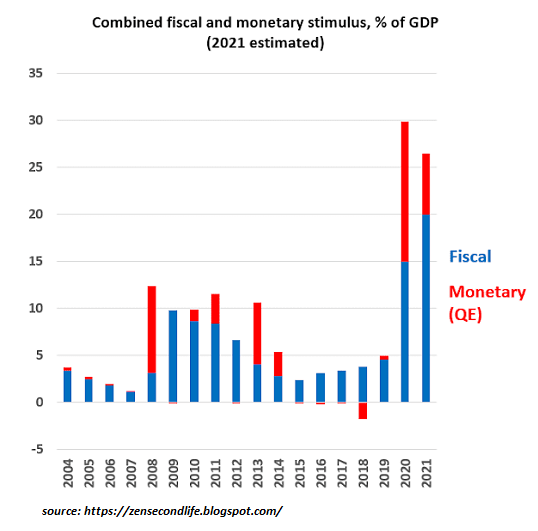
Stock prices have never been more detached from economic reality as they have been over the past 12 months, and they have only risen so high because of unprecedented intervention by the Federal Reserve and because of extremely wild spending by the federal government.

Many have warned that the party will inevitably come to a crashing end at some point, but it hasn’t happened yet.

So for now, the market optimists look like champions.

And now that Joe Biden is in the White House, the corporate media is telling us that we are on the verge of a grand new era of American prosperity.  The corporate media insists that the pandemic will soon be behind us thanks to the vaccines, and the talking heads on television envision a return to the good old days very quickly.

In fact, Barron’s is already declaring that the “U.S. economy might be stronger than it’s ever been”.

And CNN is trying to convince us that “America’s economy could be heading for a golden era of growth”.

Really?

If the U.S. economy is actually improving, then why are new claims for unemployment benefits going up?

The number of Americans filing first-time unemployment benefits unexpectedly rose last week, according to the Labor Department.

Data released Thursday showed 744,000 Americans filed first-time jobless claims in the week ended April 3. Analysts surveyed by Refinitiv were expecting 680,000 filings. The previous week’s total was revised higher by 9,000 to 728,000.

If economic conditions were getting better, that number should be going the other way.

Even I didn’t expect a number this bad.

Prior to 2020, the all-time record high for new unemployment claims in a single week was 695,000.  That record was established in October 1982, and it stood all the way until the COVID pandemic hit the U.S. early last year.

Sadly, we have been above 695,000 almost every single week since then.

The numbers compiled by the states tell us that nearly three-quarters of a million Americans filed new claims for unemployment benefits last week.  That is an absolutely catastrophic number.  Nobody should be talking about a “golden era of growth” or claiming that the “economy might be stronger than it’s ever been” until we get that number back down to pre-pandemic levels.

And right now, we are at a level that is about three times as high as pre-pandemic levels.

Look, the truth is that anyone that tells you that unemployment is low in the United States is lying to you.

According to John Williams of shadowstats.com, if honest numbers were being used the unemployment rate in the United States would be 25.7 percent right now.

That is the sort of number that we would expect to see during an economic depression, and the truth is that we are in an economic depression.

Over the past year, more than 70 million new claims for unemployment benefits have been filed, and approximately 4 million U.S. businesses have gone out of existence permanently.

But don’t worry, the stock market is hovering near all-time record highs and the corporate media is telling you that everything is going to be wonderful now that Joe Biden is in control.

Come on man!

You can’t really believe that stuff that they are shoveling.

With each passing day, more Americans are losing their jobs, more Americans are falling out of the middle class, and the cost of living just keeps going up even higher.

In fact, we just learned that global food prices have now gone up for 10 months in a row

The global food-price rally that’s stoking inflation worries and hitting consumers around the world shows little sign of slowing.

Even with grain prices taking a breather on good crop prospects, a United Nations gauge of global food costs rose for a 10th month in March to the highest since 2014. Last month’s advance was driven by a surge in vegetable oils amid stronger demand and tight inventories, according to Abdolreza Abbassian, a senior economist at the UN’s Food and Agriculture Organization.

I am going to continue to watch global food prices very carefully, because I believe that it will be a very important trend in the months and years ahead.

But for now, the good news is that at least economic conditions are relatively stable.

Yes, things are not nearly as good as they were before the pandemic, but at least they are not getting a whole lot worse.

So even though things are not great, we should enjoy this period of relative stability while we still can, because it definitely will not last.

Jeff Bezos Embodies the Cruel Autocracy of Neoliberal Capitalism

Amazon CEO and richest-man-in-the-world Jeff Bezos wants you to work as much as he does—for one millionth of the pay

By Branko Marcetic

Source: In These Times

“Is Jeff Bezos a horrible boss and is that good?” That was the question posed by Forbes magazine in 2013, a sentiment that helps explain why Amazon’s founder and CEO is detested by the Left for his oligarchic ambitions, while simultaneously admired by America’s capitalist class for his business success. Ironically, Bezos is also loathed by former President Donald Trump, while celebrated by many liberals for so-called resistance.

But with Bezos and his $115 billion fortune laying claim to the title of richest man on Earth, and with Amazon playing an increasingly influential role in public life, it is worth asking: What does Jeff Bezos stand for?

A gifted child born to a teen mom, Bezos grew up not knowing his biological father, who was once one of the top-rated unicyclists in Albuquerque, N.M. Instead, Bezos was raised by the man his mother soon married: Miguel Bezos, who had fled Cuba and the Communist revolution, which had shuttered the elite private Jesuit school he attended, as well as his family’s lumberyard.

Journalists have speculated whether Bezos’ near-pathological competitiveness is a product of his early abandonment, similar to that of fellow tech overlord Steve Jobs. No doubt equally formative was Bezos’ adoptive father, who told Brad Stone, author of The Everything Store: Jeff Bezos and the Age of Amazon, that their home life was ​“permeated” by complaints about totalitarian governments of both the Right and the Left.

Bezos envisioned the concept of an ​“everything store” while working for a Wall Street hedge fund in the 1990s. He opened Amazon in 1994 as an online bookshop, a pragmatic starting point. Bezos gave the company his own $10,000 cash injection, took out interest-free loans, and received $245,000 from his parents and family trust.

Many of Amazon’s controversial labor practices can be traced to these early years as a plucky start-up. Amazon’s small team ran on tireless ambition to live up to the company’s customer-focused promise — key to its eventual market domination. Stone reports that, to meet Bezos’ ​“get big fast” directive, employees devoted themselves completely, working long, unusual, frenzied hours. One early warehouse worker who biked to work simply forgot about his improperly parked car, eventually discovering it had been ticketed, towed and sold at auction.

Such a relentless pace is one thing for a small group of true believers but is quite another when applied to low-wage workers just making ends meet. By 2011, Amazon’s workplace culture became known through a series of headline-grabbing reports that have come to define its public image: badly paid, ceaselessly surveilled, overworked workers, struggling to maintain a breakneck pace.

Bezos created a culture in which everyone from the lowest peon to the highest-ranking executive is expected to match his own devotion, an approach that resulted in spectacular levels of staff turnover by the early 2000s. A declared enemy of ​“social cohesion,” Bezos pushed his underlings to reject compromise and instead fiercely debate and criticize colleagues when they disagreed. One former employee described it as ​“purposeful Darwinism.” Known for withering put-downs — ​“Are you lazy or just incompetent?” ​“Did I take my stupid pills today?”—Bezos also isn’t above pulling out his phone or, in some cases, simply leaving the room when an employee fails to impress.

The flipside of Bezos’ intellect is a cold, clinical approach to human relations. Bezos described himself as a ​“professional dater” during his Wall Street days, trying to improve what he called his ​“women flow” — a riff on the Wall Street term ​“deal flow.”

“He was not warm,” one person who knew Bezos during his Wall Street days told the East Bay Express in 2014. ​“It was like he could be a Martian for all I knew.”

Bezos’ pitiless leadership style bled out beyond the Amazon boardroom as he used the company’s growing market share to bully book publishers into his terms. The company launched the ​“Gazelle Project”—as in, go after publishers ​“the way a cheetah would pursue a sickly gazelle” — allowing Amazon to undercut its competition at the cost of little to no profit for smaller publishers.

As Amazon inched closer to Bezos’ original vision, it began lobbying efforts in 2000 and became more transparently political by 2011, spending millions to defeat an internet sales tax and playing hardball with state governments, threatening to shutter Amazon facilities if its wishes went unfulfilled. In 2013, Amazon began lobbying Congress to cut corporate taxes.

The same year, Bezos bought the Washington Post, invested in Business Insider and donated to the publisher of the libertarian magazine Reason. Though Bezos argues his purchase of the Post was motivated by ​“a love affair [with] the printed word” and a desire to support American democracy, others suspect Bezos’ interest in media is related to bad press following a scathing Lehman Brothers report in 2000, which sent Amazon’s stock price tumbling.

Leading up to the Post purchase, Bezos was increasingly displaying what early Amazon investor Nick Hanauer called his ​“libertarian politics.” In addition to spending $100,000 in 2010 on a campaign to defeat a proposed Washington state tax on high-income earners, Bezos put hundreds of thousands of dollars toward boosting charter schools and other neoliberal education reforms.

Bezos’ political involvement reached a new apogee in 2019 during the re-election bid of Seattle’s socialist city councilwoman, Kshama Sawant, who called Bezos ​“our enemy” and tried to pass a head tax to fund housing for those displaced by Amazon’s Seattle footprint. Amazon spent $1.5 million against Sawant and other progressive candidates, a record at the local level, with more than a dozen of the company’s executives contributing to Sawant’s opponent. (Sawant won re-election anyway.)

As for Bezos’ endgame? A Trekkie since childhood, he has long dreamed of funding space exploration, a mission pursued by other superrich moguls (such as Elon Musk) in the face of the climate emergency. Opening the doors of his secretive Blue Origin aerospace company to journalists for the first time in 2016, Bezos told the New York Times he envisioned a future of ​“millions of people living and working in space,” exploiting the natural resources of surrounding planets and rezoning Earth ​“as light industrial and residential.”

Ironically, as Bezos pours the wealth he wrung out of exhausted, low-wage Amazon workers into space exploration, Amazon is busy hastening the very planetary collapse Bezos claims he’s trying to prevent — by silencing workers who speak out against Amazon’s assistance to oil and gas companies.

Let’s imagine, however, that Bezos, who accumulates $9 million an hour, lived in a world with Bernie Sanders’ 8% wealth tax (just on fortunes over $10 billion). A single year would see $9 billion flow from Bezos’ treasure trove into government coffers, more than enough to cover the 10-year cost of Elizabeth Warren’s universal child care plan ($1.7 billion) and maintain safe drinking water under Sanders’ plan ($6 billion).

Bezos’ career is a testament to the cruel autocracy and senseless misallocation of resources that our neoliberal capitalist system enables. But his opulence also reveals that the wealth exists to build a fairer and more equitable society — if redistributed. Bezos may loathe social cohesion, but in a world organized around democracy rather than the whims of space-billionaires, it’s something we may well be able to achieve.

What’s Changed and What Hasn’t in a Tumultuous Year

By Charles Hugh Smith

Source: Of Two Minds

Inequality is America’s Monster Id, and we’re continuing to fuel its future rampage daily.

What’s changed and what hasn’t in the past year? What hasn’t changed is easy:

1. Wealth / income inequality is still increasing. (see chart #1 below)

2. Wages / labor’s share of the economy is still plummeting as financial speculation’s share has soared. (see chart #2 below)

What’s changed is also obvious:

1. Money velocity has cratered. (see chart #3 below)

2. Federal borrowing / spending has skyrocketed, pushing federal debt to unprecedented levels. (see chart #4 below)

3. Speculation has reached the society-wide mania level. This is evidenced by record margin debt levels, record levels of financial assets compared to GDP and many other indicators. (see chart #5 below)

Interestingly, every one of historian Peter Turchin’s 3-point Political Stress Index is now checked. Recall that these are core drivers of consequential social disorder, the kind that leads to empires collapsing, the overthrow of ruling elites, social revolutions, etc.

1. Stagnating real wages (i.e. adjusted for real-world inflation): check

2. Overproduction of parasitic elites: double-triple check

3. Deterioration of central state finances: check

But what about social changes? This is an interesting topic because social changes are less easily tracked (few even ask relevant questions and compile the data). Social trends are often more difficult to discern, as surveys may not track actual changes in behavior: people may give answers they reckon are expected or acceptable.

Here are four long-term trends that may have been accelerated by the pandemic:

1. The residents of overcrowded tourist destinations are sick of tourists and are demanding limits that protect increasingly fragile environments and resident quality of life.

Here’s a typical observation of a resident in Hawaii now that tourists are coming back:

Sunday I saw a group of 30 spring break tourists littering the beach with red cups and bottles of alcohol and trash. They had a table full of booze on the beach and were happily leaving their trash everywhere. No masks and no cares for Hawaii. When they left, instead of using the beach access they all climbed over the fence into someone’s yard because it saved them a minute of walking.

No I don’t miss tourists.

This is a global phenomenon. The absence of tourists has awakened a powerful sense that the profits (which flow into elite hands, not local economies) have taken precedence over the protection of what makes the destination worth visiting.

2. Work from home is here to stay. The benefits are too personal and powerful. Corporations demanding a return to long commutes and central offices will find their most productive employees are giving them “take this job and shove it” notices as they find positions with companies that understand that you can’t turn back the clock or ignore the benefits of flexible schedules.

3. Consumer behaviors have changed and are continuing to change. This is not just an expansion of home delivery; it’s a re-appraisal of big-ticket spending on concerts, entertainment, sports events and many other sectors that depend solely on free-spending consumers who ignore the recent doubling or tripling of prices.

4. Perceptions of the wealthy are changing. I touched on this topic in The Coming War on Wealth and the Wealthy (1/5/21) and The Coming Revolt of the Middle Class (1/27/21). Inequality is America’s Monster Id, and we’re continuing to fuel its future rampage daily.

Is the American Dream Still Alive? (Infographic)

Source: Strategic Culture Foundation

The post-WWII United States was at the peak of its soft power. One of its pillars was the American Dream. Every American could expect that his children would be better off – better off in every respect: healthier, longer-lived, better educated, happier, richer – than he was. Seventy years later, this dream seems to be blown to bits.

Lee Camp: It’s Time for Major Wealth Redistribution — Yes, I Mean It.

No need to be all apologetic about it, either, since we would just be reclaiming the trillions taken by the billionaires.

By Lee Camp

Source: ScheerPost.org

It’s time for wealth redistribution. There, I said it.

I know it’s the third rail of politics, but I’m not running for a damn thing, which makes me free to speak the truth. (Well, I am running for president of my neighborhood elementary school’s PTA, but I’m pretty sure I’ll win easily since my campaign slogan is “Extend the school day to 20 hours because we don’t want to deal with those little monsters. You take ‘em!” . . . Well, I’ll win as long as they don’t find out I don’t have a child.)

Anyway, we desperately need wealth redistribution. And before anyone starts yelling something about Joseph Stalin, here’s the part that’s going to blow your mind — in the United States we’ve already had wealth redistribution for decades.

Fifty trillion dollars has been redistributed from the poorest Americans to the top one percent over the past several decades. That’s right, a new study shows the richest people in the world have stolen trillions from average Americans. To put this in easier to access terms — you know how mad you get when someone takes the last donut? Well, imagine that multiplied by 50 trillion. (Quick reminder: If you make $40,000 a year, it would take you 1.25 Billion years to make $50 trillion.)

The new study reveals, “…that the cumulative tab for our four-decade-long experiment in radical inequality has grown to over $47 trillion from 1975 through 2018. At a recent pace of about $2.5 trillion a year, that number we estimate crossed the $50 trillion mark by early 2020.”

And to be clear, this money has been stolen from nearly every American. Had income distribution and buying power remained the same as it was from the end of World War II to 1975, ” . . . the aggregate annual income of Americans earning below the 90th percentile would have been $2.5 trillion higher in the year 2018 alone. That is … enough to pay every single working American in the bottom nine deciles an additional $1,144 a month. Every month. Every single year.”

The richest people in America are pilfering over $1,100 from you personally and everyone you know every single month of every single year. Just imagine what each living soul in America could do with an extra $13,700 per year — how many people that would feed, how much less stressful their lives would be, how many fewer foreclosures there would be, and how many more people would get the healthcare they need. Yet every time the most modest tax increases are proposed on the richest Americans, or every time someone so much as mumbles about putting in a public jungle gym or putting in filters to take the metal chunks out of the water or fixing the holes in our bridges that are bigger than the ones in Maria Bartiromo’s head — every time someone brings up these common sense solutions, the elites of our society (who own the media outlets and the levers of the state and the law enforcement and the courts) start screaming from their wine-soaked ski resort orgy balconies, “That’s wealth redistribution! That’s class war!”

Meanwhile, most so-called “progressives” tip-toe around this subject, saying things like, “Well, we just want to slightly increase the taxes on the giant swimming pools filled with money of the wealthiest people. It would only impact people with billions of dollars, which is only a few individuals. We’re sorry. We’re so sorry to ask for this, Mr. Boss Man. Please forgive us.”

Enough of the pussy-footing. It’s time to demand true, full-on wealth redistribution. It’s time to say to the billionaires, “We’re taking your shit, and we’re giving it back to the society you stole it from. We’re taking your cars and your marble statues of your own ass and your boats that park inside your other boats and your emerald bathtubs filled with naked man servants and your inbred cross eyed ugly-ass dogs! . . . But you can keep your children. We don’t want those sociopaths in training. But other than that, we’re taking your stuff because this level of inequality is what most rational economists call ‘fucking nuts’.”

I will however give one caveat to make this go smoother. We only take back everything over $10 million. It’s estimated that there are about 1.4 million American households who have over $10 million. So that means what I’m proposing would impact less than one-half of one percent of Americans. The average American has never even met someone with over $10 million unless they shook Jim Carrey’s hand one time on a sidewalk in New York.

So we — the 99 percent — would take everything over $10 million from the people who have over $10 million. And we would give it out with the bottom 50 percent getting the vast majority of it. This means 99.5 percent of Americans would benefit from this redistribution of wealth. So, before you argue against this idea — Remember: you benefit. You would receive money. Because I promise there is no one with over $10 million reading this column right now, unless one banker accidentally clicked on this because it was next to the Wall Street Journal in his Twitter feed.

Do you need more numbers to hammer home the point? The billionaires in this country have increased their wealth by over $1.3 Trillion, an increase of 44 percent, just since the beginning of the pandemic.

One out of every three people in America have had trouble paying their bills during this pandemic.

Nearly 15 million people have lost their healthcare coverage just since the beginning of this pandemic.

And if you are the one person with over $10 million reading this, don’t give me that horse shit about, “I worked for that money. I earned that money.” No, no, no, no, you did not earn over $10 million. I know you didn’t because that’s impossible. It’s madness. It’s Gary Busey inside Charlie Sheen inside Ted Nugent. Taking the laws of physics into account, there is no way you worked a thousand times harder than a janitor or a sanitation worker or a nurse or a busboy or a fluffer or a fluffer’s second assistant fluffer intern. It’s physically impossible that you worked a thousand times harder than every “essential worker.” (Yes, fluffers are essential.)

What you did was merely take advantage of a system that is set up to exploit the vast majority of the society while most people don’t even realize what happened. That’s what you did because you’re a sociopath. Indeed, most of the Americans with over $10 million are sociopaths. They would kick a puppy down a flight of stairs into the teeth of a wool thresher if it meant they could make an extra $1,000. But I will acknowledge that not all of them are sociopaths. Some of them are relatively okay people working inside a breathtakingly corrupt system. So for the ones who are sociopaths, why should we feel bad for taking their wealth — over $10 million — and redistributing it? (They’re sociopaths after all. Lest we forget: they kick puppies.)

And then for the other ones, who are not sociopaths but still have over $10 million, they’re not going suffer because at the end of the day, they still have ten million goddamn dollars! It’s not like they’d suddenly be scraping by, clothing their children with cardboard boxes painted to look like shirts and bow ties.

So the next time someone says to you, “You can’t raise the taxes on the top 1% because that’s class war. It’s redistribution of wealth,” don’t respond the way most squishy liberals respond — “Ummm, ahhh, errr, no, uhhhh, I’m sorry.” Instead respond, “You’re damn right it is! I want redistribution of wealth. I want a nonviolent class war — because it has been done to the rest of us for the past 50 years at least. We have been exploited and abused, beaten down and defeated, kicked and slapped and scratched and drained and sucked dry and extracted and even burgled!” (Oh man, do I hate being burgled.)

Now is our time to fight back against this terrible machine that has allowed this unbelievable level of exploitation. Screw this system that allows some people to have enough money to end world hunger (literally Jeff Bezos could end world hunger many times over) and yet never do it, while other individuals sleep on a bench hoping no one steals their one box of cereal in the night. To put my conclusion into more sophisticated academic language — Fuck that.

This is an abusive relationship, and it’s time to get out.

What “Normal” Are We Returning To? The Depression Nobody Dares Acknowledge

By Charles Hugh Smith

Source: Of Two Minds

Perhaps we need an honest national dialog about declining expectations, rising inequality, social depression and the failure of the status quo.

Even as the chirpy happy-talk of a return to normal floods the airwaves, what nobody dares acknowledge is that “normal” for a rising number of Americans is the social depression of downward mobility and social defeat.

Downward mobility is not a new trend–it’s simply accelerating. As this RAND Corporation report documents, ( Trends in Income From 1975 to 2018) $50 trillion in earnings has been transferred to the Financial Aristocracy from the bottom 90% of American households over the past 45 years.

Time magazine’s article on the report is remarkably direct: The Top 1% of Americans Have Taken $50 Trillion From the Bottom 90% — And That’s Made the U.S. Less Secure.

“The $50 trillion transfer of wealth the RAND report documents has occurred entirely within the American economy, not between it and its trading partners. No, this upward redistribution of income, wealth, and power wasn’t inevitable; it was a choice–a direct result of the trickle-down policies we chose to implement since 1975.

We chose to cut taxes on billionaires and to deregulate the financial industry. We chose to allow CEOs to manipulate share prices through stock buybacks, and to lavishly reward themselves with the proceeds. We chose to permit giant corporations, through mergers and acquisitions, to accumulate the vast monopoly power necessary to dictate both prices charged and wages paid. We chose to erode the minimum wage and the overtime threshold and the bargaining power of labor. For four decades, we chose to elect political leaders who put the material interests of the rich and powerful above those of the American people.”

I’ve been digging into downward mobility and social depression for years: Are You Really Middle Class?

The reality is that the middle class has been reduced to the sliver just below the top 5%–if we use the standards of the prosperous 1960s as a baseline.

The downward mobility isn’t just financial–it’s a decline in political power, control of one’s work and ownership of income-producing assets. This article reminds us of what the middle class once represented: What Middle Class? How bourgeois America is getting recast as a proletariat.

This reappraisal of the American Dream is also triggering a reappraisal of the middle class in the decades of widespread prosperity: The Myth of the Middle Class: Have Most Americans Always Been Poor?

Downward mobility excels in creating and distributing what I term social defeat: In my lexicon, social defeat is the spectrum of anxiety, insecurity, chronic stress, fear and powerlessness that accompanies declining financial security and social status.

Downward mobility and social defeat lead to social depression. Here are the conditions that characterize social depression:

1. High expectations of endlessly rising prosperity instilled as a birthright no longer align with economy reality.

2. Part-time and unemployed people are marginalized, not just financially but socially.

3. Widening income/wealth disparity as those in the top 10% pull away from the bottom 90%.

4. A systemic decline in social/economic mobility as it becomes increasingly difficult to move from dependence on the state or one’s parents to financial independence.

5. A widening disconnect between higher education and employment: a college/university degree no longer guarantees a stable, good-paying job.

6. A failure in the Status Quo institutions and mainstream media to recognize social depression as a reality.

7. A systemic failure of imagination within state and private-sector institutions on how to address social depression issues.

8. The abandonment of middle class aspirations: young people no longer aspire to (or cannot afford) consumerist status symbols such as luxury autos or conventional homeownership.

9. A generational abandonment of marriage, families and independent households as these are no longer affordable to those with part-time or unstable employment.

10. A loss of hope in the young generations as a result of the above conditions.

The rising tide of collective anger arising from social depression is visible in many places: road rage, violent street clashes between groups seething for a fight, the destruction of friendships for holding “incorrect” ideological views, and so on.

A coarsening of the entire social order is increasingly visible: The Age of Rudeness.

Depressive thoughts (and the emotions they generate) tend to be self-reinforcing, and this is why it’s so difficult to break out of depression once in its grip.

One part of the healing process is to expose the sources of anger that we are repressing. As psychiatrist Karen Horney explained in her 1950 masterwork, Neurosis and Human Growth: The Struggle Towards Self-Realization, anger at ourselves sometimes arises from our failure to live up to the many “shoulds” we’ve internalized, and the idealized track we’ve laid out for ourselves and our lives.

The article The American Dream Is Killing Us does a good job of explaining how our failure to obtain the expected rewards of “doing all the right things” (getting a college degree, working hard, etc.) breeds resentment and despair.

Since we did the “right things,” the system “should” deliver the financial rewards and security we expected. This systemic failure to deliver the promised rewards is eroding the social contract and social cohesion. Fewer and fewer people have a stake in the system.

We are increasingly angry at the system, but we reserve some anger for ourselves, because the mass-media trumpets how well the economy is doing and how some people are doing extremely well. Naturally, we wonder, why them and not us? The failure is thus internalized.

One response to this sense that the system no longer works as advertised is to seek the relative comfort of echo chambers–places we can go to hear confirmation that this systemic stagnation is the opposing ideological camp’s fault.

Part of the American Exceptionalism we hear so much about is a can-do optimism: set your mind to it and everything is possible.

The failure to prosper as anticipated is generating a range of negative emotions that are “un-American”: complaining that you didn’t get a high-paying secure job despite having a college degree (or advanced degree) sounds like sour-grapes: the message is you didn’t work hard enough, you didn’t get the right diploma, etc.

It can’t be the system that’s failed, right? I discuss this in my book Why Our Status Quo Failed and Is Beyond Reform: the top 10% who are benefiting mightily dominate politics and the media, and their assumption is: the system is working great for me, so it must be working great for everyone. This implicit narrative carries an implicit accusation that any failure is the fault of the individual, not the system.

The inability to express our despair and anger generates depression. Some people will redouble their efforts, others will seek to lay the blame on “the other” (some external group) and others will give up. What few people will do is look at the sources of systemic injustice and inequality.

Perhaps we need an honest national dialog about declining expectations, rising inequality and the failure of the status quo that avoids polarization and the internalization trap (i.e. it’s your own fault you’re not well-off).

We need to value honesty above fake happy-talk. Once we can speak honestly, there will be a foundation for optimism.