25 Families Own $1.1 Trillion Between Them as the Global Wealth Inequality Gap Grows

Using data from their list Forbes has produced a list of the top 25 richest families in the world. Together they are worth over $1.1 trillion, or the entire GDP of Indonesia.

By  Rosa Tressell and Dr. Leon Tressell

Source: SouthFront

Once a family-owned business Forbes is well known for producing their annual list of the world’s richest billionaires. Launched in 1982 the original list ranked the top 400 Americans by net worth. Only 13 billionaires were included in that list, and their combined worth was the equivalent of 2.8% of GDP. In an era where “Greed is Good”, the list became wildly popular, by 2000 the combined net worth of the top 400 equated to 12.2% of US GDP. So prestigious became the list that an ex-employee of Forbes has claimed that Donald J Trump inflated his personal wealth to be included.

This year more than 2,200 billionaires made the Forbes list with a combined value of $9.1 trillion, or half the GDP of the US. Amazon CEO, Jeff Bezos, topped the list this year as his fortune rose to £112 billion making him the first centi-billionaire. His wealth is now equal to that of 2.3 million Americans. This has allowed him to dethrone Bill Gates, founder of Microsoft, worth just $90 billion.

Using data from their list Forbes has produced a list of the top 25 richest families in the world. Together they are worth over $1.1 trillion, or the entire GDP of Indonesia. The richest clan is the Walton family who own the ubiquitous Walmart chain in America. They have a total family wealth of £152 billion and several family members are on the list of billionaires as individuals. The Koch Brothers, of Koch Industries, are ranked second with £98.7 billion. The third spot, with $90 billion to their name, is taken by another American family, the Mars family, known for their various sweet treats.

In comparison to the billionaires list this list is a measure of families who have inherited and grown their wealth over generations. The billionaires list is dominated by Americans in certain fields; technology, finance, entertainment and sport. It lauds entrepreneurism and promotes the self-made man (and small handful of women). The family fortunes list on the other hand reveals a more historical route for making money. Whilst Jeff Bezos has shot to the top of the list based largely on the astonishingly over valued share price of Amazon stock, the family fortunes are centered on the production and purveyance of goods.

Many of the families on the list started making their fortunes in the late nineteenth century. These are: Cargill Industries (agricultural conglomerate); Boehringer Ingelhelm (pharmaceuticals); Cox Enterprises (communications); Hyatt Hotels (hotels); SC Johnson (household goods); Roche (pharmaceuticals); and the Hearst Corporation (media). Meanwhile the Van Damme/De Spoelberch/De Mevius family (ranked fourth with a fortune of $54.1 billion) have been brewing quality Belgian beer, like Stella Artois, dating back centuries.

The production and purveyance of quality high end goods as a means to fortune is evident as BMW (the Quandt family), Chanel (the Wertheimer family) and Hermes (the Dumas family) find these families all ranked in the top ten.

Reliance Industries is the fist non-Western entry. A Mumbai-based energy conglomerate, it was founded by Dhirubhai Ambani in 1957 and is now worth $43.4 billion. It was his ambition to be the world’s richest man. However, following his untimely death there was a very public and acrimonious dispute between his two sons revolving around the inheritance. The widow eventually brokered a settlement and the family fortune goes on, but it does show how easily a family fortune can be dissipated.

In addition to Walmart there are two other families that have made their fortunes in retail. The Albrecht Brothers who founded Aldi are ranked 11th with a $38.8 billion fortune followed at twelfth by the Mulliez family who founded Auchan, France’s equivalent of Walmart. At thirteenth spot, with a fortune of £34 billion, is the Kwok family. They started in business as a grocery wholesaler but they really made their money when they moved into Hong Kong real estate in the 1970s. Similarly the Lee family from South Korea began as grocery exporters but have made their fortune as the worlds largest producers of smart phones with their company Samsung.

There is some methodology to the list that requires explanation. Bloomberg’s categorisation of family wealth is based on reliable, sourced documentation. They add up family members assets, including stakes in public and private companies, real estate, art and cash, and takes into account debts. It excludes first-generation fortunes and those in the hands of a single heir. It also excludes those who have derived their fortune from the state. This explains why there are no Chinese families on the list and only three from the Asian region. As newly found wealth is handed down this looks set to change.

The Forbes list also excludes members of royal families and dictators who derive their fortunes entirely as a result of their position of power. Nor do they value those holding fortunes in trust for their nations. So, despite being worth untold billions, families like the royal family of Brunei or the British monarchs are absent. Quantifying this wealth is difficult. For example, Buckingham Palace alone would be valued in excess of $5 billion, however there would certainly be conflict with Parliament if the Queen wanted to sell it!

Many billionaires positively don’t want to be on the list. They don’t want the publicity for their families with the increased risk of kidnapping, being hit up for money, questions from the tax man or even from law enforcement. Kenichi Shinoda, current Kingpin of the Yakuza, is rumoured to be worth billions but is known to keep a low financial profile. There is also plenty of Western media speculation that the President of Russia, Vladimir Putin, is actually the world’s richest man. The Bush family have amassed a vast fortune, and there are allegations that much of it has been amassed behind the political scenes in various CIA backed gun and drug running operations.

Calculations of wealth, for individuals or families, can be obfuscated by the numerous off shore arrangements that exist today. Historically, many of the world’s largest landowners are not officially registered as a result of having held title to the land for centuries. In addition trusts, foundations and “charities” allows for the ownership and management of assets in a more private manner. Wealthy families pay professionals a healthy wage to minimise their exposure to the taxman – especially avoidance of inheritance tax.

Absent from the list are the giant banking families, the Rockefellers, the Morgans and the Rothschilds; famed for being on every conspiracy theory list as powers behind the scene. The report says that their fortunes are too diffuse and diversified to correctly value. Other families suspected of wielding their riches for their own political and social agendas include the DuPonts, the Astors, the Bundys and the Freemans, to name a few. Families that like to keep their immense fortunes and their activities confidential.

To have such wealth is naturally to have much power. Certain families, like the Bushes and the Kennedys used their cash to enter politics. The Koch Brothers have already pledged $400 million to the Republicans for the 2018 mid-term elections and their support was seen as instrumental in securing Donald J Trump’s election victory. The Walmart Family Foundation is one of America’s largest political donors, and is described as a “heavy hitter” from the Centre of Responsive Politics. Economic advantage is translated into legislative favours via lobbying and campaign donations. For example, one Arkansas Congresswoman who supported the repeal of an estate tax received $83,650 from the Walton Family Foundation and  now works for them as a lobbyist. This exemplifies the corrupt relationship between economic and democratic inequality and is indicative of a system where the majority feel their voice is irrelevant.

Capitalism is built on an idea that a rising tide lifts all ships. We are supposed to look up to these rich families as examples of our betters. Underlying the lists that Forbes assembles is a worshiping of the rich. Underpinning the American dream is that its possible for anyone or any family to make it (onto the list). However, even Scrooge McDuck must be envious of the enormous fortunes of these families. As the wealth inequality gap grows within countries, especially the Western nations, there is the risk that the social fabric is coming apart at the seams. When 40% of Americans have less then $500 in savings the material basis for living the Dream is seriously compromised. Indeed, this could all turn just as easily into anger as people see that the six individual Walmart heirs alone have more wealth than the bottom 30% of the US population, and they ask themselves is this fair?

This report confirms accelerating trends towards further wealth disparity. Reports by Oxfam have shown a gaping chasm of global inequality. In 2017 3.7 billion people saw no increase in their wealth, whilst 82% of the wealth created went to the top 1%.

According to the World Inequality Report 2018:

If established trends in wealth inequality were to continue, the top 0.1% alone will own more wealth than the global middle class by 2050.

Donald Trump’s ambition to be included on the list displays his naked ambition for money, power and success. In his school of market economics, of dog eat dog, this trend is only the logic of the market. It is seen as aspirational by those at the top and by magazines like Forbes. However, even the 1% at Davos earlier this year had wealth inequality on the agenda. As the social fabric tears, political and social instability will increase. The Brexit vote, driven by the anger of the dispossessed English working class, for example, has turned the UK’s traditional stability on its head.  Anger is brewing below the surface everywhere and the probability of social and political uprisings throughout the globe are increasing.


What’s Wrong with the Economy: 9 Toxic Dynamics

By Charles Hugh Smith

Source: Of Two Minds

These nine dynamics are mutually reinforcing.

Beneath the surface signals of an eternally rising stock market and expanding GDP, we all sense something is deeply, systemically wrong with the U.S. economy. These nine structural dynamics generate secondary dynamics, all of which are toxic to social mobility, sustainable prosperity, accountability and democracy:

1. The financialization of the economy, which transformed services, credit, risk and labor into commodities that could be traded globally. Financialization generates enormously asymmetric returns: those with access to low-cost credit, global markets and expertise in finance collect the lion’s share of gains in income and wealth.

2. The technological transformation of the economy, which has placed a substantial scarcity premium on specific tech/managerial/communication skills and devalued ordinary labor and capital. As a result, the majority of gains in wealth and income flow to those with the scarce skills and forms of capital, leaving little for ordinary labor and capital.

3. The end of cheap fossil fuels. The fracking boom/bubble has obscured the long-term secular trend: the depletion of cheap-to-access and process oil. As many analysts have observed (Nate Hagens, Gail Tverberg, Richard Heinberg, Chris Martenson et al.), the global economy only grows if energy and credit are both cheap.

4. Globalization, which transformed the developing world into the environmental dumping ground of the wealthy nations and enabled the owners of capital to offshore waste and labor.

5. The destructive consequences of “growth at any cost” are piling up. “Growth” is the one constant of all existing political-economic systems, and none of the current Modes of Production (i.e. the structures that organize production, consumption, the economy and society) recognize that “growth” is not sustainable.

The first two dynamics drive three other dynamics that have hollowed out the productive economy:

6. The dominance of debt-funded speculation as the means of “getting ahead” as opposed to producing products and services of intrinsic value that serve the core needs of communities.

7. The economy’s gains in income and wealth are concentrated in the very top of the wealth-power pyramid: the top 5%–entrepreneurs, professionals and technocrats, etc., and within this class, most of the gains go to the top 1/10th of 1% –the existing owners of wealth, and financiers/speculators with access to cheap credit.

The net result is the bottom 95% have few opportunities to “get ahead” outside of gambling in the asset bubbles du jour: the stock and housing market. While the average middle class household may be able to borrow enough to speculate in the housing bubble, two factors limit the odds of success for ordinary investors/gamblers:

A. The gains in housing are concentrated in specific markets; outside these hot markets, gains are modest.

B. Asset bubbles eventually pop, leaving those still owning the assets with losses. The risks are thus intrinsic and high. The average investor/gambler lacks the experience needed to recognize the bubble has stopped expanding and exit the market before ll the other speculators rush for the narrowing exit.

8. The devaluation of ordinary labor and capital means the bottom 60% of the economy that lacks the requisite skills with a scarcity premium in the Emerging Economy have lost easy access to the ladder of social mobility.

9. The concentration of wealth and power in the hands of the self-serving few corrupts the economy and democracy. The U.S. economy is dominated by insider and elite rackets, skims, scams and cartels/quasi-monopolies, all of which corrupt the economy by creating perverse incentives for exploitation and gaming the system to benefit the few at the expense of the many.

This corruption in service of maximizing private/personal gains at the expense of the system itself also corrupts the mechanisms of governance, which are now little more than cloaking devices that protect insiders and elites from scrutiny and consequences.

The 20% above the bottom 60% may appear to have some access to social/economic mobility, but this is largely an artifact of the bubble economy since 2009. Once the bubble deflates, the illusion of social mobility for the “middle class” between the bottom 60% and the upper 20% vanishes.

The “upper middle class” between the bottom 80% and the top 5% is being squeezed by the over-production of elites, i.e. the over-abundance of those with college degrees and the relative scarcity of secure jobs within the top 5%. As a result, credential inflation is rampant, with Masters Degrees replacing Bachelors Degrees as the default for a white-collar job, and PhDs replacing Masters diplomas as the new default for positions that lack security and upward mobility.

In other words, the number of people who qualify for and desire a slot in the elite class (top 5%) far exceeds the number of slots available. As Peter Turchin has explained, this competition generates social disorder at the top of economic heap as the top 20% fight over the few positions open in the top 5%. The disgruntled, frustrated losers far outnumber the relatively few winners.

These nine dynamics are mutually reinforcing, meaning that each dynamic strengthens one or more of the others, reinforcing each other so the sum of the nine is far more powerful than a mere addition might suggest.

The New Aristocracy (the top 9.9%) (The Atlantic)


Inequality Social Dysfunction and Misery

By Graham Peebles

Source: Dissident Voice

Year on year the economic divisions and sub-divisions in the world deepen, the associated social ills increase: The rich, comfortable, and the very extremely rich keep getting richer, and the rest, well, whilst some may be raised up out of crippling poverty into relative poverty, the majority of people continue to live under a blanket of economic insecurity and largely remain where they are.

Straddling the global ladder of economic and social division sit the Multi-Billionaires (there are now 2,208 billionaires), 42 of whom (down from 61 in 2016), according to a recent report by Oxfam, own the same amount of wealth as the poorest half of humanity combined. Together with their lesser cohorts this coterie of Trillionaires sucked up “eighty-two percent of the wealth generated [in the world] last year…while the 3.7 billion people who make up the poorest half of the world saw no increase in their wealth.”

The defining challenge of our time

Income and wealth inequality is not simply a monetary issue, it is a complex social crisis that supports and strengthens notions of superiority and inferiority, and was described by President Barak Obama in 2013 as “the defining challenge of our time.”

Today’s obscene levels of inequality are the result of the Neo-Liberal economic system. This extreme form of capitalism took hold first in America and Britain in the early 1980s when Reagan and Thatcher ruled, workers’ rights were trampled on, ‘society’ was a dirty word and community responsibility was abandoned to selfishness and greed. With the aid of the World Bank and the IMF, Neoliberalism swiftly spread throughout the world, polluting life in every city, town and village with its divisive, cruel ideology. Commercialization and competition are key principles and have infiltrated every area of contemporary life; everything and everyone is seen as a commodity, and the size of ones bank account determines the level of health care, education and housing available, as well as one’s access to culture and freedom to travel.

Social injustice is inherent in the system, as is inequality, which is itself a major form of injustice. Inequality strengthens deep-seated social imbalances based on class and social standing, and in a world where everything is classified, commercialized and priced; i.e., attributed value, external wealth and position have become the common criteria for determining the internal worth of a human being. Comparison and imitation follow, individuality is perverted and fear fostered; fear of inadequacy, fear of failure, fear of not being loved, because not ‘deserving’ love, not being able to ‘afford’ love. Resentment, anger and self-loathing are fed, leading to a range of mental health issues, including anxiety, depression and drug and alcohol addiction.

Happiness and inequality

The impact of financial inequality on the health and well being of society has been extensively studied by Richard Wilkinson; British co-author of Spirit Level, Professor Emeritus of Social Epidemiology at the University of Nottingham. In order to establish national levels of inequality Wilkinson and his team used a benchmark based on how much richer the top 20% is to the bottom 20%: Japan and Scandinavia (Finland, Norway, Sweden, Denmark) came out most equal, and now, Slovenia and the Czech Republic have moved towards this group. Israel, New Zealand, Australia, Britain, Portugal and USA were found to have the greatest levels of inequality, and by some margin. Recent data suggests that Russia, South Africa and Turkey should now be added to the most unequal pile. Germany, Spain and Switzerland sit somewhere in the middle.

Data relating to a range of social issues was examined: The most unequal countries were found to have lower life expectancy than more equal societies, higher infant mortality, many more homicides, larger prison populations (by 10-15 times), applied longer sentences; had higher teenage pregnancies, lower mathematic/literacy levels, more obesity, less social mobility, and, according to The World Value Survey, a great deal less trust. In more equal countries, like Sweden and Norway, around 65% of people trust others, whereas in unequal societies like America a mere 15% admitted to trusting their fellow citizens.

In all areas, countries with high levels of inequality did worse, in many cases much worse, than more equal nations. Mental health, for example, (figures from the World Health Organization): In Japan around 8% of the population suffers from some form of mental health issue, compared to 30% in America. Children are considerably healthier in more equal countries – based on UNICEF’s Index of Child Well-Being – and feel a good deal happier. Wilkinson concludes, “What we’re looking at is general social dysfunction related to inequality. It’s not just one or two things that go wrong, it’s most things.”

Look to Scandinavia

If one of the primary purposes of any socio-economic system is to create environments in which human beings can grow and live happily together, then the nations suffering under the shadow of inequality need to learn from Sweden, Norway, Denmark and Finland, which are not just the least unequal, they are also the happiest countries in the world. Throughout Scandinavia public services – education (which is probably the best in the world), health care and housing, are valued, and taxes levied in order to fund them properly; there are greater levels of social justice, this allows for trust to develop, and where there is trust relationships flower. The extremes of staggering wealth and stifling poverty don’t exist as they do in the more unequal parts of the world; social mobility is greater and the dream of betterment more realistic, as Richard Wilkinson says, “if Americans want to live the ‘American dream’ they should go and live in Denmark.”

The first duty of government is to protect the people; this involves not only dealing with terrorism and the like, but requires the development of socio-economic policies that contribute to the creation of a healthy harmonious environment. By supporting extreme inequality (which has been shown to fuel a range of social issues) governments in the more unequal countries are totally failing in this fundamental duty. Politicians, who in many cases rely on big business and wealthy benefactors for their funding, are either blind to, or negligent of, the inherent faults of the current system, and the unhealthy, negative way of life it supports.

The case for fundamental change in the economic order, and a shift away from the destructive values it promotes is becoming irrefutable; however, change occurs only gradually and resistance is great. In the meantime, governments (particularly in the most unequal states) need to acknowledge the connection between the dysfunction and disease within society and their socio-economic methodology, which is literally making people ill, as well and poisoning the natural world. They need to invest properly in public services, address wage differences, ban bonuses, introduce progressive tax reform, and, unlike America and France which are taking retrograde steps by designing tax codes which will fuel inequality, look to the Scandinavian countries and learn from their example.

For too long socio-economic systems have been designed and maintained to cater to the desires and interests of a privileged few, while the majority live inhibited lives under the shadow of financial uncertainty. For harmonious societies to evolve this long-standing injustice needs to be addressed and a degree of balance found. This requires that those whose table is full to overflowing share some of their bounty, so that all may have enough, not excess, enough.

As a wise man has said, “The rich must give up what they want, so that the poor can have what they need.” What the rich and comfortable must give up is greed (another car, another house, more designer clothes, etc.), what the rest need is freedom from economic insecurity and the fear of destitution, freedom from exploitation and dependency; secure, comfortable, and well-designed accommodation, and access to good education, health care and culture. Such essential needs are the rights of all; when made manifest they go a long way towards establishing social justice, and where there is social justice, functional, compassionate communities do evolve, conflict is reduced and collective harmony is cultivated.

The Con of Diversity

By Chris Hedges

Source: OpEdNews.com

In 1970, when black students occupied the dean’s office at Harvard Divinity School to protest against the absence of African-American scholars on the school’s faculty, the white administration was forced to respond and interview black candidates. It asked James Cone, the greatest theologian of his generation, to come to Cambridge, Mass., for a meeting. But the white power structure had no intention of offering Cone a job. To be black, in its eyes, was bad enough. To be black, brilliant and fiercely independent was unpalatable. And so the job was given to a pliable African-American candidate who had never written a book, a condition that would remain unchanged for the more than three decades he taught at Harvard.

Harvard got what it wanted. Mediocrity in the name of diversity. It was a classic example of how the white power structure plays people of color. It decides whom to promote and whom to silence. When then-Maj. Colin Powell helped cover up the 1968 massacre of some 500 civilians at My Lai in Vietnam he was assured a glittering career in the Army. When Barack Obama proved obedient to the Chicago political machine, Wall Street and the Democratic Party establishment he was promoted to the U.S. Senate and the presidency.

Diversity in the hands of the white power elites — political and corporate — is an advertising gimmick. A new face, a brand, gets pushed out front, accompanied by the lavish financial rewards that come with serving the white power structure, as long as the game is played. There is no shortage of women (Hillary Clinton, Nancy Pelosi and Donna Brazile), Latinos (Tom Perez and Marco Rubio) or blacks (Vernon Jordan, Clarence Thomas and Ben Carson) who sell their souls for a taste of power.

Ta-Nehisi Coates in his book “We Were Eight Years in Power: An American Tragedy” writes that “Barack Obama is directly responsible for the rise of a crop of black writers and journalists who achieved prominence during his two terms.” But this was true only for those black writers like Coates and Michael Eric Dyson who were obsequious cheerleaders for Obama. If, like Cornel West, you were black and criticized Obama you were isolated and attacked by Obama surrogates as a race traitor.

“For those who didn’t support Obama it was the lonely time,” said Glen Ford, the executive editor of the Black Agenda Report, when we spoke recently. “It’s like A.D. and B.C. Before Obama time, my politics reflected that of a black commentator, probably within a respectable black political spectrum. I’m looking at a fax, ‘NAACP September 8, 2007. NAACP regional leader.’ I got this after giving a keynote speech in Little Rock, Ark., in commemoration of the events in Little Rock in ’57. You see what I’m saying? I could do that, even as late as 2007. Then Obama happened. It was a wonderful time for people who endorsed Obama. If you didn’t endorse Obama, you were verboten in the community. All of a sudden you were ostracized.”

The absence of genuine political content in our national discourse has degraded it to one between racists and people who don’t want to be identified as racists. The only winners in this self-destructive cat fight are corporations such as Goldman Sachs, whose interests no American can vote against, along with elite institutions dedicated to perpetuating the plutocracy. Drew G. Faust, the first woman president of Harvard University, whose appointment represented a triumph for diversity, upon her retirement was appointed to the board of Goldman Sachs, a role for which she will receive compensation totaling over half a million dollars a year. A new and “diverse” group of Democratic Party candidates, over half of whom have been recruited from the military, the CIA, the National Security Council and the State Department, is hoping to rise to political power based on the old con.

“It’s an insult to the organized movements of people these institutions claim to want to include,” Ford said. “These institutions write the script. It’s their drama. They choose the actors, whatever black, brown, yellow, red faces they want.

“I don’t think a black left should be investing any political capital or energy into getting Barack Obamas into a Harvard,” Ford said, “or believing it can transform Harvard or any of these ruling-class universities from the inside out, any more than it can transform the Democratic Party from the inside out.”

Ford points out that “diversity” has been substituted by the white power elites for “affirmative action.” And, he argues, diversity and affirmative action are radically different. The replacement of affirmative action with diversity, he says, effectively “negates African-American history as a legal basis for redress.”

Once the Supreme Court in its 1978 Bakke decision outlawed “quotas” for racial minorities, ruling institutions were freed from having to establish affirmative action programs that would have guaranteed a space for those traditionally excluded. The Trump administration’s recent reversal of an Obama-era policy that called on universities to consider race as a factor in admissions is an attempt to eradicate even diversity. President Trump and his racist enablers, including Education Secretary Betsy DeVos, are resegregating America.

“You do not take a man who for years has been hobbled by chains, liberate him, bring him to the starting line of a race, saying, ‘You are free to compete with all the others,’ and still justly believe you have been completely fair …” President Lyndon Johnson said in 1965 to the graduating class of Howard University. “This is the next and more profound stage of the battle for civil rights. We seek not just freedom but opportunity — not just legal equity but human ability — not just equality as a right and a theory, but equality as a fact and as a result.”

Johnson’s call, along with that of Martin Luther King Jr., was swiftly sabotaged by white, liberal elites, who divorced racial justice from economic justice. White liberals could live with laws prohibiting desegregation but not with giving up some of their financial and social privilege.

“White liberals are not seeking justice,” Ford said. “They’re seeking absolution. Anything that absolves them of responsibility for what this society has done, they welcome it. They’re hungry for it.

“The legal, as well as moral, basis for affirmative action lay in the culpability of the United States and all of its layers of government in the enslavement and Jim Crow ‘hobbling’ of African-Americans — a unique history of oppression of a specific people that requires institutional redress,” Ford has written. “Otherwise, the legacies of these crimes will reproduce themselves, in mutating forms, into infinity. Once the specificity of the Black American grievance was abandoned, affirmative action became a general catch-all of various historical wrongs. Stripped of its core, affirmative action morphed into ‘diversity,’ a vessel for various aggrieved groups that was politically versatile (and especially useful to the emerging Black deal makers of electoral and corporate politics), but no longer rooted in Black realities. The affirmative action of Dr. King and President Johnson was a species of reparations, a form of redress for specific and eminently documentable harms done to African Americans, as a people. It was understood as a social debt owed to a defined class.”

“‘Diversity,'” Ford wrote, “recognizes no such debt to a particular people, or to any people at all. Rather, its legal basis is the ‘compelling interest’ of public institutions in a diversified student body (or faculty).”

Diversity does not force the white power structure to address racial injustice or produce results within the black underclass. This feint to diversity was abetted, Ford points out, by black elitists who found positions for themselves in the power structure in exchange for walking away from the poor and marginalized.

Ford calls these black elitists “representationalists” who “want to see some black people represented in all sectors of leadership, in all sectors of society. They want black scientists. They want black movie stars. They want black scholars at Harvard. They want blacks on Wall Street. But it’s just representation. That’s it.”

The plague of diversity lies at the core of our political dysfunction. The Democratic Party embraces it. Donald Trump’s Republican Party repudiates it. But as a policy it is a diversion. Diversity has done little to ameliorate the suffering of the black underclass. Most blacks are worse off than when King marched in Selma. African-Americans have lost over half of their wealth since the financial collapse of 2008 because of falling home-ownership rates and job loss. They have the highest rate of poverty at 27.4 percent, followed by Hispanics at 26.6 percent and whites at 9.9 percent. And 45.8 percent of black children under six live in poverty, compared with 14.5 percent of white children in that age group. Forty percent of the nation’s homeless are African-Americans although blacks make up only 13 percent of our population. African-Americans are incarcerated at more than five times the rate of whites.

Diversity does not halt the stripping away of our civil liberties, the assault on our ecosystem or the punishing effects of mandated austerity and deindustrialization. It does not confront imperialism. Diversity is part of the mechanics of colonialism. A genuine revolutionary, Patrice Lumumba, was replaced with the pliant and corrupt Mobutu Sese Seko. Both were black. But one fought the colonial tyrants and the other served them. A political agenda built solely around “diversity” is a smokescreen for injustice.

The victory by Alexandria Ocasio-Cortez over the powerful Democratic Rep. Joe Crowley in a Democratic primary in Brooklyn last month is not a victory for diversity, although Ocasio-Cortez is a woman of color. It is a victory of political substance over the empty rhetoric of the Democratic Party. Ocasio-Cortez defied the party establishment as an avowed member of the Democratic Socialists of America. She could not even get a pre-election endorsement from Bernie Sanders, her mentor. She calls for Medicare for all, the abolishment of ICE, a federal jobs program and an end to the wars in the Middle East and has denounced Israel’s massacre of unarmed Palestinians. She stands for something. And it is only when we stand for something, including reparations for African-Americans, that we have a chance to dismantle corporate tyranny.

“I’ve always felt, in the early ’60s when I was just a kid, that the silent partner, sometimes reluctant although still a partner, in the civil rights movement were the corporations who wanted a unified market,” Ford said. “Jim Crow was a big anomaly in terms of creating a more unified market in the United States. You can’t have an Atlanta skyline, with its magnificent elevators, with Jim Crow. Not only would Atlanta not be an international city, it couldn’t be a national city with Jim Crow. The corporate forces wanted to break down Jim Crow and explicit color discrimination. It standardized the market. This is what capitalists do. The Democratic Party is not behaving any differently than the corporations over the past 50 years.

“I’m not worried by the Trump phenomenon,” Ford said. “That doesn’t scare me. It’s disconcerting. But it doesn’t scare me. I’m far more afraid of the space that it gives to the corporatists. It’s to their advantage. Trump defines the white man’s party’s space. It’s big. It’s no joke. It can win presidential elections. It can win again. It needs money from corporate Republicans, but it doesn’t need anything else from them. The white man’s party more clearly defines the space the Democrats claim. It’s everybody who is not an overt racist.

“I don’t think Trump will ever beat Obama’s records in terms of deportation,” Ford went on. “We should be fighting U.S. immigration policy. But that isn’t Trump. We should be organizing against Amazon taking over a whole city. But that isn’t Trump. Will Trump’s next pick for the Supreme Court be different from any pick that a Republican would make? In fact, because he’s crazy, he might f*ck up and make a bad pick for himself. He ain’t deep enough to pick the worst guy. He hasn’t read the Federalist Papers.”


The U.S. Economy In Two Words: Asymmetric Gains

By Charles Hugh Smith

Source: Of Two Minds

The Status Quo is in trouble if the bottom 95% wake up to the asymmetric gains that are the only possible output of our hyper-financialized economy.

The core dynamic of the U.S. economy in this era is asymmetric gains: the gains in income, wealth and power are increasingly concentrated in the top slice of the economy and society, while the income, wealth and power of the majority stagnate or decline.

The Status Quo must paper over this widening gulf with threadbare narratives that no longer match reality: for example, we’re an ownership society. We sure are: the vast majority of the nation’s productive assets are owned by the top 5%.

The U.S. economy has changed, but the transformation is largely invisible to the average participant and conventional economist. The previous iteration of the economy expired in the 1970s, an era of stagflation (stagnant growth and rising inflation that eroded the purchasing power of most households), higher energy costs and increasing global competition, an era in which the “external costs” of industrial-scale pollution finally came home to roost and the early stages of digital technologies began impacting human labor.

Stocks and bonds were destroyed in the 1970s. Investing capital in industrial production no longer generated outsized profits.

The 1980s ushered in a New Economy based on financial magic: the outsized profits flowed to those with access to credit and the tools of financialization: buying assets with borrowed money, selling the assets off in the global marketplace and reaping enormous gains by producing no goods or services.

We now inhabit a hyper-financialized economy in which the only way to get ahead is to speculate. For the middle class, this means speculating in housing: if you hit the jackpot and your house soars in value, then leverage this new wealth into the cash needed to buy a second property–or extract the equity to fund a more luxe lifestyle.

Entrepreneurs seek to generate “value” only as a means of cashing out via an initial public offering or selling their company to a global corporation. The “value” sought now is the perception of value–the magic of future promise that boosts valuations into the millions, or better yet, billions.

How many entrepreneurs are looking forward to owning their company ten years hence? Very few, as “the long haul” has no value in a hyper-financialized economy. If you don’t cash out in six months, your Big Idea might be worthless, leapfrogged by some other Big Idea.

In a hyper-financialized economy, hype is the most valuable skill. Those who can raise $100 million in capital for a fancy juicer win, as do those who sell the Big Idea to global corporations desperate not to miss out on the Next Big Thing.

In a hyper-financialized economy, future income is pulled into the present and monetized to benefit the top dogs. We borrow from the future to fund the inefficiencies of today. It’s a great system, and the Status Quo has the answer to everything: the government can never go broke because all it has to do is print more money.

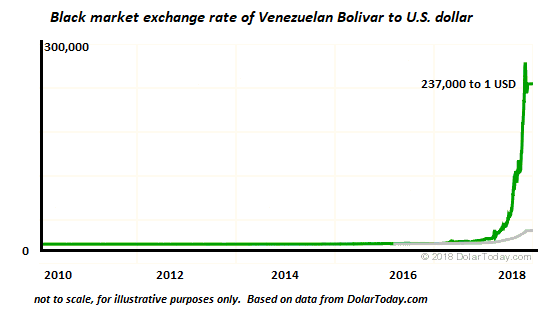
What a swell idea. Isn’t that what Venezuela has done for the past decade? And how did that work for them? If you think that destroying the purchasing power of “money” is a winner, then by all means, go on believing that the government can never go broke because all it has to do is print more money.

Here’s my favorite chart of asymmetric gains. The vast majority of the gains reaped since the 2008-09 Global Financial Meltdown have flowed to the top .1%. This is not a bug, it is a feature of hyper-financialization. Indeed, it is the only possible output of the current system.

Meanwhile, the bottom 95% live in an economy where wages go nowhere and costs are soaring. The financial media cheers when wages (supposedly) rise by 2%, but nobody dares measure the impact of rising costs in services such as healthcare and higher education.

The Status Quo is in trouble if the bottom 95% wake up to the asymmetric gains that are the only possible output of our hyper-financialized economy. Hype and propaganda are the key tools of the present era, as these are required to disconnect perception from reality. How long the disconnect will last is anyone’s guess, but when the two reconnect, all that is solid now will melt into thin air.


Why America is the World’s First Poor Rich Country

Or, How American Collapse is Made of a New Kind of Poverty

By Umair Haque

Source: Eudaimonia

Consider the following statistics. The average American can’t scrape together $500 for an emergency. A third of Americans can’t afford food, shelter, and healthcare. Healthcare for a family now costs $28k — about half of median income, which is $60k.

By themselves, of course, statistics say little. But together these facts speak volumes. The story they are beginning to tell is this.

America, it seems, is becoming something like the world’s first poor rich country. And that is the elephant in the room we aren’t quite grasping. After all, authoritarianism and extremism don’t arise in prosperous societies — but in troubled ones, which are growing impoverished, like America is today. What do I mean by all that?

Let’s begin with what I don’t mean. I don’t mean absolute poverty. Americans are not living on a few dollars a day, by and large, like people in, for example, Somalia or Bangladesh. America’s median income is still that of a rich country, around $50k, depending on how it’s counted. Nor do I really mean relative poverty — people living below median income. While that’s a growing problem in America, because the middle class is imploding, that is not really the true problem these numbers hint at, either.

America appears to be pioneering a new kind of poverty altogether. One for which we do not yet have a name. It is something like living at the knife’s edge, constantly being on the brink of ruin, one small step away from catastrophe and disaster, ever at the risk of falling through the cracks. It has two components — massive inflation for the basics of life, coupled with crushing, asymmetrical risk. I’ll come to what those mean shortly.

The average American has a relatively high income, that of a person in a nominally rich country. Only his income does not go very far. Most of it is eaten up by attempting to afford the basics of life. We’ve already seen how steep healthcare costs are. But then there is education. There is transport. There is interest and rent. There is media and communications. There is childcare and elderly care. All these things reduce the average American to constantly living right at the edge of ruin — one paycheck away from penury, one emergency away from losing it all.

But this isn’t true for America’s peers. In Europe, Canada, and even Australia, society invests in all these things — and the costs of basic necessities societies don’t provide are regulated. For example, I pay $50 dollars for broadband and TV in London — but $200 for the same thing in New York — yet in London, I get vastly more and better media for my money (even including, yes, American junk like Ancient Aliens). That’s regulation at work. And when basic goods like healthcare or elderly care or education are provided and managed at a social scale, that is when they are cheapest, and often of the best quality, too. Hence, healthcare costs far less in London, Paris, or Geneva — and life expectancy is longer, too.

So if you are earning $50k in America, it is a very different thing than earning $50k in France, Germany, or Sweden — in America, you must pay steeply for the basics of life, for basic necessities. Thus, incomes stretch much further in other countries, which enjoy a vastly higher quality of life, even though people there earn roughly the same amount, because they pay vastly less for basic necessities. Americans are rich, but only nominally — their money doesn’t buy nearly as much as their peers does, where it matters and counts most, for the basics of life.

What happens when societies don’t understand all the above? Well, a strange thing has happened to the American economy. While it’s true that things like TVs and Playstations have gotten cheaper, the costs of the basics of life have skyrocketed. All the things that really elevate people’s quality of life — healthcare, finance, education, transport, housing, and so on — have come to consume such a large share of the average household’s income that they have little left to save, invest, or spend on anything else. And what’s worse, while the basics of life have seen massive inflation, wages and incomes (not to mention savings and benefits and safety nets and opportunities) for most have stagnated. The result is an economy — and a society — that’s collapsing.

Yet all that is the straightforward effect of giving, for example, hedge funds control over drugs, or speculators control over housing, healthcare, and education — they will of course maximize profits, whereas investing in these things socially, or at least regulating them, minimizes real costs, and maximizes accessibility, affordability, and quality.

So the average American, who is left high and dry, must borrow, borrow, borrow, just to maintain a decent quality of life — because handing capitalism control of the basics of life has caused massive, skyrocketing inflation in necessities, while flatlining his income. Healthcare didn’t used to cost half of median income even a decade ago, after all — but now it does. So what happens when, in a decade or two, healthcare costs all of median income? How can an economy — let alone a society — function that way?

Well, what happens if the average American steps over the line? Misses a mortgage payment, gets ill and is unable to pay a few bills on time, can’t pay the costs of healthcare? Then they are punished severely and mercilessly. Their “credit rating” (note how banks and hedge funds don’t have them) is ruined. They can easily find themselves out on the street, without finance, without a second chance, without access to any kind of redress or support . And then they are rejected, shunned, and ostracized. They might not have an address anymore — so who will hire them? They are no longer a part of society — they have fallen through the cracks, and finding one’s way back is often next to impossible. Asymmetrical risk — corporations and lobbies and banks bear no risk at all, precisely because the average American bears them all now.

So Americans aren’t just absolutely or relatively poor, but poor in a new way entirely. First, the basics of life exploded in price, to the point that they are now unaffordable for many, maybe most, households. Second, Americans bear the risks of paying those unaffordable costs to an extreme degree, bearing the risks that institutions should, and so those risks are now ruinously high. A bank or hedge fund or corporation might go bankrupt, and liquidate its assets, and its owners stay rich — but if an American’s credit rating is ruined, loses his job, cannot pay his bills, or even if he declares bankruptcy, he falls through the cracks, hounded, embattled, institutionally black-marked. He finds himself outside society, with little way to get back in. Little wonder then that Americans work so much harder than anywhere else — they are always one step away from losing it all, from genuine ruin, but their peers in truly rich countries aren’t.

Marx probably would have called this immiseration. Neo-Marxist theorists call it precarity. And while there’s truth in both those ideas and perspectives, I think they miss three vital points.

We don’t see America as a poor country, but we should begin to. Americans live fairly abysmal lives — short, lonely, unhappy, full of work and stress and despair, compared to their peers. That is because they cannot afford better ones — predatory capitalism coupled with total economic mismanagement of social investments has made the basics of life ruinously unaffordable. In this way, it’s effectively a poor country — yes, there’s a tiny number of ultra-rich, but they are outliers now, off the map of the normal. Because it’s not just any kind of poverty, yesterday’s poverty, or even poverty as we are used to thinking about it.

America is pioneering a new kind of poverty. The kind of poverty that’s developed in America isn’t just bizarre and gruesome — it’s novel and unseen. It isn’t something that we understand well, economists, intellectuals, thinkers, because we have no good framework to think about it. It’s not absolute poverty like Somalia, and it’s not just relative poverty, like in gilded banana republics. It’s a uniquely American creation. It’s extreme capitalism meets Social Darwinism by way of rugged self-reliance crossed with puritanical cruelty.

The kind of poverty America’s pioneering today isn’t absolute, or even relative , but something more like perfectly tuned poverty, strategic poverty, basic poverty— nominally well-off people whose money doesn’t go far enough to make them actually live well, constantly living at the edge of ruin, and thus forced to choke down their bitter anger and serve the very systems which oppress and subjugate with more and more indignity and fear and servility by the year.

America’s still an innovator today. Unfortunately, what it’s innovating now is a new kind of poverty. Yet poverty is poverty. What happens in societies where poverty is growing? Authoritarianism rises, as people lose faith in democracy, which can’t seem to offer them working social contracts. Authoritarian soon enough becomes fascism — “this country, this land, its harvest — it is only for the true volk!”, the cry goes up, when there is not enough to go around. And the rest of the dark and grim story of the fall into the abyss you should know well enough by now. It ends in words we do not say.

Still, history, laughing, has told this tale to us many times. And it is telling it to tomorrow, again, in the tale of American collapse.

Neo-Liberalism and the Retreat of Democracy

By David Schultz

Source: CounterPunch

Democracy across the world is under siege. This according to the latest Freedom House report documenting that for 2017, “democracy faced its most serous crisis in decades” as seventy-one countries experienced declines in freedom or fair government, including the United States, and only thirty-five an improvement. This was the twelfth consecutive year of decline in democracy world-wide.

The question is why? Why has confidence in democracy retreated? Freedom House does not provide an answer, but there is a reason. It is democracy’s marriage to neo-liberal capitalism has fostered the conditions leading to its own undoing, similar to the way Karl Marx once described in the Communist Manifesto the “gravedigger thesis” (What the Bourgeoisie therefore produces, above all, are its own grave diggers”) where capitalism would produce the conditions that would undermine its own existence.

From the 1960s until the early 1990s democracy was in the upswing internationally. African de-colonization produced initially popularly elected governments. In South America the demise of strongmen led to a wave of democratic regimes. And the fall of the Berlin Wall in 1989 and the break up of the USSR in 1991 produced the dismantling of communist authoritarian or totalitarian governments that made it possible for Francis Fukuyama to proclaim that democracy had won and emerged as the last grand global political meta-narrative.

Yet several problems upset this rosy picture. Most prominently, it was the marriage of these new emerging democracies with free market capitalism and the victory of neo-liberalism. Internationally as post-colonial and post-communist countries emerged, international organizations such as the World Bank and the IMF forced them to adopt market reforms, often pushing them into what was then called “shock therapy.” Shock therapy involved rapid privatization of state owned enterprises and rapid dismantling of welfare states. This shock therapy was often accompanied by significant corruption as a few rich oligarchs emerged who came to own these newly privatized state enterprises.

Simultaneously, emerging democracies were rapidly pushed into what sociologist Immanuel Wallerstein would call the world-capitalist system. This system turned politically to right in the 1970s and 1980s as Margaret Thatcher in the United Kingdom and Ronald Reagan in the United States pushed neo-liberalism or market fundamentalism as an alternative to the Keynesian welfare state that had dominated the west since the 1930s. It was adopted both for ideological reasons and because of what political economist James O’Connor would call the fiscal crisis of the state tht affect economics across the world in the 1970s. This was a crisis of declining profit among private businesses and therefore declining revenue for states to fund welfare programs. Something had to give, and it was the welfare state.

Neo-liberalism is a political economic theory of the state committed to the laissez-faire market fundamentalism ideology that traces back to Adam Smith and David Ricardo. It includes a belief in comparative advantage, a minimalist state, and market freedom, and is, as articulated in the 1990s and 2000s, driven by finance capital. At the state level, neo-liberalism defines a theory of public administration. If neo-liberalism includes a commitment to market fundamentalism, then that also means that it is dedicated to a politics of limited government. This includes privatization, deregulation, and a scaling back of many traditional functions that capitalist and communist states had performed since at least World War II. But neo-liberalism as a theory transcends the state, providing also an international economic theory committed to free trade and globalism.

This emergence of neo-liberalism in the 1970s and its linkage to democracy is central to the crisis affecting the latter. As neo-liberalism retrenched the welfare state and pushed globalism it was accompanied by a dramatic increase in economic inequality in the world, as Thomas Piketty has pointed out. This occurred in the US and much of the western world. But it also impacted newly emerging democracies in Africa, Eastern Europe, and South America. Pressures for shock therapy market reforms, austerity, and open borders meant export of jobs to other countries, dismantling of social safety nets, and other economic pressures placed on governments and ruling parties.

Politically voters turned on globalism and free trade. This happened here with Trump voters in 2016, but also in Brexit in the UK. But many voters also blamed immigrants for the loss of jobs or social unrest in places ranging from France, to Italy, to Hungary. The increasing economic gap between rich and poor and, more importantly, the erosion of the economic conditions of the working class soured them on democracy. This paved the way for the emergence of strongmen as political leaders, the rise of far-right nationalist parties, and disenchantment with democracy and democratic structures to deliver the economic goods.

What we see today then in terms of the decline in support for democracy across the world is a product of its marriage to neo-liberalism. Capitalism and democracy always had an uneasy co-existence, but the neo-liberal democracy variant demonstrates the powerful contradictions in them. Either their linkage is producing outright rejection of democracy or a populist, rightist version that is merely democracy in form but not in substance.

Assets of world’s “high net wealth” millionaires surged to $70 trillion in 2017

By Barry Grey

Source: WSWS.org

The concentration of the planet’s wealth in the hands of a narrow financial elite is growing by leaps and bounds. A new report published Tuesday reveals that the wealth of the world’s 18.1 million “high net worth individuals”—those having investable assets of $1 million or more—shot up by 10.6 percent last year to top $70 trillion for the first time ever.

The “World Wealth Report 2018,” issued by the consulting firm Capgemini, revealed that the combined wealth of the world’s millionaires rose for the sixth consecutive year in 2017 to reach $70.2 trillion. It is on target to surpass $100 trillion by 2025.

Capgemini defines a high net wealth individual (HNWI) as someone with assets above $1 million, excluding his or her primary residence, collectibles, consumables and consumer durables. This defines a wealthy elite that owns more than $1 million in stocks, bonds, real estate or other investments.

The number of HNWIs grew almost 10 percent, or 1.6 million. The United States, Japan, Germany and China are the four largest markets for millionaires, accounting for 61 percent of the world’s HNWIs. The US tops the list with 5.3 million HNWIs, a 10 percent increase from 2016.

However, the Asia-Pacific region has most of these millionaires overall and accounted for the bulk of the increase in both the number of HNWIs (74.9 percent of the total) and the rise in their global wealth (68.8 percent). Economic inequality appears to be rising faster in this region than any other. Japan saw a 9 percent increase in HNWI millionaires, China an 11 percent rise and India a stunning 20 percent increase.

The financial oligarchy itself resides within what the report calls “ultra-high net wealth individuals,” those with $30 million or more in investable assets. They comprise only 1 percent of HNWIs, or 174,000 individuals, but they account for a vastly disproportionate share of the overall wealth of HNWI millionaires, as well as the increase in HNWI wealth. These ultra-HNWIs own some 35 percent of total NHWI wealth. In 2017, their ranks grew by 11.2 percent and their wealth by 12 percent, reaching $24.5 trillion.

The main factor driving the rapid enrichment of the financial aristocracy is the record rise in stock prices. “High net worth individuals around the world enjoyed investment returns above 20 percent for the second year in a row,” Anirban Bose, head of Capgemini’s financial services global strategic business unit, wrote in the report’s preface. The report noted that global market capitalization grew 21.8 percent in 2017.

The stock market has served as the primary mechanism for central banks and governments around the world to increase the wealth of the financial oligarchy, which dominates the world economy and all of the official institutions of society and dictates the policies of governments. For decades, the central banks, led by the US Federal Reserve, working in tandem with governments of the nominal “left” no less than the right, have deliberately engineered a vast transfer of wealth from the working class to the ruling elite by pursuing policies designed to pump up the financial markets.

These polices have been intensified since the 2008 financial crash. The Fed and the US government, first under Bush and then Obama, responded to the Wall Street meltdown by enacting measures to ensure that the oligarchs recouped all of their losses and were able to exploit the crisis to further enrich themselves. In addition to bailing out the banks and hedge funds with trillions of dollars in tax-payer money, they provided virtually free credit to Wall Street by means of near-zero interest rates and used “quantitative easing”—a euphemism for money-printing—to offload the banks’ bad loans onto the Fed’s balance sheet.

From the low-point of the post-crash recession in March 2009 to the present, US stock prices have risen four-fold, stoking a similar stock bonanza internationally.

This stock market boom and the entire process of social plunder have depended on the suppression of working class opposition and a savage attack on workers’ living standards by means of austerity and wage-cutting. The throttling of the class struggle has been contracted out to the trade unions, the industrial police agencies of the ruling class.

One of the most significant findings in the Capgemini report is that the total financial wealth of the world’s HNWIs more than doubled between 2008 and 2017, rising from $32.8 trillion to $70.2 trillion. This same period has seen, in the world inhabited by the vast majority of humans, a growth of poverty, hunger, homelessness, disease and, in the United States, a decline in life expectancy, a surge in infant and maternal mortality, and record rates of suicide and drug addiction.

This attack has continued and intensified under Trump, as well as governments in Europe, Latin America and Asia. Just last week the Federal Reserve raised interest rates and announced a tightening of monetary policy in response to the growth of workers’ strikes and protests. The oligarchy is petrified that lower unemployment and a tight labor market will encourage a militant wages movement that would undercut the entire basis of the stock market surge. It is moving to slow the economy and drive up unemployment.

To place the wealth of the world’s multi-millionaires and billionaires in perspective, the total of $24.5 trillion owned by “ultra-high net wealth individuals” is almost one-fifth of the world gross domestic product of $135 trillion.

$24.5 trillion is more than the GDP of the United States. It is more than the combined GDPs of the next three countries—China, Japan and Germany.

Just the global increase in ultra-HNWI wealth in 2017, $2.6 trillion, is larger than the GDPs of countries such as Italy, Brazil, Canada and Russia.

What could this money be used for were it not squandered to satisfy the demands of the rich and the super-rich for mansions, private jets and yachts? To give an example, the United Nations estimates it would cost $30 billion a year to eradicate world hunger. That means the money currently controlled by the world’s ultra-HNWIs could eliminate world hunger for 817 years.

The “World Wealth Report 2018” is only the latest in a wave of studies documenting the ever tightening grip of a tiny financial oligarchy and its ultra-wealthy periphery over the world’s resources. Wealth concentration on such a scale makes it impossible to seriously address a single social issue. The staggering diversion of resources into private wealth accumulation by the financial oligarchy starves society of the resources it needs to deal with the most basic problems.

The working class has no choice but to confront head-on the problem of economic inequality. The financial elite enforces its social interests through the wholesale buying of political parties and politicians, making democracy under capitalism nothing but a hollow shell. Any attempt within the framework of the profit system to carry out a modest reallocation of resources to ensure that all people had the basic rudiments of nutrition, health care and education would provoke a furious response from the oligarchy, which has at its disposal not only the courts, politicians and mass media, but, even more decisively, the police and the army.

When social reform becomes impossible, social revolution becomes inevitable. There is no avoiding the conclusion that it is necessary to expropriate the wealth of the financial oligarchs.