Iran goes for “maximum counter-pressure”

A U.S. Air Force B-52H Stratofortress aircraft assigned to the 20th Expeditionary Bomb Squadron taxis for takeoff on a runway at Al Udeid Air Base, Qatar, May 12, 2019. U.S. Air Force photo by Staff Sgt. Ashley Gardner

By Pepe Escobar

Source: Information Clearing House

Sooner or later the US “maximum pressure” on Iran would inevitably be met by “maximum counter-pressure”. Sparks are ominously bound to fly.

For the past few days, intelligence circles across Eurasia had been prodding Tehran to consider a quite straightforward scenario. There would be no need to shut down the Strait of Hormuz if Quds Force commander, General Qasem Soleimani, the ultimate Pentagon bête noire, explained in detail, on global media, that Washington simply does not have the military capacity to keep the Strait open.

As I previously reported, shutting down the Strait of Hormuz would destroy the American economy by detonating the $1.2 quadrillion derivatives market; and that would collapse the world banking system, crushing the world’s $80 trillion GDP and causing an unprecedented depression.

Soleimani should also state bluntly that Iran may in fact shut down the Strait of Hormuz if the nation is prevented from exporting essential two million barrels of oil a day, mostly to Asia. Exports, which before illegal US sanctions and de facto blockade would normally reach 2.5 million barrels a day, now may be down to only 400,000.

Soleimani’s intervention would align with consistent signs already coming from the IRGC. The Persian Gulf is being described as an imminent “shooting gallery.” Brigadier General Hossein Salami stressed that Iran’s ballistic missiles are capable of hitting “carriers in the sea” with pinpoint precision. The whole northern border of the Persian Gulf, on Iranian territory, is lined up with anti-ship missiles – as I confirmed with IRGC-related sources.

We’ll let you know when it’s closed

Then, it happened.

Chairman of the Chiefs of Staff of the Iranian Armed Forces, Major General Mohammad Baqeri, went straight to the point; “If the Islamic Republic of Iran were determined to prevent export of oil from the Persian Gulf, that determination would be realized in full and announced in public, in view of the power of the country and its Armed Forces.”

The facts are stark. Tehran simply won’t accept all-out economic war lying down – prevented to export the oil that protects its economic survival. The Strait of Hormuz question has been officially addressed. Now it’s time for the derivatives.

Presenting detailed derivatives analysis plus military analysis to global media would force the media pack, mostly Western, to go to Warren Buffett to see if it is true. And it is true. Soleimani, according to this scenario, should say as much and recommend that the media go talk to Warren Buffett.

The extent of a possible derivatives crisis is an uber-taboo theme for the Washington consensus institutions. According to one of my American banking sources, the most accurate figure – $1.2 quadrillion – comes from a Swiss banker, off the record. He should know; the Bank of International Settlements (BIS) – the central bank of central banks – is in Basle.

The key point is it doesn’t matter how the Strait of Hormuz is blocked.

It could be a false flag. Or it could be because the Iranian government feels it’s going to be attacked and then sinks a cargo ship or two. What matters is the final result; any blocking of the energy flow will lead the price of oil to reach $200 a barrel, $500 or even, according to some Goldman Sachs projections, $1,000.

Another US banking source explains; “The key in the analysis is what is called notional. They are so far out of the money that they are said to mean nothing. But in a crisis the notional can become real.  For example, if I buy a call for a million barrels of oil at $300 a barrel, my cost will not be very great as it is thought to be inconceivable that the price will go that high.  That is notional.  But if the Strait is closed, that can become a stupendous figure.”

BIS will only commit, officially, to indicate the total notional amount outstanding for contracts in derivatives markers is an estimated $542.4 trillion. But this is just an estimate.

The banking source adds, “Even here it is the notional that has meaning.  Huge amounts are interest rate derivatives. Most are notional but if oil goes to a thousand dollars a barrel, then this will affect interest rates if 45% of the world’s GDP is oil. This is what is called in business a contingent liability.”

Goldman Sachs has projected a feasible, possible $1,000 a barrel a few weeks after the Strait of Hormuz being shut down. This figure, times 100 million barrels of oil produced per day, leads us to 45% of the $80 trillion global GDP. It’s self-evident the world economy would collapse based on just that alone.

War dogs barking mad

As much as 30% of the world’s oil supply transits the Persian Gulf and the Strait of Hormuz. Wily Persian Gulf traders – who know better – are virtually unanimous; if Tehran was really responsible for the Gulf of Oman tanker incident, oil prices would be going through the roof by now. They aren’t.

Iran’s territorial waters in the Strait of Hormuz amount to 12 nautical miles (22 km). Since 1959, Iran recognizes only non-military naval transit.

Since 1972, Oman’s territorial waters in the Strait of Hormuz also amount to 12 nautical miles. At its narrowest, the width of the Strait is 21 nautical miles (39 km). That means, crucially, that half of the Strait of Hormuz is in Iranian territorial waters, and the other half in Oman’s. There are no “international waters”.

And that adds to Tehran now openly saying that Iran may decide to close the Strait of Hormuz publicly – and not by stealth.

Iran’s indirect, asymmetric warfare response to any US adventure will be very painful. Prof. Mohammad Marandi of the University of Tehran once again reconfirmed, “even a limited strike will be met by a major and disproportionate response.” And that means gloves off, big time; anything from really blowing up tankers to, in Marandi’s words, “Saudi and UAE oil facilities in flames”.

Hezbollah will launch tens of thousands of missiles against Israel. As Hezbollah’s secretary-general Hasan Nasrallah has been stressing in his speeches, “war on Iran will not remain within that country’s borders, rather it will mean that the entire [Middle East] region will be set ablaze. All of the American forces and interests in the region will be wiped out, and with them the conspirators, first among them Israel and the Saudi ruling family.”

It’s quite enlightening to pay close attention to what this Israel intel op is saying. The dogs of war though are barking mad.

Earlier this week, US Secretary of State Mike Pompeo jetted to CENTCOM in Tampa to discuss “regional security concerns and ongoing operations” with – skeptical – generals, a euphemism for “maxim pressure” eventually leading to war on Iran.

Iranian diplomacy, discreetly, has already informed the EU – and the Swiss – about their ability to crash the entire world economy. But still that was not enough to remove US sanctions.

War zone in effect

As it stands in Trumpland, former CIA Mike “We lied, We cheated, We stole” Pompeo – America’s “top diplomat” – is virtually running the Pentagon. “Acting” secretary Shanahan performed self-immolation. Pompeo continues to actively sell the notion the “intelligence community is convinced” Iran is responsible for the Gulf of Oman tanker incident. Washington is ablaze with rumors of an ominous double bill in the near future; Pompeo as head of the Pentagon and Psycho John Bolton as Secretary of State. That would spell out War.

Yet even before sparks start to fly, Iran could declare that the Persian Gulf is in a state of war; declare that the Strait of Hormuz is a war zone; and then ban all “hostile” military and civilian traffic in its half of the Strait. Without firing a single shot, no shipping company on the planet would have oil tankers transiting the Persian Gulf.
 

Bullet Points: How Forever War Will End

By

Source: Another Day in the Empire

Forget a popular movement to end the wars.

As George W. Bush said during his murder spree in Afghanistan and Iraq, the antiwar movement at that time (far larger than what we have today) was little more than a “focus group” ignored by the state (with the exception of sending out their operatives to spy on the movement and create disorder and factionalism).

Most Americans are numb to decades of expensive and debilitating wars. They prefer not to think about it. The corporate propaganda media provides plenty of fluff and chaff to distract them—spiked with hate screeds against the president—and the idea of a popular movement to end the wars is now nearly impossible.

Like former dirty trickster Karl Rove famously said, the American people really have no choice but to sit back and watch the creative destructionists “make history.” Any serious effort to mobilize an antiwar movement would be disrupted. The state has perfected the dark art of killing democratic action through subversion.

Economic Armageddon. It’s breathing down our necks, thanks to federal spending out of control for decades, at least half of it going to the “defense” department and associated death merchants.

“The United States recorded a government debt equivalent to 105.40 percent of the country’s Gross Domestic Product in 2017,” Trading Economics points out. “Government Debt to GDP in the United States averaged 61.70 percent from 1940 until 2017, reaching an all-time high of 118.90 percent in 1946 [after participating in the worst act of organized carnage in human history] and a record low of 31.70 percent in 1981.”

According to research conducted by William D. Harding and Mandy Smithberger, the “final annual tally for war, preparations for war, and the impact of war come to more than $1.25 trillion, more than double the Pentagon’s base budget [of the $750 billion Trump budget].”

Last year, the official tally for the national debt was $21,500 trillion. Some believe this is a lowball figure. John Williams of shadowstats.com has shown that with unfunded liabilities, the debt is actually closer to $222 trillion, a staggering number virtually unknown to the American people. Most don’t even realize the average public unfunded liability is $2 million per household (piled atop personal debt, which is at an all-time high).

Obviously, somewhere along the line, and I’d have to say soon, there will be a “reset,” an economic collapse and reordering of the game (on terms beneficial to the bankers). Empires typically fall when they become unsustainable.

Russia and China. Both nations have their own problems and are less than friendly to individual rights, although Russia is far better than totalitarian China. It is now obvious both are working to find an exit to the domination of Federal Reserve fiat funny money scheme that rules international economies and trade around the world. The US has weaponized this system by slapping sanctions on disfavored nations and those it has decided to invade and destroy (and with the current rhetoric from both sides of the one-sided war party, it is obvious the political class and its corporate directors are itching for a fight).

This is, of course, insane. I really do think the hubris—the indispensable nation, the exceptional nation—is so thick these fools can’t see how easily it would be to turn the world into a radioactive cauldron. On the other hand, I do believe, at least in regard to nuclear annihilation, somewhat saner heads will prevail.

News flash. If there is a non-nuclear (or limited nuclear) war with each or both (see the 2001 Sino-Russian Treaty of Friendship), it will not turn out good for the US, which has corrupted its defensive military capacity with a manufactured terror-asymmetrical posture.

This approach is effective in subversion operations to destabilize countries, particularly in the Middle East and South Asia. As we have seen since the end of the Second World War, the United States appears to be incapable of winning wars. This no mistake and primarily benefits Eisenhower’s military-industrial complex with a host of related new “national security” industries in addition to the war merchant stalwarts (Boeing, General Dynamics, General Electric, Lockheed-Martin, Raytheon, etc.), all feeding at the trough. Forever war is a forever profit stream for the ruling elite and its political class.

So, the conclusion is either economic collapse or defeat in a more or less conventional war will halt the trajectory the US is taking now as it is pulled along in a neocon spell with a president that has at best a sixth grade understanding of the world. Both probable outcomes are unthinkable.

Who knows. Maybe the American people will get off their duffs and demand the wars and provocations leading to war end. This was done in the 1960s and early 70s, primarily due to the Vietnam War protest that began in response to military servitude imposed on teenagers. The state ended a military draft, although it retained its “selective service” registration of potential future bullet-stoppers.

The moral aspect was secondary.

The Great Unraveling Begins: Distraction, Lies, Infighting, Betrayal

By Charles Hugh Smith

Source: Of Two Minds

The good news is renewal becomes possible when the entire rotten status quo collapses in a putrid heap.

There are two basic pathways to systemic collapse: external shocks or internal decay. The two are not mutually exclusive, of course; it can be argued that the most common path is internal decay weakens the empire/state and an external shock pushes the rotted structure off the cliff.

As Dave of the X22 Report and I discuss in The World Is About To Change & It’s Going To Be Glorious, we are in the early stages of terminal internal decay.There are a number of dynamics shared by decaying empires/states:

1. The ruling elites lose the moral imperative to sacrifice for the good of the empire/state. Instead they use the power of the state to further their own private interests and agendas.

2. The ruling elites start “fudging” reports (i.e. lies are presented as truths) and promoting narratives to mask their self-aggrandizement and the erosion of the nation/empire under their self-interested rule.

In other words, the elites know the public would resist their leadership if the truth were widely known, so the ruling elites devote tremendous resources to massaging the news to distract the public from reality and reflect positively on their self-serving leadership.

Since the weaknesses of the empire are being hidden, they cannot be addressed, and so rot that could have been fixed early becomes widespread and fatal.

3. Flush with the state’s wealth and power, the ruling elite splinters into warring camps which squander the empire’s remaining wealth on private battles over which camp will rule what appears solid and eternal–the empire.

4. As the elites battle it out, the nation/empire falls apart as the leadership’s focus is on internecine conflicts over the spoils of the empire, rather than on preserving the foundations of the empire’s wealth and security.

5. As the truth inevitably leaks out, the public grasps the enormity of the elites’ betrayal of the nation and the public interest. Faith in the elites and the institutions they control plummets, and the Great Unraveling becomes unstoppable.

6. In a last-ditch effort to save their wealth and power, the elites distract the public with Bread and Circuses– “free money” in various guises (Universal Basic Income, Modern Monetary Theory, etc.)–and the distracting Circus of political theater and a surfeit of entertainment.

Whether the elites or the public are aware of it or not, America is well down the path to terminal internal decay: Distraction, Lies, Infighting, Betrayal.

The good news is renewal becomes possible when the entire rotten status quo collapses in a putrid heap of broken promises, dysfunctional institutions, blatant lies, unpayable debts and cascading defaults.

Why Are American Communities Dying?

By Tom Chatham

Source: Project Chesapeake

Most Americans who have been around for a while know life is nothing like it used to be. When someone wanted a job one was found with a little bit of searching. Today jobs are difficult to find, especially in small communities.

When I was growing up in the 70’s, there were several car dealers in my community. There were three tractor dealers and too many mom and pop stores to count. Today there are two used car dealers and the nearest tractor dealer is twenty miles away. So how is it that we now have more people, but fewer businesses to employ them?

A nations wealth is derived from having a product to sell. That wealth needs to circulate in towns and cities to compound the wealth effect and create jobs and businesses. When wealth is not created or it is siphoned off to other places, the wealth effect can not happen, and in many cases goes into reverse. A community needs a certain amount of service related jobs to function but it also needs some type of production jobs to bring in money from the outside. This can be mining , agriculture or manufacturing type jobs, but they must exist to insure a healthy economy.

America has two major problems today. A large amount of our production is done outside the country eliminating production jobs in local communities and many of the small local businesses that kept wealth within communities have been supplanted by large corporations that siphon wealth out of communities and send it to wall street.

In the past when a small business made profit, that profit was kept in the local community because that is where the owner lived. Now, that profit leaves the community never to be seen again. With less money to circulate within the community the businesses that depend on people spending their extra dollars, have fewer customers and eventually go out of business. With fewer jobs there is that much less money circulating and the economic situation spirals down until nothing is left.

These days corporate businesses and government jobs make up the major part of many local communities. In many cases if it were not for the government jobs, many communities would no longer exist. So what do you think would happen if the government suddenly no longer had money to pay those workers? What would happen if corporate profits dropped to the point where corporate stores decided to close and cut their losses?

To some extent we are seeing this happen now in many places. Corporate stores moved in and drove small local businesses out. Then when the profits dried up the corporate stores closed leaving the community with no jobs or products to buy. With no capital in the local communities to rebuild small businesses, the people simply drive to other areas to do their shopping.

The corporate cronies and government laggards control most of the money flowing through communities now and they want to keep it that way. Any attempt to rebuild local businesses is met with luke warm results. Any business that might make a difference is either killed outright or regulated into oblivion before it can get off the ground. The county where I live has all but abandoned local businesses. The bulk of their income comes from property taxes generated by vacation homes and retirement homes of retired government employees. As long as the government pensions and paychecks continue, they see no reason to change the status quo. The result is that the younger people leave as soon as they can and the average age of the population continues to get older. As with many places today, this area has no future.

Where I live is a microcosm of the nation. Corporate and government entities continue to siphon what little money there is out of communities and just as small communities are dying, the nation will soon follow if current trends do not change. A return to small local economics is the only way to reverse some of the damage and keep our communities livable. But, do not be deceived. There is no way to undo all of the damage that has been done and even if we survive, we will only be a shadow of what we once were as a nation.

Poor Folks

By Peter Van Buren

Source: We Meant Well

A guy on Facebook I don’t know wrote a version of what has become a kind of set-piece article in today’s America. Here’s a portion:

Losing The War of Attrition or How To Turn Any Normal Person Into A Broken, Angry Radical

You are one of the millions who are employed at minimum wage. Or you are one of the millions who are euphemistically called underemployed, or you are one of the millions with no job and no prospects. You are retired- how did that happen?- or disabled- why did that happen?- and trying to survive on Social Security.

You reach a point when you realize that getting ahead is no longer possible. After that you reach a point when you realize that holding on to what you have is no longer possible. Then you reach a point when you realize that replacing what has been lost or depleted is no longer possible.

I wrote a book about this five years ago called The Ghosts of Tom Joad. No one read it. Publishers in the process of turning me down mocked me for writing about “poor people” and seemed surprised there were poor people in America who weren’t black and living in ghettos. Well, hell, then Trump happened. Because people watching a way of life — a middle class existence where the rich have more but we had some — fall away are easy targets for demagogues. Always have been. Because before we dismissed things as whataboutism we used to study them as lessons from history. Other people’s’ mistakes. History shows very clearly this economic game we’re playing ends with everyone but a small handful at the top losing badly.

I concluded five years ago the game was already decided. Our society was already then like those photos of railroad tracks, where in the distance it seems like the two rails come together in a single point. That point is essentially feudalism, where a tiny minority owns almost everything and everyone else lives off whatever scraps they let us have. Like in the Middle Ages, where everyone farmed for the king as serfs. It’s worse than slavery, because slaves at least know they’re slaves and have the possibility, however small, of freedom. Maybe for their kids if not for themselves.

We are not at the singularity, but we are inexorably headed toward it. Five additional years of data has only made that clearer; five years ago we spoke of the 1%. That number no longer matters. The new figure is .1%, an even smaller group who owns even more.

And no, none of this is new Because Trump. Since 1980, the incomes of the very rich (the .1%) have grown faster than the economy, for about a 400% cumulative increase in wealth. The upper middle class (the 9.9%) has kept pace with the economy, while the other 90% of us, the middle class and the poor have fallen behind.

By the way, it is these numbers which sent Barack Obama and Hillary Clinton during the 2008 campaign to both use $250,000 as the upper limit of the middle class. They sounded misguided, but it was sort of true. They just were still lumping what we’re calling here the “Upper Middle Class” and the “Middle Class” together. Just words. At present in the U.S. we have three-and-a-half classes: The .1%%, the 9.9%, everyone else hanging on, plus some people way at the bottom with basically nothing.

But bad news for the 9.9% Since the they the most (the most the .1% does not yet have) they have the most to lose. At their peak, in the mid-1980s, people in this group held 35% of the nation’s wealth. Three decades later that had fallen 12%, exactly as much as the wealth of the 0.1% rose. And do understand the people at the top are constructing walls and throwing nails off the back of the truck to make sure no one can catch up with them. The goal of .1% is to eliminate the competition, the 9.9% below them. They’ll only effectively have it all when the ratio is down to two classes, the .1% and the 99.9%

We are kept in place via shiny objects (500 channels, more movies and Apple watches and drugs!) and curated divisions. The ever-increasingly sharp lines between say blacks and whites are a perfect tool. Keep the groups fighting left and right and they’ll never notice the real discrimination is up and down. Some groups just found down earlier and harder, but as long as a poor white man in south Kentucky thinks he has nothing in common with a poor black man in the South Bronx they will never work together, never even see the massive economic forces consuming both equally. Forces are even now hard at work to tell us the Republican party is for whites, POC head Democrat, and any third party is a Russian shill in place to hurt the candidate you favor.

Whether your housing is subsidized via a mortgage and that tax deduction or Section 8, you’re still on the spectrum of depending on the people really in charge to allow you a place to live. I do not see a way out of this, only maybe steps that can slow it down or cause it to speed up.

Very short version summary: People like you and I fell through the cracks; we weren’t supposed to end up here but the .1% hadn’t worked out the details so they got as much as they do now and we basically ended up with bigger crumbs than we should have, especially me lucking into a “career” with no real skills.

Our own kids may do OK with what we leave for them, but only if your son is a medical doctor will he have a decent shot at our lifestyle and only because of the “cartelization” of the profession by the AMA. The rest of our kids are unlikely to have any shot at what we ended up with.

Sorry, I’m not a more cheerful guy but these conclusions are based on a fair amount of honest study.

The Five Stages of Collapse, 2019 Update

By Dmitry Orlov

Source: Club Orlov

Collapse, at each stage, is a historical process that takes time to run its course as the system adapts to changing circumstances, compensates for its weaknesses and finds ways to continue functioning at some level. But what changes rather suddenly is faith or, to put it in more businesslike terms, sentiment. A large segment of the population or an entire political class within a country or the entire world can function based on a certain set of assumptions for much longer than the situation warrants but then over a very short period of time switch to a different set of assumptions. All that sustains the status quo beyond that point is institutional inertia. It imposes limits on how fast systems can change without collapsing entirely. Beyond that point, people will tolerate the older practices only until replacements for them can be found.

Stage 1: Financial collapse. Faith in “business as usual” is lost.

Internationally, the major change in sentiment in the world has to do with the role of the US dollar (and, to a lesser extent, the Euro and the Yen—the other two reserve currencies of the three-legged globalist central banker stool). The world is transitioning to the use of local currencies, currency swaps and commodities markets backed by gold. The catalyst for this change of sentiment was provided by the US administration itself which sawed through its own perch by its use of unilateral sanctions. By using its control over dollar-based transactions to block international transactions it doesn’t happen to like it forced other countries to start looking for alternatives. Now a growing list of countries sees throwing off the shackles of the US dollar as a strategic goal. Russia and China use the ruble and the yuan for their expanding trade; Iran sells oil to India for rupees. Saudi Arabia has started to accept the yuan for its oil.

This change has many knock-on effects. If the dollar is no longer needed to conduct international trade, other nations no longer have hold large quantities of it in reserve. Consequently, there is no longer a need to buy up large quantities of US Treasury notes. Therefore, it becomes unnecessary to run large trade surpluses with the US, essentially conducting trade at a loss. Further, the attractiveness of the US as an export market drops and the cost of imports to the US rises, thereby driving up cost inflation. A vicious spiral ensues in which the ability of the US government to borrow internationally to finance the gaping chasm of its various deficits becomes impaired. Sovereign default of the US government and national bankruptcy then follow.

The US may still look mighty, but its dire fiscal predicament coupled with its denial of the inevitability of bankruptcy, makes it into something of a Blanche DuBois from the Tennessee Williams play “A Streetcar Named Desire.” She was “always dependent on the kindness of strangers” but was tragically unable to tell the difference between kindness and desire. In this case, the desire is for national advantage and security, and to minimize risk by getting rid of an unreliable trading partner.

How quickly or slowly this comes to pass is difficult to guess at and impossible to calculate. It is possible to think of the financial system in terms of a physical analogue, with masses of funds traveling at some velocity having a certain inertia (p = mv) and with forces acting on that mass to accelerate it along a different trajectory (F = ma). It is also possible to think of it in terms of hordes of stampeding animals who can change course abruptly when panicked. The recent abrupt moves in the financial markets, where trillions of dollars of notional, purely speculative value have been wiped out within weeks, are more in line with the latter model.

Stage 2: Commercial collapse. Faith that “the market shall provide” is lost.

Within the US there is really no other alternative than the market. There are a few rustic enclaves, mostly religious communities, that can feed themselves, but that’s a rarity. For everyone else there is no choice but to be a consumer. Consumers who are broke are called “bums,” but they are still consumers. To the extent that the US has a culture, it is a commercial culture in which the goodness of a person is based on the goodly sums of money in their possession. Such a culture can die by becoming irrelevant (when everyone is dead broke) but by then most of the carriers of this culture are likely to be dead too. Alternatively, it can be replaced by a more humane culture that isn’t entirely based on the cult of Mammon—perhaps, dare I think, through a return to a pre-Protestant, pre-Catholic Christian ethic that values people’s souls above objects of value?

Stage 3: Political collapse. Faith that “the government will take care of you” is lost.

All is very murky at the moment, but I would venture to guess that most people in the US are too distracted, too stressed and too preoccupied with their own vices and obsessions to pay much attention to the political realm. Of the ones they do pay attention, a fair number of them seem clued in to the fact that the US is not a democracy at all but an elites-only sandbox in which transnational corporate and oligarchic interests build and knock down each others’ sandcastles.

The extreme political polarization, where two virtually identical pro-capitalist, pro-war parties pretend to wage battle by virtue-signaling may be a symptom of the extremely decrepit state of the entire political arrangement: people are made to watch the billowing smoke and to listen to the deafening noise in the hopes that they won’t notice that the wheels are no longer turning.

The fact that what amounts to palace intrigue—the fracas between the White House, the two houses of Congress and a ghoulish grand inquisitor named Mueller—has taken center stage is uncannily reminiscent of various earlier political collapses, such as the disintegration of the Ottoman Empire or of the fall and the consequent beheading of Louis XVI. The fact that Trump, like the Ottoman worthies, stocks his harem with East European women, lends an eerie touch. That said, most people in the US seem blind to the nature of their overlords in a way that the French, with their Gilets Jaunes movement (just as an example) are definitely not.

Stage 4: Social collapse. Faith that “your people will take care of you” is lost.

I have been saying for some years now that within the US social collapse has largely run its course, although whether people actually believe that is an entire matter entirely. Defining “your people” is rather difficult. The symbols are still there—the flag, the Statue of Liberty and a predilection for iced drinks and heaping plates of greasy fried foods—but the melting pot seems to have suffered a meltdown and melted all the way to China. At present half the households within the US speak a language other than English at home, and a fair share of the rest speak dialects of English that are not mutually intelligible with the standard North American English dialect of broadcast television and university lecturers.

Throughout its history as a British colony and as a nation the US has been dominated by the Anglo ethnos. The designation “ethnos” is not an ethnic label. It is not strictly based on genealogy, language, culture, habitat, form of government or any other single factor or group of factors. These may all be important to one extent or another, but the viability of an ethnos is based solely on its cohesion and the mutual inclusivity and common purpose of its members. The Anglo ethnos reached its zenith in the wake of World War II, during which many social groups were intermixed in the military and their more intelligent members were allowed to become educated and to advance socially by the GI Bill.

Fantastic potential was unleashed when privilege—the curse of the Anglo ethnos since its inception—was temporarily replaced with merit and the more talented demobilized men, of whatever extraction, were given a chance at education and social advancement by the GI Bill. Speaking a new sort of American English based on the Ohio dialect as a Lingua Franca, these Yanks—male, racist, sexist and chauvinistic and, at least in their own minds, victorious—were ready to remake the entire world in their own image.

They proceeded to flood the entire world with oil (US oil production was in full flush then) and with machines that burned it. Such passionate acts of ethnogenesis are rare but not unusual: the Romans who conquered the entire Mediterranean basin, the barbarians who then sacked Rome, the Mongols who later conquered most of Eurasia and the Germans who for a very brief moment possessed an outsized Lebensraum are other examples.

And now it is time to ask: what remains of this proud conquering Anglo ethnos today? We hear shrill feminist cries about “toxic masculinity” and minorities of every stripe railing against “whitesplaining” and in response we hear a few whimpers but mostly silence. Those proud, conquering, virile Yanks who met and fraternized with the Red Army at the River Elbe on April 25, 1945—where are they? Haven’t they devolved into a sad little subethnos of effeminate, porn-addicted overgrown boys who shave their pubic hair and need written permission to have sex without fear of being charged with rape?

Will the Anglo ethnos persist as a relict, similar to how the English have managed to hold onto their royals (who are technically no longer even aristocrats since they now practice exogamy with commoners)? Or will it get wiped out in a wave of depression, mental illness and opiate abuse, its glorious history of rapine, plunder and genocide erased and the statues of its war heroes/criminals knocked down? Only time will tell.

Stage 5: Cultural collapse. Faith in “the goodness of humanity” is lost.

The term “culture” means many things to many people, but it is more productive to observe cultures than to argue about them. Cultures are expressed through people’s stereotypical behaviors that are readily observable in public. These are not the negative stereotypes often used to identify and reject outsiders but the positive stereotypes—cultural standards of behavior, really—that serve as requirements for social adequacy and inclusion. We can readily assess the viability of a culture by observing the stereotypical behaviors of its members.

• Do people exist as a single continuous, inclusive sovereign realm or as a set of exclusive, potentially warring enclaves segregated by income, ethnicity, education level, political affiliation and so on? Do you see a lot of walls, gates, checkpoints, security cameras and “no trespassing” signs? Is the law of the land enforced uniformly or are there good neighborhoods, bad neighborhoods and no-go zones where even the police fear to tread?

• Do random people thrown together in public spontaneously enter into conversation with each other and are comfortable with being crowded together, or are they aloof and fearful, and prefer to hide their face in the little glowing rectangle of their smartphone, jealously guarding their personal space and ready to regard any encroachment on it as an assault?

• Do people remain good-natured and tolerant toward each other even when hard-pressed or do they hide behind a façade of tense, superficial politeness and fly into a rage at the slightest provocation? Is conversation soft in tone, gracious and respectful or is it loud, shrill, rude and polluted with foul language? Do people dress well out of respect for each other, or to show off, or are they all just déclassé slobs—even the ones with money?

• Observe how their children behave: are they fearful of strangers and trapped in a tiny world of their own or are they open to the world and ready to treat any stranger as a surrogate brother or sister, aunt or uncle, grandmother or grandfather without requiring any special introduction? Do the adults studiously ignore each others’ children or do they spontaneously act as a single family?

• If there is a wreck on the road, do they spontaneously rush to each others’ rescue and pull people out before the wreck explodes, or do they, in the immortal words of Frank Zappa, “get on the phone and call up some flakes” who “rush on over and wreck it some more”?

• If there is a flood or a fire, do the neighbors take in the people who are rendered homeless, or do they allow them to wait for the authorities to show up and bus them to some makeshift government shelter?

It is possible to quote statistics or to provide anecdotal evidence to assess the state and the viability of a culture, but your own eyes and other senses can provide all the evidence you need to make that determination for yourself and to decide how much faith to put in “the goodness of humanity” that is evident in the people around you.

The Recession Will Be Unevenly Distributed

By Charles Hugh Smith

Source: Of Two Minds

Those households, enterprises and organizations that have no debt, a very low cost basis and a highly flexible, adaptable structure will survive and even prosper.

The coming recession will be unevenly distributed, meaning that it will devastate many while leaving others relatively untouched. A few will actually do better in the recession than they did in the so-called “recovery.”

I realize many of the concepts floated here are cryptic and need a fuller explanation: the impact of owning differing kinds of capital, fragmentation, asymmetry, opacity, etc. ( 2019: Fragmented, Unevenly Distributed, Asymmetric, Opaque).

These dynamics guarantee a highly uneven distribution of recessionary consequences and whatever rewards are generated will be reaped by a few.

One aspect of the uneven distribution is that sectors that were relatively protected in recent recessions will finally feel the impact of this one. Large swaths of the tech sector (which is composed of dozens of different industries and services) that were devastated in the dot-com recession of 2000-02 came through the 2008-09 recession relatively unscathed.

This time it will be different. The build-out of mobile telephony merging with the web has been completed, social media has reached the stagnation phase of the S-Curve and many technologies that are widely promoted as around the corner are far from profitability.

Then there’s slumping global demand for mobile phones and other consumer items that require silicon (processors) and other tech components: autos, to name just one major end-user of electronics.

The net result will be mass layoffs globally across much of the tech sector.Research is nice but it doesn’t pay the bills today or quiet the restive shareholders as profits tank.

The public sector is also ripe for uneven distribution of recessionary impacts.Local government and its agencies in boomtowns such as the SF Bay Area, Seattle, Los Angeles, NYC, etc. have feasted on soaring tax revenues and multi-billion dollar municipal bonds.

The Powers That Be in these boomtowns are confident that the good times will never end, and so the modest rainy-day funds they’ve set aside are widely viewed as immense bulwarks against recession when in reality they are mere sand castles that will melt away in the first wave.

A $1 billion reserve looks impressive in good times but not when annual deficits soar to $10 billion. Local governments depend on various revenue streams, and most rely on a mix of property, sales and income taxes, both wages (earned) and capital gains (unearned). All of these will be negatively impacted in the next recession.

Local governments are especially prone to The Ratchet Effect, the dynamic in which expenses move higher as revenues climb but the organization is incapable of shrinking, i.e. it only knows how to expand. This defines government as an organizational type.

Inefficiencies (including low-level corruption and fraud) pile up and are offset with higher revenues. When revenue crashes, the system is incapable of eliminating the inefficiencies or reducing benefits and headcount.

I call the endgame of The Ratchet Effect the Rising Wedge Model of Breakdown:

The Ratchet Effect is visible in organizations of all scales, from households to sprawling bureaucracies. The core of the Ratchet Effect is the ease with which the cost basis of an organization rises and the extreme resistance to any reduction in funding.

The psychology of this resistance is easy to understand: everyone hired in the expansion will fight to keep their job, regardless of the needs of the organization or the larger society. Every individual, department and division will fight with the fierceness of a cornered animal to retain their share of the budget, for their self-interest trumps the interests of the organization or society.

Since each “ratchet” will fight with desperate energy to resist being cut while those attempting to do the cutting are simply following directives, the group that has pulled out all the stops to resist cuts will typically win bureaucratic battles.

Broad-based cuts trigger Internecine Warfare Between Protected Fiefdoms as entrenched vested interests battle to shift the cuts to some politically less favored fiefdom. Bureaucracies facing cuts quickly shift resources to protecting their budget, leaving their mission on auto-control. (The Lifecycle of Bureaucracy December 2, 2010)

These dynamics create a rising wedge in which “minimum” costs continue to rise over time even if modest cuts are imposed from time to time. The eventual consequence is a cost basis that is so high that even a modest reduction collapses the organization.

In other words, incremental reductions and reforms have zero impact on the endgame. The organization has become so brittle that any structural reform triggers a breakdown.

Those households, enterprises and organizations that have no debt, a very low cost basis and a highly flexible, adaptable structure will survive and even prosper. Those with high debt loads, high fixed expenses and inflexible responses will find incremental reductions and reforms will have little impact on the endgame of breakdown and collapse.

This is one of the core topics of my latest book, Pathfinding our Destiny: Preventing the Final Fall of Our Democratic Republic.

Here’s a household example of the type of organization that won’t just survive but thrive in the recession: a household with $100,000 in revenues from multiple income sources and fixed expenses of $35,000, no debt and a management team (the spouses/adults) that’s willing to implement radical changes in lifestyle, expenses and work at the first disruption of revenues. The household that doesn’t just survive but thrives sees crisis / disruption as an opportunity, not a disaster to be mitigated with denial and wishful thinking.

National Bankruptcy as a Board Game

By Dmitry Orlov

Source: Club Orlov

Most people are familiar with the game Monopoly. Its goal is to teach capitalist kiddies a valuable lesson about capitalism; namely, that in running a business it isn’t useful to shoot for some happy modicum of accommodation with your competitors or to strive for a sustainable steady state. Instead, what you need to do to survive (never mind win) is to grow as quickly as possible and eat up your competitors alive, or you’ll get eaten up yourself. That’s not just a game; that’s exactly how capitalism actually works, and if that doesn’t work for you (it doesn’t for most people) then that’s exactly how capitalism doesn’t work.

And so the Waltons couldn’t just run Walmart as a mart; they had to make it into a global empire—just in order to survive. Now, most governments in the world realize that this sort of unbridled capitalism is harmful and seek to regulate it. For instance, Russia has a Federal Antimonopoly Service. The US Justice Department has an Antitrust Division, which is aptly named if its mission is to destroy Americans’ trust in their government’s ability to regulate business. It also has a website which currently says: “Due to the lapse in appropriations, Department of Justice websites will not be regularly updated.” Perhaps that’s all right for a country that seeks to monopolize everything—international finance and law, defense procurement and, of course, the dispensation of “freedom and democracy” and “universal values.”

Most people are also familiar with the concept of national debt. The federal debt of the US government currently equals… never mind; it’s going up much faster than you can write it down. If you want to watch it go up real time, you can look it up here. The exact number is useless: if you take a snapshot of it—say, $21,921,420,945,123.00—that will no longer be the payoff amount by the time you write out the check, and if you write out the check, no matter who you are, it will bounce. But it won’t even get that far: if you mail that check to the US Treasury Department, they wouldn’t be able to deposit it because “Due to the lapse in appropriations…” (You get the picture.)

The debt goes up all the time, and the rate at which it goes up is accelerating. The concept of acceleration may not be intuitive for some of you, so let me explain. Debt goes up with some speed. Acceleration is the amount by which that speed increases, measured in, for example, dollars per minute per minute. Calculating it is a fun little arithmetic exercise. During Barak Obama’s reign it went up by $8.6 trillion, starting from $11.6 trillion and gong up to $20.2 trillion. Trump plans to add $4.8 trillion during his first three years. (Relevant numbers can be looked up here).

Thus, Obama’s velocity was $8.6 trillion over 8 years—roughly $1 trillion per year or $2 million per minute while Trump’s velocity is roughly $1.6 trillion per year or a little over $3 million per minute. Therefore, the acceleration is only a few cents per minute per minute—but it sure adds up! Acceleration tends to sneak up on you. For instance, if you want to gain some intuitive appreciation for acceleration due to gravity (9.81m or 32 feet per second per second) then try jumping off a chair while keeping your knees straight. You can also ponder the fact that satellites that fall out of Earth’s orbit tend to burn up on reentry as they decelerate due to friction with the atmosphere.

Any sane, numerate person can tell you that increases in debt are fine provided your revenues are increasing significantly faster, but if that’s not the case then the eventual result is bankruptcy. And that is most definitely not the case. Hence the name of this board game is National Bankruptcy. But I am not sure what the objective of the game should be. Is it to go bankrupt as quickly and efficiently as possible, or is to go bankrupt as slowly and painfully as possible?

I am quite sure that players who aren’t on a path to national bankruptcy would prefer to keep it that way, and would furthermore prefer to be rid of all sovereign debt issued by whoever is going to go bankrupt before that happens. (Russia seems to have that problem solved already while China is far behind.) In any case, I am a very serious person who doesn’t like jokes and doesn’t have time to play games, board games included, so I’ll leave it to others to ponder such questions. Still, the board game metaphor seems useful for discussing this topic.

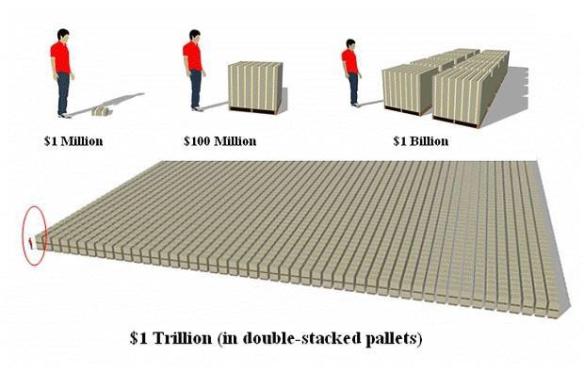
One problem with playing this game is the problem of scale. People have a problem appreciating such huge numbers. They are familiar with what a dollar is, but what’s a trillion? Here it is, represented as double-stacked pallets of $100 bills.

That seems a bit cumbersome for our board game. Reasonable values for the chips in our National Bankruptcy game would be $100 billion, $500 billion and $1 trillion. We could use a few $5 trillion and $10 trillion chips too, though not too many because I doubt that the game would go on long enough to make them useful.

I propose that for the sake of this game we introduce a handy new unit called a “piffle” which is equal to $100 billion. A trillion is 10 piffles, 10 trillion is 100 piffles. Then our chips can be 1, 5, 10, 50 and 100 piffles. Piffles allow us to express various huge quantities without going through any arithmetic contortions. US federal debt is currently 220 piffles. US trade deficit for 2018 was 6 piffles while the US defense budget was 7 piffles. For 2019 the federal budget deficit (covered by increased borrowing) is 10 piffles and rising while tax revenues are just 3 piffles and falling. The interest payment on federal debt is 3 piffles but with rising interest rates it’s going to 5 piffles within a few years.

Speaking of rising interest rates… just today Trump wished for 0% interest rates again, like Obama had while he was running up his 80 piffles’ worth of debt. But now it’s hovering around 3% and is unlikely to go down no matter what Trump wishes. Why? Well, here’s the reason. The US imports much more than it exports because it can’t afford to or lacks the ability to make all the stuff it needs; that’s why there are 6 piffles’ worth of trade deficit. When other nations sell to the US more than they buy, they end up holding lots of piffles, and since the US needs lots of piffles (remember, the budget deficit is 10 piffles) it makes plenty of sense to borrow that money right back. A little while back it was possible to borrow it back at 0% interest because the US was powerful enough to threaten those who refused to play this game with military annihilation (cue pictures of bombed-out Libya and Iraq). But times have changed, and unless the US bribes its debt-holders with 3% interest rate or better—no deal.

How have times changed? There are two effects worth mentioning. First, the military annihilation threat isn’t working any more. Yes, the US still spends a stunning, record-shattering sum of 7 piffles on defense, but none of that is working. Call it the free money effect. When people spend their own hard-earned money, they tend to be careful with it, but if it’s somebody else’s money that they got for free never intending to pay it back, then they tend to throw caution to the wind. And so US military spending has become less and less effective over time, in one of two ways: procurement costs have gone through the roof, and the resulting products have become useless.

In terms of procurement costs, the purchasing parity between the US and (just as an example) Russia seems to be at least ten to one: to get the same result, the US has to spend at least ten times more than Russia. And so although Russia spends well less than 1 piffle on defense, its military is far more effective. In terms of product uselessness, the Pentagon now resembles a woman who has a closet jam-packed with expensive designer labels but has absolutely nothing to wear because her entire wardrobe is no longer fashionable. There is the entire set of aircraft carriers none of which can operate close enough to enemy shores to be of any use at all because they can be readily sunk using hypersonic rockets launched from very far away. There are the stockpiles of Tomahawk cruise missiles which can’t make it past Soviet-era air defense systems (with a few electronics and software upgrades). There are the Patriot air defense systems which are useless even for stopping Soviet-era SCUD missiles, never mind anything more modern.

Add to this Russia’s (and soon China’s) new hypersonic weapons with conventional payloads and new air and space defense systems such as the S-400: these provide what’s known as “escalation dominance.” Suppose the US does something unspeakably nasty and Russia and/or China decide to teach it a lesson. They now have the ability to blow up any target within the US without getting anywhere near it and without placing any of their military assets at risk.

They could, for instance, take out the US electric grid in a way that will take many months to get it back on line. They can then reliably intercept anything that the US tries to retaliate with. Of course, the US can become suicidal—that’s always a risk—and launch a full-on nuclear first strike, then sit back and wait to be completely obliterated along with much of the rest of the planet. But that’s not a military strategy, that’s pure suicide, and the officers in charge of military strategy tend to be emotionally stable family men who look forward to playing with their grandchildren upon retirement.

So, why then should the US continue to spend 7 piffles on defense? The sad answer is that it will go bankrupt whether it zeroes out the defense budget or not. If the defense budget goes to 0, then there is still 3 piffles’ worth of budget deficit left, plus those 6 piffles of trade deficit aren’t going anywhere but up. But what about MAGA?—you might ask—What about firing up US manufacturing, bringing the jobs back and exporting our way out of this? After all, if we turn those 6 piffles of trade deficit into 6 piffles of trade surplus, suddenly it all works out and bankruptcy becomes avoidable.

No, sorry, that just not realistic. You see, in order to get an industrial economy going again the US needs several things. It needs cheap energy, cheap labor, low cost of doing business and readily available markets, both domestic and export. And the US doesn’t have any of these. In terms of energy—and oil is by far the most important form of energy—in 2019 the US will import exactly as much oil as it did in 1998—around 8 million barrels a day. Yes, the shale oil industry has sprung up in the meantime, and the US is currently producing 11.5 million barrels per day. But also in the meantime US oil consumption has gone up a lot—to 20 million barrels a day, which is a stunning 20% of the world’s consumption for 4.4% of the world’s population.

And so the oil deficit is still very much there. Plus the shale oil patch has never made any money but has accumulated over 2 piffles’ worth of debt and has spent over a piffle’s worth more than it made. With interest rates going up they are unlikely to be able to borrow enough to keep up the same hectic drilling rate, and with declines from existing wells at over half a million barrels per day per month it won’t take many months to whittle down that 11.5 million barrels per day, forcing the US to either boost imports or cut consumption.

But the oil price has gone down a lot lately, so there shouldn’t be a problem in any case, right? Again, sorry, no. Peak Oil for most countries has come and gone. There is now only a handful of countries left that are able to meaningfully boost oil production: Russia, Canada (mostly tar sands), Iran, Iraq, United Arab Emirates, Kuwait and Brazil. Russia has recently announced that it isn’t planning to boost production. Saudi Arabia is a huge oil producer but does not seem to have any spare capacity left. Canada’s tar sands patch is a money-losing environmental disaster. Iran and Iraq (call them Iranq, since they are both Shia Moslem, are politically aligned and neither loves America too much) aren’t exactly going to gallop to the rescue. That leaves UAE, Kuwait and Brazil, and if you add them all up together that’s nowhere near enough. So, get ready for oil price spikes, followed by a wave of demand destruction, followed by oil price collapses, followed by supply destruction—you know, the usual.

Moving on to labor. In order to stay competitive, the US will need to lower its median wage a lot. It has to be lower than what the Chinese and the Southeast Asians earn because the US needs to outcompete them to steal their export market share. Without various other major changes this will cause US workers to either rebel or starve to death in short order. The changes involve nationalizing medicine and education to drive down their costs by a factor of 1000 or so, converting to public transportation and pretty much banning the use of private cars to make transportation affordable, putting up high-rises right next to factories for affordable worker housing and so on. That’s a lot of piffles’ worth of effort!

The cost of doing business is a tough one too. The US spends way more on courts and lawyers, insurance and regulatory compliance than most other countries, and the regulatory maze that entrepreneurs have to run in order to run even a small and simple business is very costly and absolutely confounding. How does one take a machete to that whole ridiculous, corrupt scheme? I have no idea. It’s an imponderable. The Chinese would probably just call it a “cultural revolution,” round up all the lawyers and the bureaucrats, make them wear dunce caps and sandwich boards that say “I am what is wrong with this country” and march them in procession while pelting them with rocks and beating them with sticks. Something like that…

Finally, there is the question of export markets. What exactly is the US going to export more effectively than other countries are exporting already? China out-manufactures just about anybody on the planet and isn’t about to give up its spot. Russia exports grain and other foodstuffs (all non-GMO, unlike the US), nuclear and space technology, defense technology (that actually works) and much else. Pakistan and India, and various other countries, export textiles. The world is full up with product. It’s consumers to bankrupt that are in short supply. And if the US cuts its labor rates to make itself competitive, then its consumer base will shrink rather dramatically.

So it looks like bankruptcy is it, no use fighting it. But what should the US do in the meantime? I suggest that it should put up some really huge walls—just for the sake of leaving behind some spectacular ruins for future generations to marvel at. The one along the southern border seems to be going up already, but there should be at least two more. There needs to be a wall along the Mason-Dixon line, because given the heated state of US politics there needs to be a way to prevent people from trying to reenact the Civil War (a misnomer, that!) with actual real weapons and live ammo. And there also needs to be a wall along the northern border, to keep various groups of armed troglodytes from escaping to Canada and ransacking it (it’s the least we can do for our peaceful northern neighbors). How much will these three walls cost? Glad you asked! They will cost roughly 0.005 piffles apiece, 0.015 piffles total—a truly piffling amount. That’s my 0.000000002 piffle’s worth. But, you know, it’s the thought that counts.

Oh, and if you want to actually design this National Bankruptcy board game, please resist the temptation to contact me about it. Seriously, I don’t like games, board games especially. I am a very serious person who doesn’t have time for such piffles.