FACEBOOK’S PURGE OF POLITICAL PAGES FUELS DELUSION OF INSURGENT THREATS TO DEMOCRACY

By Kevin Gosztola

Source: ShadowProof

Facebook’s purge of more than 500 pages and 250 accounts ahead of midterm elections in the United States represents a massive trend to police social media activity in ways that put freedom of expression at risk.

This trend effectively discourages users from engaging in radical politics. It may be viewed as part of a counterinsurgency effort by a powerful social media company to assure a passive majority of Americans that they are properly guarding a widely used platform from alleged threats to democracy.

On October 11, Nathaniel Gleicher, Facebook’s head of cybersecurity policy, and Oscar Rodriguez, the company’s product manager, published a press release about the purge.

“We’re removing 559 pages and 251 accounts that have consistently broken our rules against spam and coordinated inauthentic behavior,” Gleicher and Rodriguez stated. “Many were using fake accounts or multiple accounts with the same names and posted massive amounts of content across a network of groups and pages to drive traffic to their websites.”

According to Gleicher and Rodriguez, these techniques were used by groups and pages to make content “appear more popular” than it truly was on Facebook.

Both suggested some of the pages and accounts were “ad farms” that misled users into believing they were “forums for legitimate political debate.”

Unfortunately, Facebook offered minimal transparency on the action. Administrators with removed pages or accounts were apparently given no specifics other than a notice that they were shut down.

Several of the pages and accounts removed were right-wing and known for boosting President Donald Trump and his administration’s agenda. There were also dozens of progressive or left-wing pages, which were taken down.

Anti-Media, an anti-establishment independent media site with two million followers, had its page removed. Carey Wedler, editor at Anti-Media, did not lose her personal Facebook page with over 100,000 followers, but almost simultaneously, Twitter sent a notice that Wedler’s account was suspended.

The Free Thought Project, Reverb Press, Press For Truth, and Rachel Blevins, an RT America correspondent, had their pages taken down.

Pages that document abuse by police were removed—Police the Police, Filming Cops, Cop Block, and Cop Logic. Both Police the Police and Filming Cops each had over a million followers.

“There are legitimate reasons that accounts and pages coordinate with each other—it’s the bedrock of fundraising campaigns and grassroots organizations,” Gleicher and Rodriguez stated. “But the difference is that these groups are upfront about who they are, and what they’re up to.”

Yet, none of the aforementioned pages, which have protested their removal, hid their missions from followers. They were very upfront about their political motives or agendas for social justice.

Gleicher and Rodriguez concluded, “As we get better at uncovering this kind of abuse, the people behind it—whether economically or politically motivated—will change their tactics to evade detection. It’s why we continue to invest heavily, including in better technology, to prevent this kind of misuse. Because people will only share on Facebook if they feel safe and trust the connections they make here.”

The last sentences of Facebook’s press release make it clear that the company took this action to protect their brand. They were concerned about how these pages or accounts were impacting the experience of more passive, or even apathetic, users.

Administrators also recognize that politicians on Capitol Hill are watching. As Senator Dianne Feinstein told executives during a recent Senate hearing, “You’ve created these platforms, and now they are being misused. And you have to be the ones to do something about it or we will.”

On October 17, Twitter also acknowledged pressure from upcoming midterm elections to guard against alleged “influence operations.” It released a dataset it said was linked to operations during the 2016 election.

“We will continue to proactively combat nefarious attempts to undermine the integrity of Twitter, while partnering with civil society, government, our industry peers, and researchers to improve our collective understanding of coordinated attempts to interfere in the public conversation,” the social media company pledged.”

No executives at any Silicon Valley tech corporation want the government to introduce regulations. With parts of the public, especially those in the liberal establishment clamoring for action, Facebook and other companies are taking steps to supposedly fix the problem.

Cracking Down On “Influence Campaigns”

Facebook’s mass removal of pages and accounts was the company’s most extensive crackdown on “influence campaigns” since it started policing its platform. Most U.S. media outlets described the offending pages and accounts as purveyors of “political spam.”

The New York Times reported on Facebook’s purge with an article that was headlined, “Facebook Tackles Rising Threat: Americans Aping Russian Schemes to Deceive.”

Ironically, this was misinformation. At no point did the Times demonstrate that the removed pages or accounts were inspired or influenced by “Russian schemes,” which may or may not have been employed during the 2016 presidential election.

What the Times did do is conflate Russia-based activity with the operation of these accounts because those users may have wielded similar tactics to extend their reach. This is as disingenuous as suggesting someone who relies on Internet privacy tools is using terrorist tactics because terrorists want to hide their location, too.

The push to impose more control over the exchange of information on Facebook stems from a widespread belief that the Russia-based Internet Research Agency conducted a campaign through more than 400 accounts and pages that relied on ads and false information to “create discord and harm” Hillary Clinton’s presidential campaign. The content was supposedly viewed by as many as 126 million Americans.

But in a paper on the 2016 presidential election by Thomas Ferguson, Paul Jorgensen, and Jie Chen from the Institute for New Economic Thinking, they show that this number is rather paltry. Americans saw at least 33 trillion posts in their news feeds between 2015 and 2017. Facebook even said a quarter of ads may have never been viewed by anyone.

The Senate intelligence committee reported minuscule ad numbers in key battleground states. In Wisconsin, $1,979 was spent. All but $54 were spent during the primary. Pennsylvania absorbed $823 and Michigan $300. “Unless Facebook discloses some vast new trove, the conclusion has to be that this was no full court press,” the report stated.

As the authors note, a few studies labeled sites as “Russian” or “Russian-influenced” simply because they have “politically distasteful” views that perhaps align with the agenda of Russia or run counter to U.S. foreign policy. This inappropriately counted non-mainstream or so-called fringe websites as part of an alleged Russian influence operation.

A far more extensive influence operation was likely perpetrated by networks highly capable of spreading right-wing messages in sophisticated manners.

“Our clearest and most significant observation is that the American political system has seen not a symmetrical polarization of the two sides of the political map, but rather the emergence of a discrete and relatively insular right-wing media ecosystem whose shape and communications practices differ sharply from the rest of the media ecosystem, ranging from the center-right to the left,” a Harvard study [PDF] on the 2016 election concluded.

The infiltrators sowing discord were aligned with Republicans and based in the United States. Like Ferguson, Jorgensen, and Chen contend, “By 2016, the Republican right had developed internet outreach and political advertising into a fine art and on a massive scale quite on its own.”

“Large numbers of conservative websites, including many that tolerated or actively encouraged white supremacy and contempt for immigrants, African-Americans, Hispanics, Jews, or the aspirations of women had been hard at work for years stoking up ‘tensions between groups already wary of one another.’ Breitbart and other organizations were in fact going global, opening offices abroad and establishing contacts with like-minded groups elsewhere.”

“Whatever the Russians were up to, they could hardly hope to add much value to the vast Made in America bombardment already underway. Nobody sows chaos like Breitbart or the Drudge Report, as the New York Times documented in one Idaho town,” the paper added.

Recognizing the influence of right-wing messaging networks during the 2016 election is critical. In fact, a list of removed pages posted by Western Journal suggests the vast majority of pages and accounts removed were right-wing. A minority were cop watch pages or libertarian pages against government abuses. An even smaller minority were liberal or Democratic pages.

Therefore, journalists are wrong to suggest there is some kind of balance between the left-wing and right-wing when it comes to spreading “fake news” or misinformation on social media platforms.

Part Of The Counterrevolution

It is difficult to discern whether police accountability or alternative media pages, which protested their removal, were targeted for the dissenting perspectives on their pages. What is more likely is that these pages were flagged by a Facebook algorithm.

“Bad content” to Facebook includes “false news,” “hate speech,” “spam,” “graphic violence,” “clickbait,” and “links to low quality web experiences (ad farms).” Given the company’s description of an “ad farm,” a page that linked to a website cluttered with ads, which were embedded to ensure server bills were paid, could be construed as an “ad farm.”

As Emma Llansó, the director of the Free Expression Project for the Center for Democracy and Technology, told the Guardian, there are a  “lot of people who fervently believe their political views and are trying to drive traffic to their posts and ideas. They’re probably also running ads on their sites to make money off doing so. The line between spammer activity with a financial motive and spammy-looking political advocacy is incredibly hard to draw.”

Facebook’s press release demonstrated indifference to the administrators of political pages, who use “backup” or fake accounts in order defend themselves from political opponents who may campaign to have their real accounts suspended.

Reverb’s page was verified by Facebook. As the Guardian reported, Reverb editor-in-chief Edward Lynn was never contacted by anyone with the company about any violations of standards.

Similarly, Brian Kolfage, who administered the Right Wing News page, which was shut down with three other pages, emailed back and forth with a Facebook executive. There were plans for a meeting so he could better understand how to comply with policies. The company chose not to work with Kolfage.

On October 17, Facebook deleted a video featuring journalist George Monbiot on the brutal colonial legacy of Christopher Columbus. It was up more than a week and had 900,000 views before it was taken down.

Again, the social media company was completely opaque in its decision. It may have been flagged as a result of graphic images in the video, but Facebook did not bother to offer an explanation.

Facebook announced a partnership in May with an influential think tank known as the Atlantic Council to help the company detect “emerging threats” and “disinformation campaigns.”  The organization formed after the North Atlantic Treaty was signed in 1949, and it is committed to maintaining America’s global dominance.

When Facebook removed 32 “suspicious pages” that were run by activists in August, it relied on the think tank’s Digital Forensic Research Lab to “point out similarities to fake Russian pages from 2016.” However, one of the pages removed was an event page for a counter-protest against a Unite the Right rally in Washington, D.C.

In Bernard Harcourt’s book, The Counterrevolution: How Our Government Went To War Against Its Own Citizens, he outlines his theory of the current paradigm citizens live under in the United States. Counterinsurgency has been systematically domesticated, even though there is “no real insurgency or active minority.”

“The Counterrevolution” creates this illusion of an “active minority.” When it comes to social media, the “active minority” is fringe political pages that are sowing discord by spreading “fake news” or misinformation. It is remarkable that part of the crackdown involved police accountability pages because law enforcement, which perpetuates this paradigm, benefits greatly from passive Americans believing cop watch pages on Facebook are “political spam.”

Or, more sinisterly, the pages and accounts are seen as employing tactics similar to Russian influence operations, which increases the fear of doing nothing to shut them down and justifies dramatic action—even if wholly innocent pages or users are censored.

Facebook may not be silencing dissenting perspectives deliberately, but in “The Counterrevolution,” it does not have to bother with restoring pages and accounts wrongfully taken down. Those pages and accounts are collateral damage. They were not specifically targeted. The social media company can claim it never intended to crack down on political speech and defend an action that is designed to give consumers and political elites the illusion that they are guarding the internet from perceived threats.

That is not to say there are no threats to democracy in the United States. A few weeks before Election Day, there are countless reports of voter suppression. But these threats do not manifest themselves in one’s news feed on Facebook. Rather, they come from Republican officials who use state apparatuses to make it harder for citizens to challenge their destructive and discriminatory agendas.

Why Is Russiagate Rumbling Into the 2018 Midterms?

By Alan Macleod

Source: FAIR

The November 6 midterms are fast approaching, yet much of the media is still looking back to the 2016 elections, and specifically the alleged Russian interference in them.

The New Yorker (10/1/18) published a 7,000-word article headlined “How Russia Helped Swing the Election for Trump.” Considering other explanations for Trump’s victory and Clinton’s loss, such as her tactical campaign errors, gerrymandering, vote suppression, racism and the actions of James Comey for only a paragraph, it quotes one expert claiming, “It stretches credulity to think the Russians didn’t” win it for him.

Meanwhile, the New York Times (9/20/18) released an intensive 10,000-word history and analysis of the Trump/Russia story, explaining to its readers that it was Putin’s “seething” ambivalence towards the West and his “nostalgia for Russia’s lost superpower status” that were the driving forces behind Russia’s nefarious actions.

There is also a great deal of fear about supposed hacking of the upcoming midterms. USA Today (10/9/18) warned, “As Russia and perhaps other foreign governments seek to undermine democratic elections, Congress and states need to get serious about defenses.” The PBS NewsHour (10/11/18) quoted one official who noted, “Given our experiences of 2016 and what we saw the Russians attempt to do across the nation’s election equipment, the election infrastructure, we certainly have a degree of concern of what their capability is.” Meanwhile, the Washington Post(9/26/18) writes, “While Russia is clearly trying to influence the 2018 elections, this time the United States is prepared and taking action to counter it.”

There is little concrete evidence offered in these reports; see Gareth Porter in Consortium News (10/10/18) for a dash of cold water on the New York Times’ narrative. Yet even the lack of evidence is an ominous sign for some. The Daily Beast (10/8/18) published an article headlined, “No Evidence That Russia Is Messing with Campaign 2018—Yet.” Despite that lack of evidence, the article asserted that the US should brace itself: “Russia has an arsenal of disruption capabilities… to sow havoc on election day,” it said, and “everyone is expecting the 2016 shock and awe” again.

The concern of the media over Russian actions has not resonated with the public more generally; a July Gallup poll reported that the number of Americans who considered Russia a top problem for the country was less than 1 percent. On the subject of the midterms and threats to their legitimacy, NPR (9/17/18) found that large majorities feel voter fraud or suppression to be a much greater danger to election integrity than foreign interference. Yet these concerns are not addressed nearly as thoroughly by the media. A search for “Russia” and “election” in the New York Timesdatabase generates 4,489 stories since the start of 2017, as compared to just 234 for “voter suppression” and “election,” 306 “gerrymandering” and “election” and 727 “racism” and “election.”

The question is not whether Russia, like other countries with extensive intelligence apparatuses, seeks to influence the elections of foreign nations. The question is why corporate media are concentrating on foreign interference, and not the other threats to democracy. In a previous article (FAIR.org7/27/18), I argued that the Democrats are using Russia to deflect anger and discontent away from their own failings. If Russia is to blame, there is no need for introspection, nor to address the deep race and class divides in the country that are addressed by surging political movements on the left, from Sanders to Black Lives Matter, and exploited by Trump and the alt-right. The focus on Russia as the sole reason for Trump’s victory allows establishment Democrats to continue as normal, without need for radical internal or policy change. As Clinton said, “America is already great.” To deflect pressure from the left, they can construct a narrative to explain why they lost to the most unpopular candidate ever.

For corporate media, the story of Russia covertly influencing the country promotes a climate where they can re-tighten their grip on the means of communication by accusing alternative media on both left and right of being Russian-sponsored “fake news.” As previously reported (FAIR.org, 8/22/18), under the guise of protecting readers, big media companies like Google, YouTube and Bing have changed their algorithms, resulting in devastating drops in traffic for reputable alternative media sites. Alternative media has been deleted, de-ranked, de-listed and de-monetized, effectively sidelining them. In response to ostensible Russian meddling, media giant Facebook announced last week (Washington Post10/11/18) it had shut down over 800 US accounts and pages for “inauthentic behavior,” a term even more nebulous than “fake news.” Included in the 800 were several police accountability watchdog groups and other alternative media, adding to its recent (temporary) deleting of TeleSUR English.

However, the best example of fake news and “inauthentic behavior” by media outlets in the modern age remains the manufacture of consent for the Afghanistan and Iraq invasions, with the crucial assistance of corporate outlets like the New York Times, Washington Post and NBC (FAIR.org11/1/01; 3/18/0310/23/17). Forty-five percent of Americans get their news from Facebook, but it seems doubtful the tech giant will remove accounts belonging to those publications.

While it is clear that Moscow has an interest in who the US elects and doesn’t elect, the media’s focus on Russiagate through the midterm elections has as much to do with its political utility as with the evidence. With President Trump accusing China of midterm interference (CNN8/26/18), it appears that both major parties have sown doubt into the process and have a pre-made excuse if they fail on November 6. Both sides undermining trust in the democratic process does not augur well for the future of US politics.

Wealth of 400 richest Americans hits record $2.9 trillion

These six men own as much wealth as half the world’s population

By Alec Anderson

Source: WSWS.org

On Wednesday, the US finance magazine Forbes released its annual “Forbes 400” list of wealthiest Americans, revealing an immense increase in wealth among the top social stratum in the United States.

The total net worth of the 400 people included on the list hit a record $2.9 trillion this year, up from $2.7 trillion last year. The most heavily represented sector was finance, from which 88 people on the list, including bank executives, hedge fund managers and investors, drew their wealth.

The next highest proportion comes from technology giants such as Google and Facebook. The CEO of Twitter and payments firm Square, Jack Dorsey, registered the greatest percentage growth in wealth from the previous year, an increase of 186 percent to $6.3 billion. This was due in large part to a jump in Square’s stock price.

The threshold necessary for inclusion on the list rose to $2.2 billion in 2018, up $100 billion from last year’s threshold. Fully one-third of billionaires in the United States, a record 204 individuals, failed to make this year’s Forbes 400 list.

The average net worth of billionaires on the list rose to $7.2 billion, an increase of a half-billion over last year’s average of $6.7 billion.

As Forbes notes, the vast increase in wealth among the very richest Americans is largely thanks to a continuing surge in US stock indexes. They have reached new record highs in part due to unprecedented levels of stock buybacks and dividend increases, which are parasitic diversions of wealth away from productive investment in areas that produce decent-paying jobs and to the detriment of pursuits such as research and development. The billionaires on the Forbes 400 list have also benefited immensely from the Trump tax cuts for corporations and the wealthy signed into law in December 2017.

Topping the list is Amazon CEO and world’s richest person Jeff Bezos, whose $160 billion is $63 billion more than the second-wealthiest person on the list, Bill Gates, and a full $78.5 billion more than last year. Bezos has made his fortune through the super-exploitation of warehouse workers around the world, enabling Amazon to move its products faster and at cheaper prices than its retail competitors.

The staggering increase in Bezos’s wealth over the past year has been due to the more than 100 percent increase in Amazon’s stock price. The $2,950 Jeff Bezos has earned per second in 2018 is more than the $2,796 a fulfillment center worker in India makes in an entire year.

Ironically, the Forbes report was published the same day that the press was full of praise for Bezos’s supposed generosity and humanitarian concern for his workers, occasioned by the announcement that he was raising the minimum wage of his US-based employees to the poverty-level wage of $15 an hour.

If the $160 billion fortune Bezos holds were divided among Amazon’s global workforce of 500,000, each worker would receive $320,000.

Coming in second on the list with a net worth of $97 billion is Microsoft co-founder and former CEO Bill Gates, who had topped the Forbes list since 1994. The top 10 wealthiest people on the list alone have a total net worth of $730 billion, up from $610 billion in 2018.

However, just the top 45 individuals out of the 400 on the list accounted for fully half of the total wealth, or $1.45 trillion. That amounts to an average fortune of more than $32 billion each, which is more than the estimated $30 billion required to end world hunger, according to a United Nations estimate.

The Forbes report illustrates that the barrier to resolving societal ills, such as poverty, hunger and disease, is the siphoning off and hoarding of a growing proportion of society’s resources by the wealthiest segment of society.

The $2.9 trillion in the hands of these 400 richest people in the United States is roughly three-quarters of the total federal budget. It represents nearly three times the 2018 budget for the Department of Health and Human Services, which was slashed from over $1.126 trillion in 2017 to $1.112 trillion this year, and 176 times the $16.4 billion budget for the Department of Education in 2018.

Rather than addressing these issues, the Democratic Party’s midterm election campaign has instead been centered on a right-wing effort to channel opposition to Supreme Court nominee Brett Kavanaugh and Donald Trump behind a #MeToo-style hysteria over alleged sexual abuse. This is accompanied by the ongoing campaign to demonize Russia and Vladimir Putin and brand Trump as a stooge of the Kremlin.

The timing of the release of the Forbes list is significant, coming as it does on the 10-year anniversary of the passage of the Troubled Asset Relief Program (TARP)—the $700 billion bank bailout that set the stage for the trillions that were essentially stolen from the working class to rescue the financial oligarchy and make it richer than ever. The result of the decade-long plundering of society since the crash, carried out by both Republican and Democratic administrations, is the ever-increasing concentration of wealth at the very top reflected in the new Forbes 400 list.

The Battle for Our Minds

By Patrick Lawrence

Source: Consortium News

After reading The New York Times piece “The Plot to Subvert an Election” I put the paper down with a single question.

Why, after two years of allegations, indictments, and claims to proof of this, that, and the other did the newspaper of record—well, once the newspaper of record—see any need to publish such a piece? My answer is simple: The orthodox account of Russia-gate has not taken hold: It has failed in its effort to establish a consensus of certainty among Americans. My conclusion matches this observation: The orthodox narrative is never going to achieve this objective. There are too many holes in it.

“The information age is actually a media age,” John Pilger, the noted British–Australian journalist, remarked during a symposium four years ago, when the Ukraine crisis was at its peak. “We have war by media; censorship by media; demonology by media; retribution by media; diversion by media—a surreal assembly line of obedient clichés and false assumptions.” Pilger revisited the theme in a piece last week on Consortium News, arguing that once-tolerated, dissenting opinion has in recent years “regressed into a metaphoric underground.”

There are battlefields in Syria, Ukraine, Yemen, and elsewhere, but perhaps the most consequential battle now being fought is for our minds.

Those who dispense with honest intellectual inquiry, healthy skepticism of all media, and an insistence that assertions require supporting evidence should not win this war. The Times piece by Scott Shane and Mark Mazzetti—two of the paper’s top-tier reporters—is a case in point: If the Russia-gate narrative were so widely accepted as their report purports, there would have been no need to publish such a piece at this late date.

Many orthodox narratives are widely accepted however among a public that is not always paying attention. The public too often participates in the manufactured consent. Usually it take years for the truth to be widely understood. Sometimes it comes when the U.S. admits it decades later, such as the role of the CIA in the coups in Iran and Chile. Other times it comes through admissions by former U.S. officials, such as former Defense Secretary Robert McNamara about the Vietnam War.

Even Recent Narratives are Fraying

There are more recent examples of official narratives quickly fraying if not starting to fall apart, though Establishment media continues to push them.

For instance, there are serious doubts about who was responsible for alleged chemical weapons attacks in Syria. The most significant was in Eastern Ghouta in August 2013 followed by attacks in Khan Sheikhoun (April 2017) and Douma (April 2018).

The corporate media accounts of each of these attacks have been countered with persuasive evidence against the prevailing view that the government of Bashar al–Assad was to blame. It has been provided journalists (Seymour Hersh ), a scientist (Theodore Postol ), and on-the-ground correspondents and local witnesses. These reports are subject to further verification. But by no means do official narratives stand without challenge.

There is also the case of Malaysian Flight MH–17, shot down over Ukrainian territory in June 2014. The official report, issued a year later, concluded that the plane was downed by Ukrainian rebels using a Russian-supplied missile. The report was faulty from the first: Investigators never visited the site , some evidence was based on a report produced by Bellingcat , an open-source web site affiliated with the vigorously anti–Russian Atlantic Council, and Ukraine was given the right to approve the report before it was issued.

Last week the Russian military disclosed evidence that serial numbers found in the debris at the MH–17 crash site indicate the missile that downed the plane was produced at a Soviet military-production plant in 1986 owned by Ukraine. Let us see further verification of this evidence (although I seriously doubt any Western correspondent will seek any). The official report of 2015 noted the serial numbers, so we know they are authentic, but it did not use them to trace the missile’s provenance.

There is also the seriously muddled case of the poisoning of the Skripals in Britain.  Why hasn’t the Western media dug into this story rather than accept at face value the pronouncements of the British government?

A month ago I lamented the damage Russia-gate has done to many of our most important institutions, the press not least among them. What is the corporate media thinking? That once President Trump is dumped, all will return to normal and professional standards will be restored? One can also argue the reverse: that adversarial journalism has returned to the White House beat largely out of personal animus towards Trump and that it will disappear again once a more “normal” president is in office.

As Pilger put it, “This is a seismic shift, with journalists policing the new ‘groupthink,’ as [Robert] Parry called it, dispensing myths and distractions, pursuing its enemies.”

In other words, Establishment journalism has shifted far afield from its traditional ideals of non-partisan, objective reporting and is instead vying for your mind to enlist it in its agenda to promote American interests abroad or one party or the other at home.

We can’t let them get away with it. Our minds are our own.

When Worse is the Enemy of Bad

By Paul Edwards

Source: CounterPunch.org

There comes a time in the decline of an empire when–in its hubris, its arrogance–it decouples from reason and blindly blunders toward its fate in a ludicrous ugly trance of stupidity.  To paraphrase Walter Cronkite–we are there.

Trump makes his one positive, even useful, gesture as President, and the decayed corpse of the Democratic Party bursts its cerements with a stinking roar of horror.

The claim that all that is wrong with America is due to the malignant machinations of Putin is the most blatantly false, potentially disastrous bucket of bullshit ever inflicted by the matrix on this ignorant, credulous, propagandized people.

The MSM–the PR arm of the War Machine Complex that owns us–has so infected the national mind with the sleazy fiction concocted by the Democrat’s Geezer Politburo–the DNC slugs, Schumer, Pelosi and their geriatric myrmidons–that Trumpophobe Automatons rage at Putin and howl for a war, the horror of which they can’t begin to imagine.

Because hostility, provocation and resultant war is exactly what is comprehended in this national insanity.  Blaming their election loss on Russia, after decades impoverishing working people for the obscene enrichment of the War Machine and its megacorporate monsters, would just be ridiculous if it weren’t so foolishly, desperately dangerous.

As vile, as odious as he is, Democrat honchos know they can’ t beat Trump by shell-gaming Americans for their Wall Street donors any more–hey, it worked fine for ages–so they slime him as a traitor in bed with that monster we’ve been made to fear most: Putin and the Evil Empire Redux.

More incredibly, they’ve persuaded so-called progressives, who, historically, fiercely defended the Bill of Rights and valiantly battled the house organs of the National Security State, that those goats nests of dishonesty and disease are pure, unsullied repositories of Constitutional rectitude.

After decades of proven baldfaced crime, deceit and the  dirtiest pool at home and abroad, the CIA, FBI, NSA, the Justice Department and the whole foetid nomenklatura of  sociopathic rats, are portrayed as white knights of virtue dispensing verity as holy writ.  And “progressives” buy it.

These are the vermin that gave us Vietnam, the Bay of Pigs, Chile, the Contras, Iraq’s WMD, and along the way managed to miss the falls of the Shah and Communism.

Truly an Orwellian clusterfuck, this.  War Party Dems misleading naive liberal souls sickened by Trump into embracing the dirty, vicious lunacy Hillary peddled to her fans, the bankers, brokers, and CEOs of the War Machine.

Trump is a fool who may yet blunder us into war; the Dems and the Deep State cabal would give us war by design.

The Utility of the RussiaGate Conspiracy

New McCarthyism allows corporate media to tighten grip, Democrats to ignore their own failings

By Alan MacLeod

Source: FAIR

To the shock of many, Donald Trump won the 2016 presidential elections, becoming the 45th president of the United States. Not least shocked were corporate media, and the political establishment more generally; the Princeton Election Consortium confidently predicted an over 99 percent chance of a Clinton victory, while MSNBC’s Rachel Maddow (10/17/16) said it could be a “Goldwater-style landslide.”

Indeed, Hillary Clinton and her team actively attempted to secure a Trump primary victory, assured that he would be the easiest candidate to beat. The Podesta emails show that her team considered even before the primaries that associating Trump with Vladimir Putin and Russia would be a winning strategy and employed the tactic throughout 2016 and beyond.

With Clinton claiming, “Putin would rather have a puppet as president,” Russia was by far the most discussed topic during the presidential debates (FAIR.org, 10/13/16), easily eclipsing healthcare, terrorism, poverty and inequality. Media seized upon the theme, with Paul Krugman (New York Times, 7/22/16) asserting Trump would be a “Siberian candidate,” while ex-CIA Director Michael Hayden (Washington Post, 5/16/16) claimed Trump would be Russia’s “useful fool.”

The day after the election, Jonathan Allen’s book Shattered detailed, Clinton’s team decided that the proliferation of Russian-sponsored “fake news” online was the primary reason for their loss.

Within weeks, the Washington Post (11/24/16) was publicizing the website PropOrNot.com, which purports to help users differentiate sources as fake or genuine, as an invaluable tool in the battle against fake news (FAIR.org, 12/1/16, 12/8/16). The website soberly informs its readers that you see news sources critiquing the “mainstream media,” the EU, NATO, Obama, Clinton, Angela Merkel or other centrists are a telltale sign of Russian propaganda. It also claims that when news sources argue against foreign intervention and war with Russia, that’s evidence that you are reading Kremlin-penned fake news.

PropOrNot claims it has identified over 200 popular websites that “routinely peddle…Russian propaganda.” Included in the list were Wikileaks, Trump-supporting right-wing websites like InfoWars and the Drudge Report, libertarian outlets like the Ron Paul Institute and Antiwar.com, and award-winning anti-Trump (but also Clinton-critical) left-wing sites like TruthDig and Naked Capitalism. Thus it was uniquely news sources that did not lie in the fairway between Clinton Democrats and moderate Republicans that were tarred as propaganda.

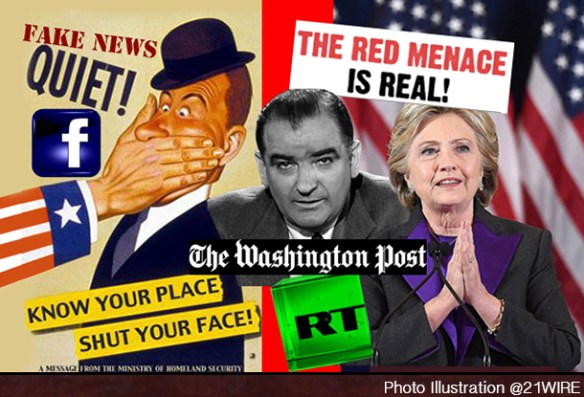
PropOrNot calls for an FBI investigation into the news sources listed. Even its creators see the resemblance to a new McCarthyism, as it appears as a frequently asked question on their website. (They say it is not McCarthyism, because “we are not accusing anyone of lawbreaking, treason, or ‘being a member of the Communist Party.’”) However, this new McCarthyism does not stem from the conservative right like before, but from the establishment center.

That the list is so evidently flawed and its creators refuse to reveal their identities or funding did not stop the issue becoming one of the most discussed in mainstream circles. Media talk of fake news sparked organizations like Google, Facebook, Bing and YouTube to change their algorithms, ostensibly to combat it.

However, one major effect of the change has been to hammer progressive outlets that challenge the status quo. The Intercept reported a 19 percent reduction in Google search traffic, AlterNet 63 percent and Democracy Now! 36 percent. Reddit and Twitter deleted thousands of accounts, while in what came to be called the “AdPocalypse,” YouTube began demonetizing videos from independent creators like Majority Report and the Jimmy Dore Show on controversial political topics like environmental protests, war and mass shootings. (In contrast, corporate outlets like CNN did not have their content on those subjects demonetized.) Journalists that questioned aspects of the Russia narrative, like Glenn Greenwald and Aaron Maté, were accused of being agents of the Kremlin (Shadowproof, 7/9/18).

The effect has been to pull away the financial underpinnings of alternative media that question the corporate state and capitalism in general, and to reassert corporate control over communication, something that had been loosened during the election in particular. It also impels liberal journalists to prove their loyalty by employing sufficiently bellicose and anti-Russian rhetoric, lest they also be tarred as Kremlin agents.

When it was reported in February that 13 Russian trolls had been indicted by a US grand jury for sharing and promoting pro-Trump and anti-Clinton memes on Facebook, the response was a general uproar. Multiple senior political figures declared it an “act of war.” Clinton herself described Russian interference as a “cyber 9/11,” while Thomas Friedman said that it was a “Pearl Harbor–scale event.” Morgan Freeman’s viral video, produced by Rob Reiner’s Committee to Investigate Russia, summed up the outrage:  “We have been attacked,” the actor declared; “We are at war with Russia.” Liberals declared Trump’s refusal to react in a sufficiently aggressive manner further proof he was Putin’s puppet.

The McCarthyist wave swept over other politicians that challenged the liberal center. Green Party presidential candidate Jill Stein refused to endorse the Russia narrative, leading mainstream figures like Rachel Maddow to insinuate she was a Kremlin stooge as well. After news broke that Stein’s connection to Russia was being officially investigated, top Clinton staffer Zac Petkanas announced:

Jill Stein is a Russian agent.

Jill Stein is a Russian agent.

Jill Stein is a Russian agent.

Jill Stein is a Russian agent.

Jill Stein is a Russian agent.

Jill Stein is a Russian agent.

Jill Stein is a Russian agent.

Jill Stein is a Russian agent.

“Commentary” that succinctly summed up the political atmosphere.

In contrast, Bernie Sanders has consistently and explicitly endorsed the RussiaGate theory, claiming it is “clear to everyone (except Donald Trump) that Russia was deeply involved in the 2016 election and intends to be involved in 2018.” Despite his stance, Sanders has also been constantly presented as another Russian agent, with the Washington Post (11/12/17) asking its readers, “When Russia interferes with the 2020 election on behalf of Democratic nominee Bernie Sanders, how will liberals respond?” The message is clear: The progressive wave rising across America is and will be a consequence of Russia, not of the failures of the system, nor of the Democrats.

It is not just politicians who have been smeared as Russian agents, witting or unwitting; virtually every major progressive movement challenging the system is increasingly dismissed in the same way. Multiple media outlets, including CNN (6/29/18), Slate (5/11/18), Vox (4/11/18) and the New York Times (2/16/18), have produced articles linking Black Lives Matter to the Kremlin, insinuating the outrage over racist police brutality is another Russian psyop. Others claimed Russia funded the riots in Ferguson and that Russian trolls promoted the Standing Rock environmental protests.

Meanwhile, Democratic insider Neera Tanden retweeted a description of Chelsea Manning as a “Russian stooge,” writing off her campaign for the Senate as “the Kremlin paying the extreme left to swing elections. Remember that.” Thus corporate media are promoting the idea that any challenge to the establishment is likely a Kremlin-funded astroturf effort.

The tactic has spread to Europe as well. After the poisoning of Russian double agent Sergei Skripal, the UK government immediately blamed Russia and imposed sanctions (without publicly presenting evidence). Jeremy Corbyn, the pacifist, leftist leader of the Labour Party, was uncharacteristically bellicose, asserting, “The Russian authorities must be held to account on the basis of the evidence and our response must be both decisive and proportionate.”

The British press was outraged—at Corbyn’s insufficient jingoism. The Sun‘s front page (3/15/18) attacked him as “Putin’s Puppet,” while the Daily Mail (3/15/18) went with “Corbyn the Kremlin Stooge.” As with Sanders, the fact that Corbyn endorsed the official narrative didn’t keep him from being attacked, showing that the conspiratorial mindset seeing Russia behind everything has little to do with evidence-based reality, and is increasingly a tool to demonize the establishment’s political enemies.

The Atlantic Council published a report claiming Greek political parties Syriza and Golden Dawn were not expressions of popular frustration and disillusionment, but “the Kremlin’s Trojan horses,” undermining democracy in its birthplace. Providing scant evidence, the report went on to link virtually every major European political party challenging the center, from right or left, to Putin. From Britian’s UKIP to Spain’s Podemos to Italy’s Five Star Movement, all are charged with being under one man’s control. It is this council that Facebook announced it was partnering with to help promote “trustworthy” news and weed out “untrustworthy” sources (FAIR.org, 5/21/18), as its CEO Mark Zuckerberg met with representatives from some of the largest corporate outlets, like the New York Times, CNN and News Corp, to help develop a system to control what content we see on the website.

The utility of this wave of suspicion is captured in Freeman’s aforementioned video. After asserting that “for 241 years, our democracy has been a shining example to the world of what we can all aspire to”—a tally that would count nearly a century of chattel slavery and almost another hundred years of de jure racial disenfranchisement—the actor explains that “Putin uses social media to spread propaganda and false information, he convinces people in democratic societies to distrust their media, their political process.”

The obvious implication is that the political process and media ought to be trusted, and would be trusted were it not for Putin’s propaganda. It was not the failures of capitalism and the deep inequalities it created that led to widespread popular resentment and movements on both left and right pressing for radical change across Europe and America, but Vladimir Putin himself. In other words, “America is already great.”

For the Democrats, Russiagate allows them to ignore calls for change and not scrutinize why they lost to the most unpopular presidential candidate in history. Since Russia hacked the election, there is no need for introspection, and certainly no need to accommodate the Sanders wing or to engage with progressive challenges from activists on the left, who are Putin’s puppets anyway. The party can continue on the same course, painting over the deep cracks in American society. Similarly, for centrists in Europe, under threat from both left and right, the Russia narrative allows them to sow distrust among the public for any movement challenging the dominant order.

For the state, Russiagate has encouraged liberals to forego their faculties and develop a state-worshiping, conspiratorial mindset in the face of a common, manufactured enemy. Liberal trust in institutions like the FBI has markedly increased since 2016, while liberals also now espouse a neocon foreign policy in Syria, Ukraine and other regions, with many supporting the vast increases in the US military budget and attacking Trump from the right.

For corporate media, too, the disciplining effect of the Russia narrative is highly useful, allowing them to reassert control over the means of communication under the guise of preventing a Russian “fake news” infiltration. News sources that challenge the establishment are censored, defunded or deranked, as corporate sources stoke mistrust of them. Meanwhile, it allows them to portray themselves as arbiters of truth. This strategy has had some success, with Democrats’ trust in media increasing since the election.

None of this is to say that Russia does not strive to influence other countries’ elections, a tactic that the United States has employed even more frequently (NPR, 12/22/16). Yet the extent to which the story has dominated the US media to the detriment of other issues is a remarkable testament to its utility for those in power.

Western Elites Decrying ‘Populism’ Betrays Fear of Democracy

By Finian Cunningham

Source: Strategic Culture Foundation

A new dreaded word has entered into official Western media speak: “Populism”. Political parties and governments which are deemed to be illegitimate are invariably labeled with the prefix “populist”. There is a vague implication that “populist” parties are imbued with disreputable politics of xenophobia, racism, nationalism and even fascism.

But who is doing the “deeming” here? It is establishment political parties and politicians who have the advantage of establishment news media organizations conveying their words and terminology.

Take French President Emmanuel Macron. He may have coined a new political party, En Marche, but he is nevertheless a politician very much of the prevailing Western establishment. He is pro-European Union as it currently operates, albeit with reforming tweaks; he is pro-NATO, pro-Atlanticist; and pro-neoliberal economic policies.

Recently, Macron decried the rise of “populist” parties across Europe. He compared them to the spread of “leprosy” and claimed they were posing a morbid threat to the conventional order of politics. Macron was referring in particular to the new coalition government in Italy, comprising the anti-establishment Five Star Movement and the League.

The French leader could also have been referring to any number of governments as seen in Austria, Hungary and other Central European states which, like the new Italian government, have challenged the EU’s official stance overEU irregular migration into the bloc.

In this context, the word “populist” as used by Macron and other establishment politicians has the connotation of “racist” or “inhumane” owing to the opposition towards the uncontrolled influx of people from outside Europe.

The “populist” prefix is often used alongside the term “far-right”. Again, the implication is that somehow the largely newcomer parties are something that should be abhorred because they are tarnished with alleged proclivities towards fascism and authoritarianism.

To reinforce that implied demonization, it is often cited by Western establishment politicians and media that the “populist” parties in Europe are aligned with Russian President Vladimir Putin, if not stealthily bankrolled by the Kremlin.

American President Donald Trump also qualifies as “populist” according to the US political and media establishment. Again, the word is loaded to infer a uniquely noxious quality in the Trump presidency and his supporters, in the same way that Democrat presidential rival Hillary Clinton once haughtily denigrated Trump and his voter base as “deplorable”. It’s a way of sanitizing the establishment from any past, and far greater, sins.

The P-word does not always mean “rightwing nationalism”. The recent elected Mexican President, Andrés Manuel Lopez Obrador, has been described in Western media as a “leftwing populist”.

In Italy, the main ruling coalition party, the Five Star Movement, headed by Luigi Di Maio, is associated with leftwing social policy.

Parties and politicians deemed to be “populist” are eclectic and defy an easy categorization, as their detractors would perhaps like to assign them. Certainly, there is a strong common stance of being opposed to uncontrolled immigration. But it is too simplistic to explain such a stance as merely xenophobic or racist.

There are legitimate and reasonable concerns that the issue of large-scale immigration has been exploited by ruling establishments and their ideological backers as a way to undermine national sovereignty and workers’ rights, from the consequent lowering of wages and employment conditions.

There is also the legitimate concern in Europe that the migration phenomenon has been largely created by illegal wars pursued by the US and its European NATO allies. Why should European member states and ordinary taxpayers have to incur financial and cultural integration problems that have been largely manufactured by ruling elites who have never been held to account for their criminal wars?

So-called populist parties are also opposed to the seemingly slavish adherence by the European political establishment to neoliberal capitalism. There is a legitimate popular backlash to economic policies which are oppressive and destructive, and whose sole priority seems to be satisfying the profits of Big Business and transnational capital. Why should European governments be held in hock to fiscal rules and debt limitations set arbitrarily by institutions seemingly under the diktat of private banks?

There are several fundamental issues that form a groundswell of popular opposition towards the conventional ways of governance, both in Europe and the US. The failings of neoliberal capitalism and its rich-get-richer racket is surely top of the grievance list. So too is relentless, irrational militarism by Western governments, unleashing illegal wars and massive refugee problems, as well as stoking unnecessary hostility towards other powers like Russia, China, Iran and North Korea.

The conventional politics, that is, the ruling establishments and their dutiful news media, are increasingly seen as incompetent, if not bankrupt. The establishment across Western countries has lost legitimacy and “moral authority” in the eyes of masses of people. That dwindling authority of the ruling class in Western states is the real, morbid concern.

One factor for this is the growth of global communications and “alternative” media sources, which Western publics are availing of to inform themselves independently from the old information monopolies that served the established order. That is why the “problem” of alleged “Russian influence” has been invented. In a desperate gambit to distract the masses from noticing the real problem, which is the crumbling of legitimacy for the Western establishment and its obedient political parties.

The looming fear among the ruling order is the ever-growing dissent among the populace. It is a fear of their own inherent failing and impending doom in the face of democratic challenge to power.

It is not so much that Trump or the new Italian government or Hungarian leader Viktor Orban, and so on, represent a vanguard for renewed democracy. These changes are merely symptoms of a deeper popular opposition to the established way of conducting politics – the order that has prevailed for most of the seven-decade period following the Second World War.

There has always been a wariness among ruling elites on both sides of the Atlantic towards a genuine democratic order breaking out, as Noam Chomsky discusses in his book ‘Deterring Democracy’. Western elites have typically viewed the masses as “rabble rousers” who are deemed to be “incapable” of governing society in the “proper way” that benefits the elites, protects their profits and property, and safeguards their imperial war-making overseas.

This underlying tension about the control of political power in Western societies encapsulates the present historical juncture where the word “populist” is being increasingly deployed. It is a term of disparagement by a failing Western establishment. What the failed order is trying to do is divert genuine popular challenge by painting it as something uncouth, vulgar, noxious, or manipulated by foreign enemies like Russia.

As American political analyst Randy Martin notes: “Populism is a convenient term for those in power who seek to isolate those who would want to share, or worse, take that power.”

When you think of the original meaning of the word – “the people” – it is starkly revealing what is really at stake for those elites who wield the “populist” term as a disparagement.

Moon-Strzok No More, Lisa Page Spills the Beans

The meaning of a crucial text message between two FBI officials appears to have been finally explained, and it’s not good news for the Russia-gate faithful, as Ray McGovern explains.

By Ray McGovern

Source: Consortium News

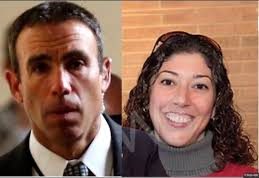
Former FBI attorney Lisa Page has reportedly told a joint committee of the House of Representatives that when FBI counterintelligence official Peter Strzok texted her on May 19, 2017 saying there was “no big there there,” he meant there was no evidence of collusion between the Trump campaign and Russia.

It was clearly a bad-luck day for Strzok, when on Friday the 13th this month Page gave her explanation of the text to the House Judiciary and Oversight/Government Reform Committees and in effect threw her lover, Strzok, under the bus.

Strzok’s apparent admission to Page about there being “no big there there” was reported on Friday by John Solomon in the Opinion section of The Hill based on multiple sources who he said were present during Page’s closed door interview.

Strzok’s text did not come out of the blue. For the previous ten months he and his FBI subordinates had been trying every-which-way to ferret out some “there” — preferably a big “there” — but had failed miserably. If Solomon’s sources are accurate, it is appearing more and more likely that there was nothing left for them to do but to make it up out of whole cloth, with the baton then passed to special counsel Robert Mueller.

The “no there there” text came just two days after former FBI Director James Comey succeeded in getting his friend Mueller appointed to investigate the alleged collusion that Strzok was all but certain wasn’t there.

Robert Parry, the late founder and editor of Consortium News whom Solomon described to me last year as his model for journalistic courage and professionalism, was already able to discern as early as March 2017 the outlines of what is now Deep State-gate, and, typically, was the first to dare report on its implications.

Parry’s article, written two and a half months before Strzok texted the self-incriminating comment to Page on there being “no big there there,” is a case study in professional journalism. His very first sentence entirely anticipated Strzok’s text: “The hysteria over ‘Russia-gate’ continues to grow … but at its core there may be no there there.”(Emphasis added.)

As for “witch-hunts,” Bob and others at Consortiumnews.com, who didn’t succumb to the virulent HWHW (Hillary Would Have Won) virus, and refused to slurp the Kool-Aid offered at the deep Deep State trough, have come close to being burned at the stake — virtually. Typically, Bob stuck to his guns: he ran an organ (now vestigial in most Establishment publications) that sifted through and digested actual evidence and expelled drivel out the other end.

Those of us following the example set by Bob Parry are still taking a lot of incoming fire — including from folks on formerly serious — even progressive — websites. Nor do we expect a cease-fire now, even with Page’s statement (about which, ten days after her interview, the Establishment media keep a timorous silence). Far too much is at stake.

As Mark Twain put it, “It is easier to fool people than to convince them that they have been fooled.” And, as we have seen over the past couple of years, that goes in spades for “Russia-gate.” For many of us who have looked into it objectively and written about it dispassionately, we are aware, that on this issue, we are looked upon as being in sync with President Donald Trump.

Blind hatred for the man seems to thwart any acknowledgment that he could ever be right about something—anything. This brings considerable awkwardness. Chalk it up to the price of pursuing the truth, no matter what bedfellows you end up with.

Courage at The Hill 

Solomon’s article merits a careful read, in toto. Here are the most germane paragraphs:

“It turns out that what Strzok and Lisa Page were really doing that day [May 19, 2017] was debating whether they should stay with the FBI and try to rise through the ranks to the level of an assistant director (AD) or join Mueller’s special counsel team. [Page has since left the FBI.]

“‘Who gives a f*ck, one more AD [Assistant Director] like [redacted] or whoever?’” Strzok wrote, weighing the merits of promotion, before apparently suggesting what would be a more attractive role: ‘An investigation leading to impeachment?’ …

“A few minutes later Strzok texted his own handicap of the Russia evidence: ‘You and I both know the odds are nothing. If I thought it was likely, I’d be there no question. I hesitate in part because of my gut sense and concern there’s no big there there.’

“So the FBI agents who helped drive the Russia collusion narrative — as well as Rosenstein’s decision to appoint Mueller — apparently knew all along that the evidence was going to lead to ‘nothing’ and, yet, they proceeded because they thought there was still a possibility of impeachment.”

Solomon adds: “How concerned you are by this conduct is almost certainly affected by your love or hatred for Trump. But put yourself for a second in the hot seat of an investigation by the same FBI cast of characters: You are under investigation for a crime the agents don’t think occurred, but the investigation still advances because the desired outcome is to get you fired from your job. Is that an FBI you can live with?”

The Timing

As noted, Strzok’s text was written two days after Mueller was appointed on May 17, 2017. The day before, on May 16,The New York Times published a story that Comey leaked to it through an intermediary that was expressly designed (as Comey admitted in Congressional testimony three weeks later) to lead to the appointment of a special prosecutor to investigate collusion between the Trump campaign and Russia. Hmmmmm.

Had Strzok forgotten to tell his boss that after ten months of his best investigative efforts — legal and other—he could find no “there there”?

Comey’s leak, by the way, was about alleged pressure from Trump on Comey to go easy on Gen. Michael Flynn for lying at an impromptu interrogation led by — you guessed it — the ubiquitous, indispensable Peter Strzok.

In any event, the operation worked like a charm — at least at first. And — absent revelation of the Strzok-Page texts — it might well have continued to succeed. After Deputy Attorney General Rod Rosenstein named Mueller, one of Comey’s best buddies, to be special counsel, Mueller, in turn, picked Strzok to lead the Russia-gate team, until the summer, when the Department of Justice Inspector General was given the Strzok-Page texts and refused to sit on them.

A Timeline

Here’s a timeline, which might be helpful:

2017

May 16: Comey leak to NY Times to get a special counsel appointed

May 17: Special counsel appointed — namely, Robert Mueller.

May 19: Strzok confides to girlfriend Page, “No big there there.”

July: Mueller appoints Strzok lead FBI Agent on collusion investigation.

August: Mueller removes Strzok after learning of his anti-Trump texts to Page.

Dec. 12: DOJ IG releases some, but by no means all, relevant Strzok-Page texts to Congress and the media, which firstreports on Strzok’s removal in August.

2018

June 14: DOJ IG Report Published.

June 15; Strzok escorted out of FBI Headquarters.

June 21: Attorney General Jeff Sessions announces Strzok has lost his security clearances.

July 12: Strzok testifies to House committees. Solomon reports he refused to answer question about the “there there” text.

July 13: Lisa Page interviewed by same committees. Answers the question.

Earlier: Bob Parry in Action

On December 12, 2017, as soon as first news broke of the Strzok-Page texts, Bob Parry and I compared notes by phone. We agreed that this was quite big and that, clearly, Russia-gate had begun to morph into something like FBI-gate. It was rare for Bob to call me before he wrote; in retrospect, it seemed to have been merely a sanity check.

The piece Bob posted early the following morning was typical Bob. Many of those who click on the link will be surprised that, last December, he already had pieced together most of the story. Sadly, it turned out to be Bob’s last substantive piece before he fell seriously ill. Earlier last year he had successfully shot downother Russia-gate-related canards on which he found Establishment media sorely lacking — “Facebook-gate,” for example.

Remarkably, it has taken another half-year for Congress and the media to address — haltingly — the significance of Deep State-gate — however easy it has become to dissect the plot, and identify the main plotters. With Bob having prepared the way with his Dec.13 article, I followed up a few weeks later with “The FBI Hand Behind Russia-gate,” in the process winning no friends among those still suffering from the highly resistant HWHW virus.

VIPS

Parry also deserves credit for his recognition and appreciation of the unique expertise and analytical integrity among Veteran Intelligence Professionals for Sanity (VIPS) and giving us a secure, well respected home at Consortium News.

It is almost exactly a year since Bob took a whole lot of flak for publishing what quickly became VIPS’ most controversial, and at the same time perhaps most important, Memorandum For the President; namely, “Intelligence Veterans Challenge ‘Russia Hack’ Evidence.”

Critics have landed no serious blows on the key judgments of that Memorandum, which rely largely on the type of forensic evidence that Comey failed to ensure was done by his FBI because the Bureau never seized the DNC server. Still more forensic evidence has become available over recent months soon to be revealed on Consortium News, confirming our conclusions.