Saturday Matinee: Kurt Vonnegut: Unstuck in Time

By Matt Zoller Seitz

Source: RogerEbert.com

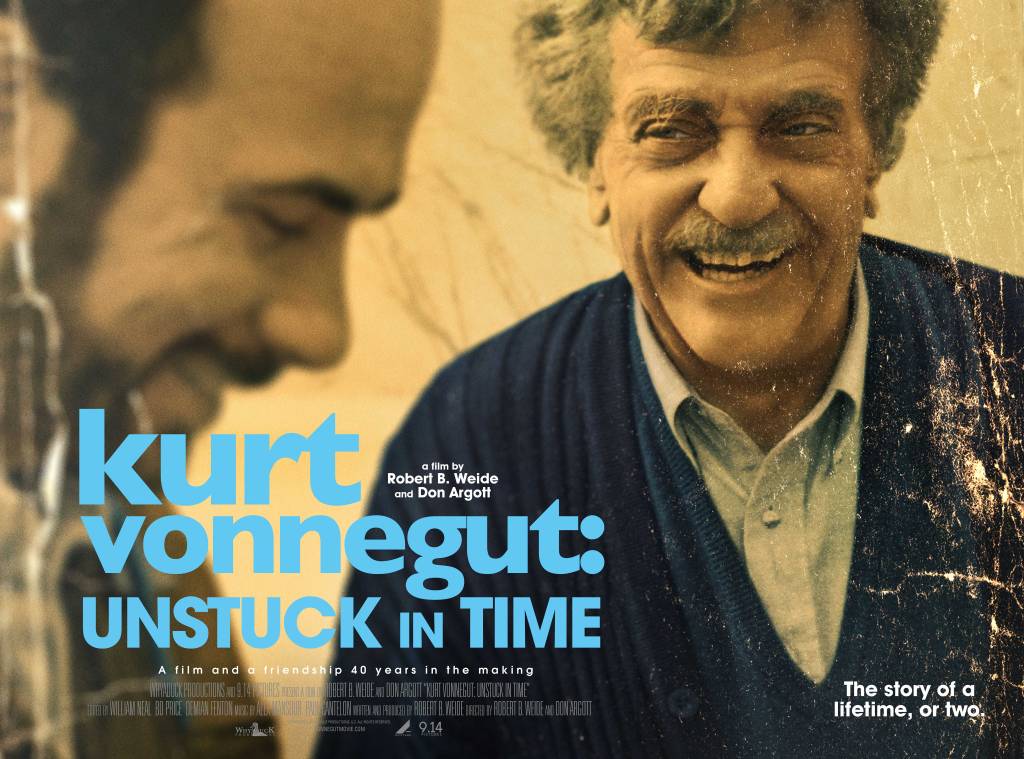
“Kurt Vonnegut: Unstuck in Time” is messy in the way that wakes for dear friends are messy.

Some speakers go on too long, and there are others that you may wish you’d heard from at greater length, or at all. And the raw sentiment coursing through every moment of the affair, however heartfelt, can be overwhelming, especially if you didn’t know the deceased as well as the folks memorializing him. 

The deceased here is Kurt Vonnegut, and the person who planned, executed and hosted this cinematic wake, director Robert B. Weide (a veteran documentarian and an Emmy-winning director for “Curb Your Enthusiasm”), was a friend of Vonnegut’s throughout the final 25 years of his life. This movie, co-directed by Don Argott, runs over two hours. Thematic and structural ideas are introduced, nurtured, forgotten, then reintroduced awkwardly. Weide himself is a major character—as well he should be, considering that Vonnegut essentially made Weide his personal archivist, sending him letters and manuscripts and faxes and video and audio tapes, and this film is as much a portrait of a friendship as it is the warts-and-all record of a great writer’s life—but sometimes the proportions feel off. When Weide disappears for long stretches, I don’t know that it’s exactly a slam to say that you don’t miss him, because people are mainly here for Vonnegut, one of the most important American writers of the 20th century, and a fount of charisma even at his lowest depths of sour narcissism in the 1970s. 

Vonnegut fans know that he specialized in slim, nimbly written books, with short chapters and short paragraphs that jumped wherever Vonnegut’s consciousness happened to take him. “Unstuck in Time” lets us know that it is consciously modeling its structure on Vonnegut’s writing, in particular his widest-read work, the nonlinear novel/memoir “Slaughterhouse Five,” from whence the documentary’s subtitle is drawn (“Billy Pilgrim came unstuck in time,” it starts); and to a lesser extent, Vonnegut’s late-career bestseller “Timequake,” a fragmented, self-aware book that is partly about the difficulty of writing “Timequake.” 

There are also cinematic allusions to Vonnegut’s literary alter-ego, Kilgore Trout, in the way that Weide and Argott and three credited film editors weave together the relationship between Vonnegut and Weide. Weide first meets Vonnegut in 1982 at age 23 after writing him a fan letter inquiring about the possibility of making a documentary about his life, and he holds onto that youthful starstruck quality even in reminiscences shot long after Vonnegut’s death in 2007. Over time, the pupil gains the master’s respect, to the point where Weide writes and coproduces a feature-length adaptation of Vonnegut’s novel “Mother Night,” starring Nick Nolte and directed by actor-filmmaker Keith Gordon, who as luck would have it played Rodney Dangerfield’s son in “Back to School,” a comedy in which Vonnegut played himself.

This may all sound as if it’s articulated more cleanly and effectively than it is. The filmmakers have committed simultaneously and with equal enthusiasm to a couple of filmmaking approaches that are at odds. One is the detached, clinical-mathematical, unsentimental, science-fictional, time-tripping biography, a la “Slaughterhouse Five” and “Timequake,” represented here by inventive cutting from image to image and idea to idea, sometimes lingering on signifiers of creative self-awareness. These include closeups of the timeline on an editor’s computer screen, montages of Vonnegut doing or saying the same thing in different decades of his life, snippets of films based on Vonnegut’s writing, and animated sequences modeled on Vonnegut’s drawings, which were as distinctive as his prose.

The other approach is more straightforward: Weide and Argott are making a straightforward PBS-style documentary about an artist’s life, supervised by a director and fan who knew him intimately, and tghat draws on footage ranging from childhood through old age. The latter might jump around in time in terms of the years in which it was created, but it ultimately tells Vonnegut’s story in a far more conventional way that the movie promises to do in its opening minutes.

This is fine; in fact it’s more than fine, because as Vonnegut and various experts on his work point out, Vonnegut remains readable and relevant in large part because he expressed himself in a direct way, drawing upon what’s described here as a journalistic writing style. Correspondingly, the most moving scenes and moments in “Unstuck in Time” are unmannered accounts of events. These range in emotional character from elating (Vonnegut’s commercial and critical success with “Slaughterhouse Five” after years of financial struggle) to vexing (after that success, he left his first wife, Jane, who’d been by his side during the lean years, moved to Manhattan, and married his mistress) to tragic (Vonnegut’s brother-in-law dying in a train wreck just two days before Vonnegut’s older sister died of cancer) to inspirational (Vonnegut unhesitatingly raising his late sister’s four sons alongside the three kids he had with Jane).

All of this material is fascinating, and articulated in vivid detail thanks to Weide’s trove of material. There are closeups of typewritten revisions of Vonnegut classics, each alteration indicated in pencil or pen, and letters and answering machine messages covering every imaginable life event. The filmmakers lay it all out so elegantly that whenever the movie seems to forget that it’s also about Weide and suddenly interrupts the flow to insert a reference to one of Weide’s own milestone events (such as his wife’s own battle with a debilitating illness and his Emmy win for “Curb,” which seems to be in there so that he can include Vonnegut’s answering machine message congratulating him) it’s awkward because Weide is clearly still grieving, too, and the viewer is torn between wanting to bear witness to Weide’s miseries and triumphs and wanting him to get back to Kurt Vonnegut as quickly as possible.

There is, nevertheless, something to be said for a documentary that tries to do something different and perhaps impossible, even if it doesn’t quite get there. And in the end, any flaws or missed opportunities are subsumed by the movie’s sincerity and wealth of insight. Its analysis of the role that Vonnegut’s World War II experience played in his demeanor as well as his fiction is fascinating and on-point, and the editors bring it all back at the end when Vonnegut, outraged by the second Bush administration’s invasion of Iraq and weaponizing of patriotism, writes a series of columns for “In These Times” magazine that will ultimately be collected in 2005’s “A Man Without a Country,” arguably his last major work.

Weide himself comes across as a sardonic and compassionate witness and guide, often taking the piss out of his own reverence for Vonnegut just when things threaten to get a bit moist. The devotion he displays towards Vonnegut throughout the second half of the writer’s life is as inspiring as Vonnegut’s own high points as a human being. We should all be lucky enough to have a friend who will tell our story.

____________________

Watch Kurt Vonnegut: Unstuck in Time on Kanopy here: https://www.kanopy.com/en/product/13799154

Saturday Matinee: The Occupation of the American Mind

Source: Media Education Foundation

“The Occupation of the American Mind” has been repeatedly attacked and misrepresented by right-wing pressure groups and outright ignored by virtually all mainstream media outlets and North American film festivals.   

To help bring context to U.S. corporate media coverage of the Oct. 7 Hamas attacks and Israel’s escalating bombardment of Gaza, we’re releasing this newly abridged, 49-minute version of our 2016 film “The Occupation of the American Mind.” The film places special emphasis on propaganda efforts designed to conceal Israel’s brutal and illegal decades-long occupation of Palestinian land as a root cause of the conflict, and to cast those who speak up for Palestinian human rights as either anti-Semitic or terrorist-sympathizers. Narrated by Roger Waters, and featuring Noam Chomsky, Rashid Khalidi, Yousef Munayyer, Amira Hass, Norman Finkelstein, Phyllis Bennis, Rula Jebreal, Norman Solomon, Max Blumenthal, Rami Khouri, M.J. Rosenberg, Stephen J. Walt, Mark Crispin Miller, Peter Hart, Henry Siegman, and Sut Jhally.


A transcript of this 49 minute version to follow along with is available by going to https://www.youtube.com/watch?v=-jKRwdsq-As

49 MINUTE VERSION (The restriction is because of violent scenes.)

“The Occupation of the American Mind: Israel’s Public Relations War in the United States.” Despite receiving an overwhelmingly positive response from those who have actually seen it,” The Occupation of the American Mind” has been repeatedly attacked and misrepresented by right-wing pressure groups and outright ignored by virtually all mainstream media outlets and North American film festivals. To bypass this campaign of misrepresentation and suppression, we’ve decided to make the film available for FREE online so that people can make up their own minds about its analysis of U.S. media coverage of the Israeli-Palestinian conflict. Please watch and share widely! Support for the free distribution of this film was provided by the Wallace Action Fund of Tides Foundation, advised by Randall Wallace. If you’d like to help support the effort to provide free distribution of The Occupation of the American Mind, please consider a donation. https://www.mediaed.org/donate/

Saturday Matinee: Kowloon Walled City

By South Sider

Source: YouTube

Credits go to cameraman Hamdani Milas. Christina Wesemann for creation and direction of the film and also to Hugo Portisch for production.

Milas was one of the people that helped filmed this 1989 documentary about the city. I spoke with him recently and he said that he is interested in a follow up video of some sort so we may expect something new on the way.

He mentioned how it was an incredibly tough shoot. They were a five person crew; himself as cinematographer, a camera assistant, focus-puller, sound recordist, a researcher, production assistant and the director, and a very nice Austrian lady who was most willing to collaborate and listen to crew suggestions.

They shot for 6 days continuously, 10-12 hours a day, at the height of the summer of 1987. He mentioned how it smelled very bad inside from the open drainage, the heat was stifling at plus 32ºC with little to no air circulation, also not knowing whether it was sewage or clean water dripping on their heads occasionally, they regularly had to wipe the camera and lens dry.

The claustrophobia- you could hardly turn around in some places with a 7kg Betacam SP camcorder on your shoulder. They had a tripod with them but hardly used it inside because there was nowhere to position it without blocking the narrow passageways.

They also frequently got lost and had to ask the locals for directions. Lunch was much-anticipated each day when they could take a break outside in the fresh air. After a day’s shoot they were absolutely dripping with sweat and the first thing they’d do after getting home was to put all their clothes straight in the wash and have a long shower. Working in those conditions was an immense challenge technically and physically but, as is often the case, none of that shows in the resulting footage.

Here we have a very interesting first hand account of what Hamdani Milas experienced in the walled city itself when he was filming this video. So by what he’s told me we can understand just how much of an incredible risk it was to film inside this city, even though it was near to when the city was demolished and the place was seen as safer it was still a high risk no go area.

I took it upon myself to re-sub the video as best as possible, the 4 part version is hard-subbed on a version of this film with very poor quality, the subs are also worded incorrectly in some places. So all I’ve done is re-subbed the whole thing and put it onto a better quality video clip.

Note: about the section of this video where Jackie Pullinger is speaking, I’m sure anyone can see the subtitles are a transcript of Jackie Pullingers actual words in English and not the narrators. I’ve noticed a comment mentioning how the subs are way off in that part. While subbing this video I realised the narrator wasn’t giving an exact translation so took it upon myself to decipher what she was actually saying over his voice. Sorry I just couldn’t help it but it was out of boredom 😉

Saturday Matinee: Lessons of Darkness

By Martin Purvis

Source: The Film Sufi

Werner Herzog’s documentary films lie at an extreme distance from the Anglo-American tradition of documentary filmmaking. Part of that distance can be linked to the distinction between two fundamental stances towards the depiction of reality: “Objectivism” and “Interactionism”, which I have discussed in other essays, for example, Avatar (2009), Close-Up (1990), and SiCKO (2007). American documentarians generally align themselves with Objectivism and hold that they are presenting an objective view of reality. An extreme form of this approach is “direct cinema”, which seeks to create the illusion that the filmmaker is an invisible “fly on the wall” and has no impact on the subjects being filmed, thereby supposedly ensuring scientific objectivity. But even in more conventional American documentaries with explicitly polemical content, there is a presumption that objective reality, independent of any observer, is being presented. Continental European documentary filmmakers, on the other hand, have had a tendency to lean towards Interactionism and have made more personal films in which the filmmaker and his or her point of view is a confessed part of the narrative. Herzog is so much on the Interactionist side of the ledger that his documentary films not only include his personal perspective, but seem primarily to be his own personal essays about the world – he, himself, is an implicit focus of the film, and the “reality” depicted is self-consciously Herzog’s own reality. Lessons of Darkness (Lektionen in Finsternis, 1992), which was shot in Kuwait in the immediate aftermath of the First Gulf War (1990-91) is one such example of Herzog’s style.

Although focussed on the harrowing events and ravages that happened in Iraq and Kuwait during that time, Lessons of Darkness has clear-cut affinities with Herzog’s first documentary Fata Morgana (1971), which was shot in Africa. In that earlier film Herzog edited footage that he had (seemingly randomly) shot in the African Sahel and tried to fashion a dark vision about man’s hopeless ineffectiveness, and consequently likely impermanent existence, on the planet – an ephemeral existence like a mirage. Some twenty years later, with Lessons of Darkness, Herzog again collected footage, this time in Kuwait, and then assembled his photographic essay in post-production, and again his vision is one of dark apocalypse and pessimism concerning man’s prospects for a sustainable future. In fact both Fata Morgana and Lessons of Darkness contain vague commentary that suggests that humankind on Earth is being clinically observed, with amazement and horror, by a visitor from another planet. However, in neither film is there any real narrative or sequence of events that could amount to a story – they are both more or less personal essays of despair. But if we assert that they are both cinematic commentaries, we have also to concede that neither of these two films provides an explicit disquisition or argument, or even has a clearly articulated thesis. What we are really presented with is just a suggestive sequence of images, on which the viewer reflectively fills in many of the blanks and faces a greater-than-usual task of constructing his or her own story or vision. This process of placing much of the narrative burden on the viewer essentially fails with Fata Morgana (which was almost a random collection of lurid images of garish and pathetic human folly), but is more successful with Lessons of Darkness, primarily because the viewer in this case is more likely to bring to the film considerable familiarity with what happened during the “First Gulf War”and use that material for his own imaginative reconstructions.

The greater part of Lessons of Darkness consists of lurid scenes of fires in the Kuwaiti oilfields burning out of control and spewing gargantuan clouds of smoke. These images are interspersed with images of devastation, both at the physical and human level, and with human firefighters seemingly overmatched in their efforts to quell the multiple, raging infernos. The images are apparently meant to be abstractly horrific, and there is almost no spoken dialogue and no explicit reference to the Gulf War, or to specific places, or to any historical context. To set some kind of context, Lessons of Darkness opens with images of wasteland and destruction, and the prologue refers to a planet “in our solar system” which evidently has undergone a catastrophic war. So the viewer sees things simultaneously with respect to two overarching narrative perspectives: the real Gulf War and an abstract metaphorical fable of how bizarre humankind’s self-destructive impulses might be to a detached, external observer. The film is then presented partitioned into thirteen chapters, each identified by apocalyptic, perhaps oracular, intertitles which suggest chapters to some sort of apocryphal Book of Revelations.

  1. “A Capital City”. This section features an opening voiceover narration with images of Kuwait City filmed from a low-flying helicopter, ominously suggesting that this doomed city will soon be utterly destroyed by warfare (it wasn’t, and this footage was filmed after the conflict).
  2. “The War”. Here is shown footage of the aerial bombing of Iraq as seen via night-vision video cameras. Although this section is relatively short and no mention of “Operation of Desert Storm” is made, the context is likely to be familiar to a worldwide audience, since it was widely viewed on CNN.
  3. “After the Battle”. Images of war devastation are presented.
  4. “Torture Chambers”. This thankfully brief section is one of the most memorable, though difficult to bear, sections in the film. First is shown what is apparently the insides of one of the torture chambers run by Saddam Hussein’s government, and it features a mute display of mechanical devices designed to inflict unbearable pain. Then an Arab woman is shown who was been rendered almost permanently speechless by having been forced by the authorities to witness her own sons being tortured to death.
  5. “Satan’s National Park”. Helicopter footage of what seems to be a vast marshland are revealed to be in fact entirely flooded with oil.
  6. “Childhood”. Another Arab mother is shown, this time with a young, disturbed boy who has been rendered speechless by what he has witnessed during the conflict. As with the woman shown earlier, the horror of what happened is not shown, it is only something so unspeakable that one cannot bear to think about it. The viewer’s imagination then fills in the blanks.
  7. “And A Smoke Arose Like The Smoke From A Furnace”. Here, 23 minutes into the film, the raging fires take over the screen. Again, they are filmed from low-flying helicopters.
  8. “A Pilgrimage”. Now the (American) firefighters are shown, sometimes relatively up close and at other times at a distance and dwarfed by the towering flames of the fires that burn endlessly. This section shows the firefighters using explosives to try to put out the fire.
  9. “A Dinosaur’s Feast”. This is more or less a continuation of the previous section showing the firefighters, but now emphasizing some of the huge construction and excavation machines employed in their work. The machinery has monster-like appearances, with arching cranes, serpentine bodies, and huge digging claws.
  10. “Protuberances” – a brief section showing closeups of oil–and-mud swamps bubbling and frothing, and evoking more nightmarish images of Hell.
  11. “The Drying Up of the Wells”. The oil-covered firefighters are shown, often in slow-motion, intensely engaged in the mechanics of their operations. The functional nature of these activities is incomprehensible to the typical viewer, and it all appears perhaps as an abstract Ballet Mécanique from the dark side. The macabre strangeness of it all, and the degree to which these operations seem to be foreign to what we might call normal human intercourse, are worth comparing to Louis Malle’s documentary, Humain, Trop Humain (1974).
  12. “Life Without Fire”. With many of the fires now apparently having been extinguished, the voiceover commentary of the interplanetary visitor expresses wonder as these strange creatures to him (i.e. the firefighters) engage in the baffling act of relighting an extinguished geyser of oil. He comments: “Has life without fire become unbearable for them? . . . . . Others, seized by madness, follow suit. . . . . Now they are content, now there’s something to extinguish again.”
  13. “I am So Weary of Sighing, O Lord, Grant That the Night Cometh”. The final portion returns to the fires, themselves, carrying with it an air of resignation and gloom.

Herzog’s fascination with fire extends to a fascination with its opposite, darkness (hence the title). The demonic forces that lurk inside the hearts of men seem to be beyond civilized understanding or rational control. These issues of cruelty and madness are as elemental as fire, itself, and are not confined to the Middle East [1]. This apparently was Herzog’s project: not to focus on just the particular horror of what happened in one part of the globe, but to fashion a fiction that would portray a more universal damnation. To this end, he opens the film with his own fabricated quotation (“The collapse of the stellar universe will occur, like creation, in grandiose splendor”) which he probably attributes to Blaise Pascal in order to give it the appropriate resonance – Pascal is perhaps not so well-known to English-speaking audiences, but his genius occupies a peculiarly iconic place in the European mind.

The horror that Herzog attempts to convey by his images of man-made Hell is enhanced by its unspeakable nature – it is beyond human articulation. Instead of a deafening roar from the fires drowning out occasional shouts from the firefighters, much of the stoundtrack is filled with funereal, dirge-like orchestral music from Mahler, Prokofieff, Verdi, Wagner, and Arvo Part. The unspeakable nature of this horror is explicitly referenced by the two mothers: one mother is unable to speak comprehensibly, and the child of the other mother has been rendered speechless by rational choice. It is left to our imaginations to fill out these nightmares.

Notes:

  1. For example, consider the use of germ warfare by the Japanese during the Second Sino-Japanese War (1937-45). Here is a quotation from an article on the subject (Judith Miller, “When Germ Warfare Happened”City Journal, (Spring 2010)):

“The methods were brutal. Army trucks dumped gallons of deadly germs alongside roads and railway lines linking Chinese towns so that infections would spread from town to town; planes dropped porcelain bombs containing infected fleas on dozens of villages, causing devastating outbreaks of bubonic plague. The Japanese laced more than 1,000 wells in the area of Harbin with typhoid bacilli. They also inserted typhus into bottles of lemonade that children loved to drink in the summer, Harris reported. In Nanking, they distributed anthrax-filled chocolate and cake to hungry children. The Japanese discovered that packing fountain pens and walking sticks with deadly germs was a particularly effective way of secretly disseminating them. In 1940, Major General Ishii sent a train carrying 70 kilograms of typhus bacterium, 50 kilograms of cholera germs, and 5 kilograms of plague-infected fleas to the city of Hangzhou, a holiday resort favored by Shanghai’s wealthy. From there, the germs were dumped into ponds and reservoirs and spread by aerial spraying, contaminating all life in fields of wheat and millet during the harvest.”

Saturday Matinee: Stranger at the Gate

How Many Strangers Are At the Gate?

By David Swanson

Source: Let’s Try Democracy

Spolier Alert: if you want to watch an excellent 30-minute film without knowing what happens, scroll down and watch it before reading any of these words.

We’ve long known that U.S. mass-shooters are disproportionately trained in shooting by the U.S. military. I don’t know whether the same applies to those who kill in the U.S. with bombs. I wouldn’t be surprised if the connection were even greater.

The Oscar-nominated short film Stranger at the Gate tells the story of a man who went from a difficult childhood straight into the U.S. military at 18.

When learning to shoot at paper targets, he had concerns about killing actual people. He recounts being given the advice that if he could look at those he would kill as anything other than human he would have no problems. So, that, he says, is what he did.

But, of course, conditioning people to thoughtlessly kill doesn’t provide them with any way of being unconditioned again, of comfortably ceasing to be self-deceptive murderers.

This guy went off to U.S. wars where he killed people he thought of as Muslims. The characterization of the people killed as belonging to an evil religion, was largely a game of military propaganda. The actual motivations of those picking the wars tended to have more to do with power, global domination, profits, and politics. But bigotry has always been used to sucker the rank and file into doing what’s desired.

Well, this good soldier did his job and returned to the United States believing that he had done his job, and that that job had been to kill Muslims because of the evil of Muslims. There was no Off switch.

He was troubled. He was drunk. The lies didn’t rest easily. But the lies had a tighter grip than the truth. When he saw that there were Muslims in his hometown, he believed he needed to kill them. Yet he grasped that he would no longer be praised for it, that he would now be condemned for it. Even so, he still believed in the cause. He decided that he would go to the Islamic Center and find proof of the evil of the Muslims that he could show everyone, and then he would blow the place up. He hoped to kill at least 200 people (or non-people).

The men and women at the Islamic Center welcomed him and transformed him.

In the United States today one may want to rewrite this line:

“Do not neglect to show hospitality to strangers, for by so doing some people have entertained angels without knowing it.”

in this way:

“Do not neglect to show hospitality to strangers, for by so doing some people have entertained would-be mass-murderers without knowing it.”

How many?

Nobody knows.

Saturday Matinee: A Glitch in the Matrix

Sundance 2021 Review: Rodney Ascher’s Hybrid Doc A GLITCH IN THE MATRIX Simulates Belief

By Martin Kudlac

Source: Screen Anarchy

It is sometimes an appropriate response to reality to go insane.”

Philip K. Dick

Sundance regular Rodney Ascher returns on the festival turf (virtually) with his The Nightmare (2015) follow-up, A Glitch in the Matrix. The title of Ascher´s newest documentary refers to a popular phrase usually reserved for déjà vu. The phrase has been widely popularized by Wachowski’s era-defining film The Matrix in 1999.

Similarly to Ascher’s 2012 documentary Room 237 that ponders strange theories and arcane interpretations of Kubrick’s take on The ShiningThe Matrix becomes frequently referenced material in his latest documentary.

A Glitch in the Matrix dives into the simulation theory (or the simulation hypothesis) that gained traction in academia, popular culture, and across mainstream media. The theory is rich and varied and extends far beyond the simple statement that “we are living in a simulation” and offers mind-warping food for thought.

While Ascher does not have the ambition to penetrate the obscure layers of the simulation theory in-depth, he captures the breadth of its implications spanning across popular culture, philosophy, religion, and psychology.

Curiously enough, A Glitch in the Matrix does not kick off with The Matrix nod but takes a more oddball albeit thoughtful detour. At the beginning of the Ascher´s documentary is the famous 1977 “Metz speech” by the visionary and paranoid author Philip K. Dick. Dick took a legion of his French fans by surprise when attending a science fiction convention. He proclaimed his books are actually not works of the imagination but his real-life experiences and that this is just one world out of many.

However, Dick is nowadays considered the prophet of the information age as his paranoid ramblings transmuted into visionary prophecies. The Exegesis of Philip K. Dick offers a more first-person perspective on the author´s unique perception of reality which is also referred to in the Ascher´s film.

The short clip of Metz speech serves as a pre-emptive rebuke to disprove the relevancy of the simulation hypothesis. It is a smart dramaturgic move on the director’s side heralding that the audience´s suspension of disbelief is not going to be strained that much. As the ground is prepared, Ascher drops the first interviewee (people interviewed on camera in the film are called “eyewitnesses”) revealing his belief in the simulation hypothesis and the circumstances that led to this assumption.

Ascher follows the similar approach from The Nightmare of respondents retelling their somewhat baffling experiences and explaining what they think The Matrix got right. No simulation theory deniers have been asked to raise the other side of the argument. However, that decision will prove unnecessary in the long-run as Ascher does not give a platform to kooky and deranged ideas and the theory will get anchored in less sensationalistic terms compared to mainstream media coverage.

Furthermore, the testimonies by “simulation believers” uncover motivations behind the process of adopting such eccentric beliefs as their worldview. Besides, the dramaturgy of “eyewitnesses” contributes to the film´s psychological thread that lands to a gut-punch denouement doubling as the film´s actual moral and a (true crime) warning.

Ascher builds on his previous works and A Glitch in the Matrix turns out to be a formalistic cross-over between Room 237 and The Nightmare. Talking heads, voice-over, and animated reenactments of (strange) experiences follow The Nightmare formula while obsessive deciphering of The Matrix is the tool of the trade brought from Room 237. The production value however exceeds the low-budget constraints of Room 237 which is basically a barebone desktop documentary wheras A Glitch in the Matrix happens to be an augmented desktop documentary.

After all, A Glitch in the Matrix is a doc for the big screens. The talking heads segments had been upgraded in a nerdy nod to the simulation theory and Cameron´s film Avatar. Each interviewee is represented as a custom-made animated videogame styled avatar and not necessarily for the purposes of anonymity.

The animation is further employed to illustrate their ideas, incidents, and encounters that led them to dispute the ontological reality. Besides, animated scenes are further employed to portray alternative scenarios to reality contemplating reasons why mankind may be imprisoned in a simulation.

The director continues to fine-tune the brand of an eerie, and in this case speculative, cinematic edutainment that appears to become his trademark. Wedged between journalism and popculture, the provocative and thought-provoking documentary introduces respectable authorities in their field as professor Nick Bostrom, the author of the paper Are You Living In a Computer Simulation?, and more surprisingly, a boundary-pushing cartoonist Chris Ware. However, less surprisingly, the poster child of simulation theory in the mainstream, the celebrity billionaire and PR stuntman Elon Musk, happens to make a presence on several occasions albeit outsourced from publicly available clips.

Alongside the Skype calls with eyewitnesses, the majority of the film is a patchwork of animation (one disturbingly immersive) and graphics by Mindbomb Films (Jodorowsky’s DuneHeaven’s Gate) made for the purposes of A Glitch in the Matrix, a host of clips either from video sharing platforms or other films and Google Earth. The director attuned the film´s style and approach to the motif of a mediated and virtual reality while the form of communication frequently memeficaton.

As Room 237 became gradually more about the semiotics of image and narrative than conspiracy theories Kubrick supposedly encoded into the film, the simulation theory in A Glitch in the Matrix acts as a concept on the intersection of two topics prevalent to current times – the impact of technological development on our understanding of the world and the mystery of human consciousness.

The development of technology heavily influences the direction of civilization and has a great impact on every possible sphere from social to language. The history of mankind is a history of technology and the current acceleration in the development of new-tech opens discussion about subjects considered before unthinkable (cue Philip K. Dick) and gives rise to new movements and philosophies such as transhumanism.

Technology can play a strong role also in religion (cue Philip K. Dick) which is one of the smaller fibers that run through A Glitch in the Matrix. More importantly, the current powerful influence of emerging tech, AI, machine learning, and the upcoming revolution with quantum computing is rewiring the way reality and the world is being formed and molded. And that is fodder for a plethora of underground prophecies and somber visions of the next stage of human (r)evolution.

Yet as the film does not fail to reiterate, the concept of our limited perception of reality and impossibility to truly experience objective reality is not a fresh discovery. The understanding that mankind is sentenced to not know the actual objective reality interweave throughout the history from Plato´s notorious parable of the cave or Cartesian notion of René Descartes both of which are acknowledged in the Ascher´s film.

They both point towards the dualism of mind (and consciousness imprisoned within) and outside reality and the impossibility to understand the objective reality from within our subjective minds which creates a fertile ground for ruminations on the intersection of philosophy and religion which the film addresses. Ultimately, A Glitch in the Matrix thematizes mankind´s timeless and Sisyphean struggle to fully comprehend consciousness, world, and reality surrounding it.

However, Glitch in the Matrix is not heavy on these theories as Ascher keeps them in the background as aftereffects of animated docu-narrative cyberpunk creepypastas disclosed by “eyewitnesses”. The director translates the interpretations (“experiences”) of simulation theory into a reflective entertainment of a speculative hybrid doc whote theme extends from the initial subject matter to envelope human condition.

After all, according to some neuroscientists, our brains are engines that hallucinate conscious reality for us.

Watch A Glitch in the Matrix on Kanopy here: https://www.kanopy.com/en/product/12951904

Saturday Matinee: The Wobblies

Classic Film Review: One of the Great Labor Documentaries is restored — “The Wobblies (1979)

By Roger Moore

Source: Movie Nation

“The One Big Union,” they called it, an organization that would represent every worker laboring for “The Man.” Unlike the “skilled labor” guilds of the earlier American Federation of Labor, it would take in everyone, including the the extreme exertion “unskilled” jobs — farm labor, lumberjacks, longshoremen and miners. It would be a union whose work actions and strikes were meant to not just exercise some control over their work days, their wages and their safety It would struggle to gain outright ownership of the industries where the workers toiled.

The One Big Union would rattle “ownership” in America’s rapacious “gilded age” and threaten capitalism itself if it succeeded.

“The Wobblies” is a classic labor documentary from 1979, a film that gets back to the core meaning of the film genre — “to document,” to have history recounted by those who actually lived it. Filmmakers Deborah Shaffer and Stewart Bird interviewed the dying out members and eyewitnesses to the actions and struggles of the Industrial Workers of the World, “The Wobblies,” and let these old men and women speak of the idealism, desperation and determination that drove America’s most radical labor movement, which came to life in 1905 and then disappeared, after 20 years of strife, scapegoating and bloody attacks from America’s defenders of the status quo.

The newly-restored film is a reminder of the varied styles and formats of documentaries before PBS an Ken Burns codified and formalized these films into academics and “experts” and actors reading letters or performing speeches of the figures represented.

What that looks and sounds like is a tapestry of testimonials, on and off camera, recreating an era of child labor and the murderously callous reign of America’s first oligarchs — Rockefeller and Ford, Carnegie and J.P. Morgan.

“I can hire one half of the working class to kill the other half,” financier Jay Gould sneered.

And so he could. In an era where workplace safety was deemed an unnecessary bother, when giant lumber companies could strip America’s forests with a remote workforce they could underfeed and house under deplorable conditions, when mining disasters were a simple “cost of doing business” worth no one’s attention, when hired cops and militia could be relied on to mow down longshoremen striking for an eight hour day, capitalists and capitalism were literally killing much of America, and getting anybody to care was a near impossible struggle.

“The Wobblies” uses archival silent films, still photographs, posters and performed recitations to recreate the labor ferment that boiled over from the late 1800s into the early 20th century. Interviews then hammer home what the Wobblies — their nickname may have come from Asian workers’ inability to say “I.W.W.” — represented, an impatience with the pace of reform and change.

“Work, good wages and respect” was their credo, witnesses recount.

“Free speech” battles erupted as the right to organize and protest was assaulted from Minot, North Dakota and Butte, Montana to Everett, Washington and Lawrence, Massachusetts, site of an early Wobbly unionizing success.

A hostile press and a political system bent towards the whims of the celebrated robber barons, who would quickly call for and receive lethal assistance in attacking and imprisoning labor organizers and shooting strikers was what the Wobblies were up against.

“Shakedowns” from railroaders hired to transport farm workers and lumbermen from site to work site via boxcar were common, abuse on the job and across industries was common. The Wobblies vowed that they wouldn’t just take a punch waiting for a passive public and blind-eyed government to act. They’d punch back.

The lack of experts interviewed here leaves the film with an implicit, sympathetic bias, but also deprives it of academically underscored proof of the context all this struggle took place in. World War I and the first “Red Scare,” the birth of the Soviet Union,” took place just as as the Wobblies were on the rise. A refusal to condemn or support the war, or to call off strikes during the conflict, added to heated pushback, attacks and image tarring by the press and government.

The “bomb throwers” label slapped on every labor movement since the Haymarket Square Riot was unjustly attached to the Wobblies from their birth and on into the age of animated film.

Clips from Ford-sponsored silent cinema cartoons depicting IWW organizers as rats and even an early Walt Disney (he hated unions) effort, “Alice’s Egg Plant” remind us how quick conservatives were to tie labor to the brand new boogeyman — communism — and smear workers’ rights organizations with that.

“The Wobblies” is a bracing, enthusiastic film, with many an old Wobbly recalling mottos, chants and even songs.

One remembrance ends with words he recalled his sympathetic father passing on to him. A worthy cause with worthy goals, the old Wobbly remembers his old man saying. “But it’s just a dream. It’ll never happen.”

Watch The Wobblies on Kanopy here: https://www.kanopy.com/en/product/12764581

Saturday Matinee: Hero – The Extraordinary Life of Mr. Ulric Cross

Hero – the extraordinary life and times of Ulric Cross

By Stephen Spark

Source: Soca News

Hero has landed. Frances-Anne Solomon’s film about the life of Ulric Cross – eight years in the making ‑ has finally reached London, though only for a few screenings. If the audience reaction at the premiere at Brixton’s Ritzy cinema was anything to go by, this film, like its subject, is destined for great things.

In conventional terms, Cross was indeed a hero. He was born in Belmont, Trinidad, and after school and some inconsequential jobs, he joined the Royal Air Force when war broke out. He became a navigator for an RAF pathfinder squadron, flying low-level missions over enemy territory to mark targets for the bombers to hit. This was not a job guaranteed to increase your life expectancy, and his near-suicidal decision to fly 80 missions without a break as Cross did was something that even he couldn’t really explain. He was, famously, the most-decorated Caribbean serviceman, gaining both a DFC and DSO for his cool-headed courage.

Like many West Indian servicemen and women, he learnt that an exemplary war record counted for little when it came to finding a peacetime job in ‘civvy street’. Despite training as a lawyer, he ended up at the BBC, but the plug was pulled on him when his interviews were deemed “too political”. And at this point the story really begins.

The title ‘hero’ is a little misleading, for his war service was only one aspect of his life and, according to Solomon, among family and friends “no one saw him as a hero”. Instead, what we have is a film about a heroic life. Cross played an important part in the African independence and pan-Africanist movements in Ghana, Cameroon and Tanzania, along with fellow Trinidadians George Padmore and C L R James. The film highlights how exciting, uncertain, energising and downright dangerous it was to be an intelligent, idealistic champion of Black empowerment and unity in Africa.

It would be impossible in anything less than a full-length dissertation to do justice to all the intersecting themes Hero contains. After the screening, almost everyone this reviewer spoke to said they needed to see it multiple times.

Hero is intellectually and emotionally absorbing, and visually exciting. Solomon has made extensive use of archive footage and melded it seamlessly with newly shot elements. At the post-film Q&A session, Solomon said that she used and adapted archive footage because the budget was too tight to allow the big set-piece scenes to be shot. It’s a restriction she turned to great advantage, as it’s resulted in a film that looks distinctive and stylish, combining newsreel immediacy with feature film gloss.

Nickolai Salcedo is mesmerising and entirely believable as Ulric Cross, and there’s a fine chemistry with Pippa Nixon as his wife, Ann – clearly a strong character in her own right. Peter Williams deserves a mention for his portrayal of the plausible, but deceptive, ‘Pony’ Macfarlane, while Fraser James brings a restless energy to the fascinating and enigmatic George Padmore.

In short: thoroughly recommended – go and see it as soon as you can.

Watch Hero on Hoopla here: https://www.hoopladigital.com/title/15317967