
We Create Our Own Reality

By Julien Charles

Source: Off-Guardian

The world watched in varying states of mind as the Davos set enjoyed its annual turn on the world stage, supping on sumptuous Atlantic crab and fresh Iberian pork, sustainable Norweigian cod, and the best Italian coffee.

When not tucking into a lavish feast, they bandied about their ideas for how the world ought to exploited (the key euphemisms here are “sustainable,” “stakeholder,” and “impossible beef.”)

Some revile and protest the annual ruling class summit, but many millions more embrace it, even gaze admirably at the mandarins of the new world order as they flit across mobile screens and offer uplifting quotes to curious media attendees.

Indeed, few seem to care as the cabal of monied interests chat amiably about centrally managed digital currencies, consolidating global health authority in unelected bodies, collapsing the world economy, generating needless food shortages, unpopular fake meat, and other new market opportunities. Fewer still see the implicit threat of globalist agendas to the rule of sovereign states.

There is such little resistance largely because billions of people believe what they read and what they are told by the news media. A healthy dose of distrust would serve the global populace well, if only it could release itself from the grip of mainstream corporate news.

In this respect, it’s worth remembering two quotes from the incomparable muckraker Upton Sinclair–author of the startling expose The Jungle.

In his book The Brass Check, Sinclair betrays the great lie of modern media, namely that it is independent. This easy falsehood is widely accepted. Millions of Americans believe that the truly deceitful media are the ones that YouTube labels as “state-affiliated media,” a damning modifier that instantly discredits every outlet so identified.

But Sinclair reminds us that “[Media] represents private interests, not public interests.” He could have gone farther and said mainstream media represents the private interests of elite capital. Marx said that every state serves a particular class. So does corporate media.

Sinclair later writes that, “It is difficult to get a man to understand something when his salary depends on his not understanding it.”

This second quote explains why so much of the MSM go along quite happily with the prescribed narrative from Washington. Their livelihoods depend on it. Occasionally a pious mainstream journalist will fiercely declare his independence from any malign editorial influence.

But as Michael Parenti responds,

“They like what you write because you write what they like.”

The principles of American exceptionalism are a prerequisite for any journalist hoping to earn a slot at a high-paying MSM outlet. They have long internalized the values of power. Put together, these quotes tell us that we are subjected to an official narrative that serves the interests of elite capital and is dutifully disseminated by a cabal of right-thinking stenographers.

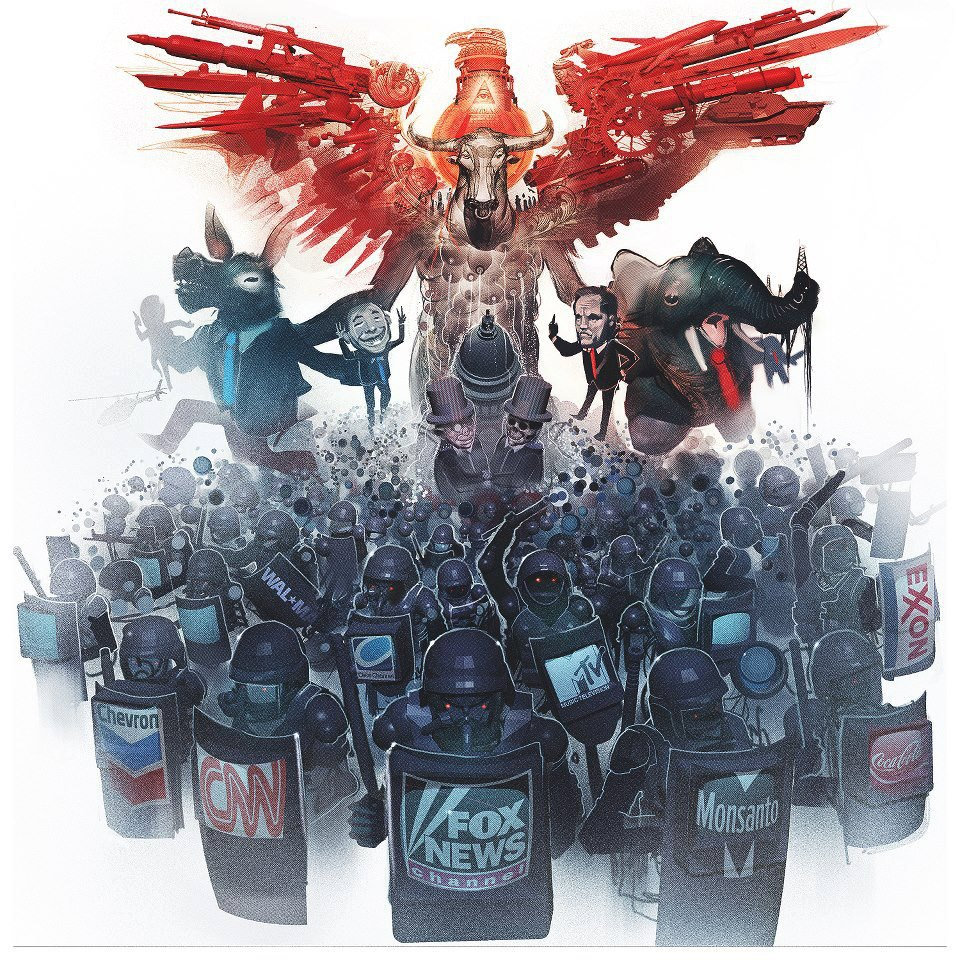
The same elite interests that own the government own the media. Hence the narrative consistency.

ALTERNATE REALITY

Given that elite interests are largely out of step with the interests of the vast majority of Americans, we often find ourselves living in an alternate reality. The war in Ukraine is just the latest iteration. Most of the reality of the conflict has been obscured from view, sins of omission that ensure the public is largely misled. Fierce and ‘principled’ op-eds reinforce the bias. For instance, little attention is paid to:

Economic motivations underlying the conflict: arms sales for American defense contractors; oil and grain profits by crisis-oriented commodity monopolies; and broader agricultural profiteering by Monsanto and Dupont via a post-coup IMF agreement; the foreclosure of the Nord Stream 2 gas pipeline from the Baltic Sea into Germany, which opens the door to western consortiums supplying the shortfall.

Ukrainian academic Olga Baysha gave a telling interview to The Gray Zone. She noted how Volodymyr Zelensky’s neoliberal policies were sold as “westernization” and “modernization” to the Ukrainian public. But these were camouflage for privatization, deregulation, and downsizing of the public sphere, all commonplace neoliberal prescriptions for wealth extraction by global corporations. To secure this narrative, Zelensky shuttered opposition media channels and political parties, including sanctions and repression before the final step.

Zelensky was following the post-coup government’s deployment of ultranationalist battalions to violently extinguish the anti-coup resistance in Donbas. That “anti-terrorist operation” was really the beginning of a civil war by Kiev against its own population, including tanks and artillery, gunships and warplanes. The subsequent Minsk peace agreements were likewise largely ignored by the aggressive Kiev action against the East.

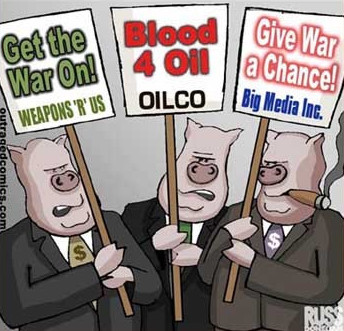
All of these political and national conflicts seem to evolve from—and devolve into—imperial economic relations. West against East, with Ukraine as a battleground. War is a revenue stream in capitalism. War is a profit center for the elites that own the media; it is only carnage for the lower classes. This distinction is rarely made.

WHY SOCIAL MEDIA HAS ABDICATED ITS ROLE

What is relatively unique in the propaganda about the Ukraine war is the degree to which social media has advanced its repressive apparatus in line with state directives. Social media became a serious thorn in the side of state power and corporate media when it consistently exposed falsehoods about the 2016 election, Russiagate, and the pandemic.

Though much war propaganda has been uncovered by scrupulous independent journalists (with a working class bias), the success of the Ukrainian narrative has been stupendous. Social media is falling in line, censoring or discrediting wrongthink whenever it appears.

What Google and YouTube and others are doing at the behest of the federal government is as Brett Weinstein said of the pandemic narrative, “They are infantilizing a huge fraction of the population. They are making certain discussions off limits.” We must “…adhere to certain pre-digested conclusions and we pretend that they emerged from evidence, which they do not.”

What we need is rational discussion. The answer to bad speech is more speech, not less. One would expect Google and YouTube and Facebook and Twitter to know this. In fact, it is very likely they do know this. As the venerable linguist politico Noam Chomsky once derisively commented, there’s no point in speaking truth to power: they already know the truth, and don’t care.

What has happened is what happens to all new media in a corporate fascist state: it is threatened until it complies with the official narrative being disseminated by the government, which is effectively owned by elite capital. Congress may have a word with Justice, and Justice may on a quiet Tuesday open the preliminaries of an antitrust investigation.

Suddenly the bright horizons of the Silicon giants are considerably dimmed. It is similar with the news media. The MSM rely too heavily on the gossip and good favor of well-placed officials; they bend too easily to the unspoken preferences of the advertisers who line their coffers; they keel too readily at the unctuous general who cavils over the soft treatment of a geopolitical rival. These perverse incentives are nicely modeled in Manufacturing Consent.

Elite capital may be loosely defined as those groups that are making enormous amounts of money off the status quo, even as many more millions are harmed by the same status quo. Elite capital used to be called “special interests.”

They are the rich and powerful billionaires who can be seen at Davos, on the boards and membership lists of the Rockefeller and Ford Foundations, the Bill and Melinda Gates Foundation and the Clinton Foundation; the Trilateral Commission and the Council on Foreign Relations; and in important think tanks like the Heritage Foundation, the American Enterprise Institute, the Brookings Institute, RAND Corporation, Cato, Hoover, CSIS, and Center for American Progress, among a proliferation of others.

They are thus not a monolithic or discrete coalition of individuals, but rather intertwined interests that share a common desire to uphold the existing establishment, by force or fraud.

MASTERS OF MYTH

Our current experience—in which we are terrifically afraid of a mild seasonal respiratory virus and terrifically xenophobic toward Russians—is reminiscent of the heyday of the Bush administration, when the neoconservative believers were riding high on a surfeit of manufactured intelligence.

Abetted by the ghoulish founder of Blairism, who claimed kindly London burghers might be liquidated by Arab WMDs in just 45 minutes. From launch to impact. From Baghdad missile shed to Kensington glade in less than an hour. Around that frightful time, George Bush’s svengali Karl Rove, educated a stunned reporter about what reality truly meant at the Metropole, in the imperium itself,

We’re an empire now, and when we act, we create our own reality. And while you’re studying that reality — judiciously, as you will — we’ll act again, creating other new realities, which you can study too, and that’s how things will sort out. We’re history’s actors … and you, all of you, will be left to just study what we do.”

That reality is what Henry Giroux called, “…the deadening unity and totalizing narratives that now marks dominant neoliberal and instrumental ideologies of the West.”

More than any moment in recent American history, we find ourselves under the spell of these reality makers, who have over the past five years produced a breathtaking array of crises that have utterly enthralled the population.

From the stunning election of a reeling madman, to chilling revelations of foreign influence, feckless investigations, failed impeachments, lethal pathogens launched from fog-draped bio labs in polluted Sino capitals, and finally to the good news of a redemptive election, only to be circumscribed by fatal new “variants” spread by pathologically stupid Trumpists.

And finally, the plague is swept from the marquee by Russian imperialism on the march in Europe. The masses automatically swap their masks for Ukrainian flags. The fear and anger remain, but are merely redirected.

WAGE SLAVERY AND PUBLIC CONSCIOUSNESS

The indoctrination of individuals into the doctrinal system of American exceptionalism is driven not only by media consolidation but also economic enslavement. First a couple of figures—as if we need more—from a John Steppling’s essay on his Aesthetic Resistance blog. He notes that in 1870 some 67 percent of Americans were self-employed, probably artisans or farmers of some kind.

Once industrial capitalism particularly in urban areas grew, that number plummeted. Today it stands at 6 percent. The point being that the independence of millions of Americans has been compromised. Now they work—millions of them—not for themselves but for vast faceless corporations.

Companies that are essentially fascist constructs, whose decisions are inscrutable to most employees, and which typically sweep the scythe of cost cutting through the ranks every few years, and increasingly turn to automated processes that are merely overseen by an incrementally deskilled workforce.

This alienation from our own work was not unaccompanied by attendent catastrophes. Alongside the vast migration of men and women into wage labor came first a rise and then a fierce destruction of union representation. That too stands at around 7 percent today, once as high as 35 percent in the early to mid 20th century, when there were socialists roaming the untamed streets and word of a Bolshevik Revolution rippled through bourgeois mansions.

The currents of the time were not overlooked by the managers of the economy. The bankers bought the papers. The president created a commission for public information. The business roundtable sketched anti-labor plot lines. Sigmund Freud’s nephew invented the dark arts of public relations.

A similar phenomenon occurred after the cultural explosion of the Sixties. The neoliberal rollback of the so-called welfare state on one hand (happily embraced by hippies as they tossed aside their tasseled suede for wide lapels and polyester pantsuits) and the co-optation of counterculture on the other.

As hippies reproduced, they found themselves suddenly needing the money on offer from the corporate monoliths they once defaced the logos of. No longer able to sustain themselves as village artisans or independent producers, they succumbed to the economic pressures and joined the rat race.

Madison Avenue, a Cyclopean beast capable of the most astonishing mimetic performances, quickly absorbed the counterculture and regurgitated rebellion as offbeat consumerism.

Everything became a style code. Facing down a lynch mob or jackbooted police cordon was replaced with wearing Chuck Conners sneakers, running marathons in ‘Just Do It’ Nikes, or donning a Coca-Cola tee shirt with a sardonic grin. At the radical end of the spectrum, burning draft cards were replaced with ‘buy nothing’ anti-consumer holidays.

Irony supplants resistance, a concession of the educated classes to the diminished prospects for revolution.

And so, having been alienated from their work, having had their counterculture killed, gutted, dressed, and stuffed, the average person has little recourse for independent thinking. At work, he is conditioned by a corporate culture that esteems ‘yes men’, pathologizes optimism, and encourages virtue signaling on behalf of the corporate charter, the values of which one is welcome to adopt as one’s own.

Away from the office, he encounters an ersatz ‘culture’ of media news and entertainment that reifies the values of the corporate state, which ostensibly include diversity, multiculturalism, and inclusion. The news instantiates the tropes of the corporate news hour, which feature the sly demonization of other societies under the guise of national security and the banner of freedom.

Then entertainment reinforces them. One reads of new sanctions levied against a rogue regime in Caracas, and then watches a new action series on Netflix in which an earnest American thwarts a diabolical scheme by the brown Venezuelan with an unquenchable thirst for yanquee blood.

IDEOLOGIES AND SUB-IDEOLOGIES

But should one spy the troubling contradictions between our professed values of inclusion and our foreign policy of exclusion, there is nowhere to turn. Unless one knows about marginalized progressive websites, Noam Chomsky primers, or a nearby Communist Meet Up, one is left with the cardboard caricatures of corporate media, which go to great lengths to convince you those contradictions are all a misunderstanding—your own, to be sure.

Without ‘comrades’ to confirm your natural mistrust, it will tend to fade as the omnipresent corporate conditioning takes over.

Louis Althusser, the French Marxist philosopher, wrote that we are all conditioned by the Ideological State Apparatuses (ISAs) and repressed by Repressive State Apparatuses (RSAs). He said we are ‘interpellated’ by the ISAs into the helpful groupthink that sustains the status quo. Perhaps to keep his readers from guzzling Drano, he did concede that ‘interventions’ were possible in which a sub-ideology breaks through a crack in the dominant ideology.

What this intervention produces, though, is indeterminate. A riotous uprising that is brutally put down by some frightful caudillo general? Whose leaders are liquidated in the bowels of some rusting soccer stadium held over from the Pan Am Games? Or perhaps the glorious, dreamed of Revolution (capital ‘R’) that guts the capitalist oligarchy, assumes its productive forces, and achieves a breathtaking synthesis of revolutionary theory and worker power? The pipe-puffing Althusser declined to say.

REALITY REPEATS ITSELF: AMOR FATI?

It is no surprise when we see such little resistance in the population to the supplying of $40 billion in lethal aid to Ukraine, or to aggressive authoritarian mandates of the government regarding the pandemic. For all of the aforementioned reasons, the dominant response is unquestioning compliance and even gratitude.

After all, having never been taught the past, or having deliberately compartmentalized those troubling histories, we digest the official narrative like a child accepts the spoonfuls of baby food from a doting mother. Tens of millions of doses of soma shoveled down the hatch at daybreak or dusk, or both, do their numbing best to aid and abet digestion of those sometimes thorny narratives, so thick with intrigue and, not occasionally, senselessness. The reward of the incurious is consensus.

Within the official narratives themselves, there is at least one constant: the demonization of the other. We can easily see parallels in the gross caricature of unvaccinated individuals as pathogenic threats in need of the needle and the demonization of Russians as barbaric hordes in need of European refinements.

These depictions are not far from the efforts of German National Socialists to segregate non-Aryans, mostly of Jewish origin, from the righteous population of pure-blood Volk. Yet one needn’t leave one’s own history to see this blatant segregationist behavior. The dark era of Jim Crow, and the modern version of the carceral state, evince the deep hostility of society for the other, those that differ in skin color, sex, gender, sexual preference, religion, ideology, economic model, or worldview.

Edward Said notes in Orientalism how the western Orientalist needed to whittle down Islam to the caricature of “tent and tribe” in order to fit it into his orderly cosmology, in which the rationalism of the European Enlightenment prevailed. Today the West performs the same reductionist act on Eurasia.

Reclining in his sumptuous country estate, the elitist Marquis tells Charles Darnay in A Tale of Two Cities, “Repression is the only lasting philosophy. The dark deference of fear and slavery…will keep the dogs obedient to the whip, as long as this roof shuts out the sky.”

Like Sinclair, Charles Dickens historicized his novels, and it might be noted that the Marquis’ venerable roof would soon fall with the collapsing scenery of the French Revolution. Whenever we are sold those confident, end-of-history tales from the corridors of elite power—be it a French chateau or a chalet in the Swiss Alps—we’d do well to recall the timeless warning of every marketplace and bazaar: caveat emptor.

Come Home, America: Stop Policing the Globe and Put an End to Wars-Without-End

By Jon W. Whitehead

Source: The Rutherford Institute

“Let us resolve that never again will we send the precious young blood of this country to die trying to prop up a corrupt military dictatorship abroad. This is also the time to turn away from excessive preoccupation overseas to the rebuilding of our own nation. America must be restored to a proper role in the world. But we can do that only through the recovery of confidence in ourselves…. together we will call America home to the ideals that nourished us from the beginning. From secrecy and deception in high places; come home, America. From military spending so wasteful that it weakens our nation; come home, America.”—George S. McGovern, former Senator and presidential candidate

I agree wholeheartedly with George S. McGovern, a former Senator and presidential candidate who opposed the Vietnam War, about one thing: I’m sick of old men dreaming up wars for young men to die in.

It’s time to bring our troops home.

Bring them home from Somalia, Afghanistan, Iraq and Syria. Bring them home from Germany, South Korea and Japan. Bring them home from Saudi Arabia, Jordan and Oman. Bring them home from Niger, Chad and Mali. Bring them home from Turkey, the Philippines, and northern Australia.

That’s not what’s going to happen, of course.

The U.S. military reportedly has more than 1.3 million men and women on active duty, with more than 200,000 of them stationed overseas in nearly every country in the world. Those numbers are likely significantly higher in keeping with the Pentagon’s policy of not fully disclosing where and how many troops are deployed for the sake of “operational security and denying the enemy any advantage.” As investigative journalist David Vine explains, “Although few Americans realize it, the United States likely has more bases in foreign lands than any other people, nation, or empire in history.”

Don’t fall for the propaganda, though: America’s military forces aren’t being deployed abroad to protect our freedoms here at home. Rather, they’re being used to guard oil fields, build foreign infrastructure and protect the financial interests of the corporate elite. In fact, the United States military spends about $81 billion a year just to protect oil supplies around the world.

The reach of America’s military empire includes close to 800 bases in as many as 160 countries, operated at a cost of more than $156 billion annually. As Vine reports, “Even US military resorts and recreation areas in places like the Bavarian Alps and Seoul, South Korea, are bases of a kind. Worldwide, the military runs more than 170 golf courses.”

This is how a military empire occupies the globe.

Already, American military servicepeople are being deployed to far-flung places in the Middle East and elsewhere in anticipation of the war drums being sounded over Iran.

This Iran crisis, salivated over by the neocons since prior to the Iraq War and manufactured by war hawks who want to jumpstart the next world war, has been a long time coming.

Donald Trump, Barack Obama, George W. Bush, Bill Clinton: they all have done their part to ensure that the military industrial complex can continue to get rich at taxpayer expense.

Take President Trump, for instance.

Despite numerous campaign promises to stop America’s “endless wars,” once elected, Trump has done a complete about-face, deploying greater numbers of troops to the Middle East, ramping up the war rhetoric, and padding the pockets of defense contractors. Indeed, Trump is even refusing to withdraw U.S. troops from Iraq in the face of a request from the Iraqi government for us to leave.

Obama was no different: he also pledged—if elected—to bring the troops home from Iraq and Afghanistan and reduce America’s oversized, and overly costly, military footprint in the world. Of course, that didn’t happen.

Yet while the rationale may keep changing for why American military forces are policing the globe, these wars abroad (in Iraq, Afghanistan, Pakistan, Syria, Yemen and now Iran) aren’t making America—or the rest of the world—any safer, are certainly not making America great again, and are undeniably digging the U.S. deeper into debt.

War spending is bankrupting America.

Although the U.S. constitutes only 5% of the world’s population, America boasts almost 50% of the world’s total military expenditure, spending more on the military than the next 19 biggest spending nations combined.

In fact, the Pentagon spends more on war than all 50 states combined spend on health, education, welfare, and safety.

The American military-industrial complex has erected an empire unsurpassed in history in its breadth and scope, one dedicated to conducting perpetual warfare throughout the earth.

Since 2001, the U.S. government has spent more than $4.7 trillion waging its endless wars.

Having been co-opted by greedy defense contractors, corrupt politicians and incompetent government officials, America’s expanding military empire is bleeding the country dry at a rate of more than $32 million per hour.

In fact, the U.S. government has spent more money every five seconds in Iraq than the average American earns in a year.

Future wars and military exercises waged around the globe are expected to push the total bill upwards of $12 trillion by 2053.

Talk about fiscally irresponsible: the U.S. government is spending money it doesn’t have on a military empire it can’t afford.

As investigative journalist Uri Friedman puts it, for more than 15 years now, the United States has been fighting terrorism with a credit card, “essentially bankrolling the wars with debt, in the form of purchases of U.S. Treasury bonds by U.S.-based entities like pension funds and state and local governments, and by countries like China and Japan.”

War is not cheap, but it becomes outrageously costly when you factor in government incompetence, fraud, and greedy contractors. Indeed, a leading accounting firm concluded that one of the Pentagon’s largest agencies “can’t account for hundreds of millions of dollars’ worth of spending.”

Unfortunately, the outlook isn’t much better for the spending that can be tracked.

A government audit found that defense contractor Boeing has been massively overcharging taxpayers for mundane parts, resulting in tens of millions of dollars in overspending. As the report noted, the American taxpayer paid:

$71 for a metal pin that should cost just 4 cents; $644.75 for a small gear smaller than a dime that sells for $12.51: more than a 5,100 percent increase in price. $1,678.61 for another tiny part, also smaller than a dime, that could have been bought within DoD for $7.71: a 21,000 percent increase. $71.01 for a straight, thin metal pin that DoD had on hand, unused by the tens of thousands, for 4 cents: an increase of over 177,000 percent.

That price gouging has become an accepted form of corruption within the American military empire is a sad statement on how little control “we the people” have over our runaway government.

Mind you, this isn’t just corrupt behavior. It’s deadly, downright immoral behavior.

Americans have thus far allowed themselves to be spoon-fed a steady diet of pro-war propaganda that keeps them content to wave flags with patriotic fervor and less inclined to look too closely at the mounting body counts, the ruined lives, the ravaged countries, the blowback arising from ill-advised targeted-drone killings and bombing campaigns in foreign lands, or the transformation of our own homeland into a warzone.

That needs to change.

The U.S. government is not making the world any safer. It’s making the world more dangerous. It is estimated that the U.S. military drops a bomb somewhere in the world every 12 minutes. Since 9/11, the United States government has directly contributed to the deaths of around 500,000 human beings. Every one of those deaths was paid for with taxpayer funds.

The U.S. government is not making America any safer. It’s exposing American citizens to alarming levels of blowback, a CIA term referring to the unintended consequences of the U.S. government’s international activities. Chalmers Johnson, a former CIA consultant, repeatedly warned that America’s use of its military to gain power over the global economy would result in devastating blowback.

The 9/11 attacks were blowback. The Boston Marathon Bombing was blowback. The attempted Times Square bomber was blowback. The Fort Hood shooter, a major in the U.S. Army, was blowback.

The assassination of Iranian General Qasem Soleimani by a U.S. military drone strike will, I fear, spur yet more blowback against the American people.

The war hawks’ militarization of America—bringing home the spoils of war (the military tanks, grenade launchers, Kevlar helmets, assault rifles, gas masks, ammunition, battering rams, night vision binoculars, etc.) and handing them over to local police, thereby turning America into a battlefield—is also blowback.

James Madison was right: “No nation could preserve its freedom in the midst of continual warfare.” As Madison explained, “Of all the enemies to public liberty war is, perhaps, the most to be dreaded because it comprises and develops the germ of every other. War is the parent of armies; from these proceed debts and taxes… known instruments for bringing the many under the domination of the few.”

We are seeing this play out before our eyes.

The government is destabilizing the economy, destroying the national infrastructure through neglect and a lack of resources, and turning taxpayer dollars into blood money with its endless wars, drone strikes and mounting death tolls.

Clearly, our national priorities are in desperate need of an overhauling.

At the height of its power, even the mighty Roman Empire could not stare down a collapsing economy and a burgeoning military. Prolonged periods of war and false economic prosperity largely led to its demise. As historian Chalmers Johnson predicts:

The fate of previous democratic empires suggests that such a conflict is unsustainable and will be resolved in one of two ways. Rome attempted to keep its empire and lost its democracy. Britain chose to remain democratic and in the process let go its empire. Intentionally or not, the people of the United States already are well embarked upon the course of non-democratic empire.

This is the “unwarranted influence, whether sought or unsought, by the military-industrial complex” that President Dwight Eisenhower warned us more than 50 years ago not to let endanger our liberties or democratic processes.

Eisenhower, who served as Supreme Commander of the Allied forces in Europe during World War II, was alarmed by the rise of the profit-driven war machine that emerged following the war—one that, in order to perpetuate itself, would have to keep waging war.

We failed to heed his warning.

As I make clear in my book Battlefield America: The War on the American People, there’s not much time left before we reach the zero hour.

It’s time to stop policing the globe, end these wars-without-end, and bring the troops home before it’s too late.

Guns for Hire: No, the Government Shouldn’t Be Using the Military to Police the Globe

By John W. Whitehead

Source: The Rutherford Institute

“Of all the enemies to public liberty war is, perhaps, the most to be dreaded because it comprises and develops the germ of every other. War is the parent of armies; from these proceed debts and taxes… known instruments for bringing the many under the domination of the few.… No nation could preserve its freedom in the midst of continual warfare.” — James Madison

Eventually, all military empires fall and fail by spreading themselves too thin and spending themselves to death.

It happened in Rome.

It’s happening again.

At the height of its power, even the mighty Roman Empire could not stare down a collapsing economy and a burgeoning military. Prolonged periods of war and false economic prosperity largely led to its demise. As historian Chalmers Johnson predicts:

The fate of previous democratic empires suggests that such a conflict is unsustainable and will be resolved in one of two ways. Rome attempted to keep its empire and lost its democracy. Britain chose to remain democratic and in the process let go its empire. Intentionally or not, the people of the United States already are well embarked upon the course of non-democratic empire.

The American Empire—with its endless wars waged by U.S. military servicepeople who have been reduced to little more than guns for hire: outsourced, stretched too thin, and deployed to far-flung places to police the globe—is approaching a breaking point.

War has become a huge money-making venture, and America, with its vast military empire and its incestuous relationship with a host of international defense contractors, is one of its best buyers and sellers. In fact, as Reuters reports, “[President] Trump has gone further than any of his predecessors to act as a salesman for the U.S. defense industry.”

Under Trump’s leadership, the U.S. military is dropping a bomb every 12 minutes.

This follows on the heels of President Obama, the so-called antiwar candidate and Nobel Peace Prize winner who waged war longer than any American president and whose targeted-drone killings resulted in at least 1.3 million lives lost to the U.S.-led war on terror.

Most recently, the Trump Administration signaled its willingness to put the lives of American troops on the line in order to guard Saudi Arabia’s oil resources. Roughly 200 American troops will join the 500 troops already stationed in Saudi Arabia. That’s in addition to the 60,000 U.S. troops that have been deployed throughout the Middle East for decades.

As The Washington Post points out, “The United States is now the world’s largest producer — and its reliance on Saudi imports has dropped dramatically, including by 50 percent in the past two years alone.”

So if we’re not protecting the oil for ourselves, whose interests are we protecting?

The military industrial complex is calling the shots, of course, and profit is its primary objective.

The military-industrial complex is also the world’s largest employer.

America has long had a penchant for endless wars that empty our national coffers while fattening those of the military industrial complex.

Aided and abetted by the U.S government, the American military-industrial complex has erected an empire unsurpassed in history in its breadth and scope, one dedicated to conducting perpetual warfare throughout the earth.

Although the U.S. constitutes only 5% of the world’s population, America boasts almost 50% of the world’s total military expenditure, spending more on the military than the next 19 biggest spending nations combined. Indeed, the Pentagon spends more on war than all 50 states combined spend on health, education, welfare, and safety.

Unfortunately, this level of war-mongering doesn’t come cheap to the taxpayers who are forced to foot the bill.

Having been co-opted by greedy defense contractors, corrupt politicians and incompetent government officials, America’s expanding military empire is bleeding the country dry at a rate of more than $32 million per hour.

In fact, the U.S. government has spent more money every five seconds in Iraq than the average American earns in a year.

With more than 800 U.S. military bases in 80 countries, the U.S. is now operating in 40 percent of the world’s nations at a cost of $160 to $200 billion annually.

Despite the fact that Congress has only officially declared war eleven times in the nation’s short history, the last time being during World War II, the United States has been at war for all but 21 of the past 243 years.

It’s cost the American taxpayer more than $4.7 trillion since 2001 to fight the government’s so-called “war on terrorism.” That’s in addition to “$127 billion in the last 17 years to train police, military and border patrol agents in many countries and to develop antiterrorism education programs, among other activities.” That does not include the cost of maintaining and staffing the 800-plus U.S. military bases spread around the globe.

The cost of perpetuating those endless wars and military exercises around the globe is expected to push the total bill upwards of $12 trillion by 2053.

The U.S. government is spending money it doesn’t have on a military empire it can’t afford.

As investigative journalist Uri Friedman puts it, for more than 15 years now, the United States has been fighting terrorism with a credit card, “essentially bankrolling the wars with debt, in the form of purchases of U.S. Treasury bonds by U.S.-based entities like pension funds and state and local governments, and by countries like China and Japan.”

War is not cheap, but it becomes outrageously costly when you factor in government incompetence, fraud, and greedy contractors.

For example, a leading accounting firm concluded that one of the Pentagon’s largest agencies “can’t account for hundreds of millions of dollars’ worth of spending.”

Unfortunately, the outlook isn’t much better for the spending that can be tracked.

Consider that the government lost more than $160 billion to waste and fraud by the military and defense contractors. With paid contractors often outnumbering enlisted combat troops, the American war effort dubbed as the “coalition of the willing” has quickly evolved into the “coalition of the billing,” with American taxpayers forced to cough up billions of dollars for cash bribes, luxury bases, a highway to nowhere, faulty equipment, salaries for so-called “ghost soldiers,” and overpriced anything and everything associated with the war effort, including a $640 toilet seat and a $7600 coffee pot.

A government audit found that defense contractor Boeing has been massively overcharging taxpayers for mundane parts, resulting in tens of millions of dollars in overspending. As the report noted, the American taxpayer paid:

$71 for a metal pin that should cost just 4 cents; $644.75 for a small gear smaller than a dime that sells for $12.51: more than a 5,100 percent increase in price. $1,678.61 for another tiny part, also smaller than a dime, that could have been bought within DoD for $7.71: a 21,000 percent increase. $71.01 for a straight, thin metal pin that DoD had on hand, unused by the tens of thousands, for 4 cents: an increase of over 177,000 percent.

That price gouging has become an accepted form of corruption within the American military empire is a sad statement on how little control “we the people” have over our runaway government.

There’s a good reason why “bloated,” “corrupt” and “inefficient” are among the words most commonly applied to the government, especially the Department of Defense and its contractors. Price gouging has become an accepted form of corruption within the American military empire.

It’s not just the American economy that is being gouged, unfortunately.

Driven by a greedy defense sector, the American homeland has been transformed into a battlefield with militarized police and weapons better suited to a war zone. Trump, no different from his predecessors, has continued to expand America’s military empire abroad and domestically, calling on Congress to approve billions more to hire cops, build more prisons and wage more profit-driven war-on-drugs/war-on-terrorism/war-on-crime programs that pander to the powerful money interests (military, corporate and security) that run the Deep State and hold the government in its clutches.

Mind you, this isn’t just corrupt behavior. It’s deadly, downright immoral behavior.

Essentially, in order to fund this burgeoning military empire that polices the globe, the U.S. government is prepared to bankrupt the nation, jeopardize our servicemen and women, increase the chances of terrorism and blowback domestically, and push the nation that much closer to eventual collapse.

Making matters worse, taxpayers are being forced to pay $1.4 million per hour to provide U.S. weapons to countries that can’t afford them. As Mother Jones reports, the Pentagon’s Foreign Military Finance program “opens the way for the US government to pay for weapons for other countries—only to ‘promote world peace,’ of course—using your tax dollars, which are then recycled into the hands of military-industrial-complex corporations.”

Clearly, our national priorities are in desperate need of an overhauling.

As Los Angeles Times reporter Steve Lopez rightly asks:

Why throw money at defense when everything is falling down around us? Do we need to spend more money on our military (about $600 billion this year) than the next seven countries combined? Do we need 1.4 million active military personnel and 850,000 reserves when the enemy at the moment — ISIS — numbers in the low tens of thousands? If so, it seems there’s something radically wrong with our strategy. Should 55% of the federal government’s discretionary spending go to the military and only 3% to transportation when the toll in American lives is far greater from failing infrastructure than from terrorism? Does California need nearly as many active military bases (31, according to militarybases.com) as it has UC and state university campuses (33)? And does the state need more active duty military personnel (168,000, according to Governing magazine) than public elementary school teachers (139,000)?

The illicit merger of the global armaments industry and the Pentagon that President Dwight D. Eisenhower warned us against more than 50 years ago has come to represent perhaps the greatest threat to the nation’s fragile infrastructure today.

The government is destabilizing the economy, destroying the national infrastructure through neglect and a lack of resources, and turning taxpayer dollars into blood money with its endless wars, drone strikes and mounting death tolls.

This is exactly the scenario Eisenhower warned against when he cautioned the citizenry not to let the profit-driven war machine endanger our liberties or democratic processes:

“Every gun that is made, every warship launched, every rocket fired signifies, in the final sense, a theft from those who hunger and are not fed, those who are cold and are not clothed. This world in arms is not spending money alone. It is spending the sweat of its laborers, the genius of its scientists, the hopes of its children. The cost of one modern heavy bomber is this: a modern brick school in more than 30 cities. It is two electric power plants, each serving a town of 60,000 population. It is two fine, fully equipped hospitals. It is some fifty miles of concrete pavement. We pay for a single fighter plane with a half million bushels of wheat. We pay for a single destroyer with new homes that could have housed more than 8,000 people. This is, I repeat, the best way of life to be found on the road the world has been taking. This is not a way of life at all, in any true sense. Under the cloud of threatening war, it is humanity hanging from a cross of iron.”

We failed to heed Eisenhower’s warning.

The illicit merger of the armaments industry and the government that Eisenhower warned against has come to represent perhaps the greatest threat to the nation today.

What we have is a confluence of factors and influences that go beyond mere comparisons to Rome. It is a union of Orwell’s 1984 with its shadowy, totalitarian government—i.e., fascism, the union of government and corporate powers—and a total surveillance state with a military empire extended throughout the world.

This is how tyranny rises and freedom falls.

As I make clear in my book Battlefield America: The War on the American People, the growth of and reliance on militarism as the solution for our problems both domestically and abroad bodes ill for the constitutional principles which form the basis of the American experiment in freedom.

After all, a military empire ruled by martial law does not rely on principles of equality and justice for its authority but on the power of the sword. As author Aldous Huxley warned: “Liberty cannot flourish in a country that is permanently on a war footing, or even a near-war footing. Permanent crisis justifies permanent control of everybody and everything by the agencies of the central government.”


War Profiteers and the Demise of the US Military-Industrial Complex

By Dmitry Orlov

Source: Club Orlov

Within the vast bureaucratic sprawl of the Pentagon there is a group in charge of monitoring the general state of the military-industrial complex and its continued ability to fulfill the requirements of the national defense strategy. Office for acquisition and sustainment and office for industrial policy spends some $100,000 a year producing an Annual Report to Congress. It is available to the general public. It is even available to the general public in Russia, and Russian experts had a really good time poring over it.

In fact, it filled them with optimism. You see, Russia wants peace but the US seems to want war and keeps making threatening gestures against a longish list of countries that refuse to do its bidding or simply don’t share its “universal values.” But now it turns out that threats (and the increasingly toothless economic sanctions) are pretty much all that the US is still capable of dishing out—this in spite of absolutely astronomical levels of defense spending. Let’s see what the US military-industrial complex looks like through a Russian lens.

It is important to note that the report’s authors were not aiming to force legislators to finance some specific project. This makes it more valuable than numerous other sources, whose authors’ main objective was to belly up to the federal feeding trough, and which therefore tend to be light on facts and heavy on hype. No doubt, politics still played a part in how various details are portrayed, but there seems to be a limit to the number of problems its authors can airbrush out of the picture and still do a reasonable job in analyzing the situation and in formulating their recommendations.

What knocked Russian analysis over with a feather is the fact that these INDPOL experts (who, like the rest of the US DOD, love acronyms) evaluate the US military-industrial complex from a… market-based perspective! You see, the Russian military-industrial complex is fully owned by the Russian government and works exclusively in its interests; anything else would be considered treason. But the US military-industrial complex is evaluated based on its… profitability! According to INDPOL, it must not only produce products for the military but also acquire market share in the global weapons trade and, perhaps most importantly, maximize profitability for private investors. By this standard, it is doing well: for 2017 the gross margin (EBITDA) for US defense contractors ranged from 15 to 17%, and some subcontractors—Transdigm, for example—managed to deliver no less than 42-45%. “Ah!” cry the Russian experts, “We’ve found the problem! The Americans have legalized war profiteering!” (This, by the way, is but one of many instances of something called systemic corruption, which is rife in the US.)

It would be one thing if each defense contractor simply took its cut off the top, but instead there is an entire food chain of defense contractors, all of which are legally required, no less, to maximize profits for their shareholders. More than 28,000 companies are involved, but the actual first-tier defense contractors with which the Pentagon places 2/3 of all defense contracts are just the Big Six: Lockheed Martin, Northrop Grumman, Raytheon, General Dynmics, BAE Systems and Boeing. All the other companies are organized into a pyramid of subcontractors with five levels of hierarchy, and at each level they do their best to milk the tier above them.

The insistence on market-based methods and the requirement of maximizing profitability turns out to be incompatible with defense spending on a very basic level: defense spending is intermittent and cyclical, with long fallow intervals between major orders. This has forced even the Big Six to make cuts to their defense-directed departments in favor of expanding civilian production. Also, in spite of the huge size of the US defense budget, it is of finite size (there being just one planet to blow up), as is the global weapons market. Since, in a market economy, every company faces the choice of grow or get bought out, this has precipitated scores of mergers and acquisitions, resulting in a highly consolidated marketplace with a few major players in each space.

As a result, in most spaces, of which the report’s authors discuss 17, including the Navy, land forces, air force, electronics, nuclear weapons, space technology and so on, at least a third of the time the Pentagon has a choice of exactly one contractor for any given contract, causing quality and timeliness to suffer and driving up prices.

In a number of cases, in spite of its industrial and financial might, the Pentagon has encountered insoluble problems. Specifically, it turns out that the US has only one shipyard left that is capable of building nuclear aircraft carriers (at all, that is; the USS Gerald Ford is not exactly a success). That is Northrop Grumman Newport News Shipbuilding in Newport, Virginia. In theory, it could work on three ships in parallel, but two of the slips are permanently occupied by existing aircraft carriers that require maintenance. This is not a unique case: the number of shipyards capable of building nuclear submarines, destroyers and other types of vessels is also exactly one. Thus, in case of a protracted conflict with a serious adversary in which a significant portion of the US Navy has been sunk, ships will be impossible to replace within any reasonable amount of time.

The situation is somewhat better with regard to aircraft manufacturing. The plants that exist can produce 40 planes a month and could produce 130 a month if pressed. On the other hand, the situation with tanks and artillery is absolutely dismal. According to this report, the US has completely lost the competency for building the new generation of tanks. It is no longer even a question of missing plant and equipment; in the US, a second generation of engineers who have never designed a tank is currently going into retirement. Their replacements have no one to learn from and only know about modern tanks from movies and video games. As far as artillery, there is just one remaining production line in the US that can produce barrels larger than 40mm; it is fully booked up and would be unable to ramp up production in case of war. The contractor is unwilling to expand production without the Pentagon guaranteeing at least 45% utilization, since that would be unprofitable.

The situation is similar for the entire list of areas; it is better for dual-use technologies that can be sourced from civilian companies and significantly worse for highly specialized ones. Unit cost for every type of military equipment goes up year after year while the volumes being acquired continuously trend lower—sometimes all the way to zero. Over the past 15 years the US hasn’t acquired a single new tank. They keep modernizing the old ones, but at a rate that’s no higher than 100 a year.

Because of all these tendencies and trends, the defense industry continues to lose not only qualified personnel but also the very ability to perform the work. INDPOL experts estimate that the deficit in machine tools has reached 27%. Over the past quarter-century the US has stopped manufacturing a wide variety of manufacturing equipment. Only half of these tools can be imported from allies or friendly nations; for the rest, there is just one source: China. They analyzed the supply chains for 600 of the most important types of weapons and found that a third of them have breaks in them while another third have completely broken down. In the Pentagon’s five-tier subcontractor pyramid, component manufacturers are almost always relegated to the bottommost tier, and the notices they issue when they terminate production or shut down completely tend to drown in the Pentagon’s bureaucratic swamp.

The end result of all this is that theoretically the Pentagon is still capable of doing small production runs of weapons to compensate for ongoing losses in localized, low-intensity conflicts during a general time of peace, but even today this is at the extreme end of its capabilities. In case of a serious conflict with any well-armed nation, all it will be able to rely on is the existing stockpile of ordnance and spare parts, which will be quickly depleted.

A similar situation prevails in the area of rare earth elements and other materials for producing electronics. At the moment, the accumulated stockpile of these supplies needed for producing missiles and space technology—most importantly, satellites—is sufficient for five years at the current rate of use.

The report specifically calls out the dire situation in the area of strategic nuclear weapons. Almost all the technology for communications, targeting, trajectory calculations and arming of the ICBM warheads was developed in the 1960s and 70s. To this day, data is loaded from 5-inch floppy diskettes, which were last mass-produced 15 years ago. There are no replacements for them and the people who designed them are busy pushing up daisies. The choice is between buying tiny production runs of all the consumables at an extravagant expense and developing from scratch the entire land-based strategic triad component at the cost of three annual Pentagon budgets.

There are lots of specific problems in each area described in the report, but the main one is loss of competence among technical and engineering staff caused by a low level of orders for replacements or for new product development. The situation is such that promising new theoretical developments coming out of research centers such as DARPA cannot be realized given the present set of technical competencies. For a number of key specializations there are fewer than three dozen trained, experienced specialists.

This situation is expected to continue to deteriorate, with the number of personnel employed in the defense sector declining 11-16% over the next decade, mainly due to a shortage of young candidates qualified to replace those who are retiring. A specific example: development work on the F-35 is nearing completion and there won’t be a need to develop a new jet fighter until 2035-2040; in the meantime, the personnel who were involved in its development will be idled and their level of competence will deteriorate.

Although at the moment the US still leads the world in defense spending ($610 billion of $1.7 trillion in 2017, which is roughly 36% of all the military spending on the planet) the US economy is no longer able to support the entire technology pyramid even in a time of relative peace and prosperity. On paper the US still looks like a leader in military technology, but the foundations of its military supremacy have eroded. Results of this are plainly visible:

• The US threatened North Korea with military action but was then forced to back off because it has no ability to fight a war against it.

• The US threatened Iran with military action but was then forced to back off because it has no ability to fight a war against it.

• The US lost the war in Afghanistan to the Taliban, and once the longest military conflict in US history is finally over the political situation there will return to status quo ante with the Taliban in charge and Islamic terrorist training camps back in operation.

• US proxies (Saudi Arabia, mostly) fighting in Yemen have produced a humanitarian disaster but have been unable to prevail militarily.

• US actions in Syria have led to a consolidation of power and territory by the Syrian government and newly dominant regional position for Russia, Iran and Turkey.

• The second-largest NATO power Turkey has purchased Russian S-400 air defense systems. The US alternative is the Patriot system, which is twice as expensive and doesn’t really work.

All of this points to the fact that the US is no longer much a military power at all. This is good news for at least the following four reasons.

First, the US is by far the most belligerent country on Earth, having invaded scores of nations and continuing to occupy many of them. The fact that it can’t fight any more means that opportunities for peace are bound to increase.

Second, once the news sinks in that the Pentagon is nothing more than a flush toilet for public funds its funding will be cut off and the population of the US might see the money that is currently fattening up war profiteers being spent on some roads and bridges, although it’s looking far more likely that it will all go into paying interest expense on federal debt (while supplies last).

Third, US politicians will lose the ability to keep the populace in a state of permanent anxiety about “national security.” In fact, the US has “natural security”—two oceans—and doesn’t need much national defense at all (provided it keeps to itself and doesn’t try to make trouble for others). The Canadians aren’t going to invade, and while the southern border does need some guarding, that can be taken care of at the state/county level by some good ol’ boys using weapons and ammo they already happen to have on hand. Once this $1.7 trillion “national defense” monkey is off their backs, ordinary American citizens will be able to work less, play more and feel less aggressive, anxious, depressed and paranoid.

Last but not least, it will be wonderful to see the war profiteers reduced to scraping under sofa cushions for loose change. All that the US military has been able to produce for a long time now is misery, the technical term for which is “humanitarian disaster.” Look at the aftermath of US military involvement in Serbia/Kosovo, Afghanistan, Iraq, Libya, Syria and Yemen, and what do you see? You see misery—both for the locals and for US citizens who lost their family members, had their limbs blown off, or are now suffering from PTSD or brain injury. It would be only fair if that misery were to circle back to those who had profited from it.

Bust the Trust: Now is the Time to Break Up Amazon

By Andy Laties with additional reporting by Sander Hicks

Source: The New York Megaphone

Standing at the cash register at an Upper West Side independent bookstore I used to run, I once noted the frequent passage of cars painted all over with Amazon’s “And You’re Done” logo. These same-day delivery vehicles were Amazon’s way of pushing back against the resurgence of New York City independent bookselling in progress. Soon, the cars were joined by a Columbus Circle location of the Amazon Books chain. That brick-and-mortar store gave lie to Amazon’s long-standing rhetoric that physical bookstores were doomed.

I have competed with Amazon for twenty years. A couple years ago, we indies were finally winning. 2015 was a great year. More independent stores were opening than closing: Books Are Magic, Greenlight, Word Up, Stories, Archestratus Books & Foods, Astoria Bookshop and Quimby’s. New locations for Book Culture, McNally Jackson, WORD and Books of Wonder were in the works. That trend was mirrored nationally. While our numbers had fallen from 4,000 to 1,500, between 1995 and 2005, now we were pushing 2,000 bookstores again.

Why do indy bookstores matter so much? Well, here’s one way to put it, from the writer Ocean Vuong, “The way I see it, whenever someone walks into a bookstore, they are walking into the future of their cultural and intellectual life. A bookseller collaborates with who you are in order to show you a way forward towards more of yourself, a way you might not have known existed for you–but is still entirely your own. Amazon, with its algorithms, can only show you where you’ve been, can only give you the calcified mirror of your past. In a bookstore, you get a human being who is also a mapmaker of possibility.”


A PEOPLE’S HISTORY OF AMAZON

Amazon itself had started as a New York City project. But retailers don’t collect sales tax on out-of-state shipments. So when hedge fund boy wonder Jeff Bezos rounded up his one million in in start-up capital, he left New York City behind. He launched his company in the lightly-populated Washington State. Bezos planned a national mail-order operation that wouldn’t have to collect sales tax in any other state, especially populous New York and California. Thus, most customers would enjoy a six percent or more cost reduction on each sale.

We indie businesses fought together for twenty years to force Amazon to collect sales tax. And we won. I’m proud of what we fierce indies did to force Amazon to pay sales tax. These taxes fund public services like Medicaid and the local fire department. But Amazon had evolved during the battle, and like that strangling kudzu vine you thought you killed last Fall, it grew back even bigger in the Spring. Instead of dying, Amazon turned into that monster plant from Little Shop of Horrors.

After our victories at the state and national levels, there was no longer any reason for Bezos to base his company in Seattle. That’s one reason Amazon is expanding with a big new HQ2 planned for Crystal City, VA. They recently planned to come back to New York City, but chickened out due to the public criticisms about Amazon’s lucrative tax breaks.

Ten years ago, Amazon used to be an innovative book-seller online. Today, They work for CIA, NSA, they help do facial recognition for ICE. They are bidding to create a “new brain” for the Pentagon, in the little-known “JEDI” program. With Jeff Bezos’s ownership of the Washington Post, they are simultaneously powerful DC lobbyists, defense contractors, spies, and a leading DC media vehicle. Amazon is one juggernaut of unbridled corporate and war-making power.

Amazon developed its Amazon Web Services (AWS), the highly profitable, cloud-hosting division, out of the software and hardware infrastructure that runs its online retail operation. Recent headlines tell the tale of how Amazon monetized AWS. Technology Review reported, “Amazon is the Invisible Backbone Behind ICE’s Immigration Crackdown” And Business Insider let us know that “Amazon is Launching a ‘Secret’ Cloud Service for the CIA.” “‘Alexa, Drop a Bomb’: Amazon Wants in on US Warfare” reveals the plans between Amazon and the Pengaton, for the new JEDI program, as reported by Truthout.

The new Amazon wants to become a leading merchant of death, specializing in robotic drones, while moonlighting as web host for ICE and CIA. Its planned “Washington D.C. footprint” is just across the highway from the Pentagon. The failed effort to come into Queens was offering “twenty-five-thousand jobs.” But who can count how many jobs Amazon has killed, and how many retail stores have closed, due to Amazon artificially lowering prices? (A recent article in Yale Law School journal makes the case that Amazon might be on the road to being a monopoly, since it artificially lowers prices to kill competition.) Amazon promises to add jobs in NYC, but recently committed to making those jobs non-union. Workers at Amazon warehouses complain of onerous conditions at low wages, in which bathroom breaks are rare, and workers sometimes have to urinate into plastic bottles.

Amazon is super convenient. It’s true. But Amazon’s retail customers will feel angst and regret once they learn their dollars pay for robotic drone warfare and racial profiling of immigrants.

Recently, the American Booksellers Association reported that Amazon could be a monopoly. They control 75% of all online retail bookselling, the way that Standard Oil controlled the oil industry, before it was broken up as a monopoly, in 1911.

Let’s resist this new version of the Amazon monopoly. Amazon is an arms dealer and corporate spy. Let’s advocate that the Federal Trade Commission dismember the Amazon octopus. Let’s support a movement that is fired up to do “trust-busting.”

For our safety, it’s time to break up Amazon.


Andrew Laties is the author of Rebel Bookseller: Why Indie Businesses Stand for Everything You Want to Fight For, from Free Speech to Buying Local to Building Communities. He currently co-owns Book and Puppet Company, in Easton, Pennsylvania.

The Military Industrial Complex Strikes Again: War Spending Will Bankrupt America

By John W. Whitehead

Source: The Rutherford Institute

Why throw money at defense when everything is falling down around us? Do we need to spend more money on our military (about $600 billion this year) than the next seven countries combined? Do we need 1.4 million active military personnel and 850,000 reserves when the enemy at the moment — ISIS — numbers in the low tens of thousands? If so, it seems there’s something radically wrong with our strategy. Should 55% of the federal government’s discretionary spending go to the military and only 3% to transportation when the toll in American lives is far greater from failing infrastructure than from terrorism? Does California need nearly as many active military bases (31, according to militarybases.com) as it has UC and state university campuses (33)? And does the state need more active duty military personnel (168,000, according to Governing magazine) than public elementary school teachers (139,000)?”— Steve Lopez, Los Angeles Times

Mark my words, America’s war spending will bankrupt the nation.

For that matter, America’s war spending has already bankrupted the nation to the tune of more than $20 trillion dollars.

Now the Trump Administration is pushing for a $4.4 trillion budget for fiscal year 2019 that would add $7 trillion to the already unsustainable federal deficit in order to sustain America’s military empire abroad and dramatically expand the police state here at home. Trump also wants American taxpayers to cover the cost of building that infamous border wall.

Truly, Trump may turn out to be, as policy analyst Stan Collender warned, “the biggest deficit- and debt-increasing president of all time.”

For those in need of a quick reminder: “A budget deficit is the difference between what the federal government spends and what it takes in. The national debt, also known as the public debt, is the result of the federal government borrowing money to cover years and years of budget deficits.”

Right now, the U.S. government is operating in the negative on every front: it’s spending far more than what it makes (and takes from the American taxpayers) and it is borrowing heavily (from foreign governments and Social Security) to keep the government operating and keep funding its endless wars abroad.

This is how military empires fall and fail: by spreading themselves too thin and spending themselves to death.

It happened in Rome. It’s happening again.

Not content to merely police the globe, in recent decades, America has gradually transformed its homeland into a battlefield with militarized police and weapons better suited to a war zone.

Since taking office, President Trump—much like his predecessors—has marched in lockstep with the military. Now Trump wants $716 billion to expand America’s military empire abroad and billions more to hire cops, build more prisons and wage more profit-driven war-on-drugs/war-on-terrorism/war-on-crime programs that eat away at the Fourth Amendment while failing to make the country any safer.

Even the funds requested for infrastructure will do little to shore up the nation’s crumbling roads, bridges, railways, highways, power grids and dams.

No matter how your break it down, this is not a budget aimed at perfecting the Union, establishing justice, insuring domestic tranquility, providing for the common defense, promoting general welfare, or securing the blessings of liberty for the American people.

No, this is a budget aimed at pandering to the powerful money interests (military, corporate and security) that run the Deep State and hold the government in its clutches.

So much for Trump’s campaign promises to balance the budget and drain the swamps of corruption.

The glaring economic truth is that at the end of the day, it’s the military industrial complex—and not the sick, the elderly or the poor—that is pushing America towards bankruptcy.

As investigative journalist Uri Friedman puts it, for more than 15 years now, the United States has been fighting terrorism with a credit card, “essentially bankrolling the wars with debt, in the form of purchases of U.S. Treasury bonds by U.S.-based entities like pension funds and state and local governments, and by countries like China and Japan.”

The illicit merger of the armaments industry and the Pentagon that President Dwight D. Eisenhower warned us against more than 50 years ago has come to represent perhaps the greatest threat to the nation’s fragile infrastructure today.

Having been co-opted by greedy defense contractors, corrupt politicians and incompetent government officials, America’s expanding military empire is bleeding the country dry at a rate of more than $15 billion a month (or $20 million an hour)—and that’s just what the government spends on foreign wars.

That does not include the cost of maintaining and staffing the 1000-plus U.S. military bases spread around the globe.

Incredibly, although the U.S. constitutes only 5% of the world’s population, America boasts almost 50% of the world’s total military expenditure,  spending more on the military than the next 19 biggest spending nations combined.

In fact, the Pentagon spends more on war than all 50 states combined spend on health, education, welfare, and safety.

War is not cheap.

Although the federal government obscures so much about its defense spending that accurate figures are difficult to procure, we do know that since 2001, the U.S. government has spent more than $1.8 trillion in the wars in Afghanistan and Iraq (that’s $8.3 million per hour).

That doesn’t include wars and military exercises waged around the globe, which are expected to push the total bill upwards of $12 trillion by 2053.

Mind you, these ongoing wars—riddled by corruption, graft and bumbling incompetence—have done little to keep the country safe while enriching the military industrial complex—and private defense contractors—at taxpayer expense.

Just recently, for example, a leading accounting firm concluded that one of the Pentagon’s largest agencies “can’t account for hundreds of millions of dollars’ worth of spending.”

Just consider the fact that it costs American taxpayers $2.1 million per year for each soldier deployed in Afghanistan.

Imagine what you could do with that money if it were spent on domestic needs here at home.

Unfortunately, that’s not going to happen anytime soon, not as long as the money interests in Washington keep calling the shots and profiting from the spoils of war.

War has become a huge money-making venture, and America, with its vast military empire, is one of its best buyers and sellers. Not only does the U.S. have the largest defense budget, it also ranks highest as the world’s largest arms exporter.

The American military-industrial complex has erected an empire unsurpassed in history in its breadth and scope, one dedicated to conducting perpetual warfare throughout the earth.

For example, while erecting a security surveillance state in the U.S., the military-industrial complex has perpetuated a worldwide military empire with American troops stationed in 177 countries (over 70% of the countries worldwide).

In the process, billions have been spent erecting luxury military installations throughout the world.

For example, the U.S. Embassy built in Iraq, dubbed “Fortress Baghdad,” covers 104 acres and boasts a “city within a city” that includes six apartment buildings, a Marine barracks, swimming pool, shops and 15-foot-thick walls. Camp Anaconda in Iraq, like many U.S. military bases scattered across the globe, was structured to resemble a mini-city with pools, fast food restaurants, miniature golf courses and movie theaters.

While most Americans can scarcely afford the cost of heating and cooling their own homes, the American government spends $20 billion annually just to provide air conditioning for military installations in Iraq and Afghanistan.

In essence, what we’re doing is “we’re air conditioning the desert over there in Afghanistan, Iraq, and other places,” noted retired brigadier general Steven Anderson, a former chief logistician for Gen. David Petraeus in Iraq.

Think about that for a minute.

There’s a good reason why “bloated,” “corrupt” and “inefficient” are among the words most commonly applied to the government, especially the Department of Defense and its contractors.

For instance, a study by the Government Accountability Office found that $70 billion worth of cost overruns by the Pentagon were caused by management failures. To put that in perspective, that equates to one and a half times the State Department’s entire $47 billion annual budget.

Fraud is rampant.

A government audit, for example, found that defense contractor Boeing has been massively overcharging taxpayers for mundane parts, resulting in tens of millions of dollars in overspending. As the report noted, the American taxpayer paid:

$71 for a metal pin that should cost just 4 cents; $644.75 for a small gear smaller than a dime that sells for $12.51: more than a 5,100 percent increase in price. $1,678.61 for another tiny part, also smaller than a dime, that could have been bought within DoD for $7.71: a 21,000 percent increase. $71.01 for a straight, thin metal pin that DoD had on hand, unused by the tens of thousands, for 4 cents: an increase of over 177,000 percent.

Price gouging has become an accepted form of corruption within the American military empire.

And if you think gas prices at home can get high, just consider what the American taxpayer is being forced to shell out overseas: once all the expenses of delivering gas to troops in the field are factored in, we’re paying between $18-30 per gallon for gas in Iraq and Afghanistan.

Incredibly, despite reports of corruption, abuse and waste, the mega-corporations behind much of this ineptitude and corruption continue to be awarded military contracts worth billions of dollars.

The rationale may keep changing for why American military forces are in Afghanistan, Iraq and elsewhere, but the one that remains constant is that those who run the government are feeding the appetite of the military industrial complex.

What began in 2001 as part of an alleged effort to root out al Qaeda has turned into a goldmine for the military industrial complex and its army of private contractors.

Just consider: the Pentagon in 2008 spent more money every five seconds in Iraq than the average American earned in a year.

Yet Congress and the White House want taxpayers to accept that the only way to reduce the nation’s ballooning deficit is by cutting “entitlement” programs such as Social Security and Medicare?

As Martin Luther King Jr. recognized, under a military empire, war and its profiteering will always take precedence over the people’s basic human needs.

Simply put, we cannot afford to maintain our over-extended military empire.

Money is the new 800-pound gorilla,” remarked a senior administration official involved in Afghanistan. “It shifts the debate from ‘Is the strategy working?’ to ‘Can we afford this?’ And when you view it that way, the scope of the mission that we have now is far, far less defensible.”

Or as one commentator noted, “Foreclosing the future of our country should not be confused with defending it.”

Inevitably, military empires collapse.

As Cullen Murphy, author of Are We Rome? and editor-at-large of Vanity Fair writes:

A millennium hence America will be hard to recognize. It may not exist as a nation-state in the form it does now—or even exist at all. Will the transitions ahead be gradual and peaceful or abrupt and catastrophic? Will our descendants be living productive lives in a society better than the one we inhabit now? Whatever happens, will valuable aspects of America’s legacy weave through the fabric of civilizations to come? Will historians someday have reason to ask, Did America really fall?

The problem we wrestle with is none other than a distorted American empire, complete with mega-corporations, security-industrial complexes and a burgeoning military. And it has its sights set on absolute domination.

Eventually, however, all military empires fail.

At the height of its power, even the mighty Roman Empire could not stare down a collapsing economy and a burgeoning military. Prolonged periods of war and false economic prosperity largely led to its demise. As historian Chalmers Johnson predicts:

The fate of previous democratic empires suggests that such a conflict is unsustainable and will be resolved in one of two ways. Rome attempted to keep its empire and lost its democracy. Britain chose to remain democratic and in the process let go its empire. Intentionally or not, the people of the United States already are well embarked upon the course of non-democratic empire.

I would suggest that what we have is a confluence of factors and influences that go beyond mere comparisons to Rome.

It is a union of Orwell’s 1984 with its shadowy, totalitarian government—i.e., fascism, the union of government and corporate powers—and a total surveillance state with a military empire extended throughout the world.

As we have seen with the militarizing of the police, the growth of and reliance on militarism as the solution for our problems both domestically and abroad affects the basic principles upon which American society should operate.

We must keep in mind that a military empire will be ruled not by lofty ideals of equality and justice but by the power of the sword. Those in the military are primarily trained to conduct warfare, not preserve the peace.

Here’s the kicker, though: if the American empire falls and the American economy collapses—and with it the last vestiges of our constitutional republic—it will be the government and its trillion-dollar war budgets that are to blame.

Of course, the government has already anticipated this breakdown.

That’s why the government has transformed America into a war zone, turned the nation into a surveillance state, and labelled “we the people” as enemy combatants.

For years now, the government has worked with the military to prepare for widespread civil unrest brought about by “economic collapse, loss of functioning political and legal order, purposeful domestic resistance or insurgency, pervasive public health emergencies, and catastrophic natural and human disasters.”

Having spent more than half a century exporting war to foreign lands, profiting from war, and creating a national economy seemingly dependent on the spoils of war, the war hawks long ago turned their profit-driven appetites on us, bringing home the spoils of war—the military tanks, grenade launchers, Kevlar helmets, assault rifles, gas masks, ammunition, battering rams, night vision binoculars, etc.—and handing them over to local police, thereby turning America into a battlefield.

As I make clear in my book Battlefield America: The War on the American People, this is how the police state wins and “we the people” lose.

More than 50 years ago, President Dwight Eisenhower warned us not to let the profit-driven war machine endanger our liberties or democratic processes.

We failed to heed his warning.

As Eisenhower recognized in a speech given to the American Society of Newspaper Editors, on Apr. 16, 1953, the consequences of allowing the military-industrial complex to wage war, exhaust our resources and dictate our national priorities are beyond grave:

“Every gun that is made, every warship launched, every rocket fired signifies, in the final sense, a theft from those who hunger and are not fed, those who are cold and are not clothed. This world in arms is not spending money alone. It is spending the sweat of its laborers, the genius of its scientists, the hopes of its children. The cost of one modern heavy bomber is this: a modern brick school in more than 30 cities. It is two electric power plants, each serving a town of 60,000 population. It is two fine, fully equipped hospitals. It is some fifty miles of concrete pavement. We pay for a single fighter plane with a half million bushels of wheat. We pay for a single destroyer with new homes that could have housed more than 8,000 people… This is not a way of life at all, in any true sense. Under the cloud of threatening war, it is humanity hanging from a cross of iron.”