Saturday Matinee: Junk Head

By Niels Matthijs

Source: onderhond.com

It must’ve been two or three years ago when I first heard about Takahide Tori’s Junk Head [Janku Heddo]. I didn’t need more than a single screenshot to know this was a film that was going to be right up my ally. Several years and countless geo-locked film festivals later, I was finally able to watch it. Junk Head is one of those rare films that actually managed to surpass my initial expectations, Tori’s passion project is an absolute wet dream for fans of stop-motion and sci-fi, with gleaming bonus appeal for those who have an appetite for the weird and creative.

To brand this film a passion project is in fact a gross understatement. Takahide Tori is an interior decorator by profession, who started this project in 2009 without any of the formal training needed to tackle a project like this. What’s more is that he started this journey all on his own. It took him about 4 years and an endless amount of YouTube tutorials to create a 30-minute short. After garnering the vocal support of some big industry names (Guillermo del Toro being one of them), additional funding and a little outside help pushed him to make a 115-minute version, which was later trimmed down to the 101-minute cut that is currently making the rounds.

Reviewers have cited many influences when writing about Junk Head, the most prominent (and interesting) one for me is Tsutomu Nihei’s Blame (coincidentally Nihei is an architect turned mangaka). But where Nihei’s first masterpiece is all about rising through a superstructure, Junk Head’s hero is descending into an underground one. And sure enough, the creature design borrows happily from H.R. Giger, Tsukamoto’s cyberpunk roots peek around every corner and names like Lynch or Cronenberg make for sane analogies, but when all is said and done, there’s nothing really quite like Junk Head out there.

The plot is set in a distant future. Mankind has lost its ability to procreate, a human-created species has revolted and developed a separate society underground. When a virus wreaks havoc on the surface, an expedition is launched to study how this newly developed species procreate, in an ultimate but somewhat desperate attempt to save humankind. The human delegate immediately finds himself in a pickle and as he travels deeper and deeper underground, his chances to complete his mission diminish with every step taken. Instead, his journey becomes an ultimate struggle for survival.

It’s difficult to overstate the visual grandeur present in Junk Head. Looking at the lushly decorated, detailed and expansive sets, Hori surely benefitted from his experience as an interior decorator, but even then it’s hard to believe what he accomplished here. The camera work is insane, the art design superb, the stop-motion animation on point. It’s crazy to think most of it was done by a single guy, but even without taking that into account Junk Head still looks mighty impressive. Not counting some CG work that was added at a later stage, this is true craftsmanship from start to finish. The style is extremely coherent though, which is great if you love this kind of gritty and ugly bleakness, those hoping for a more colorful and jolly universe better stay clear.

Though Hori’s visual accomplishments may be the obvious standout, it’s worth noting that he also took almost all the sound work upon himself. From the actual score, to the sound effects and character dubs (which aren’t in a decipherable language, but do feature distinct voices), it’s all done by Hori himself. And while this may have been out of necessity, the quality of his work is once again exemplary. The electronic score is very fitting, adding oodles of atmosphere, the voice acting is fun and distinctive and the sound effects are spot on. Together with the visuals it creates a tight and immersive experience, the kind you can only get when an entire team is entirely in sync, or when one guy does everything by himself.

Junk Head is an expansive sci-fi adventure, where the audience is forced to discover a strange and alien underground world together with the main character. Hori does take a little time to explain the broader lore of this universe, but doesn’t get into too much detail. It keeps his world wrapped in a veil of mystery, which probably won’t be to everybody’s liking. Personally, I welcome the mystery and adventure, following the events as they are experienced by the main character. Those who need more grounded explanations for what they see on screen may feel a bit disoriented at times.

As for any additional themes, the broader story offers some food for thought if needed. The premise isn’t all that original though, with humanity’s usual flaws sending us to the brink of extinction, having to resort to desperate measures to find a way out of the mess we created for ourselves. I’m not even certain whether Hori takes any of this too seriously, it could just as well be a convenient excuse for the gritty and uninhabitable world he wanted to depict, but at least it’s there for those who care about such things. The fact that there’s not really a clear-cut ending or an easy way out of this mess certainly helps too.

Every fan of Japanese cyberpunk will tell you not nearly enough films are being produced in this niche. That alone makes Junk Head a notable film. The (admittedly slim) bright side of this is that filmmakers who do try their hand at it are usually very spirited and driven to do the genre justice. With Junk Head, Hori delivers a sprawling sci-fi adventure, meticulously styled, set in a dark and perilous universe that harbors neat surprises around every corner. It’s a living testament that one person can still deliver a professional film, even if it costs him 7 years of his life. An absolute must-see this one, make sure you catch it if the opportunity arises.


Watch Junk Head on Tubi here: https://tubitv.com/movies/100040381/junk-head

Saturday Matinee: Neptune Frost

By Robert Daniels

Source: RogerEbert.com

“Neptune Frost,” the dense Afrofuturist film from co-directors Saul Williams and Anisia Uzeyman, holds many resplendent identities at once: It’s a musical; it’s an intersex narrative; it’s a technological allegory espousing anticapitalist and anticolonialist views. It’s a collective dream coated in a blue lacquer dancing on the edge of something unrecognizable, something wholly transcendent. And it arrives with an exceptional display of bravura.

The film’s nimbleness, marked by a brazenness suggesting creators who allow their imaginations to be the moth that reaches for the stars, is apparent from the jump when the camera pans across the graveled gray and orange ridges of a mine. One of the miners, Tekno, beholds a chunk of coltan, the metal used to power our cellphones and other high-tech electronics, only to be summarily struck to death by the butt of a soldier’s gun. His grief-stricken brother Matalusa (Bertrand Ninteretse) cradles him as the other workers, accompanied by drums, with shovels hitting the ground for additional percussion, dance in mourning. This incident causes Matalusa to flee the mine, and a waking dream guides him to another dimension.

A similar, parallel vision, following the death of their aunt and a traumatic experience involving a pastor, pulls Neptune (Elvis “Bobo” Ngabo) away from their Rwandan village through the backroads of a country in upheaval. “I was born in my 23rd year,” explains Neptune in the film’s opening narration. And it’s not until Neptune transforms (this time played by Cheryl Isheja) that we figure out what exactly this ambiguous, yet potent line means.

Neptune is an intersex hacker exploring and disrupting binaries. They arrive in that other dimension, a village fed by a mysterious power source, to find Matalusa. There they discover a band of rebellious Black folks, such as Memory (Eliane Umuhire), Psychology (Trésor Niyongabo), and so forth who want to transform the world away from domineering colonialist powers, away from a totalitarian government known as the Authority, and out from one age into another. “Neptune Frost” demands your attention. Uzeyman’s luminous cinematography caresses black skin under blue and purple lights, allowing this talented group of actors to play to every corner of their innate beauty. The ingenious costumes by Cedric Mizero—a collection of wires, knobs, and hard drives—range from motherboard chic to a lightweight yet richly colored fabric that is elegant. The musical numbers, fusions of singer-songwriter Williams’ Afropunk style with atmospheric drones owing to Sun Ra, spring from the group so organically you immediately become fluent in their dynamic rhythms, moods, and tones.

While the artistry does dazzle, you never forget that “Neptune Frost” is a movie dedicated to the cause of liberation: a liberation of stolen resources and Black folks, and a freedom of the body. I found myself enraptured by the scenes of community building, of Africans bound together by a love for each other and a hope for the future moving toward revolutionary ends. The scenes of dance and happiness in this dimension, hidden away from white eyes (for the time being) is soul filling. In this ecstasy, in spite of an outside war-torn world, Neptune and Matalusa commit not just to the cause but to their shared spirit. Their bliss is idyllic, and therefore short lived. But it’s their willingness to challenge the Authority, through their romance and the acting of hacking, that serves as a battle cry against governments unwilling to serve their people. 

While the logic guiding “Neptune Frost” is difficult to follow, this isn’t the kind of work you can sleepwalk through. It pushes the viewer. There are no wasted plot points, no unnecessary pieces of dialogue or needless landscapes. Every texture contains a million little stories. It is humbling to see two filmmakers so curious, and so creatively playful as to invite messiness and brilliance. In all its so muchness, “Neptune Frost” is a reminder of cinema’s infinite storytelling possibilities.  


Watch Neptune Frost on Kanopy here: https://www.kanopy.com/en/product/neptune-frost

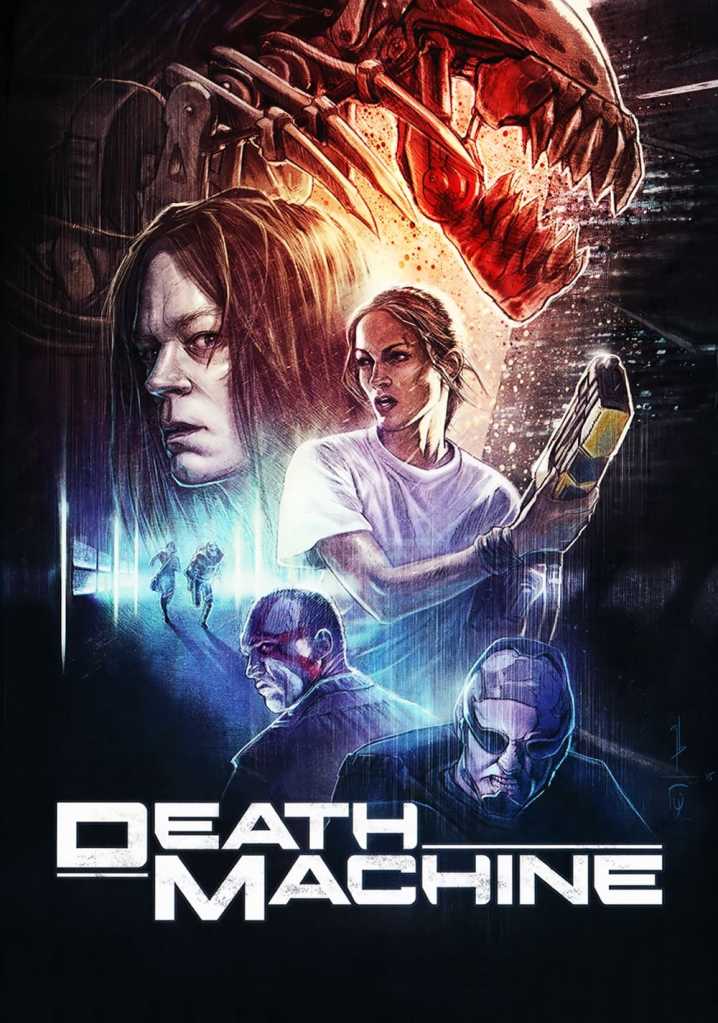
Saturday Matinee: Death Machine

THE DAILY DIG: DEATH MACHINE (1994)

“DEATH MACHINE” HAS ALL THE WORKINGS TO BE A CULT SCI-FI HORROR FILM, RIPE FOR REDISCOVERY AND A PROPER US RELEASE FINALLY.

By Bobby Lisse:

Source: Morbidly Beautiful

A weapons manufacturer tries to cover up its mistakes with a super soldier program while a morally sound executive does her best to uncover their evil plot and the scientist behind it all plots to maim and destroy it all. Let’s dig into 1994’s “Death Machine”, directed by Stephen Norrington!

AS I SEE IT

The directorial debut from Stephen Norrington, and reportedly the effort that landed him the director’s chair for BladeDeath Machine is a good movie with an arsenal of flaws.

Set in the future, which is now past, 2003, we follow the company Chaank that provides military weapons. Their failed Robocop-like super-soldier suit has malfunctioned and caused a slaughter of civilians. Now they’re back to the drawing board, so to speak, though the bottom line is always more important. In steps Scott Ridley who instructs the board they will just be pivoting.

The mad scientist behind the creation, Jack Dante, secretly creates a psycho-death bot named Warbeast. And once the fun starts, this metal death force shreds everyone in its path.

The story has interesting points, such as the evil corporation, the righteous humanist alliance, and the mad genius hellbent on domination. But the acting and script fall off a cliff a little more than halfway through the film. The sets are great, and the animation on the Warbeast is chaotic and amazing, which makes sense because the Director used to cut his teeth in creature effects on films like Aliens and Alien 3. 

The homages are off the charts.

Some of the examples I picked up on were sound effects from DoomMasters of the Universe toys that decorate Dante’s office, a Daffy Duck impression from Brad Dourif, a battle cry from Street Fighter, as well as the Warbeast resembling a Mouser from Teenage Mutant Ninja Turtles. The names of the characters as well are tributary. Some are identical: John Carpenter, Scott Ridley (Ridley Scott), Jack Dante (Joe Dante), Weyland, Yutani (Alien).

There was too much whimsy and cheeky humor inserted for the tone of the film and could have used some fine-tuning. But I feel it was just on the cusp of being a classic sci-fi/horror.

FAMOUS FACES

Brad Dourif (Dante): you know him, you love him, he’s everyone’s favorite good guy. He always brings the same quality of maniacal energy and really excels as the bad guy, but no role was as iconic and great as that of our friend Chuck in Child’s Play. 

He has since become a Rob Zombie regular (31 and Three from Hell), but Richard Brake (Ridley) showed he has the propensity for villainy in what I felt was an underappreciated role. He really stood out, and it was a shame he was killed off so early as he seemed to have an insurmountable level of maddening bravado.

William Hootkins (John Carpenter) is probably most famous as Porkins (Red Six) in Star Wars. He also played Eckhart in Tim Burton’s Batman.

Rachel Weisz has a brief cameo in this her first feature, and would later go on to star in The Mummy series and marry James Bond.

OF GRATUITOUS NATURE

The inclusion of the heartbreaking and gut-wrenching story of Cale’s daughter getting her arm flayed in a garbage disposal does nothing for the greater good of the story. It affords Pouget an opportunity to display another emotion in her repertoire. At this point, however, the script already jumped the shark.

HEARTTHROB

Ely Pouget (Hayden Cale) is a great leading lady for this genre, and her skills are emphasized in the first half of the film. She’s got Ripley’s bad-ass woman card in my opinion, and she’s beautiful to boot. She seems to have hardly aged since 1994 in most recent photographs as well.

RIPE FOR A REMAKE

This is one of those odd, hardly heard of, 90’s films that deserved better. I know it’s been given numerous cuts and a so-called definitive cut, but it could really stand to use some sound editing and unbiased clipping. It’s not sacred ground, but I would rather it see a clean pass rather than a clean slate.

SPAWNS

No progeny to report.

WHERE TO WATCH

An uncut Blu-ray was released in Germany (the version I watched). If you don’t feel like paying up for it, you can stream on Amazon Prime, Roku, Vudu, or Plex.

Déjà Vu All Over Again

The Matrix, resurrected

By John Semley

Source: The Baffler

MIDWAY THROUGH 1999’S THE MATRIX, Keanu Reeves’s hacker-cum-cyberpunk-messiah Neo sees a black cat shivering in a doorway. Then, he sees it again. “Woah,” he utters, in that trademark, flat Keanu Reeves way. “Déjà vu . . . ” The phenomenon, Trinity (Carrie-Anne Moss) tells him, means big trouble. In the titular world-scale digital simulation in which the bulk of the film unfolds, déjà vu signals a computer glitch: a case of the simulation tweaking its code in real time.

One can’t help but be reminded of this idea watching The Matrix Resurrections, a long-gap sequel to the original sci-fi trilogy, which ended with Reeves’s Neo striking a détente between the machine overlords that enslaved mankind within a counterfeit reality and the fleshy human resistors who opposed them. The new film opens as the original does, following a heavily-armed SWAT team as they swarm a seedy motel room where a leather-clad hacker is plonking away at a computer terminal. The scene expands to introduce a new character, Bugs (Jessica Henwick), who notes to her compatriot that this familiar scene is a training module, designed to hone the skills of the digital heavies who patrol the parameters of the matrix. Or rather, a version of it that exists within the original matrix. It’s sixty years after the events of the last film, and nearly twenty years after its release. Things have gotten deeper—if only slightly.

The simulation now includes a popular video game trilogy—called, of course, The Matrix—that re-stages the events of the original films. Neo, too, is back, in his guise as Thomas Anderson. This time he’s not a computer programmer but a video game designer, whose “great ambition was to make a game indistinguishable from reality.” He’s the chief architect of the Matrix game trilogy, which has just seen a sequel green-lit within the fiction of both the matrix and The Matrix. (Matrix Resurrections was itself promoted with a tie-in video game demo, The Matrix Awakens.) Like William James’s image of our world resting on an infinite regress of rocks, it seems like it’s matrixes all the way down.

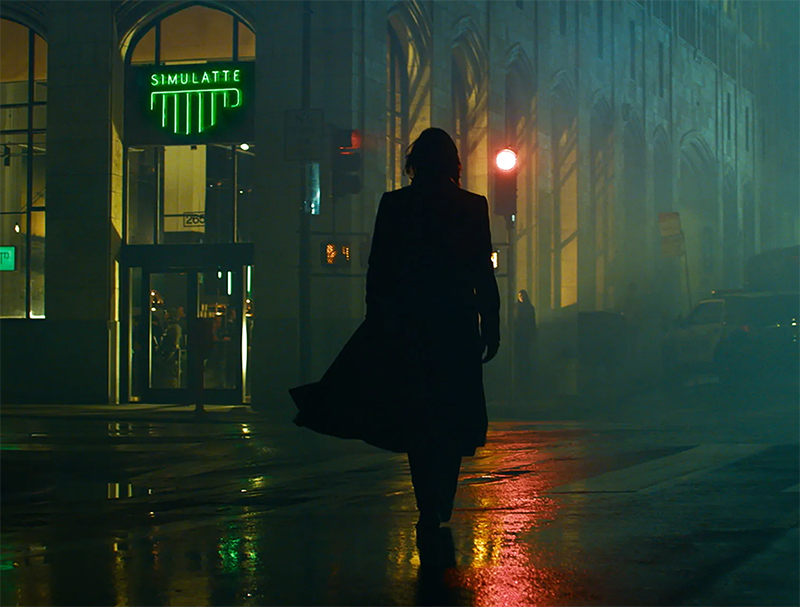
The planned game sequel prompts much hand-wringing. Characters bat ideas back and forth in an open-concept office, trying to get to the heart of what made the original Matrix work. Resurrections abounds with this sort of dorky meta-humor. There are jokes about the game design firm’s parent company being Warner Bros. (the actual film’s producer) and jokes about déjà vu. A fourth-wave coffee shop is called “Simulatte.” That kind of thing. It’s the sort of stuff that elicits barking, staccato guffaws from in-the-know audience members that quickly fade into barely bemused titters. It’s meant to be cute, but it’s mostly annoying.

Still, the film is not without its charms. Some of the early action scenes crack along reliably, playing with inversions of gravity and time, like a fleeter Christopher Nolan flick. And the notion of revisiting the world of the matrix is not without appeal. After all, the original film forecasted a world of digital disenfranchisement that is now, under the auspices of our current Silicon Valley overlords, regarded as aspirational. (In a telling touch, Resurrections moves the action from an implied Chicago to the Bay Area, explicitly marked by familiar landmarks and San Francisco PD cruisers.) And with its image of two pills representing diverging ideological bents, The Matrix provided a ready-made vocabulary that has been embraced in our real world, where everyone is redpilledblackpilledDanpilled, or Tedpilled. But Resurrections never manages to meaningfully intervene in the very conditions it seems to be diagnosing—and which the series had already diagnosed, decades ago. Like postmodernity itself, the state of digital dependency dramatized by The Matrix cannot be alleviated. It can only be mediated, with increasing levels of irony and winking self-awareness.

To wit: Resurrections is not about digitization, or the metaphysics of reality, or the broken promise of the cyberpunk genre. It is about movie reboots. Here, Neo must be liberated again, literally remaking his quest from the original film, with the obstacles re-skinned and old foes appearing in new guises (Jonathan Groff, playing the meddling computer program Smith, is a hunkier, paler imitation of the menacing Hugo Weaving). Characters snipe about how humanity is merely reframing the same handful of archetypal themes and ideas. “We’re still telling the same stories we’ve always told,” says one game designer, sounding like he’s been watching too many Jordan Peterson YouTubes. “Just with different names, different faces.” This may well be true. But it also feels like a cop-out. Especially because the original Matrix, as imagined by sororal duo Lilly and Lana Wachowski, felt genuinely inventive. It blended Terminator-styled dystopian sci-fi with Hong Kong wire-fu action and state-of-the-art special effects, all draped in the industrial liveries of a turn-of-the-millennium goth club. It may not have been wholly new. But it was thrilling remix. It spoke to the ennui of America at the “end of history.” It captured the soul-deadening, Dilbert-esque daily doldrums explored in films like Fight Club and Office Space. It also played straight to the anxiety around “Y2K” and the mounting cultural panic that home computers and toaster ovens might break down or turn against their owners. The Matrix felt like it was speaking to its time. Now, movies seem to chatter only among themselves.

There’s plenty of precedent here, of course: Ready Player Onethe recent Space Jam sequel; and the new Spider-Man movie, which draws together two decades worth of sticky narrative threads spun across three distinct franchises. Corporate wheeling-and-dealing is increasingly allegorized onscreen, to the point that many blockbusters are now about their own production. Within ten years, we’ll see Aaron Sorkin hoisting an Oscar overhead, rewarded by his peers for helming a chatty drama about the backroom legal finagling that saw a Star Wars-branded lightsaber licensed to the movie Free Guy. Hollywood is already lodged in the post-postmodern rabbit hole, with little to show for it. The culture is glitching, looping, stuck in some long, static interregnum, like a radio drifting between channels. If a new Matrix movie felt grimly inevitable in such a climate, it also had great potential.

And I suppose it’s nice that director Lana Wachowski (going solo this time) returned to wield some control over a story that would otherwise be expropriated however-which-way by the studio. But she has only a passing interest in the new convolutions of the simulation itself. Wachowski is more invested in revisiting Neo and Trinity’s wrenching, realities-spanning romance. Rather than the heady ideas at play in the premise—which have been by-and-large replaced by geeky in-jokes—she wants to explore (again) the profound power of love as some supernatural force. At its worst, the Wachowski worldview recalls that classic Simpsons joke: the secret ingredient is always capital-l Love.

This strain of touchy-feely sci-fi certainly has its admirers, and I sometimes count myself among them. But I find the Wachowskis’ sappiness (however earnest) more tolerable when enlivened by their stylistic and technical inventiveness. The rote, underdog rhythms of Speed Racer (2008) only work because they unfold within an aesthetic landscape that splits the difference between La Chinoise and Paper MarioThe Matrix’s heavy hooey about fate and choice and freeing one’s mind is leavened because, well, the movie is entertaining as hell. But now, the ideas are stale (2003’s The Matrix Reloaded already introduced the concept of its story being a remake), and the action settles into tedium: graceful bullet-time ballets are replaced by crunchy, John Wick-style fights and repetitive CGI set pieces that see Neo stopping hails of bullets with his hands, over and over and over again.

Perhaps there’s something modestly clever in the major meta-gesture of this newest Matrix—in its idea of the matrix reproducing its own destruction in the form of an interactive video game. After all, the notion that the very systems that delude us offer self-contained safe spaces for relieving those delusions is apt. Like capital, the matrix survives by evolving quicker than the forces that oppose it. If we take this message seriously, then the goodly thing to do is to ignore The Matrix Resurrections and all corporatized entertainments. To put down Twitter and TikTok and smooch our spouses; build a snowman with the kiddies; clink some beers with a gaggle of good buddies.

That we should all invest not in our virtual existences, but the fleshy, loving, contingent relationships of real life, is a perfectly decent message. That the Wachowskis have been repeating this tired line for two decades speaks despairingly to the conditions of our own, present-day dystopia. Resurrections is suspended between cyberpunk trappings that were already shopworn circa 1999 and the intellectual prison of high-concept meta-mongering. It is a movie of the interregnum, one that could have been auto-generated by it. In this way, The Matrix does manage to speak to the times. Again.

Saturday Matinee: Split!

Fractal Accidents: Attachment and Agency in Chris Shaw’s ‘Split’

By Jonathan Lukens

Source: We Are the Mutants

As a young man, I felt that most people conceived of memory differently than I did, believing that failures of memory were errors of playback more than of recording. This idea, that memory works like a vinyl record in which everything we experience has its groove, supposes that it’s just a matter of knowing precisely where to put the needle down to replay the experience. In contrast, my younger self operated with the also erroneous belief that our memories are only hazy recordings of what we have somehow deemed worthy of recalling—that memory is like finding old semi-legible notes to ourselves written in an old notebook and trying to  figure out what they mean.

It was with this theory of memory in mind that I had begun to consider Split, a movie that I thought I remembered renting from a video store up the street from my childhood home sometime around 1990. For over a decade, my occasional recollections of the film, often spaced years apart, might prompt a web search with no results, which would then introduce a sense of disorientation: I could not experience the instant gratification of finding some online mention that might confirm that what I remembered was real. Was Split (that was the name, right?) just an Easter Egg written into the script of my past—some sort of Berenstain (sic?) Bears thing? After all, and with all due respect to the films’ creators: if my adolescent mind was going to fabricate a memory, this is the sort of thing it would have come up with. 

Originally released theatrically in 1989, and subsequently on VHS in 1991 by Futura Home Video, Split was reissued on DVD in 2018 by Verboden Video and is also available through Alamo Drafthouse’s streaming app, which is how I was able to confirm its existence and watch it again. Spoilers of the film follow, but only insofar as my synopsis is veridical to the plot—a nested disclaimer I wouldn’t need to make if the film were less fractured. Whether its cracked mirror nature is a deliberate mindfuck, the result of freshman filmmaking hamfistedness, or both, is not something I can tell you. 

The film opens with Starker, our hero, wandering the streets of San Francisco. His ripped jeans show his bare rear end, and he’s wearing the sort of jagged and discolored false teeth that might have been advertised in old comic books alongside fake vomit and squirting flowers. He walks through a parking lot full of city buses, suddenly looking directly at the camera and yelling, “Stop following me. Leave me alone.” At first, we believe he is addressing us, the viewers, and breaking the fourth wall, but the camera cuts to two men dressed in a mid-‘80s Ivy League casual style—like they just walked out of a JC Penny catalog shoot. One sits at a computer; the other, older and mustachioed, is framed over his right shoulder. The younger man was surveilling Starker, and, as the dialogue reveals, the populace more broadly. He rewinds a recording of Starker’s camera-facing monologue and consults with the older agent, who says Starker is just crazy, but capitulates to the younger agent’s desire for further observation.

They run a face recognition program, presented as a musical montage, in which we see Starker’s head rendered as a 3D model as the camera hops around a black and white grid of similar hairless heads looking for a match. The sequence is still enthralling and somewhat hypnotic after 30 years. This isn’t a real 3D scan of a human head; rather it’s a painstakingly created proof of concept showing us what the technology that would soon become ubiquitous might look like. It dances. We hear pitch-shifted human voices of the sort we might associate with Laurie Anderson’s “O Superman,” and they create a synthetic and escalating harmonic pattern as the facial recognition nears completion.

This is the first of a few similarly rendered and soundtracked scenes that make Split worth more attention than it will ever receive. Analog processes are used to pre-mediate future digital operations, and there is a lo-fi poetry to them. These skies are the color of the ancestors of our flat-screen TVs, their saturations and frequency roll-off the stuff of a time when there really were dead channels, and tuned-in heads bobbed to the tangible yet barely audible click that the phone made just before it rang. Different media have different dispositions, and I explain these in the hope of being descriptive, while mindful of any argument about the veracity of concepts of authenticity.

Jittering a bit and mumbling, Starker heads into a diner and has a seat at a booth. He orders coffee from a waitress we’ll meet again later while speaking in a hybrid of fake European accents. Making a mess while examining a ketchup bottle, then pouring a packet of artificial sweetener onto the table and snorting it up his nose like cocaine, he talks to himself as the surrounding patrons begin to grow nervous. One of them gets up, takes him by the shoulder and leads him outside. At one point the camera lingers for a moment—letting us know that a brightly colored fabric pouch that Starker has left behind means something. 

As the film progresses, we watch Starker give the agents surveilling him the slip. After being knocked out and having his jacket tagged with a tracking device, he discovers the device, removes his jacket, and changes clothes to elude his pursuers. To illustrate the process of his being tracked we are treated to a primitive color representation of a 3D vector map of the city. It’s like an isomorphic video game built of an extruded and pastel colored De Stijl painting that says, “Welcome to the control society. Now you’re playing with power.” The whole sequence provides a taste of the ‘90s to come, bringing to mind critiques of the automatic production of space and tactical media projects like the Institute for Applied Autonomy’s iSee and the performances of the Surveillance Camera Players.

Starker retrieves the brightly colored fabric pouch from the trash outside the diner. He dons a new—and more ridiculous—disguise: a stick-on mustache and goatee paired with wire-rimmed glasses, a brown turtleneck, and a beige corduroy sports coat. Setting the scene for an art gallery opening, a lovingly blocked shot of Starker creates the sort of recursion we would associate with a Magritte or Escher through a row of champagne flutes. The camera lingers over a series of paintings reminiscent of Basil Wolverton’s or Erol Otus’s more psychedelic work. Gallery patrons talk trash about the paintings and each other while Starker shoves food in his pockets—John Belushi in Animal House style—as a lovely minimal synth piece by Robert Shaw, the director’s brother and creator of the computer generated effects seen through the film, begins to warble and flutter.

Conversing with the fictional creator of these paintings (in reality those of writer/director Chris Shaw himself), a flat-topped New Waver wearing a mustard yellow dinner jacket over a t-shirt, our ludicrously costumed hero mentions preparing to “wake people up.” As they discuss the artwork hanging on the gallery walls, they stop to look at a storyboard—which we realize is the storyboard of the current scene. As the artist begins to realize the same truth, he becomes enraged. He screams, but none of the patrons seem to notice or care.

The film meanders for a while, if it was not already meandering. We see the junior and senior agents discuss an analysis that reveals no discernible patterns in Starker’s behavior, and they escalate their attempts to find him. Now at the artist’s apartment after the art opening, Starker is coaxed into revealing his plan: “All we have to do is change the program!” he says, later addressing the painter’s skepticism with, “I have the way. The way is here—in my package!” Removing the pouch from an inside coat pocket, Starker then opens it to reveal a white plastic disc approximately the size of his hand. The artist remarks that it resembles a urinal deodorizer.

Starker goes on a tear: “Science is a jealous god.” The mystical “separates us from robots.” “What I am holding is a mutant biological organism.” He almost immediately contradicts himself and says the substance is just a placebo because people require a scientific reason to believe in something and that that is necessary for “the dream” to have power. He explains that he is going to dose the city’s water supply with this substance and then it will spread around the world as people excrete it through their urine. Sort of an Amanita muscaria re-trip meets infrastructural schwerpunkt: The MacGuffin is Elan Vital as urinal cake.

A few meaning-laden but plot-insignificant scenes later, Starker heads back to the diner. After a scuffle in which he startles Susan (the waitress we saw earlier) and she kicks him to the ground, he pressures her to let him hide out at her place. Reasonably viewing him as a crazy and potentially dangerous creep, she declines his offer. But, after following her to her car, he convinces her to relent by claiming that he used to be a veterinarian and that he may be able to explain the lethargy of the cat in a carrier in her back seat. The absurdity of this caged animal suddenly appearing to move the plot along is rendered even more absurd when Susan later explains that she already understood that the cat was lethargic because she had had it sterilized earlier in the day. There is something so metaphorically overt about this detail that I can’t tell if it’s a bad joke or a catastrophic mistake. In any event, Starker seems no less concerned about going home with a woman that left a post-op feline in the back of a car all day than Susan is about bringing home a man who claimed he was being followed and sat in her place of business snorting Sweet and Low through a straw while ranting in a fake French accent.

I will omit a lot of interpersonal awkwardness, strange dialogue, and things that may be significant to alternate interpretations in revealing that Starker crashes at Susan’s place (Pop Tarts and chill). The time they spend together only serves to make her subsequent death at the hands of the Starker’s pursuers insufficiently tragic to motivate his subsequent attempt at revenge. Discovering her murder at the hands of the Izod-clad archons, Starker—now in drag and blackface—follows the agents back to their bosses’ HQ. They enter through a large circular metal door, and Starker, who they don’t realize is following behind, is unable to enter.

Their boss, perhaps too obviously referred to as the “Agency Director” in a film about agency panic, laments his “monstrous” newly installed cybernetic arm. In an abrupt spasm of the plot that seems to indicate that the Director’s body is deteriorating, a lab-coated flunky soothes him by explaining that he has created that ultimate mad-scientist expression of mind-body dualism: a machine that can transfer a mind into another body. The camera cuts to Starker, unseen on the Agency Director’s CCTV, who is loading a pistol. He tries to find a way to open the door while the minions inside hurry to find a body to receive the Agency Director’s mind. The agents open the door and grab Starker, having seemingly no idea that they have apprehended the very person they were relentlessly pursuing earlier. Starker drops his gun in the struggle, and they strap him to a chair and lower a brain transfer apparatus over his head.

“Let me out! It worked!” Starker says, but it’s not clear if the process was successful or if Starker is trying to convince the agents that it was. We’re left to wonder if this Camp Concentration-style mind transfer worked at all. It’s set up as a techgnostic climax that never happens, as if this cyberpunk yacht rock anthem makes it to the guitar solo just as the amp blows. The enraged Agency Director yells and tells his minions to get rid of “her.” They throw Starker out, not seeming to care that this random person just entered their secret bunker, and still not realizing that it was Starker himself. 

The final quarter of the film involves agents pursuing Starker while the Agency Director’s body is gradually replaced with a mechanical one. The music is great here and evokes both a sort of period instrumental soft rock call-center hold music and early Chrome. Someone with disposable income should release a proper soundtrack.

Now looking like a lo-fi Robocop or a reject from a Shinya Tsukamoto film, the Agency Director’s cybernetic augmentations (or too on-the-nose self-amputations) have endowed him with new powers. He accesses satellites while issuing abrasively vocoded directives that also appear on a camera-facing screen, perhaps to ensure intelligibility to the audience. Starker’s location is revealed on a map as crescendoing lo-bit sound effects accompany synth pads and drums. “Eradicate!” The Agency Director yells in a Davros-like moment. The camera cuts to Starker hopping over fences and traversing a roadside embankment, while the Agency Director seems to glitch out as he installs one last bionic eye into his head. 

Now fully metal-skinned and ambulatory, he walks over to a pool of water inside headquarters. Elsewhere in a meadow, Starker stumbles into a pool himself, grabbing the white disc he revealed earlier. Somehow, both pools have become a sort of fold in space—the Agency Director reaches through and grabs Starker. They struggle, each remaining primarily in their own physical location while their arms bend through each others’ space. Starker breaks free and releases the chemical in the white disc. White dust floats in the air.

The end credits roll (well, melt, actually) and no further explanation is given.

***

Ultimately, outside of the beauty of the graphics and soundtrack, the joy and frustration of Split is that we are confronted with something that we can’t quite classify. Foregrounds and backgrounds of plot and image oscillate and change places, but so do the cues we’d typically use to determine whether or not we approached the material as comic or tragic, accidental or deliberate, high brow or trash stratum.

Watching Split (had I really seen it before?) left me with the distinct feeling that I just missed five minutes of it without leaving my seat. Shaw never really makes it clear what we should focus on, and the director’s commentary on the DVD doesn’t provide much help. There Shaw describes the film as “a dream that doesn’t really explain itself.” He does, however, talk a bit about chaos—not just disorder, but the branch of mathematics we might associate with Lorenz, Mandelbrot, the butterfly effect, and fractals. While history might provide examples of minor perturbations in complex systems causing them to collapse or toggle into alternate states, it seems here that chaos is really just used as a sort of “magic” (in the same way that “science” is used in superhero comics) to attempt to explain how Starker has a capacity for action that exceeds that of the archons that surveil him.

Really thinking about agency as contingent and distributed means something quite different and perhaps far more unsettling. I’d like to tell you that Split reveals a negotiation between ideas of cowboy individualism on one end, and on the other an appreciation of the behavior of complex adaptive systems of which human “individuals” are both composed of and parts of. In reality, the film presents 20th century ideas of autonomy and individuality taken to such an extreme that they become a bit goofy. The film presents an inverse relationship between attachment and individuality. Take, for example, this dialogue between the two primary agents who discover and begin tracking Starker, in which the frustrated junior agent asks:

How can he make it? We all have something: our family, our friends, something, but he… he gets by on nothing. How can he be that free? No human needs, no weaknesses, no feelings, nothing.

As they discuss their pending report to the Agency Director, the senior agent explains that they will just have to tell it like it is:

       No recurrent behavior, no attachments, no soft spots: superman.

So, the superman, the “free” man, is the man who cares about no one and has no routine. Attachment to others is presented in the same way that an ascetic might present an attachment to material things, but also as a commodity that the system of surveillance capitalism depicted in the film exploits. In the world of Split, one can either be “free” and thus detached from social forces one can’t actually detach from, or part of some sort of winkingly self-aware Matrix.

Many of the characters, including Susan, the painter, some street crazies, and the pursuing agents, seem to have some awareness that by participating in society they are being had. It’s as if they are wearing the glasses from They Live (1988) but realize that if they call attention to their alien overlords they will just be ignored anyway.

Shaw’s broader argument seems to be that as an “individual” who is truly “free,” Starker exists without a data-body; he’s an Übermensch who cannot be profiled or reduced to his so-called statistical self. As such, Starker stands outside of culture—the infrastructure of shared social and material substrates that both the one and the many call upon to act. But he still has the magic urinal cake, the fulcrum and lever by which he is super empowered.

Like a bad haircut, dosing the water supply with mutagenic hallucinogens seems cool in high school, when we are naive enough to dream that control is simply a matter of centralization and that shocking the dupes out of their somnambulism is something they will high five us for afterwards. But while portrayed as some sort of systems-disrupting black swan herald of a “new age,” maybe Starker—and the film itself—just represents a dance around the collapse of any sort of shared systems of meaning. After all, at the climactic moment when Starker releases the mutagen, the end credits roll. Were not shown what comes next—just the end of the now.  

Saturday Matinee: Ghost in the Shell

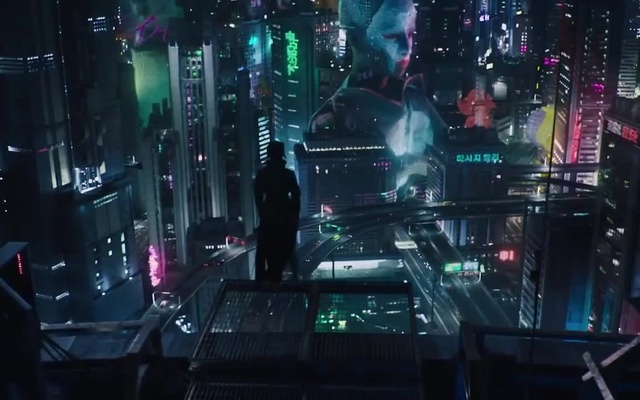
“Ghost in the Shell” (1995) is a cyberpunk anime directed by Mamoru Oshii and based on the manga of the same name by Masamune Shirow. Set in 2029 Japan, the plot centers on Motoko Kusanagi, a cyborg public-security agent hunting a mysterious hacker known as the Puppet Master who has manipulated the minds of cyborg-human hybrids. With her partner Batou she corners the hacker, but questions about her own identity sends her quest in an unforeseen direction.

Cyberpunk is Dead

By John Semley

Source: The Baffler

“It was an embarrasser; what did I want? I hadn’t thought that far ahead. Me, caught without a program!”
—Bruce Bethke, “Cyberpunk” (1983)

Held annually in a downtown L.A. convention center so massive and glassy that it served as a futurist backdrop for the 1993 sci-fi action film Demolition Man and as an intergalactic “Federal Transport Hub” in Paul Verhoeven’s 1997 space-fascism satire Starship Troopers, the Electronic Entertainment Expo, a.k.a. “E3,” is the trade show of the future. Sort of.

With “electronic entertainment” now surpassing both music and movies (and, indeed the total earnings of music and movies combined), the future of entertainment, or at least entertainment revenue, is the future of video games. Yet it’s a future that’s backward-looking, its gaze locked in the rearview as the medium propels forward.

Highlights of E3’s 2019 installment included more details around a long-gestating remake of the popular PlayStation 1-era role-playing game Final Fantasy VII, a fifth entry in the demon-shooting franchise Doom, a mobile remake of jokey kids side-scroller Commander Keen, and playable adaptations of monster-budget movie franchises like Star Wars and The Avengers. But no title at E3 2019 garnered as much attention as Cyberpunk 2077, the unveiling of which was met with a level of slavish mania one might reserve for a stadium rock concert, or the ceremonial reveal of an efficacious new antibiotic.

An extended trailer premiere worked to whet appetites. Skyscrapers stretched upward, slashed horizontally with long windows of light and decked out with corporate branding for companies called “DATA INC.” and “softsys.” There were rotating wreaths of bright neon billboards advertising near-futuristic gizmos and gee-gaws, and, at the street level, sketchy no-tell motels and cars of the flying, non-flying, and self-piloting variety. In a grimy, high-security bunker, a man with a buzzcut, his face embedded with microchips, traded blows with another, slightly larger man with a buzzcut, whose fists were robotically augmented like the cyborg Special Forces brawler Jax from Mortal Kombat. The trailer smashed to its title, and to wild applause from congregated gamers and industry types.

Then, to a chug-a-lug riff provided by Swedish straight-edge punkers Refused (recording under the nom de guerre SAMURAI) that sounded like the sonic equivalent of a can of Monster energy drink, an enormous freight-style door lifted, revealing, through a haze of pumped-out fog, a vaguely familiar silhouette: a tall, lean-muscular stalk, scraggly hair cut just above the shoulders. Over the PA system, in smoothly undulating, bass-heavy movie trailer tones, a canned voice announced: “Please welcome . . . Keanu Reeves.” Applause. Pitchy screams. Hysterics in the front row prostrating themselves in Wayne’s World “we’re not worthy!” fashion. “I gotta talk to ya about something!” Reeves roared through the din. Dutifully reading from a teleprompter, he plugged Cyberpunk 2077’s customizable characters and its “vast open world with a branching storyline,” set in “a metropolis of the future where body modification has become an obsession.”

More than just stumping for Cyberpunk 2077, Reeves lent his voice and likeness to the game as a non-playable character (NPC) named “Johnny Silverhand,” who is described in the accompanying press materials as a “legendary rockerboy.” A relative newbie to the world of blockbuster Xbox One games, Reeves told the audience at E3 that Cyberpunk piqued his interest because he’s “always drawn to fascinating stories.” The comment is a bit rich—OK, yes, this is a trade show pitch, but still—considering that such near-futuristic, bodily augmented, neon-bathed dystopias are hardly new ground for Reeves. His appearance in Cyberpunk 2077 serves more to lend the game some genre cred, given Reeves’s starring roles in canonical sci-fi films such as Johnny Mnemonic (1995) and the considerably more fantastic Matrix trilogy (1999-2003)—now quadrilogy; with an anticipated fourth installment announced just recently. Like many of E3 2019’s other top-shelf titles, Cyberpunk 2077 looked forward by reflecting back, conjuring its tech-noir scenario from the nostalgic ephemera of cyberpunk futures past.

This was hardly lost among all the uproar and excitement. Author William Gibson, a doyenne of sci-fi’s so-called “cyberpunk” subgenre, offered his own withering appraisal of Cyberpunk 2077, tweeting that the game was little more than a cloned Grand Theft Auto, “skinned-over with generic 80s retro-future” upholstery. “[B]ut hey,” Gibson added, a bit glibly, “that’s just me.” One would imagine that, at least in the burrows of cyberpunk fandom, Gibson’s criticism carries considerable weight.

After all, the author’s 1984 novel Neuromancer is a core text in cyberpunk literature. Gibson also wrote the screenplay for Johnny Mnemonic, adapted from one of his own short stories, which likewise developed the aesthetic and thematic template for the cyberpunk genre: future dystopias in which corporations rule, computer implants (often called “wetware”) permit access to expansive virtual spaces that unfold before the user like a walk-in World Wide Web, scrappy gangs of social misfits unite to hack the bad guys’ mainframes, and samurai swords proliferate, along with Yakuza heavies, neon signs advertising noodle bars in Kanji, and other fetish objects imported from Japanese pop culture. Gibson dissing Cyberpunk 2077 is a bit like Elvis Presley clawing out of his grave to disparage the likeness of an aspiring Elvis impersonator.

Gibson’s snark speaks to a deeper malaise that has beset cyberpunk. A formerly lively genre that once offered a clear, if goofy, vision of the future, its structures of control, and the oppositional forces undermining those authoritarian edifices, it has now been clouded by a kind of self-mythologizing nostalgia. This problem was diagnosed as early as 1991 by novelist Lewis Shiner, himself an early cyberpunk-lit affiliate.

“What cyberpunk had going for it,” Shiner wrote in a New York Times op-ed titled “Confessions of an Ex-Cyberpunk, “was the idea that technology did not have to be intimidating. Readers in their teens and 20’s responded powerfully to it. They were tired of hearing how their home computers were tempting them into crime, how a few hackers would undermine Western civilization. They wanted fiction that could speak to the sense of joy and power that computers gave them.”

That sense of joy had been replaced, in Shiner’s estimation, by “power fantasies” (think only of The Matrix, in which Reeves’s moonlighting hacker becomes a reality-bending god), which offer “the same dead-end thrills we get from video games and blockbuster movies” (enter, in due time, the video games and blockbuster movies). Where early cyberpunk offerings rooted through the scrap heap of genre, history, and futurist prognostication to cobble together a genre that felt vital and original, its modern iterations have recourse only to the canon of cyberpunk itself, smashing together tropes, clichés, and old-hat ideas that, echoing Gibson’s complaint, feel pathetically unoriginal.

As Refused (in their pre-computer game rock band iteration) put it on the intro to their 1998 record The Shape of Punk to Come: “They told me that the classics never go out of style, but . . . they do, they do.”

Blade Ran

The word was minted by author Bruce Bethke, who titled a 1980 short story about teenage hackers “Cyberpunk.” But cyberpunk’s origins can be fruitfully traced back to 1968, when Philip K. Dick published Do Androids Dream of Electric Sheep?, a novel that updated the speculative fiction of Isaac Asimov’s Robot series for the psychedelic era. It’s ostensibly a tale about a bounty hunter named Rick Deckard chasing rogue androids in a post-apocalyptic San Francisco circa 1992. But like Dick’s better stories, it used its ready-made pulp sci-fi premise to flick at bigger questions about the nature of sentience and empathy, playing to a readership whose conceptions of consciousness were expanding.

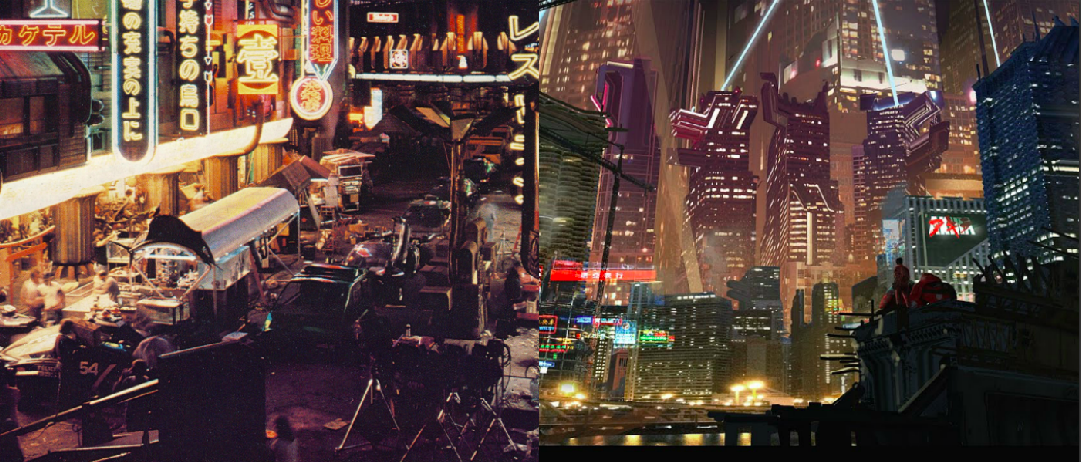
Ridley Scott brought Dick’s story to the big screen with a loose 1982 film adaptation, Blade Runner, which cast Harrison Ford as Deckard and pushed its drizzly setting ahead to 2019. With its higher order questions about what it means to think, to feel, and to be free—and about who, or what, is entitled to such conditions—Blade Runner effectively set a cyberpunk template: the billboards, the neon, the high-collared jackets, the implants, the distinctly Japanese-influenced mise-en-scène extrapolated from Japan’s 1980s-era economic dominance. It is said that William Gibson saw Blade Runner in theaters while writing Neuromancer and suffered something of a crisis of conscience. “I was afraid to watch Blade Runner,” Gibson told The Paris Review in 2011. “I was right to be afraid, because even the first few minutes were better.” Yet Gibson deepened the framework established by Blade Runner with a crucial invention that would come to define cyberpunk as much as drizzle and dumpsters and sky-high billboards. He added another dimension—literally.

Henry Case, Gibson establishes early on, “lived for the bodiless exultation of cyberspace.” As delineated in Neuromancer, cyberspace is an immersive, virtual dimension. It’s a fully realized realm of data—“bright lattices of logic unfolding across that colorless void”—which hackers can “jack into” using strapped-on electrodes. That the matrix is “bodiless” is a key concept, both of Neuromancer and of cyberpunk generally. It casts the Gibsonian idea of cyberspace against another of the genre’s hallmarks: the high-tech body mods flogged by Keanu Reeves during the Cyberpunk 2077 E3 demo.

Early in Neuromancer, Gibson describes these sorts of robotic, cyborg-like implants and augmentations. A bartender called Ratz has a “prosthetic arm jerking monotonously” that is “cased in grubby pink plastic.” The same bartender has implanted teeth: “a webwork of East European steel and brown decay.” Gibson’s intense, earthy descriptions of these body modifications cue the reader into the fundamental appeal of Neuromancer’s matrix, in which the body itself becomes utterly immaterial. Authors from Neal Stephenson (Snow Crash) to Ernest Cline (Ready Player One, which is like a dorkier Snow Crash, if such a thing is conceivable), further developed this idea of what theorist Fredric Jameson called “a whole parallel universe of the nonmaterial.”

As envisioned in Stephenson’s Snow Crash, circa 1992, this parallel universe takes shape less as some complex architecture of unfathomable data, and more as an immersive, massively multiplayer online role-playing game (MMORPG). Stephenson’s “Metaverse”—a “moving illustration drawn by [a] computer according to specifications coming down the fiber-optic cable”—is not a supplement to our real, three-dimensional world of physical bodies, but a substitute for it. Visitors navigate the Metaverse using virtual avatars, which are infinitely customizable. As Snow Crash’s hero-protagonist, Hiro Protagonist (the book, it should be noted, is something of a satire), describes it: “Your avatar can look any way you want it to . . . If you’re ugly, you can make your avatar beautiful. If you’ve just gotten out of bed, your avatar can still be wearing beautiful clothes and professionally applied makeup. You can look like a gorilla or a dragon or a giant talking penis in the Metaverse.”

Beyond Meatspatial Reasoning

The Metaverse seems to predict the wide-open, utopian optimism of the internet: that “sense of joy and power” Lewis Shiner was talking about. It echoes early 1990s blather about the promise of a World Wide Web free from corporate or government interests, where users could communicate with others across the globe, forge new identities in chat rooms, and sample from a smorgasbord of lo-res pornographic images. Key to this promise was, to some extent, forming new identities and relationships by leaving one’s physical form behind (or jacked into a computer terminal in a storage locker somewhere).

Liberated from such bulky earthly trappings, we’d be free to pursue grander, more consequential adventures inside what Gibson, in Neuromancer, calls “the nonspace of the mind.” Elsewhere in cyberpunk-lit, bodies are seen as impediments to the purer experience of virtuality. After a character in Cory Doctorow’s Down and Out in the Magic Kingdom unplugs from a bracingly real simulation immersing him in the life of Abraham Lincoln, he curses the limitations of “the stupid, blind eyes; the thick, deaf ears.” Or, as Case puts it in Neuromancer, the body is little more than “meat.”

In Stephenson’s Metaverse, virtual bodies don’t even obey the tedious laws of physics that govern our non-virtual world. In order to manage the high amount of pedestrian traffic within the Metaverse and prevent users from bumping around endlessly, the complicated computer programming permits avatars simply to pass through one another. “When things get this jammed together,” Hiro explains, “the computer simplifies things by drawing all of the avatars ghostly and translucent so you can see where you’re going.” Bodies—or their virtual representations—waft through one another, as if existing in the realm of pure spirit. There is an almost Romantic bent here (Neuromancer = “new romancer”). If the imagination, to the Romantics, opened up a gateway to deep spiritual truth, here technology serves much the same purpose. Philip K. Dick may have copped something of the 1960s psychedelic era’s ethos of expanding the mind to explore the radiant depths of the individual soul, spirit, or whatever, but cyberpunk pushed that ethos outside, creating a shared mental non-space accessible by anyone with the means—a kind of Virtual Commons, or what Gibson calls a “consensual hallucination.”

Yet outside this hallucination, bodies still persist. And in cyberpunk, the physical configurations of these bodies tend to express their own utopian dimension. Bruce Bethke claimed that “cyberpunk” resulted from a deliberate effort to “invent a new term that grokked the juxtaposition of punk attitudes and high technology.” Subsequent cyberpunk did something a bit different, not juxtaposing but dovetailing those “punk attitudes” with high-tech. (“Low-life, high-tech” is a kind of a cyberpunk mantra.) Neuromancer’s central heist narrative gathers a cast of characters—hacker Henry Case, a cybernetically augmented “Razorgirl” named Molly Millions, a drug-addled thief, a Rastafari pilot—that can be described as “ragtag.” The major cyberpunk blockbusters configure their anti-authoritarian blocs along similar lines.

In Paul Verhoeven’s cyberpunk-y action satire Total Recall, a mighty construction worker-cum-intergalactic-spy (Arnold Schwarzenegger) joins a Martian resistance led by sex workers, physically deformed “mutants,” little people, and others whose physical identities mirror their economic alienation and opposition to a menacing corporate-colonial overlord named Cohaagen.

In Johnny Mnemonic, Keanu Reeves’s businesslike “mnemonic courier” (someone who ferries information using computer implants embedded in the brain) is joined by a vixenish bodyguard (Dina Meyer’s Jane, herself a version of Neuromancer’s Molly Millions), a burly doctor (Henry Rollins), and a group of street urchin-like “Lo-Teks” engaged in an ongoing counterinsurgency against the mega-corporation Pharmakom. Both Mnemonic and Recall rely on cheap twists, in which a figure integral to the central intrigue turns out to be something ostensibly less- or other-than-human. Total Recall has Kuato, a half-formed clairvoyant mutant who appears as a tumorous growth wriggling in the abdomen of his brother. Even more ludicrously, Mnemonic’s climax reveals that the Lo-Teks’ leader is not the resourceful J-Bone (Ice-T), but rather Jones, a computer-augmented dolphin. In cyberpunk, the body’s status as “dead meat” to be transcended through computer hardware and neurological implantation offers a corollary sense of freedom.

The idea of the cybernetic body as a metaphor for the politicized human body was theorized in 1985, cyberpunk’s early days, by philosopher and biologist Donna Haraway. Dense and wildly eclectic, by turns exciting and exasperating, Haraway’s “Cyborg Manifesto” is situated as an ironic myth, designed to smash existing oppositions between science and nature, mind and body. Haraway was particularly interested in developing an imagistic alternative to the idea of the “Goddess,” so common to the feminism of the time. Where the Goddess was backward-looking in orientation, attempting to connect women to some prelapsarian, pre-patriarchal state of nature, the cyborg was a myth of the future, or at least of the present. “Cyborg imagery,” she writes, “can suggest a way out of the maze of dualisms in which we have explained our bodies and our tools to ourselves.” Part machine and part flesh, Haraway visualizes the cyborg as a being that threatens existing borders and assumes responsibility for building new ones.

Though they are not quite identical concepts, Haraway’s figure of the cyborg and the thematics of cyberpunk share much in common. A character like Gibson’s Molly Millions, for example, could be described as a cyborg, even if she is still essentially gendered as female (the gender binary was one of the many “dualisms” Haraway believed the cyborg could collapse). Cyborgs and cyberpunk are connected in their resistance to an old order, be it political and economic (as in Neuromancer, Johnny Mnemonic, etc.) or metaphysical (as in Haraway). The cyborg and the cyberpunk both dream of new futures, new social relationships, new bodies, and whole new categories of conceptions and ways of being.

The historical problem is that, for the most part, these new categories and these new relationships failed to materialize, as cyberpunk’s futures were usurped and commodified by the powers they had hoped to oppose.

Not Turning Japanese

In an introduction to the Penguin Galaxy hardcover reissue of Neuromancer, sci-fi-fantasy writer Neil Gaiman ponders precisely how the 1980s cyberpunk visions came to shape the future. “I wonder,” he writes, “to what extent William Gibson described a future, and how much he enabled it—how much the people who read and loved Neuromancer made the future crystallize around his vision.”

It’s a paradox that dogs most great sci-fi writers, whose powers for Kuato-style clairvoyance have always struck me as exaggerated. After all, it’s not as if, say, Gene Roddenberry literally saw into the future, observed voice-automated assistants of the Siri and Alexa variety, and then invented his starship’s speaking computers. It’s more that other people saw the Star Trek technology and went along inventing it. The same is true of Gibson’s matrix or Stephenson’s Metaverse, or the androids of Asimov and Dick. And the realization of many technologies envisioned by cyberpunk—including the whole concept of the internet, which now operates not as an escapist complement to reality, but an essential part of its fabric, like water or heat—has occurred not because of scrappy misfits and high-tech lowlifes tinkering in dingy basements, but because of gargantuan corporate entities. Or rather, the cyberpunks have become the corporate overlords, making the transition from the Lo-Teks to Pharmakom, from Kuato to Cohaagen. In the process, the genre and all its aspirations have been reduced to so much dead meat. This is what Shiner was reacting to when, in 1991, he renounced his cyberpunk affiliations, or when Bruce Bethke, who coined the term, began referring to “cyberpunk” as “the c-word.”

The commodification of the cool is a classic trick of capitalism, which has the frustrating ability to mutate faster than the forces that oppose it. Yet even this move toward commodification and corporatization is anticipated in much cyberpunk. “Power,” for Neuromancer’s Henry Case, “meant corporate power.” Gibson goes on: “Case had always taken it for granted that the real bosses, the kingpins in a given industry, would be both more and less than people.” For Case (and, it follows, Gibson, at least at the time of his writing), this power had “attained a kind of immortality” by evolving into an organism. Taking out one-or-another malicious CEO hardly matters when lines of substitutes are waiting in the wings to assume the role.

It’s here that cyberpunk critiques another kind of body. Not the ruddy human form that can be augmented and perfected by prosthetics and implants, but the economic body. Regarding the economy as a holistic organism—or a constituent part of one—is an idea that dates back at least as far as Adam Smith’s “invisible hand.” The rhetoric of contemporary economics is similarly biological. An edifying 2011 argument in Al Jazeera by Paul Rosenberg looked at the power of such symbolic conceptions of the economy. “The organic metaphor,” Rosenberg writes, “tells people to accept the economy as it is, to be passive, not to disturb it, to take a laissez faire attitude—leave it alone.”

This idea calls back to another of cyberpunk’s key aesthetic influences: the “body economic” of Japan in the 1980s. From the 2019 setting of 1982’s Blade Runner, to the conspicuous appearance of yakuza goons in Gibson’s stories, to Stephenson’s oddly anachronistic use of “Nipponese” in Snow Crash, cyberpunk’s speculative futures proceed from the economic ascendency of 1980s Japan, and the attendant anxiety that Japan would eventually eclipse America as an economic powerhouse. This idea, that Japan somehow is (or was) the future, has persisted all the way up to Cyberpunk 2077’s aesthetic template, and its foregrounding of villains like the shadowy Arasaka Corporation. It suggests that, even as it unfolds nearly sixty years from our future, the blockbuster video game is still obsessed with a vision of the future past.

Indeed, it’s telling that as the robust Japanese economy receded in the 1990s, its burly body giving up the proverbial ghost, that Japanese cinema became obsessed with avenging spirits channeled into the present by various technologies (a haunted video cassette in Hideo Nakata’s Ringu, the internet itself in Kiyoshi Kurosawa’s Kairo, etc.). But in the 1980s, Japan’s economic and technologic dominance seemed like a foregone conclusion. In a 2001 Time article, Gibson called Japan cyberpunk’s “de facto spiritual home.” He goes on:

I remember my first glimpse of Shibuya, when one of the young Tokyo journalists who had taken me there, his face drenched with the light of a thousand media-suns—all that towering, animated crawl of commercial information—said, “You see? You see? It is Blade Runner town.” And it was. It so evidently was.

Gibson’s analysis features one glaring mistake. His insistence that “modern Japan simply was cyberpunk” is tethered to its actual history as an economic and technological powerhouse circa the 1980s, and not from its own science-fictional preoccupations. “It was not that there was a cyberpunk movement in Japan or a native literature akin to cyberpunk,” he writes. Except there so evidently was.

The Rusting World

Even beyond the limp, Orwellian connotations, 1984 was an auspicious year for science-fiction. There was Neuromancer, yes. But 1984 also saw the first collected volume of Akira, a manga written and illustrated by Katsuhiro Otomo. Originally set, like Blade Runner, in 2019, Akira imagines a cyberpunk-y Neo-Tokyo, in which motorcycle-riding gangs do battle with oppressive government forces. Its 1988 anime adaptation was even more popular, in both Japan and the West. (The film’s trademark cherry red motorcycle has been repeatedly referenced in the grander cyberpunk canon, appearing in Steven Spielberg’s film adaptation of Ready Player One and, if pre-release hype is to believed, in Cyberpunk 2077 itself.) In 2018, the British Film Institute hailed Akira, accurately, as “a vital cornerstone of the cyberpunk genre.”

Japan has plenty of other, non-Akira cyberpunk touchstones. As a cinematic subgenre, Japanese cyberpunk feels less connected to the “cyber” and more to the spirit of “punk,” whether in the showcasing of actual Japanese punk rock bands (as in 1982’s Burst City) or the films’ own commitment to a rough-hewn, low-budget, underground aesthetic. Chief among the latter category of films is Shinya Tsukamoto’s Tetsuo: The Iron Man, which was shot on 16mm over a grueling year-and-a-half, mostly in and around Tetsuo actress and cinematographer Kei Fujiwara’s apartment, which also housed most of the film’s cast and crew.

Unlike the Western cyberpunk classics, Tsukamoto’s vision of human-machine hybridization is demonstrably more nightmarish. The film follows two characters, credited as the Salaryman (Tomorowo Taguchi) and the Guy (a.k.a. “The Metal Fetishist,” played by writer/director/producer/editor Tsukamoto himself), bound by horrifying mutations, which see their flesh and internal organs sprouting mechanical hardware.

In its own way, Tetsuo works as a cyberpunk-horror allegory for the Japanese economy. As the Salaryman and the Fetishist learn to accept the condition of their mechanization, they merge together, absorbing all the inorganic matter around them, growing enormously like a real-world computer virus or some terrifying industrial Katamari. Their mission resonates like a perverse inversion of Japan’s post-industrial promise. As Tsukamoto’s Fetishist puts it: “We can rust the whole world and scatter it into the dust of the universe.”

Like Haraway’s development of the cyborg as a metaphoric alternative to the New Age “goddess,” Tetsuo’s titular Iron Man can offer a similar corrective. If cyberpunk has become hopelessly obsessed with its own nostalgia, recycling all its 1980s bric-a-brac endlessly, then we need a new model. Far from the visions of Gibson, in which technology provides an outlet for a scrappy utopian impulse that jeopardizes larger corporate-political dystopias, Tetsuo is more pessimistic. It sees the body—both the individual physical body and the grander corpus of political economy—as being machine-like. Yet, as Rosenberg notes in his Al Jazeera analysis of economic rhetoric, it may be more useful to conceive of the economy not as a “body” or an organism but as a machine. The body metaphor is conservative, “with implications that tend toward passivity and acceptance of whatever ills there may be.” Machines, by contrast, can be fixed, greased, re-oriented. They are, unlike bodies, a thing separate from us, and so subject to our designs.

Cybernetic implants and cyborg technology are not some antidote to corporate hegemony. The human does not meld with technology to transcend the limitations of humanity. Rather, technology and machinery pose direct threats to precisely that condition. We cannot, in Tsukamoto’s film, hack our way to a better future, or technologically augment our way out of collective despair. Technology—and the mindless rush to reproduce it—are, to Tsukamoto, the very conditions of that despair. Even at thirty years old, Tetsuo offers a chilling vision not of the future, or of 1980s Japan, but of right now: a present where the liberating possibilities of technology have been turned inside-out; where hackers become CEOs whose platforms bespoil democracy; where automation offers not the promise of increased wealth and leisure time, but joblessness, desperation, and the wholesale redundancy of the human species; where the shared hallucination of the virtual feels less than consensual.

There’s nothing utopian about the model of cyberpunk developed in Tetsuo: The Iron Man. It is purely dystopian. But this defeatism offers clarity. And in denying the collaborative, collectivist, positive vision of a technological future in favor of a vision of identity-destroying, soul-obliterating horror, Tsukamoto’s stone-cold classic of Japanese cyberpunk invites us to imagine our own anti-authoritarian, anti-corporate arrangements. The enduring canon of American-style cyberpunk may have grown rusty. It has been caught, as Bethke put it in his genre-naming story, “without a program.” But the genre’s gnarlier, Japanese iterations have plenty to offer, embodying sci-fi’s dream of imagining a far-off future as a deep, salient critique of the present. It is only when we accept this cruel machinery of the present that we can freely contemplate how best to tinker with its future.

Left to peddle such a despairing vision in a packed-out L.A. convention center, even cyberpunk’s postmortem poster boy Keanu Reeves would be left with little to say but a resigned, bewildered, “Woah . . .”


Cyberpunk: The Human Condition amid High-tech Alienation and Urban Dystopia

By Raymond Lam

Source: BuddhistDoor.net

I love the seashore and the countryside, but I have spent most of my life in cities, with little to no time spent in the country. I grew up in Brisbane, Australia (which, despite its beauty and vibrant coffee culture, is hardly a skyscraper metropolis) and have spent a good deal of time in Hong Kong. Over the years I have visited Shanghai, Tokyo, and Seoul—cities that have long inspired novelists and artists in cyberpunk circles.

Cyberpunk features “technologized” cities with endless skyscrapers shimmering in an ocean of neon lights and elevated railways. These cityscapes are often bathed in darkness, shadow, and rain. More often than not, the protagonists of these stories are lone-wolf types, running through grungy alleys and estranged from wider society. As a genre of writing, film, and animation, the dystopian cyberpunk imagination has been immensely influential in both Asian and Western pop culture, exemplified by the Blade Runner movies, The Matrix franchise, and the Japanese anime Ghost in the Shell.

To many social commentators, cyberpunk carries eerie reminders of certain characteristics of urban living today—an endless feed of information, insecurity, and distractions through the Internet and social media, the press and media serving as distractions or brainwashing rather than useful information, and social alienation and unfulfilling work. In these activities is an almost gleeful dismissiveness of the need to reflect on human nature and what it means to be a human being: a key concern of religions and philosophical schools through the ages.

As Buddhistdoor Global columnist Paola Di Maio notes about our headlong trajectory into developing communication between human beings and AI: “Excited at the prospect of scientific advances, researchers seem to ignore that enhanced cognition comes with enhanced responsibility, maturity, and responsible decision-making abilities.” This is the key concern and, as it happens, the idea of human interface with computers or “mind technologies” is about as cyberpunk as it gets.

There are far more informed writers who have unpacked the themes of cyberpunk exhaustively, but I find this description particularly useful for grasping the general aesthetic and spirit. This is from an essay by Lawrence Person: “Classic cyberpunk characters were marginalized, alienated loners who lived on the edge of society in generally dystopic futures where daily life was impacted by rapid technological change, an ubiquitous datasphere of computerized information, and invasive modification of the human body.” (Slashdot.org) Surely many of these themes sound familiar?

The eminent science fiction writer J. G. Ballard (1930–2009) defied assumptions about traditional storytelling and sought to upend the archetypes that were assumed to be universal, saying that he wanted a storytelling style that possessed “more psycho-literary ideas, more meta-biological and meta-chemical concepts, private time systems, synthetic psychologies and space-times, more of the sombre half-worlds one glimpses in the paintings of schizophrenics.” (Ballard 2017, 103) Most interestingly, Ballard criticized the “external” emphasis of so much science fiction of his day (such as on space travel), declaring: “The biggest developments of the immediate future will take place, not on the Moon or Mars, but on Earth, and it is inner space, not outer, that needs to be explored. The only truly alien planet is Earth.” (Ballard 2017, 103)

My opinion is that good cyberpunk is itself a kind of literary expression of contemporary inner preoccupations and concerns. Take the notion of loneliness, for example. Some good research has been done about urban life and its correlation with loneliness, but the results are ambiguous. One study found that urban life is undoubtedly more stressful than rural life (and has been so since the Industrial Revolution), yet how lonely one feels is a very difficult thing to measure. If we are to take seriously Ballard’s notion that the best kind of science fiction is about inner space, then perhaps we have also been distracted by the neon cityscapes of gritty cyberpunk metropolises.

The interesting stuff is not happening in an action-packed helipad gunfight with a hypersonic jet on top of a tower owned by a futuristic robotics corporation. It is happening in the neurotic mind of one of that corporation’s low-level office workers, humiliated in public through a thoughtless social media post by her supervisor, who himself seeks distraction from his instantly replaceable managerial role by interfacing his brain with a computer’s pornographic VR program. It is not just about cybernetics and the development of androids, but how society changes as a result of them.

I like to think that, perhaps one day in the future, when meditation practice centers are hidden away in glass and metal skyscrapers—some of them already are in the worlds biggest cities—and temples of traditional Asian design are surrounded by looming corporate structures, these loci of spiritual meaning and truly human work will have helped to fortify the inner worlds of these cities’ denizens against the darker side of cyberpunk. Ballard was right. The true struggle for meaning and dignity is more often on the inside, even in a society dominated by neon, nightfall, and neuro-computers.

References

Ballard, J. G. 2017. “Which way to inner space?” In Science Fiction Criticism: An Anthology of Essential Writings. Edited by Rob Latham. London and New York: Bloomsbury.