The Raging Twenties: A New Map of Dystopia

Pepe Escobar’s new book Raging Twenties: Great Power Politics Meets Techno-Feudalism tells the story of a new phase of the U.S. empire.

By Pepe Escobar

Source: Consortium News

The Raging Twenties started with a murder: a missile strike on Gen. Soleimani at Baghdad airport on Jan. 3, 2020. Almost simultaneously, that geopolitical lethality was amplified when a virus cannibalized virtually the whole planet.

It’s as if Time has been standing still – or imploded – ever since. We cannot even begin to imagine the consequences of the anthropological rupture caused by SARS-CoV-2.

Throughout the process, language has been metastasizing, yielding a whole new basket of concepts while solidifying others. Circuit breaker. Biosecurity. Negative feedback loops. State of exception. Necropolitics. New Brutalism. Hybrid Neofascism. New Viral Paradigm.

This new terminology collates to the lineaments of a new regime, actually a hybrid mode of production: turbo-capitalism re-engineered as Rentier Capitalism 2.0, where Silicon Valley behemoths take the place of estates, and also The State. That is the “techno-feudal” option, as defined by economist Cedric Durand.

Squeezed and intoxicated by information performing the role of a dominatrix, we have been presented with a new map of Dystopia, packaged as a “new normal”, featuring cognitive dissonance, a bio-security paradigm, the inevitability of virtual work, social distancing as a political program, info-surveillance, and triumphant Trans-humanism.

A sanitary shock was superimposed over the ongoing economic shock – where financialization always takes precedence over the real economy.

But then the glimpse of a rosy future was offered towards more “inclusive” capitalism, in the form of a Great Reset, designed by a tiny plutocratic oligarchy duly self-appointed as Saviors.

All of these themes evolve along the 25 small chapters of this book, interacting with the larger geopolitical chessboard.

SARS-CoV-2 accelerated what was already a swing of the power center of the world towards Asia.

Since WWII, a great deal of the planet lived as cogs of a tributary system, with the Hegemon constantly transferring wealth and influence to itself – via what analyst Ray McGovern describes as SS (security state) enforcing the will of the MICIMATT (Military-Industrial-Congressional-Intelligence-Media-Academia-Think-Tank) complex.

This world-system is irretrievably fading out – especially due to the interpolations of the Russia-China strategic partnership. And that’s the other overarching theme of this book.

As a proposal to escape our excess hyper-reality show, this book does not offer recipes, but trails: configurations where there’s no masterplan, but multiple entryways and multiple possibilities.

These trails are networked to the narrative of a possible, emerging new configuration, in the anchoring essay titled “Eurasia, The Hegemon and the Three Sovereigns.”

In a running dialogue, you will have Michel Foucault talking to Lao Tzu, Marcus Aurelius talking to Vladimir Putin, philosophy talking to geoeconomics – all the while attempting to defuse the toxic interaction of the New Great Depression and variations of Cold War 2.0.

With the exception of the anchoring essay, this is a series of columns, arranged chronologically, originally published here on Consortium News/Washington D.C., Asia Times/Hong Kong and Strategic Culture/Moscow, widely republished and translated across the Global South.

They come from a global nomad. Since the mid 1990s I have lived and work between (mostly) East and West. With the exception of the first two months of 2020, I spent the bulk of the Raging Twenties in Asia, in Buddhist land.

So you will feel that the scent of these words is inescapably Buddhist, but in many aspects even more Taoist and Confucianist. In Asia we learn that the Tao transcends everything as it provides serenity. There’s much we can learn from humanism, stripped-off metaphysics.

2021 may be even fiercer than 2020. Yet nothing condemns us to be lost in a wilderness of mirrors while, as Ezra Pound wrote,

a tawdry cheapness

shall reign throughout our days.

The hidden “secret” of this book may be actually a yearning – that we’re able to muster our inner strength and choose a Taoist trail to ride the whale.

For those who don’t use Amazon, here is a mini-guide on how to order Raging Twenties: Great Power Politics Meets Techno-Feudalism.

IN ORDER TO UNDERSTAND THE WORLD TODAY YOU MUST UNLEARN THIS ONE THING

By Sigmund Fraud

Source: Waking Times

At present, we are dangerously trending toward chaos, total world war, civil war, incivility, and a complete breakdown of civil society, and to the indoctrinated, it’s difficult to understand why exactly this is happening. As the stress of this mounts, the misinformed lash out at friends, family members and strangers who do not fully subscribe to their worldview. The battle really is one of understanding how the world works, and with such epidemic false perceptions, people choose the wrong targets for their ire.

If one were to unlearn, however, many of the things we’ve been taught about how our world works, re-educate the self, and re-orient to a more complete and truthful assessment of the world today, the picture becomes more clear, things make more sense, and a pathway to unity opens up. One thing we can all agree on, though, is that we’ve all been duped in big ways, most notably in the one arena which affects everyone, everyday, at every time. Money.

False = Money is Real and the Economy is Capitalist

Trained to worship money and the idea of infinite growth, it’s tough to understand just how much unnatural stress is being introduced in our world by a financial system and world economy which is operates explicitly for the profit a few key players. The money is fiat, and its value is controlled by privately run organizations who have the power to enslave the entire world with debt.

Furthermore, the system is not capitalism, but rather something beyond capitalism. Post capitalism, perhaps, as it more closely resembles the zombie ghost of capitalism, soullessly eating everything in its path with no interest at all in sustainability.

Recently speaking on this matter, financial analyst Max Keiser explained the result of having central bank managed interest rates kept artificially low in order to enrich those at the top of the pyramid. This is one major piece of very large and hidden puzzle.

“There’s no incentive to save money, there’s only an incentive to commit fraud. So if there’s no incentive to save money, then there’s no capital, and without capital there’s no capitalism. So you have, unfortunately, now a situation where it’s the survival of the most fraudulently inclined. It’s a kakistocracy, which is rule by the least capable of a society.” ~Max Keiser

This short interview with Max Kaiser by Luke Rudkowski sheds more insight on this issue:

The system we have today is really more akin to an elaborate slave plantation. All money that we use today in public is borrowed from private banks, and we pay dearly for the privilege of using it.

This is because money is created out of debt in a one-to-one increase in public debt. The national debt is $20 Trillion. That means the (roughly) 234 million US Americans would have to pay approximately $62,000 each to pay it off. This includes babies, children, poor people, and homeless people. There are even those who claim that it’s mathematically impossible to pay off the debt. And almost every country is in debt to every other country. It’s the height of insanity.

As former Governor of the Federal Reserve Marriner Eccles said, “If there were no debts in our money system, there wouldn’t be any money.” ~Gary ‘Z’ McGee

The stress in our world stemming from a global banking system designed to enslave is felt everywhere, from endless wars to unaffordable healthcare and evermore expensive food. Yet while few people really understand how this works, we are battling a war of propaganda and mind control.

Making sense of the world today is no easy task for those who’ve yet to abandon the standard American diet of propaganda and mental programming. Indoctrination works in a couple of key ways. Firstly, beliefs are instilled and reinforced by repetition, and secondly, undesirable beliefs are ignored and cast aside as fringe. What’s left is a mind which focuses on what it’s supposed to focus on, constructing a reality around a false and incomplete picture of the world.

This is food for thought for free thinkers, with the aim overcoming petty division in order to create a more prosperous and unified future.

Post-Pandemic Landscapes: Behavior Modification as the New Consensus Reality

By Kingsley L. Dennis

Source: Waking Times

The ‘Covid Event’ gave the unreal world its great coup over the place of the real. This perception intervention gave the final stimulus necessary to tip the twenty-first century into an awaiting technologically manipulated reality. A new landscape is emerging where, for the first time, the human mind is finding itself out-of-place within its own territory. What are now being termed the emerging ‘post-pandemic’ landscapes are likely to be hazardous territory for our mental, emotional, and physical states. The human condition is under modification.

New forms of power are on the rise, embedded within structures of health security, that are re-imagining our social lives, living and workspaces, and our physical and digital movements. Until now, the spider’s web of social control mainly operated below the waterline in a space where an almost intangible world existed beyond governance or accountability.  Now the Kraken awakes and is unashamedly coming to the surface. The beast of behavior modification is spreading its tentacles through our most established social and cultural institutions without shame – all in the name of health security (the new nom de plume of social management).  These institutions include the media, city life, the office, and – perhaps most of all – the online-digital world. The modification of these spaces is set to further desensitize, anesthetize, and dehumanize us. It is as if the collective human mind is being groomed and prepared for a new consensus reality of ‘normalized dissonance.’

The post-pandemic landscape is merging physical pandemics with its own viral digital epidemics that are infecting the human psyche. The Italian philosopher Franco Berardi has noted that our ‘electronic mediascape’ is putting ‘the sensitive organism in a state of permanent electrocution.’[1] The social body is being deliberately targeted by strategies that cause anxiety, fragmentation, exhaustion, confusion, polarization, and fear. We can see this through national and local lockdowns; social distancing; anti-social interaction; social ostracization; loss of economic independence, and more. In early July, Prof Sir Venki Ramakrishnan, president of the Royal Society (the UK’s national academy of science) stated publicly that face masks should be worn in all public spaces (as they already are in many places in Europe and worldwide). Not wearing a face covering, he added, ‘should be regarded as “anti-social” in the same way as drink driving or failing to wear a seatbelt.’[2] This is nothing short of encouraging a regime of public shaming. The human condition is being subjected to a new rhythm of the modern power-machine that is breaking down our social alliances.

The established conditions that created a sense of social reality are being dissolved and replaced with processes aimed at managing the masses through forms of separation and quantification. That is, the techniques necessary to begin the formation of a technologized humanity. These processes seek to reduce human life, and its environment, to something measurable and predicable – a life ordained by algorithms. These imposed changes are creating a disequilibrium in the human psyche – a fragmentation of the human self. Furthermore, they are seeking to break down our trusted social relations.

There is something insidious creeping up into the global collective that is attempting to create a world of sleepwalkers, plied with fear-pills, updated with vaccines, programmed with nonsense, and dismissive of alternative thinking. As a conscious, biological organism we are being prepared to mimic the automation of the machine. Humanity is mentally sleeping and slipping into the void where a new form of the ‘social collective’ awaits us.

Techniques are being devised and employed to produce normalized and standardized behavior in order to create a socially managed populace. The collective human mind is being adapted and adopted into an infrastructure of control that operates largely through modes of digital connectivity. I refer to this rising mechanism of social engineering as the modern power-machine (MPM) that exerts control over human expression and autonomy of behavior. To enact this, a consortium of institutions have been selected to structure contemporary societies toward specific functions that give the promise of security and human well-being whilst developing increased social dependency. This is the post-pandemic landscape now rapidly arising and to which all future generations shall be born into.

Childhood’s End

Luciano Floridi, a professor of philosophy and the ethics of information, believes that human civilization is shifting into a phase of ‘hyperhistory.’ A hyperhistorical society that is dependent upon integrative technologies, says Floridi, could also become human-independent – that is, not needing us. Life on this planet is being developed into an infrastructure that favors machinic intelligence and artificial organisms, thus de-territorializing the human experience. Our urban environments may soon be more conducive to artificial life than biological ones. No one is yet ready for the mutation at hand. We are being programmed to take on a new position in the world that will erode the possibility of human transcendence; a world where the ‘flesh robot’ will eventually become the reality consensus.

We are witnessing an unprecedented migration of humanity from its physical space to the digital-sphere – an environment of surveillance and technocratic social management. The incoming generations will recognize no fundamental difference between the digital-sphere and the physical world as this mergence will form the reality they are born into. To the new generations, the digital-physical-sphere will be their only reality for they will have been born without the offline-online distinction. In the words of Luciano Floridi, they were born onlife. This is now their reality, and it is ‘onlife.’ The world that many of us recognized as being human will never be the same again. With the ‘onlife’ mode, a new era of history begins. Childhood comes to an end when they stop being a child and become a user. It is then that they inhabit whole new realities – realities they may believe to be ‘user-generated’ when in fact the reverse is more the case.

Connectivity and access will be part of the regime of the new power-machine. And the rights of access are going to be a matter of consensus health security (as addressed in New Dawn 180/181).  To be a part of the power-machine will mean opting-in to its sanctioned, and on-surveillance, connections. Soon, opting out will be made an almost impossible alternative. Connecting into the power-machine will become the new cartography of the ‘human reality.’ Living ‘manually’ will become one of the last few remaining sites of resistance as human life becomes regulated-by-automation.

The City as Machine Cradle

Modern living, especially within dense urban metropolises, as well as within poverty-stricken neighborhoods, severely affects the human psychological condition, as well as affecting the nervous system. Journalist Naomi Klein has noted how a form of ‘Pandemic Shock Doctrine’ is emerging where city metropolises are forming suspicious partnerships with large tech conglomerates to re-design city living. Klein has stated that the quarantine lockdowns were not so much to save lives ‘but as a living laboratory for a permanent — and highly profitable — no-touch future.’[3] One tech CEO that Klein interviewed commented that: ‘There has been a distinct warming up to human-less, contactless technology…Humans are biohazards, machines are not.’[4] Several local city governments are in negotiations with large private tech companies to create a ‘seamless integration’ between city government, education, health, and policing operations. Further, the individual home will become a smart-enclosed hub for the urban dweller. All this, and more, as a ‘frontline pandemic response.’

Online learning, the home office, telehealth, and online commerce are all now a part of an emerging investment landscape to convert existing physical-digital infrastructures to cloud-based ones that will be incorporated into the arriving fully-completed 5G network. All in the name of providing citizens with a securitized ‘virus free’ landscape. Erich Schmidt, ex-CEO of Google/Alphabet and now chair of the Defense Innovation Board that advises the Department of Defense on military A.I., announced publicly with a straight face:

‘The benefit of these corporations, which we love to malign, in terms of the ability to communicate, the ability to deal with health, the ability to get information, is profound. Think about what your life would be like in America without Amazon.’[5]

Schmidt has now been hired to head up the task force commissioned to reimagine New York’s post-Covid reality. And he won’t be alone. High-tech is now jumping to get into partnerships with local governments in order to bring a safer, more ‘securitized’ landscape into civil society – all for ‘our’ benefit.

The business office landscape is also under re-organization to further regulate and isolate the social interactions of working colleagues. It can be said that a new form of business behavior modification is in the works. In a recent business analysis published in Bloomberg by Jeff Green and Michelle F. Davis, they suggested that:

The pre-Covid workplace, with its shared desks and common areas designed for “creative collisions,” is getting a makeover for the social distancing era. So far, what employers have come up with is a mash-up of airport security style entrance protocols and surveillance combined with precautions already seen at grocery stores, like sneeze guards and partitions.[6]

The authors of the report also foresee that the newly returned office worker will likely be encased in a makeshift cubicle made of plexiglass sheets. A new mode of anti-interaction is clearly in the works.

Hundreds of major companies, at least, are planning what they call ‘employee re-orientation programs’ and have already hired ‘thermal scanners’ to monitor employees for fevers, according to the article’s sources. The authors also noted that there has been a spike in job postings for ‘tracers,’ who would track down the contacts of anyone who tests positive for the covid-19 virus. In short, companies are now looking for a range of solutions to keep people away from one another throughout the working day. IBM, for example, is looking into using existing sensors or finding new technology to detect when people are too close together or ‘trending’ in that direction. Another report from the UK[7] noted how companies were looking into developing their own specialist employee smartphone apps that would operate elevators hands-free. The language employers are using includes creating ‘safe bubbles’ around employees and monitoring so that these ‘safe bubbles’ do not overlap. How would they manage such monitoring?

Various companies, the UK report goes on to say, are looking to teach artificial intelligence (AI) to monitor the video cameras that are monitoring the employees. Dr Mahesh Saptharishi, Motorola Solutions’ chief technology officer (based in Boston) explained that AI algorithms can offer feedback about ‘pinch points’ where people are too close together. Instead of employers (read ‘humans’) having to spend time (read ‘waste time’) watching the actual video, they can ‘ask’ the AI how well social distancing is being observed overall, and where problem points are.[8] So that’s the issue solved then. We’ll just rely on AI algorithms to tell us how to ‘social distance’ in our non-interacting bubbles and we can modify our behavior accordingly. Job done!

What this also signifies is that in order to be able to modify our behavior, machine intelligence will need to gather ever greater datasets about us. That is, ‘smart cities’ and ‘secure offices’ equals increased surveillance which equals expanded datasets. The ‘Black Iron Prison’ that Philip K. Dick saw coming is now hitting us squarely in the form of surveillance capitalism.

Surveillance Capitalism

Professor Shoshana Zuboff, the author of the widely acclaimed The Age of Surveillance Capitalism, has said that digital connection is now a means to others’ commercial ends. With the rapid rise of data collection for commercial gain, Zuboff says that: ‘The result is that both the world and our lives are pervasively rendered as information.’[9] People are reduced to being less than products because they are rendered into being a mere ‘input’ for the creation of the real product which is the data. Predictions about peoples’ futures are sold to the highest bidder so that these futures can be profited from or altered to favor better commercial gains. Zuboff considers surveillance capitalism to be, at its core, parasitic and self-referential – a parasite that feeds on every aspect of every human’s experience.

Human experience is considered free to be taken as raw material and it is this that becomes the product of value. From this material, organizations decide to intervene in our lives to shape and modify human behavior in order to favor the outcomes that are most desirable for commercial gains. Behavioral modification is now in the hands of private capital – and undertaken with the minimal amount of external oversight. At its most basic, humans have been reduced to ‘batteries’ that produce datasets for algorithms and machine learning to process. What is most worrying is that, by and large, the general populations are ignorant of what is going on quite literally beneath their fingertips. As Zuboff notes, people unknowingly end up funding their own forms of domination.

Through its operations of technocratic ‘normalization’ and the deliberate breaking up of social alliances, the power-machine age is manufacturing a new standardization of the human body and mind. With the encroachment of socially managed interventions, people are made vulnerable to the increased destabilizing of the human self. The human sense of ‘self’ and identity has become a fragile thing; it is analyzed, scrutinized, and criticized through social media; it is modified through surveillance capitalism; and it is increasingly being rendered by AI facial recognition systems such as Clearview. As these post-pandemic landscapes become increasingly rolled out in more social environments, we are likely to see, as a consequence, an ever-greater fragmentation of the human self.

The Fragmented Self

It is no exaggeration to say that humanity is entering a period of existential crisis that has perhaps not been last witnessed since the Middle Ages. Only this time, we don’t have our religious institutions to offer us salvation. The responsibility is upon our shoulders of finding salvation through becoming fully human in the face of dehumanizing forces. At present, we are being bombarded with such contradictory information that many people are unable to find coherence or to make a whole picture out of the shards. That is, the human mind is finding it increasingly difficult to see the patterns and to connect the dots. Many people will also now be experiencing forms of cognitive dissonance. One definition of this state is: ‘Cognitive dissonance refers to a situation involving conflicting attitudes, beliefs or behaviours. This produces a feeling of mental discomfort leading to an alteration in one of the attitudes, beliefs or behaviours to reduce the discomfort and restore balance.’[10]

The result of this is that the mind desperately wishes to reduce this discomfort and restore balance by seeking – or being provided with – a coherent picture, or closure. The danger here is that this ‘closure’ or ‘coherent picture’ may be provided by an external source, institution, or body (a structure of orthodox ‘authority’) and many people will jump onto it as a way of gaining closure, and thus comfort. When, in truth, we need to find this coherence and closure within ourselves, through our own resources. With the increasing breakdown of social relations and an interactive human environment, people’s consciousness is being further pushed into compartmentalization where events are seen as random rather than interrelated and meaningful. This lack of meaningfulness will be compensated for by the rise of virtual attractions as the digital-sphere increasingly becomes the ‘safe and secure’ home that people turn to. Critical thought, perceptive observation, and intuitive knowing will be under the onslaught of nullifying behavior modification.

As we are now seeing in the public space, self-identity (race, sexuality, etc) is becoming a target of division, further creating doubt, anxiety, and social polarization. Psychologically, people are being pushed to acquiesce, submit, and accept the measures that are being implemented as the ‘new normal’ post-pandemic landscapes. And the more we submit, the more we become vulnerable to further submission and disempowerment. Bureaucratic regimes and administrative structures will creep further into our living, work, and leisure lives until a form of what French philosopher Michel Foucault calls disciplinary power will dominate over the human condition. New forms of social discipline and collective obedience are fostering an artificial and engineered state of perception. We are right in the middle of a time of intense ‘enforced socialization,’ or what Edward Snowden recently referred to as an ‘architecture of oppression.’ For some, the only response to this overwhelming ‘architecture of oppression’ will be to find their comfort zones – such as sitting in their chairs at home with their ‘surrogates’ roaming the digital-physical landscape on their part.[11] Or, as the 2008 computer-animated sci-fi film Wall-E depicted, growing lazy and obese while robots cater to all their needs, while indulging in infantile entertainments. We can only hope this shall never be the case.

Humanity has entered unprecedented times. Such times demand an unprecedented response. It appears that we are now being asked to ‘step up’ to accept our responsibility for our human becoming, and so to become fully human. By doing nothing, we are allowing our behavior to be modified and our self-identities to be splintered. In these post-pandemic landscapes, the choices we make will be choices that, like never before, determine our future as a human species. I suggest it is time now for declaring our unity as an empowered fully human species – by not accepting the push of the power-machine into distanced and disempowered individuals.

What “Normal” Are We Returning To? The Depression Nobody Dares Acknowledge

By Charles Hugh Smith

Source: Of Two Minds

Perhaps we need an honest national dialog about declining expectations, rising inequality, social depression and the failure of the status quo.

Even as the chirpy happy-talk of a return to normal floods the airwaves, what nobody dares acknowledge is that “normal” for a rising number of Americans is the social depression of downward mobility and social defeat.

Downward mobility is not a new trend–it’s simply accelerating. As this RAND Corporation report documents, ( Trends in Income From 1975 to 2018) $50 trillion in earnings has been transferred to the Financial Aristocracy from the bottom 90% of American households over the past 45 years.

Time magazine’s article on the report is remarkably direct: The Top 1% of Americans Have Taken $50 Trillion From the Bottom 90% — And That’s Made the U.S. Less Secure.

“The $50 trillion transfer of wealth the RAND report documents has occurred entirely within the American economy, not between it and its trading partners. No, this upward redistribution of income, wealth, and power wasn’t inevitable; it was a choice–a direct result of the trickle-down policies we chose to implement since 1975.

We chose to cut taxes on billionaires and to deregulate the financial industry. We chose to allow CEOs to manipulate share prices through stock buybacks, and to lavishly reward themselves with the proceeds. We chose to permit giant corporations, through mergers and acquisitions, to accumulate the vast monopoly power necessary to dictate both prices charged and wages paid. We chose to erode the minimum wage and the overtime threshold and the bargaining power of labor. For four decades, we chose to elect political leaders who put the material interests of the rich and powerful above those of the American people.”

I’ve been digging into downward mobility and social depression for years: Are You Really Middle Class?

The reality is that the middle class has been reduced to the sliver just below the top 5%–if we use the standards of the prosperous 1960s as a baseline.

The downward mobility isn’t just financial–it’s a decline in political power, control of one’s work and ownership of income-producing assets. This article reminds us of what the middle class once represented: What Middle Class? How bourgeois America is getting recast as a proletariat.

This reappraisal of the American Dream is also triggering a reappraisal of the middle class in the decades of widespread prosperity: The Myth of the Middle Class: Have Most Americans Always Been Poor?

Downward mobility excels in creating and distributing what I term social defeat: In my lexicon, social defeat is the spectrum of anxiety, insecurity, chronic stress, fear and powerlessness that accompanies declining financial security and social status.

Downward mobility and social defeat lead to social depression. Here are the conditions that characterize social depression:

1. High expectations of endlessly rising prosperity instilled as a birthright no longer align with economy reality.

2. Part-time and unemployed people are marginalized, not just financially but socially.

3. Widening income/wealth disparity as those in the top 10% pull away from the bottom 90%.

4. A systemic decline in social/economic mobility as it becomes increasingly difficult to move from dependence on the state or one’s parents to financial independence.

5. A widening disconnect between higher education and employment: a college/university degree no longer guarantees a stable, good-paying job.

6. A failure in the Status Quo institutions and mainstream media to recognize social depression as a reality.

7. A systemic failure of imagination within state and private-sector institutions on how to address social depression issues.

8. The abandonment of middle class aspirations: young people no longer aspire to (or cannot afford) consumerist status symbols such as luxury autos or conventional homeownership.

9. A generational abandonment of marriage, families and independent households as these are no longer affordable to those with part-time or unstable employment.

10. A loss of hope in the young generations as a result of the above conditions.

The rising tide of collective anger arising from social depression is visible in many places: road rage, violent street clashes between groups seething for a fight, the destruction of friendships for holding “incorrect” ideological views, and so on.

A coarsening of the entire social order is increasingly visible: The Age of Rudeness.

Depressive thoughts (and the emotions they generate) tend to be self-reinforcing, and this is why it’s so difficult to break out of depression once in its grip.

One part of the healing process is to expose the sources of anger that we are repressing. As psychiatrist Karen Horney explained in her 1950 masterwork, Neurosis and Human Growth: The Struggle Towards Self-Realization, anger at ourselves sometimes arises from our failure to live up to the many “shoulds” we’ve internalized, and the idealized track we’ve laid out for ourselves and our lives.

The article The American Dream Is Killing Us does a good job of explaining how our failure to obtain the expected rewards of “doing all the right things” (getting a college degree, working hard, etc.) breeds resentment and despair.

Since we did the “right things,” the system “should” deliver the financial rewards and security we expected. This systemic failure to deliver the promised rewards is eroding the social contract and social cohesion. Fewer and fewer people have a stake in the system.

We are increasingly angry at the system, but we reserve some anger for ourselves, because the mass-media trumpets how well the economy is doing and how some people are doing extremely well. Naturally, we wonder, why them and not us? The failure is thus internalized.

One response to this sense that the system no longer works as advertised is to seek the relative comfort of echo chambers–places we can go to hear confirmation that this systemic stagnation is the opposing ideological camp’s fault.

Part of the American Exceptionalism we hear so much about is a can-do optimism: set your mind to it and everything is possible.

The failure to prosper as anticipated is generating a range of negative emotions that are “un-American”: complaining that you didn’t get a high-paying secure job despite having a college degree (or advanced degree) sounds like sour-grapes: the message is you didn’t work hard enough, you didn’t get the right diploma, etc.

It can’t be the system that’s failed, right? I discuss this in my book Why Our Status Quo Failed and Is Beyond Reform: the top 10% who are benefiting mightily dominate politics and the media, and their assumption is: the system is working great for me, so it must be working great for everyone. This implicit narrative carries an implicit accusation that any failure is the fault of the individual, not the system.

The inability to express our despair and anger generates depression. Some people will redouble their efforts, others will seek to lay the blame on “the other” (some external group) and others will give up. What few people will do is look at the sources of systemic injustice and inequality.

Perhaps we need an honest national dialog about declining expectations, rising inequality and the failure of the status quo that avoids polarization and the internalization trap (i.e. it’s your own fault you’re not well-off).

We need to value honesty above fake happy-talk. Once we can speak honestly, there will be a foundation for optimism.

THE INDIVISIBILITY OF LIFE

By Julian Rose

Source: Waking Times

‘Know Thyself.’ On a tombstone in an English churchyard is the following inscription, “Here lies John Bailey. The fact that he died does not guarantee that he lived.”

And that is surely the point. ‘To Live’ is the dynamic expression of existence; not being stuck in some soulless routine permanently in fear of stepping out of line with a sterile status quo.

The art of living involves the assertion of freedom, creativity and empathy with and for fellow humans and all living beings. It is our deepest self expression of an organic sense of purpose. The will to live is expressed through the flow of that warm inner feeling called ‘love of life’.

When, within the human experience, attempts are made to block this flow by forces opposed to Life, our ‘love of life’ causes us to adopt an unwavering commitment to fight for the preservation of all that is good, real and humane. In other words, to defend the basic tenets of a civilised society. Many actively engaged individuals find themselves in this position today.

But why such a high proportion of humanity fails to respond to this ‘Life-call’, preferring instead a ‘no risk’ three dimensional sub-existence – is an unsolved conundrum – in spite of thousands of divergent explanations being put forward?

However, one thing we do know is that when some form of material wealth or power is experienced by those who have sidelined their innate spirituality, it becomes an addiction around which a fixated dependency immediately forms. From there on, such individuals only experience existence as a sterile ambition-chasing game.

In these circumstances, Life becomes reduced to a competition to build and protect material wealth and status; and all those who reject such extremity – but nevertheless remain essentially passive – serve as fuel for the ambitions of these vampires.

The present pyramid of top-down economic and political oppression is built upon this catastrophic deviation from the organic, spirit led, path of Life.

The net result of this deviation from truth is the manifestation of a compensatory expression of the suppressed life-force. The original expression, blocked from following its organic path, turns in on itself and starts to devour that which would otherwise have guided the individual to the light.

Whereas, to openly give free voice to that Divine source of which we are all descendants, is the supreme individual expression of the life force with which we have all been blessed.

We are living through a time of open manifestation of the domineering anti-life materialistic obsession, stripped of all spiritual energy. What we are seeing on a daily basis today, emanating from the top end of the ‘competition pyramid’, is a ‘pandemic’. But it has nothing to do with a virus and everything to do with a feverish grasping for ultimate power and control over others – which includes all life forms down to the very DNA of life itself.

Taken at its face value, this is an abject expression of clinical insanity. If such an extremity was expressed within a family unit, the perpetrator would be recognised as deeply disturbed and in need of serious help and quite possibly of being isolated for fear of causing serious harm to others.

But when the same symptoms are displayed by politicians, bankers, media editors, corporate directors, the police and so forth – it is not recognised as insanity or even megalomania – but as an  ‘acceptable’ type of eccentric behaviour, which is grudgingly seen as ‘par for the course’.

This should lead us all to reflect on how such a stark departure from a human path of life could ever have been engineered into existence.

How a set of values applied to leadership within a family and to political/corporate ‘leadership’ – could be so starkly different. And how such a schizophrenic state of affairs could be allowed to continue to prevail in every corner of the world?

My conclusion is that such a gross imbalance exists due to the engineered separation of primary values within the greater social community, so as to create a divide and conquer controlling agent within society. Once this is in place, schizophrenic actions are not seen for what they are, they are taken as the norm.

In reality, there is no such division between values and responsibilities we see as important within families and those we see as important within political and business affairs. They are indivisible. That which expresses truth – and guidance based upon this truth – has Divine origins. The Divine is whole.

But by the time formal education and parental ambition (for siblings) has weighed-in, a separation of the material and the spiritual/social is all too often made manifest. It is as though these two realms were innately antagonistic.

This state of affairs is the signature of a bankrupt society. An engineered split that looks distinctly like the work of demons; as there is no natural explanation for why antagonism should exist between material and spiritual realms.

All animate and inanimate life is built of spirit and matter – ‘spirit-matter’ – which cannot be separated into opposing elements. But that separation is exactly what the proponents of an increasingly robotic human race have set their sights on.

To reinstate the wholeness which is our natural birthright, and to ensure its continuity throughout the life cycles that proceed from childhood through adolescence and into adulthood, is the essential task all caring, humanitarian and feeling individuals cannot turn away from.

‘Living’ means bringing a better world into being. Encouraging the spark of Life to rise up out of the ashes of a dystopian wilderness. To let Life educate us rather than those who police the status quo.

The verb ‘to educate’ comes from the Latin ‘e-ducare’ meaning ‘to draw out from’. This is a direct reference to encouraging the manifestation of our innate creativity.  Not the ‘fact absorbing’ mission that has been forced on young people during decades of ‘schooling’. The real meaning of such words has been deliberately obfuscated.

The imperative for getting this new dynamic moving cannot be overstated. Much of humanity is on the brink of psychological, psychotic and schizophrenic imprisonment. A state which cannot help but deeply imbalance the very fabric of our living planet.

Faced by this dramatic challenge to create unity out of disunity, we have to draw strongly upon the well of our deeper selves. For the ‘real me’ and the ‘real you’ are the only forces that can rise-up and radiate enough light to penetrate and dissolve the false clouds hanging over this world.

But how can one exert light, freedom and justice when all around fellow humans are covering their faces with a mask of anxiety and fear? When every news item inflates a lie? When the whole world seems turned up-side-down by demonic double speak?

Yes, that is the predominant question on millions of minds right at this moment.

The answer lies in the expression “know thyself”. “Thyself” as an eternal spirit/being of cosmic origins which has – temporarily – taken on a human form and is currently resident on Planet Earth.

‘A cosmic being having an earthly experience’.

Once you and I can detach ourselves from living the lie and primarily identify ourselves with a state of ‘non-attachment’ to the material and ego-led realm, we are free. We cannot be destroyed. We have become eternal. At one with our Creator.

This is a place completely out of reach of our oppressors – whatever form they may take. From here we can go into battle for planet Earth and planet people with not a trace of fear; knowing that when we give all for the cause of truth, Truth returns all to us – with a bonus!

This is how we are to defeat the demonic entities which we have allowed to occupy and rule this planet. They are but mirrors of our failure to follow the call of truth. To BE our true selves. To listen and respond to the inner voice of deeper guidance.

We have the will to quite simply dump our old false existence and transform from pseudo-humans into real humans, indivisible from the divine wellspring of Life. For each one of us, that is our uniquely individual challenge. When expressed collectively, it forms the foundation of a new society.

Of such beings, when they finally pass, it will be stated “The fact that this brave soul had a human experience is here recorded. May that soul continue its great exploration of the divine infinite from whence it came.”

To Conspiracy Theory or to Not Conspiracy Theory (That is the Question)

By Scott Owen

Source: CounterPunch

Ever since the words were first introduced, conspiracy theories have carried the weight and stigma of mysterious enigmas wrapped in multiple layers of intrigue, deception, black-ops and lies. The very notion of conspiracy theories is itself considered by some to be a conspiracy theory. There are those who maintain that the CIA invented the term or at least brought it into our common language as a way of ridiculing those who questioned the Warren Report account of the murder of president JFK.

Whether the CIA did or did not intentionally use those words, conspiracy theory, to discredit those who were non-believers of the official Warren Report line, we will never know. And that’s the thing about a conspiracy theory, as to its truth, we may never know. What should be known however, what we would be better to believe, is that in this world of intrigue, deception, black-ops and lies, that there are without a doubt conspiracies. If the CIA ever had the desire to de-legitimize someone or some entire group, then or especially now, this moment is certainly ripe for supplying them with all the necessary ingredients for pulling off a grand conspiracy of mass de-legitimization of those they see as being political rabble-rousers.

The group who stormed the capitol on Jan.6th is one such group who follow conspiracy theories but although they are unique in being the ones who stormed the capitol, they are not unique in their beliefs in conspiracy theories. It might be hard, if one were to look, to find someone who does not believe in some conspiracy theory or another and it would be right for that to be the case because surely, one or the other of those theories is true, based on facts and even provable if the right material evidence could be produced. In this world of intrigue, deception, black-ops and lies however, it is sometimes very hard, impossible even for most of us, to get our hands on the right material evidence and those shady CIA operators are loving it. Nothing produces the environment where conspiracy theories thrive like reams of hidden or redacted evidence.

Are many of the conspiracy theories we hear nothing but pure bunk made-up by who knows who for no other reason than to confuse and distract? Yes, many of them are. Are some of those theories the result of half understood notions that are used in an effort to understand hidden truth? Yes, many of them are. Are some of those theories true but only the tip of even greater conspiracies that we still haven’t even begun to suspect? It’s likely so. Would it be of some value to the public to keep an open mind where conspiracy theories are concerned? Yes, as it would be one of the tyrants greatest moments in  psy-op history if we were not keeping an open mind where conspiracy theories are concerned. Are conspiracy theories currently being down-played and ridiculed as being absurd and the domain of idiots and fools? Yes they are!

Is this treatment of conspiracy theories as some form of mental illness or instability, coupled with corporate and government censorship of things that they and they alone deem as being conspiracy theories with no redeeming even harmful value to the public, a smart way to go in societies hoping to retain some shred of truth and freedom? No it is not. Let us ask ourselves then, would we be wise to write off as unacceptable any theories that suggest conspiracy and to then allow government and corporate control of censorship of those theories? I think not. Would you then prefer to live in a society where people are allowed to freely suggest conspiracies where there may or may not be conspiracies or would you prefer to live in a society where no conspiracy theories are allowed even though they may or may not be true?

Do you wish to live in a society where you and you alone are allowed to discern truth from fiction according to the evidence you yourself are able to uncover or do you want corporations and government to do that for you?

REVIEW: Seeking Truth in a Country of Lies by Edward Curtin

By Ray McGinnis

Source:  Off-Guardian

Seeking Truth in a Country of Lies is a selection of essays. They reveal what stirs author Ed Curtin’s heart, his mind, and his path toward clarity. With each chapter he passionately reflects on the state of his country and what matters most to him. It is a compelling read.

The epigraph at the beginning of Seeking Truth in a Country of Lies“In a dark time, the eye begins to see,” comes from Theodore Roethke’s poem “In A Dark Time”. Here the poet describes a state of disorientation and dislocation of identity. Roethke asserts this is essential to achieve clarity, insight and wisdom. In a dark time, one discovers the fragmented and broken state of things. With this fitting epigraph, Ed Curtin proceeds to alert his readers to the fragmented and broken state of things in America, and the task of its citizenry to begin to see more clearly.

The topics Curtin, a former professor at the Massachusetts College of Liberal Arts, takes up are not original to him. But they are marked with his own articulate original stamp. One aspect of his novel contribution is that Curtin steps beyond standard frameworks of political analyses.

Three themes have permeated his attention from a young age: truth, death and freedom. He cites an excerpt from an interview with the poet Kenneth Rexroth who told journalist Lawrence Lipton in 1959:

Since all society is organized in the interest of exploiting classes and since if men knew this they would cease to work and society would fall apart, it has always been necessary, at least since the urban revolutions, for societies to be governed ideologically by a system of fraud.

Rexroth referred to this system of fraud as the “social lie.” And in Seeking Truth in a Country of Lies, Curtin takes on the task of describing the roots of the fraud, and its more recent manifestations. He also takes time to point out, despite the burdens society grapples with in an age of deceit, that beauty, art, love, and whimsy are among the qualities that persist as signs of grace.

In his essay “Inside America’s Doll House: A Vast Tapestry Of Lies” Curtin cites Jim Garrison, the District Attorney of New Orleans who in 1969 brought to trial a case naming persons connected to the assassination of President John F. Kennedy. Garrison attempted to show that the assassination of JFK was the work of the CIA and Allen Dulles.

However, Garrison was routinely described as a lunatic by CIA-connected media spokespersons. It was Garrison’s conclusion that American citizens passively consumed television news that was laced with propaganda. Such propaganda was manufactured to preclude Americans from “understanding…what is really happening….”

Garrison warned that Americans were living “in a doll’s house.” Building on the hard lessons Jim Garrison learned from the trial in 1969, Ed Curtin observes:

In the doll’s house into which America gradually has been converted, a great many of our basic assumptions are totally illusory.

His book was also released in winter 2020, some 57 years after JFK’s assassination.

Curtin notes that in 2009:

[President] Obama backed the 2009 coup d’état in Honduras that has resulted in so many deaths at the hands of U.S. trained killers, and now [followers of Trump complain about] all these ‘non-white’ people fleeing to the U.S. to escape a hell created by the U.S…

After 2009. it was learned that U.S. officers at the Center for Hemispheric Defense Studies trained members of the Honduran military to oust democratically elected President Manuel Zelaya. In 2009 and the years following Honduras has had one of the highest rates of murder in the world. These have been driven by death squads connected to the Honduran military. But this coup mattered little to both President’s Obama and Trump, while Hondurans have paid the price in murder, increased debt and poverty.

Examples of what Curtin raises continue since his book was published in late 2020. For Venezuelans it matters little whether a Republican or a Democrat is president in the USA. Under Donald Trump there was a failed attempt in May 2020 to kidnap Venezuelan President Nicolas Maduro. And on the first day of his presidency, Joe Biden signed an executive order declaring the United States recognizes Venezuelan opposition leader Juan Guaidó as the nations’ President. This despite Maduro winning over 67% of the popular vote in 2018; That the second candidate in the election results was Henri Falcón who won 21%; And Juan Guaidó wasn’t even a candidate in 2018. Imagine if Venezuela protested the result of the 2020 United States election, and recognized Mitt Romney as president (who ran in 2012 but didn’t run in 2020).

With Biden there is a change of tone from Trump, but many American foreign policies remain the same. Former President Jimmy Carter said of Venezuela’s 2012 elections when Hugo Chavez was re-elected:

…of the 92 elections that we’ve [Carter Centre Foundation in Atlanta] monitored, I would say the election process in Venezuela is the best in the world.

But that story that doesn’t conform with the media’s narrative. So, it goes down the memory hole.

Curtin notes that while average Americans have not constructed the doll’s house they live in, they are complicit. It is average Americans who have accepted “decades of fabricated reality for so-called peace of mind.” A consequence of accepting illusory narratives is that people are not really free.

In order to cope with a plausible lie, consumers of the news play dumb. And Curtin notes most Americans…

want to be nice (Latin, nescire, not to know, to be ignorant) and to be liked.

As they become a people of the lie, repeating the lies they are fed, a memetic desire arises in society. And the repetition of these lies fuels violence and scapegoating. The doll’s house that Americans (and many citizens of other countries who consume the news uncritically) live in, are reinforced by contracts they have made with the world. This is in order to enhance their social standing, financial status, professional advancement and maintain familial harmony. That kind of peace of mind and contentment require individuals not to venture out far from the doll house, in case they encounter truths they find hard to handle.

Curtin notes that the Central Intelligence Agency began to use the term “conspiracy theory” in a memo on April 1, 1967. This was to discredit assassination theories about other plausible actors in the death of the slain president on November 22, 1963. And he notes that it just so happens that the term “9/11” was first used on September 12, 2001, by future New York Times editor Bill Keller to designate the language for how to refer to the day of the attacks. By using a term synonymous with dialing an emergency number in the United States, the term became fused with feelings of “anxiety, depression, panic and confusion.”

It is useful to note that at the time of the attacks on September 11, 2001, the emergency number in Saudi Arabia was 999. In Afghanistan the emergency numbers were 102, 112 and 119. The numbers in Yemen were 191 and 194. The emergency numbers in the United Arab Emirates were 112, 998 and 999. The emergency number in Libya was 1515. The number in Kuwait was 112. The numbers in Iraq were 104, 115 and 122. In Syria emergency numbers were 110, 112 and 113. In Lebanon the numbers variously were 112, 140, 175 and 999. The emergency numbers in Egypt were 122, 123 and 180. Across continental Europe the emergency number to call on September 11, 2001, was 112. The emergency numbers in Iran were 110, 112, 115 and 125.

Curiously, 911 was a number to dial an emergency uniquely in the United States, Canada, Mexico (as well as 065, 066 and 068), and South America. 911 was not an emergency number in the states where Arabs were alleged to have plotted to attack the Pentagon and the World Trade Center.

In some future scenario – were it to ever happen – might rogue American terrorists fly planes into skyscrapers in Tehran, Iran? And in such a scenario, might such terrorists plot an attack on a January 10th, 12th or 15th of a given year, fusing the day of the atrocity with the abbreviation for a date synonymous with one of the numbers Iranians dialed in case of an emergency?

In his essay “Why I Don’t Speak of 9/11 Anymore,” Curtin notices that by “referring to September 11 as 9/11,” Keller ensured…

an endless national emergency became wedded to an endless war on terror aimed at preventing Hitler-like terrorists from obliterating us with nuclear weapons that could create another ground zero or holocaust. It is a term that pushes all the right buttons evoking unending social fear and anxiety. It is language as sorcery; it is propaganda at its best.

Because Curtin suspects that the repetition of the term “9/11” is embedded in an advanced form of mind-control, he refuses to use the term in relation to the attacks. Instead, he uses the phrase “the attacks of September 11, 2001.” Whatever vocabulary we use to refer to the attacks, Curtin advises that we find one that can unbind us from the mesmerizing impact of its official shorthand repeated endlessly, subliminally evoking confusion, depression and panic in its hearers.

As our post-modern society has evolved, the task of creating propaganda is more complex. And so, the complexity of society drives a majority to want ready-made frameworks for understanding their reality coherently. Curtin shows that…

people want to be provided with myths to direct them to the ‘truth,’ but that so-called truth has been preconceived within the overarching myth provided by propaganda.

Nonetheless, the propaganda is efficient enough to allow most people to deduce that they’ve reached their conclusions of their own free will. Most people will assume that they’ve been provided with a suitable range of information about the key points of a given topic in order to decide what is trustworthy. However, the same consumers of the news will regard as inconceivable that the narrative they’ve been led to accept contains cherry-picked news that omits perspectives that are off-message. Surely, wouldn’t any dissenting voices that are worth knowing about would be given a hearing on the six o’clock news?

Curtin concurs with author Lisa Pease who wrote in her book A Lie Too Big To Fail: The Real History of the Assassination of Robert F. Kennedy:

The way the CIA took over America in the 1960s is the story of our time, and too few recognize this. We can’t fix a problem we can’t even acknowledge exists.

To support his assessment, Curtin points to numerous examples in different chapters across his book. This includes a chapter on “The Message From Dallas, JFK and The Unspeakable,” where he summarizes JFK author James W. Douglass’ layer-by-layer excavation of a CIA-backed assassination of a president who had turned from war-making toward peace-making.

In another chapter titled “What Are We Working For ‘At Eternity’s Gate’,” Curtin writes about the rat-race. He recalls a summer job as a clerk in a General Motors office in Manhattan. The “bait” was the salary, and so his youth was spent that summer confined to a boring job.

As I read Curtin’s description, I thought about some of the jobs I had: working a night shift as a hotel security guard, a cleaner at a private golf club, and working at a vehicle repair shop for the Ministry of Forests for the Province of British Columbia. The latter I spent a summer affixing forestry vehicle identification serial numbers on the side of government trucks.

The author mentions a film about the life of Vincent Van Gogh, titled At Eternity’s Gate, which offers a vision of new possibilities for what it means to work, to be alive. For Van Gogh it was the “act of painting” that was “the stroke of genius.” And so, for the impoverished painter it was not the completion of paintings that was important, but immersing himself in painting. This was the key to life.

In this essay, Curtin invites the reader to contemplate what it means to live and to ask ourselves why we work. He tells us:

For Vincent the answer was simple: reality. But reality is not given to us and is far from simple; we must create it in acts that penetrate the screens and clichés that wall us off from it.

One of the screens that Curtin had to penetrate was a slogan he was taught as a United States Marine:

My rifle is my life.

Curtin saw through the slogan, recognizing that being human meant to be a lover of life and being committed to waging peace.

In yet another essay, “The Sexual Passion of Winston Smith”, Curtin details the commodification of society, where everything can be bought and sold. As he speaks about the body’s commodification, Curtin reminds us that part of the body – “the tongue is a bell, tolling out its [language’s] meaning.” It is finally the tongue that helps us in speech to “tell the truth that propagandists try to deny.”

In his book, the author offers suggestions for pointing a way forward that can help us search for truth in a landscape of falsehoods. One of these is poetry. He points out that citizens in Chile, Ireland and Russia know their national poets and can quote their works “by heart.” But in America poets and poetry are ignored. A new generation is too busy checking Facebook, Twitter or Instagram. But Curtin argues:

Poetry is the search for truth. It marries outer to inner.

The best of what poetry can offer helps a society…

address questions of value and ultimate concern…of truth and lies.

He contrasts these with…

screen and selfie culture [where] these matters are irrelevant.

In addition to truth and lies, Curtin points to myriad oddities that dot the landscape of America’s cultural past. Many of the rock n’ roll bands in the mid-sixties were viewed as part of a countercultural/anti-war protest movement against the establishment. There are books like one by Alex Constantine, The Covert War Against Rock, that document operations by the CIA and FBI to discredit and disrupt the lives of pop-rock stars identified as subversive. Jimi Hendrix, John Lennon and others had extensive intelligence files on them. Constantine cites a leaked intelligence memorandum discussed in testimony before the Church Committee on April 26, 1976.

Regarding certain recording artists, the FBI wrote to its agents:

Show them as scurrilous and depraved. Call attention to their habits and living conditions, explore every possible embarrassment. Send in women and sex, break up marriages. Have members arrested on marijuana charges….Send articles to newspapers showing their depravity. Use narcotics and free sex to entrap. Use misinformation to confuse and disrupt….Provoke target groups into rivalries that may result in death.

But was another arm of the intelligence community simultaneously grooming anti-establishment recording artists? In Seeking Truth in a Country of Lies Curtin notes that Buffalo Springfield performed in concert, along with the Beach Boys, at the United States Military Academy at West Point, in Orange County, New York, on November 25, 1967.

Curtin points out that this is “a very odd venue for a ‘dissident’ rock group.” Their Top Ten hit in the spring of ’67 – “For What It’s Worth” – invited radio listeners to consider, though it wasn’t “exactly clear” what was “happening,” to “stop,” and “look” at what was “going down.”

How did members of Buffalo Springfield feel about performing at the military academy when there were “battle lines being drawn?” And what an odd thing for cadets at West Point to be listening to lyrics that warn:

step out of line, the man come and take you away.

Citing David McGowan’s Weird Scenes Inside the Canyon, Curtin notes that “Papa” John Philips of the Mamas and the Papas attended the US Naval Academy at Annapolis, Maryland, and that his dad was a Marine Corps Captain:

John’s wife had worked at the Pentagon and her father was involved in covert intelligence in Vietnam.

The Doors Jim Morrison, a neighbor and friend of Philips, was the son of U.S. Navy Admiral George Morrison who was the commander of American Naval ships during the Gulf of Tonkin incident that accelerated the Vietnam War.

Frank Zappa’s father happened to be a chemical warfare specialist.

Curtin notes others like David Crosby and Stephen Stills were also from military family backgrounds. And many of these young musicians all converged at Laurel Canyon:

Although they were draft age, none of them [were] drafted as they played music, dropped acid, and created the folk-rock movement…

Were these musicians’ part of intelligence community operations, as much as the agents who were harassing them? Or as David McGowan asks, was…

the entire youth culture of the 1960s…created not as a grass-roots challenge to the status quo, but as a cynical exercise in discrediting and marginalizing the budding anti-war movement and creating a fake opposition that could be easily controlled and led astray…?

With each chapter, Ed Curtin takes us into different rooms in the doll’s house, and helps us connect the dots. His stories and reflections, in an age of “fake news”, are essential reading.

In the quest for truth, readers of Seeking Truth in a Country of Lies will be advised to take the road less travelled. This road requires we quiet our minds, and welcome silence. It is a road less travelled where each must ask: what can I do to help transform our terrible, corrupt, beautiful world longing to be more human, just and peaceful?

Curtin does not intend for us as readers to simply finish his book unfazed. He hopes his chapters might rouse us to find ways to resist in this age of permanent war and oligarchy, in a world still longing for peace and justice.

Seeking Truth in a Country of Lies is available in digital and paperback versions at Amazon and other retailers. For more info and praise for the book, visit Ed Curtin’s website: www.edwardcurtin.com

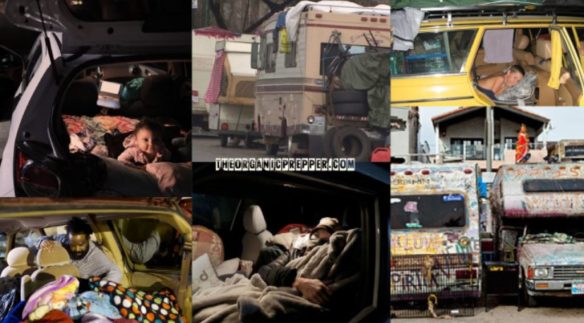
Desperate Americans Who Can’t Afford Housing Are Becoming “Modern-Day Nomads” …But Not By Choice

By Robert Wheeler

Source: The Organic Prepper

A recent story floating around mainstream media regarding “modern-day nomads” reads like a contemporary article on Henry David Thoreau. It shares stories of people looking to downsize their life and live simply and stories of people who have fallen on hard times, unable to afford rent. 

However, what is lacking is the exposure of the dark underbelly of the “modern-day nomad” culture. In other words, they neglect to mention the fact that the enormous growth of the “modern-day nomad” is rooted in the fact that the world economy has all but collapsed, now mired in a global economic depression of unemployment, low wages, and personal financial catastrophes.

While it sounds romantic, it’s often rooted in desperation.

Nevertheless, some of the stories begin in the following way:

If you look closely on city streets, campgrounds, and stretches of desert run by the Bureau of Land Management, you’ll see more Americans living in vehicles than ever before. It was never their plan.

“I wasn’t prepared when I had to move into my SUV. The transmission was going. I had no money saved. I was really scared,” said April Craren, 52, bundled in blankets atop a cot inside her new minivan, a 2003 Toyota Sienna.

She flipped the camera on her phone to show me the camp stove she uses to make coffee and her view of the sun rising over the Colorado River. She has no toilet, shower, or refrigeration.

After separating from her husband, April found herself homeless in June 2020, exacerbating the depressive disorder for which she receives $1,100 a month in disability benefits.

“I could have gotten an apartment but in a crappy unsafe place with no money to do anything at all,” she explained.

Last year, where April lived in Nixa, Missouri, the average rent for an apartment was $762, slightly less than the national average. Like nearly half of American renters, she would have been crippled by the cost.

It’s not surprising, then, that job loss, divorce, or, say, the sudden onset of global health or financial crisis can push so many over the edge.

Many Americans have found themselves trapped in a spiral of poverty from which they simply can’t recover.

It doesn’t sound so bad to those of us with minimalist persuasions

At 52, April Craren didn’t choose this life. It was thrust upon her by unfortunate life circumstances. Craren couldn’t afford the exorbitant rent that is now average across the country on a fixed income. (Partly due to inflation but mostly due to the housing crash in 2008.)

The coordination of lockdowns and COVID restrictions have plunged the world into a deep depression of which we are only beginning to see. Even Wall Street couldn’t have caused this much damage. 

“If the Great Recession was a crack in the system, Covid and climate change will be the chasm,” says Bob Wells, the nomad who plays himself in the film Nomadland. Thankfully, Wells was able to help Craren adopt her lifestyle so she can now survive as a “nomad” through his Home On Wheels Alliance.

Wells’s lifestyle was a choice. But the newfound interest in the nomadic lifestyle is not a choice for many.

From Yahoo:

Realizing he had something valuable to share, he bought the domain name Cheap RV Living in 2005. He posted tips and tricks about better vehicle-dwelling, but what he was really offering was a road map to a better life.

Four years later, when close to 10 million Americans were displaced after the Great Recession, traffic to his site exploded. Finding himself at the center of a growing online community, he decided to create a meet-up in Quartzsite, Arizona. He dubbed it the Rubber Tramp Rendezvous (RTR), and in January 2011, 45 vehicles showed up. Eight years later, an estimated 10,000 vehicles convened for what was said to be the largest nomad gathering in the world.

The event’s explosive growth is undoubtedly a reflection of America’s increasing interest in van life as an answer to the affordable housing crisis, an idea made accessible by Bob on his YouTube channel, also named Cheap RV Living, created in 2015.

The “increasing interest in van life” that Yahoo News refers to is not some petit-bourgeois fantasy being realized by privileged middle-class white kids, able to go home at any time. It is the necessity of formerly middle class, working-class, and poor people all across America who are out of work or are working but cannot afford housing.

Minimalism is a legitimate lifestyle for some; others have no choice

For many, this culture of minimalism is genuinely how they wish to live. Nomads have a genuine desire to see empty overconsumption come to an end. However, we can not ignore that minimalism is being promoted to prepare the Western population who are used to high living standards to accept those that are much lower.

Why do you think we continually see articles promoting insects as a legitimate dining option? Why are The Great Reset promoters at the World Economic Forum telling the public that they will soon own nothing and learn to love it?

Being a nomad doesn’t mean you can’t be prepared.

For those who are already nomads, whether by choice or forced by economic circumstance, it might be helpful to know that there are many prepping options available to you. There is no need to be left to the mercy of wherever you are right now. 

I highly encourage you to access Daisy Luther’s article, “There’s Another Option Besides Hunkering Down and Bugging Out: Nomadic Living.” It will give you the perspective of someone who has voluntarily experienced and lived the nomadic lifestyle while also the mindset of remaining prepared for anything and everything. 

At the rate the Great Reset is taking shape, many of us may find ourselves embracing the nomadic lifestyle, willingly or not.

Have you considered nomadic living?