
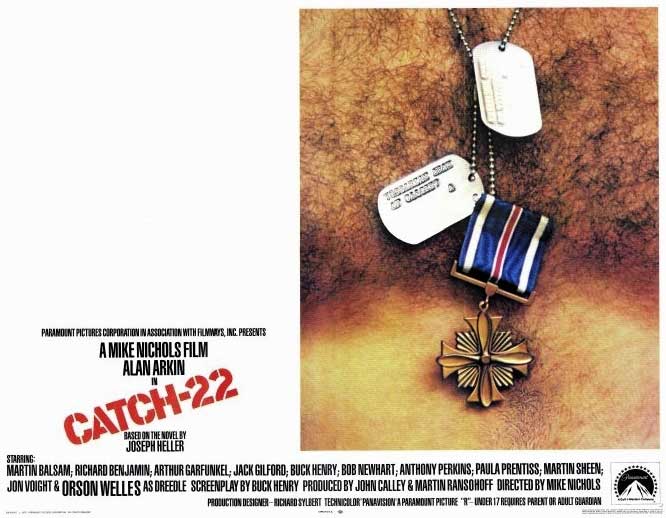
Saturday Matinee: Catch-22

Classic Film Review: So was “Catch-22” the failure we remember it to be?

By Roger Moore

Source: Movie Nation

Perhaps it took a humorless, career-crippling George Clooney TV version of Joseph Heller’s novel to make us better appreciate Mike Nichols’ daring, infamously-expensive version of “Catch-22.”

Released at the height of the Vietnam War, suffering in comparison to Robert Altman’s equally anti-war dramedy “M*A*S*H,” seemingly more on a par with with equally cynical action comedy “Kelly’s Heroes,” which has had the benefit of a lot more TV exposure, “Catch” still plays the way it did way back in 1970 — as a pricey, “difficult” satire with a “difficult” shoot as baggage.

But wipe away the “Catch-22 lore,”the people cast and cast-aside, the fact that Nichols wanted the more age-appropriate Al Pacino as Yossarian, the young bombardier/anti-hero, and grapple with the film’s disordered narrative, the nightmarish focus of the story — an active-duty combat airman flying through and ranting through what we now call Post Traumatic Stress Syndrome, coupled with a tinge of guilt.

It’s amazing to see now. And considering how our war movies, from “300” to “Midway,” “Greyhound” to “Flyboys” and even at times, “Dunkirk,” are made now — with digital planes and ships and sometimes tanks — they really don’t make’em like this any more.

Nichols made the most of his coastal Mexican location, showing off all 17 WWII vintage B-25s taking off and landing every chance he got. You couldn’t do that today.

And that cast. Alan Arkin makes a fine, perplexed and outraged Yossarian, a sane man trapped in the insanity of war, an actor who never hits a punchline too hard, never takes the character’s exasperation into parody.

“Let me see if I’ve got this straight. In order to be grounded, I’ve got to be crazy. And I must be crazy to keep flying. But if I ask to be grounded, that means I’m not crazy anymore, and I have to keep flying.”

“You got it,” Doc Daneeka (Jack Gilford) tells him. “That’s Catch-22.

“Whoo… That’s some catch, that Catch-22.”

Orson Welles as a grumpy general, Tony Perkins as a put-upon chaplain, Martin Balsam as the murderously vain Col. Cathcart, Buck Henry as his venal sidekick, Col. Corn (screenwriter Henry was never better, as an actor), baby-faced Bob Balaban as the always-crashing, always-tinkering, even-tempered Orr, it’s a dazzling corps.

Bob Newhart half-stammering through Major Major Major, a very young Martin Sheen raging as the pilot Dobbs, Art Garfunkel as the innocent co-pilot Nately who falls for an Italian hooker, Charles Grodin as an upper-class twit navigator, a smarmy, befuddlingly upbeat Richard Benjamin (cast, with his wife Paula Prentiss as a nurse Yossarian chases), the famous French star who fled to Hollywood Marcel Dalio is the wizened old Italian who figures Italy has already won the war, since it has surrendered and Americans are still fighting and dying. And there’s a sea of actors we’d come to recognize on TV (“The Bob Newhart Show” is over-represented) in the years that followed.

Jon Voight stands out, just enough, as the grinning opportunist Milo Minderbender, a stand-in for every war profiteer you’ve ever read about, working the angles, an impersonal unpatriotic multinational corporation who wins no matter who loses.

Like its two contemporaries, “M*A*S*H” and “Kelly’s Heroes,” it’s a guy’s movie with a dated leering quality about the opposite sex. It’s heavy-handed, here and there, betraying Nichols — feeling his oats after “The Graduate” — indulging in some serious “blank check” filmmaking.

And reading, over the years, of all the people Nichols wanted to cast, or cast and then replaced, you kind of wish he’d moved on from Gilford, a future Oscar nominee who doesn’t bring enough cowardly sniveling to the good doc.

“Catch-22” was popular enough that they did a pilot for a sitcom based on it, as was the case with “M*A*S*H.” Richard Dreyfuss had the lead in that.

Over the years, I’ve interviewed half a dozen actors from that all-star cast, and often, without prompting, they’d bring it up. It took half a year of their lives, most of them, and burned itself into their memories, even if it wasn’t the blockbuster Paramount expected it to be.

Watching it again, outside of the academic settings where it turned up in “film as satire” classes and the like, it feels more cinematic than the scruffy, Altmanesque “M*A*S*H,” a movie marred by that stupid screen-time-chewing football game. It’s less fun than the more-watchable “Patton” and even “Kelly’s Heroes” (which is FAR longer).

But as a darker-than-dark comedy about the futility and insanity of war, it towers above its contemporaries in ways that should have scared-off George Clooney. It’s the best film of a seemingly-unfilmmable classic novel we’re ever going to get.

MPAA Rating: R, graphic violence, blood, nudity, profanity

Cast: Alan Arkin, Martin Balsam, Buck Henry, Tony Perkins, Bob Newhart, Paula Prentiss, Richard Benjamin, Marcel Dalio, Bob Balaban, Art Garfunkel, Martin Sheen, Jack Gilford, Peter Bonerz, Norman Fell, Austin Pendleton, Jon Voight and Orson Welles.

Credits: Directed by Mike Nichols, script by Buck Henry, based on the Joseph Heller novel. A Paramount release.

Running time: 2:02

____________________

Watch Catch-22 on Kanopy here: https://www.kanopy.com/en/product/3216674
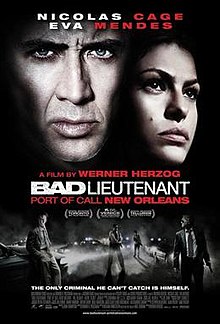
Saturday Matinee: Bad Lieutenant: Port of Call New Orleans

Review: Bad Lieutenant: Port of Call New Orleans

By Jessica Winter

Source: Film Comment

When is the audience allowed to laugh at a serious movie? How do you gauge whether the laughter expresses surprise, shock, nervousness, disdain, feigned superiority, genuine mirth, or some combination thereof? Take Werner Herzog’s films with his best fiend, Klaus Kinski: at a New York repertory screening of the deranged-conquistador saga Aguirre, Wrath of God a few years back, the patrons might as well have been watching The Hangover. Were they wrong? Or how about Abel Ferrara’s 1992 hell trip Bad Lieutenant: is it wildly inappropriate to laugh when Harvey Keitel’s depraved cop screams “You ratfucker!” at a church lady he mistakes for Jesus Christ? Is it wildly inappropriate not to laugh?

Herzog’s not-a-remake, Bad Lieutenant: Port of Call New Orleans, tacitly addresses this dilemma. Like much of the Herzog-Kinski catalogue, it’s a case study in bug-eyed monomania, and like Ferrara’s original, it’s a descent into the swamplands of the human soul with a drug-addled, quasi-righteous, borderline-insane cop as your tour guide. Unlike either, the reboot appears to be a comedy, or something close to it. BL:POCNO has comedy props: singing iguanas, a “magic crack pipe,” Val Kilmer. It has comic refrains that become funnier with each iteration, including Nicolas Cage’s emphysematic laugh and—for reasons that are tough to explain concisely—the letter “G.” It has punch lines. (“Everything I take is prescription. Except for the heroin.”) It has, for lack of a better term, a Gator Cam. Best of all, it has Cage, a walking sight gag who throws out his back early and spends the rest of the film bathed in a cold sweat of cocaine and Vicodin, lumbering around the post-Katrina landscape like he’s got a jumbo-sized T-square surgically jammed between his shoulder blades.

Cage’s Terence McDonagh comes off as part Kinski-style holy fool, part standard-issue Rogue Cop Who Gets Results. He shuttles crookedly between his adorable coke-whore sweetheart (Eva Mendes), his alcoholic father (Tom Bower), Dad’s beery girlfriend (Jennifer Coolidge, impressively frowsy), and his 24-7 mission pursuing local crack kingpin Big Fate (Alvin “Xzibit” Joiner), who’s possibly the most affable and credulous drug lord in cinema history. (This ambitious lad is happy to show new friend McDonagh the would-be flagship of a future real-estate empire: “waterfront condos” sited on some godforsaken loading dock, where Big Fate’s henchmen currently dump the bodies of their victims.)

But BL:POCNO’s shaggy police procedural (the screenwriter is NYPD Blue and Law & Order alumnus William Finkelstein) is almost an afterthought, always secondary to the Passion of the Cage: stations include a pharmacy meltdown worthy of Julianne Moore in Magnolia, a scary-funny parking-lot shakedown of two club kids out on Daddy’s credit cards, and above all, a feat of witness intimidation involving an electric shaver and a nice old lady’s nasal cannula. Pawing absently at his face, sniffing at bags of evidence (usually pocketing them for later), and huffing crack with anyone who’s holding, McDonagh is a mass of primitive, unexamined desires. In the grip of both addiction and workaholism, he has an appetite but not a will, a brain but not a mind. He is, perhaps, reptile brain incarnate—hence those singing iguanas and surveillance-camera-eyed alligators, not to mention the lone little fish swimming sad circles in a glass in a dead boy’s room.

The Herzog version almost entirely eschews the religious iconography of BL 1.0, but McDonagh does occasionally experience the kind of ecstatic self-forgetting that saints and drug addicts have in common. The dopey bliss that washes over Cage’s face when he glimpses a break-dancing ghost or regales his starry-eyed girlfriend with childhood tales of “buried treasure” is the happiest gift this erratic actor has given us in a long time. Shot in New Orleans largely for the tax break, labeled Bad Lieutenant largely because the producers had rights to the brand name, and starring an actor who, not to put too fine a point on it, makes a lot of crap, Herzog’s movie has expedience and exploitation written all over it. But it’s too weird and unhinged and endearing—and, for all its sordid details, too ingenuous—to be anything but a labor of love.


Watch the film on Hoopla here: https://www.hoopladigital.com/title/12197641

Saturday Matinee: Death Laid an Egg

Synopsis by Robert Firsching

Source: AllMovie

This is a deliriously strange thriller about a scientist (Jean-Louis Trintignant) who is breeding headless, boneless chickens at a high-tech farm. He’s having an affair with Ewa Aulin, who is plotting with him to kill his wife (Gina Lollobrigida)…and she’s plotting with Aulin to kill him…and he and Lollobrigida are plotting…oh, it’s too confusing, but extremely memorable. The bizarre, only semi-linear editing and trippy cinematographic techniques are artifacts of the psychedelic era and combine with the twisted story to make any Euro-cultist’s dreams come true. A film that defies easy categorization, it veers uneasily between giallo, drug film, and science-fiction, with heavy doses of romance and Antonioni-like weirdness. Some parts are even reminiscent of David Lynch‘s Eraserhead. Aulin was in the even stranger Microscopic Liquid Subway to Oblivion a few years later. A must-see for genre fans.


Watch the full film on Kanopy.

Saturday Matinee: Trust

“Trust” (1990) is an independent comedy written and directed by Hal Hartley about the relationship between misfits Maria (Adrienne Shelly) and Matthew (Martin Donovan) who are equally alienated in their stifling Long Island town. Equal parts stylized and realistic with a focus on the struggle to live with intelligence and integrity in a society hostile towards such traits, Trust is a quintessential Hal Hartley film.

Watch the full film on Hoopla here: https://www.hoopladigital.com/title/11374855

Sunday Matinee: The Spook Who Sat by the Door

spook_who_sat_by_door_poster_02

“The Spook Who Sat by the Door” (1973) is one of the most unabashedly radical revenge fantasies ever filmed. Based on the 1969 novel by Sam Greenlee, the film was directed by Ivan Dixon, and co-produced by Dixon and Greenlee, who had to resort to grassroots community fundraising to get it made. The plot centers on Dan Freeman, a covert black nationalist who infiltrates the Chicago offices of the CIA as a token black employee in a clerical position (they seat him by the door to demonstrate their commitment to diversity for visitors). After learning what he needs to learn, Freeman promptly resigns, gets a new position as a social worker in the ghetto, recruits an army of freedom fighters and teaches them CIA guerrilla warfare tactics in preparation for an uprising. Not surprisingly, the film was removed from theaters shortly after release due to pressure from the FBI and was not available on home video until 2004.

The full version of the The Spook Who Sat by the Door presented on the following YouTube video is preceded by interviews with Sam Greenlee who provides details about how his film was suppressed by the government:

Saturday Matinee: Bad Boy Bubby

Screen shot 2011-01-10 at 15.08.57

In “Bad Boy Bubby” (1993), an Australian film by writer/director Rolf de Heer, Nicholas Hope gives a brilliant performance as Bubby, a man who’s been kept confined and abused physically and emotionally by his mother for 35 years. He eventually escapes and has a number of chance encounters which reveal different aspects of himself and society. The first portion of the film is the most brutal, but as Bubby ventures out into the world the film’s tone lightens a bit and becomes more of a traditional (yet still twisted) dark comedy. Bad Boy Bubby is definitely not for all tastes and is initially difficult to watch, but is ultimately rewarding for its uniformly great performances, writing and direction.

Saturday Matinee: What to Do in Case of Fire?

3b6ef1ef605e7

“What to Do in Case of Fire?” (2001) opens with a montage of young anarchist squatters fighting police, making propaganda films, and constructing a homemade bomb in Berlin circa 1987. They plan to blow up a vacant mansion but the bomb is a dud, until thirteen years later when it injures a real estate broker and potential buyer in a fluke accident.

Only two of the original members of the anarchist collective, Tim and Hotte, are still squatting in the same communal housing since the 80s and are unable to prevent police from confiscating filmed evidence in a raid triggered by the bomb incident. Because all members of the collective are potentially linked to the bombing, Tim and Hotte scramble to track down former comrades and formulate an action plan before the evidence is examined. The reunion of old friends, including those who’ve settled into traditional family life or sold out for corporate jobs, stirs up a host of interpersonal conflicts which they must resolve in order to work together to remain free.

Though the film does at times seem to fall back on lazy stereotypes of anarchists, it at least puts them in a human light. Even less radical viewers could relate to certain struggles the protagonists are faced with, such as trying to balance freedom and security, being “successful” versus upholding one’s ideals, and coming to terms with friendships that change over time. It would have been interesting had the film delved deeper into Berlin’s anarchist and squatters movements, in my opinion, but it’s nevertheless a charming and fun mix of comedy, drama and heist genres.

Note: to activate English subtitles on the video, click on the Closed Captions (CC) icon on the bottom right corner while video is playing, click on the box that says “Portuguese (Brazil)”, click “Translate Captions”, click on “Afrikaans”, then you should be able to scroll down until you can click on “English”. The subtitle feature might not be available on some portable devices.