Viral Inequality: From Jeff Bezos to the struggle of Indian Farmers

Billionaires have profited enormously from lockdown, whilst mega corporations are buying out and shutting down independent stores and farms.

By Colin Todhunter

Source: OffGuardian

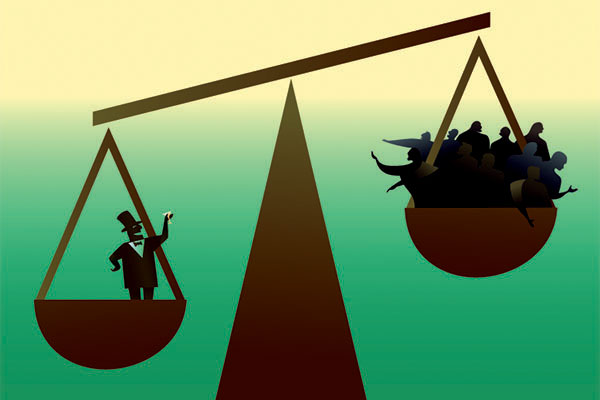
According to a new report by Oxfam, ‘The Inequality Virus’, the wealth of the world’s billionaires increased by $3.9tn (trillion) between 18 March and 31 December 2020. Their total wealth now stands at $11.95tn.

The world’s 10 richest billionaires have collectively seen their wealth increase by $540bn over this period. In September 2020, Jeff Bezos could have paid all 876,000 Amazon employees a $105,000 bonus and still be as wealthy as he was before COVID.

At the same time, hundreds of millions of people will lose (have lost) their jobs and face destitution and hunger. It is estimated that the total number of people living in poverty could have increased by between 200 million and 500 million in 2020. The number of people living in poverty might not return even to its pre-crisis level for over a decade.

Mukesh Ambani, India’s richest man and head of Reliance Industries, which specialises in petrol, retail and telecommunications, doubled his wealth between March and October 2020. He now has $78.3bn. The average increase in Ambani’s wealth in just over four days represented more than the combined annual wages of all of Reliance Industries’ 195,000 employees.

The Oxfam report states that lockdown in India resulted in the country’s billionaires increasing their wealth by around 35 per cent. At the same time, 84 per cent of households suffered varying degrees of income loss. Some 170,000 people lost their jobs every hour in April 2020 alone.

The authors also noted that income increases for India’s top 100 billionaires since March 2020 was enough to give each of the 138 million poorest people a cheque for 94,045 rupees.

The report went on to state:

…it would take an unskilled worker 10,000 years to make what Ambani made in an hour during the pandemic…and three years to make what Ambani made in a second.”

During lockdown and after, hundreds of thousands of migrant workers in the cities (who had no option but to escape the country’s avoidable but deepening agrarian crisis) were left without jobs, money, food or shelter.

It is clear that COVID has been used as cover for consolidating the power of the unimaginably rich. But plans for boosting their power and wealth will not stop there. One of the most lucrative sectors for these people is agrifood.

More than 60 per cent of India’s almost 1.4 billion population rely (directly or indirectly) on agriculture for their livelihood. Aside from foreign interests, Mukesh Ambani and fellow billionaire Gautam Adani (India’s second richest person with major agribusiness interests) are set to benefit most from the recently passed farm bills that will lead to the wholesale corporatisation of the agrifood sector.

CORPORATE CONSOLIDATION

A recent article on the grain.org website, ‘Digital control: how big tech moves into food and farming (and what it means)’, describes how Amazon, Google, Microsoft, Facebook and others are closing in on the global agrifood sector while the likes of Bayer, Syngenta, Corteva and Cargill are cementing their stranglehold.

The tech giants entry into the sector will increasingly lead to a mutually beneficial integration between the companies that supply products to farmers (pesticides, seeds, fertilisers, tractors, drones, etc) and those that control the flow of data and have access to digital (cloud) infrastructure and food consumers. This system is based on corporate centralisation and concentration (monopolisation).

Grain notes that in India global corporations are also colonising the retail space through e-commerce. Walmart entered into India in 2016 by a US$3.3 billion take-over of the online retail start-up Jet.com which, in 2018, was followed by a US$16 billion take-over of India’s largest online retail platform Flipkart. Today, Walmart and Amazon now control almost two-thirds of India’s digital retail sector.

Amazon and Walmart are using predatory pricing, deep discounts and other unfair business practices to lure customers towards their online platforms. According to Grain, when the two companies generated sales of over US$3 billion in just six days during a Diwali festival sales blitz, India’s small retailers called out in desperation for a boycott of online shopping.

In 2020, Facebook and the US-based private equity concern KKR committed over US$7 billion to Reliance Jio, the digital store of one of India’s biggest retail chains. Customers will soon be able to shop at Reliance Jio through Facebook’s chat application, WhatsApp.

The plan for retail is clear: the eradication of millions of small traders and retailers and neighbourhood mom and pop shops. It is similar in agriculture.

The aim is to buy up rural land, amalgamate it and roll out a system of chemically-drenched farmerless farms owned or controlled by financial speculators, the high-tech giants and traditional agribusiness concerns. The end-game is a system of contract farming that serves the interests of big tech, big agribusiness and big retail. Smallholder peasant agriculture is regarded as an impediment to be replaced by large industrial-scale farms.

This model will be based on driverless tractors, drones, genetically engineered/lab-produced food and all data pertaining to land, water, weather, seeds and soils patented and often pirated from peasant farmers.

Farmers possess centuries of accumulated knowledge that once gone will never be got back. Corporatisation of the sector has already destroyed or undermined functioning agrarian ecosystems that draw on centuries of traditional knowledge and are increasingly recognised as valid approaches to secure food security.

And what of the hundreds of millions to be displaced in order to fill the pockets of the billionaire owners of these corporations? Driven to cities to face a future of joblessness: mere ‘collateral damage’ resulting from a short-sighted system of dispossessive predatory capitalism that destroys the link between humans, ecology and nature to boost the bottom line of the immensely rich.

IMPERIAL INTENT

India’s agrifood sector has been on the radar of global corporations for decades. With deep market penetration and near saturation having been achieved by agribusiness in the US and elsewhere, India represents an opportunity for expansion and maintaining business viability and all-important profit growth. And by teaming up with the high-tech players in Silicon Valley, multi-billion dollar data management markets are being created. From data and knowledge to land, weather and seeds, capitalism is compelled to eventually commodify (patent and own) all aspects of life and nature.

Foreign agricapital is applying enormous pressure on India to scrap its meagre (in comparison to the richer nations) agricultural subsidies. The public distribution system and publicly held buffer stocks constitute an obstacle to the profit-driven requirements of global agribusiness interests.

Such interests require India to become dependent on imports (alleviating the overproduction problem of Western agricapital – the vast stocks of grains that it already dumps on the Global South) and to restructure its own agriculture for growing crops (fruit, vegetables) that consumers in the richer countries demand. Instead of holding physical buffer stocks for its own use, India would hold foreign exchange reserves and purchase food stocks from global traders.

Successive administrations have made the country dependent on volatile flows of foreign capital via foreign direct investment (and loans). The fear of capital flight is ever present. Policies are often governed by the drive to attract and retain these inflows. This financialisation of agriculture serves to undermine the nation’s food security, placing it at the mercy of unforeseen global events (conflict, oil prices, public health crises) international commodity speculators and unstable foreign investment.

Current agricultural ‘reforms’ are part of a broader process of imperialism’s increasing capture of the Indian economy, which has led to its recolonization by foreign corporations as a result of neoliberalisation which began in 1991. By reducing public sector buffer stocks and introducing corporate-dictated contract farming and full-scale neoliberal marketisation for the sale and procurement of produce, India will be sacrificing its farmers and its own food security for the benefit of a handful of unscrupulous billionaires.

As independent cultivators are bankrupted, the aim is that land will eventually be amalgamated to facilitate large-scale industrial cultivation. Indeed, a recent piece on the Research Unit for Political Economy site, ‘The Kisans Are Right: Their Land Is At Stake‘, describes how the Indian government is ascertaining which land is owned by whom with the ultimate aim of making it easier to eventually sell it off (to foreign investors and agribusiness). Other developments are also part of the plan (such as the Karnataka Land Reform Act), which will make it easier for business to purchase agricultural land.

India could eventually see institutional investors with no connection to farming (pension funds, sovereign wealth funds, endowment funds and investments from governments, banks, insurance companies and high net worth individuals) purchasing land. This is an increasing trend globally and, again, India represents a huge potential market. The funds have no connection to farming, have no interest in food security and are involved just to make profit from land.

The recent farm bills – if not repealed – will impose the neoliberal shock therapy of dispossession and dependency, finally clearing the way to restructure the agri-food sector. The massive inequalities and injustices that have resulted from the COVID-related lockdowns are a mere taste of what is to come.

The hundreds of thousands of farmers who have been on the streets protesting against these bills are at the vanguard of the pushback – they cannot afford to fail. There is too much at stake.

ACCORDING TO THE FATHER OF PROPAGANDA AN INVISIBLE GOVERNMENT CONTROLS OUR MINDS WITH A THOUGHT PRISON

By Sigmund Fraud

Source: Waking Times

“Who are the men who without our realizing it, give us our ideas, tell us whom to admire and whom to despise, what to believe about the ownership of public utilities, about the tariff, about the price of rubber, about the Dawes Plan, about immigration; who tell us how our houses should be designed, what furniture we should put in them, what menus we should serve on our table, what kind of shirts we must wear, what sports we should indulge in, what plays we should see, what charities we should support, what pictures we should admire, what slang we should affect, what jokes we should laugh at?” ~ Edward Bernays, Propaganda

Authored by Edward Bernays and published in 1928, the book Propaganda still holds its position as the gold standard for influencing and manipulating public behavior. Drawing on his expertise in psychology while using the language of manipulation, Bernays pioneered social engineering via mass media, and his work lives on in the distorted, statist, consumer world we have today.

But who are the ones behind the curtain telling us what to think by directing our attention onto the things which serve interests?

Interestingly, chapter III of Propaganda is titled, ‘The New Propagandists, and is devoted to explaining why the controls for mass manipulation are so closely guarded by a relatively tiny elite who sit in the shadows, out of the public eye, choosing what we are to see and to think, even controlling the politicians we elect to represent us.

If we set out to make a list of the men and women who, because of their position in public life, might fairly be called the molders of public opinion we could quickly arrive at an extended list of persons mentioned in “Who’s Who…”

Such a list would comprise several thousand persons. But it is well known that many of these leaders are themselves led, sometimes by persons whose names are known to few.

Such persons typify in the public mind the type of ruler associated with the phrase invisible government.

An invisible government of corporate titans and behind the scenes influencers who’s mark on culture cannot be understated today. Bernays continues:

The invisible government tends to be concentrated in the hands of the few because of the expense of manipulating the social machinery which controls the opinions and habits of the masses.

The public relations counsel, then, is the agent who, working with modern media communication and the group formation of society, brings an idea to the consciousness of the public. But he is a great deal more than that. He is concerned with courses of action, doctrines, systems and opinions, and the securing of public support for them.

Ultimately, the goal of this type of mass-produced, pop-culture propaganda is to weaken the individual’s ability to think critically, thereby creating an environment where many people look to one another for approval, always second-guessing their own faculties. When this happens, the strength of the collective group begins to take form and multiply, and ideas can be implanted into the popular culture, taking root in the form of widespread conformist behavior.

Thinking critically means making reasoned judgments that are logical and well thought out. It is a way of thinking in which one doesn’t simply accept all arguments and conclusions to which one is exposed without questioning the arguments and conclusions. It requires curiosity, skepticism and humility. People who use critical thinking are the ones who say things such as, “How do you know that?” “Is this conclusion based on evidence or gut feelings?” and “Are there alternative possibilities when given new pieces of information?””  [Source]

Final Thoughts

The takeaway here is that not much has changed in 100 years of corporate/statist American culture, other than the technical capacity to scale this ever upward. Our lives are still heavily influenced by the likes of the described by Bernays. There is one advantage we do have now, however, as technology has given us greater access to the truth and we are now free to split from the matrix psychologically by understanding what it is and how it influences our lives. If we choose to do so, that is, if we choose to take the red pill.

In order to understand your life and your mission here on earth in the short time you have, it is imperative to learn to see the thought prison that has been built around you, and to actively circumnavigate it. Free-thinking is being stamped out by the propagandists, but our human tendency is to crave freedom, and with the aid of truth, we are more powerful than the control matrix and the invisible government.

The Deep State’s Stealthy, Subversive, Silent Coup to Ensure Nothing Changes

By John W. Whitehead

Source: The Rutherford Institute

“You have such a fervent, passionate, evangelical faith in this country…why in the name of God don’t you have any faith in the system of government you’re so hell-bent to protect? You want to defend the United States of America, then defend it with the tools it supplies you with—its Constitution. You ask for a mandate, General, from a ballot box. You don’t steal it after midnight, when the country has its back turned.”—Seven Days in May (1964)

No doubt about it: the coup d’etat was successful.

That January 6 attempt by so-called insurrectionists to overturn the election results was not the real coup, however. Those who answered President Trump’s call to march on the Capitol were merely the fall guys, manipulated into creating the perfect crisis for the Deep State—a.k.a. the Police State a.k.a. the Military Industrial Complex a.k.a. the Techno-Corporate State a.k.a. the Surveillance State—to swoop in and take control.

It took no time at all for the switch to be thrown and the nation’s capital to be placed under a military lockdown, online speech forums restricted, and individuals with subversive or controversial viewpoints ferreted out, investigated, shamed and/or shunned.

This new order didn’t emerge into being this week, or this month, or even this year, however.

Indeed, the real coup happened when our government “of the people, by the people, for the people” was overthrown by a profit-driven, militaristic, techno-corporate state that is in cahoots with a government “of the rich, by the elite, for the corporations.”

We’ve been mired in this swamp for decades now.

Every successive president starting with Franklin D. Roosevelt has been bought lock, stock and barrel and made to dance to the Deep State’s tune.

Enter Donald Trump, the candidate who swore to drain the swamp in Washington DC. Instead of putting an end to the corruption, however, Trump paved the way for lobbyists, corporations, the military industrial complex, and the Deep State to feast on the carcass of the dying American republic.

Joe Biden will be no different: his job is to keep the Deep State in power.

Step away from the cult of personality politics and you’ll find that beneath the power suits, they’re all alike.

Follow the money.  It always points the way.

As Bertram Gross noted in Friendly Fascism: The New Face of Power in America, “evil now wears a friendlier face than ever before in American history.”

Writing in 1980, Gross predicted a future in which he saw:

…a new despotism creeping slowly across America. Faceless oligarchs sit at command posts of a corporate-government complex that has been slowly evolving over many decades. In efforts to enlarge their own powers and privileges, they are willing to have others suffer the intended or unintended consequences of their institutional or personal greed. For Americans, these consequences include chronic inflation, recurring recession, open and hidden unemployment, the poisoning of air, water, soil and bodies, and, more important, the subversion of our constitution. More broadly, consequences include widespread intervention in international politics through economic manipulation, covert action, or military invasion

This stealthy, creeping, silent coup that Gross prophesied is the same danger that writer Rod Serling envisioned in the 1964 political thriller Seven Days in May, a clear warning to beware of martial law packaged as a well-meaning and overriding concern for the nation’s security.

Incredibly enough, almost 60 years later, we find ourselves hostages to a government run more by military doctrine and corporate greed than by the rule of law established in the Constitution. Indeed, proving once again that fact and fiction are not dissimilar, today’s current events could well have been lifted straight out of Seven Days in May, which takes viewers into eerily familiar terrain.

The premise is straightforward.

With the Cold War at its height, an unpopular U.S. President signs a momentous nuclear disarmament treaty with the Soviet Union. Believing that the treaty constitutes an unacceptable threat to the security of the United States and certain that he knows what is best for the nation, General James Mattoon Scott (played by Burt Lancaster), the head of the Joint Chiefs of Staff and presidential hopeful, plans a military takeover of the national government.  When Gen. Scott’s aide, Col. Casey (Kirk Douglas), discovers the planned military coup, he goes to the President with the information. The race for command of the U.S. government begins, with the clock ticking off the hours until the military plotters plan to overthrow the President.

Needless to say, while on the big screen, the military coup is foiled and the republic is saved in a matter of hours, in the real world, the plot thickens and spreads out over the past half century.

We’ve been losing our freedoms so incrementally for so long—sold to us in the name of national security and global peace, maintained by way of martial law disguised as law and order, and enforced by a standing army of militarized police and a political elite determined to maintain their powers at all costs—that it’s hard to pinpoint exactly when it all started going downhill, but we’ve been on that fast-moving, downward trajectory for some time now.

The question is no longer whether the U.S. government will be preyed upon and taken over by the military industrial complex. That’s a done deal, but martial law disguised as national security is only one small part of the greater deception we’ve been fooled into believing is for our own good.

How do you get a nation to docilely accept a police state? How do you persuade a populace to accept metal detectors and pat downs in their schools, bag searches in their train stations, tanks and military weaponry used by their small town police forces, surveillance cameras in their traffic lights, police strip searches on their public roads, unwarranted blood draws at drunk driving checkpoints, whole body scanners in their airports, and government agents monitoring their communications?

Try to ram such a state of affairs down the throats of the populace, and you might find yourself with a rebellion on your hands. Instead, you bombard them with constant color-coded alerts, terrorize them with shootings and bomb threats in malls, schools, and sports arenas, desensitize them with a steady diet of police violence, and sell the whole package to them as being for their best interests.

This present military occupation of the nation’s capital by 25,000 troops as part of the so-called “peaceful” transfer of power from one administration to the next is telling.

This is not the language of a free people. This is the language of force.

Still, you can’t say we weren’t warned.

Back in 2008, an Army War College report revealed that “widespread civil violence inside the United States would force the defense establishment to reorient priorities in extremis to defend basic domestic order and human security.” The 44-page report went on to warn that potential causes for such civil unrest could include another terrorist attack, “unforeseen economic collapse, loss of functioning political and legal order, purposeful domestic resistance or insurgency, pervasive public health emergencies, and catastrophic natural and human disasters.”

In 2009, reports by the Department of Homeland Security surfaced that labelled right-wing and left-wing activists and military veterans as extremists (a.k.a. terrorists) and called on the government to subject such targeted individuals to full-fledged pre-crime surveillance. Almost a decade later, after spending billions to fight terrorism, the DHS concluded that the greater threat is not ISIS but domestic right-wing extremism.

Meanwhile, the police have been transformed into extensions of the military while the nation itself has been transformed into a battlefield. This is what a state of undeclared martial law looks like, when you can be arrested, tasered, shot, brutalized and in some cases killed merely for not complying with a government agent’s order or not complying fast enough. This hasn’t just been happening in crime-ridden inner cities. It’s been happening all across the country.

And then you’ve got the government, which has been steadily amassing an arsenal of military weapons for use domestically and equipping and training their “troops” for war. Even government agencies with largely administrative functions such as the Food and Drug Administration, Department of Veterans Affairs, and the Smithsonian have been acquiring body armor, riot helmets and shields, cannon launchers and police firearms and ammunition. In fact, there are now at least 120,000 armed federal agents carrying such weapons who possess the power to arrest.

Rounding out this profit-driven campaign to turn American citizens into enemy combatants (and America into a battlefield) is a technology sector that has been colluding with the government to create a Big Brother that is all-knowing, all-seeing and inescapable. It’s not just the drones, fusion centers, license plate readers, stingray devices and the NSA that you have to worry about. You’re also being tracked by the black boxes in your cars, your cell phone, smart devices in your home, grocery loyalty cards, social media accounts, credit cards, streaming services such as Netflix, Amazon, and e-book reader accounts.

So you see, January 6 and its aftermath provided the government and its corporate technocrats the perfect excuse to show off all of the powers they’ve been amassing so assiduously over the years.

Mind you, by “government,” I’m not referring to the highly partisan, two-party bureaucracy of the Republicans and Democrats.

I’m referring to “government” with a capital “G,” the entrenched Deep State that is unaffected by elections, unaltered by populist movements, and has set itself beyond the reach of the law.

I’m referring to the corporatized, militarized, entrenched bureaucracy that is fully operational and staffed by unelected officials who are, in essence, running the country and calling the shots in Washington DC, no matter who sits in the White House.

This is the hidden face of a government that has no respect for the freedom of its citizenry.

Brace yourself.

There is something being concocted in the dens of power, far beyond the public eye, and it doesn’t bode well for the future of this country.

Anytime you have an entire nation so mesmerized by the antics of the political ruling class that they are oblivious to all else, you’d better beware.

Anytime you have a government that operates in the shadows, speaks in a language of force, and rules by fiat, you’d better beware.

And anytime you have a government so far removed from its people as to ensure that they are never seen, heard or heeded by those elected to represent them, you’d better beware.

As I make clear in my book Battlefield America: The War on the American People, we are at our most vulnerable right now.

All of those dastardly seeds we have allowed the government to sow under the guise of national security are bearing demon fruit.

The gravest threat facing us as a nation is not extremism but despotism, exercised by a ruling class whose only allegiance is to power and money.

American Requiem

However inequitable its bias, capitalist democracy at least offered the possibility of incremental and piecemeal reform. Now it is a corpse.

By Chris Hedges

Source: ScheerPost.com

Well, it’s over. Not the election. The capitalist democracy. However biased it was towards the interests of the rich and however hostile it was to the poor and minorities, the capitalist democracy at least offered the possibility of incremental and piecemeal reform. Now it is a corpse. The iconography and rhetoric remain the same. But it is an elaborate and empty reality show funded by the ruling oligarchs — $1.51 billion for the Biden campaign and $1.57 billion for the Trump campaign — to make us think there are choices. There are not. The empty jousting between a bloviating Trump and a verbally impaired Joe Biden is designed to mask the truth. The oligarchs always win. The people always lose. It does not matter who sits in the White House. America is a failed state.

“The American Dream has run out of gas,” wrote the novelist J.G. Ballard. “The car has stopped. It no longer supplies the world with its images, its dreams, its fantasies. No more. It’s over. It supplies the world with its nightmares now.”

There were many actors that killed America’s open society. The corporate oligarchs who bought the electoral process, the courts and the media, and whose lobbyists write the legislation to impoverish us and allow them to accumulate obscene amounts of wealth and unchecked power. The militarists and war industry that drained the national treasury to mount futile and endless wars that have squandered some $7 trillion and turned us into an international pariah. The CEOs, raking in bonuses and compensation packages in the tens of millions of dollars, that shipped jobs overseas and left our cities in ruins and our workers in misery and despair without a sustainable income or hope for the future. The fossil fuel industry that made war on science and chose profits over the looming extinction of the human species. The press that turned news into mindless entertainment and partisan cheerleading. The intellectuals who retreated into the universities to preach the moral absolutism of identity politics and multiculturalism while turning their backs on the economic warfare being waged on the working class and the unrelenting assault on civil liberties. And, of course, the feckless and hypocritical liberal class that does nothing but talk, talk, talk.

If there is one group that deserves our deepest contempt it is the liberal elites, those who posture as the moral arbiters of society while abandoning every value they purportedly hold the moment they become inconvenient. The liberal class, once again, served as pathetic cheerleaders and censors for a candidate and a political party that in Europe would be considered on the far-right. Even while liberals were being ridiculed and dismissed by Biden and by the Democratic Party hierarchy, which bizarrely invested its political energy in appealing to Republican neocons, liberals were busy marginalizing journalists, including Glenn Greenwald and Matt Taibbi, who called out Biden and the Democrats. The liberals, whether at The Intercept or The New York Times, ignored or discredited information that could hurt the Democratic Party, including the revelations on Hunter Biden’s laptop. It was a stunning display of craven careerism and self-loathing.

The Democrats and their liberal apologists are, the election has illustrated, oblivious to the profound personal and economic despair sweeping through this country. They stand for nothing. They fight for nothing. Restoring the rule of law, universal health care, banning fracking, a Green New Deal, the protection of civil liberties, the building of unions, the preservation and expansion of social welfare programs, a moratorium on evictions and foreclosures, the forgiveness of student debt, stiff environmental controls, a government jobs program and guaranteed income, financial regulation, opposition to endless war and military adventurism were once again forgotten. Championing these issues would have resulted in a Democratic Party landslide. But since the Democratic Party is a wholly owned subsidiary of corporate donors, promoting any policy that might foster the common good, diminish corporate profits and restore democracy, including imposing campaign finance laws, was impossible. Biden’s campaign was utterly bereft of ideas and policy issues, as if he and the Democrats could sweep the elections by promising to save the soul of America. At least the neofascists have the courage of their demented convictions.

The liberal class functions in a traditional democracy as a safety valve. It makes piecemeal and incremental reform possible. It ameliorates the worst excesses of capitalism. It proposes gradual steps towards greater equality. It endows the state and the mechanisms of power with supposed virtues. It also serves as an attack dog that discredits radical social movements. The liberal class is a vital component within the power elite. In short, it offers hope and the possibility, or at least the illusion, of change.

The surrender of the liberal elite to despotism creates a power vacuum that speculators, war profiteers, gangsters and killers, often led by charismatic demagogues, fill. It opens the door to fascist movements that rise to prominence by ridiculing and taunting the absurdities of the liberal class and the values they purport to defend. The promises of the fascists are fantastic and unrealistic, but their critiques of the liberal class are grounded in truth. Once the liberal class ceases to function, it opens a Pandora’s box of evils that are impossible to contain.

The disease of Trumpism, with or without Trump, is, as the election illustrated, deeply embedded in the body politic. It is an expression among huge segments of the population, taunted by liberal elites as “deplorables,” of a legitimate alienation and rage that the Republicans and the Democrats orchestrated and now refuse to address. This Trumpism is also, as the election showed, not limited to white men, whose support for Trump actually declined.

Fyodor Dostoevsky saw the behavior of Russia’s useless liberal class, which he satirized and excoriated at the end of the 19th century, as presaging a period of blood and terror. The failure of liberals to defend the ideals they espoused inevitably led, he wrote, to an age of moral nihilism. In Notes From Underground, he portrayed the sterile, defeated dreamers of the liberal class, those who hold up high ideals but do nothing to defend them. The main character in Notes From Underground carries the bankrupt ideas of liberalism to their logical extreme. He eschews passion and moral purpose. He is rational. He accommodates a corrupt and dying power structure in the name of liberal ideals. The hypocrisy of the Underground Man dooms Russia as it now dooms the United States. It is the fatal disconnect between belief and action.

“I never even managed to become anything: neither wicked nor good, neither a scoundrel nor an honest man, neither a hero nor an insect,” the Underground Man wrote. “And now I am living out my life in my corner, taunting myself with the spiteful and utterly futile consolation that it is even impossible for an intelligent man seriously to become anything, and only fools become something. Yes, sir, an intelligent man of the nineteenth century must be and is morally obliged to be primarily a characterless being; and a man of character, an active figure – primarily a limited being.”

The refusal of the liberal class to acknowledge that power has been wrested from the hands of citizens by corporations, that the Constitution and its guarantees of personal liberty have been revoked by judicial fiat, that elections are nothing more than empty spectacles staged by the ruling elites, that we are on the losing end of the class war, has left it speaking and acting in ways that no longer correspond to reality.

The “idea of the intellectual vocation,” as Irving Howe pointed out in his 1954 essay This Age of Conformity, “the idea of a life dedicated to values that cannot possibly be realized by a commercial civilization — has gradually lost its allure. And, it is this, rather than the abandonment of a particular program, which constitutes our rout.” The belief that capitalism is the unassailable engine of human progress, Howe wrote, “is trumpeted through every medium of communication: official propaganda, institutional advertising and scholarly writings of people who, until a few years ago, were its major opponents.”

“The truly powerless people are those intellectuals — the new realists — who attach themselves to the seats of power, where they surrender their freedom of expression without gaining any significance as political figures,” Howe wrote. “For it is crucial to the history of the American intellectuals in the past few decades — as well as to the relationship between ‘wealth’ and ‘intellect’ — that whenever they become absorbed into the accredited institutions of society they not only lose their traditional rebelliousness but to one extent or another they cease to function as intellectuals.” 

Populations can endure the repression of tyrants, as long as these rulers continue to effectively manage and wield power. But human history has amply demonstrated that once those in positions of power become redundant and impotent, yet retain the trappings and privileges of power, they are brutally discarded. This was true in Weimar Germany. It was true in the former Yugoslavia, a conflict I covered for The New York Times. 

The historian Fritz Stern in The Politics of Cultural Despair, his book on the rise of fascism in Germany, wrote of the consequences of the collapse of liberalism. Stern argued that the spiritually and politically alienated, those cast aside by the society, are prime recruits for a politics centered around violence, cultural hatreds and personal resentments. Much of this rage, justifiably, is directed at a liberal elite that, while speaking the “I-feel-your-pain” language of traditional liberalism, sells us out.

“They attacked liberalism,” Stern writes of the fascists emerging at the time in Germany, “because it seemed to them the principal premise of modern society; everything they dreaded seemed to spring from it; the bourgeois life, Manchesterism, materialism, parliament and the parties, the lack of political leadership. Even more, they sense in liberalism the source of all their inner sufferings. Theirs was a resentment of loneliness; their one desire was for a new faith, a new community of believers, a world with fixed standards and no doubts, a new national religion that would bind all Germans together. All this, liberalism denied. Hence, they hated liberalism, blamed it for making outcasts of them, for uprooting them from their imaginary past, and from their faith.”

We are in for it. The for-profit health care system, designed to make money — not take care of the sick — is unequipped to handle a national health crisis. The health care corporations have spent the last few decades merging and closing hospitals, and cutting access to health care in communities across the nation to increase revenue — this, as nearly half of all front-line workers remain ineligible for sick pay and some 43 million Americans have lost their employee-sponsored health insurance. The pandemic, without universal health care, which Biden and the Democrats have no intention of establishing, will continue to rage out of control. Three hundred thousand Americans dead by December. Four hundred thousand by January. And by the time the pandemic burns out or a vaccine becomes safely available, hundreds of thousands, maybe a few million, will have died.

The economic fallout from the pandemic, the chronic underemployment and unemployment — close to 20 percent when those who have stopped looking for work, those furloughed with no prospect of being rehired and those who work part-time but are still below the poverty line are included in the official statistics — will mean a depression unlike anything we have seen since the 1930s. Hunger in US households has already tripled since last year. The proportion of US children who are not getting enough to eat is 14 times higher than last year. Food banks are overrun. The moratorium on foreclosures and evictions has been lifted while over 30 million destitute Americans face the prospect of being thrown into the street.

There is no check left on corporate power. The inevitable social unrest will see the state, no matter who is in the White House, use its three principle instruments of social control — wholesale surveillance, the prisons and militarized police — buttressed by a legal system that routinely revokes habeas corpus and due process, to ruthlessly crush dissent. People of color, immigrants and Muslims will be blamed and targeted by our native fascists for the nation’s decline. The few who continue in defiance of the Democratic Party to call out the crimes of the corporate state and the empire will be silenced. The sterility of the liberal class, serving the interests of a Democratic Party that disdains and ignores them, fuels the widespread feelings of betrayal that saw nearly half the voters support one of the most vulgar, racist, inept and corrupt presidents in American history. An American tyranny, dressed up with the ideological veneer of a Christianized fascism, will, it appears, define the empire’s epochal descent into irrelevance.

Lords of Misrule: UK Elites and the Rise of Global Feudalism

By Chris Floyd

Source: Empire Burlesque

I darkly suspect that the UK is entering a long winter of discontent and widespread upheaval, which will likely end with the replacement of the hapless opportunist Boris Johnson by someone even worse: the hardcore, inhumane, hard-right true believer Michael Gove, with the equally inhumane, sinister crank Dom Cummings still running the show. (Cummings, remember, has long been Gove’s man, not Johnson’s.) Together they will use the chaos and suffering to keep pushing their brutal agenda of “disruption” and “reform” to destroy the ability of government to act for the greater common good. Instead they will continue turning over its functions to cronies in the private sector, who will drain the Treasury in corrupt deals while providing degraded services – or none at all – as we have seen in almost every case of “privatisation” over the past decades and especially during the pandemic.

Gove and Cummings are part of a broader rightwing movement across the world, which has for decades been funded with unimaginable amounts of money (almost always “dark money,” hidden and laundered through cut-outs). These extremist ideologues believe that government has only one legitimate function: enhancing the power and privilege of an elite that rules by the “right” of its inherent superiority: either its “superior genes” (as Trump – and Cummings’ lordly father-in-law – openly say) or a putative in-born “superior intellect” (as Dom postulates, ludicrously including himself among that number). Money is the main signifier of inherent worth in this barbaric belief system; and being unaccountable to the laws and regulations that restrict the grubby rabble is one of the chief privileges of the elect.

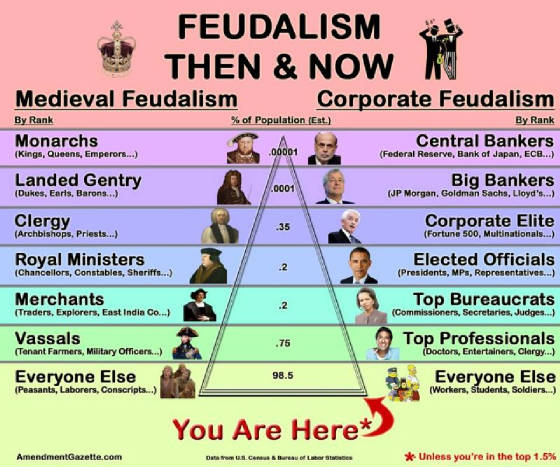
In essence, it’s a form of high-tech feudalism, where baronal power centers (oligiarchs, corporations) hold sway over weak and nominal national governments. If you read what the right-wing think tanks (often American in origin) with which Gove and Cummings have long been associated are ACTUALLY saying in the dense, dull prose of their innumerable “policy papers,” you’ll see that this characterization of their ideology and their aims is no exaggeration. It’s an ancient evil – brutal, rapacious rule by unaccountable elites – dressed up in modern form and cloaked in the cynical perversion of rhetoric about “rights” and “freedom” and “sovereignty” and “modernization” and “AI,” etc. They are heartless liars in pursuit of loot and power, and they literally, demonstrably, do not care who lives or dies, as long as they get what they want.

Until we recognize this, until we stop treating these radical, death-dealing, society-wrecking extremists as normal politicians working within the system, we cannot effectively confront them and stop their depredations. They will continue to use the system itself to hollow out government and society until there is nothing left but their little clique, sealed in sumptuous fortresses behind masses of armed guards, lording it over the ruins.

The Election Has Already Been Hijacked and the Winner Decided: ‘We the People’ Lose

By John W. Whitehead

Source: The Rutherford Institute

“Free election of masters does not abolish the masters or the slaves.” ― Herbert Marcuse

Republicans and Democrats alike fear that the other party will attempt to hijack this election.

President Trump is convinced that mail-in ballots are a scam except in Florida, where it’s safe to vote by mail because of its “great Republican governor.”

The FBI is worried about foreign hackers continuing to target and exploit vulnerabilities in the nation’s electoral system, sowing distrust about the parties, the process and the outcome.

I, on the other hand, am not overly worried: after all, the voting booths have already been hijacked by a political elite comprised of Republicans and Democrats who are determined to retain power at all costs.

The outcome is a foregone conclusion: the Deep State will win and “we the people” will lose.

The damage has already been done.

The Department of Homeland Security (DHS), which has been tasked with helping to “secure” the elections and protect the nation against cyberattacks, is not exactly an agency known for its adherence to freedom principles.

After all, this is the agency largely responsible for turning the American republic into a police state. Since its creation, the DHS has ushered in the domestic use of surveillance drones, expanded the reach of fusion centers, stockpiled an alarming amount of ammunition (including hollow point bullets), urged Americans to become snitches through a “see something, say something” campaign, overseen the fumbling antics of TSA agents everywhere, militarized the nation’s police, spied on activists and veterans, distributed license plate readers and cell phone trackers to law enforcement agencies, contracted to build detention camps, carried out military drills and lockdowns in American cities, conducted virtual strip searches of airline passengers, established Constitution-free border zones, funded city-wide surveillance cameras, and undermined the Fourth Amendment at every turn.

So, no, I’m not losing a night’s sleep over the thought that this election might by any more rigged than it already is.

And I’m not holding my breath in the hopes that the winner of this year’s popularity contest will save us from government surveillance, weaponized drones, militarized police, endless wars, SWAT team raids, asset forfeiture schemes, overcriminalization, profit-driven private prisons, graft and corruption, or any of the other evils that masquerade as official government business these days.

You see, after years of trying to wake Americans up to the reality that there is no political savior who will save us from the police state, I’ve come to realize that Americans want to engage in the reassurance ritual of voting.

They want to believe the fantasy that politics matter.

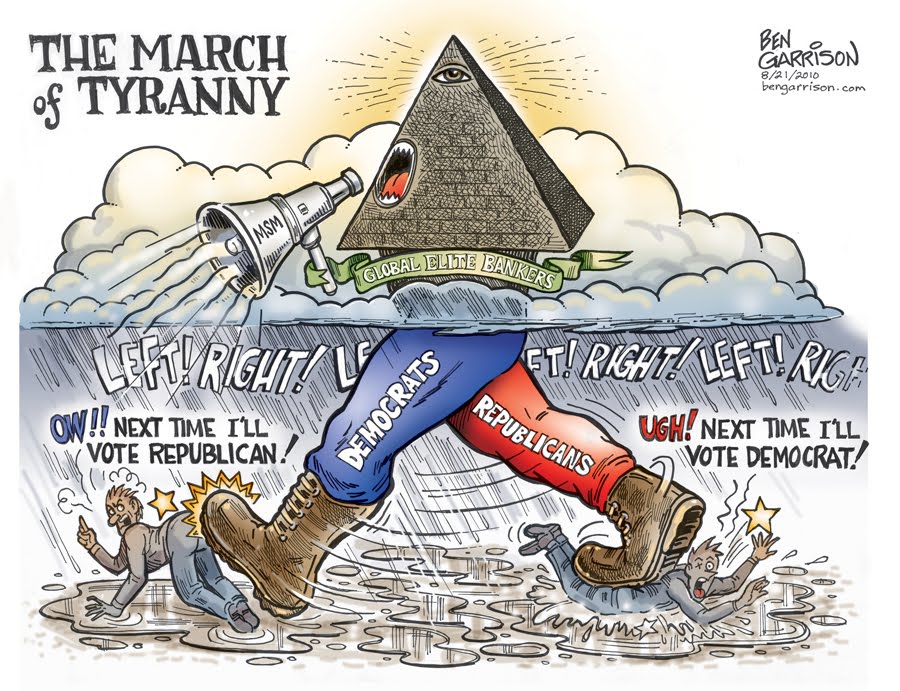
They want to be persuaded that there’s a difference between the Republicans and Democrats (there’s not).

Some will swear that Donald Trump has been an improvement on Barack Obama (he is not).

Others are convinced that Joe Biden’s values are different from Donald Trump’s (with both of them, money talks).

Most of all, voters want to buy into the fantasy that when they elect a president, they’re getting someone who truly represents the citizenry rather than the Deep State (in fact, in the oligarchy that is the American police state, an elite group of wealthy donors is calling the shots in cooperation with a political elite).

The sad truth is that it doesn’t matter who wins the White House, because they all work for the same boss: Corporate America. Understanding this, many corporations hedge their bets on who will win the White House by splitting their donations between Democratic and Republican candidates.

Politics is a game, a joke, a hustle, a con, a distraction, a spectacle, a sport, and for many devout Americans, a religion. It is a political illusion aimed at persuading the citizenry that we are free, that our vote counts, and that we actually have some control over the government when in fact, we are prisoners of a Corporate Elite.

In other words, it’s a sophisticated ruse aimed at keeping us divided and fighting over two parties whose priorities, more often than not, are exactly the same so that we don’t join forces and do what the Declaration of Independence suggests, which is to throw the whole lot out and start over.

It’s no secret that both parties support endless war, engage in out-of-control spending, ignore the citizenry’s basic rights, have no respect for the rule of law, are bought and paid for by Big Business, care most about their own power, and have a long record of expanding government and shrinking liberty. Most of all, both parties enjoy an intimate, incestuous history with each other and with the moneyed elite that rule this country.

Despite the jabs the candidates volley at each other for the benefit of the cameras, they’re a relatively chummy bunch away from the spotlight. Moreover, despite Congress’ so-called political gridlock, our elected officials seem to have no trouble finding common ground when it’s time to collectively kowtow to the megacorporations, lobbyists, defense contractors and other special interest groups to whom they have pledged their true allegiance.

So don’t be fooled by the smear campaigns and name-calling or drawn into their divide-and-conquer politics of hate. They’re just useful tactics that have been proven to engage voters and increase voter turnout while keeping the citizenry at each other’s throats.

It’s all a grand illusion.

It used to be that the cogs, wheels and gear shifts in the government machinery worked to keep the republic running smoothly. However, without our fully realizing it, the mechanism has changed. Its purpose is no longer to keep our republic running smoothly. To the contrary, this particular contraption’s purpose is to keep the Deep State in power. Its various parts are already a corrupt part of the whole.

Just consider how insidious, incestuous and beholden to the corporate elite the various “parts” of the mechanism have become.

Congress. Perhaps the most notorious offenders and most obvious culprits in the creation of the corporate-state, Congress has proven itself to be both inept and avaricious, oblivious champions of an authoritarian system that is systematically dismantling their constituents’ fundamental rights. Long before they’re elected, Congressmen are trained to dance to the tune of their wealthy benefactors, so much so that they spend two-thirds of their time in office raising money. As Reuters reports, “For many lawmakers, the daily routine in Washington involves fundraising as much as legislating. The culture of nonstop political campaigning shapes the rhythms of daily life in Congress, as well as the landscape around the Capitol. It also means that lawmakers often spend more time listening to the concerns of the wealthy than anyone else.”

The President. What Americans want in a president and what they need are two very different things. The making of a popular president is an exercise in branding, marketing and creating alternate realities for the consumer—a.k.a., the citizenry—that allows them to buy into a fantasy about life in America that is utterly divorced from our increasingly grim reality. Take President Trump, for instance, who got elected by promising to drain the swamp in Washington DC. Instead of putting an end to the corruption, however, Trump has paved the way for lobbyists, corporations, the military industrial complex, and the rest of the Deep State (also referred to as “The 7th Floor Group”) to feast on the carcass of the dying American republic. The lesson: to be a successful president, it doesn’t matter whether you keep your campaign promises, sell the American people to the highest bidder, or march in lockstep with the Corporate State as long as you keep telling people what they most want to hear.

The Supreme Court. The U.S. Supreme Court—once the last refuge of justice, the one governmental body really capable of rolling back the slowly emerging tyranny enveloping America—has instead become the champion of the American police state, absolving government and corporate officials of their crimes while relentlessly punishing the average American for exercising his or her rights. Like the rest of the government, the Court has routinely prioritized profit, security, and convenience over the basic rights of the citizenry. Indeed, law professor Erwin Chemerinsky makes a compelling case that the Supreme Court, whose “justices have overwhelmingly come from positions of privilege,” almost unerringly throughout its history sides with the wealthy, the privileged, and the powerful.

The Media. Of course, this triumvirate of total control would be completely ineffective without a propaganda machine provided by the world’s largest corporations. Besides shoveling drivel down our throats at every possible moment, the so-called news agencies which are supposed to act as bulwarks against government propaganda have instead become the mouthpieces of the state. The pundits which pollute our airwaves are at best court jesters and at worst propagandists for the false reality created by the American government. When you have internet and media giants such as Google, NBC Universal, News Corporation, Turner Broadcasting, Thomson Reuters, Comcast, Time Warner, Viacom, Public Radio International and The Washington Post Company donating to political candidates, you no longer have an independent media—what we used to refer to as the “fourth estate”—that can be trusted to hold the government accountable.

The American People. “We the people” now belong to a permanent underclass in America. It doesn’t matter what you call us—chattel, slaves, worker bees, it’s all the same—what matters is that we are expected to march in lockstep with and submit to the will of the state in all matters, public and private. Unfortunately, through our complicity in matters large and small, we have allowed an out-of-control corporate-state apparatus to take over every element of American society.

We’re playing against a stacked deck.

The game is rigged, and “we the people” keep getting dealt the same losing hand. The people dealing the cards—the politicians, the corporations, the judges, the prosecutors, the police, the bureaucrats, the military, the media, etc.—have only one prevailing concern, and that is to maintain their power and control over the citizenry, while milking us of our money and possessions.

It really doesn’t matter what you call them—Republicans, Democrats, the 1%, the elite, the controllers, the masterminds, the shadow government, the police state, the surveillance state, the military industrial complex—so long as you understand that while they are dealing the cards, the deck will always be stacked in their favor.

As I make clear in my book, Battlefield America: The War on the American People, our failure to remain informed about what is taking place in our government, to know and exercise our rights, to vocally protest, to demand accountability on the part of our government representatives, and at a minimum to care about the plight of our fellow Americans has been our downfall.

Now we find ourselves once again caught up in the spectacle of another presidential election, and once again the majority of Americans are acting as if this election will make a difference and bring about change. As if the new boss will be different from the old boss.

When in doubt, just remember what the astute commentator George Carlin had to say about the matter:

The politicians are put there to give you the idea that you have freedom of choice. You don’t. You have no choice. You have owners. They own you. They own everything. They own all the important land. They own and control the corporations. They’ve long since bought and paid for the Senate, the Congress, the state houses, the city halls. They got the judges in their back pockets and they own all the big media companies, so they control just about all of the news and information you get to hear. They got you by the balls. They spend billions of dollars every year lobbying. Lobbying to get what they want. Well, we know what they want. They want more for themselves and less for everybody else, but I’ll tell you what they don’t want. They don’t want a population of citizens capable of critical thinking. They don’t want well-informed, well-educated people capable of critical thinking. They’re not interested in that. That doesn’t help them. That’s against their interests. They want obedient workers. Obedient workers, people who are just smart enough to run the machines and do the paperwork…. It’s a big club and you ain’t in it. You and I are not in the big club. …The table is tilted, folks. The game is rigged and nobody seems to notice…. Nobody seems to care. That’s what the owners count on…. It’s called the American Dream, ’cause you have to be asleep to believe it.

How Corporate Tyranny Works

By Chris Hedges

Source: OpEdNews.com

Those, like environmental lawyer Steven Donziger, who fight the corporate control of our society on behalf of the vulnerable find the institutions of power unite to crucify them.

The persecution of the attorney Steven Donziger is a grim illustration of what happens when we confront the real centers of power, masked and unacknowledged by the divisive cant from the Trump White House or the sentimental drivel of the Democratic Party. Those, like Donziger, who name and fight the corporate control of our society on behalf of the vulnerable see the judiciary, the press and the institutions of government unite to crucify them.

“It’s been a long battle, 27 years,” Donziger said when I reached him by phone in his apartment in Manhattan.

Donziger, who has been fighting polluting American oil companies for nearly three decades on behalf of indigenous communities and peasant farmers in Ecuador, has been under house arrest in Manhattan for a year. He will go to trial in federal court in New York on September 9 on contempt of court charges, which could see him jailed for six months. Ever since he won a multibillion-dollar judgment in 2011 against the oil giant Chevron, the multinational has come after him personally through litigation that threatens to destroy him economically, professionally and personally.

“Our L-T [long-term] strategy is to demonize Donziger,” Chevron wrote in an internal memo in 2009, as reviewed by Courthouse News.

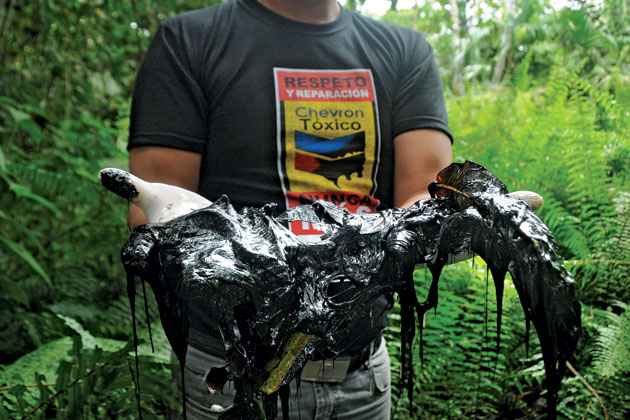
It started when Texaco went into Ecuador in the Amazon in the 1960s and cut a sweetheart deal with the military government then ruling Ecuador,” Donziger told me. “Over the next 25 years, Texaco was the exclusive operator of a very large area of the Amazon that had several oil fields within this area, 1500 square miles. They drilled hundreds of wells. They created thousands of open-air, unlined toxic waste pits where they dumped the heavy metals and toxins that came up from the ground when they drilled. They ran pipes from the pits into rivers and streams that local people relied on for their drinking water, their fishing and their sustenance. They poisoned this pristine ecosystem, in which lived five indigenous peoples, as well as a lot of other non-indigenous rural communities. There was a mass industrial poisoning.”

“By the time I went down there in the early 1990s, many people had died, cancer rates were skyrocketing according to several independent health evaluations, people were really hurting. There was zero regard for the lives of the local people by Texaco. I was a very young lawyer back in 1993 when I first went to Ecuador. It was like looking at an apocalyptic scene. There was oil on the roads. People were living in abject poverty. They had no shoes. They would get oil on their feet when they walked along the roads. The oil pollution had permeated every aspect of daily life. It was in the food supply. It was in the water supply. It was in the air. The average person there would get exposed multiple times a day to very harmful, cancer-causing toxins, with foreseeable results.”

“I, with other lawyers, filed a lawsuit in New York against Texaco. The reason we filed in New York was because Texaco’s headquarters were in New York in 1993. The decisions to pollute in Ecuador, to play God to the people of Ecuador, were made in New York. We sued in New York. Texaco tried to get the case back to Ecuador where they had never been held accountable, where they knew the indigenous peoples had no money or resources to find lawyers.”

“They thought it would just go away,” said Donziger. “Over a 10-year period, we battled to get a jury trial in the United States. Ultimately, they won that part of the battle. It went down to Ecuador.”

“We started working with a team of Ecuadoran lawyers in the early 2000s. We went forward with the lawsuit. We produced voluminous scientific and testimonial evidence, showing that they caused probably the world’s worst oil pollution. It was called the ‘Amazon Chernobyl’ by locals and experts. They dumped 16 billion gallons of toxic waste. They did it deliberately to save money. This was unlike the BP spill in the Gulf of Mexico, which was a terrible accident, even though it was a product of horrendous negligence by BP. This was done by design to pollute, knowing that people would die, and that indigenous groups would be decimated, and that this beautiful part of the Amazon would be destroyed.”

The refusal to abide by even minimal environmental regulations saved Texaco an estimated $3 on every barrel of oil produced over 26 years (1964-1992), according to Amazon Watch, or an estimated extra $5 billion in revenue. The hundreds of waste pits the company eventually abandoned in Ecuador, on average, contain 200 times the contamination allowed by typical global standards.

“They tried to grind us down using classic corporate defense tactics,” Donziger said of the legal war. “They filed thousands of motions. We stood strong. We had a great legal team of Ecuadorian lawyers.”

In the end, they won a stunning victory, a rare moment of accountability for first-world conglomerates who rape the environment of developing nations by exploiting weak, corrupt governments.

“The verdict came down, about $18 billion in favor of the affected communities, which is what it would take at a minimum to clean up the actual damage and compensate the people for some of their injuries. That eventually got reduced on appeal in Ecuador to $9.5 billion, but it was affirmed by three appellate courts, including the highest court of Ecuador. It was affirmed by the Canadian Supreme Court, where the Ecuadorians went to enforce their judgment in a unanimous opinion in 2015.”

Chevron, as the evidence mounted against it, sold their assets in Ecuador and left the country. The corporation threatened the plaintiffs with a “lifetime of litigation” if they attempted to collect, and, according to internal Chevron memos, launched a legal and media campaign that has cost an estimated $2 billion to prevent payment of the settlement and to demonize and destroy Donziger.

Donziger came to his epic battle against Chevron through journalism. “I was a journalist on my college newspaper,” he said of his time as a history major at American University. “My first job out of college was as a journalist with [United Press International]. I worked for UPI in Washington. They were strong in Latin America. I traveled to Managua in 1983 or 1984, I don’t remember exactly, and found work in the UPI bureau. I was 23 years old. I worked in the UPI bureau in Managua during the Sandinista era.”

He left UPI after a year in Managua but stayed on in Nicaragua to work as a freelance journalist for newspapers such as The Fort Lauderdale News, The Toronto Star and The Atlanta Constitution. He spent about three years as a reporter before going to Harvard Law School. When he graduated from Harvard Law School in 1991, he worked as a public defender in Washington, D.C. He documented Iraqi civilian casualties in Iraq following the first Gulf War that became a report adopted by the United Nations.

A classmate at law school was from Ecuador. His classmate’s father organized a trip in April 1993 for lawyers and medical professionals to look at the contamination caused by the oil extraction in the Amazon. That trip, which Donziger joined, spawned the suit against Texaco. He would make more than 250 trips to Ecuador over the next two decades.

“Journalism significantly shaped my views and skill set,” he said. “It was vital to allowing my work to be successful. From the beginning this was a unique litigation, for many reasons, but one of the reasons was we, as a team, decided to work across multiple platforms. If we only saw this case as a lawsuit we would never win.”

“Chevron controlled the legal system in Ecuador with their influence. We needed to operate across different platforms, including engaging with the media and carrying out significant public education. Most Ecuadorians, other than those who lived in the region, knew nothing about the pollution that had been happening in their country. We carried out zealous advocacy in the public arena. We realized that the indigenous people would never get a fair trial in Ecuador if they did not illuminate what had happened to them and get public support.”

“The fact that I am detained shows how far we’ve come and how much risk Chevron feels. It’s not a sign we lost. It’s the opposite.”

Steven Donziger

Both the judge who oversaw its lawsuit against Donziger for “racketeering” and Chevron itself “claim that this type of activity is wrong,” he said. “The irony is that what we were doing is what the big oil companies have always done. They always operate in the public relations domain, lobbying Congress to pass legislation to extinguish various legal claims, meeting political leaders behind the scenes. They operate across every platform they can find to exercise their power. We were smart enough to meet them toe-to-toe wherever they were operating and neutralize their ability to undermine the fairness of the trial. That’s how they operate. They try to control court systems.”

“My journalism [experience] sensitized me to injustice. It allowed me to understand the media. I knew how to write press releases, which matters when you do a public case like this. I knew how to work across different platforms to mobilize positive energy around the case. Human rights work involves, first and foremost, justice for victims. But equally important is accountability for the perpetrators. The fact that I am detained shows how far we’ve come and how much risk Chevron feels. It’s not a sign we lost. It’s the opposite.”

Chevron, which had left Ecuador, went back to the New York court, where Donziger had originally filed the lawsuit before Chevron got a change of venue to Ecuador, and sued him, using a civil courts portion of the federal law famous for breaking the New York Mafia in the 1970s, the Racketeer Influenced and Corrupt Organizations Act.

In effect, “They sued me as a civil racketeer, under a civil RICO statute for $60 billion,” he said. “That was the largest amount of money an American individual ever had been sued for. This began a 10-year campaign to demonize me by Chevron and by its judicial allies.”

Chevron, which has more than $260 billion in assets, has hired an estimated 2,000 lawyers from 60 law firms to carry out its campaign, according to court documents. The oil giant dropped its demand for financial damages weeks before the RICO trial, which would have necessitated a jury trial. Judge Lewis A. Kaplan, a former lawyer for the tobacco industry who had undisclosed investments in funds with Chevron holdings, according to his public financial disclosure statement, decided the RICO case alone. He found credible a witness named Alberto Guerra, relocated to the US by Chevron at a cost of some $2 million, who claimed the verdict in Ecuador was the product of a bribe. Kaplan used Guerra’s testimony as primary evidence for the racketeering charge, although Guerra, a former judge, later admitted to an international tribunal that he had falsified his testimony.

“[Kaplan] wouldn’t allow me to bring in any environmental evidence that the Ecuadorian courts had used to find Chevron liable,” Donziger said. “He wouldn’t let me testify on my own behalf on direct. He allowed Chevron to use secret witnesses whose identities he wouldn’t reveal to me. He tried to treat it like a national-security kind of case to try to demonize me. Because Chevron’s whole strategy is to demonize [me] as a way to distract attention from its environmental crimes in Ecuador. And Judge Kaplan, who knows all the tricks in the books because he used to work for [tobacco company] Brown & Williamson, when he was [an attorney with the law firm of] Paul, Weiss. He knows the tobacco industry playbook that they used for years and years and continue to use. And he worked with the Chevron lawyers at Gibson, Dunn & Crutcher to implement them against me without a jury. And there was nothing I could do about it.”

(Paul, Weiss is a large law firm that currently advises Chevron on its $13 billion purchase of another energy company.)

John Keker, one of Donziger’s lawyers on that case, said he was up against 160 lawyers for Chevron and during the trial he felt “like a goat tethered to a stake.” He called the court proceedings under Kaplan “a Dickensian farce” and a “show trial.” In the end, Kaplan ruled that the judgment in the Ecuadorean court against Chevron was the result of fraud.

He also ordered Donziger to turn over decades of all client communication to Chevron, in effect eradicating attorney-client privilege, a backbone of the Anglo-American legal system with roots dating to ancient Rome. Donziger appealed what was, according to legal experts following the case, an unprecedented and illegal order. While Donziger’s appeal was pending, Kaplan charged him with criminal contempt for this principled stance, as well as his refusal to turn over his passport, his personal electronics and to refrain from seeking the collection of the original award against Chevron.

When his criminal contempt charges against the environmental lawyer were ignored by the U.S. attorney’s office for over five years, Judge Kaplan, using an exceedingly rare judicial maneuver, appointed the private law firm of Seward & Kissel, to act in the name of the government to prosecute Donziger. Neither the judge nor the law firm disclosed that Chevron has been a client of Seward & Kissel.

Kaplan also violated the established random case assignment protocol to personally assign Loretta Preska, a member of the right-wing Federalist Society, to hear the case. Chevron is a major donor to the Federalist Society. Preska, in a show of bias, already has said the charges against Donziger appear to be “very strong,” according to Courthouse News. In May, she disallowed him from having his charges heard by a jury.

“The last thing any of them wants is for a group of ordinary citizens to see what has happened to Steven Donziger,” Rick Friedman, one of Donziger’s attorneys, said of Chevron.

“The last thing any of them wants is for a group of ordinary citizens to see what has happened to Steven Donziger.”

Rick Friedman, attorney

Preska’s fealty to corporate power was previously on public display in 2013 when she imposed a 10-year sentence, the maximum allowed under a plea deal, on Jeremy Hammond, the activist who hacked into Stratfor, a private security firm. Hammond made public a barrage of damning internal emails and exposed the email address and password of an account used for business by Preska’s husband, Thomas Kavaler, a partner at the law firm Cahill Gordon & Reindel. Preska, despite the conflict of interest, refused to recuse herself. The 10-year sentence was one of the longest in U.S. history for hacking.

Kaplan had Preska demand Donziger post an $800,000 bond on a misdemeanor charge. Preska placed him under house arrest and confiscated his passport which he has used to meet with attorneys around the world attempting to enforce the judgment against Chevron. Kaplan managed to have Donziger disbarred. He allowed Chevron to freeze Donziger’s bank accounts, slapped Donziger with millions in fines without allowing him a jury, forced him to wear an ankle monitor 24 hours a day and effectively shut down his ability to earn a living. Kaplan allowed Chevron to impose a lien on Donziger’s apartment in Manhattan where he lives with his wife and teenage son.

Donziger is scheduled to go to trial without a jury on September 9 in New York City for contempt. Preska will preside over the trial. There has not been a criminal trial in Manhattan federal court since March because of the pandemic. Donziger’s trial would be the first, although hundreds of other defendants facing far more serious felony charges are waiting in jails, infested with COVID-19, for a trial date. Donziger’s four pro bono lawyers said they do not want to risk their lives by traveling to New York during the pandemic for what is a misdemeanor offense.

“The judgment against Chevron Corporation in Ecuador was the product of fraud, bribery and corruption,” Sean Comey, Senior Advisor – External Affairs Chevron Corporation said when I asked the corporation to comment on the case. “Steven Donziger is a proven liar and an adjudicated racketeer. He committed criminal acts in the U.S. and abroad in pursuit of his extortion scheme in the Ecuadorian courts. Donziger’s continuing lawlessness is now a matter for prosecutors and the U.S. courts to decide. Chevron is not involved in Donziger’s criminal prosecution.”

The flagrant corruption and misuse of the legal system to abjectly serve corporate interests in the Donziger case illustrates the deep decay within our judiciary and democratic institutions, one that was abetted by Democratic administrations that stacked the courts with corporate lawyers — Kaplan was appointed by Bill Clinton — and Donald Trump, who has elevated ideologues selected by the Federalist Society to the federal bench. Ruling after ruling in Donziger’s case has ignored or grossly distorted the law on behalf of Chevron to ensure that Donziger will be prosecuted, sent to prison and remain in debt for life — all while the $9.5 billion settlement is never paid to aid the people harmed in Ecuador.

The International Association of Democratic Lawyers and the international committee of the National Lawyers Guild issued a letter signed by more than 70 organizations calling the persecution of Donziger an “attack on the rule of law.” The letter said his house arrest was “unprecedented” and charged that he was being targeted for what it called “one of the most important corporate accountability and human rights cases of our time.” The letter accused Kaplan of “violating basic notions of fairness in the judicial process that lie at the core of the rule of law.”

“We cannot allow the rule of law to be upended by corporate interests and a highly biased federal judge seeking to destroy the willpower of one lawyer who has already withstood decades of brutal litigation and scathing personal and professional attacks,” the letter read.

Chevron has also used its clout and advertising dollars to keep the story from being reported in numerous media outlets.

“Based on where this story is trending, we have launched a full offensive to kill it or redirect it,” an August 10, 2010 internal memo from Chevron reads concerning a potential report — on the case being done by the Fox News bureau in Miami.

“In addition to working through the Miami bureau, we have reached out to more senior news folks at Fox News, both in NY (through Dana) and in WDC (through Greg Mueller). So, we are trying to attack this story on multiple fronts. To this end, Kent is set to talk to John Stack and Sean Smith who both reside at Fox News in NY at 1:30 today. Finally, if need be, I think we may need to pull the JSW card with Roger Ailes. We have checked John’s availability to place a call to Roger, but his first availability is tomorrow afternoon.”

From 2010 to 2018, John S. Watson was the CEO and chairman of the Chevron Corporation.

The story was killed.

Another internal memo lays out the steps, also ultimately successful, to prevent a similar story from appearing in GQ magazine. The memo suggests that Chevron work …with the Columbia Journalism Review (that ran the rebuke of 60 minutes) and the Media Research Center to expose any degree of bias by GQ and raise alerts about the reporting techniques prior to the story’s publication.”

The memo recommends letting the magazine know that it will face legal action if the story runs and calls on Chevron investigators to “conduct further due diligence on reporter.” Chevron has also hired reporters to produce fake pieces of journalism that peddle the corporation’s propaganda on fake news sites it runs.

The New York Times magazine earlier this year considered a story about Donziger and then dropped it. The newspaper runs its own ad agency called T Brand Studio. Chevron is a major client, meaning The New York Times, through T Brand Studio, produces ads for Chevron.

Jake Silverstein, editor of the magazine, when asked to comment said by email: “It was one of several stories William [Langewiesche] considered writing for us in the past year, one that ultimately we decided not to assign. Many factors go into our decisions about what to assign, and none of them ever include who is or is not a client of T Brand Studio or any other part of the paper’s advertising business.”

Dean Baquet, the newspaper’s executive editor, said, when I reached him by email, that the idea that the magazine piece on Donziger was killed because Chevron is a major advertiser is “a ridiculous claim.” He added, “I didn’t even know Chevron worked with T Brand [Studio].”

But that Chevron has invested tremendous resources to kill stories about this case is indisputable given the detailed campaigns to block coverage outlined in its own internal memos.

“I’ve experienced this multiple times with media over the past 10 to 15 years,” Donziger said. “An entity will start writing the story, spend a lot of time on it, then the reporter disappears. The story doesn’t run.”

While The NationThe Intercept and Courthouse News Service have reported on Donziger’s current legal battle, no major mainstream publication has touched it.

“Corporate influence over our federal judiciary has increased dramatically in recent years,” Donziger said. “This firm [Chevron] has captured an element of power from the government and deployed it against a human rights activist.”

Front Line Defenders issued a report in 2019 that found that 300 human rights activists had been murdered in 31 countries, more than two-thirds in Latin America. Of those killed, 40 percent fought for land rights, indigenous peoples and environmental justice.

“What’s shocking to a lot of people is that this is now happening in the United States,” Donziger said. “I don’t mean murder, but death by a thousand cuts. Chevron does not want me to be a lawyer anymore, at a minimum. They don’t want me advocating even as a non-lawyer. They want to silence me. They want to kill every story they can. They’d rather have no story about this case than even a positive story about their side. They don’t want people to know about it. They want to erase it from people’s thought process.

“I cannot get a fair trial with a judge appointed by Judge Kaplan rather than through the random assignment process,” he lamented. “I cannot get a fair trial with a prosecutor whose law firm [has worked] for Chevron. These are egregious conflicts of interest. Its misconduct on a grand scale. I’ve been locked up four times as long as the longest sentence ever imposed on a lawyer for criminal contempt in New York. Anyone who cares about the rule of law should be appalled.”

Private gain must no longer be allowed to elbow out the public good

By Dirk Philipsen

Source: aeon

Adam Smith had an elegant idea when addressing the notorious difficulty that humans face in trying to be smart, efficient and moral. In The Wealth of Nations (1776), he maintained that the baker bakes bread not out of benevolence, but out of self-interest. No doubt, public benefits can result when people pursue what comes easiest: self-interest.

And yet: the logic of private interest – the notion that we should just ‘let the market handle it’ – has serious limitations. Particularly in the United States, the lack of an effective health and social policy in response to the coronavirus disease (COVID-19) outbreak has brought the contradictions into high relief.

Around the world, the free market rewards competing, positioning and elbowing, so these have become the most desirable qualifications people can have. Empathy, solidarity or concern for the public good are relegated to the family, houses of worship or activism. Meanwhile, the market and private gain don’t account for social stability, health or happiness. As a result, from Cape Town to Washington, the market system has depleted and ravaged the public sphere – public health, public education, public access to a healthy environment – in favour of private gain.

COVID-19 reveals a further irrational component: the people who do essential work – taking care of the sick; picking up our garbage; bringing us food; guaranteeing that we have access to water, electricity and WiFi – are often the very people who earn the least, without benefits or secure contracts. On the other hand, those who often have few identifiably useful skills – the pontificators and chief elbowing officers – continue to be the winners. Think about it: what’s the harm if the executive suites of private equity, corporate law and marketing firms closed down during quarantine? Unless your stock portfolio directly profits from their activities, the answer is likely: none. But it is those people who make millions – sometimes as much in an hour as healthcare workers or delivery personnel make in an entire year.

Simply put, a market system driven by private interests never has protected and never will protect public health, essential kinds of freedom and communal wellbeing.

Many have pointed out the immorality of our system of greed and self-centred gain, its inefficiency, its cruelty, its shortsightedness and its danger to planet and people. But, above all, the logic of self-interest is superficial in that it fails to recognise the obvious: every private accomplishment is possible only on the basis of a thriving commons – a stable society and a healthy environment. How did I become a professor at an elite university? Some wit and hard work, one hopes. But mostly I credit my choice of good parents; being born at the right time and the right place; excellent public schools; fresh air, good food, fabulous friends; lots of people who continuously and reliably provide all the things that I can’t: healthcare, sanitation, electricity, free access to quality information. And, of course, as the scholar Robert H Frank at Cornell University so clearly demonstrated in his 2016 book on the myth of the meritocracy: pure and simple luck.

Commenting on how we track performance in modern economies – counting output not outcome, quantity not quality, prices not possibilities – the US senator Robert F Kennedy said in 1968 that we measure ‘everything, in short, except that which makes life worthwhile’. His larger point: freedom, happiness, resilience – all are premised on a healthy public. They rely on our collective ability to benefit from things such as clean air, free speech, good public education. In short: we all rely on a healthy commons. And yet, the world’s most powerful metric, gross domestic product (GDP), counts none of it.

The term ‘commons’ came into widespread use, and is still studied by most college students today, thanks to an essay by a previously little-known American academic, Garrett Hardin, called ‘The Tragedy of the Commons’ (1968). His basic claim: common property such as public land or waterways will be spoiled if left to the use of individuals motivated by self-interest. One problem with his theory, as he later admitted himself: it was mostly wrong.

Our real problem, instead, might be called ‘the tragedy of the private’. From dust bowls in the 1930s to the escalating climate crisis today, from online misinformation to a failing public health infrastructure, it is the insatiable private that often despoils the common goods necessary for our collective survival and prosperity. Who, in this system based on the private, holds accountable the fossil fuel industry for pushing us to the brink of extinction? What happens to the land and mountaintops and oceans forever ravaged by violent extraction for private gain? What will we do when private wealth has finally destroyed our democracy?

The privately controlled corporate market has, in the precise words of the late economics writer Jonathan Rowe, ‘a fatal character flaw – namely, an incapacity to stop growing. No matter how much it grew yesterday it must continue to do so tomorrow, and then some; or else the machinery will collapse.’

To top off the items we rarely discuss: without massive public assistance, late-stage extractive capitalism, turbocharged by private interest and greed, would long be dead. The narrow kind of macroeconomic thinking currently dominating the halls of government and academia invokes a simpleminded teenager who variously berates and denounces his parents, only to come home, time and again, when he is out of ideas, money or support. Boeing, Goldman Sachs, Bank of America, Exxon – all would be bust without public bailouts and tax breaks and subsidies. Every time the private system works itself into a crisis, public funds bail it out – in the current crisis, to the tune of trillions of dollars. As others have noted, for more than a century, it’s a clever machine that privatises gains and socialises costs.

When private companies are back up and running, they don’t hold themselves accountable to the public who rescued them. As witnessed by activities since the 2008 bailouts at Wells Fargo, American Airlines and AIG, companies that have been rescued often go right back to milking the public.

By focusing on private market exchanges at the expense of the social good, policymakers and economists have taken an idea that is good under clearly defined and very limited circumstances and expanded it into a poisonous and blind ideology. Now is the time to assert the obvious: without a strong public, there can be no private. My health depends on public health. My freedom depends on social freedom. The economy is embedded in a healthy society with functional public services, not the other way around.

This moment of pain and collapse can serve as a wakeup call; a realisation that the public is our greatest good, not the private. Look outside the window to see: without a vibrant and stable public, life can quickly get poor, nasty, brutish and short.