“The Cost Of Sanity, In This Society, Is A Certain Level Of Alienation”

By Caitlin Johnstone

Source: CaitlinJohnstone.com

The late psychonaut/philosopher Terence McKenna once said “The cost of sanity, in this society, is a certain level of alienation,” and I think my regular readers will immediately and experientially understand exactly what he was talking about.

It’s not always easy to be on the outside of consensus reality. Our entire society, after all, has been built upon consensus–upon a shared agreement about what specific mouth sounds mean, on what money is and how it works, on how we should all behave toward each other in public spaces, and on what normal human behavior in general looks like.

We all share a learned agreement that we picked up from our culture in early childhood that it’s normal and acceptable to stand around with your hands in your pockets and babble about the weather to anyone who gets too close to you, for example, whereas it would be considered weird and disruptive to stand around slathered in Cheese Whiz shrieking the word “Poop!” But we could just as easily reverse that consensus on behavioral norms tomorrow, and as long as we all agreed to it we could do it without missing a beat.

In exactly the same way, there exists a general consensus about what’s going on in our world at the moment. There’s a general consensus that we live in the kind of society we were taught about in school: a free and democratic nation which maybe did some not so great things in the past, but is now a supremely virtuous beacon of light on this earth that kicked Hitler’s ass and then surfed into the present day on a wave of truth and sensible fiscal policy. There’s a general consensus that the news reporters on our screens paint us a more or less accurate picture of world affairs, that there are a lot of Bad Guys in our world with whom the Good Guys in our government are fighting, and that most of our nation’s problems are caused by the people in the other political party.

This consensus is grounded in delusion. It is insanity.

In reality, of course, we live in a world where our understanding of the world is constantly being deceitfully manipulated by oligarchic media propaganda and the utterances of oligarch-owned politicians. Where elections are mostly just a live action role-playing game which allows the rabble to pretend that they have some degree of influence over the things that their government does. Where our government routinely forms alliances with the worst Bad Guys on the planet while manufacturing consent to topple governments whose downfall would be utterly disastrous. Where our nation’s problems have almost nothing to do with half its population disagreeing with our personal ideology, and practically everything to do with the loose international alliance of plutocrats and government agencies who actually run things behind the facade of the comings and goings of official elected governments.

Sanity means seeing this as it is, rather than subscribing to the mass delusion of the consensus worldview. Which, as you probably already know, can make it difficult to relate to others in some ways. Conversations about politics often either get heated very rapidly when you challenge a tightly-held orthodoxy or dead-end in awkwardness. Friendships can end. Family relationships can be ruined. Collective narratives about you can be woven and circulated within your social circle which have nothing to do with how you actually see things.

And that’s just if you talk about your worldview. If you keep your views to yourself, as many do, that’s just another kind of alienation. It’s to stand outside of public political discourse completely, unable to participate out of fear of the backlash you’d receive from your friends, loved ones and acquaintances if you started talking about Trump as a symptom rather than the disease, or said that Corbyn is being targeted by a transparently bogus smear campaign, or said that Russia’s interventions in world affairs are clearly dwarfed by America’s by orders of magnitude. The specific heresies will vary depending upon the social circle, but the inability to voice them necessarily comes with the same sense of alienation.

But the alternative to that sense of alienation is to live a lie. It’s to climb back inside the distorted funhouse-mirror reality tunnel of the establishment narrative control matrix and plug yourself back into the same delusions that everyone else is living. Most of us couldn’t even do that if we wanted to. Even if we could the intense mental gymnastics we’d have to perform just to avoid the discomfort of cognitive dissonance would make it not worth the effort.

We close ourselves off from a full sense of participation in our society when we depart from the consensus worldview, but in closing that door we open so many more. Because, as it turns out, all that effort that people pour into staying on the same wavelength as everyone else closes them off to a vast spectrum of potential human experience. The allure of the mass delusion is that you need to devote yourself to being plugged into it in order to achieve what the mass delusion defines as “success”, but in so doing you lose the ability to leap down psychological and experiential rabbit holes of consciousness that those still jacked into the matrix can’t even imagine. And in so doing you open up the possibility for an immensely more fulfilling and enjoyable life that has really deeply explored the more intimate questions about what it means to be a human being on this planet.

Jiddu Krishnamurti once said, “It is no measure of health to be well-adjusted to a profoundly sick society.” And a profoundly sick society is indeed what we have here. The alienation which we experience is an alienation from something that isn’t worth belonging to anyway.

I began this essay with a quote from one of the celebrated thought leaders of the psychedelic movement, and I think the question of what we can do to cope with the alienation McKenna spoke of is best answered by ending with a quote from another such leader, Timothy Leary:

“Admit it. You aren’t like them. You’re not even close. You may occasionally dress yourself up as one of them, watch the same mindless television shows as they do, maybe even eat the same fast food sometimes. But it seems that the more you try to fit in, the more you feel like an outsider, watching the ‘normal people’ as they go about their automatic existences. For every time you say club passwords like ‘Have a nice day’ and ‘Weather’s awful today, eh?’, you yearn inside to say forbidden things like ‘Tell me something that makes you cry’ or ‘What do you think deja vu is for?’. Face it, you even want to talk to that girl in the elevator. But what if that girl in the elevator (and the balding man who walks past your cubicle at work) are thinking the same thing? Who knows what you might learn from taking a chance on conversation with a stranger? Everyone carries a piece of the puzzle. Nobody comes into your life by mere coincidence. Trust your instincts. Do the unexpected. Find the others.”

How Surveillance and Propaganda Work in ‘the Free World’

By Brian Cloughly

Source: Strategic Culture Foundation

A Bloomberg report of October 22 was concise and uncompromising in declaring Russia to be a surveillance state. Harking back to the good old days of the Cold War, as is increasingly the practice in much of the Western media, Bloomberg recounted that “The fourth of 10 basic rules Western spies followed when trying to infiltrate Russia’s capital during the Cold War — don’t look back because you’re never alone — is more apt than ever. Only these days it’s not just foreigners who are being tracked, but all 12.6 million Muscovites, too. Officials in Moscow have spent the last few years methodically assembling one of the most comprehensive video-surveillance operations in the world. The public-private network of as many as 200,000 cameras records 1.5 billion hours of footage a year that can be accessed by 16,000 government employees, intelligence officers and law-enforcement personnel.”

Terrifying, one might think. Straight out of Orwell’s 1984, that dystopian prediction of what the world could become, as noted in one description of how the face of the state’s symbolic leader, Big Brother, “gazes at you silently out of posters and billboards. His imposing presence establishes the sense of an all-seeing eye. The idea that he is always watching from the shadows imposes a kind of social order. You know not to speak out against The Party — because big brother is watching… The face always appears with the phrase Big Brother is watching you. As if you could forget.” Such is the terrifying Bloomberg picture of Moscow where there are supposedly 200,000 video cameras. You can’t blow your nose without it being seen. And wait for the next phase, in which Big Brother will hear you laugh.

In line with the Western approach, there is little mention of surveillance in other cities, but the website ‘Caught on Camera’ has analysed world-wide practices. It reports that there are some 25 million closed-circuit surveillance cameras world-wide and “the United Kingdom [with 4 million cameras] has more CCTV activity than any other European country, per capita… surprisingly, the Wandsworth borough in London in particular has more CCTV cameras than Boston, Dublin, Johannesburg and San Francisco put together. It is estimated there are 500,000 cameras dotted around London. The average person living in London will be recorded on camera 300 times in one day.”

The statistics obtained by Caught on Camera and comparitech differ markedly from those in the Bloomberg story which was retailed throughout the Western world by many news outlets, who increasingly refer to the West as “the Free World”. Comparitech records that as at August 2019 Moscow, with a population of 12.4 million, had 146,000 (not 200,000) cameras, while London’s 9 million citizens were being watched by 627,707 cameras. The picture (if one may use that word) is slightly slanted. To put it another way, London has 68 cameras for each 1,000 people, and the ratios elsewhere are enlightening: Shanghai 113 (China is in treble figures in three cities); Atlanta (Ga) 15; Chicago 13; Baghdad, Sydney and Dubai 12; Moscow and Berlin 11; and St Petersburg, Canberra and Washington DC tie at 5.

The slanting doesn’t stop there, because there are other ways of attacking Russia, spearheaded by such as the Washington Post, which highlighted the Bloomberg surveillance tale. The Post behaves like Big Brother focusing on Winston Smith, the hapless victim/hero of 1984 whose job it is “to rewrite the reports in newspapers of the past to conform with the present reality.” There is an eerie resonance in this, because the Post’s reportage on Russia verges on the obsessively censorious, while it avoids mention of anything remotely positive.

Understandably, the Post relies heavily on such sources as “Meduza, a Latvia-based online news outlet that covers the Kremlin” which reported that the Russian government “passed a law earlier this year that lets Vladimir Putin take all the country’s Internet traffic off the World Wide Web if he decrees that there’s an ‘emergency’.”

The fact that the intelligence services of the West have worked for a long time to devise strategies and tactics to destroy internet services in Russia and many other countries is neither here nor there, but it is important for Western propaganda purposes to condemn Russia for taking measures to counter the manoeuvres of the West’s cyberwar agencies. The Post emphasised that arrangements were made by various Russian ministries and agencies, including the Emergencies Ministry and the Federal Security Service which “is the successor to the KGB, where Putin was once an officer.”

The absurdity of that needlessly-injected personal point is amusing in a way, and serves to highlight the unending reiteration of detail intended to set the western public against Russia. Naturally, there is exclusion of information that could lead to audiences approving of Russia in any way.

The news site Axios states it aims to “deliver the cleanest, smartest, most efficient and trust-worthy experience for readers and advertisers alike” but when it comes to Russia it appears that there could be a bit of selectivity in that delivery. For example, in October the UK’s Guardian newspaper reported approvingly that according to the World Health Organisation (WHO), alcohol consumption in Russia “has dropped by 43% since 2003” and commented that the WHO had “put the decrease down to a series of measures brought in under the sport-loving president, Vladimir Putin, including restrictions on alcohol sales and the promotion of healthy lifestyles.” But Axios didn’t report it quite like that.

The Guardian also noted that “The last Soviet leader, Mikhail Gorbachev, led an anti-alcohol campaign with partial prohibition, which brought down consumption from the mid-1980s until 1990. But after the collapse of the Soviet Union, alcohol consumption exploded, continuing to rise until the start of the 2000s. Under Putin, Russia has introduced measures including a ban on shops selling any alcohol after 11 pm, increases in the minimum retail price of spirits and an advertising blackout.” The result has been “increased life expectancies in Russia, which reached a historic peak in 2018, at 78 years for women and 68 years for men. In the early 1990s, male life expectancy was just 57 years.”

This is an amazing societal development. In no other country has there been a comparable initiative that resulted in such a massive and positive shift in community habits.

The BBC was more coy than the Guardian about allocating approval for the remarkable success of the programme, and confined itself to reporting that the WHO “attributed the decline to a series of alcohol-control measures implemented by the state, and a push towards healthy lifestyles.” There was no reference to President Putin, and indeed the credit went elsewhere, because “alcohol-control measures introduced under former President Dmitry Medvedev included advertising restrictions, increased taxes on alcohol and a ban on alcohol sales between certain hours.”

Axios followed suit, and ‘Radio Free Europe’ didn’t mention Presidents Putin, Medvedev or Gorbachev, retailing simply that the “decline in consumption was due to “alcohol-control measures introduced at the beginning of the 2000s.” There were no reports of the achievement in US mainstream outlets or the UK’s resolutely right-wing anti-Russia media. (The Guardian doesn’t carry a Russian flag; it merely reports without xenophobic bias.)

The WHO Case Study provides an admirably detailed timeline of legislature and other developments concerning Russia’s successful drive against alcohol abuse, recording, for example, that in 2018 there was a “presidential decree on ‘National Purposes and Strategic Development Challenges of the Russian Federation until 2024’… including in the field of public health. The aim is to increase life expectancy to 78 years by 2024 and to 80 years by 2030, as well as the proportion of citizens leading a healthy lifestyle and systematically engaging in physical activities and sports.”

Don’t expect such an initiative to be praised or even mentioned by the Western media. Big Brother prefers to slant the cameras.

As The OPCW Is Accused Of False Reporting U.S. Propaganda Jumps To Its Help

Source: Moon of Alabama

An international organization published two false reports and got caught in the act. But as the false reports are in the U.S. interests a U.S. sponsored propaganda organization is send out to muddle the issue. As that effort comes under fire the New York Times jumps in to give the cover-up effort some extra help.

The Organisation for the Prohibition of Chemical Weapons (OPCW) manufactured a pretext for war by suppressing its own scientists’ research:

OPCW emails and documents were leaked and whistleblowers came forward to speak with journalists and international lawyers. Veteran journalist Jonathan Steele, who has spoken with the whistleblowers, wrote an excellent piece on the issues. In the Mail on Sunday columnist Peter Hitchens picked up the issue and moved it forward.

Under U.S. pressure the OPCW management modified or suppressed the findings of its own scientists to make it look as if the Syrian government had been responsible for the alleged chemical incident in April 2018 in Douma.

The public attention to the OPCW’s fakery lead to the questioning of other assertions the OPCW had previously made. With the OPCW under fire someone had to come to its help.

To save the propaganda value of the OPCW reports the U.S. financed Bellingcat propaganda organization jumped in to save the OPCW’s bacon. Bellingcat founder “suck my balls” Elliot Higgins claimed that the OPCW reports satisfied the concerns the OPCW scientist had voiced.

That assertion is now further propagated by a New York Times piece which, under the pretense of reporting about open source analysis, boosts Bellingcat and its defense of the OPCW:

The blogger Eliot Higgins made waves early in the decade by covering the war in Syria from a laptop in his apartment in Leicester, England, while caring for his infant daughter. In 2014, he founded Bellingcat, an open-source news outlet that has grown to include roughly a dozen staff members, with an office in The Hague. Mr. Higgins attributed his skill not to any special knowledge of international conflicts or digital data, but to the hours he had spent playing video games, which, he said, gave him the idea that any mystery can be cracked.

Bellingcat journalists have spread the word about their techniques in seminars attended by journalists and law-enforcement officials. Along with grants from groups like the Open Society Foundations, founded by George Soros, the seminars are a significant source of revenue for Bellingcat, a nonprofit organization.

It seems that the New York Times forgot to mention an important monetary source for Bellingcat. Here is a current screenshot of Bellingcat’s About page:

Porticus, Adessium, Pax for Peace and the Postcode Lottery are all Dutch organizations. Then there is the notorious Soros organization the New York Times mentioned. But why did the NYT forgot to tell its readers that Bellingcat is financed by the National Endowment for Democracy which itself is to nearly 100% funded by the U.S. government?

Could that be because the NED, which spends U.S.government money on more than 1.600 U.S. government paid Non-Government Organizations, is a Trojan horse, a cover for the CIA?

Spurred by Watergate – the Church committee of the Senate, the Pike committee of the House, and the Rockefeller Commission, created by the president, were all busy investigating the CIA. Seemingly every other day there was a new headline about the discovery of some awful thing, even criminal conduct, the CIA had been mixed up in for years.

What was done was to shift many of these awful things to a new organization, with a nice sounding name – The National Endowment for Democracy. The idea was that the NED would do somewhat overtly what the CIA had been doing covertly for decades, and thus, hopefully, eliminate the stigma associated with CIA covert activities.

“We should not have to do this kind of work covertly,” said Carl Gershman in 1986, while he was president of the Endowment. “It would be terrible for democratic groups around the world to be seen as subsidized by the C.I.A. We saw that in the 60’s, and that’s why it has been discontinued. We have not had the capability of doing this, and that’s why the endowment was created.”And Allen Weinstein, who helped draft the legislation establishing NED, declared in 1991: “A lot of what we do today was done covertly 25 years ago by the CIA.”

In effect, the CIA has been laundering money through NED.

The fact that the NED is doing the CIA’s work is likely the reason why the NYT puff piece about Bellingcat forgets to mention its payments and also why it jumps to Bellingcat’s and the OPCW’s help:

Some journalists and activists hostile to what they characterize as Bellingcat’s pro-Western narratives have criticized some of its coverage of the war in Syria.At issue is an April 7, 2018, attack on Douma, Syria. Bellingcat reported, based on an analysis of six open-source videos, that it was “highly likely” that Douma civilians had died because of chemical weapons. In March, the Organization for the Prohibition of Chemical Weapons reported that there were “reasonable grounds” to say that chemical weapons had been used in the attack.

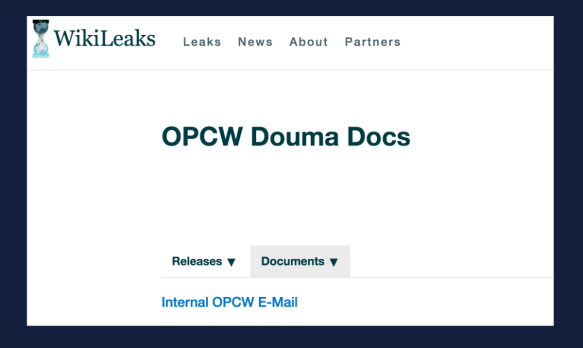
Critics of Bellingcat have pointed to an email from an investigator with the organization, saying that it raised questions about the findings. WikiLeaks published the email on Nov. 23. In a response, Bellingcat defended its reporting, saying the final report on Douma from the Organization for the Prohibition of Chemical Weapons reflected the concerns of the investigator whose email was published by WikiLeaks.

By playing video games Elliot Higgins learned to identify chemical attacks in dubious video sequences published by terrorist affiliates. If true it is an admirable capability. Still his assertion that the OPCW report “reflected the concerns of the investigator” who criticized it is, as Caitlin Johnstone demonstrates, utterly false:

Bellingcat simply ignores this absolutely central aspect of the email, as well as the whistleblower’s point about the symptoms of victims not matching chlorine gas poisoning.

“In this case the confidence in the identity of chlorine or any choking agent is drawn into question precisely because of the inconsistency with the reported and observed symptoms,” the whistleblower writes in the email. “The inconsistency was not only noted by the [Fact Finding Mission] team but strongly noted by three toxicologists with expertise in exposure to [Chemical Weapons] agents.”

Bellingcat says nothing about these revelations in the email, and says nothing about the fact that the OPCW excluded them from both its Interim Report in July 2018 and its Final Report in March 2019, the latter of which actually asserted the exact opposite saying there was “reasonable grounds that the use of a toxic chemical as a weapon took place. This toxic chemical contained reactive chlorine. The toxic chemical was likely molecular chlorine.”

Bellingcat completely ignores all of these points, …

In its defense of the OPCW report Bellingcat wrote:

[A] comparison of the points raised in the letter against the final Douma report makes it amply clear that the OPCW not only addressed these points, but even changed the conclusion of an earlier report to reflect the concerns of said employee.

Mail on Sunday columnist Peter Hitchens did not concur with that paragraph:

Apart from the words ‘a’, and ‘the’, everything in the above paragraph is, to put it politely, mistaken. Bellingcat have been so anxious to trash the leak from the OPCW that they have (as many did when the attack was first released) rushed to judgment without waiting for the facts. More is known by the whistleblowers of the OPCW than has yet been released …

Caitlin and Peter should play more video games. I have read in the NYT that they are the true path to learning and to the factual assessment of alleged chemical attacks.

On April 7 2018 terrorists of the Jaish al Islam group ruled in Douma. They killed 40 civilians. The bodies were shown in videos along with chlorine gas canisters to pretend that the Syrian government had killed those people. The OPCW’s fact finding team analyzed the evidence and found that the canisters had not been dropped from the air but were manually placed. The symptoms the victims showed were inconsistent with a chlorine attack and chlorinated substances were only found in extremely low concentrations. There were absolutely no “reasonable grounds” to say that chemical weapons had been used in the attack.

But the OPCW management, under U.S. pressure and despite the protests by its own scientists, put out a report that said the opposite. As the manipulation came to light the U.S. funded Bellingcat made a perfunctory attempt to muddle the issue. Thus another propaganda organization, the New York Times, had to jump in to save Bellingcat and the false OPCW claims.

It is not going to help. There will soon be more evidence that the OPCW management published two false reports on Douma, and likely even more on other issues. There will be a public recognition that the OPCW has failed.

Establishment media’s mass deception

By Stephen Lendman

Source: Intrepid Report

On major geopolitical and other issues, mass deception overrides truth and full disclosure in establishment media print editions and daily broadcasts—wealth, power and privileged interests served over peace, equity and justice.

The NYT is Exhibit A. Its Friday edition featured Iran-bashing disinformation, saying the following: “Iran has used the continuing chaos in Iraq to build up a hidden arsenal of short-range ballistic missiles in Iraq [sic], part of a widening effort to try to intimidate the Middle East and assert its power [sic]”—citing unnamed US intelligence and Pentagon officials,” adding that the US built up “its military presence in the Middle East to counter emerging threats to American interests [sic], including attacks on oil tankers and facilities that intelligence officials have blamed on Iran [sic].”

Iranian missiles “pose a threat to American allies and partners in the region, including Israel and Saudi Arabia, and could endanger American troops…”

Fact: Iranian Foreign Ministry Spokesman Bahram Qassemi debunk phony claims about IRGC missiles in Iraq, saying that the accusations are “false, meaningless and ludicrous. What has been raised and published by some infamous cells and certain media about the transfer of Iranian missiles to Iraq is a nonsensical statement and sheer lie.”

They’re all about maliciously vilifying Iran to create a nonexistent threat, wanting its Iranian relations with neighboring countries undermined.

Iranian military advisors are in Iraq and Syria at the behest of their governments, Tehran’s Supreme National Security Council Secretary Ali Shamkhani earlier explained—adding that they’re there to help combat US-supported terrorism.

The US and its key allies are “the main creators and sponsors of takfiri terrorists,” he earlier stressed.

Fact: Iran was falsely blamed earlier for attacks on regional oil tankers and facilities it had nothing to do with—no evidence suggesting otherwise. The incidents were false flags staged to wrongfully blame Iran for what happened.

Fact: Iran threatens no other countries. Claims otherwise are bald-faced Big Lies, part of establishment media supported US propaganda.

Fact: The US and its imperial allies threaten humanity. Needing enemies to unjustifiably justify its imperial agenda, they’re invented because no real ones exist—none since WW II ended.

Fact: Iran’s nuclear program has no military component, never did in a nation abhorring these weapons, wanting them eliminated everywhere.

Fact: Iranian defense spending is solely for self-defense, its legal right under international law. It’s ruling authorities haven’t attacked another nation in centuries—what US-dominated NATO and Israel do repeatedly, their hostile actions supported by the Times and other establishment media.

Instead of reporting “all the news that’s fit to print,” Times’ editions feature managed news misinformation and disinformation.

Times and other establishment media columnists are what famed journalist George Seldes (1890 – 1995) called “prostitutes of the press.”

They’re propagandists, scam artists and charlatans—paid to lie, distort, misinform, and blame victims for US high crimes committed against them, while supporting monied interests over popular ones.

In his latest disinformation piece, Times columnist David Brooks “cheer[ed] (predatory) capitalism, now and forever,” adding, “I came to realize that capitalism is really good at doing the one thing socialism is really bad at: creating a learning process to help people figure stuff out… It has a competitive profit-driven process to motivate you to learn and innovate, every single day.”

Fact: Diogenes called education “the foundation of every state.” Horace Mann said: “The common [public] school (socialized education) is the greatest discovery ever made by man”—calling it the “great equalizer” that was “common” to all.

In 1862, the Morrill Act established land-grant public colleges and universities on a tuition-free basis.

For the next century, many US state and other public colleges and universities charged no or nominal tuition and other fees to attend—socialized higher education, affordable to millions that worked as intended.

Attending today entraps millions of students into debt bondage because of exorbitantly higher education costs—at a time when career opportunities are a shadow of what they were post-WW II

Fact: New Deal, Fair Deal, and Great Society program helped millions of Americans avoid poverty—social programs that worked, eroding and disappearing today.

FDR’s Great Depression social programs built or renovated 700,000 miles of roads, 7,800 bridges, 45,000 schools, 2,500 hospitals, 13,000 parks and playgrounds, 1,000 airfields, and other infrastructure projects—including much of Chicago’s lakefront.

Fact: The post-WW II (GI Bill) Servicemen’s Readjustment Act provided college or vocational education for 7.8 million returning vets.

Fact: Another 2.4 million got VA-backed low-interest, no down payment home loans at a time when their average cost was under $5,000—letting millions of families afford them.

Studies later showed the GI Bill was one of America’s soundest investments. It paid for itself seven times over. It also helped millions readjust successfully to civilian life.

The State University of New York (SUNY) system, the nation’s largest, was tuition-free until 1963. The University of California system had free tuition until the 1980s.

Today, SUNY tuition, room, board and fees are around $14,000 annually. At UCLA, it’s around $34,000 annually for state residents, at UC Berkeley over $36,000, for non-state residents about $63,000 annually.

Facilitating free or low-cost higher education and home ownership in the US post-WW II with VA-backed low-interest loans helped created post-war prosperity.

In the 1940s and 50s, strong unions and well-paid factory jobs elevated millions of Americans to middle-class status, what’s fast eroding today.

The economy then grew annually at around 3.5%. By 1960, blue-collar workers were the biggest buyers of many luxury goods and services, including homes and autos.

Socialism works as intended when unobstructed by foreign interference. Under Hugo Chavez, Venezuela was Latin America’s fastest growing economy.

The country prospered until devastated by US economic terrorism, harming the nation and its people.

According to the Times’ resident neocon Bret Stephens, “NATO is full of freeloaders [sic],” falsely adding the alliance is “how we defend the free world. Europe without American protection is a continental disaster waiting to happen.”

Fact: US-dominated NATO threatens world peace and humanity’s survival. After Soviet Russia dissolved in December 1991, NATO became an alliance for aggression, not deterrence, its current US-controlled mission.

As long as NATO exists, endless US-led wars will continue, world peace and stability remaining unattainable—the ominous threat of nuclear war by accident or design possible.

Attacking The Source: The Establishment Loyalist’s Favorite Online Tactic

By Caitlin Johnstone

Source: CaitlinJohnstone.com

If you’re skeptical of western power structures and you’ve ever engaged in online political debate for any length of time, the following has definitely happened to you.

You find yourself going back and forth with one of those high-confidence, low-information establishment types who’s promulgating a dubious mainstream narrative, whether that be about politics, war, Julian Assange, or whatever. At some point they make an assertion which you know to be false–publicly available information invalidates the claim they’re making.

“I’ve got them now!” you think to yourself, if you’re new to this sort of thing. Then you share a link to an article or video which makes a well-sourced, independently verifiable case for the point you are trying to make.

Then, the inevitable happens.

“LMAO! That outlet!” they scoff in response. “That outlet is propaganda/fake news/conspiracy theory trash!”

Or something to that effect. You’ll encounter this tactic over and over and over again if you continually engage in online political discourse with people who don’t agree with you. It doesn’t matter if you’re literally just linking to an interview featuring some public figure saying a thing you’d claimed they said. It doesn’t matter if you’re linking to a WikiLeaks publication of a verified authentic document. Unless you’re linking to CNN/Fox News (whichever fits the preferred ideology of the establishment loyalist you’re debating), they’ll bleat “fake news!” or “propaganda!” or “Russia!” as though that in and of itself magically invalidates the point you’re trying to make.

And of course it doesn’t. What they are doing is called attacking the source, also known as an ad hominem, and it’s a very basic logical fallacy.

Most people are familiar with the term “ad hominem”, but they usually think about it in terms of merely hurling verbal insults at people. What it actually means is attacking the source of the argument rather than attacking the argument itself in a way that avoids dealing with the question of whether or not the argument itself is true. It’s a logical fallacy because it’s used to deliberately obfuscate the goal of a logical conclusion to the debate.

“An ad hominem is more than just an insult,” explains David Ferrer for The Quad. “It’s an insult used as if it were an argument or evidence in support of a conclusion. Verbally attacking people proves nothing about the truth or falsity of their claims.”

This can take the form of saying “Claim X is false because the person making it is an idiot.” But it can also take the form of “Claim X is false because the person making it is a propagandist,” or “Claim X is false because the person making it is a conspiracy theorist.”

Someone being an idiot, a propagandist or a conspiracy theorist is irrelevant to the question of whether or not what they’re saying is true. In my last article debunking a spin job on the OPCW scandal by the narrative management firm Bellingcat, I pointed out that Bellingcat is funded by imperialist regime change operations like the National Endowment for Democracy, which was worth highlighting because it shows the readers where that organization is coming from. But if I’d left my argument there it would still be an ad hominem attack, because it wouldn’t address whether or not what Bellingcat wrote about the OPCW scandal is true. It would be a logical fallacy; proving that they are propagandists doesn’t prove that what they are saying in this particular instance is false.

What I had to do in order to actually refute Bellingcat’s spin job was show that they were making a bad argument using bad logic, which I did by highlighting the way they used pedantic wordplay to make it seem as though the explosive leaks which have been emerging from the OPCW’s investigation of an alleged chemical weapons attack in Douma, Syria were insignificant. I had to show how Bellingcat actually never came anywhere close to addressing the actual concerns about a leaked internal OPCW email, such as extremely low chlorinated organic chemical levels on the scene and patients’ symptoms not matching up with chlorine gas poisoning, as well as the fact that the OPCW investigators plainly don’t feel as though their concerns were met since they’re blowing the whistle on the organisation now.

And, for the record, Bellingcat’s lead trainer/researcher guy responded to my arguments by saying I’m a conspiracy theorist. I personally count that as a win.

The correct response to someone who attacks the outlet or individual you’re citing instead of attacking the actual argument being made is, “You’re attacking the source instead of the argument. That’s a logical fallacy, and it’s only ever employed by people who can’t attack the argument.”

The demand that you only ever use mainstream establishment media when arguing against establishment narratives is itself an inherently contradictory position, because establishment media by their very nature do not report facts against the establishment. It’s saying “You’re only allowed to criticise establishment power using outlets which never criticize establishment power.”

Good luck finding a compilation of Trump’s dangerous escalations against Moscow like the one I wrote the other day anywhere in the mainstream media, for example. Neither mainstream liberals nor mainstream conservatives are interested in promoting that narrative, so it simply doesn’t exist in the mainstream information bubble. Every item I listed in that article is independently verifiable and sourced from separate mainstream media reports, yet if you share that article in a debate with an establishment loyalist and they know who I am, nine times out of ten they’ll say something like “LOL Caitlin Johnstone?? She’s nuts!” With “nuts” of course meaning “Says things my TV doesn’t say”.

It’s possible to just click on all the hyperlinks in my article and share them separately to make your point, but you can also simply point out that they are committing a logical fallacy, and that they are doing so because they can’t actually attack the argument.

This will make them very upset, because for the last few years establishment loyalists have been told that it is perfectly normal and acceptable to attack the source instead of the argument. The mass hysteria about “fake news” and “Russian propaganda” has left consumers of mainstream media with the unquestioned assumption that if they ever so much as glance at an RT article their faces will begin to melt like that scene in Raiders of the Lost Ark. They’ve been trained to believe that it’s perfectly logical and acceptable to simply shriek “propaganda!” at a rational argument or well-sourced article which invalidates their position, or even to proactively go around calling people Russian agents who dissent from mainstream western power-serving narratives.

But it isn’t logical, and it isn’t acceptable. The best way to oppose their favorite logically fallacious tactic is to call it like it is, and let them deal with the cognitive dissonance that that brings up for them.

Of course some nuance is needed here. Remember that alternative media is just like anything else: there’s good and bad, even within the same outlet, so make sure what you’re sharing is solid and not just some schmuck making a baseless claim. You can’t just post a link to some Youtuber making an unsubstantiated assertion and then accuse the person you’re debating of attacking the source when they dismiss it. That which has been presented without evidence may be dismissed without evidence, and if the link you’re citing consists of nothing other than unproven assertions by someone they’ve got no reason to take at their word, they can rightly dismiss it.

If however the claims in the link you’re citing are logically coherent arguments or well-documented facts presented in a way that people can independently fact-check, it doesn’t matter if you’re citing CNN or Sputnik. The only advantage to using CNN when possible would be that it allows you to skip the part where they perform the online equivalent of putting their fingers in their ears and humming.

Don’t allow those who are still sleeping bully those who are not into silence. Insist on facts, evidence, and intellectually honest arguments, and if they refuse to provide them call it what it is: an admission that they have lost the debate.

New OPCW Leak Further Vindicates Skeptics Of Establishment Syria Narrative

By Caitlin Johnstone

Source: CaitlinJohnstone.com

On the sixth of July last year, the Organisation for the Prohibition of Chemical Weapons (OPCW) released its interim report on its findings regarding an alleged poison gas attack in Douma, Syria in April 2018. The incident, which resulted in dozens of civilian casualties, was blamed on the Syrian government by the US, UK and France, who launched retaliatory airstrikes on multiple targets in that nation.

The interim report claimed that “various chlorinated organic chemicals were found” in different locations on the scene, but strangely said nothing about the levels at which those chemicals were found. The Moon of Alabama blog highlighted this suspicious exclusion on the day the report came out, noting that levels are absolutely essential in determining chemical weapons use when you’re talking about compounds which are found virtually everywhere at some level in any industrialized region.

“The preliminary OPCW report says nothing about the concentrations in which these substances were found,” MoA observed. “Without knowing the concentrations, which may be extremely low, one can not come to further conclusion.”

“The ‘various chlorinated organic chemicals’ are unsurprising,” MoA wrote. “Chlorine is widely used for water purification and cleaning and ‘chlorinated organic chemicals’ will be found in any household.”

A new addition to the body of leaks which have been hemorrhaging from the OPCW shows that such skepticism was indeed entirely warranted. A leaked email sent shortly before the interim report was published reveals that the chlorinated organic chemicals which OPCW investigators found on the scene were as low as one or two parts-per-billion, meaning, just as Moon of Alabama speculated last year, that they were found at trace quantities you’d expect to find in any industrialized area.

The leaked email, which has been published by WikiLeaks and several other outlets, was sent by an unnamed OPCW investigator to the OPCW’s then-cabinet chief Bob Fairweather, outright accusing OPCW leadership of misleading the public with the information it was omitting from the report it was drafting. Those who’ve been following this scandal closely may remember Fairweather as the man who journalist Jonathan Steele recently reported was responsible for calling investigators into his office to be intimidated by unknown officials from the United States government.

The email was sent to Fairweather on June 22nd, laden with pointed words and phrases like “misrepresents the facts”, “selectively omitting”, “highly misleading”, “disingenuous”, “inaccurate”, and “a major deviation from the original report.” Less than two weeks later, on July the fourth, the investigators were reportedly called into Fairweather’s office for a disturbing meeting with US officials which deeply rattled them.

“On July 4 there was another intervention,” Steele’s report reads. “Fairweather, the chef de cabinet, invited several members of the drafting team to his office. There they found three US officials who were cursorily introduced without making clear which US agencies they represented. The Americans told them emphatically that the Syrian regime had conducted a gas attack, and that the two cylinders found on the roof and upper floor of the building contained 170 kilograms of chlorine. The inspectors left Fairweather’s office, feeling that the invitation to the Americans to address them was unacceptable pressure and a violation of the OPCW’s declared principles of independence and impartiality.”

It’s worth noting at this time that the US government already has a known and established history of leveraging the ostensibly neutral and international OPCW to conform to its preexisting military agendas.

Fairweather’s intimidation ploy appears to have been a response to comments made in the email, and probably other similar internal objections made by other investigators at that time. The email reads as follows (transcript and parenthetical annotations made by Daily Mail):

Dear Bob,

I wish to express, as a member of the FFM (Fact Finding Mission) team that conducted the investigation into the alleged chemical attack in Douma on 7 April, my gravest concern at the redacted version of the FFM report, which I understand was at the behest of the ODG. (Office of the Director General). After reading this modified report, which incidentally no other team member who deployed into Douma has had the opportunity to do, I was struck by how much it misrepresents the facts. Many of the facts and observations outlined in the full version are inextricably interconnected and, by selectively omitting certain ones, an unintended bias has been introduced into the report, undermining its credibility. In other cases, some crucial facts that have remained in the redacted version have morphed into something quite different to what was initially drafted. If I may, I will outline some specific aspects to the redacted report that are particularly worrisome.

The statement in paragraph 8.3 of the final conclusions ‘The team has sufficient evidence at this time to determine that chlorine, or another reactive chlorine-containing chemical, was likely released from cylinders’, is highly misleading and not supported by the facts. The only evidence available at this moment is that some samples collected at Locations 2 and 4 were in contact with one or more chemicals that contain a reactive chlorine atom. Such chemicals could include molecular chlorine, phosgene, cyanogen chloride, hydrochloric acid, hydrogen chloride or sodium hypochlorite (the major ingredient of household chlorine-based bleach). Purposely singling out chlorine gas as one of the possibilities is disingenuous. It is also worth noting that the term ‘reactive chlorine-containing chemical’ used in the redacted report is, in fact, inaccurate. It actually describes a reactive chemical that contains chlorine which itself (the chlorine) is not necessarily reactive e.g. chlorophenol. The original report uses the more accurate term ‘a chemical containing reactive chlorine’.

The redacted report states that the gas was likely released from the cylinders (in Locations 2 and 4). The original report purposely emphasised the fact that, although the cylinders might have been the source of the suspected chemical release, there was insufficient evidence to affirm this. It is possible the error was simply a typo. This is a major deviation from the original report.

Paragraph 8.2 states that ‘based on the high levels of various chlorinated organic derivatives, […] detected in environmental samples’. Describing the levels as ‘high’ likely overstates the extent of levels of chlorinated organic derivatives detected. They were, in most cases, present only in parts per billion range, as low as 1-2 ppb, which is essentially trace quantities.

The original report discusses in detail the inconsistency between the victims’ symptoms, as reported by witnesses and seen in video recordings. Omitting this section of the report (including the Epidemiology which has been removed in its entirety) has a serious negative impact on the report as this section is inextricably linked to the chemical agent identified. It either supports or detracts from the confidence in the identity of any possible chemical. In this case the confidence in the identity of chlorine or any choking agent is drawn into question precisely because of the inconsistency with the reported and observed symptoms. The inconsistency was not only noted by the FFM team but strongly noted by three toxicologists with expertise in exposure to CW (Chemical Weapons) agents.

The original report has extensive sections regarding the placement of the cylinders at both locations as well as the relative damage caused to the impact points, compared to that caused to the cylinders suspected of being the sources of the toxic chemical. These sections are essentially absent from the redacted report. This information was important in assessing the likelihood of the ‘presence’ of toxic chemicals versus the ‘use’ of toxic chemicals.

A feature of this investigation and report was the robust and extensive scientific basis for sampling plans and analysing the data collected. A comprehensive bibliography of peer-reviewed scientific literature was attached to support and enhance the credibility of the work of the mission. This has unfortunately been omitted from the redacted report.

By singling out chlorine above other equally plausible substances containing reactive chlorine and presenting it as a fact in isolation creates, I believe, a level of partiality that would negatively impact on the perceived credibility of the report, and by extension that of the Organisation. I am requesting that the fact-finding report be released in its entirety as I fear that this redacted version no longer reflects the work of the team. The original report contains facts and observations that are all equally valid. The fact that inconsistencies are highlighted or observations not fully understood does not justify their omission. The inconsistencies and observations are based on the evidence and data collected. Further information in the future may help resolve them but the facts as they stand at present will not alter and need to be reported.

If the redacted version is to be released, I respectfully request to attach my differing observations, in accordance with the spirit of paragraph 62 of part II of the Verification Annex of the CWC.

Yours sincerely

The OPCW’s final report published March of this year continued the pattern of crucial omissions even more egregiously than the interim report.

“Regarding the alleged use of toxic chemicals as a weapon in Douma, the evaluation and analysis of all the above-referenced information gathered by the FFM provide reasonable grounds that the use of a toxic chemical as a weapon has taken place on 7 April 2018,” the final report claims. “This toxic chemical contained reactive chlorine. The toxic chemical was likely molecular chlorine.”

Again, the information complained about in the leaked email remained omitted.

The unfolding scandal about the US and its allies once again deceiving the world about yet another military intervention in yet another Middle Eastern nation is a major story, and hardly anyone’s been on top of it.

Back when I published an article about the first OPCW whistleblower this past May it was shared by actress Susan Sarandon on Twitter, who captioned it with the question, “This is really important. Why aren’t we talking about it?” Click on the tweet and read through the comments if you want to see the platoon of blue-checkmarked narrative managers who converged on her post telling her I’m a crazed conspiracy theorist who mustn’t be listened to. I got this story right, and everyone who’s been ignoring it or dismissing it has made an ass of themselves.

So congratulations to me. Congratulations to Moon of Alabama for getting this story right from day one. Congratulations to Piers Robinson, Tim Hayward, and the Working Group on Syria, Propaganda and Media who published the first OPCW leak back in May of this year in the face of numerous obnoxious smear pieces from the mainstream media. Congratulations to Jimmy Dore, Aaron Maté and the handful of other alternative media figures who’ve been keeping this story alive while all the “reputable” mainstream news outlets tried to let it die.

We were right, they were wrong. Maybe going forward people should listen to us a bit more and listen to them a bit less.

Bolivia’s New Puppet Regime Wastes No Time Aligning With US Foreign Policy

By Caitlin Johnstone

Source: CaitlinJohnstone.com

The Washington-recognized interim government which just ascended to power via US-backed military coup in Bolivia is already shifting the nation’s foreign policy into alignment with the US-centralized empire, severing important ties with two governments which have resisted absorption into the imperial blob.

“Bolivia’s caretaker government isn’t wasting any time overhauling its foreign policy, announcing Friday that it will expel hundreds of Cuban officials and break ties with longtime ally Venezuela,” The Miami Herald reports. “In a series of statements, Bolivia’s new foreign minister, Karen Longaric, told local media that about 725 Cubans — including doctors and medical staff — would begin leaving Bolivia on Friday.”

“In that same interview she also said she’d be recalling Bolivia’s diplomatic staff from Venezuela,” Miami Herald adds. “Later, asked if she would maintain ties with Venezuelan leader Nicolás Maduro, she said, ‘Of course we’ll break diplomatic relations with the Maduro government.’”

Of course they will.

This news comes as no surprise to anyone who’s been paying attention. US foreign policy is essentially an endless war on disobedience, in which governments that refuse to bow to US interests are toppled by any means necessary and replaced by governments who will.

International affairs are much easier to understand once you stop thinking in terms of separate, sovereign nations and start thinking in terms of alliances and empire. What we are witnessing can best be described as a slow-motion third world war between what amounts to an unofficial globe-spanning empire centralized around the United States and its military on one side, and all the nations which have refused to be absorbed into this empire on the other. Nations which allow themselves to be absorbed are rewarded with the carrot of military and economic alliance with the empire, and nations which refuse are punished with the stick of invasions, sanctions, trade wars, and coups, with the ultimate goal being total unipolar global domination. The bigger the imperial blob grows, the stronger and more effective it becomes in undermining the interests of unabsorbed nations like Venezuela and Cuba.

Nothing takes precedence over this agenda of unipolar hegemony. As long as a nation remains loyal to the empire, it can fund terrorists, butcher Washington Post columnists, and create the worst humanitarian crisis in the world without fear of any retribution of any kind from the US-centralized empire. As a leaked State Department memo explained in 2017, so far as the empire is concerned human rights violations are nothing more than a strategic narrative control weapon with which to attack unabsorbed nations, and to be ignored when they are perpetrated by absorbed nations.

It should therefore also surprise no one that this same Washington-recognized government installed via US-backed military coup is now murdering demonstrators who object to it.

As of this writing there have been five protesters confirmed to have been killed by gunfire in Cochabamba, where security forces are cracking down on demonstrations with extreme aggression against majority-Indigenous demonstrations in support of the ousted president Evo Morales.

The narrative managers at The New York Times are reporting on the events in Cochabamba with the obnoxious insinuation that it may actually be Morales and Bolivia’s Indigenous population who are to blame for current tensions. Here are a couple of excerpts from NYT’s latest contribution to the narrative matrix titled “Ethnic Rifts in Bolivia Burst Into View With Fall of Evo Morales” (emphases mine):

Mr. Morales’s nearly 14 years in power represented a breakthrough for the three-quarters of Bolivians who are either of Indigenous descent or identify as members of Indigenous groups. But he also reinforced his base of support with explicit appeals to racial identity that many Bolivians found threatening and polarizing.

“Racism exists in Bolivia; it existed before Evo, and it will never disappear,” said Michelle Kieffer, an insurance broker, as she sipped a cappuccino in an upper-middle-class neighborhood of the country’s administrative capital, La Paz.

“While Evo started an important discussion,” she added, “he also manipulated the race issue, and that has caused disunity. And now people of different races look at each other with suspicion.”

Right. Gotcha. Maybe it’s the impoverished brown-skinned people who are in fact the real fascists, and not the literal Christian fascist coupmongers whose US-backed government takeover they are protesting. Thanks, NYT.

Morales won re-election by over ten percentage points last month, and his previously-elected term wasn’t scheduled to end until January. He was commanded to resign during a current term by the military despite fully acquiescing to demands for a new internationally supervised election. Now it’s being reported that the popular leftist party to which he belonged, MAS, may be banned by the Jeanine Añez-led interim government from participating in the next elections.

Despite all this the western mass media are continuing their cartoonishly ridiculous pattern of resisting the use of the word ‘coup’ when reporting on Bolivia, except to admonish people for using that word as in the case of recent narrative management pieces by The Washington Post, The Washington Examiner, and The Economist.

“Supporters of the coup in Bolivia can’t call it a coup,” US politician Lee Carter recently noted. “The US has a law preventing us from sending foreign aid to a new government if it was installed by a coup. So they come up with absurd claims that the military forcing Evo out somehow isn’t a coup.”

And the western mass media are falling right in line with the government forces in refusing to use this word, despite the ousting of a government by the military being exactly the thing that a coup is. This is because in a plutocracy, plutocrat-owned media is functionally the same as state media. Reporters for plutocratic media know what they are and are not permitted to say without being told, so they advance narratives which favor the status quo upon which their plutocrat employers have built their respective kingdoms. This is the status quo of the US-centralized empire, which just absorbed Bolivia and pivoted its foreign policy against the unabsorbed governments of Venezuela and Cuba.

Bolivia coup led by Christian fascist paramilitary leader and millionaire – with foreign support

Bolivian coup leader Luis Fernando Camacho is a far-right multi-millionaire who arose from fascist movements in the Santa Cruz region, where the US has encouraged separatism. He has courted support from Colombia, Brazil, and the Venezuelan opposition.

By Max Blumenthal and Ben Norton

Source: The Grayzone

When Luis Fernando Camacho stormed into Bolivia’s abandoned presidential palace in the hours after President Evo Morales’s sudden November 10 resignation, he revealed to the world a side of the country that stood at stark odds with the plurinational spirit its deposed socialist and Indigenous leader had put forward.

With a Bible in one hand and a national flag in the other, Camacho bowed his head in prayer above the presidential seal, fulfilling his vow to purge his country’s Native heritage from government and “return God to the burned palace.”

“Pachamama will never return to the palace,” he said, referring to the Andean Mother Earth spirit. “Bolivia belongs to Christ.”

Bolivia’s extreme right-wing opposition had overthrown leftist President Evo Morales that day, following demands by the country’s military leadership that he step down.

Virtually unknown outside his country, where he had never won a democratic election, Camacho stepped into the void. He is a powerful multi-millionaire named in the Panama Papers, and an ultra-conservative Christian fundamentalist groomed by a fascist paramilitary notorious for its racist violence, with a base in Bolivia’s wealthy separatist region of Santa Cruz.

Camacho hails from a family of corporate elites who have long profited from Bolivia’s plentiful natural gas reserves. And his family lost part of its wealth when Morales nationalized the country’s resources, in order to fund his vast social programs — which cut poverty by 42 percent and extreme poverty by 60 percent.

In the lead-up to the coup, Camacho met with leaders from right-wing governments in the region to discuss their plans to destabilize Morales. Two months before the putsch, he tweeted gratitude: “Thank you Colombia! Thank you Venezuela!” he exclaimed, tipping his hat to Juan Guaido’s coup operation. He also recognized the far-right government of Jair Bolsonaro, declaring, “Thank you Brazil!”

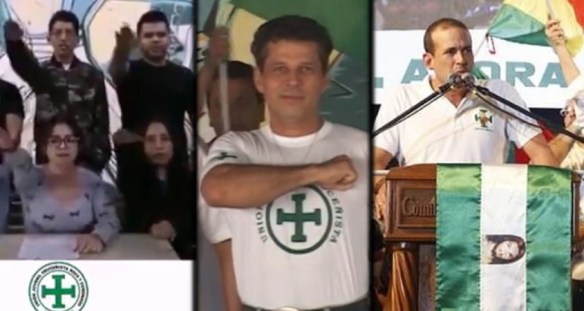
Camacho had spent years leading an overtly fascist separatist organization called the Unión Juvenil Cruceñista. The Grayzone edited the following clips from a promotional historical documentary that the group posted on its own social media accounts:

While Camacho and his far-right forces served as the muscle behind the coup, their political allies waited to reap the benefits.

The presidential candidate Bolivia’s opposition had fielded in the October election, Carlos Mesa, is a “pro-business” privatizer with extensive ties to Washington. US government cables published by WikiLeaks reveal that he regularly corresponded with American officials in their efforts to destabilize Morales.

Mesa is currently listed as an expert at the Inter-American Dialogue, a DC-based think tank funded by the US government’s soft-power arm USAID, various oil giants, and a host of multi-national corporations active in Latin America.

Evo Morales, a former farmer who rose to prominence in social movements before becoming the leader of the powerful grassroots political party Movement Toward Socialism (MAS), was Bolivia’s first Indigenous leader. Wildly popular in the country’s substantial Native and peasant communities, he won numerous elections and democratic referenda over a 13-year period, often in landslides.

On October 20, Morales won re-election by more than 600,000 votes, giving him just above the 10 percent margin needed to defeat opposition presidential candidate Mesa in the first round.

Experts who did a statistical analysis of Bolivia’s publicly available voting data found no evidence of irregularities or fraud. But the opposition claimed otherwise, and took to the streets in weeks of protests and riots.

The events that precipitated the resignation of Morales were indisputably violent. Right-wing opposition gangs attacked numerous elected politicians from the ruling leftist MAS party. They then ransacked the home of President Morales, while burning down the houses of several other top officials. The family members of some politicians were kidnapped and held hostage until they resigned. A female socialist mayor was publicly tortured by a mob.

Following the forced departure of Morales, coup leaders arrested the president and vice president of the government’s electoral body, and forced the organization’s other officials to resign. Camacho’s followers proceeded to burn Wiphala flags that symbolized the country’s Indigenous population and the plurinational vision of Morales.

The Organization of American States, a pro-US organization founded by Washington during the Cold War as an alliance of right-wing anti-communist countries in Latin America, helped rubber stamp the Bolivian coup. It called for new elections, claiming there were numerous irregularities in the October 20 vote, without citing any evidence. Then the OAS remained silent as Morales was overthrown by his military and his party’s officials were attacked and violently forced to resign.

The day after, the Donald Trump White House enthusiastically praised the coup, trumpeting it as a “significant moment for democracy,” and a “strong signal to the illegitimate regimes in Venezuela and Nicaragua.”

Emerging from the shadows to lead a violent far-right putsch

While Carlos Mesa timidly condemned the opposition’s violence, Camacho egged it on, ignoring calls for an international audit of the election and emphasizing his maximalist demand to purge all supporters of Morales from government. He was the true face of the opposition, concealed for months behind the moderate figure of Mesa.

A 40-year-old multi-millionaire businessman from the separatist stronghold of Santa Cruz, Camacho has never run for office. Like Venezuelan coup leader Juan Guaidó, whom more than 80 percent of Venezuelans had never heard of until the US government anointed him as supposed “president,” Camacho was an obscure figure until the coup attempt in Bolivia hit its stride.

He first created his Twitter account on May 27, 2019. For months, his tweets went ignored, generating no more than three or four retweets and likes. Before the election, Camacho did not have a Wikipedia article, and there were few media profiles on him in Spanish- or English-language media.

Camacho issued a call for a strike on July 9, posting videos on Twitter that got just over 20 views. The goal of the strike was to try to force the resignation of Bolivian government’s electoral organ the Supreme Electoral Tribunal (TSE). In other words, Camacho was pressuring the government’s electoral authorities to step down more than three months before the presidential election.

It was not until after the election that Camacho was thrust into the limelight and transformed into a celebrity by corporate media conglomerates like the local right-wing network Unitel, Telemundo, and CNN en Español.

All of a sudden, Camacho’s tweets calling for Morales to resign were lighting up with thousands of retweets. The coup machinery had been activated.

Mainstream outlets like the New York Times and Reuters followed by anointing the unelected Camacho as the “leader” of Bolivia’s opposition. But even as he lapped up international attention, key portions of the far-right activist’s background were omitted.

Left unmentioned were Camacho’s deep and well-established connections to Christian extremist paramilitaries notorious for racist violence and local business cartels, as well as the right-wing governments across the region.

It was in the fascist paramilitaries and separatist atmosphere of Santa Cruz where Camacho’s politics were formed, and where the ideological contours of the coup had been defined.

Cadre of a Francoist-style fascist paramilitary

Luis Fernando Camacho was groomed by the Unión Juvenil Cruceñista, or Santa Cruz Youth Union (UJC), a fascist paramilitary organization that has been linked to assassination plots against Morales. The group is notorious for assaulting leftists, Indigenous peasants, and journalists, all while espousing a deeply racist, homophobic ideology.

Since Morales entered office in 2006, the UJC has campaigned to separate from a country its members believed had been overtaken by a Satanic Indigenous mass.

The UJC is the Bolivian equivalent of Spain’s Falange, India’s Hindu supremacist RSS, and Ukraine’s neo-Nazi Azov battalion. Its symbol is a green cross that bears strong similarities to logos of fascist movements across the West.

And its members are known to launch into Nazi-style sieg heil salutes.

https://twitter.com/GrayzoneProject/status/1194137427474038784

Even the US embassy in Bolivia has described UJC members as “racist” and “militant,” noting that they “have frequently attacked pro-MAS/government people and installations.”

After journalist Benjamin Dangl visited with UJC members in 2007, he described them as the “brass knuckles” of the Santa Cruz separatist movement. “The Unión Juvenil has been known to beat and whip campesinos marching for gas nationalization, throw rocks at students organizing against autonomy, toss molotov cocktails at the state television station, and brutally assault members of the landless movement struggling against land monopolies,” Dangl wrote.

“When we have to defend our culture by force, we will,” a UJC leader told Dangl. “The defense of liberty is more important than life.”

Camacho was elected as vice president of the UJC in 2002, when he was just 23 years old. He left the organization two years later to build his family’s business empire and rise through the ranks of the Pro-Santa Cruz Committee. It was in that organization that he was taken under the wing of one of the separatist movement’s most powerful figures, a Bolivian-Croatian oligarch named Branko Marinkovic.

In August, Camacho tweeted a photo with his “great friend,” Marinkovic. This friendship was crucial to establishing the rightist activist’s credentials and forging the basis of the coup that would take form three months later.

Camacho’s Croatian godfather and separatist powerbroker

Branko Marinkovic is a major landowner who ramped up his support for the right-wing opposition after some of his land was nationalized by the Evo Morales government. As chairman of the Pro-Santa Cruz Committee, he oversaw the operations of the main engine of separatism in Bolivia.

In a 2008 letter to Marinkovic, the International Federation for Human Rights denounced the committee as an “actor and promoter of racism and violence in Bolivia.”

The human rights group added that it “condemn[ed] the attitude and secessionist, unionist and racist discourses as well as the calls for military disobedience of which the Pro-Santa Cruz Civic Committee for is one of the main promoters.”

In 2013, journalist Matt Kennard reported that the US government was working closely with the Pro-Santa Cruz Committee to encourage the balkanization of Bolivia and to undermine Morales. “What they [the US] put across was how they could strengthen channels of communication,” the vice president of the committee told Kennard. “The embassy said that they would help us in our communication work and they have a series of publications where they were putting forward their ideas.”

In a 2008 profile on Marinkovic, the New York Times acknowledged the extremist undercurrents of the Santa Cruz separatist movement the oligarch presided over. It described the area as “a bastion of openly xenophobic groups like the Bolivian Socialist Falange, whose hand-in-air salute draws inspiration from the fascist Falange of the former Spanish dictator Franco.”

The Bolivian Socialist Falange was a fascist group that provided safe haven to Nazi war criminal Klaus Barbie during the Cold War. A former Gestapo torture expert, Barbie was repurposed by the CIA through its Operation Condor program to help exterminate communism across the continent. (Despite its antiquated name, like the German National Socialists, this far-right extremist group was violently anti-leftist, committed to killing socialists.)

The Bolivian Falange came into power in 1971 when its leader, Gen. Hugo Banzer Suarez, ousted the leftist government of Gen. Juan Jose Torres Gonzales. The government of Gonzales had infuriated business leaders by nationalizing industries and antagonized Washington by ousting the Peace Corps, which it viewed as an instrument of CIA penetration. The Nixon administration immediately welcomed Banzer with open arms and courted him as a key bulwark against the spread of socialism in the region. (An especially ironic 1973 dispatch appears on Wikileaks showing Secretary of State Henry Kissinger thanking Banzer for congratulating him on his Nobel Peace Prize).

The movement’s putschist legacy persevered during the Morales era through organizations like the UJC and figures such as Marinkovic and Camacho.

The Times noted that Marinkovic also supported the activities of the UJC, describing the fascist group as “a quasi-independent arm of the committee led by Mr. Marinkovic.” A member of the UJC board told the US newspaper of record in an interview, “We will protect Branko with our own lives.”

Marinkovic has espoused the kind of Christian nationalist rhetoric familiar to the far-right organizations of Santa Cruz, calling, for instance, for a “crusade for the truth” and insisting that God is on his side.

The oligarch’s family hails from Croatia, where he has dual citizenship. Marinkovic has long been dogged by rumors that his family members were involved in the country’s powerful fascist Ustashe movement.

The Ustashe collaborated openly with Nazi German occupiers during World War Two. Their successors returned to power after Croatia declared independence from the former Yugoslavia – a former socialist country that was intentionally balkanized in a NATO war, much in the same way that Marinkovic hoped Bolivia would be.

Marinkovic denies that his family was part of the Ustashe. He claimed in an interview with the New York Times that his father fought against the Nazis.

But even some of his sympathizers are skeptical. A Balkan analyst from the private intelligence firm Stratfor, which works closely with the US government and is popularly known as the “shadow CIA,” produced a rough background profile on Marinkovic, speculating, “Still don’t know his full story, but I would bet a lot of $$$ that this dude’s parents are 1st gen (his name is too Slavic) and that they were Ustashe (read: Nazi) sympathizers fleeing Tito’s Communists after WWI.”

The Stratfor analyst excerpted a 2006 article by journalist Christian Parenti, who had visited Marinkovic at his ranch in Santa Cruz. Evo Morales’ “land reform could lead to civil war,” Marinkovic warned Parenti in the Texas-accented English he picked up while studying at the University of Texas.

Today, Marinkovic is an ardent supporter of Brazil’s far-right leader Jair Bolsonaro, whose only complaint about Chilean dictator Augusto Pinochet was that he “didn’t kill enough.”

Marinkovic is also a public admirer of Venezuela’s far-right opposition. “Todos somos Leopoldo” — “we are all Leopoldo,” he tweeted in support of Leopoldo López, who has been involved in numerous coup attempts against Venezuela’s elected leftist government.

While Marinkovic denied any role in armed militant activity in his interview with Parenti, he was accused in 2008 of playing a central role in an attempt to assassinate Morales and his Movement Toward Socialism party allies.

He told the New York Times less than two years before the plot developed, “If there is no legitimate international mediation in our crisis, there is going to be confrontation. And unfortunately, it is going to be bloody and painful for all Bolivians.”

An assassination plot links Bolivia’s right to international fascists

In April 2009, a special unit of the Bolivian security services barged into a luxury hotel room and cut down three men who were said to be involved in a plot to kill Evo Morales. Two others remained on the loose. Four of the alleged conspirators had Hungarian or Croatian roots and ties to rightist politics in eastern Europe, while another was a right-wing Irishman, Michael Dwyer, who had only arrived in Santa Cruz six months before.

The ringleader of the group was said to be a former leftist journalist named Eduardo Rosza-Flores who had turned to fascism and belonged to Opus Dei, the traditionalist Catholic cult that emerged under the dictatorship of Spain’s Francisco Franco. In fact, the codename Rosza-Flores assumed in the assassination plot was “Franco,” after the late Generalissimo.

During the 1990s, Rosza fought on behalf of the Croatian First International Platoon, or the PIV, in the war to separate from Yugoslavia. A Croatian journalist told Time that the “PIV was a notorious group: 95% of them had criminal histories, many were part of Nazi and fascist groups, from Germany to Ireland.”

By 2009, Rosza returned home to Bolivia to crusade on behalf of another separatist movement in Santa Cruz. And it was there that he was killed in a luxury hotel with no apparent source of income and a massive stockpile of guns.

The government later released photos of Rosza and a co-conspirator posing with their weapons. Publication of emails between the ringleader and Istvan Belovai, a former Hungarian military intelligence officer who served as a double agent for the CIA, cemented the perception that Washington had a hand in the operation.

Marinkovic was subsequently charged with providing $200,000 to the plotters. The Bolivian-Croatian oligarch initially fled to the United States, where he was given asylum, then relocated to Brazil, where he lives today. He denied any involvement in the plan to kill Morales.

As journalist Matt Kennard reported, there was another thread that tied the plot to the US: the alleged participation of an NGO leader named Hugo Achá Melgar.

“Rozsa didn’t come here by himself, they brought him,” the Bolivian government’s lead investigator told Kennard. “Hugo Achá Melgar brought him.”

The Human Rights Foundation destabilizes Bolivia

Achá was not just the head of any run-of-the-mill NGO. He had founded the Bolivian subsidiary of the Human Rights Foundation (HRF), an international right-wing outfit that is known for hosting a “school for revolution” for activists seeking regime change in states targeted by the US government.

HRF is run by Thor Halvorssen Jr., the son of the late Venezuelan oligarch and CIA asset Thor Halvorssen Hellum. The first cousin of the veteran Venezuelan coup plotter Leopoldo Lopez, Halvorssen was a former college Republican activist who crusaded against political correctness and other familiar right-wing hobgoblins.

After a brief career as a firebrand right-wing film producer, in which he oversaw a scandalous “anti-environmentalist” documentary financed by a mining corporation, Halvorssen rebranded as a promoter of liberalism and the enemy of global authoritarianism. He launched the HRF with grants from right-wing billionaires like Peter Thiel, conservative foundations, and NGOs including Amnesty International. The group has since been at the forefront of training activists for insurrectionary activity from Hong Kong to the Middle East to Latin America.

Though Achá was granted asylum in the US, the HRF has continued pushing regime change in Bolivia. As Wyatt Reed reported for The Grayzone, HRF “freedom fellow” Jhanisse Vaca Daza helped trigger the initial stage of the coup by blaming Morales for the Amazon fires that consumed parts of Bolivia in August, mobilizing international protests against him.

At the time, Daza posed as an “environmental activist” and student of non-violence who articulated her concerns in moderate-seeming calls for more international aid to Bolivia. Through her NGO, Rios de Pie, she helped launch the #SOSBolivia hashtag, which signaled the imminent foreign-backed regime-change operation.

Courting the regional right, prepping the coup

While HRF’s Daza rallied protests outside Bolivian embassies in Europe and the US, Fernando Camacho remained behind the scenes, lobbying right-wing governments in the region to bless the coming coup.

In May, Camacho met with Colombia’s far-right President Ivan Duque. Camacho was helping to spearhead regional efforts at undermining the legitimacy of Evo Morales’ presidency at the Inter-American Court of Human Rights, seeking to block his candidacy in the October election.

That same month, the rightist Bolivian agitator also met with Ernesto Araújo, the chancellor of Jair Bolsonaro’s ultra-conservative administration in Brazil. Through the meeting, Camacho successfully secured Bolsonaro’s backing for regime change in Bolivia.

This November 10, Araújo enthusiastically endorsed the ouster of Morales, declaring that “Brazil will support the democratic and constitutional transition” in the country.

Then in August, two months before Bolivia’s presidential election, Camacho held court with officials from Venezuela’s US-appointed coup regime. These included Gustavo Tarre, Guaido’s faux Venezuelan OAS ambassador, who formerly worked at the right-wing Center for Strategic and International Studies (CSIS) think tank in Washington.

After the meeting, Camacho tweeted gratitude to the Venezuelan coup-mongers, as well as to Colombia and Brazil.

Mesa and Camacho: a marriage of capitalist convenience

Back in Bolivia, Carlos Mesa occupied the spotlight as the opposition’s presidential candidate.

His erudite image and centrist policy proposals put him in a seemingly alternate political universe from fire-breathing rightists like Camacho and Marinkovic. For them, he was a convenient front man and acceptable candidate who promised to defend their economic interests.

“It might be that he is not my favorite, but I’m going to vote for him, because I don’t want Evo,” Marinkovic told a right-wing Argentine newspaper five days before the election.

Indeed, it was Camacho’s practical financial interests that appeared to have necessitated his support for Mesa.

The Camacho family has formed a natural gas cartel in Santa Cruz. As the Bolivian outlet Primera Linea reported, Luis Fernando Camacho’s father, Jose Luis, was the owner of a company called Sergas that distributed gas in the city; his uncle, Enrique, controlled Socre, the company that ran the local gas production facilities; and his cousin, Cristian, controls another local gas distributor called Controgas.

According to Primera Linea, the Camacho family was using the Pro-Santa Cruz Committee as a political weapon to install Carlos Mesa into power and ensure the restoration of their business empire.

Mesa has a well-documented history of advancing the goals of transnational companies at the expense of his own country’s population. The neoliberal politician and media personality served as vice president when the US-backed President Gonzalo “Goni” Sanchez de Lozada provoked mass protests with his 2003 plan to allow a consortium of multinational corporations to export the country’s natural gas to the US through a Chilean port.

Bolivia’s US-trained security forces met the ferocious protests with brutal repression. After presiding over the killing of 70 unarmed protesters, Sanchez de Lozada fled to Miami and was succeeded by Mesa.

By 2005, Mesa was also ousted by huge demonstrations spurred by his protection of privatized natural gas companies. With his demise, the election of Morales and the rise of the socialist and rural Indigenous movements behind him were just beyond the horizon.

US government cables released by WikiLeaks show that, after his ouster, Mesa continued regular correspondence with American officials. A 2008 memo from the US embassy in Bolivia revealed that Washington was conspiring with opposition politicians in the lead-up to the 2009 presidential election, hoping to undermine and ultimately unseat Morales.

The memo noted that Mesa had met with the chargé d’affaires of the US embassy, and had privately told them he planned to run for president. The cable recalled: “Mesa told us his party will be ideologically similar to a social democratic party and that he hoped to strengthen ties with the Democratic party. ‘We have nothing against the Republican party, and have in fact gotten support from IRI (International Republican Institute) in the past, but we think we share more ideology with the Democrats,’ he added.”

wikileaks bolivia carlos mesa

Today, Mesa serves as an in-house “expert” at the Inter-American Dialogue, a neoliberal Washington-based think tank focused on Latin America. One of the Dialogue’s top donors is the US Agency for International Development (USAID), the State Department subsidiary that was exposed in classified diplomatic cables published on Wikileaks for strategically directing millions of dollars to opposition groups including those “opposed to Evo Morales’ vision for indigenous communities.”

Other top funders of the Dialogue include oil titans like Chevron and ExxonMobil; Bechtel, which inspired the initial protests against the administration in which Mesa served; the Inter-American Development Bank, which has forcefully opposed Morales’ socialist-oriented policies; and the Organization of American States (OAS), which helped delegitimize the Morales’s re-election victory with dubious claims of irregular vote counts.

Finishing the job

When Carlos Mesa touched off nationwide protests in October by accusing the Evo Morales government of committing electoral fraud, the right-wing firebrand hailed by his followers as “Macho Camacho” emerged from the shadows. Behind him was the hardcore separatist shock force that he led in Santa Cruz.

Mesa faded into the distance as Camacho emerged as the authentic face of the coup, rallying his forces with the uncompromising rhetoric and fascist symbology that defined the Unión Juvenil Cruceñista paramilitary.

As he declared victory over Morales, Camacho exhorted his followers to “finish the job, let’s get the elections going, let’s start judging the government criminals, let’s put them in jail.”

Back in Washington, meanwhile, the Trump administration released an official statement celebrating Bolivia’s coup, declaring that “Morales’s departure preserves democracy.”