Creating consensus on Ukraine

By Rick Staggenborg, MD

Source: OpEdNews.com

The antiwar community has fractured at a time when it most needs to speak with one voice to end the war in Ukraine. About all we can agree on is that the war is a terrible thing that needs to be stopped. Beyond that, reasonable people disagree about messaging, and unreasonable people demonize those who disagree. The result is that average Americans who don’t usually follow politics, let alone international affairs, form opinions based on emotional responses to what they hear in mainstream media rather than what may be most likely to promote peace. This is true despite the fact that most would say that peace is what they want.

The ability to influence American thinking through emotional appeals is what those with the power to manipulate the media count on to serve imperialism’s aims. If we can at least agree that how we frame our response is important, people who sincerely want to do something to end the war might be able to agree on what message would most effectively sway public opinion in a way that might influence our government to act in the interest of peace.

The most fundamental disagreement is over whether it’s necessary to call Russia out as solely or even primarily at fault for the war, or whether it is important to provide the context needed to understand the US role in creating the conditions that led it to decide that it had no choice but to respond to Ukrainian actions in Donbass with military force.

Given that our goal is to influence public opinion, it’s understandable that most peace groups have opted to follow the lead of politicians and mainstream commentators and preface every statement with a condemnation of Russia. After all, since they believe these accusations are justified, they fear being seen as supportive of Russia if they only focus on what the US has done that promotes war and what it hasn’t done that might have prevented it. Some peace groups go so far as to ignore clear US provocations as unimportant. Since it was Russia that invaded, they believe that their proper job is to wave Ukrainian flags and protest Russia’s actions, despite the reality that this will have no beneficial effect on the course of the war.

Other peace activists feel that either approach absolves the US of responsibility for creating conditions that led to the conflict. Believing the US actually initiated the conflict, they argue that dating its onset as February 24 is not only misleading, but false. They see the conflict as having started long before the Russian invasion and argue that knowing what choices Putin had is relevant to assigning blame.

The truth is that we don’t have to agree on who is at fault if we don’t make that an issue. As a psychotherapist with training in family therapy, I know from experience that focusing on who is responsible for a problem almost never leads to a satisfactory solution. And from a practical standpoint, placing sole blame on Russia is counterproductive not only because it splits the antiwar movement, but because to much of the public it provides a justification for an aggressive US response. Avoiding a conflict over whether Russia should be characterized as the sole aggressor is why many want to limit the message to demanding that the US
1) stop arming Ukraine, 2) declare it will never support Ukraine joining NATO, and 3) push Ukraine to negotiate without preconditions.

From a family therapy perspective, trying to keep the discussion focused on a solution would certainly be the approach to take if the US actually wanted to end the conflict. Unfortunately, that doesn’t seem to be the case. The effect of sending increasingly lethal weapons and imposing sanctions that primarily harm civilians is to prolong the war and increase casualties of both soldiers and civilians on both sides.

Recent reports indicate that the effort to help a depleted Ukrainian military drive Russia out of Donbass is futile. However, this approach is very profitable for a weapons industry that generously funds the elections of members of Congress willing to serve its interests, which is no doubt why any debate about how the US should proceed assumes that it will involve continuing a strategy that has proven to result in arming extremists when used in places like Iraq and Afghanistan. And yes, there are extremists with significant influence in Ukraine despite media denials.

Clearly, the focus on providing weapons has redirected the public’s attention from the question of how to end the war to how best to punish Russia, regardless of how US strategy affect Ukrainian civilians. This is not by accident, but by design. That’s why it is necessary to challenge the distortions, omissions and outright lies that are used to influence public opinion to conform with the goals of American imperialism. Unfortunately, the inability to agree on the facts is what has led to the stark divisions among those wanting to do something to make the war to end. That is we have to put aside our pride and listen to each other to understand why a minority firmly believes that the consensus opinion of the majority is based on misplaced trust in mainstream media.

Most Americans think they are informed if they read mainstream media and watch a variety of TV news sources. Antiwar activists know differently, because we know we have been lied into war repeatedly, at least from Vietnam through Syria. Unfortunately, like the general public, many peace proponents have no idea how information that challenges the government’s narrative is being systematically suppressed in unprecedented ways.

It’s always been true that truth is the first casualty of war. In today’s hybrid warfare, it is more critical than ever to control the information domain. The way news is presented by government officials and approved media frames the way most people think about US foreign policy. This is why the idea of sending ever more powerful weapons to prolong a military conflict that cannot be won is never challenged. While the ultimate outcome of Russia’s invasion cannot be predicted with certainty, the one thing we know for sure is that providing increasingly lethal weaponry will lead to more death on both sides and do nothing to promote stability in the region.

Of course, there is much more that could be said about the tremendous amount of disinformation in the mainstream media regarding Ukraine. While much of it is relevant to understanding the situation, it is far beyond the scope of this essay. I can only recommend that those who are inclined to believe what they read or hear in government-approved media look at any of the credible alternative sources that present evidence of critical facts that are being withheld from them.

A good way to find them is to look at the list of websites that Prop or Not, a shadowy group that claims to be the arbiter of “reliable sources,” claims should not be trusted. Interspersed among many dubious websites listed are some of the most informative sources of information contradicting the mainstream narrative. These are sites with authors that include prominent investigative journalists and veterans of the CIANSAState Departmenthigh ranking White House positions and military intelligence. They cite their sources, which gives their articles far more credibility than the mostly anonymous sources favored by the New York Times and Washington Post when reporting on many of the same stories.

I urge anyone interested in finding a common message to present to the public to read the statement released by the US Peace Council.
No Way Out but War

Permanent war has cannibalized the country. It has created a social, political, and economic morass. Each new military debacle is another nail in the coffin of Pax Americana.

By Chris Hedges

Source: ScheerPost


The United States, as the near unanimous vote to provide nearly $40 billion in aid to Ukraine illustrates, is trapped in the death spiral of unchecked militarism. No high speed trains. No universal health care. No viable Covid relief program. No respite from 8.3 percent inflation. No infrastructure programs to repair decaying roads and bridges, which require $41.8 billion to fix the 43,586 structurally deficient bridges, on average 68 years old. No forgiveness of $1.7 trillion in student debt. No addressing income inequality. No program to feed the 17 million children who go to bed each night hungry. No rational gun control or curbing of the epidemic of nihilistic violence and mass shootings. No help for the 100,000 Americans who die each year of drug overdoses. No minimum wage of $15 an hour to counter 44 years of wage stagnation. No respite from gas prices that are projected to hit $6 a gallon.

The permanent war economy, implanted since the end of World War II, has destroyed the private economy, bankrupted the nation, and squandered trillions of dollars of taxpayer money. The monopolization of capital by the military has driven the US debt to $30 trillion, $ 6 trillion more than the US GDP of $ 24 trillion. Servicing this debt costs $300 billion a year. We spent more on the military, $ 813 billion for fiscal year 2023, than the next nine countries, including China and Russia, combined.

We are paying a heavy social, political, and economic cost for our militarism. Washington watches passively as the U.S. rots, morally, politically, economically, and physically, while China, Russia, Saudi Arabia, India, and other countries extract themselves from the tyranny of the U.S. dollar and the international Society for Worldwide Interbank Financial Telecommunication (SWIFT), a messaging network banks and other financial institutions use to send and receive information, such as money transfer instructions. Once the U.S. dollar is no longer the world’s reserve currency, once there is an alternative to SWIFT, it will precipitate an internal economic collapse. It will force the immediate contraction of the U.S. empire shuttering most of its nearly 800 overseas military installations. It will signal the death of Pax Americana.

Democrat or Republican. It does not matter. War is the raison d’état of the state. Extravagant military expenditures are justified in the name of “national security.” The nearly $40 billion allocated for Ukraine, most of it going into the hands of weapons manufacturers such as Raytheon Technologies, General Dynamics, Northrop Grumman, BAE Systems, Lockheed Martin, and Boeing, is only the beginning. Military strategists, who say the war will be long and protracted, are talking about infusions of $4 or $5 billion in military aid a month to Ukraine. We face existential threats. But these do not count. The proposed budget for the Centers for Disease Control and Prevention (CDC) in fiscal year 2023 is $10.675 billion. The proposed budget for the Environmental Protection Agency (EPA) is $11.881 billion. Ukraine alone gets more than double that amount. Pandemics and the climate emergency are afterthoughts. War is all that matters. This is a recipe for collective suicide.

There were three restraints to the avarice and bloodlust of the permanent war economy that no longer exist. The first was the old liberal wing of the Democratic Party, led by politicians such as Senator George McGovern, Senator Eugene McCarthy, and Senator J. William Fulbright, who wrote The Pentagon Propaganda Machine. The self-identified progressives, a pitiful minority, in Congress today, from Barbara Lee, who was the single vote in the House and the Senate opposing a broad, open-ended authorization allowing the president to wage war in Afghanistan or anywhere else, to Ilhan Omar now dutifully line up to fund the latest proxy war. The second restraint was an independent media and academia, including journalists such as I.F Stone and Neil Sheehan along with scholars such as Seymour Melman, author of The Permanent War Economy and Pentagon Capitalism: The Political Economy of War. Third, and perhaps most important, was an organized anti-war movement, led by religious leaders such as Dorothy Day, Martin Luther King Jr. and Phil and Dan Berrigan as well as groups such as Students for a Democratic Society (SDS). They understood that unchecked militarism was a fatal disease.

None of these opposition forces, which did not reverse the permanent war economy but curbed its excesses, now exist. The two ruling parties have been bought by corporations, especially military contractors. The press is anemic and obsequious to the war industry. Propagandists for permanent war, largely from right-wing think tanks lavishly funded by the war industry, along with former military and intelligence officials, are exclusively quoted or interviewed as military experts. NBC’s “Meet the Press” aired a segment May 13 where officials from Center for a New American Security (CNAS) simulated what a war with China over Taiwan might look like. The co-founder of CNAS, Michèle Flournoy, who appeared in the “Meet the Press” war games segment and was considered by Biden to run the Pentagon, wrote in 2020 in Foreign Affairs that the U.S. needs to develop “the capability to credibly threaten to sink all of China’s military vessels, submarines and merchant ships in the South China Sea within 72 hours.” 

The handful of anti-militarists and critics of empire from the left, such as Noam Chomsky, and the right, such as Ron Paul, have been declared persona non grata by a compliant media. The liberal class has retreated into boutique activism where issues of class, capitalism and militarism are jettisoned for “cancel culture,” multiculturalism and identity politics. Liberals are cheerleading the war in Ukraine. At least the inception of the war with Iraq saw them join significant street protests. Ukraine is embraced as the latest crusade for freedom and democracy against the new Hitler. There is little hope, I fear, of rolling back or restraining the disasters being orchestrated on a national and global level.  The neoconservatives and liberal interventionists chant in unison for war. Biden has appointed these war mongers, whose attitude to nuclear war is terrifyingly cavalier, to run the Pentagon, the National Security Council, and the State Department.

Since all we do is war, all proposed solutions are military. This military adventurism accelerates the decline, as the defeat in Vietnam and the squandering of $8 trillion in the futile wars in the Middle East illustrate. War and sanctions, it is believed, will cripple Russia, rich in gas and natural resources. War, or the threat of war, will curb the growing economic and military clout of China.

These are demented and dangerous fantasies, perpetrated by a ruling class that has severed itself from reality. No longer able to salvage their own society and economy, they seek to destroy those of their global competitors, especially Russia and China. Once the militarists cripple Russia, the plan goes, they will focus military aggression on the Indo-Pacific, dominating what Hillary Clinton as secretary of state, referring to the Pacific, called “the American Sea.” 

You cannot talk about war without talking about markets. The U.S., whose growth rate has fallen to below 2 percent, while China’s growth rate is 8.1 percent, has turned to military aggression to bolster its sagging economy. If the U.S. can sever Russian gas supplies to Europe, it will force Europeans to buy from the United States. U.S. firms, at the same time, would be happy to replace the Chinese Communist Party, even if they must do it through the threat of war, to open unfettered access to Chinese markets. War, if it did break out with China, would devastate the Chinese, American, and global economies, destroying free trade between countries as in World War I. But that doesn’t mean it won’t happen.

Washington is desperately trying to build military and economic alliances to ward off a rising China, whose economy is expected by 2028 to overtake that of the United States, according to the UK’s Centre for Economics and Business Research (CEBR). The White House has said Biden’s current visit to Asia is about sending a “powerful message” to Beijing and others about what the world could look like if democracies “stand together to shape the rules of the road.” The Biden administration has invited South Korea and Japan to attend the NATO summit in Madrid.

But fewer and fewer nations, even among European allies, are willing to be dominated by the United States. Washington’s veneer of democracy and supposed respect for human rights and civil liberties is so badly tarnished as to be irrecoverable. Its economic decline, with China’s manufacturing 70 percent higher than that of the U.S., is irreversible. War is a desperate Hail Mary, one employed by dying empires throughout history with catastrophic consequences. “It was the rise of Athens and the fear that this instilled in Sparta that made war inevitable,” Thucydides noted in the History of the Peloponnesian War. 

A key component to the sustenance of the permanent war state was the creation of the All-Volunteer Force. Without conscripts, the burden of fighting wars falls to the poor, the working class, and military families. This All-Volunteer Force allows the children of the middle class, who led the Vietnam anti-war movement, to avoid service. It protects the military from internal revolts, carried out by troops during the Vietnam War, which jeopardized the cohesion of the armed forces.

The All-Volunteer Force, by limiting the pool of available troops, also makes the global ambitions of the militarists impossible. Desperate to maintain or increase troop levels in Iraq and Afghanistan, the military instituted the stop-loss policy that arbitrarily extended active-duty contracts. Its slang term was the backdoor draft. The effort to bolster the number of troops by hiring private military contractors, as well, had a negligible effect. Increased troop levels would not have won the wars in Iraq and Afghanistan but the tiny percentage of those willing to serve in the military (only 7 percent of the U.S. population are veterans) is an unacknowledged Achilles heel for the militarists.

“As a consequence, the problem of too much war and too few soldiers eludes serious scrutiny,” writes historian and retired Army Colonel Andrew Bacevich in After the Apocalypse: America’s Role in a World Transformed. “Expectations of technology bridging that gap provide an excuse to avoid asking the most fundamental questions: Does the United States possess the military wherewithal to oblige adversaries to endorse its claim of being history’s indispensable nation? And if the answer is no, as the post-9/11 wars in Afghanistan and Iraq suggest, wouldn’t it make sense for Washington to temper its ambitions accordingly?”

This question, as Bacevich points out, is “anathema.” The military strategists work from the supposition that the coming wars won’t look anything like past wars. They invest in imaginary theories of future wars that ignore the lessons of the past, ensuring more fiascos. 

The political class is as self-deluded as the generals. It refuses to accept the emergence of a multi-polar world and the palpable decline of American power. It speaks in the outdated language of American exceptionalism and triumphalism, believing it has the right to impose its will as the leader of the “free world.” In his 1992 Defense Planning Guidance memorandum, U.S. Under Secretary of Defense Paul Wolfowitz argued that the U.S. must ensure no rival superpower again arises. The U.S. should project its military strength to dominate a unipolar world in perpetuity. On February 19, 1998, on NBC’s “Today Show”, Secretary of State Madeleine Albright gave the Democratic version of this doctrine of unipolarity. “If we have to use force it is because we are Americans; we are the indispensable nation,” she said. “We stand tall, and we see further than other countries into the future.”

This demented vision of unrivaled U.S. global supremacy, not to mention unrivaled goodness and virtue, blinds the establishment Republicans and Democrats. The military strikes they casually used to assert the doctrine of unipolarity, especially in the Middle East, swiftly spawned jihadist terror and prolonged warfare. None of them saw it coming until the hijacked jets slammed into the World Trade Center twin towers. That they cling to this absurd hallucination is the triumph of hope over experience.

There is a deep loathing among the public for these elitist Ivy League architects of American imperialism. Imperialism was tolerated when it was able to project power abroad and produce rising living standards at home. It was tolerated when it restrained itself to covert interventions in countries such as Iran, Guatemala, and Indonesia. It went off the rails in Vietnam. The military defeats that followed accompanied a steady decline in living standards, wage stagnation, a crumbling infrastructure and eventually a series of economic policies and trade deals, orchestrated by the same ruling class, which deindustrialized and impoverished the country.

The establishment oligarchs, now united in the Democratic Party, distrust Donald Trump. He commits the heresy of questioning the sanctity of the American empire. Trump derided the invasion of Iraq as a “big, fat mistake.” He promised “to keep us out of endless war.” Trump was repeatedly questioned about his relationship with Vladimir Putin. Putin was “a killer,” one interviewer told him. “There are a lot of killers,” Trump retorted. “You think our country’s so innocent?” Trump dared to speak a truth that was to be forever unspoken, the militarists had sold out the American people.

Noam Chomsky took some heat for pointing out, correctly, that Trump is the “one statesman” who has laid out a “sensible” proposition to resolve the Russia-Ukraine crisis. The proposed solution included “facilitating negotiations instead of undermining them and moving toward establishing some kind of accommodation in Europe…in which there are no military alliances but just mutual accommodation.”

Trump is too unfocused and mercurial to offer serious policy solutions. He did set a timetable to withdraw from Afghanistan, but he also ratcheted up the economic war against Venezuela and reinstituted crushing sanctions against Cuba and Iran, which the Obama administration had ended. He increased the military budget. He apparently flirted with carrying out a missile strike on Mexico to “destroy the drug labs.” But he acknowledges a distaste for imperial mismanagement that resonates with the public, one that has every right to loath the smug mandarins that plunge us into one war after another. Trump lies like he breathes. But so do they.

The 57 Republicans who refused to support the $40 billion aid package to Ukraine, along with many of the 19 bills that included an earlier $13.6 billion in aid for Ukraine, come out of the kooky conspiratorial world of Trump. They, like Trump, repeat this heresy. They too are attacked and censored. But the longer Biden and the ruling class continue to pour resources into war at our expense, the more these proto fascists, already set to wipe out Democratic gains in the House and the Senate this fall, will be ascendant. Marjorie Taylor Greene, during the debate on the aid package to Ukraine, which most members were not given time to closely examine, said: “$40 billion dollars but there’s no baby formula for American mothers and babies.”

“An unknown amount of money to the CIA and Ukraine supplemental bill but there’s no formula for American babies,” she added. “Stop funding regime change and money laundering scams. A US politician covers up their crimes in countries like Ukraine.”

Democrat Jamie Raskin immediately attacked Greene for parroting the propaganda of Russian president Vladimir Putin.

Greene, like Trump, spoke a truth that resonates with a beleaguered public. The opposition to permanent war should have come from the tiny progressive wing of the Democratic Party, which unfortunately sold out to the craven Democratic Party leadership to save their political careers. Greene is demented, but Raskin and the Democrats peddle their own brand of lunacy. We are going to pay a very steep price for this burlesque.

Pop Culture Has Become an Oligopoly

By Adam Mastroianni

Source: Experimental History

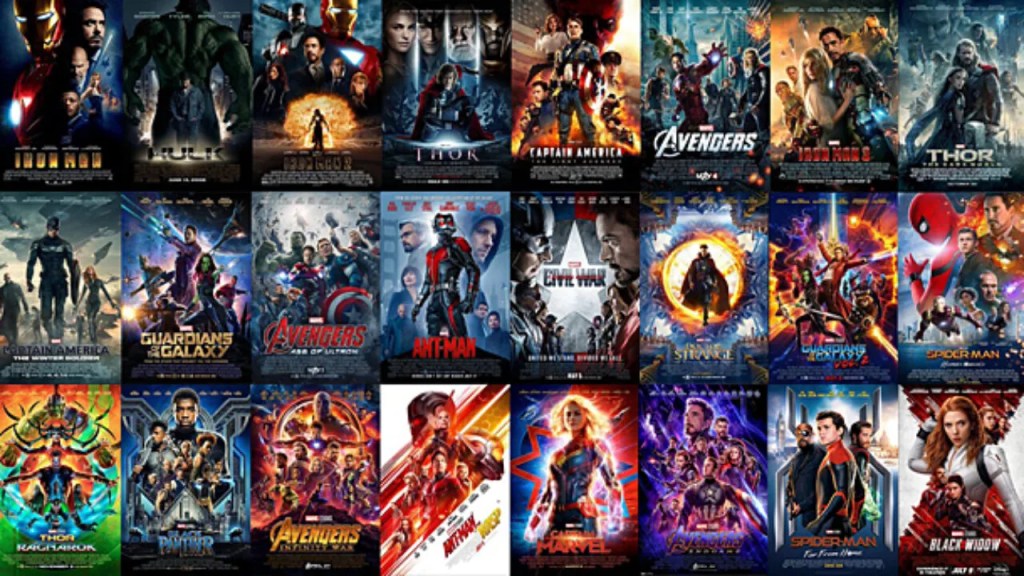
You may have noticed that every popular movie these days is a remake, reboot, sequel, spinoff, or cinematic universe expansion. In 2021, only one of the ten top-grossing films––the Ryan Reynolds vehicle Free Guy––was an original. There were only two originals in 2020’s top 10, and none at all in 2019.

People blame this trend on greedy movie studios or dumb moviegoers or competition from Netflix or humanity running out of ideas. Some say it’s a sign of the end of movies. Others claim there’s nothing new about this at all.

Some of these explanations are flat-out wrong; others may contain a nugget of truth. But all of them are incomplete, because this isn’t just happening in movies. In every corner of pop culture––movies, TV, music, books, and video games––a smaller and smaller cartel of superstars is claiming a larger and larger share of the market. What used to be winners-take-some has grown into winners-take-most and is now verging on winners-take-all. The (very silly) word for this oligopoly, like a monopoly but with a few players instead of just one.

I’m inherently skeptical of big claims about historical shifts. I recently published a paper showing that people overestimate how much public opinion has changed over the past 50 years, so naturally I’m on the lookout for similar biases here. But this shift is not an illusion. It’s big, it’s been going on for decades, and it’s happening everywhere you look. So let’s get to the bottom of it.

(Data and code available here.)

Movies 

At the top of the box office charts, original films have gone extinct. 

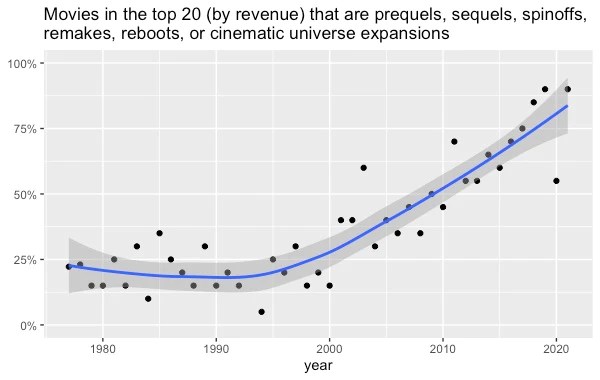
I looked at the 20 top-grossing movies going all the way back to 1977 (source), and I coded whether each was part of what film scholars call a “multiplicity”—sequels, prequels, franchises, spin-offs, cinematic universe expansions, etc. This required some judgment calls. Lots of movies are based on books and TV shows, but I only counted them as multiplicities if they were related to a previous movie. So 1990’s Teenage Mutant Ninja Turtles doesn’t get coded as a multiplicity, but 1991’s Teenage Mutant Ninja Turtles II: The Secret of the Ooze does, and so does the 2014 Teenage Mutant Ninja Turtles remake. I also probably missed a few multiplicities, especially in earlier decades, since sometimes it’s not obvious that a movie has some connection to an earlier movie.

Regardless, the shift is gigantic. Until the year 2000, about 25% of top-grossing movies were prequels, sequels, spinoffs, remakes, reboots, or cinematic universe expansions. Since 2010, it’s been over 50% ever year. In recent years, it’s been close to 100%.

Original movies just aren’t popular anymore, if they even get made in the first place.

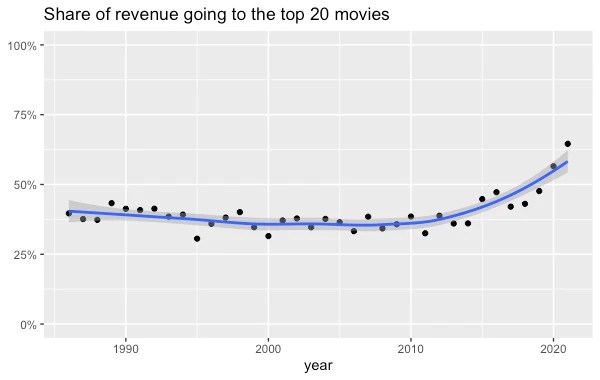
Top movies have also recently started taking a larger chunk of the market. I extracted the revenue of the top 20 movies and divided it by the total revenue of the top 200 movies, going all the way back to 1986 (source). The top 20 movies captured about 40% of all revenue until 2015, when they started gobbling up even more.

Television

Thanks to cable and streaming, there’s way more stuff on TV today than there was 50 years ago. So it would make sense if a few shows ruled the early decades of TV, and now new shows constantly displace each other at the top of the viewership charts.

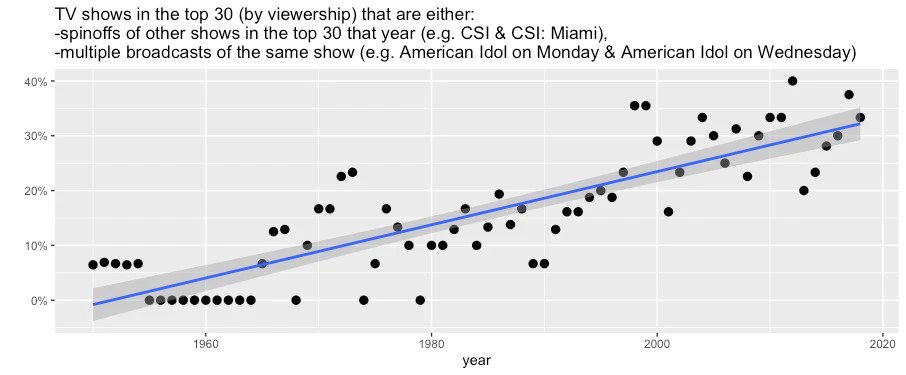
Instead, the opposite has happened. I pulled the top 30 most-viewed TV shows from 1950 to 2019 (source) and found that fewer and fewer franchises rule a larger and larger share of the airwaves. In fact, since 2000, about a third of the top 30 most-viewed shows are either spinoffs of other shows in the top 30 (e.g., CSI and CSI: Miami) or multiple broadcasts of the same show (e.g., American Idol on Monday and American Idol on Wednesday). 

Two caveats to this data. First, I’m probably slightly undercounting multiplicities from earlier decades, where the connections between shows might be harder for a modern viewer like me to understand––maybe one guy hosted multiple different shows, for example. And second, the Nielsen ratings I’m using only recently started accurately measuring viewership on streaming platforms. But even in 2019, only 14% of viewing time was spent on streaming, so this data isn’t missing much.

Music

It used to be that a few hitmakers ruled the charts––The Beatles, The Eagles, Michael Jackson––while today it’s a free-for-all, right?

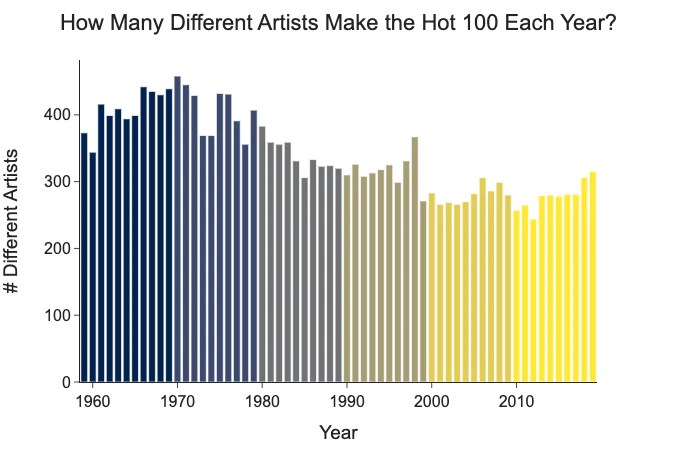
Nope. A data scientist named Azhad Syed has done the analysis, and he finds that the number of artists on the Billboard Hot 100 has been decreasing for decades.

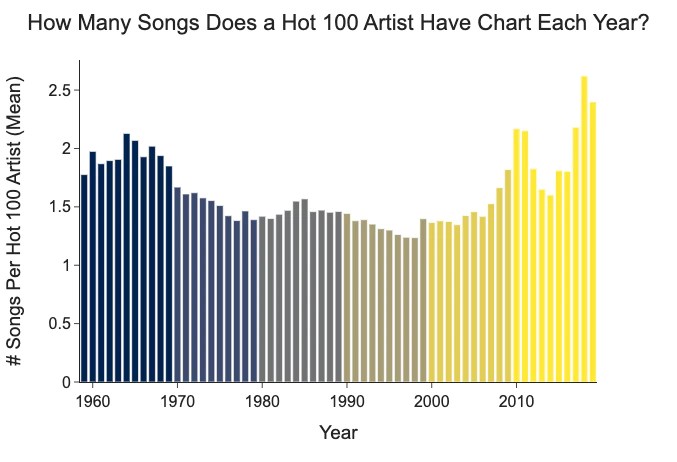
And since 2000, the number of hits per artist on the Hot 100 has been increasing. 

(Azhad says he’s looking for a job––you should hire him!)

A smaller group of artists tops the charts, and they produce more of the chart-toppers. Music, too, has become an oligopoly.

Books

Literature feels like a different world than movies, TV, and music, and yet the trend is the same.

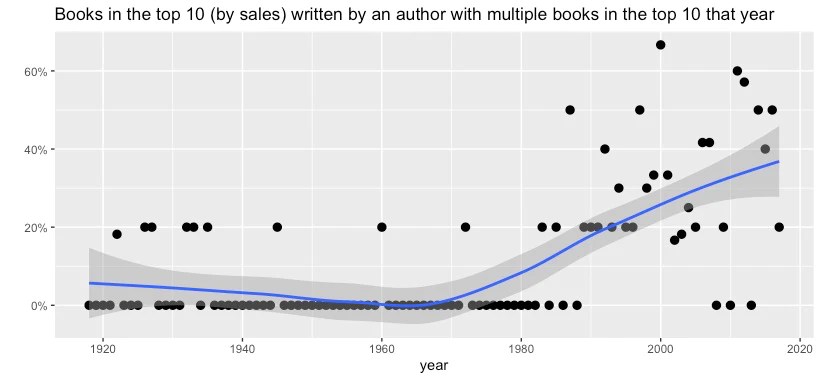
Using LiteraryHub’s list of the top 10 bestselling books for every year from 1919 to 2017, I found that the oligopoly has come to book publishing as well. There are a couple ways we can look at this. First, we can look at the percentage of repeat authors in the top 10––that is, the number of books in the top 10 that were written by an author with another book in the top 10.

It used to be pretty rare for one author to have multiple books in the top 10 in the same year. Since 1990, it’s happened almost every year. No author ever had three top 10 books in one year until Danielle Steel did it 1998. In 2011, John Grisham, Kathryn Stockett, and Stieg Larsson all had two chart-topping books each.

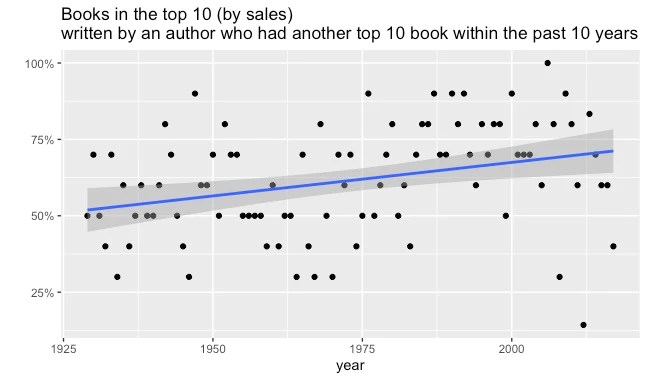
We can also look at the percentage of authors in the top 10 were already famous––say, they had a top 10 book within the past 10 years. That has increased over time, too. 

In the 1950s, a little over half of the authors in the top 10 had been there before. These days, it’s closer to 75%.

Video games

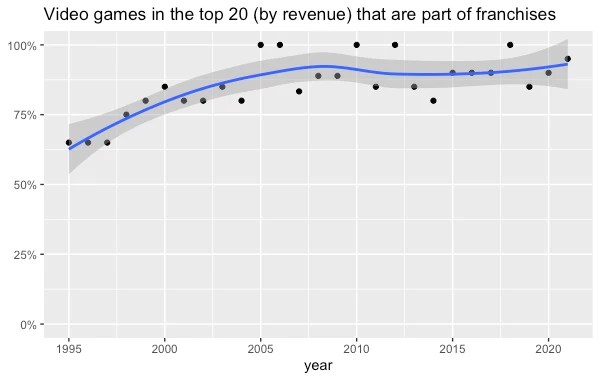
I tracked down the top 20 bestselling video games for each year from 1995 to 2021 (sources: 1234567) and coded whether each belongs to a preexisting video game franchise. (Some games, like Harry Potter and the Sorcerer’s Stone, belong to franchises outside of video games. For these, I coded the first installment as originals and any subsequent installments as franchise games.)

The oligopoly rules video games too:

In the late 1990s, 75% or less of bestselling video games were franchise installments. Since 2005, it’s been above 75% every year, and sometimes it’s 100%. At the top of the charts, it’s all Mario, Zelda, Call of Duty, and Grand Theft Auto.

Why is this happening?

Any explanation for the rise of the pop oligopoly has to answer two questions: why have producers started producing more of the same thing, and why are consumers consuming it? I think the answers to the first question are invasionconsolidation, and innovation. I think the answer to the second question is proliferation.

Invasion

Software and the internet have made it easier than ever to create and publish content. Most of the stuff that random amateurs make is crap and nobody looks at it, but a tiny proportion gets really successful. This might make media giants choose to produce and promote stuff that independent weirdos never could, like an Avengers movie. This can’t explain why oligopolization started decades ago––YouTube only launched in 2005, for example, and most Americans didn’t have broadband until 2007––but it might explain why it’s accelerated and stuck around.

Consolidation

Big things like to eat, defeat, and outcompete smaller things. So over time, big things should get bigger and small things should die off. Indeed, movie studiosmusic labelsTV stations, and publishers of books and video games have all consolidated. Maybe it’s inevitable that major producers of culture will suck up or destroy everybody else, leaving nothing but superstars and blockbusters. Indeed, maybe cultural oligopoly is merely a transition state before we reach cultural monopoly.

Innovation

You may think there’s nothing left to discover in art forms as old as literature and music, and that they simply iterate as fashions change. But it took humans thousands of years to figure out how to create the illusion of depth in paintings. Novelists used to think that sentences had to be long and complicated until Hemingway came along, wrote some snappy prose, and changed everything. Even very old art forms, then, may have secrets left to discover. Maybe the biggest players in culture discovered some innovations that won them a permanent, first-mover chunk of market share. I can think of a few:

  • In books: lightning-quick plots and chapter-ending cliffhangers. Nobody thinks The Da Vinci Code is high literature, but it’s a book that really really wants you to read it. And a lot of people did!
  • In music: sampling. Musicians seem to sample more often these days. Now we not only remake songs; we franchise them too.
  • In movies, TV, and video games: cinematic universes. Studios have finally figured out that once audiences fall in love with fictional worlds, they want to spend lots of time in them. Marvel, DC, and Star Wars are the most famous, but there are also smaller universe expansions like Better Call Saul and El Camino from Breaking Bad and The Many Saints of Newark from The Sopranos. Video game developers have understood this for even longer, which is why Mario does everything from playing tennis to driving go-karts to, you know, being a piece of paper.

Proliferation

Invasion, consolidation, and innovation can, I think, explain the pop oligopoly from the supply side. But all three require a willing audience. So why might people be more open to experiencing the same thing over and over again?

As options multiply, choosing gets harder. You can’t possibly evaluate everything, so you start relying on cues like “this movie has Tom Hanks in it” or “I liked Red Dead Redemption, so I’ll probably like Red Dead Redemption II,” which makes you less and less likely to pick something unfamiliar. 

Another way to think about it: more opportunities means higher opportunity costs, which could lead to lower risk tolerance. When the only way to watch a movie is to go pick one of the seven playing at your local AMC, you might take a chance on something new. But when you’ve got a million movies to pick from, picking a safe, familiar option seems more sensible than gambling on an original.

This could be happening across all of culture at once. Movies don’t just compete with other movies. They compete with every other way of spending your time, and those ways are both infinite and increasing. There are now 60,000 free books on Project Gutenberg, Spotify says it has 78 million songs and 4 million podcast episodes, and humanity uploads 500 hours of video to YouTube every minute. So uh, yeah, the Tom Hanks movie sounds good.

What do we do about it?

Some may think that the rise of the pop oligopoly means the decline of quality. But the oligopoly can still make art: Red Dead Redemption II is a terrific game, “Blinding Lights” is a great song, and Toy Story 4 is a pretty good movie. And when you look back at popular stuff from a generation ago, there was plenty of dreck. We’ve forgotten the pulpy Westerns and insipid romances that made the bestseller lists while books like The Great GatsbyBrave New World, and Animal Farm did not. American Idol is not so different from the televised talent shows of the 1950s. Popular culture has always been a mix of the brilliant and the banal, and nothing I’ve shown you suggests that the ratio has changed.

The problem isn’t that the mean has decreased. It’s that the variance has shrunk. Movies, TV, music, books, and video games should expand our consciousness, jumpstart our imaginations, and introduce us to new worlds and stories and feelings. They should alienate us sometimes, or make us mad, or make us think. But they can’t do any of that if they only feed us sequels and spinoffs. It’s like eating macaroni and cheese every single night forever: it may be comfortable, but eventually you’re going to get scurvy. 

We haven’t fully reckoned with what the cultural oligopoly might be doing to us. How much does it stunt our imaginations to play the same video games we were playing 30 years ago? What message does it send that one of the most popular songs in the 2010s was about how a 1970s rock star was really cool? How much does it dull our ambitions to watch 2021’s The Matrix: Resurrections, where the most interesting scene is just Neo watching the original Matrix from 1999? How inspiring is it to watch tiny variations on the same police procedurals and reality shows year after year? My parents grew up with the first Star Wars movie, which had the audacity to create an entire universe. My niece and nephews are growing up with the ninth Star Wars movie, which aspires to move merchandise. Subsisting entirely on cultural comfort food cannot make us thoughtful, creative, or courageous.

Fortunately, there’s a cure for our cultural anemia. While the top of the charts has been oligopolized, the bottom remains a vibrant anarchy. There are weird books and funky movies and bangers from across the sea. Two of the most interesting video games of the past decade put you in the role of an immigration officer and an insurance claims adjuster. Every strange thing, wonderful and terrible, is available to you, but they’ll die out if you don’t nourish them with your attention. Finding them takes some foraging and digging, and then you’ll have to stomach some very odd, unfamiliar flavors. That’s good. Learning to like unfamiliar things is one of the noblest human pursuits; it builds our empathy for unfamiliar people. And it kindles that delicate, precious fire inside us––without it, we might as well be algorithms. Humankind does not live on bread alone, nor can our spirits long survive on a diet of reruns.

Biden Wanted $33B More For Ukraine. Congress Quickly Raised it to $40B. Who Benefits?

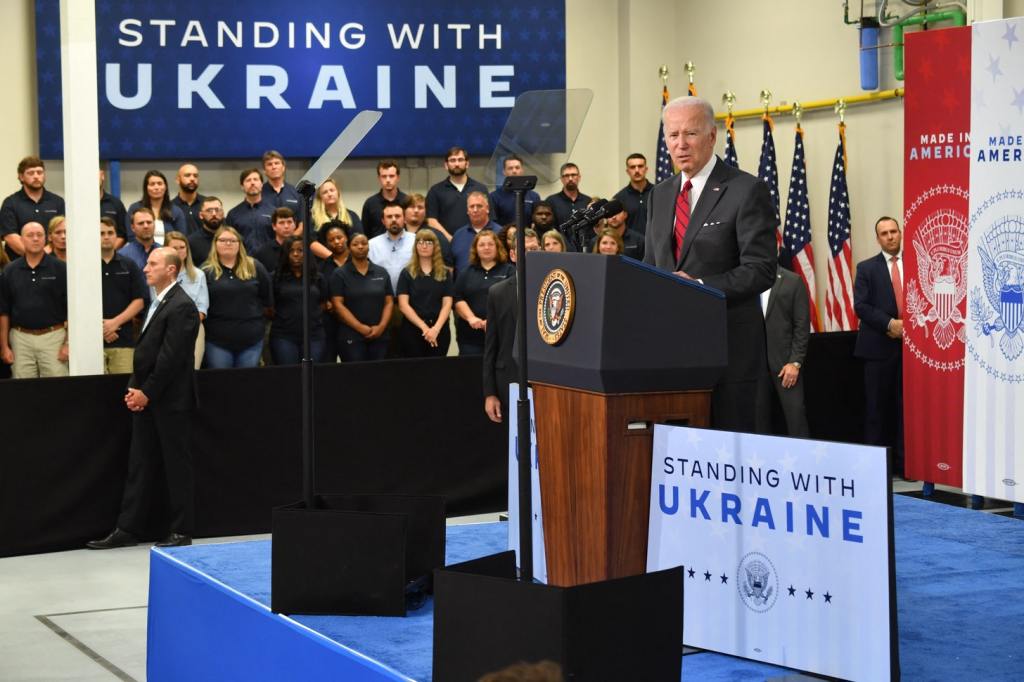
US President Joe Biden speaks about the conflict in Ukraine during a visit to the Lockheed Martins Pike County Operations facility on May 3, 2022 (Photo by Nicholas Kamm/AFP via Getty Images)

Tens of billions, soon to be much more, are flying out of U.S. coffers to Ukraine as Americans suffer, showing who runs the U.S. Government, and for whose benefit.

By Glenn Greenwald

Source: Substack

From the start of the Russian invasion of Ukraine on February 24, the Biden White House has repeatedly announced large and seemingly random amounts of money that it intends to send to fuel the war in Ukraine. The latest such dispatch, pursuant to an initial $3.5 billion fund authorized by Congress early on, was announced on Friday; “Biden says U.S. will send $1.3 billion in additional military and economic support to Ukraine,” read the CNBC headline. This was preceded by a series of new lavish spending packages for the war, unveiled every two to three weeks, starting on the third day of the war:

  • Feb. 26: “Biden approves $350 million in military aid for Ukraine”: Reuters;
  • Mar. 16: “Biden announces $800 million in military aid for Ukraine”: The New York Times;
  • Mar. 30: “Ukraine to receive additional $500 million in aid from U.S., Biden announces”: NBC News;
  • Apr. 12: “U.S. to announce $750 million more in weapons for Ukraine, officials say”: Reuters;
  • May 6: “Biden announces new $150 million weapons package for Ukraine”: Reuters.

Those amounts by themselves are in excess of $3 billion; by the end of April, the total U.S. expenditure on the war in Ukraine was close to $14 billion, drawn from the additional $13.5 billion Congress authorized in mid-March. While some of that is earmarked for economic and humanitarian assistance for Ukraine, most of it will go into the coffers of the weapons industry — including Raytheon, on whose Board of Directors the current Secretary of Defense, Lloyd Austin, sat immediately before being chosen by Biden to run the Pentagon. As CNN put it: “about $6.5 billion, roughly half of the aid package, will go to the US Department of Defense so it can deploy troops to the region and send defense equipment to Ukraine.”

As enormous as those sums already are, they were dwarfed by the Biden administration’s announcement on April 28 that it “is asking Congress for $33 billion in funding to respond to the Russian invasion of Ukraine, more than double the $14 billion in support authorized so far.” The White House itself acknowledges that the vast majority of that new spending package will go to the purchase of weaponry and other military assets: “$20.4 billion in additional security and military assistance for Ukraine and for U.S. efforts to strengthen European security in cooperation with our NATO allies and other partners in the region.”

It is difficult to put into context how enormous these expenditures are — particularly since the war is only ten weeks old, and U.S. officials predict/hope that this war will last not months but years. That ensures that the ultimate amounts will be significantly higher still.

The amounts allocated thus far — the new Biden request of $33 billion combined with the $14 billion already spent — already exceed the average annual amount the U.S. spent for its own war in Afghanistan ($46 billion). In the twenty-year U.S. war in Afghanistan which ended just eight months ago, there was at least some pretense of a self-defense rationale given the claim that the Taliban had harbored Osama bin Laden and Al Qaeda at the time of the 9/11 attack. Now the U.S. will spend more than that annual average after just ten weeks of a war in Ukraine that nobody claims has any remote connection to American self-defense.

Even more amazingly, the total amount spent by the U.S. on the Russia/Ukraine war in less than three months is close to Russia’s total military budget for the entire year ($65.9 billion). While Washington depicts Russia as some sort of grave and existential menace to the U.S., the reality is that the U.S. spends more than ten times on its military what Russia spends on its military each year; indeed, the U.S. spends three times more than the second-highest military spender, China, and more than the next twelve countries combined.

But as gargantuan as Biden’s already-spent and newly requested sums are — for a ten-week war in which the U.S. claims not to be a belligerent — it was apparently woefully inadequate in the eyes of the bipartisan establishment in Congress, who is ostensibly elected to serve the needs and interests of American citizens, not Ukrainians. Leaders of both parties instantly decreed that Biden’s $33 billion request was not enough. They thus raised it to $40 billion — a more than 20% increase over the White House’s request — and are now working together to create an accelerated procedure to ensure immediate passage and disbursement of these weapons and funds to the war zone in Ukraine. “Time is of the essence – and we cannot afford to wait,” House Speaker Nancy Pelosi said in a letter to House members, adding: “This package, which builds on the robust support already secured by Congress, will be pivotal in helping Ukraine defend not only its nation but democracy for the world.” (See update below).

We have long ago left the realm of debating why it is in the interest of American citizens to pour our country’s resources into this war, to say nothing of risking a direct war and possibly catastrophic nuclear escalation with Russia, the country with the largest nuclear stockpile, with the US close behind. Indeed, one could argue that the U.S. government entered this war and rapidly escalated its involvement without this critical question — which should be fundamental to any policy decision of the U.S. government — being asked at all.

This omission — a failure to address how the interests of ordinary Americans are served by the U.S. government’s escalating role in this conflict — is particularly glaring given the steadfast and oft-stated view of former President Barack Obama that Ukraine is and always will be of vital interest to Russia, but is not of vital interest to the U.S. For that reason, Obama repeatedly resisted bipartisan demands that he send lethal arms to Ukraine, a step he was deeply reluctant to take due to his belief that the U.S. should not provoke Moscow over an interest as remote as Ukraine (ironically, Trump — who was accused by the U.S. media for years of being a Kremlin asset, controlled by Putin through blackmail — did send lethal arms to Ukraine despite how provocative doing so was to Russia).

While it is extremely difficult to isolate any benefit to ordinary American citizens from all of this, it requires no effort to see that there is a tiny group of Americans who do benefit greatly from this massive expenditure of funds. That is the industry of weapons manufacturers. So fortunate are they that the White House has met with them on several occasions to urge them to expand their capacity to produce sophisticated weapons so that the U.S. government can buy them in massive quantities:

Top U.S. defense officials will meet with the chief executives of the eight largest U.S. defense contractors to discuss industry’s capacity to meet Ukraine’s weapons needs if the war with Russia continues for years.

Deputy Defense Secretary Kathleen Hicks told reporters Tuesday she plans to participate in a classified roundtable with defense CEOs on Wednesday to discuss “what can we do to help them, what do they need to generate supply”….

“We will discuss industry proposals to accelerate production of existing systems and develop new, modernized capabilities critical to the Department’s ongoing security assistance to Ukraine and long-term readiness of U.S. and ally/partner forces,” the official added.

On May 3, Biden visited a Lockheed Martin facility (see lead photo) and “praised the… plant that manufactures Javelin anti-tank missiles, saying their work was critical to the Ukrainian war effort and to the defense of democracy itself.”

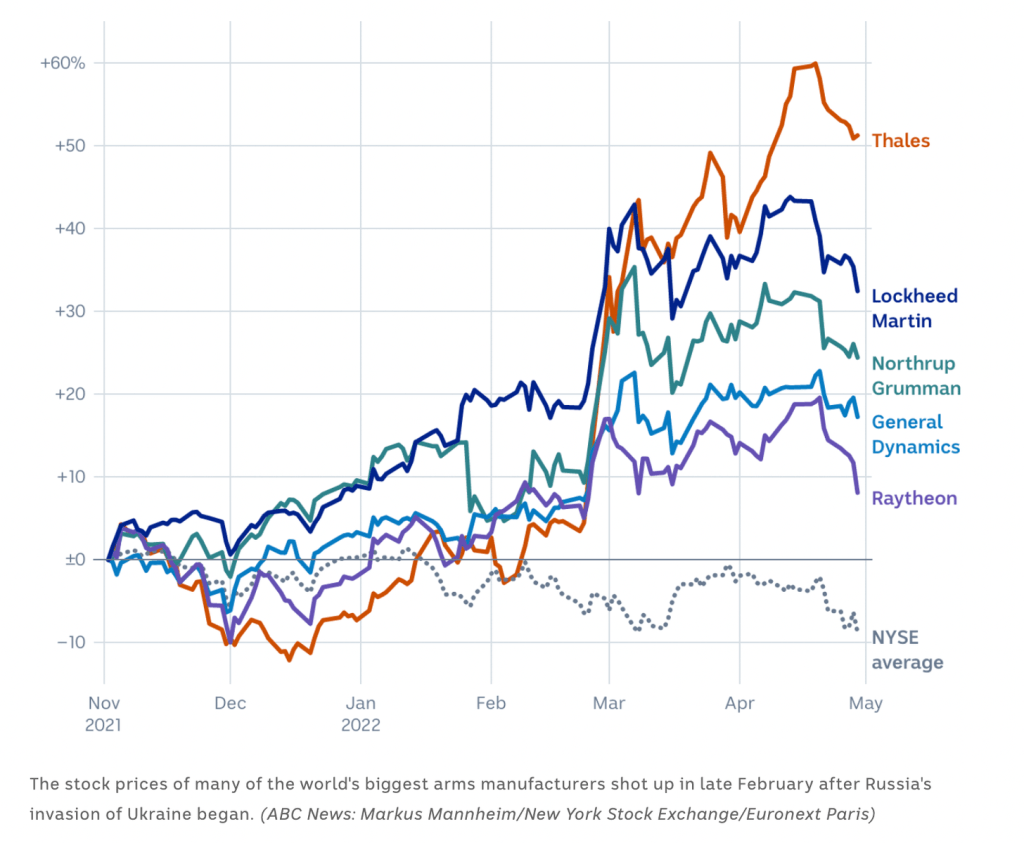
Indeed, by transferring so much military equipment to Ukraine, the U.S. has depleted its own stockpiles, necessitating their replenishment with mass government purchases. One need not be a conspiracy theorist to marvel at the great fortune of this industry, having lost their primary weapons market just eight months ago when the U.S. war in Afghanistan finally ended, only to now be gifted with an even greater and more lucrative opportunity to sell their weapons by virtue of the protracted and always-escalating U.S. role in Ukraine. Raytheon, the primary manufacturer of Javelins along with Lockheed, has been particularly fortunate that its large stockpile, no longer needed for Afghanistan, is now being ordered in larger-than-ever quantities by its former Board member, now running the Pentagon, for shipment to Ukraine. Their stock prices have bulged nicely since the start of the war:

But how does any of this benefit the vast majority of Americans? Does that even matter? As of 2020, almost 30 million Americans are without any health insurance. Over the weekend, USA Today warned of “the ongoing infant formula shortage,” in which “nearly 40% of popular baby formula brands were sold out at retailers across the U.S. during the week starting April 24.” So many Americans are unable to afford college for their children that close to a majority are delaying plans or eliminating them all together. Meanwhile, “monthly poverty remained elevated in February 2022, with a 14.4 percent poverty rate for the total US population….Overall, 6 million more individuals were in poverty in February relative to December.” The latest data from the U.S. Census Bureau found that “approximately 42.5 million Americans [are] living below the poverty line.” Americans with diabetes often struggle to buy life-saving insulin. And on and on and on.

Now, if the U.S. were invaded or otherwise attacked by another country, or its vital interests were directly threatened, one would of course expect the U.S. government to expend large sums in order to protect and defend the national security of the country and its citizens. But can anyone advance a cogent argument, let alone a persuasive one, that Americans are somehow endangered by the war in Ukraine? Clearly, they are far more endangered by the U.S. response to the war in Ukraine than the war itself; after all, a nuclear confrontation between the U.S. and Russia has long been ranked by the Bulletin of Atomic Scientists as one of the two greatest threats facing humanity.


One would usually expect the American left, or whatever passes it for these days, to be indignant about the expenditure of tens of billions of dollars for weapons while ordinary Americans suffer. But the American left, such that it exists, is barely visible when it comes to debates over the war in Ukraine, while American liberals stand in virtual unity with the establishment wing of the Republican Party behind the Biden administration in support for the escalating U.S. role in the war in Ukraine. A few stray voices (such as Noam Chomsky) have joined large parts of the international left in urging a diplomatic solution in lieu of war and criticizing Biden for insufficient efforts to forge one, but the U.S. left and American liberals are almost entirely silent if not supportive.

That has left the traditionally left-wing argument about war opposition to the populist right. “You can’t find baby formula in the United States right now but Congress is voting today to send $40 billion to Ukraine,” said Donald Trump, Jr. on Tuesday, echoing what one would expect to hear from the 2016 version of Bernie Sanders or the pre-victory AOC. “In the America LAST $40 BILLION Ukraine FIRST bill that we are voting on tonight, there is authorization for funds to be given to the CIA for who knows what and who knows how much? But NO BABY FORMULA for American mothers!” explained Rep. Marjorie Taylor Greene (R-GA). Christian Walker, the conservative influencer and son of GOP Senate candidate Herschel Walker in Georgia, today observed: “Biden should go apply to be the President of Ukraine since he clearly cares more about them than the U.S.” Chomsky himself caused controversy last week when he said that there is only one statesman of any stature in the West urging a diplomatic solution “and his name is Donald J. Trump.”

Meanwhile, the only place where dissent is heard over the Biden administration’s war policy is on the 8:00 p.m. and 10:00 p.m. programs on Fox News, hosted, respectively, by Tucker Carlson and Laura Ingraham, who routinely demand to know how ordinary Americans are benefiting from this increasing U.S. involvement. On CNN, NBC, and in the op-ed pages of The New York Times and The Washington Post, there is virtually lockstep unity in favor of the U.S. role in this war; the only question that is permitted, as usual, is whether the U.S. is doing enough or whether it should do more.

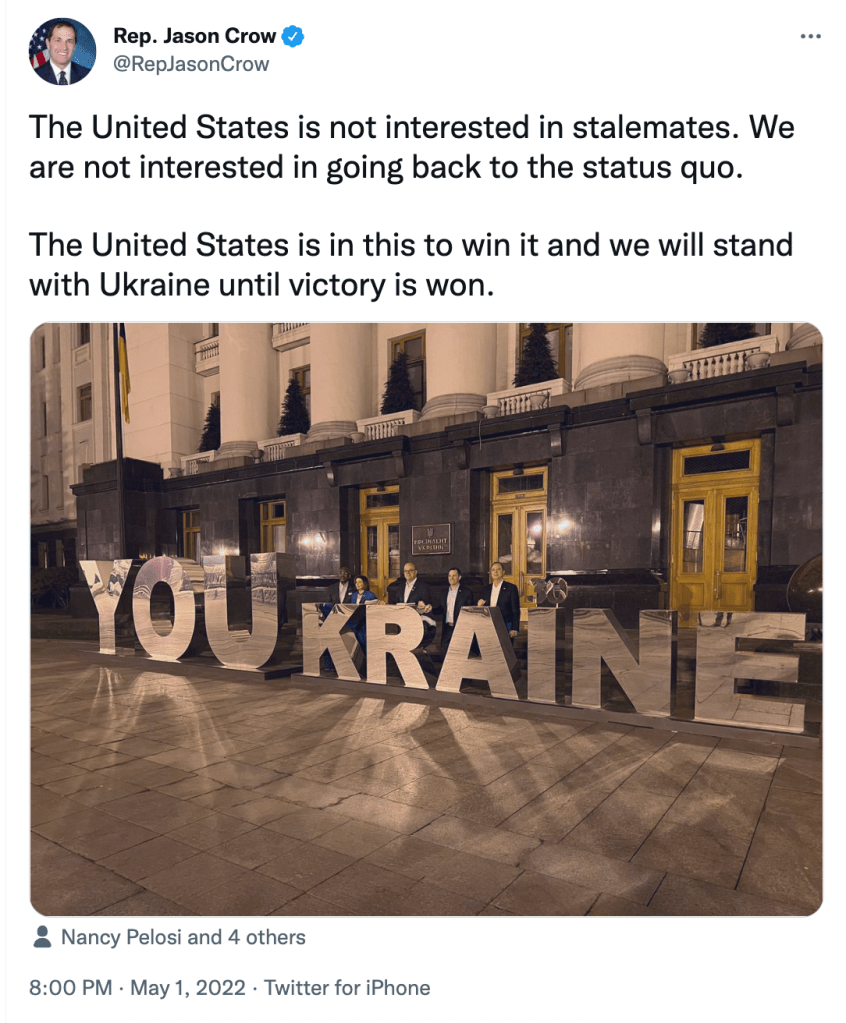
That the U.S. has no legitimate role to play in this war, or that its escalating involvement comes at the expense of American citizens, the people they are supposed to be serving, provokes immediate accusations that one is spreading Russian propaganda and is a Kremlin agent. That is therefore an anti-war view that is all but prohibited in those corporate liberal media venues. Meanwhile, mainstream Democratic House members, such as Rep. Jason Crow (D-CO), are now openly talking about the war in Ukraine as if it is the U.S.’s own:

Whatever else is true, the claim with which we are bombarded by the corporate press — the two parties agree on nothing; they are constantly at each other’s throats; they have radically different views of the world — is patently untrue, at least when it comes time for the U.S. to join in new wars. Typically, what we see in such situations is what we are seeing now: the establishment wings of both parties are in complete lockstep unity, always breathlessly supporting the new proposed U.S. role in any new war, eager to empty the coffers of the U.S. Treasury and transfer it to the weapons industry while their constituents suffer.

One can believe that Russia’s invasion of Ukraine is profoundly unjust and has produced horrific outcomes while still questioning what legitimate interests the U.S. has in participating in this war to this extent. Even if one fervently believes that helping Ukrainians fight Russia is a moral good, surely the U.S. government should be prioritizing the ability of its own citizens to live above the poverty line, have health insurance, send their kids to college, and buy insulin and baby formula.

There are always horrific wars raging, typically with a clear aggressor, but that does not mean that the U.S. can or should assume responsibility for the war absent its own vital interests and the interests of its citizens being directly at stake. In what conceivable sense are American citizens benefiting from this enormous expenditure of their resources and the increasing energy and attention being devoted by their leaders to Ukraine rather than to their lives and the multi-pronged deprivations that define them?

CORRECTION (May 10, 2022, 20:47 pm ET): This article was edited shortly after publication to reflect that Russia’s total annual military budget is $65.9 billion, not $65.9 million.

UPDATE (May 10, 2022, 22:39 pm ET)Shortly after publication of this article, the $40 billion package for the war in Ukraine passed in the House of Representatives by a vote of 368-57. According to CNN: “All 57 votes in opposition were from Republicans.”

What the Media Still Isn’t Telling You About Russiagate

By Ray McGovern

Source: AntiWar.com

Two years ago last Saturday (May 7, 2020) Adam Schiff (D, California), Chair of the House Intelligence Committee, was forced to perform what Nixon co-conspirator John Ehrlichman famously called a “modified limited hangout.”

On that day, Schiff released sworn testimony that there was zero technical evidence that Russia – or anyone else – hacked those DNC emails so prejudicial to Hillary Clinton (later published by WikiLeaks).

Now, please, before you put me in Putin’s or Trump’s pocket, read on: The testifier was Shawn Henry, the head of the cybersecurity firm CrowdStrike. For reasons former FBI Director James Comey would never really explain, he deferred to CrowdStrike to do the forensic work on the DNC computers that were supposedly “hacked.” Comey told Congress that CrowdStrike “would share with us what they saw.”

In June 2019, it was revealed that CrowdStrike never produced an un-redacted or final forensic report for the government because the FBI never required it to, according to the Justice Department.

Are you starting to smell a rat? What about the “modified limited hangout”?

Well, if some or all of this is news to you, it is because the NY Times and other major media have deep-sixed it for exactly two years now, and counting. It gets worse – much worse.

What Did Schiff Know and When Did He Know It?

Fasten your seatbelts: It was on December 5, 2017 that Shawn Henry gave sworn testimony to the House Intelligence Committee – see the official transcript. Henry testified that there was no technical evidence that Russia, or any other entity, hacked the DNC emails that were published by WikiLeaks just before the Democratic Convention in July 2016. (The emails showed how the deck had been stacked against Bernie Sanders – in the primaries, for example.)

Shawn Henry is a longtime protégé of former FBI Director Robert Mueller and headed Mueller’s FBI cyber investigation unit. After retiring from the FBI in 2012, he took a senior position at CrowdStrike. At his testimony on Dec. 5, 2017, he had Graham M. Wilson, a partner at Perkins Coie, as well as David C. Lashway of Baker & McKenzie in support.

Falling Silently in the Forest

Veteran Intelligence Professionals for Sanity, relying on (1) the extensive expertise and professional experience of two members who happened to have been Technical Directors at NSA, (2) the revelations of Edward Snowden, and (3) the immutable principles of physics, had already concluded that the accusation of that Russian hack on the DNC was phony. (That Brennan’s CIA “believed” it to be credible helped not a whit.)

Below is how we began “Allegations of Hacking are Baseless,” our Memorandum of December 12, 2016 (a year before Shawn Henry was forced to choose between telling the truth or perjuring himself). We wrote:

New York Times report on Monday alluding to “overwhelming circumstantial evidence” leading the CIA to believe that Russian President Vladimir Putin “deployed computer hackers with the goal of tipping the election to Donald J. Trump” is, sadly, evidence-free. This is no surprise, because harder evidence of a technical nature points to an inside leak, not hacking – by Russians or anyone else. (See: “US Intel Vets Dispute Russia Hacking Claims.”)

We even included a brief tutorial on the difference between a “hack” and a leak, but we were already, in Dec. 2016 going up against deeply encrusted popular “belief” based on intelligence-corporate media connivance.

‘Modified Limited Hangout’

Schiff was able to hide Shawn Henry’s testimony for two and a half years. Under considerable pressure from a new Director of National Intelligence, who threatened to release the testimony himself, Schiff finally relented and released it (as mentioned above) on May 7, 2020. As for Establishment media, the transcript of Henry’s testimony fell like the proverbial tree in the forest with no one around to hear it.

Did the NY Times, et al. get “The Memo” ordering all to avoid Henry’s testimony like the plague? Actually, in this particular case, corporate media had quite enough incentive of their own to hide from media consumers the fact that “Russian hacking,” the cornerstone of Russia-gate, was a crock, and that viewers and listeners had been had.

When I wrote about the released – well, sort of released – Shawn Henry transcript the following day, there was a wealth of background information to provide context to this sordid affair. I included a four-minute discussion I had had with Schiff just five days after Trump took office, a reminder that the Dems were well into “Russian hacking” as the centerpiece of Russia-gate from the very start. (That clip, and lots else, is embedded here)

So Schiff knew on Dec. 5, 2017 that “Russian hacking” of those DNC emails was bogus. I was recently asked, why do you suppose he did not tell Robert Mueller, the “Inspector Javert” in hot pursuit of “Russian election interference,” whose $32-million investigation of Russia-gate lasted from May 2017 till March 2019? Good question. Did Shawn Henry misplace the telephone number of Mueller, his old boss and mentor? Or did Mueller know, and despite knowing, continued his Javert-like chase until after the mid-terms in November 2018. (That worked for the Democrats; and, not incidentally, Schiff took back the reins of the Intelligence Committee.)

Most of Americans have no idea how they’ve been had on Russia-gate. And the NYTimes, et al. have every reason to keep them in the dark about “Russian hacking.” Most people have little idea as to how the steady drumming on Russian perfidy has conditioned them not only to distrust “the Russians,” but to hate them. (What, after all, could be more hateful than for being responsible for giving us four years of Trump?) Sadly – and admittedly – it cannot be considered unreasonable to be convinced that everything out of Trump’s mouth is a lie and that he would never ever tell the truth about Russia – given what Obama and others call his “bromance” with Putin.

There are, of course, dangerous implications in all this for what Americans may be asked in terms of confronting Russia on Ukraine.

On wider Russia-gate issues over the past five years and my tree-falling-in-forest attempts to expose the malfeasance of our corporate-captive media, readers may wish to review this.

A Weird, Stupid Dystopia

By Caitlin Johnstone

Source: CaitlinJohnstone.com

The last few days in the United States have seen a parade of wealthy freaks fellating each other’s egos and preening for the cameras in outlandish garb while ordinary Americans suffer more and more.

The weekend’s White House Correspondents’ Dinner saw a gaggle of media celebrities congregate to congratulate one another on what a great job they’ve been doing bravely telling the truth and holding the most powerful government on earth to account. The host, Trevor Noah of The Daily Show, gushed with enthusiasm about how much freedom the press have in America to say things the powerful don’t like.

“As we sit in this room tonight, people, I really hope you all remember what the real purpose of this evening is,” Noah said. “Yes, it’s fun. Yes, we dress nice. Yes, the people eat, they drink, we have fun. But the reason we’re here is to honor and celebrate the fourth estates and what you stand for — what you stand for — an additional check and balance that holds power to account and gives voice to those who otherwise wouldn’t have one.”

“And if you ever begin to doubt your responsibilities, if you ever begin to doubt how meaningful it is, look no further than what’s happening in Ukraine,” said Noah. “Look at what’s happening there. Journalists are risking and even losing their lives to show the world what’s really happening. You realize how amazing it is. In America, you have the right to seek the truth and speak the truth even if it makes people in power uncomfortable, even if it makes your viewers or your readers uncomfortable. You understand how amazing that is? I stood here tonight and I made fun of the president of the United States, and I’m going to be fine. I am going to be fine, right? Do you really understand what a blessing it is?”

Of course there are people who’ve said things that US presidents don’t like who are not in fact fine. Julian Assange continues to waste away in Belmarsh Prison as the US government continues its efforts to extradite him to he can become the first publisher ever tried under the Espionage Act. Edward Snowden, an American, remains in exile because one US president after another continues to refuse to pardon his heroic whistleblowing about the sinister surveillance practices of the US intelligence cartel. Daniel Hale, also an American, sits in prison for exposing the depravity of America’s monstrous drone program.

Trevor Noah did not mention these people, or the many others who’ve been persecuted, silenced, imprisoned and killed for saying things the powerful individuals who govern the US don’t approve of, because as a member of the mainstream media his job is not to inform but to propagandize.

Far from providing “an additional check and balance that holds power to account and gives voice to those who otherwise wouldn’t have one” as Noah claims, the people in his audience on Saturday night are tasked with manipulating public thought in facilitation of the interests of the powerful. The mainstream news media in America, and throughout all the so-called free democracies of the western world, are propaganda institutions whose first and foremost job is to manufacture consent for oligarchy and empire.

Which is why the President of the United States, when he took the podium that night, had nothing but friendly words for the mainstream press.

“What’s clear, and I mean this from the bottom of my heart, is that you, the free press, matter more than you ever did in the last century,” Biden said. “We’ve all seen the courage of Ukrainian people because of the courage of American reporters in this room, and your colleagues across the world who are on the ground taking their lives in their own hands.”

This past weekend also saw a friendly gathering of brave fourth estate truth warriors and political and government operatives of the US empire at a party hosted by the billionaire owner of the neocon war propaganda rag The Atlantic.

Politico reports:

David and Katherine Bradley and Laurene Powell Jobs hosted a dinner at the Bradleys’ home. SPOTTED: Secretary of State Antony Blinken and Cabinet Secretary Evan Ryan, Commerce Secretary Gina Raimondo, CIA Director Bill Burns, press secretary Jen Psaki, Deputy A.G. Lisa Monaco, Sen. Tina Smith (D-Minn.), FCC Chair Jessica Rosenworcel, Del. Stacey Plaskett (D-U.S. Virgin Islands), homeland security adviser Elizabeth Sherwood-Randall, Jeffrey Goldberg, Nick Thompson, Peter Lattman, Anne Applebaum, Russell Berman, Franklin Foer, David Frum, Elaine Godfrey, Adam Harris, Mark Leibovich, Jeff Dufour, Heather Kuldell, Kevin Baron, José Andrés, Enes Kanter, Mitch Landrieu, Dafna Linzer, Rachel Martin, Judy Woodruff, Jake Tapper, Wolf Blitzer, Jonathan Capehart, Katty Kay, Steve and Jean Case, John Dickerson and Jen Palmieri.

Yep, when you see a shady basketball player/empire propagandist fraternizing with the CIA Director while surrounded by media celebrities and government insiders at a party hosted by a media-owning plutocrat, you know you’re in a country where power is held to account. Right, Trevor?

The orgy of embarrassment was capped off by the 2022 Met Gala, a big weird dystopian parade of rich freaks dressed like Hunger Games aristocracy and laughing in the face of everyone who can’t afford to live.

An honest Met Gala dress would have a corset made from the bones of Yemeni children, draped with a cloth of stolen gold and lithium spun by the tiny hands of child slaves, with a full-length train that leached oil and blood wherever it went.

This while ordinary Americans struggle just to survive. While American women appear to be on the precipice of losing their reproductive sovereignty. While money is poured into a proxy war which threatens to escalate into a conflict that could easily end all life on earth.

This is your dying empire, America. This is your end-stage capitalism. This is your dystopia, in all its weird, phony, stupid glory.

It is horrifying. The longer you look at it, the creepier it gets.

Breathe it all in, folks.

We’re in for a hell of a ride.

Hedges: The Pimps of War

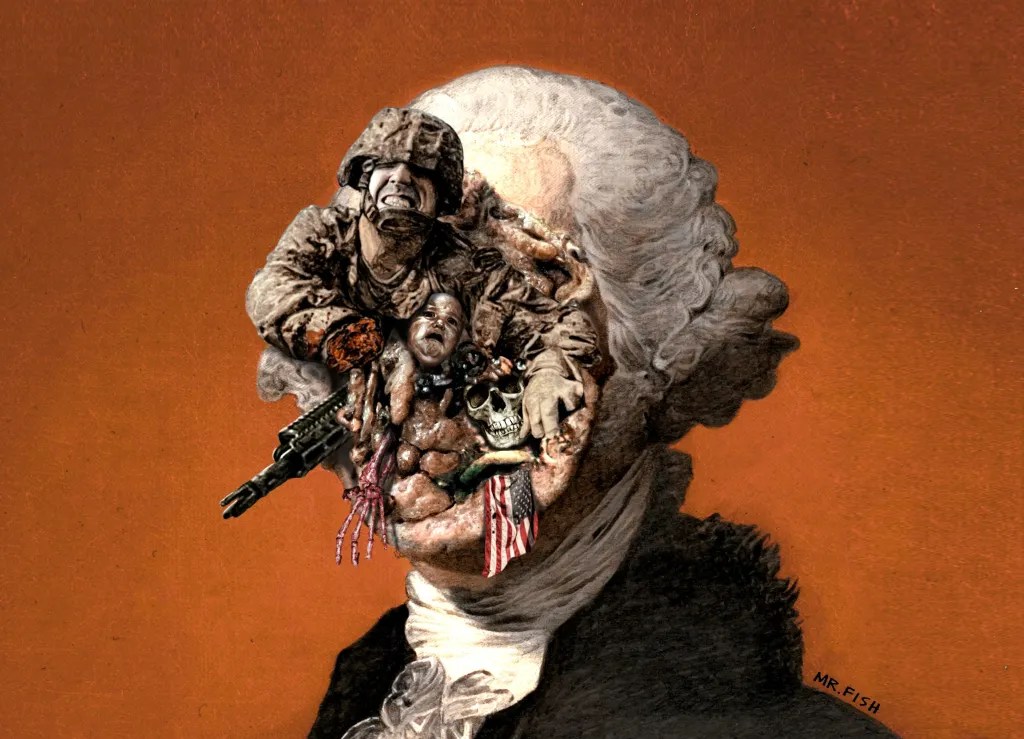
Whores of War, original illustration by Mr. Fish.

The coterie of neocons and liberal interventionists who orchestrated two decades of military fiascos in the Middle East and who have never been held to account are now stoking a suicidal war with Russia.

By Chris Hedges

Source: ScheerPost.com

The same cabal of warmongering pundits, foreign policy specialists and government officials, year after year, debacle after debacle, smugly dodge responsibility for the military fiascos they orchestrate. They are protean, shifting adroitly with the political winds, moving from the Republican Party to the Democratic Party and then back again, mutating from cold warriors to neocons to liberal interventionists. Pseudo intellectuals, they exude a cloying Ivy League snobbery as they sell perpetual fear, perpetual war, and a racist worldview, where the lesser breeds of the earth only understand violence. 

They are pimps of war, puppets of the Pentagon, a state within a state, and the defense contractors who lavishly fund their think tanks — Project for the New American Century, American Enterprise Institute, Foreign Policy Initiative, Institute for the Study of War, Atlantic Council and Brookings Institution. Like some mutant strain of an antibiotic-resistant bacteria, they cannot be vanquished. It does not matter how wrong they are, how absurd their theories, how many times they lie or denigrate other cultures and societies as uncivilized or how many murderous military interventions go bad. They are immovable props, the parasitic mandarins of power that are vomited up in the dying days of any empire, including ours, leaping from one self-defeating catastrophe to the next.

I spent  20 years as a foreign correspondent reporting on the suffering, misery, and murderous rampages these shills for war engineered and funded. My first encounter with them was in Central America. Elliot Abrams — convicted of providing misleading testimony to Congress on the Iran-Contra Affair and later  pardoned by President George H.W. Bush so he could return to government to sell us the Iraq War — and Robert Kagan, director of the State Department’s public diplomacy office for Latin America — were propagandists for the brutal military regimes in El Salvador and Guatemala, as well as the rapists and homicidal thugs that made up the rogue Contra forces fighting the Sandinista government in Nicaragua, which they illegally funded. Their job was to discredit our reporting.

They, and their coterie of fellow war lovers, went on to push for the expansion of NATO in Central and Eastern Europe after the fall of the Berlin Wall, violating an agreement not to extend NATO beyond the borders of a unified Germany and recklessly antagonizing Russia. They were and are cheerleaders for the apartheid state of Israel, justifying its war crimes against Palestinians and myopically conflating Israel’s interests with our own. They advocated for air strikes in Serbia, calling for the US to “take out” Slobodan Milosevic. They were the authors of the policy to invade Afghanistan, Iraq, Syria and Libya. Robert Kagan and William Kristol, with their typical cluelessness, wrote in April 2002 that “the road that leads to real security and peace” is “the road that runs through Baghdad.”

We saw how that worked out. That road led to the dissolution of Iraq, the destruction of its civilian infrastructure, including the obliteration of 18 of 20 electricity-generating plants and nearly all the water-pumping and sanitation systems during a 43-day period when 90,000 tons of bombs were rained down on the country, the rise of radical jihadist groups throughout the region, and failed states. The war in Iraq, along with the humiliating defeat in Afghanistan, shredded the illusion of US military and global hegemony. It also inflicted on Iraqis, who had nothing to do with the attacks of 9/11, the widespread killing of civilians, the torture and sexual humiliation of Iraqi prisoners, and the ascendancy of Iran as the preeminent power in the region. They continue to call for a war with Iran, with Fred Kagan stating that “there is nothing we can do short of attacking to force Iran to give up its nuclear weapons.” They pushed for the overthrow of President Nicholas Maduro, after trying to do the same to Hugo Chavez, in Venezuela. They have targeted Daniel Ortega, their old nemesis in Nicaragua.

They embrace a purblind nationalism that prohibits them from seeing the world from any perspective other than their own. They know nothing about the machinery of war, its consequences, or its inevitable blowback. They know nothing about the peoples and cultures they target for violent regeneration. They believe in their divine right to impose their “values” on others by force. Fiasco after fiasco. Now they are stoking a war with Russia.

“The nationalist is by definition an ignoramus,” Yugoslav writer Danilo Kiš observed. “Nationalism is the line of least resistance, the easy way. The nationalist is untroubled, he knows or thinks he knows what his values are, his, that’s to say national, that’s to say the values of the nation he belongs to, ethical and political; he is not interested in others, they are no concern of his, hell — it’s other people (other nations, another tribe). They don’t even need investigating. The nationalist sees other people in his own images — as nationalists.”

The Biden administration is filled with these ignoramuses, including Joe Biden. Victoria Nuland, the wife of Robert Kagan, serves as Biden’s undersecretary of state for political affairs. Antony Blinken is secretary of state. Jake Sullivan is national security advisor. They come from this cabal of moral and intellectual trolls that includes Kimberly Kagan, the wife of Fred Kagan, who founded The Institute for the Study of War, William Kristol, Max Boot, John Podhoretz, Gary Schmitt, Richard Perle, Douglas Feith, David Frum, and others. Many were once staunch Republicans or, like Nuland, served in Republican and Democratic administrations. Nuland was the principal deputy foreign policy adviser to Vice President Dick Cheney. 

They are united by the demand for larger and larger defense budgets and an ever expanding military. Julian Benda called these courtiers to power “the self-made barbarians of the intelligentsia.”

They once railed against liberal weakness and appeasement. But they swiftly migrated to the Democratic Party rather than support Donald Trump, who showed no desire to start a conflict with Russia and who called the invasion of Iraq a “big, fat mistake.” Besides, as they correctly pointed out, Hillary Clinton was a fellow neocon. And liberals wonder why nearly half the electorate, who revile these arrogant unelected power brokers, as they should, voted for Trump.

These ideologues did not see the corpses of their victims. I did. Including children. Every dead body I stood over in Guatemala, El Salvador, Nicaragua, Gaza, Iraq, Sudan, Yemen or Kosovo, month after month, year after year, exposed their moral bankruptcy, their intellectual dishonesty, and their sick bloodlust.  They did not serve in the military. Their children do not serve in the military. But they eagerly ship young American men and women off to fight and die for their self-delusional dreams of empire and American hegemony. Or, as in Ukraine, they provide hundreds of millions of dollars in weaponry and logistical support to sustain long and bloody proxy wars.

Historical time stopped for them with the end of World War II. The overthrow of democratically elected governments by the US during the Cold War in Indonesia, Guatemala, the Congo, Iran and Chile (where the CIA oversaw the assassination of the commander-in-chief of the army, General René Schneider, and President Salvador Allende), the Bay of Pigs, the atrocities and war crimes that defined the wars in Vietnam, Cambodia, and Laos, even the disasters they manufactured in the Middle East, have disappeared into the black hole of their collective historical amnesia. American global domination, they claim, is benign, a force for good, “benevolent hegemony.” The world, Charles Krauthammer insisted, welcomes “our power.” All enemies, from Saddam Hussein to Vladimir Putin, are the new Hitler. All US interventions are a fight for freedom that make the world a safer place. All refusals to bomb and occupy another country are a 1938 Munich moment, a pathetic retreat from confronting evil by the new Neville Chamberlain. We do have enemies abroad. But our most dangerous enemy is within.

The warmongers build a campaign against a country such as Iraq or Russia and then wait for a crisis — they call it the next Pearl Harbor — to justify the unjustifiable. In 1998, William Kristol and Robert Kagan, along with a dozen other prominent neoconservatives, wrote an open letter to President Bill Clinton denouncing his policy of containment of Iraq as a failure and demanding that he go to war to overthrow Saddam Hussein. To continue the “course of weakness and drift,” they warned, was to “put our interests and our future at risk.” Huge majorities in Congress, Republican and Democrat, rushed to pass the Iraq Liberation Act. Few Democrats or Republicans dared be seen as soft on national security. The act stated that the United States government would work to “remove the regime headed by Saddam Hussein” and authorized $99 million towards that goal, some of it being used to fund Ahmed Chalabi’s Iraqi National Congress that would become instrumental in disseminating the fabrications and lies used to justify the Iraq war during the administration of George W. Bush.

The attacks of 9/11 gave the war party its opening, first with Afghanistan, then Iraq. Krauthammer, who knows nothing about the Muslim world, wrote that “the way to tame the Arab street is not with appeasement and sweet sensitivity but with raw power and victory…The elementary truth that seems to elude the experts again and again…is that power is its own reward. Victory changes everything, psychologically above all. The psychology in the [Middle East] is now one of fear and deep respect for American power. Now is the time to use it.” Removing Saddam Hussein from power, Kristol crowed, would “transform the political landscape of the Middle East.”  

It did, of course, but not in ways that benefited the US.

They lust for apocalyptic global war. Fred Kagan, the brother of Robert, a military historian, wrote in 1999 that “America must be able to fight Iraq and North Korea, and also be able to fight genocide in the Balkans and elsewhere without compromising its ability to fight two major regional conflicts. And it must be able to contemplate war with China or Russia some considerable (but not infinite) time from now [author’s emphasis].”

They believe violence magically solves all disputes, even the Israeli-Palestinian morass. In a bizarre interview immediately after 9/11, Donald Kagan, the Yale classicist and rightwing ideologue who was the father of Robert and Fred, called, along with his son Fred, for the deployment of US troops in Gaza so we could “take the war to these people.” They have long demanded the stationing of NATO troops in Ukraine, with Robert Kagan saying that “we need to not worry that the problem is our encirclement rather than Russian ambitions.”  His wife, Victoria Nuland, was outed in a leaked phone conversation in 2014 with the US Ambassador to Ukraine, Geoffrey Pyatt, disparaging the EU and plotting to remove the lawfully elected President Viktor Yanukovych and install compliant Ukrainian politicians in power, most of whom did eventually take power. They lobbied for US troops to be sent to Syria to assist “moderate” rebels seeking to overthrow Basha al-Assad. Instead, the intervention spawned the Caliphate. The US ended up bombing the very forces they had armed, becoming Assad’s de facto air force.

The Russian invasion of Ukraine, like the attacks of 9/11, is a self-fulfilling prophecy. Putin, like everyone else they target, only understands force. We can, they assure us, militarily bend Russia to our will.

“It is true that acting firmly in 2008 or 2014 would have meant risking conflict,” Robert Kagan wrote in the latest issue of Foreign Affairs of Ukraine, lamenting our refusal to militarily confront Russia earlier. “But Washington is risking conflict now; Russia’s ambitions have created an inherently dangerous situation. It is better for the United States to risk confrontation with belligerent powers when they are in the early stages of ambition and expansion, not after they have already consolidated substantial gains. Russia may possess a fearful nuclear arsenal, but the risk of Moscow using it is not higher now than it would have been in 2008 or 2014, if the West had intervened then. And it has always been extraordinarily small: Putin was never going to obtain his objectives by destroying himself and his country, along with much of the rest of the world.”

In short, don’t worry about going to war with Russia, Putin won’t use the bomb.

I do not know if these people are stupid or cynical or both. They are lavishly funded by the war industry. They are never dropped from the networks for their repeated idiocy. They rotate in and out of power, parked in places like The Council on Foreign Relations or The Brookings Institution, before being called back into government. They are as welcome in the Obama or Biden White House as the Bush White House. The Cold War, for them, never ended. The world remains binary, us and them, good and evil. They are never held accountable. When one military intervention goes up in flames, they are ready to promote the next. These Dr. Strangeloves, if we don’t stop them, will terminate life as we know it on the planet.

The Inflation Crisis Of 2022 Is Now Worse Than Anything That We Experienced During The 1970s

By Michael Snyder

Source: Activist Post

Most Americans don’t realize this, but we truly have entered historic territory.  As you will see below, the inflation crisis of 2022 has now escalated to a level that is beyond anything that we experienced during the horrible Jimmy Carter era of the 1970s.  If you are old enough to have been alive back then, you probably remember the constant headlines about inflation.  And you also probably remember that it seemed like the impotent administration in power in Washington was powerless to do anything about it.  In other words, it was a lot like what we are going through today.  Unfortunately for us, this new economic crisis is still only in the very early chapters.

Of course the mainstream media would like us to believe that what we are experiencing today is not even close to what Americans went through in the late 1970s and early 1980s.  According to CNN, the U.S. inflation rate hit a peak of 14.6 percent in the first half of 1980…

The inflation rate hit a record high of 14.6% in March and April of 1980. It helped to lead to Carter’s defeat in that fall’s election. It also led to some significant changes in the US economy.

Compared to that, the numbers we have been given in early 2022 seem rather tame.  On Tuesday, we learned that the official rate of inflation in the U.S. hit 8.5 percent in the month of March…

Prices that consumers pay for everyday items surged in March to their highest levels since the early days of the Reagan administration, according to Labor Department data released Tuesday.

The consumer price index, which measures a wide-ranging basket of goods and services, jumped 8.5% from a year ago on an unadjusted basis, above even the already elevated Dow Jones estimate for 8.4%.

8.5 percent is much lower than 14.6 percent, and so to most people it would seem logical to conclude that we are still a long way from the kind of nightmarish crisis that our nation endured during the waning days of the Carter administration.

But is that the truth?

In reality, we can’t make a straight comparison between the official rate of inflation in 2022 and the official rate of inflation in 1980.  The way that the inflation rate is calculated has been changed more than 20 times since 1980, and every time it was changed the goal was to make the official rate of inflation appear to be lower.

What we really need is an apples-to-apples comparison; fortunately, John Williams over at shadowstats.com has done the math for us.

According to Williams, if the inflation rate was still calculated the way that it was back in 1980, the official rate of inflation would be somewhere around 17 percent right now.

17 percent!

That means that the inflation that we are seeing now is even worse than anything that Americans went through during the Jimmy Carter era.

And government figures for individual categories seem to confirm that inflation is now wildly out of control.  For example, the price of gasoline has risen by 48 percent over the past year…

The price of gasoline rose by 48.0 percent from March 2021 to March 2022, according to numbers released today by the Bureau of Labor Statistics.

In just one month—from February to March—the seasonally adjusted price of gasoline went up 18.3 percent.

Vehicle prices have escalated to absurd levels as well.  If you can believe it, the average retail selling price of a used vehicle at CarMax has risen by 39.7 percent in just 12 months…

CarMax experienced a slowdown in fourth-quarter used car sales volume as its average retail selling price jumped 39.7% year-over-year to $29,312, an increase of approximately $8,300 per unit.

And I discussed yesterday, home prices in the United States have jumped 32.6 percent over the past two years.

We have entered a full-blown inflationary nightmare, and the Biden administration is trying to blame Vladimir Putin for it.

Needless to say, that is extremely disingenuous of Biden, because prices were already skyrocketing even before the war in Ukraine started.

But it is true that the war is making economic problems even worse all over the globe, and that isn’t going to end any time soon.

A couple of weeks ago there was a bit of optimism that some sort of a ceasefire agreement could be reached, but now there appears to be no hope that there will be one any time soon.

On Tuesday, Putin told the press that peace talks have reached “a dead end”

Talks with Ukraine have reached “a dead end,” Russian President Vladimir Putin said in fresh Tuesday remarks. “We will not stop military operations in Ukraine until they succeed.” He explained that Ukraine has “deviated” from agreements and any possible prior progress reached during the Istanbul meetings, according to state-run RIA.

The strong remarks aimed at both Kiev and the West were given during a joint presser with his Belarusian counterpart Alexander Lukashenko. He further hailed that the military operations is still going “according to plan,” Bloomberg reports, however while admitting to the domestic population that “Russian logistics and payment systems remain a weakness and the long-term impact of western measures could be more painful.” But he also said the county has withstood the economic “blitzkrieg” from the West.

And Volodymyr Zelenskyy is now saying that the return of Crimea is a “red line” for him

Ukrainian President Volodymyr Zelensky named recognition of the annexation of the Crimea region as one of his red lines for Moscow in any potential peace talks with Russian President Vladimir Putin to end war between the two countries.

Russia annexed the southern region of Crimea in 2014. Russian-backed separatists and forces, as well Ukrainian soldiers, have since been fighting in the eastern region of Ukraine.

Russia will never, ever willingly give Crimea back to Ukraine.

Anyone who thinks otherwise is simply being delusional.

So unless someone changes their tune, this war between Russia and Ukraine is going to keep going until someone achieves total victory.

And that could take a really long time.

Meanwhile, global food supplies will get tighter and tighter, and global economic conditions will continue to rapidly deteriorate.

In other words, the kind of nightmare scenario that I have been warning about for years is now upon us.

And so what happens if another “black swan event” or two hits us later in 2022?

We are so vulnerable right now, and it wouldn’t take much at all to push us over the edge and into an unprecedented worldwide crisis of epic proportions.