Why Kim Dotcom Connects The DNC Email Leak To The Murder Of Seth Rich

By: b

Source: Moon of Alabama

Last week we learned a new fact about the DNC email leak in 2016 and of the events that likely led to the killing of Seth Rich.

A quite aggressive Wikipedia page discusses the Murder of Seth Rich:

The murder of Seth Rich occurred on July 10, 2016, at 4:20 a.m. in the Bloomingdale neighborhood of Washington, D.C. Rich died about an hour and a half after being shot twice in the back. The perpetrators were never apprehended; police suspected he had been the victim of an attempted robbery.

The 27-year-old Rich was an employee of the Democratic National Committee (DNC), and his murder spawned several right-wing conspiracy theories, including the false claim, contradicted by the law enforcement branches that investigated the murder, that Rich had been involved with the leaked DNC emails in 2016. It was also contradicted by the July 2018 indictment of 12 Russian military intelligence agents for hacking the e-mail accounts and networks of Democratic Party officials and by the U.S. intelligence community’s conclusion the leaked DNC emails were part of Russian interference in the 2016 United States elections. Fact-checking websites like PolitiFact, Snopes, and FactCheck.org stated that the theories were false and unfounded. The New York Times, the Los Angeles Times and The Washington Post wrote that the promotion of these conspiracy theories was an example of fake news.

Well, that is not what really had happened.

Yes, Seth Rich worked as IT administrator for the Democratic National Committee. He was a fan of Bernie Sanders. During the 2016 primaries DNC functionaries did their best to work against Bernie Sanders and for Hillary Clinton. To make that public Seth Rich collected an archive of all DNC emails, copied it onto an USB stick and looked for someone who would publish them.

UPDATE 20:00 UTC

The former British ambassador Craig Murray said that he was given the USB stick by an intermediary of a disgusted Democratic whistleblower and brought it from Washington DC to Wikileaks which eventually published the emails. The data involved were not only from the DNC but also from Clinton’s campaign chair John Podesta:

WikiLeaks made the DNC messages public in July and the incriminating emails from Podesta were published in October. The messages predominantly showed that DNC officials were bent on sabotaging the presidential campaign of Bernie Sanders in favor of Hillary Clinton. Murray insisted that the information was leaked and not hacked by Russia.

“Neither of the leaks came from the Russians. The source had legal access to the information. The documents came from inside leaks, not hacks…leakers were motivated by disgust at the corruption of the Clinton Foundation and the tilting of the primary election playing field against Bernie Sanders.”

/End Update/

Craig Murray did not mention Seth Rich. Up to last week we did not know if Seth Rich really made contact with Wikileaks.

But we did know that the DNC was never ‘hacked’ by anything Russia. The date/timestamps of the leaked files were consistent with local copying and inconsistent with an internet transfer. The company Crowdstrike which was hired to protect the DNC’s networks and which did an investigation into the case never observed an actual ‘Russian’ hack or any data exfiltration from the DNC network. As ITwire wrote in May 2020:

The controversial American security firm CrowdStrike, which was called in to investigate the alleged Russian hack of DNC servers in 2016, had no proof that any emails from the system had been exfiltrated despite public assertions that this had occurred, according to the transcript of an interview released by the US Government a few days ago.

The transcript was from an interview conducted with CrowdStrike’s president of services and chief security officer Shawn Henry by the US House Permanent Select Committee on Intelligence in December 2017, but only released to the US Special Counsel Robert Mueller who conducted a two-year inquiry into alleged Russian collusion in the 2016 presidential poll.

While the exfiltration of emails from the DNC server has been accepted as a proven fact, Henry’s answers to queries from committee members make it clear that this was definitely not the case.

In one typical exchange, Henry was asked, “What about the emails that everyone is so, you know, knowledgeable of? Were there also indicators that they were prepared but not evidence that they actually were exfiltrated?” To this Henry responded, “There’s not evidence that they were actually exfiltrated. There’s circumstantial evidence – but no evidence that they were actually exfiltrated.”

PolitiFact, Snopes and FactCheck.org are, unsurprisingly, wrong with their assertions.

But how did the emails find their way to Julian Assange at Wikileaks. Assange has never explained that. But Wikileaks set out a $20,000 reward for finding the killer of Seth Rich. That made it obvious that there was a connection between them but no one gave further explanations of it.

It took until last week for the world to learn more about what really happened. On April 21 some rather pungent NAFO activist, Pekka Kallionniemi, launched a Twitter thread with an attack on a person well known in IT circles:

Pekka Kallioniemi @P_Kallioniemi – 10:09 UTC · Apr 21, 2023

In today’s #vatniksoup, I’ll introduce a German-Finnish entrepreneur, conspiracy theorist and propagandist, Kim Dotcom. He’s best-known for his illegal online activities and projects, for his hate towards the US, and for his unwavering support for Putin’s imperialism.
1/18
[…]
In 2017, Dotcom claimed that he worked with Seth Rich, a US citizen and employee on the Democratic National Committee who was murdered during a suspected robbery.His death spawned..
10/18
[…]
..several conspiracy theories stating that he was a whistleblower who had leaked documents damning Hillary Clinton and her campaign manager, John Podesta. The hack-and-leak operation was actually conducted by Russian intelligence service GRU’s hacker group called Fancy Bear.
11/18

Who is Kim Dotcom you might ask:

Kim Dotcom (born Kim Schmitz; 21 January 1974), also known as Kimble and Kim Tim Jim Vestor, is a German-Finnish Internet entrepreneur and political activist who lives in Glenorchy, New Zealand.

Dotcom is the founder and former CEO of the defunct file hosting service Megaupload (2005–2012). In 2012, the United States Department of Justice seized its website and pressed charges against Dotcom, including criminal copyright infringement, money laundering, racketeering and wire fraud. Dotcom was residing in New Zealand at the time; at the request of US authorities, New Zealand police raided his home in 2012 and arrested him. Dotcom posted bail and has been going through legal proceedings ever since to avoid extradition to the United States.

In 2017, Dotcom played a role in spreading conspiracy theories about the murder of Seth Rich.

In May 2017 the Washington Post wrote:

When Seth Rich’s Gmail account received an alert this week from Mega.com, attempting to start a new account on a website created by the New Zealand-based Internet businessman and convicted hacker Kim Dotcom, his family knew that something was off.

Over seven frenzied days, Dotcom had become a leading purveyor of the theory that Rich, a staffer at the Democratic National Committee who was shot dead near his home in Northeast Washington last summer, had supplied DNC documents to WikiLeaks and was killed as a result. Multiple security analysts and an FBI investigation have tied the release to hackers with ties to Russia. D.C. police have said repeatedly that they think Rich was slain in a random robbery attempt.

According to experts and Rich’s family, the emailed invitation from welcome@mega.nz appeared to be an attempt to gain access to Rich’s email. Joel Rich, who monitors his late son’s Gmail account when new emails come in, did not click the link. Dotcom had not worked at Mega itself for years, but he was promising on Twitter to prove that the younger Rich had been in contact with WikiLeaks — and Fox News host Sean Hannity was telling his 2.37 million Twitter followers to be ready for a ­revelation.

Hannity had invited Dotcom to appear on his show for what he said on Twitter would be a “#GameChanger” interview. The implication: that Dotcom would finally offer evidence of his claim that Rich had sent internal DNC documents to WikiLeaks before his death.

All that began to unravel Tuesday afternoon when Fox News retracted a story that had claimed the same Rich-WikiLeaks connection, telling readers that the article was “not initially subjected to the high degree of editorial scrutiny we require for all our reporting.” Fox News did not respond to a request for comment, but Dotcom wrote on his website that he would not speak further about his allegations.

Since then little on the issue was heard from Kim Dotcom. There was no explanation why he was involved in the Seth Rich issue in the first place.

But after Pekka Kallionniemi’s attack was widely retweeted Kim Dotcom contested it:

Kim Dotcom @KimDotcom – 0:41 UTC · Apr 22, 2023

🧵 NAFO bullying exposed

I’m responding to an attempted character assassination by NAFO troll @P_Kallioniemi who prides himself with having attacked over 150 “pro-Russian actors and propagandists.”

His problem is that he picked the wrong guy for his cyber bullying.

Who is Pekka? A research fellow at Tampere University in Finland and a self-proclaimed disinformation expert. Ironic because most of the claims in his attack against me are false. I’m tagging the Dean of Tampere University @SaariJuho to make him aware of Pekka’s NAFO bullying.

First of all I’m in good company because some of the people Pekka has bullied on Twitter are @ggreenwald, @mtaibbi, @rustyrockets & @jimmy_dore. None are “Russian propagandists” or “grifters looking to make some easy money” as Pekka claims. They are truth-tellers, like myself.

False claim 1: Kim was deported from Thailand to Germany.<

Truth: I was never deported from Thailand. I left voluntarily.
[…]
False claim 6: Dotcom claimed that he worked with Seth Rich.

Truth: Seth Rich contacted me and offered information about the DNC. I rejected receiving the data personally and forwarded him to someone close to Wikileaks. That’s how Wikileaks got the DNC and Hillary Clinton leaks.

False claim 7: The (DNC) hack and leak operation was conducted by Russian intelligence.

Truth: A forensic analysis of the leaked DNC data by former US intelligence officials proved that it wasn’t remotely transferred. The meta data shows that the files were transferred locally.

The bold part is significant as it is first time that we learn:

  • That there was a direct connection between Seth Rich and Wikileaks.
  • Why Kim Dotcom had involved himself in the Seth Rich case after Rich had been killed.

You may say that the first claim is not new because many had presumed that. But no one involved had ever actually publicly made the claim. Dotcom’s assertion of this connection through him is new.

After contacting Kim Dotcom Seth Rich was pointed to someone else near to Wikileaks. Eventually Wikileaks asked Craig Murray to fly to DC and to bring the files to Wikileaks. The  Clinton server emails were published by Wikileaks in March 2016. The DNC emails were published in June and July 2016. The Podesta emails were published in October 2016.

I hope that Kim Dotcom will one day write down the complete sequence of events that are related to Seth Rich and the publishing of the Clinton, Podesta and DNC leaks by Wikileaks.

Nord Stream Terror Attack: The Plot Thickens

By Pepe Escobar

Source: Strategic Culture Foundation

What’s left for all of us is to swim in a swamp crammed with derelict patsies, dodgy cover stories and intel debris.

Seymour Hersh’s bombshell report on how the United States government blew up the Nord Stream 1 and 2 pipelines in the Baltic Sea last September continues to generate rippling geopolitical waves all across the spectrum.

Except, of course, in the parallel bubble of U.S. mainstream media, which has totally ignored it, or in a few select cases, decided to shoot the messenger, dismissing Hersh as a “discredited” journalist, a “blogger”, and a “conspiracy theorist”.

I have offered an initial approach, focused on the plentiful merits of a seemingly thorough report, but also noting some serious inconsistencies.

Old school Moscow-based foreign correspondent John Helmer has gone even further; and what he uncovered may be as incandescent as Sy Hersh’s own narrative.

The heart of the matter in Hersh’s report concerns attribution of responsibility for a de facto industrial terror attack. Surprisingly, no CIA; that falls straight on the toxic planning trio of Sullivan, Blinken and Nuland – neoliberal-cons part of the “Biden” combo. And the final green light comes from the Ultimate Decider: the senile, teleprompt-reading President himself. The Norwegians feature as minor helpers.

That poses the first serious problem: nowhere in his narrative Hersh refers to MI6, the Poles (government, Navy), the Danes, and even the German government.

There’s a mention that on January 2022, “after some wobbling”, Chancellor Scholz “was now firmly on the American team”. Well, by now the plan had been under discussion, according to Hersh’s source, for at least a few months. That also means that Scholz remained “on the American team” all the way to the terror attack, on September 2022.

As for the Brits, the Poles and all NATO games being played off Bornhom Island more than a year before the attack, that had been extensively reported by Russian media – from Kommersant to RIA Novosti.

The Special Military Operation (SMO) was launched on February 24, almost a year ago. The Nord Stream 1 and 2 blow up happened on September 26. Hersh assures there were “more than nine months of highly secret back and forth debate inside Washington’s national security community about how to ‘sabotage the pipelines’”.

So that confirms that the terror attack planning preceded, by months, not only the SMO but, crucially, the letters sent by Moscow to Washington on December 2022, requesting a serious discussion on “indivisibility of security” involving NATO, Russia and the post-Soviet space. The request was met by a dismissive American non-response response.

While he was writing the story of a terror response to a serious geopolitical issue, it does raise eyebrows that a first-rate pro like Hersh does not even bother to examine the complex geopolitical background.

In a nutshell: the ultimate Mackinderian anathema for the U.S. ruling classes – and that’s bipartisan – is a Germany-Russia alliance, extended to China: that would mean the U.S. expelled from Eurasia, and that conditions everything any American government thinks and does in terms of NATO and Russia.

Hersh should also have noticed that the timing of the preparation to “sabotage the pipelines” completely blows apart the official United States government narrative, according to which this a collective West effort to help Ukraine against “unprovoked Russian aggression”.

That elusive source

The narrative leaves no doubt that Hersh’s source – if not the journalist himself – supports what is considered a lawful U.S. policy: to fight Russia’s “threat to Western dominance [in Europe].”

So what seems a U.S. Navy covert op, according to the narrative, may have been misguided not because of serious geopolitical reasons; but because the attack planning intentionally evaded U.S. law “requiring Congress to be informed”. That’s an extremely parochial interpretation of international relations. Or, to be blunt: that’s an apology of Exceptionalism.

And that brings us to what may be the Rosebud in this Orson Welles-worthy saga. Hersh refers to a “secure room on the top floor of the Old Executive Office Building …that was also the home of the President’s Foreign Intelligence Advisory Board”.

This was supposedly the place where the terror attack planning was being discussed.

So welcome to PIAB: the President Intelligence Advisory Board. All members are appointed by the current POTUS, in this case Joe Biden. If we examine the list of current members of PIAB, we should, in theory, find Hersh’s source (see, for instance, “President Biden Announces Appointments to the President’s Intelligence Advisory Board and the National Science Board”“President Biden Announces Key Appointments”“President Biden Announces Key Appointments to Boards and Commissions”“President Biden Announces Key Appointments to Boards and Commissions”; and “President Biden Announces Key Appointments to Boards and Commissions”.

Here are the members of PIAB appointed by Biden: Sandy WinnefeldGilman LouieJanet NapolitanoRichard VermaEvan BayhAnne FinucaneMark AngelsonMargaret HamburgKim Cobb; and Kneeland Youngblood.

Hersh’s source, according to his narrative, asserts, without a shadow of a doubt, that “Russian troops had been steadily and ominously building up on the borders of Ukraine” and that “alarm was growing in Washington”. It’s beggars belief that this supposedly well informed lot didn’t know about the massing of NATO-led Ukrainian troops across the line of contact, getting ready to launch a blitzkrieg against Donbass.

What everyone already knew by then – as the record shows even on YouTube – is that the combo behind “Biden” were dead set on terminating the Nord Streams by whatever means necessary. After the start of the SMO, the only thing missing was to find a mechanism for plausible deniability.

For all its meticulous reporting, the inescapable feeling remains that what Hersh’s narrative indicts is the Biden combo terror gambit, and never the overall U.S. plan to provoke Russia into a proxy war with NATO using Ukraine as cannon fodder.

Moreover, Hersh’s source may be eminently flawed. He – or she – said, according to Hersh, that Russia “failed to respond” to the pipeline terror attack because “maybe they want the capability to do the same things the U.S. did”.

In itself, this may prove that the source was not even a member of PIAB, and did not receive the classified PIAB report assessing Putin’s crucial speech of September 30, which identifies the “responsible” party. If that’s the case, the source is just connected (italics mine) to some PIAB member; was not invited to the months-long situation-room planning; and certainly is not aware of the finer details of this administration’s war in Ukraine.

Considering Sy Hersh’s stellar track record in investigative journalism, it would be quite refreshing for him to elucidate these inconsistencies. That would get rid of the fog of rumors depicting the report as a mere limited hangout.

Considering there are several “silos” of intel within the U.S. oligarchy, with their corresponding apparatuses, and Hersh has cultivated his contacts among nearly all of them for decades, there’s no question the allegedly privileged information on the Nord Stream saga came from a very precise address – with a very precise agenda.

So we should see who the story really indicts: certainly the Straussian neo-con/neoliberal-con combo behind “Biden”, and the wobbly President himself. As I pointed out in my initial analysis, the CIA gets away with flying colors.

And we should not forget that the Big Narrative is changing fast: the RAND report, the looming NATO humiliation in Ukraine, Balloon Hysteria, UFO psy op. The real “threat” is – who else – China. What’s left for all of us is to swim in a swamp crammed with derelict patsies, dodgy cover stories and intel debris. Knowing that those who really run the show never show their hand.

If Government Officials Want To Prevent Rebellion They Should Stop Committing Treason

By Brandon Smith

Source: Alt-Market.us

I have been working within the liberty movement for almost 17 years now. In that time I’ve been involved in numerous organizations that all generally fought the same battle, or the same war – The war against encroaching centralization and authoritarianism. Each group and each institution has had different ideas about how to go about solving the problem of incremental tyranny.

Some of them focused on politics, others on preparedness, and still others on convincing police and military to stand on the side of freedom. Some of them had focused goals, some of them were scattered. Some had decent leadership, while the leadership in others was lacking (or self sabotaging). None of them, however, had malicious intent. None of them sought power over others, only to prevent power from being abused.

In some cases the effort became confrontational because that was the only option, as with Bundy Ranch. Liberty activists vowed never to allow another Waco or another Ruby Ridge in which federal agents violate the due process of targeted citizens, or outright murder them. And we should continue to hold to that promise. As we have seen time and time again, agencies like the FBI, ATF, CIA, etc are corrupt beyond all reckoning and there comes a point where the only solution to deal with a bully is to punch him in the teeth.

The Jan 6th event is also something that has been highly misrepresented on both sides – Leftists argue that it was an “insurrection” worse than anything seen since the Civil War in the name of installing Trump as a dictator. Many conservatives argue that it was a “honey pot” or “false flag” which was completely controlled by feds and informants. Neither claim is accurate.

Yes, there were obviously feds present at the event and yes, Capitol Police let protesters into the building as video evidence proves. But, the vast majority of people that showed up to the capitol that day were not feds. They were normal Americans seeking to air their grievances, as is their constitutional right. It is a mistake to pigeonhole very single major event as nothing more than a false flag; it’s lazy and it ignores the greater reality that many millions of people in the US are unhappy with the declining state of our nation.

As for those that claim it was an insurrection, they don’t know what an insurrection is.

Inconveniencing the government for a couple hours is not an insurrection. Protesting at the Capitol Building is not an insurrection. A real insurrection would be led by armed groups that would not leave the capitol voluntarily, and many people on both sides would die during such an action. As it stands, not a single person was killed by a Jan. 6th protester. Not one. This is not something that can be honestly said for the BLM protests which caused dozens of deaths and billions of dollars in property damage across the country.

If it had been BLM that day marching into the Capitol Building, the media would have nothing but applause and positive things to say. But because it was a show of conservative strength, they call it an insurrection and they seek to imprison the people involved. The media response to BLM vs their response to Jan 6th tells us one thing – The establishment wants to destroy conservatives and elevate leftist movements.

This debate, however, ignores the bigger question: Why is half the country angry? Why does half the country mistrust the government to the point that a potential civil war seems like the only viable option?

The establishment controlled media and the Biden Administration would argue that it is our fault. We are “conspiracy theorists” suffering from delusions of rising totalitarianism. We supposedly misinterpret everything we see as something more nefarious than what it is. We are dangerous because we are willing to lash out over changes that serve the greater good but disadvantage us in some way. Or, we are “white supremacists” and the evolving demographics of the country are triggering our inherent toxic ideology.

None of these claims are true. All of them are easily debunked propaganda, but they represent a narrative that is repeated ad nauseam on every mainstream outlet, on every social media website and by every leftist politician. There is no conspiracy theory, there is only conspiracy reality.

Almost every single “conspiracy claim” made by liberty groups over the past two decades has turned out to be true. There is indeed an authoritarian agenda at the core of our government today, and it has been gestating for many years. We saw this agenda enacted right out in the open during the pandemic lockdowns. the federal government and some state governments sought to erase nearly every protection outlined in the Bill of Rights, including free speech.

Most recently, we have seen the exposure of the Twitter Files by Elon Musk, which contain hard evidence of collusion (direct communications) between government agencies and Big Tech companies to silence the 1st Amendment rights of American citizens.

Multiple agencies have been exposed this year in a conspiracy with the old Twitter management (and undoubtedly all other large social media platforms) to censor and ban targeted individuals or groups that discuss information that is contrary to the establishment narrative. Whether it is info on Jan 6th, or info on the covid pandemic or vaccines, or info on Hunter Biden’s laptop, the FBI, DHS, the DNC, etc were all engaging in a joint effort to erase dissent and hide the facts according to internal documents and communications with Twitter staff.

The FBI in particular has even been caught PAYING Twitter staff millions of dollars to process their requests (censor people). This is proven TREASON, a violation of several elements of the Bill of Rights, and the FBI should be eliminated for it. Not reprimanded, but eliminated.

The FBI’s response to being caught was predictable. They state:

“The men and women of the FBI work every day to protect the American public. It is unfortunate that conspiracy theorists and others are feeding the American public misinformation with the sole purpose of attempting to discredit the agency.”

Translation: We are your “protectors”, therefore we can do whatever we want. Anyone that calls us out on our corrupt operations is crazy and a liar regardless of evidence. Discrediting the agency puts the public at risk. We are too big to fail.

The corporate media will come up with numerous spin devices to try to dilute the Twitter revelations, but they will fail. There is no way around it – The US government has been working with Big Tech companies to control free debate and silence citizens. The FBI has chosen a clear political side. They have gone to war against Americans that support constitutional liberty. This is illegal and if punishment is not dealt to the officials involved then eventually punishment will be enacted by members of the American public.

Conservative/libertarian rebellions usually do not happen without good reason. Conservatives prefer order rather than chaos. We prefer stability rather than crisis. We tend to want the system to work and serve the public as it is supposed to. It’s our strength as well as our weakness. Where others see a broken country, we see something that might be fixed.

We have no use for deconstructionists who see crisis and disaster as an opportunity.

That said, when it becomes clear that the system does not work, that it has been corrupted beyond redemption and that the establishment is openly instituting tyrannical policies, we aren’t going to stand by, we are going to act.

Some people claim this is “never” going to happen. Yet, tens of thousands of people showed up to face off with the feds at Bundy Ranch, half the states in the US stood against the covid mandates and thousands of people marched to the Capitol on Jan 6th. It’s only a matter of time.

I don’t think people realize how close we actually came to a kinetic civil war because of the covid mandates and the attempted vaccine passports. We were two seconds away from midnight. All I can say is, the moment someone tries to force me to take an untested Big Pharma product, I’ll put them six feet under. And, almost everyone I know feels the same way.

The big secret that’s not really secret is this: The establishment knows they are playing with fire. It’s why they backed off from the mandates. They know that their corrupt actions are fomenting civil unrest and that in some cases we have majority public support. They know that in the near future there is going to be a rebellion against them. They know this because they plan to continue chipping away at our freedoms until we snap; they just want to be able to control the outcome when we do.

The narratives we are hearing today about white supremacy, domestic terrorism, conspiracy theory and conservative rage are only about one thing: Gaslighting.

They poke and prod and stab at us, they attack us and degrade our freedoms subversively, and at the same time they paint us as the “insurrections”, the aggressors. They do this so that when we move to stop them from attacking us, the notion that we are the aggressors is already planted within the public consciousness.

This is 4th Generation warfare. It’s classic psy-ops. If you are the psychopath causing harm the best case scenario is to make your victims out to be the bad guys instead, so that when you get caught or your victims strike back you can claim to be a victim yourself.

Is this scheme going to work for establishment elites? No, not in the long term. No amount of gaslighting is going to save a psychopath when his victims come to pay him back. What the rest of the public thinks of you does not matter, only justice matters. That said, I want to reiterate the greater point here, which is that the actions of government agencies and the media suggest that the liberty movement is a legitimate threat to them.

We are far more prevalent than they care to admit. They want to paint us as fringe crazies and marginal bigots, while at the same time promoting the notion that we are capable of a national insurrection. They can’t have it both ways.

We are indeed a danger to them. Not to America, just to the despots that want to deconstruct it. What they don’t want the populace to know is that there is a very easy way to stop us – Simply stop committing treason and we will go away. Stop trying to erase our freedoms and we will back off quietly. Stop abusing governmental powers and you have nothing to fear from us.

Continue in these behaviors and policies, and yes, you should be afraid. Because once the reckoning begins, it will not stop until all elements of corruption are washed away.

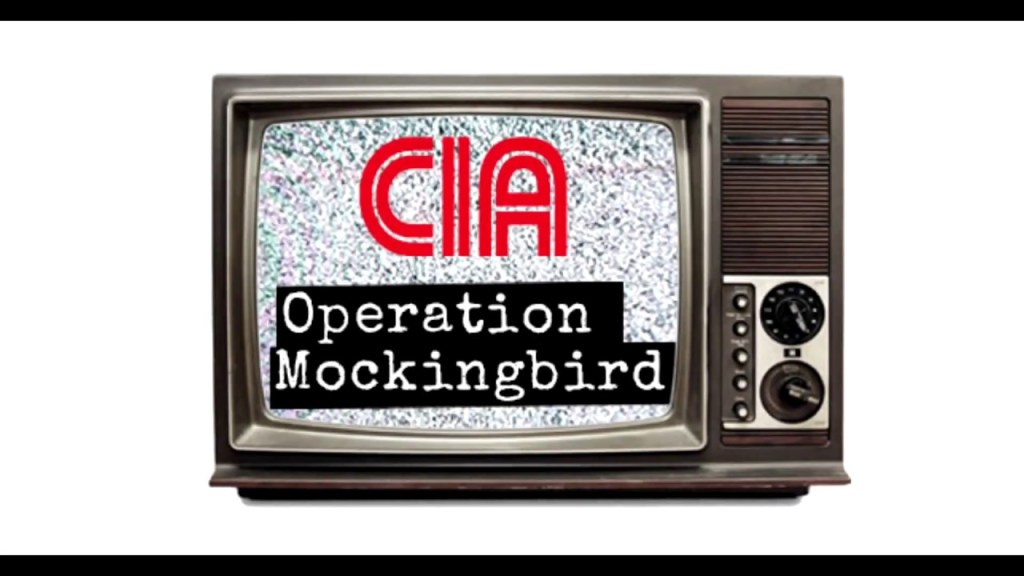
Why the CIA’s Operation Mockingbird is Widely Misunderstood

By Alex Constantine

Source: Constantine Report

In November, Newsweek, one of the most trusted news sources in the land, referred to Operation Mockingbird (CIA influence on the media, and, in many cases, infiltration) as “a supposed Cold War-era CIA program that is frequently referenced by QAnon conspiracy theorists.” (Source) Newsweek, of course, and the Washington Post were hubs in the Mockingbird network, so denial and misrepresentation are understandable.

But in the real world of CIA shenanigans …

Sourcewatch: “Operation Mockingbird was a secret Central Intelligence Agency campaign to influence domestic and foreign media beginning in the 1950s.

“The activities, extent and even the existence of the CIA project remain in dispute: the operation was first called Mockingbird in Deborah Davis’ 1979 book, Katharine the Great: Katharine Graham and her Washington Post Empire. But Davis’ book, alleging that the media had been recruited (infiltrated) by the CIA for propaganda purposes, was itself controversial and has since been shown to have had a number of erroneous assertions. More evidence of Mockingbird’s existence emerged in the 2007 memoir American Spy: My Secret History in the CIA, Watergate and Beyond, by convicted Watergate “plumber” E. Howard Hunt and The Mighty Wurlitzer: How the CIA Played America by Hugh Wilford (2008).”

https://www.sourcewatch.org/index.php/The_CIA_and_journalism

Carl Bernstein wrote about the program at length in Rolling Stone, and he waasn’t a QAnon adherent. Neither were the many journalists who have documented the history of the CIA-media relationship.

A misunderstanding about the code name Mockingbird has led some investigative reporters to dispute the operation’s existence. An FOIA request is submitted to the CIA for any related records. The Agency responds that it has no files under that code name. The journalist does receive documents on a Project Mockingbird, but that was an unrelated media surveillance op, and had nothing to do with Wurlitzers pumping out military-industrial propaganda. The journalist does his research, he finds that the CIA has, in fact, influenced public opinion via the news media, but where is the nomenclature Operation Mockingbird?

The journalist then brow-beats “conspiracy theorists” for falling into rabbit holes.

The fault lies with the reporter who doesn’t do essential homework on the origins of the bird. Officially, there is no  “Operation Mockingbird,” for the simple reason that the CIA didn’t exist when the it was conceived. Truman signed the Agency into existence in 1947. Allen Dulles, who would be appointed as its director, christened Operation Mockingbird the year before the Agency was born. His ambition to control men’s minds was a glint in his eye at the time. Cold war loomed, and he considered propaganda to be a priority. Dulles began lining up publishers, editors and journalists for an undertaking he thought of as mass mind control.

Nearly all of the CIA’s mind control files were destroyed in January, 1973 at the direction of DCI Richard Helms, so it’s possible that OM documents were among them. (Source: “Joint Hearings Before the Select Committee on Intelligence,” August 3, 1977, p. 3.)

By the time the CIA was repurposed from the obsolete postwar OSS, Operation Mockingbird was already well underway. As CIA director, Dulles pressed on with his objective to manipulate the common volk with dodgy news copy and op-ed treatises. It was a Dulles initiative before the CIA took Mockingbird under its wing.

Frank Wisner, the notorious Nazi recruiter, was selected to oversee the program. Wisner was recruited by Dean Acheson 1947 for a slot in the State Department’s Office of Occupied Territories. Shortly thereafter, the CIA created a the Office of Policy Coordination (OPC), the covert operations division of the Agency,  and Wisner was put in charge of the off-the-books media operation. (“Project Mockingbird,” the CIA journalist surveillance op, may well have been a sub-program.) So Mockingbird was a going concern by 1950, the year given by SourceWatch, among others, for its inception. Another common misunderstanding is the assumption that, because the CIA interacts with the media, all news is “fake news.” It isn’t. The overwhelming majority of journalists are independent of control beyond the editor’s desk. The lion’s share of all news reports are accurate enough — with the exception of the ultra-conservative echo chamber. But “fake news” is planted in the public print. Reader’s Digest, for instance, was a Mockingbird disinformation outlet for decades, and still prints propaganda. But the magazine wasn’t filled cover-to-cover with CIA perception management. One or two articles on Cold War topics were dropped into a mix of compressed books, human interest pieces, recipes, dieting tips, and the usual Digest  mom’s-jowls content. In some instances, paid CIA assets wrote the political articles. It’s the occasional planted story that warps public opinion. It’s not all that heavy-handed, a poison pill not a sledge hammer.

Newsweek was (and is) among the magazines most useful to the Operation. The code name may be unofficial, but infiltration of the media is not hard to prove, and it doesn’t take a complicit news weekly to know which way the wind blows.

Questioning The Official Story About Official Stories: A Role for Citizen Investigations

By Time Hayward

Source: Tim Hayward Blog

Official stories, according to the official story about them, are (nearly) always true. The ‘nearly’ gets mentioned just because, on rare occasions, an official story is acknowledged to have been wrong, as, for instance, with Iraq’s falsely alleged weapons of mass destruction in 2003. But that’s considered an exception to the rule, and to extrapolate from it to a more pervasive mistrust is to be foolish, ill-informed or even a dupe of hostile propaganda. In fact, diagnosing what is wrong with sceptics about official stories, and proposing ways of curing or otherwise dealing with them, are now becoming a growth industry in the media and academia. So we hear a lot about how dissenting from official narratives is to fall victim to ‘conspiracy theory’ or ‘disinformation’; and dissenters may be diagnosed as needing re-education or even psychological help. As for the dissent itself, this is increasingly subject to censure and censorship.

However, a major question is left unaddressed: What is it that’s supposed to make official stories so credible?

The assumption is that official stories are produced by people with relevant expert knowledge, so disputing them is a product of ignorance; and since experts have credentials, experience and the backing of competent institutions, rejecting their expertise is unwise or even delusional. Also assumed is that official stories are generally produced and disseminated in good faith.

But are those assumptions generally warranted? In probing their grounds we are brought to question whether the official meta-story, as we may call it, overstates reasons for automatically accepting official stories and underestimates the competence that members of the public can bring to independent inquiries.

Why Believe Official Stories?

No serious thinker would suggest that an official story should be believed just because it comes from officials. Indeed, use of the very expression ‘official story’, in practice, tends to imply that there is also some alternative story that does not have the backing of officials but might be more credible. We know, too, that many societies from various times and places have maintained order by invoking all manner of mythological stories, ideological stories, and blatantly discriminatory stories. Sometimes this has meant denying, suppressing or persecuting as heretics people engaged in rigorous intellectual questioning of officialdom.

A more plausible reason for believing official stories has been set out by the philosopher Neil Levy (2007). He points out that we all know most of the things we know in life because we have learned them from others: our direct personal experience of the world is extremely limited compared to the expanse of our general knowledge and the intricacies of our more specialist understandings. We rely on the testimony and good faith of others in almost everything we do, so just to live a normal life in society we trust a wide range of institutions and social arrangements. To doubt their general dependability would contradict the tacit assumptions that get us through life and would render inexplicable how even a tolerably well-ordered society could ever be possible.

The force of that consideration is strong, but not absolute – and how strong also depends on what kinds of communication we are referring to as official stories. It is strongest if one uses the term to refer to all public communications that emanate from an official source. In actual usage, however, that is not how the term ‘official story’ is normally understood. We don’t regard it as an ‘official story’ that to get a passport you need to submit an authenticated photograph of yourself; we don’t regard it as an ‘official story’ that in UK cars are to be driven on the left; and nor do we these days regard it as an ‘official story’ that smoking is bad for our health. By far the greater part of public pronouncements, like these, are simply taken to state how matters stand. When the distinctive term ‘official story’ occurs, it is typically in contexts where a public pronouncement has met with scepticism. So, for example, whereas we seldom nowadays hear the rationale for mandating wearing seatbelts in cars referred to as an ‘official story’, because there is no longer serious dissent, recent claims that the rationale for mandating mRNA injections against SARS-Cov2 was substantially comparable to that for seatbelts encountered resistance: the ‘official story’ about the benefits and safety of the mRNA injections has been subject to criticism from some sections of medical and scientific communities.

Of course, the mere fact of scepticism in some quarters does not mean that a given official story is necessarily mistaken, but it does highlight how an official story is not just an uncontroversial statement of how matters stand. It leads thoughtful people to look more closely at the nature of authority claimed for an official story.

Are There Experts in Expertise?

The authority claimed for official stories derives, as Levy explains, from the fact of being produced by ‘people socially acknowledged as the relevant experts on a topic’ (Levy 2022). Relevance here is understood in terms of knowledge and experience relating to the salient subject matter. However, certain people might officially be appointed as relevant experts, on other bases, such as known affinities with the organisation’s mission. So it is possible for designated experts to support an official story while a number of other people with materially relevant knowledge and experience take a quite different view.

Even among designated expert advisers, however, achieving an authoritative consensus on the kind of matter that official stories relate to is not straightforward. This is for reasons similar to those involved in giving policy advice (see e.g. Grundmann 2017). Insofar as an official story appeals to a scientific basis, it should be borne in mind that findings of science – a process of open, collaborative and progressive inquiry – have a provisional status, with all scientific statements being in principle corrigible. This means that a scientific adviser’s confidence can never be completely unconstrained or unhedged. Zeynep Panuk (2021) refers to a ‘paradox of scientific advice’ that arises from the difficulties of basing decisions on scientific knowledge that is almost always uncertain and subject to disagreement. Panuk cites experience of how overconfident scientists in advisory committees may suppress dissent so as to present a consensus view, only to find that its implementation had unfortunate or even disastrous consequences. Recent experiences of overconfident pronouncements on ‘The Science’ during the Covid pandemic have furnished further examples (Miller 2022Nelson 2022).

The kind of controversy for which an ‘official story’ comes into play will not normally reduce to some specialist detail of basic science, or even a collection of these, but will concern a situation involving many factors – including those pertaining to social organisation, human action and decision-making. Such situations are similar to those where policy advice is sought from scientific experts (SAPEA 2019 Ch. 2; Martin et al 2020). Official stories are seldom if ever straightforward statements of scientific opinion on a single well-defined scientific research question: they typically relate to situations where many interacting variables may not all be clearly disaggregable. There is in principle no necessary reason why an independent and unofficial grouping of investigators with materially relevant expertise might not be as well-suited to an inquiry as an official grouping. In fact, challenges to official stories can sometimes draw on impressive constellations of expertise.

Citizen Investigations

If the official meta-story may overestimate the dependability of designated expert advice, it may also underestimate the investigative competence of ordinary citizens. For challenges to official stories can be mustered not just by isolated individuals, caricatured as ‘doing their own research’ while ‘reading things on the internet,’ but by well-informed collaborative groups. These can be better able to track truths than independent individuals: ‘the superiority of the group over the individual does not require that one member has the right answer prior to deliberation: group deliberation may enable the aggregation of the genuine insights of several members and the rejection of the false hypotheses of some of the same individuals.’ (Levy 2019: 316)

Furthermore, if it is the case that ‘[g]roups of individuals who are strangers to one another are better at tracking truths than groups of individuals who have a shared history’ (Levy 2019: 318) then this is an advantage of groups comprising people who come together in cyberspace from all walks of life and may have little or no biographical information about those they connect with. Citizens doing their own research sometimes start their own Wikis, or form groups on Reddit, or informally deliberate via Twitter or Telegram. Sometimes they create investigative collectives offline.

It was from participating in chatrooms, for instance, that the now much-feted organisation Bellingcat originated: its founder, Eliot Higgins, a gamer-turned-investigative-citizen, would review copious amounts of war footage from his sofa in Leicester and discuss his observations in chatrooms. The work of his investigative collaborative has come to be ‘commended in the global media and by global agencies such as Amnesty International and Human Rights Watch.’ (Nguyen and Scifo 2018: 377) Impressed by the methods of ‘open source intelligence’ (D’Alessandra and Sutherland 2021), curators of official stories in the West – particularly those relating to geopolitical issues involving Russia – have bestowed accolades on Bellingcat, along with generous funding and encouragement.

So, there is precedent for treating citizens’ investigations as authoritative. Other groups of citizen investigators, that do not receive any funding, have mounted significant challenges to some of the West’s own official stories. Thus, directly countering Bellingcat, on occasion, is the Working Group on Syria, Propaganda and Media which has earned the confidence of whistleblowers rather than officials (OPCW 2020).

Aside from the benefits of collaboration, the reality of serious dissent in the digital sphere is that it can involve myriad critical individuals with significant independent claims to epistemic authority in their professional fields and who exhibit judicious awareness of both their own limitations and the value of others’ insights. For instance, challenging various official narratives are whistleblowers who include scientists, diplomats, intelligence officers, and various state or corporate employees. Challenges come too from professionals with relevant specialist expertise across fields like medicine, architecture, engineering, pharmaceuticals, and a gamut of others. Also worth highlighting are those journalists with previous careers in mainstream media organisations who found they could only maintain their professional integrity by becoming independent.[1] When a group of people independently deliberating together can include, for instance, a former head of a nation’s armed services, a UN weapons inspector, a senior diplomat, an intelligence officer, a world leading International Relations expert and a seasoned war correspondent, the insights they generate regarding situations relevant to foreign policy may well be no less sound than those informing the official story.[2] Indeed, in virtue of their freedom from institutional constraints, they may be more reliably informative for the public than the official story.

If serious challenges to official stories have become more prevalent in recent years, as they arguably have, this is likely due in good part to the sheer extent to which mainstream media have excluded the voices of experts who, maintaining their professional integrity and independence in the face of sometimes considerable hostility, have continued to articulate their challenges to official stories. Attentive members of the public notice this – just as they notice when the force of the state is brought to bear on those who bring to light its lies and malfeasance, and not only in high profile cases like Edward Snowden, Chelsea Manning, Katharine Gun or Julian Assange.

Part of the official meta-story currently is that the internet and social media are being flooded by targeted disinformation that is misleading and confusing people. However, from another perspective one might see that thanks to digital communications citizens can become aware of arguments developed by other experts which are suppressed by protectors of an ‘official story’. An example would be the authors of the Great Barrington Declaration (GBD) (2020), advocating an approach to dealing with the Covid situation characterized as ‘focused protection’ instead of the officially promoted lockdown approach. Lay persons may not be able to adjudicate first hand between recommendations from the GBD and the John Snow Memorandum (2020), which defended lockdown, but they can understand enough to know that the latter does not command an unproblematic consensus such as would be rational simply to defer to. Members of the public can assess the trustworthiness of expertise and official stories without a high level of technical knowledge, as science studies scholars have shown (Yearley 2005; Hess 2012).

People understand that if a view is suppressed rather than openly addressed and rebutted the reason might be that it cannot be rebutted. If an attentive public observes that dissent is simply treated as inadmissible, and especially if those formulating it are subject to smearing or censorship, then there is a corresponding diminution of public trust in the orthodox view.

Tension At The Heart of An Official Story

If the claim that the authority of an official story derives from an expert consensus can be questionable, something more certain is that an official story is asserted with the kind of authority that comes with power. People may defer to an official story not because they necessarily find it credible but out of a prudent concern to avoid the costs of dissidence. Those with power can also incentivise wider media of communication to stick to the narrative. This difference between epistemically earned authority and politically declared authority is a tension at the heart of official stories. Understanding it helps explain why we find a good many journalistic and scholarly studies of the supposed pathologies of dissident citizens and rather little reflection on the real nature of the authority of official stories.

Today we find a welter of studies of online ‘disinformation’ that trace webs of connection across cyberspace seeking to link influential dissenting accounts on social media with bots and trolls associated with malign actors. These communications are said to be engaged in strategically. That is, their aim is to persuade the public to accept a pre-established story rather than to allow people to determine, through open deliberations, what the most credible story is.

Yet this is exactly what the promulgators of official stories themselves do. Regardless of whether the content of a given official story is reliable or not, the form of an official story – in virtue of fulfilling its official function – is that of a strategic communication. Its communication, as official, is presented as a matter not for deliberation but for public acceptance. It is not submitted to public scrutiny with an implicit invitation for critical feedback. It is not up for discussion. It is communicated not to advance debate but to settle it.

This is the inherent tension in an official story: its assertion of epistemic authority depends on an implicit claim that it can be backed by processes of deliberative reasoning, but the pronouncement of an official story as a settled opinion curtails any such process.

What this means in practice has been illustrated, for instance, in the situation arising with the UK Government’s Covid response, which professedly aimed to ‘Follow The Science’ (Stevens 2020). This notion can only ever be ‘a misleading oversimplification’ of what it means to base policy on science (Abbasi 2020), and when UK government ministers claimed to be ‘guided by the science’, what they meant in practice was being guided by their scientists: ‘Ministers formed strong relationships with key scientific advisors, relied on evidence from their Scientific Advisory Group for Emergencies (SAGE), and ignored or excluded many other sources.’ (Cairney 2021) Thus a policy of public communications was decided on the basis of a selective interpretation of scientific findings. But more than this, instead of caution in the face of uncertainty, a policy of robustly promoting a particular view involved the use of psychological operations of a kind more normally associated with a war effort than with public health advice (Sidley 2021, 2022).

Unfortunately, as that example also showed, the defence of an official story against criticism can include counter-measures taken to smear and discredit dissenters. This is never an edifying approach, but is especially troubling when it involves discrediting serious critics who have their own credible claim to epistemic authority. This was illustrated in the case of the eminent scientists who signed the Great Barrington Declaration. They were widely vilified not only in the media but even by other academics, for pointing to certain established principles of epidemiology – including those developed over the two preceding decades of pandemic preparedness planning – that were being set aside and overridden by policy-makers on the basis of modellers’ projections in favour of a ‘zero-covid’ strategy (Ioannidis 2022). This vilification involved not only overt smearing but also something more insidious, namely, the pre-emptive dismissal of their views – notwithstanding their impeccable academic pedigree – as too far ‘beyond the pale’ to warrant serious consideration (HART 2022).

This situation showed that the other institutions of civil society, including the media and academia, which the official meta-story claims provide critical scrutiny, can in fact simply amplify official strategic communications. Thus the organisations that Levy recommends we rely on as guarantors of the authors of official stories can in reality see it as their responsibility to promote and defend the official story rather than question it. Public perceptions that this is the case are accompanied by a deficit of trust in the media and institutions more generally.

The official meta-story blames ‘conspiracy theorists’ and other critical questioners for this lack of trust. But perhaps that gets things the wrong way round.

Conclusion

Trust is something that has to be won, and, if betrayed, it can be lost. As the public’s trust in official stories diminishes, the official meta-story looks to blame this on ‘conspiracy theorists’ and other ‘disruptive influences’. Perhaps a more credible story about official stories would include serious reflection on how they might be made more transparently trustworthy.

Meanwhile, it is reasonable to suggest that each serious challenge to an official story should be assessed on its merits. This does not mean being swayed by extravagant contrarian hypotheses, since these should be treated with even more caution, and, when appropriate, summarily rejected. It does mean being duly aware of how the presumption in favour of official stories is necessarily defeasible. That is the case not just because any story may prove to be mistaken, even in all good faith, but also because we know that any organisation with politically-conferred authority is liable at times to come under political pressures that may, in certain circumstances, override scruples of honesty.

References

Abbasi, Kamran. 2020. ‘Covid-19: politicisation, “corruption,” and suppression of science’. BMJ; 371:m4425, 13 November: doi:10.1136/bmj.m4425   

Cairney, Paul. 2021. ‘The UK Government’s COVID-19 Policy: What Does “Guided by the Science” Mean in Practice?’ Frontiers in Political Science 315 March.https://www.frontiersin.org/articles/10.3389/fpos.2021.624068 DOI: 10.3389/fpos.2021.624068

D’Alessandra, Federica and Kirsty Sutherland. 2021. ‘The Promise and Challenges of New Actors and New Technologies in International Justice’. Journal of International Criminal Justice, 19(1): 9–34. https://doi.org/10.1093/jicj/mqab034

Great Barrington Declaration. 2020. https://gbdeclaration.org/

Grundmann, Reiner. 2017. ‘The Problem of Expertise in Knowledge Societies’. Minerva 55, 25–48 (2017). https://doi-org.ezproxy.is.ed.ac.uk/10.1007/s11024-016-9308-7

HART [Health Advisory and Recovery Team]. 2022. ‘The crushing of dissent throughout the covid era’, 8 October: https://www.hartgroup.org/the-crushing-of-dissent-throughout-the-covid-era/

Hess, David J. 2012. Science Studies: An Advanced Introduction. New York: NYU Press.

Ioannidis, John P. 2022. ‘Citation impact and social media visibility of Great Barrington and John Snow signatories for COVID-19 strategy.’ BMJ Open 2022;12:e052891. doi:10.1136/ bmjopen-2021-052891

John Snow Memorandum. 2020. https://www.johnsnowmemo.com/

Levy, Neil. 2007. ‘Radically Socialized Knowledge and Conspiracy Theories’, Episteme 4(2): 181-192.

Levy, Neil. 2019. ‘Due deference to denialism: explaining ordinary people’s rejection of established scientific findings’. Synthese 196: 313-327.

Levy, Neil. 2022. ‘Do Your Own Research!’ Synthese 200: 356. https://doi.org/10.1007/s11229-022-03793-w

Martin, Graham P., Esmée Hanna, Margaret McCartney and Robert Dingwall. 2020. ‘Science, society, and policy in the face of uncertainty: reflections on the debate around face coverings for the public during COVID-19’. Critical Public Health 30:5: 501-508, DOI: 10.1080/09581596.2020.1797997

Miller, Ian. 2022. Unmasked: The Global Failure of COVID Mask Mandates.

Nelson, Fraser. 2022. ‘The lockdown files: Rishi Sunak on what we weren’t told.’ The Spectator, 27 August: https://www.spectator.co.uk/article/the-lockdown-files-rishi-sunak-on-what-we-werent-told/

Nguyen, An and Salvatore Scifo. 2018. ‘Mapping the Citizen News Landscape: Blurring Boundaries, Promises, Perils, and Beyond.’ In Journalism, edited by Tim P. Vos. Berlin/Boston: De Gruyter.

OPCW [Organisation for the Prohibition of Chemical Weapons]. 2019. ‘Report Of The Fact-Finding Mission Regarding The Incident Of Alleged Use Of Toxic Chemicals As A Weapon In Douma, Syrian Arab Republic, On 7 April 2018.’ OPCW Technical Secretariat S/1731/2019: https://www.opcw.org/sites/default/files/documents/2019/03/s-1731-2019%28e%29.pdf

Panuk, Zeynep (2021) ‘COVID-19 and the Paradox of Scientific Advice.’ Perspectives on Politics 20(2): 562-576. DOI: https://doi.org/10.1017/S1537592721001201

SAPEA [Science Advice for Policy by European Academies]. 2019. Making sense of science for policy under conditions of complexity and uncertainty. Berlin: SAPEA. https://doi.org/10.26356/MASOS 

Sidley, Gary. 2021. ‘A Year of Fear.’ The Critic 23 March: https://thecritic.co.uk/a-year-of-fear/

Sidley, Gary. 2022. ‘Britain’s unethical Covid messaging must never be repeated.’ The Spectator 6 February: https://www.spectator.co.uk/article/britain-s-unethical-covid-messaging-must-never-be-repeated/

Stevens, Alex. 2020. ‘Governments cannot just ‘follow the science’ on COVID-19’. Nature Human Behaviour 4, 560: https://doi.org/10.1038/s41562-020-0894-x

Yearley, Steven. 2005. Making Sense of Science: Understanding the Social Study of Science. Thousand Oaks, CA: Sage.


[1] This is the case, for instance, with Jonathan Cook (formerly of The Guardian), Chris Hedges (formerly with the New Yorker), John Pilger (award-winning documentary film maker), and the late Robert Parry who founded the independent outlet Consortium News.

[2] This is to characterize part of the composition of the Berlin Group 21 that has produced the Statement of Concern relating to whistleblowers from the OPCW. See https://berlingroup21.org/ and associated press release: https://www.einnews.com/pr_news/538579944/leading-international-voices-call-on-opcw-and-its-scientific-advisors-to-allow-all-douma-investigators-to-be-heard

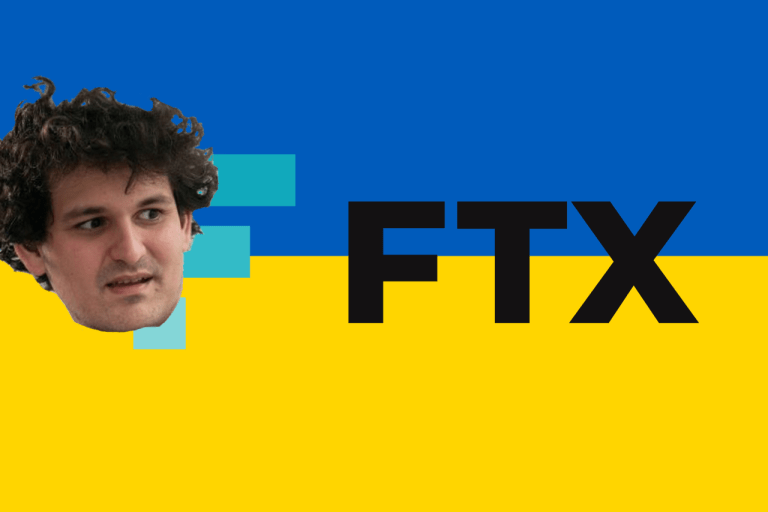
FTX partnership with Ukraine is latest chapter in shady Western aid saga

By Kit Klarenberg

Source: The Grayzone

The Ukrainian government mysteriously disappeared online records of its fundraising arrangement with the FTX crypto scam just days before the scandal erupted. The initiative claims to have raised $60 million for Ukraine, but where did the money go?

The demise of FTX, the fifth-biggest cryptocurrency exchange by trade volume in 2022, and the second-largest by holdings, has sent a wave of chaos through global financial markets. 

As the turbulence grows, the government of Ukraine is conducting an ongoing cleanup and whitewashing operation to rid any and all references to a high-level cryptocurrency fundraising arrangement it struck with FTX from the web. Eerily, it seems to have commenced just days before the scandal erupted. 

Online records unearthed by The Grayzone claim tens of millions were raised by FTX for the Ukrainian government, and put to a variety of belligerent uses. But with the company now exposed as a Potemkin village lacking underlying assets, and major question marks hanging over whether its operations were from day one fraudulent top to bottom, where does that leave the supposedly successful donation scheme? Were those sums truly raised, and if so, to what purposes were they actually put?

FTX’s destruction resulted from a mass sell-off of the company’s native bitcoin token, FTT, by the rival exchange, Binance. Its value plummeted, prompting a three-day “run” on billions of dollars worth of cryptocurrency, which in turn created – or exposed – a “liquidity crisis” within FTX, as it did not have the available assets required to redeem client withdrawals. FTX filed for bankruptcy on November 11th. 

FTX founder and top Democrat Party donor Sam Bankman-Fried now faces criminal investigations in the Bahamas, where the exchange was headquartered, and calls for official investigations into the largely unregulated cryptocurrency industry are reverberating across the globe.

The sudden death of FTX has been compared to the 2008 disintegration of Lehman Brothers that precipitated the financial crisis.

Massive customer holdings have apparently gone missing thanks to a secret “back door” in the FTX bookkeeping system that allowed Bankman-Fried to make changes to the company’s financial records without any accountability. This connivance may have been used to hide at least $10 billion in client funds Bankman-Fried transferred from exchange to another company he founded, digital asset trader Alameda Research. 

While mainstream media pores over the details of Bankman-Fried’s gargantuan crypto scam, not one single major outlet has investigated or even acknowledged FTX’s relationship with the government of Ukraine. 

Were client holdings unaccountably and illegally funneled into the West’s proxy war? Or did the supposed aid FTX sent to Kiev find its way into the hands of Ukrainian scammers, corrupt warlords and illicit actors? 

The corporate media’s failure to explore these questions appears all the more perverse given Bankman-Fried’s flamboyant promotion of his intimate financial relationship with the government of Ukrainian President Volodymyr Zelensky. 

FTX pledges to “turn bitcoin into bullets, bandages and other war materiel” for Ukraine

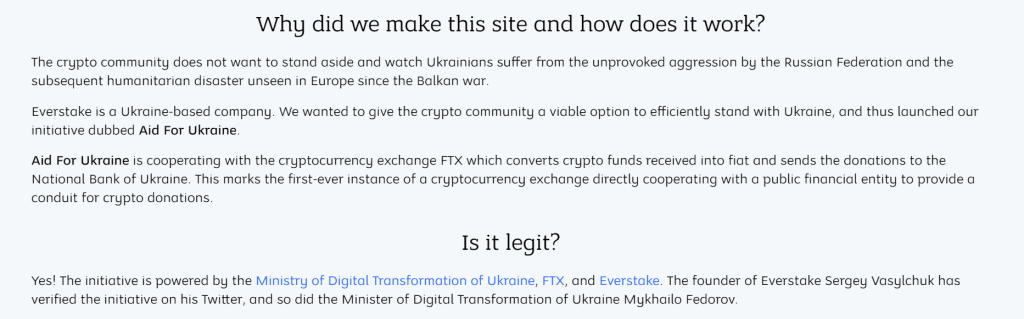
The partnership between FTX and the Ukrainian government was first publicized on March 14th when the leading cryptocurrency website CoinDesk announced Kiev had launched a dedicated webpage for cryptocurrency donations dubbed Aid for Ukraine.

Under its auspices, FTX pledged to “convert crypto contributions to Ukraine’s war effort into fiat for deposit” at the National Bank of Kiev, allowing the embattled government to “turn bitcoin into bullets, bandages and other war materiel.” CoinDesk stated the initiative “deepens an unprecedented tie-up between public and private sector forces in crypto.” 

Oleksandr Bornyakov, an official at Ukraine’s Ministry of Digital Transformation, hinted to CoinDesk about an “upcoming NFT collection” auction to “give the next boost to the crypto fundraising process.”

(Bornyakov’s Ministry of Digital Transformation played a key role in the successful, Zelensky-led campaign to cancel The Grayzone’s Max Blumenthal and Aaron Mate’s appearance at Web Summit, a major international gathering of the tech industry in Lisbon, Portugal). 

In a press release accompanying the announcement of the FTX partnership with Ukraine, Bankman-Fried explained that, “at the onset of the conflict in Ukraine, FTX felt the need to provide assistance in any way it could.” He promised that the arrangement provided “the ability to deliver aid and resources to the people who need it most.”

Kiev disappears Aid for Ukraine site days before FTX scandal goes public

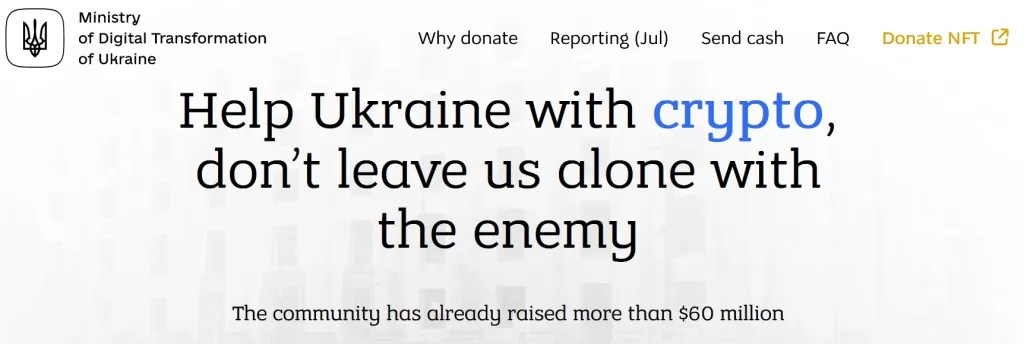
The Aid for Ukraine webpage has now been deleted, but can still be accessed via the Internet Archive. Until very recently, it encouraged visitors to “help Ukraine with crypto” and pleaded, “don’t leave us alone with the enemy.” 

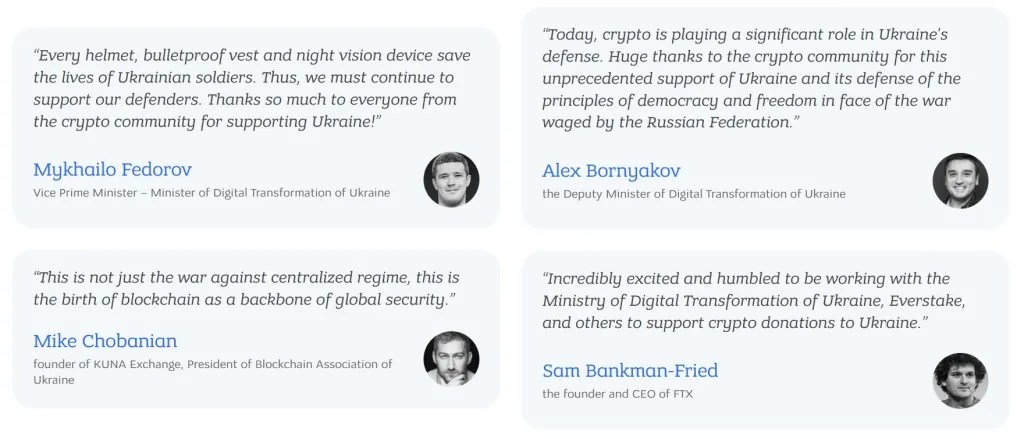
The site featured promotional quotes from an assortment of Ukrainian government officials and bitcoin bros – among them, FTX’s founder.

Mykhailo Fedorov, Ukraine’s deputy Prime Minister, and Minister of Digital Transformation of Ukraine, thanked “the crypto community” for funding the purchase of helmets, bulletproof vests, and night vision devices. For his part, Bankman-Fried declared himself “incredibly excited and humbled” to “support crypto donations to Ukraine.”

The last available Internet Archive capture of Aid for Ukraine” took place on the afternoon of October 26th. Throughout the webpage’s existence, the Internet Archive captured multiple snapshots of it weekly. This clearly indicates the page was purged by Kiev in late October, several days before the FTX crisis initially broke out.

Once it was deleted, the Ukrainian government created a standalone website on November 1st to promote the endeavor. The page was identical, and quotes from Bankman-Fried, and references to FTX’s involvement and its logo, remained in place until the morning of November 15th.

Was the original webpage’s dumping and erasure, and the shift to a totally new interface, at that time merely a spooky coincidence, or were the Ukrainians warned of what was coming? What did Kiev know, and when did it know it?

Bankman-Fried channeled millions to Biden through “stealth” PAC

Though FTX has been accused of serving as a money laundering vehicle for the US Democratic Party, concrete evidence supporting this claim has yet to materialize. But given Bankman-Fried’s background as one of the most prolific donors to the Democrats, and the role he played as a nexus between party power-brokers and the cryptocurrency sphere, the allegations are understandable. 

Bankman-Fried is the son of Stanford law professor Barbara Friedman, founder of a shadowy Super PAC called Mind the Gap which quietly channeled millions to Democratic party candidates, primarily from nameless Silicon Valley investors. 

The organization has no website or social media footprint, and its founders do not advertise their involvement publicly. Chosen through complex data analysis, beneficiaries of the Super PAC often have no idea themselves who or what has donated to their campaigns.

“The raison d’être is stealth,” an individual “with ties to the organization” told Vox back in 2020.

Bankman-Fried establishment of FTX in April 2019 – the same month Joe Biden announced his 2020 Presidential run – has added to the intrigue surrounding the scandal. Once vast sums started flowing into and through the FTX exchange, its founder channeled profits into Biden’s campaign coffers. Oddly, Bankman-Fried had no prior history of political giving.

Throughout the 2020 campaign, Bankman-Fried gifted over $5 million to Biden and groups supporting him. This reportedly helped fuel a potentially decisive “nine-figure, eleventh-hour blitz of TV advertising” targeting swing states, and made the crypto bro the second-largest donor to the president, right behind Michael Bloomberg.

Bankman-Fried claimed this wellspring of generosity was “motivated less by specific issues than by the Biden team’s ‘generic stability and decision-making process.’” Such an apparent lack of enthusiasm for the President stands at odds with the staggering sums he has pumped into Democratic party coffers ever since. 

In 2022 alone, Bankman-Fried lavished almost $40 million on Democratic candidates, campaigns, and PACs. The giving spree made him the second-largest individual donor to Democratic causes, behind liberal venture capitalist George Soros. 

More recently, Bankman-Fried pledged to donate a staggering $1 billion between this year and 2024 to ensure a Democratic victory in the next presidential vote. On October 14th, however, he completely backtracked, branding the investment a “dumb” move. Something scandalous was brewing behind the scenes.

One week later, the Texas State Securities Board announced it was investigating FTX on suspicion of selling unregistered securities. The development went largely unnoticed by the media. To the extent it generated any interest at all, it was framed as just one of several examples of financial authorities scrutinizing crypto players.

What happened to the $60 million raised by Aid for Ukraine?

If FTX was indeed laundering funds for the proxy war in Ukraine, the slightest indication that regulators were investigating its operations would have triggered alarm bells throughout Washington – and by extension, Kiev. This may be why the Ukrainian government switched the Aid for Ukraine webpage with a dedicated website, and scrubbed the original entirely from the internet just days after the announcement.

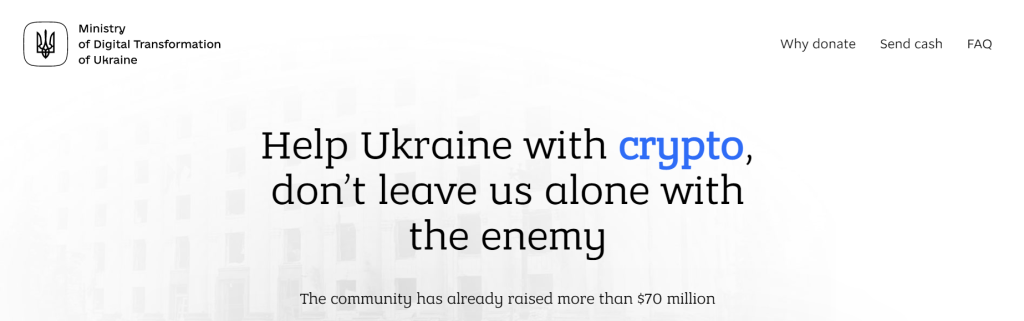
Also curious are the Internet Archive captures of the Aid for Ukraine website that show records of funds purportedly flowing to Kiev via Bitcoin had not been updated since July. At the time, the webpage reported that over $60 million had been raised by the “community.” This figure is reflected on the updated standalone Aid for Ukraine fundraising site.

A breakdown of spending on the new Aid for Ukraine website states Kiev had spent a total of $54,573,622 in cryptocurrency donations by July 7th on a wide variety of equipment, vehicles, drones, “lethal equipment” and other resources. One of the biggest single expenditures was $5,250,519 on a “worldwide anti-war media campaign,” the details of which would only “be published after our victory” due to “security reasons.”

Ukrainian government officials and private sector actors involved in the operation of Aid for Ukraine have scoffed at suggestions of impropriety regarding its use, but have only raised further questions with their denials.

Oleksandr Bornyakov of Ukraine’s Ministry of Digital Transformation declared that Aid for Ukraine simply used FTX to “convert donations into fiat in March.” The CEO of Everstake, the “validator” company that in theory guaranteed crypto funds donated via Aid for Ukraine reached Kiev’s Ministry of Defense, also thanked “every crypto holder for donating…in those early day [sic], when every cent and every minute was crucial.” 

Taken in tandem, these comments suggest Aid for Ukraine was set up purely to receive donations in the initial stages of the war, and the $60 million figure represents sums received and converted in the weeks immediately following the launch of the initiative. This interpretation is reinforced by an Everstake staffer’s presentation at a cryptocurrency conference at Web Summit on November 1st, on the subject of “raising [over] $60m in crypto for Ukraine.”

But an Internet Archive capture of Aid for Ukraine on April 1st adds to the confusion, showing that two-and-a-half-weeks after the initiative launched, the webpage was updated to claim “over $70 million” had been raised from crypto donors. This was revised down to “over $60 million” five days later. 

More strangely, Aid for Ukraine records show that from the time of the initiative’s launch to April 14th, a total of $45,103,538 was spent. This means just $9,470,084 was spent between April 14 and July 7th, a period in which the war developed into a “bloody war of attrition” according to The Guardian.

This leaves a gap of at least $5.5 million in the money Aid for Ukraine claimed to have raised in its initial weeks, and the funds it says it distributed in Ukraine. 

The disparity was confirmed in a tweet by the official Aid for Ukraine Twitter account, posted on the evening of November 15th, which stated that “out of $60 million received, $54 million have already been spent on Ukraine’s humanitarian and military needs.” 

This implies that no further funds of any size were received after early April, and the total has remained static ever since, despite the resource being open for donations. Which would be highly unusual.

The government of Ukraine, FTX, and Everstake all now have serious questions to answer. Namely, why the funds purportedly raised appear to have decreased in a span of a few days, why no donations have been received since then on the Aid for Ukraine webpage or its new website, how much has been donated since the alleged initial influx, and where did the rest of the money go?

Ukraine: a black hole for Western aid

Stories of potential financial impropriety by Ukrainian officials and the country’s military are invariably ignored or outright buried by the Western media. An August exposé by the Kyiv Independent documented wide-ranging abuses by the leadership of a wing of the International Legion, including sexual harassment, looting, threatening soldiers at gunpoint and sending them unprepared on reckless missions. Though the Kyiv Independent often influences Western media’s coverage of the Ukraine conflict, this story was completely ignored in mainstream quarters.

That same month, CBS broadcast an investigative feature revealing that only 30 percent of Western arm shipments to Ukraine ever reach the frontline. Due to intense backlash from the Pentagon and other powerful sources, CBS temporarily pulled its own documentary and an accompanying promotional trailer and article from the web. The feature has since been “updated” to claim that “the situation has significantly improved” since filming, and “a much larger quantity now gets where it’s supposed to go.”

When it comes to Ukraine, Democrats at the highest levels are also immensely skilled at burying embarrassing stories. In December 2015, Joe Biden coerced Kiev’s then-leader Petro Poroshenko into firing prosecutor general Viktor Shokin as a condition for the US underwriting a $1 billion IMF loan to Ukraine.

“I’m going to be leaving here in six hours. If [Shokin] is not fired, you’re not getting the money,” Biden threatened. 

With Shokin’s firing, the experienced lawyer’s ongoing probe into the energy giant Burisma ended as well. Which meant that Burisma’s most famous board member, Hunter Biden, the son of then-US Vice President’s son, eluded official scrutiny. 

Now, a politically connected crypto-billionaire who used a secret financial “back door” to fleece customers of ungodly sums of money has become the latest character in the saga of shady US aid to Ukraine. And though the collapse of his FTX firm is front page news, mainstream outlets are studiously avoiding the Ukraine angle.

The Biotech Plan To Destroy Us

By Llewellyn H. Rockwell, Jr.

Source: LewRockwell.com

Covid has generated a great of controversy, but one thing can’t be doubted. Covid, and the misguided attempts to combat it, have wreaked havoc since March 2022.  How was the Covid virus created? An answer, devastating in its implications, has just come to light. (Thanks to the heroic Ron Unz for tipping us off on this). What you’re about to read sounds like something you would expect from one of our authors at LRC, authors whom the Left is quick to dismiss as “conspiracy theorists.” But the person we’re talking about has impeccable leftwing credentials. He’s the economist Jeffrey Sachs, famous for his work on “sustainable development” and “third-world poverty.” You couldn’t miss reading about him in the mainstream media—at least until recently.

In an interview published online in Current Affairs, on August 22, “Prof. Sachs explains how he, as the head of the COVID-19 commission for a leading medical journal, [The Lancet] came to the conclusion that powerful actors were preventing a real investigation from taking place. He also explains why it is so important to get to the bottom of the origins of COVID: because, he says, there is extremely dangerous research taking place with little accountability, and the public has a right to know since we are the ones whose lives are being put at risk without our consent. “

The “official” view is that the Covid virus was an accident that came from contaminated animal parts in the Wuhan market in China. Sachs suggests that studies that purport to confirm this account have been faked. “Well, the funny thing is those scientists who are saying that said the same thing on February 4, 2020, before they had done any research at all. And they published the same statement in March 2020, before they had any facts at all. So they’re creating a narrative. And they’re denying the alternative hypothesis without looking closely at it. That’s the basic point. “

That’s the “official” truth, in other words the government lies, about Covid. What does Sachs think was really going on? “The alternative hypothesis is quite straightforward. And that is that there was a lot of research underway in the United States and China on taking SARS-like viruses, manipulating them in the laboratory, and creating potentially far more dangerous viruses. And the particular virus that causes COVID-19, called SARS-Cov-2, is notable because it has a piece of its genetic makeup that makes the virus more dangerous. And that piece of the genome is called the ‘furin cleavage site.’ Now, what’s interesting, and concerning if I may say so, is that the research that was underway very actively and being promoted, was to insert furin cleavage sites into SARS-like viruses to see what would happen. Oops!”

It gets worse. The “scientists” who published the “accidental market mishap” theory knew it was false, but they circulated this lie to cover up biotech research they didn’t want disturbed. “At the beginning, which we could date from the first phone call of the National Institutes of Health (NIH) with a group of virologists on February 1, 2020, the virologists said ‘Oh my god, that is strange, that could well be a laboratory creation. What is that furin cleavage site doing in there?’ Because scientists knew that was part of an active ongoing research program. And yet, by February 3, the same group is saying ‘No, no, it’s natural, it’s natural.’ By February 4, they start to draft the papers that are telling the public, ‘Don’t worry, it’s natural.’ By March, they write a paper—totally spurious, in my view—called the proximal origins paper that is the most cited bio paper in 2020. It said: it is absolutely natural. [Note: the paper’s conclusion is ‘we do not believe that any type of laboratory-based scenario is plausible.’] But they didn’t have any of the data that you read about in the New York Times. They didn’t have any of this. They just said the labs weren’t working on this alternative. But you know what, they don’t know what the labs were working on, because they never asked, and NIH hasn’t told us.”

Sachs is emphatic about this: “So my point is, there is a huge amount of reason to believe that that research was underway. Because there are published papers on this. There are interviews on this. There are research proposals. But NIH isn’t talking. It’s not asking. And these scientists have never asked either. From the very first day, they have kept hidden from view the alternative. And when they discuss the alternative, they don’t discuss the research program. They discuss complete straw men about the lab, not the actual kind of research that was underway, which was to stick furin cleavage sites into SARS-like viruses in a way that could have created SARS-Cov-2.

What I’m calling for is not the conclusion. I’m calling for the investigation. Finally, after two and a half years of this, it’s time to fess up that it might have come out of a lab and here’s the data that we need to know to find out whether it did.”

When you read this, you of course want to know more details about motives for the plot Sachs has uncovered. Sachs has an answer: “One thing that is rather clear to me is that there is so much dangerous research underway right now under the umbrella of biodefense or other things that we don’t know about, that is not being properly controlled. This is for sure. And that’s happening around the world. And governments say ‘don’t poke your nose into that.’ That’s our business, not your business. But it’s actually our business. It’s our business to understand what is going on with this. This is not to be kept secret. We don’t trust you.

Let me put it this way: I don’t trust them right now. I want to know. Because even what we know of the dangerous research is enough to raise a lot of questions of responsibility for the future. And to pose the question: ‘Hey, what other viruses are you guys working on? What should we know?’ Because no matter what the truth is on SARS-Cov-2, what is pretty clear is we’ve got so much technological capacity to engineer dangerous pathogens right now. And a lot of that is being done. And it’s classified. It’s secret, and we don’t know what it is. And I don’t like that feeling at all. I don’t recommend it for us and for the world.”

LRC readers won’t be surprised that the monster “Dr.” Anthony Fauci is in this up to his neck. “The alternative that is the right one to look at is part of a very extensive research program that was underway from 2015 onward, funded by the NIH, by Tony Fauci, in particular NIAID [National Institute of Allergy and Infectious Diseases], and it was to examine the spillover potential of SARS-like viruses. The champions of this research explained in detail their proposals. But after the event, we’d never asked them, ‘So what were you actually doing? What experiments did you do? What do you know?’ We somehow never asked. It was better just to sweep it under the rug, which is what Fauci and the NIH have done up until this point. Maybe they could tell us, ‘Oh, full exoneration,’ but they haven’t told us that at all. They haven’t shown us anything.

So there’s nothing ‘kooky’ about it, because it’s precisely what the scientists were doing. And then you can listen to the scientists on tape describing why they think the research program is so important, because they say these are dangerous viruses, and therefore we have to prepare broad spectrum vaccines and drugs. They explain it’s not good enough to test one or two viruses. We have to test all of them. And then they came to realize, as I said earlier, that just having a SARS-like virus, if it doesn’t have this piece of the gene, it’s almost surely not going to be that effective. So they got around to the idea. ‘Well, let’s put these in,’ if you can imagine that. To my mind, it’s mind-boggling.’

Sachs compares the biotech danger to the threat of nuclear war. “I can tell you one thing that I’ve learned from talking to a lot of scientists in the last couple of years: the technological capacity to do dangerous things using this biotechnology is extraordinary right now. So I want to know what’s being done. I want to know what other governments are doing, too, not just ours. I want some global control over this stuff.

We’ve kind of understood the nuclear risk—even that, of course, is in a lot of ways hidden from view. But this is a clear and present risk. And there’s reason to believe we’re actually in the midst of it, not just hypothetically. So come on: it’s time to open the books everywhere. It’s time to find out. Maybe it was the marketplace. Maybe it wasn’t a lab. But we need to get real answers, now. Not the kind of misdirection that’s been going in since February 2020. Enough nonsense! Enough New York Times stories saying, ‘Oh, it’s this, it’s that,’ without looking closely at the very plausible laboratory hypothesis.

There’s more. As the great Murray Rothbard would have said, “Get this!” “The most interesting things that I got as chair of the Lancet commission came from Freedom of Information Act (FOIA) lawsuits and whistleblower leaks from inside the U.S. government. Isn’t that terrible? NIH was actually asked at one point: give us your research program on SARS-like viruses. And you know what they did? They released the cover page and redacted 290 pages. They gave us a cover page and 290 blank pages! That’s NIH, for heaven’s sake. That’s not some corporation. That is the U.S. government charged with keeping us healthy.

What I found is that we have a lot of data which we’re not finding right now. And I don’t want to have to rely on FOIA and leaks, though those can be incredibly informative. I want clear, independent scientific investigation and transparency. One way to do this would be a bipartisan congressional oversight investigation that had subpoena power. Give us your lab records, your notebooks, your data files of virus strains, and so forth. There are many questions that we need independent scientists to define, to tell us exactly the kinds of information. But we know right now we’re operating in an environment in which the government is working to hide the data that we need to make a real assessment.”

In the past few years, Sachs has also called for a ceasefire in the Ukraine and an end to US economic sanctions against Venezuela. Somehow, I suspect you won’t be hearing much about Sachs anymore in the organs of the kept press.

Saturday Matinee: The New Pearl Harbor

Source: Top Documentary Films

On the very day of “September 11” several commentators drew a parallel with the historical events of Pearl Harbor. But there was also someone on the same day who offered a prediction. In fact the more information that’s been emerging about “September 11” the more we’ve come to realize that many different aspects of the two events bear a chilling resemblance to each other. While both events were needed by the U.S. to go to war, in both cases the ultimate goal was not the one initially stated.

Roosevelt knew a surprise Japanese attack would enrage the public and jumpstart the American war machine. In this way F.D.R. would get backdoor entry into what he really wanted – war with Hitler. According to their own documents, before 9/11, authorities knew that surprise attack like new Pearl Harbor would enrage the public and start a war against Afghanistan. In this way they would get the backdoor entry into what they really wanted – the war with Saddam Hussein.

Before and during the World War II, the propaganda machine made a relentless effort to create a direct connection between Hitler and Japan. One poll, taken immediately after Pearl Harbor, showed that more than 60% of Americans believed that Germany was behind the attack. The Bush-Cheney propaganda machine made an even harder effort to create direct association between Iraq and Osama bin Laden. By the end of 2003 nearly 70% of Americans believed that Saddam was implicated in the “September 11” attacks.

Top levels of the Roosevelt’s administration knew in advance that Pearl Harbor was going to be attacked. Secretary of state, Cordell Hull, even knew the exact day of the attack a week before it took place. Before “September 11” many in the intelligence community knew the attacks were on their way.

Vital information on the Japanese attack was kept from those who could’ve used it to defend the Hawaiian port and to minimize the number of American casualties. Two men could use that information immediately: Admiral Husband Kimmel and Lieutenant General Walter Short, the commanders at Pearl Harbor. But they never get it. Before “September 11” important information was kept from counterterrorism czar, Richard Clarke, who could have organized the defense and even have prevented the attacks altogether.