Deteriorating social conditions, dollarization and lack of punishment for criminals have been key aspects of Ecuadorian politics since the U.S.-led regime change in the country.
In South America, a new scenario of hostilities is emerging. A civil war began in Ecuador, with the local government declaring martial law and a state of “internal armed conflict” in response to several terrorist attacks carried out by drug trafficking groups. At first, this seems like a simple domestic security issue, with no major geopolitical relevance. However, analyzing the case in depth, it is possible to see that the conflict situation is a direct result of U.S. interventionist actions in Latin America.
Ecuador has been going through an extremely turbulent political and economic period over the last seven years. In 2017, Lenin Moreno was elected president in the country as an ally of Rafael Correa. Combining elements of the socialist left with Catholic conservatism, Correa was the leader of the so-called “Citizen Revolution”, having promoted important social reforms over ten years, making the country one of the most prosperous and safe in South America.
Moreno was elected with the promise of continuing Correa’s legacy, having broad popular approval due to the endorsement given to him by his predecessor. However, once coming to power, Moreno undid the legacy of the Citizen Revolution, breaking with Correa and launching a radical neoliberal wave strongly supported by the U.S. Not only that, Moreno was also a key factor in consolidating a reactionary wave across South America, having even sent weapons and war equipment to Bolivia in 2019 in order to support Jeanine Añez’s coup d’état.
The neoliberal shock policy implemented by Moreno and his successor Guillermo Lasso had a brutal social impact in Ecuador. In addition to poverty, unemployment, inflation and other problems in the economic sphere, neoliberal measures also brought with them an exponential increase in crime. The country’s safety indexes quickly dropped. The number of homicides jumped from 970 in 2017 to 4800 in 2022. The country went from being the safest in South America to becoming the most dangerous one, consolidating a drastic social change with catastrophic impacts.
During his years in government, Rafael Correa had implemented both economic measures to reduce social inequalities and strong punitive actions against criminals, halting the growth of the organized crime in the country. He, however, failed to reverse Ecuador’s economic dollarization, which had been implemented before his rise to power. Correa had plans to change Ecuador’s monetary policy, but Moreno’s “soft coup d’état” prevented such a project from being advanced.
It is known that dollarized economies are preferred by drug trafficking cartels and criminal organizations since the absence of exchange mechanisms makes it easier for illegal money to circulate in society, mainly through money laundering schemes. In this sense, since dollarization in 2000, the Ecuadorian authorities have had many difficulties in controlling the illegal economic flow in the country, and this has only gotten worse as criminal networks have gained even more power in the country since Moreno’s neoliberal shock.
Regarding the criminal scenario, Ecuador is known for being a region disputed by Colombian and Mexican cartels. Several gangs operate in Ecuador as proxies for foreign cartels. The country’s location is strategic for the drug market in the southern direction of the continent, which is why Mexican and Colombian traffickers (who control the illegal Latin American market) compete for Ecuadorian territory and back local armed militias to achieve their objectives. In addition, Ecuador is located between Peru and Colombia, which are the two largest global producers of cocaine, further increasing the strategic interest of the Ecuadorian territory for drug trafficking.
Neoliberalism in Ecuador has made the state incapable of controlling the activities of foreign groups in the country, as well as preventing local citizens – increasingly poor and vulnerable – from being co-opted by illegal networks. The result was the emergence of a brutal conflict, with the authorities completely losing control of the situation.
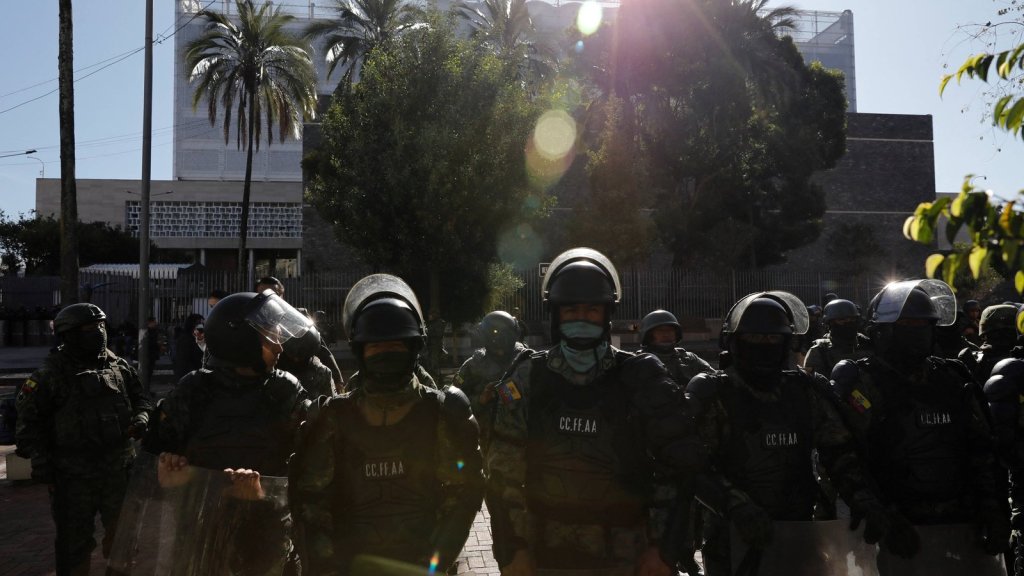
The current outbreak of violence began after the state reacted to the escape from prison of Adolfo Macías — known as “El Fito” — leader of the “Los Choneros” gang. The government declared a state of emergency and tried to impose a siege on the criminals, but suffered several brutal retaliations, with members of Fito’s gang capturing the University of Guayaquil, invading a live TV studio, and even bombing hospitals and public facilities. Furthermore, prisons were captured by criminals, with officers being held hostage, tortured and even hanged. The barbaric scenario led President Daniel Noboa to declare war on the “domestic enemy”, calling on the armed forces to act.
Currently, the streets of Ecuador are the scene of brutal urban warfare, with soldiers facing heavily armed narco-terrorists in intense attrition. The power acquired by criminal groups in the country is impressive, which shows how the impotence of a neoliberal state can have devastating consequences for national security.
It is important to emphasize that U.S.-born Daniel Noboa does not appear to be a skilled politician to reverse this situation completely. He came to power in a tense electoral scenario, in which gangs actively participated in political disputes, even being involved in the murder of a candidate. Noboa is a liberal politician who is extremely aligned with the U.S., and is not interested in resuming Correa’s policies, in addition to suffering a lot of pressure from criminal groups – which have a broad institutional infiltration.
However, it is desirable that at least the public situation in the country returns to normal in some way. The use of military force is the correct way to neutralize gang violence, but it is not the key to solving the drug trafficking problem. To truly undermine the power of criminal networks, it is necessary to implement illiberal policies that reduce poverty, removing ordinary citizens from the sphere of influence of drug trafficking in the country’s periphery. Furthermore, it is necessary to de-dollarize the economy and establish a sovereign currency and exchange rate policy, which make the work of drug trafficking more difficult through strict control of financial flows.
Noboa will certainly not be able to end the drug trafficking problem, as he is not willing to follow the illiberal path, but there is hope that, with the use of force, he will be able to return to normality at some point in the future. After suffering losses on the battlefield, gangs may agree to secretly negotiate a peace agreement with the government to end hostilities on both sides. This will have a positive aspect, as it will put an end to fighting, but it will also have a catastrophic characteristic, as it will definitely turn Ecuador into a Narco-State, where criminal gangs negotiate with the government and act in an institutional manner.
If the U.S. had not intervened in Correa’s Citizen Revolution, perhaps the situation in Ecuador would be different today. But, with neoliberalism and dollarization, the only possible result is a scenario like the current one.
Embrace of the Serpent (Spanish: El abrazo de la serpiente) is a 2015 internationally co-produced adventure drama film directed by Ciro Guerra, and written by Guerra and Jacques Toulemonde Vidal. Shot almost entirely in black and white, the film follows two journeys made thirty years apart by the indigenous shaman Karamakate in the Colombian Amazonian jungle, one with Theo, a German ethnographer, and the other with Evan, an American botanist, both of whom are searching for the rare plant yakruna. It was inspired by the travel diaries of Theodor Koch-Grunberg and Richard Evans Schultes, and dedicated to lost Amazonian cultures.
Embrace of the Serpent was premiered on 15 May 2015 during the Directors’ Fortnight section at the 2015 Cannes Film Festival, where it won the Art Cinema Award. The film was released in Colombia on 21 May 2015, and worldwide over the course of the following twelve months. It has received universal acclaim from critics, who praised the cinematography and the story’s impact of the destruction of the Amazon rainforest and way of life by white colonialism. It has won numerous awards, including the Alfred P. Sloan Prize at the 2016 Sundance Film Festival, the Grand Jury Prize for Best Picture at the 2017 Riviera International Film Festival, and seven awards at the 3rd Platino Awards to recognise the best Ibero-American films of 2015, including the Platino Award for Best Ibero-American Film. In 2016 the film was submitted as Colombia’s entry for the category of Best Foreign Language Film at the 88th Academy Awards and was included among the final five nominees, becoming the first Colombian film ever to receive a nomination for an Academy Award.
The film tells two stories thirty years apart, both featuring Karamakate, an Amazonian shaman and last survivor of his tribe. He travels with two scientists, firstly with the German Theo von Martius in 1909 and then with an American named Evan in 1940, to look for the rare yakruna, a sacred plant.[4]
Theo, an ethnographer from Tübingen who has already been residing in the Amazon for several years, is very sick and is travelling by canoe with his field notes and a westernised local named Manduca who he saved from enslavement on a rubber plantation. Karamakate prolongs his life, blasting white powder called “the sun’s semen” (possibly a hallucinogenic made from virola[5]) up his nose, but is reluctant to become involved with a westerner and refuses his money. Theo is searching for yakruna as the only cure for his disease and the three set off in the canoe to search for it.
Many years later an American botanist, Evan (Brionne Davis), paddles up to a much older Karamakate (Antonio Bolívar) who has apparently forgotten the customs of his own people. Evan says he is hoping to complete Theo’s quest and Karamakate does assist, again reluctantly, saying his knowledge is spent. Evan has a book of Theo’s final trek, which his aide had sent back to Europe, as he did not survive the jungle. The book includes an image of Karamakate, which he refers to as his chullachaqui, a native term for hollow spirit. Karamakate agrees to help him only when Evan describes himself as someone who has devoted himself to plants, although Evan’s real purpose is actually to secure disease-free rubber trees, since the United States’s supplies of rubber from South East Asia had dwindled due to the Japanese wartime advance.
Both expeditions feature a Spanish Catholic Mission by the side of an Amazon tributary, run in 1909 by a sadistic, lone Spanish priest who beats orphan boys for any “pagan” behaviour, and in 1940 by a delusional Brazilian figure who believes he is the Messiah. He only trusts the visitors when he believes they are the Biblical Magi, but Karamakate wins his respect when he heals his wife. By now the children of 1909 have grown into disturbed and violent acolytes.
In 1909, we are left with Theo, sick and having fled the Mission, arriving at a frontier post just about to be invaded by Colombian soldiers during the Amazon rubber boom, where the sacred yakruna is being abused by drunken men, and cultivated, against local traditions. Karamakate is furious and destroys it. In 1940, Karamakate does show Evan the origin of the plant in striking denuded dome-shaped mountains (Cerros de Mavecure), allegedly the home of yakruna. He reveals one yakruna flower that is on the last plant – he has destroyed all the others – and prepares it for Evan. The preparation being hallucinogenic, aids Evan in undergoing a superconscious experience. While most of the film is in black-and-white, a part of this experience is shown in colour to signify its intensity. The film ends with a transformed Evan remaining enamoured by a group of butterflies.
I just finished watching the much-acclaimed series “Narcos” on Netflix. What a fantastic program. And what an excellent depiction of the futility and corruption of the war on drugs.
The series is a true-life account of Pablo Escobar, a Colombian drug lord who headed up the Medellin drug cartel, a black-market drug group that smuggled hundreds of tons of cocaine into the United States in the 1970s and 1980s. Smuggling an estimated 80 percent of the cocaine into the United States, Escobar became known as called the “King of Cocaine,” attaining in the process a net worth of $30 billion by the early 1990s. According to Wikipedia, Escobar was the wealthiest criminal in history.
Amidst much acclaim and publicity, the U.S. government and the Colombian government, working together, targeted Escobar with arrest or killing. Escobar retaliated by effectively declaring war on the government, a war that consisted of assassinations and bombings. Every time the DEA (which was operating in Colombia, along with the U.S. military and the CIA) and Colombian officials tightened the noose on Escobar’s operation, Escobar responded with bullets and bombs, killing a multitude of government officials and private citizens.
The logic of the drug-war crackdown was clear: By eradicating Escobar, officials thought they would be eradicating 80 percent of the cocaine being shipped into the United States. So, all the death and destruction resulting from the crackdown on Escobar was considered worth it in the long run.
But that’s not what happened. The more they tightened the noose around Escobar, the more his cocaine competitors—that is, the ones who were supplying the 20 percent, expanded their operations, gaining them a larger market share. Among the principal beneficiaries of the crackdown on Escobar was the Cali Cartel, which, not surprisingly, became the next big target of the U.S. and Colombian drug warriors, with similar results—the more they cracked down on the Cali Cartel, the more their competitors stepped into the breach and gained a larger market share.
In 1993, they finally caught up to Escobar and killed him in a shootout. You can imagine how U.S. and Colombian officials trumpeted that drug-war victory. Another “milestone” in the war on drugs, the term they have used for decades whenever they kill or capture some big drug lord.
But of course it was all to no avail. Even though they killed Escobar and ultimately smashed the Medellin and Cali cartels, amidst great fanfare and publicity, other suppliers quickly took their places and continued providing cocaine users in the United States with their drug.
In other words, all those people who lost their lives in the drug war on Escobar died for nothing. Absolutely nothing.
There is something else to consider: what the drug war against Escobar did to law-enforcement agents, both American and Colombian. It corrupted them to the core. Frustrated over all the death and destruction that Escobar was wreaking across the country and over their inability to apprehend him, officials began employing brutal and illegal tactics in return, such as torturing prisoners for information and then murdering them so that they couldn’t talk about what the officials had done to them.
Of course, there was also widespread bribery that was taking place within the Colombian police. In fact, that was one of the reasons they had such a hard time catching up to Escobar—his informants within the police and Colombian military would alert him to whatever was going on.
The pathetic thing about all this death, destruction, mayhem, and corruption is that there was a much simpler way to have put Escobar, the Cali Cartel, and all the other black-market drug suppliers out of business, a way that would not have involved assassinations, bombings, torture, and corruption. All that the U.S. and Colombian governments had to do was legalize drugs.
If they had done that, Escobar and the rest of the black-market suppliers would have been put out of business instantaneously. That’s because of the difference between legal markets and black markets.
In legal markets, suppliers compete against each other by providing better goods and services to their customers. Think CVS, Walgreen, and other pharmacies. Notice that they are not out bombing and assassinating each other and other people.
It’s totally different in black or illegal markets. Competitors in these markets deal with each other through violent turf wars that involve murder, kidnapping, bombing, and mayhem. While people like Escobar are able to thrive in a black market, they inevitably go out of business in a legal market because they lack the skills that are necessary in legal markets.
A good example of this phenomenon is alcohol. We don’t see alcohol dealers killing each other to get a larger share of the market. That’s because booze is legal.
But it wasn’t that way when booze was illegal. During Prohibition, there were people like Al Capone involved in the sale and distribution of alcohol, along with killing, mayhem, and corruption.
This same principle, of course, applies today. Notwithstanding all the hoopla to which all of us are subjected when the feds or state drug warriors make a drug bust, the result is no different than it was 20–30 years ago with Escobar. The minute they make the bust, the supplier is replaced by someone else.
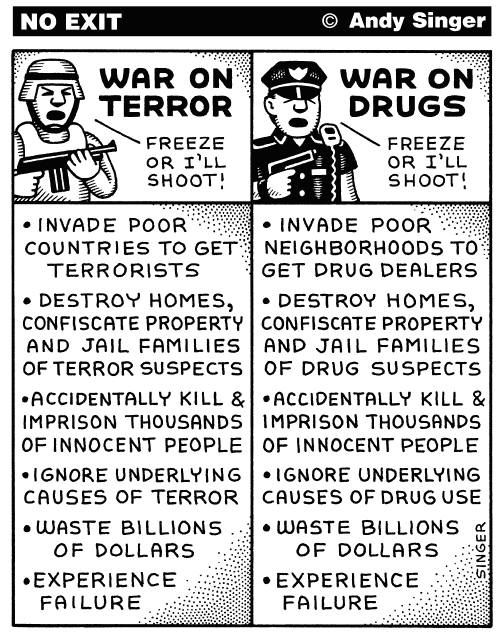
There is only one way to eradicate drug lords and illicit drug dealers, along with all the death, destruction, and corruption that comes with them: End the war on drugs by legalizing drugs.
Jacob G. Hornberger is founder and president of The Future of Freedom Foundation.
+ I’ve spent the week greedily consuming the treats offered up by Wikileaks’s excavation of John Podesta’s inbox. Each day presents juicy new revelations of the venality of the Clinton campaign. In total, the Podesta files provide the most intimate and unadulterated look at how politics really works in late-capitalist America since the release of the Nixon tapes.
+ There’s a big difference, though. With Nixon, the stakes seemed greater, the banter more Machiavellian, the plots and counter-plots darker and more cynical.
+ The Podesta email tranches show the inner mechanics of a much more mundane, petty and banal political machine. Instead of shaping a campaign around an ideological movement, the Clinton operation resembles the packaging of a political mutual fund, a balanced, low-risk portfolio of financial interests, captive NGOs and dependent demographic sectors.
+ The red meat in the emails can be found in the disclosures of the internal rivalries, self-aggrandizement and sycophancy of hired guns and consultants, especially as they gravitate toward Podesta, whose chilly presence looms behind the scenes like the ghost of Thomas Cromwell.
+ The three prevailing obsessions of the Podesta emails: raising money, containing the contamination of the Clinton Foundation and screwing Bernie Sanders. There’s barely any hint of anxiety over Trump. In fact, they relish his every false move, almost as if each faltering step had been pre-visualized, if not orchestrated.
+ If possible, the press corps comes off worse than Team Clinton. Almost every reporter is revealed as pliable, servile and so lazy that they basically beg the Clinton PR shop to write their stories for them.
+ The press has reiterated this obsequiousness over the course of the last seven days with what can only be described as an orgy of coverage of the Trump sex tapes and assorted scandals. By all accounts, the Trump campaign is dead and has been for weeks. The 24/7 obsession now amounts to a kind of political corpse abuse. Forsaken in this feeding frenzy has been any serious attention at all to the Wikileaks email dump, except to echo Clinton camp assertions that they were the victims of a Russian plot to tilt the election to Trump. If so, the Russians have proved even more incompetent than we thought them to be.
+ Of course, the Russian diversion is a convenient excuse for the lapdog press having missed one major scandal after another that has been staring them in the face for months, if not years.
+ Significantly, the email dump also proves what many of us have long suspected: that there are no walls separating the Clinton campaign, its foundation and Super Pacs and the DNC itself. Those supposedly distinct entities are, in fact, all part of one vast, interconnected organization–a syndicate, if you will, that has deftly evaded campaign finance laws (created by Democrats) and rigged its own primary process to ensure a pre-ordained winner.
+ The key thing to remember about the DNC is that it has been under the complete control of the Clintons and their operatives since the 1990s. Obama never cleaned house and installed his own people, a lapse that proved fatal to his own political and legislative agenda. The Clintons’ loyalty to Obama was always paper-thin and conditioned on whether it would advance their own interests: Hillary’s pursuit of the presidency and Bill’s maniacal quest for lucrative speaking fees.
+ It was no surprise that Bill unloaded on ObamaCare a few days ago, calling it the “craziest thing in the world.” The Clintons want to efface Obama’s legacy and replace it with their own, the same way the Pharaohs of ancient Egypt smashed the images of the previous ruler and replaced it with their own visage.
+ So what follows are a few of my favorite revelations from Podesta’s inbox, starting with an email where Podesta is joking about a fundraiser on Martha’s Vineyard. John Podesta: “I didn’t think wet works meant pool parties at the Vineyard.” Another Clinton murder? Check the drain for trace evidence?
+ I can picture the invitation: “HRC Pool Party: Donate or Drown!”
+ Rightwing websites, of course, are taking this as proof, HRC, murdered Scalia.
+ Peter Berlios reminded me of the global outrage when Trump’s special friend, Vladimir Putin, used a similar expression in regard to the Chechens: “We will wet them even in the shit house.”
+ By the way, John Podesta owned 75,000 shares in Leonidio LLC, a firm linked to who? Yes, Vladimir Putin.
+ Podesta’s correspondent in this exchange is Steve Elmendorf, a longtime Democratic powerbroker who was Dick Gephardt’s chief of staff. Over the years, Elmendorf has perfected the art, crucial to any Democratic candidate, of seducing progressive sectors of the party to dutifully line up behind a neoliberal candidate. A few years ago, he explained his strategic thinking this way:
“The bloggers and online donors represent an important resource for the party, but they are not representative of the majority you need to win elections. The trick will be to harness their energy and their money without looking like you are a captive of the activist left.”
+ Bill Richardson is the famously irascible former Governor of New Mexico, who served as Energy Secretary and UN ambassador during Bill Clinton’s second term. The relationship soured when the governor broke ranks and endorsed Barack Obama in 2008. Richardson and the Clintons have been feuding ever since. Indeed, Bill once described the antagonism as a “permanent” state of hostilities.
In August of 2015, Podesta took it on his own initiative to negotiate a detente between the two men. Apparently, Hillary was furious at Podesta’s impertinence. She doesn’t forgive. Podesta writes back urging her to consider the political consequences, especially with Hispanics in must-win western states like Colorado and New Mexico, where Richardson still has pull.
“I had heard that you were upset that I encouraged a call between [Bill Clinton] and Richardson to bury the hatchet. I did that at the request of Jose Villarreal who pushed me and made the point that Richardson is still on TV a lot, especially on Univision and Telemundo and not withstanding the fact that he can be a dick, it was worth getting him in a good place. Probably worth a quick call to ask him to stay stout and publicly endorse, but if it’s too galling, don’t bother.”
+ Even someone as close to the Clintons as Podesta keeps running into the couple’s aversion to apologizing for anything. After issuing a non-apology apology on her email server scandal, Podesta gripes to his number two, Neera Tanden: “No good deed goes unpunished. Press takeaway was the whine of but ‘she really didn’t apologize to the American people. I am beginning to think Trump is on to something.”
Tanden notes: “Everyone wants her to apologize. And she should. Apologies are like her Achilles heel…This apology thing has become like a pathology. I can only imagine what’s happening in the campaign. Is there some way I can be helpful here? I know if I just email her she will dismiss it out of hand.”
Podesta replies tersely: “You should email her. She can say she’s sorry without apologizing to the American people. Tell her to say it and move on, why get hung on this.”
+ Few figures in the Podesta emails come off as more appalling than Neera Tanden, whose primary mission, perhaps the only thing she is really competent at, is detecting even minor deviations from obedience to Clintonian orthodoxy. No one agitates her more than Bernie and his Sandernistas, who she seems ready to dial up a drone strike against at a moment’s notice. She’s the Lee Atwater of neoliberalism, without Atwater’s malign intelligence and sense of humor.
+ Here’s Neera in panic mode over a Wall Street Journal piece on Hillary’s email server quoting an anonymous White House as saying Clinton may have “screwed up” on the matter. Tanden gets so worked up that she seems ready to target Obama: “WH crapping on her is going to send this into orbit.”
+ During one of her speeches-for-hire, Hillary promised Wall Street tycoons that she would block marijuana legalization (don’t want to cut into those tobacco stocks). Here’s her archly worded back and forth with Xerox’s CEO, Ursula Burns, following March 2014 speech. Clinton used Wall Street lingo to express her opposition to ending pot prohibition “in all senses of the word.” Who says she doesn’t have a sense of humor?
URSULA BURNS: So long means thumbs up, short means thumbs down; or long means I support, short means I don’t. I’m going to start with — I’m going to give you about ten long-shorts.
SECRETARY CLINTON: Even if you could make money on a short, you can’t answer short.
URSULA BURNS: You can answer short, but you got to be careful about letting anybody else know that. They will bet against you. So legalization of pot?
SECRETARY CLINTON: Short in all senses of the word.
+ When served with subpoena for records on Benghazi, a seriously agitated Robbie Mook asks, “We’re not releasing EVERYTHING, right?”
+ Among the things the Clinton damage control team must deal with: “Tony Rodham hustling gold mining deals in Haiti.”
+ I wonder if they considered setting up a special squad to deal with Clinton Hustler Eruptions?
+ Mark Siegel, the former executive director of the DNC, emailed Podesta on the eve of the Convention outlining strategies to entice the “self-righteous (Bernie) ideologues” to “work their asses off for Hillary.”
+ “Let’s throw Bernie a bone,” Siegel recommends, in the form of reducing the number of super delegates in 2020 primary campaign. Perhaps “Bernie Bones” could be come a new treat at Ben & Jerry’s?
+ Hillary’s closest advisor and most intimate confident is Huma Abedin. No one more aggressively enforces Hillary’s own wishes or guards her privacy. Abedin, who we must assume is speaking directly for Hillary, is adamant that Hillary continue with her strategy of avoiding press conferences. Each time Hillary answers a few questions at one of her events, the message gets lost, Huma frets. “Can we survive not answering questions from press at message events?”
Podesta swats down this notion emphatically.
“If she thinks we can get to Labor Day without taking press questions, I think that’s suicidal. We have to find some mechanism to let the stream [sic] out of the pressure cooker.”
Not a huge deal, Huma. If HRC is compelled to answer, she can just lie the way she usually does. Hillary’s a natural.
+ One email to Podesta from Hillary’s account in August of 2014 provides confirmation for what we’ve long suspected: Clinton was well aware that Qatar and Saudi Arabia are the principle funders of ISIS in Iraq and Syria:
“While this military/para-military operation is moving forward, we need to use our diplomatic and more traditional intelligence assets to bring pressure on the governments of Qatar and Saudi Arabia, which are providing clandestine financial and logistic support to [ISIS] and other radical Sunni groups in the region.”
+ There’s a reason I started calling MSNBC MSDNC. Here we have an email from a producer of “All In with Chris Hayes” slobbering all over Hillary Clinton in an attempt to secure an appearance on Hayes’ tendentious show:
“Hey Adrienne,
Thanks for your help in getting Karen on with Chris the other night. I have a question for you. As you guys have probably seen, we’ve been airing a ‘Hillary Clinton for Millennials’ segment on our program every night this past week.”
“The point of the segment is basically to inform young people about all of the crap and nonsense that Sec. Clinton and President Clinton (but mostly Sec. Clinton) had to face back in the 90s when President Clinton was running for office…everything from cookie-gate to stand-by-your-man-gate to Hillarycare.”
“The point isn’t to dwell on the past but the point is to talk about this amazing, intelligent woman who probably faced more nonsense back in the day because she is a woman…and she continues to have to face it. She is smarter than most men and more qualified than most men to be president.”
This kind of shameless groveling makes Sean Hannity seem like an objective reporter.
+ How to deal with the Sanders phenomenon haunted even veteran political operators on Team Clinton. Here’s an exchange from January 6, 2016 between Mandy Grunwald and Jennifer Palmieri:
Palmieri: “I liked messing with Bernie on wall street at a staff level for the purposes of muddying the waters and throwing them off their game a bit. But don’t know that it is most effective contrast for her. Seems like we are picking the fight he wants to have.”
Grunwald: “Bernie wants a fight on Wall Street. We should not give him one.”
+ Here’s an excerpt from the Clinton campaing’s press policy, cautioning against allowing coverage of the anemic turnouts at Hillary rallies: “‘Less than a 100 people at a rally? No cell phones! No press!”
+ The emails in 2015 show increasing fear that Elizabeth Warren’s freelance attacks on the big banks and investment houses will alienate the tycoons and moguls who fund the DNC. Nancy Pelosi (Net Worth: $58 million) & Co. scurry to reassure Wall Street: “Elizabeth Warren doesn’t speak for Dem Party!”
+ HRC HQ knew she needed to run against a candidate like Trump. It was her only hope of winning the election & they went to work to make it so. It unnerved some her allies, one of whom wrote Podesta: “Right now I am petrified that Hillary is almost totally dependent on Republicans nominating Trump.”
As the World Burns
+ When there’s no opposition to a war, it will go on forever. See Afghanistan, 15 years and counting. Barbara Lee was the lone vote against it then and one of the few who remember it now. The Authorization for Unilateral Military Force, which launched the Afghan War, has been involved 30 times now for other interventions. Lee should get some kind of peace prize, though not the one awarded to Kissinger, Peres and Obama.
+ Russian meddling in US elections? Yet to be proven. US role in trying to overthrow more than 50 governments worldwide in last 65 years? Fact.
+ Twelve Bush officials sign letter denouncing Trump. Get ready for the Fourth Bush Term!
+ Obama announced this week that Russia will pay a price for hacking into the DNC’s computers, implying that some kind of cyber-attack will be launched on the Kremlin. What’s Obama going to do to the person who leaked the Trump tape or Trump’s tax return? Drone them?
+ Chris Christie, now a wanted man, calls Trump’s comments on kissing and grouping unsuspecting women “completely indefensible “. This is rich coming from a man who publicly humiliates women at his press conferences and then mocked, demonized and locked up a nurse named Kaci Hickox, who had shown the humanity to actually treat Ebola victims.
+ Instead of being subjected to condescending Western philanthropy, Haiti desperately needs to be allowed to chart the course of their own reconstruction. Be sure to read Mark Schuller’s important piece in this week’s CounterPunch.
+ Where’s the feminist outrage over the noxious Jeffrey Goldberg being tapped as the new editor-in-chief of The Atlantic? Judy Miller got run out of the reporting biz for her yellow journalism. Goldberg gets promoted for his! Sexism?
+ With Jeffrey Goldberg helming the Atlantic and Hillary heading for White House, everything is aligning for next big bang war. Good morning, Teheran!
+ Glenn Beck is tortured by a simple question: should he or shouldn’t he vote for Hillary Clinton? When he comes to a resolution perhaps can make his announcement live on Rachel Maddow Show? All together now, follow the bouncing bombs…
+ It took Nixon to go to China, and Donald J. Trump to destroy the GOP from the inside-out. Credit where credit is due. The Donald is fragging the entire GOP establishment, from Paul Ryan to John McCain, as his campaign goes down in flames.
+ Those freaking out over Trump’s joke about jailing Hillary have never shown the slightest angst about her policy of assassinating people, including American citizens, by drone without trial, hearing or indictment.
+ Trump didn’t rise from the swamps of the GOP. He is a monster created, promoted and advertised by the media. Even now they feast on him.
+ Of course, if Trump didn’t exist, the Clintons would have had to invent him. In a way, they did, elevating Trump as the “pied-piper candidate.”
+ Here’s the revolting Curt Schilling, another Pervert for Jesus.
+ Bernie Sanders took off enough time this week from campaigning for Hillary to broadcast this platitude: “When the Founding Fathers were writing the Constitution, I’m pretty sure they weren’t thinking ‘Let’s make sure billionaires can buy elections.’”
But Bernie your old buddy Howard Zinn would have told you that is exactly what the Founding “Fathers” were thinking, which is why they only permitted white land-owning men to enjoy the franchise and doubled down by allowing the southern land barons to keep, breed and sell their slaves to buy elections.
+ The Democrats’ decision to reduce the entire closing chapter of the campaign to a rather prudish emphasis on sexual politics represents a retreat from the party’s frail commitment to tolerance and sexual liberation. Of course, it also protects Hillary from having to grapple with her entangled record on trade, economics, criminal justice and militarism. Just wait for the renewed attacks on rap music, heavy metal, and “Game of Thrones.” Will Tipper Gore be named Culture Czar?
+ Few people know where more of the Clintons’ skeletons are buried than Ken Silverstein, the founder of CounterPunch and one of the best investigative journalists around. As pre-Halloween treat, he unearths a few here regarding the Clinton foundation’s deplorable escapades in Colombia. Silverstein quotes a Colombian union organizer as saying:
“They are doing nothing for workers. I don’t even know what they are doing in this country other than exploiting poverty and extracting money.”
+ Every President needs an Axis of Evil to justify their existence (and those all important defense contracts). Here’s Hillary’s. Read it and bleed.
+ Still, people see through her. Latest WSJ/NBC poll from Ohio, taken after the Trump sex tape and the St. Louis debate, shows HRC still below 50%…with WOMEN voters!
+ Someone sent me a link to a story claiming nervously that while Russia Prepares for War, the US Sleeps. Sleeps? Making Russia prepare for war (and sink billions it doesn’t have into a weapons production that will never come close to rivaling the Pentagon’s armory of mass destruction) has been the point of US foreign policy toward Russia for the last 60 years. Putin is walking blindly into same quagmire that doomed the Soviet Union. (See Andrew Cockburn’s indispensable The Threat. The book may be out of print, but it’s central thesis isn’t.)
+ When Human Rights Watch isn’t clamoring for a humanitarian cruise missile intervention or sabotaging the peace deal in Colombia, it can actually produce some compelling documents, such as this important report on the human toll of the war on drugs. The gist of the report is that every 25 seconds someone is the United States is arrested on simple possession of drugs for their own personal use, totaling more than 1.5 million arrests every year. Each day, there are more than 137,000 people in the US in prison or jail on possession charges, with tens of thousands of others under detention, house arrest or some form of probation.
+ The truly deplorable Joy Behar slimes Bill Clinton’s accusers as “tramps.” I guess that means they should feel grateful that Bill mauled them.
+ Perhaps Trump was just besotted with too much Fitzgerald. After all, he does live in a penthouse as big as the Ritz: “Hard to sit here and be close to you and not kiss you.” (Tender is the Night). Nah…
+ The Washington Post frantically conspired to kill off Nate Parker’s incandescent new film on the Nat Turner slave revolt, Birth of a Nation. After weeks of unrelenting negative publicity, the box office results were meager. The Post couldn’t help but gloat, publishing a stupid little piece by Caitlin Gibson titled: “The Big Debate Over ‘Birth of a Nation’ is Over: Audiences Just weren’t that Interested.”
+ Imagine the Post’s verdict on the greatest American novel: “The big debate over Moby-Dick is over. Only sold 500 copies upon release. Likely never hear from that author again…”
+ The concerted effort to destroy Parker and his film reminds me of the sabotaging of Welles’ Magnificent Ambersons (where a third of the footage was actually dumped in the Pacific Ocean) and John Huston’s fiercely anti-war film of Crane’s Red Badge of Courage, which MGM studios mutilated, cutting the film from its original 2-hour length and adding maudlin voice over narration (See Lillian Ross’s Picture for the gory details.)
+ The announcement that Bob Dylan has won the Nobel Prize for Literature induced much carping from uptight academics about the alleged degeneration of the award. How dare they honor a rock singer? My question is what took them so long? The crusty Nobel committee should have recognized the role of popular music at least 35 years ago and given the prize to Bob Marley. Even Dylan would probably admit that Smokey Robinson should have been in line ahead of him.
+ Still Dylan deserves the recognition. He’s the greatest white blues singer and probably the best songwriter of the rock era. My favorites from across the decades: Masters of War, Highway 61 Revisited, Just Like Tom Thumb Blues, Stuck Inside of Mobile With the Memphis Blues Again, I Want You, All Along the Watchtower, The Man in Me, Forever Young, I Shall be Released, If You See Her Say Hello, This Wheel’s on Fire, Tears of Rage, Hurricane, Precious Angel, Blind Willie McTell, Julius & Ethyl, Heart of Mine, Don’t Fall Apart on Me Tonight, Dark Eyes, Everything is Broken, Love Sick, Not Dark Yet.
+ But I hope he tells the committee to shove it, as did Jean-Paul Sartre. If not, I trust he will stay in character and mumble Dylanesque obscurities to a mystified audience.
+ Wikileaks reports that Keith Richards was on the short list for Nobel Prize in Chemistry. Robbed!
In the Presidential Election of 2016, Republican and Democratic insiders are wrestling like two dogs over a bone over who controls the illegal drug trade.
To the victor go the spoils. Who wins the election wins control of America’s vast drug bazaar, largest in the world, whose proceeds prop up lucky bankers and politicians lapping at the trough of the biggest richest slush fund in the history of the world.
It’s the smart play
It’s the biggest business in the world, and the No. 1 industry on the face of the planet, in terms of foreign trade. And if you didn’t know that about the illegal drug trade, then the vast amounts spent on propaganda and disinformation every year in the so-called “War on Drugs” is working.
The first industry to globalize vertically was the illegal drug business. It’s an open question whether drug trafficking drove globalization, or the other way around.
Negotiated by Bill Clinton, the chief beneficiary of NAFTA (North American Free Trade Agreement)—by dollar volume and impact on the economy—was the drug trade.
The Democrats, committed to globalization, will continue to farm out transportation and money laundering to, among others, minions of Mexico’s President Enrique Nieto Pena, cronies of retired Colombian strongman Alvaro Uribe, and a host of eager bankers from the world’s largest banks.
Will a Republican victory will bring back Oliver North? No, it’ll be a Trump Administration appointee with a certain erect posture and short-but-stylishly-cut hair, chosen to occupy the Oliver North seat on the National Security Council.
The Enterprise Lives. And prospers.
Why there’s no Global War on Johnnie Walker Red
Although America’s sun is slowly sinking below the horizon, the country still boasts the biggest and the best illegal drug delivery pipeline on the planet, so efficient it’s sick, the and envy of the world. The UK and Europe may be nipping at our heels, growing bigger vis a vis the U.S. as drug consumers, but the U.S. remains the biggest market.
This market is what we sell to the world; one of a few businesses where we’re still No. 1, along with financial services, which basically means meaning laundering drug money, and movies based on comic books.
“In 2012, 3.3 million deaths, or 5.9 percent of all global deaths, were due to alcohol consumption.”
If the U.S. cares about the health of its citizens we’ll soon have a Liquor Enforcement Administration(an LEA), with approximately sixteen times the funding that the War on Drugs receives every year, which is 40 billion dollars.
That’s within reach of the Pentagon budget; its safe to say it ain’t gonna happen.
It doesn’t happen, becauses of the banks, and also because, as the UN World Drug Report also states, and flatly, worldwide people spend more money on drugs every day than on food.
Yup. You can look it up.
An even bigger reason: Global Too Big to Jail Banks.
London’s Financial Times has warning for global elite
Even when you think you’re talking about something else, you’re talking about drugs, even if you don’t know it. London’s Financial Times briefly surfaced from the 19th Century with a headline reading “Global elites must heed the warning of populist rage’
“The explanation for the prolonged stagnation in real incomes are repeated financial crises and subsequent weak recoveries, which have destroyed popular confidence in the competence and moral principles, honesty, and decency of the elite.”
The greedy parasitic elite that betrayed the middle class, and the country.
The Times continues, “The role of finance is excessive. The financial system remains riddled with perverse incentives.”
Without drug money there is no financialization. Because the banks by themselves don’t have the capital. Some say that sounds like a good thing.
“Air America meets Traffic meets Pineapple Express”
A steady diet of movies like the upcoming ‘Mena’ starring Tom Cruise playing the supposedly-swashbuckling former Air America pilot Barry Seal, has given the movie-going public the idea that the real action in the illegal drug trade is in drug trafficking.
That’s not the case. The real action is in money laundering. Because if you can’t wash clean the money you end up with, it quickly becomes useless to anyone with more long-term goals than throwing the biggest party or longest orgy the world has ever seen. And because money weighs more than drugs—and is way more bulky unless you’re smuggling marijuana which is today considered more out of the stone age than old school.
So there’s a problem. Providing a solution are casinos, bodegas, cambios, Western Union, grocery stores, restaurants, even dry cleaners, and banks. Especially banks. In fact it they weren’t for laundering drug money, HSBC, JP Morgan, Barclays and Bank of America would have already gone the way of Mario Brothers or YAHOO, which only makes news anymore when pieces are sold off in foreclosure.
Three brief moments in time in the drug trade
A Turkish boat carrying a massive 3.2 tonnes of high purity cocaine hidden in a ballast tank at the front of the MV Hamal was busted 100 miles east of the Aberdeenshire coast.
It was a record $673 million (£512 million) cocaine haul.The captain and second in command—Mumin Sahin and Emin Ozmen—were convicted, and sent to prison.
“The Captain and the second in command” are the drug trade’s equivalent of David Letterman Show favorites Mujibur and Sirajul, who ran a t-shirt shop in a tiny frontage near the Ed Sullivan Theater. They were ordinary people who Letterman found exceptional just because there were so ordinary.
Is there a shortage of people ready to take a chance smuggling a half-billion cargo? Is that the plan?
“Operation SCREENPLAY” gets a tentative green light
“OPERATION Screenplay will go down as one of the all-time great UK drug busts,” enthused John McGowan, head of border investigations.
“To put it in perspective, the total seizure of cocaine by all police forces in England and Wales in 2014-15 was 3.4 tons. That was for everything. This single seizure was 3.2 tons.”
In a blatant pitch for more government funding—so that he could presumably really go to town, he added, “And all we had was intelligence from the French that there was a considerable quantity of cocaine on board.”
The paper seemed not so sure. The report ended, “Despite the size of the seizure, anecdotal evidence suggests police did not record a dip in the amount of cocaine on our streets.”
Playing whack-a–mole around the world
An expert who testified at their trial about “recognised trade routes” for shipping cocaine was perhaps a little too candid. He told the jury:
“It is now south of Venezuela and Guyana because of a lot of enforcement activity by the USA patrolling the coast. It’s massive importation – unprecedented in my experience.”
Those sneaky traffickers. Always playing whack-a-mole.
Cocaine production in Colombia increased dramatically—shooting up a staggering 46 percent—last year.The country now has the resources to produce 712 tons of cocaine annually. Growth exploded in lawless areas in the Sierra Nevada mountains in the north and in the Amazon region, on the Venezuelan and Ecuadorean borders and along the Pacific coast.
But cultivation dropped in central Colombia, where the people running both Colombia’s government and drug trade of Colombia.
Huh. Imagine that.
The Mexican Navy left with many barrels of zesty condiments
The Mexican navy found 13 tons of cocaine inside barrels of hot sauce in Manzanillo, 500 miles west of Mexico City. The barrels full of zesty condiment and cocaine were believed to belong to the Sinaloa Cartel.
A week earlier, busy Mexican sailors discovered almost a ton of cocaine—more than 900 keys—floating in the open sea off the coast of Chiapas.
A ton of cocaine. Just… floating…100 miles from shore.
The world’s richest industries
How much money an industry makes is the best rule of thumb for how much clout that industry exerts on the countries in which it operates. The illegal drug trade has yearly revenues exceeding the 946 billion in annual revenue of Walmart, Microsoft, Google, Ebay, and British Petroleum, combined.
In the U.S., and almost everywhere else, it’s a cash cow of almost unimaginable proportions.
The richest industries are all based on at assets we use in our lives every day, from computers to entertainment, to oil, to shopping, to drugs. According to therichest.com, “They are industries we give our hard-earned money to out of necessity, desire, or a mix of the two. And they also tend to be the most valuable, and not just from a monetary standpoint. Their value lies in the fact that they’re needed to help society advance and function smoothly.”
Imagine several hundred million people trying to get through Monday morning with coffee. Luckily, that won’t ever happen.
About Daniel Hopsicker
Daniel Hopsicker is an investigative journalist dubious about the self-serving assertion of U.S. officials that there are no American Drug Lords.
For over two decades now, US planes have been dumping tons of pesticides over Columbian coca fields. America’s immoral and asinine policy of the War on Drugs has perpetuated the aerial spraying of Monsanto’s Roundup over rural areas of Columbia since 1994.
Originally the Columbian government wholeheartedly supported the ridiculous notion of mass killing all vegetation in attempt to cull the drug trade. However, it is no longer a secret that the health effects of long-term exposure to glyphosate are less than desirable.
Just last month, the World Health Organization was forced to admit that glyphosate is “probably carcinogenic to humans.”
The recent acceptance by the mainstream that Monsanto’s Roundup causes a slew of negative health effects has sparked fear and infighting among the Columbian government.
Health Minister Alejandro Gaviria said last week that Colombia should “immediately suspend” spraying — a move vehemently opposed by Defense Minister Juan Carlos Pinzon, who said it would “give criminals the upper hand.”
The row erupted just as US Deputy Secretary of State Antony Blinken paid a visit to Colombia, which the United States sees as one of its closest allies in the region.
The politicians who are fear-mongering about stopping the program are likely scared of losing the hundreds of millions in funds received annually from the US to combat the cultivation of this plant.
Daniel Mejia, the head of Colombia’s Center for Research on Security and Drugs explained why they are worried about the program. “We carried out a study that showed fumigating caused dermatological and respiratory problems and provoked miscarriages,” he said.
Even if dumping massive amount of carcinogenic pesticides from airplanes was a good idea, it’s not effective. According to the United Nations Office on Drugs and Crime, this program has aided Colombia in reducing its coca fields from more than 140,000 hectares (346,000 acres) in 2001 to 48,000 hectares in 2013. However, they conveniently left out the increase seen last year. The amount of land under coca cultivation in Colombia jumped 39 percent in 2014 to 112,000 hectares (about 27,000 acres), according to the Office of National Drug Control Policy.
Cocaine trafficking in Latin American region has caused a slew violence and turmoil, including the Columbian civil war. However, this turmoil is a direct result of prohibition spearheaded by the United States.
Columbia never had a cocaine trafficking problem until the US-funded war on drugs began its destructive path across South America.
During the 1980s, Peru, Bolivia and Colombia were responsible for 65%, 25% and 10% of the world’s coca production respectively. By 2000, however, the US “war on drugs” in neighboring Andean countries had turned Colombia into the world’s largest cocaine producer by far, representing 90% of the total, according to a report from the from the Woodrow Wilson International Center for Scholars.
The coca plant is one of the most beneficial and astonishingly resilient plants in the world. Resistant to drought and disease, coca needs no irrigation and the alkaloids it contains provide a myriad of medicinal uses. From its analgesic effects to digestive aid, coca’s positive influence in medicine is vast.
The plant has played an important role in history dating back to the Pre-Inca period.
According to a study published by Harvard University in 1975, (Nutritional Value of Coca Leaf (Duke, Aulick, Plowman 1975)) chewing 100 grams of coca is enough to satisfy the nutritional needs of an adult for 24 hours. Thanks to the calcium, proteins, vitamins A and E, and other nutrients it contains, the plant offers even better possibilities to the field of human nutrition than it does to that of medicine, where it is commonly used today.
However, the state cares not about the benefit of such a plant, only that it can be turned into a white powdery substance and snorted to stimulate long and often nonsensical conversations. Instead of cultivating the plant for its benefits, the immoral war on drugs drops carcinogens from airplanes to stop its growth.
The president of Columbia, Juan Manuel Santos, is avoiding any stance on the aerial spraying program whatsoever. According to the AFP, his staff said the final authority on the matter is the National Narcotics Council, which falls under the Justice Ministry. In the meantime, however, the spraying continues.



 After the Crash