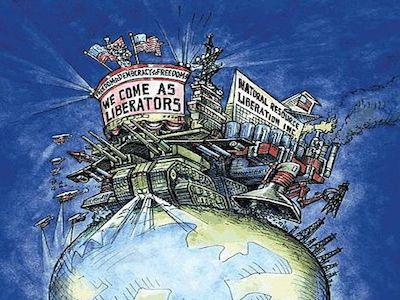
Western ‘Civilization’ Is Doomed to Aggressive Collapse, and by its Own Hand

By Gary D. Barnett

Source: GaryDBarnett.com

“Western civilization is a loaded gun pointed at the head of this planet.”

~ Terence McKenna

The word civilization from Latin is civis, which means citizen, and civitas, which means city-stateIt is seen as ‘enlightened culture’ instead of barbarism. A more modern take on the Latin root of this word would be a society which has developed a writing system, government, production of surplus food, division of labor, and ‘urbanization.’ The two trouble spots here are the false belief in the necessity of government and of urbanization. Both indicate collectivism instead of the individual and independent rule, in what should properly be a voluntary society. Regardless, a so-called ‘civil society’ today is what would be thought of as a mature, progressive, and non-barbarous state of ‘superiority.’ The ancient Greeks clarified this as far back as the fifth century BCE, and felt themselves above others who were not as worthy in their minds. As time passed, a citizen was not just a resident of a particular area, but in reality, became the property of the State, or more accurately, a lifetime indentured servant.

A common truth that should be recognized, is that in order to be a citizen in the modern world, one must be considered of secondary importance to the State or nation, and therefore a pawn or slave of that State or nation. After all, initially, ‘citizenship’ is decided simply by state of birth, or by parent’s state of birth. Each individual has no say in their original and usually lifetime citizenship, and this classification, as in herd animals, is a label decided by the ruling political class. This is not any indication of freedom, as should be quite obvious, but is a pronouncement of inferiority to rule, which negates from birth the individual in favor of the State. There is no need to get further into the particulars of this type of human ownership in this discussion, but sufficed to say, how can one be considered to be free when born a slave?

The subject here is the fate of what is considered Western Civilization, and why it is doomed to not only failure, but complete collapse as a political and ruling force. In fairness, all civilizations eventually fail, and in my opinion, this is mainly due to the false belief that a system of top-down rule, restrictive laws, and completely concentrated co-existence, is necessary for sustained survival. While the division of labor is extremely useful in many if not most aspects of modern life, total concentration of populations is not  mandatory for civilization to survive and prosper. But it is the desired outcome by those who rule, (consider ‘smart cities’) because it allows for easier control over the masses of common people, who always far outnumber the ruling class, and are therefore considered a continuous threat to their power.

The ‘West’ has claimed to be the most superior, most benevolent, most enlightened, and most powerful group of nation-states for centuries, but it is coming apart at the seams so quickly that its influence and grip on the rest of the world could end in short order. But is that the designed plan, or is it due to outrageous arrogance, criminal excess at every level of existence, devastation of the monetary and economic systems, widespread brutal aggression, or all the above?

Western civilization is certainly on the brink of extinction, and the sought after replacement is that of a technocratic world governing system run by the very few. It seems the further man supposedly advances, the more backward is his pretend progress. Certainly, and positively in the U.S, intelligence levels and the ability to think critically have all but disappeared; this in a time when western society is ‘claimed’ to be the most ‘educated.’ In fact, the exact opposite is the case, as schooling in this country has caused mass ignorance and stupidity over generations, all by design. In order to control the people, the West decided long ago to purposely dumb down the common population, and indoctrinate them to such an extent, as to make impotent the idea of individual legitimate thought, and any ability to question authority. This tactic by the State was successful in its mission, but also successful in creating its own demise. This is quite the irony, but then that is the way of the madness of humanity.

Consider our current reality for a moment, and then consider the outcome of this political experiment. This nation, although never totally free, was one of wonder for a good portion of its history. 170 years ago, nearly 100% literacy was common, classical education was brilliant, and children were intelligent, driven, responsible, and grown up by the time they were in their mid-teens or before. Most all were entrepreneurs and understood moral principles, self-responsibility, and the importance of family. They based their lives on logic and reason, and due to these attitudes, were incredibly valuable to the building of independent, honest, virtuous, and vital societies. If one is to compare that to today’s population, an awakening should immediately occur.

Currently, this country is in the midst of a complete and total mental breakdown of the masses, in that they are not, generally speaking, responsible for themselves, and are dependent on an evil and heinous government. The intellectual capabilities of the general population have descended into the realm of effective illiteracy of the majority, regardless of age. Hate is the new norm accepted by the proletariat, sexual perversion is in full view of all, and promoted by the State. Theft, looting, property destruction, and violence at every turn, are openly ignored, while being sanctioned by government and its complicit mouthpieces in the rotten media. Constant war is tolerated, the murdering military is lauded as heroes, while truthtellers are shamed, threatened, and ostracized, and in some cases eliminated. ‘Reverse’ racism is rampant and applauded, while society has become married to victimization as a way of life. Self-esteem, confidence, responsible behavior, empathy, and the drive to succeed have disappeared from view. Total government control, destruction of wealth of all but the super-rich, blanket surveillance, lockdowns, ludicrous and immoral mandates, mass bio-weapon tyranny, tremendous property theft, and purposeful murder of innocents is routine, and mostly ignored. Entire towns and cities are being intentionally destroyed, thousands burned to death with microwave or directed energy weapons, or by other atrocious means, while those affected clamor for more government assistance, instead of eliminating the criminal and murderous State that is at the heart of all this barbarous madness.

The governing systems of Western societies have no intention, and never have, to free or protect the people, as the only goal sought by these evil ruling monsters, is power and control of all by brute force, lies, propaganda, and murder. Western civilization will be purposely relegated to the dustbin of history; the result being the swift and merciless destruction of life and all societal cohesion. Without mass dissent and non-compliance, bogus ‘climate change,’ currency destruction, digitization of all aspects of life, concentration of populations, famine, property theft, war, and transhumanism, will lead to even more perverse behavior, idiocy, and mass indifference of the majority.

This will signal the end of an era, and the beginning of a permanent hell on earth. This was caused by the masses of collective hordes ignoring their responsibility to themselves, in favor of the expectation of total dependence instead of individual excellence. No one can hide from reality forever, as it will eventually catch up and swallow you whole.

The State cannot rule successfully unless the people voluntarily allow it, and choose to surrender to obedience and a life of slavery. Only people who will accept and be convinced of truth, and have the courage to act on that truth, can be of use to freedom. All others, those who do not want to know the truth, those who continue to cling to the State’s false narratives, and who seek a master, should be absolutely avoided, as they will never help or improve themselves, and therefore will be of no value to those who seek real freedom.

“Violence is not necessary to destroy a civilization. Each civilization dies from indifference toward the unique values which created it.”

 ~ Nicolas Gomez Davila, 1913-1994, Columbian writer
US Empire of Debt Headed for Collapse

By Pepe Escobar

Source: The Unz Review

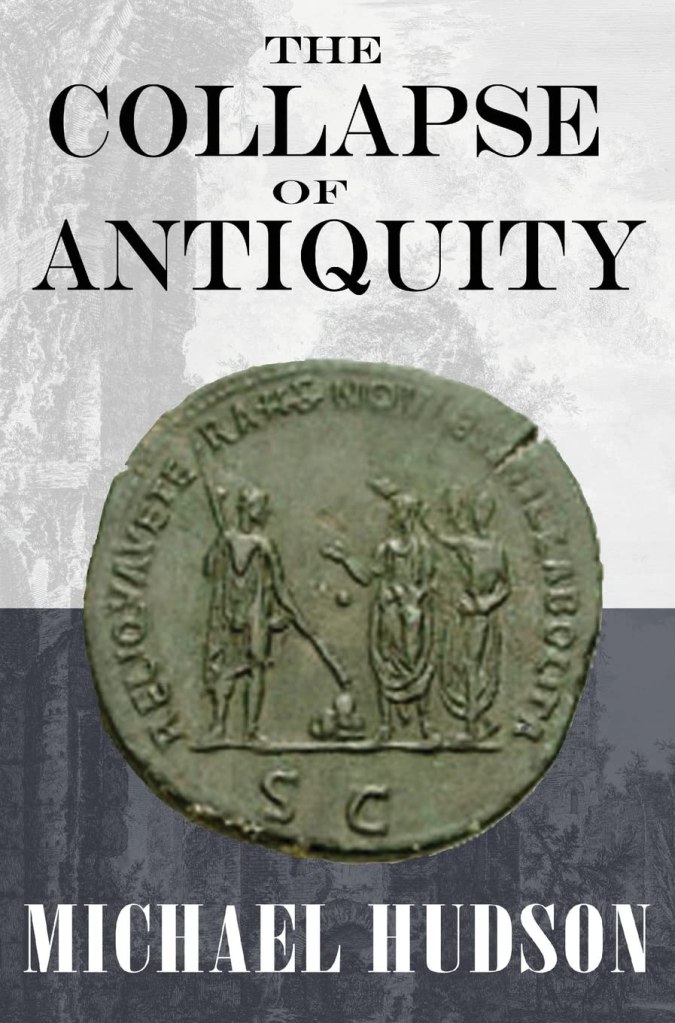
Prof. Michael Hudson’s new book, The Collapse of Antiquity: Greece and Rome as Civilization’s Oligarchic Turning Point is a seminal event in this Year of Living Dangerously when, to paraphrase Gramsci, the old geopolitical and geoeconomic order is dying and the new one is being born at breakneck speed.

Prof. Hudson’s main thesis is absolutely devastating: he sets out to prove that economic/financial practices in Ancient Greece and Rome – the pillars of Western Civilization – set the stage for what is happening today right in front of our eyes: an empire reduced to a rentier economy, collapsing from within.

And that brings us to the common denominator in every single Western financial system: it’s all about debt, inevitably growing by compound interest.

Ay, there’s the rub: before Greece and Rome, we had nearly 3,000 years of civilizations across West Asia doing exactly the opposite.

These kingdoms all knew about the importance of canceling debts. Otherwise their subjects would fall into bondage; lose their land to a bunch of foreclosing creditors; and these would usually try to overthrow the ruling power.

Aristotle succinctly framed it: “Under democracy, creditors begin to make loans and the debtors can’t pay and the creditors get more and more money, and they end up turning a democracy into an oligarchy, and then the oligarchy makes itself hereditary, and you have an aristocracy.”

Prof. Hudson sharply explains what happens when creditors take over and “reduce all the rest of the economy to bondage”: it’s what’s called today “austerity” or “debt deflation”.

So “what’s happening in the banking crisis today is that debts grow faster than the economy can pay. And so when the interest rates finally began to be raised by the Federal Reserve, this caused a crisis for the banks.”

Prof. Hudson also proposes an expanded formulation: “The emergence of financial and landholding oligarchies made debt peonage and bondage permanent, supported by a pro-creditor legal and social philosophy that distinguishes Western civilization from what went before. Today it would be called neoliberalism.”

Then he sets out to explain, in excruciating detail, how this state of affairs was solidified in Antiquity in the course of over 5 centuries. One can hear the contemporary echoes of “violent suppression of popular revolts” and “targeted assassination of leaders” seeking to cancel debts and “redistribute land to smallholders who have lost it to large landowners”.

The verdict is merciless: “What impoverished the population of the Roman Empire” bequeathed a “creditor-based body of legal principles to the modern world”.

Predatory oligarchies and “Oriental Despotism”

Prof Hudson develops a devastating critique of the “social darwinist philosophy of economic determinism”: a “self-congratulatory perspective” has led to “today’s institutions of individualism and security of credit and property contracts (favoring creditor claims over debtors, and landlord rights over those of tenants) being traced back to classical antiquity as “positive evolutionary developments, moving civilization away from ‘Oriental Despotism’”.

All that is a myth. Reality was a completely different story, with Rome’s extremely predatory oligarchies waging “five centuries of war to deprive populations of liberty, blocking popular opposition to harsh pro-creditor laws and the monopolization of the land into latifundia estates”.

So Rome in fact behaved very much like a “failed state”, with “generals, governors, tax collectors, moneylenders and carpet beggars” squeezing out silver and gold “in the form of military loot, tribute and usury from Asia Minor, Greece and Egypt.” And yet this Roman wasteland approach has been lavishly depicted in the modern West as bringing a French-style mission civilisatrice to the barbarians – while carrying the proverbial white man’s burden.

Prof. Hudson shows how Greek and Roman economies actually “ended in austerity and collapsed after having privatized credit and land in the hands of rentier oligarchies”. Does that ring a – contemporary – bell?

Arguably the central nexus of his argument is here:

“Rome’s law of contracts established the fundamental principle of Western legal philosophy giving creditor claims priority over the property of debtors – euphemized today as ‘security of property rights’. Public expenditure on social welfare was minimized – what today’s political ideology calls leaving matters to ‘the market’. It was a market that kept citizens of Rome and its Empire dependent for basic needs on wealthy patrons and moneylenders – and for bread and circuses, on the public dole and on games paid for by political candidates, who often themselves borrowed from wealthy oligarchs to finance their campaigns.”

Any similarity with the current system led by the Hegemon is not mere coincidence. Hudson: “These pro-rentier ideas, policies and principles are those that today’s Westernized world is following. That is what makes Roman history so relevant to today’s economies suffering similar economic and political strains.”

Prof. Hudson reminds us that Rome’s own historians – Livy, Sallust, Appian, Plutarch, Dionysius of Halicarnassus, among others – “emphasized the subjugation of citizens to debt bondage”. Even the Delphic Oracle in Greece, as well as poets and philosophers, warned against creditor greed. Socrates and the Stoics warned that “wealth addiction and its money-love was the major threat to social harmony and hence to society.”

And that brings us to how this criticism was completely expunged from Western historiography. “Very few classicists”, Hudson notes, follow Rome’s own historians describing how these debt struggles and land grabs were “mainly responsible for the Republic’s Decline and Fall.”

Hudson also reminds us that the barbarians were always at the gate of the Empire: Rome, in fact, was “weakened from within”, by “century after century of oligarchic excess.”

So this is the lesson we should all draw from Greece and Rome: creditor oligarchies “seek to monopolize income and land in predatory ways and bring prosperity and growth to a halt.” Plutarch was already into it: “The greed of creditors brings neither enjoyment nor profit to them, and ruins those whom they wrong. They do not till the fields which they take from their debtors, nor do they live in their houses after evicting them.”

Beware of pleonexia

It would be impossible to fully examine so many precious as jade offerings constantly enriching the main narrative. Here are just a few nuggets (And there will be more: Prof. Hudson told me, “I’m working on the sequel now, picking up with the Crusades.”)

Prof. Hudson reminds us how money matters, debt and interest came to the Aegean and Mediterranean from West Asia, by traders from Syria and the Levant, around 8th century B.C. But “with no tradition of debt cancellation and land redistribution to restrain personal wealth seeking, Greek and Italian chieftains, warlords and what some classicists have called mafiosi [ by the way, Northern European scholars, not Italians) imposed absentee land ownership over dependent labor.”

This economic polarization kept constantly worsening. Solon did cancel debts in Athens in the late 6th century – but there was no land redistribution. Athens’ monetary reserves came mainly from silver mines – which built the navy that defeated the Persians at Salamis. Pericles may have boosted democracy, but the eventful defeat facing Sparta in the Peloponnesian War (431-404 B.C.) opened the gates to a heavy debt-addicted oligarchy.

All of us who studied Plato and Aristotle in college may remember how they framed the whole problem in the context of pleonexia (“wealth addiction”) – which inevitably leads to predatory and “socially injurious” practices. In Plato’s Republic, Socrates proposes that only non-wealthy managers should be appointed to govern society – so they would not be hostages of hubris and greed.

The problem with Rome is that no written narratives survived. The standard stories were written only after the Republic had collapsed. The Second Punic War against Carthage (218-201 B.C.) is particularly intriguing, considering its contemporary Pentagon overtones: Prof. Hudson reminds us how military contractors engaged in large-scale fraud and fiercely blocked the Senate from prosecuting them.

Prof. Hudson shows how that “also became an occasion for endowing the wealthiest families with public land when the Rome state treated their ostensibly patriotic donations of jewelry and money to aid the war effort as retroactive public debts subject to repayment”.

After Rome defeated Carthage, the glitzy set wanted their money back. But the only asset left to the state was land in Campania, south of Rome. The wealthy families lobbied the Senate and gobbled up the whole lot.

With Caesar, that was the last chance for the working classes to get a fair deal. In the first half of the 1st century B.C. he did sponsor a bankruptcy law, writing down debts. But there was no widespread debt cancellation. Caesar being so moderate did not prevent the Senate oligarchs from whacking him, “fearing that he might use his popularity to ‘seek kingship’” and go for way more popular reforms.

After Octavian’s triumph and his designation by the Senate as Princeps and Augustus in 27 B.C., the Senate became just a ceremonial elite. Prof Hudson summarizes it in one sentence: “The Western Empire fell apart when there was no more land for the taking and no more monetary bullion to loot.” Once again, one should feel free to draw parallels with the current plight of the Hegemon.

Time to “uplift all labor”

In one of our immensely engaging email exchanges, Prof. Hudson remarked how he “immediately had a thought” on a parallel to 1848. I wrote in the Russian business paper Vedomosti: “After all, that turned out to be a limited bourgeois revolution. It was against the rentier landlord class and bankers – but was as yet a far cry from being pro-labor. The great revolutionary act of industrial capitalism was indeed to free economies from the feudal legacy of absentee landlordship and predatory banking — but it too fell back as the rentier classes made a comeback under finance capitalism.”

And that brings us to what he considers “the great test for today’s split”: “Whether it is merely for countries to free themselves from US/NATO control of their natural resources and infrastructure — which can be done by taxing natural-resource rent (thereby taxing away the capital flight by foreign investors who have privatized their natural resources). The great test will be whether countries in the new Global Majority will seek to uplift all labor, as China’s socialism is aiming to do.”

It’s no wonder “socialism with Chinese characteristics” spooks the Hegemon creditor oligarchy to the point they are even risking a Hot War. What’s certain is that the road to Sovereignty, across the Global South, will have to be revolutionary: “Independence from U.S. control is the Westphalian reforms of 1648 — the doctrine of non-interference in the affairs of other states. A rent tax is a key element of independence — the 1848 tax reforms. How soon will the modern 1917 take place?”

Let Plato and Aristotle weigh in: as soon as humanly possible.

I Used To Be Disgusted, Now I’m Disabused

By Charles Hugh Smith

Source: Of Two Minds

It’s certainly possible to be disgusted, but being disabused of the fantasy that the system is self-correcting is the healthier perspective.

I used to be disgusted, now I’m disabused: beneath all the self-serving narratives, fad-memes and over-simplifications regurgitated as serious analysis, these are the core dynamics I see:

1. Imperial corruption of democracy and open markets. I described this in Regardless of Who’s Elected, Imperial Corruption Rules the Nation: the dynamic adaptive churn of unfettered representative democracy and open markets are anathema to insiders, vested interests and elites, each of which has gained asymmetric power by subverting democracy and markets to serve their private interests rather than the public interest / common good–phrases that are meaningless to insiders, vested interests and elites except as simulacra used for PR.

2. The Deep State, the unelected and unaccountable Administrative State. I’ve been discussing the Deep State before it entered common use–for example:

Going to War with the Political Elite You Have (May 14, 2007)

The Dollar and the Deep State (February 24, 2014)

Is the Deep State Fracturing into Disunity? (March 14, 2014)

The Administrative State has existed in some form in every nation-state / empire, but the U.S. Deep State only gained its vast global powers in World War II and the Cold War, where the lesson learned was the public may choose unwisely (for example, choosing appeasement over preparation) and so the really important decisions needed to preserve the nation cannot be left to parochial politicos in elected office–those decisions must be in the hands of those who know what has to be done.

Democracy is the rubber stamp for doing what’s necessary. Beyond that, it’s a potentially fatal hindrance. That’s the mindset of the Deep State, and if you and I were in upper-echelon positions in the Administrative State, we’d agree with this mindset when things get serious.

This mindset is a self-reinforcing group-think feedback loop: those who believe the public should set policy are weeded out, either by self-selection or via being sent to bureaucratic Siberia.

We’re protecting you. That’s all you need to know.

This opens the door to functionaries who came to do good but stayed to do well, i.e. those with the right credentials and connections to enter the Power Circle to “serve the public” but soon become insiders maximizing their own private gains. That’s the problem with the Administrative State: it’s ultimately unaccountable, not just to the public or elected officials but to itself.

3. Vested interests block adaptions that threaten their share of the spoils. Any advance that increases efficiency and productivity and furthers the public good is squelched, suppressed or co-opted by vested interests who rightly fear their share of the spoils might be diminished by advances that obsolete their particular cartel, monopoly or other embedded skim, scam, fraud, embezzlement or simply unproductive dead weight.

The status quo is thus locked into a death spiral as gatekeepers, insiders, vested interests and sold to the highest bidder politicos will protect vested interests even as the engines flood and the ship begins its long descent into the void.

How do otherwise smart people become so blind to what’s going on? They believe the status quo is so wealthy, so powerful, so clever, etc., that it will overcome any obstacles or crises because it’s always done so in the past, and so it is permanent, immutable, forever, and our supping at the trough of free money couldn’t possibly weaken such an enduring Leviathan.

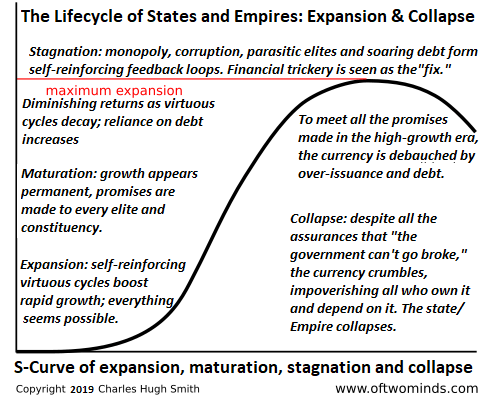
This is the fatal fantasy of every empire. We’re too successful to fail and collapse. But oddly enough, faith in the permanence of success leads to the very collapse that’s deemed “impossible.”

4. Concentrations of wealth, power, capital and production fatally distort the economy and the social order. When “competition” has been reduced to two telecoms, two healthcare insurers, two pork processors, etc., the system has been stripped of adaptability and resilience.

When 10,000 small farmers each have 100 chickens, the stock of 1 million chickens is spread over a wide geography and entrepreneurial network of suppliers, wholesalers, etc. Bird flu may spread widely but it’s far more difficult to wipe out 10,000 small farms’ poultry compared to the ease of bird flu spreading in one giant factory that concentrates 1 million chickens in one facility. Supply chains stripped of network resilience are equally fragile and prone to disruption and collapse.

Concentrating any form of capital, production and power renders the system vulnerable to collapse due to the inherent weaknesses generated by replacing complex networks with vertical-integration under the control of a few cartels, monopolies, autocrats, gatekeepers or regulators–the latter two being easily influenced by political pressure and/or private gain.

It’s certainly possible to be disgusted, but being disabused of the fantasy that the system is self-correcting is the healthier perspective. Everything is forever until systemic weaknesses reveal themselves, typically at the most inopportune junctures.

Peering Into the Crystal Ball, We See… Instability Leading to Collapse

By Charles Hugh Smith

Source: Of Two Minds

We can only choose one: open, dynamic stability (evolution) or autocracy (instability and collapse).

When the fundamentals of life change, every organism must evolve or die. This is equally true of human organizations, societies and economies.

Evolution requires conserving what still works and experimenting until something comes along that works better. We call the fundamentals changing selective pressure and the process of experimenting with mutations / variations natural selection.

In genetic and epigenetics, this process is automatic. In human organizations, those in power influence the choice of what is conserved or replaced and what it’s replaced with. Those who benefit from the current arrangement will fight to conserve it as is, while those being weakened by selective pressure and those hoping to gain advantages with a new arrangement will fight for replacing the old with the new.

Longtime correspondent Ron G. recently shared an insightful economic characterization of this dynamic: wealth defense vs wealth creation. Those holding the system’s wealth have few incentives to risk changing the system, as those changes could undermine or erode their wealth. They have incentives to limit evolutionary forces that threaten their wealth as a means of defending their wealth.

Those who have lost wealth and those with little wealth have incentives to change the system to favor wealth creation.

We can describe the first as orthodoxy–evolution threatens the stability of the status quo, so limit evolution to the margins–and heretics being the second option that tosses out the status quo in favor of a more advantageous variation.

This isn’t either / or, of course. As Ron points out, corporations have incentives to both conserve stability and embrace variations that increase revenues and profits by expanding the markets for the company’s products. In Ron’s words: “The function of orthodoxy or corporate policy / rigor is to mitigate variations that would decrease stability.”

In other words, there’s a danger of throwing the baby out with the bath water. Dynamic equilibrium is based on a constant flux of variations and experiments–that is, low-level instability–continually modifying the system to maintain core stability.

Without this constant flux of low-level instability, sources of instability pile up, unnoticed and uncorrected, until they become consequential enough to destabilize the entire system. The system implodes, crashes, unravels, etc.

We can understand this flux of variations and experiments as evolutionary churn, and this churn requires two things: a steady flow of mutations / variations to feed the process of experimentation, and transparency so advantageous variations aren’t suppressed. In a transparent evolutionary system, data and information about each variation and experiment flows freely between all nodes in the system.

You see the problem. Those benefiting from the status quo are threatened by variations that could replace whatever is defending their wealth. Those in power benefit from the status quo, so their Job One is to suppress evolution by limiting transparency and variations, which include dissent.

Theoretically, those in power favor evolutionary advances that enhance their power and wealth, but anything that powerful is generally a two-edged sword: modified slightly, it could disrupt the entire status quo and fatally undermine their power.

So the safe bet is to suppress all evolutionary churn except those improvements which can be used to further cement their power. These are by definition autocratic.

You see the delicious irony: autocrats suppress evolutionary churn and transparency as threats, but evolutionary churn and transparency are the essential forces maintaining the system’s dynamic equilibrium. Once the system’s dynamic equilibrium decays, systemic instability builds up and eventually brings the entire system crashing down.

Because this process is obscured by authoritarian suppression of transparency, “nobody saw it coming.”

As those in power adopt ever stronger authoritarian measures to limit the potential threats of evolutionary churn and transparency, they accelerate the fatal instabilities building up within their self-serving, kleptocratic social, political and economic systems.

By suppressing the evolutionary churn and transparency that maintain the system’s dynamic equilibrium, they doom their regime to collapse.

The crystal ball isn’t cloudy, it’s crystal-clear: rising instability leading to collapse. “Nobody saw it coming” except those who understand evolution requires evolutionary churn and transparency.

Collapse is a perfectly good evolutionary solution. Stability is either dynamic or it’s not actually stable; it’s merely a simulacrum of stability sliding toward instability and ruin.

The better option is to embrace evolutionary churn and transparency and accept the trade-off: we can only choose one: open, dynamic stability (evolution) or autocracy (instability and collapse). Choose wisely, for once systems collapse there’s no turning back the clock.

Politics Is Dead, Here’s What Killed It

By Charles Hugh Smith

Source: Of Two Minds

Representational democracy–a.k.a. politics as a solution to social and economic problems–has passed away. It did not die a natural death. Politics developed a cancer very early in life (circa the early 1800s), caused by wealth outweighing public opinion. This cancer spread slowly but metastasized in the past few decades, spreading to every nook and cranny of our society and economy as “democracy” devolved into an invitation-only auction of elections and political favors.

Politics might have had a fighting chance but three forces betrayed the nation and its citizenry.

1. The Federal Reserve transferred trillions of dollars of unearned wealth into the feeding troughs of the super-wealthy and corporations, vastly increasing the wealth the top 0.01% had to buy elections and favors. The Federal Reserve cloaked its treachery with jargon– quantitative easing, stimulus, etc.–and then stabbed the nation’s representational democracy in the back.

2. The Supreme Court betrayed the nation’s representative democracy by labeling corporations buying elections and political favors a form of “free speech.” (Please don’t hurt yourself laughing too hard.) The Supreme Court’s equating wealth buying elections and favors with individual citizens’ sacrosanct right of free speech was a knife in the back of the nation and its citizenry.

3. The two political parties betrayed their traditional voter bases to kneel at the altar of corporate / elite wealth, wealth which bought elections and political favors. The Democrats, traditional champions of the workforce in the 20th century, abandoned workers in favor of serving their corporate masters, masking their betrayal with fine-sounding phrases.

The Republican Party, traditionally promoters of Big Business (Wall Street, banks, mega-corporations), had maintained a narrow but crucial interest in trust-busting (limiting monopolies) to defend free enterprise and small business from the predations of monopolies and cartels. Those days are long past; just as the Democratic Party tossed the working class overboard to the sharks, the Republican Party walked small business off the gangplank right into the voracious jaws of cartels and globalized, financialized corporate sharks.

To cloak their betrayal and treachery, the parties have pursued a divide-and-conquer distraction game, pushing half the nation into one-size-fits-all “enemies lists” with labels that have lost all meaning other than as means to promote divisiveness and rancor: Liberal and Conservative, socialist and capitalist, etc.

It’s not the citizenry who are “deplorable,” it’s the parties’ corporate-derriere-kissing toadies, lackeys, apparatchiks, purveyors of propaganda, enforcers, apologists, sycophants, grifters and “leaders” who manage to greatly increase their private wealth while “serving the public” (heh).

These three betrayals of public trust and representational democracy caused the demise of politics as a solution to social and economic problems. “Politics” has been stripped to its essence: an invitation-only auction of elections and political favors. The price to watch from the rear of the auction is $1 million; to actually place a bid, the minimum is $10 million, but the winning bids are generally much higher.

(Lobbying, campaign contributions, bogus think-tanks, and philanthro-capitalist foundations are all part of the auction funding.)

Here’s “politics” in America now: come with mega-millions or don’t even bother to show up. Choose which “enemies list” you want to be on; there’s not much choice. And don’t forget to put a flower on the grave of representational democracy.

Are Americans Rational?

By Dmitry Orlov

Source: Club Orlov

I’ve been holding back on commenting on current events because they are far too silly. At this point it is safe to say that the elections in the US have been thoroughly botched and that, no matter who is ultimately chosen as president for the next four years, enough questions will remain in the minds of enough people to thoroughly delegitimize the national leadership in the eyes of at least half the country.

Just this morning I got a missive from Paul Craig Roberts containing the following bullet points:

• Joe Biden’s Twitter account has 20 million followers. Trump’s Twitter account has 88.8 million followers.

• Joe Biden’s Facebook account has 7.78 million followers. Trump’s Facebook account has 34.72 million followers. How likely is it that a person with four to five times the following of his rival lost the election?

• Joe Biden, declared by the biased presstitutes to be president by landslide, gave a Thanksgiving Day message and only 1,000 people watched his live statement. Where is the enthusiasm?

• Trump’s campaign appearances were heavily attended and that Biden’s were avoided. Somehow a candidate who could not draw supporters to his campaign appearances won the presidency.

• Despite Biden’s total failure to animate voters during the presidential campaign, he received 15 million more votes than Barack Obama did in his 2012 re-election.

• Biden won despite underperforming Hillary Clinton’s 2016 vote in every urban US county, but outperformed Clinton in Democrat-controlled Detroit, Milwaukee, Atlanta, and Philadelphia, the precise cities where the most obvious and most blatant electoral fraud was committed.

• Biden won despite receiving a record low share of the Democrat primary vote compared to Trump’s share of the Republican primary vote.

• Biden won despite Trump bettering his 2016 vote by ten million votes and Trump’s record support from minority voters.

• Biden won despite losing the bellwether counties that have always predicted the election outcome and the bellwether states of Ohio and Florida.

• Biden won in Georgia, a completely red state with a red governor and legislature both House and Senate. Somehow a red state voted for a blue president.

• Biden won despite the Democrats losing representation in the House.

• In Pennsylvania 47 memory cards containing more than 50,000 votes are missing.

• Pennsylvania 1.8 million ballots were mailed out to voters, but 2.5 million mail-in ballots were counted.

Roberts is a Republican and therefore believes that the Democrats stole the election. A Democrat, once it turns out that Trump won after all, would believe the opposite. But that makes no difference because, as I keep repeating, the US is not a democracy and it doesn’t matter who is its president.

It is not a democracy because the vast majority of votes—all Democratic votes in Republican states and all Republican votes in Democratic states—are simply thrown away. That’s roughly half the electorate who have no chance of making their vote count in the state where they live. Of course, they could move to a different state, in which case their vote would be thrown away for the opposite reason—lost as part of a superfluously large majority.

This is easy enough to explain to any rational person—but not to the vast majority of Americans, for whom such logic goes in one ear and comes out the other. In short, they are not rational. Worse than that, their leaders are not rational either. This brings us to the second point—that it doesn’t matter who is president.

Trump keeps talking about making America great—by bringing manufacturing back from China. Except that the opposite has happened over the past four years: China’s industrial production has continued to grow (although more slowly than before) while in the US it has continued to decline. Nor is is there any reason at all to think that this is going to change over the next four years.

Biden keeps talking about America continuing as the leader of the free world—except that America is no longer the leader of much of anything and there is no reason to think that anything can be done to reverse this slide. Thus, no matter who becomes (or remains) president, the US administration will continue to wallow in nostalgia while steadfastly refusing to admit defeat.

This defeat has multiple elements. First, the shale oil gamble is over. Drilling rates have collapsed, many shale oil companies are bankrupt, and US oil production is set to plummet from over 12 million barrels per day at its peak to around 5 million by next June (according to Art Berman, whose opinion I trust). After that point the US will once again become a major oil importer, and since no other swing producers are available this will drive up oil prices, perhaps beyond the previous all-time record of $150/barrel, resulting in a US oil import bill of half a trillion dollars a year. But it is doubtful whether that much extra oil can be produced at almost any price.

Second, national bankruptcy is looming ever closer. The federal government now overspends its revenues by a factor of two or more, meaning that for every dollar of federal revenue it borrows and spends at least two. Previously, despite its already ridiculous size and exponential growth rate, US federal debt could be given an appearance of legitimacy because enough foreign buyers could be found for it; but this is no longer the case. And so this debt is looking less and less legitimate because it is being monetized—simply printed into existence—as the Federal Reserve degenerates into a pure pyramid scheme.

Third, the US dollar (along with some other currencies to which it is tied) is poised on the edge of a hyperinflationary wipe-out. In an effort to shore up the economy a great deal of money has been unleashed into the economy and it went chasing after stocks, keeping it from triggering hyperinflation. Thus we have the truly bizarre combination of a record-high stock market along with record-high bankruptcies, foreclosures and evictions. At some point confidence in the stock market will evaporate and all of this notional money will go chasing after anything that isn’t made of paper (with the possible exception of toilet paper). Much of this notional money will evaporate as people liquidate their stock holdings, but enough will remain to result in hoarding and hyperinflation. The US dollar will devalue internationally and the US will lose access to imports.

Fourth, the US has lost its lead militarily, definitely to Russia and possibly to China and Iran. Its major military asset is its aircraft carrier fleet, which is by now completely useless because it can be destroyed using conventional weapons from a safe stand-off distance which is greater than the reach of its aircraft. Consequently, it cannot be deployed close enough to an enemy shore to make its aircraft useful. US military bases, hundreds of which are scattered all over the globe, but mostly clustered along Russia’s and China’s borders, are also useless militarily, as demonstrated by Iran’s rocket attacks against two of them in Iraq. In short, the entire US military is by now more of a liability than an asset—likely to draw the US into a military confrontation which it cannot win.

Now, do you hear these points discussed in the national media, in the course of the election campaign or otherwise? Do these points come up at all in conversations with colleagues, neighbors, friends and family? Are these topics of discussion in high school civics classes? (Wait, what high school civics classes?) No? And yet they are real, and their consequences are at this point unavoidable, and refusing to acknowledge them will only exacerbate their effects.

Collapse is bad enough when you and everyone around you can acknowledge it. But if everyone from the president (pick either one) to the lowliest convenience store clerk is incapable of accepting it as real and thinking through some of the immediate consequences, that makes it much, much worse. I refuse to accept any of the responsibility for this dreadful state of affairs; I’ve been doing all I can to warn people for a decade and a half now. It is now pointless for me to issue any more warnings. All I can do now is watch the inevitable unfold.

“Watch this!”

By Dmitry Orlov

Source: Club Orlov

There are times in my career as a collapse observer and systematizer when my running commentary can quite reasonably be pared down to just two words: “Watch this!” The current severe stage of the financial and economic collapse sequence that was initiated in 2008, which is being artificially masked (no pun intended) by the fake Covid “pandemic,” and now a hung and fraudulent US election on top of it is just such an occasion: why not just sit back and watch the world burn? But I happen to be in a particularly good and sprightly mood today, and when I get that way few things can hold me back from holding forth and bloviating prophetically.

Let’s start with a quick jaunt down memory lane. I first realized that the USA was going to follow the general trajectory of the USSR back in 1995. I also immediately realized that the USSR was rather well prepared for collapse whereas the USA was about to be blindsided by it, and so, as a public service, I thought I should warn people. “And a fat lot of good that did!” some of you might immediately exclaim. But you would be wrong: lots of people have written to me to say how much better adjusted they are psychologically now that they have heard and accepted my message, for now they are ready to accept collapse with equanimity and poise. This is sure to make their company less tedious moving forward.

And so I had my “Eureka!” moment in 1995, and a decade later, in 2005, I went public with my observations. I got a surprisingly sympathetic response from some particularly enlightened people (even if they said so themselves). And now, a quarter of a century after my initial insight, as the US enters national bankruptcy and institutional collapse, the whole world is being treated to an end-of-empire spectacular election extravaganza starring none other than the consummate showman and impresario extraordinaire Donald Trump. He used to run beauty pageants, while this one is more of an ugliness pageant, but then beauty is rare and always fades while ugliness is commonplace and usually just gets uglier, making it a much safer bet. And so let’s accept it as a parting present to the world from a vanishing nation that gave us horror flicks, reality television and three-ring circuses with sideshow freaks.

Within the sweeping panoramic tableau of the 2020 election, Trump (our hero) appears bathed in a golden sunset glow of nostalgia for lost American greatness which he forever promises to rekindle. Rest assured, Trump or no Trump, America will never be great again. But Trump’s magic halo extends out from his resplendent orange cranial plumage and enfolds all those who pine for the lost Pax Americana and fear and loathe what America is fast becoming—which is, to put it bluntly, a holding tank for degenerates of every stripe presided over by a freak show. They pine for a time when men were manly and women womanly, when secretaries were flattered when their bosses took time away from their busy schedules to rub up against them, and when everyone was either a WASP, or worked hard on trying to look and act like one, or kept to their assigned station in life and knew better than to get too uppity. They want to believe that the ethnic melting pot can still produce noble alloys, preferably Corinthian bronze, and certainly not clinker or slag.

Arrayed against our fearless orange-hued leader, who at 74 is no spring chicken himself, is a ghoulish gaggle of geriatric gerontocrats. There is Joe Biden, 77, whose brain ran away and joined a circus some years ago but who imagines himself to be president-elect, or senator, or vice-president, or something. Having spent eight years lurking in the shadows as Obama’s VP, Biden is as fit to lead as a pig is kosher after rubbing its side against a corner of a synagogue. To assist Biden in his dodderings there is his party-appointed nanny, Kamala Harris, a mere slip of a girl at 56.

Also haunting the balcony of the American mausoleum is Nancy Pelosi, 80, who still runs the House of Representatives even though proper employment for her at this point would be up on a pole keeping the birds off the corn. There is also Bernie Sanders, 79, a sad pagliaccio whose permanent role in the political Commedia dell’Arte that the Democratic Party stages every four years is to simulate democracy by cheerleading crowds of young imbeciles in Act I, to feign death after falling off his pogo stick in Act II, and to stagger to his feet, wave and smile for the curtain call.

Last but not least, there is the horrid harpy Hillary Clinton, who is relatively young at 73 but whose putrid smell and cadaverous, ghastly visage are not longer fit for public display except in most delicately contrived circumstances. Hidden even further backstage is the suppurating cadaver of George Soros who, at 90, is still pulling the strings and wreaking havoc in the US and around the world. (His minions had recently spread color revolution to Armenia, in turn causing it to “elect” Pashinyan, a choice imbecile and a traitor, who then lost a big chunk of Armenian territory to Azerbaijan.) I could mention quite a few other financial corpses and oligarchic cadavers, but will refrain, to avoid giving you nightmares. Nobody lives forever, not even Henry Kissinger, 97, and so all we have to do is wait.

In healthy societies, older leaders age out and make room for younger leaders who take over for them after a lengthy period of study and apprenticeship. In sick societies, older leaders cling to power with no one competent there to replace them and once they die are replaced by traitors and criminals. The USSR and the USA are two such examples. The late Soviet serial gerontocracy of Brezhnev, Andropov and Chernenko, who for a time haunted the balcony of the Lenin mausoleum and, once dispatched to the netherworld, were swiftly replaced by the traitorous duo of blabbermouth Mikhail Gorbachëv and Drunk President Boris Yeltsin, was a tragedy for Russia. The resulting die-off was of the same order of magnitude as the losses incurred during World War II. In accordance with the worn-out cliché about history repeating, the current American gerontocracy is more of a farce than a tragedy, but its results are likely to be no less lethal for the population.

To complete this ghastly tableau, in the ongoing US presidential election, an almost-dead candidate and his charming assistant have been voted for by an army of the undead: voters that have mailed in their ballots in spite of being deceased. I have spot-checked a bit of the incriminating evidence myself, and I am pretty sure that there were over 11,000 such voters in a single Michigan county alone. But this is by no means a local scam: among many other vote-counting shenanigans, it appears that there was a nationwide effort to order mail-in ballots for dead people, fill them out for Biden, and mail them in. You might say that this is a human rights issue: why deprive dead people of their right to vote? Isn’t it about time to stop discriminating against the dead? Perhaps LGBTQ should be amended to LGBTQD for “Dead.” But why stop there? Why not also add a “U” for the unborn and stop this unpardonable discrimination against abortions?

In any case, dead voters for Biden turn out to be just the tip of an entire iceberg of election fraud. There are also the over 1.8 million nonexistent yet registered voters discovered by Judicial Watch back in September. Add to that the faulty voting system, creepily named “Dominion,” which miscounted votes to favor Biden. Add to that the undeservedly kid-gloved and fawning press coverage afforded to Biden and the US mass media’s overwhelmingly hostile attitude toward Trump. Add to that the fraudulent poll data which, just as prior to the 2016 election, was contrived to make a fraudulent Biden victory seem plausible. Add to that the amply funded organizations such as BLM and Antifa (in which the “Anti-” prefix is gratuitous, this organization in fact being very much “Fa…”) which have been ordered to protest, loot and riot in many major US cities, moving their mercenaries from location to location, where they then recruit useful idiots among the locals. What this adds up to is a vast, brazen, carelessly self-incriminating conspiracy to overthrow a sitting president through election fraud.

If you believe even for a moment that I am scandalized, disgusted and outraged by this trampling of the sacred principles of democracy, then pardon me while I shake my head sardonically while quietly chuckling to myself. No, I am not the least bit upset. In fact, this development fills me with optimism for the future. I believe that this ghastly institutional failure is a wonderful development that offers great hope to the rest of the world, and perhaps even to the US itself, although the political environment in the US appears to be rather hopeless irrespective of how horribly or wonderfully its ridiculous electoral system can be made to function.

In any case, it would be futile to try to give the US some semblance of a democratic election system. It would be like trying to clean up a beach by picking up empty beer cans around a beached whale. The presidency, after four years of ham-handed efforts to unseat a president using false evidence, is a failed institution. Congress, which now nonchalantly overspends federal revenue by a factor of three, is a fiscal zombie. The Federal Reserve, which is now a pure pyramid scheme, is a financial zombie. And then there is the rest of the ridiculously bloated US economy, which is waiting for a stiff gust of wind to cause ephemeral wealth to flood out of stocks and bonds and into cash, much of it evaporating in the process and the rest causing a tsunami of consumer price inflation.

In the course of this spectacle, the false image of the US as a shining city on a hill, a beacon for huddled masses yearning to breathe free and a beneficent global policeman safeguarding “universal human rights,” enforcing “universal human values” and spreading “freedom and democracy” around the world is being stomped into the dirt, having excrement poured all over it, and being stomped into the dirt some more. As the curtain descends on this final act of Pax Americana, the image of the orange enfant terrible and the senile puppet with his child-nurse in tow playing on the teeter-totter of electoral dysfunction on the playground of second childhood will forever remain etched into the retinas of the whole world. The whole world will then be able to move on and look for worthier role models and for less corrupt policemen. And that’s progress!

The collapse of the USA will make the collapse of the USSR look like a stroll through a leafy park and a boat ride on a placid pond. I’ve been saying this for 15 years now. My message is still there, for all those who wish to understand what’s been happening and to keep their sanity.

Why We’re Doomed: Our Delusional Faith in Incremental Change

By Charles Hugh Smith

Source: Of Two Minds

Better not to risk any radical evolution that might fail, and so failure is thus assured.

When times are good, modest reforms are all that’s needed to maintain the ship’s course. By “good times,” I mean eras of rising prosperity which generate bigger budgets, profits, tax revenues, paychecks, etc., eras characterized by high levels of stability and predictability.

Since stability has been the norm for 75 years, institutions and conventional thinking have both been optimized for incremental change. This is an analog of natural selection in Nature: when the organism’s environment is stable, there’s little pressure to favor random mutations, as these can be risky.

Why risk big changes when everything’s working fine as is?

Absent any big changes in their environment, organisms’ genetic programming remains stable. Unlike natural selection’s process of generating random mutations and testing their efficacy and advantages over the existing programming, human organizations quickly habituate to stable eras by institutionalizing incremental changes as the only available process for reform / change.

Radical reforms are not just frowned on as 1) unneccesary and 2) needlessly risky, there is no institutionalized process to propose, test and adopt radical changes because there is no need for such a process.

Nature has such a process: punctuated equilibirium. When faced with a rapidly changing environment, organisms face intense evolutionary pressure to adapt or die. Mutations which confer a significant advantage in the new environment become part of the species’ genetic programming as those with the adaptation bear offspring who carry the advantageous adaptation. Those without the advantageous adaptation die and those with the adaptation thrive and multiply.

Once the environment stabilizes in “the new normal,” the evolutionary pressure lets up and the species returns to the stability of relatively few changes in its genetic programming.

Organisms which have lost the ability to adapt to rapid change die off once they encounter instability. Species that constantly face instability and rapid change will selectively favor genetic traits which optimize rapid evolution.

Nature tends to retain a basement closet full of fast-evolution tricks just in case the organism faces novel challenges.

Alas, human organizations and conventional thinking have no such closet of fast-evolution tricks. Rather, human organizations and conventional thinking marshal formidable forces to suppress anything which threatens the status quo, because why risk upsetting the feeding trough unless it’s absolutely necessary?

Therein lies the fatal problem: radical adaptation is never absolutely necessary in human organizations and conventional thinking until it’s too late–and even then, the leadership and conventional thinking will fatalistically accept oblivion rather than opt for a risky strategy of testing every mutation and fast-tracking whatever has promise, even though the odds of failure are high since 1) the challenge is novel and therefore unpredictable and 2) most mutations will fail to provide the radical advantages needed to meet the challenge.

In other words, what’s absolutely necessary to human organizations and conventional thinking is the suppression of potentially dangerous novel ideas because the worst-case scenario is that the novel ideas upset the feeding trough all the insiders have come to depend on.

Unfortunately for human organizations and conventional thinking, novel challenges demand precisely what they’re incapable of: risky rapid evolution. The risks will never seem worth it because some insiders might lose their spot at the feeding trough.

Since this loss is viewed as catastrophic by those at risk, they will fight with everything they have to stymie any radical reforms. Ironically, their resistance to rapid evolution only guarantees the demise of the entire organization / status quo, including the spot at the trough they were so eager to defend at all costs.

As the crisis deepens, the default setting in organizations and conventional thinking is that incremental changes and reforms will be enough, because they’ve been enough for four generations. I call this entirely natural default setting the delusional faith in incremental change because this faith isn’t guided by history or the logic of causality; it’s simply convenient and easy.

Nobody gets fired or demoted for agreeing to do more of what’s failed spectacularly.

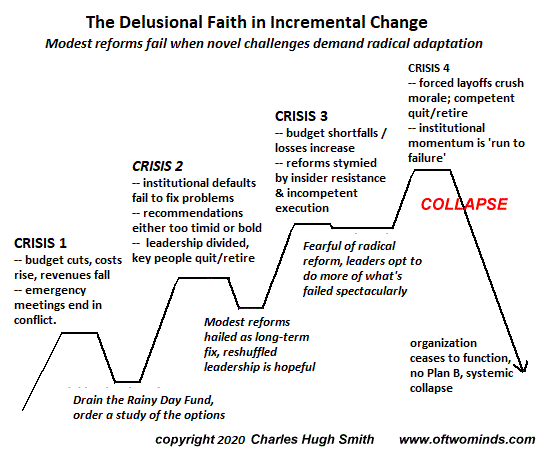
I’ve prepared a chart of the delusional faith in incremental change showing how each new crisis is met by incremental institutionalized defaults that are completely inadequate to the novel challenges that have arisen. The blindness to the need for radical adaption has been institutionalized as well: this is what worked in the past, so it will work nowWhy risk everything when we have procedures that have worked well?

Each stage of the crisis draws whatever conventional response causes the least pain. First, the “rainy day fund” is drained to keep everyone at the feeding trough. Studies of options are funded, and so on.

The recommendations are either too timid and clearly inadequate or they’re too bold and risky. So incremental policy and budget tweaks are adopted as acceptable institutional defaults.

But rifts open in the leadership as the farsighted few demand rapid, radical adaptations and the conventional risk-averse crowd digs in their heels. The farsighted few are pushed out or quit / retire, eliminating the only people who had the ability and experience to actually pull off a radical change of course.

A reshuffling of leadership evokes hope that the modest reforms will work magic. Alas, incremental tweaks only work in eras of stability. They fail miserably in unstable eras of rapidly-evolving challenges.

As everything runs to failure, the only acceptable path is to do more of what’s failed spectacularly, a default to low-risk incrementalism that only accelerates the final inevitable collapse.

The delusional faith in incremental change guarantees systemic failure. Better not to risk any radical evolution that might fail, and so failure is thus assured.

This is why our status quo is doomed: