
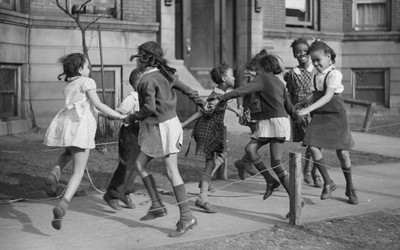
The end of childhood play

By Brian Kaller

Source: resilience

Recorded history is the history of adults–generals, statesmen, explorers and scientists–but all of those adults began their path as children. And running beneath this official history is the unofficial history of childhood games and rituals, many of which were passed down for generations; children inhabited a separate universe of traditions, contests, solemn rituals and codes of honour, like a Viking horde living in your house unnoticed. It was in this world that every future general first learned to lead, every future scientist first turned over logs to delight in the tiny nightmares underneath, and every future explorer first plucked up the courage to enter the haunted woods. Elderly people here in Ireland, who grew up without electricity or many cars, still remember the feral exploration and creative play that was once the birthright of every child.

“Children today don’t have to think much about games given to them – we made up our own,” said one elder. “We played spin the top, marbles, hoop the hoop, hop scotch, conkers, kick the can, scut the whip, jackstones, and box the fox. Hop scotch has survived to some extent, but only among girls … Even when the dark evenings closed in we played ‘Battle In, Battle Out,’ and ‘Jack jack show the light.’”

The games varied widely from person to person; villages only a few miles away could apparently have very different game-traditions. City streets, perhaps because they drew families from so many rural villages, seem to have been a vast melting pot of such games; when British novelist Norman Douglas published his whimsical overview of the children’s games of London in 1916, he spent dozens of pages–most of the book–just listing games. Not dozens of games, mind you–dozens of pages of lists of games, any of which could be as complex as any video game today and most of which were known to most children.

The games, rhymes, and rituals children invented were so ubiquitous, and so often out of sight of adults, that they were little remarked upon or recorded, and only now, when they have almost disappeared, can we look back and see how remarkable they were. In the 1950s the husband-and-wife team of Peter and Iona Opie interviewed children on playgrounds around the UK and found that, instead of being silly and spontaneous, children’s rhymes and stories actually preserved historical traditions their parents had lost.

“Boys continue to crack jokes that Swift collected from his friends in Queen Anne’s time,” Opie wrote. “They ask riddles which were posed when Henry VIII was a boy. . . . They learn to cure warts . . . after the manner which Francis Bacon learned when he was young. . . . They rebuke one of their number who seeks back a gift with a couplet known in Shakespeare’s day. . . . and they are [perpetuating stories] which were gossip in Elizabethan times.” They re-discovered the observation of Queen Anne’s physician John Arbuthnot, who said that “nowhere was tradition preserved pure and uncorrupt but amongst school-boys, whose games and plays are delivered down invariably from one generation to another.”

This is especially remarkable since most of these rituals were not taught by parents or grandparents, who might have learned them decades earlier, but by other children who could only have known them for a few years. Since they were re-transmitted over years rather than decades, their transmission signal should have decayed more quickly. Instead, the children proved stronger at retaining historical knowledge than most adults–not in the sense of reciting facts, but in treasuring their past.

Some of their superstitions, like a blister as proof of lying, date back at least to the 1500s, and they chanted a rhyme that apparently dates back to the era of France’s Henry IV in 1610. Most interestingly, country children still wore oak leaves or an acorn in their button-holes on 29 May to remember the return of Charles II in 1651–and could explain why they did so–at a time when few adults remembered the date.

Keep in mind, also, that few people were writing in the 1500s, most writing was not about children’s games, and much of what was written then has been lost–so if a ritual was first recorded in the 1500s, it could well be much older. Oral traditions can endure for thousands or even tens of thousands of years; Australian Aborigines have traditions about the sea level changing that seem to date from the last Ice Age. No one knows if any children’s rhymes and games date back so far, but Douglas believed that one chant stretched back to the time of Nero, and the Opies seemed to agree.

Their games and rituals were still very local, even in the 1950s when mass media was already washing away the local cultures of villages and neighbourhoods. “While some children roll eggs at Easter,” the Opies wrote, “or nettle the legs of classmates on the 29th of May, or leave little gifts on people’s doorsteps on St. Valentine’s Day, or act under the delusion that they are above the law on a night in November, other children, sometimes living only the other side of a hill, will have no knowledge of these activities.”

Here, too, Ireland held onto this heritage later than most countries, and a radio documentary of children playing in a Dublin school-yard in 1977 showed them using their own complicated musical chants. They weren’t all local traditions–one chant cited Shirley Temple, “the girl with the curly hair”–but even that showed the staying power of these songs, as this was two generations after she had been famous.

The Opies also noted that children spontaneously adopted a “code of oral legislation”–cultural institutions for testing truthfulness, swearing affirmation, making bets and bargains, and determining the ownership of property–the adult legal code in miniature. These codes universally included a practice absent from adult law, however–that of asking for respite, what we recognize as “calling time out,” and what today’s children reportedly call “pause,” a usage imported from video games.

“Throughout history, bands of children gathered and roamed city streets and countrysides, forming their own societies each with its own customs, legal rules and procedures, parodies, politics, beliefs, and art,” the blog Carcinisation pointed out. “With their rhymes, songs, and symbols, they created and elaborated the meaning of their local landscape and culture, practicing for the adult work of the same nature. We are left with only remnants and echoes of a once-magnificent network of children’s cultures, capable of impressive feats of coordination.”

This seems to have been true of all human cultures–anthropologists report it in hunter-gather tribes, and Zechariah 8:5 said that “the streets of the city shall be full of boys and girls playing.” Certainly it was true among people I knew in Ireland or the USA in living memory. To see how recently outdoor play was assumed, look at a map of most American cities; anything built before World War II is typically a grid for easy transport, but post-war suburban streets curl like tossed spaghetti and end in cul-de-sacs in order to do the opposite, to slow and discourage traffic to be “safe for families.” The sprawl that covers much of America looks the way it does because it was made to be safe for children to play in the street–which in 1945 was exactly what they would be doing.

If the returning GIs who first moved into these homes could be transported to the present day, however, they would be puzzled. Aside from the fact that the future never happened–no flying cars or robot butlers–the most glaring difference would be the absence of any children. To a time traveler it would seem like the beginning of a Twilight Zone episode, and they’d would demand to know what happened–was there a plague? An alien invasion? Are the children grown from pods now? Are they marched to an altar and sacrificed to a dark god? Or is this some horrific science-fiction future where children grow up staring at glowing rectangles, and are drugged when they get restless?

“Even the idea of a children’s game seems to be slipping from our grasp,” Neil Postman wrote in 1982. “A children’s game, as we used to think of it, requires no instructors or umpires or spectators; it uses whatever space and equipment are at hand; it is played for no other reason than pleasure. . . . Who has seen anyone over the age of nine playing Jacks, Johnny on the Pony, Blindman’s Buff, or ball-bouncing rhymes? . . . Even Hide-and-Seek, which was played in Periclean Athens more than two thousand years ago, has now almost completely disappeared from the repertoire of self-organized children’s amusements. Children’s games, in a phrase, are an endangered species.”

The decline began a few generations ago, when television steamrolled over children’s cultural traditions, and that screen has now multiplied into a billion hand-held ones. When children everywhere carry all the world’s pornography in their pocket, as well as electronic games psychologically designed to addict people as powerfully as heroin, few future leaders will organise their mates, and few budding scientists will turn over any logs. Moreover, children today grow up under effective house arrest, as local ordinances, paranoid neighbours and police conspire to prohibit children from venturing far outside. They grow up learning no lessons, organising no peers, and exploring no territory, unless it be shifting electrons around a screen, and the screen becomes their world.

This unnatural state takes all the power of modern society to maintain, and it does not have to be inevitable or permanent; even now some parents keep their children unplugged and gather with other parents who do the same. If they don’t live near the country themselves, they might visit family who do. They teach small children some games from old books, and let the children take it from there. How this guerrilla action proceeds will depend on the situation, but it needs to be done. Otherwise, today’s children will live in a country filled with the most dependent and least self-sufficient humans who ever lived, polarised and paralysed by their screens, and facing a difficult future. We will need a new generation of people who can strategise, negotiate, and work together again, and to do that we need children to experience childhood once more.

Truth or Delusion?

By Robert J. Burrowes

One inevitable outcome of the phenomenal violence we all suffer as
children is that most of us live in a state of delusion throughout our
lives. This makes it extraordinarily difficult for accurate information,
including vital information about the endangered state of our world and
how to respond appropriately, to penetrate the typical human mind.

‘Phenomenal violence?’ you might ask. ‘All of us?’ you wonder. Yes,
although, tragically, most of this violence goes unrecognised because it
is not usually identified as such. For most people, it is a
straightforward task to identify the ‘visible’ violence that they have
suffered and, perhaps, still suffer. However, virtually no-one is able
to identify the profoundly more damaging impact of the ‘invisible’ and
‘utterly invisible’ violence that is inflicted on us mercilessly from
the day we are born.

So what is this ‘invisible’ and ‘utterly invisible’ violence?

‘Invisible’ violence is the ‘little things’ that adults do to children
every day, partly because they are just ‘too busy’. For example, when
adults do not allow time to listen to, and value, a child’s thoughts and
feelings, the child learns to not listen to themSelf thus destroying
their internal communication system. When adults do not let a child say
what they want (or ignore them when they do), the child develops
communication and behavioural dysfunctionalities as they keep trying to
meet their own needs (which, as a basic survival strategy, they are
genetically programmed to do).

When adults blame, condemn, insult, mock, embarrass, shame, humiliate,
taunt, goad, guilt-trip, deceive, lie to, bribe, blackmail, moralize
with and/or judge a child, they both undermine their sense of Self-worth
and teach them to blame, condemn, insult, mock, embarrass, shame,
humiliate, taunt, goad, guilt-trip, deceive, lie, bribe, blackmail,
moralize and/or judge.

The fundamental outcome of being bombarded throughout their childhood by
this ‘invisible’ violence is that the child is utterly overwhelmed by
feelings of fear, pain, anger and sadness (among many others). However,
parents, teachers, religious figures and other adults also actively
interfere with the expression of these feelings and the behavioural
responses that are naturally generated by them and it is this ‘utterly
invisible’ violence that explains why the dysfunctional behavioural
outcomes actually occur.

For example, by ignoring a child when they express their feelings, by
comforting, reassuring or distracting a child when they express their
feelings, by laughing at or ridiculing their feelings, by terrorizing a
child into not expressing their feelings (e.g. by screaming at them when
they cry or get angry), and/or by violently controlling a behaviour that
is generated by their feelings (e.g. by hitting them, restraining them
or locking them into a room), the child has no choice but to
unconsciously suppress their awareness of these feelings.

However, once a child has been terrorized into suppressing their
awareness of their feelings (rather than being allowed to have their
feelings and to act on them) the child has also unconsciously suppressed
their awareness of the reality that caused these feelings. In brief,
this means that the child now lives in a state of delusion. And because
this state was caused by terrorizing the child, the child is unable to
perceive the series of delusions in which they now live.

Moreover, unless the child (or, later, adult) consciously feels their
fear and terror, it will be extraordinarily difficult for them to
perceive anything beyond the delusions that they acquired during
childhood. This is simply because the various elements of the child’s
delusional state (the ‘values’, beliefs, attitudes, prejudices, biases)
were the ones approved by the key adults – parents, teachers, religious
figures – in the child’s life.

Needless to say, living in a delusional state has many outcomes that are
disastrous for the individual, for society and for nature because the
individual will now behave on the basis of their delusions rather than
in response to an accurate assessment of all available information
through appropriate sensory, emotional, intellectual and conscientious
scrutiny. For a full explanation of this process, see ‘Why Violence?‘ and ‘Fearless Psychology and Fearful Psychology: Principles and Practice‘.

In essence then, the typical human being lives in a delusional state and
this state is held in place by enormous, but unconscious, terror: the
unfelt and hence unreleased childhood terror of being endlessly
threatened and punished (for not complying with parental or other adult
‘authority’ throughout childhood).

And if you have ever tried to persuade someone, by argument of an
intellectual nature, that a belief they hold is inaccurate and wondered
why you couldn’t get anywhere, it is because you have run into their
unconscious terror. And sheer terror beats the best argument in the
world ‘hands down’.

So when you listen to people like Donald Trump and Marine Le Pen, or
ponder those politicians and military generals who conduct endless wars,
or watch those people on the street protesting against Muslims and
refugees, or watch police beating up another indigenous or black person,
or hear someone else deny the climate science, remember that you are
witness to a person or people living in a terrified and delusional state
that prevents them from perceiving and responding intelligently to
reality. And that, in the case of political and corporate leaders, they
only have the support to do what they do because a great many other
delusional individuals (including voters and employees) enable them.

Equally importantly, however, it is also necessary to recognise that a
delusional state afflicts many of those we like to regard as ‘on our
side’. It is just that their delusions work differently, perhaps, for
example, by making them believe that only token ‘make it up as you go
along’ responses (rather than comprehensive strategies) are necessary if
we are to work our way out of the multifaceted crisis in which human
society now finds itself. This is why many ‘leaders’ of liberation
struggles as well as activist movements concerned with ending war(s) and
the climate catastrophe, for example, are so unable to articulate
appropriately visionary and functional strategies. But the problem
afflicts many other ‘progressive’ social movements as well, which limp
along making only occasional or marginal impact, if they have any impact
at all.

So what are we to do? Well, the most important thing you can do is to
never consciously participate in a delusion, whether your own or that of
anyone else. I say ‘consciously’ of course because unless you identify
the delusion, you will not be able to avoid participating in it. And
there are probably few humans in history who have avoided all of the
delusions their culture threw at them. If they did, they were probably
outcast or killed. Christ, Gandhi and King are reasonably good examples
of people in this latter category. But, historically speaking, many
activists have been killed for refusing to participate in elite-promoted
delusions. And many others have been marginalised, one way or another,
depending on the culture.

The value of not participating in a delusion, whether someone’s personal
delusion or a widespread social one, arises from the impact you have on
those around you: some of these people will have the courage to reflect
on your behaviour and reconsider their own.

If you believe you are relatively free of delusion and are committed to
taking serious steps to tackle one or more aspects of our multifaceted
global crisis, then you are welcome to consider making ‘My Promise to
Children‘,  and to consider participating in ‘The Flame Tree Project to Save Life on
Earth‘, signing the online pledge of ‘The People’s Charter to Create a Nonviolent World
and/or considering using the strategic framework on one or the other of these two websites for your campaign or liberation struggle: Nonviolent Campaign Strategy
and Nonviolent Defense/Liberation Strategy.

Living the truth on a daily basis is a tough road. And it will never
come without cost. But living in the comfort of delusion, rather than
taking action, is the path of cowards.


Biodata: Robert J. Burrowes has a lifetime commitment to understanding and ending human violence. He has done extensive research since 1966 in an effort to understand why human beings are violent and has been a nonviolent activist since 1981. He is the author of ‘Why Violence?‘ His email address is flametree@riseup.net and his website is at http://robertjburrowes.wordpress.com


Robert J. Burrowes
P.O. Box 68
Daylesford
Victoria 3460
Australia
Email: flametree@riseup.net

Websites:
Nonviolence Charter
Flame Tree Project to Save Life on Earth
‘Why Violence?’
Nonviolent Campaign Strategy
Nonviolent Defense/Liberation Strategy
Anita: Songs of Nonviolence
Robert Burrowes
Global Nonviolence Network

Public School or Prison? Here Are 10 Ways It’s Hard To Tell

sprongg-700x466

By Alice Jones Webb

Source: The Mind Unleashed

Every weekday morning, from September through June, parents across the country get up earlier than they want to, rush like crazy, wrangle kids into appropriate clothing, and wait in exhausting drop-off lines to get their children to school on time. Why? Because punctuality is a virtue? Or because they are afraid of getting in trouble?

In big cities and small communities, the same routine is repeated with minor variations. Small children and near adult adolescents will spend the majority of their waking hours somewhere they would rather not be. But few people question the set-up. Parents send their kids to school with the best of intentions, wanting to produce happy, healthy, productive adults. Public school is supposed to be for their own good. Very few question its necessity and virtue. No one questions the fact that our country’s public schools are looking less and less like places of learning and more and more like places of detention (and I don’t mean The Breakfast Club type either).

When you stop and think about it (which few people actually do), our public schools have more in common with our prison system than any parent would care to admit. Most of us are products of the system and will defend its honor and integrity like sufferers of severe Stockholm Syndrome. So let me break it down into a list of glaring similarities that even those of us who went to public school can easily understand.

1. Both School and Prison Take Away Freedom. To get into prison, a person has to be convicted of a crime (although all of us know that prisons are full of people convicted of pretty bogus crimes… just stick with me). Children in school are only guilty of the crime of being children. Since school attendance is compulsory, children, much like criminal prisoners, don’t get to choose whether they get locked up for seven or more hours a day. They are forced to go to school by strict truancy laws until they are at least 16, at which point their youth has already been squandered inside constrictive cinder block walls.

2. Both School and Prison use Security as a Means of Control. Prisons and public schools both use metal detectors, surveillance cameras, police patrols, drug-sniffing dogs, and lock downs to create a facade of greater security. In most elementary schools, there is an emphasis on moving students from location to location in a rigidly ordered manner. The straight line of silent children walking with hands behind their backs look frighteningly like lines of prisoners. The strict codes of conduct used in the majority of schools, as well as the consistent use of handcuffs and pepper spray on unruly high school students, work together to condition young people to the cultural normalcy of over-policing.

Stay in line. Do as you’re told. Don’t make trouble. These are the messages we send to both our prisoners and our school children. But it’s okay. It’s for their own good.

3. Both Schools and Prisons Serve Undesirable Food. The cafeterias in public schools are scarily similar to prison cafeterias, often even sharing the same menus. Unappetizing, bland, processed meals with little nutritional value are the norm in both institutions. And bringing a lunch from home is banned in many school districts. Add in the armed security guards that patrol most public school lunch rooms and a casual observer might not be able to tell the difference.

4. Both Schools and Prisons Enforce Strict Dress Codes. Like prisons, some schools obligate their students to wear uniforms, limiting self-expression, and encouraging a herd mentality that makes control easier (for safety’s sake, of course). But even in schools without required uniforms, strict dress codes are generally in place. Failure to tuck in a shirt tail can land a student in detention. Donning a blouse that doesn’t adequately cover a girl’s shoulders could get her sent home. Sometimes the dress code guidelines are so arbitrary and so strictly detailed, it seems like they are in place just to get students in trouble. In 2008, Gonzales High School in Texas made the national news for requiring dress code violators to wear actual prison jumpsuits. It’s like officials want the students to seem like criminals. Perhaps it makes the policing of students at their own hands seem more justified.

5. Both Students and Prisoners are Tracked. Many prisons use electronic bracelets or other tracking devices to keep track of prisoners’ locations. Many schools are doing the same thing. ID badges with built-in RFID chips can track the location of a child wherever they are wearing it, and many schools require ID badges to be worn during school hours. Some schools have even started using fingerprints and iris scanners to keep track of their prisoners… I mean students.

6. Both Schools and Prisons Have Armed Guards. Often referred to as SROs (school resource officers), most school buildings are patrolled by armed police officers. They are generally uniformed and carry pepper spray, tasers, and batons that they can use on students should the need arise. These officers police hallways and lunchrooms, administer searches of children’s lockers and school bags, and man the TSA-style checkpoints at the entrances to the buildings our children enter to learn.

7. Both Schools And Prisons do not Allow Anger. Although anger is a justifiable emotion toward constrictive and oppressive political structures, neither students nor prisoners have the power to express their emotions. In prison, angry convicts are locked away in solitary confinement, their movements and small remaining freedoms restricted for safety’s sake. In public school, anger is interpreted as a failing of the individual rather than the system that creates it. There, anger is seen as “disruptive behavior” or “cognitive impairment” or a “social or learning disability”. Often the angry student is marginalized by placement in special education classes, enrolled in “alternative schools”, or medicated to control their disruptions, all of which are just differing forms of confinement.

8. Both Students and Prisoners are Forced to Work. The scene of the prison chain gang in striped clothing, hacking away at rocks and debris is one that most people have seen in old films. Today’s prisoner work force looks a little different, with prisoners wearing orange jumpsuits and doing highway clean-up minus the bulky steel chains. Students are often forced to work, too. Sometimes they are forced to work cleaning up school grounds as a disciplinary action. But in some school systems, volunteer work or “community service” is required each year for a passing grade. Interesting to note that “community service” is frequently doled out as punishment to citizens convicted of minor crimes, but our children are only guilty of being kids.

9. Both Schools and Prisons Follow Strict Schedules. A rigid schedule of walking, eating, learning, exercise, and bathroom use is followed in both institutions. It doesn’t matter when you have to pee, or need to stretch your legs, or want a breath of fresh air. Those things can only be done during allotted times defined by those in authority.

10. Both Schools and Prisons Have Zero-Tolerance Policies. Most public schools now have policies of zero-tolerance when it comes to violence, bullying, drug possession, etc. Interestingly, much of the verbiage in our schools’ disciplinary policies come straight from the nation’s “War on Drugs” (which is directly responsible for the vast majority of our country’s prisoners). Zero-tolerance policies require harsher penalties for sometimes minor classroom offenses and often result in law enforcement being called in to handle school disciplinary actions. The result has been what many refer to as the “School-to-prison pipeline”. The policies make criminals out of students, pushing kids out of the classroom and into the criminal justice system at alarming rates. At least the transition will be easy. Those school children have already spent the majority of their lives in a system that matches the penitentiary where they’ll be spending most of the rest of it.

With such dark and intimidating surroundings, focusing on learning becomes difficult. It’s no wonder most kids don’t want to go to school. When you’re treated like a prisoner, it’s easy to feel like one.

About the Author

Alice Jones Webb is a writer, homeschooling mother of four, black belt, autodidact, free-thinker, avid reader, obsessive recycler, closet goth, a bit of a rebel, but definitely not your typical soccer mom. You can usually find her buried under the laundry and also on Facebook, Twitter, and her blog, DifferentThanAverage.com, where she blogs about bucking the status quo.

Life’s Most Important Dramas Are Being Disrupted

index

By Charles Hugh Smith

Source: Washington’s Blog

The idea that human life subdivides rather naturally into stages is based on our natural progression from childhood into adulthood and eventual (if we’re lucky) old age.

Confucian thought views life as a developmental process with seven stages, each roughly corresponding to a decade: childhood, young adulthood (16-30), age of independence (30-39), age of mental independence (40-49), age of spiritual maturity (50-59), age of acceptance (60-69), and age of unification (70 – end of life).

Each stage has various tasks, goals and duties, which establish the foundation for the next stage.

Each stage is centered on a core human drama: for the teenager, establishing an identity and life that is independent of parents; for the young adult, finding a mate and establishing a career; for the middle-aged, navigating the challenges of raising children and establishing some measure of financial security; for those in late middle-age, helping offspring reach independent adulthood and caring for aging parents; early old age, seeking fulfillment now that life’s primary duties have been accomplished and managing one’s health; and old age, the passage of accepting mortality and the loss of vitality.

The End of Secure Work and the diminishing returns of financialization are disrupting these core human dramas and frustrating those who are unable to proceed to the next stage of life:

1. Teenagers are being pressured to focus their lives on achieving a conventional financial success that is becoming harder to achieve.

2. Young adults without secure full-time careers cannot afford marriage or children, so they extend the self-absorption of late adolescence into middle age.

3. The middle-aged are finding financial security elusive or out of reach as they struggle to fund their young adult children, aging parents and their own retirement.

4. Increasing longevity is pressuring the late-middle-aged’s stage of fulfillment, as elderly parents may require care even as their children reach their own retirement (65-70).

The financial pressures generated by the demise of financialization and the End of Secure Work are not just disrupting each stage; they are upending essential financial balances between the young, the middle-aged and the old.

The elderly, protected by generous social welfare benefits paid by current taxpayers, also benefit from the soaring value of assets such as real estate and stocks. Meanwhile, financialization’s asset bubbles have pushed housing beyond the reach of most young people.

Downsizing, lay-offs, low-paying replacement work and poor decisions to buy houses near the peak of the prior bubble have left many of the middle-aged with high fixed costs and a stagnant or increasingly insecure income.

The stresses of trying to make enough money to afford what was once assumed to be a birthright–a “middle class” lifestyle–is taking a heavy toll on the mental and physical health of the middle-aged, leaving many of them too tired for any fulfilling activities and easy prey for destructive self-medication.

This erosion of opportunities to complete life’s stages and core dramas is gradual, and rarely recognized, much less addressed. We are constantly bombarded with messages to innovate, keep up, be fulfilled, etc.–essentially impossible demands for those with multiple generational and/or business duties.

The most productive response to these financial disruptions is to focus not on what’s scarce and fraught with intense competition (the top 5% slots of conventional financial security) but on what’s still abundant, which is opportunities outside conventional hierarchies, ways of reducing fixed costs and life-skills that are entrepreneurial, adaptive and fulfilling.

When I talk about the Mobile Creative class, I’m not talking about a finance-centric definition of success or a path to join the top 5% in Corporate America and the government. The herd is chasing those dwindling slots, too, guaranteeing frustration and failure for the 95% who won’t secure one of those slots.

What we’re really discussing is a way of living that places a premium on independent thinking, maintaining very low fixed costs, establishing a healthy honesty with oneself and one’s associates and customers, the ability to make realistic assessments of oneself, one’s successes, failures and errors, and a focus on challenges, opportunities, risks, adaptability, flexibility and experimentation, all with a goal of building one’s own human, social and physical capital–the foundations not just of well-being but of any meaningful measure of independent, real wealth.