No Man’s Land

fence

By Steven Stoll

Source: Orion Magazine

A chainlink fence topped with razor wire surrounds fourteen acres of thistle and grass at East Forty-First Street between Long Beach Avenue and South Alameda Street in Los Angeles. These two city blocks occupy a transitional environment of sorts. In one direction the sight of small houses stretches for miles toward the Pacific Ocean, but turn around and the neighborhood becomes industrial, consisting of a textile factory, a scrap metal recycling company, trucking terminals, and warehouses. The tracks of the Southern Pacific Railroad run parallel to Long Beach Avenue. There are few trees or anything green and growing but the drought-resistant thistle.

In 1986, the City of Los Angeles acquired the land from a group of owners through eminent domain, but then folded plans to build a waste incinerator when the community resisted. The land ended up in the holdings of the Harbor Department. It had been two years since the uprising that followed the acquittal of four Los Angeles police officers, tried for beating Rodney King. Perhaps looking to make a gesture and lacking its own use for the site, the Harbor Department invited members of a local food bank to plant a community garden.

They did. Between 1994 and 2006 hundreds of families grew a profusion of food plants on what had been a blighted lot just a few years before. One visitor identified a hundred species, most of them native to Mexico and South America— chayote, guava, tomatillo, sapodilla, and sugarcane, in addition to maize, beans, avocados, bananas, and squashes. The South Central Farm was not misnamed: photographs show the land in robust cultivation, producing a wealth of food.

But in 2001, one of the prior owners filed a lawsuit against the city. The property had never been used to build the incinerator, and so, he argued, Los Angeles had no reason to seize it. The city settled the case in 2003 by selling the fourteen acres back to the prior owner.

In the ensuing confrontation a single absentee negated the sustained labor and improvements of 350 families, representing around a thousand people, now accused of squatting. They refused to leave. Lawyers filed briefs. Gardeners swore resistance. (One said, “Just think if we assemble, two from every family, and you know we’ll each grab a hoe, and no one will get past us.”) Movie stars showed up with camera crews. A foundation offered millions of dollars as a purchase price, which the owner rejected. A date was set for the forced removal of the stalwarts. On June 13, 2006, Los Angeles County Sheriffs arrested forty people. Bulldozers destroyed the farm. A decade later, the land remains vacant.

In the case of the South Central Farm, ownership for profit triumphed over use for subsistence, which, of course, is the way of the world. Nothing could be more ordinary than a landowner asserting his rights. And yet, just five centuries ago, what happened on those fourteen acres in south Los Angeles wouldn’t have made sense to anyone.

In 1500, no one sold land because no one owned it. People in the past did, however, claim and control territory in a variety of ways. Groups of hunters and later villages of herders or farmers found means of taking what they needed while leaving the larger landscape for others to glean from. They certainly fought over the richest hunting grounds and most fertile valleys, but they justified their right by their active use. In other words, they asserted rights of appropriation. We appropriate all the time. We conquer parking spaces at the grocery store, for example, and hold them until we are ready to give them up. The parking spaces do not become ours to keep; the basis of our right to occupy them is that we occupy them. Only until very recently, humans inhabited the niches and environments of Earth somewhat like parking spaces.

Ownership is different from appropriation. It confers exclusive rights derived from and enforced by the state. These rights do not come from active use or occupancy. Property owners can neglect land for years, waiting for the best time to sell it, even if others would put it to better use. And in the absence of laws protecting landscapes, the holders of legal title can mow down a rainforest or drain a wetland without regard to social and ecological cost. Not all owners are destructive or irresponsible, but the imperative to seek maximum profit is built into the assumptions within private property. Land that costs money must make money.

Champions of capitalism don’t see private property as a social practice with a history but as a universal desire—a nearly physical law—that amounts to the very expression of freedom. The economist Friedrich Hayek called it “the most important guarantee of freedom, not only for those who own property, but scarcely less for those who do not.” But Hayek never explained how buyers and sellers of real estate spread a blanket of liberty over their tenants. And he never mentioned the fact that the concept, far from being natural law, was created by nation-states—the notion that someone could claim a bit of the planet all to himself is relatively new.

Every social system falls into contradictions, opposing or inconsistent aspects within its assumptions that have no clear resolution. These can be managed or put off, but some of them are serious enough to undermine the entire system. In the case of private property, there are at least two—and they may throw the very essence of capitalism into illegitimacy.

The first of the system’s contradictions points to its origins. Land in the English countryside during the sixteenth century was regulated by feudal obligations so obscure and so thick that few people today can make sense of them. An English peasant could use a run of soil for a term of years or for her entire life, but it did not belong to her. Village elders, representatives of the local lord, and even the deacon of the church might have claimed an interest in how this or that field was planted. Everyone from monarch to serf received a different slice of the realm. These use rights could be exchanged only in very limited ways: a lord occupied his ancestral house and manor for as long as he lived, but he could not sell them.

All sorts of events caused the demise of feudalism. The Black Death of the fourteenth century killed so many millions that the labor market tipped in favor of those who survived. The spread of money gave things exchange value and made buying and selling easier. Food production increased during the sixteenth century, creating more calories for work and more commodities for trade. And an international wool market inspired lords to change common fields into sheep walks.

The problem was that lords could not put sheep where they wanted. They lived within the feudal assemblage of obligations and rights attached to social orders and scraps of landscape. Faced with declining returns and proliferating opportunities, they began to curse the old rules—they wanted land for themselves.

Enclosure is just what it sounds like: the physical and legal bounding of an area. In practice it meant the seizure of villages, common fields, and outlying forests and marshes. It allowed lords to evict former residents so that they could do new things with land. Sometimes it happened by agreement, with peasants giving in to demands they feared to contest; other times there was violence. In 1607 at least one thousand peasants tore up hedges in Northamptonshire and filled in ditches that demarcated property lines. The rebels made a statement: “Wee, as members of the whole, doe feele the smarte of these incroaching Tirants, which would grind our flesh upon the whetstone of poverty.” King James didn’t flinch from the whetstone. His forces killed forty insurgents and hanged their leader.

The king’s involvement tells us that grasping lords did not do this dirty work by themselves. Parliament legalized their land grab by granting them something that had never before existed in human history: ownership. Lords could now act without regard to tradition or the needs of residents. Some demolished whole communities. The word pauper dates from the seventeenth century to describe poor people who wandered the roads homeless, eating anything they could scavenge and turning up cold and wet at church doors. Peasants became workers as their only option for survival. Some stooped for a wage on the very land they once tilled as members of villages.

Enclosure created two things at once: private property and wage labor, the essential preconditions for capitalism. Like all social practices, private property has a degree of flexibility. Some of its advantages can and should be diffused among as many people as possible. By eliminating messy titles to land and its embeddedness in tradition, enclosure made possible a new measure of innovation and abundance. But that’s also the first of its contradictions. It generates wealth and unprecedented social power for some by making others poor and dependent.

All of this matters because enclosure never came to an end. It jumped continents and kept on going. The colonial wars for North America, in which Britain and then the United States seized land from hundreds of tribes, can be understood as a rolling dispossession—by purchase, treaty, and ejectment. Enclosure also took place in Australia and South Africa. Wherever nation-states became landowners they turned the commons into private property. The epicenter of enclosure today is Africa. A resident of the village of Dialakoroba, in Mali, which has lost thousands of acres to foreign investors, recently said this: “I do not know, in ten to twenty years, how people will live in our villages because there will be no land to till. . . . Everything has been sold to rich people in very opaque conditions.”

Private property’s second contradiction comes from the odd notion that land is a commodity, which is anything produced by human labor and intended for exchange. Land violates the first category, but what about the second? As the historian Karl Polanyi wrote, land is just another name for nature. It’s the essence of human survival. To regard it as an item for exchange “means to subordinate the substance of society itself to the laws of the market.”

Clearly, though, we regard land as a commodity and this seems natural to us. Yet it represents an astonishing revolution in human perception. Real estate is a legal abstraction that we project over ecological space. It allows us to pretend that a thousand acres for sale off some freeway is not part of the breathing, slithering lattice of nonhuman stakeholders. Extending the surveyor’s grid over North America transformed mountain hollows and desert valleys into exchangeable units that became farms, factories, and suburbs. The grid has entered our brains, too: thinking, dealing, and making a living on real estate habituates us to seeing the biosphere as little more than a series of opportunities for moneymaking. Private property isn’t just a legal idea; it’s the basis of a social system that constructs environments and identities in its image.

Advocates of private property usually fail to point out all the ways it does not serve the greater good. Adam Smith famously believed that self-interested market exchange improves everything, but he really offered little more than that hope. He could not have imagined mountains bulldozed and dumped into creeks. He could not have imagined Camden, New Jersey, and other urban sacrifice zones, established by corporations and then abandoned by them. Maximum profit is the singular, monolithic interest at the heart of private property. Only the public can represent all the other human and nonhuman interests.

Unbelievably, perhaps, the United States Congress has done this. Consider one of its greatest achievements: the Endangered Species Act (ESA) of 1973. The act nails the abstraction of real estate to the ground. When a conglomerate of California developers proposed a phalanx of suburbs across part of the Central Valley, they came face to face with their nemesis: the vernal pool fairy shrimp. In 2002, the Supreme Court upheld the shrimp’s status as endangered and blocked construction. It was a case in which the ESA diminished the sacred rights to property for the sake of tiny invertebrates, leaving critics of the law dumbfounded. But those who would repeal the ESA (and all the other environmental legislation of the 1970s) don’t appreciate the contradiction it helps a little to contain: the compulsion to derive endless wealth from a muddy, mossy planet.

Of course, in the era of climate change, those invaluable laws and the agencies they created now seem too limited in their scope and powers to take on the spectacular collision between Economy and Ecology now in motion. But maybe the most radical way we can treat the ownership of Earth—the single most subversive notion we can have about private property—is that it’s merely a social relationship, an agreement between people to behave in certain ways. It can be challenged, changed, and contained. Much of what holds failing social systems together is that those in power succeed in eliminating the mere thought that things could be otherwise.

Should private property itself be extinguished? It’s a legitimate question, but there is no clear pathway to a system that would take its place, which could amount to some kind of global commons. Instead I suggest land reform, not the extinguishing of property rights but their radical diffusion. Imagine a space in which people own small homes and gardens but share a larger area of fields and woods. Let’s call such legislation the American Commons Communities Act or the Agrarian Economy Act. A policy of this sort might offer education in sustainable agriculture keyed to acquiring a workable farm in a rural or urban landscape. The United States would further invest in any infrastructure necessary to move crops to markets.

Let’s give abandoned buildings, storefronts, and warehouses to those who would establish communities for the homeless. According to one estimate, there are ten vacant homes for every homeless person. Squatting in unused buildings carries certain social benefits that should be recognized. It prevents the homeless from seeking out the suburban fringe, far from transportation and jobs (though it’s no substitute for dignified public housing). Plenty of people are now planting seeds in derelict city lots. In Los Angeles, an activist named Ron Finley looks for weedy ground anywhere he can find it for what he calls “gangsta gardening,” often challenging absentee owners. In 2013, the California legislature responded to sustained pressure from urban gardeners like Finley and passed the Urban Agriculture Incentive Zones Act, which gives tax breaks to any owner who allows vacant land to be used for “sustainable urban farm enterprise.”

Squatting raises another, much larger question. To what extent should improvements to land qualify one for property rights? The suppression of traditional privileges of appropriation amounts to one of the most revolutionary changes in the last five hundred years. All through the centuries people who worked land they did not own (like squatters and slaves) insisted that their toil granted them title. The United States once endorsed this view. The Homestead Act of 1862 granted 160 acres to any farmer who improved it for five years. Western squatters’ clubs and local preemption laws also endorsed the idea that labor in the earth conferred ownership.

It’s worth remembering that there is nothing about private property that says it must be for private use. Conservation land trusts own vast areas as nonprofit corporations and invite the public to hike and bike. It’s not an erosion of the institution of property but an ingenious reversal of its beneficiaries. But don’t wait for a land trust to be established before you enjoy the fenced up beaches or forests near where you live. Declare the absentee owners trustees of the public good and trespass at will. As long as the land in question is not someone’s home or place of business, signs that say KEEP OUT can, in my view, be morally and ethically ignored. Cross over these boundaries while humming “This Land Is Your Land.” Pick wildflowers, watch sand crabs in the surf, linger on your estate. Violating absentee ownership is a long-held and honorable tradition.

The arrest of the South Central Farmers was deeply disturbing in Los Angeles. So much so that citizens began to call for other farms, in other locations throughout the city and county. Ten years later community gardens abound. More than a hundred of them are thriving, including the Stanford Avalon Community Garden, which was established by some of the very families evicted from the South Central Farm. It runs one mile long and 80 feet wide underneath power lines, on city property. There is space for 180 plots, each about 1,300 square feet. The farmers compete with each other for the greatest yields. They pay a small fee for a plot and absorb all the food into their households, to be eaten and sold.

Building this garden movement has not extinguished any of the rights of private or public landowners. But only sustained resistance and protest could have forced these entities to accommodate thousands of household farmers. Yet nothing could be more ordinary or more radical than the desire for autonomy from the tyranny of wages, a dream that persists in billions of humans striving in slums and factories, ready for their moment to reclaim the commons.


Steven Stoll is Professor of History at Fordham University, where he teaches environmental history and the history of capitalism and agrarian societies. He is the author of Larding the Lean Earth: Soil and Society in Nineteenth-Century America (2002) and The Great Delusion (2008), about the origins of economic growth in utopian science. His writing has appeared in Harper’s Magazine, Lapham’s Quarterly, and the New Haven Review. He is finishing a book about losing land and livelihood in Appalachia.

Why Are We Still Working?

intcap2

By Mike Dowson

Source: NewMatilda.com

This may be an opportune moment to consider the question. Especially if you’re not actually working.

You may have retired. Perhaps you’ve just left university, considering your options. Perhaps you’re taking a welcome break.

Maybe you have no choice but to take a break. Did you retire early because your job was axed? Has the casual work you depend on dried up? Have you been unable to find a job, despite your qualifications?

Perhaps, as you read this, you’re at work, filling in time, forgoing a holiday. Or at the beach, while the kids play in the surf, watching for emails on your phone.

Of course, it’s obvious why we work. Money. You don’t get something for nothing. And everything is so expensive these days.

If anything, most of us need to work more. Both spouses, extra hours, second jobs. Would anyone, except an idiot, seriously suggest we should all be working less?

Well, actually, yes.

As long ago as 1930, the economist John Maynard Keynes predicted that, by now, people in technologically advanced societies wouldn’t need to work much at all. When Keynes said this, advances in technology were yielding extraordinary increases in productivity. The implications seemed obvious. If it took less time to produce what we needed, surely we’d work less.

It turns out that for much of the 20th Century average working hours in developed countries steadily fell. Then, around the 1970s, the trend plateaued. In some countries, it reversed and working hours began to climb again. This occurred at the same time women were entering the workforce in great numbers so total workforce participation also increased.

In Australia, by the new millennium, many full time employees were working more than their grandparents had.

What happened? Did technology fail to deliver the gains Keynes expected?

On the contrary. Technological advancement outstripped even the giddy imaginations of futurists from a century ago. We can grow food, dig up minerals, make fridges and bridges, move things and ourselves around the planet and share knowledge and information much faster with a fraction of the workforce it once took.

But if staggering productivity gains haven’t manifested as lower working hours, where did they go?

Some prominent economists, including some Nobel laureates, have grappled with this question.

Gary Becker observed that our appetite for material goods has expanded along with our ability to produce them. Instead of working less hours, we opted for bigger houses with more gadgets, which we replace more often.

This process has been fuelled by a deluge of marketing, which persuades us to consume things we previously didn’t recognise a need for.

Does that explain it? Anthropologist David Graeber doesn’t think so. If it continually takes fewer human hours to produce these things, shouldn’t we be able to afford them without working more? What are all these working hours producing?

Graeber argues that, although productive jobs have, in fact, been steadily automated away just as predicted, we have also seen a vast proliferation of new jobs that only seem to exist to keep people working.

Consider this. Productivity growth has stalled in Australia. How can this be? Technology hasn’t stopped advancing. The time we should be winning back through productivity gains must be getting reabsorbed.

Productivity returns are highest in capital-intensive industries like mining and manufacturing. As those jobs disappear, either replaced by technology, or lost altogether, the workforce moves into labour-intensive industries like hospitality and professional services. This dilutes the gains in the other industries.

At the same time, unemployment has been trending up since 2008. Young people especially, are out of work. The number of underemployed people, who would work more if they could, is also high. More jobs are casual.

There’s a downward trend in job prospects for new graduates. Some of them settle for part-time work or a free internship. Many find work which is unrelated to primary qualification. That’s now more likely to be in a job without benefits, or multiple such jobs.

There’s another factor. Our lives are now longer relative to our working lives. We tend to start full-time work later, after years of study, and more of life is spent in retirement. Many jobless older people are struggling with the cost of living. Many would work more if they could.

Instead of everyone working less, what seems to be happening is that experienced workers, in professions which are still in demand, are working more, while the young, the old, and those with skills which no longer attract investment have difficulty finding work.

MIT academics Andrew McAfee and Erik Brynjolfsson refer to this as the great decoupling. For many years, real GDP per capita and median income rose in tandem. Since the 1970s, wages as a percentage of GDP have fallen dramatically, while corporate profits as a percentage of GDP are now at their highest level, despite recurring economic shocks.

To put it simply, labour isn’t as important to growth as it used to be.

There is nothing in the economic outlook or current government policy settings which suggests this trend is going to change.

Automation, artificial intelligence and robotics are encroaching on more human occupations. The Committee for Economic Development of Australia (CEDA) has estimated that as many as 40 per cent of the jobs that are left are vulnerable to replacement by technology over the next decade.

No matter how many politicians chant the jobs mantra for the media, more productive jobs are going to disappear.

The terrible irony in this situation is that there is so much that needs to be done.

Among the underemployed graduates I personally know of, there is a psychologist, a soil chemist and a biodiversity specialist. Have we run out of things to do in the areas of mental health, agriculture and the environment?

Mental illness is widespread. Our food bowl is under threat from climate change. We have a mass extinction on our hands.

What we don’t have, apparently, is sufficient money to invest in making full use of the talent that is available to face these challenges.

Why? What failure of collective enterprise could result in this absurd incongruity?

Capital, like technology, is largely blind to human need. Capital goes where the profit is. If there was profit in healing minds and saving species, some of it would go there. While there is more profit in alcohol, gambling and deforestation, more of it will go there.

People don’t register their desire for a healthy society by shopping for it. Capital doesn’t get that signal through the market. The argument that consumers somehow direct the course of civilisation by choosing dolphin-friendly tuna and “eco” cleaning products is stupid and facile. The factors that most affect our destiny are not options in the supermarket.

If a healthy society is something we want, we have to act collectively. Since few people are active major shareholders, for the time being that task tends to fall to governments.

Whether enacted via direct spending, or by creating incentives for private investment, government initiatives are funded from collective surplus – in other words, tax revenue or borrowing against future earnings increases. Despite political spin to the contrary, our tax is low compared to the OECD as a proportion of GDP.

The great decoupling has coincided with rising inequality. Those with money to invest get rich. Those with only labour to sell miss out. Capital doesn’t like to pay for labour, and it doesn’t like to pay tax either.

But why, if our labour isn’t needed for profit, are we still working?

Faced with a looming crisis in social services, but committed ideologically to low taxation, successive Australian governments used tax concessions to turn superannuation and real estate – where most Australians keep their wealth – into a mini-capitalist alternative to social security.

Of course, this only works while people have jobs that provide super and sufficient income to buy housing. And it doesn’t help the real economy, the place where we apply technological innovation to produce things of real value, especially things we can export.

Nevertheless, one group of people enriched themselves through property investment, pushing up the value of real estate around the country in the process. Another group of people became affluent with nothing more than a job that paid super and a home in a good location.

With commodity revenue pouring in from overseas, it was easy to believe we had discovered some kind of magic prosperity formula. But the surplus generated from commodities mostly wasn’t invested back into productive activity. Instead it was turned into tax cuts and other benefits. These had broad electoral appeal but favoured the wealthy, and encouraged further speculation.

The real estate boom didn’t make the country richer. Nor did it make housing more accessible. It simply transferred wealth from one group of people to another. In the process, it put a basic need out of reach of many, including young people, and diverted investment from the productive economy. It also lured a huge number of Australians into precarious debt.

Contrary to popular opinion, encouraged by unscrupulous politics, we have relatively low government debt, but we now have the largest per capita private debt in the world.

So why are we still working? Because we’re in debt.

Middle-aged people are the ones working long hours. They’re also the ones buying houses. And they’re the ones with the most credit card debt as well.

The generation before them had affordable housing, job security and a real social safety net. They’re not so fortunate, but for the ones after them, a steady job with enough for a deposit has become a kind of Holy Grail, and social security is survival at best.

The current trend points to a time when a young graduate might start adult life with a HECS debt, go into credit card debt on a part-time job and a free internship, and eventually get into massive debt to own a flat her grandparents could have bought with ease.

She might even find a job in financial services, if they haven’t all been automated. It’s the sector that helps wealthy people turn their money into more money. It’s also where ordinary people go to borrow money for a house.

Debt is profitable. Even during the great decoupling, as productive jobs disappear, and real wages fall, it’s proven possible to harness the aspirations of ordinary people for profit, without any of the effort or intelligence required for developing new productive capacity, by simply enticing a greater proportion of personal income into servicing debt.

The mining boom is over. Not that it was ever as important as the miners like to claim. Manufacturing continues its long decline. The banks have been warned they are overexposed.

Whatever combination of policy levers is applied, we need to create the conditions that direct investment into producing things that we and the world need, while caring for our environment and our population. We don’t need to direct it in into unearned private wealth at the expense of our neighbours, our country and future generations.

Our current class of politicians has so far failed to even acknowledge our present circumstances, let alone articulate a credible vision for change. Many of them became rich from property investment. Our Prime Minister is a former banker.

Naturally, the people who’ve done well for themselves are reluctant to sacrifice their advantage. Nevertheless, we have to change the narrative around “wealth creation” from one which is essentially about personal enrichment from gaming the system, to one which is about mutual benefit through innovation and productivity.

Change has come, whether we like it or not. If we respond intelligently, taking advantage of the potential we have developed through our education system, we may very well end up working less, but not in a divided society, with many of us struggling to survive.

The 1% Versus the 99%: Realignment, Repression or Revolution

640px-Standard_oil_octopus_loc_color

Wealth Inequality Is Putting the US on Course for a Showdown

By Klaus Marre

Source: WhoWhatWhy.org

The richest 20 Americans now own as much wealth as the country’s poorest 152 million people combined.

That is just one of the findings of noted inequality scholar and author Chuck Collins’s most recent report, “Billionaire Bonanza, The Forbes 400 and the Rest of Us.”

In a wide-ranging interview, which will be available in its entirety as a podcast tomorrow, Collins likened the current situation to the “Gilded Age,” the time just before the turn of the 20th century, when there was a similar accumulation of wealth at the top and political power was concentrated in the hands of a few rich men.

And Americans are slowly realizing that the extreme accumulation of wealth at the very top is hurting their own prospects.  But grassroots efforts to redress economic inequality must contend with the political power that comes with great wealth.

This is an unstable situation. With pressure building for change but potent forces stacked against it, there are only three options, Collins told WhoWhatWhy: “Realignment, revolution or repression.”

Rules Rigged, and the Rich Get Richer

Back in the Gilded Age, the country managed to convert the pressure that was building from the bottom up into meaningful changes that resulted in a realignment of political power and the rise of the middle class. Those gains, however, are now being reversed. In fact, a new report found that, for the first time in decades, the middle class no longer constitutes the economic majority in the United States.

The shift toward increasing inequality began in the 1970s. At that time, Collins says (and research shows), “we stopped being an economy in which most people grew together” and instead became a “society that is dramatically pulled apart.”

Wages have now been stagnant for three decades and the median wealth of Americans has actually declined since 1990. At the same time, the rich have gotten richer. A lot richer.

Like the Great Depression in the early 1930s, the economic crisis of 2008 has been a wake-up call for the country. Polls historically have shown that people are indifferent to great wealth as long as they feel the rules are fair and that they at least have the option of moving up the ladder. But for many, the latest crash is changing that perception.

“In the economic meltdown of 2008, people realized the rules are rigged, that the big financial industry people … are tipping the scale in their favor,” Collins said. This has led to a perception that upward mobility in America is stalled — a perception supported by statistical data.

Collins believes that this sentiment has helped boost the candidacies of presidential hopefuls as diverse as Donald Trump and Bernie Sanders.

The collapsing middle class, including groups like recent college students whose prospects are blighted by crushing debt burdens, represents an “angry and mobilized constituency.” These are the people whose dissatisfactions are articulated by populists like Trump.

At the other end of the spectrum, the success of self-avowed “democratic socialist” Sanders shows how fluid the situation is. Collins pointed out that the Vermont senator has been saying the same things for 30 years — but only now are they resonating with a larger proportion of the electorate.

Collins pointed out that Sanders is the only major candidate who does not need a billionaire bankrolling his primary campaign to do well in the polls.

One bloc of voters who can cause a tectonic shift in the near future are millennials, many of whom are resentful of the obstacles they face in pursuing the American dream while paying off their college loans. With 40 million households shouldering a burden of $1.2 trillion in college debt, Collins believes that if this segment of the population were to organize, they could force significant change.

“Otherwise, the machinery of inequality will just keep chugging along as it currently is and it will get more concentrated,” Collins said. In any case, all of the ingredients are there for a major political realignment.

“We’re headed for a showdown.”

[audio http://www.whowhatwhy.org/files/Chuck%20Collins%20WWW%20Final.mp3 ]

http://www.whowhatwhy.org/files/Chuck%20Collins%20WWW%20Final.mp3

Colonialism and Imperialism: Two Most Deadly Forms of Terrorism

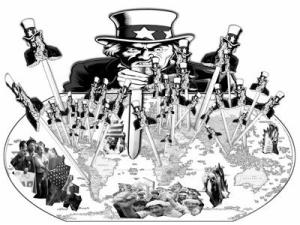
imperialism_usa

By Andre Vltchek

Source: Dissident Voice

Terrorism has many forms and many faces, but the most terrible of them is cold cruelty.

We are asked to believe that terrorists consist of dirty lunatics, running around with bombs, machine guns and explosive belts. That’s how we are told to imagine them.

Many of them are bearded; almost all are “foreign looking”, non-white, non-Western. In summary they are wife beaters, child rapists and Greek and Roman statue destroyers.

Actually, during the Cold War, there were some white looking “terrorists” – the left-wingers belonging to several revolutionary cells, in Italy and elsewhere in Europe. But only now we are learning that the terrorist acts attributed to them were actually committed by the Empire, by several European right-wing governments and intelligence services. You remember, the NATO countries were blowing up those trains inside the tunnels, or bombing entire train stations…

It “had to be done”, in order to discredit the Left, just to make sure that people would not become so irresponsible as to vote for the Communists or true Socialists.

There were also several Latin American ‘terror’ groups – the revolutionary movements fighting for freedom and against oppression, mainly against Western colonialism. They had to be contained, liquidated, and if they held power, overthrown.

But terrorists became really popular in the West only after the Soviet Union and the Communist Block were destroyed through thousands of economic, military and propaganda means, and the West suddenly felt too exposed, so alone without anyone to fight. Somehow it felt that it needed to justify its monstrous oppressive acts in Africa, the Middle East, Latin America and Asia.

It needed a new “mighty”, really mighty, enemy to rationalize its astronomical military and intelligence budgets. It was not good enough to face a few hundred ‘freaks’ somewhere inside the Colombian jungle or in Northern Ireland or Corsica. There had to be something really huge, something matching that ‘evil’ Soviet “threat”.

Oh how missed that threat was, suddenly! Just a threat of course; not the danger of egalitarian and internationalist ideals…

And so the West linked terrorism with Islam, which is one of the greatest cultures on earth, with 1.6 billion followers. Islam is big and mighty enough, to scare the shit out of the middle class housewives in some Western suburb! And on top of that, it had to be contained anyway, as it was essentially too socialist and too peaceful.

At that time in history, all great secular and socialist leaders of Muslim countries, (like in Iran, Indonesia and Egypt), were overthrown by the West, their legacy spat on, or they were simply banned.

But that was not enough for the West!

In order to make Islam a worthy enemy, the Empire had to first radicalize and pervert countless Muslim movements and organizations, then create the new ones, consequently training, arming and financing them, so they could really look frightening enough.

There is of course one more important reason why “terrorism”, particularly Muslim “terrorism”, is so essential for the survival of Western doctrines, exceptionalism and global dictatorship: it justifies the West’s notion of absolute cultural and moral superiority.

This is how it works:

For centuries, the West has been behaving like a mad bloodthirsty monster. Despite the self-glorifying propaganda being spread by Western media outlets all over the world, it was becoming common knowledge that the Empire was raping, murdering and plundering in virtually all corners of the Globe. A few more decades and the world would see the West exclusively as a sinister and toxic disease. Such a scenario had to be prevented by all means!

And so the ideologues and propagandists of the Empire came up with a new and brilliant formula: Let’s create something that looks and behaves even worse than we do, and then we could trumpet that we are still actually the most reasonable and tolerant culture on earth!

And let’s make a real pirouette: let’s fight our own creation – let’s fight it in the name of freedom and democracy!”

This is how the new generation; the new breed of “terrorist” was born. And it lives! It is alive and well! It is multiplying like Capek’s Salamanders.

*****Western terrorism is not really discussed, although its most extreme and violent forms are battering the world relentlessly and have for a long time, with hundreds of millions of victims piling up everywhere.

Even the legionnaires and gladiators of the Empire, like the Mujaheddin, Al-Qaida, or ISIS, can never come close to the savagery that has been demonstrated time and again by their British, French, Belgian, German or US masters. Of course they are trying very hard to match their gurus and bread-givers, but they are just not capable of their violence and brutality.

It takes “Western culture” to butcher some 10 million people in just one single geographic area, in almost one go!

*****So what is real terrorism, and how could ISIS and others follow its lead? They say that ISIS is decapitating their victims. Bad enough. But who is their teacher?

For centuries, the empires of Europe were murdering, torturing, raping and mutilating people on all continents of the world. Those who were not doing so directly, were “investing” into colonialist expeditions, or sending its people to join genocidal battalions.

King Leopold II and his cohorts managed to exterminate around 10 million people of Western and Central Africa, in what is now known as the Congo. He was hunting people down like animals, forcing them to work on his rubber plantations. If he thought that they were not filling up his coffers fast enough, he did not hesitate to chop off their hands, or burn entire village populations inside their huts, alive.

10 million victims vanished. 10 million! And it did not take place in some distant past, in the “dark ages”, but in the 20th century, under the rule of so-called constitutional monarchy, and self-proclaimed democracy. How does it compare with the terrorism that is ruling over the territories occupied by ISIS? Let’s compare numbers and brutality level!

And the Democratic Republic of Congo has, since 1995, lost again close to 10 million people in a horrid orgy of terror, unleashed by the West’s proxies, Rwanda and Uganda (see the trailer to my film “Rwanda Gambit”).

Germans performed holocausts in South-Western Africa, in what is now Namibia. The Herero tribe was exterminated, or at least close to 90% of it was. People were first kicked out from their land and from their homes, and driven into the desert. If they survived, the German pre-Nazi expeditions followed, using bullets and other forms of mass killing. Medical experiments on humans were performed, to prove the superiority of the Germanic nation and the white race.

These were just innocent civilians; people whose only crime was that they were not white, and were sitting on land occupied and violated by the Europeans.

The Taliban never came close to this, or even ISIS!

To this day, the Namibian government is demanding the return of countless heads severed from its people: heads that were cut off and then sent to the University of Freiburg and several hospitals in Berlin, for medical experiments.

Just imagine, ISIS chopping thousands of European heads, in order to perform medical experiments aiming to demonstrate the superiority of the Arab race. It would be absolutely unthinkable!

Local people were terrorized in virtually all colonies grabbed by Europe, something that I have described in detail in my latest 840-page book “Exposing Lies of the Empire”.

What about the Brits and their famines, which they were using as population control and intimidation tactics in India! In Bengal at least 5 million died in 1943 alone, 5.5 million in 1876-78, 5 million in 1896-97, to name just a few terrorist acts committed by the British Empire against a defenseless population forced to live under its horrid and oppressive terrorist regime!

What I have mentioned above are just 3 short chapters from the long history of Western terrorism. An entire encyclopedia could be compiled on the topic.

But all this sits far from Western consciousness. European and North American masses prefer not to know anything about the past and the present. As far as they are concerned, they rule the world because they are free, bright and hard working. Not because for centuries their countries have plundered and murdered, and above all terrorized the world forcing it into submission.

The elites know everything, of course. And the more they know, the more they put that knowledge to work.

Terrorist trade and experience are passed on from Western masters to their new Muslim recruits.

The Mujahideen, Al-Qaida, ISIS – on closer examination, their tactics of intimidation and terrorization are not original at all. They are built on imperialist and colonialist practices of the West.

News about this, or even about the terror that has been inflicted on the Planet by the West, is meticulously censored. You would never see them on the programs broadcast by the BBC, or read about them in mainstream newspapers and magazines.

On the other hand, the violence and ruthlessness of the client terrorist organizations are constantly highlighted. They are covered in their tiniest detail, repeated, and “analyzed”.

Everybody is furious, horrified! The UN is “deeply concerned”, Western governments are “outraged”, and the Western public “has had enough – it does not want immigrants from those terrible countries that are breeding terrorism and violence”.

The West “simply has to get involved”. And here comes the War on Terror.

It is a war against the West’s own Frankenstein. It is a war that is never meant to be won. Because if it is won, god forbid, there would have to be peace, and peace means cutting defense budgets and also dealing with the real problems of our Planet.

Peace would mean the West looking at its own past. It would mean thinking about justice and rearranging the entire power structures of the Planet. And that can never be allowed.

And so the West is “playing” war games; it is “fighting” its own recruits (or pretending to fight them), while innocent people are dying.

No part of the world, except the West, would be able to invent and unleash something so vile and barbaric as ISIS or Al-Nusra!

Look closer at the strategy of these group-implants: it has no roots in Muslim culture whatsoever. But it is fully inspired by the Western philosophy of colonialist terrorism: “If you don’t fully embrace our dogmas and religion, then we will cut off your head, slash your throat, rape your entire family or burn your village or city to the ground. We will destroy your grand cultural heritage as we did in South America 500 years ago, and in so many other places.”

And so on and so on! It would really require great discipline not to see the connections!

*****In 2006 I was visiting my friend, a former President of Indonesia, and a great progressive Muslim leader, Abdurrahman Wahid, (known in Indonesia as “Gus Dur”). Our meeting was held at the headquarters of his massive Muslim body Nahdlatul Ulama (NU). At that time the NU was the biggest Muslim organization in the world.

We were discussing capitalism and how it was destroying and corrupting Indonesia. Gus Dur was a “closet socialist”, and that was one of the main reasons why the servile pro-Western Indonesian “elites” and the military deposed him out of the Presidency in 2001.

When we touched on the topic of “terrorism”, he suddenly declared in his typically soft, hardly audible voice: “I know who blew up the Marriott Hotel in Jakarta. It was done by our own intelligence services, in order to justify the increase in their budget, as well as aid that they have been receiving from abroad.”

Of course, the Indonesian army, intelligence services and police consist of a special breed of humans. For several decades, since 1965, they have been brutally terrorizing their own population, when the pro-Western coup toppled the progressive President Sukarno and brought to power a fascist military clique, backed by the predominantly Christian business gang. This terror took between 2-3 million lives in Indonesia itself, as well as in East Timor and (until now) in occupied and thoroughly plundered Papua.

3 genocides in only 5 decades!

The Indonesian coup was one of the greatest terrorist acts in the history of mankind. The rivers were clogged with corpses and changed their color to red.

Why? So that capitalism would survive and Western mining companies could have their booty, at the expense of a completely ruined Indonesian nation. So the Communist Party of Indonesia (PKI) would not be able to win elections, democratically.

But in the West, those 1965 intensive massacres planned by the Empire were never described as “terrorism”. Blowing up a hotel or a pub always is however, especially if they are frequented by Western clientele.

Now Indonesia has its own groups of “terrorists”. They returned from Afghanistan where they fought on behalf of the West against the Soviet Union. They are returning from the Middle East now. The recent attacks in Jakarta could be just a foreplay, a well-planned beginning of something much bigger, maybe an opening of the new “front” of toy soldiers of the Empire in Southeast Asia.

For the West and its planners – the more chaos the better.

Had Abdurrahman Wahid been allowed to stay as the President of Indonesia, there would, most likely, have been no terrorism. His country would have undergone socialist reforms, instituted social justice, rehabilitated Communists and embraced secularism.

In socially balanced societies, terrorism does not thrive.

That would be unacceptable to the Empire. That would mean – back to Sukarno’s day! The most populous Muslim nation on earth cannot be allowed to go its own way, to aim for socialism, and to annihilate terrorist cells.

It has to be at the edge. It has to be ready to be used as a pawn. It has to be scared and scary! And so it is.

*****The games the West is playing are complex and elaborate. They are murky and nihilist. They are so destructive and brutal that even the sharpest analysts are often questioning their own eyes and judgments: “Could all this be really happening?”

The brief answer is: “Yes it can. Yes it is, for many long decades and centuries.”

Historically, terrorism is a native Western weapon. It was utilized freely by people like Lloyd George, a British PM, who refused to sign the agreement banning aerial bombardment of civilians, using unshakeable British logic: “We reserve the right to bomb those niggers.” Or Winston Churchill who was in favor of gassing the ‘lower grade’ of races, like Kurds and Arabs.

That is why, when some outsider, a country like Russia, gets involved, launching its genuine war against terrorist groups, the entire West is consumed by panic. Russia is spoiling their entire game! It is ruining a beautifully crafted neo-colonialist equilibrium.

Just look how lovely everything is: after killing hundreds of millions all over the Globe, the West is now standing as the self-proclaimed champion of human rights and freedom. It is still terrorizing the world, plundering it, fully controlling it – but it is being accepted as the supreme leader, a benevolent advisor, and the only trustworthy part of the world.

And almost nobody is laughing.

Because everyone is scared!

Its brutal legions in the Middle East and Africa are destabilizing entire countries, their origins are easily traceable, but almost no one is daring to do such tracing. Some of those who have tried – died.

The more frightening these invented, manufactured and implanted terrorist monsters, the more beautiful the West looks. It is all gimmicks. It has roots in advertisement, and in hundreds of years of propaganda apparatus.

The West then pretends to fight those deep forces of darkness. It uses powerful, “righteous” language, which has clear bases in Christian fundamentalist dogma.

An entire mythology is unleashed; it feels like Wagner’s “Ring”.

The terrorists represent evil, not the enormous expenditure from the coffers of the US State Department, the European Union and NATO. They are more evil than the Devil himself!

And the West, riding on the white horse, slightly pissed on wine but always in good humor, is portrayed as both a victim and the main adversary of those satanic terrorist groups.

It is one incredible show. It is one terrible farce. Look underneath the horseman’s mask: look at those exposed teeth; that deadly grin! Look at his red eyes, full of greed, lust and cruelty.

And let us never forget: colonialism and imperialism are two most deadly forms of terrorism. And these are still the two main weapons of that horseman who is choking the world!

André Vltchek is a novelist, filmmaker, and investigative journalist. He has covered wars and conflicts in dozens of countries. His latest book is Exposing Lies of the Empire. He also wrote, with Noam Chomsky, On Western Terrorism: From Hiroshima to Drone Warfare. Andre is making films for teleSUR and Press TV. After living for many years in Latin America and Oceania, Vltchek presently resides and works in East Asia and the Middle East. He can be reached through his website or his Twitter. Read other articles by Andre.

Leviathan and Behemoth

images

By Chris Shaw

Source: Center for a Stateless Society

Introduction

The capitalist economy has gone through another shock, and the potential for another, larger one is on the horizon. While it’s seemingly in its death throes, capitalism continues to fuel growth. Under such a system we have seen a vast improvement in general living standards across the globe, despite rigged markets and the omnipresent power of the state. However, who is this growth for? While absolute poverty has been rolled back, and in many Western nations completely eliminated, we still see a large, indebted underclass, a Global South regularly sold out to the interests of capital and a system of vast wealth that only seems accessible to a privileged few. Economists may say that if we look at BRIC countries we see an equalisation of wealth and growth with the West, but these BRIC markets are used as cogs in a hegemonic state-corporate machine. Third World entrepreneurship isn’t encouraged, but rather sidelined for corporate dominance. This is a system that needs to end. The debt economy, big government, the corporate-state partnership and modern globalisation all need to end. In their place we need truly free markets, where cooperation and exchange are paramount and aren’t controlled by corporate or government interests.

Our neoliberal society is composed of corporate hegemony backed by state power. By corporate hegemony I mean the power modern capital has over governance. This isn’t just found within corporations, but within guild-like occupational boards (Lawyers and Doctors and their licencing requirements) and corporate trade unions that support the maintenance of wage labour at the expense of worker independence from the structure of capital. Any markets we see are rigged in favour of corporate interests. The major monopolies of government control make sure that markets are a tool of big business and the ability of workers to break free from this paradigm is limited if not impossible. The entry barriers to markets, the restrictions on self-employment and the continued lobbying of government for patronage and favourable legislation leads to a corrupt, crony system that relies on the indenture of the poor in favour of employers and business.

There are many libertarians who unfortunately see this system as just and fair. They see sweatshop labour as an excellent solution to Third World poverty. The idea of growth is given religious prescience, without realising cultural antecedents and the importance of community within the realm of the individual. They don’t understand the power dynamics at play, and the continued collusion of corporate and state interests. They fail to see the monopolisation of social institutions and the commodification of culture and life. The destruction of livelihoods all in the name of GDP growth. This is not a free market, but rather capitalism at work. To move away from this we need to understand that free, or freed, markets are economic organisations free from coercive control, where the individual and community are the key players and profit is not reliant on its exploitative features, but rather the ability to meet real demand.

We need to look at the current capitalist system from the anarchist perspective that I put forward in this paper. Modern capitalism is a state-based system, reliant on enforced hierarchies and the provision of false choice. Real choice would confer power on individuals and communities, while under today’s system real choice is in the hands of bureaucrats and corporate oligarchies. Chartier’s definitions of capitalism, “capitalism: an economic system that features a symbiotic relationship between big business and government”[1] and “capitalism: rule—of workplaces, society, and (if there is one) the state—by capitalists (that is, by a relatively small number of people who control investable wealth and the means of production)”[2] shines light on this conception. Rather than capitalism being a system of free markets as posited by some libertarians (Block, Mises, Hayek, etc.) it is instead a system reliant on big government and its institutions and the control of said institutions via capital.

The vulgar libertarians who view the capitalist economy as some form of free market do not understand the forms of power present. If a worker wants to start a collectively-owned business, can he? Not without huge capital requirements and regulatory hoops to jump through. How about setting up a mutual credit system with a different currency? Well there are legal tender laws that in the United State are enforced with more brutality than the punishments given for heinous crimes[3]. When talking of free markets, we need to understand that freedom is only relative to where the power lies. If it lies with the state and its subsidiaries, then freedom is conferred on large employers and corporate unions whom receive forms of state funding and favourable regulation. If it lay with individuals and communities, we would most likely see a move away from one-size-fits-all regulation, the processes of commodification through rentierism and arbitrary entry barriers.

The Regulatory Apparatus

The regulatory apparatuses found within the economy also benefit the capitalist structure. While generally seen as a bulwark against corporate power, the regulations found in an economy create entry barriers to markets and a form of implicit subsidy to big business, as these businesses rent-seek government for more regulation, allowing for a monopoly within particular economic sectors. We can see in the banking, energy, manufacturing and retail sectors that this is the case. Childs noted this in relation to the development of monopoly power in American business during the late 19th and early 20th centuries. He states “this, then, was the basic context of big business; these were the problems that it faced. How did it react? Almost unanimously, it turned to the power of the state to get what it could not get by voluntary means”[4]. In particular Childs saw this occurring in the rail industry in America during the late 19th century. Massive competition had begun in the rail industry, which massively sunk profits for established companies and encouraged many start ups and smaller competitors. As large rail companies weren’t competitive enough in this environment, they came to rely on government intervention, where regulatory boards were created staffed mostly by executives from the large rail companies.

This is what regulation is really about. It isn’t a way of protecting the hapless consumer from the ravages of a free market, but is rather a tool of corporate power that forms entry barriers and enforces particular dichotomies of ownership and organisation in an economy. Capitalism becomes a system of patronage, where corporations gain favour due to their money and power, which itself comes from the state in the first place. As Paul notes “the rich are more than happy to secure for themselves a share of the loot – for example, in the form of subsidised low-interest loans…bailouts when their risky loans go sour, or regulatory schemes that hurt their smaller competitors”[5]. Rifkin shows a similar process, describing how “the critical industries that made up the infrastructure…banded together in a mega lobby to ensure…financial underwriting, as well as industry-friendly codes, regulations, and standards to ensure market success”[6].

The regulatory apparatuses also have the effect of distorting economies of scale, decoupling supply from demand and favouring largesse in business and ownership models. Thus we see the development of high overhead costs which restrict market entry to best capitalised of entrepreneurs. By limiting competition, we see perverse operations occurring that favour the interests of business over the worker and consumer. Thus things like planned obsolescence, guaranteed markets and a continuation of private gain and socialised loss. As had been noted by Childs, private cartels were difficult to maintain. Even the rail trusts, themselves built in contrived, government-produced markets, were ravaged by competition from smaller rail providers[7] that favoured more local economies of scale. So these corporations looked to the government, who enshrined their demands into acts and legislation which created cartels that were much more easily enforced. We just need to look where wage laws, licensure laws and planning/zoning laws are coming from and who lobbies for them. Invariably its dome by corporations and their lobbying arms. We also forms of legal privilege, as in the case of limited liability and corporate personhood, which are really only accessible with very high capital costs and a developed shareholder clientele. These systems are purely artificial, and whether they would work voluntarily is not the question. Rather it is, if they are efficient, why do they need the government to provide these privileges and apparatuses. The answer is simple, they aren’t efficient.

Even when there are laws supposedly to ameliorate the effects of marketisation, as in the case of welfare and government-provided services, they are usually built on the back of resilient communities who developed their own systems, and usually end up allowing employers to pay subpar wages and benefits and lessen the strength of community relations. It builds layers onto a poor foundation. Or to put it another way, the corporate-state nexus is putting a cinderblock on toothpicks. Bureaucrats don’t fully understand the problem with this but realise it is unstable. So to stabilise it, they put more toothpicks under the cinderblock, thinking it will stabilise. However, the system is inherently unstable and propping it up denies the inevitable.

This assurance of market success shows that under a truly free market they wouldn’t exist, or if they did it would be on a much smaller scale. The regulatory web is just another power dynamic that allows for capture and control. To describe this as a free market is laughable. These processes are completely involuntary, reliant on extortion through taxation and allow for the redistribution of wealth from the poor and middle class to the rich and privileged.

The Money Monopoly

While regulation, which “far from coming against the wishes of the regulated interests, was openly welcomed by them in nearly every case”[8], is an important part of the corporate state, the original four legal monopolies (as identified by Tucker), money, land, tariffs and patents, allowed for the development of rent-seeking corporations. These four monopolies, or as I see them structural monopolies as they create the structure of the socio-economic paradigm, are fundamentals of capitalism.

The money monopoly allows for the restriction of credit and the development of debt-based models that destroy stores of value and make individuals slaves to the desires of governments and banks through modern forms of debt peonage. As Dowd notes, over the 20th century “the US dollar has lost almost 85 per cent of its purchasing power even by official government statistics; for its part, sterling has lost 98 per cent of its value over the last century”[9]. The restriction of credit coupled with the inflationary tendencies of modern fiat currencies mean the poorest are effectively forced into wage labour, as they rely on pitiable increases in nominal wages and are unable to gain any real credit for self-employment or collective worker-owned enterprises. What happens is a redistribution of wealth from the poorest to the richest. Long shows that “inflationary monetary policies on the part of central banks also tend to benefit those businesses that receive the inflated money first in the form of loans and investments, when they are still facing the old, lower prices”[10]. The pre-inflation money allows investors and banks to capitalise on new production and investment while the poorer elements of a society receive minimal benefits as the inflationary course makes its run, with prices rising and wages following later.

This also leads to massive levels of debt found currently throughout the globe, as credit instruments are used to make up for stagnant wages that can’t afford increasing land prices and subsequently rent prices, as well as an increase in the price of consumer goods that are a significant chunk of working people’s wages. The process of rent extraction via high interest rates follows from this, as “the money monopoly also includes entry barriers against cooperative banks and prohibitions against private issuance of banknotes, by which access to finance capital is restricted and interest rates are kept artificially high”[11]. Carson notes further that the elimination of controlled interest rates would lead to “significant numbers (of workers) retiring in their forties or fifties, cutting back to part-time, or starting businesses; with jobs competing for workers, the effect on bargaining power would be revolutionary”[12]. The current banking system leads to the necessitation of wage labour through restricted credit dissemination and debt-based forms of finance.

The Land Monopoly

The land monopoly is another lynchpin of capitalism. Most modern land is either nationalised or corporatised through state structures, leading to massive land centralisation and the process of land expropriation that is visible in much of the Third World. Alternative land arrangements, such as those organised by tribes and local networks, are swallowed up in this process. Many commons regimes that have existed for centuries are being eliminated in favour of the interests of capital. This process of enclosure of common lands began at “the end of the Medieval Age, when royal and feudal landowners began to enclose common lands, especially in Tudor England and Trastamara Spain. Through legal and political manoeuvres, wealthy landowners marked and hedged off sections of the commons for their own profits, impoverishing many villagers and ultimately destroying their communitarian way of life”[13]. The enclosures have continued into the 20th century, where “common lands have suffered a third, global wave of commodification and enclosure, ‘land grabbing’ spurred by the dominant neoliberal doctrine and competition for non-renewable natural resources and supported now by the evolutionary theory of land rights”[14]. The modern enclosures of land occur most noticeably in Africa and South America. We see the elimination of common land owned by native tribes and the raping of natural resources. The Niger Delta and its oil reserves show this acutely, with oil spills being common and almost no compensation to the farmers and workers who rely on the Delta for their livelihoods.

In effect this is a process of neo-colonialism pushed through via the Washington Consensus that is epitomised in international groups like the IMF and WTO. The plight of Bangladeshi workers is caused by this problem of neocolonial practices. In Bangladesh “wealthy and influential people have encroached on public lands…, often with help of officials in land-administration and management departments”[15] which has led to a result of “Many of the rural poor in Bangladesh are landless, have only small plots of land, are depending on tenancy, or sharecropping”[16]. What follows is a continuation of the development of a landless mass of cheap labour as a result of the nationalisation and corporatisation of land.

Then there are planning and zoning laws and property laws which act as a form of implicit land nationalisation in many Western countries. Among their many effects, they artificially inflate land prices, which has a knock on effect of making housing unaffordable and making the purchase of land extremely difficult for small businesses. This further encourages the process of rentierism and indebtedness as individuals have to get out mortgages or rent accommodation, and individuals looking to start a business are priced out, thus favouring large corporations. If you want to self-build a home or business, it becomes impossible. Instead a series of state-favoured land developers are able to land bank and rent out at extortionate rates. They aren’t subject to competition and making new land isn’t possible, so you create a system of patronage and favouritism, simply adding to the enforced necessitation of wage labour.

These processes of land appropriation lead to the development of land speculation via government-favoured industries, creating artificially high land prices which price out small businesses, community groups and anyone who isn’t able seek rent from the state. This speculation also fuels boom-bust cycles, with much of the credit used by investors and businesses being put into the easy investments of land and housing. This creates economic bubbles through the wide diffusion of mortgages and an increase in house and infrastructure building that isn’t necessarily needed. In London, we see this playing out with high-price apartments and high-rises that don’t address the needs of the wider population and are fueled, at least partially, via QE-induced credit. The development of a rentier society occurs. With land prices held artificially high, rich landowners are able to rent out their properties at high prices, creating economic precarity and stimulating the larger wage labour monopoly that is caused by a combination of this monopoly and the money monopoly.

The Larger Wage Labour Monopoly

As previously mentioned, credit is restricted thus funding options are limited for workers. Add to this high land prices, and the ability to buy a house or develop a business are severely restricted, developing the large pool of wage labour seen today. This obviously favours large-scale employers such as corporations who are able develop to their current size due to this wage labour monopoly. It leads to a means of surplus value, or rent, extraction. As Solow notes “one important reason for the failure of real wages to keep up with productivity is that the division of rent in industry has been shifting against the labor side for several decades”[17].

Alongside the two monopolies, the increase in precarious wage labour is compounded by the restriction of collective action and the development of monopolist unions that complement the centralised economic actors. The legislation governing strikes and the ability to make a union add to this problem, making it difficult for freelance workers to unionise and stopping the development of radical trade unions and company unions. Thatcher’s trade union reforms in the UK created such a problem as the majority of private sector unions are part of the corporate system of economic centralisation. The final nail in the coffin is the minimum wage. This creates a wage ceiling and simply allows corporations to price smaller competitors out of the market while subsequently limiting the hours and benefits workers receive. As most minimum wages aren’t enough to live on, many workers rely on debt-based credit which pushes individuals further into wage labour, creating debt-led wage slavery and maintaining a massive, centralising economic monopoly on the choice of workers.

As Solow explains, in the US “in the past 10 years productivity has increased 12.3 percent in the non-farm business sector of our economy while real compensation of labor has increased by only 5.1 percent”[18]. So what we see is a form of surplus value extraction, whereby the excess product of labour is captured by the interests of capital and removed from the compensation of labour. This can’t simply be explained away by using the marginalist critique. The value of a product is at least partially informed by its labour input. Marshall’s analysis shows that “price was determined, at any given time, by the balance between the demand and supply that actually existed at that moment. As the time factor came into play…price approached closer and closer to cost”[19] thus showing that the equilibrium of supply to demand moves from subjective criteria of value toward the input of labour in that value. Again looking at Solow’s productivity figures, the compensation of labour isn’t in proportion to production.

Hodgskin’s idea of a market artificially privileged with rents, profits and interest becomes a reality in the modern context. The increase in freelancing and labour market individuation means the expropriation of rent and the limitation of choice, particularly as unions are simply a representation of the corporate interest, particularly since the Wagner Act in America and the trade union reforms in Britain. The individualisation of labour serves to increase these artificial privileges, meaning can be paid less and thus become more reliant on debt instruments such as mortgages and credit cards to simply earn a living and have a roof over their head. This system is even more acute in the Global South, with the restriction of choice via the structural monopolies being almost explicitly enforced via the government as land in enclosed and regulations used to restrict microeconomic activity that doesn’t serve the interests of global value chains. Their human capital is monopolised, wages restricted, collective action completely banned and working conditions extremely poor. The main profit garnered from this is simply the mark-up created by internal tariffs and intellectual property (to be discussed later in this paper), which limits domestic market production and serves only the interests of capital and big business, as both the workers and consumers are given low wages and higher prices respectively.

What happens then is the construction of a monopsony situation in wages and labour, where the product of labour isn’t adequately paid, becoming widespread due to companies paying below this level. This is compounded by wage laws favoured by corporate interests, and an inability for the worker to capture this value through collective bargaining or through the means of owning one’s productive capacities due to market entry barriers that restrict self-employment and worker or community ownership. It constrains the real choice of workers and puts the power dynamics upon employers and bureaucrats.

Tariffs

The next two monopolies that Tucker highlighted further the centralisation of economic power toward corporations. Tariffs are simply a form of direct state intervention to favour domestic industry over foreign competitors. There are arguments favourable to this position, such as those by List and Chang. However, there is a significant time limit on the ability of tariffs to produce any sort of growth (usually artificially induced by state policies), and eventually many of the protected industries become bloated and begin to rely on further government subsidy.

The use of tariffs today is much more limited than it was during the mercantile years of the 17th and 18th centuries. However, one area where tariffs are still largely used is modern agriculture in the West, particularly the US and the EU. The Farm Bill in the US creates price distortions within food markets that favours large agribusiness over small, family farms. As Reitzig explains “the farm bill perpetuates the myth of cheap food. It subsidizes Big Ag so that BA can sell its food to the market cheap and you find it at the grocery store for less than you’d pay for it from your local farmer”[20]. However as “it costs the small local farmer about the same to produce the same food as the Big Ag farmer”[21], all the Farm Bill does is redistribute tax money toward large agricultural firms. The economies of scale thus get changed, with farmers forced into retail sector bulk sell offs that are increasingly inefficient and perpetuate the agricultural tariffs and subsidies.

There also forms of internal tariffs that protect large industry through direct subsidisation. For example “between 1973 and 2003, the US government paid out $74 billion in energy subsidies to promote R&D in fossil fuels and nuclear power”[22]. This was despite these companies having huge profit margins, which shows the actual profitability of these industries. They are reliant on institutions of theft to simply develop critical infrastructure as a result of their internal unproductiveness and their falling foul of the economic calculation problem. It creates a system of perverse incentives as these firms aren’t induced to work and develop in smarter, cleaner ways and instead produce the same limited output. This is corporatism at its finest, with government purposefully favouring large firms over small firms, and thus encouraging wasteful practices. Returning to farming, the EU holds similar policies, which in many ways restrict crop diversification and mean that certain farmers are favoured over others. This leads to artificially low prices which allows for retail monopolisation due to farmers being unable to sell their own product due to EU regulations which create this system. It is a continuation of the obstinate incentives that leads to overproduction, false demand and the entrenchment of economic disadvantages and inefficiencies.

Patents

Patents act in a similar way. They privilege large businesses in rigged markets and allow for centralisation and monopolisation. “The patent privilege has been used on a massive scale to promote concentration of capital, erect entry barriers, and maintain a monopoly of advanced technology in the hands of western corporations. It is hard even to imagine how much more decentralized the economy would be without it”[23]. Patents act to lock up innovation in a legal quagmire. It puts new technology into the hands of capital, limiting its distribution and creating a rentier system, where the privilege to use new technology and even knowledge is commodified by large corporations in collusion with the state.

This inability to access new technologies and knowledge creates a form of entry barrier, with smaller competitors being unable to afford this access. Most modern tech companies (Google, Apple, Microsoft) are in effect monopolists of knowledge and technology, limiting its accessibility and collecting the rent they charge on these products. Their market position becomes entrenched with restrictive data laws and copyrights that mean the passage of information is blocked by virtual, artificial toll gates that wouldn’t exist if not for coercive legislation.

Then there is the direct government subsidisation of research and development (R&D) spending that allows for large companies to reap “monopoly profits from technology it didn’t spend a penny to develop”[24]. Modern tech companies then are not only monopolists of patented of knowledge but also rentiers of technology they had no real part in developing. So while small inventors and start ups toil away trying to create a product that can only be sold on a rigged market, large firms benefit purely because of their power and the revolving door of government benefaction. Similar processes occur in military-based R&D spending, where corporations are given large grants and procurement contracts to develop military hardware and weaponry that on a freed market would not even necessarily be required by any customer or business. As Chomsky notes, in the US “the Pentagon system has long been the country’s biggest welfare program, transferring massive public funds to high-tech industry on the pretext of defense and security”[25]. These companies’ profits and growth are not then created in a market mechanism of competition and demand-led supply, but rather in a bubble of government-led protection, where they ride on the coattails of stolen innovation and forms of theft AKA patents and taxation respectively. “If they had to face the market, they’d be out selling rags or something, but they need a nanny state, a powerful nanny state to pour money into their pockets”[26].

Further, this process of patenting becomes a pure form of commodification as they remove products and ideas from their cultural origins. For example, the Human Genome Diversity Project used DNA from certain indigenous tribes in Central and South America. Some of this DNA was patented, and thus removed from the culture it came from without any sort of compensation by the HGDP and the beneficiaries of this knowledge. Biocolonialism and biopiracy are the best terms for this occurrence. By extracting culturally sensitive information and knowledge, a process of commodification occurs, and the whole concept of property, that of the sovereign ownership of the individual or collective, becomes redundant. Further the innovative capacities that supposedly come from intellectual property are limited if not completely negative. In fact the information that was patented was found to be 30% less innovative than the information released for full public use[27].

This analysis is backed by evidence from Scherer, who showed “a survey of 91 companies in which only seven ‘accorded high significance to patent protection as a factor in their R & D investments.’ Most of them described patents as “the least important of considerations.’ Most companies considered their chief motivation in R & D decisions to be ‘the necessity of remaining competitive, the desire for efficient production, and the desire to expand and diversify their sales”[28]. Thus patents and intellectual property “eliminate ‘the competitive spur for further research’ because incremental innovation based on others’ patents is prohibited, and because the holder can ‘rest on his laurels for the entire period of the patent.’ with no fear of a competitor improving his invention”[29].

Transport Subsidies

The fifth monopoly, transport subsidies, is one that has been identified by Carson. As Carson describes, “spending on transportation and communications networks from general revenues, rather than from taxes and user fees, allows big business to ‘externalize its costs’ on the public, and conceal its true operating expenses”[30]. These transportation subsidies allow for the development of large business operations, particularly in the retail and manufacturing sectors. By subsidising the movement of goods by heavy duty vehicles, it means they are given a state-based competitive advantage against smaller, local competitors.

Companies like Wal-Mart and Tesco are able to price their goods artificially cheaply as a result of not adding the transportation costs. Many of these companies actively lobbied for such infrastructure projects. When the interstate system was being built, it “had both an immediate stimulus effect on the industries that participated…oil companies, general contractors, cement manufacturers, steel companies…were among the dozens of industries involved in the building of the great interstate highway system”[31] showing the degree of corporate-state cooperation. It was because these infrastructure projects benefitted their products and models that they lobbied for them.

Of course Carson’s view of this quite US-centric. In much of Europe, particularly the UK, we see other regulations that create a very different kind of transport subsidy. While these nations do subsidise transport via taxation to pay for roads rather than using user fees or road pricing, they also have high fuel duties and regulation on forms of transport, such as regulations on truck design and usage. The fuel duties act as a subsidy in the sense that they destroy small transport firms and simply monopolise the transport industry as only larger companies can afford the higher prices. The forms of regulation mentioned mean that innovation into new vehicle design and competition between firms is limited and simply continues the dominance of particular transport and production companies that aren’t subject to market competition. Thus what we see are two different types of transport subsidies that both act to continue the current economic paradigm.

These subsidies serve to amplify economies of scale, creating national and international markets largely in the control of corporate interests. These large markets create systems of disequilibrium, with monopoly interests being able to develop oligopoly markets from which rents can be extracted. A modern example of this is the creation of HS2 in the UK. It serves as a vanity project for political and bureaucratic elites, who can gain well-paying jobs as political advisors and construction directors. It also allows for the continuation of the North-South divide, with large London-centric firms sucking out talent from the North and Midlands, at little expense to themselves. As Wellings describes it, it’s an example of externalised costs and internalised benefits, with vested interests serving to gain[32]. Economies of scale are created artificially, with competition in local markets suffering due to a project only favourable to London-based businesses. Local economies of scale, which are more natural and more open to individual considerations and supply and demand, are priced out by government intervention. Local transport projects, like roads linking market towns and local rail infrastructure, are ignored due to a lack of political prestige for politicians and their donors and lobbyists.

Road and rail subsidised by the state leads to the current economies of scale that favour large, centralised business entities. It also prices out and discourages private infrastructure projects that could actually make an economic difference by increasing competition and lowering prices, while maintaining local economies of scale which benefit large swathes of areas that currently don’t benefit from the subsidised corporate model. These three monopolies further the wage labour monopoly, by erecting entry barriers against small business and self-employment and by creating feudalistic patent regimes and transport systems that create favourable economies of scale. National markets serve larger companies and hierarchical organisation, and international markets continue to serve and enlarge this. It pushes real costs onto the consumer/taxpayer, and further creates illegitimate profits taken from oligopoly markets.

The Corporate Infrastructure

This wage labour monopoly, with the five structural monopolies feeding it, is the basis of the modern corporate dominated economy. As a result, modern corporations act as oppressive actors on the world stage, using wage slaves and forms of indebtedness to develop the massive growth seen in the 20th and 21st centuries. As Carson states “in a very real sense, every subsidy and privilege described above is a form of slavery. Slavery, simply put, is the use of coercion to live off of someone else’s labor. For example, consider the worker who pays $300 a month for a drug under patent, that would cost $30 in a free market. If he is paid $15 an hour, the eighteen hours he works every month to pay the difference are slavery. Every hour worked to pay usury on a credit card or mortgage is slavery. The hours worked to pay unnecessary distribution and marketing costs (comprising half of retail prices), because of subsidies to economic centralization, is slavery. Every additional hour someone works to meet his basic needs, because the state tilts the field in favor of the bosses and forces him to sell his labor for less than it is worth, is slavery”[33].

Then there is the system of incentives created by this corporate-state monopoly. Infrastructures are developed that maintain the inefficiencies. Rifkin’s analysis of a series of Industrial Revolutions shows this to be the case. The Second Industrial Revolution, the current economic system we live in according to Rifkin, is reliant on state-invested infrastructure and subsidisation[34]. The subsidisation of natural capital is one example of this. Roberts shows that “the total unpriced natural capital consumed by the more than 1,000 “global primary production and primary processing region-sectors” amounts to $7.3 trillion a year — 13 percent of 2009 global GDP”[35]. The term natural capital is obviously a broad, all-encompassing term. The specifics are those of the production of pollutants that is subsidised by specific tax breaks and forms of limited liability. These follow from elements of the land monopoly which means pollution becomes an externalised cost upon taxpayers, furthering the inefficiencies of a particular economic paradigm, which Rifkin calls the Second Industrial Revolution but what I would call capitalism.

The maintenance of this system means most companies that are reliant on fossil fuels and the energy and transport infrastructures that follow from them have no incentive to divest into new market ventures, but instead have an interest in resource and capital accumulation. It creates ‘revolving door’ government, where lobbyists persist in convincing policy makers for subsidies here and tax breaks there all the while relying on the rent extraction they gain from state intervention.

This process within resource extraction and energy use is more widely seen in the general production processes of capitalism. The levels of overproduction and continued consumption are fed by the structural monopolies, as well as justifying the wage labour monopoly. To fund the levels of consumption needed to continue production means people are put into a paradigm of working longer to buy more things to enjoy. Its paradoxical as you spend more time at work, thus limiting the amount of time you have to actually enjoy consumer goods. Further, as goods become more expensive due to increasing cost mark-ups and inflationary policies, and housing prices and rents go up due to land speculation and monopoly ownership, more people become reliant on debt instruments to fund their everyday lives and their increasing consumer spending. This has created a precipitous debt bubble as Steve Keen’s work has shown. It has also meant that much of the current growth seen since the Great Recession has been on the back of consumer spending, as Blanchflower has documented.

Incentives are created which lead to increasing, unnatural growth and increasing levels of debt. In particular, levels of corporate debt have skyrocketed during the recession of 2008. This is due to systemic overproduction and waste that has developed due to mass production systems used by most multinationals. The structural subsidies create this system where large production facilities with forms of guaranteed profit are needed for massive market areas, usually on a national or international level. Carson has pointed out that modern markets are hardly an example of spontaneous order and aren’t reliant on supply and demand[36]. Rather the system is reliant on a system of planning, with codified relations between suppliers and distributors and systems of guaranteed consumption through external market control in the form of internal sales tariffs and the financialisation of the economy.

Internal sales tariffs limit what stores/areas products can be sold in, and are only viable as a result of intellectual property regimes that allow for increased costs and a further disconnect between production and consumption. Financialisation on the other hand simply maintains the production systems as well as processes of commodification. It makes corporate debt a commodity, and puts value into meaningless products, which allows for more accumulation and overproduction as business isn’t rewarded for genuine wealth production and creation, which comes from artificial processes, but is rewarded rather by debt financialisation, unsustainable growth in bureaucracy and the continued expropriation of surplus value, or human capital. This also represents a commodification process, as the social relation of debt, as identified by Graeber and Martin, is put into an economistic context, with debt serving the purposes of profit and capital. The debt relationship, that’s shaped by community relations and gift-giving and receiving[37], is taken as a value of capital. And this debt is allowed to build up and shape other economic activity. Consumer purchase after consumer purchase represents this. It is encouraged, and when it slows the government takes over and funds through quantitative easing programs, allowing for the construction of bigger, more complex bubbles. It shows that corporation and government are two sides of the same coin.

We have to remember that as much as governments, corporations are just as likely to be effected by the knowledge problem. To get around, every relationship and process is effectively planned. Business to business relations, as seen in distribution and supply chains, are maintained for decades by large manufacturers so as to continue guaranteed buyers of their products. In other cases, the supply and warehousing operations are subsumed by the manufacturer, owning every process from production to sale. Global value chains are an outgrowth of this hierarchalised control and planning, with much of their success being guaranteed by government. It is dictatorial governments in the Global South (who usually have the backing of the US government and its interests) that ban collective action among labourers through extraordinarily harsh measures, it is trade agreements with their backing by Western governments that maintain artificial property rights such as patents and it is government that externalises the cost of global transportation of these goods onto the taxpayer, thus distorting economies of scale to favour the large corporations and forms of state-corporate economic planning. In other the words, the commodification and Sovietisation of the economy.

Culture Under Capitalism

A paradigm that enforces this economic hierarchy is created, where life is work and your main identity is around the soul-crushing job you inhabit. Social relations are commodified and local economic activity is strangled. The whole idea of community in the 21st century is being replaced by a centralised state and economic activity that has no interest in that community, but is inward looking, determining profit margins rather building strong societal relations. The ability to escape this paradigm is extremely limited by the coercive hand of the state. It restricts collective organising, eliminates common and private property and develops extremely insufficient systems of economic organisation.

What we’ve seen is the disembedding of markets from their cultural and social origins[38]. Relations of debt and consumption, which were as much in political institutions and based around social relations, have been expropriated by capital. Thus instead of markets forming one of many different idea of economic organisation of which it could complement, we see the neoliberal discourse of praising markets and even seeing marketisation in what have been social relations up to this day. Thus public services such as health and energy are wrapped in discourses of competition and corporate ownership. However, markets aren’t actually like this. If we look to genuinely free markets, which are few and far between, we don’t see large production and corporate ownership. Instead we see markets crafted around local institutions and genuine demand for certain goods and services. Ownership is much more decentralised. However, due to government-based price and scale distortions, culture and its institutions are brought into the marketised economy, creating the marketised society.

 It leads to the development of modern consumerism, creating warped identities based around products. It kills culture and intelligence in favour of an advertised individual. Carson shows that “mass production divorces production from consumption. The rate of production is driven by the imperative of keeping the machines running at full capacity so as to minimize unit costs, rather than by customer orders. So in addition to contractual control of inputs, mass-production industry faces the imperative of guaranteeing consumption of its output by managing the consumer”[39]. The consumer is separated from the producer. Mass production means a consumer culture. Rather than supply meeting demand, demand is made to compensate for oversupply. It also creates forms of consumer inequality that mean Third World workers have almost no access to the products they help produce. The development of domestic markets in consumer goods is massively restricted via patents and tariffs.

Within the Western world there is similar consumer inequality, with a creation of an underclass who desire consumer goods that their limited wages can hardly afford. Bauman’s analysis of the London Riots in 2011 saw an element of this consumer yearning, with products like high-end trainers and flat-screen TVs being taken. Bauman notes that “from cradle to coffin we are trained and drilled to treat shops as pharmacies filled with drugs to cure or at least mitigate all illnesses and afflictions of our lives and lives in common. Shops and shopping acquire thereby a fully and truly eschatological dimension”[40]. The cultural backwater caused by modern consumerism creates a form of stigmatisation and symbol status, with haves and have nots developing into distinct classes in a consumer culture. As Bauman states “for defective consumers, those contemporary have-nots, non-shopping is the jarring and festering stigma of a life un-fulfilled — and of own nonentity and good-for-nothingness. Not just the absence of pleasure: absence of human dignity. Of life meaning”[41].

The processes of commodification amplify this systemic crisis. The divorcing of production from consumption leads to the most atomistic forms of individualism. It becomes a process of overconsumption and hoarding, without any appreciation of the product development. Cultural and societal obligations and considerations get uprooted by what is wanted and what can be bought. It puts value squarely into the hands of capital, with the determination of worth being decided in social hierarchies that follow from the enforced economic hierarchies of modern capitalism. It is a symptom of the false choice of employment or death, of work creating one’s value in life and of a market shaped not by workers, communities and cultures but by the interests capital and the state that props it up.

Conclusion

This system is massively unsustainable, and becomes more and more reliant on tax revenues to make it profitable. The price system becomes distorted, encouraging the mass production that “leads to ever-increasing demands on state services”[42]. This then shows the inefficiency of large corporations. They are as much subject to the economic calculation problem as the state. Their reliance on the theft of individual income via the taxation system means in anarchist society they are completely unviable. As a system of economic organisation “capitalism could not have survived at any point in its history without state intervention. Coercive state measures at every step have denied workers access to capital, forced them to sell their labor in a buyer’s market, and protected the centers of economic power from the dangers of the free market”[43].

In systems of anarchy, there would be an end to corporate dominance due to their inability to seek state rent and thus collapsing in their inefficiencies. As noted by Carson, there were two paths that could have been taken to organise industry and the economy. The one that was followed was “centralized production using expensive, product-specific machinery in large batches on a supply-push basis”[44]. However a better system was possible. One of “decentralized production for local markets, integrating general-purpose machinery into craft production and governed on a demand-pull basis with short production runs and frequent shifts between product lines”[45]. This would have required localised industry, networked communities and what Rifkin calls lateral, distributional, collaborative markets. Workers would be independent of capital, and have an ability to take back their surplus value. It would involve voluntary governance structures and self-organised communities. It would be an end to the corporate-state nexus.

By having this centralised system, we open the floodgates to the continuation of boom-bust cycles through monopoly government control. Since the delinking of production from consumption, there has been a development of mass production and the apparatuses that prop it up. Marx noted this particular phenomenon, with “the birth of large-scale industry this true proportion had to come to an end, and production is inevitably compelled to pass in continuous succession through vicissitudes of prosperity, depression, crisis, stagnation, renewed prosperity, and so on”[46]. This process in the end favours the capitalists. It destroys real value in an economy and allows for more government involvement. Further, it leads to capital accumulation through government subsidisation and the monopoly position many modern corporations hold within their respective markets.

It’s a process of artificial wealth accumulation and creation, backed by the five monopolies previously mentioned. High land prices, restrictive credit access and the use of interest rates to effectively distort the value of currency, the use of market entry barriers through regulations and patents and the use of transport subsidies all favour the main monopoly, that of wage labour. Because of the diminishing returns that many of these companies are finding, they are becoming increasingly reliant on the extraction of surplus value from their workers. As mentioned earlier, wage laws allow them to eliminate smaller competitors and the development of varied, precarious work contracts mean a diversification of their workforce, which allows them to reduce hours paid and thus reduce their labour costs. However, the compensation of a worker’s product isn’t necessarily met. Thus the accruing of capital simply means the extraction of rent from workers, which is enforced by the limitation of worker’s to pool their labour value and capital and develop their own industry in a truly free market.

Government is the glue which holds capitalism together. Without it, the economies of scale, the appropriation and centralisation of land and the distortion of inputs and outputs would be impossible. Without a central bank, the destructive tax of inflation wouldn’t be feasible in a competitive currency market. The redistribution of wealth and malinvestment couldn’t occur on the same scale as markets would act as a corrective against these activities. The use of tariffs and patents to lock up technology and create artificial wealth couldn’t happen without the state’s coercive power. Economic organisation is a fluid concept, that changes from place to place and people to people. What is right for one community or tribe is not what is necessarily right for another. A freed market would reflect this, as it would embed markets in pre-existing cultural/social structures and stop the developments of commodification and neo-colonialism that persist presently. This is a world free of state-action and corporate control. This is anarchism.

Bibliography

Bauman, Z. (2011). The London Riots – On Consumerism Coming Home To Roost. Available: http://www.socialeurope.eu/2011/08/the-london-riots-on-consumerism-coming-home-to-roost/. Last accessed 21st Sep 2015.

Carson, K (2007). Studies in Mutualist Political Economy. United States: BookSurge.

Carson, K. (2010). The Distorting Effects of Transportation Subsidies. Available: http://fee.org/freeman/the-distorting-effects-of-transportation-subsidies/. Last accessed 15th Sep 2015.

Carson, K (2010). The Homebrew Industrial Revolution. United States: BookSurge.

Carson, K. (2002). The Iron Fist Behind the Invisible Hand. Available: http://www.mutualist.org/id4.html. Last accessed 25th Sep 2015.

Chartier, G. (2010). Advocates of Freed Markets Should Embrace “Anti-Capitalism”. Available: http://c4ss.org/wp-content/uploads/2010/01/chartier.anticapitalism.pdf. Last accessed 14th Sep 2015.

Childs, R. (1971). Big Business and the Rise of American Statism. Available: http://praxeology.net/RC-BRS.htm. Last accessed 16th Sep 2015.

de Ugarte, D. (2015). Biomedical patents reduce innovation by 30%. Available: http://blog.p2pfoundation.net/biomedical-patents-reduce-innovation-by-30/2015/09/09. Last accessed 16th Sep 2015.

Dowd, K (2014). New Private Monies. London: Institute of Economic Affairs.

Long, R. (2008). Corporations versus the Market; or, Whip Conflation Now. Available: http://www.cato-unbound.org/2008/11/10/roderick-t-long/corporations-versus-market-or-whip-conflation-now. Last accessed 15th Sep 2015.

Martin, F (2013). Money: The Unauthorised Biography. London: Bodley Head.

Paul, R (2007). The Revolution: A Manifesto. 2nd ed. United States: Grand Central Publishing.

Polanyi, K (2002). The Great Transformation. 2nd ed. Boston: Beacon Press.

Reitzig, L. (2014). Farm Bill 2014 or “The Destruction of Small Family Farms”. Available: http://nourishingliberty.com/farm-bill-2014-just-how-bad-is-it/. Last accessed 21st Sep 2015.

Richman, S. (2013). Bangladeshi Workers Need Freed Markets. Available: http://fff.org/explore-freedom/article/bangladesh-needs-freed-markets/. Last accessed 16th Sep 2015.

Rifkin, J (2011). The Third Industrial Revolution. New York: Palgrave MacMillan.

Roberts, D. (2013). None of the world’s top industries would be profitable if they paid for the natural capital they use. Available: http://grist.org/business-technology/none-of-the-worlds-top-industries-would-be-profitable-if-they-paid-for-the-natural-capital-they-use/. Last accessed 16th Sep 2015.

Shorr, I. (1996). On US Military Budgets. Available: http://www.chomsky.info/interviews/19960211.htm. Last accessed 25th Sep 2015.

Solow, R. (2015). The Future of Work. Available: http://www.psmag.com/business-economics/the-future-of-work-why-wages-arent-keeping-up. Last accessed 16th Sep 2015.

StopHS2. (2013). “Classic Example” of Vested Interests. [Online Video]. 18 November. Available from: https://www.youtube.com/watch?v=r94VP3USOuE. [Accessed: 31 October 2015].

Vivero Pol, J. (2015). Transition towards a food commons regime. Available: http://poseidon01.ssrn.com/delivery.php?ID=9851100240740070870950101221090931190350100270460840350111130010740820980970930810660540551030481120240140671180910151151060840400590600730100851021250261111. Last accessed 15th Sep 2015.

Notes:

[1] Chartier, G. 2010, 1

[2] Chartier, G. 2010, 2

[3] Dowd, K. 2014

[4] Childs, R. 1971

[5] Paul, R. 2009, 70

[6] Rifkin, J. 2011, 134

[7] Childs, R. 1971

[8] Childs, R. 1971

[9] Dowd, K. 2014, 85-86

[10] Long, R. 2008

[11] Carson, K. 2002

[12] Carson, K. 2002

[13] Vivero Pol, L. 2015, 9

[14] Vivero Pol, L. 2015, 9

[15] Richman, S. 2013

[16] Richman, S. 2013

[17] Solow, R. 2015

[18] Solow, R. 2015

[19] Carson, K. 2007, 50

[20] Reitzig, L. 2014

[21] Reitzig, L. 2014

[22] Rifkin, J. 2011, 134

[23] Carson, K. 2002

[24] Carson, K. 2002

[25] Shorr, I. 1996

[26] Shorr, I. 1996

[27] de Ugarte, D. 2015

[28] Carson, K. 2002

[29] Carson, K. 2002

[30] Carson, K. 2002

[31] Rifkin, J. 2011, 134

[32] Wellings, R. https://www.youtube.com/watch?v=r94VP3USOuE

[33] Carson, K. 2002

[34] Rifkin, J. 2011

[35] Roberts, D. 2013

[36] Carson, K. 2010

[37] Martin, F. 2013

[38] Polanyi, K. 2002

[39] Carson, K. 2010, 50

[40] Bauman, Z. 2011

[41] Bauman, Z. 2011

[42] Carson, K. 2010, 111

[43] Carson, K. 2002

[44] Carson, K. 2010

[45] Carson, K. 2010

[46] Carson, K. 2010, 256

Economic grace of ‘Social Credit’: national dividend with compensated retail prices for consumer goods distribution in an age of technology

quote-at-the-present-time-the-alternative-is-not-between-change-or-no-change-but-between-change-c-h-douglas-77-2-0224By Wallace Klinck

Source: The Daily Censored

“The unacknowledged, but obvious, truth is that unnecessary work, imposed by either edict or contrived financial legerdemain, is slavery and servitude—totally irrational and immoral.  Every engineer worthy of the name is trying to eliminate the need for human effort as a factor of production while every witless or hypocritical politician, pressured by the financial powers above and an insecure and uncomprehending population below, is professing, at least, to promote policies designed to ‘put people back to work.’” (from the below article)

Five minute video of Major C.H. Douglas, founder of Social Credit (1934):

Because of its deleterious impact on personal freedom and initiative, centralization of both economic and political power is the critical issue facing society. The primary obstacle to reversing this growing concentration of power is an almost universal ignorance of the manner in which the existing financial system renders the price-system increasingly non-self-liquidating, making impossible the recovery of industrial production costs through sales. Institutions and individuals attempt to resolve this problem by resorting to bank debt, thereby obtaining access to the products of industry by the self-defeating expedient of mortgaging our future–i.e., transferring these costs as an exponentially growing debt charge against future cycles of production–and by engaging in an orgy of wasteful and destructive activities, effectively culminating in continuous war.

Their monopolistic proclivities disincline both Finance-Capitalism operating under the Monopoly of Credit and every form of collectivist organization (e.g., socialism, communism or fascism) from grappling with this problem.  The solution must entail an appropriate modification of the existing financial-credit and price system so as to properly facilitate distribution of the immense output of modern technology-based industry, in the context of expanding leisure.

Nearly a century ago this emergent challenge was studied in depth by the British engineer Clifford Hugh Douglas, who not only analyzed the defects of the existing price system as it functions under present financial and industrial cost-accounting conventions, but also put forward realistic remedial proposals.  Between and for a period after the World Wars, Douglas’s ideas, which he named “Social Credit”, attracted large numbers of adherents and spawned many political movements in countries around the world.

Douglas recognized that life is more than bread alone and that in order to attain his full stature man must be released from unnecessary material concerns in order to make time for matters of the Mind and Spirit. This clearly was inherent in certain much-neglected aspects of the message of Jesus, who explicitly stated that lack of faith is the reason for our obsession with toiling our own way to material survival. Jesus asked how we could doubt that God, who provides for the fish and birds and the beasts, knows our needs and will provide even better for us. On more than one occasion Jesus unconditionally distributed loaves and fishes to crowds that had gathered to hear him. To indicate how reality operates outside of puritanical human notions of morality, Jesus pointed out that his heavenly Father causes the sun to rise on the evil and the good, and lets rain fall on both the just and the unjust.

An aspect of this divine caring is the ability we have been given to accumulate understanding of natural laws, which has resulted in an endless extension of “mechanical advantage”—termed by Social Crediters the Unearned Increment of Association—from which has emerged our amazing modern technology with its outflow of material abundance. Through learning how to associate effectively in the areas of both human endeavours and material resources, we have multiplied our productive capacity many thousands, if not millions, of times over.  The historical aggregation of Unearned Increments has provided the vast Cultural Heritage upon which we all so greatly, if unconsciously, depend.

This is the background of why Social Credit came to be perceived by its leading thinkers as “practical Christianity”. Although Douglas did not set out to design it as such, ongoing development of Social Credit thought has revealed it to be uniquely consonant with and revelatory of the assurances given by the founder of the Christian faith.

This realistic perception of our situation is absent from the major ideologies of our time.  For example, Libertarians promote the notion that the individual must “make it on his/her own”. No one today (apart maybe from individuals lost in the wilderness) is doing this; all have the benefit of the Cultural Heritage, which ties us in a web of dependencies not only with our contemporaries but also with previous generations.

Socialism, which calls for State ownership and administration of the means of production—the central planning of the economy and of human activity—similarly endeavors to alienate people from their heritage.  Besides specifically attacking the very principle of inheritance, Socialists force the energies of the members of society into mandatory employment in projects prescribed by the State. Suppression of individual initiative is an inevitable result of this constraint of access to the possibilities afforded by the richness of the Cultural heritage. This observation applies to all forms of “socialism”, whether national or international in nature.

Social Credit is the inverse of socialism and a negation of finance capitalism.  Many persons have it in their minds that a sharing society necessarily is socialistic; i.e., power centralizing. Presumably they think this way on the erroneous assumption that the sharing will be accomplished by redistributing existing wealth by means of various confiscatory forms of taxation.  However, Social Credit, uniquely, stands not for redistribution of earned incomes, but rather for distribution of consumer goods at source as they emerge from the production line.

Douglas enunciated and stressed the truism that production without consumption is sheer futility and waste.

The fundamental task of economic policy is to match and balance the cycles of consumption and production.  Producers’ costs cannot be recovered without money received from consumers, whose incomes alone provide business its means to liquidate all financial costs of production.

In order to effect this balance, Douglas recommended that National (Consumer) Dividends and Compensated (lowered) Prices at point of retail sale must be provided and financed by a Government Agency (created or existing, whatever is most efficient and convenient) with funds not derived from taxation but drawn down from a properly constructed National Credit Account.  This would be a continuously updated actuarial accounting of the nation’s real credit, being an inventory of all those resources which are available to be used for production and which, if so used, may result in the making of financial prices.

Unfortunately, the public are conditioned to reason from the false assumption that the economic “pie” is limited to the financial incomes paid out in production, and hence they perceive this as the only possible source of funding. This assumption includes the erroneous corollary that the price-system is self-liquidating; i.e., that incomes paid out as wages, salaries and dividends are not only equal to, but available to meet, the total financial costs of production. That this is a major fallacy is readily proved by the enormous accumulation of inflationary private and public debt created as loans by the banking system, which allows goods to be purchased after a fashion but does not liquidate their financial costs of production in a synchronized fashion.  As a kind of stop-gap expedient, these loans merely transfer these costs into the future, to be liquidated with income derived from later cycles of production unrelated to the cycles in which they were incurred.

The physical (i.e., real) costs of production are met as production takes place. Obviously, if this were not the case, production could not proceed.  This is self-evident and axiomatic. When goods are produced in finished form they are meant to be used and should be immediately available to the overall consuming public in toto and without entailing any residual financial debt.

This universal piling-up of debt is bogus and is required only because price increasingly includes, as real capital replaces labor as a factor of production, allocated charges in respect of real capital which are not distributed as income in the same cycle of production. Consumer income is cancelled prematurely, leaving a growing deficiency of income relative to the total prices of goods awaiting purchase. In other words, the flow of final prices increasingly exceeds the flow of effective financial purchasing-power. Purchasing-power is prematurely cancelled in respect of still existing real capital, whereas it should be cancelled only at the rate of actual physical consumption or depletion.  Money should be issued at the rate of production and cancelled at the rate of consumption

In the face of this predicament, we can simply forgo acquisition of these goods, leaving the producer no option but to warehouse or destroy them and go bankrupt—making his endeavors a mindless exercise in futility. Or we can ensure that, while required remaining actual “workers” (i.e., recipients of remuneration from others for services rendered) continue to have the benefit of their earnings, all citizens, workers included, have access to the full output of industry by being provided adequate aggregate purchasing-power to make this possible.

Besides being a practical necessity, such an arrangement recognizes the share all have in the almost fantastic Cultural Heritage of Civilization. In a Social Credit dispensation, Inheritance would be generalized.

In stark contrast is the socialist attitude, which is that inheritance is evil and should be abolished.

Social Credit stands most definitely, unashamedly and unabashedly, for a sharing society—and as labor is increasingly reduced by technology it would become more sharing with the passage of time. Unlike Socialism, which in reality has always been more about centralized control than about sharing, Social Credit does not involve State ownership, planning or administration of the economy or of social organization as such. By giving people as individuals full access to the ever-increasing abundance made possible by technology and to concomitant economic independence, it is in fact highly decentralizing.

The rational purpose of technology is to eliminate inefficiency, and “jobs” concocted merely for the sake of distributing incomes are precisely that—mere wasted energy and materials.  The solution to the problem of economic insecurity in the modern age of super-production does not lie primarily in “making” work, but increasingly in facilitating

distribution.  Those who clamor for “jobs” actually visualize a model along the lines of fascist and communist states, which give and demand of everyone endless work throughout their lifetime, in accordance with the rather suspect dictum that “work will make you free”—but not until you die.

The unacknowledged, but obvious, truth is that unnecessary work, imposed by either edict or contrived financial legerdemain, is slavery and servitude—totally irrational and immoral.  Every engineer worthy of the name is trying to eliminate the need for human effort as a factor of production while every witless or hypocritical politician, pressured by the financial powers above and an insecure and uncomprehending population below, is professing, at least, to promote policies designed to “put people back to work.”

Frankly, if I desire “work”, then I want to do it by my own choice and at my own leisure, increasingly freed from the enforced conformity and servitude of the existing system.

We should not be striving to provide more, and more, human work but rather more technological productive efficiency with augmented effective consumer purchasing-power capable of eliminating consumer debt and liquidating industrial costs in a timely manner.  Let robots do the work.  Tirelessly and without complaint, they perform the vast majority of it better than people can.

You want more work?  Then let’s have another war—or, better yet, continuous wars until we end up destroying the whole planet or all life upon it.

Indeed, the flaws in the current financial system provide a constant incentive for military war, which normally is just an extension of economic war. Unbalanced international trade is driven by the increasing inherent orthodox need to export—not to receive an equivalent of real wealth in return, but to capture financial credits from other nations to compensate for the internal intrinsic deficiency of consumer purchasing-power that exists in the domestic price-system of every nation.

Anyone who does not understand this compulsive destructive dynamic of the modern financial-economic system is totally unqualified even to comment on our economic position.

The abundance that technology makes possible should set men and women free from physical want, increasingly enabling them to choose independently and without duress their preferred activities in life. As opposed to the ubiquitous Keynesian, cognitively dissonant, counterfeit socialist concept of “economic democracy” as a centralized administrative proletarian Work-State, Social Credit gives real meaning to the concept of economic democracy by favoring a consumer-motivated system of production.

C. H. Douglas stressed the importance of understanding policy by tracing its pedigree.  From a metaphysical standpoint, Social Credit would be a practical, physical incarnation of the Christian Doctrine of Salvation by Unearned Grace—in contradistinction to the prevailing Judaic conception, and system, of Salvation through Works. The current financial system is predicated upon a materialist philosophy characterizable as do ut des,  meaning “this for that”—in other words, that nothing can be obtained except it be earned, that, as the saying goes, “There is no free lunch”. It is the underlying principle of the madness-inducing doctrine of “Salvation through Works”.

Hence, the existing financial system issues money only as debt for production and never for consumption, except in the latter case as debt which must be acquitted by future work This policy of issuing money only for work might have had some basis in equity in the primitive economy where production was primarily due to human effort. It makes no rational or moral sense whatever in the modern highly technological economy where non-human factors of production predominate and human intervention becomes increasingly a mere, although essential, catalyst within a vast productive complex.

Social Credit coheres profoundly with the Christian philosophy of Salvation through Unearned Grace–Grace being an outright gift from God. Spiritual Grace has, or should have, a physical counterpart, or incarnation, in the economic or material realm. Thus, from this philosophical standpoint access to consumer goods and services should increasingly be justified not by work alone but rather by the individual’s share in an inalienable inheritance of the communal capital that has accumulated over the ages.  The effect of growth of our historic Cultural Heritage has always been to advance the potential for faster, more diversified and less wasteful productivity, with an accompanying potential for enhanced human leisure.

Christian philosophy holds that it is a major sin to make an end of a means. The rational purpose and end of production is consumption, not to create work (a means). An economic system should provide goods and services for mankind as efficiently as possible with minimal trouble and effort for all concerned.

One might ask how it is possible for a nation such as the United States of America, professedly predicated upon Christian principles, to base its entire economy and social structure upon a financial system that is a total inversion of those principles. A clue to this strange contradiction may be found in Douglas’s observation that Finance and the Established Media are concentric. As a result, he said, society has been hypnotized, with the consequence that only a drastic de-hypnotization can save it.

If society can pursue a continuous, destructive, malevolent and malignant policy of devastating the continents and populations of foreign nations, then surely we can easily pursue instead the civilized alternative of providing (Consumer) Dividends and Compensated (lowered) Retail Prices to support a secure and leisured life for our citizens.  Under the existing iniquitous financial system we are driven to deliver those potential Dividends to other nations in the form of bombs.  This would appear to be insanity by any rational criterion, but it satisfies the overarching irrational one of providing plenty of “jobs” and “incomes” (not to mention “profits”)—albeit at the additional cost of stupendous physical waste, human suffering and a massive, exponentially expanding financial mortgage burdening our future.  This too would appear to be insanity, but apparently not to members of the banking fraternity, which finances it all with conspicuously detached equanimity.

Surely the time is long past when individuals and nations should have stopped “fighting” amongst themselves and instead concentrated their intelligence, energies and talents on demanding reality-grounded financial and economic policies.

I hope that the above commentary may help to clarify some of the major questions and issues often raised about Social Credit.

Dr. Oliver Heydorn has recently published a major informative book, comprehensively incorporating C. H. Douglas’s essential ideas. Refer:  http://www.socred.org

See also:

https://en.wikipedia.org/wiki/Social_credit

http://social-credit.blogspot.ca

http://www.socialcredit.com.au

http://socialcredit.schooljotter2.com

___________________________________________________________

The author was born during the so-called “Great Depression” when in 1935 the historic election of the world’s first “Social Credit” Government in the Province of Alberta, Canada startled the pundits and alarmed the global financial powers.  In later years he became acquainted with several Cabinet Ministers of that Government.  His close mentor was Mr. Leslie Denis Byrne, O.B.E., a British actuary and technical expert in Social Credit who was sent, with a colleague, from Britain by C. H. Douglas to advise the fledgling new Provincial Administration. The author holds baccalaureate degrees in Arts and Education. In Arts, he majored in political science, and minored in economics. In Education, he majored in social studies, secondary route.

Appreciation is expressed to Robert E. Klinck, M.A. for his considerate and patient assistance in editing this essay.


The Psychopathy of Greed

psychos_in_power

By Zen Gardner

Source: ZenGardner.com

I always find it interesting that people blame corporate greed for our overall condition. Sure it’s a major factor at one level, but it’s just an obvious outcropping of something much, much deeper. Sadly not that many are willing to go there.

That the entire world system is built on a capitalist system in one form or another is mind boggling. Defying our innate conscious awareness to the contrary, the signal has been given and repeatedly endorsed as well as crassly promoted that we need to gain off of each other, in each and every transaction, every exchange, in a no holds barred, dog eat dog environment.

One look at the marketing world and you get the picture. And the supposed “fittest” come out on top.

This is how and why the populace acquiesces to domination by the few. “They’re just good at what they do. They’re smarter and more motivated than the rest of us so surely they deserve to be winners in the game.”

Humanity’s being told how the game works and that this is your only option. “It’s just the way it is, so get to work and earn your salary, then invest in the game and try to get ahead and make a name and lots of money for yourself.” At which point the sharks devour the unsuspecting guppy.

Group absolved endemic greed doesn’t make it right, however justified, by any stretch of the imagination.

The Corporate “Growth” Model

It’s fully accepted that corporations need to grow. For their good, for our good, or so we’re told. It’s a fear based econo-survivalist psychological scam. Who says they need to constantly make more, for their investors’ interests or otherwise? Yet this is considered healthy in a capitalistic system, under the guise of increased jobs and benefits and a prosperous economy.

Do the employees really benefit? Do the consumers who go increasingly into debt trying to catch the materialist carrot benefit? Who really benefits?

Yet this model is accepted carte blanche as a driving force for a healthy economy. If you stand back to think about it outside of all this financial gibberish it’s completely destructive, enslaving insanity for the good of the few. And yet this model is mimicked as if it’s the paradigm of truth through every level of Pavlovian entrained economic and interpersonal commerce engagement.

Getting to the Root of the Problem

The entire system is built on a background of assumed scarcity, that there’s not enough to go around so unless you push and shove your way into a place where you “earn” your keep and beat those around you you’ll be hung out to dry.

Clever bastards. All while they sit at the top of the food chain devouring their prey.

What’s even more surreal is how those who “succeed” in making a lot of money are then considered authorities on any and every subject. Just look the Rockefeller family, one such clusterfuck among many, screwing their way up the capitalist ladder who then set up think tanks, foundations and whatnot to influence the course of humanity according to their whims.

What or who made them the “wise ones” to rule over us? Guess what: Endorsed greed, abject avarice and the resultant intoxicating money and power in the hands of a few.

Look at creeps like George Soros or Bill Gates and a plethora of other unelected plutocrats, inserted intellectuals and accepted moral and geopolitical authorities like the Pope, lap dog Kissinger or voice pet Brzezinski and the panorama of puppet heads of state. It’s insane. Never mind the Rothchilds, Carnegies, Morgans, the so-called royal families of Europe such as the Windsors and House of Orange-Nassau of the Netherlands, the Vatican or whomever is hoarding the really big bucks.

The message is the same: in their minds we and our world are owned. And they ain’t sharing nothing with the rest of us. Why? Apparently we don’t deserve it. Do you like that fate and outcome? “Everyone else is accepting it, so it must be OK”…reasons the stilted servant.

Greed – A Name You Can Trust

You’ve all heard the outlandish statistics about how few have so much in this world. Yet it is by and large accepted by quiet submission, incredible as that may seem. The problem is humanity’s acquiescence to a rigged system. While the wealth of some of these bloodline families, banking moguls and mega rich corporate thugs could feed the poor of the earth many times over, they sit on their booty and only get more oppressive.

This brings us to the psychopathy of greed, amongst many other issues. Greed is insatiable. It is a vampiristic dynamic. It only sucks and is never satisfied. Wealth soon takes a back seat to power and control, their ultimate aphrodisiac. This is what it all leads to. And this reptilian, archontic urge is never satisfied, it always wants more. At any cost to the hosts of these parasites.

The issue is that psychopathy, especially in positions of power, is not just rampant but so readily accepted. That’s where the problem exponentially compounds.

This is the heartbreaking aspect to all of this, how humanity has bought into their program and replicates these unnatural urges at every level of society, which of course their system is designed to do. And while the masses abuse each other in this same lower vibrational parasitic frequency, no one is conscious enough to realize their oppressive trendsetters are feeding off of all of humanity by the very meme they’ve put into place.

If people woke up to that one fact we’d have an overnight revolution of disengagement causing a massive resetting of how society should and could cooperate.

Conclusion – The 5 Step Program

Parasitic forces build parasitic institutions, and encourage the same in others while maintaining their dominance. Be it corporatism, capitalism, communism and socialism, fractional banking or base line competition for resources and day to day needs, this system is rigged to the core.

Agreeing to help foment this dog eat dog mentality under the guise of survival or “rightful competition” only perpetrates the problem.

To become free and help build the better world we know exists requires conscious disconnection with this systemic disease. It begins in both small and big steps. But the underlying propellant towards change is identifying the problem for what it is. A parasitic disease, promulgated by those who stand to gain, and realizing their mindset is a pathological, direly destructive one that seeks to exert its twisted idea of oligarchical as well as personal control at any expense.

Step Up

First, do your part. Realize what is transpiring before your eyes, no matter how horrid it may first appear.

Second, disengage. In any and every way possible. Just take steps in that direction and the mounting freedom it engenders will empower you to take the next step.

Third, tell others – like a house afire. Use wisdom but never hold back. The hour is late as they are entering their last phases of implementable programs and are getting desperate to throttle humanity’s awakening.

Fourth – stand strong in your convictions. Feed those convictions, strengthen them, and encourage the same in others, as the mainstream of society is a nasty polluted river we must avoid, resist, oppose and most of all penetrate and reverse with everything in us.

Fifth – Stand fast in your convictions. Live a life committed to your newfound awakened understanding….fearlessly. This presence of awakened individuals does more than we’ll ever know.

See greed for what it is, but most of all don’t comply with their fabricated hierarchical world of abuse. It’s fraudulent, manipulative, destructive and a de facto form of voluntary enslavement.

See the world for what it has become. But more importantly, see the world as it should be and operate within that paradigm. Their fabricated world of lies will then crumble at our feet.

Much love, Zen

ZenGardner.com

Insurrection and Utopia, Part 1: “We are Eating From a Trashcan; This Trashcan is Ideology.”

AsoskW4CMAAPEf9

By Dr. Bones

Source: Gods and Radicals

It all started innocently enough. A friend asked me a question on facebook:

“How can you advocate anarchic revolution when your political vision is so far in the minority?”

The underlying premise was a good one: In a country of 300+ million, how can you call for the upheaval of society, the breaking of societal and political bonds, when so few would readily identify as Anarchists/Socialists/Communists/Leftists/Anti-Capitalists/What-have-you? It’s a question often thrown at the Left and unfortunately many haven’t fully wrapped their heads around it.

In a way it’s a watermark. For an ideology or political vision to go from outright dismissal and laughter to being asked to provide real world examples of what would be done if it came to pass is a sign of growth; it is a signal, an omen, that the winds are beginning to blow in our favor and many want to know what might lie ahead. It’s one thing to talk about “from each according to their ability, to each according to their need” but it’s quite another to discuss how restaurants would be run democratically and without profit or what exactly people might “do” on a day to day level in a classless, stateless society.

Still, the question is not an easy one. We could argue that it is the one question that has always plagued and nagged the Left: “Well that’s all good and well, but how do you plan to achieve this? How does such a world become born?” Staunch Marxists rely on a religious belief in the inevitable procession of history, Syndicalists will rail about the need for increased unionization, firebrand Neo-Bolsheviks plot to simply take power and liquidate class enemies, while the newly minted faux-left “Democratic Socialists” will hem-and-haw about passing enough laws to magically change the balance of power.

All of these options present difficult problems. History has been shown to be anything but inevitable (every year since 1914 has been “Late Capitalism”), a worker-owned McDonalds is still a site of exploitation, nobody ever bothers to explain just where all these people ready to kill for the Revolution are to come from, and the ludicrous doctrine of the Sandernistas that the wealthy and powerful will simply submit to higher taxes and the rule of law is so preposterous it’s only response should be derisive laughter.

So, where are we? Where do we go from here? How are we to change the world?

I start first with a question: Whose world?

You Can’t Teach an Old Carrion-Eater New Tricks

Society, technology, language, and culture all bear the birth marks and forms of the ideological underpinnings of the system they emerged from. Marx notes:

The ideas of the ruling class are in every epoch the ruling ideas, i.e. the class which is the ruling material force of society, is at the same time its ruling intellectual force. The class which has the means of material production at its disposal, has control at the same time over the means of mental production, so that thereby, generally speaking, the ideas of those who lack the means of mental production are subject to it. The ruling ideas are nothing more than the ideal expression of the dominant material relationships, the dominant material relationships grasped as ideas; hence of the relationships which make the one class the ruling one, therefore, the ideas of its dominance.

The Ruling Class, whether Capitalist or State Socialist, informs and projects its will and vision onto the rest of society by the sheer nature of being the dominant force in that society. Of course we can see this politically, but Marx notes this extends also into ideas, culture, anything that could be identified as a byproduct of human interaction and thinking.

The iron steel resolve and blatant disregard of human life so typical of the fearsome Bolshevik Commissar was not so much traits born as traits cultivated; ideals taken within the individual and digested. These cultivated traits came directly from the ideological call for early revolutionary Bolsheviks to identify themselves as “hards,” to be tough, to be ruthless and uncompromising in their goals; when they took state power it become propagated on a cultural level. This meme, this political trait, spiraled out and became a creature, a position, a symbolic figure to be adored/feared all onto its own. It transcended its existence as a mere “idea” or feeling about how party members should behave.

Uber, the trendy internet-based taxi service, could have just as easily manifested into the world as a collectively owned, worker-managed co-op. The internet platform itself is not that revolutionary, the people and tools to create the business were there all along and yet….it did not. Instead Uber emerged and was formed through an ideological lens that made sense to the Ruling Class and by a CEO who’s practically a poster boy for modern capitalism:

“Let’s consider how Kalanick treated his Uber taxi drivers in New York. When he was trying to convince them to break the law to boost Uber’s footprint in the city, Kalanick offered yellow cab drivers free iPhones and promised to “take care of” any legal problems they encountered with the TLC. A few short months later, when the service was forced to close, those same drivers received a message to come to Uber HQ. Reports the Verge ‘Multiple drivers said Uber called them into headquarters, claiming they needed to come by in order to get paid and would get a cash bonus for showing up. When the cabbies came in, Uber surprised them by asking for the device back, informing them that taxi service was no longer available in New York.’”

This is how Uber is evolving, this is how the entire concept other companies will build off is evolving: through actions committed under the dictate and logic of a particular ideology. Taken as gospel or rejected as too harsh new companies will only differ themselves in shades from this first “business plan” and mold their own social and economic arrangements within this ideological parameter. Even the technologies, once thought to be “pure” of politics develop along political lines.

“In an even stronger sense, many technologies can be said to possess inherent political qualities, whereby a given technical system by itself requires or at least strongly encourages specific patterns of human relationships. Winner (1985, 29–37) suggests that a nuclear weapon by its very existence demands the introduction of a centralized, rigidly hierarchical chain of command to regulate who may come anywhere near it, under what conditions, and for what purposes. It would simply be insane to do otherwise. More mundanely, in the daily infrastructures of our large-scale economies — from railroads and oil refineries to cash crops and microchips — centralization and hierarchical management are vastly more efficient for operation, production, and maintenance. Thus the creation and maintenance of certain social conditions can happen in the technological system’s immediate operating environment as well as in society at large.”

What’s interesting is the feedback loop this creates: technology is warped and shaped by the society(and thus dominant ideology), while at the same time the society becomes molded by the technology.

“As technologies are being built and put into use, significant alterations in patterns of human activity and human institutions are already taking place … the construction of a technical system that involves human beings as operating parts brings a reconstruction of social roles and relationships. Often this is a result of the new system’s own operating requirements: it simply will not work unless human behavior changes to suit its form and process. Hence, the very act of using the kinds of machines, techniques and systems available to us generates patterns of activities and expectations that soon become “second nature.”…

Winner gives several examples of technologies employed with intention to dominate, including post-1848 Parisian thoroughfares built to disable urban guerrillas, pneumatic iron molders introduced to break skilled workers’ unions in Chicago, and a segregationist policy of low highway overpasses in 1950s Long Island, which deliberately made rich, white Jones Beach inaccessible by bus, effectively closing it off to the poor. In all these cases, although the design was politically intentional, we can see that the technical arrangements determine social results in a way that logically and temporally precedes their actual deployment. There are predictable social consequences to deploying a given technology or set of technologies.”

In effect we our trapped in a web: We exist in a world not only molded and shaped by a Hierarchical and Capitalist mentality, but the very tools we use including our social selves maintain and reinforce this artifice. The ideology molds the world which molds the people which molds the technology which molds the world which molds the people, etc, etc, etc. As Slajov Zizek points out even those who wish to rebel against the system seem doomed(as if by design?) to remain within it:

“If, today, one follows a direct call to act, this act will not be performed in an empty space — it will be an act WITHIN the hegemonic ideological coordinates: those who ‘really want to do something to help people’ get involved in (undoubtedly honorable) exploits like Medecins sans frontiere, Greenpeace, feminist and anti-racist campaigns, which are all not only tolerated, but even supported by the media, even if they seemingly enter the economic territory (say, denouncing and boycotting companies which do not respect ecological conditions or which use child labor) — they are tolerated and supported as long as they do not get too close to a certain limit. This kind of activity provides the perfect example of interpassivity: of doing things not to achieve something, but to PREVENT from something really happening, really changing.”

Even if State power is seized, if the old masters are cast out, the very throne itself acts like a cursed object and corrupts those that sought to destroy it. People who fought for the worker’s emancipation end up crushing strikes, Greens end up debating just how much depleted uranium to bury underground and how much to fire out of tanks, anti-austerity Leftists end up dispatching riot police to break up protests, the list goes on and on throughout history. The simple truth is you can take the most noble pauper and make him a king, and he may be a great king, but he must still maintain certain conditions(however unjust) by simply being king. The more he becomes attached to this position the more “pragmatism” takes over, excusing acts once thought unthinkable in the name keeping the current conditions going if only to “continue to do good things.” Hugo Chavez and Castro can speak all day of “people’s liberation” but the fact is people aren’t liberated if simply holding a different opinion is so threatening to your revolution they have to be jailed. And thus the throne lives on. While the Kings may change shape or party color the throne of the State and Capital continue to exist, continue to propagate exploitative and domineering cultural memes, social conditions, and technological apparatus.

But there is hope, even on the hinterlands of the oh-so-popular activism of today, in that seemingly bizarre behavior the State displays when people, protests, and organizations are met with overwhelming force.  Why can millions march up and down streets freely “as long as they do not get close to a certain limit” of behavior? What is this Hedge, this boundary we must cross? What is this line so jealously guarded?

Push it to the Limit

Remember the Cuban Missile crises? Where the big bad Soviet Union brought us within an inch to war, ready to point nuclear warheads stationed in Cuba right at us? And how it was only through tough diplomacy and American bravado that we got them to turn around? No? Good, because it didn’t happen like that at all. The Soviets, arming an ally after a recent American-backed invasion, made the deal, not us: Remove the missiles stationed in Turkey(a country that shared a border with the USSR) pointed at Moscow and they would do the same. Kennedy liked the deal and took it. This brought horror to the Military-Industrial establishment; they saw it as backing down to the Soviets. Remember that ideology bit? They didn’t see it as two individuals avoiding nuclear war; their ideological lens would not permit them to. They instead saw it in a hierarchical, dominating dialectic: we had been submissive towards another power. But the Soviets didn’t see it that way, and neither did much of the world, and therein lay the true danger: a new way of thinking, a shift in vision had been displayed and put into practice. And this would not stand.

Others have covered just how against the grain Kennedy went, and how often those who went against him howled for war. I leave the fact that one of those two combatants is dead under your feet for you to play with and ponder. I could mention that right when Nobel Laureate Martin Luther King started talking about “economic justice” and planned on occupying DC until the Vietnam war was ended he too ended up dead. Interestingly enough his family won a wrongful death suit(full court transcripts available) alleging the government killed him. But I’ll instead stick with “accepted” facts like the long history of COINTELPRO, an FBI program specializing in infiltrating, discrediting, and disrupting domestic political organizations. And this wasn’t a kids games either.

“Infiltration: Agents and informers did not merely spy on political activists. Their main purpose was to discredit and disrupt. Their very presence served to undermine trust and scare off potential supporters. The FBI and police exploited this fear to smear genuine activists as agents.

Psychological warfare: The FBI and police used myriad “dirty tricks” to undermine progressive movements. They planted false media stories and published bogus leaflets and other publications in the name of targeted groups. They forged correspondence, sent anonymous letters, and made anonymous telephone calls. They spread misinformation about meetings and events, set up pseudo movement groups run by government agents, and manipulated or strong-armed parents, employers, landlords, school officials and others to cause trouble for activists. They used bad-jacketing to create suspicion about targeted activists, sometimes with lethal consequences.

Legal harassment: The FBI and police abused the legal system to harass dissidents and make them appear to be criminals. Officers of the law gave perjured testimony and presented fabricated evidence as a pretext for false arrests and wrongful imprisonment. They discriminatorily enforced tax laws and other government regulations and used conspicuous surveillance, “investigative” interviews, and grand jury subpoenas in an effort to intimidate activists and silence their supporters.

Illegal force: The FBI conspired with local police departments to threaten dissidents; to conduct illegal break-ins in order to search dissident homes; and to commit vandalism, assaults, beatings and assassinations. The object was to frighten or eliminate dissidents and disrupt their movements….

The FBI also conspired with the police departments of many U.S. cities (San Diego, Los Angeles, San Francisco, Oakland, Philadelphia, Chicago) to encourage repeated raids on Black Panther homes—often with little or no evidence of violations of federal, state, or local laws—which resulted directly in the police killing many members of the Black Panther Party…In order to eliminate black militant leaders whom they considered dangerous, the FBI is believed to have worked with local police departments to target specific individuals, accuse them of crimes they did not commit, suppress exculpatory evidence and falsely incarcerate them.”

Anyone who thinks this has ended is sorely mistaken. Really, really mistaken.

“Participants were tasked to “identify those who were ‘problem-solvers’ and those who were ‘problem-causers,’ and the rest of the population whom would be the target of the information operations to move their Center of Gravity toward that set of viewpoints and values which was the ‘desired end-state’ of the military’s strategy.”

Let me translate that for you: “We are actively studying political movements, identifying people whom might actually change things and are using propaganda techniques to change the conversations they have as well as they views they hold to better suit the military’s domestic strategy.” Let that one sink in.

Truth be told we may never fully know how deep the rabbit hole goes. But there is a unifying factor here: the State clamps down hard whenever the ongoing narrative, the ideology itself is shown not to be the only one. They’re afraid of ideas, because these things are what sparks action. The greatest threat to the system isn’t just learning things aren’t what they appear to be, but beginning to imagine a world where things are different. If something is outside the “parameters of acceptance” for the dominant ideology it presupposes that there are limitations to the system; if there are limitations to the system it can become old, worn out, made useless, and ultimately replaced.

So the Ruling Class will violently defend it’s doctrines at all costs. Can we beat such an invincible enemy, an enemy whose literally shaped us all our lives?  How can we achieve that? Can we ever free ourselves and stop eating out of the trashcan of Capitalist Ideology?

Follow me down a rabbit hole of our own making, lets…article6


Dr. Bones is an 8 year practitioner of the Southern occult tradition known as Conjure, Rootwork, and Hoodoo. A skilled card reader and Spiritworker, Dr. Bones has undertaken all aspects of the work, both benevolent and malefic. Politically he holds the Anarchist line that “Individuality can only flourish where equality of access to the conditions of existence is the social reality. This equality of access is Communism.” He resides in the insane State of Florida with his loving wife, a herd of cats, and a house full of spirits.
He can be reached through facebook and at drbones@gmail.com