
By Jon Rappoport
Source: NoMoreFakeNews.com
Yet another consequence of the fake pandemic is the propping up of that doddering old fool, elite television news.
The COVID story doesn’t need Walter Cronkite. It only needs wall to wall. From 5AM to midnight, pandemic updates (mixed now with riot coverage), and the network ratings get well. The ratings jump out of the dumpster and rumble on the studio set and do cartwheels.
I’ve written a number of articles about network television news. Here are excerpts—
NEWS ABOUT THE NEWS.
The elite anchor is not a person filled with passion or curiosity. Therefore, the audience doesn’t have to be passionate or filled with curiosity, either.
The anchor is not a demanding voice on the air; therefore, the audience doesn’t have to be demanding.
The anchor isn’t hell-bent on uncovering the truth. For this he substitutes a false dignity. Therefore, the audience can surrender its need to wrestle with the truth and replace that with a false dignity of its own.
The anchor takes propriety to an extreme: it’s unmannerly to look below the surface of things. Therefore, the audience adopts those manners.
On air, the anchor is neutral, a castratus, a eunuch.
This is a time-honored ancient tradition. The eunuch, by his diminished condition, has the trust of the ruler. He guards the emperor’s inner sanctum. He acts as a buffer between his master and the people. He applies the royal seal to official documents.
Essentially, the television anchor is saying, “See, I’m ascetic in the service of truth. Why would I hamstring myself this way unless my mission is sincere objectivity?”
All expressed shades of emotion occur and are managed within that persona of the dependable court eunuch. The anchor who can move the closest to the line of being human without actually arriving there is the champion. In recent times, it was Brian Williams—until his “conflations” and “misremembrances” surfaced, and he was exiled to the wasteland of MSNBC.
The vibrating string between eunuch and human is the frequency that makes an anchor “great.” Think Cronkite, Chet Huntley, Edward R Murrow. Huntley was just a touch too masculine, so they teamed him up with David Brinkley, a medium-boiled egg. Brinkley supplied twinkles of comic relief.
The cable news networks don’t have anyone who qualifies as an elite anchor. Wolf Blitzer of CNN made his bones during the first Iraq war only because his name fit the bombing action so well. Brit Hume of FOX has more anchor authority than anyone now working in network television, but he’s semi-retired, content to play the role of contributor, because he knows the news is a scam on wheels.
There are other reasons for “voice-neutrality” of the anchor. Neutrality conveys a sense of science. “We did the experiment in the lab and this is how it turned out.”
Neutrality implies: we, the news division, don’t have to make money (a lie); we’re not like the cop shows; we’re on a higher plane; we’re performing a public service; we’re a responsible charity.
From the early days of television, there has been a parade of anchors/actors with know-how—intonation, edge of authority, parental feel, the ability to execute seamless blends from one piece of deception to the next:
John Daly, Douglas Edwards, Ed Murrow, Chet Huntley, David Brinkley, Harry Reasoner, Walter Cronkite, Dan Rather, and more recently, second-stringers—Brian Williams, Diane Sawyer, Scott Pelley.
They’re all gone.
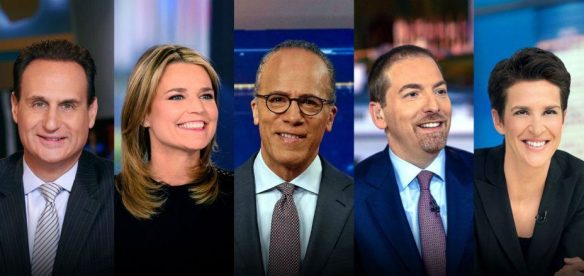
Now we have Lester Holt, David Muir, and the newly appointed Norah O’Donnell. They couldn’t sell water in the desert.
Lester Holt is a cadaverous presence on-air, whose major journalistic achievement thus far is interrupting Donald Trump 41 times during a presidential debate; David Muir has the gravitas of a Sears underwear model; Norah O’Donnell, long-term, will have the energy needed to illuminate a miniature Xmas-tree light bulb.
The networks have no authoritative anchor-fathers waiting in the wings. They don’t breed them and bring them up through the minor leagues anymore.
Instead, armies of little Globalists, and ideologues who don’t realize they’re working for Globalists, have been infiltrating the news business. At best, they’re incompetent.
Thus, news-production techniques that enable an ongoing illusion of oceanic authority collapse like magnetic fields that have been suddenly switched off.
The selective mood lighting, the restful blue colors on the set, the inter-cutting of graphics and B-roll footage, the flawless shifts to reporters in far-flung places…it’s as if all these supporting features have suddenly been overcome by actors in a stage play who are abruptly stepping out of character. The spell is broken.
Elite mainstream news, in a fatuous attempt to save itself, is trying a democratic approach. Anchors are sharing more on-air minutes with gaggles of other reporters. But this is counter-productive in the extreme. The News has always meant one face and one authority and one voice and one tying-together of all broadcast elements. It’s as if, in a hypnotherapist’s office, the therapist decides to bring in colleagues to help render the patient into an alpha-state.
If by some miracle, the news bosses could raise Walter Cronkite, “the father of our country,” from the dead and put him back in the chair… but too many years have gone by; years of unaccomplished anchors. The horse is out of the barn, the cat is out of the bag.
This is why major news outlets have been appealing to social media/big tech for help, AKA censorship of independent voices.
One veteran news director told me several years ago, “We don’t have the stars [elite anchors] anymore. The star system is dead. You could comb all the local news outlets in America, and you wouldn’t find one face and voice who could really carry the freight. They’ve vanished. The up and coming people are lame. We’ve made them that way. It’s some cockeyed standard of equality we’ve internalized. And now we’re paying the price.”
The news is all about manipulating the context of stories. The thinner the context, the thinner the mind must become to accept it.
Imagine a rectangular solid. The news covers the top surface. Therefore, the viewer’s mind is trained to work in only two dimensions. Then it can’t fathom depth, and it certainly can’t appreciate the fact that the whole rectangular solid moves through time, the fourth dimension.
First, we have the studio image itself, the colors in foreground and background, the blend of restful and charged hues. The anchor and his/her smooth style.
Then we have the shifting of venue from the studio to reporters in the field, demonstrating the reach of coverage: the planet. As if this equals authenticity.
Actually, those reporters in the field rarely dig up information on location. A correspondent standing on a rooftop in Cairo could just as easily be positioned in a bathroom in a Las Vegas McDonald’s. His report would be identical.
The managing editor, usually the elite news anchor, chooses the stories to cover and has the final word on their sequence.
The anchor goes on the air: “Our top story tonight, more signs of gridlock today on Capitol Hill, as legislators walked out of a session on federal budget negotiations…”
The viewer fills in the context for the story: “Oh yes, the government. Gridlock is bad. Just like traffic on the I-5. We want the government to get something done, but they won’t.”
The anchor: “The Chinese government reports the new flu epidemic has spread to three provinces. Forty-two people have already died, and nearly a hundred are hospitalized…”
The viewer again supplies context, such as: “Flu. Dangerous. Epidemic. Get my flu shot.”
The anchor: “A new university study states that gun owners often stock up on weapons and ammunition…”
The viewer: “People with guns. Why do they need a dozen weapons? I don’t need a gun. The police have guns. Could I kill somebody if he broke into the house?”
The anchor: “Doctors at Yale University have made a discovery that could lead to new treatments in the battle against autism…”
Viewer: “Good. More research. Laboratory. The brain.”
If, at the end of the newscast, the viewer bothered to review the stories and his own reactions to them, he would realize he’d learned nothing. But reflection is not the game.
In fact, the flow of the news stories has washed over him and created very little except a sense of (false) continuity.
Therefore, every story on the news broadcast achieves the goal of keeping the context thin—night after night, year after year. The overall effect of this staging is: small viewer’s mind, small viewer’s understanding.
Next we come to words and pictures. More and more, news broadcasts are using the rudimentary film technique of a voice narrating what the viewer is seeing on the screen.
People are shouting and running and falling in a street. The anchor or a field reporter says: “The country is in turmoil. Parliament has suspended sessions for the third day in a row, as the government decides what to do about uprisings aimed at forcing democratic elections…”
Well, the voice must be right, because we’re seeing the pictures. If the voice said the riots were due to garbage-pickup cancellations, the viewer would believe that, too.
We see Building #7 of the WTC collapse. Must have been the result of a fire. The anchor tells us so. Words give meaning to pictures.
Staged news.
Since the dawn of time, untold billions of people have been urging a “television anchor” to “explain the pictures.”
The news gives them that precise solution, every night.
“Well, Mr. Jones,” the doctor says, as he pins X-rays to a screen in his office. “See this? Right here? We’ll need to start chemo immediately, and then we may have to remove most of your brain, and as a follow-up, take out one eye.”
Sure, why not? The patient saw the pictures and the anchor explained them.
Eventually, people get the idea and do it for themselves. They see things, they invent one-liners to explain them.
They’re their own anchors. They short-cut and undermine their own experience with vapid summaries of what it all means.
For “intelligent” viewers, there is a sober mainstream choice in America, a safety valve: PBS. That newscast tends to show more pictures from foreign lands.
“Yes, I watch PBS because they understand the planet is interconnected. It isn’t just about America. That’s good.”
Sure it’s good, if you want the same thin-context or false-context reports on events in other countries. Instead of the two minutes NBC might give you about momentous happenings in Syria, PBS will give you four minutes.
PBS experts seem kinder and gentler. “They’re nice and they’re more relaxed. I like that.”
Yes, the PBS experts are taking Valium, and they’re not drinking as much coffee as the CBS experts.
When network television news was created in the late 1940s, no one in charge knew how to do it. It was a new creature.
Sponsors? Yes. A studio with a desk and an anchor? Yes. A list of top stories? Yes. Important information for the public? Yes.
Of course, “important information” could have several definitions—and the CIA already had a few claws into news, so there would be boundaries and fake stories within those boundaries.
The producers knew the anchor was the main event; his voice, his manner, his face. He was the actor in a one-man show. But what should he project to the audience at home?
The first few anchors were dry sandpaper. John Cameron Swayze at NBC, and Douglas Edwards at CBS. But Swayze, also a quiz show host, broke out of the mold and imparted a bit of “cheery” to his broadcasts. A no-no. So he was eventually dumped.
In came a duo. Chet Huntley and David Brinkley. NBC co-anchors from 1956 to 1970. Chet was the heavy, with a somber baritone, and David was “twinkly,” as he was called by network insiders. He lightened the mood with a touch of sarcasm and an occasional grin. It worked. Ratings climbed. Television news as show biz started to take off. At the end of every broadcast, there was: “Good night, Chet.” “Good night, David.” The audience ate it up. They loved that tag.
However, rival CBS wasn’t standing still. They offloaded their anchor, Douglas Edwards, a bland egg, and brought in Walter Cronkite, who would go on to do 19 years in the chair (1962-1981). Walter was Chet Huntley with a difference. As he grew older, he emerged as a father, a favorite uncle, with an authoritative hills-and-valleys baritone that created instant trust. Magic. A news god was born.
Despite many efforts at the three major networks, no anchor over the past 40 years has been able to pull off the full Cronkite effect.
The closest recent competitor—until he was fired for lying and exiled to the waste dump at MSNBC—was Brian Williams. Williams artfully executed a reversal of tradition. He portrayed the youthful prodigy, a gradually maturing version of a newsboy who once bicycled along country roads, threw folded up papers on front porches, and knew all his customers by name. A good boy. A local boy. Your neighbor under the maple trees of an idyllic town. Cue the memories.
By the time Williams took over the helm at NBC, television news was decidedly a team operation. There were reporters in the field. The technology enabled the anchor to go live to these bit players, who tried to exude the impression they were actually running down leads and interviewing key sources on the spot—when in fact they could just as easily be doing their stand-ups from a hot dog cart outside 30 Rockefeller Plaza, the home studio of the network—because most of their information was really coming from inside that studio.
Nevertheless, the team was everything. The anchor was a manager, and his job was to impart an authentic feel to every look-in, from the White House to Paris to Berlin to Jerusalem to Beijing to a polar bear on an iceberg.
And local television news was blowing up to gargantuan proportions. Every city and town and village and hamlet seemed to have its own gaggle of hearty faces delivering vital info of interest to the citizenry. Branding and shaping this local phenomenon evolved into: FAMILY. Yes, that was the ticket. These bubbly, blown-dry, enthused, manic news and weather and sports hawks were really “part of the community.” Local News was no longer shoveled high and deep with an air of objectivity. “Aloof” was out. Share and care was in. What that had to do with actual news was anyone’s guess, but there it was. “Hi, we’re your team at KX6, and we feel what you feel and we live here with you and we know when the roads are icy and the wrecks pile up on the I-15 and the cops arrest someone for cocaine possession and when the charity bake sale is coming up to pay for [toxic] meds for seniors and when your cousin Judy passes away we mourn as you do…”
News for and by a fictional collective.
Disney news.
A caricature of a simulacrum of an imitation.
The discovery was: the viewing audience wanted news as a cartoon.
The problem is: this model deteriorates. The descending IQ of the news producers and anchors and reporters undergoes a grotesque revolution. Year by year, broadcasts make less sense. Even on the national scene, NBC hands its prime anchor spot to Lester Holt, who plays the old Addams Family living corpse, Lurch.
ABC, always looking for a new face, goes all in with David Muir, a Sears underwear-model type.
CBS counters with a youngish cipher, Jeff Glor, after ridding itself of Scott Pelley, who, true to his on-camera persona, might show up on The Young and the Restless as a lunatic surgeon doing operations without anesthetic.
The networks are losing it.
It’s a sight to behold.
Cable news is even worse. The longest surviving anchor is Wolf Blitzer at CNN. Wolf’s energy level tops out as a man in a tattered bathrobe, in his kitchen, chatting with his cousin while they play checkers.
When professionals broadcast one absurdity after another, they begin to see the effects are actually strengthening their own position of authority.
It’s a revelation. It’s also a continuation of the tradition of the Trickster archetype. For example, with just a few minor adjustments, Brian Williams can be seen as the sly Reynard the Fox…
From the viewpoint of elite television news, controlling the minds of its audience depends on what’s politely called “cognitive dissonance”:
As the anchor recites a news story, the viewer sees an obvious hole through which he could drive a truck.
The story makes no sense, yet it’s being presented as bland fact. The trusted anchor clearly has no problem with it.
What’s the viewer to do? He experiences a contradiction, a “dissonance.”
For example, this year’s flu vaccine. The US government has admitted the vaccine is geared to a flu virus that isn’t circulating in the population. Therefore, even by conventional standards, the vaccine is useless. But the kicker is, the CDC says people should take the vaccine anyway.
The anchor relays all this information—and never seriously questions the situation, never torpedoes the government for recommending the vaccine.
The average viewer feels a tug, a pulse of discomfort, a push-pull. The vaccine story is idiocy (side one), but the trusted anchor accepts it (side two).
Dissonance.
The top chiefs of news—and top propaganda operatives—anticipate cognitive dissonance. In a real sense, they want it to happen. They make it happen. Over and over.
Why?
Because it throws the viewer into a tailspin. And in that mental state, in his effort to resolve the contradiction, he will normally choose to…give in. Surrender. Believe in the anchor. It’s the easier path.
The viewer will even doubt his own perception. “I see no good reason for Building 7 to collapse, but the news doesn’t bring that up, so…it must be me.”
This is the power of the news. It presents absurdities and then moves right along, as if nothing has happened.
The introduction of contradiction, dissonance, and absurdity parading as ordinary reality is an intentional feature of brainwashing.
On the nightly news, the anchor reports that US government debt has risen by another three trillion dollars. He then cuts to a statement from a Federal Reserve spokesman: the new debt level isn’t a problem; in fact, it’s sound monetary policy; it strengthens the economy.
The viewer, caught up in this absurdity, tries to make sense of it, then gives up and passively accepts it. Brainwashing.
Smoothly transitioning from this story, the anchor relays information from the CDC: vaccination rates must achieve 90% in the population, in order to protect people from dangerous viruses. The viewer thinks, “Well, my daughter is already vaccinated, so if she comes into contact with a child who isn’t vaccinated, why would there be a problem? Why does 90% of the population have to be vaccinated to keep her safe? She’s already vaccinated.”
The viewer wrestles with this craziness for a moment, then gives in and accepts what the CDC and the anchor are saying. More passivity. More brainwashing.
The anchor moves right along to the next story: “The US is experiencing one of the coldest winters in history, further evidence of the effects of global warming, according to scientists at the United Nations.”
The viewer shakes his head, tries to deal with this dissonance, surrenders, and accepts what he is hearing. Deeper passivity is the result. Deeper brainwashing.
On and on it goes, day after day, month after month, year after year, on the news.
Contradiction, absurdity, dissonance; acceptance, surrender, passivity.
The same general formula is used in interrogations and formal mind control. It adds up to disorientation of the target.
Most disoriented people opt for the lowest- common-denominator solution: give in; accept the power of the person of authority.
Among the many supporters of conventional news is the education system. Most teachers never learn logic, and they don’t teach it. The result? Their students never gain the ability or the courage to reject the news and its dissonances.
What little these students gain from 12 or 16 years of schooling they eventually sacrifice on the altar of consensus reality—as broadcast every night on the screen before them.
Salvador Dali, surrealist, was one of the most reviled painters of the 20th century.
He disturbed Conventional Folk who just wanted to see an apple in a bowl on a table.
Dali’s apples and bowls were executed with a technical skill few artists could match—except the apples were coming out of a woman’s nose while she was ironing the back of a giraffe, who was on fire.
“It doesn’t go together! It doesn’t make sense! He’s Satan!”
Yet, these same Folk sit in front of the television screen every night and watch the entirely surreal network news. Elite anchors seamlessly and quickly move from blood running in the streets of a distant land to a hairdryer product-recall to an unseasonal hail storm in Michigan to a debate about public policy on pedophiles to genetically engineered mosquitoes in Florida to a possible breakthrough in storing computer simulations of human brains for later recapture to squirrels gathering nuts in New Jersey.
Nothing surreal about this??
When the elite anchor goes on air and digs in, he’s paid to be seamless. He could be transitioning from mass killings in East Asia to sub-standard air conditioners, and he makes the audience track through the absurd curve in the road.
The elite anchor should have a voice that soothes just a bit but brooks no resistance. It’s authoritative but not demanding.
Scott Pelley (CBS) was careful to watch himself on this count, because his tendency was to shove the message down the viewer’s throat like a surgeon making an incision with an icepick. Pelley was a high-IQ android who was training himself to be human.
Diane Sawyer wandered into sloppiness, like a housewife who’s still wearing her bathrobe at 4 in the afternoon. She exuded sympathetic syrup, as if she’d had a few cocktails for lunch. And she affected a pose of “caring too much.”
Brian Williams was head and shoulders above his two competitors. You had to look and listen hard to spot a speck of confusion in his delivery. He knew how to believe his act was real. He could also flick a little aw-shucks apple-pie at the viewer. Country boy who moved to the big city.
Segues, blends are absolutely vital. These are the transitions between one story and another. “Earlier today, in Boston.” “Meanwhile, in New York, the police are reporting.” “But on the Hill, the news was somewhat disappointing for supporters of the president.”
Doing excellent blends can earn an anchor millions of dollars. The audience doesn’t wobble or falter or make distinctions between what went before and what’s coming now. It’s all one script. It’s one winding weirdness of story every night.
And NOW, we have COVID, and we have riots. The current stories— the lies are egregious and relentless, the editorializing is cheesy. The omissions are Grand Canyons.
Surreal, cognitively dissonant, smoothly blended, outrageous:
The News Business. As Usual.
But with the junior varsity anchors, and their lack of skill, the networks need overwhelming stories to sell their act. They need COVID and riots. They have to have government manufacturing chaos and destruction and tighter control, in order to keep viewers coming back night after night.
You’ve got elite Globalists and elite government on one edge, and elite news on the other edge. They feed into each other. They bolster each other.
So why must they spend so much time censoring dissent?
Because freedom exists.
Because, no matter what, it always will.
And underestimating its power, time and time again, has proven to be a colossal mistake.


 After the Crash