Our Vanishing World: Rainforests

By Robert J. Burrowes

Rainforests are a crucial feature of Earth’s biosphere. Apart from being critical to Earth’s climate and vital carbon sinks, the major player in Earth’s hydrological (water) cycle, a massive producer of oxygen and home to most of the world’s species, rainforests are the home of a large indigenous human population. They are also the source of many vital resources, including medicines, used by humans around the world.

However, the vast range of ecological services that rainforests have provided ongoingly for the 400 million years of their existence, and which have been critical to the survival of homo sapiens since we first walked the Earth 200,000 years ago, are not measured and valued by accountants and economists: Have you ever seen a balance sheet or set of national accounts that includes an entry for ‘Value of ecological services taken from nature and on which life and our entire production of goods and services depend’?

Because these services have been available without the need for human management or intervention, and given the primitive conception of accounting and economics that humans use, the ecological services of rainforests are given no monetary value. Hence, essential ecological services are treated as worthless by virtually everyone in the industrialized world. As a result, modern industrialized humans have decided to systematically destroy the rainforests in order to extract a vast amount of short-term profit for the benefit of a few and the temporary satisfaction of many. So if we do not value ecological services such as oxygen and water generation as well as climate and weather-moderating capacities, what is it that we do value by destroying rainforests?

A small proportion of rainforest is logged to provide attractive rainforest timbers – such as teak, mahogany, ebony and rosewood – for a variety of decorative purposes, including making furniture, which can last hundreds of years.

However, a much wider range and vastly greater quantity of rainforest trees are cut or burnt down for purposes such as the following: acquiring timbers used in construction, clearing land to establish cattle farms so that many people can eat cheap hamburgers, clearing land to establish palm oil plantations so that many people can eat processed (including junk) foods based on this oil, clearing land to establish palm oil and soy bean plantations so that some people can delude themselves that they are using a ‘green biofuel’ in their car (when, in fact, these fuels generate a far greater carbon footprint than fossil fuels), mining (much of it illegal) for a variety of minerals (such as gold, silver, copper, coltan, cassiterite and diamonds), and logging to produce woodchips so that some people can buy cheap paper, including cheap toilet paper.

In essence then: We trade the essential life-giving and sustainably-available ecological services of Earth’s rainforests, also home to indigenous peoples and countless wildlife, for hamburgers and other processed junk foods, carbon-intensive ‘biofuels’, paper and some building and furniture materials, as well as some minerals. Obviously, some humans are far from clever at ‘making deals’.

But if you think that is bad, consider this: ‘by one estimate, a hectare of livestock or soy is worth between $25 and $250, while the same hectare of sustainably managed forest can yield as much as $850’ harvesting, depending on the location, such products as medicinal plants, rubber, nuts and fruits while benefitting from a range of ecotourism services and research opportunities. See ‘Rainforest on Fire: On the Front Lines of Bolsonaro’s War on the Amazon, Brazil’s Forest Communities Fight Against Climate Catastrophe’. Of course, you have to know how to manage the forest sustainably to yield this much income but that sort of intelligence is rare and invariably escapes those focused on destruction for short-term profit.

So how bad is this rainforest destruction? Well, worldwide we are currently destroying rainforests for these unsustainable and mainly short-term products at the rate of 80,000 acres each day. See ‘Measuring the Daily Destruction of the World’s Rainforests’.

Moreover, beyond the devastating impact this has on indigenous peoples, forcing increasing numbers of them to leave their destroyed homes in the rainforest to try to survive elsewhere, this rainforest destruction is also the key driver of species extinctions globally with one million species of life on Earth threatened with extinction. As reported in the recent Global Assessment Report on Biodiversity and Ecosystem Services researched and published by the Intergovernmental Science-Policy Platform on Biodiversity and Ecosystem Services (IPBES) – the scientific body which assesses the state of biodiversity and the ecosystem services this provides to society – ‘Nature is declining globally at rates unprecedented in human history. The IPBES Global Assessment ranks, for the first time at this scale, the 5 direct drivers of change in nature with the largest global impact. So what are the culprits behind nature’s destruction?’ Number 1. on the IPBES list is ‘Changes in land and sea use, like turning intact tropical forests into agricultural land’.

Let me briefly illustrate the nature and extent of this destruction by discussing rainforests in just three locations (the Brazilian Amazon, the Democratic Republic of the Congo and Indonesia/West Papua) where the destruction of rainforest was greatest in 2018 – see ‘The World Lost a Belgium-sized Area of Primary Rainforests Last Year’ – and which are representative of elsewhere around the planet where even World Heritage listed areas are ongoingly under threat.

The Brazilian Amazon

While the Amazon in South America occurs in several countries, two-thirds of it lie within the borders of Brazil. Unfortunately, since his fraudulent election in 2018, the neofascist, corrupt and insane president Jair Bolsonaro – see the definition of sanity, which Bolsonaro does not come close to meeting, in ‘The Global Elite is Insane Revisited’ – has promptly eliminated years of painstaking effort by committed indigenous and environmental activists to convince previous governments to protect the Brazilian Amazon from the worst corporate and other depredations.

For just a taste of the documentation on Bolsonaro’s actions in accord with elite interests and to the detriment of indigenous and environmental well-being, see ‘Bolsonaro Caps Natives’ Lands, Pleasing Farmers in One of First Acts’, ‘Rainforest on Fire: On the Front Lines of Bolsonaro’s War on the Amazon, Brazil’s Forest Communities Fight Against Climate Catastrophe’, ‘Bolsonaro’s Clearcut Populism. “The Barbarism has Begun”’, this report from Amazon Watch: ‘Complicity in Destruction II: How northern consumers and financiers enable Bolsonaro’s assault on the Brazilian Amazon’ and ‘Amazon Deforestation Accelerating Towards Unrecoverable “Tipping Point”’.

The key drivers of rainforest destruction in the Amazon are soy production and cattle ranching. Brazilian soy accounted for 14.3% of the country’s total exports, generating $31.0 billion in 2017, while cattle exports accounted for about $5.4 billion. Because Brazil leads the world in exports of both of these commodities, it is the world market for these products that is driving these industries to aggressively expand activities to the detriment of the rainforest and indigenous peoples.

But the Amazon is huge, you might say: Does it matter if we destroy some of it for soy and cattle farming? Well, one recent study suggested that deforestation of 20–25% of the Amazon would be the tipping point beyond which it would cease to be a functioning rainforest ecosystem and this, as you might expect, would be catastrophic. Moreover, recent severe droughts appear to be ‘the first flickers of this ecological tipping point’ suggesting that it is already imminent. See ‘Amazon Tipping Point’.

So, to reiterate, the key driver of rainforest destruction in the Brazilian Amazon is consumer-generated demand for certain products in other parts of the world. And while the US and European countries play critical roles in destruction of the Amazon, China is the largest importer of agricultural products from Brazil so its government and consumers are complicit too. For example, as China’s demand for Brazilian soy surges due to the trade war between the United States and China, ‘it could drive further ecological catastrophe: 13 million hectares (50,000 square miles) in the Amazon and Cerrado could ultimately be cleared to meet this additional demand.’ See ‘Complicity in Destruction II: How northern consumers and financiers enable Bolsonaro’s assault on the Brazilian Amazon’.

The point then, is this: governments and ordinary people (in their role as consumers) in other parts of the world can play a vital role in defending the Amazon and its indigenous peoples – see, for example, Brazil’s Indigenous People Articulation – by choosing what they buy from Brazil. Boycotting rainforest timber, beef and soy bean products are powerful options to consider. But don’t forget, there is no point simply identifying and boycotting Brazilian timbers, beef and soy beans. If you want impact on the total market (to prevent one country’s timber, beef and soy beans being substituted for another’s), then you must boycott them all (unless you can clearly identify the source of the product as local and sustainable). Obviously, this takes commitment. The future of the Amazon depends largely on enough of us making that commitment.

The Democratic Republic of the Congo in Central Africa

The rainforests of the Congo Basin in central Africa are the second largest on Earth. Much of this rainforest lies within the borders of the Democratic Republic of the Congo, crippled by corrupt government for decades and a new president elected earlier this year who has inherited a corrupt and inefficient state apparatus. See ‘Democratic Republic of the Congo: Overview of corruption and anti-corruption’.

Unfortunately, therefore, rainforests in the Congo have long been under siege on several fronts. With rebel soldiers (such as the Rwanda-backed M23), miners and poachers endlessly plundering inadequately protected national parks and other wild places for their resources, illegal mining is rampant, over-fishing a chronic problem, illegal logging (and other destruction such as charcoal burning for cooking) of rainforests is completely out of control in some places, poaching of hippopotami, elephants, chimpanzees and okapi for ivory and bushmeat is unrelenting (often despite laws against hunting with guns), and wildlife trafficking of iconic species (including the increasingly rare mountain gorilla) simply beyond the concern of most people.

The Congolese natural environment – including the UNESCO World Heritage sites at Virunga National Park and the Okapi Wildlife Reserve, together with their park rangers – and the indigenous peoples such as the Mbuti (‘pygmies’) who live in them, are under siege. In addition to the ongoing mining, smaller corporations that can’t compete with the majors, such as Soco, want to explore and drill for oil. For a taste of the reading on all this, see ‘Virunga National Park Ranger Killed in DRC Ambush’, ‘The struggle to save the “Congolese unicorn”’, ‘Meet the First Female Rangers to Guard One of World’s Deadliest Parks’ and ‘The Battle for Africa’s Oldest National Park’.

Unfortunately too, as with rainforests elsewhere, ‘What Happens in the Congo Basin Doesn’t Stay in the Congo Basin’: it impacts on regions across Africa playing a part, for example, in recent droughts in Ethiopia and Somalia causing millions of people to depend on emergency food and water rations. See ‘Congo Basin Deforestation Threatens Food and Water Supplies Throughout Africa’.

As with the Amazon, you have some powerful options to consider if you want to save the Congolese rainforests and their indigenous peoples. Again, refusing to buy rainforest timbers, conflict minerals and wildlife products is a good start but remember that key minerals in your computer and mobile phone are illegally sourced from the Congo so your thoughtful consideration of minimizing how many of these devices you own can play a part too. For a fuller account of this exploitation and its destructive impact on the rainforests and its indigenous peoples, with references to many other sources, see ‘500 years is long enough! Human Depravity in the Congo’.

Indonesia and West Papua

Indonesia has the most extensive rainforest cover in Asia – and is home to hundreds of distinct indigenous languages and over 3,000 animal species including Sumatran tigers, pygmy elephants, rhinoceros and orangutans – but the forests are being systematically degraded and destroyed. Rainforest cover has steadily declined since the 1960s when 82 percent of the country was covered with forest; it is less than 50 percent today. The rainforest is being destroyed by logging, mining, large-scale agricultural plantations (especially for palm oil), colonization, and subsistence activities like shifting agriculture and cutting for fuelwood. Much of the remaining cover consists of logged-over and degraded forest although large areas, including of the island of Kalimantan/Borneo (shared with Malaysia and Brunei), have been stripped bare.

Logging for tropical timbers and pulpwood (to make paper) is the biggest cause of rainforest destruction in the country where as much as 75 percent of the logging is illegal. Indonesia is the world’s largest exporter of tropical timber, which generates more than $US5 billion annually. And more than 48 million hectares (55 percent of the country’s remaining rainforests) are concessioned for logging. Destruction of the rainforest in Indonesia has opened up some of the most remote places on Earth to development: as rainforests in less remote locations have been decimated, timber corporations have stepped up practices on the island of Kalimantan/Borneo and the occupied West Papau, where great swaths of forests have been cleared in recent years. In fact, 20 percent of Indonesia’s logging concessions are in West Papua, despite ongoing resistance by West Papuans.

Unfortunately, the fastest and cheapest way to clear rainforests for plantations is by burning. Hence, every year ‘hundreds of thousands of hectares go up in smoke as developers and agriculturalists feverishly light fires before monsoon rains begin to fall. In dry years – especially during strong el Niño years – these fires can burn out of control for months on end, creating deadly pollution that affects neighboring countries and causes political tempers to flare’. See Indonesian Rainforests’.

Mining operations, including for coal, also have a devastating impact on the rainforests and their peoples. See ‘New report exposes World Bank links to destructive coal mining in Indonesia’. By far the worst of these projects, however, is the gigantic gold, silver, and copper mine in occupied West Papua, run by Freeport-McMoRan. As widely documented, the mining company has dumped appalling amounts of waste into local streams, rendering downstream waterways and wetlands ‘unsuitable for aquatic life’. Relying on large payments to Indonesian police and military officers, the mining operation is ‘protected’; this has resulted in many West Papuans being killed.

The waste from the mine, estimated by Freeport at 700,000 tons each day, covers several square miles and Government surveys have found that tailings from the mines have produced levels of copper and sediment so high that almost all fish have disappeared from vast areas of wetlands downstream from the mine.

Like other powerful corporations in Indonesia (and elsewhere), Freeport-McMoRan is well aware that there is little official interest in its abuses of local people and the environment as long as corrupt officials are given sufficient incentive to ignore them. As elsewhere in many parts of the world, therefore, corporate access to resources includes serious human rights abuses and persistent conflicts between companies and local communities which is ignored by corrupt politicians. See Indonesian Rainforests’.

Apart from the rainforest itself and the millions of people who live in them, destruction of the rainforest threatens the habitat of iconic species like Sumatran tigers and orangutans, as well as many others, and plays a part in destroying the climate too.

But the damage does not stop with the issues noted above. Forests across the world are being destroyed to make fabrics for clothing we wear every day. Fabrics like rayon, viscose and modal are all made from trees and, every year, more than 120 million trees are cut down to make clothing. This is done by companies such as Forever 21, Under Armour, Foot Locker, Prada Group and Michael Kors. You can join the Rainforest Action Network in campaigning to get these laggard companies to adopt responsible sourcing policies for their forest-based fabrics. See ‘Does your clothing contain rainforest destruction?’

Bizarrely, while its incredible rainforests, along with its coral reefs and beaches, play a part in attracting tourists from across the world to see Indonesia’s charismatic native species – such as orangutans, Sumatran tigers, Komodo dragons, whale sharks, sea turtles and manta rays – and to experience its adventure and dive destinations, this tourism also contributes significantly to the destruction as rainforests make way for tourist facilities.

So, as with Brazil and the Congo, you can boycott rainforest products from Indonesia and other countries where rainforests are being destroyed. Along with suggestions made earlier, responsible choices about the clothing you wear and the tourist destinations you choose (or boycott) will all make a difference.

The ‘Big Picture’ Fight for the Rainforests: What can we do?

A great deal. Halting rainforest destruction might be a complex undertaking but it is imperative if we are to have any prospect of preserving life on Earth. So I hope that you will consider the many options I have offered above and those I mention now and do as many as you can, even if you are already working on other critical issues such as the climate and the struggle to end war and the threat of nuclear war.

If you want easy options, you can support the campaign efforts of organizations that defend rainforests, indigenous peoples and wildlife such as the Rainforest Action Network, the Rainforest Information Centre, the Rainforest 4 Foundation and Rainforest Rescue which work closely with indigenous and local communities while campaigning against the governments and corporations destroying rainforests, as well as the banks and insurance companies that support this destruction.

If you recognize the pervasiveness of the fear-driven violence in our world, which also drives the massive over-consumption of resources by people in industrialized countries – see ‘Love Denied: The Psychology of Materialism, Violence and War’ – then consider addressing this directly starting with yourself – see ‘Putting Feelings First’ – and by reviewing your relationship with children. See ‘My Promise to Children’ and ‘Nisteling: The Art of Deep Listening’.

If you want to understand and address the fundamental cause of violence in our world, see Why Violence? and Fearless Psychology and Fearful Psychology: Principles and Practice.

If you wish to campaign strategically in support of indigenous peoples and local communities in their struggles to halt the destruction of Earth’s rainforests. See Nonviolent Campaign Strategy.

The governments and corporations that profit from the destruction of the rainforests are deeply entrenched and not about to give way without strategically focused campaigns to make it untenable and unprofitable for them to do so. This will include convincing key personnel, whether company directors of corporations involved in rainforest destruction, cargo ship owners, trade unionists (in many industries) and the many other agents involved in the rainforest destruction-to-customer supply chain, as well as ordinary consumers of rainforest products, to make conscious choices about the products they supply, use and/or buy. So strategy is imperative if we are to get corrupt and/or conscienceless governments and corporations, as well as people further removed from the source of the destruction, to end their role in rainforest destruction before it is too late.

The big deforestation drivers are timber, palm oil, cattle and soy while mining, oil drilling, clothing and dam construction all play significant roles too, depending on the country. And, as reported by the CDP (formerly the Carbon Disclosure Project): ‘The ABCD (The Archer Daniels Midland Company [ADM], Bunge, Cargill and Louis Dreyfus Company) trader companies have a large impact on countless commodity supply chains. For example, they represent up to 90% of the global grain trade. With a wide array of clients that go from Nestlé to McDonald’s, their role in managing deforestation risk is crucial’ and, so far, grossly inadequate. See ‘Revenue at risk: Why addressing deforestation is critical to business success’ which contains a long list of hundreds of companies (on pages 39-46) which are making zero effective effort to end their rainforest-destroying business practices.

Given the strategic sophistication necessary to tackle this complex problem effectively, if you want to view a 15 minute video of (or read a couple of short articles about) the inspirational Melbourne Rainforest Action Group (MRAG) that successfully led a national campaign from 1988 to 1991 to halt imports of rainforest timber into Australia, you can view it here: ‘Time to Act’.

In those cases where corrupt elites control or occupy countries, such as those controlling Brazil, the Democratic Republic of the Congo and West Papua, it might be necessary to remove these corrupt governments as part of the effort – see Nonviolent Defense/Liberation Strategy – thus helping to restore the political space for local populations to defend rainforests and their rights.

You might also consider joining the global network of people resisting violence in all contexts by signing the online pledge of The Peoples Charter to Create a Nonviolent World.

But if you do nothing else while understanding the simple point that Earth’s biosphere, including its rainforests, cannot sustain a human population of this magnitude of whom more than half endlessly over-consume, then consider accelerated participation in the strategy outlined in The Flame Tree Project to Save Life on Earth.

Or, if none of the above options appeal or they seem too complicated, consider committing to:

The Earth Pledge

Out of love for the Earth and all of its creatures, and my respect for their needs, from this day onwards I pledge that: 

  1. I will listen deeply to children (see explanation above)
  2. I will not travel by plane
  3. I will not travel by car
  4. I will not eat meat and fish
  5. I will only eat organically/biodynamically grown food
  6. I will minimize the amount of fresh water I use, including by minimizing my ownership and use of electronic devices
  7. I will not buy rainforest timber
  8. I will not buy or use single-use plastic, such as bags, bottles, containers, cups and straws
  9. I will not use banks, superannuation (pension) funds or insurance companies that provide any service to corporations involved in fossil fuels, nuclear power and/or weapons
  10. I will not accept employment from, or invest in, any organization that supports or participates in the exploitation of fellow human beings or profits from killing and/or destruction of the biosphere
  11. I will not get news from the corporate media (mainstream newspapers, television, radio, Google, Facebook, Twitter…)
  12. I will make the effort to learn a skill, such as food gardening or sewing, that makes me more self-reliant
  13. I will gently encourage my family and friends to consider signing this pledge.

Feeling overwhelmed? Still prefer something simpler?

I wish I could, in all sincerity, offer you that option. If it were still 1990, I would. But the time for simple actions to make a difference is long past and time is now incredibly short. See ‘Human Extinction by 2026? A Last Ditch Strategy to Fight for Human Survival’.

In essence, you have a choice: understand and act on the crucial importance of rainforests before we destroy their integrity and lose them completely. Or help to accelerate the human rush to extinction as a consequence of failing to do so.


Biodata: Robert J. Burrowes has a lifetime commitment to understanding and ending human violence. He has done extensive research since 1966 in an effort to understand why human beings are violent and has been a nonviolent activist since 1981. He is the author of Why Violence? His email address is flametree@riseup.net and his website is here.


Neoliberal Defenestration and the Overton Window

By Stephen Martin

Source: CounterPunch

‘It is difficult to get Artificial Intelligence to understand something, when the Research and Development funding it depends upon its not understanding it’

Paraphrase of Upton Sinclair.

defenestration  (diːˌfɛnɪˈstreɪʃən)

n

the act of throwing a person or thing  out of a window

[C17: from New Latin dēfenestrātiō, from Latin de- + fenestra window

The freedictionary.com

‘If there is such a phenomenon as absolute evil, it consists of treating another human being as a thing

John Brunner ‘The Shockwave Rider

This small article a polemic against neoliberal hegemony; in particular the emerging issue of ‘surplus population’ as related to technological displacement in context of a free market, an issue purposive to such hegemony which as an ‘elephant growing in the panopticon’  i.e. not to be mentioned?

The central premise is that Artificial Intelligence (AI) + Robotics  comprise a nefarious as formulaic temptation to the elite of the ‘Technetronic era’ as Zbigniew Brzezinski put it: this consistent with a determinism as stems ontologically from ‘Empiricism’  form of a  ‘One Dimensionality’ as Marcuse phrased it over five Decades ago; and which thru being but mere simulacra, AI and Robotics represent an ontological imperative  potentially expropriated under pathology to denial of Kant’s concept of ‘categorical imperative’?  (That Kant did not subscribe to determinism is acknowledged). The neoliberal concepts of ‘Corporatism’ and ‘free market’ are powerful examples of this ‘one dimensionality’ which is clearly pathological, a topic notably explored by Joel Bakan concerning the pursuit of profit within a Corporatist framework.

– ‘One dimensionality in, one dimensionality out’– so it goes ontologically as to some  paraphrase of GIGO as trending alas way of ‘technological determinism’ towards an ‘Epitaph for Biodiversity’  as would be – way of ‘Garbage’ or ‘Junk’ un apperceived as much as ‘retrospection’ non occurrent indeed -and where ‘Farewell to the Working Class’ as André Gorz conceived to assume an entirely new meaning: -this to some denouement of  ‘Dystopian Nightmare’ as opposed to  ‘Utopian Dream’, alas; such the ‘Age of Leisure’  as ‘beckoning’ to be not for the majority or ‘Demos’,but rather  for the ‘technetronic elite’ and  their ‘AI’ and Robotics – such ‘leisure’ being as to a ‘freedom’ pathological and facilitated  by the absence of conscience as much as morality; such the ‘farewell’; such the defenestration of ‘surplus’ , such the ‘Age’ we ‘live’ within as to ‘expropriation’ and ‘arrogation’  to amount to  ‘Death by Panopticon’ such the ‘apotheosis’?

It is being so cheerful which keeps these small quarters going.

But digression.

–  It is a relatively small step from ‘the death of thought’ to ‘the death of Life’under Neoliberal Orthodoxy as proving to be the most toxic ideology ever knownsuch the hegemony as a deliberative, shift of the ‘ Overton Window’ currently occurring as to trend deterministic; such the mere necrotrophy as a ‘defenestration’ – and the ‘one percent’ but a deadly collective of parasitic orifice? For what is ‘Empiricism’ when implemented thru  AI and Robotic Technology in a Corporatist economy as but a ‘selective investment’  as to Research and Development by elite ‘private interests’,  which to a determinism so evidently entailing a whole raft of ‘consequence’ ; such the means, such the production, such the ‘phenomenology’ as ‘owned’ indeed? Under pathology, selectivity is impaired to point of ‘militarization’?

But foremost amongst said ‘raft’ of consequence – the concept of ‘classification’ as incorporates methodological reduction of the particular to a composite of generalities so typical of ‘Science’ as expropriated; the fruition thereof replicated not least thru ‘Consumerism’ – and ‘Lifestyle’ – as much as ‘Life’ reduced as much as abrogated to but correlation way  of ‘possession’ of ‘things’: this  as said replication expressed as much ‘thru’ Linnaeus as Marx  concerning ‘class’- and as results in concepts’ Incorporated’ such as the ‘Overton Window’ – as will be explored by way of ‘extrapolation’ below? The debasing of identity as a correlate of possessions as a necessary ‘abrogation’ by way of engineered ‘bio hack’ is only furthered, such the loss of dimensionality as a potential, by such as social media? An excellent multimedia illustration of such loss is found here.

It’s to be noted that for Empiricism the concept of ‘good’ and ‘evil’ entails an extra dimensionality  as ‘metaphysical’ – and that ‘Politics’ so deconstructed despite abuse under orthodoxy as to ‘mitigation’ remains as  ‘Moral Economics’ – this despite the  mitigative contention of neoliberal orthodoxy that there no morality in the ‘synonymy’; to a pragmatic as ‘Utilitarian’ point of a ‘Killing the Host’ prevailing at paradigmatic as much as Geopolitical level as but explicative of a ‘necrotrophy’; as much as the ‘defenestration’ as euphemism herein proposed this small article  would explicate?

Kudos to Michael Hudson for exposing, and continuing to expose, the ‘death of thought’ which Neoliberalism as an orthodoxy as but a mere ‘racket’ of ‘transfer of resources’ represents.

– Are we ‘on a roll’ here as much as ‘off the leash’ – such the rebellion ‘psycho political’; such the ‘CounterPunch’ by way of digital pamphleteering as ‘restricted code’ rejected evidenced by way of ‘alternative’?

‘Politics’ should mean a diversity biological as much as phenomenological; it should mean more than Empirical ‘utility’, by way of the extra dimensionality which Metaphysics represents; this, as much as ‘Democracy’ demands diversity; ‘thought permitted’ as evidencing same as much as questions allowed to be asked; while Corporatism as antithesis demands ‘line’, a homogeneity, a uniformity, an abrogation as to a contingency?

Whether ‘Empiricism’ as to Philosophy is ‘Essentialist’ or ‘Instrumentalist’ is as of much political relevance as the Medieval question ‘how many angels can dance upon the head of a needle?‘ – the tragic fact remaining in ‘Oceania’  become to Corporatism  is that the economic impact of (AI + Robotics) constitutes a ‘technological displacement’ which under a ‘one dimensionality’ as ‘Orthodox’  is as a ‘political impact’ at a quintessential or axiomatic level, such the ‘formulae’ as (=Ecocide) ‘completes’ under a determinism of hegemony as demands ‘whoredom’? AI and Robotics destroy the symbiotic relationship between production and consumption thru reducing the requirement for human labor as waged in the productive process; AI and Robotics thereby impact upon the distribution of resources as wage based. The fairy tale of compensatory employment opportunities is at best wishful thinking, at worst it is a purposively contrived propaganda?

‘Biodiversity’, alas, becoming more limited to a ‘Thanatos‘ of ‘Military Industrial Corporatist Complex’  as explicates the ‘Age of the Anthropocene’as of the ‘1%’ as funders of ‘hegemony’ such the transfer of resources?

‘As ‘we’ view the world so it becomes’, indeed – this as much as how ‘Others’, through hegemony as ‘Utilitarian’, would have it viewed – and that such a large part of ‘Currency’ as ‘it’  to the permit of ‘Hegemony’ which would control and issue views – such the window as ‘Overtonian’ as can be shifted?

How long before the ‘collateral damage’ concerning premature fatality and reduced life expectancy as evidenced in homelessness, withdrawal of social welfare, militarization of policing, drug abuse, including prescription of synthetic opioids, incarceration all as obscenities explicating the ‘cheapening of life’  becomes ‘formalised’ under neoliberal orthodoxy as euthanasia? To such an Overton Window would it at first be ‘voluntary’?

It was ‘Utilitarianism’ as gave the World the concept of ‘Panopticon’ back in the Eighteenth Century.

Apropos to such ‘Thanatos‘ identified:

Wherefore art thou ‘Eros’: as represented by checkout operator, bank teller, driver, warehouseman, barista, cook, secretary, journalist, lawyer, receptionist, ‘ human voice at the end of the line’ – such the insidious inroads being made consequent the advance of Empirical based Technology?

The ‘Litany’ of such ‘displacement/defenestration’ could go on, as it undoubtedly shall under prevailing Hegemony ‘Western’ as ‘Oceanic’ as much orthodox as ‘deadly’, such the invasive penetration of ‘one dimensionality’ as ‘technological displacement’ evidenced under neoliberal orthodoxy as entailing a transfer of resources to mere ‘Stateless Bastards’, such the point of a determinism as would prevail woeful?

Ponerological questions such as would not be asked commensurate:

Is the ultimate ‘stateless bastard’ satan?

Can ‘synonymy seen’ be’ revolutionary’?

‘Technological displacement’ under an ontology of ‘One Dimensionality’ aka‘Corporatism’ but a euphemism for ‘surplus population’; this as much as ‘Corporatism’ promotes the illusion of ‘Democracy’ by way of ‘mental cheating’; such the synonymy as ‘simulacra’ an ‘illusion’ denied – but ‘real’ under ‘doublethink’?

‘Trickle down economics’ is as real as much as ‘technological displacement’ to be compensated for in the ‘opening up of a whole new vista of opportunity’, such the death of thought as neoliberal orthodoxy represents some parallel of tales told by such as Horatio Alger to point of ‘illusion’ encouraged?

These small quarters would ‘rip a new one’ in Neoliberal Orthodoxy by way of polemic.

It remains a ‘big’ question under contemplation of the genius of Orwell and the highly perspicacious ratio of ‘1/15/84’ (hence the ‘one percent’) as to why, within an undoubtedly comprehensive as prescient Dystopian vision where ‘oligarchic collective’ a synonym of ‘technetronic elite’, he ‘permitted the currency’ of the ‘Prole’ as ‘84%’ to prevail as a presence rather than but a memory disappeared by way of ‘memory hole’?

Under neoliberal orthodoxy the political utility of the ‘Proles’ and in particular the ‘Lumpenproletariat’, alas, is as to but fear as a ‘stick’; a basis of control and manipulation same sense as Upton Sinclair explicated ‘carrot’ contingent by way of synonym seen: to wit;  accept control and manipulation as ‘rewarded’ or be ‘expelled’; be but as a ‘Prole’ subsisting and awaiting death, such the economic incarceration as ‘CAFO’ epitomises the cheapening of life under a hegemony as has corollary of alienation, marginalization and impoverishment wielded under Dystopian imperative; this to a ‘transfer of resources’ from ‘Eros‘ to ‘Thanatos‘ reinforced thru contingency of profit such the ‘ponerology’ of ‘Biodiversity’ reduced by way of paradigm Geopolitical?

To love Life is to loathe the deadly; such the philanthropy as would only be evidenced, such the irony, by the ‘ragged trousered’ as so reduced, such the divide et imperaevidenced?

-And so to ‘defenestration’ as ongoing 21stC. by way of ‘surplus population’ generated deterministically as to be dealt with ‘Utilitarian’ as much as the elimination of ‘Biodiversity’ such the ‘technetronic era’ as much as of Dystopia for Humanity as opposed to a Utopia for (AI + Robotics)?

In the annals of International Finance, in which ‘usury’ figures large as polymorphous(?), the power of (AI + Robotics) ‘growing’ as ‘metastasising’ –  as evidenced by the concept of ‘Dark Pools’, and in political manipulation to point of control and issue of currency  by algorithms, such as  infamously deployed by the now defunct Cambridge Analytica using data ‘supplied’ by Facebook are on the rise – such the ‘technetronic era’ furthered?

When neoliberal orthodoxy states Say hello to my little friend!‘ way of the militarization of ‘AI +Robotics” then a ‘defenestration’ form of ‘take all to hell’ will occur, such the shift of the ‘Overton Window’ in progress?

As to the ‘Overton Window’ as in title this small article; a fellow ‘CounterPuncher ‘sees thru it’ most apposite:

Overton described the evolution to broad public acceptance as a process that develops by degrees: “Unthinkable; Radical; Acceptable; Sensible; Popular; Policy.” The right used this model and stuck with it for 30 years to achieve its current dominance. Ideas like slashing unemployment insurance and welfare, privatizing crown corporations, gutting taxes on the wealthy, making huge cuts to social programs and signing “trade” deals that give corporations more power, were all “unthinkable” or “radical” in the beginning. But after 30 years of relentless promotion and the courting of politicians, all of these ideas are now public policy.

Murray Dobbin

– You see it is really quite ‘simple’ when boiled down, such the reductioad absurdumas ‘one dimensionality’ the result of Empiricism embraced to an exclusion of alternative, as ‘Evolution’ circumscribes as much as theoretically delineates?

‘The Talking Heads’ got it right regarding the consequences of neoliberal orthodoxy as concerns the masses and the ‘death of thought’ whereby a ‘Road to Nowhere’  becoming more ‘incorporative’?

Thru Empiricism as an ‘Ontology’, Man in process of nurturing a necrotrophy, such the orifice as existing to be stuffed to a ‘friction of the finitude’. Each ‘Billionaire’ as become so Empirically quantifiable as under such ‘neoliberal jungle’ such the paradigm of abrogation is as to to an obscene ‘transfer of resources’ whereby egocentricity a ‘Thanatos‘ as opposed to ‘Eros‘, and whereby in such land of the blind as a ‘Kingdom’, the ‘one eyed’ as ‘one dimensional’ as much as Empiricism lack any sense of empathy let alone mercy, and which AI and Robotics to epitomise?

Under such ‘paradigm’ of necrotrophy as debasement as much as abrogation it is as blessed to be a Prole? As Martin Luther so humorously said:

‘So our Lord God commonly gives riches to those gross asses to whom He vouchsafes nothing else’

The rationale for composing this small article is not to be pessimistic, rather such the pretension it is as to be a ‘gadfly’ against the manifestly ongoing cheapening of life thru which such a small minority profit from, and which yet remains mutable, as future submissions shall propose.

Agrochemicals and Institutional Corruption: Pleading with the Slave Master Will Not Set You Free

By Colin Todhunter

Source: CounterPunch

Environmental campaigner Dr Rosemary Mason has just written to President of the European Commission Jean-Claude Juncker, Vice President of the European Commission Frans Timmermans and Health Commissioner Vytenis Andruikaitis. As set out below, she asks these top officials some very pertinent questions about the EU’s collusion with the agrochemical corporations.

1) In authorising glyphosate on behalf of the Glyphosate Task Force led by Monsanto, why did President Juncker fail to state the European Chemicals Agency’ (ECHA) risk assessment in full?

2) Why did the EU collude with corporations that made nerve gases in WW2 for chemical warfare and for use in the Nazi concentration camps? These firms continued to use similar chemicals in agriculture to poison ‘pests’, beneficial insects, birds and people.

3) Could it be that is it is because biocides regulations in the EU are merely designed to make corporations money and are ultimately controlled by the agrochemical industry?

4) Why did Monsanto, the European Food Safety Authority (EFSA), the ECHA and the industry-funded UK Science Media Centre suppress the paper by Gilles-Eric Seralini of the two-year rat feeding study of GM crops and Roundup that produced organ damage and tumours at four months?

5) Do the commissioners know that Cancer Research UK was hijacked by the Agrochemical Industry in 2010 with the full knowledge of the UK government? Michael Pragnell, former Chairman of Cancer Research UK (CRUK), was founder of Syngenta and former chairman of industry lobby group CropLife International. The CRUK website says that there is no convincing evidence that pesticides cause cancer. Instead, CRUK links cancer to life style choices and individual behaviour and blames alcohol use, obesity and smoking.

6) Why did the EU regulators and David Cameron, on behalf of the British government, ignore the Letter from America in 2014 from nearly 60 million citizens, warning you not to authorise GM crops and Roundup because of their toxicity to human health and the environment?

7) Where have all the insects and birds gone as a result of intensive chemical agriculture? The UK, Germany, France, Denmark and Canada are rapidly losing biodiversity. US farmland growing GM Roundup Ready crops has become a biological desert.

8) Did Monsanto and President Juncker conceal the ECHA harmonised classification of glyphosate as “toxic to aquatic life with long-lasting effects” because it would explain the accelerating deterioration of coral in the Great Barrier Reef?

Mason concludes her letter by reiterating the damning advisory opinion of the International Monsanto Tribunal delivered in 2017. She also sent the commissioners a recent letter signed by 23 prominent organisations criticising the EU’s decision to renew the license for glyphosate and outlining Monsanto’s undue influence over decision making.

Along with her letter, Mason sent a 22-page document containing detailed information on:

* The European Commission’s flawed renewal of the license for glyphosate

* The causes of decline in coral cover on the Great Barrier Reef

* European legislation existing for the benefit of the agrochemical industry

* Contamination by glyphosate and neonicotinoid insecticides causing dramatic declines in insects and birds

* Glyphosate being present everywhere

* The International Monsanto Tribunal and various alarming reports on pesticides, their use and impacts

To date, there has been no response from the commissioners to Mason.

In 2003, the World Wide Fund for Nature (UK) concluded that every person it tested across the UK was contaminated by a cocktail of highly toxic chemicals, which were banned from use during the 1970s. Over the years, Mason has cited a range of sources to show the harmful impact of pesticides and that the amount and range of pesticide residues on British food is increasing annually. She also notes a massive rise in the use of glyphosate between 2012 and 2014 alone.

In her many detailed documents and letters (which contains her own views on all the questions she poses above to the commissioners) she has sent to officials over the years, Mason offers sufficient evidence to show that the financial and political clout of a group of powerful agrochemical/agribusiness corporations ensure that its interests are privileged ahead of public health and the environment to the detriment of both. Mason has gone to great lengths to describe the political links between industry and various government departments, regulatory agencies and key committees that have effectively ensured that ‘business as usual’ prevails.

The corporations which promote industrial agriculture and the agrochemicals Mason campaigns against have embedded themselves deeply within the policy-making machinery at both national and international levels. From the flawed narrative that industrial agriculture is necessary to feed the world to providing lavish research grants and the capture of important policy-making institutions, global agribusiness has secured a bogus ‘thick legitimacy’ within policymakers’ mindsets and mainstream discourse.

By referring to the Monsanto Tribunal, Mason implies that governments, individuals and civil groups that collude with corporations to facilitate ecocide and human rights abuses resulting from the actions of global agribusiness corporations should be hauled into court. Perhaps it is only when officials and company executives are given lengthy jail sentences for destroying health and the environment that some change will begin to happen.

From Rachel Carson onward, the attempt to roll back the power of these corporations and their massively funded lobby groups has had limited success. Some 34,000 agrochemicals remain on the market in the US, many of which are there due to weak regulatory standards or outright fraud, and from Argentina to Indonesia, the devastating impact of the industrial chemical-dependent model of food and agriculture on health and the environment has been documented by various reports and writers at length.

What is worrying is that these corporations are being facilitated by the World Bank’s ‘enabling the business of agriculture’, duplicitous trade deals like the US-India Knowledge Initiative on Agriculture, the Gates Foundation’s ‘opening up’ of African agriculture and the bypassing of democratic procedures at sovereign state levels to impose seed monopolies and proprietary inputs on farmers and to incorporate them into a global supply chain dominated by these powerful companies.

For the reasons set out in my previous piece, pleading with public officials to roll back the actions and influence of agrochemical/agribusiness corporations may have no more impact than appealing to a slave master to set you free.

Ultimately, the solution relies on people coming together to challenge a system of neoliberal capitalism that by design facilitates the institutionalised corruption that we see along with the destruction of self-sufficiency and traditional food systems. At the same time, alternatives must be promoted based on localisation, the principles of a politically-oriented model of agroecology (outlined here, here and here) and a food system that serves the public good not private greed.


Colin Todhunter is an extensively published independent writer and former social policy researcher based in the UK and India.

Ecuador Endangered

By John Seed

The tropical Andes of Ecuador are at the top of the world list of biodiversity hotspots in terms of vertebrate species, endemic vertebrates, and endemic plants. Ecuador has more orchid and hummingbird species than Brazil, which is 32 times larger, and more diversity than the entire USA.

In the last year, the Ecuadorean government has quietly granted mining concessions to over 1.7 million hectares (4.25 million acres) of forest reserves and indigenous territories. These were awarded to transnational corporations in closed-door deals without public knowledge or consent.

This is in direct violation of Ecuadorean law and international treaties, and will decimate headwater ecosystems and biodiversity hotspots of global significance. However, Ecuadorean groups think there is little chance of stopping the concessions using the law unless there is a groundswell of opposition from Ecuadorean society and strong expressions of international concern.

The Vice President of Ecuador, who acted as Coordinating Director for the office of ‘Strategic Sectors’, which promoted and negotiated these concessions, was jailed for 6 years for corruption. However, this has not stopped the huge giveaway of pristine land to mining companies.

From the cloud forests in the Andes to the indigenous territories in the headwaters of the Amazon, the Ecuadorean government has covertly granted these mining concessions to multinational mining companies from China, Australia, Canada, and Chile, amongst others.

The first country in the world to get the rights of Nature or Pachamama written into its constitution is now ignoring that commitment.

They’ve been here before. In the 80’s and 90’s Chevron-Texaco dumped 18 billion gallons of crude oil there in the biggest rainforest petroleum spill in history. This poisoned the water of tens of thousands of people and has done irreparable damage to ecosystems.

Now 14% of the country has been concessioned to mining interests. This includes a million hectares of indigenous land, half of all the territories of the Shuar in the Amazon and three-quarters of the territory of the Awa in the Andes.

Please sign the petition and contribute to the crowdfund which will help Ecuadorean civil society’s campaign to have these concessions rescinded.

As founder and director of the Rainforest Information Centre (RIC), I’ve had a long history of involvement with Ecuador’s rainforests.

Back in the late ‘80’s our volunteers initiated numerous projects in the country and one of these, the creation of the Los Cedros Biological Reserve was helped with a substantial grant from the Australian Government aid agency, AusAID. Los Cedros lies within the Tropical Andes Hotspot, in the country’s northwest. Los Cedros consists of nearly 7000 hectares of premontane and lower montane wet tropical and cloud forest teeming with rare, endangered and endemic species and is a crucial southern buffer zone for the quarter-million hectare Cotocachi-Cayapas Ecological Reserve. Little wonder that scientists from around the world rallied to the defense of Los Cedros.

In 2016 a press release from a Canadian mining company alerted us to the fact that they had somehow acquired a mining concession over Los Cedros! We hired a couple of Ecuadorean researchers and it slowly dawned on us that Los Cedros was only one of 41 “Bosques Protectores” (protected forests) which had been secretly concessioned. For example, nearly all of the 311,500 hectare Bosque Protector “Kutuku-Shaimi”, where 5000 Shuar families live, has been concessioned. In November 2017, RIC published a report by Bitty Roy, Professor of Ecology from Oregon State University and her co-workers, mapping the full extent of the horror that is being planned.

Although many of these concessions are for exploration, the mining industry anticipates an eightfold growth in investment to $8 billion by 2021 due to a “revised regulatory framework” much to the jubilation of the mining companies. Granting mineral concessions in reserves means that these reserves aren’t actually protected any longer as, if profitable deposits are found, the reserves will be mined and destroyed.

In Ecuador, civil society is mobilising and has asked their recently elected government to prohibit industrial mining “in water sources and water recharge areas, in the national system of protected areas, in special areas for conservation, in protected forests and fragile ecosystems”.

The indigenous peoples have been fighting against mining inside Ecuador for over a decade. Governments have persecuted more than 200 indigenous activists using the countries anti-terrorism laws to hand out stiff prison sentences to indigenous people who openly speak out against the destruction of their territories.

Fortunately, the new government has signalled an openness to hear indigenous and civil society’s concerns, not expressed by the previous administration.

In December 2017, a large delegation of indigenous people marched on Quito and President Moreno promised no NEW oil and mining concessions, and on 31 January 2018, Ecuador’s Mining Minister resigned a few days after Indigenous and environmental groups demanded he step down during a demonstration. On 31 January, The Confederation of Indigenous Nationalities of Ecuador, CONAIE, announced their support for the platform shared by the rest of civil society involved in the anti-mining work. Then on 15 February CONAIE called on the government to “declare Ecuador free of industrial metal-mining”, a somewhat more radical demand than that of the rest of civil society.

But we will need a huge international outcry to rescind the existing concessions: many billions of dollars of mining company profits versus some of the most biologically diverse ecosystems on Earth and the hundreds of local communities and indigenous peoples who depend on them.

PLEASE SIGN THE PETITION TO SUPPORT THEIR DEMANDS.

From 2006, under the Correa-Glas administration, Ecuador contracted record levels of external debt for highway and hydroelectric dam infrastructure to subsidize mining. Foreign investments were guaranteed by a corporate friendly international arbitration system, facilitated by the World Bank which had earlier set the stage for the current calamity by funding mineralogical surveys of national parks and other protected areas and advising the administration on dismantling of laws and regulations protecting the environment.

After 2008, when Ecuador defaulted on $3.2 billion worth of its national debt, it borrowed $15 billion from China, to be paid back in the form of oil and mineral exports. These deals have been fraught with corruption. Underselling, bribery and the laundering of money via offshore accounts are routine practice in the Ecuadorean business class, and the Chinese companies who now hold concessions over vast tracts of Ecuadorean land are no cleaner. Before leaving office Correa-Glas removed much of the regulation that had been holding the mining industry in check. And the corruption goes much deeper than mere bribes.

The lure of mining is a deadly mirage. The impacts of large-scale open pit mining within rainforest watersheds include mass deforestation, erosion, the contamination of water sources by toxins such as lead and arsenic, and desertification. A lush rainforest transforms into an arid wasteland incapable of sustaining either ecosystems or human beings.

Without a huge outcry both within Ecuador and around the world, the biological gems and pristine rivers and streams will be destroyed.

But it doesn’t have to be this way. Civil society needs an open conversation with the state. Ecuador has enormous potential to develop its economy based on renewable energy and its rich biodiversity can support a large ecotourism industry. In 2010 Costa Rica banned open-pit mining, and today has socioeconomic indicators better than Ecuador’s. Costa Rica also provides a ‘Payment for Ecosystem Services’ to landholders, and through this scheme has actually increased its rainforest area (from 20% to just over 50%).

Ecuador’s society and government must explore how an economy based on the sustainable use of pristine water sources, the country’s incomparable forests, and other natural resources is superior to an economy based on short term extraction leaving behind a despoiled and impoverished landscape. For example, studies by Earth Economics in the Intag region of Ecuador (where some of the new mining concessions are located) show that ecosystem services and sustainable development would offer a better economic solution let alone ecological and social.

The Rainforest Information Centre is launching a CROWDFUND to support Ecuadorean NGO’s to mobilise and to mount a publicity and education campaign and to help advance a dialogue throughout Ecuador and beyond: ‘Extractivism, economic diversification and prospects for sustainable development in Ecuador’.

We have set the crowdfund target at A$15,000 and Paul Gilding, ex-CEO of Greenpeace International is getting the ball rolling with an offer to match all donations $ for $ so that every $ that you donate will be matched by Paul. Donations are tax-deductible in Australia and the US.

When you sign the PETITION you will reach not just to the President of Ecuador and his cabinet. The petition is also addressed to the other actors who have set the stage for this calamity, being:

  • The World Bank who funded a project which collected geochemical data from 3.6 million hectares of Western Ecuador including seven national protected areas and dozens of forest reserves thus doing the groundwork for the mining industry.
  • The international governments and NGO’s who funded the creation and upkeep of these Bosques Protectores and indigenous reserves and other protected sites and who now need to persuade Ecuador to prevent their good work from being undone.
  • The governments of the countries whose mining companies are preparing this devastation.

Australian senator Lee Rhiannon (who was part of helping us create Los Cedros 30 years ago) wrote to the Canadian Environment Minister on our behalf and the Canadian Embassy has expressed concern about the bad name Cornerstone is giving the other Canadian mining projects. They have asked us for a meeting to discuss the reports of bad business practices by the company. Likewise, the Chinese government is beginning to develop some guidance which will come into effect in March 2018. We are lobbying the Australian government to put pressure on BHP, Solgold and other Australian companies preparing to mine protected forests and indigenous reserves in Ecuador.

Visit Ecuador Endangered for more links to the history and causes of Ecuador’s mining crisis. There you will find research, detailed reports and news updates. Contact information can be found for those wanting to be involved in the campaign, which is being run entirely by volunteers. To let the Ecuadorean Government, World Bank and mining companies know you want them to invest in a sustainable future for all, a petition can be found here.


Please join, follow and share this campaign on Social Media.


Biodata: John Seed is the founder and director of the Rainforest Information Centre in Australia. He has been campaigning to save the world’s rainforests since the 1970s.


FOR PRINT MEDIA: A LONGER VERSION OF THIS ARTICLE REPLETE WITH HYPERLINKS MAY BE FOUND AT www.rainforestinfo.org.au/forests/ecuador/article.htm

Biological Annihilation on Earth Accelerating

By Robert J. Burrowes

Human beings are now waging war against life itself as we continue to destroy not just individual lives, local populations and entire species in vast numbers but also destroy the ecological systems that make life on Earth possible.

By doing this we are now accelerating the sixth mass extinction event in Earth’s history and virtually eliminating any prospect of human survival.

In a recently published scientific study ‘Biological annihilation via the ongoing sixth mass extinction signaled by vertebrate population losses and declines‘ the authors Gerardo Ceballos, Paul R. Ehrlich and Rodolfo Dirzo document the accelerating nature of this problem.

‘Earth’s sixth mass extinction is more severe than perceived when looking exclusively at species extinctions…. That conclusion is based on analyses of the numbers and degrees of range contraction … using a sample of 27,600 vertebrate species, and on a more detailed analysis documenting the population extinctions between 1900 and 2015 in 177 mammal species.’ Their research found that the rate of population loss in terrestrial vertebrates is ‘extremely high’ – even in ‘species of low concern’.

In their sample, comprising nearly half of known vertebrate species, 32% (8,851 out of 27,600) are decreasing; that is, they have decreased in population size and range. In the 177 mammals for which they had detailed data, all had lost 30% or more of their geographic ranges and more than 40% of the species had experienced severe population declines. Their data revealed that ‘beyond global species extinctions Earth is experiencing a huge episode of population declines and extirpations, which will have negative cascading consequences on ecosystem functioning and services vital to sustaining civilization. We describe this as a “biological annihilation” to highlight the current magnitude of Earth’s ongoing sixth major extinction event.’

Illustrating the damage done by dramatically reducing the historic geographic range of a species, consider the lion. Panthera leo ‘was historically distributed over most of Africa, southern Europe, and the Middle East, all the way to northwestern India. It is now confined to scattered populations in sub-Saharan Africa and a remnant population in the Gir forest of India. The vast majority of lion populations are gone.’

Why is this happening? Ceballos, Ehrlich and Dirzo tell us: ‘In the last few decades, habitat loss, overexploitation, invasive organisms, pollution, toxification, and more recently climate disruption, as well as the interactions among these factors, have led to the catastrophic declines in both the numbers and sizes of populations of both common and rare vertebrate species.’

Further, however, the authors warn ‘But the true extent of this mass extinction has been underestimated, because of the emphasis on species extinction.’ This underestimate can be traced to overlooking the accelerating extinction of local populations of a species.

‘Population extinctions today are orders of magnitude more frequent than species extinctions. Population extinctions, however, are a prelude to species extinctions, so Earth’s sixth mass extinction episode has proceeded further than most assume.’ Moreover, and importantly from a narrow human perspective, the massive loss of local populations is already damaging the services ecosystems provide to civilization (which, of course, are given no value by government and corporate economists).

As Ceballos, Ehrlich and Dirzo remind us: ‘When considering this frightening assault on the foundations of human civilization, one must never forget that Earth’s capacity to support life, including human life, has been shaped by life itself.’ When public mention is made of the extinction crisis, it usually focuses on a few (probably iconic) animal species known to have gone extinct, while projecting many more in future. However, a glance at their maps presents a much more realistic picture: as much as 50% of the number of animal individuals that once shared Earth with us are already gone, as are billions of populations.

Furthermore, they claim that their analysis is conservative given the increasing trajectories of those factors that drive extinction together with their synergistic impacts. ‘Future losses easily may amount to a further rapid defaunation of the globe and comparable losses in the diversity of plants, including the local (and eventually global) defaunation-driven coextinction of plants.’

They conclude with the chilling observation: ‘Thus, we emphasize that the sixth mass extinction is already here and the window for effective action is very short.’

Of course, it is too late for those species of plants, birds, animals, fish, amphibians, insects and reptiles that humans have already driven to extinction or will yet drive to extinction in the future. 200 species yesterday. 200 species today. 200 species tomorrow. 200 species the day after…. And, as Ceballos, Ehrlich and Dirzo emphasize, the ongoing daily extinctions of a myriad local populations.

If you think that the above information is bad enough in assessing the prospects for human survival, you will not be encouraged by awareness or deeper consideration of even some of the many variables adversely impacting our prospects that were beyond the scope of the above study.

While Ceballos, Ehrlich and Dirzo, in addition to the problems they noted which are cited above, also identified the problems of human overpopulation and continued population growth, as well as overconsumption (based on ‘the fiction that perpetual growth can occur on a finite planet’) and even the risks posed by nuclear war, there were many variables that were beyond the scope of their research.

For example, in a recent discussion of that branch of ecological science known as ‘Planetary Boundary Science’, Dr Glen Barry identified ‘at least ten global ecological catastrophes which threaten to destroy the global ecological system and portend an end to human beings, and perhaps all life. Ranging from nitrogen deposition to ocean acidification, and including such basics as soil, water, and air; virtually every ecological system upon which life depends is failing’. See ‘The End of Being: Abrupt Climate Change One of Many Ecological Crises Threatening to Collapse the Biosphere‘.

Moreover, apart from the ongoing human death tolls caused by the endless wars and other military violence being conducted across the planet – see, for example, ‘Yemen cholera worst on record & numbers still rising‘ – there is catastrophic environmental damage caused too. For some insight, see The Toxic Remnants of War Project.

In addition, the out-of-control methane releases into the atmosphere that are now occurring – see ‘7,000 underground gas bubbles poised to “explode” in Arctic‘ and ‘Release of Arctic Methane “May Be Apocalyptic,” Study Warns‘ – and the release, each and every day, of 300 tons of radioactive waste from Fukushima into the Pacific Ocean – see ‘Fukushima Radiation Has Contaminated The Entire Pacific Ocean – And It’s Going To Get Worse‘ – are having disastrous consequences that will negatively impact life on Earth indefinitely. And they cannot be reversed in any timeframe that is meaningful for human prospects.

Apart from the above, there is a host of other critical issues – such as destruction of the Earth’s rainforests, destruction of waterways and the ocean habitat and the devastating impact of animal agriculture for meat consumption – that international governmental organizations such as the UN, national governments and multinational corporations will continue to refuse to decisively act upon because they are controlled by the insane global elite. See ‘The Global Elite is Insane‘ with more fully elaborated explanations in ‘Why Violence?‘ and ‘Fearless Psychology and Fearful Psychology: Principles and Practice‘.

So time may be short, the number of issues utterly daunting and the prospects for life grim. But if, like me, you are inclined to fight to the last breath, I invite you to consider making a deliberate choice to take powerful personal action in the fight for our survival.

If you do nothing else, consider participating in the fifteen-year strategy of ‘The Flame Tree Project to Save Life on Earth‘. You can do this as an individual, with family and friends or as a neighbourhood.

If you are involved in (or considering becoming involved in) a local campaign to address a climate issue, end some manifestation of war (or even all war), or to halt any other threat to our environment, I encourage you to consider doing this on a strategic basis. See Nonviolent Campaign Strategy.

And if you would like to join the worldwide movement to end violence in all of its forms, environmental and otherwise, you are also welcome to consider signing the online pledge of ‘The People’s Charter to Create a Nonviolent World‘.

We might be annihilating life on Earth but this is not something about which we have no choice.

In fact, each and every one of us has a choice: we can choose to do nothing, we can wait for (or even lobby) others to act, or we can take powerful action ourselves. But unless you search your heart and make a conscious and deliberate choice to commit yourself to act powerfully, your unconscious choice will effectively be the first one (including that you might take some token measures and delude yourself that these make a difference). And the annihilation of life on Earth will continue, with your complicity.

Extinction beckons. Will you choose powerfully?


Biodata: Robert J. Burrowes has a lifetime commitment to understanding
and ending human violence. He has done extensive research since 1966 in
an effort to understand why human beings are violent and has been a
nonviolent activist since 1981. He is the author of ‘Why Violence?
His email address is flametree@riseup.net
and his website is at http://robertjburrowes.wordpress.com


Robert J. Burrowes
P.O. Box 68
Daylesford
Victoria 3460
Australia
Email: flametree@riseup.net

Websites:
Nonviolence Charter
Flame Tree Project to Save Life on Earth
‘Why Violence?’
Nonviolent Campaign Strategy
Nonviolent Defense/Liberation Strategy
Anita: Songs of Nonviolence
Robert Burrowes
Global Nonviolence Network

Capture, Smear, Contaminate: The Politics Of GMOs

gmo_crops_genfood_735_350-400x190

By Colin Todhunter

Source: RINF

When rich companies with politically-connected lobbyists and seats on public bodies bend policies for their own ends, we are in serious trouble. It is then that public institutions become hijacked and our choices, freedoms and rights are destroyed. Corporate interests have too often used their dubious ‘science’, lobbyists, political connections and presence within the heart of governments to subvert institutions set up to supposedly protect the public interest for their own commercial benefit. Once their power has been established, anyone who questions them or who stands in their way can expect a very bumpy ride.

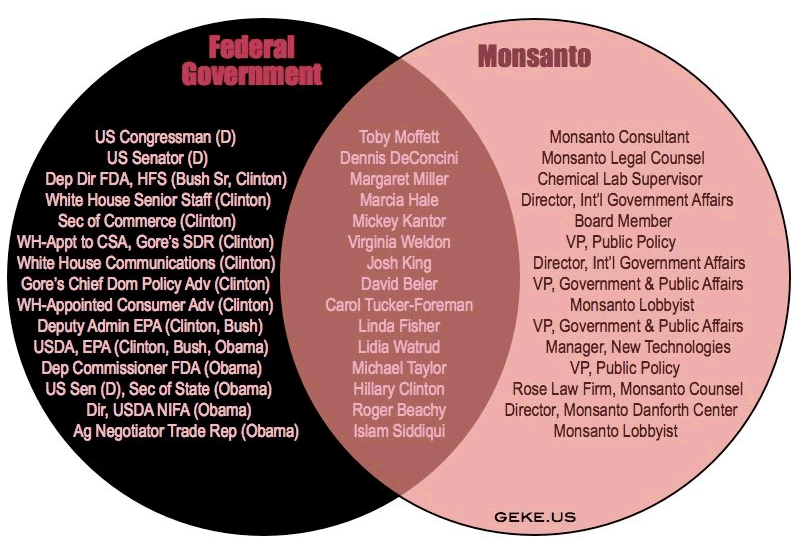
The revolving door between the private sector and government bodies has been well established. In the US, many senior figures from the Genetically Modified Organisms (GMOs) industry, especially Monsanto, have moved with ease to take up positions with the Food and Drug Administration and Evironmental Protection Agency and within the government. Writer and researcher William F Engdahl writes about a similar influence in Europe, noting the links between the GMO sector within the European Food Safety Authority. He states that over half of the scientists involved in the GMO panel which positively reviewed the Monsanto’s study for GMO maize in 2009, leading to its EU-wide authorisation, had links with the biotech industry.

“Monsanto should not have to vouchsafe the safety of biotech food. Our interest is in selling as much of it as possible. Assuring its safety is the FDA’s job” – Phil Angell, Monsanto’s director of corporate communications. “Playing God in the Garden” New York Times Magazine,October 25, 1998.

Phil Angell’s statement begs the question: then who should vouchsafe for it, especially when the public bodies have been severely comprised? Monsanto has all angles covered.

When corporate interests are able to gain access to such positions of power, little wonder they have some heavy-duty tools at their disposal to try to fend off criticism by all means necessary.

A well-worn tactic of the pro-GMO lobby is to slur and attack figures that have challenged the ‘science’ and claims of the industry. With threats of lawsuits and UK government pressure, some years ago top research scientist Dr Arpad Pusztai was effectively silenced over his research concerning the dangers of GM food. A campaign was set in motion to destroy his reputation. Professor Seralini and his team’s research was also met with intense industry pressure, with Monsanto effectively targeting the heart of science to secure its commercial interests. There are numerous examples of scientists being targeted like this. A WikiLeaks cable highlighted how GMOs were being forced into European nations by the US ambassador to France who plotted with other US officials to create a ‘retaliatory target list’ of anyone who tried to regulate GMOs. That clearly indicates the power of the industry.

What the GMO sector fails to grasp is that the onus is on it to prove that its products are safe. And it has patently failed to do this. No independent testing was done before Bush senior allowed GMOs onto the US market. The onus should not be on others to prove they are safe (or unsafe) after they are on the market, especially as public attorney Steven Druker‘s book ‘Altered Genes, Twisted Truth’ shows that GMOs are on the US market due to fraudulent practices and the bypassing of scientific evidence pointing to potential health hazards.

We therefore have the right to ask whether we should trust studies carried out by the sector itself that claims GM crops are safe? Let us turn to Tiruvadi Jagadisan for an answer.

He worked with Monsanto for nearly two decades, including eight years as the managing director of India operations. A few years ago, he stated that Monsanto “used to fake scientific data” submitted to government regulatory agencies to get commercial approvals for its products in India. The former Monsanto boss said government regulatory agencies with which the company used to deal with in the 1980s simply depended on data supplied by the company while giving approvals to herbicides. As reported in India Today, he is on record as saying that India’s Central Insecticide Board simply accepted foreign data supplied by Monsanto and did not even have a test tube to validate the data which at times was faked.

Now that scientists such as Professor Seralini are in a sense playing catch-up by testing previously independently untested GMOs, he is attacked. However, the attacks on Seralini and his study have been found to be based on little more than unscientific polemics and industry pressure. In fact, in new study, Seralini highlights the serious flaws of industry-backed studies that were apparently slanted to distort results. It remains to be seen whether he and his team are in for another bout of smears and attacks.

But this is symptomatic of the industry: it says a product is safe, therefore it is – regardless that science is being used as little more than an ideological smokescreen. We are expected to take its claims at face value. The revolving door between top figures at Monsanto and positions at the FDA makes it difficult to see where the line between lobbying and regulation is actually drawn. People are rightly suspicious of the links between the FDA and GMO industry in the US and the links between it and the regulatory body within the EU.

GM represents the so-called “Green Revolution’s” second coming. Agriculture has changed more over the last two generations than it did in the previous 12,000 years. Environmentalist Vandana Shiva notes that, after 1945, chemical manufacturers who had been involved in the weapons industry turned their attention to applying their chemical know-how to farming. As a result ‘dwarf seeds’ were purposively created to specifically respond to their chemicals. Agriculture became transformed into a chemical-dependent industry that has destroyed much biodiversity. What we are left with is crop monocultures, which negatively impact food security and nutrition. In effect, modern agriculture is part of the paradigm of control based on mass standardization and a dependency on corporate products.

The implications have been vast. Chemical-industrial agriculture has proved extremely lucrative for the oil and chemicals industry, courtesy of oil-rich Rockefeller interests which were instrumental in pushing for the green revolution throughout the world, and has served to maintain and promote Western hegemony, not least via ‘structural adjustment’ and the consequent uprooting of traditional farming practices in favour of single-crop export-oriented policies, dam building to cater for what became a highly water intensive industry, loans and indebtedness, boosting demand for the US dollar, etc.

Agriculture has been a major tool of US foreign policy since 1945 and has helped to secure its global hegemony. One must look no further than current events in Ukraine, where the strings attached to financial loans are resulting in the opening up of (GM) agriculture to Monsanto. From Africa to India and across Asia, the hijack of indigenous agriculture and food production by big corporations is a major political issue as farmers struggle for their rights to remain on the land, retain ownership of seeds, grow healthy food and protect their livelihoods.

Apart from tying poorer countries into an unequal system of global trade and reinforcing global inequalities, the corporate hijacking of food and agriculture has had many other implications, not least where health is concerned.

Dr Meryl Hammond, founder of the Campaign for Alternatives to Pesticides, told a Canadian parliament committee in 2009 that a raft of studies published in prestigious peer-reviewed journals point to strong associations between chemical pesticides and a vast range of serious life-threatening health consequences. Shiv Chopra, a top food advisor to the Canadian government, has documented how all kinds of food products that were known to be dangerous were passed by the regulatory authority and put on the market there due to the power of the food industry.

Severe anemia, permanent brain damage, Alzheimer’s, dementia, neurological disorders, reproductive problems, diminished intelligence, impaired immune system, behavioural disorders, cancers, hyperactivity and learning disability are just some of the diseases that numerous studies have linked to our food.

Of course, just like cigarettes and the tobacco industry before, trying to ‘prove’ the glaringly obvious link will take decades as deceit is passed off as ‘science’ or becomes institutionalized due to the hijacking of government bodies by the corporations involved in food production.

But anyone who questions the need for GMOs in the first place and the risks they bring and devastating impacts they have is painted as clueless and indulging in scare mongering and falsehoods, while standing in the way of human progress. But can we expect much better from an industry that has a record of smearing and attempting to ruin people who criticise it? Are those of us who question the political links of big agritech and the nature of its products ready to take lessons on ethics and high-minded notions of ‘human progress’ from anyone involved with it?

This is an industry that has contaminated crops and bullied farmers with lawsuits in North America, an industry whose companies have been charged with and most often found guilty of contaminating the environment and seriously damaging health with PCBs and dioxins, an industry complicit in concealing the deadly impact of GM corn on animals, an industry where bribery seems to be second nature (Monsanto in Indonesia), an industry associated with human rights violations in Brazil and an industry that will not label its foods in the US.

A great myth forwarded by the pro-GMO lobby is that governments are freely choosing to adopt GMOs. Any brief analysis of the politics of GM highlights that this is nonsense. Various pressures are applied and agritech companies have captured policy bodies and have a strategic hold over the WTO and trade deals like the TTIP.

For instance, take the 2005 US-India nuclear deal (allowing India to develop its nuclear sector despite it not being a signatory of the Non-Proliferation Treaty and allegedly pushed through with a cash for votes tactic in the Indian parliament). It was linked to the Knowledge Initiative on Agriculture, which was aimed at widening access to India’s agricultural and retail sectors. This initiative was drawn up with the full and direct participation of representatives from various companies, including Monsanto, Cargill and Walmart.

When the most powerful country comes knocking at your door seeking to gain access to your markets, there’s good chance that once its corporate-tipped jackboot is in, you won’t be able to get it out.

And it seems you can’t. So far, Bt cotton has been the only GM crop allowed in India, but the open field trials of many GM crops are now taking place around the country despite an overwhelming consensus of official reports warning against this. The work of numerous public bodies and research institutes is now compromised as a result of Monsanto’s strategic influence within India (see this and this).

If global victory cannot be achieved by the GMO biotech sector via the hijack of public bodies and trade deals or intimidation, then the politics of another form of contamination may eventually suffice:

“The hope of the industry is that over time the market is so flooded [with GMOs] that there’s nothing you can do about it. You just sort of surrender” – Don Westfall, biotech industry consultant and vice-president of Promar International, in the Toronto Star,January 9 2001.

Open field planting is but one way of achieving what Westfall states. Of course, there are numerous other ways too (see this).

As powerful agribusiness concerns seek to ‘consolidate the entire food chain’ with their seeds, patents and GMOs, it is clear that it’s not just the health of the nation (any nation) that is at stake but the global control of food and by implication nations.

“What you are seeing is not just a consolidation of seed companies, it’s really a consolidation of the entire food chain” – Robert Fraley, co-president of Monsanto’s agricultural sector 1996, in the Farm Journal. Quoted in: Flint J. (1998) Agricultural industry giants moving towards genetic monopolism. Telepolis, Heise.

Colin Todhunter is an independent writer: colintodhunter.com