Hillary Clinton’s Email Absolution: Two Parties, One Criminal Regime

1015636467

By Eric Draitser

Source: StopImperialism.org

What was your reaction when you heard FBI Director James Comey announce to the world that the Bureau would not be recommending that charges be filed against Hillary Clinton over her handling of emails while she was Secretary of State?  Did you do a humorous spit take with your coffee like some modern day Danny Thomas?  Were you frozen in place like Americans were on November 22, 1963?  Did your jaw hit the floor with your tongue rolling out like a flabbergasted cartoon character?

Chances are you weren’t the least bit surprised that no charges were recommended.  But what does that tell you about our political system?

That millions of Americans weren’t remotely caught off guard by the exculpation of Hillary Clinton is less a commentary about American attitudes than it is a clear indication of the all-pervasive criminality that is at the heart of America’s political ruling class.  And the fact that such criminality is seen as par for the course demonstrates once again that the rule of law is more a rhetorical veneer than a juridical reality.

But consider further what the developments of recent days tell us both about the US and, perhaps even more importantly, the perception of the US internationally. For while Washington consistently wields as weapons political abstractions such as transparency, corruption, and freedom, it is unwilling to apply to itself those same cornerstones of America’s collective self-conception. Hypocrisy is perhaps not strong enough a word.

Not Even Hiding It Anymore…    

Remember the good old days when corrupt politicians committed their crimes in smoke-filled rooms, making handshake deals in quiet corners of luxury hotel suites or over lobster at five star restaurants? Those things certainly still happen, but the transgressions, like all things, seem to have lost a bit of their classiness. It may not be the Plaza Hotel, but the Phoenix airport was no less a scene of wanton lawlessness and impropriety when former President, and soon to be First Gentleman, Bill Clinton met privately with Attorney General Loretta Lynch.

The meeting, which only came to light thanks to the work of local ABC15 morning anchor Christopher Sign, has been widely criticized by pundits and legal experts from both sides of the political spectrum.  Naturally, questions about impropriety, and potential illegal tampering in a federal investigation, were immediately raised once the meeting was made public.  Of course, nothing was done to alleviate any of those concerns, calling into question the very impartiality of the investigation.

But the larger story has to do with symbolic message being sent by the meeting.  Specifically, there is one set of laws for American citizens, and an entirely different set of laws for political elites like the Clintons.

Moreover, there’s more to it than just criminality.  There is the air of superiority which oozes from every action taken by the Clintons who have made hundreds of millions of dollars unscrupulously pandering to, and serving the interests of, the financial elite of Wall Street and the corporate oligarchy.  That feeling of invincibility is what drives someone like Bill Clinton to demand that the FBI surrounding him at the Phoenix airport dictate to bystanders that there are to be “no photos, no pictures, no cell phones.”  To make such a demand is to see oneself as above the law, above the First Amendment, above the plebs, as it were.

And this sort of behavior is what we’ve come to expect from the Clintons.  Who can forget the seemingly endless rap sheet that the dynamic Democrat duo has earned over the decades?  The Whitewater Scandal, in many ways a template for the Clinton email scandal, involved shady business practices and political insider dealing by the Clintons and their real estate developer cronies.  And, like the email scandal, Whitewater was an example of the Clintons deliberately destroying records that likely implicate them in very serious crimes.

As the New York Times reported in 1992, “The Clintons and Mr. McDougal disagree about what happened to Whitewater’s records. Mr. McDougal says that at Mr. Clinton’s request they were delivered to the Governor’s mansion. The Clintons say many of them have disappeared. Many questions about the enterprise cannot be fully answered without the records.”

So it seems the Clintons have this nasty habit of committing crimes and then destroying the records of those crimes and claiming complete ignorance about what happened.  For you and me, such a flimsy excuse would go over like a lead balloon, likely leading to jail time.  For the Clintons, the controversy quietly fades away and slips down the memory hole.

And then of course there’s the mysterious death of Deputy White House Counsel Vince Foster, the man who filed three years of delinquent Whitewater corporate tax returns, and then was subsequently found dead a month later.  While his death was officially ruled a suicide, the serendipitous development for the Clintons led to speculation that Foster was killed on the order of the Clintons in order to silence a potentially damning source of information about Clinton misdeeds.

Indeed, some claim that evidence exists that Foster was in fact murdered, including the statements from one of the lead prosecutors investigating the death, Miguel Rodriguez, who claims that photos showed a gunshot wound on Foster’s neck, a wound that was not mentioned in the official report.  Whether true or not, the speculation about the Clintons’ involvement in a political assassination has only grown.

But of course there are so many more scandals it’s hard to keep count.  From appointments of Clinton Foundation donors to key State Department positions in a sort of “pay for play” scheme, to the salaries paid to people like Hillary’s Deputy Chief of Staff Huma Abedin who, while working for the State Department, alsoworked for Teneo, a consulting firm run by another close Clinton crony.  And who could forget the Clinton Foundation and the myriad conflict of interest issues, lack of transparency, and outright criminality associated with it?

This article would go on for tens of thousands more words were it to chronicle all of Clinton’s scandals.  But the true focus here is not even simply on Clinton crimes, but rather on the culture of corruption and lawlessness that exists unfettered in Washington; it is the endemic corruption that the Clintons represent, perhaps better than anyone.

Corruption and Malfeasance: As American as Apple Pie

It is difficult to encapsulate in a few short paragraphs the multi-layered forms of corruption that are embedded in the very fabric of America’s political culture. Perhaps it could be best separated into three distinct, though interrelated, categories: the open door, the closed door, and the revolving door.

The open door of corruption and criminality represents the kind of wrongdoing that takes place out in the open, in full view of the public, but which is treated as anything but criminal.  Whether it be lying the US into wars of aggression – the Iraq War was based on lies about weapons of mass destruction, the war on Libya was sold on the pretext of lies about civilians being murdered by the government – or simply the obviously corrupt form of campaign financing that allows Wall Street and the corporate elites to bankroll the alleged “democracy” that the US so proudly proselytizes the world over; these forms of corruption and criminality are in many ways the bedrock of American politics.

As the International Military Tribunal at Nuremberg famously stated, “To initiate a war of aggression…is not only an international crime; it is the supreme international crime, differing only from other war crimes in that it contains within itself the accumulated evil of the whole.” By this very definition, every political leader in the US going back decades is guilty of war crimes.

Going further, one can draw on the legacy of Franklin Roosevelt who, in a now legendary speech at Madison Square Garden in 1936, unequivocally proclaimed:

We had to struggle with the old enemies of peace–business and financial monopoly, speculation, reckless banking, class antagonism, sectionalism, war profiteering. They had begun to consider the Government of the United States as a mere appendage to their own affairs. We know now that Government by organized money is just as dangerous as Government by organized mob. Never before in all our history have these forces been so united against one candidate as they stand today. They are unanimous in their hate for me–and I welcome their hatred.

But today, rather than welcoming the hatred of Wall Street and the corporate oligarchy, America’s politicians pander to them, grovel before them, kiss their rings in hopes of securing for themselves a financially and professionally lucrative future. So deep is the rot that most Americans passively accept this as business as usual, failing to understand that it is anything but acceptable.

The closed door forms of criminality are often completely concealed from public view, and what does become known is only thanks to courageous actions by reporters and whistleblowers.  Take for instance the activities of the CIA, only a fraction of which were exposed by the Church and Pike Committees, which included obviously criminal activities ranging from the overthrow of governments to assassination of political leaders to domestic spying and propaganda, all of which being blatantly illegal.

But the closed door also conceals the activities of prominent political figures such as Hillary Clinton, whosesecret lobbying for things like right wing coup governments in Honduras, shows the degree to which politicians literally conspire in secret.  Clinton, like so many of her colleagues, also grovels at the feet of Wall Street financiers, including taking massive payoffs for speeches with the tacit wink-wink-nudge-nudge that goes along with them.

Finally, the revolving door is one of the shining examples of America’s political corruption, or perhaps better put, complete subservience to the corporate oligarchy.  When key government officials leave public life and head to that oft-lionized “private sector,” what they are actually providing is access – access to government for corporations and capital.

When the head of the Centers for Disease Control (CDC) leaves her government post and takes a job as President of Merck & Co. Inc’s vaccine division, no one bats an eye.

When the architect of Obamacare, who before working on the health plan was an executive at one of the nation’s largest health insurance providers, leaves her government job and takes a position with Johnson & Johnson’s government affairs and policy group, it garners barely a passing comment.

When Wall Street executives take positions at head of the Treasury Department – Tim Geithner and Hank Paulsen both worked for Goldman Sachs, as just one example – it is simply “the way things are.”  This revolving door form of political corruption may not be anything new, but it is so rarely defined as corruption.  But that’s exactly what it is.

However, none of this prevents Washington from publicly admonishing other countries for their corruption problems.  Russia? Zimbabwe? Venezuela? China? Nigeria? All corrupt.  United States? Well, er, ummm…Democracy! Freedom!  This is the sort of reflexive hypocrisy that typifies American exceptionalism or, as the rest of the world might call it, the arrogance of empire.


Related Podcast:

Progressive Commentary Hour – 7.19.16

This Is Our Neoliberal Nightmare: Hillary Clinton, Donald Trump, and Why the Market and the Wealthy Win Every Time

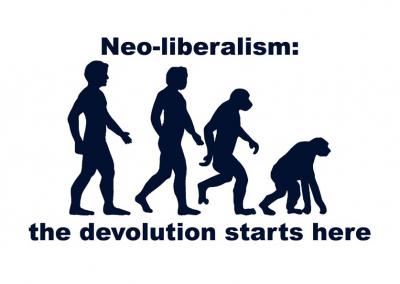
neo_liberalism_devolution_via_permanentculturenow.com_

The rage driving our politics stems from cruelty of capitalism. So why do we vote for those who worship the market?

By Anis Shivani

Source: AlterNet

Over the last fifteen years, editors often asked me not to mention the word “neoliberalism,” because I was told readers wouldn’t comprehend the “jargon.” This has begun to change recently, as the terminology has come into wider usage, though it remains shrouded in great mystery.

People throw the term around loosely, as they do with “fascism,” with the same confounding results. Imagine living under fascism or communism, or earlier, classical liberalism, and not being allowed to acknowledge that particular frame of reference to understand economic and social issues. Imagine living under Stalin and never using the communist framework but focusing only on personality clashes between his lieutenants, or likewise for Hitler or Mussolini or Mao or Franco and their ideological systems! But this curious silence, this looking away from ideology, is exactly what has been happening for a quarter century, since neoliberalism, already under way since the early 1970s, got turbocharged by the Democratic party under the Democratic Leadership Council (DLC) and Bill Clinton. We live under an ideology that has not been widely named or defined!

Absent the neoliberal framework, we simply cannot grasp what is good or bad for citizens under Cruz versus Trump, or Clinton versus Sanders, or Clinton versus Trump, away from the distraction of personalities. To what extent does each of them agree or disagree with neoliberalism? Are there important differences? How much is Sanders a deviation? Can we still rely on conventional distinctions like liberal versus conservative, or Democrat versus Republican, to understand what is going on? How do we grasp movements like the Tea Party, Occupy, and now the Trump and Sanders insurgencies?

Neoliberalism has been more successful than most past ideologies in redefining subjectivity, in making people alter their sense of themselves, their personhood, their identities, their hopes and expectations and dreams and idealizations. Classical liberalism was successful too, for two and a half centuries, in people’s self-definition, although communism and fascism succeeded less well in realizing the “new man.”

It cannot be emphasized enough that neoliberalism is not classical liberalism, or a return to a purer version of it, as is commonly misunderstood; it is a new thing, because the market, for one thing, is not at all free and untethered and dynamic in the sense that classical liberalism idealized it. Neoliberalism presumes a strong state, working only for the benefit of the wealthy, and as such it has little pretence to neutrality and universality, unlike the classical liberal state.

I would go so far as to say that neoliberalism is the final completion of capitalism’s long-nascent project, in that the desire to transform everything—every object, every living thing, every fact on the planet—in its image had not been realized to the same extent by any preceding ideology. Neoliberalism happens to be the ideology—unlike the three major forerunners in the last 250 years—that has the fortune of coinciding with technological change on a scale that makes its complete penetration into every realm of being a possibility for the first time in human history.

From the early 1930s, when the Great Depression threatened the classical liberal consensus (the idea that markets were self-regulating, and the state should play no more than a night-watchman role), until the early 1970s, when global instability including currency chaos unraveled it, the democratic world lived under the Keynesian paradigm: markets were understood to be inherently unstable, and the interventionist hand of government, in the form of countercyclical policy, was necessary to make capitalism work, otherwise the economy had a tendency to get out of whack and crash.

It’s an interesting question if it was the stagflation of the 1970s, following the unhitching of the United States from the gold standard and the arrival of the oil embargo, that brought on the neoliberal revolution, with Milton Friedman discrediting fiscal policy and advocating a by-the-numbers monetarist policy, or if it was neoliberalism itself, in the form of Friedmanite ideas that the Nixon administration was already pursuing, that made stagflation and the end of Keynesianism inevitable.

It should be said that neoliberalism thrives on prompting crisis after crisis, and has proven more adept than previous ideologies at exploiting these crises to its benefit, which then makes the situation worse, so that each succeeding crisis only erodes the power of the working class and makes the wealthy wealthier. There is a certain self-fulfilling aura to neoliberalism, couched in the jargon of economic orthodoxy, that has remained immune from political criticism, because of the dogma that was perpetuated—by Margaret Thatcher and her acolytes—that There Is No Alternative (TINA).

Neoliberalism is excused for the crises it repeatedly brings on—one can think of a regular cycle of debt and speculation-fueled emergencies in the last forty years, such as the developing country debt overhang of the 1970s, the savings and loan crisis of the 1980s, the Asian currency crisis of the 1990s, and the subprime mortgage crisis of the 2000s—better than any ideology I know of. This is partly because its very existence as ruling ideology is not even noted by the population at large, which continues to derive some residual benefits from the welfare state inaugurated by Keynesianism but has been led to believe by neoliberal ideologues to think of their reliance on government as worthy of provoking guilt, shame, and melancholy, rather than something to which they have legitimate claim.

It is not surprising to find neoliberal multiculturalists—comfortably established in the academy—likewise demonizing, or othering, not Muslims, Mexicans, or African Americans, but working-class whites (the quintessential Trump proletariat) who have a difficult time accepting the fluidity of self-definition that goes well with neoliberalism, something that we might call the market capitalization of the self.

George W. Bush’s useful function was to introduce necessary crisis into a system that had grown too stable for its own good; he injected desirable panic, which served as fuel to the fire of the neoliberal revolution. Trump is an apostate—at least until now—in desiring chaos on terms that do not sound neoliberal, which is unacceptable; hence Jeb Bush’s characterization of him as the “candidate of chaos.” Neoliberalism loves chaos, that has been its modus operandi since the early 1970s, but only the kind of chaos it can direct and control.

To go back to origins, the Great Depression only ended conclusively with the onset of the second world war, after which Keynesianism had the upper hand for thirty-five years. But just as the global institutions of Keynesianism, specifically the IMF and the World Bank, were being founded at the New Hampshire resort of Bretton Woods in 1944, the founders of the neoliberal revolution, namely Friedrich Hayek, Ludwig von Mises, Milton Friedman, and others were forming the Mount Pelerin Society (MPS) at the eponymous Swiss resort in 1947, creating the ideology which eventually defeated Keynesianism and gained the upper hand during the 1970s.

So what exactly is neoliberalism, and how is it different from classical liberalism, whose final manifestation came under Keynesianism?

Neoliberalism believes that markets are self-sufficient unto themselves, that they do not need regulation, and that they are the best guarantors of human welfare. Everything that promotes the market, i.e., privatization, deregulation, mobility of finance and capital, abandonment of government-provided social welfare, and the reconception of human beings as human capital, needs to be encouraged, while everything that supposedly diminishes the market, i.e., government services, regulation, restrictions on finance and capital, and conceptualization of human beings in transcendent terms, is to be discouraged.

When Hillary Clinton frequently retorts—in response to demands for reregulation of finance, for instance—that we have to abide by “the rule of law,” this reflects a particular understanding of the law, the law as embodying the sense of the market, the law after it has undergone a revolution of reinterpretation in purely economic terms. In this revolution of the law persons have no status compared to corporations, nation-states are on their way out, and everything in turn dissolves before the abstraction called the market.

One way to sum up neoliberalism is to say that everything—everything—is to be made over in the image of the market, including the state, civil society, and of course human beings. Democracy becomes reinterpreted as the market, and politics succumbs to neoliberal economic theory, so we are speaking of the end of democratic politics as we have known it for two and a half centuries. As the market becomes an abstraction, so does democracy, but the real playing field is somewhere else, in the realm of actual economic exchange—which isnot, however, the market. We may say that all exchange takes place on the neoliberal surface.

Neoliberalism is often described—and this creates a lot of confusion—as “market fundamentalism,” and while this may be true for neoliberal’s self-promotion and self-presentation, i.e., the market as the ultimate and only myth, as were the gods of the past, I would argue that in neoliberalism there is no such thing as the market as we have understood it from previous ideologies.

The neoliberal state—actually, to utter the word state seems insufficient here, I would claim that a new entity is being created, which is not the state as we have known it, but an existence that incorporates potentially all the states in the world and is something that exceeds their sum—is all-powerful, it seeks to leave no space for individual self-conception in the way that classical liberalism, and even communism and fascism to some degree, were willing to allow.

There are competing understandings of neoliberal globalization, when it comes to the question of whether the state is strong or weak compared to the primary agent of globalization, i.e., the corporation, but I am taking this logic further, I am suggesting that the issue is not how strong the state is in the service of neoliberalism, but whether there is anything left over beyond the new definition of the state. Another way to say it is that the state has become the market, the market has become the state, and therefore both have ceased to exist in the form we have classically understood them.

Of course the word hasn’t gotten around to the people yet, hence all the confusion about whether Hillary Clinton is more neoliberal than Barack Obama, or whether Donald Trump will be less neoliberal than Hillary Clinton. The project of neoliberalism—i.e., the redefinition of the state, the institutions of society, and the self—has come so far along that neoliberalism is almost beyond the need of individual entities to make or break its case. Its penetration has gone too deep, and none of the democratic figureheads that come forward can fundamentally question its efficacy.

I said almost. The reason why Bernie Sanders, self-declared democratic socialist, is so threatening to neoliberalism is that he has articulated a conception of the state, civil society, and the self that is not founded in the efficacy and rationality of the market. He does not believe—unlike Hillary Clinton—that the market can tackle climate change or income inequality or unfair health and education outcomes or racial injustice, all of which Clinton propagates. Clinton’s impending “victory” (whatever machinations were involved in engineering it) will only strengthen neoliberalism, as the force that couldn’t be defeated even when the movement was as large and transcendent as Sanders’s. Although Sanders doesn’t specify “neoliberalism” as the antagonist, his entire discourse presumes it.

Likewise, while Trump supporters want to take their rebellion in a fascist direction, their discomfort with the logic of the market is as pervasive as the Sanders camp, and is an advance, I believe, over the debt and unemployment melancholy of the Tea Party, the shame that was associated with that movement’s loss of identity as bourgeois capitalists in an age of neoliberal globalization. The Trump supporters, I believe, are no longer driven by shame, as was true of the Tea Party, and as has been true of the various dissenting movements within the Republican party, evangelical or otherwise, in the recent past. Rather, they have taken the shackles off and are ready for a no-holds barred “politically incorrect” fight with all others: they want to be “winners,” even at the cost of exterminating others, and that is not the neoliberal way, which doesn’t acknowledge that there can be winners and losers in the neoliberal hyperspace.

In the current election campaign, Hillary Clinton has been the most perfect embodiment of neoliberalism among all the candidates, she is almost its all-time ideal avatar, and I believe this explains, even if not articulated this way, the widespread discomfort among the populace toward her ascendancy. People can perceive that her ideology is founded on a conception of human beings striving relentlessly to become human capital (as her opening campaign commercialso overtly depicted), which means that those who fail to come within the purview of neoliberalism should be rigorously ostracized, punished, and excluded.

This is the dark side of neoliberalism’s ideological arm (a multiculturalism founded on human beings as capital), which is why this project has become increasingly associated with suppression of free speech and intolerance of those who refuse to go along with the kind of identity politics neoliberalism promotes.

And this explains why the 1990s saw the simultaneous and absolutely parallel rise, under the Clintons, of both neoliberal globalization and various regimes of neoliberal disciplining, such as the shaming and exclusion of former welfare recipients (every able-bodied person should be able to find work, therefore under TANF welfare was converted to a performance management system designed to enroll everyone in the workforce, even if it meant below-subsistence wages or the loss of parental responsibilities, all of it couched in the jargon of marketplace incentives).

The actual cost to the state of the AFDC program was minimal, but its symbolism was incalculable. The end of welfare went hand in hand with the disciplinary “crime bill” pushed by the Clintons, leading to an epidemic of mass incarceration. Neoliberalism, unlike classical liberalism, does not permit a fluidity of self-expression as an occasional participant in the market, and posits prison as the only available alternative for anyone not willing to conceive of themselves as being present fully and always in the market.

I believe that the generation of people—in their forties or older—supporting Hillary have already internalized neoliberal subjectivity, which they like to frame as realism or pragmatism, refusing for instance to accept that free college or health care are even theoretical possibilities. After all, they have maintained a measure of success in the past three or four decades after conceptualizing themselves as marketplace agents. Just as the Tea Party supporters found it intolerable that government should help irresponsible homeowners by bailing them out of unsustainable debt, the Clinton supporters hold essentially the same set of beliefs toward those who dare to think of themselves outside the discipline of the market.

I spoke of the myth of the market, as something that has no existence in reality, because none of the elements that would have to exist for a market to work are actually in place; this is even more true for neoliberalism than it was for the self-conscious annihilation of the market by communism, because at least in that system the market, surreptitiously, as in various Eastern European countries, kept making an appearance. But when the market takes neoliberal shape, i.e., the classical conceptions of the buyer and seller as free agents are gone, then radical inequality is the natural outcome. And inequality in the last four decades, as statistics for the U.S. and everywhere neoliberalism has made inroads prove beyond a doubt, has exploded, thereby invalidating neoliberalism’s greatest claim to legitimacy, that it brings about a general increase in welfare. So neoliberalism, to the extent that the inequality discourse has made itself manifest recently, must insist all the more vocally on forms of social recognition, what Clinton, for example, likes to call the “fall of barriers.”

Neoliberalism likes to focus on public debt—in the Clinton years debt reduction became a mania, though George W. Bush promptly spent all the accumulated surpluses on tax cuts for the wealthy and on wars of choice—rather than inequality, because the only way to address inequality is through a different understanding of public debt; inequality can only be addressed through higher taxation, which has by now been excluded from the realm of acceptable discourse—except when Sanders, Trump, or Jeremy Corbyn in England go off script.

So to recapitulate neoliberalism’s comprehensive success, let us note that we have gone from a liberal, Keynesian, welfare state to a neoliberal, market-compliant, disciplinary state.

Neoliberalism expects—and education at every level has been redesigned to promote this—that economic decision-making will be applied to all areas of life (parenthood, intimacy, sexuality, and identity in any of its forms), and that those who do not do so will be subject to discipline. Everyone must invest in their own future, and not pose a burden to the state or anyone else, otherwise they will be refused recognition as human beings.

This supposed economic “rationality” (though it is the greatest form of irrationality) applies to civil society as much as the state, so that none of the ideals of classical liberalism, or previous ideologies rooted in humanism, are valid any longer, the only value is the iteration of the market (as myth, not reality); in other words, neoliberalism, unlike the elevation of the individual in classical liberalism or the state in fascism or the collectivity in communism, has erected something, the market, that has no real existence, as the only god to serve! And it is just like a god, with an ethereal, unchallengeable, irrefutable, ubiquitous presence. Whatever in state policy does not serve market-conformity is to be banned and banished from memory (the secular scriptures are to be rewritten), which explains neoliberalism’s radical narrowing of public discourse, including the severance of identity politics from any class foundation.

Neoliberalism will continue to perpetuate reduced opportunity, because one of its characteristics—as in any system that wants to thrive on the world stage—is to constantly refine the field upon which the human subject can operate.

As such, those displaced workers who have suffered the most from the erosion of the old industries in the former manufacturing centers of the world are not even factors to contend with, they are invisible and cannot be part of the policy equation. To the extent that their actual presence is reckoned with, the economy can be said to have crashed; but the problem doesn’t arise because of the management of unemployment or underemployment statistics, unlike a housing crash which is palpable and cannot escape statistical definition.

The danger for neoliberalism—as is clear from the support of millions of displaced human beings for Trump—is that with each crisis neoliberalism sheds more workers, makes individuals and firms more “disciplined,” narrows the scope of opportunity even further. At times, the disciplining of the non-neoliberal other—as with the killing of Michael Brown or Eric Garner—explodes to surface consciousness in an unsavory way, so an expert manager like Clinton or Obama is required to tamp down the emotions of such unruly entities as Black Lives Matter which arise in response. If climate change, according to Clinton and her cohort, can and should have market solutions, then surely racial disparity, or police violence, should also have market solutions and no others; it is here that neoliberal multiculturalism, operating in the academy, is so insidious, because at the elite level it functions to validate market discourse, it does not step outside it.

The present breakdown of both major political parties can be explained by the frustration that has built up in the body politic over the past decade, because after the crash there was no sustained intellectual movement to question the myth of the market. The substitution of economic justice with identity politics is something Ralph Nader, Howard Dean, and now Bernie Sanders have contested in a humane manner, while the same process is at work, admittedly in an inhumane way, in the Trump phenomenon.

Thus, also, Hillary Clinton’s animus against free college education; that form of expansion of opportunity, which was a reality from the 1950s to the 1980s, cannot be allowed to return, human beings are supposed to invest in their own future earnings potential, they are not entitled to a transcendent experience without barriers manifesting in discipline and self-correction. Education, like everything else, including one’s own health, becomes an expensive consumer good, not a right, no longer an experience that might lead to a consciousness beyond the market but something that should be fully encapsulated by the market. If one is a capable market player, education as we have classically understood it becomes redundant.

Unlike the interregnum between 1945-1973, the rising tide—no matter the befuddlements Arthur Laffer and his fellow Reaganite ideologues proffered—does not lift all boats today, it is outside the logic of neoliberalism that it do so, so the idea of reforming neoliberalism, or what is often called “globalization with a human face,” is a rhetorical distraction. All of the policy innovations—interpreted as “socialism” by the Tea Partiers—offered by Barack Obama fall within the purview of neoliberalism, above all the Affordable Care Act, whose genesis was hatched in neoliberal think tanks decades ago.

It is important to note that neoliberal economic restructuring necessarily means social restructuring, i.e., a movement toward disciplinarity and away from liberalism; the disciplinarity can take a Bushian, Clintonian, or Trumpian form, but these are manifestations of the same tendency.

When wage growth is decoupled from economic growth (as it has been since Friedman and others inaugurated the revolution in the early 1970s), this means that the human subject is ripe for discipline. Furthermore, wage fairness cannot be rationally discussed (hence the obfuscation surrounding the $15 minimum wage orchestrated by Clinton and others) because the concept of the market has been disembedded from society; the market as abstraction, not a concrete reality, makes any notion of reform or restructuring impossible. Like the minimum wage, something like free child care also remains outside the bounds of discourse, because public policy cannot accommodate discussions that do not take the self-regulating market as unassailable myth.

What neoliberalism can accommodate is relentless tax cuts (Trump has already offered his huge tax cut plan, as Bush did as his first order of business), which only exacerbate the problem, leading to increasing concentrations of wealth. It has to be said, though, that Ted Cruz more comfortably fit the neoliberal paradigm, with his familiar calls for lower taxes along with reduced regulation and further limits on social welfare, whereas Trump shows, for now, some elements of apostasy. If neoliberalism were to get a Cruz, it would have no problem working with him, or rather, Cruz would have had no problem executing neoliberalism, beyond the surface dissimilarities from Hillary Clinton.

As Sanders has consistently noted, economic inequality leads to political inequality, which means that democracy, after a certain point, becomes only theoretical (viz. Citizens United and the electoral influence of such powerful entities as the Koch brothers). Both processes—economic inequality and political inequality—have accelerated after each downturn in the forty-five-year history of neoliberalism, therefore a downturn is always exciting, and even preordained, for a Bush, a Trump, or a Clinton. Again, economic inequality and political polarity (polarity is simply a manifestation of democracy having become dysfunctional) strongly correlate, and both have come to a head in this election.

Neoliberalism’s task, from this point on, is to mask and manage the increasing inequalities that are likely to befall humanity, especially as the planet reaches a crisis point in its health. In a way, George W. Bush threw a wrench—he was a perverted Keynesian in a way, believing in war to prime the pump, or inflating unsustainable bubbles, or spending exorbitantly on grandiose gestures—into the process of neoliberal globalization that was going very smoothly indeed under Bill Clinton and would likely have flourished under Al Gore as well. With Hillary Clinton, the movement will be toward further privatization of social welfare, “reforming” it along market principles, as has been true of every neoliberal avatar, whether it was Bill Clinton’s incentives to work in the performance management makeover of welfare, George Bush’s proposed private social security accounts, Mitt Romney’s proposed private health care accounts, or the school vouchers that tempt all of them from time to time.

What remains to be seen is the extent to which the millennial generation might be capable of thinking outside the neoliberal paradigm, i.e., they don’t just want more of what neoliberal promises to give them yet fails to deliver, but want things that neoliberalism does not or cannot promise. On this rests the near-term future of the neoliberal project.

Beyond Sanders himself, the key question is the ability of the millennial generation to conceive of themselves outside the neoliberal subjectivity they have been pushed to internalize. They have been encouraged to think of themselves as capital producers, turning their intellectuality into social media popularity for the benefit of capital, in the service of the same abstract market that has no place, no role, no definition beyond the fallen liberal calculus. Does the millennial generation believe, even about its most intimate core, that everything has been privatized?

I am not necessarily making a pessimistic prediction. I am merely outlining the strength of an opponent that has refused to be named for forty-five years, although it has been the ruling ideology that long! In defining neoliberalism, I have sought to distance myself from the distraction of personalities, and tried to expose the dark side of our politics which we can only see when we name and understand the ideology as such. We are up against a system that is so strong that it has survived, for the most part, the last crash, as citizens couldn’t get their heads around the idea of nationalizing banks or health care.

It is existentially imperative to ponder what happens beyond Sanders, because neoliberalism has its end-game in sight, letting inequality continue to escalate past the crash point (meaning the point where the economy works for most people), past any tolerable degradation of the planet (which is being reconceptualized in the shape of the market).

What, indeed, does happen beyond Sanders, because as we have seen Hillary Clinton is one of the founders of neoliberal globalization, one of its central historical figures (having accelerated the warehousing of the poor, the attack on trade unions, and the end of welfare and of regulatory prowess), while Trump is an authoritarian figure whose conceptions of the state and of human beings within the state are inconsistent with the surface frictionlessness neoliberalism desires? To go back to Hillary Clinton’s opening campaign commercial, to what extent will Americans continue to believe that the self must be entrepreneurially leveraged toward maximum market gains, molded into mobile human capital ever ready to serve the highest bidder?

As to whether a non-neoliberal globalization is possible and what that might look like on the international stage after a quarter-century of Clinton, Bush, and Obama—which is essentially the frustration Trump is tapping into—I’ll take that up in a follow-up essay, which will further clarify the differences between Sanders versus Clinton, and Trump versus Clinton.

I would suggest that it is not that globalization causes or has caused neoliberalism, but that neoliberalism has pushed a certain form of globalization that suits its interests. This is a crucial distinction, on which everything else hinges. The neoliberal market doesn’t actually exist; at the moment it is pure abstraction; what is actually filling up economic and political space can only be discussed when we step away from this abstraction, as Sanders has so ably done, and as the Occupy and Black Lives Matter movements tentatively set in motion.

 

Anis Shivani is the author of several books of fiction, poetry, and criticism, including, most recently, My Tranquil War and Other Poems. His novel Karachi Raj (HarperCollins/Fourth Estate) was released this summer. His next book is the poetry collection Whatever Speaks on Behalf of Hashish, out in October.

The Belated Downfall of Bill Clinton

Bill-HIllary-Clinton-Corrupt

One of the unintended consequences of Hillary Clinton’s campaign has been the renewed and often revealing public appearances of Bill Clinton. His involvement in Hillary’s campaign has been a series of awkward events, from violating election campaigning laws back in March to his condescending treatment of Black Lives Matter protesters in April. Throughout May he was hounded on the campaign trail by criticism of corrupt practices of his foundation. In late May what what was supposed to be a routine campaign stop at a New Mexico diner escalated to a grueling 30 minute argument with Bernie Sanders supporter Josh Brody.

At another restaurant appearance in Los Angeles’s Watts neighborhhod last Saturday, Clinton had the misfortune of being there at the same time as 23 year old Sarra Tekola of Women of Color Speak Out, who did exactly that when she ambushed him by shouting “Hey Clinton, fuck you! My people are still in jail from your crime bill! Three strikes – you’re out, mandatory minimum, then you wanna take pictures with my people here? We’re still in jail for what you did!” (an inspiring moment documented by a widely viewed viral video).

The next two days while giving a speeches in Boyle Heights and Richmond, Clinton faced more heckling from Sanders supporters and on Monday he was also confronted with the news that his brother Roger, who on his last day in office Bill pardoned for cocaine dealing, was jailed for drunken driving.

Though it’s likely Hillary and Bill will be back in the White House (barring a surprise intervention of hackers/whistleblowers), their public image is unlikely to get any less loathsome and any illusions citizens may still hold regarding positive aspects of their legacy will continue to crumble. Angry disenfranchised voters of all stripes will never cease to hold them accountable for their misdeeds for the rest of their days.

The Man Who Bought the Clintons: the Political Business of Terry McAuliffe

1081055032

(Editor’s note: In light of yesterday’s announcement that Hillary Clinton’s former campaign chairman Terry McAuliffe is being investigated by federal prosecutors for illegal foreign campaign donations made directly to him and through the Clinton Foundation, it’s worth revisiting this article from 10/15 to learn more about his shady history.)

By

Source: CounterPunch

In May 1999, the Labor Department brought suit against Jack Moore and John Grau, charging the two men with mismanaging the pension fund for the International Brotherhood of Electrical Workers. Moore was the longtime secretary of the union, while Grau was the vice-president of the National Electrical Contractor’s Association, which was partner in the fund. At issue was a series of sweetheart real estate deals in central Florida, which regulators labeled “imprudent”, and cost the fund money. Moore and Grau eventually settled the case for more than six figures. The union was forced to kick in another $5 million to cover the losses to the pension fund. The person at the center of the scandal, however, made out in the deal very well, indeed. His name: Terry McAuliffe, former head of the DNC, now governor of Virginia.

McAuliffe met Moore in 1988, when both were raising money for the doomed presidential bid of Dick Gephardt. They became close friends, allies in a campaign to redesign the Democratic Party into a more moderate political vessel, along the lines of the pre-Reagan Republicans. Moore controlled the $6 billion IBEW pension fund and had a reputation for investing money in businesses run by friends and political cronies.

So it was that in November 1990, McAuliffe approached Moore and his friend Grau with a proposal for a real estate partnership in central Florida with an investment company called American Capital Management, which McAuliffe owned with his wife Dorothy. The deal involved the purchase of the Woodland Square Shopping Center and five apartment complexes outside Orlando, Florida. It was a lopsided partnership. The pension fund put up $39 million to purchase the property. McAuliffe shelled out $100, yet he and his wife enjoyed 50 percent ownership in the project. He eventually parlayed his $100 investment into a $2.45 million profit.

Fresh from this triumph, McAuliffe approached Moore with a new proposal. He asked Moore to dip into the pension fund one more time for $6 million so that he could purchase a parcel of land south of Orlando called Country Run, which McAuliffe planned to subdivide into 500 single-family homes. Moore obliged and loaned McAuliffe the money. The development soon proved to be a bust. Only half the homes were built and many of them didn’t sell. Years passed, but McAuliffe never bothered to make a single payment to the pension fund on the loan. According to Labor Department records, McAuliffe was in default from December 1992 through October 1997. The managers of the pension fund never demanded payment or called in the loan. The only collateral they had required was the nearly worthless Country Run property itself.

Eventually, McAuliffe found a buyer for the property and repaid the loan. But the aroma of the deals attracted the attention of the Labor Department, which had been looking into the looting of worker pension funds. In May of 1999, the agency brought a suit against Moore and Grau for mismanagement of the fund. Both eventually settled, agreeing to six figure fines, and resigned their positions. The IBEW was compelled to reimburse the pension fund to the tune of five million dollars. The Labor Department didn’t have any authority to go after McAuliffe. That was up to the Clinton Justice Department and they took a pass. He wasn’t sued or otherwise inconvenienced. So a labor fund got looted and Terry McAuliffe got very rich.

This wasn’t the only time McAuliffe steered a labor union toward dangerous legal and financial shoals. In 1996, McAuliffe helped devise a political money-cycling scheme that led to the downfall of several leaders of the Teamster’s Union, including the union’s reform-minded president Ron Carey and his political director William Hamilton. At Hamilton’s trial on corruption charges, Richard Sullivan, the former director of finance for the Democratic National Committee, testified that McAuliffe asked Sullivan and other top DNC fundraisers to approach big Democratic donors who could make a contribution of at least $50,000 to the re-election campaign of Ron Carey, then in a pitched battle with James Hoffa, Jr. Under McAuliffe’s scheme, Sullivan testified, the Teamster’s Union would later recycle that $50,000 back into various Democratic Party accounts. Once again, McAuliffe was never charged with wrongdoing and his lawyer, Richard Ben-Veniste, repeatedly said there’s was nothing illegal in his client’s plan. He lives a charmed life.

* * *

Terry McAuliffe was born in 1957 in Syracuse, New York. His father was a longtime Democratic powerbroker in upper state New York and a top fundraiser for the party. Terry got into politics at a young age. But as anyone can tell there’s not much evidence that he was ever excited about policy issues. The environment, abortion rights, civil rights, peace. These great issues didn’t turn Terry on. Instead, he was entranced by the mechanics of political fundraising, party planning and schmoozing with business elites and Hollywood celebrities.

He made a beeline for the Beltway, attending Catholic University. Through his father’s influence, he got a position as a fundraiser for Jimmy Carter. And then he was off and running, renting his financial services to House and senate races and gubernatorial elections.

In the meantime, McAuliffe managed to earn the obligatory law degree from Georgetown University. Then in 1984, he began to fine-tune his craft under the wing of Tony Coelho, the longtime House whip and master fundraiser from California. At the time, Coelho was heading up the Democratic Congressional Campaign Committee, the main DNC fundraising apparatus for House races.

More than anyone, Coelho laid the foundations for the Democratic Party’s open courting of big business. And Terry McAuliffe, working from the master’s Rolodex, served as Coelho’s chief apprentice, sprinting from one Beltway lobby shop to the next offering prime access to Democratic powerbrokers for political cash, hard and soft money, the new coin of the realm.

The young fundraiser learned an early lesson. No enterprise was off-limits, no matter how tarnished the reputation of the company: weapons-makers, oil companies, chemical manufacturers, banks, sweatshop tycoons. Indeed, McAuliffe made his mark by targeting corporations with festering problems, ranging from liability suits to environmental and worker safety restraints to bothersome federal regulators. The more desperate these enterprises were for political intervention, the more money McAuliffe knew he could seduce into DNC coffers. What about environmental groups? Big labor? The traditional core of the Democratic Party? Not only didn’t their objections (assuming they voiced any) matter, they actually made McAuliffe’s pitch more appealing to the corporadoes. After all, the Republicans didn’t have any sway over these organizations. Triangulation, the backstabbing political playbook of Clintontime, originated as a fundraising gimmick. A very lucrative one.

In the early 90s, really big money began to pour into the DNC. McAuliffe recruited robust donations from Arco and Chevron, Entergy and Enron, Phillip Morris and Monsanto, Boeing and Lockheed, Citibank and Weyerhaeuser. Many of these corporations had all but abandoned the Democrats during the Reagan era. McAuliffe lured them back with promises of favorable treatment by a new generation of anti-regulatory Democrats attuned to the special needs of multinational corporations. This was the mulch bed from which the Clinton presidency took root.

By 1994, Clinton himself had aligned himself to McAuliffe’s magic touch. He tapped him as the chief fundraiser for the 1996 reelection campaign. In this capacity, McAuliffe masterminded some of the more risqué political fundraising operations since the Kennedy era. There were the fundraisers at Buddhist temples in California. There were the notorious coffee klatches, where for a six-figure contribution to the DNC, corporate executives were brought to the White House for some face-time with Bill and Hillary, Al and Tipper, and a retinue of cabinet secretaries, with pen in hand ready to address any nagging problem. McAuliffe also devised the plan to rent out the Lincoln Bedroom to top contributors for slumber parties with the president.

Over the course of the next six years, McAuliffe was personally responsible for raising, largely from corporate sources, more than $300 million for the DNC.

* * *

The scene: the MCI Center in Washington, D.C. The date: May 14, 2000. The Event: “BBQ and Blue Jeans Gala.” It’s Terry McAuliffe’s biggest party yet. A star-studded gathering of DC lobbyists, corporate executives and Hollywood liberals, all in dressed in blue jeans, eating BBQ and listening to the blues and country music. It was also the single biggest fundraiser in history. More than $25 million was raised for the DNC in a single night.

Toward the end of the evening, Al Gore lumbered his way onto the stage and seized the microphone. He directed the spotlight turned on McAuliffe, the real star of the evening. “Terry”, Gore said, “You are the greatest fundraiser in the history of the universe.” The crowd thundered with applause for the man who had just lightened their wallets of several thousands of dollars.

Gore would soon come to rue those fervent words. While most Democrats blamed Katherine Harris or the Supreme Court for the loss of the White House to George W. Bush, McAuliffe pointed the finger at Gore. The fundraiser believed that Gore ran an inept campaign, misspending the precious millions he had worked so diligently to raise. McAuliffe detested the way that Gore distanced himself from the Clintons and refused to allow the president to campaign for him even in key southern states. Even worse from McAuliffe’s perspective, Gore had subtly dissed Clinton on the campaign trail, suggesting that he himself was a man of firmer moral sinew than the embattled president.

When Gore lost, the party fell back into the control of the Clintons and their chief emissary, Terry McAuliffe. The fundraiser swiftly took his revenge out on Gore. In late January, as the moving vans where pulling away from the White House, McAuliffe planned a major send off for the Clintons at Andrews Air Base. All the top Democrats were there; many were invited to give tributes to the first couple in front of the national TV cameras. Al Gore, naturally, expected to give the keynote farewell address. But McAuliffe refused to allow Gore even near a microphone. Gore wasn’t permitted to speak a single word. “McAuliffe didn’t want Gore to speak”, a top aide at the DNC told the Washington Post. “McAuliffe didn’t even want Gore there. The send off was about good memories, success stories. And the VP wasn’t either.”

McAuliffe’s implacable loyalty to Clinton was soon rewarded. Later in 2001, Bill Clinton engineered the ouster of Joe Andrew as head of the DNC and installed McAuliffe, who only months earlier had offered to purchase the Clintons a house in Chappaqua, New York for $1.3 million, as the chief of the party. As the head of the DNC, McAuliffe was now in a position to protect the Clintons’ legacy, reward loyalists, punish party dissidents and select the next presidential nominee.

When Gore began to flirt with the notion of challenging Bush in 2004, McAuliffe went to work to kill off his campaign before it even started. He went straight to Gore’s top political sponsors and advised them to withhold funds from the Gore campaign chest. He was tremendously persuasive, convincing even some of Gore’s most loyal backers, such as financier James Tisch, to deny money to their old friend.

The sabotage of the nascent Gore 2004 campaign was just a run-up for demolition job McAuliffe directed against the unauthorized campaign of Vermont governor Howard Dean. The Dean threat had almost nothing to do with any perceived ideological heresy from the Vermonter. After all Dean was a run-of-the-mill neoliberal who pretty much aped the centrist economic policies of Clinton. The real threat posed by Dean came from his determination to raise millions in campaign contributions outside of the precincts of the DNC. McAuliffe’s control over the party stemmed from his role as the prime dispenser of campaign cash, the elixir necessary to keep political recipients loyal to the party leadership and its policies. Dean showed another way was possible and he had to be put down.

But after the Dean juggernaut was scuttled, McAuliffe reached out a helping hand to the defeated candidate. As usual, the hand proffered money. The Dean campaign was in debt, the legions of Deaniacs seething with rage over the demolition of their hero. McAuliffe offered to help pay off Dean’s debts and set up his new institute, Democracy for America. In return, Dean worked to calm his troops, imploring them not to abandon the party for the independent campaign of Ralph Nader.

* * *

Terry McAuliffe didn’t just use his business contacts to fatten the accounts of the Democratic National Committee; he also deftly exploited them to inflate his own fortune, which now nudges toward nine figures. A similar fruitful intimacy with corporate cronies led to Tony Coelho’s stunning fall from grace, but McAuliffe never looked back. His trajectory has been decidedly prosperous and, to this point, utterly immune to the slumping fortunes of the economy outside the confines of the Beltway. These days McAuliffe says he wants to resurrect the Misery Index, but he’s not acquainted with any of the numbers.

In 1996, McAuliffe met a young corporate tycoon named Gary Winnick, who had once referred to himself as the richest man in Los Angeles. Winnick ran Global Crossing, a fiber-optics company chartered in the tax-friendly haven of Bermuda. At the time McAuliffe met Winnick, Global Crossing was a privately held company, poised to cash in on the deregulation of the telecom industry and the new opportunities in China. In 1997, Winnick offered McAuliffe the opportunity to purchase $100,000 worth of Global Crossing stock.

When Global Crossing shares went public in 1998, the value of the stock soared. Operating with an acute sensitivity to the fluctuations of the market bordering on ESP, McAuliffe sold his shares at the precise moment the stock peaked. McAuliffe told the New York Times he pocketed $18 million in the deal. Within a few months, Global Crossing’s stock collapsed, the company plunged into bankruptcy and more than a third of its workforce were tossed into the ranks of the unemployed.

McAuliffe also served as an on-call DC fixer for Winnick in those optimistic days following the Clinton reelection. In early 1997, McAuliffe set up shop in an office in downtown DC owned by a Winnick company called Pacific Capital Group. According to a boastful McAuliffe, Winnick hired him as a consultant to “help work some deals” with the federal government. “Gary was looking for some political action”, McAuliffe told Worth magazine. “He wanted a stable of people around him with great contacts.”

Few people inside the Beltway enjoyed better contacts than McAuliffe, as Winnick would soon discover. At an appearance in Los Angeles later that year, Bill Clinton lavished on Winnick his personal endorsement. “Gary Winnick has been a friend of mine for some time now and I’m thrilled by the success that Global Crossing has had.”

There’s no evidence that Winnick and Clinton had even met each other before that evening. But the endorsement proved fruitful. It signaled not only Clinton’s faith in the company, but also sent a message to federal agencies that Global Crossing was a firm that they should do business with. It soon paid off. A few months later Global Crossing won a $400 million contract from the Pentagon after repeated prodding from the White House.

After the contract was awarded, McAuliffe arranged for Winnick to play a round of golf with Clinton. Shortly after the afternoon on the links, Winnick donated $1 million to the Clinton presidential library.

Winnick’s joy was short lived, however. In the winter of 2001, the Pentagon rescinded the Global Crossing deal following an investigation by the Inspector General of the Defense Department, which raised questions over how the contract was awarded and Global Crossing’s ability to fulfill its obligations. Later, the company fell into the financial death noted above.

The attack dogs in the Bush White House never really made much of McAuliffe’s ripe ties to Global Crossing. Why? Global Crossing had been almost equally generous to the Bush family.

In 1997, Global Crossing invited former President George H.W. Bush to address company executives in Tokyo, Japan. At the time, Bush’s standard speaking fee was $80,000. The morning after the speech, Bush had breakfast with Winnick. Winnick advised Bush that it would prove much more profitable for the former president to accept payment in Global Crossing stock, then privately held, than cash. Bush agreed. Soon the company went public and the value of Bush’s stock swelled to more than $14 million. Not a bad pay-off for an hour’s speech. To complete the symmetry, one of Winnick’s top executives also serves as a trustee of the G.H.W. Presidential Library Fund.

Winnick tried to cover all of his bases. Yet as with Enron and Tyco, even the most judicious dispensation of money across the political spectrum couldn’t save a company that had been looted from the inside out. Global Crossing went down and so did Winnick. But the politicians who made it all possible remain indemnified from any liability for the carnage, protected by a mutually advantageous non-aggression pact.

Never bite the hands that feed the system.


This essay will appear in “An Orgy of Thieves: Scenes from the Counter-Revolution” coming in 2016 from CounterPunch Books.

Jeffrey St. Clair is editor of CounterPunch. His new book is Killing Trayvons: an Anthology of American Violence (with JoAnn Wypijewski and Kevin Alexander Gray). He can be reached at: sitka@comcast.net.

Thomas Frank on How Democrats Went From Being the ‘Party of the People’ to the Party of Rich Elites

download

Democrats have gone from the party of the New Deal to a party that is defending mass inequality.

By Tobita Chow

Source: In These Times

The Democratic Party was once the party of the New Deal and the ally of organized labor. But by the time of Bill Clinton’s presidency, it had become the enemy of New Deal programs like welfare and Social Security and the champion of free trade deals. What explains this apparent reversal? Thomas Frank—best known for his analysis of the Republican Party base in What’s the Matter with Kansas?attempts to answer this question in his latest book, Listen Liberal: Or, What Ever Happened to the Party of the People?

According to Frank, popular explanations which blame corporate lobby groups and the growing power of money in politics are insufficient. Frank instead points to a decision by Democratic Party elites in the 1970s to marginalize labor unions and transform from the party of the working class to the party of the professional class. In so doing, the Democratic Party radically changed the way it understood social problems and how to solve them, trading in the principle of solidarity for the principle of competitive individualism and meritocracy. The end result is that the party which created the New Deal and helped create the middle class has now become “the party of mass inequality.” In These Times spoke with Frank recently about the book via telephone.

The book is about how the Democratic Party turned its back on working people and now pursues policies that actually increase inequality. What are the policies or ideological commitments in the Democratic Party that make you think this?

The first piece of evidence is what’s happened since the financial crisis. This is the great story of our time. Inequality has actually gotten worse since then, which is a remarkable thing. This is under a Democratic president who we were assured (or warned) was the most liberal or radical president we would ever see.  Yet inequality has gotten worse, and the gains since the financial crisis, since the recovery began, have gone entirely to the top 10 percent of the income distribution.

This is not only because of those evil Republicans, but because Obama played it the way he wanted to. Even when he had a majority in both houses of Congress and could choose whoever he wanted to be in his administration, he consistently made policies that favored the top 10 percent over everybody else. He helped out Wall Street in an enormous way when they were entirely at his mercy.

He could have done anything he wanted with them, in the way that Franklin Roosevelt did in the ‘30s. But he chose not to.

Why is that? This is supposed to be the Democratic Party, the party that’s interested in working people, average Americans. Why would they react to a financial crisis in this way? Once you start digging into this story, it goes very deep. You find that there was a transition in the Democratic Party in the ‘70s, 80’s and ‘90s where they convinced themselves that they needed to abandon working people in order to serve a different constituency: a constituency essentially of white-collar professionals.

That’s the most important group in their coalition. That’s who they won over in the ’70s, ’80s and ’90s. That’s who they serve, and that’s where they draw from. The leaders of the Democratic Party are always from this particular stratum of society.

A lot of progressives that I talk to are pretty familiar with the idea that the Democratic Party is no longer protecting the interests of workers, but it’s pretty common for us to blame it on mainly the power of money in politics. But you start the book in chapter one by arguing there’s actually something much deeper going on. Can you say something about that?

Money in politics is a big part of the story, but social class goes deeper than that. The Democrats have basically made their commitment [to white-collar professionals] already before money and politics became such a big deal. It worked out well for them because of money in politics. So when they chose essentially the top 10 percent of the income distribution as their most important constituents, that is the story of money.

It wasn’t apparent at the time in the ‘70s and ‘80s when they made that choice. But over the years, it has become clear that that was a smart choice in terms of their ability to raise money. Organized labor, of course, is no slouch in terms of money. They have a lot of clout in dollar terms. However, they contribute and contribute to the Democrats and they almost never get their way—they don’t get, say, the Employee Free Choice Act, or Bill Clinton passes NAFTA. They do have a lot of money, but their money doesn’t count.

All of this happened because of the civil war within the Democratic Party. They fought with each other all the time in the ‘70s and the ‘80s. One side hadn’t completely captured the party until Bill Clinton came along in the ‘90s. That was a moment of victory for them.

Bill Clinton’s presidency is what progressives usually cite as the time when things went bad. But there’s a trend that goes back to the ’70s, right?

Historians always cite the ’68 election as the turning point. The party was torn apart by the controversy over the Vietnam war, protesters were in the streets in Chicago and the Democratic candidate Hubert Humphrey went on to lose. Democrats thought this was terrible, and it was. So they set up a commission to reorganize the party, the McGovern Commission.

The McGovern Commission basically set up our modern system of primaries. Before the commission, we didn’t have these long primary contests in state after state after state. Primaries are a good thing, as were most things the McGovern Commission did.

But they also removed organized labor from its structural position of power in the Democratic Party. There was a lot of resentment towards labor during the Vietnam War. A lot of unions took President Johnson’s side on Vietnam. There was also this sense—which I think was correct at the time—that labor was a dinosaur, that it was out of touch and undemocratic and very white.

There were a lot of reasonable objections to organized labor at the time. The problem is, when you get rid of labor in your party, you also get rid of issues that matter to working people. That’s the basic mistake that Democrats made in the ’70s. Of course, labor still is a big part of the Democratic coalition—it gives them their money, it helps out at election time in a huge way. But unions no longer have the presence in party councils that they used to. That disappeared.

One of the most shocking quotes in the book is from Alfred Kahn, an advisor to Jimmy Carter, who said, “I’d love the Teamsters to be worse off. I’d love the automobile workers to be worse off.” He then basically says that unionized workers are exploiting other workers.

Isn’t that amazing? He’s describing a situation in the 1970s. There was all this controversy in the 1970s about labor versus management—this was the last decade where those fights were front and center in our national politics. And he’s coming down squarely on the side of management in those fights.

And remember, Kahn was a very important figure in the Carter administration. The way that he describes unions is incorrect—he’s actually describing professionals. Professionals are a protected class that you can’t do anything about—they’re protected by the laws of every state that dictate who can practice in these fields. It’s funny that he projects that onto organized labor and holds them responsible for the sins of another group.

This is a Democrat in an administration that is actually not very liberal. This is the administration that carried out the first of the big deregulations. This is the administration that had the great big capital gains tax cuts, that carried out the austerity plan that saw the Federal Reserve jack its interest rates sky high. They clubbed the economy to the ground in order to stop “wage inflation,” in which workers, if they have enough power, can keep demanding higher wages. It was incredible.

What’s the content of the ideology of the professional class and how does it hurt working people? What are their guiding principles?

The first commandment of the professional class is the idea of meritocracy, which allows people to think that those on top are there because they deserve to be. With the professional class, it’s always associated with education. They deserve to be there because they worked really hard and went to a good college and to a good graduate school. They’re high achievers. Democrats are really given to credentialism in a way that Republicans aren’t.

If you look at the last few Democratic presidents, Bill Clinton and Obama, and Hillary Clinton as well, their lives are a tale of educational achievement. This is what opened up the doors of the world to them. It’s a party of who people who have gotten where they are by dint of educational accomplishment.

This produces a set of related ideas. When the Democrats, the party of the professionals, look at the economic problems of working-class people, they always see an educational problem, because they look at working class people and say, “Those people didn’t do what I did”: go and get advanced degrees, go to the right college, get the high SAT scores and study STEM or whatever.

There’s another interesting part of this ideology: this endless search for consensus. Washington is a city of professionals with advanced degrees, and Democrats look around them there and say, “We’re all intelligent people. We all went to good schools. We know what the problems are and we know what the answers are, and politics just get in the way.”

This is a very typical way of thinking for the professional class: reaching for consensus, because politics is this ugly thing that you don’t really need. You see this in Obama’s endless efforts to negotiate a grand bargain with Republicans because everybody in Washington knows the answers to the problems—we just have to get together, sit down and make an agreement. The same with Obamacare: He spent so many months trying to get Republicans to sign on, even just one or two, so that he could say it was bipartisan. It was an act of consensus. And the Republicans really played him, because they knew that’s what he’d do.

To go back to your point about education: At one point you quote Arne Duncan, who was Obama’s secretary of education, saying that the only way to end poverty is through education. Why can’t that work?

The big overarching problem of our time is inequality. If you look at historical charts of productivity and wage growth, these two things went hand in hand for decades after World War II, which we think of as a prosperous, middle-class time when even people with a high school degree, blue-collar workers, could lead a middle class life. And then everything went wrong in the 1970s. Productivity continued to go up and wage growth stopped. Wage growth has basically been flat ever since then. But productivity goes up by leaps and bounds all the time. We have all of these wonderful technological advances. Workers are more productive than ever but they haven’t benefited from it. That’s the core problem of inequality.

Now, if the problem was that workers weren’t educated enough, weren’t smart enough, productivity would not be going up. But that productivity line is still going up. So we can see that education is not the issue.

It’s important that people get an education, of course. I spent 25 years of my life getting an education. It’s basic to me. It’s a fundamental human right that people should have the right to pursue whatever they want to the maximum extent of their individual potential. But the idea that this is what is holding them back is simply incorrect as a matter of fact. What’s holding them back is that they don’t have the power to demand higher wages.

If we talk about the problem as one of education rather than power, then the blame goes back to these workers. They just didn’t go out and work hard and do their homework and get a gold star from their teacher. If you take the education explanation for inequality, ultimately you’re blaming the victims themselves.

Unfortunately, that is the Democratic view. That’s why Democrats have essentially become the party of mass inequality. They don’t really have a problem with it.

So really, the solution would have to be solidarity and organized power.

That was an essential point that I try to make in Listen Liberal: that there is no solidarity in a meritocracy. A meritocracy really is every man for himself.

Don’t get me wrong. People at the top of the meritocracy, professionals, obviously have enormous respect for one another. That is the nature of professional meritocracy. They have enormous respect for the people at the top, but they feel very little solidarity for people beneath them who don’t rise in the meritocracy.

Look at the white-collar workplace. If some professional gets fired, the other professionals don’t rally around and go on strike or protest or something like that. They just don’t do that. They feel no solidarity because everything goes back to you and whether or not you’ve made the grade. If somebody gets fired, they must’ve deserved it somehow.

I have my own personal experience. Look at academia over the last 20 years. They’re cranking out these Ph.D.s in the humanities who can’t get jobs on tenure track and instead have to work as adjuncts for very low pay, no benefits. One of the fascinating parts about this is that, with a few exceptions, the people who do have tenure-track jobs and are at the top of their fields, do very little about what’s happened to their colleagues who work as adjuncts. Essentially this is the Uberizing of higher education. The professionals who are in a position of authority have done almost nothing about it. There are academics here and there who feel bad about what’s happened to adjuncts and do say things about it, but by and large, overall, there is no solidarity in that meritocracy. They just don’t care.

Do you think there’s a connection between the fact that the Democratic Party has turned against workers and the rise of Donald Trump?

Yes. Because if you look at the polling, Trump is winning the votes of a lot of people who used to be Democrats. These white, working-class people are his main base of support. As a group, these people were once Democrats all over the country. These are Franklin Roosevelt’s people. These are the people that the Democrats essentially decided to turn their backs on back in the 1970s. They call them the legatees of the New Deal. They were done with these guys, and now look what’s happened—they’ve gone with Donald Trump. That’s frightening and horrifying.

But Trump talks about their issues in a way that they find compelling, especially the trade issue. When he talks about trade, they believe him. Ironically, he’s saying the same things that Hillary Clinton and Bernie Sanders are saying about trade, but for whatever reason people find him more believable on this subject than they do Hillary Clinton.

Do you think that the rise of the Bernie campaign could herald a new era in the history of the Democratic Party?

I hope so. Both Trump and Bernie are turning their respective parties upside down. What Bernie is doing is very impressive. I interviewed him a few years ago and have always admired him. I think he’s a great man. To think that he could beat a Clinton in a Democratic primary anywhere in this country, let alone many primaries, was unthinkable a short time ago. And he’s done it without any Wall Street or big-business backing. That is extraordinary. It shows the kind of desperation that’s out there.

He has shown the way, and whether he gets the nomination or not (he probably won’t), there’ll be another Bernie four years from now. And there’ll also be another Trump. The Republican Party is being turned on its head much more violently than the Democrats. Hillary will probably get the nomination. I live in Washington, D.C., and I spend time around Hillary-style Democrats. They really think that they’ve got this thing in the bag. And I don’t just mean her versus Bernie. I mean the Democratic Party winning the presidency for the rest of our lives. From here to eternity. They can choose whoever they want. They could nominate anybody and they would win. They think they’re in charge.

One of your villains from the ’70s is Frederick Dutton, who wrote a book about how the Democratic Party needed to realign itself. You have a quote from him saying, “Every major realignment in U.S. political history has been accompanied by the coming of a large new group into the electorate.” You’re very critical of how he uses that idea in the ‘70s. But if you look at the newer voters attached to the Bernie campaign, it looks like the Democratic Party is experiencing something like that now.

Yes, in both cases you’re talking about a generational shift. That’s what he meant in 1971. He was talking about the counterculture and the “Now Generation” and the idea that they would come into the electorate and demand a different kind of politics—specifically his kind of politics.

Everybody always sees this new group that’s coming in as supporting what they want. That’s what he thought. I have a certain amount of contempt for that. Many years ago I wrote a book about the counterculture and how it was used for this purpose—specifically by the advertising industry. But Bernie’s doing the same thing. He’s using it for his own purposes.

Millenials’ take on the world is fascinating. Just a few years ago, people thought of them as very different. But now they’re coming out of college with enormous student debt, and they’re discovering that the job market is casualized and Uberized. The work that they do is completely casual. The idea of having a middle-class lifestyle in that situation is completely off the table for them.

Every time I think about these people, it burns me up. It makes me so angry what we’ve done to them as a society. It really gives the lie to Democratic Party platitudes about the world an education will open up for you. That path just doesn’t work anymore. Millenials can see that in their own lives very plainly.

So I’m very excited that they’re pro-Bernie. They really are the future.


Tobita Chow is chair of The People’s Lobby, an independent political organization based in Chicago, and co-author of “The Movement We Need,” a pamphlet on analysis and strategy for the progressive movement. He has been involved in faith-based community organizing on the South Side of Chicago since 2009, and is a leader in the “Moral Mondays Illinois” campaign against state budget cuts. He is an MDiv student at the Lutheran School of Theology at Chicago.

Hillary’s Neocon Problem

Neoconned

By Gerald Sussman

Source: Strategic Culture Foundation

Hillary Clinton has a dark history in foreign policy. Indeed, if the Nuremberg principles were applied evenly, her name would certainly be on the docket, along with her former boss in the White House, who is actually less of a hawk than she. When Donald Trump publicly expressed a willingness to negotiate with Russia over international conflicts, she referred to such an idea as putting “Christmas in the Kremlin.”  She’s red-baited Bernie Sanders for his support for the Cuban and Nicaraguan revolutions back in the 1980s. Clinton basically backs not “political realism,” but the more imperial tradition of neoconservative “American exceptionalism,” a chauvinist mindset by which the US sets the political, economic, and military priorities of the world and the places and times of its interventions, sometimes with allied support, sometimes without, at its own discretion.

Hillary is a product of her husband’s alignment with Democratic Leadership Council (DLC) and the right wing shift of the party, which moved the Democrats away from its moorings in organized labor, the New Deal, civil rights, and the Great Society. Bill Clinton’s successful election undoubtedly inspired the formation of “New” Labour in Britain, which likewise broke with its party history in the labor movement. In the 1990s, then MP Tony Blair, his shadow government chancellor of the exchequer Gordon Brown, and his chief pollster Philip Gould came to America as apprentices of the Clinton presidential campaigns to study their public relations and other electioneering tactics. This became part of New Labour’s successful “Third Way” victorious strategy in 1997. Back then, Anthony Howard, writing in the Times of London, said that Clinton’s New Democrats “lighted the path” for Blair’s New Labour. Blair partnered with Clinton and the DLC in taking a more militarist stance toward Saddam Hussein, which paved the way for Bush’s and Blair’s 2003 invasion of Iraq.

Bill Clinton’s and the DLC’s legacy candidate is Hillary. And what better way to prove her cojones, in case anyone thought a woman president might turn out to be a negotiator and peacenik, than to pick on Russia and reignite the Cold War. Despite the Russians’ brilliant mix of negotiation – warding off a US invasion of Iran, getting the US off Assad’s back with the disposal of his chemical weapons stash – and their effective military intervention against ISIS, Obama, Clinton, and now Kerry will not relent in their hostility. The US neocon inner circle cannot countenance a balance of power arrangement with the Kremlin, disregarding Russia’s status as the second most militarily powerful country in the world. Clinton has called Putin a dictator, the favorite term of disgrace in American ruling circles, except when it comes to America’s allies in the Gulf states, Erdogan, and the long list of authoritarian friends the US has backed over the entire course of the postwar era. Indeed, Putin may be a strongman of sorts, and an extremely popular one in his own country, but is far less of an authoritarian than his predecessor, ” Boris Yeltsin, who ruled by decree and whom Hillary’s husband lauded and financed as a genuine, if quite inebriated, democrat.

Was Hillary in on Bill’s political choices? Recently speaking to Amy Goodman on Democracy Now, Clinton’s secretary of labor Robert Reich said that Bill never made an important decision without consulting the first lady. What are the programs to which Hillary can claim advisory credit during her husband tenure? NAFTA, welfare reform (“ending welfare as we know it,” said Bill), balancing the budget (inflicting austerity measures), the 1994 crime bill (“three strikes and you’re out”), bank deregulation (a sonata for the Great Recession). All of these projects, says author Thomas Frank, were for working Americans and people of color absolute disasters. And one might add to his list the expansion of NATO and the assault on Yugoslavia.

As secretary of state, Hillary backed CIA director Petraeus’ plan to overthrow the Assad government in Syria, from which Obama eventually backed away, thanks to Russia’s intervention and defense of Syria’s sovereignty. As a good neocon soldier for American exceptionalism, Clinton aligns herself with whatever appears at the moment to be the “national interest” center of political gravity (promoting the oil industry, arms sales, the pro-Zionist alliance, divide and rule aid to opponents of secular nationalism, right-to-protect military and economic interventions). The distraction over her emailgate and the Benghazi investigation hides the real crimes of her active support for the bombing of Libya, the overthrow of the government, and the resulting chaos and ISIS organizing in the country, not to mention her backing for the Honduran coup d’etat. Former secretary of defense Robert Gates says that it was Hillary who pushed Obama into the decision on Libya, for which the president now publicly expresses regret, calling the present condition of the country (his words) “a shit show.”

Her champions who cheer her work with women and children ignore the thousands of women and children in Libya and elsewhere in the Middle East, who were slaughtered under her leadership in the State Department. Speaking on regime change, even a right-wing former Pentagon analyst, Michael Maloof, didn’t believe it was appropriate to attack Iraq. “Now with Libya,” he says, “it’s the same. And Hillary Clinton was very much responsible for that.”

If she becomes president, what can be expected of her on domestic policy? She’ll be a good team player – that is, the neocon team – and may even get something accomplished, such as privatizing part of social security and medicare, which was always part of the DLC agenda, and working more closely with the oil companies. Among her other achievements during her years in the State Department, according to investigative journalist, Lee Fang, was her creation of a separate bureau, with more than 60 staff, whose focus was on energy resources. Traveling the world, Clinton used her position, partnered with Chevron, to promote the practice of fracking in developing countries.

With the power couple in the White House, their assets already worth well over $100 million, and with a Congress being mostly a millionaires’ club, no serious tax increase on the rich can be expected. Indeed, the White House will be more of a revolving door for government officials and staff moving back and forth between the corporate world and “public service.” Open Secrets.org found 84 revolving door personnel working for Hillary, more than on any other politician’s staff: “the greatest number of staffers who either came to Capitol Hill after representing private interests or left the member’s staff for a lobbying position.”

Her march to the White House relies on over 400 superdelegates pledged to her – a number of them also wearing the hat of corporate lobbyist – rather than to the democratic voice of the people, Even if nominated and then elected, Hillary, lacking credibility about her authenticity, will not be a popular president. Nearly half of Democrats don’t trust her (56% express trust vs. 81% for Bernie). And a new AP-GfK poll reveals that 55% of all Americans hold a negative opinion of her. Under her presidency, and with the return of the first man, American politics will continue to be business as usual.


Gerald Sussman is a Professor in the Toulan School of Urban Studies and Planning at Portland State University


Related Video:

Blood Money: Four More Years of Drug War Horror with HRC

hillary-clinton-winking-AP-640x480

By Chris Floyd

(Empire Burlesque)

The Drug War, like the Terror War, is essentially a vast machine for profiteering by the purveyors of weapons and tools of repression. Like the Terror War, the Drug War demonstrably exacerbates the problems it purports to address, and has led to widespread chaos, death and state corruption of almost unfathomable levels. And Hillary Clinton, almost certain to be the next president, is deeply complicit in both of these malevolent enterprises.

Clinton’s extensive and eager involvement in the genuinely insane hyper-militarizataion of American policy in the so-called War on Terror is well-attested. Indeed, she boasts of it, trumpeting how she urged a reluctant Obama into destroying Libya, for example: a “great victory” which she famously celebrated by crowing over the rape and murder of Libyan leader Moamar Gaddafi: “We came, we saw, he died!” The neocons who pressed for the war of aggression against Iraq — which Clinton supported — are now flocking to her banner, as are the war profiteers and their Wall Street allies. And why not? Clinton is the most hawkish Democratic candidate since Henry Jackson. The blood money will continue to flow like the Nile in flood under her watch.

But Clinton’s role in the Drug War is perhaps less well-known. Jesse Franzblau remedies this with an excellent article at CounterPunch, noting her instrumental role in the slaughterfest and corruption feast that the Drug War has spawned in Mexico. Franzblau writes of the $2.5 billion Merida Initiative:

Negotiated behind closed doors in the last years of the Bush administration, the plan was originally proposed as a three-year program. Yet Hillary Clinton’s State Department pushed aggressively to extend it, overseeing a drastic increase of the initiative that continues today.

Much of this aid goes to U.S.-based security, information, and technology contracting firms, who make millions peddling everything from helicopter training to communications equipment to night-vision goggles, surveillance aircrafts, and satellites.

This aid comes in addition to the direct sales of arms and other equipment to Mexico authorized by the State Department, as Christy Thorton pointed out in a 2014 New York Times op-ed. Those sales reached $1.2 billion in 2012 alone, the last full year of Clinton’s tenure. Indeed, as the Mérida Initiative has grown, Mexico has become one of the world’s biggest purchasers of U.S. military arms and equipment.

But while sales have boomed for U.S.-based contractors, the situation in Mexico has badly deteriorated. The escalation of U.S. counter-drug assistance in the country has paralleled a drastic increase in violence, fueling a drug war that’s killed more than 100,000 people since 2006.

Turning Mexico into a major fountain of war profits: quite another accomplishment for a secretary of state whose skills have been lavishly praised by no less than Henry Kissinger, her close friend and advisor. Franzblau goes on to lay out, in grim detail, how Clinton’s State Department, openly flouting U.S. law, increased its cooperation with Mexican military and law enforcement units known to be perpetrating horrific human rights abuses:

Human Rights Watch reported in 2011, for example, on widespread cases of torture in Guerrero going back to 1994. The group noted regular abuses by police and military forces, including “cases of homicide, torture, and extortion” overseen by the judicial police chief in the northern part of the state. The same report highlighted strong evidence of the involvement of military officials from Chilpancingo in cases of kidnapping and disappearances in 2010, as the U.S. embassy was clearing officials for training from the same military base.

The payoff for these illegalities has been sweet for the future president:

Notably, several of the contractors that profited from U.S. security assistance in Mexico — such as General Electric, Lockheed Martin, and United Technologies Corporation, which owns Sikorsky — reportedly contributed to the Clinton Foundation. And according to the transparency group Open Secrets, Clinton currently tops the list of all 2016 presidential candidates in campaign contributions from the military contracting industry.

By the end of Clinton’s first term in 2021, we will be in the 20th year of the Terror War — and the 50th year of the Drug War. How many more lives, how many more communities, how many more countries will be laid waste by these inhuman engines of greed and power — and their “progressive” champions — in that time?

MEET HILLARY’S CAMPAIGN CHAIR: “Moneyman” John Podesta and his Revolving Door

By Gustav Wynn

Source: OpEdNews.com

If you haven’t heard yet about John Podesta, don’t be surprised – the major media’s radio silence belies his power and influence, working both inside and outside the US government to bundle campaign money and influence policy. Outside the US, his family’s lobbying firm is a magnet for gobs of cash coming from Saudi Arabia, Russia, Iraq, Azerbaijan, Qatar and many others hoping to curry favor on the inside track.

The above video demonstrates the bluntness of Mr. Podesta, one time chief of staff to Bill Clinton, as he lay out his ill-fated scheme for public education, raining aggressive standardized testing policies, Common Core and charter schools onto the states through an avalanche of money. Buddied up with Jeb Bush, this 42 minute conference unpacked in 2012 how the Race to the Top initiative would transform every 3rd-8th grade public school into testing factories built on unproven, secret logarithmic formulas to rank students, teachers and schools.

PEARSON PAYDAY: The clip shows Bush and Podesta laughing about how strongly they agreed that billionaire philanthropists, corporations, hedge fund managers and political action committees should pump money into “infrastructure” for education reform. The plot would succeed, farming out major education functions to testing firms and consultants as schools lost student funding, precious learning time, arts, sports and counseling services.

Part of the plan was to generate PR and “communications” through advocacy organizations, but the heavy lifting came as hedge funders flooded statehouses with campaign cash. Once elected, Podesta’s revolving door came into use, dispatching staffers to write the policy for busy politicians. He founded Center for American Progress, the think tank Politico calls Hillary’s “policy shop” and hired a slew of former Dept of Education officials to write articles.

The implementation of Common Core has been roundly panned, with Hillary Clinton herself deeming it a botch-job after it led to explosive test refusals across the states, led in striking fashion by New York. Podesta noted in the video that education “reform” would go through ups and downs, insisting the donors anticipate fierce, sustained resistance.

He accurately described how teachers would reject his corporatization, but he left out how parents and students would opt-out of exams en masse, turning the resultant data into “swiss cheese” and thereby, making expectations of standardization pointless. Yet Hillary doubled down just last week, saying she would encourage her granddaughter to take the Common Core exams. This signals to education reformers to keep funding candidates and keep promoting the “valuable data” claim.

DEEDS, NOT WORDS: Hillary promised last month to end the revolving door onstage in televised debates, but her closest advisers took funding from the Gates, Waltons and Wall Street to promote privatization. Her current staff includes lobbyists for Keystone XL, private prisons and big finance firms.

The idea that she takes Wall Street money yet would still be tough on them defies common sense, as did the claim Obama was tough on banks after he took their millions. Like David Dayen, those following the issue know Obama went exceedingly soft on banks, failing to prosecute securities fraud, robosigning and granting backdoor immunity deals that only cut in the government on the heist.

Hillary says she needs corporate cash to compete with Republicans, but this was proven wrong by Bernie, raising record-breaking amounts at the same time making PAC money a liability. Hillary’s lack of vision shows how little faith she had in working class Americans.

podesta---king-png_3098_20160417-66

THE ESTABLISHMENT HELPS IT’S OWN: But it also shows how entrenched Hillary is in the money-fueled status quo. Podesta has been running SuperPACs since the Obama years, but was also given powerful advisory positions in the White House, picking Obama’s cabinet members and advising on education and environmental issues.

Podesta’s family lobbies for a variety of corporate interests, foreign governments and fossil fuel producers, including Sberbank, the biggest state-influenced bank in Russia, who was looking to avoid sanctions following the occupation of Crimea. The same bank was just found to have shell corporations in the Panama Papers.

The major media won’t report this, but here, Salon exposes how foreign entities ply The Podesta Group with rich lobbying fees, notably Saudi royalty, the governments of Iraq and Kuwait, Qatari liquid natural gas producers and many US corporations including Walmart, Monsanto and Lockheed Martin.

The Podesta Group was founded by John Podesta but is now run by Tony Podesta, also a large bundler for Hillary. The firm was instrumental in brokering unconscionable deals as Clinton administration officials like Madeline Albright and Wesley Clark actually acquired major telecoms in Kosovo, capitalizing on their diplomatic contacts. The revolving door is still in full swing today. Dubbing John Podesta the “Hillary moneyman”, reporter Michael Isikoff listed a number of foreign lobbyists who also bundle big bucks for Hillary including some who served with her at the State Dept.

ABOVE REPROACH: The Podestas maintain that the millions the firm receives do not affect John’s work on policy matters. John also told Politico that speeches the Clintons gave to Wall Street and overseas conglomerates don’t affect their decisions. Podesta himself advised Bill Clinton to repeal Glass-Steagall, in a hasty 3-day decision that is today seen as a contributing cause of the 2008 fiscal crisis, only to lobby for Bank of America and others after leaving office.

Writing for The Nation in 2013, Ken Silverstein described CAP as an uncommonly secretive revolving door to the Obama White House, basically an unregistered lobby shop promising access to important officials for large contributions. CAP took exception, yet refused to disclose donors or basic financial statements.

Time and again, the Podesta’s controversial deeds never seem to reflect back on Hillary. For example, John co-hosted this recent fundraiser with an NRA lobbyist, another with a big pharma lobbyist, and nuclear power producers. Tony’s wife Heather, also a major bundler, lobbies for the health insurance industry.

PRO-UNION, THIS WEEK: In NY, Hillary visited the picket line of striking Verizon workers but she has taken major campaign cash from Verizon. She also took over $330k from the Waltons, the largest anti-union employer in the US. But Hillary’s union support is decidedly top-down. Here the NY Post, Fox News, Jacobin, the LA Times, Slate, and union teachers themselves disapprove of the extremely early endorsement of Clinton by the AFT, followed later by the NEA.

MEDIA MALPRACTICE: The fix will not be televised. CNN’s parent corp is a top donor to Hillary’s campaign which is hard to ignore seeing their “Bernie Blackout”. Here a CNN anchor actually tells Amy Goodman that Bernie’s speech was censored because he didn’t win more states than Hillary.

In order to paint Hillary’s win as a foregone conclusion, media regularly reports delegate totals including superdelegates which are subject to change. But the media didn’t cover Bernie at all for 2-3 months until Rachel Maddow and Chris Hayes started reporting his large crowds. The NY Times was caught stealth-editing a positive Bernie article after it was shared widely. The WaPo’s bias was evident as they publushed 16 anti-Bernie articles right before Super Tuesday.

THANKS HILLARY: Since the first Citizens United ruling in January 2012, media firms have enjoyed over $5 billion per year in expanded ad spending. Ironically, the case began as a lawsuit pitting Citiens United, a right wing organization against Hillary Clinton who wanted to block them from distributing DVDs called Hillary The Movie. The Supreme Court however greatly expanded the scope of the case to categorize almost all political spending in national races as “free speech”.

Later that year, a second Citizens United ruling made unlimited, anonymous spending legal in all political races, including state and local contests. So what started as a bitter vendetta against Hillary became a key ruling greenlighting uncontrollable money orgies during elections, particularly encouraging negative ads as “independent” expenditures are less controversial. The prohibition against coordination between PACs and campaigns has become something of an open joke, but the greater irony is the way Hillary now harnesses the PAC money and unlimited spending as the frontrunner.

THE SUPERDELEGATE FIX: Leaving little to chance, Hillary “bought” hundreds of superdelegates in 2015 before Bernie was even running. The Hillary Victory Fund is a PAC run by her campaign and the DNC which uses the campaign finance loophole created by the awful McKutcheon SCOTUS decision.

Hillary’s wealthy supporters max out contributions to 33 different state parties who then transfer the money to Hillary. It’s legal but this is money laundering. Then, the fund distributes less than a third of the donations to local candidates, securing the votes of superdelegates long before a single primary vote was cast.

They double the money by maxing out spouses, and then double it again by doing it in calendar years 2015 and 2016. So even though we have limits, Hillary found a way to get $25 million from her core contributors and hundred of superdelegates committed. This is how the game was rigged before votes were cast. Wyoming showed us that people’s votes don’t matter, Bernie won by 12% but got 7 delegates to Hillary’s 11.

As the primary progresses, many voters are realizing how byzantine and unfair party primaries are, with many controls on the idea of one person-one vote, not the least of which has been voting improprieties such as the hours-long lines in Arizona, reports of unrequested party affiliation switching in NY, PA and elsewhere.

The bottom line here is class war, with the 1% doing their all to secure a win for the most corporatist candidate they can. An anti-establishment Republican voter backlash has led to unimaginable success by Donald Trump, but so too have Democratic voters flocked to Bernie Sanders as 2016 increasingly becomes an election about rejecting money-in-politics. We can only hope the truth somehow gets out to the largest voting block in the country – the non-voter – to motivate them to get active and defend the middle class.


About the Author:

(OpEdNews Contributing Editor since October 2006) Inner city schoolteacher from New York, mostly covering media manipulation. I put election/finance reform ahead of all issues but also advocate for fiscal conservatism, ethics in journalism and curbing overpopulation. I enjoy open debate, history, the arts and hope to adopt a third child. Gustav Wynn is a pseudonym, but you knew that.

Related Video: