As The OPCW Is Accused Of False Reporting U.S. Propaganda Jumps To Its Help

Source: Moon of Alabama

An international organization published two false reports and got caught in the act. But as the false reports are in the U.S. interests a U.S. sponsored propaganda organization is send out to muddle the issue. As that effort comes under fire the New York Times jumps in to give the cover-up effort some extra help.

The Organisation for the Prohibition of Chemical Weapons (OPCW) manufactured a pretext for war by suppressing its own scientists’ research:

OPCW emails and documents were leaked and whistleblowers came forward to speak with journalists and international lawyers. Veteran journalist Jonathan Steele, who has spoken with the whistleblowers, wrote an excellent piece on the issues. In the Mail on Sunday columnist Peter Hitchens picked up the issue and moved it forward.

Under U.S. pressure the OPCW management modified or suppressed the findings of its own scientists to make it look as if the Syrian government had been responsible for the alleged chemical incident in April 2018 in Douma.

The public attention to the OPCW’s fakery lead to the questioning of other assertions the OPCW had previously made. With the OPCW under fire someone had to come to its help.

To save the propaganda value of the OPCW reports the U.S. financed Bellingcat propaganda organization jumped in to save the OPCW’s bacon. Bellingcat founder “suck my balls” Elliot Higgins claimed that the OPCW reports satisfied the concerns the OPCW scientist had voiced.

That assertion is now further propagated by a New York Times piece which, under the pretense of reporting about open source analysis, boosts Bellingcat and its defense of the OPCW:

The blogger Eliot Higgins made waves early in the decade by covering the war in Syria from a laptop in his apartment in Leicester, England, while caring for his infant daughter. In 2014, he founded Bellingcat, an open-source news outlet that has grown to include roughly a dozen staff members, with an office in The Hague. Mr. Higgins attributed his skill not to any special knowledge of international conflicts or digital data, but to the hours he had spent playing video games, which, he said, gave him the idea that any mystery can be cracked.

Bellingcat journalists have spread the word about their techniques in seminars attended by journalists and law-enforcement officials. Along with grants from groups like the Open Society Foundations, founded by George Soros, the seminars are a significant source of revenue for Bellingcat, a nonprofit organization.

It seems that the New York Times forgot to mention an important monetary source for Bellingcat. Here is a current screenshot of Bellingcat’s About page:

Porticus, Adessium, Pax for Peace and the Postcode Lottery are all Dutch organizations. Then there is the notorious Soros organization the New York Times mentioned. But why did the NYT forgot to tell its readers that Bellingcat is financed by the National Endowment for Democracy which itself is to nearly 100% funded by the U.S. government?

Could that be because the NED, which spends U.S.government money on more than 1.600 U.S. government paid Non-Government Organizations, is a Trojan horse, a cover for the CIA?

Spurred by Watergate – the Church committee of the Senate, the Pike committee of the House, and the Rockefeller Commission, created by the president, were all busy investigating the CIA. Seemingly every other day there was a new headline about the discovery of some awful thing, even criminal conduct, the CIA had been mixed up in for years.

What was done was to shift many of these awful things to a new organization, with a nice sounding name – The National Endowment for Democracy. The idea was that the NED would do somewhat overtly what the CIA had been doing covertly for decades, and thus, hopefully, eliminate the stigma associated with CIA covert activities.

“We should not have to do this kind of work covertly,” said Carl Gershman in 1986, while he was president of the Endowment. “It would be terrible for democratic groups around the world to be seen as subsidized by the C.I.A. We saw that in the 60’s, and that’s why it has been discontinued. We have not had the capability of doing this, and that’s why the endowment was created.”And Allen Weinstein, who helped draft the legislation establishing NED, declared in 1991: “A lot of what we do today was done covertly 25 years ago by the CIA.”

In effect, the CIA has been laundering money through NED.

The fact that the NED is doing the CIA’s work is likely the reason why the NYT puff piece about Bellingcat forgets to mention its payments and also why it jumps to Bellingcat’s and the OPCW’s help:

Some journalists and activists hostile to what they characterize as Bellingcat’s pro-Western narratives have criticized some of its coverage of the war in Syria.At issue is an April 7, 2018, attack on Douma, Syria. Bellingcat reported, based on an analysis of six open-source videos, that it was “highly likely” that Douma civilians had died because of chemical weapons. In March, the Organization for the Prohibition of Chemical Weapons reported that there were “reasonable grounds” to say that chemical weapons had been used in the attack.

Critics of Bellingcat have pointed to an email from an investigator with the organization, saying that it raised questions about the findings. WikiLeaks published the email on Nov. 23. In a response, Bellingcat defended its reporting, saying the final report on Douma from the Organization for the Prohibition of Chemical Weapons reflected the concerns of the investigator whose email was published by WikiLeaks.

By playing video games Elliot Higgins learned to identify chemical attacks in dubious video sequences published by terrorist affiliates. If true it is an admirable capability. Still his assertion that the OPCW report “reflected the concerns of the investigator” who criticized it is, as Caitlin Johnstone demonstrates, utterly false:

Bellingcat simply ignores this absolutely central aspect of the email, as well as the whistleblower’s point about the symptoms of victims not matching chlorine gas poisoning.

“In this case the confidence in the identity of chlorine or any choking agent is drawn into question precisely because of the inconsistency with the reported and observed symptoms,” the whistleblower writes in the email. “The inconsistency was not only noted by the [Fact Finding Mission] team but strongly noted by three toxicologists with expertise in exposure to [Chemical Weapons] agents.”

Bellingcat says nothing about these revelations in the email, and says nothing about the fact that the OPCW excluded them from both its Interim Report in July 2018 and its Final Report in March 2019, the latter of which actually asserted the exact opposite saying there was “reasonable grounds that the use of a toxic chemical as a weapon took place. This toxic chemical contained reactive chlorine. The toxic chemical was likely molecular chlorine.”

Bellingcat completely ignores all of these points, …

In its defense of the OPCW report Bellingcat wrote:

[A] comparison of the points raised in the letter against the final Douma report makes it amply clear that the OPCW not only addressed these points, but even changed the conclusion of an earlier report to reflect the concerns of said employee.

Mail on Sunday columnist Peter Hitchens did not concur with that paragraph:

Apart from the words ‘a’, and ‘the’, everything in the above paragraph is, to put it politely, mistaken. Bellingcat have been so anxious to trash the leak from the OPCW that they have (as many did when the attack was first released) rushed to judgment without waiting for the facts. More is known by the whistleblowers of the OPCW than has yet been released …

Caitlin and Peter should play more video games. I have read in the NYT that they are the true path to learning and to the factual assessment of alleged chemical attacks.

On April 7 2018 terrorists of the Jaish al Islam group ruled in Douma. They killed 40 civilians. The bodies were shown in videos along with chlorine gas canisters to pretend that the Syrian government had killed those people. The OPCW’s fact finding team analyzed the evidence and found that the canisters had not been dropped from the air but were manually placed. The symptoms the victims showed were inconsistent with a chlorine attack and chlorinated substances were only found in extremely low concentrations. There were absolutely no “reasonable grounds” to say that chemical weapons had been used in the attack.

But the OPCW management, under U.S. pressure and despite the protests by its own scientists, put out a report that said the opposite. As the manipulation came to light the U.S. funded Bellingcat made a perfunctory attempt to muddle the issue. Thus another propaganda organization, the New York Times, had to jump in to save Bellingcat and the false OPCW claims.

It is not going to help. There will soon be more evidence that the OPCW management published two false reports on Douma, and likely even more on other issues. There will be a public recognition that the OPCW has failed.

Attacking The Source: The Establishment Loyalist’s Favorite Online Tactic

By Caitlin Johnstone

Source: CaitlinJohnstone.com

If you’re skeptical of western power structures and you’ve ever engaged in online political debate for any length of time, the following has definitely happened to you.

You find yourself going back and forth with one of those high-confidence, low-information establishment types who’s promulgating a dubious mainstream narrative, whether that be about politics, war, Julian Assange, or whatever. At some point they make an assertion which you know to be false–publicly available information invalidates the claim they’re making.

“I’ve got them now!” you think to yourself, if you’re new to this sort of thing. Then you share a link to an article or video which makes a well-sourced, independently verifiable case for the point you are trying to make.

Then, the inevitable happens.

“LMAO! That outlet!” they scoff in response. “That outlet is propaganda/fake news/conspiracy theory trash!”

Or something to that effect. You’ll encounter this tactic over and over and over again if you continually engage in online political discourse with people who don’t agree with you. It doesn’t matter if you’re literally just linking to an interview featuring some public figure saying a thing you’d claimed they said. It doesn’t matter if you’re linking to a WikiLeaks publication of a verified authentic document. Unless you’re linking to CNN/Fox News (whichever fits the preferred ideology of the establishment loyalist you’re debating), they’ll bleat “fake news!” or “propaganda!” or “Russia!” as though that in and of itself magically invalidates the point you’re trying to make.

And of course it doesn’t. What they are doing is called attacking the source, also known as an ad hominem, and it’s a very basic logical fallacy.

Most people are familiar with the term “ad hominem”, but they usually think about it in terms of merely hurling verbal insults at people. What it actually means is attacking the source of the argument rather than attacking the argument itself in a way that avoids dealing with the question of whether or not the argument itself is true. It’s a logical fallacy because it’s used to deliberately obfuscate the goal of a logical conclusion to the debate.

“An ad hominem is more than just an insult,” explains David Ferrer for The Quad. “It’s an insult used as if it were an argument or evidence in support of a conclusion. Verbally attacking people proves nothing about the truth or falsity of their claims.”

This can take the form of saying “Claim X is false because the person making it is an idiot.” But it can also take the form of “Claim X is false because the person making it is a propagandist,” or “Claim X is false because the person making it is a conspiracy theorist.”

Someone being an idiot, a propagandist or a conspiracy theorist is irrelevant to the question of whether or not what they’re saying is true. In my last article debunking a spin job on the OPCW scandal by the narrative management firm Bellingcat, I pointed out that Bellingcat is funded by imperialist regime change operations like the National Endowment for Democracy, which was worth highlighting because it shows the readers where that organization is coming from. But if I’d left my argument there it would still be an ad hominem attack, because it wouldn’t address whether or not what Bellingcat wrote about the OPCW scandal is true. It would be a logical fallacy; proving that they are propagandists doesn’t prove that what they are saying in this particular instance is false.

What I had to do in order to actually refute Bellingcat’s spin job was show that they were making a bad argument using bad logic, which I did by highlighting the way they used pedantic wordplay to make it seem as though the explosive leaks which have been emerging from the OPCW’s investigation of an alleged chemical weapons attack in Douma, Syria were insignificant. I had to show how Bellingcat actually never came anywhere close to addressing the actual concerns about a leaked internal OPCW email, such as extremely low chlorinated organic chemical levels on the scene and patients’ symptoms not matching up with chlorine gas poisoning, as well as the fact that the OPCW investigators plainly don’t feel as though their concerns were met since they’re blowing the whistle on the organisation now.

And, for the record, Bellingcat’s lead trainer/researcher guy responded to my arguments by saying I’m a conspiracy theorist. I personally count that as a win.

The correct response to someone who attacks the outlet or individual you’re citing instead of attacking the actual argument being made is, “You’re attacking the source instead of the argument. That’s a logical fallacy, and it’s only ever employed by people who can’t attack the argument.”

The demand that you only ever use mainstream establishment media when arguing against establishment narratives is itself an inherently contradictory position, because establishment media by their very nature do not report facts against the establishment. It’s saying “You’re only allowed to criticise establishment power using outlets which never criticize establishment power.”

Good luck finding a compilation of Trump’s dangerous escalations against Moscow like the one I wrote the other day anywhere in the mainstream media, for example. Neither mainstream liberals nor mainstream conservatives are interested in promoting that narrative, so it simply doesn’t exist in the mainstream information bubble. Every item I listed in that article is independently verifiable and sourced from separate mainstream media reports, yet if you share that article in a debate with an establishment loyalist and they know who I am, nine times out of ten they’ll say something like “LOL Caitlin Johnstone?? She’s nuts!” With “nuts” of course meaning “Says things my TV doesn’t say”.

It’s possible to just click on all the hyperlinks in my article and share them separately to make your point, but you can also simply point out that they are committing a logical fallacy, and that they are doing so because they can’t actually attack the argument.

This will make them very upset, because for the last few years establishment loyalists have been told that it is perfectly normal and acceptable to attack the source instead of the argument. The mass hysteria about “fake news” and “Russian propaganda” has left consumers of mainstream media with the unquestioned assumption that if they ever so much as glance at an RT article their faces will begin to melt like that scene in Raiders of the Lost Ark. They’ve been trained to believe that it’s perfectly logical and acceptable to simply shriek “propaganda!” at a rational argument or well-sourced article which invalidates their position, or even to proactively go around calling people Russian agents who dissent from mainstream western power-serving narratives.

But it isn’t logical, and it isn’t acceptable. The best way to oppose their favorite logically fallacious tactic is to call it like it is, and let them deal with the cognitive dissonance that that brings up for them.

Of course some nuance is needed here. Remember that alternative media is just like anything else: there’s good and bad, even within the same outlet, so make sure what you’re sharing is solid and not just some schmuck making a baseless claim. You can’t just post a link to some Youtuber making an unsubstantiated assertion and then accuse the person you’re debating of attacking the source when they dismiss it. That which has been presented without evidence may be dismissed without evidence, and if the link you’re citing consists of nothing other than unproven assertions by someone they’ve got no reason to take at their word, they can rightly dismiss it.

If however the claims in the link you’re citing are logically coherent arguments or well-documented facts presented in a way that people can independently fact-check, it doesn’t matter if you’re citing CNN or Sputnik. The only advantage to using CNN when possible would be that it allows you to skip the part where they perform the online equivalent of putting their fingers in their ears and humming.

Don’t allow those who are still sleeping bully those who are not into silence. Insist on facts, evidence, and intellectually honest arguments, and if they refuse to provide them call it what it is: an admission that they have lost the debate.

Untying PropOrNot: Who They Are … and a Look at 2017’s Biggest Fake News Story

By George Eliason, an American journalist living in Ukraine.

Source: Washington’s Blog

Preface by Washington’s Blog: A leading cybersecurity expert has publicly said that Mr. Eliason’s research as  presented in this article does not violate the law.  Washington’s Blog does not express an opinion about whether or not the claims set forth in this article are accurate or not. Make up your own mind.

A little over a year ago, the deep-state graced the world with Propornot. Thanks to them, 2017 became the year of fake news. Every news website and opinion column now had the potential to be linked to the Steele dossier and Trump collusion with Russia. Every journalist was either with us or against us. Every one that was against us became Russia’s trolls.

Fortunately for the free world, the anonymous group known as Propornot that tried to “out” every website as a potential Russian colluder, in the end only implicated themselves.

Turnabout is fair play and that’s always the fun part, isn’t it? With that in mind, I know the dogs are going to howl this evening over this one.

The damage Propornot did to scores of news and opinions websites in late 2016-2017 provides the basis of a massive civil suit. I mean huge, as in the potential is there for a tobacco company sized  class-action sized lawsuit. I can say that because I know a lot about a number of entities that are involved and the enormous amount of money behind them.

How serious is this? In 2016, a $10,000 reward was put out for the identities of Propornot players. No one has claimed it yet, and now, I guess no one will. There are times in your life that taking a stand has a cost. To make sure the story gets out and is taken seriously, this is one of those times.

If that’s what it takes for you to understand the danger Propornot and the groups around them pose to everyone you love, if you understand it, everything will have been well worth it.

In this article, you’ll meet some of the people staffing Propornot. You’ll meet the people and publications that provide their expenses and cover the logistics. You’ll meet a few of the deep state players. We’ll deal with them very soon. They need to see this as the warning shot over the bow and start playing nice with regular people.  After that, you’ll meet the NGO’s that are funding and orchestrating all of it. How am I doing so far?

The image that you see is the clincher or game winner that supplies the necessary proof up front and the direct path to Propornot. This was a passive scan of propornot.com showing the administrative dashboard belongs to the InterpreterMag.com as shown on the left of the image. On the right, it shows that uploads to Propornot.com come from InterpreterMag.com and is a product of that publication.

Now we have the first layer of Propornot, fake news, and our 1st four contestants. We havea slew of new media organizations that are influenced by, or feeding Propornot. Remember, fake news got off the ground and got its wings because of the attention this website received from the Washington Post in Dec. 2016.

At the Interpreter Mag level, here are the people:

  • Michael Weiss is the Editor-in-Chief at the InterpreterMag.com. According to his Linkd profile, he is also a National Security Analyst for CNN since Jul 2017 as well as an Investigative Reporter for International Affairs for CNN since Apr 2017. He has been a contributor there since 2015. He has been a Senior Editor at The Daily Beast since Jun 2015.

With the lengthy CNN cred’s, how much involvement does CNN have in fake news? Yes, I know, but we’re talking about Propornot.

  • James Miller’s bio at the InterpreterMag.com includes Managing Editor of The Interpreter where he reports on Russia, Ukraine, and Syria. James runs the “Under The Black Flag” column at RFE/RL which provides news, opinion, and analysis about the impact of the Islamic State extremist group in Syria, Iraq, and beyond. He is a contributor at Reuters, The Daily Beast, Foreign Policy, and other publications. He is an expert on verifying citizen journalism and has been covering developments in the Middle East, specifically Syria and Iran, since 2009. Follow him on Twitter: @MillerMENA- Miller even works for the US Embassy in Kiev “diplo-page” the Kiev Post.

The Interpreter is a product of the Atlantic Council. The Digital Forensics Research Lab has been carrying the weight in Ukrainian-Russian affairs for the Atlantic Council. Fellows working with the Atlantic Council in this area include:

  • Bellingcat- Aric Toler and Eliot Higgins- This linked article shows how an underwear salesman became one of the most important faces of the deep state.  Don’t laugh, the image is really appropriate. Higgins’ insecurity runs so deep because of his failures that Higgins tries to get publications censured that question his author-i-tie.
  • Anne Applebaum
  • StopFake- Irena Chalupa- Chalupa is the sister to the same Alexandra Chalupa that brought the term Russian hacking to worldwide attention. Irena Chalupa is a nonresident fellow with the Atlantic Council’s Dinu Patriciu Eurasia Center. She is also a senior correspondent at Radio Free Europe/Radio Liberty (RFE/RL), where she has worked for more than twenty years. Ms. Chalupa previously served as an editor for the Atlantic Council, where she covered Ukraine and Eastern Europe. Irena Chalupa is also the news anchor for Ukraine’s propaganda channel Stopfake.org She is a Ukrainian Diaspora leader. The Chalupa’s are the 1st family of Ukrainian propaganda. She works with and for Ukrainian Intelligence through the Atlantic Council, Stopfake, and her sisters Andrea (Euromaidanpr) and Alexandra.

The strand that ties this crew together is they all work for Ukrainian Intelligence. If you hit the links, the ties are documented very clearly. We’ll get to that point again shortly, but let’s go further:

Propornot-> Atlantic Council -> Broadcasting Board of Governors (BBG)

Who are the BBG? According to Wikipedia- “The Broadcasting Board of Governors (BBG) is an independent agency of the United States government. According to its website, its mission is to “inform, engage, and connect people around the world in support of freedom and democracy. The BBG supervised Voice of America (VOA), Radio Free Europe/Radio Liberty, Radio y Television Marti, Radio Free Asia, and the Middle East Broadcast Networks.

The board of the BBG was eliminated and replaced with a single appointed chief executive officer as part of the National Defense Authorization Act for Fiscal Year 2017, which was passed in December 2016.”
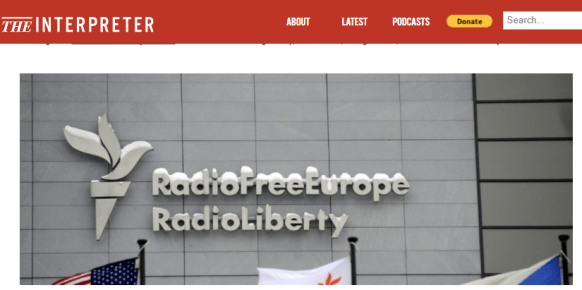
On January 1, 2016, the  Interpreter became a special project of RFE/RL and under the oversight of the BBG. The Secretary of State had a seat on the board of the BBG until December 2016. Why the change?

During the 2016 election, the BBG developed a major conflict of interest. At least two BBG board members worked actively for the Hillary Clinton presidential campaign. These government officials were working against the president-elect after the election. It looks like it didn’t go unnoticed. In the following linked article, it shows that they should be investigated for their part in an attempted coup.

From a Nov 7, 2016, article– “Karen Kornbluh is helping refine and to get Hillary Clinton’s message out. ” All of them are names to watch if Clinton wins — and key jobs at the FCC and other federal agencies are up for grabs.”

According to her bio: Karen founded the New America Foundation’s Work and Family Program and is a senior fellow for Digital Policy at the Council on Foreign Relations. Karen has written extensively about technology policy, women, and family policy for The AtlanticThe New York Times and The Washington PostNew York Times columnist David Brooks cited her Democracy article “Families Valued,” focused on “juggler families” as one of the best magazine articles of 2006.

Michael Kempner is the founder, President and Chief Executive Officer of MWW Group, a staunch Hillary Clinton supporter, and may get a greater role if she is elected.  Kempner is a member of the Public Relations Hall of Fame. Michael Kempner hired Anthony Weiner after the sexting scandal broke in 2011.

Jeff Shell, chairman of the BBG and  Universal Filmed Entertainment is supporting a secondary role by being an honor roll donor to the Atlantic Council. While the BBG is supposed to be neutral it has continuously helped increase tensions in Eastern Europe. While giving to the Atlantic Council may not be illegal while in his position, currently, the Atlantic Council’s main effort is to ignite a war with Russia. This may set up a major conflict of interest.

According to journalist Robert Parry “The people that will be taking senior positions and especially in foreign policy believe “This consensus is driven by a broad-based backlash against a president who has repeatedly stressed the dangers of overreach and the need for restraint, especially in the Middle East.”

Parry goes on to say that at the forefront of this is the Atlantic Council, a think tank associated with NATO. Their main goal is a major confrontation with nuclear-armed Russia.”

So, to make sense of all this, most of the people listed would have held cabinet positions in a Hillary Clinton presidency. If the Interpreter is a project of RFE/RL then the decision to go ahead with Propornot would have to go across their desk. That includes then Sec of State, John Kerry.

The unasked question of why would a US Government Agency do this (?) needs to be addressed. All the people listed above were actively working for Clinton to get her elected and throw Donald Trump’s campaign off the rails.

After the election, they were going to take care of Clinton’s “deplorables” by dissecting alternative media. I wrote about this before the election and I warned several major new sites what they could expect. I was right on the money. After she lost, it was already in motion. The deplorable media didn’t fall into a particular political pattern other than they did not promote Hillary Clinton.

The purpose of Propornot has been to get people to demand freedom of speech be rolled back. This was/is to be done by destroying fact-based media. If you read further, the entire plan is laid out starting from 2015 when it started coming together.

These people want reality shaped on what the perceived majority (louder) group believes to be true, regardless of what the facts are. Perception based reality is only a Facebook like away from killing one person or elevating another to hero status regardless of what they have done.

That little statement about the free speech rally says it all. It’s something that would hardly be noticed unless you were looking for it because it is part of the meta-data.

Now you can say it’s only a sentence and who cares? Nobody communicates through metadata do they? Wasn’t that what Propornot was all about? Yes, they do communicate through metadata. That’s why I look at it.

Do you see it? No? Look again. There in the metadata, at the bottom of the image is an ad for a job. Go for it and remember to mention the header. It could just as easily be hacking instructions, or a do not disturb sign. That’s why it pays to really research carefully.

The Boston ‘Free Speech’ Rally was billed by the social networks and MSM as a fascist rally. It was really a Free Speech Rally. What they learned is that with just a little nudge, they can make you demand nationalist repression. Nice going Boston!

Hey, is this starting to sound a little conspiratorial? If it is, we need ruskie hackers with Guy Fawkes masks to make this work. They have to admit to changing international politics through hacking in 2016, belong to a foreign country, code in Russian, and use spear phishing techniques to lure people in. Let’s not forget that they also have to work for some form of Intelligence.

Most importantly, they have to work with and influence all of the people above. They will definitely impact US foreign policy toward Russia. Let’s raise the stakes even more. The hackers have to answer to whoever is funding a lot of the illegal and immoral activities.
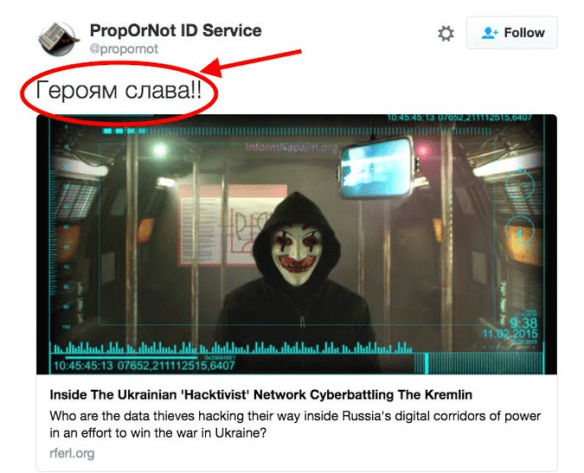
They are not even savvy enough to stay clear of outing each other. This is the Pravy Sektor hacker RUH8.  The common thread for these hackers is clear if you read the linked material on the profiles that make up these organizations. They work for Bellingcat, Informnapalm, the Atlantic Council, Ukrainian Intel, and the Diaspora.

In a follow-up article, I have reason to ask if they were given access to United States Government Top Secret Secure Servers. I’m not kidding.

In a Euromaidan Press article dated November 2nd, 2016, the hackers state enthusiastically “Ukrainian hackers have a rather high level of work. So the help of the USA… I don’t know, why would we need it? We have all the talent and special means for this. And I don’t think that the USA or any NATO country would make such sharp movements in international politics.”

And we have a winner. In 2016 the sharp movement in international politics was caused by…survey says….hacking!!!!

According to Donna Brazille, the Democratic Party servers were hacked multiple times and the hacking didn’t stop until December 2016. At this juncture, we should be able to agree that Seth Rich leaked the information to Wikileaks. But, now we are talking about other hacks. In the above linked article, these hacker specifically say their favorite route is spear phishing email accounts.

In the article, you’ll also see they work directly for Ukrainian Intel. Bellingcat works directly for Ukrainian Intel and works with them and the Atlantic Council. Stopfake is a product of Irena Chalupa who works for RFE/RL, the Atlantic Council and the Ukrainian government. Stopfake works directly with them and is a product of the Ukrainian government. Crowdstrike has an ongoing relationship with Ukrainian Intel and these particular hackers. Crowdstrike conjured up Fancy Bear. Well say, hello to the real fancy bear of 2016 (*fancybear is technically a set of tools and not people).

This means that former Secretary of State John Kerry approved of Ukrainian Intelligence hackers having access to servers inside a US Government Agency because of Propornot and the Atlantic Councils reliance on the hackers.

How are the Ukrainian hackers tied into Propornot at any level? James Miller isn’t shy about using their work. Propornot relies on the work of the Atlantic Council, Aric Toler, Aaron Weisburd, Clint Watts, and Joel Harding. The Ukrainian hackers work directly with InformNapalm and are the go-to resource for most of the people involved and all of the people just named.

Below we have assessed the details of the reports from InformNapalm, and have expanded on their investigation. — James Miller

Americans are attacking Americans for a foreign country for what amounts to pennies. We’ll deal with them again soon.

Who does the Atlantic Council work for? It’s the same people that staff RFE/RL.

“On 29 January 2016 in Washington, U.S.A., Ukrainian World Congress (UWC) President Eugene Czolij and Atlantic Council President and CEO Frederick Kempe officially signed a Memorandum of Agreement to renew the cooperation between the UWC and the Atlantic Council, that began in September 2014.

In accordance with this Memorandum, the UWC will continue its cooperation with the Atlantic Council on implementing the “Ukraine in Europe Initiative”, which aims to galvanize international support for an independent, sovereign and territorially integral Ukraine, including Crimea. This initiative is also intended to support reforms in Ukraine and its EuroAtlantic integration, and to counter Russian disinformation.”

This one little paragraph spells out clearly what I have shown in detail throughout this article.

The Ukrainian World Congress is represented in the US Congress by the Ukrainian Caucus headed up by ISIS supporter and Nazi cheerleader Marcy Kaptur. Her Ukrainian Caucus represents people  with political positions that scared Adolf Hitler in WWII.

The obvious takeaway is that a lawsuit is a bare minimum that needs to happen. People need to be investigated for crimes against the state. When we take a closer look at who had potential access to top-secret servers, that will become painfully obvious.

These people have tried and are trying to rip the fabric of society in pieces. At the very least, they have earned a good tarring…and feathering. When you look at the financial end of this a lawsuit in the billions would barely touch it.

Just one company the Ukrainian Diaspora started for this is valued over 100 million dollars. This will need to be a class action suit with a cease and desist to the BBG.

In early 2015, almost 2 years before most people took the idea of censorship seriously, I documented its inception. In the same way, it happens with many of the biggest stories of our times, I stumbled onto it by accident.

In early March 2015, Ukrainian Information Policy designer Joel Harding laid out what to expect going forward in the following statements: “In military IIO operations center on the ability to influence foreign audiences, US, and global audiences, and adversely affect enemy decision making through an integrated approach. Even current event news is released in this fashion. Each portal is given messages that follow the same themes because it is an across the board mainstream effort that fills the information space entirely when it is working correctly.

The purpose of “Inform and Influence Operations”  is not to provide a perspective, opinion, or lay out a policy. It is defined as the ability to make audiences “think and act” in a manner favorable to the mission objectives. This is done through applying perception management techniques which target the audiences emotions, motives, and reasoning.

These techniques are not geared for debate. It is to overwhelm and change the target psyche.

Using these techniques information sources can be manipulated and those that write, speak, or think counter to the objective are relegated as propaganda, ill-informed, or irrelevant.”- Harding

While the above sounds gloriously overoptimistic, Harding, along with his little band of Kremlin Troll hunters personally started developing the idea of organizations capable of blackballing journalists and publications in a way that could not be construed as censorship.

From another March 2015 articleA “Disinformation Charter” for Media and BloggersTop-down censorship should be avoided. But rival media, from Al-Jazeera to the BBC, Fox and beyond, need to get together to create a charter of acceptable and unacceptable behavior. Vigorous debate and disagreement qre ,of course, to be encouraged—but media organizations that practice conscious deception should be excluded from the community. A similar code can be accepted by bloggers and other online influencers.

This “Disinformation Charter” for responsible behavior (Ministry of Truth?) he describes is to fight “conscious deception” can only be weighed against how he describes Propaganda. “The word is frequently used to describe any news emerging one’s opponent.”– Harding

Journalists that need to be excluded are those “our side” label as propagandists or active measure agents.”

Harding’s connections in media are very large. Through his friend Mathew Armstrong, Harding had access to and the ear of the board of the Broadcasting Board of Governors (BBG). The BBG board is staffed by the who’s who of network and radio broadcast, print media and shortwave CEO’s and heavy hitters. They are behind RFE/RL (Radio Free Europe/ Radio Liberty).

On the other end of this in 2015, Joel Harding was assembling a group of miscreants to attack the social networks of different journalist and publications. The crude logic behind a direct assault was that by developing, training, and overseeing vast troll networks they could speak over their opposition (people that their employers wanted to be silenced) and subdue dissident online conversation and control the information.

Where this wasn’t feasible, they set up hack and harass attacks at various publication to get them to stop publishing hard-hitting journalists. This still hasn’t been effective because it caused publishers to dig in and harden their internet properties instead.

The softer more indirect approach Harding pushed in March 2015 quickly developed into the unified media strategy he wanted for the US and Europe. Control the information and don’t allow contradicting information or news into the media stream. When it does get in, call it propaganda.

Enter Propornot.

 

‘Corruption’ as a Propaganda Weapon

By Robert Parry

Source: Consortium News

Sadly, some important duties of journalism, such as applying evenhanded standards on human rights abuses and financial corruption, have been so corrupted by the demands of government propaganda – and the careerism of too many writers – that I now become suspicious whenever the mainstream media trumpets some sensational story aimed at some “designated villain.”

Far too often, this sort of “journalism” is just a forerunner to the next “regime change” scheme, dirtying up or delegitimizing a foreign leader before the inevitable advent of a “color revolution” organized by “democracy-promoting” NGOs often with money from the U.S. government’s National Endowment for Democracy or some neoliberal financier like George Soros.

We are now seeing what looks like a new preparatory phase for the next round of “regime changes” with corruption allegations aimed at former Brazilian President Luiz Ignacio Lula da Silva and Russian President Vladimir Putin. The new anti-Putin allegations – ballyhooed by the UK Guardian and other outlets – are particularly noteworthy because the so-called “Panama Papers” that supposedly implicate him in offshore financial dealings never mention his name.

Or as the Guardian writes:Though the president’s name does not appear in any of the records, the data reveals a pattern – his friends have earned millions from deals that seemingly could not have been secured without his patronage. The documents suggest Putin’s family has benefited from this money – his friends’ fortunes appear his to spend.”

Note, if you will, the lack of specificity and the reliance on speculation: “a pattern”; “seemingly”; “suggest”; “appear.” Indeed, if Putin were not already a demonized figure in the Western media, such phrasing would never pass an editor’s computer screen. Indeed, the only point made in declarative phrasing is that “the president’s name does not appear in any of the records.”

A British media-watch publication, the Off-Guardian, which criticizes much of the work done at The Guardian, headlined its article on the Putin piece as “the Panama Papers cause Guardian to collapse into self-parody.”

But whatever the truth about Putin’s “corruption” or Lula’s, the journalistic point is that the notion of objectivity has long since been cast aside in favor of what’s useful as propaganda for Western interests.

Some of those Western interests now are worried about the growth of the BRICS economic system – Brazil, Russia, India, China and South Africa – as a competitor to the West’s G-7 and the International Monetary Fund. After all, control of the global financial system has been central to American power in the post-World War II world – and rivals to the West’s monopoly are not welcome.

What the built-in bias against these and other “unfriendly” governments means, in practical terms, is that one standard applies to a Russia or a Brazil, while a more forgiving measure is applied to the corruption of a U.S. or European leader.

Take, for instance, former Secretary of State Hillary Clinton’s millions of dollars in payments in speaking fees from wealthy special interests that knew she was a good bet to become the next U.S. president. [See Consortiumnews.com’s “Clinton Stalls on Goldman-Sachs Speeches.”]

Or, similarly, the millions upon millions of dollars invested in super-PACS for Clinton, Sen. Ted Cruz and other presidential hopefuls. That might look like corruption from an objective standard but is treated as just a distasteful aspect of the U.S. political process.

But imagine for a minute if Putin had been paid millions of dollars for brief speeches before powerful corporations, banks and interest groups doing business with the Kremlin. That would be held up as de facto proof of his illicit greed and corruption.

Losing Perspective

Also, when it’s a demonized foreign leader, any “corruption” will do, however minor. For example, in the 1980s, President Ronald Reagan’s denounced Nicaraguan President Daniel Ortega for his choice of eyewear: “The dictator in designer glasses,” declared Reagan, even as Nancy Reagan was accepting free designer gowns and free renovations of the White House funded by oil and gas interests.

Or, the “corruption” for a demonized leader can be a modest luxury, such as Ukrainian President Viktor Yanukovych’s “sauna” in his personal residence, a topic that got front-page treatment in The New York Times and other Western publications seeking to justify the violent coup that drove Yanukovych from office in February 2014.

Incidentally, both Ortega and Yanukovych had been popularly elected but were still targeted by the U.S. government and its operatives with violent destabilization campaigns. In the 1980s, the CIA-organized Nicaraguan Contra war killed some 30,000 people, while the U.S.-orchestrated “regime change” in Ukraine sparked a civil war that has left some 10,000 people dead. Of course, in both cases, Official Washington blamed Moscow for all the trouble.

In both cases, too, the politicians and operatives who gained power as a result of the conflicts were arguably more corrupt than the Nicaraguan Sandinistas or Yanukovych’s government. The Nicaraguan Contras, whose violence helped pave the way for the 1990 election of U.S.-backed candidate Violeta Chamorro, were deeply implicated in cocaine trafficking. [See Consortiumnews.com’s “The Sordid Contra-Cocaine Saga.”]

Today, the U.S.-supported Ukrainian government is wallowing in corruption so deep that it has provoked a new political crisis.[See Consortiumnews’com’s “Reality Peeks Through in Ukraine.”]

Ironically, one of the politicians actually named in the Panama Papers for having established a shadowy offshore account is the U.S.-backed Ukrainian President Petro Poroshenko, although he got decidedly second-billing to the unnamed Putin. (Poroshenko denied there was anything improper in his offshore financial arrangements.)

Double Standards

Mainstream Western journalism no longer even tries to apply common standards to questions about corruption. If you’re a favored government, there might be lamentations about the need for more “reform” – which often means slashing pensions for the elderly and cutting social programs for the poor – but if you’re a demonized leader, then the only permissible answer is criminal indictment and/or “regime change.”

One stark example of these double standards is the see-no-evil attitude toward the corruption of Ukraine’s Finance Minister Natalie Jaresko, who is touted endlessly in the Western media as the paragon of Ukrainian good governance and reform. The documented reality, however, is that Jaresko enriched herself through her control of a U.S.-taxpayer-financed investment fund that was supposed to help the people of Ukraine build their economy.

According to the terms of the $150 million investment fund created by the U.S. Agency for International Development (USAID), Jaresko’s compensation was supposed to be capped at $150,000 a year, a pay package that many Americans would envy. But it was not enough for Jaresko, who first simply exceeded the limit by hundreds of thousands of dollars and then moved her compensation off-books as she amassed total annual pay of $2 million or more.

The documentation of this scheming is clear. I have published multiple stories citing the evidence of both her excessive compensation and her legal strategies for covering up evidence of alleged wrongdoing. [See Consortiumnews.com’s “How Ukraine’s Finance Minister Got Rich” and “Carpetbagging Crony Capitalism in Ukraine.”]

Despite the evidence, not a single mainstream Western news outlet has followed up on this information even as Jaresko is hailed as a “reform” candidate for Ukrainian prime minister.

This disinterest is similar to the blinders that The New York Times and other major Western newspapers put on when they were assessing whether Ukrainian President Yanukovych was ousted in a coup in February 2014 or just wandered off and forgot to return.

In a major “investigative” piece, the Times concluded there was no coup in Ukraine while ignoring the evidence of a coup, such as the intercepted phone call between U.S. Assistant Secretary of State for European Affairs Victoria Nuland and U.S. Ambassador to Ukraine Geoffrey Pyatt discussing who they would put into power. “Yats is the guy,” said Nuland – and surprise, surprise, Arseniy Yatsenyuk ended up as prime minister.

The Times also ignored the observation of George Friedman, president of the global intelligence firm Stratfor, who noted that the Ukraine coup was “the most blatant coup in history.” [See Consortiumnews.com’s “NYT Still Pretends No Coup in Ukraine.”]

The Propaganda Weapon

The other advantage of “corruption” as a propaganda weapon to discredit certain leaders is that we all assume that there is plenty of corruption in governments as well as in the private sector all around the world. Alleging corruption is like shooting large fish crowded into a small barrel. Granted, some barrels might be more crowded than others but the real decision is whose barrel you choose.

That’s part of the reason why the U.S. government has spread around hundreds of millions of dollars to finance “journalism” organizations, train political activists and support “non-governmental organizations” that promote U.S. policy goals inside targeted countries. For instance, before the Feb. 22, 2014 coup in Ukraine, there were scores of such operations in the country financed by the National Endowment for Democracy (NED), whose budget from Congress exceeds $100 million a year.

But NED, which has been run by neocon Carl Gershman since its founding in 1983, is only part of the picture. You have other propaganda fronts operating under the umbrella of the State Department and USAID. Last year, USAID issued a fact sheet summarizing its work financing friendly journalists around the globe, including “journalism education, media business development, capacity building for supportive institutions, and strengthening legal-regulatory environments for free media.”

USAID estimated its budget for “media strengthening programs in over 30 countries” at $40 million annually, including aiding “independent media organizations and bloggers in over a dozen countries,” In Ukraine before the coup, USAID offered training in “mobile phone and website security,” which sounds a bit like an operation to thwart the local government’s intelligence gathering, an ironic position for the U.S. with its surveillance obsession, including prosecuting whistleblowers based on evidence that they talked to journalists.

USAID, working with billionaire George Soros’s Open Society, also funds the Organized Crime and Corruption Reporting Project, which engages in “investigative journalism” that usually goes after governments that have fallen into disfavor with the United States and then are singled out for accusations of corruption. The USAID-funded OCCRP also collaborates with Bellingcat, an online investigative website founded by blogger Eliot Higgins.

Higgins has spread misinformation on the Internet, including discredited claims implicating the Syrian government in the sarin attack in 2013 and directing an Australian TV news crew to what looked to be the wrong location for a video of a BUK anti-aircraft battery as it supposedly made its getaway to Russia after the shoot-down of Malaysia Airlines Flight 17 in July 2014.

Despite his dubious record of accuracy, Higgins has gained mainstream acclaim, in part, because his “findings” always match up with the propaganda theme that the U.S. government and its Western allies are peddling. Though most genuinely independent bloggers are ignored by the mainstream media, Higgins has found his work touted by both The New York Times and The Washington Post.

In other words, the U.S. government has a robust strategy for deploying direct and indirect agents of influence. Indeed, during the first Cold War, the CIA and the old U.S. Information Agency refined the art of “information warfare,” including pioneering some of its current features like having ostensibly “independent” entities and cut-outs present U.S. propaganda to a cynical public that would reject much of what it hears from government but may trust “citizen journalists” and “bloggers.”

But the larger danger from this perversion of journalism is that it sets the stage for “regime changes” that destabilize whole countries, thwart real democracy (i.e., the will of the people), and engender civil warfare. Today’s neoconservative dream of mounting a “regime change” in Moscow is particularly dangerous to the future of both Russia and the world.

Regardless of what you think about President Putin, he is a rational political leader whose legendary sangfroid makes him someone who is not prone to emotional decisions. His leadership style also appeals to the Russian people who overwhelmingly favor him, according to public opinion polls.

While the American neocons may fantasize that they can generate enough economic pain and political dissension inside Russia to achieve Putin’s removal, their expectation that he will be followed by a pliable leader like the late President Boris Yeltsin, who will let U.S. operatives back in to resume plundering Russia’s riches, is almost certainly a fantasy.

The far more likely possibility is that – if a “regime change” could somehow be arranged – Putin would be replaced by a hard-line nationalist who might think seriously about unleashing Russia’s nuclear arsenal if the West again tries to defile Mother Russia. For me, it’s not Putin who’s the worry; it’s the guy after Putin.

So, while legitimate questions about Putin’s “corruption” – or that of any other political leader – should be pursued, the standards of evidence should not be lowered just because he or anyone else is a demonized figure in the West. There should be single not double standards.

Western media outrage about “corruption” should be expressed as loudly against political and business leaders in the U.S. or other G-7 countries as it is toward those in the BRICS.


Investigative reporter Robert Parry broke many of the Iran-Contra stories for The Associated Press and Newsweek in the 1980s. You can buy his latest book, America’s Stolen Narrative, either in print here or as an e-book (from Amazon and barnesandnoble.com).

Related Video: