Corporate Power: Who Owns the World?

By Dr. Joseph Mercola

Source: The Herland Report

Who Owns the World? A handful of mega corporations — private investment companies — dominate every aspect of our lives; everything we eat, drink, wear or use in one way or another.

These investment firms are so enormous, they control the money flow worldwide.

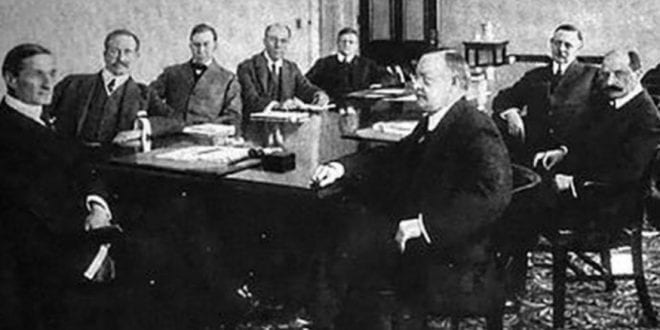
While there appear to be hundreds of competing brands on the market, like Russian nesting dolls, larger parent companies own multiple smaller brands. In reality, all packaged food brands, for example, are owned by a dozen or so larger parent companies. (Feature photo: A rare photo of The Federal Reserve Board of Governors)

These parent companies, in turn, are owned by shareholders, and the largest shareholders are the same in all of them: Vanguard and Blackrock, writes Dr. Joseph Mercola, osteopathic physician, best-selling author and recipient of multiple awards in the field of natural health.

No matter what industry you look at, the top shareholders, and therefore decision makers, are the same: Vanguard, Blackrock, State Street and/or Berkshire Hathaway. In virtually every major company, you find these names among the top 10 institutional investors.

These major investment firms are in turn owned by their own set of shareholders. One of the most amazing things about this scheme is that the institutional investors also own each other.

They’re all shareholders in each other’s companies. At the very top are Vanguard and Blackrock. Blackrock’s largest shareholder is Vanguard, which does not disclose the identity of its shareholders due to its unique structure.

To understand what’s really going on, watch Tim Gielen’s hour-long documentary, “MONOPOLY: Who Owns the World?”

Who Owns the World? Until recently, it appeared economic competition had been driving the rise and fall of small and large companies across the U.S. Supposedly, PepsiCo is Coca Cola’s competitor, Apple and Android vie for your loyalty and drug companies battle for your health care dollars. However, all of that turns out to be an illusion.

Since the mid-1970s, two corporations — Vanguard and Blackrock — have gobbled up most companies in the world, effectively destroying the competitive market on which America’s strength has rested, leaving only false appearances behind.

Indeed, the global economy may be the greatest illusionary trick ever pulled over the eyes of people around the world. To understand what’s really going on, watch Tim Gielen’s hour-long documentary, “MONOPOLY: Who Owns the World?” above.

Corporate Domination

Who Owns the World? As noted by Gielen, who narrates the film, a handful of mega corporations — private investment companies — dominate every aspect of our lives; everything we eat, drink, wear or use in one way or another. These investment firms are so enormous, they control the money flow worldwide. So, how does this scheme work?

While there appear to be hundreds of competing brands on the market, like Russian nesting dolls, larger parent companies own multiple smaller brands. In reality, all packaged food brands, for example, are owned by a dozen or so larger parent companies.

Pepsi Co. owns a long list of food, beverage and snack brands, as does Coca-Cola, Nestle, General Mills, Kellogg’s, Unilever, Mars, Kraft Heinz, Mondelez, Danone and Associated British Foods. Together, these parent companies monopolize the packaged food industry, as virtually every food brand available belongs to one of them.

These companies are publicly traded and are run by boards, where the largest shareholders have power over the decision making. This is where it gets interesting, because when you look up who the largest shareholders are, you find yet another monopoly.

While the topmost shareholders can change from time to time, based on shares bought and sold, two companies are consistently listed among the top institutional holders of these parent companies: The Vanguard Group Inc. and Blackrock Inc.

Pepsi and Coca-Cola — An Example

Who Owns the World? For example, while there are more than 3,000 shareholders in Pepsi Co., Vanguard and Blackrock’s holdings account for nearly one-third of all shares. Of the top 10 shareholders in Pepsi Co., the top three, Vanguard, Blackrock and State Street Corporation, own more shares than the remaining seven.

Now, let’s look at Coca-Cola Co., Pepsi’s top competitor. Who owns Coke? As with Pepsi, the majority of the company shares are held by institutional investors, which number 3,155 (as of the making of the documentary).

As shown in the film, three of the top four institutional shareholders of Coca-Cola are identical with that of Pepsi: Vanguard, Blackrock and State Street Corporation. The No. 1 shareholder of Coca-Cola is Berkshire Hathaway Inc.

These four — Vanguard, Blackrock, State Street and Berkshire Hathaway — are the four largest investment firms on the planet. “So, Pepsi and Coca-Cola are anything but competitors,” Gielen says. And the same goes for the other packaged food companies. All are owned by the same small group of institutional shareholders.

Big Tech Monopoly

Who Owns the World? The monopoly of these investment firms isn’t relegated to the packaged food industry. You find them dominating virtually all other industries as well. Take Big Tech, for example. Among the top 10 largest tech companies we find Apple, Samsung, Alphabet (parent company of Google), Microsoft, Huawei, Dell, IBM and Sony.

Here, we find the same Russian nesting doll setup. For example, Facebook owns Whatsapp and Instagram. Alphabet owns Google and all Google-related businesses, including YouTube and Gmail.

It’s also the biggest developer of Android, the main competitor to Apple. Microsoft owns Windows and Xbox. In all, four parent companies produce the software used by virtually all computers, tablets and smartphones in the world. Who, then, owns them? Here’s a sampling:

  • Facebook — More than 80% of Facebook shares are held by institutional investors, and the top institutional holders are the same as those found in the food industry: Vanguard and Blackrock being the top two, as of the end of March 2021. State Street Corporation is the fifth biggest shareholder
  • Apple — The top four institutional investors are Vanguard, Blackrock, Berkshire Hathaway and State Street Corporation
  • Microsoft — The top three institutional shareholders are Vanguard, Blackrock and State Street Corporation

You can continue going through the list of tech brands — companies that build computers, smart phones, electronics and household appliances — and you’ll repeatedly find Vanguard, Blackrock, Berkshire Hathaway and State Street Corporation among the top shareholders.
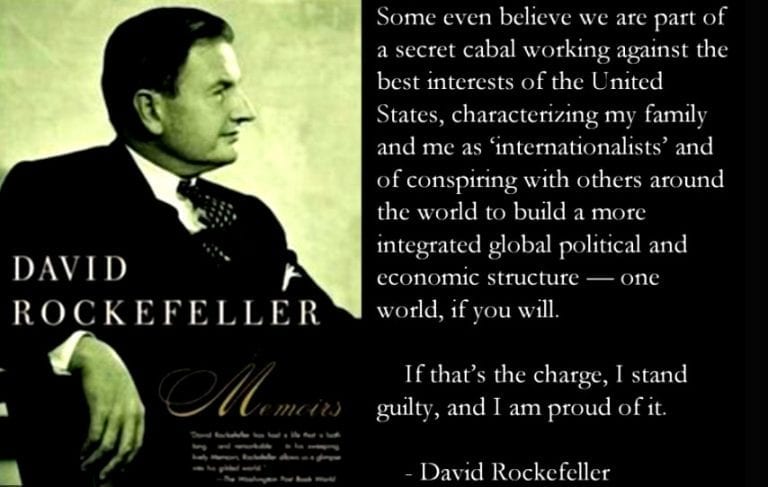
Who Owns the World? A famous David Rockefeller quote, the dream of a global political and economic structure – one world.

Same Small Group Owns Everything Else Too

Who Owns the World? The same ownership trend exists in all other industries. Gielen offers yet another example to prove this statement is not an exaggeration:

“Let’s say we want to plan a vacation. On our computer or smart phone, we look for a cheap flight to the sun through websites like Skyscanner and Expedia, both of which are owned by the same group of institutional investors [Vanguard, Blackrock and State Street Corporation].

We fly with one of the many airlines [American Airlines, Air France, KLM, United Airlines, Delta and Transavia] of which the majority of the shares are often owned by the same investors …

The airline we fly [on] is in most cases a Boeing or an Airbus. Again, we see the same [institutional shareholders]. We look for a hotel or an apartment through Bookings.com or AirBnB.com. Once we arrive at our destination, we go out to dinner and we write a review on Trip Advisor. The same investors are at the basis of every aspect of our journey.

And their power goes even much further, because even the kerosene that fuels the plane comes from one of their many oil companies and refineries. Just like the steel that the plane is made of comes from one of their many mining companies.

This small club of investment companies, banks and mutual funds, are also the largest shareholders in the primary industries, where our raw materials come from.”

The same goes for the agricultural industry that the global food industry depends on, and any other major industry. These institutional investors own Bayer, the world’s largest seed producer; they own the largest textile manufacturers and many of the largest clothing companies.

They own the oil refineries, the largest solar panel producers and the automobile, aircraft and arms industries. They own all the major tobacco companies, and all the major drug companies and scientific institutes too. They also own the big department stores and the online marketplaces like eBay, Amazon and AliExpress.

They even own the payment methods we use, from credit card companies to digital payment platforms, as well as insurance companies, banks, construction companies, telephone companies, restaurant chains, personal care brands and cosmetic brands.

No matter what industry you look at, the top shareholders, and therefore decision makers, are the same: Vanguard, Blackrock, State Street and/or Berkshire Hathaway. In virtually every major company, you find these names among the top 10 institutional investors.

Who Owns the Investment Firms of the World?

Who Owns the World? Diving deeper, we find that these major investment firms are in turn owned by their own set of shareholders. One of the most amazing things about this scheme is that the institutional investors — and there are many more than the primary four we’ve focused on here — also own each other. They’re all shareholders in each other’s companies.At the top of the pyramid — the largest Russian doll of all — we find Vanguard and Blackrock.

“Together, they form an immense network that we can compare to a pyramid,” Gielen says. Smaller institutional investors, such as Citibank, ING and T. Rowe Price, are owned by larger investment firms such as Northern Trust, Capital Group, 3G Capital and KKR.

Those investors in turn are owned by even larger investment firms, like Goldman Sachs and Wellington Market, which are owned by larger firms yet, such as Berkshire Hathaway and State Street. At the top of the pyramid — the largest Russian doll of all — we find Vanguard and Blackrock.

“The power of these two companies is something we can barely imagine,” Gielen says. “Not only are they the largest institutional investors of every major company on earth, they also own the other institutional investors of those companies, giving them a complete monopoly.”

Gielen cites data from Bloomberg, showing that by 2028, Vanguard and BlackRock are expected to collectively manage $20 trillion-worth of investments. In the process, they will own almost everything on planet Earth.

BlackRock — The Fourth Branch of Government

Who Owns the World? Bloomberg has also referred to BlackRock as the “fourth branch of government,” due to its close relationship with the central banks. BlackRock actually lends money to the central bank, the federal reserve, and is their principal adviser.

Dozens of BlackRock employees have held senior positions in the White House under the Bush, Obama and Biden administrations. BlackRock also developed the computer system that the central banks use.

While Larry Fink is the figurehead of BlackRock, being its founder, chairman and chief executive officer, he’s not the sole decision maker, as BlackRock too is owned by shareholders. Here we find yet another curiosity, as the largest shareholder of BlackRock is Vanguard.

Who Owns the World? “This is where it gets dark,” Gielen says. Vanguard has a unique structure that blocks us from seeing who the actual shareholders are. “The elite who own Vanguard don’t want anyone to know they are the owners of the most powerful company on earth.” Still, if you dig deep enough, you can find clues as to who these owners are.

The owners of the wealthiest, most powerful company on Earth can be expected to be among the wealthiest individuals on earth. In 2016, Oxfam reported that the combined wealth of the richest 1% in the world was equal to the wealth of the remaining 99%. In 2018, it was reported that the world’s richest people get 82% of all the money earned around the world in 2017.

In reality, we can assume that the owners of Vanguard are among the 0.001% richest people on the planet. According to Forbes, there were 2,075 billionaires in the world as of March 2020. Gielen cites Oxfam data showing that two-thirds of billionaires obtained their fortunes via inheritance, monopoly and/or cronyism.

“This means that Vanguard is in the hands of the richest families on earth,” Gielen says. Among them we find the Rothschilds, the DuPont family, the Rockefellers, the Bush family and the Morgan family, just to name a few.

Many belong to royal bloodlines and are the founders of our central banking system, the United Nations and just about every industry on the planet.

Gielen goes even further in his documentary, so I highly recommend watching it in its entirety. I’ve only summarized a small piece of the whole film here.

A Financial Coup D’etat

Speaking of the central bankers, I recently interviewed finance guru Catherine Austin Fitts, and she believes it’s the central bankers that are at the heart of the global takeover we’re currently seeing. She also believes they are the ones pressuring private companies to implement the clearly illegal COVID jab mandates. Their control is so great, few companies have the ability to take a stand against them.

“I think [the central bankers] are really depending on the smart grid and creepy technology to help them go to the last steps of financial control, which is what I think they’re pushing for,” she said.

“What we’ve seen is a tremendous effort to bankrupt the population and the governments so that it’s much easier for the central bankers to take control. That’s what I’ve been writing about since 1998, that this is a financial coup d’etat.

Now the financial coup d’etat is being consolidated, where the central bankers just serve jurisdiction over the treasury and the tax money. And if they can get the [vaccine] passports in with the CBDC [central bank digital currency], then it will be able to take taxes out of our accounts and take our assets. So, this is a real coup d’etat.”

A Case of Graphical Correlations: Making Sense of India’s COVID-19 Surge

By Mathew Maavak

Source: Activist Post

India is currently witnessing a COVID-19 surge of unprecedented proportions, with an allegedly triple-mutant strain stretching the nation’s healthcare infrastructure to the limits.  The uncertainty hanging over the nation is compounded by viral despatches of dead bodies piling up in morgues; of people dropping dead in the streets; of despondent souls jumping off their balconies; and of funeral pyres all over the country. There will be no public service-minded Big Tech censorship in this instance.

This is supposedly Wuhan 2.0. Any social media addict would be forgiven for thinking that India’s population of 1.3 billion might suffer a dip before the year is out.

Amidst the toxic miasma of fear-mongering, coherent explanations over this surge are hard to come by. Therefore, one needs to resort to correlations and proxies in order to gauge causations and effects. For starters, one should compare the yearly death tolls (from all causes) before and after the advent of COVID-19 in India, particularly for the year 2021. But relevant data will only be available a year from now. Many will die as a result of continued lockdowns which generally weaken the immune system. Essential medical procedures will be deferred as hospitals are compelled to focus on COVID-19.  Rising socioeconomic despair will naturally lead to a surge in suicides. In the end, not all coronavirus deaths can be directly attributed to the virus no matter how “experts” add them up.

Other correlations must also be explored in the Indian context. India was rather late in joining the mass vaccination bandwagon. Throughout 2020, its COVID-19 mortality figures were moderate by global standards due to the efficacy of low-cost treatment protocols. Hydroxychloroquine (HCQ) was sanctioned for early stage treatment from March 2020 onwards; while a few months later, India’s most populous state of Uttar Pradesh (population 231 million) replaced HCQ with ivermectin (an anti-parasitic drug).

The results were highly encouraging. As the TrialSiteNews (TSN) reported on Jan 9 2021:

By the end of 2020, Uttar Pradesh — which distributed free ivermectin for home care — had the second-lowest fatality rate in India at 0.26 per 100,000 residents in December. Only the state of Bihar, with 128 million residents, was lower, and it, too, recommends ivermectin.

Despite having the coronavirus situation under control, New Delhi was under immense pressure from various international lobbies and their local proxies to roll out a mass vaccination campaign. It can be argued that India’s ongoing oxygen shortages are the direct result of prioritizing foreign-curated experimental vaccines over local necessities.

While the initial mass vaccination launch was pencilled for Jan 16, the campaign effectively took off only in late February. With uncanny timing, the New York Times hailed India as an “unmatched vaccine manufacturing power” that could counter China in the area of vaccine diplomacy.

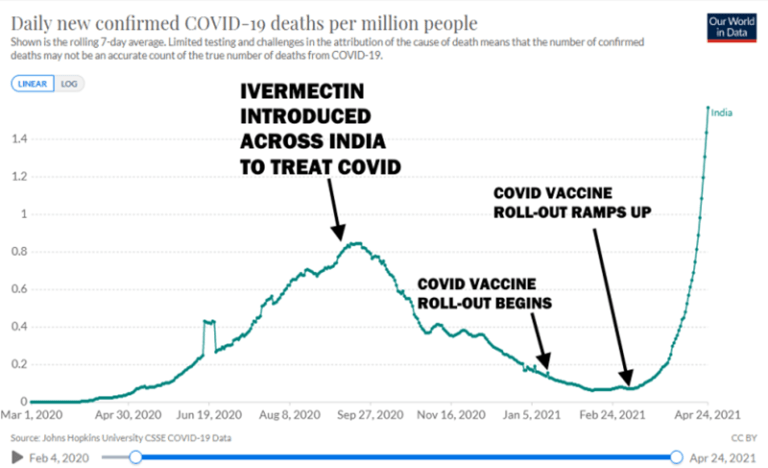
As the goal of vaccinating 300 million people by August 2021 neared the midway mark, however, the number of COVID-19 cases surged accordingly. The graph below broadly charts this anomaly.

Not only has India’s COVID-19 cases surged in tandem with increased vaccination, the trajectory of infections and inoculations can be neatly superimposed as the following graph suggests.

Can one infer that there may be a correlation between increased vaccinations and infections? This is not the first time that gene-based therapies ended up creating new viral chimeras. The World Health Organisation (WHO) recently admitted that a Bill & Melinda Gates Foundation (BMGF)-backed vaccine program was responsible for a new polio outbreak in Africa.  The usual suspects were also behind a vaccination-linked polio surge in Pakistan and Afghanistan.

Vaccines causing deadly outbreaks of the very diseases they are supposed to eradicate happen to be a 21st century phenomenon – brought to you by an unholy alliance of Big Tech and Big Pharma. In the process, new mutant strains or “vaccine-derived viruses” emerge, necessitating even more potent vaccines which deliver greater profits and levers of global control to Big Tech. This is how the Davos cabal tries to stay relevant in a century that should otherwise be dominated by Asia. India may end up being the first Asian victim of Big Tech’s Great Reset against the East.

A recent study by Tel Aviv University may shed further light on India’s bizarre surge. It seems those who have been vaccinated with the Pfizer-BioNTech vaccine are 8 times more likely to contract the new South African variant of COVID-19 than the unvaccinated.

The Covishield (Oxford University-AstraZeneca) and Covaxin (Bharat Biotech) vaccines used in India may have produced a similar effect. Dr. Harvey Risch, a professor of epidemiology at Yale University, has estimated that over 60 percent of all new COVID-19 cases seem to occur among the “vaccinated.” Dr Michael Yeadon, former vice president and chief science officer for Pfizer, fears a more alarming outcome which includes the possibility of “massive-scale depopulation”. These are not your average basement-dwelling conspiratorial kooks!

“The vaccine,” to paraphrase Francis Bacon, “is now appearing to be the worse than the disease itself.” Gene-based vaccines open up a Pandora’s Box of what systems theorists call “emergence”. The human body is a complex system that may react unpredictably to interferences at its most substrate (or genetic) levels. As a result, mutant virus strains may emerge alongside unforeseen side effects. This is what we are witnessing worldwide.

But as the virus mutates, so does the official narrative. The Indian Medical Association (IMA) now claims that mass vaccinations in densely-packed stadiums and halls are “superspreader” events. Is the IMA suggesting that new vaccine delivery systems, as lobbied by Big Tech, will solve this problem? Let us wait and see. Furthermore, is close proximity the prime culprit behind the super-surge in India? India is a nation where trains, buses and all forms of public spaces teem with human bodies. Yet, it did not lead to mass casualties in 2020 as many had feared.

In the absence of a watertight scientific explanation from mainstream gatekeepers, a more plausible narrative may be sought from peripheral sources. The Daily Expose offers one such graphic-laden narrative to explain the correlation between mass vaccinations and the rising death toll in India.

While the Daily Expose concedes that correlation does not always equal causation, a similar pattern was noticed in other nations. The vaccination-mortality graph for Mongolia, for example, is particularly eye-popping.

Did Mongolia witness a near-zero to mutant COVID-19 surge just when mass vaccinations rolled out? How coincidental can that be?

The Case of America: Red vs Blue States

One may scientifically argue that India’s surge had nothing to do with ramped-up vaccinations. A new mutant virus may also somehow explain the vaccination-mortality correlations in Mongolia.

Therefore one should resort to another layman-friendly proxy to see whether similar correlations exist elsewhere. How about a comparison within the most coronavirus-affected nation on earth – the United States of America?

Reports thus far suggest that US states which have been resisting mass vaccinations and/or mandatory masking, at least in relative terms, are generally faring better than those adhering to draconian COVID-19 guidelines. Just weeks after Texas lifted its public mask mandate – featuring full crowds at bars, restaurants and concerts  no less – COVID-19 cases as well as hospitalizations dropped to its lowest levels since October 2020. The current White House occupant, who continues to make a buzz over his mental acuity, nonetheless panned the move as a symptom of “Neanderthal thinking”.  In the meantime, South Dakota Governor Kristi Noem, a prominent opponent of mandatory masking, is using COVID-19 restrictions elsewhere to lure businesses to her state. Other red states such as Florida and Arizona have moved to ban the so-called vaccine passports.

Rather coincidentally, the annual flu has virtually disappeared in the United States since the onset of the pandemic. It must be a modern medical miracle!

How will India fare?

With the surge affecting the nation badly, the CEOs of Google, Microsoft and Apple, among others, have pledged heartfelt aid to India. With friends like these, one wonders why Indians cannot question the global COVID-19 narrative on Twitter, Facebook or YouTube without being summarily banned or censored. If India can concede the digital rights of its own citizens and the digital sovereignty of the nation to Big Tech, then how is it going to crowdsource solutions for COVID-19? Or deal with any other future crisis for that matter? An Indian scientific paper which tentatively explored a laboratory origin for COVID-19 can be summarily removed after concerted condemnation from Western academics but a similar claim made by the former head of the US Centers for Disease Control (CDC) appears relatively palatable. Isn’t this a textbook example of neoliberal racism?

Indians should also question why Africa has not been badly affected thus far, despite a South African variant hovering in the region. This is a continent mired in conflicts, poverty, serious healthcare deficits and other Third World-related woes. It lacks world-class scientists and institutions which India admittedly has. Is it because Africa does not pose an economic threat to the Western oligarchy the way Asia does? Or maybe, mass vaccinations haven’t yet taken off in Africa?

For the time being, India cannot reverse course on its vaccination drive and adopt measures similar to the one employed by the Eisenhower administration during the 1957-58 Asian Flu pandemic. The fear genie is already out of the bottle. Big Tech controls the digital narrative in India as it does elsewhere. Even if New Delhi manages to tame the COVID-19 crisis within the next few weeks or months, Big Tech will still be around to stifle India’s destiny.

Ultimately, this game is much bigger than COVID-19; it is about global domination through perennial mass-manufactured crises until a Great Reset is achieved.

The New Normal’s Religion of ‘Techno-Voodooism’ has Bewitched the World

If Covid-19 has been a boon for anyone, that would be Big Business and Big Tech – overblowing fears, widening the wealth gap and facilitating global control through all-powerful technology the world now depends on.

By Dr. Mathew Maavak

Source: Covert Geopolitics

What happens when systems cross the threshold of peak complexity and can no longer be improved in their current forms?

Decision-makers can commission competing models in order to pick a winner. This however calls for patience, prudence and sound oversight. Alternately, they can pounce on a fantastical blueprint that will supposedly gel via Artificial Intelligence and get to play monopoly at the same time. An all-in-one solution!

Such thinking was precisely what beleaguered the F-35 combat aircraft program with its estimated $1.7 trillion in lifetime costs. After 20 years of troubled development, the stealth fighter’s problems have become so insurmountable that there is talk in the US Air Force of considering a clean slate fighter jet program to replace its ageing F-16s.

The F-35 illustrates the other barely-analysed pandemic infecting our world – that of ‘technological voodooism’ (coined by the author for want of a better term).

Returns on investments these days are no longer measured by healthy profits generated by proven products. The devotees of techno-voodooism are essentially totalitarians who believe that not just markets, but the world itself, must be reorganized and monopolized by an enlightened few in a smart era called the Great Reset. The prime agency promoting this technopia is the World Economic Forum (WEF) which has promised a wonderful world where we will “own nothing” and yet “be happy.”

The outcome thus far has been societal meltdowns, malfunctioning jets in the skies and iRobot Roomba vacuums that meander aimlessly on the floor. The modern adage ‘if it ain’t broke, don’t fix it’ may have been lost on iRobot’s C-Suite executives. Roomba machines use artificial intelligence to scan room size, identify obstacles and remember the most efficient routes for cleaning.” But the quest for greater efficiency and profits at lesser costs – a process which Buckminster Fuller called ‘ephemeralization’ more than 80 years ago – has resulted in smart updates and berserk gadgets. Even after the vacuum is reset, IoT connectivity ensures that the robot is updated back to its state of regression.

Now, imagine the consequences of similar systems breakdowns worldwide? For starters, consider the point of singularity when robot chefs are updated with a new definition of what constitutes meat? A berserk Roomba machine can at least be switched off and plopped down as a paperweight. That is not an option for Boeing 737 MAX 8 planes which reportedly used artificial intelligence to bend aerodynamic laws on the cheap.

The string of Boeing disasters – as well as other failures mentioned thus far – has not deterred the merchants of techno-voodooism. Instead, every new crisis is seen as an opportunity for AI-mediated quick fixes and big profits. Remember Big Tech’s apocalyptic Covid-19 projections of the previous year?

Pseudosciences, based on the chimera of smart systems have been allowed to run amok, emboldening the WEF to claim that Covid-19 “lockdowns are quietly improving cities around the world.” Tell that to the tens of millions of small businesses who have lost their livelihoods to multinational corporations. Just how did cities improve with the archipelago of trash that piled up during lockdowns? What about the environmental impacts which happen to be a pet peeve of the WEF?

It is not just cities that have supposedly “improved” with Covid-19. Bill Gates is now the largest owner of farmland in the United States – coincidentally at a time when lockdowns have worsened food security and incomes among the poor. Logically, this great humanitarian could have matched his suite of predictive analytics software with owned farmland capacity to alleviate lockdown-induced hunger, but Gates is reportedly too busy promoting synthetic beef and vaccines.

The global ‘coronapsychosis’ has in fact accelerated wealth fractionation at the expense of the mid-to-low income classes. Just 655 people now own $4 trillion in wealth, while 200 million can’t cover a $1,000 expense in the United States alone. Imagine the sheer numbers of the impoverished worldwide, especially in nations bonded to the Anglo-American compact?

As for Covid-19 itself, inconvenient facts are routinely censored or shadow-banned by AI-powered social media platforms and search engines. Annual flu deaths in the US – which the British Medical Journal once questioned whether it was more PR than science – have surprisingly disappeared from official health statistics due to the pandemic.

Big Tech will not allow us to question the efficacy of vaccines developed in the West. After all, Artificial Intelligence has seemingly accelerated the development of vaccines that would have otherwise taken years or decades to research, test and deploy.

We should not ask why dozens of people (as of early February) had contracted a rare blood disorder after taking vaccines from Pfizer and Moderna. Or why there is an alarming number of deaths from Norway to Spain to the Netherlands post-vaccination? Or even how thousands of Israelis could test positive for Covid-19 despite receiving Pfizer/BioNTech jabs?

The Covid-19 vaccination figures in Israel are so alarming that two researchers have even called the fiasco “a new Holocaust.” Yet, the Israeli government wants local authorities to maintain a database of its vaccine refuseniks. (The Nazis, too, once maintained a meticulous database of “undesirables” in localities they were about to occupy, but that historical parallel is lost on today’s lamestream media).

Supine Governments

Techno-voodooism did not emerge in a vacuum. It thrived in tandem with ‘inclusivity’ and ‘sustainability’ programs which, in turn, handed the reins of power, scholarship and opinion-making to a horde of half-wits worldwide. This is one reason why governments, backed by spineless bureaucrats and academics, are increasingly surrendering national sovereignties to Big Tech.

One can imagine the quid pro quo: A post-retirement sinecure; jobs for children and relatives; and coding opportunities for trolls who push the Big Tech agenda. No wonder planes are falling from the skies and a raft of disasters await humanity throughout this decade.

Europe is an exemplar in this regard. Its leaders are now worried that Apple and Google may end up issuing Covid-19 health certificates before the union can reach a consensus. Isn’t that the job of sovereign governments with taxpayer-funded healthcare systems? But this trend is getting more sordid by the day.

Bureaucrats are falling over each other to gift vaccine roadmaps and distributions systems to Big Tech because their AI-driven systems can supposedly deliver optimal outcomes. They should just pick Bill Gates’ concept of using mosquitoes as airborne syringes. Call it a bang for the bite!

These shameless capitulations are not limited to the healthcare sector alone. Entire government machineries are gradually hived off to Big Tech. The trailblazing US state of Nevada may even allow tech giants to set up their own governments. These entities can impose taxes, form school districts and even run the judicial system. The first such ‘smart city’ may break ground as early as 2022. What could possibly go wrong?

In the final analysis, while the author argues that Artificial Intelligence and smart systems have real, sectoral potentials, these have been hijacked by the techno-voodooism of Big Tech. We should therefore brace ourselves for a very turbulent decade!

Twitter’s ban on Trump will only deepen the US tribal divide

By Jonathan Cook

Source: Jonathan Cook Blog

Anyone who believes locking President Donald Trump out of his social media accounts will serve as the first step on the path to healing the political divide in the United States is likely to be in for a bitter disappointment.

The flaws in this reasoning need to be peeled away, like the layers of an onion.

Twitter’s decision to permanently ban Trump for, among other things, “incitement of violence” effectively cuts him off from 88 million followers. Facebook has said it will deny Trump access to his account till at least the end of his presidential term.

The act of barring an elected president, even an outgoing one, from the digital equivalent of the public square is bound to be every bit as polarising as allowing him to continue tweeting.

These moves threaten to widen the tribal divide between the Democratic and Republican parties into a chasm, and open up a damaging rift among liberals and the left on the limits of political speech.

Claims of ‘stolen’ election

The proximate cause of Facebook and Twitter’s decision is his encouragement of a protest march on Washington DC last week by his supporters that rapidly turned violent as several thousand stormed the Capitol building, the seat of the US government.

Five people are reported to have died, including a police officer struck on the head with a fire extinguisher and a woman who was shot dead inside the building, apparently by a security guard.

The protesters – and much of the Republican party – believe that Trump’s Democratic opponent, Joe Biden, “stole” November’s presidential election. The storming of the Capitol occurred on the day electoral college votes were being counted, marking the moment when Biden’s win became irreversible.

Since the November election, Trump has cultivated his supporters’ political grievances by implying in regular tweets that the election was “rigged”, that he supposedly won by a “landslide”, and that Biden is an illegitimate president.

The social networks’ immediate fear appears to be that, should he be allowed to continue, there could be a repetition of the turmoil at the Capitol when the inauguration – the formal transfer of power from Trump to Biden – takes place next week.

No simple solutions

Whatever we – or the tech giants who now dominate our lives – might hope, there are no simple solutions to the problems caused by extreme political speech.

To many, banning Trump from Twitter – his main megaphone – sounds like a proportionate response to his incitement and his narcissistic behaviour. It appears to accord with a much-cited restriction on free speech: no one should be allowed to shout “Fire!” in a crowded theatre.

But that comparison serves only to blur important distinctions between ordinary speech and political speech.

The prohibition on shouting “Fire!” reflects a broad social consensus that giving voice to a falsehood of this kind – a lie that can be easily verified as such and one that has indisputably harmful outcomes – is a bad thing.

There is a clear way to calculate the benefits and losses of allowing this type of speech. It is certain to cause a stampede that risks injury and death – and at no gain, apart from possibly to the instigator’s ego.

It is also easy to determine how we should respond to someone who shouts “Fire!” in a crowded theatre. They should be prosecuted according to the law.

Who gets to decide

Banning political speech, by contrast, is a more complicated affair because there is rarely consensus on the legitimacy of such censorship, and – as we shall see – any gains are likely to be outweighed by the losses.

Trump’s ban is just the latest instance in a growing wave of exclusions by Twitter and Facebook of users who espouse political views outside the mainstream, whether on the right or the left. In addition, the tech giants have been tinkering with their algorithms to make it harder to find such content – in what amounts to a kind of pre-censorship.

But the critical issue in a democracy is: who gets to decide if political speech is unreasonable when it falls short of breaching hate and incitement laws?

Few of us want state institutions – the permanent bureaucracy, or the intelligence and security services – wielding that kind of power over our ability to comment and converse. These institutions, which lie at the heart of government and need to be scrutinised as fully as possible, have a vested interest in silencing critics.

There are equally good grounds to object to giving ruling parties the power to censor, precisely because government officials from one side of the political aisle have a strong incentive to gag their opponents. Incitement and protection of public order are perfect pretexts for authoritarianism.

And leaving the democratic majority with the power to arbitrate over political speech has major drawbacks too. In a liberal democracy, the right to criticise the majority and their representatives is an essential freedom, one designed to curb the majority’s tyrranical impulses and ensure minorities are protected.

‘Terms of service’

In this case, however, the ones deciding which users get to speak and which are banned are the globe-spanning tech corporations, the wealthiest companies in human history.

Facebook and Twitter have justified banning Trump, and anyone else, on the grounds that he violated vague business “terms of service” – the small print on agreement forms we all sign before being allowed access to their platforms.

But barring users from the chief means of communication in a modern, digitised world cannot be defended simply on commercial or business grounds, especially when those firms have been allowed to develop their respective monopolies by our governments.

Social media is now at the heart of many people’s political lives. It is how we share and clarify political views, organise political actions, and more generally shape the information universe.

The fact that western societies have agreed to let private hands control what should be essential public utilities – turning them into vastly profitable industries – is a political decision in itself.

Political pressures

Unlike governments, which have to submit to intermittent elections, tech giants are accountable chiefly to their billionaire owners and shareholders – a tiny wealth elite whose interests are tied to greater wealth accumulation, not the public good.

But in addition to these economic imperatives, the tech companies are also increasingly subjected to direct and indirect political pressures.

Sometimes that occurs out in the open, when Facebook executives get hauled before congressional committees to explain their actions. And doubtless pressure is being exerted too out of sight, behind closed doors.

Facebook, Twitter, Google and Apple all want their respective, highly profitable tech monopolies to continue, and currying favour with the party in power – or the one coming into power – is the best strategy for avoiding greater regulation.

Either way, it means that, in their role as gatekeepers to the global, digital public square, the tech giants exercise overtly political powers. They regulate an outsourced public utility, but are not subject to normal democratic oversight or accountability because their relationship with the state is veiled.

Censorship backfires

Banning Trump from social media, whatever the intention, will inevitably look like an act of political suppression to his supporters, to potential supporters and even to some critics who worry about the precedent being set.

In fact, to many it will smack of vengeful retaliation by the “elites”.

Consider these two issues. They may not seem relevant to some opponents but we can be sure they will fuel his supporters’ mounting sense of righteous indignation and grievance.

First, both the department of justice and the federal trade commission under Trump have opened anti-trust investigations of the major tech corporations to break up their monopolies. Last month the Trump administration initiated two anti-trust lawsuits – the first of their kind – specifically against Facebook.

Second, these tech giants have chosen to act against Trump now, just as Biden prepares to replace him in the White House. Silicon Valley was a generous funder of Biden’s election campaign and quickly won for itself positions in the incoming administration. The new president will decide whether to continue the anti-trust actions or drop them.

Whether these matters are connected or not, whether they are “fake news” or not, is beside the point. The decision by Facebook and Twitter to bar Trump from its platforms can easily be spun in his supporters’ minds as an opportunistic reprisal against Trump for his efforts to limit the excesses of these overweening tech empires.

This is a perfect illustration of why curbs on political speech – even of the most irresponsible kind – invariably backfire. Censorship of major politicians will always be contested and are likely to generate opposition and stoke resentment.

Banning Trump won’t end conspiracy theories on the American right. It will intensify them, reinforce them, embolden them.

Obnoxious symptom

So in the cost-beneft calculus, censoring Trump is almost certain to further polarise an already deeply divided American society, amplify genuine grievances and conspiracy theories alike, sow greater distrust towards political elites, further fracture an already broken political system and ultimately rationalise political violence.

The solution is not to crack down on political speech, even extreme and irresponsible speech, if it does not break the law. Trump is not the cause of US political woes, he is one obnoxious symptom.

The solution is to address the real causes, and tackle the only too justified resentments that fuelled Trump’s rise and will sustain him and the US right in defeat. Banning Trump – just like labelling his supporters “a basket of deplorables” – will prove entirely counter-productive.

Fixing a broken system

Meaningful reform will be no simple task. The US political system looks fundamentally broken – and has been for a long time.

It will require a much more transparent electoral system. Big donor money will have to be removed from Congressional and presidential races. Powerful lobbies will need to be ousted from Washington, where they now act as the primary authors of Congressional legislation promoting their own narrow interests.

The old and new media monopolies – the latter our new public square – will have to be broken up. New, publicly funded and publicly accountable media models must be developed that reflect a greater pluralism of views.

In these ways, the public can be encouraged to become more democratically engaged, active participants in their national and local politics rather than alienated onlookers or simple-minded cheerleaders. Politicians can be held truly accountable for their decisions, with an expectation that they serve the public interest, not the interests of the most powerful corporations.

The outcome of such reforms, as surveys of the American public’s preferences regularly show, would be much greater social and economic equality. Joblessness, home evictions and loss of medical cover would not stalk so many millions of Americans as they do now, during a pandemic. In this environment, the wider appeal of a demagogue like Trump would evaporate.

If this all sounds like pie-in-the-sky idealism, that in itself should serve as a wake-up call, highlighting just how far the US political system is from the liberal democracy it claims to be.

Insurrection Versus Insurrection

By James Howard Kunstler

Source: Kunstler.com

In the dark hours of Sunday, the BigTech-government alliance showed its hand in its massive purge of the public square — which is what social media became in a nation of strip-malls, parking lots, and nonstop propaganda — shutting down all voices countering the constructed narrative-du-jour: that the Democratic Party stands for defending Americans’ liberty against a rogue president. There have been many “shots” fired so far to kick off a civil war, but that action was an artillery blast.

Remember, the Left’s playbook is to accuse their opposition of doing exactly what they are doing. And so, of course, House Speaker Nancy Pelosi has launched a last-minute impeachment on grounds of the president inciting “insurrection.” By a strange coincidence, reports on as-yet-still-live web channels say that the president has actually invoked the Insurrection Act against seditionists in our government, including, perhaps, Ms. Pelosi. If it is true — and I can’t confirm it — then the nation has blundered into an epic political battle.

Some facts may suggest the truth of the situation: The Washington DC air-space was shut down for hours on Sunday afternoon, and 6000 national guard troops have been moved into the District of Columbia as well as other cities controlled by Democrats with Antifa/BLM mobs at their disposal. What does that signify? The news media couldn’t be troubled to find out.  Mr. Trump is reported to be in “a safe location.” As of last week, that was Dyess Air Force Base outside Abiline, Texas. Maybe he is somewhere else now. The New York TimesWashPo and CNN would like you to think that Mr. Trump has been pounded down a rat-hole. That’s one possibility. Another possibility is that the Democratic Party is unnerved and desperate about what’s liable to come down on them in the days ahead, which resembles a colossal hammer in the sky.

Mr. Trump is still president, and you’ve probably noticed he has been president for four years to date, which ought to suggest that he holds a great deal of accumulated information about the seditionists who have been playing games with him through all those years. So, two questions might be: how much of that information describes criminal acts by his adversaries — most recently, a deeply suspicious national election based on hackable vote-tabulation computers — and what’s within the president’s power to do something about it? I guess we’ll find out.

Or, to state it a little differently, it is impossible that the president does not have barge-loads of information about the people who strove mightily to take him down for four years. At least two pillars of the Intel Community — the CIA and the FBI — have been actively and visibly working to undermine and gaslight him, but you can be sure that the president knows where the gas has been coming from, and these agencies are not the only sources of dark information in this world. Also consider that not all the employees at these agencies are on the side of sedition.

By its work this weekend, starring Jack Dorsey (Twitter), Zuck (Facebook), Tim Cook (Apple), and Jeff Bezos (Amazon and The WashPo), you know exactly what you would be getting with The Resistance taking power in the White House and Congress: unvarnished tyranny. No free speech for you! They will not permit opposing voices to be heard, especially about the janky election that elevated America’s booby-prize, Joe Biden, to the highest office in the land.

Now there’s a charismatic, charming, dynamic, in-charge guy! He’s already doing such a swell job “healing America.” For instance, his declaration Tuesday to give $30-billion to businesses run by “black, brown, and Native American entrepreneurs” (WashPo). Uh, white folks need not apply? Since when are federal disbursements explicitly race-based? What and who, exactly, comprise the committee set up to operate Joe Biden, the hypothetical, holographic President? Surely you don’t believe he’s spirit-cooking this sort of economic policy on his own down in the fabled basement.

And so, here we stand at the start of what’s liable to be a fateful week for the United States. There is a lot of chatter on the lowdown that the current president — that would be Mr. Trump, for those out there who are confused — is about to act to take down the scurvy party that enabled and condoned six months of rioting, arson, and looting in at least a dozen cities — cadres of whom may have actually instigated that incursion into the US Capitol building on Wednesday. The president appears to understand his duty to preserve, protect and defend the Constitution of the United States against all enemies, foreign and domestic. He had plenty of opportunity to be a quitter from 2017 to 2021 and he hung in there, against every cockamamie operation the Deep State threw at him. Odds are he’s not quitting now.

Having Sucked America Dry, Tech Giants Seek New Markets Beyond Reach of US Antitrust Laws

Sept. 27, 2015 Facebook CEO Mark Zuckerberg hugs Prime Minister of India Narendra Modi at Facebook in Menlo Park, Calif. (AP Photo/Jeff Chiu, File)

An aggressive push to consolidate companies in the tech sector, coupled with the world’s ever-increasing dependence on digital platforms and tools, is quickly leading to a crisis of sovereignty.

By Raul Diego

Source: MintPress News

The American consumer market for big tech gadgets appears to have reached the point of saturation as the novelty of mobile devices and laptops plateau and the persistent lockdown sees savings dwindle and discretionary spending disappear. Apple, which has enjoyed reigning over the smartphone market for more than a decade, has been forced to drop its prices over the last year as a result of a market at full capacity.

Nevertheless, one of the world’s most liquid companies, along with other tech giants like Facebook and Google – whose parent company, Alphabet, Inc. recently overtook Apple as the most cash-rich company in the world – are taking full advantage of their position to gobble up startups in emerging sectors in the Artificial Intelligence (AI) space like Natural Language Processing (NLP), Machine Learning (ML) and Deep Learning (DL), in order to solidify their place in other, mostly untapped markets in developing nations.

Big tech’s insatiable appetite, as manifested in this current sprint to further consolidate their assets, is bound to give them even more control over their already substantial access to our data and other digital activities of the population at large.  Earlier this year, then Presidential candidate Elizabeth Warren led the call to “Break Them Up,” in reference to the big tech companies, declaring that they had “bulldozed competition, used our private information for profit, and tilted the playing field against everyone else. And in the process, they have hurt small businesses and stifled innovation.” Her plan to “level the playing field,” however, seems to have gone away with her fleeting candidacy.

Nonetheless, they are all gearing up to face an election-year challenge to their growing power as a year-long House Judiciary subcommittee investigation is set to conclude and will more than likely provide plenty of fodder for the antitrust battles looming on the horizon. Some analysts have speculated that the U.S. government could impose fines on companies like Google in the tens of billions for past violations. But, whether or not this Congress implements measures with any real teeth remains to be seen.

Captive market shares

American tech giants are turning their focus to south-east Asia as their original markets in the U.S. can no longer support most of their quarterly profit projections. Apple’s recent acquisition of Seattle-based Xnor.ai, which specializes in “low-power, edge-based artificial intelligence tools” that will help them develop low-cost hardware for things like security cameras using artificial visual intelligence.

The Xnor.ai acquisition is just one of several made by Apple this year. Others include an Irish AI platform called Voysis that enables voice interactions with digital retailers; NextVR, a virtual reality headset company that holds over 40 patents in that space and will help Apple carve out a niche in the burgeoning world of streaming music and sporting events.

Google, which already has a virtual monopoly over Internet search capabilities and related tools, is aggressively pursuing startups in the cloud computing space, healthcare, and advertising market. A salient example is the ongoing $2.1 Billion-dollar acquisition of Fitbit, which has reportedly entered its final stages but has raised calls in some quarters for U.S. antitrust regulators to take a closer look.

The bank of Zuckerberg

Meanwhile, Facebook is continuing its incursion into the virtual entertainment arena with the purchase of Sanzaru Games in February as the social media giant solidifies its VR stake by taking over both hardware and software sides of that emerging market. Zuckerberg has also added to his social media empire with plans to acquire animated gif search engine Giphy for $400 Million, extending his consolidation over two of the most popular social media and communication platforms in its portfolio: Instagram and WhatsApp.

Facebook’s recent $5.7 Billion-dollar investment in India’s Jio Platforms also reveals how the tech giant is betting on Asia for its future growth. Facebook claims that Jio has “brought more than 388 million people online” and is poised to leverage its ubiquitous presence in the country through WhatsApp, boasting that the chat/call app has become a “commonly used verb across many Indian languages and dialects.”

The Indian telecom, led by that nation’s richest man, also includes a recently launched e-commerce site called JioMart, that further opens the door for Facebook’s digital payments platform and has the very real potential to put the social media company in a new class as a payment processing giant, shaking up the status quo in a space largely controlled by the banking sector.

Breaking out of the virtual gold cage

Having sucked the American market dry, these colossal corporations continue their unfettered growth and are increasingly beyond the reach of national anti-monopoly laws. Their aggressive push to consolidate across sectors in the technology space, coupled with the world’s ever-increasing dependence on digital platforms and tools is quickly leading us into a crisis of sovereignty.

If three companies own or have a stake in virtually all of the apps, gadgets and software that are ultimately responsible for collecting out data, performing our transactions and providing the content we consume, we will effectively become prisoners of these same corporations.

Even if Google were to re-instate the infamous “don’t be evil” motto in its code of conduct, such a state of affairs would render that promise moot. The slew of acquisitions by the world’s top tech companies in the midst of an economic depression for the rest of us does not bode well for a future of greater self-determination as the wealth and knowledge gaps grow larger.

Efforts to bridge these gaps are being undertaken by people like Dion Devow in Australia, an entrepreneur who is on a mission to close the gap between Indigenous Australians and IT. But, how effective can such efforts really be in the long run if the technological infrastructure continues to accumulate in the hands of so very few?

Minority Report (2002) Esoteric Analysis

By Jay Dyer

Source: Jay’s Analysis

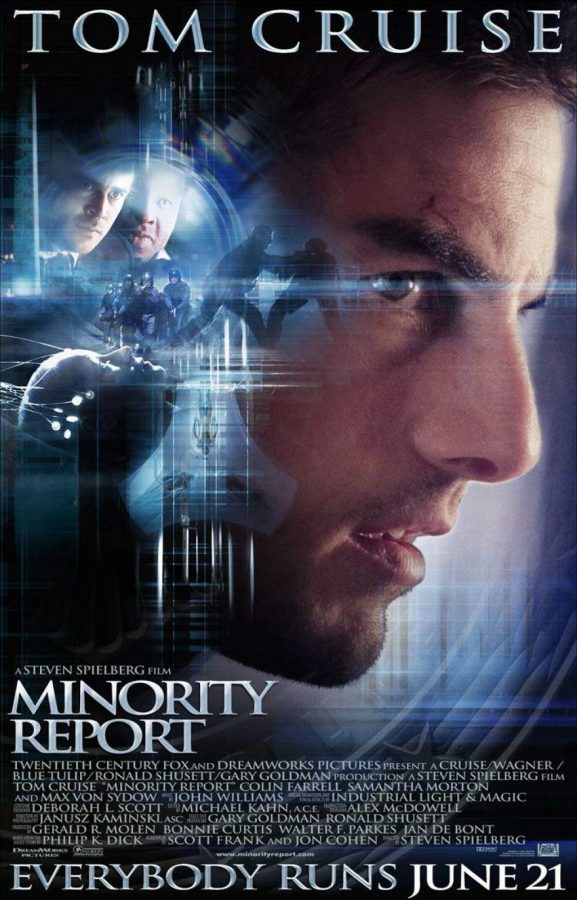
Spielberg’s Minority Report is now an important film to revisit.  Based on the short story by visionary science fiction author Phillip K. Dick, Spielberg’s film version implements an important number of predictive programming elements not found in Dick.  Both are worth a look, but the film is important for JaysAnalysis, since now 13 years later, we are actually seeing the implementation of the total technocratic takeover, including pre-crime tracking systems.

Although the film and the short story present the precognition as a metaphysical mystery by telepathic individuals who can see into the aether, the real pre-crime systems are based on A.I. and the digitizing of all records under total information awareness.  And as I’ve said, this was DARPA’s plan for the Internet all along.

In fact, a good friend of mine worked for a few years digitizing mass medical records, and while most are aware of Google’s attempts to digitize all books, most do not know why.  I’ve warned for several years now the end goal of all this digitization is not for “efficiency” and trendy techy cool iWatches to monitor heart rates and location.  The ultimate goal is total mind control, loss of free will and the complete rewrite of all past reality.

Consider, for example, the power the system will wield with the ability to “delete” all past versions of literature – religious texts, Shakespeare, 1984, nothing will be sacred and unable to be “revised.”  Remember that in 2009 Amazon erased Orwell’s 1984.  Your own past may even be deleted, subject to revision or altered to make you the next villain!  All this is revealed in detail in Minority Report.  Thus, while the public adopts “Kindles,” print itself is assigned the doom of the kindled fire – like Farenheit 451, as Richard Grove has said.

Minority Report’s setting is a 2055 dystopic D.C., where Agent John Anderton (Tom Cruise) is framed for two murders from within his own PreCrime Corporation ranks by the CEO, Lamar Burgess (Max Von Sydow). (Note: The existing system appears to be a merger of private and government sectors.)   I’m sure most readers have seen the film, so I’ll spare you detailed plot recaps and hit the highlights for the sake of our purposes.

The film’s PreCrime alerts a private corporation to a predetermined murder event ahead of time, giving the Agents of the corporation time to save victims.  Hailed as a perfect system, the infallibility of PreCrime has made D.C. the safest city in the world, with no murders for several years.  As a result, the PreCrime test requires a total surveillance society, something akin to complete panopticism.  In fact, the advertising in D.C. is user specific, targeting pedestrian’s personal desires based on retina scans – and all travel requires retinal scanning and mass microchipping.

We are now on the verge of the implementation of retinal scanning, as the U.S. military has engaged in retinal scanning in occupied territories for several years now.  It is important to understand that the action of the military abroad are often a test ground for the implementation of such surveillance and tracking technology at “home.”  In October 2010, the Guardian reported of U.S. troops stationed in Afghanistan:

“With each iris and fingertip scanned, the device gave the operator a steadily rising percentage chance that the goat herder was on an electronic “watch list” of suspects. Although it never reached 100%, it was enough for the man to be taken to the nearest US outpost for interrogation.

Since the Guardian witnessed that incident, which occurred near the southern city of Kandahar earlier this year, US soldiers have been dramatically increasing the vast database of biometric information collected from Afghans living in the most war-torn parts of southern and eastern Afghanistan. The US army now has information on 800,000 people, while another database developed by the country’s interior ministry has records on 250,000 people.”

Wired Magazine reported millions were the goal.  The goal is not millions, but the entire globe, where any and all information is now currency for “big data.”  This is exactly the world Minority Report foresaw, and for those curious about Phillip K. Dick, whispers are his foresight was due to being well-connected with the Silicon Valley elites.  This is how Ubik foresaw the “Internet of Things” I’ve written about many times, and probably in part why Dick went insane (or was targeted).  Slate writes of Ubik:

“Samsung, the world’s largest manufacturer of televisions, tells customers in its privacy policy that “personal or other sensitive” conversations “will be among the data captured and transmitted to a third party” through the TV’s voice-recognition software. Welcome to the Internet of Things.

Sci-fi great Philip K. Dick warned us about this decades ago. In his classic 1969 novel Ubik, the characters have to negotiate the way they move and how they communicate with inanimate objects that monitor them, lock them out, and force payments.”

Just as the predictive algorithm in Asimov’s Foundation was able to track mass movements, so now the same algorithmic tracking is in place across the “web of things” that are capable of being recorded and tracked – and that’s most things.  The Pentagon has a virtual “you” in a realtime 3D interface that updates its data consistently from everything done on the web.  The Register reported in 2009 about this simulated warfare and predictive software:

“Defense analysts can understand the repercussions of their proposed recommendations for policy options or military actions by interacting with a virtual world environment,” write the researchers.

“They can propose a policy option and walk skeptical commanders through a virtual world where the commander can literally ‘see’ how things might play out. This process gives the commander a view of the most likely strengths and weaknesses of any particular course of action.”

It’s not telepathic Samantha Morton’s in a tub of goo, it’s Google and DARPA developing highly advanced technology along the lines of what William Binney exposed, as a former NSA employee.  Think here of War Games (1983), where the A.I. bot was able to war game future scenarios of global thermonuclear war, but thankfully Ferris Bueller was there to save us.  If this was displayed in 1983 in pop culture, imagine how far that technology has come 30 years later.  Lest anyone think the “precrime” is merely for security and weekend Xbox enjoyment, recall what I wrote two years back:

“Capitalism, communism, nationalism, 401ks, blah blah blah, all of these things are basically obsolete. Why?  Because of the nature of the real secret high-tech and plans for mega SmartCities that are to come.  You see, you think you are getting ahead and climbing the scum social ladder, and you aren’t even aware that the CEO of IBM Ginni Rommety gives lectures about SmartCities where everything you do will be rationed, tracked and traced by the central supercomputers, with pre-crime determining whether you are guilty of crimethink.  So everything you are trusting in is already obsolete.  You think I’m exaggerating?  On the contrary, you and your children’s futures are determined (you don’t have a future), and if you are allowed to live past the great culling, you will essentially be boxed into a giant WalmartTargetGameStopUniversity City that will literally be run by a supercomputer. Watch for yourself:”

And lest anyone think PreCrime is a thing of the future, consider that it has been used for two years in the U.K.  The New Scientist and 21stCenturyWire report:

“That’s the hope of police in the US, who have begun using advanced software to analyse crime data in conjunction with emails, text messages, chat files and CCTV recordings acquired by law enforcement. The system, developed by Wynyard, a firm based in Auckland, New Zealand, could even look at social media in real time in an attempt to predict where the gang might strike next.

“We’re trying to get to the source of the mastermind behind the criminal activity, that’s why we’re setting up a database so everybody can provide the necessary information and help us get higher up the chain,” says Craig Blanton of the Marion County Sheriff’s Office in Indiana. Because Felony Lane Gang members move from state to state to stay one step ahead, the centralised database is primed to aggregate historical information on the group and search for patterns in their movements, Blanton says.

“We know where they’ve been, where they are currently and where they may go in the future,” he says. “I think had we not taken on this challenge, we along with the other 110 impacted agencies would be doing our own thing without better knowledge of how this group operates.”

It’s not the only system that police forces have at their disposal. PredPol, which was developed by mathematician George Mohler at Santa Clara University in California, has been widely adopted in the US and the UK. The software analyses recorded crimes based on date, place and category of offence. It then generates daily suggestions for locations that should be patrolled by officers, depending on where it calculates criminal activity is most likely to occur.”

Returning to the film, an interesting tidbit occurs about three times that I noticed.  Any time Anderton or his fellow Agents access the “Temple,” the holding site of the telepathic PreCogs, the sound made is distinctly the iPhone power on sound.  The first iPod premiered in 2001, so I’m assuming it’s the same sound for turning on, but readers can correct me.  I find it curious if not, since the sound would likely be chosen for a reason. This puts the infamous 1984 Apple ad in a new, ominous light.

If you’ve seen the important Spike Jonze film, Her, you’ll see why.  In Her, lead character Theodore (Joaquin Phoenix) falls in love with an iOS – his operating system.  The iOS of his future is an intelligent software system with capability for learning (like the A.I. in War Games), and ultimately transcends its own limitations.

I bring this up because Minority Report is distinctly dominated by eye imagery.  While seemingly insignificant, it is my opinion that Siri and Apple in particular are crucial in the implementation of the coming new order.  Apple ads have contained a distinctly esoteric and significant cultural referent.  This is not to say Microsoft or any of the other tech giants are insignificant, on the contrary, I believe they are all arms of one entity and the appearance of competition is largely illusory.

There is only one military industrial complex, and DARPA and Google and Apple and Microsoft are all its children.  The façade of competition is enough to advance the technology by the tech nerds that serve it, but in the end, it all serves the same system.  My point here is that the iPhone is much more than an iPhone. It is actually an EYEphone, functioning as the eye of Sauron himself, as A.I. reconnaissance before the takeover.

I have mentioned before the whispers are the iPhone of the next few years will contain a Siri that communicates with you like a personal assistant.  I have finally found an article on this here, which describes it directly in connection to Her, like I said here.  “Viv” will do the following:

“On the other hand, not only will Viv recognize disparate requests, she will also be able to put them together. Basically, Viv is Siri with the ability to learn. The project is being kept heavily under wraps, but the guys at Viv have hinted that they’re working towards creating a “global brain,” a shared source of artificial intelligence that’s as readily accessible as heat or electricity.  It’s unclear how soon a breakthrough of this magnitude can happen. But if this team made Siri, you can bet their next project is going to blow the tech world to pieces.”

In order to endear the public to that idea, a prototype Siri had to be offered.  While this may be a rumor, it will eventually come.  And the dystopic scenario presented in Her will meet the nightmare of Minority Report.  For now, it all seems harmless (though we are seeing a generation of youth destroyed by screens and pads – Steve Jobs didn’t let his own kids play with an iPad!), but the end goal I assure is nefarious.

The dominant ideology of these tech giants is pure and total dysgenics (not eugenics).  In order for the total rewrite to come, the existing structure must be destroyed.  The “old way” of doing things will be scapegoated as the technocracy replaces it, offering utopia and salvation, but the synthetic rewrite is a Trojan horse.  Humanity will be enslaved in the same virtual Matrix Anderton is enslaved in, in the film.

The film’s tag line, which pops up numerous times in the story, is about running.  “Everybody runs,” and John spends most of the film on the run from the very system he operated.  The film asks the question multiple times, “Can you see?” and when we think of this on a deeper level in terms of predictive programming, I think we are intended to look beyond the immediate narrative.  There are also numerous hat tips to Blade Runner, where again the “running” imagery comes to the fore.  Can we run from the panopticon?  Do we have eyes to see the iEYES that are “infallibly” surveilling us perpetually?

How to Avert a Digital Dystopia

By Jumana Abu-Ghazaleh

Source: OneZero

“What I find [ominous] is how seldom, today, we see the phrase ‘the 22nd century.’ Almost never. Compare this with the frequency with which the 21st century was evoked in popular culture during, say, the 1920s.”

—William Gibson, famed science-fiction author, in an interview on dystopian fiction.

The 2010s are almost over. And it doesn’t quite feel right.

When the end of 2009 came into view, the end of the 2000s felt like a relatively innocuous milestone. The current moment feels so much more, what’s the word?

Ah, yes: dystopian.

Looking back, “dystopia” might have been the watchword of the 2010s. Black Mirror debuted close to the beginning of the decade, and early in its run, it was sometimes critiqued for how over-the-top it all felt. Now, at the end of the decade, it’s regularly critiqued as made obsolete by reality.

And it’s not just prestige TV like Black Mirror reflecting the decade’s mood of incipient collapse. Of the 2010s top 10 highest-grossing films, by my count at least half involve an apocalypse either narrowly averted or, in fact, taking place (I’m looking at you, Avengers movies).

People have reasons to wallow. I get it. The existential threat of climate change alone — and seeing efforts to mitigate it slow down precisely as it becomes more pressing — could fuel whole libraries of dystopian fiction.

Meanwhile, our current tech landscape — the monopolies, the wild spread of disinformation, the sense that your most private data could go public whenever, with no recourse, all the things that risk making Black Mirror feel quaint — truly feels dystopian.

We enjoy watching distant, imaginary dystopias because they distract us from oncoming, real dystopias.

Since no one in a position to actually do something about our dystopian reality seems to be admitting it — no business leaders, politicians or legacy media — it makes sense that you might get catharsis of acknowledgment from pop culture instead. And yet, the most popular end-of-the-world fiction isn’t about actual imminent threats from climate or tech. It’s about Thanos coming to snap half of life out of existence. Or Voldemort threatening to destroy us Muggles.

Maybe that kind of pop culture, which acknowledges dystopia but not the actual threats we currently face, gives us a feeling of control: Sure, Equifax could leak my social security number and face zero consequences, but there are no Hunger Games. Wow — it really could be so much worse! Maybe we enjoy watching distant, imaginary dystopias because they distract us from oncoming, real dystopias.

But let’s look at those actual potential dystopias for a moment and think about what we need to do to avert them.

I’d suggest the big four U.S. tech giants — Amazon, Facebook, Apple, Google — each have a distinct possible dystopia associated with them. If we don’t turn around our current reality, we will likely get all four — after all, for all the antagonistic rhetoric among the giants, they are rather co-dependent. Let’s look at what we might have, ahem, look forward to — unless we demand the tech giants deliver on the utopia they purportedly set out to achieve when their respective founders raised their rounds of millions. I would argue not only that we can, but that we must hold them accountable.

“Mad Max,” or, slowly then all at once: starring Apple

“‘How did you go bankrupt?’ Bill asked. ‘Two ways,’ Mike said. ‘Gradually and then suddenly.’”

—Ernest Hemingway, The Sun Also Rises.

When you think of Mad Max, you probably think of an irradiated, post-apocalyptic desert hellscape. You’re also not thinking of Mad Max.

In the original 1979 film, the apocalypse hasn’t quite yet happened. There’s been a substantial social breakdown, but things are getting worse in slow motion. There are still functioning towns. Our protagonist, Max, is a working-class cop; and while there’s reason to believe a big crash is coming, or has even begun, society is still hanging on. (It’s only in the sequels that we’re well into the post-apocalyptic landscape people are thinking of when they say “Mad Max.”)

A relatively subtle dystopia, where things gradually decline in the background, is also a good day-to-day description of a society overrun by algorithms, even without the attention-grabbing mega-scandals of a Cambridge Analytica or massive data breach. A kind of dystopia “light” — and Apple is its poster child.

After all, Apple has a genuinely better track record than some of the other tech giants on a few key privacy issues. But it’s also genuinely aware of the value of promulgating that vision of itself — and that can lead Apple users into danger.

In January, Apple purchased a multistory billboard outside the Consumer Electronics Show in Las Vegas, with this message: “What happens on your iPhone, stays on your iPhone.” Sounds great — but it’s deeply misleading, and as journalist Mark Wilson noted, Apple’s mismatch between rhetoric and behavior fuels the nightmare that is our current data security crisis:

“[iPhone] contents are encrypted by default […] But that doesn’t stop the 2 million or so apps in the App Store from spying on iPhone users and selling details of their private lives. “Tens of millions of people have data taken from them — and they don’t have the slightest clue,” says [the] founder of [the] cybersecurity firm Guardian […] The Wall Street Journal studied 70 iOS apps […] and found several that were delivering deeply private information, including heart rate and fertility data, to Facebook.” [Emphasis mine.]

A tech giant that is claiming it’s the path to salvation, while effectively creating a trap for those who believe it, sounds ironically familiar given Apple’s famous evocation of Big Brother.

After all, when people talk about habit-forming technology in terms so terrifying they’ve convinced Silicon Valley executives to limit their children’s access to their own products, let’s be real: They’re talking about iPhones.

When academic child psychology researcher Jean Twenge talks about a possible teenage mental health epidemic fueled by social media, we know what’s at the heart of it: She’s talking about iPhones.

All those aforementioned horror stories, and a huge slice of those algorithms you’ve heard so much about, are likely first reaching you on smartphones that, with world market share above 50%, are largely, you guessed it, iPhones. (And none of these stories even mention Apple workers at overseas at facilities like Foxconn who create our iPhones and who really are living in a kind of explicit dystopia.)

What happens on your iPhone almost certainly doesn’t stay on your iPhone. But who created that surveillance capitalism running it all in the first place?

Enter Google.

“Black Mirror:” “Nosedive,” or, welcome to surveillance capitalism: starring Google

“We know where you are. We know where you’ve been. We can more or less know what you’re thinking about.”

—Google’s then-CEO Eric Schmidt, in a 2011 interview.

You’ve probably heard it before: “if you’re not paying, you’re the product.” This is usually in reference to ostensibly “free” services like Facebook or Gmail. It’s a creepy thought. And, according to Shoshana Zuboff, professor emeritus at Harvard and economic analyst of what she’s termed “surveillance capitalism,” the selling of your personal information undermines autonomy. It’s worse than you being the product: “You are not the product. You are the abandoned carcass.”

Google, according to Zuboff, is the original inventor of Surveillance Capitalism. In their early “Don’t Be Evil” days, the idea of accessing people’s private Google searches and selling them was considered unthinkable. Then Google realized it could use search data for targeting purposes — and never stopped creating opportunities to surveil their users:

“Google’s new methods were prized for their ability to find data that users had opted to keep private and to infer extensive personal information that users did not provide. These operations were designed to bypass user awareness. […]In other words, from the very start Google’s breakthrough depended upon a one-way mirror: surveillance.”

Twenty years later, surveillance capitalism has become so ubiquitous that it’s hard to live in Western society without being surveilled constantly by private actors.

As far as I know, no mass popular culture has really yet captured this reality, but one small metaphor that kind of hits on its effects is a Black Mirror episode called “Nosedive.”

In “Nosedive,” everyday people’s lived experience is very clearly the picked-apart carcass for an entire economic and social order; a kind of surveillance-driven social credit score affects every aspect of your daily life, from customer service to government resources to friendships, all based on your app usage and, most creepily, how other people rate you in the app.

If surveillance capitalism has been the engine powering our economy in the background for nearly two decades, it’s now having a coming-out party. Increasingly, Google isn’t just surveilling us in private — with its “designing smart cities” initiatives, the company will literally be making city management decisions instead of citizens: Sidewalk Labs, a Google sister company, plans to develop “the most innovative district in the entire world” in the Quayside neighborhood of Toronto, and Google itself is planning on siphoning every bit of data about how Quayside residents live and breathe and move via ubiquitous monitoring sensors that will likely inform — for a fee naturally — how other cities will develop.

If surveillance capitalism has been the engine powering our economy in the background for nearly two decades, it’s now having its coming-out party.

Much like Apple, Google takes pains to present itself as a conscientious corporate citizen. They might be paternalistic, or antidemocratic — but they have learned it’s important to their brand that they’re seen as responsive to their workers and the broader public, largely thanks to the courageous and persistent effort of their workers and consumer advocates in civil society.

Not so much with Amazon.

“Elysium,” or, dystopia for some, Prime Day for others: starring Amazon

“[The New York Times] claims that our intentional approach is to create a soulless, dystopian workplace where no fun is had and no laughter heard. Again, I don’t recognize this Amazon and I very much hope you don’t either.” —Jeff Bezos, August 17, 2015 letter to staff after the New York Times investigation into working conditions at the company.

In 2015, Jeff Bezos felt the need to set the record straight: The New York Times was wrong about Amazon. Working there did not feel like a dystopia.

The years since have only validated the New York Times story, which focused on life for coders and executives at Amazon. Notably, when the Times and other investigative journalists have probed life for the far more numerous warehouse workers employed by Amazon, Bezos has largely stayed silent.

In fact, the further down the corporate ladder you get at Amazon, the more likely it seems that Jeff Bezos will stay quiet on any controversy. Just this month, in a report published almost exactly four years after Bezos’ “Amazon is not a dystopia” declaration, the New York Times has uncovered almost a dozen previously unreported deaths allegedly caused by Amazon’s decentralized delivery network. Rather than defend itself out loud, Amazon has kept quiet while repeating the same argument in the courts: Those delivery people aren’t Amazon workers at all, and thus Amazon is not liable.

Amazon, like every major tech giant, has a key role in the dystopia of surveillance capitalism — the monopolylike market share of Amazon Web Services, and Amazon’s involvement in increasingly ubiquitous facial recognition software, represent their own deeply dystopian trends. But the most visible dystopia Amazon creates, for all to see, is dystopia in the workplace.

In many ways, Amazon is the single company that best explains the appeal of an Andrew Yang figure to a certain slice of economically alienated young voters. When speaking near Amazon’s HQ in Seattle, Yang explicitly talked about the surveillance of Amazon workers, and how reliable those jobs are in any case:

“All the Amazon employees [here] are like, ‘Oh shit, is Jeff watching me right now?’… [Amazon will] open up a fulfillment warehouse that employs, let’s call it 20,000 people. How many retail workers worked at the malls that went out of business because of Amazon? [The] greatest thing would be if Jeff Bezos just stood up one day and said, ‘Hey, the truth is we are one of the primary organizations automating away millions of American jobs.’ […] I have friends who work at Amazon and they say point-blank that ‘we are told we are going to be trying to get rid of our own jobs.’”

You can flat-out disagree with Yang’s proposed solutions, but a lot of his appeal stems from the fact that he’s diagnosing a problem that broad swaths of people don’t feel is being talked about. Yang validates his supporters’ concerns that they are, in fact, living in a dystopia of the corporate overlord variety.

In the movie Elysium, most work is done in warehouses, under constant surveillance, with workers creating the very automation systems that surveil and punish them. The movie takes place in a company townlike setting, with no such thing as a class system or social mobility. Meanwhile, the ruling class in Elysium lives in space, having left everyone else behind to work on Earth, a planet now fully ravaged by climate change.

That might sound particularly far-fetched, but given Bezos’ explicit intention to colonize space because “we are in the process of destroying this planet,” it suddenly doesn’t feel so off the mark. And in an era where Governors and Mayors openly genuflect to Amazon, preemptively giving up vast swaths of democratic powers for the mere possibility that Amazon might host an office building there, it’s hard not to feel like we’re already in an Elysium-flavored dystopia.

Amazon has their dystopia picked out, flavor and all. But what happens when the biggest social network in the world can’t decide which dystopia it wants to be when it grows up?

Pick a dystopia — any dystopia!: starring Facebook

“Understanding who you serve is always a very important problem, and it only gets harder the more people that you serve.”

—Mark Zuckerberg, 2014 interview with the New York Times.

Ready Player One is one of the more popular recent dystopian novels.

The bleak future it depicts is relatively straightforward: In the face of economic and ecological collapse, the vast majority of human interaction and commercial activity happens over a shared virtual reality space called Oasis.

In Oasis, the downtrodden masses compete in enormous multiplayer video games, hoping to win enough prizes and gain sufficient corporate sponsorship to scrape out a decent existence. Imagine a version of The Matrix, where people choose to constantly log into unreality because actual reality has gotten so unbearably terrible, electing to let the real world waste away. Horrific.

Ready Player One is also the book that Oculus founder and former Facebook employee Palmer Luckey used to give new hires, working on virtual reality to get them “excited” about the “potential” of their work.

Sound beyond parody? In so many ways, Facebook is unique among the tech giants: It’s not hiding the specter of dystopia. It’s amplifying dystopia.

It’s hard to pick a popular dystopia Facebook isn’t invested in.

Surveillance capitalism? Google invented it, but Facebook has taken it to a whole new level with its social and emotional contagion experiments and relentless tracking of even nonusers.

1984? Sure, Facebook says, quietly patenting technology that lets your phone record you without warning.

Brave New World? Lest we forget, Facebook literally experimented with making depression contagious in 2014.

28 Days Later, or any of the various other mass-violence-as-disease horror movies like The Happening? Facebook has been used to spread mass genocidal panics far more terrifying than any apocalyptic Hollywood film.

What about the seemingly way out there dystopias — something like THX-1138 or a particularly gnarly Black Mirror episode where a brain can have its thoughts directly read, or even electronically implanted? It won’t comfort you to know that Facebook just acquired CTRL-Labs, which is developing a wearable brain-computer interface, raising questions about literal thought rewriting, brain hacking, and psychological “discontinuity.”

Roger McNamee, an early Zuckerberg advisor and arguably its most important early investor, has become unadorned about it: Facebook has become a dystopia. It’s up to the rest of us to catch up.

We spent the 2010s on dystopia—let’s spend the 2020s on utopia instead

“Plan for the worst, hope for the best, and maybe wind up somewhere in the middle.” —Bright Eyes, “Loose Leaves”

People generally seem to think dystopias are possible, but utopias are not. No one ridicules you for conceiving of a dystopia.

I think part of that is because it gives us an easy out. Dystopias paralyze us. They overwhelm. They make us feel small and powerless. Envisioning Dystopia is like getting married anticipating the divorce. All we can do is make sure it’s amicable.

Is there room for a utopian counterweight? There’s not only room, there’s an urgent need if we want to look forward (as opposed to despondently) to the 22nd century. We cannot avert or undo dystopias without believing in their counterparts.

But we need to make the utopian alternative feel real, accessible, and achievable. We need to be rooting not for the lesser of two evils, but for something actually good.

Dystopias — real, about-to-unfold dystopias — have been averted before. The threat of nuclear apocalypse during the Cold War. The shrinking hole in the ozone layer (which is both distinct from, and has lessons to teach us about, the climate crisis). We didn’t land in utopia, but it was only by hitching our wagons to a utopian vision that we averted the worst.

In 2017, cultural historian Jill Lepore penned a kind of goodbye letter to dystopian fiction, calling for a renewal of utopian imagination. “Dystopia,” she lamented, “used to be a fiction of resistance; it’s become a fiction of submission.” Dystopian narratives once served as stark warnings of what might be in store for us if we do nothing, spurring us on to devise a brighter future. Today, dystopian fiction is so prevalent and comes in so many unsavory flavors that our civic imaginations are understandably confined to identifying the one we deem most likely to inevitably happen, and to come to terms with it.

But we don’t have to.

A new decade is on the way. Let’s spend the 2020s exercising our utopian imaginations — the muscles we use to envision dystopia are now all too-well-developed, and a body that only exercises one set of muscles quickly grows off-balance.

Dystopias disempower. We are tiny, inconsequential — how could we do anything about them? Utopias, on the other hand, are rhetorical devices calling upon us to build. They invite our participation. Because a utopia where we don’t matter is a contradiction in terms.

Let’s envision a world where those creating algorithms are thinking not only about their reach, but also about their impact. A world in which we are not the carcass left behind by surveillance capitalism. A world in which calling for ethical norms and standards is in itself a utopian act.

Let’s spend the next decade fighting for what we actually want: A world in which the powerful few are held to a higher standard; an industry in which ethics aren’t an afterthought, and the phrase “unintended consequences” doesn’t absolve actors from the fall out of their very deliberate acts.

Let’s actualize the utopia which, ironically enough, the tech giants themselves so enthusiastically promised us when they set out to change the world.

Let’s spend this next decade asking for what we actually want.