Another World is Possible

original

From the Spanish Civil War to the fall of the Berlin Wall, anarchism pushes for a new social order

By Tommaso Segantini

Source: Adbusters

The Spanish Civil War that occurred between 1936-1939 is always remembered as the fight between the Republicans and Franco’s nationalist semi-fascist forces. However, the war was marked by another, extraordinary event; in 1936, the year of the outbreak of the civil war, the world witnessed the first glimpses of an anarchist revolution. Sam Dolgoff, an American anarcho-syndicalist, stated that the Spanish Revolution “came closer to realizing the ideal of the free stateless society on a vast scale than any other revolution in history.”

The revolution was led by the CNT (Confederación Nacional del Trabajo), a confederation of anarchist and anarcho-syndicalist trade unions. A significant part of Spain’s economy was collectivized and put under direct worker’s control. In Catalonia, workers controlled more than 75% of the economy. We should not imagine Soviet-style forced collectivization, but, as Sam Dogloff said, “a genuine grass roots functional libertarian democracy, where each individual participated directly in the revolutionary reorganization of social life”. George Orwell, who has served as a combatant for the CNT, was able to document the revolution as a first-hand observer. Two short passages from his Homage to Catalonia, published in 1938, illustrate superbly the spirit of the revolution: “[T]here was a belief in the revolution and the future, a feeling of having suddenly emerged into an era of equality and freedom. Human beings were trying to behave as human beings and not as cogs in the capitalist machine,” and “many of the normal motives of civilized life—snobbishness, money-grubbing, fear of the boss, etc.—had simply ceased to exist. The ordinary class-division of society had disappeared to an extent that is almost unthinkable in the money-tainted air of England; there was no one there except the peasants and ourselves and no one owned anyone else as his master.”

Unfortunately, the Spanish anarchist utopia did not last long. The anarchists were crushed by a temporary alliance between all other political parties (including the Communists and the Socialists) and the brief—but real—experience of an anarchist society faded away.

However, an important lesson can be drawn from the anarchist utopia of 1936: another world is possible (which is also the slogan of the World Social Forum). Before discussing anarchism’s possible role in the resistance to the capitalist world order, let’s shortly retrace last century’s main stages of the capitalist system’s consolidation: elites have won the long-lasting struggle against the working class; this was achieved firstly by granting workers some benefits after World War II, notably through the implementation of welfare systems in the West, then by fragmenting them with the increase in specialization of labor and the growth of the service industry during the post-Fordist period and finally by assessing the knockout blow through neoliberal policies, which erased hard-fought social and economic rights, diminished trade unions’ bargaining power and weakened their influence.

The libertarian revolutions of 1968 have also ended up in disappointment. Hopes brought by the “New Left” political movement that emerged from the demands of students, activists and workers, came to a close when economic powers and politics colluded in the 80s, removing the last glimmers of hope that change could happen from within the current political system. The 1980s also marked the beginning of the neoliberal era (deregulation of the financial system, erosion of welfare states, privatization programs, financial crises, cuts to public spending).

Finally, the fall of the Berlin Wall represented the end of the last bastion of ideological resistance against capitalism: communism. Fukuyama’s The End of History and the Last Man main thesis was emblematic in the representation of the world we faced and still face today: the triumph of liberal democracy and capitalism marked the end point of mankind’s ideological and political evolution.

We live in a historically specific cultural paradigm, shaped during the course of the last century through mass media, popular culture and advertising, which converged together and formed our consumer culture and in an economic and political system structured to serve the interests of a small elite. In this scenario, anarchist thought has a dual function of resistance: as a challenge to the neoliberal ideology, and as a possible concrete utopia that can guide us in the construction of a valid alternative social order.

The most accessible ground for us, “the 99%,” through which a radical change can be achieved, is that of ideas. No economic or political revolution can bring genuine change without, stated Serge Latouche, an advocator of the degrowth movement, “the decolonization of our minds” from the ideological framework we find ourselves in. Anarchism challenges the ideas, the dehistoricized and naturalized assumptions, and the taken-for-granted norms of today’s society. In an anarchist society, solidarity would replace individualism; mutual aid would prevail on competition; altruism on egoism; spirituality on materialism; the local on the global. Changing the current global framework of rules first necessitates an individual ideological liberation that can only come through self-awareness. To free our body we must first free our mind.


5 Reasons Why Anarchy Would be an Improvement in Human Governance

goldman-quote

By Gary ‘Z’ McGee

Source: Waking Times

“Give a man a gun and he’ll rob a bank. Give a man a bank and he’ll rob the world.” –Unknown

Give people just a little bit of knowledge and courage and they will track down those greedy-ass bankers and hold them accountable. All we need is just a little courageous anarchy. The problem, the crux, the fly in the ointment: most people are not courageous enough, and most people don’t want to learn anything that attacks their all-too-precious worldview. Yes, the very worldview that is keeping people indebted to an immoral, unhealthy, unsustainable, unjust system of human governance, is precisely the worldview that the majority of people are clinging to. Indeed, most people, even though they would probably say otherwise, would rather be kissed with a lie than slapped with the truth. They would rather deny facts that tarnish their worldview than reject the deceit that upholds it. But as Martin Luther King, Jr. said, “Human progress is neither automatic nor inevitable. Every step toward the goal of justice requires sacrifice, suffering, and struggle; the tireless exertions and passionate concern of dedicated individuals.”

Healthy human evolution requires authentic vigilance. It requires a consistent upheaval of the status quo. This requires proactive human beings who are willing to be authentically vigilant and consistently rebellious. It requires courageous interdependent individuals who dare to recondition the status-quo-junky original condition. It turns out that the wisdom gained from anarchy is precisely the ability to distinguish between sacrifice that is transformative and healthy from mere suffering caused by the state that we’ve allowed because we were too cowardly or too unimaginative to think of a healthier way to live. Like Stefan Molyneux said, “Never, ever underestimate the degree to which people will scatter themselves into a deep fog in order to avoid seeing the basic realities of their own cages. The strongest lock on the prison is always avoidance, not force.”

Here are five reasons why anarchy will improve human governance and thereby cultivate a healthy human evolution.

1.) It Has Inherent Checks and Balances

“Failure shows us the way –by showing us what isn’t the way.”Ryan Holiday

This one alone is reason enough to give anarchy a try again. The other four are just icing on the cake. I say “again” because human beings lived in hunter-gatherer groups that were characterized by what anthropologists call Fierce Egalitarian Anarchy. They not only shared things, they demanded that things be shared: meat, shelter, and protection… this was simply the best way to mitigate risk in a survival context in a world with limited resources.

Fierce egalitarianism and primal politics (tribal anarchy) worked exceptionally well for the human race for 95% of our existence on this planet. Indeed, it’s one of the only reasons why we’ve survived as long as we have.

In an amazing game theory study by Duéñez-Guzmán-Sadedin on the topic of police corruption, they concluded that once a police system becomes entrenched, nothing can stop it from eventually becoming corrupt, with the result being a population of gullible sheep and hypocritical overlords. But they didn’t stop the study there. They decided to tweak it ever so slightly. In the words of Suzanne Sadedin: “The results were startling. By making a few alterations to the composition of the justice system, corrupt societies could be made to transition to a state called ‘righteousness’. In righteous societies, police were not a separate, elite order. They were everybody. When virtually all of society stood ready to defend the common good, corruption didn’t pay. Similarly, as it turns out, social norms in hunter-gatherer societies are enforced by the whole group rather than any specially empowered individuals.”

This is a critical aspect of anarchy: that everyone is free to be as moral, or as amoral, as they need to be in order to maintain a healthy cosmic, ecological, and social order. Freedom is primary. Health is secondary. Understanding how everything is connected is third. And immorality is not tolerated.

The monumental problem with our Statist society is that we are not taught to be as moral or as amoral as we need to be in order to maintain a healthy cosmic, ecological, and social order. In fact, statism purposefully forces whatever the state decrees to be healthy, as healthy, whether or not it is actually healthy according to cosmic law. This creates an exorbitant amount of problems.

2.) It Would Nullify Debt Slavery and Eliminate Poverty

“When plunder becomes a way of life for a group of men living in a society, they create for themselves in the course of time a legal system that authorizes it and a moral code that glorifies it.”Frederic Bastiat

How does our legal system authorize plunder? It allows banks to create fiat money out of thin air and then charge interest on it, which keeps the poor wallowing in poverty, and entrenches the rich in corruptible power structures based upon immoderate wealth.

How does our moral code glorify plunder? It pushes militarization, creates profit prisons, creates “war heroes” out of violent psychopaths, and makes war itself a profitable endeavor. It puts profit over people, equity over equality, transforms elections into auctions, and creates a fundamentally unsustainable and unhealthy money first, human heart second, mentality. Like Naseem Nicholas Taleb said, “Those who do not think that employment is systematic slavery are either blind or employed.”

How does anarchy flip the tables on the authorization and glorification of plunder? It prevents plunder from ever becoming possible because anarchy-based modes of governance are engineered in such a way that groups never get to the point of concentrated centers of power. The monopolization of power never gets to the point to where it becomes corrupt, because of controlled leveling mechanisms such as reverse dominance and wealth expiation. Like Jim Dodge said, “Anarchy doesn’t mean out of control; it means out of their control.” Whoever “they” may be: monopolizing corporations, overreaching governments, tyrants.

Self-aware critical thinker beware: political propaganda, especially in regards to war, money, government, and law, are designed to keep you conditioned and brainwashed into believing whoever is in power is being moral and just with their power. But as George Orwell warned, “Political language is designed to make lies sound truthful and murder respectable, and to give an appearance to solidity to pure wind.”

Have no illusions: within the current systems of human governance, poverty is a business. Profits are made on the labor of the poor, the consumption of the poor, and the debt of the poor. Anarchy is a system of human governance built to lift people out of poverty and into freedom. It gives people hope for a more balanced future of human prosperity. Like Raymond Williams advised, “To be truly radical is to make hope possible rather than despair convincing.”

3.) It Would Be Eco-Morally and Ecologically Healthier and More Sustainable

“The best teachers are those who show you where to look, but don’t tell you what to see.” –Alexandra K.Trenfor

Authority tells you what to see, and therefore must be questioned. Authority is telling you that it’s okay to live immoderate, over-indulgent, violent, ecocidal lifestyles. It’s not okay, because it is fundamentally unhealthy and leads to unsustainable devolution. In a system of human governance that is systematically transforming livingry into weaponry, it is the supreme duty of all healthy, moral, compassionate, eco-conscious, indeed anarchist, people to question authority to the nth degree.

Such audacious questioning has the potential to create robust eco-centric communities based upon permaculture, wellness, creativity, and a sacred economy that takes the interconnectedness of all things into deep consideration. It incentivizes individuals who value human flourishing, environmental flourishing, permaculture, sustainable building, alternative education, and nature-based wellness.

The cornerstone of anarchist modes of human governance is the deep understanding of the interdependence of all living things. As Nikola Tesla proclaimed, “Every living being is an engine geared to the wheelwork of the universe. Though seemingly affected only by its immediate surroundings, the sphere of external influence extends to infinite distance.”

An anarchist society divorced from the oppressive Big Brother bitch-slap of Statism, reveals a society that is capable of preserving the moral Golden Mean and the middle-way, as opposed to the immoral, suffocating greed of state politics. It will uncover a society that exemplifies the Golden Ratio of nature, as opposed to the state’s expropriation of nature and nature-based cultures.

4.) It Would Result in the Expiation of Power and Wealth Through an Ethics of Reciprocity

“A freedom that is interested only in denying freedom must be denied.”Simone De Beauvoir

The ultimate leveling mechanism inherent within anarchist modes of human governance is the ethics of reciprocity combined with the expiation of power.

Anthropologist Christopher Boehm has proposed a social theory that anarchist, egalitarian hunter-gatherers maintained equality through a leveling mechanism he calls Reverse Dominance: a social system of checks and balances that maintains egalitarian ethos while preventing a dominance hierarchy from forming. Reverse dominance hierarchies are broken down into four different leveling mechanisms: public opinion, ridicule, disobedience, and ostracism. These mechanisms work because human beings are social creatures and hugely influenced by peer pressure and social acceptance.

Anarchist modes of human governance are largely based upon shame as a regulatory method. Within such a society individuals are socially, morally, and ecologically compelled to expiate their power and reciprocate wealth because the alternative is the risk of shaming, ridicule, and/or ostracism. Like A.C. Grayling explained it, “The first task is to win something; the second, to banish the feeling that has been won; otherwise it is a burden.” In order for power and wealth not to become a psychological burden within anarchist systems, the powerful and the wealthy must be able to expiate and reciprocate their power and wealth, lest people become oppressed, and entire systems become corrupt.

But this does NOT mean that skill, courage, intelligence and perseverance are not rewarded. Anarchy does not imply socialism. Ours is a cultural problem. We’ve been raised to believe in the false ideal of greed. We’ve been conditioned to own. Our culture has become ego-centric, as opposed to eco-centric. It has become ownership-based, as opposed to relationship-based.

But prestige and merit can still be highly strived for values within an anarchist society that practices expiation of wealth and the ethics of reciprocity.

As I wrote in Breaking out of a Broken System, “Eco-moralism tames capitalism through holistic checks and balances. Ego-moralism jumpstarts communism through proactive citizenry. What we’re left with is a healthy anarchism with an egalitarian ethos which is less about capital and one-upmanship and more about respect for what is borrowed. It is less about ownership and more about relationships. It is ethical, spiritual, and diverse; as opposed to egotistical, religious, and homogenized by nationalism. Eco-moralism helps us pierce through the smoke and mirrors of hyper-reality and into the way reality actually is: interconnected and interdependent. Ego-moralism helps us become more motivated by revealing that our egos are actually tools towards leveraging a healthy balance between cosmos and psyche.”

Anarchists are crazy enough to think they can change the world, which is precisely why they will.

5.) It Would Create Compassionate, Humble, but Courageous Leadership

“To really understand something is to be liberated from it. Dedicating one’s self to a great cause, taking responsibility, and gaining self-knowledge is the essence of being human. A predatory capitalist’s greatest enemy, and humanity’s greatest ally, is the self-educated individual who has read, understood, delays their gratification, and walks around with their eyes wide open.” –The Four Horsemen, documentary

Anarchist modes of human governance create precisely the type of self-educated, autodidactic individual that predatory capitalist’s and pacifist socialist’s fear. As Louis G. Herman wrote, “When individuals try to balance self-interest with a consideration of the bigger picture, they discover, as Socrates did, that deep self-interest actually includes concern for the good of the whole.” An individual (ego) acting on the good of the whole (eco) is a force of nature first, a person second, which provides them the phenomenal power of standing on the shoulders of giants while also wearing a wide array of masks of self-mastery.

If we can combine fierce egalitarian primal politics along with the type of progressive self-interested people who are capable of considering the bigger interdependent picture, then we have a recipe for a healthy, prestigious anarchic leadership. We have a blueprint for authentically venerated and wise leadership that has the potential to transform the currently unlivable human world into a livable one. Like MLK Jr. said, “The hope of a secure livable world lies with disciplined nonconformists, who are dedicated to justice, peace, and brotherhood. The trailblazers in human, academic, scientific, and spiritual freedom have always been nonconformists. In any cause that concerns the progress of mankind, put your faith in the nonconformist.”

Indeed, it is typically the nonconformist who is the one testing the outer limits of the human imagination: stretching comfort zones, shattering mental paradigms, and flattening status quo boxes that those hooked on conformity so desperately try to think outside of. As Henry David Thoreau said, in true anarchist leadership form, “I was not designed to be forced. I will breathe after my own fashion. Let us see who is the strongest.”


Related videoThis has to be the best 5 minutes ever aired on Fox News (that may seem like faint praise but it’s a rare treat to find such an on point rant anywhere on cable television):

Juxtaposing Anarchy: From Chaos to Cause

anarchism_defined_by_ztk2006-d3j3ga4

By Colin Jenkins

Source: The Hampton Institute

Anarchy is synonymous with chaos and disorder. It is a term that stands in direct contrast to the archetype of society we have become accustomed to: hierarchical, highly-structured, and authoritative. Because of this, it carries negative connotations. Merriam-Webster, the consensus source of meaning within the dominant paradigm, defines anarchy as: a situation of confusion and wild behavior in which the people in a country, group, organization, etc., are not controlled by rules or laws; or, a state of disorder due to absence or non-recognition of authority. The implications made in these definitions are clear – any absence of authority, structure, or control most surely amounts to confusion, wild behavior, and disorder. In other words, human beings are incapable of controlling themselves, maintaining order, and living peacefully amongst one another. So we are to believe.

Far removed from the general presentation of anarchy is anarchism, a political philosophy rich in intellectual and theoretical tradition. Again turning to Merriam-Webster, we are told that anarchism is: a political theory holding all forms of governmental authority to be unnecessary and undesirable and advocating a society based on voluntary cooperation and free association of individuals and groups. Even from within the dominant paradigm, we see a wide range of divergence between anarchism, which is presented strictly as an idea, and anarchy, which is presented as the real and absolute consequence (though hypothetical) of transforming this idea to praxis. Juxtaposing these terms, injecting historical perspective to their meaning, and realizing the differences between their usage within the modern lexicon and their philosophical substance should be a worthy endeavor, especially for anyone who feels that future attempts at shaping a more just society will be fueled by ideas, both from the past and present.

While comparing and contrasting the various ways in which anarchy is deployed, we recognize three arenas: 1) Popular culture, which embraces and markets the association of chaos, wild behavior, and disorder; 2) Corporate politics, which uses the term as a pejorative, mostly to describe dominant right-wing platforms like the Tea Party and USAmerican libertarian movement; and 3) In activist and theoretical circles, where anarchism is understood as an authentic and legitimate political philosophy with roots firmly placed in the Enlightenment.

Pop Anarchy and Nihilism: Rebels without a Cause

The anti-authoritarian tendencies of anarchism are understandably attractive in a world that is overwhelmingly authoritative, intensely conformist, and socially restrictive. The conservative nature of American culture, which is notorious for repressing attitudes and beliefs that form outside of the dominant “white, Judeo-Christian” standard, begs for the existence of a thriving subculture that is based on rebellion, if only as an avenue of personal liberation and expression. The 1955 James Dean movie, Rebel without a Cause, offered a first glimpse into this nihilistic backlash against the deadening and soulless culture of conformity as it showcased the contradictory and often confusing nature of adolescence in white, middle-class suburbia.

On the heels of Dean was a baby-boomer revolution fueled by radical inquiry, hippie culture, bohemian lifestyles, and a “British Invasion.” For the better part of a decade, the counterculture movement in the US that came to be known quite simply as “the ’60s” boasted a wide array of meaningful causes, addressing everything from poverty to institutional racism and segregation to war. However, this brief period of revolutionary cause dissipated into a new and distinctly different counterculture through the 1970s and 80s, taking on a rebellious yet counterrevolutionary identity. In contrast to the existentialist nature of the 60s, which sought answers through philosophical exploration, the collective angst that developed in subsequent decades sought individual freedom through nihilism, self-destruction, and chronic apathy. Not giving a shit about detrimental traditions transformed into not giving a shit about anything. In turn, acts of defiance morphed from politically conscious and strategic opposition to oppressive structures to spiteful and self-destructive nothingness.

The revolutionary uprising of the 1960s, which had been stomped out by government suppression and maligned as an “excess of democracy,” was effectively replaced by a reactionary insurrection bankrupt of any constructive analysis or productive goal. This nothingness was embraced by a significant counterculture that developed alongside the punk rock music scene, which flirted with anarchist politics before descending into an egoistic and narrow identity based in privilege. What followed was a brand of “pop anarchy” devoid any meaning beyond contrived images. Acts of rebellion were central, but a cause was neither constructed nor needed. The anarchist and revolutionary symbolism that screamed for meaning was reduced to shallow marketing schemes as remnants of legitimate angst were redirected into childish rants against parents, teachers, “the man,” and “the system” – terms that often carried little meaning for those who used them. The exclusivity that developed made political organizing virtually impossible, and had an alienating effect on many. “Looking at the fact that most people who rear their heads at anarchist ‘movement’ events are roughly between 16-30 years old, with background influences of ‘punk’ or other ‘alternative’ persuasions,” explains one former anarchist from the punk scene, “it is easy to understand why such ‘movements’ tend to alienate most people than interest them.” A major problem that was exposed was demographics. “Punk primarily appealed to middle-class, straight white boys, who, thought they were ‘too smart’ for the rock music pushed by the corporations, still wanted to ‘rock out.’ It is also a culture that was associated with alienating oneself from the rest of society, often times in order to rebel against one’s privileged background or parents.” Because of this, “we have to admit that it was (and still is) exclusive.”

By contrasting US punk culture of this time with its British counterpart, one could see the development of a counterculture that lacked revolutionary meaning or class context. As Neil Eriksen explains:

“The distinctions between US and British punk rock are based solidly on differences in the audience. In the US the counter-cultural character of punk is evident in the primary emphasis on style of dress and posturing. ‘Middle class’ youth can copy the style of the British punks and are afforded the economic and ideological space to make it a whole lifestyle, similar to the way the hippies dropped out, turned on and tuned in. It is primarily those who do not have to work for a living who can afford the outrageous blue, green and orange punk hair styles and gold safety pins. The working class generally cannot choose to go to work with orange hair. In England punk is much more complex, especially given the history of other sub-cultures such as the Mods, Rockers and Skinheads. British punks find in their sub-cultural expressions of music and attitudes, as well as styles, more of an organic indication of their experiences as under- or unemployed youth. In the US, punk has few organic working class roots, and it thus functions as a broad counter-cultural milieu that does not indict the system for lack of jobs, but tends toward nihilism and mindlessness.”

The counterculture described above was a favorable, and almost inevitable, result of both appropriation from above and cooptation at the hands of capitalist profit. Revolutionary politics, in its authentic form, is not a profitable commodity. Instead, the radical roots of anarchist philosophy, which are briefly described in the definition of “anarchism” provided by Merriam-Webster, serve as a threat to any society that possesses extreme divisions of power and wealth. The United States – with its hierarchical governmental structure, no-holds-barred corporate landscape, and extreme divisions between the wealthy and everyone else (20% of the population owns 90% of the wealth) is no exception. For this reason, anarchism has (historically) been appropriated by the dominant culture (which is shaped by this 20%), diluted to anarchy, and served to the masses in the form of entertainment. This process has led to “gradual appearances in mainstream culture over the course of several years, at times far removed from its political origin (described by Situationists as ” recuperation“). These appearances typically connected it with anarchy and were intended as sensationalist marketing ploys, playing off the mainstream association of anarchy with chaos.”

The most recent form of this appropriation has come in the popular television series, Sons of Anarchy, which depicts a California biker gang inundated with drama, drug abuse, senseless murders, gun-running, and gang activity. Despite glimpses and a few mentions of the fictional founder’s manifesto, which included some scattered words by genuine anarchists like Emma Goldman and Pierre Joseph Proudhon, the show clearly chooses chaos and senseless, self-serving crime as its theme. The pinnacle of this appropriation, and ignorance of the rich history of philosophical anarchism, concludes with reviews that refer to one of the show’s main characters, a ruthless, murderous, and power-hungry leader by the name of Clay Morrow, as a ” true anarchist.”

Liberal Enablers and the Right’s Appropriation of Libertarianism

In the midst of the US government shutdown in October of 2013, Senate Majority Leader Harry Reid took to the Senate floor to criticize the move. “We have a situation where we have a good day with the anarchists,” Reid said. “Why? Because the government is closed.” Reid’s comment was meant as a jab to the Republican Party, which was largely responsible for allowing the shutdown to take place, purely as a political ploy. A few days later, Democratic Senator Elizabeth Warren referred to “anarchist tirades” and “thinly veiled calls for anarchy in Washington” coming from Tea Party members in the House as the impetus for the shutdown. Warren even went as far as equating anarchists with “pessimists and ideologues whose motto is, ‘I’ve got mine, the rest of you are on your own,’ while ironically tying in neoliberal deregulation that “tolerates dangerous drugs, unsafe meat, dirty air, or toxic mortgages,” as an “anarchists’ dream.”

“Anarchy” has maintained its status as a pejorative in the modern American liberal lexicon, but not by choice. Borrowing from the nihilism of pop anarchy, it embraces misconceptions, ignores historical roots, and guts the term of genuine meaning. Considering that such rhetoric is coming from folks who have advanced degrees in political science, careers as political pundits, and a working knowledge of history, it can only be explained as calculated fear-mongering. The fact of the matter is that the Republican Party is just as “statist” as the Democratic Party, if only in different ways. And while the approach of political sects like the Tea Party and USAmerican “libertarian” movements present a less-statist platform than their counterparts from within the establishment, their philosophical make-ups (if you can even call them that) include a blatant disregard for the public at-large, an underlying racism that is dangerously oppressive, a love affair with capitalism, a childish refusal to recognize needs outside of privileged interests, a fanatical support for gun rights, and a narrow-minded obsession with protecting private property and personal wealth – beliefs that are more in line with the self-absorbed, reactionary nature of fascism than with the revolutionary, “cooperative individualism” of anarchism. Ultimately, the Tea Party, much like the USAmerican “libertarian” movement, is focused on one goal: protecting an embedded array of privilege and maintaining the status quo; and the means to their end (at least, theoretically) is the coercive power structure of the market, as opposed to that of the state. If and only when the market hierarchy is threatened by, say, a popular uprising, a workers strike, or a movement for civil rights, this brand of “libertarian” views the state – in the form of domestic police and military forces – as a necessary component. In other words, these so-called “anarchists” are really nothing of the sort. Instead, they are more than willing to use state power to uphold historically-based inequities related to wealth accumulation, racism, and class division.

If the cheap political jabs used by liberals were packed with historical context, they could be closer to the truth. However, this would defeat the purpose. Parts of the right-wing have, in fact, appropriated and twisted anarchist philosophy, mostly through a concerted effort to adopt an ahistorical version of “libertarianism.” In his “anarcho-capitalist” manifesto, Betrayal of the American Right, Murray Rothbard explained this intent:

“One gratifying aspect of our rise to some prominence is that, for the first time in my memory, we, ‘our side,’ had captured a crucial word from the enemy. Other words, such as ‘liberal,’ had been originally identified with laissez-faire libertarians, but had been captured by left-wing statists, forcing us in the 1940s to call ourselves rather feebly ‘true’ or ‘classical’ liberals. ‘Libertarians,’ in contrast, had long been simply a polite word for left-wing anarchist; that is for anti-private property anarchists, either of the communist or syndicalist variety. But now we had taken it over, and more properly from the view of etymology; since we were proponents of individual liberty and therefore of the individual’s right to his property.”

Of course, like all others who claim this contradictory title of anarcho-capitalist, Rothbard either failed to recognize “how property results in similar social relations and restrictions in liberty as the state,” or simply believed that “liberty” was synonymous with feudalistic ideals. As one anarchist (of the authentic variety) writer laments, the thought process of this faux-anarchism is that a “capitalist or landlord restricting the freedom of their wage-workers and tenants” is ok, but any such restrictions from “the state” is not. “It’s an oddity that in the United States, the main current of libertarian thought has been twisted and inverted into a kind of monstrous stepchild,” explains Nathan Schneider. “Rather than seeking an end to all forms of oppression, our libertarians want to do away with only the government kind, leaving the rest of us vulnerable to the forces of corporate greed, racial discrimination, and environmental destruction.”

Since the Democratic Party’s use of the term borrows from the simplistic, nihilistic version of “pop anarchy,” rather than the complex, philosophical version of anarchism, it becomes useful within the modern political arena. The true right-wing appropriation of anarchism as noted by Rothbard, which is fabricated in its own right, becomes buried under the fear-mongering and falsely implied association by the likes of Reid and Warren. Historically, this same type of fear-mongering has allowed for fascist scapegoating (Reichstag Fire), capitalist scapegoating (Haymarket Affair), and unlawful state executions ( Sacco and Vanzetti), all designed to exploit widespread ignorance regarding anarchist beliefs and prevent authentic libertarian movements from spreading through the populace. “The figure of the anarchist has long dominated our national imagination,” explains Heather Gautney. “It’s a word that conjures up the lawless, the nihilistic and even the violent. It’s the image Senators Reid and Warren invoked in their talking points against the Republicans.” It’s also an image devoid any real meaning. By removing its substance and demonizing its association, the establishment wins.

Anarcho-Punk, Underground Hip Hop, and Conscious Chaos: Rebels with a Cause

While “pop anarchy” took over much of the American punk scene in the ’70s and ’80s, it was only part of the story. Punk culture still served what Henry Rollins once succinctly described as “the perfect expression of postmodern angst in a decadent society,” creating an outlet for rebellious urges seeping from the dominant culture. It also served as a catalyst for pockets of revolutionary politics. When done right, it was the perfect combination of expression and meaning. The hard, edgy, and chaotic sounds spilling from the music represented a form of liberation that was desperately needed, while the lyrics roared against the establishment and aimed at deadening conformity and the music industry’s increasingly corporatized and cookie-cutter production value. The UK provided an example of this perfection when it birthed anarcho-punk.

“From the numerous situationist slogans that graced the lyrics of early punk bands, to the proliferation of anarcho-punk bands such as Crass and Conflict in the early eighties, punk rock as a subculture has had a unique history of having a strong relationship with explicitly anarchist and anti-capitalist political content over the years,” explains an anonymous Colours of Resistance blogger . “Many anarchists today, including myself, are by-products of punk rock, where most become politicized from being exposed to angry, passionate lyrics of anarcho-punk bands, “do-it-yourself” zines, and countless other sources of information that are circulated within the underground punk distribution networks. Some are introduced to punk through the introduction to the anarchist social circles. Regardless of which comes first, the correlation between the punk scene and the anarchist scene is hard to miss, especially at most anarchist gatherings and conferences.”

Within the anarcho-punk movement, “the possibilities for advances in popular culture in the dissolution of capitalist hegemony and in building working class hegemony” began to surface. “The fact that punk rock validated political themes in popular music once again,” Eriksen suggests, “opened the field” for the left libertarian movements. As an example, punk initiatives like “Rock Against Racism were able to sponsor Carnivals with the Anti-Nazi League drawing thousands of people and many popular bands to rally against racism and fascism” and “openly socialist bands like the Gang of Four were taken seriously by mainstream rock critics and record companies, and thereby were able to reach a broad audience with progressive entertainment.”

Punk ideologies that arose from this era touched on concepts like anti-establishment, equality, freedom, anti-authoritarianism, individualism, direct action, free thought, and non-conformity – many ideas that are synonymous with historical-anarchist thought. This social consciousness naturally led to activism, and specifically, acts of direct action, protests, boycotts, and squatting. These elements represented authentic anarchist philosophy and served as a counter to nihilistic and empty “pop anarchy,” while politicizing many.

Another form of “rebellion with a cause” came from American hip-hop and rap. The rise of hip-hop in the US paralleled that of the punk scene, and shared many of the same revolutionary tendencies. While not explicitly anarchist, hip-hop took on an identity that mirrored authentic anarchist philosophy. Its anti-authoritarian nature was far from nihilistic, but rather survivalist; born in response to centuries of racial subjugation, economic strangulation, and violent oppression at the hands of domestic police forces. Hip-hop’s birthplace, the Bronx (NYC), characterized its development. “Heavily influenced by the economically and socially oppressed ghettoes, along with the echoes of the last generation’s movements for liberation and the street gangs that filled in the void they left,” Derek Ide tells us, “the South Bronx provided the perfect matrix in which marginalized youth could find a way to articulate the story of their own lives and the world around them. In this historically unique context, a culture would be created through an organic explosion of the pent-up, creative energies of America’s forgotten youth. It was a culture that would reach every corner of the world in only a couple decades..”

In the end, hip-hop and gangsta rap provided endless displays of socially-conscious and revolutionary tracks throughout the ’80s and ’90s, and combined with the punk scene to construct a form of “conscious chaos” that provided valuable social and cultural analyses as well as revolutionary goals that sought to establish a more just world. These counter-cultural movements represented an important about-turn from the contrived nihilism and “pop anarchy” that had surfaced in response to the “excess of democracy” in the ’60s, and displayed elements that echoed authentic anarchism, as a revolutionary libertarian philosophy.

Authentic Anarchism and Its Philosophical Roots

The roots of Anarchism, as a school of thought, are firmly placed in the Age of Enlightenment and, specifically, within two major themes stemming from that period: liberalism and socialism. In a sea of definitions, one of the most concise and encompassing is offered by Lucien van der Walt and Michael Schmidt in their 2009 book, “Black Flame: The Revolutionary Class Politics of Anarchism and Syndicalism.” In it, they describe anarchism as “a revolutionary and libertarian socialist doctrine” that “advocates individual freedom through a free society” and “aims to create a democratic, egalitarian, and stateless socialist order through an international and internationalist social revolution, abolishing capitalism, landlordism, and the state.” [1]

Anarchism’s roots in the Enlightenment are undeniable. From Jean-Jacques Rousseau’s “Discourse on Inequality” to Wilhelm von Humboldt’s “The Limits of State Action,” the libertarian strain born of this time served as the precursor to the anarchist thinkers of the 19th and 20th centuries. Their similarities are found in a philosophical examination of social inequities like personal wealth, private property, political power, and all forms of authority established within human societies – elements that are heavily scrutinized by anarchists. However, despite these roots, Schmidt and van der Walt tell us that anarchism should be considered “a relatively recent phenomenon” that emerged specifically “from the 1860s onward within the context of the modern working-class and socialist movement, within the womb of the First International.” [2] For this reason, anarchism can most aptly be described as “socialism from below.” In fact, the demarcation between enlightenment philosophy and anarchist thought is generally found in their distinct reactions to hierarchies created by systems of monarchy, feudalism, and theocracy (enlightenment) and hierarchies created by the exploitative nature of capitalism and the modern liberal, democratic state (anarchism).

The development and separation of anarchism from the Enlightenment was made clear by prominent anarchist thinkers at and around the turn of the 20 th century. In the years following the Paris Commune, Russian revolutionary anarchist, Mikhail Bakunin, expressed his disgust with the idea of a “purely formal liberty conceded, measured out and regulated by the State, an eternal lie which in reality represents nothing more than the privilege of some founded on the slavery of the rest,” and “the shabby and fictitious liberty extolled by the School of J-J Rousseau and the other schools of bourgeois liberalism, which considers the would-be rights of all men, represented by the State which limits the rights of each – an idea that leads inevitably to the reduction of the rights of each to zero.”[3] A few decades later, in a critique of liberalism, Peter Kropotkin denounced the aim of all so-called “superior civilizations,” which was “not to permit all members of the community to develop in a normal way,” but rather “to permit certain, better-endowed individuals fully to develop, even at the cost of the happiness and the very existence of the mass of mankind.” This separation had much to do with the newly developed social constraints stemming from capitalism. As Noam Chomsky explains, “It is true that classical libertarian thought is opposed to state intervention in social life, as a consequence of deeper assumptions about the human need for liberty, diversity, and free association…” however, “on the same assumptions, capitalist relations of production, wage labor, competitiveness, and the ideology of ‘possessive individualism’ all must be regarded as fundamentally antihuman” as well. For this reason, he suggests, “libertarian socialism is properly regarded as the inheritor of the liberal ideals of the Enlightenment,” while it also embraces its own identity through the inclusion of a class analysis and critique of the coercive structures stemming from the capitalist hierarchy.[4]

The socialist nature of anarchism represents a fundamental current in both its thought and process, yet is often overlooked by many who claim to be anarchists, especially in the United States. This misunderstanding is caused by both pro-market (and even pro-capitalist) “libertarian” movements that are ahistorical and seemingly blind to the authoritative structures of modern, industrial capitalism, as well as by the abovementioned “pop anarchy” phenomenon and “liberal enabling” that falsely limit anarchism to a vague and unsophisticated “anti-government” stance. Superficial dualities that have captured consensus thought, most notably that of “collectivism vs. individualism,” are also largely responsible for this misinterpretation. Because of this, the virtual disappearance of class analysis from modern libertarian thought in the United States not only represents a significant departure from nearly two centuries of libertarianism, but also neglects to address a highly-authoritative and hierarchical private structure that has long surpassed its governmental counterpart. Schmidt and van der Walt explain the importance of rejecting “pop anarchy” stereotypes and maintaining this class analysis within anarchist thought:

“For anarchists, individual freedom is the highest good, and individuality is valuable in itself, but such freedom can only be achieved within and through a new type of society. Contending that a class system prevents the full development of individuality, anarchists advocate class struggle from below to create a better world. In this ideal new order, individual freedom will be harmonised with communal obligations through cooperation, democratic decision-making, and social and economic equality. Anarchism rejects the state as a centralised structure of domination and an instrument of class rule, not simply because it constrains the individual or because anarchists dislike regulations. On the contrary, anarchists believe rights arise from the fulfilment of obligations to society and that there is a place for a certain amount of legitimate coercive power, if derived from collective and democratic decision making.

The practice of defining anarchism simply as hostility to the state has a further consequence: that a range of quite different and often contradictory ideas and movements get conflated. By defining anarchism more narrowly, however, we are able to bring its key ideas into a sharper focus, lay the basis for our examination of the main debates in the broad anarchist tradition in subsequent chapters, and see what ideas are relevant to current struggles against neoliberalism.”[5]

When considering and rejecting both public and private forms of restriction, the most fundamental element of authentic anarchism clearly becomes cooperation. This theme was thoroughly established by Kropotkin in his 1902 classic, Mutual Aid: A Factor of Evolution, in which he pointed to “the practice of mutual aid, which we can retrace to the earliest beginnings of evolution, we thus find the positive and undoubted origin of our ethical conceptions; and we can affirm that in the ethical progress of man, mutual support not mutual struggle – has had the leading part. In its wide extension, even at the present time, we also see the best guarantee of a still loftier evolution of our race.” This theme was echoed by Rudolf Rocker in his 1938 treatise on Anarcho-Syndicalism. Said Rocker, “Anarchism is a definite intellectual current in the life of our time, whose adherents advocate the abolition of economic monopolies and of all political and social coercive institutions within society” while calling on “a free association of all productive forces based upon cooperative labor” to replace “the present capitalistic economic order.”[6]

Why Does this Matter?

The importance of Anarchist theory lies in its critique of hierarchies and the uneven distribution of power emanating from such. This makes this school of thought an important component as we move forward in attempting to address the pervasive ills of society, whether coming from the state or corporate structures that tower over us. The mere questioning of these “authorities” is crucial in itself. As Chomsky tells us:

“… any structure of hierarchy and authority carries a heavy burden of justification, whether it involves personal relations or a large social order. If it cannot bear that burden – sometimes it can – then it is illegitimate and should be dismantled. When honestly posed and squarely faced, that challenge can rarely be sustained. Genuine libertarians have their work cut out for them.” <[7]

While many socialist-oriented strains incorporate this same analysis, some do not. Essentially, regarding the formation of class-consciousness, anarchist theory of all varieties (syndicalism, mutualism, communism, etc.) act as ideal compliments to historically strong currents of Marxism, Leninism, Maoism, and Trotskyism, and should be included within all such theoretical considerations. When transforming theory to praxis, anarchism’s inclusion of worker collectivization in the form of labor or trade unions prove valuable in this regard. In his treatise on Syndicalism, Rocker made a compelling argument for the usefulness of this brand of anarchism as a component to working-class emancipation. For the Anarcho-Syndicalists,” says Rocker, “the trade union is by no means a mere transitory phenomenon bound up with the duration of capitalist society, it is the germ of the socialist economy of the future, the elementary school of socialism in general.” He continues, “Every new social structure makes organs for itself in the body of the old organism. Without this preliminary, any social evolution is unthinkable. Even revolutions can only develop and mature the germs which already exist and have made their way into the consciousness of men (and presumably, women); they cannot themselves create these germs or generate new worlds out of nothing.” [8]

Putting this philosophy into action is still of utmost importance. Creating a brand that is palatable and accessible to the working-class majority, without sacrificing its revolutionary tone and message, is also crucial. In his 2013 book, “Translating Anarchy: The Anarchism of Occupy Wall Street,” Mark Bray stresses the importance of deploying a practical anarchism which avoids the esoteric idealism that so many genuine and well-intentioned anarchists get bogged down in. This pragmatic approach is perhaps most important when attempting to relay information via short interviews and sound bites. Bray points to three specific lessons he learned while interacting with mainstream media during his time at Zuccotti Park:

“First, I learned the value of presenting my revolutionary ideas in an accessible format. How I dress, the words I choose, and how I articulate them affect how I am received, so if my primary goal is to convince people of what I am saying, then it’s often useful to shed my “inessential weirdness.” Second, I realized the usefulness of letting tangible examples sketch the outline of my ideas without encumbering them with explicit ideological baggage. Finally, I concluded that the importance that Americans place on the electoral system dictates that any systematic critique should start with the corporate nature of both parties. Like it or not, that’s where most people are at in terms of their political framework, so if you skip past the candidates to alternative institutions, for example, without convincing them of the bankrupt nature of the electoral system, you’ll lose them.” [9]

Essentially, anarchism is what democracy is supposed to be – self-governance. In this sense, anyone even remotely involved in the Occupy movement had the privilege, likely for the first time in their lives, to truly witness democracy (anarchism) in action. “This is not the first time a movement based on fundamentally anarchist principles – direct action, direct democracy, a rejection of existing political institutions and attempt to create alternative ones – has cropped up in the US,” explains David Graeber. “The civil rights movement (at least, its more radical branches), the anti-nuclear movement, the global justice movement … all took similar directions.” And, in a country where a large majority of citizens have given up on and/or no longer believe in their representatives, a little democracy may be exactly what we need, even if it’s not what our white, wealthy, slave-owning “founding fathers” wanted. “Most (of the founding fathers) defined ‘democracy’ as collective self-governance by popular assemblies, and as such, they were dead set against it, arguing it would be prejudicial against the interests of minorities (the particular minority that was had in mind here being the rich),” Graeber tells us. “They only came to redefine their own republic – modeled not on Athens, but on Rome – as a ‘democracy’ because ordinary Americans seemed to like the word so much.”

In our inevitable and necessary escape from the faux democracy of America’s colonists and founders, anarchist thought will undoubtedly play a role. It is, after all, the only school of thought that can be described as authentic, class-based libertarianism. Its foundation is the reasonable expectation that all structures of dominance, authority, and hierarchy must justify themselves; and, if they cannot, they must be dismantled.

This covers ALL coercive institutions – not only governments, the state, police, and military, but also cultural phenomena like patriarchy, racism, and white supremacy, and most importantly, economic systems like capitalism. Unlike modern forms of “libertarianism” in the US, which ignore racist structures and the historical formations behind them, and falsely view the labor-capital relationship inherent in capitalism as a “choice,” authentic Anarchism correctly views such elements as coercive and forced; and seeks to dismantle them in order to move forward with constructing a society based on free association, where all human beings have a healthy degree of control over their lives, families, and communities.

Contrary to consensus thought (propaganda), such as those rooted in “rugged individualism” and “American exceptionalism,” there is a collective and cooperative nature to true liberty. We simply cannot gain control over our lives until we learn to respect the lives of all others. This is the essence of community. And we cannot begin to do this until we deconstruct illegitimate hierarchies of wealth and power, which have been constructed through illegal and immoral means over the course of centuries. Recognizing these structures and realizing that they are NOT legitimate, and therefore do not deserve to exist, is the first step in this process. Embracing contributions from this school of thought is crucial in this regard.

Fundamentally, Anarchism is a working-class ideology. Occupy Wall Street was largely influenced by it. Workers’ co-ops are largely influenced by it. Any action that attempts to establish free association within society can learn much from it. Its foundational requirement of organic human cooperation and peaceful co-existence has been tried and tested throughout history – from hunter-gatherer societies across the world to Native American communities to the Paris Commune to revolutionary Catalonia to Chiapas. It provides a philosophical foundation – not a rigid blueprint – that allows for limitless potential in attempting to solve our problems, collectively, while trying to carve out a meaningful human experience for everyone. It may not provide all answers, or even most, but its foundation is worthy of building from, or at least considering. Its true value is found in its inclusion of historical formations as well as its role as a catalyst for new ideas and action – something we desperately need, moving forward.

Notes

[1] Schmidt, Michael & van der Walt, Lucien. Black Flame: The Revolutionary Class Politics of Anarchism and Syndicalism. AK Press, 2009, p. 33

[2] Schmidt & van der Walt, p. 34

[3] Guerin, Daniel. “Anarchism: From Theory to Practice.” Monthly Review Press, 1970. Taken from the Preface by Noam Chomsky.

[4] Chomsky on Anarchism , selected and edited by Barry Pateman. AK Press: 2005, p. 122-123

[5] Schmidt and van der Walt, p. 33

[6] Rudolf Rocker, Anarcho-Syndicalism: Theory and Practice, 6th edition. AK Press, 2004. P. 1

[7] Chomsky on Anarchism , p. 192.

[8] Rocker, P. 59.

[9] Mark Bray, Translating Anarchy: The Anarchism of Occupy Wall Street. Zero Books, 2013.

 

MAY DAY – The International Labor Day

crane13

Source: The Anarchist International

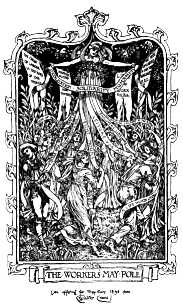
May 1st, International Workers’ Day, commemorates the historic struggle of working people throughout the world, and is recognized in most countries. The United States of America and Canada are among the exceptions. This despite the fact that the holiday began in the 1880s in the USA, linked to the battle for the eight-hour day, and the Chicago anarchists.

The struggle for the eight-hour day began in the 1860s. In 1884, the Federation of Organized Trades and Labor Unions of the United States and Canada, organized in 1881 (and changing its name in 1886 to American Federation of Labor ) passed a resolution which asserted that “eight hours shall constitute a legal day’s work from and after May 1, 1886, and that we recommend to labor organizations throughout this district that they so direct their laws as to conform to this resolution”. The following year the Federation repeated the declaration that an eight-hour system was to go into effect on May 1, 1886. With workers being forced to work ten, twelve, and fourteen hours a day, support for the eight-hour movement grew rapidly. In the months prior to May 1, 1886, thousands of workers, organized and unorganized, members of the organization Knights of Labor and of the federation, were drawn into the struggle. Chicago was the main center of the agitation for a shorter day. The anarchists were in the forefront of the Central Labor Union of Chicago, which consisted of 22 unions in 1886, among them the seven largest in the city.

During the Railroad strikes of 1877, the workers had been violently attacked by the police and the United States Army. A similar tactic of state terrorism was prepared by the bureaucracy to fight the eight-hour movement. The police and National Guard were increased in size and received new and powerful weapons financed by local business leaders. Chicago’s Commercial Club purchased a $2000 machine gun for the Illinois National Guard to be used against strikers. Nevertheless, by May 1st, the movement had already won gains for many Chicago workers. But on May 3, 1886, police fired into a crowd of strikers at the McCormick Harvester Machine Company, killing at least one striker, seriously wounding five or six others, and injuring an undetermined number. Anarchists called for a mass meeting the next day in Haymarket Square to protest the brutality.

The meeting proceeded without incident, and by the time the last speaker was on the platform, the rainy gathering was already breaking up, with only about two hundred people remaining. It was then a police column of 180 men marched into the square and ordered the meeting to disperse. At the end of the meeting a bomb was thrown at the police, killing one instantly, six others died later. About seventy police officers were wounded. Police responded by firing into the crowd. How many civilians were wounded or killed from police bullits never was ascertained exactly. Although it was never determined who threw the bomb, the incident was used as an excuse to attack anarchists and the labor movement in general. Police ransacked the homes and offices of suspected radicals, and hundreds were arrested without charge. A reign of police terror swept over Chicago. Staging “raids” in the working-class districts, the police rounded up all known anarchists and other socialists. “Make the raids first and look up the law afterward!” publicly counseled the state’s attorney.

Anarchists in particular were harassed, and eight of Chicago’s most active were charged with conspiracy to murder in connection with the Haymarket bombing. A kangaroo court found all eight guilty, despite a lack of evidence connecting any of them to the bomb-thrower, and they were sentenced to die. In October 9, 1886, the weekly journal Knights of Labor published in Chicago, carried on page 1 the following announcement: “Next week we begin the publication of the lives of the anarchists advertised in another column.”

The advertisement, carried on page 14, read: The story of the anarchists, told by themselves; Parsons, Spies, Fielden, Schwab, Fischer, Lingg, Engle, Neebe. The only true history of the men who claim that they are condemned to suffer death for exercising the right of Free Speech: Their association with Labor, Socialistic and Anarchistic Societies, their views as to the aims and objects of these organizations, and how they expect to accomplish them; also their connection with the Chicago Haymarket Affair. Each man is the author of his own story, which will appear only in the “Knights of Labor” during the next three months, – the great labor paper of the United States, a 16-page weekly paper, containing all the latest foreign and domestic labor news of the day, stories, household hints, etc. A co-operative paper owned and controlled by members of the Knights of Labor, and furnished for the small sum of $1.00 per annum. Adress all communications to Knights of Labor Publishing Company, 163 Washington St., Chicago, Ill. Later this journal and the paper Alarm published the autobiographies of the Haymarket men.

Albert Parsons, August Spies, Adolf Fischer and George Engel were hanged on November 11, 1887. Louis Lingg committed suicide in prison. The authorities turned over the bodies to friends for burial, and one of the largest funeral processions in Chicago history was held. It was estimated that between 150,000 to 500,000 persons lined the route taken by the funeral cortege of the Haymarket martyrs. A monument to the executed men was unveiled June 25, 1893 at Waldheim Cemetery in Chicago. The remaining three, Samuel Fielden, Oscar Neebe and Michael Schwab, were finally pardoned in 1893.

On June 26, 1893, the governor of Illinois, John Peter Altgeld, issued the pardon message in which he made it clear that he was not granting the pardon because he believed that the men had suffered enough, but because they were innocent of the crime for which they had been tried, and that they and the hanged men had been the victims of hysteria, packed juries and a biased judge. He noted that the defendants were not proven guilty because the state “has never discovered who it was that threw the bomb which killed the policeman, and the evidence does not show any connection whatsoever between the defendants and the man who threw it.”

International Workers’ Day is the commemoration of the Haymarket Event in Chicago in 1886. In 1889, the first congress of the Second International, meeting in Paris for the centennial of the French Revolution and the Exposition Universelle (1889), following an initiative from the American Federation of Labor, called for international demonstrations on the 1890 anniversary of the Chicago protests. These were so successful that May Day was formally recognized as an annual event at the International’s second congress in 1891.

It is not surprising that the state, business leaders, mainstream union officials, and the media would want to hide the true history of May Day. In its attempt to erase the history and significance of May Day, the United States government declared May 1st to be “Law Day”, and gave the workers instead Labor Day, the first Monday of September – a holiday devoid of any historical significance.

Nevertheless, rather than suppressing the labor and anarchist movements, the events of 1886 and the execution of the Chicago anarchists, spokesmen of the movement for the eight-hour day, mobilized many generations of radicals. Emma Goldman, a young immigrant at the time, later pointed to the Haymarket affair as her political birth. Instead of disappearing, the anarchist movement only grew in the wake of Haymarket.

As workers, we must recognize and commemorate May Day not only for it’s historical significance, but also as a time to organize around issues of vital importance of today for the working-class broadly defined, i.e. the grassroots – the people seen as a class in contrast to the superiors in income and/or rank – economically and/or political/administrative.

The May Day Manifestos of the International Workers of the World affiliated to the Anarchist International, from the latest years are published on its Webpage, click here!

Perceptions of Power

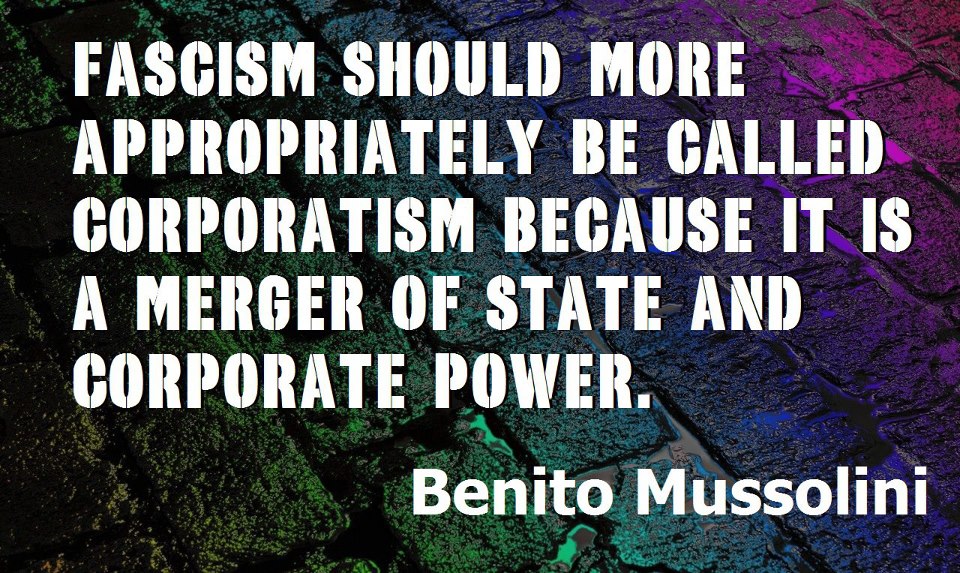
Fascism-s-b-called-Corporatism-Mussolini

By

Source: Center for a Stateless Society

Parsing Political Divides in the Mainstream and in Anarchism

CNBC describes the Corporate Perception Indicator as “a far-reaching survey of business executives and the general population from 25 markets,” “research firm Penn Schoen Berland survey[ing] 25,012 individuals and 1,816 business executives.” The results of the survey show quite unsurprisingly that the general public associates government with words like “corruption,” “lies,” “incompetence,” and “thieves.” As for big business, the words that came to the minds of those surveyed included, again, “corruption” and “thieves,” also “monopoly” and “power.” Interestingly, overall perceptions of both corporations and government appear to be largely negative. In American political discourse, the political right is characterized by a perceptible overpraise of business, devoted to a view of corporations that sees them as essentially free market actors, “creators” and “doers” that give us progress and innovation. Even if this is not true of everyone on the American right, certainly such sentiments are important to the right’s narrative on free markets. The right looks on government, in contrast, as the bungling and inept meddler attempting to hold back our industrious and our productive, the supporter of the lazy and parasitic who would rather live on the government dole than work for a living.

On the left, corporations are perceived as putting profits above people, as willing to do anything to suck more and more of the world’s natural wealth into the hands of a grasping, extravagant one percent. Government, on the other hand, is treated as the agent of “the greater good” or “the public good,” a kind of benevolent, altruistic mother to us all.

In the United States, people who identify themselves as free marketers or libertarians are much more likely to align with the former of these competing narratives, the right’s assertion that the corporation is the home of the movers and the shakers, the creative and energetic champions of free enterprise. This relationship between self-identified libertarians and the American right helps explain the broader anarchist movement’s pardonable reluctance to accept individualist or market anarchists as the genuine article. Further, hostility toward communism has a long history in individualist anarchism, typified by Benjamin Tucker’s frequent denunciations, yet certainly preceding them.[1]

We may observe at this juncture that both the right and the left share the historically and empirically ridiculous theory that government and corporate power are locked in an eternal war. But it is a great politico-economic myth that governments and large corporations operate at variance with one another, that one must align herself in her political commitments with one or the other, never both, never neither. For left wing individualists, surveys which demonstrate dissatisfaction with and negative attitudes toward both actually make perfect sense. That big business should be associated with greed and governments with corruption is hardly astonishing or remarkable. Further, these results underline the problem with seeing corporate power and government power as rivals, rather than seeing them much more accurately as codependent partners in crime, mutually reinforcing components parts of a larger phenomenon we might call a ruling class or power elite.

We needn’t risk the cognitive dissonance that comes with treating the State as the great restraint upon the socially destructive avarice of multinational corporations. For we find, whenever we bother to look, that elites in the business community regularly work with the public sector to create conditions accommodating to monopolism. The ideal of free and open competition, however championed in corporate press releases and political campaigning, is nowhere to be found and indeed never has been. Thus do market anarchists prosecute our laissez faire critique of capitalism. We come from an older tradition of American libertarians, radicals who contemned capitalism as much as any communist, but understood the importance of individual rights and mutually beneficial trade.

It is interesting to witness anarchist communists and syndicalists develop strict, exclusionary criteria for anarchism, particularly insofar as the arguable father of our doctrine, Pierre-Joseph Proudhon, was neither, his mutualism containing many market-friendly if not outright pro-market elements. No less important for anarchism as it developed in America is Josiah Warren, whose first forays into anarchist thought antedate Proudhon. If market or individualist anarchism represents a form of “pseudo-intellectualism,” then some of the anarchist tradition’s brightest lights must apparently be relegated to the dustbin of history. Granting that opposition to not only political but also economic authority is a necessary condition for the true anarchist, individualists like Warren (and his followers such as Benjamin Tucker) more than qualify.

Whether our communist and syndicalist comrades admit it or not, free market ideas figured prominently in fledgling anarchist thought, regarded as perfectly consistent with and a natural outgrowth of, to quote Warren, “the absolute right of supreme individuality.” Considering Warren as an example, many contemporary anarchists may not know that anarchist luminary Peter Kropotkin acknowledged Warren as an inspiration and, in the words of Crispin Sartwell, “a precursor of (and influence on?) Proudhon.” In discussing Warren’s legacy, Sartwell observes one of the major, continuing tensions between the individualist and communist strains of anarchism, the debate on “lifestyle anarchism.” Sartwell argues, quite correctly in the author’s view, that Warren “belongs squarely in what is called by its opponents ‘lifestyle anarchism’: that strain concerned with creating alternatives within the interstices in the existing system rather than arming to overthrow it.” “Peaceful Revolutionist” that he was, Warren emphasized experiments in the creation of practical alternatives to dominant economic and social modalities. To Warren, the whole of life was open to and the subject of reform. This holistic approach, the universality of his critique of the existing state of affairs, he likely inherited from Robert Owen, even while dispensing with other aspects of Owenite thinking. Indeed, Warren’s departure from Owen and his ideas offers us an illuminative proxy for the tensions and debates that still divide individualist from communist elements within anarchism. Warren worried about the overwhelming of the individual within combinations and, paraphrasing Sartwell, imposed a priori schemes. Communists often tend to see the undisciplined “lifestylism” of Warren-type experimentation as essentially bourgeois, outside of or ancillary to genuine class struggle.

Discussing early figures in anarchism such as Warren opens opportunities to reflect on the similarities that unite all anarchists. We can pause to wonder what someone with Warren’s breadth of interests and hopes for reform might think of twenty-first century problems and perceptions thereof.

As all anarchists understand, politics is at bottom conquest, spoliation and rape. Everything else, everything peaceful, voluntary and consensual is something different, throwing the distinction between the “politics means” and the “economic means” once again into sharp relief. The economic means to wealth is defined by the normal, even obvious standards we refer to in interactions with merchants, our friends, and family, the mutually beneficial guidelines we use to cooperate and trade with coequals. The political means, by contrast, is the acquisition of wealth by aggression, by forcible extraction through systematic privilege. The State, being the organization with a monopoly on the legal use of force, is the wellspring of such privilege. As Josiah Warren pointed out in Equitable Commerce:

Theorists have told us that laws and governments are made for the security of person and property; but it must be evident to most minds, that they never have, never will accomplish this professed object; although they have had the world at their control for thousands of years, they have brought it to a worse condition than that in which they found it, in spite of immense improvements in mechanism, division of labor, and other elements of civilization to aid them. On the contrary, under the plausible pretext of securing person and property, they have spread wholesale destruction, famine, and wretchedness in every frightful form over all parts of the earth, where peace and security might otherwise have prevailed. They have shed more blood, committed more murders, tortures, and other frightful crimes in the struggles against each other for the privilege of governing, than society ever would or could have suffered in the total absence of all government whatever.

A deep, principled loathing of both big business and government unites all anarchists. Confronted with the alarming realities of the present moment, its authoritarian repressions and economic maladies, anarchists ought to help one another in peaceful projects to build a freer, better world. Data such as those contained in the Corporate Perception Indicator survey show a world fully primed for our anti-authoritarian, anti-capitalist critiques. It falls upon us to communicate our message, to do the constructive work of inaugurating a new order.

[1] Relatedly, in True Civilization, Josiah Warren wrote, “What is called conservatism has all the time been entirely right in its objections to communism, and in insisting on individual ownership and individual responsibilities both of which communism annihilates; conservatism has also shown wisdom in its aversion to sudden and great changes, for none have been devised that contained the elements of success.”


Saturday Morning Matinee: The Net

netcover2

Notes by Other Cinema:

Ultimately stunning in its revelations, Lutz Dammbeck’s The Net explores the incredibly complex backstory of Ted Kaczynski, the infamous Unabomber. This exquisitely crafted inquiry into the rationale of this mythic figure situates him within a late 20th Century web of technology—a system that he grew to oppose. A marvelously subversive approach to the history of the Internet, this insightful documentary combines speculative travelogue and investigative journalism to trace contrasting countercultural responses to the cybernetic revolution.

For those who resist these intrusive systems of technological control, the Unabomber has come to symbolize an ultimate figure of Refusal. For those that embrace it, as did and do the early champions of media art like Marshall McLuhan, Nam June Paik, and Stewart Brand, the promises of worldwide networking and instantaneous communication outweighed the perils. Dammbeck’s conceptual quest links these multiple nodes of cultural and political thought like the Internet itself. Circling through themes of utopianism, anarchism, terrorism, CIA, LSD, Tim Leary, Ken Kesey and the Merry Pranksters, The Net exposes a hidden matrix of revolutionary advances, coincidences, and conspiracies.

http://www.youtube.com/watch?v=xLqrVCi3l6E

Saturday Matinee: What to Do in Case of Fire?

3b6ef1ef605e7

“What to Do in Case of Fire?” (2001) opens with a montage of young anarchist squatters fighting police, making propaganda films, and constructing a homemade bomb in Berlin circa 1987. They plan to blow up a vacant mansion but the bomb is a dud, until thirteen years later when it injures a real estate broker and potential buyer in a fluke accident.

Only two of the original members of the anarchist collective, Tim and Hotte, are still squatting in the same communal housing since the 80s and are unable to prevent police from confiscating filmed evidence in a raid triggered by the bomb incident. Because all members of the collective are potentially linked to the bombing, Tim and Hotte scramble to track down former comrades and formulate an action plan before the evidence is examined. The reunion of old friends, including those who’ve settled into traditional family life or sold out for corporate jobs, stirs up a host of interpersonal conflicts which they must resolve in order to work together to remain free.

Though the film does at times seem to fall back on lazy stereotypes of anarchists, it at least puts them in a human light. Even less radical viewers could relate to certain struggles the protagonists are faced with, such as trying to balance freedom and security, being “successful” versus upholding one’s ideals, and coming to terms with friendships that change over time. It would have been interesting had the film delved deeper into Berlin’s anarchist and squatters movements, in my opinion, but it’s nevertheless a charming and fun mix of comedy, drama and heist genres.

Note: to activate English subtitles on the video, click on the Closed Captions (CC) icon on the bottom right corner while video is playing, click on the box that says “Portuguese (Brazil)”, click “Translate Captions”, click on “Afrikaans”, then you should be able to scroll down until you can click on “English”. The subtitle feature might not be available on some portable devices.