Clinging Bitterly to Guns and Religion

The End Stage of American Empire
By William J. Astore

Source: TomDispatch.com

All around us things are falling apart. Collectively, Americans are experiencing national and imperial decline. Can America save itself? Is this country, as presently constituted, even worth saving?

For me, that last question is radical indeed. From my early years, I believed deeply in the idea of America. I knew this country wasn’t perfect, of course, not even close. Long before the 1619 Project, I was aware of the “original sin” of slavery and how central it was to our history. I also knew about the genocide of Native Americans. (As a teenager, my favorite movie — and so it remains — was Little Big Man, which pulled no punches when it came to the white man and his insatiably murderous greed.)

Nevertheless, America still promised much, or so I believed in the 1970s and 1980s. Life here was simply better, hands down, than in places like the Soviet Union and Mao Zedong’s China. That’s why we had to “contain” communism — to keep them over there, so they could never invade our country and extinguish our lamp of liberty. And that’s why I joined America’s Cold War military, serving in the Air Force from the presidency of Ronald Reagan to that of George W. Bush and Dick Cheney. And believe me, it proved quite a ride. It taught this retired lieutenant colonel that the sky’s anything but the limit.

In the end, 20 years in the Air Force led me to turn away from empire, militarism, and nationalism. I found myself seeking instead some antidote to the mainstream media’s celebrations of American exceptionalism and the exaggerated version of victory culture that went with it (long after victory itself was in short supply). I started writing against the empire and its disastrous wars and found likeminded people at TomDispatch — former imperial operatives turned incisive critics like Chalmers Johnson and Andrew Bacevich, along with sharp-eyed journalist Nick Turse and, of course, the irreplaceable Tom Engelhardt, the founder of those “tomgrams” meant to alert America and the world to the dangerous folly of repeated U.S. global military interventions.

But this isn’t a plug for TomDispatch. It’s a plug for freeing your mind as much as possible from the thoroughly militarized matrix that pervades America. That matrix drives imperialism, waste, war, and global instability to the point where, in the context of the conflict in Ukraine, the risk of nuclear Armageddon could imaginably approach that of the 1962 Cuban Missile Crisis. As wars — proxy or otherwise — continue, America’s global network of 750-odd military bases never seems to decline. Despite upcoming cuts to domestic spending, just about no one in Washington imagines Pentagon budgets doing anything but growing, even soaring toward the trillion-dollar level, with militarized programs accounting for 62% of federal discretionary spending in 2023.

Indeed, an engorged Pentagon — its budget for 2024 is expected to rise to $886 billion in the bipartisan debt-ceiling deal reached by President Joe Biden and House Speaker Kevin McCarthy — guarantees one thing: a speedier fall for the American empire. Chalmers Johnson predicted it; Andrew Bacevich analyzed it. The biggest reason is simple enough: incessant, repetitive, disastrous wars and costly preparations for more of the same have been sapping America’s physical and mental reserves, as past wars did the reserves of previous empires throughout history. (Think of the short-lived Napoleonic empire, for example.)

Known as “the arsenal of democracy” during World War II, America has now simply become an arsenal, with a military-industrial-congressional complex intent on forging and feeding wars rather than seeking to starve and stop them. The result: a precipitous decline in the country’s standing globally, while at home Americans pay a steep price of accelerating violence (2023 will easily set a record for mass shootings) and “carnage” (Donald Trump’s word) in a once proud but now much-bloodied “homeland.”

Lessons from History on Imperial Decline

I’m a historian, so please allow me to share a few basic lessons I’ve learned. When I taught World War I to cadets at the Air Force Academy, I would explain how the horrific costs of that war contributed to the collapse of four empires: Czarist Russia, the German Second Reich, the Ottoman empire, and the Austro-Hungarian empire of the Habsburgs. Yet even the “winners,” like the French and British empires, were also weakened by the enormity of what was, above all, a brutal European civil war, even if it spilled over into Africa, Asia, and indeed the Americas.

And yet after that war ended in 1918, peace proved elusive indeed, despite the Treaty of Versailles, among other abortive agreements. There was too much unfinished business, too much belief in the power of militarism, especially in an emergent Third Reich in Germany and in Japan, which had embraced ruthless European military methods to create its own Asiatic sphere of dominance. Scores needed to be settled, so the Germans and Japanese believed, and military offensives were the way to do it.

As a result, civil war in Europe continued with World War II, even as Japan showed that Asiatic powers could similarly embrace and deploy the unwisdom of unchecked militarism and war. The result: 75 million dead and more empires shattered, including Mussolini’s “New Rome,” a “thousand-year” German Reich that barely lasted 12 of them before being utterly destroyed, and an Imperial Japan that was starved, burnt out, and finally nuked. China, devastated by war with Japan, also found itself ripped apart by internal struggles between nationalists and communists.

As with its prequel, even most of the “winners” of World War II emerged in a weakened state. In defeating Nazi Germany, the Soviet Union had lost 25 to 30 million people. Its response was to erect, in Winston Churchill’s phrase, an “Iron Curtain” behind which it could exploit the peoples of Eastern Europe in a militarized empire that ultimately collapsed due to its wars and its own internal divisions. Yet the USSR lasted longer than the post-war French and British empires. France, humiliated by its rapid capitulation to the Germans in 1940, fought to reclaim wealth and glory in “French” Indochina, only to be severely humbled at Dien Bien Phu. Great Britain, exhausted from its victory, quickly lost India, that “jewel” in its imperial crown, and then Egypt in the Suez debacle.

There was, in fact, only one country, one empire, that truly “won” World War II: the United States, which had been the least touched (Pearl Harbor aside) by war and all its horrors. That seemingly never-ending European civil war from 1914 to 1945, along with Japan’s immolation and China’s implosion, left the U.S. virtually unchallenged globally. America emerged from those wars as a superpower precisely because its government had astutely backed the winning side twice, tipping the scales in the process, while paying a relatively low price in blood and treasure compared to allies like the Soviet Union, France, and Britain.

History’s lesson for America’s leaders should have been all too clear: when you wage war long, especially when you devote significant parts of your resources — financial, material, and especially personal — to it, you wage it wrong. Not for nothing is war depicted in the Bible as one of the four horsemen of the apocalypse. France had lost its empire in World War II; it just took later military catastrophes in Algeria and Indochina to make it obvious. That was similarly true of Britain’s humiliations in India, Egypt, and elsewhere, while the Soviet Union, which had lost much of its imperial vigor in that war, would take decades of slow rot and overstretch in places like Afghanistan to implode.

Meanwhile, the United States hummed along, denying it was an empire at all, even as it adopted so many of the trappings of one. In fact, in the wake of the implosion of the Soviet Union in 1991, Washington’s leaders would declare America the exceptional “superpower,” a new and far more enlightened Rome and “the indispensable nation” on planet Earth. In the wake of the 9/11 attacks, its leaders would confidently launch what they termed a Global War on Terror and begin waging wars in Afghanistan, Iraq, and elsewhere, as in the previous century they had in Vietnam. (No learning curve there, it seems.) In the process, its leaders imagined a country that would remain untouched by war’s ravages, which was we now know — or do we? — the height of imperial hubris and folly.

For whether you call it fascism, as with Nazi Germany, communism, as with Stalin’s Soviet Union, or democracy, as with the United States, empires built on dominance achieved through a powerful, expansionist military necessarily become ever more authoritarian, corrupt, and dysfunctional. Ultimately, they are fated to fail. No surprise there, since whatever else such empires may serve, they don’t serve their own people. Their operatives protect themselves at any cost, while attacking efforts at retrenchment or demilitarization as dangerously misguided, if not seditiously disloyal.

That’s why those like Chelsea ManningEdward Snowden, and Daniel Hale, who shined a light on the empire’s militarized crimes and corruption, found themselves imprisoned, forced into exile, or otherwise silenced. Even foreign journalists like Julian Assange can be caught up in the empire’s dragnet and imprisoned if they dare expose its war crimes. The empire knows how to strike back and will readily betray its own justice system (most notably in the case of Assange), including the hallowed principles of free speech and the press, to do so.

Perhaps he will eventually be freed, likely as not when the empire judges he’s approaching death’s door. His jailing and torture have already served their purpose. Journalists know that to expose America’s bloodied tools of empire brings only harsh punishment, not plush rewards. Best to look away or mince one’s words rather than risk prison — or worse.

Yet you can’t fully hide the reality that this country’s failed wars have added trillions of dollars to its national debt, even as military spending continues to explode in the most wasteful ways imaginable, while the social infrastructure crumbles.

Clinging Bitterly to Guns and Religion

Today, America clings ever more bitterly to guns and religion. If that phrase sounds familiar, it might be because Barack Obama used it in the 2008 presidential campaign to describe the reactionary conservatism of mostly rural voters in Pennsylvania. Disillusioned by politics, betrayed by their putative betters, those voters, claimed the then-presidential candidate, clung to their guns and religion for solace. I lived in rural Pennsylvania at the time and recall a response from a fellow resident who basically agreed with Obama, for what else was there left to cling to in an empire that had abandoned its own rural working-class citizens?

Something similar is true of America writ large today. As an imperial power, we cling bitterly to guns and religion. By “guns,” I mean all the weaponry America’s merchants of death sell to the Pentagon and across the world. Indeed, weaponry is perhaps this country’s most influential global export, devastatingly so. From 2018 to 2022, the U.S. alone accounted for 40% of global arms exports, a figure that’s only risen dramatically with military aid to Ukraine. And by “religion,” I mean a persistent belief in American exceptionalism (despite all evidence to the contrary), which increasingly draws sustenance from a militant Christianity that denies the very spirit of Christ and His teachings.

Yet history appears to confirm that empires, in their dying stages, do exactly that: they exalt violence, continue to pursue war, and insist on their own greatness until their fall can neither be denied nor reversed. It’s a tragic reality that the journalist Chris Hedges has written about with considerable urgency.

The problem suggests its own solution (not that any powerful figure in Washington is likely to pursue it). America must stop clinging bitterly to its guns — and here I don’t even mean the nearly 400 million weapons in private hands in this country, including all those AR-15 semi-automatic rifles. By “guns,” I mean all the militarized trappings of empire, including America’s vast structure of overseas military bases and its staggering commitments to weaponry of all sorts, including world-ending nuclear ones. As for clinging bitterly to religion — and by “religion” I mean the belief in America’s own righteousness, regardless of the millions of people it’s killed globally from the Vietnam era to the present moment — that, too, would have to stop.

History’s lessons can be brutal. Empires rarely die well. After it became an empire, Rome never returned to being a republic and eventually fell to barbarian invasions. The collapse of Germany’s Second Reich bred a third one of greater virulence, even if it was of shorter duration. Only its utter defeat in 1945 finally convinced Germans that God didn’t march with their soldiers into battle.

What will it take to convince Americans to turn their backs on empire and war before it’s too late? When will we conclude that Christ wasn’t joking when He blessed the peacemakers rather than the warmongers?

As an iron curtain descends on a failing American imperial state, one thing we won’t be able to say is that we weren’t warned.
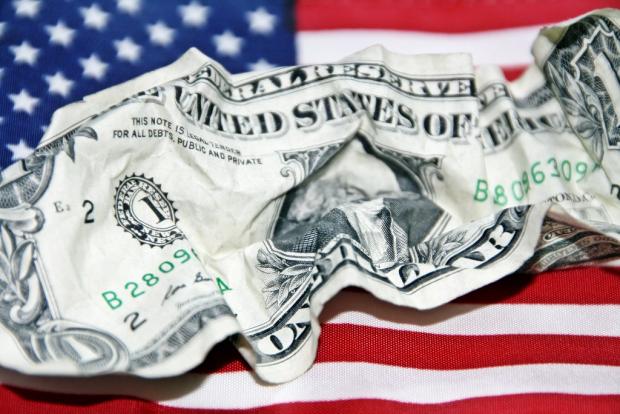

The End of American “Exceptionalism”?

Failing banks, inflation, soaring interest rates and the flight from the petrodollar could become a disaster for ordinary Americans

Dollar” by Images_of_Money is licensed under CC BY 2.0.

By Philip Giraldi

Source: FreePress.org

Watching a once great nation commit suicide is not pretty. President Joe Biden does not seem to understand that his role as elected leader of the United States is to take actions that directly or indirectly benefit the folks who voted for him as well as the other Americans who did not do so. That is how a constitutional democracy is supposed to work. Instead, Biden and the gang of introverts and neocon war criminals that the has surrounded himself with have done everything that can to inflict fatal damage on the economy through rash initiatives both overseas and at home. A spending spree to buy support from the bizarre constituencies that make up the Democrat Party base while also fighting an undeclared war in Europe have meant that nearly two trillion dollars has been added to the national debt under Biden’s rule, a debt that was already unsustainable at nearly $30 trillion, larger than the United States’ gross national product. Plans to cancel student loan debts will add hundreds of billions of dollars more to the red ink.

And those actions undertaken overseas, to include continuing to expand the war in Ukraine against Russia, will do immeasurable more damage. Consider how the Democratic Party has long had it in for Russian Federal President Vladimir Putin, dating back to when Putin took power in 2000 and started kicking out the western scallywags who were looting his country. Subsequently, false intelligence and other innuendoes were contrived by Hillary Clinton and her team in 2016 to implicate Donald Trump as a Russian stooge who was secretly working for Putin. When that didn’t work and Trump was elected, the Russians were accused by the media and Democrats of willy-nilly interfering in US elections more generally speaking, a much-exaggerated claim in contrast to the overwhelming silence surrounding the real electoral and policy interference, which has been coming from Israel and its fifth column inside the United States, who, not coincidentally, are the chief proponents of the war against Russia.

Placing a target on Vladimir Putin’s back appears to have an unfortunate consequence which Biden has yet to wake up to, namely the fact that the United States now has what might be described as a Ponzi scheme faux economy which is very vulnerable, particularly as much of the world has become disenchanted with the US style of global leadership. Note for example the recent state visit by French President Emmanuel Macron to Beijing, where he embraced a “global strategic partnership with China” to bring about a “multipolar” world, freed of “blocs” that is not sheltering behind “Cold War mentality.” Macron also criticized the “extraterritoriality of the US dollar.”

And threats made by the Bidens against both China and Russia have accomplished little beyond drawing the two major political and military powers closer together. Beijing and Moscow entered into a trade agreement in their own currencies in 2014 and have openly taken steps to challenge US dominance of international currency exchanges, creating instead a global multipolar trading environment. Europe aside, many nations are now eager to cut the tie that binds, which is the decades long American dominance of international financial mechanisms and also the general use of dollars to pay for oil and other energy supplies. The widespread use of petrodollars enables the buffoonish Janet Yellen at the US Treasury and the Federal Reserve banks to print unlimited unbacked fiat currency, knowing that there will always be a market for it.

Which brings us back to the Ukraine war, pursued “until we win” by Biden and his somnolent Secretary of State Antony Blinken. One of the first moves when Russia intervened in Ukraine was to block and eventually confiscate Russia’s 300 billion dollars-worth of foreign reserves in banks in the US and Europe. That sent a shock wave across currency markets all around the world. Biden and Yellen had weaponized the US’s own national currency, which hitherto had been an untouchable step in international relations for nations that were not actually at war. Countries like China and India with large economies then realized that the US Treasury Department and the dominance of the dollar as an exchange currency had now become a weapon of war and a serious threat to the economies of all other nations.

As a consequence, the US Dollar is right now being rejected by many nations as the world’s reserve currency. Some nations all over the world have agreed to use the Chinese Yuan and Indian Rupee for any-and-all international currency transactions. Saudi Arabia continues to use the petrodollar but does not demand it. Recently, Saudi Crown Prince Mohammed bin Salman and Chinese President Xi Jinping agreed to permit the Saudis to sell oil to China in Yuan. Saudi Arabia, the world’s largest oil exporter, is now allowing multiple currencies to be used to purchase its oil, a major attack on the primacy of the US dollar and it also has accepted Chinese mediation to mend fences with the US and Israel’s arch enemy Iran. And the Saudis have even more recently refused a Biden Administration request that it start pumping more oil to reduce energy costs, signaling that the shift is both political and economic in nature. Japan, a major economy, has also started purchasing oil and gas directly from Russia against the US imposed energy embargo while Brazil, another major economy, has agreed to use the Yuan in its increasing trade with China. As fewer nations utilize the US dollar, America’s ability to export and ignore its burgeoning domestic debt and inflation to other countries is being diminished.

This might have a decisive impact on the US currency as the drive to break with the petrodollar continues to grow and could produce something like a “perfect storm” impacting on the US economy. It threatens to drastically lower the standards of living of nearly all Americans within the next several years as the dollar loses value and purchasing power. As the US economy is heavily interconnected with many European economies, Europe is also likely to be a victim of the coming disaster.

The good news, of course, is that the United States will no longer be able to afford its endless wars and international interventions. Lacking its economic power, it will no longer be able to declare itself “exceptional” and the enforcer of a “rules based international order.” It would mean an ending of the funding of developments like the Ukraine proxy war and the troops will have to come home from places like Syria and Somalia. And it might even mark the ending of sending billions of dollars annually to a wealthy Israel.

Ending dollar supremacy would inevitably have an immediate impact on what passes for US foreign policy, making it more difficult for Washington to initiate and sustain Treasury Department sanctions on countries like Iran and North Korea. It could also create economic turmoil for many countries until the situation resolves itself by producing greater volatility in currency markets worldwide. The Federal Reserve Bank will no doubt respond to the unfolding crisis by acting as it always does by raising interest rates to astronomical levels, thereby hurting most the Americans who can least afford the shock therapy.

And it did not have to turn out this way. It could have been avoided. If the US, which had no horse in the race, had left Ukraine alone Vladimir Putin would not have become a symbol of defiance against the “Rules Based International Order” and he would not have worked with China to establish multipolarity in the way the financial world operates. Instead, we have a situation where Europe is being de-industrialized due to soaring energy prices and Washington’s destruction of the Nord Stream pipelines while the US is potentially confronting economic disaster as the dollar’s relevance to international trade sinks. The ultimate irony is that Russia, and also the US/Israeli arch enemy Iran, are by comparison doing quite well economically as they sell their oil and gas to anyone in any currency. One has to conclude that when US Treasury Secretary Janet Yellen recently made her secret trip to Kiev to promise the despicable Volodymyr Zelensky billions of taxpayer dollars the United States might just have been better served if she had stayed in Washington and made some minimal effort to address the mounting economic problems confronting us here at home.

We Create Our Own Reality

By Julien Charles

Source: Off-Guardian

The world watched in varying states of mind as the Davos set enjoyed its annual turn on the world stage, supping on sumptuous Atlantic crab and fresh Iberian pork, sustainable Norweigian cod, and the best Italian coffee.

When not tucking into a lavish feast, they bandied about their ideas for how the world ought to exploited (the key euphemisms here are “sustainable,” “stakeholder,” and “impossible beef.”)

Some revile and protest the annual ruling class summit, but many millions more embrace it, even gaze admirably at the mandarins of the new world order as they flit across mobile screens and offer uplifting quotes to curious media attendees.

Indeed, few seem to care as the cabal of monied interests chat amiably about centrally managed digital currencies, consolidating global health authority in unelected bodies, collapsing the world economy, generating needless food shortages, unpopular fake meat, and other new market opportunities. Fewer still see the implicit threat of globalist agendas to the rule of sovereign states.

There is such little resistance largely because billions of people believe what they read and what they are told by the news media. A healthy dose of distrust would serve the global populace well, if only it could release itself from the grip of mainstream corporate news.

In this respect, it’s worth remembering two quotes from the incomparable muckraker Upton Sinclair–author of the startling expose The Jungle.

In his book The Brass Check, Sinclair betrays the great lie of modern media, namely that it is independent. This easy falsehood is widely accepted. Millions of Americans believe that the truly deceitful media are the ones that YouTube labels as “state-affiliated media,” a damning modifier that instantly discredits every outlet so identified.

But Sinclair reminds us that “[Media] represents private interests, not public interests.” He could have gone farther and said mainstream media represents the private interests of elite capital. Marx said that every state serves a particular class. So does corporate media.

Sinclair later writes that, “It is difficult to get a man to understand something when his salary depends on his not understanding it.”

This second quote explains why so much of the MSM go along quite happily with the prescribed narrative from Washington. Their livelihoods depend on it. Occasionally a pious mainstream journalist will fiercely declare his independence from any malign editorial influence.

But as Michael Parenti responds,

“They like what you write because you write what they like.”

The principles of American exceptionalism are a prerequisite for any journalist hoping to earn a slot at a high-paying MSM outlet. They have long internalized the values of power. Put together, these quotes tell us that we are subjected to an official narrative that serves the interests of elite capital and is dutifully disseminated by a cabal of right-thinking stenographers.

The same elite interests that own the government own the media. Hence the narrative consistency.

ALTERNATE REALITY

Given that elite interests are largely out of step with the interests of the vast majority of Americans, we often find ourselves living in an alternate reality. The war in Ukraine is just the latest iteration. Most of the reality of the conflict has been obscured from view, sins of omission that ensure the public is largely misled. Fierce and ‘principled’ op-eds reinforce the bias. For instance, little attention is paid to:

Economic motivations underlying the conflict: arms sales for American defense contractors; oil and grain profits by crisis-oriented commodity monopolies; and broader agricultural profiteering by Monsanto and Dupont via a post-coup IMF agreement; the foreclosure of the Nord Stream 2 gas pipeline from the Baltic Sea into Germany, which opens the door to western consortiums supplying the shortfall.

Ukrainian academic Olga Baysha gave a telling interview to The Gray Zone. She noted how Volodymyr Zelensky’s neoliberal policies were sold as “westernization” and “modernization” to the Ukrainian public. But these were camouflage for privatization, deregulation, and downsizing of the public sphere, all commonplace neoliberal prescriptions for wealth extraction by global corporations. To secure this narrative, Zelensky shuttered opposition media channels and political parties, including sanctions and repression before the final step.

Zelensky was following the post-coup government’s deployment of ultranationalist battalions to violently extinguish the anti-coup resistance in Donbas. That “anti-terrorist operation” was really the beginning of a civil war by Kiev against its own population, including tanks and artillery, gunships and warplanes. The subsequent Minsk peace agreements were likewise largely ignored by the aggressive Kiev action against the East.

All of these political and national conflicts seem to evolve from—and devolve into—imperial economic relations. West against East, with Ukraine as a battleground. War is a revenue stream in capitalism. War is a profit center for the elites that own the media; it is only carnage for the lower classes. This distinction is rarely made.

WHY SOCIAL MEDIA HAS ABDICATED ITS ROLE

What is relatively unique in the propaganda about the Ukraine war is the degree to which social media has advanced its repressive apparatus in line with state directives. Social media became a serious thorn in the side of state power and corporate media when it consistently exposed falsehoods about the 2016 election, Russiagate, and the pandemic.

Though much war propaganda has been uncovered by scrupulous independent journalists (with a working class bias), the success of the Ukrainian narrative has been stupendous. Social media is falling in line, censoring or discrediting wrongthink whenever it appears.

What Google and YouTube and others are doing at the behest of the federal government is as Brett Weinstein said of the pandemic narrative, “They are infantilizing a huge fraction of the population. They are making certain discussions off limits.” We must “…adhere to certain pre-digested conclusions and we pretend that they emerged from evidence, which they do not.”

What we need is rational discussion. The answer to bad speech is more speech, not less. One would expect Google and YouTube and Facebook and Twitter to know this. In fact, it is very likely they do know this. As the venerable linguist politico Noam Chomsky once derisively commented, there’s no point in speaking truth to power: they already know the truth, and don’t care.

What has happened is what happens to all new media in a corporate fascist state: it is threatened until it complies with the official narrative being disseminated by the government, which is effectively owned by elite capital. Congress may have a word with Justice, and Justice may on a quiet Tuesday open the preliminaries of an antitrust investigation.

Suddenly the bright horizons of the Silicon giants are considerably dimmed. It is similar with the news media. The MSM rely too heavily on the gossip and good favor of well-placed officials; they bend too easily to the unspoken preferences of the advertisers who line their coffers; they keel too readily at the unctuous general who cavils over the soft treatment of a geopolitical rival. These perverse incentives are nicely modeled in Manufacturing Consent.

Elite capital may be loosely defined as those groups that are making enormous amounts of money off the status quo, even as many more millions are harmed by the same status quo. Elite capital used to be called “special interests.”

They are the rich and powerful billionaires who can be seen at Davos, on the boards and membership lists of the Rockefeller and Ford Foundations, the Bill and Melinda Gates Foundation and the Clinton Foundation; the Trilateral Commission and the Council on Foreign Relations; and in important think tanks like the Heritage Foundation, the American Enterprise Institute, the Brookings Institute, RAND Corporation, Cato, Hoover, CSIS, and Center for American Progress, among a proliferation of others.

They are thus not a monolithic or discrete coalition of individuals, but rather intertwined interests that share a common desire to uphold the existing establishment, by force or fraud.

MASTERS OF MYTH

Our current experience—in which we are terrifically afraid of a mild seasonal respiratory virus and terrifically xenophobic toward Russians—is reminiscent of the heyday of the Bush administration, when the neoconservative believers were riding high on a surfeit of manufactured intelligence.

Abetted by the ghoulish founder of Blairism, who claimed kindly London burghers might be liquidated by Arab WMDs in just 45 minutes. From launch to impact. From Baghdad missile shed to Kensington glade in less than an hour. Around that frightful time, George Bush’s svengali Karl Rove, educated a stunned reporter about what reality truly meant at the Metropole, in the imperium itself,

We’re an empire now, and when we act, we create our own reality. And while you’re studying that reality — judiciously, as you will — we’ll act again, creating other new realities, which you can study too, and that’s how things will sort out. We’re history’s actors … and you, all of you, will be left to just study what we do.”

That reality is what Henry Giroux called, “…the deadening unity and totalizing narratives that now marks dominant neoliberal and instrumental ideologies of the West.”

More than any moment in recent American history, we find ourselves under the spell of these reality makers, who have over the past five years produced a breathtaking array of crises that have utterly enthralled the population.

From the stunning election of a reeling madman, to chilling revelations of foreign influence, feckless investigations, failed impeachments, lethal pathogens launched from fog-draped bio labs in polluted Sino capitals, and finally to the good news of a redemptive election, only to be circumscribed by fatal new “variants” spread by pathologically stupid Trumpists.

And finally, the plague is swept from the marquee by Russian imperialism on the march in Europe. The masses automatically swap their masks for Ukrainian flags. The fear and anger remain, but are merely redirected.

WAGE SLAVERY AND PUBLIC CONSCIOUSNESS

The indoctrination of individuals into the doctrinal system of American exceptionalism is driven not only by media consolidation but also economic enslavement. First a couple of figures—as if we need more—from a John Steppling’s essay on his Aesthetic Resistance blog. He notes that in 1870 some 67 percent of Americans were self-employed, probably artisans or farmers of some kind.

Once industrial capitalism particularly in urban areas grew, that number plummeted. Today it stands at 6 percent. The point being that the independence of millions of Americans has been compromised. Now they work—millions of them—not for themselves but for vast faceless corporations.

Companies that are essentially fascist constructs, whose decisions are inscrutable to most employees, and which typically sweep the scythe of cost cutting through the ranks every few years, and increasingly turn to automated processes that are merely overseen by an incrementally deskilled workforce.

This alienation from our own work was not unaccompanied by attendent catastrophes. Alongside the vast migration of men and women into wage labor came first a rise and then a fierce destruction of union representation. That too stands at around 7 percent today, once as high as 35 percent in the early to mid 20th century, when there were socialists roaming the untamed streets and word of a Bolshevik Revolution rippled through bourgeois mansions.

The currents of the time were not overlooked by the managers of the economy. The bankers bought the papers. The president created a commission for public information. The business roundtable sketched anti-labor plot lines. Sigmund Freud’s nephew invented the dark arts of public relations.

A similar phenomenon occurred after the cultural explosion of the Sixties. The neoliberal rollback of the so-called welfare state on one hand (happily embraced by hippies as they tossed aside their tasseled suede for wide lapels and polyester pantsuits) and the co-optation of counterculture on the other.

As hippies reproduced, they found themselves suddenly needing the money on offer from the corporate monoliths they once defaced the logos of. No longer able to sustain themselves as village artisans or independent producers, they succumbed to the economic pressures and joined the rat race.

Madison Avenue, a Cyclopean beast capable of the most astonishing mimetic performances, quickly absorbed the counterculture and regurgitated rebellion as offbeat consumerism.

Everything became a style code. Facing down a lynch mob or jackbooted police cordon was replaced with wearing Chuck Conners sneakers, running marathons in ‘Just Do It’ Nikes, or donning a Coca-Cola tee shirt with a sardonic grin. At the radical end of the spectrum, burning draft cards were replaced with ‘buy nothing’ anti-consumer holidays.

Irony supplants resistance, a concession of the educated classes to the diminished prospects for revolution.

And so, having been alienated from their work, having had their counterculture killed, gutted, dressed, and stuffed, the average person has little recourse for independent thinking. At work, he is conditioned by a corporate culture that esteems ‘yes men’, pathologizes optimism, and encourages virtue signaling on behalf of the corporate charter, the values of which one is welcome to adopt as one’s own.

Away from the office, he encounters an ersatz ‘culture’ of media news and entertainment that reifies the values of the corporate state, which ostensibly include diversity, multiculturalism, and inclusion. The news instantiates the tropes of the corporate news hour, which feature the sly demonization of other societies under the guise of national security and the banner of freedom.

Then entertainment reinforces them. One reads of new sanctions levied against a rogue regime in Caracas, and then watches a new action series on Netflix in which an earnest American thwarts a diabolical scheme by the brown Venezuelan with an unquenchable thirst for yanquee blood.

IDEOLOGIES AND SUB-IDEOLOGIES

But should one spy the troubling contradictions between our professed values of inclusion and our foreign policy of exclusion, there is nowhere to turn. Unless one knows about marginalized progressive websites, Noam Chomsky primers, or a nearby Communist Meet Up, one is left with the cardboard caricatures of corporate media, which go to great lengths to convince you those contradictions are all a misunderstanding—your own, to be sure.

Without ‘comrades’ to confirm your natural mistrust, it will tend to fade as the omnipresent corporate conditioning takes over.

Louis Althusser, the French Marxist philosopher, wrote that we are all conditioned by the Ideological State Apparatuses (ISAs) and repressed by Repressive State Apparatuses (RSAs). He said we are ‘interpellated’ by the ISAs into the helpful groupthink that sustains the status quo. Perhaps to keep his readers from guzzling Drano, he did concede that ‘interventions’ were possible in which a sub-ideology breaks through a crack in the dominant ideology.

What this intervention produces, though, is indeterminate. A riotous uprising that is brutally put down by some frightful caudillo general? Whose leaders are liquidated in the bowels of some rusting soccer stadium held over from the Pan Am Games? Or perhaps the glorious, dreamed of Revolution (capital ‘R’) that guts the capitalist oligarchy, assumes its productive forces, and achieves a breathtaking synthesis of revolutionary theory and worker power? The pipe-puffing Althusser declined to say.

REALITY REPEATS ITSELF: AMOR FATI?

It is no surprise when we see such little resistance in the population to the supplying of $40 billion in lethal aid to Ukraine, or to aggressive authoritarian mandates of the government regarding the pandemic. For all of the aforementioned reasons, the dominant response is unquestioning compliance and even gratitude.

After all, having never been taught the past, or having deliberately compartmentalized those troubling histories, we digest the official narrative like a child accepts the spoonfuls of baby food from a doting mother. Tens of millions of doses of soma shoveled down the hatch at daybreak or dusk, or both, do their numbing best to aid and abet digestion of those sometimes thorny narratives, so thick with intrigue and, not occasionally, senselessness. The reward of the incurious is consensus.

Within the official narratives themselves, there is at least one constant: the demonization of the other. We can easily see parallels in the gross caricature of unvaccinated individuals as pathogenic threats in need of the needle and the demonization of Russians as barbaric hordes in need of European refinements.

These depictions are not far from the efforts of German National Socialists to segregate non-Aryans, mostly of Jewish origin, from the righteous population of pure-blood Volk. Yet one needn’t leave one’s own history to see this blatant segregationist behavior. The dark era of Jim Crow, and the modern version of the carceral state, evince the deep hostility of society for the other, those that differ in skin color, sex, gender, sexual preference, religion, ideology, economic model, or worldview.

Edward Said notes in Orientalism how the western Orientalist needed to whittle down Islam to the caricature of “tent and tribe” in order to fit it into his orderly cosmology, in which the rationalism of the European Enlightenment prevailed. Today the West performs the same reductionist act on Eurasia.

Reclining in his sumptuous country estate, the elitist Marquis tells Charles Darnay in A Tale of Two Cities, “Repression is the only lasting philosophy. The dark deference of fear and slavery…will keep the dogs obedient to the whip, as long as this roof shuts out the sky.”

Like Sinclair, Charles Dickens historicized his novels, and it might be noted that the Marquis’ venerable roof would soon fall with the collapsing scenery of the French Revolution. Whenever we are sold those confident, end-of-history tales from the corridors of elite power—be it a French chateau or a chalet in the Swiss Alps—we’d do well to recall the timeless warning of every marketplace and bazaar: caveat emptor.

America Leader of the Free World? How to Forget U.S. interference in Foreign Elections

By Philip Giraldi

Source: Strategic Culture Foundation

Joe Biden should read up on the history of American political and military interventions, regime changes and electoral interference worldwide.

After only five months in office, President Joe Biden has already become notorious for his verbal gaffes and mis-spokes, so much so that an admittedly Republican-partisan physician has suggested that he be tested to determine his cognitive abilities. That said, however, there is one June 16th tweet that he is responsible for that is quite straightforward that outdoes everything else for sheer mendacity. It appeared shortly after the summit meeting with Russian President Vladimir Putin and was apparently intended to be rhetorical, at least insofar as Biden understands the term. It went: “How would it be if the United States were viewed by the rest of the world as interfering with the elections directly of other countries and everybody knew it? What would it be like if we engaged in activities that he engaged in? It diminishes the standing of a country.”

There have been various estimates of just exactly how many elections the United States has interfered in since the Second World War, the numbers usually falling somewhere between 80 and 100, but that does not take into account the frequent interventions of various kinds that took place largely in Latin America between the Spanish-American War and 1946. One recalls how the most decorated Marine in the history of the Corps Major General Smedley Butler declared that “War is a racket” in 1935. He confessed to having “…helped make Mexico, especially Tampico, safe for American oil interests in 1914. I helped make Haiti and Cuba a decent place for the National City Bank boys to collect revenues in. I helped in the raping of half a dozen Central American republics for the benefits of Wall Street. The record of racketeering is long. I helped purify Nicaragua for the international banking house of Brown Brothers in 1909-1912. I brought light to the Dominican Republic for American sugar interests in 1916. In China I helped to see to it that Standard Oil went its way unmolested.”

And there have been since 1900 other regime change and interventionist actions, both using military force and also brought about by corrupting local politicians with money and other inducements. And don’t forget the American trained death squads active in Latin America. Some would also include in the list the possibly as many as 50 Central Intelligence Agency and Special Ops political assassinations that have been documented, though admittedly sometimes based on thin evidence.

That Joe Biden, who has been at a reasonably high level in the federal government for over forty years, including as Vice President for eight years and now President should appear to be ignorant of what his own government has done and quite plausibly continues to do is astonishing. After all, Biden was VP when Victoria Nuland worked for the Obama Administration as the driving force behind efforts in 2013-2014 to destabilize the Ukrainian government of President Viktor Yanukovych. Yanukovych, an admittedly corrupt autocrat, nevertheless became Prime Minister after a free election. Nuland, who is the Assistant Secretary of State for European and Eurasian Affairs at the State Department, provided open support to the Maidan Square demonstrators opposed to Yanukovych’s government, to include media friendly appearances passing out cookies on the square accompanied by Senator John McCain to encourage the protesters.

A Dick Cheney and Hillary Clinton protégé who is married to leading neocon Robert Kagan, Nuland openly sought regime change for Ukraine by brazenly supporting government opponents in spite of the fact that Washington and Kiev had ostensibly friendly relations. As Biden’s tweet even recognized in a backhanded way, it is hard to imagine that any U.S. administration would tolerate a similar attempt by a foreign nation to interfere in U.S. domestic politics, particularly if it were backed by a $5 billion budget, but Washington has long believed in a global double standard for evaluating its own behavior. Biden clearly is part of that and also clearly does not understand what he is doing or saying.

Nuland is most famous for her foul language when referring to the potential European role in managing the unrest that she and the National Endowment for Democracy had helped create. The Obama and Biden Administration’s replacement of the government in Kiev was the prelude to a sharp break and escalating conflict with Moscow over Russia’s attempts to protect its own interests in Ukraine, most particularly in Crimea. That point of conflict has continued to this day, with a U.S. warships in the Black Sea engaging in exercises with the Ukrainian navy.

Biden was also with the Obamas when they chose to destabilize and destroy Libya. Nor should Russia itself be forgotten. Boris Yeltsin was re-elected president of Russia in 1996 after the Clinton Administration pumped billions of dollars into his campaign, enabling him to win a close oligarch-backed victory that had been paid for and managed by Washington. Joe Biden was a Senator at the time.

And then there is Iran, where democratically elected Mohammed Mossadeq was deposed by the CIA in 1953 and replaced by the Shah. The Shah was replaced by the Islamic Republic in turn in 1979 and the poisoned relationship between Washington and Tehran has constituted a tit-for-tat quasi-cold war ever since, marked by assassinations and sabotage.

And who can forget Chile where Salvador Allende was removed by the CIA in 1973 and replaced by Augusto Pinochet? Or Cuba and the Bay of Pigs invasion in 1961 where the CIA failed to bring about regime change in Havana? Can it be that Joe Biden cannot recall any of those “interventions,” which were heavily covered in the international media at the time?

And to make up the numbers, Joe can possibly consider the multiple “interferences in elections,” which is more precisely what he was referring to. As a CIA officer stationed in Europe and the Middle East in and 1970s through the early 1990s, I can assure him that I personally know about nearly continuous interference in elections in places like France, Spain, Portugal and Italy, all of which had prominent communist parties, some of which were on the verge of government entry. Bags of money went to conservative parties, politicians were bribed and journalists bought. In fact, during that time period I would dare to say there was hardly an election that the United States did not somehow get involved in.

Does it still go on? The U.S. has been seeking regime change in Syria since 2004 and is currently occupying part of the country. And of course, Russia is on the receiving end of a delegitimization process through a controlled western media that is seeking to get rid of Putin by exploiting a CIA and western intelligence funded opposition. China has no real opposition or open elections, nor can its regime plausibly be changed, but it is constantly being challenged by depicting it and its behavior in the most negative fashion possible.

Joe Biden really should read up on the history of American political and military interventions, regime changes and electoral interference worldwide. He just might learn something. The most important point might, however, elude him. All of the intervention and all of the deaths have turned out badly both for the U.S. and for the people and countries being targeted. Biden has taken a bold step to withdraw U.S. forces from Afghanistan, though it now appears that that decision might be in part reversed. Much better to complete the process and also do the same thing in places like Iraq, Somalia and Syria. The whole world will be a better place for it.

What “Normal” Are We Returning To? The Depression Nobody Dares Acknowledge

By Charles Hugh Smith

Source: Of Two Minds

Perhaps we need an honest national dialog about declining expectations, rising inequality, social depression and the failure of the status quo.

Even as the chirpy happy-talk of a return to normal floods the airwaves, what nobody dares acknowledge is that “normal” for a rising number of Americans is the social depression of downward mobility and social defeat.

Downward mobility is not a new trend–it’s simply accelerating. As this RAND Corporation report documents, ( Trends in Income From 1975 to 2018) $50 trillion in earnings has been transferred to the Financial Aristocracy from the bottom 90% of American households over the past 45 years.

Time magazine’s article on the report is remarkably direct: The Top 1% of Americans Have Taken $50 Trillion From the Bottom 90% — And That’s Made the U.S. Less Secure.

“The $50 trillion transfer of wealth the RAND report documents has occurred entirely within the American economy, not between it and its trading partners. No, this upward redistribution of income, wealth, and power wasn’t inevitable; it was a choice–a direct result of the trickle-down policies we chose to implement since 1975.

We chose to cut taxes on billionaires and to deregulate the financial industry. We chose to allow CEOs to manipulate share prices through stock buybacks, and to lavishly reward themselves with the proceeds. We chose to permit giant corporations, through mergers and acquisitions, to accumulate the vast monopoly power necessary to dictate both prices charged and wages paid. We chose to erode the minimum wage and the overtime threshold and the bargaining power of labor. For four decades, we chose to elect political leaders who put the material interests of the rich and powerful above those of the American people.”

I’ve been digging into downward mobility and social depression for years: Are You Really Middle Class?

The reality is that the middle class has been reduced to the sliver just below the top 5%–if we use the standards of the prosperous 1960s as a baseline.

The downward mobility isn’t just financial–it’s a decline in political power, control of one’s work and ownership of income-producing assets. This article reminds us of what the middle class once represented: What Middle Class? How bourgeois America is getting recast as a proletariat.

This reappraisal of the American Dream is also triggering a reappraisal of the middle class in the decades of widespread prosperity: The Myth of the Middle Class: Have Most Americans Always Been Poor?

Downward mobility excels in creating and distributing what I term social defeat: In my lexicon, social defeat is the spectrum of anxiety, insecurity, chronic stress, fear and powerlessness that accompanies declining financial security and social status.

Downward mobility and social defeat lead to social depression. Here are the conditions that characterize social depression:

1. High expectations of endlessly rising prosperity instilled as a birthright no longer align with economy reality.

2. Part-time and unemployed people are marginalized, not just financially but socially.

3. Widening income/wealth disparity as those in the top 10% pull away from the bottom 90%.

4. A systemic decline in social/economic mobility as it becomes increasingly difficult to move from dependence on the state or one’s parents to financial independence.

5. A widening disconnect between higher education and employment: a college/university degree no longer guarantees a stable, good-paying job.

6. A failure in the Status Quo institutions and mainstream media to recognize social depression as a reality.

7. A systemic failure of imagination within state and private-sector institutions on how to address social depression issues.

8. The abandonment of middle class aspirations: young people no longer aspire to (or cannot afford) consumerist status symbols such as luxury autos or conventional homeownership.

9. A generational abandonment of marriage, families and independent households as these are no longer affordable to those with part-time or unstable employment.

10. A loss of hope in the young generations as a result of the above conditions.

The rising tide of collective anger arising from social depression is visible in many places: road rage, violent street clashes between groups seething for a fight, the destruction of friendships for holding “incorrect” ideological views, and so on.

A coarsening of the entire social order is increasingly visible: The Age of Rudeness.

Depressive thoughts (and the emotions they generate) tend to be self-reinforcing, and this is why it’s so difficult to break out of depression once in its grip.

One part of the healing process is to expose the sources of anger that we are repressing. As psychiatrist Karen Horney explained in her 1950 masterwork, Neurosis and Human Growth: The Struggle Towards Self-Realization, anger at ourselves sometimes arises from our failure to live up to the many “shoulds” we’ve internalized, and the idealized track we’ve laid out for ourselves and our lives.

The article The American Dream Is Killing Us does a good job of explaining how our failure to obtain the expected rewards of “doing all the right things” (getting a college degree, working hard, etc.) breeds resentment and despair.

Since we did the “right things,” the system “should” deliver the financial rewards and security we expected. This systemic failure to deliver the promised rewards is eroding the social contract and social cohesion. Fewer and fewer people have a stake in the system.

We are increasingly angry at the system, but we reserve some anger for ourselves, because the mass-media trumpets how well the economy is doing and how some people are doing extremely well. Naturally, we wonder, why them and not us? The failure is thus internalized.

One response to this sense that the system no longer works as advertised is to seek the relative comfort of echo chambers–places we can go to hear confirmation that this systemic stagnation is the opposing ideological camp’s fault.

Part of the American Exceptionalism we hear so much about is a can-do optimism: set your mind to it and everything is possible.

The failure to prosper as anticipated is generating a range of negative emotions that are “un-American”: complaining that you didn’t get a high-paying secure job despite having a college degree (or advanced degree) sounds like sour-grapes: the message is you didn’t work hard enough, you didn’t get the right diploma, etc.

It can’t be the system that’s failed, right? I discuss this in my book Why Our Status Quo Failed and Is Beyond Reform: the top 10% who are benefiting mightily dominate politics and the media, and their assumption is: the system is working great for me, so it must be working great for everyone. This implicit narrative carries an implicit accusation that any failure is the fault of the individual, not the system.

The inability to express our despair and anger generates depression. Some people will redouble their efforts, others will seek to lay the blame on “the other” (some external group) and others will give up. What few people will do is look at the sources of systemic injustice and inequality.

Perhaps we need an honest national dialog about declining expectations, rising inequality and the failure of the status quo that avoids polarization and the internalization trap (i.e. it’s your own fault you’re not well-off).

We need to value honesty above fake happy-talk. Once we can speak honestly, there will be a foundation for optimism.

The American Exceptionalism of Secretary of State Antony Blinken

By Kevin Gosztola

Source: Shadowproof

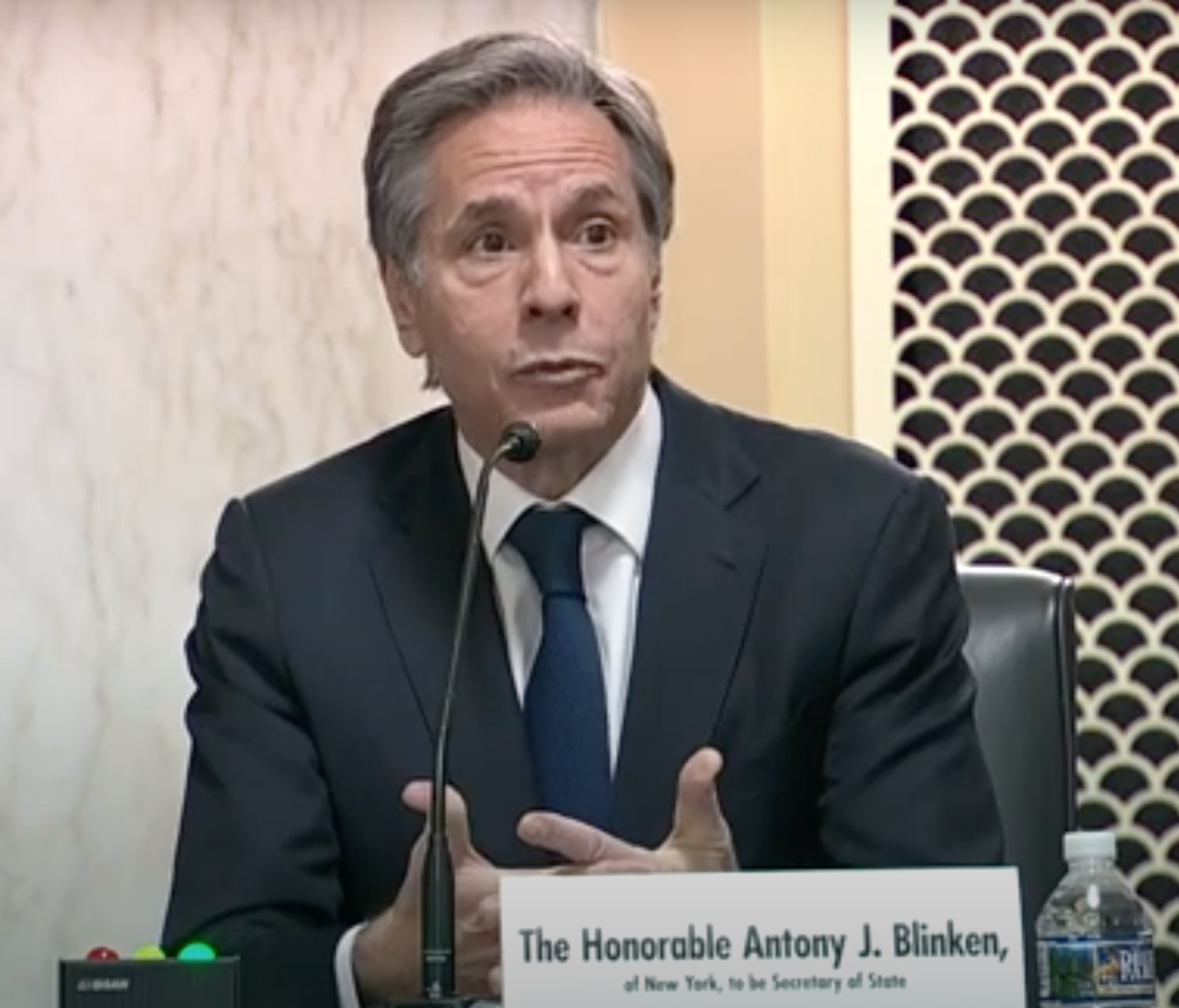
“American leadership still matters. The reality is the world simply does not organize itself,” Secretary of State Antony Blinken proclaimed at his confirmation hearing. “When we are not engaged, when we are not leading, then one of two things is likely to happen. Either some other country tries to take our place but not in a way that is likely to advance our interests and values, or maybe, just as bad, no one does and then you have chaos.”

Much like President Joe Biden, Blinken is a neoliberal Democrat who believes in the doctrine of “Manifest Destiny.” He thinks if the United States does not impose its will and shape the world then there will be no law and order. He cannot fathom how countries could survive on their own. At least, that is how he argues for greater American intervention in global regions.

Blinken was confirmed as secretary of state in a vote on January 26. Not a single Democrat in the Senate voted against Blinken.

He is a longtime ally of Biden, and during Biden’s first term as vice president, he was his national security adviser.

During President Barack Obama’s second term, Blinken was deputy secretary of state. He was also a part of President Bill Clinton’s National Security Council from 1994 to 2001.

Making Venezuela’s ‘Regime Enablers’ Finally Feel The Pain Of Sanctions

Blinken’s predecessor Mike Pompeo, a right-wing Christian reconstructionist, was involved in President Donald Trump administration’s failed regime change operation against Nicolas Maduro’s government in Venezuela. Yet, despite its failure, Blinken told Republican Senator Marco Rubio he thought the Biden administration should keep recognizing Juan Guaido as the one and only true “leader.”

“We need an effective policy that can restore democracy to Venezuela, free and fair elections,” Blinken declared. He even embraced sanctions, despite the fact that they have hampered the country’s ability to respond to the COVID-19 pandemic and resulted in the deaths of tens of thousands of Venezuelans.

“Maybe we need to look at how we more effectively target the sanctions that we have so that regime enablers finally feel the pain of those sanctions,” Blinken added.

However, a report [PDF] from the Congressional Research Service (CRS) dated January 22, 2021, indicates the sanctions by both the Obama and Trump administrations were targeted pretty well and imposed to inflict “pain” against 113 Venezuelans and 13 entities.

…President Maduro, his wife, Cecilia Flores, and son, Nicolás Maduro Guerra; Executive Vice President Delcy Rodriguez; Diosdado Cabello (Socialist party president); eight supreme court judges; the leaders of Venezuela’s army, national guard, and national police; governors; the director of the central bank; and the foreign minister…

Trump imposed sanctions to prohibit Venezuela from participating in U.S. financial markets and block the government’s ability to issue digital currency. Treasury Department officials prohibited corporations from purchasing Venezuelan debt. Venezuela’s state oil company, PdVSA, was aggressively targeted for seeking to evade U.S. sanctions and Venezuela’s central bank was sanctioned too.

Blinken Defends Being Wrong On War In Libya

Obama flouted the War Powers Act and launched a war in Libya against Muammar Gaddafi’s regime without the approval of Congress. It created a power vacuum filled by extremist militia groups and transformed the country into a failed state. Migrants are captured and sold in what the United Nations has referred to as “open slave markets.”

Despite the catastrophe sparked by war, Blinken defended his support for a regime change war. “I think it’s been written about. I — I was the president-elect’s national security adviser at the time. And he did not agree with that course of action.”

Biden was opposed to war in Libya. “My question was, okay, tell me what happens? [Gaddafi’s] gone. What happens? Doesn’t the country disintegrate? What happens then? Doesn’t it become a place where it becomes a petri dish for the growth of extremism? Tell me. Tell me what we’re gonna do.”

Rather than concede President Biden was right and he was wrong, Blinken signaled to Senate Republicans that he would be their hawk when Biden was too dovish.

Blinken bafflingly blamed Gaddafi, who was summarily executed, for what happened in Libya after his death.

“We didn’t fully appreciate the fact that one of the things Gaddafi had done over the years was to make sure that there was no possible rival to his power. And as a result, there was no effective bureaucracy, no effective administration in Libya with which to work when he was gone,” Blinken argued.

The Bothsidesism Of Blinken’s View Toward War In Yemen

Sarah Lazare recalled for In These Times the horrors unleashed on the people of Yemen, as a result of the Obama administration’s support for Saudi Arabia’s war against the Houthis.

“The coalition bombed a center for the blind, a funeral, a wedding, a factory and countless homes and residential areas, and blockaded Yemen’s ports, cutting off vital food and medical shipments — all while the Obama-Biden administration was in power,” Lazare wrote.

“Indeed, the Obama White House was so complicit in war crimes in Yemen in that its own State Department internally warned key U.S. military personnel could be subject to war crimes prosecution, according to a Reuters investigation published in October 2016. By July 2015, a United Nations official was already warning that Yemen was on the verge of a famine, a premonition that horrifically came true.”

One of Pompeo’s final actions was to sanction Houthis, which caused a disruption to aid groups delivering humanitarian assistance. Biden froze the sanctions for one month the same day the Senate confirmed Blinken.

Asked about the intense humanitarian crisis in Yemen, Blinken drew a false equivalency between the actions of the Houthis and the Saudis.

“We need to be clear-eyed about the Houthis. They overthrew a government in Yemen. They engaged in a path of aggression through the country. They directed aggression toward Saudi Arabia,” Blinken contended. “They’ve committed atrocities and human rights abuses and that is a fact. What’s also a fact though is that the Saudi-led campaign in Yemen to push back against

the Houthi aggression has contributed to what is, by most accounts, the worst humanitarian situation that we face anywhere in the world.”

The Houthis were part of the Arab Spring uprising in Yemen against the corrupt government of Ali Abdullah Saleh. State Department officials generally backed these rebellions against autocratic rulers.

According to a 2017 post from Bruce Riedel of the Brookings Institution, “American intelligence officials said that Iran was actually trying to discourage the Houthis from seizing Sanaa and openly toppling Hadi. Iran preferred a less radical course, but the Houthi leadership was drunk with success. Moreover, Undersecretary of Defense Michael Vickers said on the record in January that Washington had a productive informal intelligence relationship with the Houthis against al-Qaida. He suggested that the cooperation could continue.”

The Obama administration, which included Blinken, did not want to jeopardize a 70-year-plus alliance with Saudi Arabia and backed the monarchy’s intervention.

‘Very Much’ Supporting U.S. Arms Shipments To Ukraine

Blinken expressed his support for arming Ukrainian groups a total of three times. He even reminded Republican Senator Ron Johnson he had the opportunity in 2018 to write an op-ed for the New York Times promoting what senators euphemistically describe as “lethal defensive assistance.”

He told Republican Senator Rob Portman, “I very much support the continued provision to Ukraine of lethal defensive assistance and, and indeed, of the training program as well.”

“To the extent that across a couple of administrations, we’ve been able to effectively train and as well as assist in different ways the Ukrainians, that has made a material difference in their ability to withstand the aggression they’ve been on the receiving end of from Russia,” Blinken asserted.

It is difficult to gauge whether the policy has been effective or helped Ukrainians withstand battles with pro-Russian separatist groups. There is not a whole lot of reporting.

But Lieutenant General Ben Hodges, who was the commander of the U.S. Army in Europe, stated in 2015, “If the U.S. policy changed to provide, say, Javelins, for example, that would probably lead to increased lethality on the battlefield for the Ukrainians. It would not change the situation strategically in a positive way, because the Russians would double down. They would dramatically increase more violence, more death, more destruction.”

“The conflict in Ukraine’s mostly Russian-speaking industrial east, called Donbass, erupted in April 2014, weeks after Russia’s annexation of the Crimean Peninsula,” according to the Associated Press. “More than 14,000 people have been killed in fighting between Ukrainian forces and Russia-backed separatists.”

Professor Stephen Cohen called attention to the role of neo-Nazi forces in Ukraine. The overthrow of Viktor Yanukovych was a “violent coup” led by fascist conspirators opposed to Russia. They conducted exterminations of ethnic Russians. The Azov Battalion, part of Kiev’s armed forces, is pro-Nazi and was banned from receiving U.S. military aid, but it almost certainly obtained weapons shipped by the Trump administration from the black market.

“We are left then not with Putin’s responsibility for the resurgence of fascism in a major European country but with America’s shame, and possible indelible stain, on its historical reputation for tolerating it, even if only through silence,” Cohen concluded.

US Return To Iran Nuclear Deal Not Happening Soon

It was the United States under Trump that ditched the Iran nuclear deal, not Iran. Still, it is the Biden’s administration position that Iran should first “comply” with U.S. demands before the U.S. rejoins the deal.

“If Iran returns to compliance with the JCPOA [nuclear deal], we would do the same thing and then use that as a platform working with our allies and partners to build longer and stronger agreements — also capture some of the other issues that need to be dealt with, with regard to missiles, with regard to Iran’s activities and destabilizing activities in the region,” Blinken said.

“There is a lot that Iran will need to do to come back into compliance. We would then have to evaluate whether it actually [did] so. So, I don’t think that’s anything that’s happening tomorrow or the next day.”

Meanwhile, as CBS News described in November, Iran has endured a “harrowing, sanctions-fueled coronavirus catastrophe.”

Doctors experience shortages of every supply necessary for fighting the pandemic. “U.S.-led sanctions have choked off Iran’s access to foreign-made chemicals and equipment.”

Iran has begged Biden to lift sanctions that prevent Iran from accessing COVID-19 vaccines.

***

Melodramatically, Senator Marco Rubio feverishly asked Blinken has any doubt that the Chinese Communist Party’s goal is to be the “world’s predominant political, geopolitical, military, and economic power and for the United States to decline in relation.”

“I do not,” Blinken replied.

“You have no doubt?” Rubio chimed.

“I have no doubt,” Blinken restated.

From Obama to Trump, U.S. empire has prepared its forces for what it calls “great power competition” between China and Russia. It fears China will take the place of the U.S., leading to one of Blinken’s nightmare futures.

Much of the public is wary over military interventions in the Middle East. The threat of terrorism is no longer enough to justify expenditures toward an ever-gargantuan military-industrial complex. Countering China, however, is an easier sell.

“Forcing men, women, and children into concentration camps, trying to, in effect, reeducate them to be adherents to the ideology of the Chinese Communist Party, all of that speaks to an effort to commit genocide,” Blinken remarked.

Human rights abuses under Biden will increasingly be weaponized to defend policies and operations that ramp up tensions with China. Whether descriptions of China’s acts are accurate or not, the point will be to silence anyone who questions whether the violations are enough to warrant increased conflict. (Of course, how dare anyone raise the matter of U.S. deportation camps and their horrors or America’s mass incarceration of 1–2 million people to point out any sort of hypocrisy.)

After the House of Representatives voted to arm so-called rebel groups in Syria in 2014, MSNBC’s Joe Scarborough asked Blinken about concerns that arms “could end up in wrong hands.” Blinken brushed aside concerns and maintained the U.S. would vet and give arms to “the right people.”

In March 2016, the Los Angeles Times reported “CIA-armed units and Pentagon-armed [militias had] repeatedly shot at each other while maneuvering through contested territory on the northern outskirts of Aleppo” in Syria.

Blinken may not be rapture ready like his predecessor, Mike Pompeo. He may be more willing to wave the LGBTQIA+ rainbow flag when arming proxy forces or backing regime change operations. However, they are both devout believers in American exceptionalism.

He views Biden as a president who will put the “globe back on its axis” after Trump. He will spend his time at the State Department working to “restore democracy” and “renew” America’s “leadership” in the world. Which means Blinken will continue the many callous, cold, and calculating traditions of U.S. imperialism, promote hubris over humility, and commit himself to cloaking ignoble acts in the rhetoric of human rights.

Julian Assange, Prometheus Bound

He is being punished not for stealing fire – but for exposing power under the light of truth and provoking the god of Exceptionalism. 

By Pepe Escobar

Source: Consortium News

This is the tale of an Ancient Greek tragedy reenacted in AngloAmerica.

Amid thundering silence and nearly universal indifference, chained, immobile, invisible, a squalid Prometheus was transferred from the gallows for a show trial in a faux Gothic court built on the site of a medieval prison.

Kratos, impersonating Strength, and Bia, impersonating Violence, had duly chained Prometheus, not to a mountain in the Caucasus, but to solitary confinement in a high-security prison, subject to relentless psychological torture. All along the Western watchtowers, no Hephaestus volunteered to forge in his smithy a degree of reluctance or even a sliver of pity.

Prometheus is being punished not for stealing fire – but for exposing power under the light of truth, thus provoking the unbounded ire of  Zeus The Exceptionalist, who’s only able to stage his crimes under multiple veils of secrecy.

Prometheus pierced the myth of secrecy – which envelops Zeus’s ability to control the human spectrum. And that is anathema.

For years, debased, hack stenographers worked relentlessly to depict Prometheus as a lowly trickster and inconsequential forger.

Abandoned, smeared, demonized, Prometheus was comforted by only a small chorus of Oceanids – Craig Murray, John Pilger, Daniel Ellsberg, Wiki warriors, Consortium writers. Prometheus was denied even the basic tools to organize a defense that might at least rattle Zeus’s cognitive dissonant narrative.

Oceanus, the Titan father of the Oceanids, could not possibly urge Prometheus to appease Zeus.

Fleetingly, Prometheus might have revealed to the chorus that exposing secrecy was not what best suited his heart’s content. His plight might also, in the long run, revive popular attachment to the civilizing arts.

One day, Prometheus was visited by Io, a human maiden. He may have forecasted she would engage in no future travels, and she would bear him two offspring. And he may have foreseen that one of their descendants – an unnamed epigone of Heracles – many generations hence, would release him, figuratively, from his torment.

Zeus and his prosecutorial minions don’t have much of a case against Prometheus, apart from possession and dissemination of classified Exceptional information.

Still it was eventually up to Hermes — the messenger of the Gods, and significantly, the conduit of News — to be sent down by Zeus in uncontrollable anger to demand that Prometheus admits he was guilty of trying to overthrow the rules-based order established by the Supreme Exceptional.

This is what’s being ritualized at the current show trial, which was never about Justice.

Prometheus won’t be tamed. In his mind, he will be relieving Tennyson’s Ulysses: “to strive, to seek, to find, and not to yield.”

So Zeus may finally strike him with the thunderbolt of Exceptionalism, and Prometheus will be hurled into the abyss.

Prometheus’s theft of the secrecy of power, though, is irreversible. His fate will certainly prompt the late entrance of Pandora and her jar of evils – complete with unforeseen consequences.

Whatever the verdict reached in that 17th century court, it’s far from certain that Prometheus will enter History just as a mere object of blame for human folly.

Because now the heart of the matter is that the mask of Zeus has fallen.

David Ray Griffin’s The Christian Gospel for Americans: A Systematic Theology

By Edward Curtin

Source: Behind the Curtain

A Review  

There are very few writers who have done more to try to open the public’s mind to the evil nature of the American empire than David Ray Griffin.  His series of books on the false flag attacks of September 11, 2001 will endure for a long time, and they will one day, when it is safe to do so, be recognized as seminal texts exposing the traitorous conspiracy of elements within the Unites States’ government to launch the endless so-called war on terror.  That many now know, and many more will, that those so-called “terrorist” attacks were carried out by terrorists in the highest reach of the U.S. government will be due to his extraordinary work.

What many do not know is that David Ray Griffin is a Christian theologian with impeccable credentials and a scholarly oeuvre of dozens of theological books. And that long before his conscience led him to devote himself to exposing the U.S. government’s lies about the September 11 attacks, he was committed to proclaiming the radical Christian gospel of a living Christ, who was executed by the Roman state for opposing its grotesque and violent empire.

The Christian Gospel for Americans is his crowning achievement, a rare marriage of spiritual contemplation and social analysis that brings to life Jesus and the Hebrew prophets for contemporary Americans.  It is an accessible systematic theology of freedom and creativity that will inspire hope in all caring souls to resist the demonic American Empire. It is an intellectual tour de force, a kaleidoscopic “constructive postmodern” example of process theology at its finest, drawing on the work of Alfred North Whitehead, John Cobb, and Henri Bergson, among others.  Rarely does such a book come along to roil the waters of religious and social complacency.

Times change.  Once in the United States of America, theologians were fêted as important social critics and considered worth heeding.  Two of the most famous in the mid-to-late twentieth century were Reinhold Niebuhr and Paul Tillich.  Both appeared on the cover of Henry Luce’s Time Magazine, and Barack Obama was later fond of referring to Niebuhr to justify his violent policies to extend the American empire.  Obama knew his audience, for Niebuhr was noted for a neo-orthodox theological perspective that encouraged “political realism,” popular among the elites who had created and extended the American empire.  He was a friend of the rich and famous ruling establishment.  His critiques of immoral government practices were always offered within the parameters of official acceptance, conservative and liberal.  He was the establishment’s theologian, lionized by the empire-touting Time magazine as the theologian who really understood politics and how God figured into the necessary realism of American foreign policy.

To his great credit, David Ray Griffin is a brave theologian who will never appear on the cover of Time magazine, for his message is more in keeping with the Biblical prophets who warned the people that their government’s behavior is an abomination in the eyes of God, and if they do not dissent and reject such policies, they will be rejecting the God they say they worship.  In true prophetic style, he connects the dots to say: look at what you are doing, slaughtering innocents everywhere as you worship your golden calf. When the Hebrew prophets “indict Israel or Judah,” he writes, “the indictments are not directed against the people in general, but against the elites who were responsible for creating and maintaining the structures of domination and exploitation.’”

The American elites surely do not wish to publicize a man who says such things; better to ignore him or have their mouthpieces call him a “conspiracy nut,” which of course they have.

Griffin’s book is rooted in the basic fact that “Christian theology is necessarily at once theological and political” since Jesus was a radical rebel leader who opposed the demonic power of the Roman Empire and was executed for that reason.  This is so fundamental, yet it has been papered over, especially since the age of Constantine in the fourth century.  Griffin says:

For one thing, the complete opposition of Jesus and his followers to the imperialism of their day has been largely hidden to readers of the gospels.  The main reason for this hiddenness is that the authors of the gospels, seeking to present the message of Jesus so as to serve the needs of the Christian movement 40 or more years after the death of Jesus, sought to make it appear that Jesus’ message was directed against, and evoked opposition from, ‘the Jews,’ rather than the Roman Empire and those who collaborated with it….This failure of later Christians to understand the beginnings of their religion has contributed to what is arguably the most fateful reversal in history: Christianity, in origin probably the most explicitly anti-imperial religious movement ever, has since the fourth century provided the religious foundation for the growth of empires even more extensive than Rome’s….He [Jesus] was crucified by the Roman Empire – not by ‘the Jews’ – because he was perceived as a threat by Roman authorities.  Given the nature of Jesus’ life and his death, American Christians today should be anti-imperialistic, rather than basking in the pleasures of Empire, as did the Roman populace two thousand years ago – ignoring the terror and poverty brought to other provinces by Roman rule.

This is the foundation upon which Griffin builds his gospel for Americans.

His theological method is liberal, while his content is conservative.  This means that to establish truth by appealing to authority is rejected as a method.  It is only evidence and reason that he relies on to establish the truth of various doctrines.  Therefore science and modern scholarship are important and must always be considered.  To claim something is true because of a deposit of divine revelation that you can read in the Bible is an old way of doing theology and Griffin rejects that method.  In fact, his understanding of revelation is an ongoing process, insight as part of the creative and spontaneous freedom of living in openness to God’s spirit.

His theology is conservative in content because it rests upon certain primary doctrines of the Christian gospel (good news) “such as God’s creation of the world, God as actively present in it, and divinely-given life after death.”

For those unfamiliar with modern theological thinking that is not bound by a particular church’s teachings and respects science, Griffin’s method might at first seem unusual.  As one trained in theology and philosophy, I can assure you it is not.  His process of reasoning accords with the best scholarship in those disciplines, but one has to take the time to enter into its postmodern worldview that positions many of the conundrums of traditional religious thinking within a new framework, one that Griffin calls postmodern naturalism where “divine influence must be understood as part of the normal cause-effect relations, not an exception to them.”

Griffin takes on many of the great issues that have perplexed inquiring minds: the problem of evil, creation, truth, human freedom, God’s so-called omnipotence, miracles, life after death, out-of-body experiences, etc. Whether you end up agreeing with all his reasoning or not, you will be challenged to assess your thinking.  I find his systematic theological analyses to be brilliant and always intriguing.

But the point of his systematic theology is to bring us to his analysis of the demonic nature of the American Empire and the need for Christians and people of all faiths to resist it.  In my opinion, his argument for the demonic as a real power in the world, and that the United States is in its grip, is true.  He says:

Can we look at the past century of our world without thinking that the human race must be under the influence of such a power?  The twentieth century was by far the bloodiest century in history, with unprecedented slaughter and genocide, and yet we have taken no steps to overcome the war-system of settling disputes.  Americans created nuclear weapons and then, when we learned how deadly they are, built thousands more, until we had the world wired to be destroyed many times over.  After we learned that a relatively modest exchange of nuclear weapons could initiate a “nuclear winter,” leading to the death of human civilization and other higher forms of life, we still did not abolish them.

He gives the historical background to the American belief in its divine mission, the idea of Manifest Destiny, and the city on the hill nonsense about America being God’s country whose mission was to spread democracy around the world.  He quotes George W. Bush saying, in his state-of-the-union address two months before laying waste to Iraq based on lies, “The liberty we prize is not America’s gift to the world; it is God’s gift to humanity.”

Melville couldn’t have said it better through the mouth of mad Ahab.  Mad Ahab, mad Bill Clinton, mad George, mad Lyndon Johnson, the list goes on and on.  Madmen all, God’s men in their minds, or perhaps just lying madmen playing with our minds, God be damned.

Griffin lays it all out – Iran 1953, Guatemala 1954, Vietnam 1954-73, Indonesia 1965, etc.  – all the blood, the massacres, the evil empire doing its nonstop handiwork across the world.

He does, however, omit a crucial element of the demonic at work here in the U.S., as if something is blocking him from recognizing it, some shadow blocking his sight.  It is a strange omission.  It is as if his vision is focused outward on all the evil the American government inflicts on the world, but here in his own house, he cannot see the demonic at work.

He nowhere mentions the American government’s assassinations of JFK, Malcolm X, MLK, and RFK, all martyrs to the unspeakable truth that this country is in the grip of evil killers who will stop at nothing to silence the voices of genuine peacemakers who have opposed the American Empire. Their deaths opened the door to hell on earth for millions of others around the world.

He correctly catalogues the long list of U. S. atrocities, false flag attacks, coup d’états, immoral and endless wars; gives dates; draws a damning picture of a country in the grip of demonic forces intent on savagely killing innocents wherever it can find them.  He shows conclusively that the United States is the Roman Empire updated and outfitted to kill millions with sophisticated weapons and to spread its imperialistic power with evil intent.

He makes an open and shut case that if one wishes to follow the Christian Gospel, one must act in opposition to this evil empire.  But he forgets that the crucifixion is also a domestic affair, and the homegrown rebels must be eliminated first.

Even the wisest of men, such as the David Ray Griffin, have their Achilles heels.

But despite that omission, or maybe because of it since it shows us how flawed we all areThe Christian Gospel for Americans is a brilliant clarion call to action.

Read it.  It will rock your world.  It is gospel.