The Richest Sociopath in the World

By John Rachel

Source: Dissident Voice

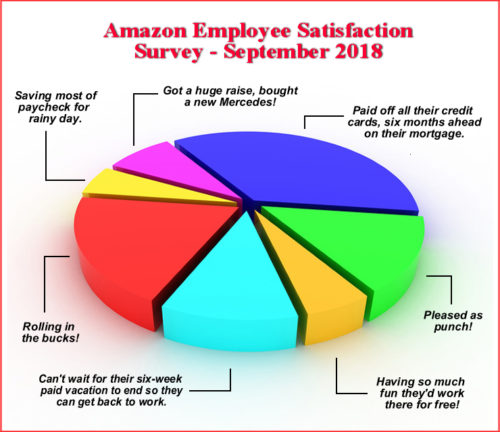
Obviously the above pie chart is a put-on. It is well-documented that working conditions for most employees of Amazon are  abysmaldehumanizing, bordering on abuse we normally associate with slavery.

Moreover, the median employee’s salary under Jeff Bezos’ imperial lordship is $28,446. No one working as a regular there has paid off their credit cards and is driving to work in a Mercedes. 

Jeff Bezos is referred to as The Richest Man in the World and his personal fortune, while growing by $191,000 each minute, is currently estimated at $168 billion.

So …

$28,446 vs. $168,000,000,000? While I can acknowledge the simple math, I find the contrast of such numbers on a gut level difficult to grasp.

To get a handle on such inequality, let’s try approaching it from different angles.

One way to put the disparity into perspective is to recognize it takes Bezos just under 9 seconds to earn what Amazon’s median worker does in an entire year.

Another is to recognize that for a worker to go through Jeff Bezos’ current personal fortune — and, of course, it continues mounting at accelerating levels as I write this — at his/her current median annual income of $28,446 per year, WOULD TAKE 5,905,927 YEARS! That’s close to 6 million years!

For Jeff Bezos himself to go through his current $168 billion, assuming his earnings stopped dead this very moment — which as you and I know they won’t — SPENDING $1,000,000 A DAY, would take NEARLY 460 years. Yes, even spending $1 million a day, in the year 2475 he’d still have plenty of cash, tens of million of dollars mad money. We can feel confident that he wouldn’t be foraging through the dumpster behind 7-11. 

Now, further consider that while the $28,446 median salary is above the national poverty line for a single individual if that person is the sole breadwinner for a family of four, it is marginally above it, which is why many Amazon employees must rely on government assistance to keep from starving.

As well as calculation, I did some speculation — a simple exercise in imagination.

Apparently Bezos’ wealth generating machine is raking it in so fast, he’s currently making $11.5 million per hour … every hour … 24 hours a day … seven days a week. $11,500,000 per hour! 

So here’s what I was picturing in my mind’s eye … 

If for 40 hours of the 168 hours in a week, Bezos were willing to scrape by on a mere $5,840,000 per hour, he could give every one of his 566,000 Amazon employees a $10 per hour raise. Of course, the remaining 128 hours in each week, Bezos could continue earning his normal $11.5 million per hour, not having to share any of it with the pathetic slobs who work for him.

Rhetorical question: Does Jeff Bezos have any concept of what that $10 per hour increase would mean to his employees? 

I’m not going to even suggest here I’m offering this for Bezos to entertain. There are so many advantages to him both as a putative member of the human race and the employer of over a half million workers — advantages that are so OBVIOUS — if they haven’t occurred to him up until now, then his brain functions in ways beyond my understanding. For one thing, he could point to his new fig leaf of “generosity” and ask people to stop calling him a selfish prick. Second, Amazon employees I’m sure would respond to his largesse with greater company loyalty and increased tolerance for his onerous working conditions. He’d still be the richest SOB on the block and could mock the pauperish Bill Gates and Warren Buffett as pitiable wannabees.

Consider …

The most poorly paid Amazon employee now makes $12 per hour. The $10 per hour raise I proposed would boost those $12 per hour workers right up there with Costco employees, who make an average of $21 per hour. And with the across-the-board $10 per hour increase, Bezos’ higher paid employees would be earning among the finest wages in the world provided by a major corporation. 

And by golly, there’s a plus side to the plus side …

Bezos’s bold and gracious gesture would result in a public relations coup of cosmic proportions! Amazon would no longer be demonized — well, not quite as much — by us bleeding-heart lefties as a capitalistic scourge and one-way ticket to Hell for the future of mankind, even if its environmental record is appalling and its business model generally the stuff of steroid-laced neo-feudalism.

Granted, Bezos would have to do some belt-tightening. He’d have to watch his pennies but could probably manage it, eh? Maybe he could skip a couple meals and do some of his own weeding at his estate. After all, after lavishing the $10 per hour raise on all of his employees, he’d only be pulling in $1,705,600,000 per week. I know I know! Like me you’re probably getting all teary-eyed for the poor guy.

Let me get to the extremely anti-climactic conclusion of this lament qua analysis.

Since nothing will change until the system itself changes, meaning the one in place now that creates, incentivizes, and lionizes the obscenely wealthy — reference current holder of the Office of President of the United States of America — I can only recommend this …

We have been labeling Jeff Bezos as ‘The Richest Man in the World’. Yet, quite honestly I don’t personally know any human, man or woman, who behaves like this gluttonous chunk of self-indulgent meat. It actually makes me nauseous to think we’re members of the same species.

Thus, from now on let’s use the correct terminology. Let’s call Jeff Bezos what he really is: the Richest Sociopath in the World.

We could probably order bumper stickers to help correct the record … from Amazon, of course.

Amazon and Apple: Wall Street’s Trillion Dollar Babies

By Dean Baker

Source: CounterPunch

Last month Amazon joined Apple, becoming the second company in the world to have a $1 trillion market capitalization. Amazon’s accomplishment didn’t cause quite as much celebration as Apple’s – it pays to be number one – nonetheless this was treated as a milestone that all of us should view as good news.

Actually, the celebratory coverage of both events demonstrated the incredibly ill-informed nature of much economic reporting in the United States. A big run-up in share prices is good news for the people who own lots of stock in the company; it is not especially good news for anyone else.

In principle, the value of a stock is supposed to represent the expected future earnings of the company. I said “supposed” because stock prices fluctuate wildly in response to all sorts of things that are not obviously connected to future earnings, but in the textbook definition, it is the discounted value of future earnings that determine stock prices. To be clear, this is not the socialist textbook, this is the capitalist textbook that is taught in business schools.

What does it mean that Amazon and Apple have market valuations of more $1 trillion? Presumably, it means that investors are now more optimistic about the companies’ future profit potential. It’s difficult to see why the rest of us should celebrate this outcome.

Apple obviously makes products that consumers value, and in that sense, it is contributing to the economy and generating wealth. But, suppose instead of one huge company we had 10 little (or littler) Apples that sold iPhones, computers, and the other items that comprise Apple’s product line? Would we be any poorer as a society in that case, even if the market cap of our leading tech company was just $100 billion?

Or, even with Apple as our dominant tech company, suppose the surge over the $1 trillion barrier was due to a victory in an antitrust case, which would allow Apple to charge higher prices going forward. That’s great for Apple’s stockholders, but what exactly would the rest of us be celebrating? Paying more money for our iPhones?

In the same vein, in the past, Apple has been caught conspiring with other Silicon Valley companies, agreeing not to compete for workers. Apple, along with its co-conspirators, ended up paying a substantial settlement as a result.

Suppose Apple found a legal way to fix wages or bought a judge to make it legal. The prospect of a lower wage bill would also be good for Apple’s stock price, but not especially good news for those of us who are more likely to make our living from working than owning Apple stock. Again, there is not much in this story for most of us to celebrate.

The celebration for Amazon is even more peculiar. Amazon is clearly an innovative company that has sped the development of Internet retailing. It also has specialized in tax avoidance, eliciting investment incentives from state and local governments, and abusive labor practices.

Perhaps the crossing of the $1 trillion threshold was associated with investors’ confidence that Amazon’s CEO had developed a new and more effective tax avoidance scheme. Again, great news for Amazon stockholders, but pretty bad news for the folks who will have to make up the revenue shortfall.

What is notably different about Amazon is that, unlike Apple, the company does not have huge profits. While Apple earned $48.4 billion in after-tax profits in 2017, Amazon’s profit was just over $3 billion. That gives the company an incredible price-to-earnings ratio of more than 300-to-1.

There are two stories we can tell here. One is that investors expect Amazon’s profits to increase enormously. This would be a case where it takes advantage of its market power to increase its profit margins hugely. Ordinarily, this would be the basis for antitrust action, but given the corruption of the political system, it is certainly possible the company could get away with it. Again, is a future of higher prices something the rest of us should really be celebrating?

The other possibility is that Amazon’s stock price is driven by fantasy, like the Internet stocks of the late 1990s or Bitcoin today. Presumably, at some point reality will reassert itself, but should the rest of us celebrate ill-informed investors being taken for ride?

It is striking that so many would see economic or social progress as being in some way captured by stock valuations. In 1953 Jonas Salk developed the polio vaccine. This eventually led to the near eradication of a disease that had killed or crippled tens of millions of people.

Salk didn’t try to patent his invention. A private charity funded the research. But, what if there had been a Salk Inc. that had the patent on a vaccine that could save tens of millions of lives? Surely the market cap would be an order of magnitude larger than either Apple’s or Amazon’s. Was it a loss to society that the vaccine was made available for pennies rather than tens of thousands of dollars a shot?

If we want to talk about value to society, the anti-smoking crusaders of the last four decades have saved tens of thousands of lives and improved the health of millions more by reducing smoking in the United States and around the world. The people who led this fight, most of whom were women, won’t be featured on the covers of business magazines, but they did much more to enhance society’s wealth than Jeff Bezos.

Anyhow, congratulations to Apple and Amazon’s stockholders on their stock gains. They have been fortunate. The rest of us, not so much.

Jeff Bezos’ Paper Tells You Not to Worry About Those Billionaires

By Dean Baker

Source: FAIR

Just when you thought economic commentary in the Washington Post couldn’t get any more insipid, Roger Lowenstein proves otherwise. In a business section “perspective” (7/20/18), he tells readers:

But what if inequality is the wrong metric. Herewith a modest proposition: economic inequality is not the best yardstick. What we should be paying attention to is social mobility.

Wow, what a novel idea, as though right-wingers have not been pushing this line since the dawn of time: “Don’t worry that your standard of living is awful, the important thing is that your kids will be able to get rich.” (It doesn’t help his story that his poster child for the rich being good is Lloyd Blankfein, who made his fortune shuffling financial assets at Goldman Sachs, and benefited from a massive government bailout.)

But let’s be generous, and try to take Lowenstein’s story seriously. He goes on: “Rising inequality, although a fact, is also very hard to find a culprit for. Not that economists haven’t tried.”

Really? There are plenty of really good explanations for rising inequality, many of which are in my (free) book Rigged. I suppose in the Age of Trump, it is appropriate that the Post has a business columnist determined to flaunt his ignorance.

But then we get the real payday:

It’s also far from proved—to me, it’s not even intuitive—that high incomes on Wall Street and elsewhere are the reason for, say, flatter wages in manufacturing. The fact that Mark Zuckerberg is so rich is annoying, and his separateness from Main Street may not be a great thing socially, but in an economic sense, his fortune did not “come from” the paychecks of ordinary workers.

OK, let’s explain this one so that even someone profoundly ignorant of economics can understand. Suppose that someone, we’ll call them Jeff Bezos or Mark Zuckerberg, were really good at printing counterfeit bills. Imagine that they printed up trillions of these counterfeit bills. This would make them incredibly rich, if they could get away with it. But, as Lowenstein says, how does this make anyone else worse off?

While Lowenstein doesn’t see any problem with our incredibly rich counterfeiters, in the real world, we have the problem that they are creating demand for goods and services with their consumption. If the economy is below full employment, this would be good news, since any source of demand will generate more output and jobs. However, if we are near full employment, or the Federal Reserve Board thinks we are near full employment, then this demand comes at the expense of the paychecks of ordinary workers.

Prices like house prices and rents are driven up by our counterfeiters and the demand created by their servants. The Fed raises interest rates to slow growth and employment, and lessen the ability of ordinary workers to get pay increases, since the labor market will be weaker.

Now, folks may object that Bezos and Zuckerberg are not like counterfeiters; they actually generate value for the economy. While this undoubtedly partly true, it is also the case that much of Bezos’ wealth came from avoiding the requirement that retailers collect state and local sales taxes. Zuckerberg’s wealth came from control of a monopoly platform, and Blankfein’s wealth came from running a too-big-to-fail institution with friends in high places.

Insofar as people get incredibly wealthy from being successful in earning rents at the expense of others in the economy, rather than generating wealth, they are very much like counterfeiters. Furthermore, since productivity has been growing at an incredibly slow rate for the last dozen years (just over 1.0 percent annually), it seems in aggregate that these incredibly rich folks are much better at generating wealth for themselves than for the economy as a whole. This makes the rent-seeker story look very plausible.

While Lowenstein’s plea for greater mobility is about as old as capitalism and has been incredibly unsuccessful, let me propose something considerably more original that you probably won’t see in the Washington Post. Since we have so completely bombed at providing anything like equal opportunity, and no serious person can think this is about to change in the decades ahead, how about we structure our economy so that it makes less difference whether someone ends up at the top end, like Jeff Bezos, or at the bottom, earning the minimum wage?

That one is almost certainly far too simple for the great minds to ever consider.

Technology giants hold censorship meeting with US intelligence agencies

By Will Morrow

Source: WSWS.org

The New York Times and Washington Post this week published reports of a private meeting last month between eight major technology and social media corporations and the US intelligence agencies, to discuss their censorship operations in the lead-up to the November 2018 mid-term elections.

The meeting was convened at Facebook’s Menlo Park, California, headquarters on May 23, and was attended by representatives from Amazon, Apple, Google, Microsoft, Snap, Twitter and Oath, which owns Yahoo and the telecommunications network Verizon, along with agents from the FBI and the Department of Homeland Security.

The Post described the meeting, organized at the request of Facebook, as a “new overture by the technology industry to develop closer ties to law enforcement.” Both articles were based on anonymous statements by individuals who attended. One attendee told the Post that the conversation was a “back-and-forth, with both sides talking about how they were thinking about the problem and how we were looking for opportunities to work together.”

The meeting is yet another testament to the increasing integration of the technology giants with the US military/intelligence apparatus. These companies, which provide a growing share of the technical infrastructure for the repressive apparatus of the state, increasingly see the censorship of left-wing, anti-war, and progressive viewpoints as an integral part of their business strategy.

Amazon, Microsoft and Google are competing to secure control over a $10 billion project to host the Pentagon’s Cloud infrastructure, a position that will literally mean hosting the communications between military units engaged in battle. Employees at the three companies have also written letters in recent months denouncing their provision of artificial intelligence technology to improve drone targeting (Google), facial recognition of civilians by police agencies (Amazon), and assisting in the operations of the Immigration and Customs Enforcement (Microsoft).

The Times and the Post are the main media voices for the campaign by the Democratic Party and intelligence agencies for Internet censorship, under the guise of opposing the spread of “misinformation” by the Russian government. This McCarthyite campaign is based on the totally unsubstantiated allegation that Russian “fake news” led to popular disillusionment with Hillary Clinton in the 2016 vote, and the subsequent election of Donald Trump. The newspapers’ synchronized reports therefore present last month’s meeting as aimed at preventing Russian interference in the mid-term elections.

But the real target of the censorship campaign is popular access to left-wing news sources not controlled by the corporate media, and the proliferation of oppositional social media content, such as videos of police killings, mass roundups of immigrants, military interventions, protests and exposures of corporate malfeasance and government criminality.

Since the beginning of the year, Facebook has rolled out a series of changes to its News Feed, including demoting political content in favor of so-called “personal moments,” and prioritizing content from so-called “trustworthy sources”—in reality pro-establishment propaganda outlets—including the Times and the Wall Street Journal. The social media giant has also changed its algorithms to reduce the spread of “viral videos,” which CEO Mark Zuckerberg declared are “not good for people’s well-being and society.”

Last Thursday, Facebook published an announcement by its Head of News Integrity Tessa Lyons, announcing a further expansion of these measures, including the introduction of “fact-checking” for videos and photos. The post also stated that Facebook is introducing “machine learning to help identify and demote foreign Pages that are likely to spread financially-motivated hoaxes to people in other countries.” These will work alongside Facebook’s army of “fact checkers”—i.e., censors—many of them former security and intelligence agents, who belong to the 20,000 people employed in its “security” and “moderation” department.

The “demotion” of what Facebook calls “false news” was codified in “community guidelines” published by the company in April. The guidelines state that because the suppression of “false news” is a “sensitive issue,” the company does not openly remove news stories, which would be easily detected by publishers and their followers, but does the same thing secretly: “significantly reduc[ing] its distribution by showing it lower on the News Feed.” (See: “Facebook codifies its censorship regime”)

Lyons repeated this line of argument in an interview with PBS’ Miles O’Brien on May 16. Admitting that “censoring and fully removing information unless it violates our community standards is not the expectation from our community,” Lyons explained that instead “we work to reduce the damage it can do” by restricting its proliferation. The Washington Post reported yesterday that while speaking at the International Fact Checkers Network conference last week, Lyons “told attendees that … [Facebook] will soon use machine learning to predict pages that are more likely to share misinformation.”

With the official ending of net neutrality this month, the financial oligarchy that controls both the search and social media monopolies and internet service providers has further tightened its grip over the freedom of expression on the internet, with ISPs given the prerogative to block and throttle internet content at will.

The expansion of internet censorship takes place amidst mounting pressure on whistleblower Julian Assange, the Wikileaks journalist who has been effectively imprisoned in the Ecuadorian embassy in London since 2012, where he was forced to take refuge to avoid being extradited to the US and charged for publishing evidence of US government crimes. The persecution of Assange for the “crime” of publishing the truth is aimed at intimidating whistleblowers and honest journalists all around the world.

Google , which attended last month’s meeting with the FBI and Department of Homeland Security, has altered its search engine algorithms to censor left-wing and anti-war websites, including the World Socialist Web Site, whose Google search traffic fell by three quarters in response to changes by the search engine in April 2017. There are indications that Google has recently intensified its censorship of the World Socialist Web Site, with search impressions falling by as much as one third over the past month.

In August 2017, the World Socialist Web Site published an open letter to Google demanding that it end its censorship of the internet, declaring, “Censorship on this scale is political blacklisting. The obvious intent of Google’s censorship algorithm is to block news that your company does not want reported and to suppress opinions with which you do not agree.”

We urge all readers of the World Socialist Web Site seeking to defend the freedom of expression online to contact us and join the struggle against internet censorship.

Amazon, Microsoft and Google compete for Pentagon Cloud warfighter project

By Will Morrow

Source: WSWS.org

Amazon, Microsoft and Google are competing to secure a multi-billion-dollar Department of Defense contract to build and oversee the US military’s Cloud computing infrastructure, which will be used to control every aspect of the Pentagon’s global operations.

The Joint Enterprise Defense Infrastructure (JEDI) project will transfer the large number of separate data control centers currently being run by the Pentagon into a centralized Cloud network that will be administered by one of the technology giants. The contract is reported to be worth up to $10 billion over the next decade, potentially making it the Department of Defense’s single largest acquisition ever. The winning bidder is expected to be announced in September.

The company that secures the contract will be completely integrated into all of the US military’s fighting operations. According to Nextgov, Brigadier General David Krumm, the deputy director for requirements for the Joint Chiefs of Staff, described JEDI as a “global fabric” that will connect the headquarters with active combat forces, from an F-35 fighter jet pilot to a Pacific submarine captain to an Army platoon leader. “This is going to make a difference like few things have to get information to our warfighters,” Krumm said.

The Department of Defense hosted an industry conference on the project on March 7 in Arlington, Virginia, attended by technology companies, including representatives from Amazon and Microsoft. Krumm told the audience that JEDI would “change the way that this nation, its soldiers, its sailors, its Marines and its airmen fight and win our nation’s wars.”

The Cloud network will be required to hold data at all security classification levels, meaning security officials with top secret security clearances will be working at the facilities.

On May 16, Bloomberg Government published images of the advertisements produced by Amazon and Microsoft on electronic billboards in the Pentagon railway station about how their companies’ technology could support the military in battle.

Microsoft’s ad featured an image of a special operations soldier and the caption, “The cloud gets actionable insight while the action is still unfolding.” An Amazon Web Services ad included the statement, “Time to launch: months minutes,” to underscore that the cloud infrastructure will help coordinate missile launches.

The JEDI program was first announced in September 2017, a month after Trump’s Defence Secretary James Mattis carried out a tour of Silicon Valley boardrooms. Mattis met with Google’s Founder Sergey Brin and CEO Sundar Pichai, as well as executives at Facebook and Amazon, to discuss further integrating their technologies into the US armed forces.

The Defense One website reported on April 12 that “Brin in particular was eager to showcase how much Google was learning every day about AI and cloud implementation,” citing an anonymous senior Defense Department official. Mattis “returned to Washington, D.C., convinced that the US military had to move much of its data to a commercial cloud provider—not just to manage files, email, and paperwork but to push mission-critical information to front-line operators,” the article noted.

Significantly, the article notes that while Amazon and Microsoft have publicly expressed their desire to secure the contract, Google has “kept its own interest … out of the press. Company leaders have even hidden the pursuit from its own workers, according to Google employees Defense One reached.”

Google’s integration into the military’s operations has triggered widespread opposition among its employees. A letter published in April written to Google’s CEO Pichai and signed by more than 3,000 Google workers, demanded that the company cease its collaboration with the Pentagon.

The letter was a response to Google admitting in March that it is providing the military with artificial intelligence software that can be used to detect objects in video surveillance footage, under what is called Project Maven. This technology can be directly used to develop automatic targeting for the US drone murder operations in the Middle East and North Africa.

The Defense One article stated that “Maven is more than either Google or the Defense Department has admitted publicly, according to the senior defense official who called it a ‘pathfinder’ project, a starting point for future collaboration between the Pentagon and Google.”

Media reports indicate that the company most likely to secure the JEDI contract is Amazon. The company is considered to have an edge because it is already operating a Cloud network for the US intelligence agencies, under a $600 million contract reached in 2013.

Since September 2016, Amazon has been providing facial recognition technology called Rekognition to police forces and private intelligence contractors. Rekognition is able to process video footage from police body cameras, surveillance cameras and CCTV to “identify persons of interest against a collection of millions of faces in real-time, enabling timely and accurate crime prevention” (see: “Amazon providing facial recognition technology to police agencies for mass surveillance”).

The distinction between the technology corporations and the state has become almost entirely blurred as they become ever-more integrated into the military-intelligence apparatus. This takes place as Washington is working to outpace its major geostrategic rivals, above all China and Russia, in the arena of advanced warfare technology and artificial intelligence, in preparation for a catastrophic war that would inevitably involve the use of nuclear weapons.

As they integrate themselves into the American military build-up, the technology giants are collaborating in mass political censorship of left-wing and anti-war websites, above all the World Socialist Web Site, in order to suppress mass opposition to war. Since April 2017, Google has altered its search result algorithms in order to censor the WSWS and other left-wing and anti-war websites.


The author also recommends:

Google, drone murder and the military-intelligence-censorship complex
[19 May 2018]

No Need To Wait – Dystopia Is Almost Upon Us

Source: TruePublica

Microsoft’s CEO has warned the technology industry against creating a dystopian future, the likes of which have been predicted by authors including George Orwell and Aldous Huxley. Satya Nadella kicked off the the company’s 2017 Build conference with a keynote that was as unexpected as it was powerful. He told the developers in attendance that they have a huge responsibility, and that the choices they make could have enormous implications.

They won’t listen of course. The collection of big data along with management, selling and distribution and the systems architecture to control it is now worth exactly double global military defence expenditure. In fact, this year, the big data industry overtook the worlds most valuable traded commodity – oil.

The truth is that the tech giants have already captured us all. We are already living in the beginnings of a truly dystopian world.

Leaving aside the endemic surveillance society our government has chosen on our behalf with no debate, politically or otherwise, we already have proof of the now and where it is leading. With fingerprint scanning, facial recognition, various virtual wallets to pay for deliveries, some would say your identity is as good as stolen. If it isn’t, it soon will be. That’s because the hacking industry, already worth a mind blowing $1trillion annually is expected to reach $2.1 trillion in just 14 months time.

The reality of not being able to take public transportation, hire a car, buy a book, or a coffee – requiring full personal identification is almost upon us. Britain even had an intention to be completely cashless by 2025 – postponed only by the impact of Brexit.

Alexa, the Amazon home assistant listens to everything said in the house. It is known to record conversations. Recently, police in Arkansas, USA demanded that Amazon turn over information collected from a murder suspect’s Echo — the speaker that controls Alexa, because they already knew what information could be extracted from it.

32M is the first company in the US that provides a human chip, allowing employees “to make purchases in their break-room micro market, open doors, login to computers, use the copy machine.” 3M also confirmed what the chip could really do – telling employees to “use it as your passport, public transit and all purchasing opportunities.”

Various Apps now locate people you may know and your own location can be shared amongst others without your knowledge and we’ve known for years that governments and private corporations have access to this data, whether you like it not.

Other countries are providing even scarier technologies.  Hypebeast Magazine reports that  Aadhaar is a 12-digit identity number issued to all Indian residents based on their biometric and demographic data. “This data must be linked to their bank account or else they’ll face the risk of losing access to their account. Folks have until the end of the year to do this, with phone numbers soon to be connected through the 12 digits by February. Failure to do so will deactivate the service. ” The technology has the ability to refuse access to state supplied services such as healthcare.

Our article “Insurance Industry Leads The Way in Social Credit Systems” also highlights what the fusion of technology and data is likely to end up doing for us. An astonishing 96 per cent of insurers think that ecosystems or applications made by autonomous organisations are having a major impact on the insurance industry. The use of social credit mechanisms is being developed, some already implemented, which will determine our future behaviour, which will affect us all – both individually and negatively.”

The Chinese government plans to launch its Social Credit System in 2020. Already being piloted on 12 million of its citizens, the aim is to judge the trustworthiness – or otherwise – of its 1.3 billion residents. Something as innocuous as a person’s shopping habits become a measure of character. But the system not only investigates behaviour – it shapes it. It “nudges” citizens away from purchases and behaviours the government does not like. Friends are considered as well and individual credit scores fall depending on their trustworthiness. It’s not possible to imagine how far this will go in the end.

However to get us all there, to that situation, we need to be distracted from what is going on in the background. Some, are already concerned.


Distraction – detaching us from truth and reality

The Guardian wrote an interesting piece recently which highlighted some of the concerns of those with expert insider knowledge of the tech industry. For instance, Justin Rosenstein, the former Google and Facebook engineer who helped build the ‘like’ button –  is concerned. He believes there is a case for state regulation of smartphone technology because it is “psychologically manipulative advertising”, saying the moral impetus is comparable to taking action against fossil fuel or tobacco companies.

If we only care about profit maximisation,” he says, “we will go rapidly into dystopia.” Rosenstien also makes the observation that after Brexit and the election of Trump, digital forces have completely upended the political system and, left unchecked, could render democracy as we know it obsolete.

Carole Cadwalladre’s recent Exposé in the Observer/Guardian proved beyond doubt that democracy has already departed.  Here we learn about a shadowy global operation involving big data and billionaires who influenced the result of the EU referendum. Britain’s future place in the world has been altered by technology.

Nir Eyal 39, the author of Hooked: How to Build Habit-Forming Products writes: “The technologies we use have turned into compulsions, if not full-fledged addictions.” Eyal continues: “It’s the impulse to check a message notification. It’s the pull to visit YouTube, Facebook, or Twitter for just a few minutes, only to find yourself still tapping and scrolling an hour later.” None of this is an accident, he writes. It is all “just as their designers intended”.

Eyal feels the threat and protects his own family by cutting off the internet completely at a set time every day. “The idea is to remember that we are not powerless,” he said. “We are in control.”

The truth is we are no longer in control and have not been since we learned that our government was lying to us with the Snowden revelations back in 2013.

Tristan Harris, a 33-year-old former Google employee turned vocal critic of the tech industry agrees about the lack of control. “All of us are jacked into this system,” he says. “All of our minds can be hijacked. Our choices are not as free as we think they are.” Harris insists that billions of people have little choice over whether they use these now ubiquitous technologies, and are largely unaware of the invisible ways in which a small number of people in Silicon Valley are shaping their lives.

Harris is a tech whistleblower. He is lifting the lid on the vast powers accumulated by technology companies and the ways they are abusing the influence they have at their fingertips – literally.

“A handful of people, working at a handful of technology companies, through their choices will steer what a billion people are thinking today.”

The techniques these companies use such as social reciprocity, autoplay and the like are not always generic: they can be algorithmically tailored to each person. An internal Facebook report leaked this year, ultimately revealed that the company can identify when teenagers feel “worthless or “insecure.” Harris adds, that this is “a perfect model of what buttons you can push in a particular person”.

Chris Marcellino, 33, a former Apple engineer is now in the final stages of retraining to be a neurosurgeon and notes that these types of technologies can affect the same neurological pathways as gambling and drug use. “These are the same circuits that make people seek out food, comfort, heat, sex,” he says.

Roger McNamee, a venture capitalist who benefited from hugely profitable investments in Google and Facebook, has grown disenchanted with both of the tech giants. “Facebook and Google assert with merit that they are giving users what they want,” McNamee says. “The same can be said about tobacco companies and drug dealers.”

James Williams ex-Google strategist who built the metrics system for the company’s global search advertising business, says Google now has the “largest, most standardised and most centralised form of attentional control in human history”. “Eighty-seven percent of people wake up and go to sleep with their smartphones,” he says. The entire world now has a new prism through which to understand politics, and Williams worries the consequences are profound.

Williams also takes the view that if the attention economy erodes our ability to remember, to reason, to make decisions for ourselves – faculties that are essential to self-governance – what hope is there for democracy itself?

“The dynamics of the attention economy are structurally set up to undermine the human will,” he says. “If politics is an expression of our human will, on individual and collective levels, then the attention economy is directly undermining the assumptions that democracy rests on. If Apple, Facebook, Google, Twitter, Instagram and Snapchat are gradually chipping away at our ability to control our own minds, could there come a point, I ask, at which democracy no longer functions?”

“Will we be able to recognise it, if and when it happens?” Williams says. “And if we can’t, then how do we know it hasn’t happened already?”


The dystopian arrival

Within ten years, some are speculating that many of us will be wearing eye lenses. Coupled with social media, we’ll be able to identify strangers and work out that a particular individual, in say a bar, has a low friend compatibility, and data shows you will likely not have a fruitful conversation. This idea is literally scratching the surface of the information overload en-route right now.

It is not at all foolish to think that in that same bar a patron is shouting at the bartender, who refuses to serve him another drink because the glass he was holding measured his blood-alcohol level through the sweat in his fingers. He’ll have to wait at least 45 minutes before he’ll be permitted to order another scotch. You might even think that is a good idea – it isn’t.

Google’s Quantum Artificial Intelligence  Lab, already works with other organisations associated with NASA. Google’s boss sits on the Board of the Pentagon with links plugged directly into the surveillance architecture of the NSA in the USA and GCHQ in Britain. This world, where artificial intelligence makes its mark, as Williams mentions earlier, will deliberately undermine the ability to think for yourself.

In the scenario of the eye lenses, you might even have the ability to command your eyewear to shut down. But when you do, suddenly you are confronted with an un-Googled world. It appears drab and colourless in comparison. The people before you are bland, washed out and unattractive. The art, plants, wall paint, lighting and decorations had all been shaped by your own preferences, and without the distortion field your wearable eyewear provided, the world appears as a grey, lifeless template.

You find it difficult to last without the assistance of your self imposed augmented life, and accompanied by nervous laughter you switch it back on. The world you view through the prism of your computer eyewear has become your default setting. You know you have free will, but don’t feel like you need it. As Marcellino says the same neurological pathways as gambling and drug use drive how you choose to see the world.

This type of technology will be available and these types of scenario’s will become real, sooner than you think.

Our governments, allied with the tech giants are coercing us into a place of withering obedience with the use of 360 degree state surveillance. New technology, which is somehow seen as the road to liberty, contentment and prosperity, is really our future being shaped by a system that will destroy our civil liberties, crush our human rights and it will eventually ensnare and trap us all. This much they are already attempting in China and Japan with social credit mechanisms and pre-crime technology which is a truly frightening prospect. Without debate or our knowledge, here in western democracies, these technologies are already in use.

 

The Singular Pursuit of Comrade Bezos

By Malcolm Harris

Source: Medium

It was explicitly and deliberately a ratchet, designed to effect a one-way passage from scarcity to plenty by way of stepping up output each year, every year, year after year. Nothing else mattered: not profit, not the rate of industrial accidents, not the effect of the factories on the land or the air. The planned economy measured its success in terms of the amount of physical things it produced.

— Francis Spufford, Red Plenty

But isn’t a business’s goal to turn a profit? Not at Amazon, at least in the traditional sense. Jeff Bezos knows that operating cash flow gives the company the money it needs to invest in all the things that keep it ahead of its competitors, and recover from flops like the Fire Phone. Up and to the right.

— Recode, “Amazon’s Epic 20-Year Run as a Public Company, Explained in Five Charts


From a financial point of view, Amazon doesn’t behave much like a successful 21st-century company. Amazon has not bought back its own stock since 2012. Amazon has never offered its shareholders a dividend. Unlike its peers Google, Apple, and Facebook, Amazon does not hoard cash. It has only recently started to record small, predictable profits. Instead, whenever it has resources, Amazon invests in capacity, which results in growth at a ridiculous clip. When the company found itself with $13.8 billion lying around, it bought a grocery chain for $13.7 billion. As the Recode story referenced above summarizes in one of the graphs: “It took Amazon 18 years as a public company to catch Walmart in market cap, but only two more years to double it.” More than a profit-seeking corporation, Amazon is behaving like a planned economy.

If there is one story on Americans who grew up after the fall of the Berlin Wall know about planned economies, I’d wager it’s the one about Boris Yeltsin in a Texas supermarket.

In 1989, recently elected to the Supreme Soviet, Yeltsin came to America, in part to see Johnson Space Center in Houston. On an unscheduled jaunt, the Soviet delegation visited a local supermarket. Photos from the Houston Chronicle capture the day: Yeltsin, overcome by a display of Jell-O Pudding Pops; Yeltsin inspecting the onions; Yeltsin staring down a full display of shiny produce like a line of enemy soldiers. Planning could never master the countless variables that capitalism calculated using the tireless machine of self-interest. According to the story, the overflowing shelves filled Yeltsin with despair for the Soviet system, turned him into an economic reformer, and spelled the end for state socialism as a global force. We’re taught this lesson in public schools, along with Animal Farm: Planned economies do not work.

It’s almost 30 years later, but if Comrade Yeltsin had visited today’s most-advanced American grocery stores, he might not have felt so bad. Journalist Hayley Peterson summarized her findings in the title of her investigative piece, “‘Seeing Someone Cry at Work Is Becoming Normal’: Employees Say Whole Foods Is Using ‘Scorecards’ to Punish Them.” The scorecard in question measures compliance with the (Amazon subsidiary) Whole Foods OTS, or “on-the-shelf” inventory management. OTS is exhaustive, replacing a previously decentralized system with inch-by-inch centralized standards. Those standards include delivering food from trucks straight to the shelves, skipping the expense of stockrooms. This has resulted in produce displays that couldn’t bring down North Korea. Has Bezos stumbled into the problems with planning?

Although OTS was in play before Amazon purchased Whole Foods last August, stories about enforcement to tears fit with the Bezos ethos and reputation. Amazon is famous for pursuing growth and large-scale efficiencies, even when workers find the experiments torturous and when they don’t make a lot of sense to customers, either. If you receive a tiny item in a giant Amazon box, don’t worry. Your order is just one small piece in an efficiency jigsaw that’s too big and fast for any individual human to comprehend. If we view Amazon as a planned economy rather than just another market player, it all starts to make more sense: We’ll thank Jeff later, when the plan works. And indeed, with our dollars, we have.

In fact, to think of Amazon as a “market player” is a mischaracterization. The world’s biggest store doesn’t use suggested retail pricing; it sets its own. Book authors (to use a personal example) receive a distinctly lower royalty for Amazon sales because the site has the power to demand lower prices from publishers, who in turn pass on the tighter margins to writers. But for consumers, it works! Not only are books significantly cheaper on Amazon, the site also features a giant stock that can be shipped to you within two days, for free with Amazon Prime citizensh…er, membership. All 10 or so bookstores I frequented as a high school and college student have closed, yet our access to books has improved — at least as far as we seem to be able to measure. It’s hard to expect consumers to feel bad enough about that to change our behavior.


Although they attempt to grow in a single direction, planned economies always destroy as well as build. In the 1930s, the Soviet Union compelled the collectivization of kulaks, or prosperous peasants. Small farms were incorporated into a larger collective agricultural system. Depending on who you ask, dekulakization was literal genocide, comparable to the Holocaust, and/or it catapulted what had been a continent-sized expanse of peasants into a modern superpower. Amazon’s decimation of small businesses (bookstores in particular) is a similar sort of collectivization, purging small proprietors or driving them onto Amazon platforms. The process is decentralized and executed by the market rather than the state, but don’t get confused: Whether or not Bezos is banging on his desk, demanding the extermination of independent booksellers — though he probably is — these are top-down decisions to eliminate particular ways of life.

Now, with the purchase of Whole Foods, Bezos and Co. seem likely to apply the same pattern to food. Responding to reports that Amazon will begin offering free two-hour Whole Foods delivery for Prime customers, BuzzFeed’s Tom Gara tweeted, “Stuff like this suggests Amazon is going to remove every cent of profit from the grocery industry.” Free two-hour grocery delivery is ludicrously convenient, perhaps the most convenient thing Amazon has come up with yet. And why should we consumers pay for huge dividends to Kroger shareholders? Fuck ’em; if Bezos has the discipline to stick to the growth plan instead of stuffing shareholder pockets every quarter, then let him eat their lunch. Despite a business model based on eliminating competition, Amazon has avoided attention from antitrust authorities because prices are down. If consumers are better off, who cares if it’s a monopoly? American antitrust law doesn’t exist to protect kulaks, whether they’re selling books or groceries.

Amazon has succeeded in large part because of the company’s uncommon drive to invest in growth. And today, not only are other companies slow to spend, so are governments. Austerity politics and decades of privatization put Amazon in a place to take over state functions. If localities can’t or won’t invest in jobs, then Bezos can get them to forgo tax dollars (and dignity) to host HQ2. There’s no reason governments couldn’t offer on-demand cloud computing services as a public utility, but instead the feds pay Amazon Web Services to host their sites. And if the government outsources health care for its population to insurers who insist on making profits, well, stay tuned. There’s no near-term natural end to Amazon’s growth, and by next year the company’s annual revenue should surpass the GDP of Vietnam. I don’t see any reason why Amazon won’t start building its own cities in the near future.

America never had to find out whether capitalism could compete with the Soviets plus 21st-century technology. Regardless, the idea that market competition can better set prices than algorithms and planning is now passé. Our economists used to scoff at the Soviets’ market-distorting subsidies; now Uber subsidizes every ride. Compared to the capitalists who are making their money by stripping the copper wiring from the American economy, the Bezos plan is efficient. So, with the exception of small business owners and managers, why wouldn’t we want to turn an increasing amount of our life-world over to Amazon? I have little doubt the company could, from a consumer perspective, improve upon the current public-private mess that is Obamacare, for example. Between the patchwork quilt of public- and private-sector scammers that run America today and “up and to the right,” life in the Amazon with Lex Luthor doesn’t look so bad. At least he has a plan, unlike some people.

From the perspective of the average consumer, it’s hard to beat Amazon. The single-minded focus on efficiency and growth has worked, and delivery convenience is perhaps the one area of American life that has kept up with our past expectations for the future. However, we do not make the passage from cradle to grave as mere average consumers. Take a look at package delivery, for example: Amazon’s latest disruptive announcement is “Shipping with Amazon,” a challenge to the USPS, from which Amazon has been conniving preferential rates. As a government agency bound to serve everyone, the Postal Service has had to accept all sorts of inefficiencies, like free delivery for rural customers or subsidized media distribution to realize freedom of the press. Amazon, on the other hand, is a private company that doesn’t really have to do anything it doesn’t want to do. In aggregate, as average consumers, we should be cheering. Maybe we are. But as members of a national community, I hope we stop to ask if efficiency is all we want from our delivery infrastructure. Lowering costs as far as possible sounds good until you remember that one of those costs is labor. One of those costs is us.

Earlier this month, Amazon was awarded two patents for a wristband system that would track the movement of warehouse employees’ hands in real time. It’s easy to see how this is a gain in efficiency: If the company can optimize employee movements, everything can be done faster and cheaper. It’s also easy to see how, for those workers, this is a significant step down the path into a dystopian hellworld. Amazon is a notoriously brutal, draining place to work, even at the executive levels. The fear used to be that if Amazon could elbow out all its competitors with low prices, it would then jack them up, Martin Shkreli style. That’s not what happened. Instead, Amazon and other monopsonists have used their power to drive wages and the labor share of production down. If you follow the Bezos strategy all the way, it doesn’t end in fully automated luxury communism or even Wall-E. It ends in The Matrix, with workers swaddled in a pod of perfect convenience and perfect exploitation. Central planning in its capitalist form turns people into another cost to be reduced as low as possible.

Just because a plan is efficient doesn’t mean it’s good. Postal Service employees are unionized; they have higher wages, paths for advancement, job stability, negotiated grievance procedures, health benefits, vacation time, etc. Amazon delivery drivers are not and do not. That difference counts as efficiency when we measure by price, and that is, to my mind, a very good argument for not handing the world over to the king of efficiency. The question that remains is whether we have already been too far reduced, whether after being treated as consumers and costs, we might still have it in us to be more, because that’s what it will take to wrench society away from Bezos and from the people who have made him look like a reasonable alternative.

Freedom Rider: Oligarch Jeff Bezos

By Margaret Kimberley

Source: Intrepid Report

Amazon CEO Jeff Bezos has a net worth of $105 billion and is the richest man in the world. But he is not just the richest man at this moment in history. He is the richest person who has ever lived. As of 2017 he and seven other billionaires had a collective net worth equal to that of the poorest 3.6 billion people on earth.

These figures have been in the news of late but without much useful analysis. The corporate media refuse to state what is obvious. Namely that inequality is worse around the world precisely because these super rich people demand it.

While pundits and politicians go on breathlessly about oligarchs in Russia, they seldom take a look at the wealthiest in their own backyard and the control they exert over the lives of millions of people. When Amazon announced it would choose a site for its new headquarters, cities across the country began a furious race to the bottom. Amazon is not alone in the thievery department. Major corporations like Walmart always request and receive public property and public funds in order to do business.

Some 235 cities have put themselves in the running for this dubious venture. Chicago is willing to give Amazon $1.3 billion in payroll taxes that prospective employees would ordinarily pay that city. If Chicago wins this booby prize, Amazon employees would pay taxes to their employer and not to the government. This is truly cutting out the middle man and makes real the rule of, by, and for the wealthiest.

The potential for public outrage isn’t lost on unprincipled politicians. Some cities now refuse to reveal how much they plan to give away. But the news to date is disheartening with Boston offering $75 million while Houston is willing to part with $268 million. Amazon says it will hire 50,000 people but their business model already pays employees so little that many of them qualify for public assistance, despite being employed.

The United States is as much of an oligarchy as countries it usually disparages but it is far more dishonest about its true nature. All talk of democracy is a lie as the rich get richer, by an additional $1 trillion in 2017, and wield more and more power over the lives of everyone else.

The Bezos juggernaut is not restricted to theft of public money. He is also the sole owner of the Washington Post, one of the most influential newspapers in the country. Bezos owns a newspaper that is an organ of the ruling elite and he also has a $600 million contract to provide the Central Intelligence Agency with cloud computing services.

The Washington Post was the force behind Propaganda or Not, an effort to destroy left wing voices like those at Black Agenda Report. Under the guise of fighting Russia and so-called fake news, the Bezos owned Post began the censorship campaign that has put the left’s presence on the Internet in such jeopardy.

Politicians outdo one another giving away public resources to the richest man on the planet who also owns a major newspaper and services the surveillance state. If it can be said that any one person rules the world, Bezos would be obvious choice. No one in Chicago, Boston, Houston or any of the other cities giving away the store ever voted for Jeff Bezos. All talk of democracy is a sham as long as the richest people take from the rest of humanity.

The effort to make government an irrelevance is thoroughly bipartisan. Republicans and Democrats alike are willing to turn over government coffers to Bezos and his ilk and the rights of the people be damned.

Whoever wins this tarnished brass ring ought to be consigned to political defeat. The mayor, aldermen, city council members or whoever else brings disaster to their locality should be punished for aiding and abetting the theft. If these cities can give to the richest man who ever lived, they can surely use public money to help their residents right now. But they will never do that because they are all bought off and compromised. They are either cynical or afraid to go against the real rulers of the country.

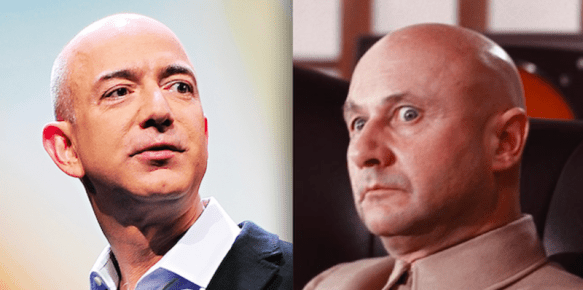
Bezos may look like the villain in a James Bond movie but there is nothing funny about him. He is deadly serious and so are his intentions. In a Bezos run world, every worker will be impoverished, every level of government will subsidize corporations, and anyone who speaks out will be discredited and under surveillance.

The last thing any city needs is a new Amazon headquarters. We need an end to billionaire rule in this country and around the world. That will be the salvation of the people, not more sweatshops run by wealthy people who steal from everyone else.


Margaret Kimberley’s Freedom Rider column appears weekly in BAR, and is widely reprinted elsewhere. She maintains a frequently updated blog as well as at freedomrider.blogspot.com. Ms. Kimberley lives in New York City, and can be reached via e-Mail at Margaret.Kimberley(at)BlackAgendaReport.com.