Yesterday, NSA whistleblower Edward Snowden gave an “Alternative Christmas Message” on Britain’s Channel 4 television. It was short and concise, yet more substantial and important than a typical State of the Union Address. Though he makes the connection to Orwell’s 1984 that many of us have already made, it’s still a message more people need to become aware of or be reminded of. It’s also a call to action that all freedom loving people can rally behind regardless of nationality and political ideology.
This is the full transcript followed by the unedited video:
Hi, and Merry Christmas. I’m honored to have the chance to speak with you and your family this year.
Recently, we learned that our governments, working in concert, have created a system of worldwide mass surveillance, watching everything we do.
Great Britain’s George Orwell warned us of the danger of this kind of information. The types of collection in the book—microphones and video cameras, TVs that watch us—are nothing compared to what we have available today. We have sensors in our pockets that track us everywhere we go.
Think about what this means for the privacy of the average person. A child born today will grow up with no conception of privacy at all. They’ll never know what it means to have a private moment to themselves—an unrecorded, unanalyzed thought. And that’s a problem, because privacy matters. Privacy is what allows us to determine who we are and who we want to be.
The conversation occurring today will determine the amount of trust we can place both in the technology that surrounds us and the government that regulates it. Together, we can find a better balance. End mass surveillance. And remind the government that if it really wants to know how we feel, asking is always cheaper than spying.
For everyone out there listening, thank you, and Merry Christmas.
Besides being one of the saddest headlines I’ve seen in awhile, it says a lot about the current state of law enforcement in America. This is the full story behind it as reported by Jean Paul Zodeaux of Collapse.com:
A vigil for the deceased Jesus Huerta yesterday went from peace to pandemonium last night in Durham, North Carolina after police, who showed up in full riot gear tear gassed those at the vigil, including the family of the deceased, and arresting six people.
A month ago, in North Carolina, Jesus Huerta, a teen aged boy living in Durham, North Carolina allegedly committed suicide sitting in the back of a police cruiser, after being searched, with hands cuffed behind his back, shooting himself in the head. It is as implausible a story as one can think of. Of course, a good writer will take the implausible and make it look plausible. Too bad the Chief of Police, Jose Lopez in Durham doesn’t have any writers on hand. Instead, what Chief Lopez did was wait a few weeks, issue a statement that Jesus Huerta was found slumped over and dead in the back of a patrol car after the officer who was driving the vehicle heard what he thought to be a gunshot:
“Our department continues to investigate the origin of the weapon but can confirm that it was not a departmental weapon and no officer fired a weapon during this incident.”
Not only lacking good enough writers to make the implausible seem plausible, Chief Lopez also appears to lack any valid public relations department. At a press conference a week ago, presumably for the purposes of calming the public, Lopez only made matters worse by stating the investigation was seeking to find whether Huerta “shot himself’ on purpose or if it was accidental. Understandably, much of the public was interested in an investigation of the police involved. Instead they got Chief Lopez.
Crazy things can happen, this much is understood, and even if we’re are to accept the story that a teenage boy who was searched by a police officer before handcuffed and placed in the back seat of his patrol car wound up producing a gun missed in the search and shot himself, it would take a person disconnected with reality to think that the reaction to such a story would be one of quiet acceptance. Of course people are going to be suspicious of the story, particularly since Jesus Huerta is not the first person who has died while in the custody of Durham Police in the last five months.
On July 27th of this year, police responding to reports of a stabbing, and surrounding Jose Ocampo who was holding a knife and refused to drop it, shot him four times in the chest. Ocampo did not speak English and did not understand the commands being given him. Of course, no matter what language you speak, it should be common sense that when you are surrounded by police while holding a knife you drop it, but it was once common sense that shooting a man four times in the chest because he’s not relinquishing a knife sounds an awful lot like excessive force.
According to a friend of Ocampo’s who was on the scene, that Ocampo was attempting to give the knife to police:
“You know the part you use to cut? He put his hand on that part and gave the other end to police.”
Still, and in today’s environment, it should be expected that police will find such an thing as an excuse to open fire, but people are getting quite tired of what is to now be expected, and any police officer, and certainly a police chief should understand this, and instead of responding with defiance and more dubious tactics of force such as the full force in riot gear at a vigil for a teenager who was shot in the head while in handcuffs in the back seat of a Durham police patrol car.
Chief Lopez’ strategy of intimidation and his clear lack of compassion for the Huerta family only makes the Durham police come off as more suspicious. That is no way to sell the implausible story they’re attempting to sell the public. What Lopez should have done was accept responsibility for his part in the death of Jesus Huerta, which would be to admit that there is an obvious break down of procedure and put the whole police department on review. This is not what Lopez did, and increasingly, as more police departments expect a suspicious public to buy implausible stories, this is not what is getting done.
Today, humanity faces a stark choice: save the planet and ditch capitalism, or save capitalism and ditch the planet.
– Fawzi Ibrahim
Freedom is having time to live.
– Uruguay’s president, Jose Mujica
Here it comes again. Another Black Friday of shoppers being trampled to death at the entrance of Target, Bed Bath & Beyond and Walmart. And then, hallelujah! … the Christmas shopping season begins.
This year, let’s rise above it! It’s time to start challenging the entrenched values of capitalism, which have hijacked our lives and our cultural rituals for far too long. ’Tis the season to make a pact with ourselves … to start changing our own lives so that we can collectively face the gigantic psycho-financial-eco crises of our time.The journey toward a sane sustainable future begins on a deeply personal and individual level with a single, voluntary step: make a vow to yourself to go cold turkey on consumption this Friday (in North America – Saturday for the rest of the world). Do not buy anything for 24 hours … and watch what happens … you just might have an unexpected, emancipatory epiphany!
Buy Nothing Day is legendary for instigating this type of personal transformation. As you suddenly remember what real living is all about, you may sense an upsurge of radical empowerment and feel a strange magic creeping back into your life.
Join millions of us in over 80 countries on November 29/30 and find out for yourself what it feels like.
And why not play some jazz while you are at it!? Put up Buy Nothing Day posters in your office, neighborhood, on campus … organize a credit card cut up, pull off a Whirl-mart at a box store, or put on an anonymous mask and walk zombie-like through your local mall.
Then, if you feel inspired, take the next step … for generations, the holidays have been hijacked by commercial forces … this year, why not take the season back? Have a heart to heart with your family and decide to celebrate Christmas, Chanukkah and Kwanzaa in a whole new way. Go for it!
This year, let’s throw a well-honed, fun-filled monkey wrench into the doomsday machine!
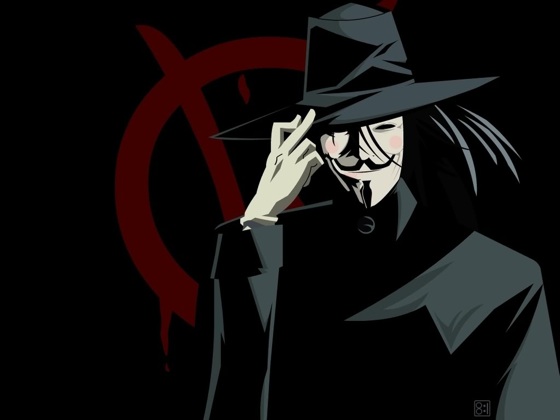
In honor of Guy Fawkes Day I’d like to bring attention to a few intriguing statements from Alan Moore (writer of the graphic novel V for Vendetta) on the connections between his fictions and reality from an interview he did shortly after the start of the Occupy Movement.
I suppose I’ve gotten used to the fact that some of my fictions percolate out into the material world.
…I suppose when I was writing V for Vendetta I would in my secret heart of hearts have thought: wouldn’t it be great if these ideas actually made an impact? So when you start to see that idle fantasy intrude on the regular world… It’s peculiar. It feels like a character I created 30 years ago has somehow escaped the realm of fiction.
…And when you’ve got a sea of V masks, I suppose it makes the protesters appear to be almost a single organism – this “99%” we hear so much about. That in itself is formidable. I can see why the protesters have taken to it. It turns protests into performances.
The mask is very operatic; it creates a sense of romance and drama. I mean, protesting, protest marches, they can be very demanding, very grueling. They can be quite dismal. They’re things that have to be done, but that doesn’t necessarily mean that they’re tremendously enjoyable – whereas actually, they should be.
I think it’s appropriate that this generation of protesters have made their rebellion into something the public at large can engage with more readily than with half-hearted chants, with that traditional, downtrodden sort of British protest. These people look like they’re having a good time. And that sends out a tremendous message.
The reason V’s fictional crusade against the state is ultimately successful is that the state, in V for Vendetta, relies upon a centralised computer network which he has been able to hack. Not an obvious idea in 1981, but it struck me as the sort of thing that might be down the line. This was just something I made up because I thought it would make an interesting adventure story. Thirty years go by and you find yourself living it.
I have no particular connection or claim to what [the protesters] are doing, nor am I suggesting that these people are fans of mine, or of V for Vendetta…So there’s always… Now I didn’t feel responsible, but…at the moment, the demonstrators seem to me to be making clearly moral moves, protesting against the ridiculous state that our banks and corporations and political leaders have brought us to.
…It would probably be better if the authorities accepted this is a new situation, that this is history happening. History is a thing that happens in waves. Generally it is best to go with these waves, not try to make them turn back – the Canute option. I’m hoping that the world’s leaders will realise this.
…Vox populi, Voice of the people. And I think that if the mask stands for anything, in the current context, that is what it stands for. This is the people. That mysterious entity that is evoked so often – this is the people.
Last July Moore was interviewed by Salon.com to talk about his new Kickstarter project, Jimmy’s End, but he also shared the following relevant observations about emerging NSA revelations, the surveillance state and technology:
There seems to be something going on, even from the briefest appraisal of the news, with the amount of events transpiring. This is such a connected world, it’s useless to isolate any part of it as a discrete phenomenon. You can’t really talk about the problems in Syria, because its problems are global. The waves of discontent and outrage — whether in the Arab countries, or in Brazil, or in America and Europe over the degrees to which its citizens are being monitored — are not separate phenomena. They are phenomena of an emergent world, and the existence of the Internet is one of its major drivers. We have got no idea how it’s going to turn out, because the nature of our society is such that if anything can be invented, then we will invent it. Sooner or later, if it is possible.
So the Internet is changing everything, but I wouldn’t yet want to say for good or ill. I suspect, as ever, that it will be an admixture of both. But we are all along for the ride, even those people like me who do not have Internet connections, mobile phones or even functioning televisions. I’m slowly disconnecting myself. Basically, it’s a feeling that if we are going to subject our entire culture to what is an unpredictable experiment, then I’d like to try to remain outside the petri dish. [Laughs] It’s only sensible to have somebody as a control.
To me, one of the biggest surprises of these recent surveillance revelations is how surprised people are. The level of surveillance we’ve had over here for the past 20 years now is ridiculous — and useless, I would add. Eerily enough, the security cameras on every street corner of Britain was instigated by the incoming Blair government in 1997, which was when I decided, back in 1982 or so, to set the first episode of “V for Vendetta,” which had cameras on every street corner. So yeah, we’ve had those for awhile; they’ve proliferated and multiplied for decades. More recently, there have been troops of police who have said that all these things are useful for is alienating the public. [Laughs] They are not actually useful in the prevention of crimes, or even actually apprehending their suspects.
Here’s the thing: If you’re monitoring every single thing that goes on in a given culture, if you have all the information that is there to be had, then that is the equivalent of having none of it. [Laughs] How are you going to process that amount of information? That’s when you get all these wonderful emerging paradoxes. Recently over here, there was a case where it was suspected that the people who monitor security screens were taking unnecessary toilet breaks and gossiping when they should be watching us. So it was decided that the only sensible thing to do was to put a security camera in the monitor room. [Laughs] This is answering the question that Juvenal asked so succinctly all those years ago: Who watches the watchmen? The answer is more watchmen! And yet more watchmen watch them, and of course it will eventually occur to them to ask: Can those people who are watching the people doing the watching really be trusted? Much better if they were under surveillance.
That’s the level of absurdity these Orwellian solutions bring to our increasingly complex world. George Orwell’s vision was 1947. Yes, the world was more complex than it had been, but nowhere near as complex as it was going to get. We currently have in Northampton — and I think we might be the first to have it — security cameras in some places that actually talk to you. “Pick that cigarette end up! Yes, you!” [Laughs] Which is so much like Patrick McGoohan’s vision for the Village in “The Prisoner,” all those years ago.
…Technology is always a two-edged sword. It will bring in many benefits, but also many disasters. Because of the complexity of our situation, we cannot predict what things will be until they happen. It’s just part of our responsibility as people in the modern world to do our very, very best to deal with them, and think them through, as they occur. While I’m remote from most technology to the point that I’m kind of Amish, I have played a couple of computer games — until I realized I was being bloodied with adrenalin over something that wasn’t real. At the end of a couple of hours of very addictive play, I may have procured the necessary amount of mushrooms to save a princess, but I also wasted hours of my life that I’ll never be able to get back. This is the reason I am not on the Internet. I am aware of its power as a distraction, and I don’t have the time for that.
Despite the constant clamor for attention from the modern world, I do believe we need to procure a psychological space for ourselves. I apparently know some people who try to achieve this by logging off, or going without their Twitter or Facebook for a limited period. Which I suppose is encouraging, although it doesn’t seem that remarkable from my perspective. I think that people need to establish their own psychological territory in face of the encroaching world.
Despite the fact that Moore said he disowned all Hollywood adaptations of his works, in my opinion the quality of his writing can transcend limitations inherent in such attempts, retaining power and resonance even in “watered down” form. Though I was disappointed by the film version of V for Vendetta overall, many who would not have otherwise been exposed to Moore’s work were able to absorb important aspects of his message through it and viral clips such as this:
The past few days have been especially turbulent ones for the NSA and its Director Keith Alexander. On Friday afternoon the NSA website experienced a shutdown which was widely reported as a denial of service attack, possibly involving members of hacker collective Anonymous. The NSA later claimed the problem was due to an “internal error” during a scheduled update. It goes without saying that we should take what the NSA says with an industrial-sized carton of salt.
On Friday night Foreign Policy magazine reported a multinational coalition has formed in the U.N. to draft a General Resolution to curb the power of the NSA’s surveillance network. The delegations involved include Brazil, Germany, France, Mexico, Cuba, Venezuela, Argentina, Austria, Bolivia, Ecuador, Guyana, Hungary,
India, Indonesia, Liechtenstein, Norway, Paraguay, South Africa,
Sweden, Switzerland, and Uruguay. This action follows the political upheaval caused by Thursday’s release of Snowden documents which revealed at least 35 world leaders were spied on by the NSA. Since it’s doubtful they were under suspicion of terrorism, what’s a more likely explanation for the spying? Blackmail.
Just yesterday a massive “Stop Watching Us” rally demonstrated near the White House demanding an investigation, regulatory reform and accountability for those found to be responsible for unconstitutional surveillance. Twelve large boxes of 575,000 petition signatures were shown to the crowd at the foot of the US Capitol. According to a Reuters report:
The march attracted protesters from both ends of the political spectrum as liberal privacy advocates walked alongside members of the conservative Tea Party movement in opposition to what they say is unlawful government spying on Americans.
…The event was organized by a coalition known as “Stop Watching Us” that consists of some 100 public advocacy groups and companies, including the American Civil Liberties Union, privacy group Electronic Frontier Foundation, Occupy Wall Street NYC and the Libertarian Party.
As damaging as the NSA has been to our privacy, they may prove to be more damaging to the government itself. The first steps towards ending an abusive relationship are to snap out of denial, seek support, and address the underlying root of the problem. A positive aspect of the NSA spying scandal is that it’s helping the world wake up to the previously hidden (to many) evil behind the friendly facade. It’s truly a hopeful development to see countries around the world and groups of different political stripes in solidarity organizing around the issue of NSA criminality. We need more of this type of focus and cooperation if we are to confront the sources of our biggest problems and make positive changes in this arena and others.
Artist and activist Banksy has been posting daily works at http://www.banksyny.com/ as part of a monthlong residency in New York. These are some of the highlights so far:
10/1 The street is in play.
10/2 New York Accent
10/4 Dirty Underwear: The Musical
10/4 Occupy! The Musical
10/4 Playground Mob: The Musical
10/5 A New York delivery truck converted into a mobile garden (includes rainbow, waterfall and butterflies).
Perhaps, if one’s definition of a “bad guy” is so broad it becomes meaningless.
Among the findings in this must-read article recently posted at Washington’s Blog, Does the Government Only Label Bad Guys As Terrorists?, the following characteristics could get you labeled as a terrorist by the government:
As you can see the list is pretty long, but sure to get longer as the government becomes even more corrupt, ineffectual, and fearful of revolt. Having such a loose definition of “terrorist” will do nothing to make anyone any safer (except perhaps the wealthy elite). In fact, it will only discourage dissent and encourage obedience to the corporate state which ultimately endangers the health of society.
The good folks at BrainFeed have helpfully compiled classic segments of George Carlin’s many performances and interviews:
Notes by BrainFeed:
George Denis Patrick Carlin (May 12, 1937 — June 22, 2008) was an American stand-up comedian, social critic, satirist, actor, and writer/author who won five Grammy Awards for his comedy albums. Carlin was noted for his black humor as well as his thoughts on politics, the English language, psychology, religion, and various taboo subjects. Carlin and his “Seven Dirty Words” comedy routine were central to the 1978 U.S. Supreme Court case F.C.C. v. Pacifica Foundation, in which a 5–4 decision by the justices affirmed the government’s power to regulate indecent material on the public airwaves.
The first of his 14 stand-up comedy specials for HBO was filmed in 1977. From the late 1980s, Carlin’s routines focused on socio-cultural criticism of modern American society. He often commented on contemporary political issues in the United States and satirized the excesses of American culture. His final HBO special, It’s Bad for Ya, was filmed less than four months before his death. In 2004, Carlin placed second on the Comedy Central list of the 100 greatest stand-up comedians of all time, ahead of Lenny Bruce and behind Richard Pryor. He was a frequent performer and guest host on The Tonight Show during the three-decade Johnny Carson era, and hosted the first episode of Saturday Night Live. In 2008, he was posthumously awarded the Mark Twain Prize for American Humor.








 After the Crash