
From Jesus Christ to Julian Assange: When Dissidents Become Enemies of the State

By John W. Whitehead

Source: The Rutherford Institute

“In a time of universal deceit, telling the truth is a revolutionary act.” — George Orwell

When exposing a crime is treated as committing a crime, you are being ruled by criminals.

In the current governmental climate, where laws that run counter to the dictates of the Constitution are made in secret, passed without debate, and upheld by secret courts that operate behind closed doors, obeying one’s conscience and speaking truth to the power of the police state can render you an “enemy of the state.”

That list of so-called “enemies of the state” is growing.

Wikileaks founder Julian Assange is merely the latest victim of the police state’s assault on dissidents and whistleblowers.

On April 11, 2019, police arrested Assange for daring to access and disclose military documents that portray the U.S. government and its endless wars abroad as reckless, irresponsible, immoral and responsible for thousands of civilian deaths.

Included among the leaked materials was gunsight video footage from two U.S. AH-64 Apache helicopters engaged in a series of air-to-ground attacks while American air crew laughed at some of the casualties. Among the casualties were two Reuters correspondents who were gunned down after their cameras were mistaken for weapons and a driver who stopped to help one of the journalists. The driver’s two children, who happened to be in the van at the time it was fired upon by U.S. forces, suffered serious injuries.

There is nothing defensible about crimes such as these perpetrated by the government.

When any government becomes almost indistinguishable from the evil it claims to be fighting—whether that evil takes the form of war, terrorism, torture, drug trafficking, sex trafficking, murder, violence, theft, pornography, scientific experimentations or some other diabolical means of inflicting pain, suffering and servitude on humanity—that government has lost its claim to legitimacy.

These are hard words, but hard times require straight-talking.

It is easy to remain silent in the face of evil.

What is harder—what we lack today and so desperately need—are those with moral courage who will risk their freedoms and lives in order to speak out against evil in its many forms.

Throughout history, individuals or groups of individuals have risen up to challenge the injustices of their age. Nazi Germany had its Dietrich Bonhoeffer. The gulags of the Soviet Union were challenged by Aleksandr Solzhenitsyn. America had its color-coded system of racial segregation and warmongering called out for what it was, blatant discrimination and profiteering, by Martin Luther King Jr.

And then there was Jesus Christ, an itinerant preacher and revolutionary activist, who not only died challenging the police state of his day—namely, the Roman Empire—but provided a blueprint for civil disobedience that would be followed by those, religious and otherwise, who came after him.

Indeed, it is fitting that we remember that Jesus Christ—the religious figure worshipped by Christians for his death on the cross and subsequent resurrection—paid the ultimate price for speaking out against the police state of his day.

A radical nonconformist who challenged authority at every turn, Jesus was a far cry from the watered-down, corporatized, simplified, gentrified, sissified vision of a meek creature holding a lamb that most modern churches peddle. In fact, he spent his adult life speaking truth to power, challenging the status quo of his day, and pushing back against the abuses of the Roman Empire.

Much like the American Empire today, the Roman Empire of Jesus’ day had all of the characteristics of a police state: secrecy, surveillance, a widespread police presence, a citizenry treated like suspects with little recourse against the police state, perpetual wars, a military empire, martial law, and political retribution against those who dared to challenge the power of the state.

For all the accolades poured out upon Jesus, little is said about the harsh realities of the police state in which he lived and its similarities to modern-day America, and yet they are striking.

Secrecy, surveillance and rule by the elite. As the chasm between the wealthy and poor grew wider in the Roman Empire, the ruling class and the wealthy class became synonymous, while the lower classes, increasingly deprived of their political freedoms, grew disinterested in the government and easily distracted by “bread and circuses.” Much like America today, with its lack of government transparency, overt domestic surveillance, and rule by the rich, the inner workings of the Roman Empire were shrouded in secrecy, while its leaders were constantly on the watch for any potential threats to its power. The resulting state-wide surveillance was primarily carried out by the military, which acted as investigators, enforcers, torturers, policemen, executioners and jailers. Today that role is fulfilled by the NSA, the FBI, the Department of Homeland Security and the increasingly militarized police forces across the country.

Widespread police presence. The Roman Empire used its military forces to maintain the “peace,” thereby establishing a police state that reached into all aspects of a citizen’s life. In this way, these military officers, used to address a broad range of routine problems and conflicts, enforced the will of the state. Today SWAT teams, comprised of local police and federal agents, are employed to carry out routine search warrants for minor crimes such as marijuana possession and credit card fraud.

Citizenry with little recourse against the police state. As the Roman Empire expanded, personal freedom and independence nearly vanished, as did any real sense of local governance and national consciousness. Similarly, in America today, citizens largely feel powerless, voiceless and unrepresented in the face of a power-hungry federal government. As states and localities are brought under direct control by federal agencies and regulations, a sense of learned helplessness grips the nation.

Perpetual wars and a military empire. Much like America today with its practice of policing the world, war and an over-arching militarist ethos provided the framework for the Roman Empire, which extended from the Italian peninsula to all over Southern, Western, and Eastern Europe, extending into North Africa and Western Asia as well. In addition to significant foreign threats, wars were waged against inchoate, unstructured and socially inferior foes.

Martial law. Eventually, Rome established a permanent military dictatorship that left the citizens at the mercy of an unreachable and oppressive totalitarian regime. In the absence of resources to establish civic police forces, the Romans relied increasingly on the military to intervene in all matters of conflict or upheaval in provinces, from small-scale scuffles to large-scale revolts. Not unlike police forces today, with their martial law training drills on American soil, militarized weapons and “shoot first, ask questions later” mindset, the Roman soldier had “the exercise of lethal force at his fingertips” with the potential of wreaking havoc on normal citizens’ lives.

A nation of suspects. Just as the American Empire looks upon its citizens as suspects to be tracked, surveilled and controlled, the Roman Empire looked upon all potential insubordinates, from the common thief to a full-fledged insurrectionist, as threats to its power. The insurrectionist was seen as directly challenging the Emperor.  A “bandit,” or revolutionist, was seen as capable of overturning the empire, was always considered guilty and deserving of the most savage penalties, including capital punishment. Bandits were usually punished publicly and cruelly as a means of deterring others from challenging the power of the state.  Jesus’ execution was one such public punishment.

Acts of civil disobedience by insurrectionists. Much like the Roman Empire, the American Empire has exhibited zero tolerance for dissidents such as Julian Assange, Edward Snowden and Chelsea Manning who exposed the police state’s seedy underbelly. Jesus branded himself a political revolutionary starting with his act of civil disobedience at the Jewish temple, the site of the administrative headquarters of the Sanhedrin, the supreme Jewish council. When Jesus “with the help of his disciples, blocks the entrance to the courtyard” and forbids “anyone carrying goods for sale or trade from entering the Temple,” he committed a blatantly criminal and seditious act, an act “that undoubtedly precipitated his arrest and execution.” Because the commercial events were sponsored by the religious hierarchy, which in turn was operated by consent of the Roman government, Jesus’ attack on the money chargers and traders can be seen as an attack on Rome itself, an unmistakable declaration of political and social independence from the Roman oppression.

Military-style arrests in the dead of night. Jesus’ arrest account testifies to the fact that the Romans perceived Him as a revolutionary. Eerily similar to today’s SWAT team raids, Jesus was arrested in the middle of the night, in secret, by a large, heavily armed fleet of soldiers.  Rather than merely asking for Jesus when they came to arrest him, his pursuers collaborated beforehand with Judas. Acting as a government informant, Judas concocted a kiss as a secret identification marker, hinting that a level of deception and trickery must be used to obtain this seemingly “dangerous revolutionist’s” cooperation.

Torture and capital punishment. In Jesus’ day, religious preachers, self-proclaimed prophets and nonviolent protesters were not summarily arrested and executed. Indeed, the high priests and Roman governors normally allowed a protest, particularly a small-scale one, to run its course. However, government authorities were quick to dispose of leaders and movements that appeared to threaten the Roman Empire. The charges leveled against Jesus—that he was a threat to the stability of the nation, opposed paying Roman taxes and claimed to be the rightful King—were purely political, not religious. To the Romans, any one of these charges was enough to merit death by crucifixion, which was usually reserved for slaves, non-Romans, radicals, revolutionaries and the worst criminals.
Jesus was presented to Pontius Pilate “as a disturber of the political peace,” a leader of a rebellion, a political threat, and most gravely—a claimant to kingship, a “king of the revolutionary type.” After Jesus is formally condemned by Pilate, he is sentenced to death by crucifixion, “the Roman means of executing criminals convicted of high treason.”  The purpose of crucifixion was not so much to kill the criminal, as it was an immensely public statement intended to visually warn all those who would challenge the power of the Roman Empire. Hence, it was reserved solely for the most extreme political crimes: treason, rebellion, sedition, and banditry. After being ruthlessly whipped and mocked, Jesus was nailed to a cross.

As Professor Mark Lewis Taylor observed:

The cross within Roman politics and culture was a marker of shame, of being a criminal. If you were put to the cross, you were marked as shameful, as criminal, but especially as subversive. And there were thousands of people put to the cross. The cross was actually positioned at many crossroads, and, as New Testament scholar Paula Fredricksen has reminded us, it served as kind of a public service announcement that said, “Act like this person did, and this is how you will end up.”

Jesus—the revolutionary, the political dissident, and the nonviolent activist—lived and died in a police state. Any reflection on Jesus’ life and death within a police state must take into account several factors: Jesus spoke out strongly against such things as empires, controlling people, state violence and power politics. Jesus challenged the political and religious belief systems of his day. And worldly powers feared Jesus, not because he challenged them for control of thrones or government but because he undercut their claims of supremacy, and he dared to speak truth to power in a time when doing so could—and often did—cost a person his life.

Unfortunately, the radical Jesus, the political dissident who took aim at injustice and oppression, has been largely forgotten today, replaced by a congenial, smiling Jesus trotted out for religious holidays but otherwise rendered mute when it comes to matters of war, power and politics.

Yet for those who truly study the life and teachings of Jesus, the resounding theme is one of outright resistance to war, materialism and empire.

What a marked contrast to the advice being given to Americans by church leaders to “submit to your leaders and those in authority,” which in the American police state translates to complying, conforming, submitting, obeying orders, deferring to authority and generally doing whatever a government official tells you to do.

Telling Americans to march in lockstep and blindly obey the government—or put their faith in politics and vote for a political savior—flies in the face of everything for which Jesus lived and died.

Ultimately, this is the contradiction that must be resolved if the radical Jesus—the one who stood up to the Roman Empire and was crucified as a warning to others not to challenge the powers-that-be—is to be an example for our modern age.

As I make clear in my book Battlefield America: The War on the American People, we must decide whether we will follow the path of least resistance—willing to turn a blind eye to what Martin Luther King Jr. referred to as the “evils of segregation and the crippling effects of discrimination, to the moral degeneracy of religious bigotry and the corroding effects of narrow sectarianism, to economic conditions that deprive men of work and food, and to the insanities of militarism and the self-defeating effects of physical violence”—or whether we will be transformed nonconformists “dedicated to justice, peace, and brotherhood.”

As King explained in a powerful sermon delivered in 1954, “This command not to conform comes … [from] Jesus Christ, the world’s most dedicated nonconformist, whose ethical nonconformity still challenges the conscience of mankind.”

We need to recapture the gospel glow of the early Christians, who were nonconformists in the truest sense of the word and refused to shape their witness according to the mundane patterns of the world.  Willingly they sacrificed fame, fortune, and life itself in behalf of a cause they knew to be right.  Quantitatively small, they were qualitatively giants.  Their powerful gospel put an end to such barbaric evils as infanticide and bloody gladiatorial contests.  Finally, they captured the Roman Empire for Jesus Christ… The hope of a secure and livable world lies with disciplined nonconformists, who are dedicated to justice, peace, and brotherhood.  The trailblazers in human, academic, scientific, and religious freedom have always been nonconformists.  In any cause that concerns the progress of mankind, put your faith in the nonconformist!

…Honesty impels me to admit that transformed nonconformity, which is always costly and never altogether comfortable, may mean walking through the valley of the shadow of suffering, losing a job, or having a six-year-old daughter ask, “Daddy, why do you have to go to jail so much?”  But we are gravely mistaken to think that Christianity protects us from the pain and agony of mortal existence.  Christianity has always insisted that the cross we bear precedes the crown we wear.  To be a Christian, one must take up his cross, with all of its difficulties and agonizing and tragedy-packed content, and carry it until that very cross leaves its marks upon us and redeems us to that more excellent way that comes only through suffering.

In these days of worldwide confusion, there is a dire need for men and women who will courageously do battle for truth.  We must make a choice. Will we continue to march to the drumbeat of conformity and respectability, or will we, listening to the beat of a more distant drum, move to its echoing sounds?  Will we march only to the music of time, or will we, risking criticism and abuse, march to the soul saving music of eternity?

Why Activists Fail

By Robert J. Burrowes

Despite enormous ongoing effort over more than a thousand years, during and since the formation and shaping of the modern world, and as the number of issues being contested has steadily increased, activists of many types have made insufficient progress on key issues, particularly in relation to ending violence and war (and the threat of nuclear war), stopping the exploitation of many peoples and halting the endless assaults on Earth’s biosphere.

Of course, in order for those of us who identify as activists to have any prospect of success in these and other endeavors, we need to understand how the world works and to develop an interrelated set of nonviolent strategies that are being effectively implemented to address each of the key aspects of this crisis.

This is because there is a great deal wrong with how the human world functions and a staggering amount that needs to be done if we are to fix it and preserve the planetary biosphere in doing so, particularly given that the primary threats are now so serious that human extinction is likely to occur within a few years. See ‘Human Extinction by 2026? A Last Ditch Strategy to Fight for Human Survival’.

Of course, if human governance systems, ranging from international organizations like the United Nations and its various agencies to national, provincial and local governments functioned effectively, then we might expect these agencies, which theoretically function on our behalf, to have addressed these problems a long time ago. Or to do so now.

However, for reasons that are readily identifiable, these agencies have little power and routinely malfunction (from the viewpoints of ordinary people and the planetary biosphere).

So let me start by briefly explaining how the world works and then elaborating a few key points about strategy so that you can choose, if you wish (and, problematically, assuming there is still time), to play a more active and effective role, in one or more ways, in the struggle to make our world one of peace, justice and sustainability.

How the World Works: A Brief History

The formal human governance systems on Earth – that is, governments and intergovernmental organizations such as the United Nations – are controlled by the global elite which is invisible to, and hence not considered by, most people including activists. This, of course, is how the elite wants it and one can still readily find accounts that ask if the elite (by whatever name it is given) actually exists and even ascribe it a mystical quality. If the idea is not simply written off as a ‘conspiracy theory’.

Well the global elite exists and its membership can be readily identified. But let me start by briefly outlining how the global elite acquired its extraordinary control over world affairs.

Following the Neolithic revolution 12,000 years ago, agriculture allowed human settlement to supersede the hunter-gatherer economy. However, while the Neolithic revolution occurred spontaneously in several parts of the world, some of the Neolithic societies that emerged in Asia, Europe, Central America and South America resorted to increasing degrees of social control in order to achieve a variety of social and economic outcomes, including increased efficiency in food production.

Civilizations emerged just over 5,000 years ago and, utilizing this higher degree of social control, were characterized by towns or cities, efficient food production allowing a large minority of the community to be engaged in more specialized activities, a centralized bureaucracy and the practice of skilled warfare. See ‘A Critique of Human Society since the Neolithic Revolution’.

With the emergence of civilization, elites of a local nature (such as the Pharoahs of Egypt), elites with imperial reach (including Roman emperors), elites of a religious nature (such as Popes and officials of the Vatican), elites of an economic character (particularly the City of London Corporation) and elites of a ‘national’ type (especially the monarchies of Europe) progressively emerged, essentially to manage the administration associated with maintaining and expanding their realms (political, financial and/or religious).

Following the Peace of Westphalia in 1648, which formally established the nation-state system, national elites, increasingly of an economic nature as capitalism progressively developed and rapidly expanded, consolidated their hold over national societies and, as these elites internationalized their reach in the following centuries, by the second half of the C20th, a truly global elite had consolidated its control over the world.

Awareness of elites in earlier eras has been noted by some authors. For example, in his 1775 book An Inquiry into the Nature and Causes of the Wealth of Nations, Adam Smith noted that ‘All for ourselves, and nothing for other people, seems, in every age of the world, to have been the vile maxim of the masters of mankind’.

But the work of C. Wright Mills in his 1956 classic The Power Elite is the original scholarly effort of the post-World War II era to document the nature of this elite, how it functions and why it had total control over US national society. Of course, despite scholarship of this nature, which has been added to routinely ever since, most people still believe the elite-sponsored delusion that international organizations, such as the United Nations, and national governments actually have some significant say in world affairs.

To jump to the present then, for the best recent account of how the global elite manifests today, see the book by Professor Peter Phillips titled Giants: The Global Power Elite. In this book, Phillips identifies the world’s top seventeen asset management firms, such as BlackRock and J.P Morgan Chase, that collectively manage more than $US41.1 trillion in a self-invested network of interlocking capital that spans the globe. The seventeen Giants operate in nearly every country in the world and are ‘the central institutions of the financial capital that powers the global economic system’. They invest in anything considered profitable, ranging from ‘agricultural lands on which indigenous farmers are replaced by power elite investors’ to public assets (such as energy and water utilities), to fossil fuels, nuclear power and war.

More precisely, Phillips identifies the 199 individual directors of the seventeen global financial Giants and the importance of those transnational institutions that serve a unifying function – including the World Bank, International Monetary Fund, G20, G7, World Trade Organization (WTO), World Economic Forum (WEF), Trilateral Commission, Bilderberg Group, Bank for International Settlements and Council on Foreign Relations – and particularly two very important global elite policy-planning organizations: the Group of Thirty (which has 32 members) and the extended executive committee of the Trilateral Commission (which has 55 members).

And Phillips carefully explains why and how the global elite defends its power, profits and privilege against rebellion by the ‘unruly exploited masses’: ‘the Global Power Elite uses NATO and the US military empire for its worldwide security. This is part of an expanding strategy of US military domination around the world, whereby the US/ NATO military empire, advised by the power elite’s Atlantic Council, operates in service to the Transnational Corporate Class for the protection of international capital everywhere in the world’.

‘The US military empire stands on hundreds of years of colonial exploitation and continues to support repressive, exploitative governments that cooperate with global capital’s imperial agenda. Governments that accept external capital investment, whereby a small segment of a country’s elite benefits, do so knowing that capital inevitably requires a return on investment that entails using up resources and people for economic gain. The whole system continues wealth concentration for elites and expanded wretched inequality for the masses….

‘Understanding permanent war as an economic relief valve for surplus capital is a vital part of comprehending capitalism in the world today. War provides investment opportunity for the Giants and Transnational Corporate Class elites and a guaranteed return on capital. War also serves a repressive function of keeping the suffering masses of humanity afraid and compliant.’

If you would like to read other books which also give a clear sense of elites and their agents operating beyond the law to the extraordinary detriment of humanity and the Earth, then I strongly recommend William Blum’s classic Killing Hope: U.S. Military and CIA Interventions Since World War II and Paul L. Williams’ eye-opening account of Operation Gladio: The Unholy Alliance between the Vatican, the CIA and the Mafia.

In plain language then: The global elite manages human governance systems for its benefit with no concern for ordinary people – who are considered unworthy – or the planetary biosphere. And the most important function that international agencies and governments perform, from the elite perspective, is that they appear to have control over certain jurisdictions and matters so that relevant constituencies focus their efforts, for example, on ‘changing government policy’ or changing the party in government. By having activist effort focused on lobbying governments or changing the party in government, this effort is absorbed and dissipated; hence, nothing of consequence changes because the elite has significant control over all major political processes, parties and their policies.

Of course, I should add that the elite is smart enough to make it look like something has changed occasionally, perhaps by allowing a small concession after years of effort (invariably on a ‘social’ issue, such as gay marriage, that doesn’t adversely impact their power, profits and privilege), so that most activist effort remains focused on governments and international governmental agencies. The elite also allows a ‘genuinely progressive’ candidate to emerge regularly so that activists are again suckered into putting effort into electoral outcomes rather than building movements for broad-based social transformation based on grassroots organizing.

In managing their already vast and endlessly accumulating wealth the global elite siphons a staggering amount of financial resources out of the global economy every day and channels these resources through secretive tax havens to evade tax. Globally, $US10billion of wealth produced by the labor of ordinary people is ‘lost’ each week in this way and more than 10% of global financial wealth (which doesn’t include non-financial wealth ranging from racehorses and yachts to artworks and gold bars) is now hidden in these secrecy jurisdictions. See ‘Elite Banking at Your Expense: How Secretive Tax Havens are Used to Steal Your Money’.

A small proportion (but nevertheless significant amount) of elite wealth is used to create and manage the dominant narrative in relation to the state of the world by financing production of this narrative, generated by elite think tanks, and then distributed through education systems, the entertainment industry and the corporate media. In short, we are bombarded with elite propaganda, given names such as ‘education’, ‘entertainment’ and ‘news’, that hopelessly distorts popular perception of what is taking place.

So why does all of the above happen?

In essence: global elite control of formal human governance systems for its own benefit is an outcome of the global elite’s insanity, as well as the insanity of those who serve it. ‘So what is sanity?’ you might ask.

Sanity is defined as the capacity to consider a set of circumstances, to carefully analyze the evidence pertaining to those circumstances, to identify the cause of any conflict or problem, and to respond appropriately and strategically, both emotionally and intellectually, to that conflict or problem with the intention of resolving it, preferably at a higher level of need satisfaction for all parties (including those of the Earth and all of its living creatures). For a fuller explanation, see ‘The Global Elite is Insane Revisited’ with a lot more detail in ‘Why Violence?’ and ‘Fearless Psychology and Fearful Psychology: Principles and Practice’. In brief, individuals who are not incredibly psychologically damaged, do not behave as described above.

In essence then, while the description of how the world works offered above is accurate, it is driven by an insane elite – endlessly and compulsively accumulating profit, power and privilege at the expense of ordinary people and the biosphere – and the insanity of those who serve the elite, such as virtually all politicians and businesspeople, bankers and accountants, judges and lawyers, academics and corporate media personnel.

Hence, struggles for peace, justice, sustainability and liberation (from military occupation, dictatorship, genocidal assault, coups and invasions), by various means (including those which are nonviolent), fail far too often. But not just because of the enormous power of the global elite. They fail because activists do not understand how the world works, including how the elite exercises its power and, in the case of those who use nonviolent action explicitly, they fail when activists do not understand the psychology, politics and strategy of nonviolent struggle. And while these subjects are not complicated, they do require time to learn.

To reiterate then, the answer to the question ‘Why do activists fail?’ is this: Virtually all activists do not understand strategy and so they do not campaign strategically. This means that anything done – whether a decision in a meeting, a phone call or email, an action or event planned and executed – simply fails to have the impact it could have. Let me elaborate this explanation using just three basic components (out of twelve) of sound nonviolent strategy.

Before doing so I should emphasize that I am talking about those who identify as ‘activists’. I am not talking about lobbyists (or those who use activism in the service of lobbying). Moreover, I am assuming that all activists are using some version of what they understand as ‘nonviolent action’, whether or not they claim to be doing so or even realize they are, simply because no other tradition of activism offers the comprehensive strategic guidance that the literature on nonviolence offers.

So what should activists do so that their efforts have strategic impact?

Strategic Analysis

The foundation of any sound strategy – particularly if campaigning on major issues such as to end war, to end the climate catastrophe, to halt destruction of the fresh water supply and the rainforests, to defeat a coup, occupation or invasion nonviolently, to transform the global economy, to bring down the global elite… – is a thorough understanding of the conflict.

This means, most importantly, having a clear sense of the ‘big picture’ (including those overarching structures and actors in far-off places that maintain/perpetrate the local manifestations of violence and exploitation), not just the detail of the issue on which you focus. Fundamentally, this requires an astute understanding of the global power structure. If we do not understand how power works in society, particularly structurally, including in relation to the conflict we seek to resolve, then we cannot plan and implement a strategy that will work. As the historical record tragically demonstrates.

But it also requires our analysis to include a reasonable understanding of how key issues (such as war, destruction of the climate and environment, and exploitation of women, working people and indigenous peoples) intersect and reinforce each other. If we do not understand something of these relationships then we cannot plan strategy that takes these relationships into account and thus adequately account for all variables driving a conflict. Again, as the historical record painfully demonstrates.

So, for example, the failure of most climate and environmental activists to adequately consider the role of war (and military activity and violence generally) in destroying the climate and environment means that a primary driver of these two conflicts is barely mentioned let alone discussed and then actually tackled strategically – ideally by working in tandem with antiwar activists – by activists working to end the climate catastrophe and defend the environment as a whole.

But this failure to consider the ‘big picture’ is also the reason why most climate activists are focused on switching (from fossils fuels and nuclear power) to renewable energy and miss the fundamental point that we are destroying the entire global environment – including the fresh water, rainforests and oceans – and unless we dramatically reduce, by about 80%, our consumption in all key areas involving both energy and resources of every kind – water, household energy, transport fuels, metals, meat, paper and plastic – and immediately cease driving, flying and eating meat for starters, we have no chance of averting human extinction. See ‘Will humans be extinct by 2026?’ and ‘Climate-Change Summary and Update’.

Which is also why simple, structured approaches to this reduction of consumption, while dramatically expanding our individual and community self-reliance so that all environmental concerns are effectively addressed, must be part of any effective strategy to address the climate/environment catastrophe. See ‘The Flame Tree Project to Save Life on Earth’.

In one simple sentence: We cannot save the climate without saving the rainforests too, and ending war.

Having written all of the above, it is important to acknowledge that there are plenty of fine sources of accurate information on specific issues produced by independent think tanks and activist scholars and researchers. For example, you will find plenty of information about weapons corporations and weapons expenditure (still rising) on the website of the Stockholm International Peace Research Institute and the climate movement produces some rigorous research, with the latest report meticulously documenting that bank financing of fossil fuels is still rising despite the Paris climate ‘agreement’ in 2015. See ‘Banking on Climate Change: Fossil Fuel Finance Report Card 2019’.

Strategic Focus

If we do not thoroughly analyze the conflict, it is impossible to identify the appropriate strategic focus for action and to then plan tactics that address that focus. This inevitably means that we are essentially guessing what to do, not knowing in advance, as we should, that the action we take will have strategic impact.

Moreover, guessing what action to take, usually on the basis of what is familiar or what feels good – perhaps because we get out with a bunch of ‘good people’ – virtually inevitably leads to poor choices like organizing a large demonstration. Demonstrations are notoriously ineffective, as world history’s largest demonstration on 15 February 2003 – involving demonstrations in more than 600 cities around the world, involving up to 30,000,000 people, against the imminent US-led war on Iraq – see ‘The World Says No to War: Demonstrations against the War on Iraq’ – illustrated yet again. Single actions and numbers are not determinative; strategy is determinative. Obviously, large demonstrations could be effective, if they were strategically focused – never on governments though – but only a rare activist understands this with the recent worldwide ‘School Strike 4 Climate Action’ demonstrations on 15 March and the ‘Hands off Venezuela’ demonstrations on 16 March graphically illustrating this lack of understanding and thus wasting opportunities to make a strategic difference.

Let me explain this notion of strategic focus with a simple example, and then invite you to consider it in a little more detail.

Given the critical role that airline flights, travel by car and eating meat, for example, play in destroying the climate and, in the case of the first two, driving US-led wars for control of fossil fuels, imagine if all of those students attending the School Strike 4 Climate rallies had used the day to sign a personal pledge – the Earth Pledge? – which read something like this:

Out of love for the Earth and all of its inhabitants, and my respect for their needs, from this day onwards I pledge that:

  1. I will not travel by plane
  2. I will not travel by car
  3. I will not eat meat and fish
  4. I will only eat organically/biodynamically grown food
  5. I will minimize the amount of fresh water I use
  6. I will not buy rainforest timber
  7. I will not buy or use single-use plastic, such as bags, bottles, containers, cups and straws
  8. I will not use banks that provide any service to corporations involved in fossil fuels, nuclear power and/or weapons
  9. I will not get news from the corporate media (mainstream newspapers, television, radio, Facebook…)
  10. I will make the effort to learn a skill, such as food gardening or sewing, that makes me more self-reliant
  11. I will gently encourage my family and friends to consider signing this pledge.

Imagine if at all future climate rallies, participants were given the opportunity to sign such a pledge.

And imagine if at every demonstration against war, every participant was given the opportunity to sign such a pledge. There is little point yelling (or displaying a sign that reads) ‘No war for oil’ when you are the one using the oil. Surely, that would be hypocritical, wouldn’t it?

If it seems too difficult for now, would you sign the pledge after crossing out one or two items that you might reconsider later?

Perhaps, we can even mark 2 October 2019, the 150th anniversary of Gandhi’s birth, and the International Day of Nonviolence, as a day of world commitment with local ceremonies, small or large, around the world so that people can attend an event to make a public pledge of this nature too.

With the Earth under siege, would you sign such a pledge? What would you need to reorganize about your life to make it manageable?

The point then is this: It is easy to ask someone else to change their behaviour. It is more effective to change your own. And, if we do, we functionally undermine the cause of problems that concern so many of us.

Anyway, somewhat more elaborately, if you want strategic focus in your campaign strategy to end war or the climate catastrophe, for example, check out the two strategic aims and the basic list of strategic goals in ‘Campaign Strategic Aims’. And for the two strategic aims and the basic list of strategic goals to defend against a range of military threats, see ‘Defense Strategic Aims’.

This requires, vitally importantly, that the tactic in any given circumstance is thoughtfully crafted to achieve the strategic goal carefully identified as appropriate for this stage of the campaign. See the relationship and distinction between ‘The Political Objective and Strategic Goal of Nonviolent Actions’.

And for a better understanding of the power of nonviolent action and how to frame it for maximum strategic impact, see also ‘Nonviolent Action: Why and How it Works’.

Strategic Timeframe

Inadequate analysis, perhaps because you simply believe, without investigation, what the global elite is telling you via its many channels, such as its captive mainstream processes (including education systems and the corporate media), might lead you to work to a wholly unrealistic timeframe.

Unfortunately, this is precisely what is happening with the climate catastrophe. Unquestioningly following the elite-controlled discourse on this issue leads most people, including climate activists, to work to an ‘end of century’ timeframe or to believe, for example, that we have until 2030 to end our use of coal. And yet even some mainstream sources, such as the UN, are already reporting the catastrophic consequences of having set the utterly inadequate goal of limiting the global temperature increase to 2° (or 1.5°) celsius above the preindustrial norm. See, for example, ‘Global Linkages – A graphic look at the changing Arctic’ and ‘3-5°C temperature rise is now “locked-in” for the Arctic’.

So it is imperative that activists use their analysis (based on truthful sources) to make a realistic assessment of the timeframe. It might not be convenient to have less time than we think is necessary to precipitate the changes we want but our responsibility as activists includes the need to tell unpalatable truths (which the global elite and its agents will never do).

Fundamentally then, tell the truth. If there is a choice between being popular and telling the truth, I encourage you to always tell the truth. Deluding ourselves that we are doing a fine job and affirming each other for minor gains won’t avert human extinction or save those countless lifeforms, human and otherwise, who die each day as a result of our incredibly dysfunctional and violent world. Nor will it help those who are living under occupation, dictatorship or military assault.

Of course, telling the truth will scare many people. But it is still sounder strategy to trust people to hear the truth well, no matter how unpalatable it might be. Besides if we do not tell the truth and trust people, we have no prospect of mobilizing them strategically in the time we have left.

Needless to say, if you are going to tell the truth to others, you need to be courageous enough to perceive it yourself first. And to act on it.

Summary

In the above three sections, I explained the importance of a sound analysis, strategic focus and an appropriate timeframe as well as the importance of telling the truth, in developing and implementing an effective nonviolent strategy. This applies whatever the nature of the struggle: a peace, justice or environmental campaign or a defense or liberation struggle.

But effective strategy requires more than these three components and each of these components must also be soundly understood and rigorously implemented.

So if becoming more strategic appeals to you, check out either of these websites: Nonviolent Campaign Strategy or Nonviolent Defense/Liberation Strategy.

Or, for a quick overall look at the twelve components of nonviolent strategy, check out the Nonviolent Strategy Wheel on each site, such as this one.

In addition, if you want to focus on parenting children so that they are powerfully able to deal with reality and not get suckered into the widespread addictions of over-consumption and militarism – see ‘Love Denied: The Psychology of Materialism, Violence and War’ – or into believing that lobbying governments is the way to precipitate change, then you are welcome to consider making ‘My Promise to Children’ and learning the art of nisteling. See ‘Nisteling: The Art of Deep Listening’.

Of course, if you have problems reducing your consumption or questioning the efficacy of military violence, then consider addressing the unconscious psychological impediments to this. See ‘Putting Feelings First’.

If you like, you can also join the worldwide movement to end all violence by signing the online pledge of ‘The People’s Charter to Create a Nonviolent World’.

A Final Word

Some corporate economists are concerned that the global economy is facing a ‘downturn’ and, possibly, even entering a recession. As a result, they are arguing for measures to boost economic growth.

The reality, however, is that industrial civilization is already steadily and rapidly breaking down – with an endless sequence of climate and environmental catastrophes now taking place: for one of the latest, see ‘Death toll jumps in Mozambique storm as 15,000 await rescue’ – and will collapse completely within a few years. Why? Because the Earth has very little left to give without a staggering amount of regenerative inputs (some of which we can supply but others that require geological time).

But you do not need to believe me.

Consider the evidence for yourself.

If, after reading the lengthy list of documents, scientific and otherwise, cited in the key articles about near-term human extinction mentioned above, you can search out compelling evidence to refute the argument for near-term human extinction that is presented, then I hope you will share this evidence widely so that we can all be relieved that we have more time than an increasing number of courageous scientists are warning at risk to their livelihoods and professional appointments.

But if you cannot refute the evidence cited above or find the evidence that does it to your satisfaction, I invite you to respond thoughtfully and powerfully by taking immediate action to start systematically and substantially reducing your personal consumption while systematically increasing your personal and community self-reliance, in 16 areas, at the same time. Again, see ‘The Flame Tree Project to Save Life on Earth’.

I can assure you that if we ‘step down’ the global economy systematically while increasing our self-reliance at a (much) lower level of consumption (which will also demonetize economic activity), then all of those corporations – such as those producing fossil fuels, mining strategic minerals and destroying rainforests – will cease producing products for which there is no market. They will simply have no financial incentive to do so. And this will functionally and ongoingly undermine the power of the global elite to manipulate us into surrendering our power by lobbying governments and surrendering our labor and resources to buy their products to increase their power and profits. Moreover, elites will have less incentive to start and fight the wars to steal the resources necessary to make the products our over-consumption currently requires.

As you probably realize, it is your own action that gives you credibility (and moral authority) to then encourage others to follow your example, and for you to campaign for others to change their behaviour too. One hundred years ago, Mohandas K. Gandhi – perhaps anticipating the latest UN report: ‘UN Alliance For Sustainable Fashion addresses damage of “fast fashion”’ – was reminding us that ‘Earth provides enough to satisfy every person’s needs, but not every person’s greed.’ And he modeled the minimal consumption he asked of others in his own life first. At his death, he owned two outfits of handspun cotton, which he made himself on a spinning wheel, and a pair of sandals.

We do not have to be as frugal as Gandhi but we do need to substantially reduce our consumption and increase our self-reliance if we are to have any chance of preserving a biosphere that will sustain life for viable populations of all species.

Activists need to have the courage to act this out and then spread this message to everyone (particularly in the industrialized world): not waste their time asking elite agents, like governments, to support the switch to renewable energy or stop fighting wars to steal resources.

If we are to fight effectively to preserve the biosphere, we must do it strategically.


Biodata: Robert J. Burrowes has a lifetime commitment to understanding and ending human violence. He has done extensive research since 1966 in an effort to understand why human beings are violent and has been a nonviolent activist since 1981. He is the author of ‘Why Violence?’ His email address is flametree@riseup.net and his website is here.

Robert J. Burrowes
P.O. Box 68
Daylesford, Victoria 3460
Australia

Email: flametree@riseup.net

Websites:
Nonviolence Charter
Flame Tree Project to Save Life on Earth
‘Why Violence?’
Feelings First
Nonviolent Campaign Strategy
Nonviolent Defense/Liberation Strategy
Anita: Songs of Nonviolence
Robert Burrowes
Global Nonviolence Network

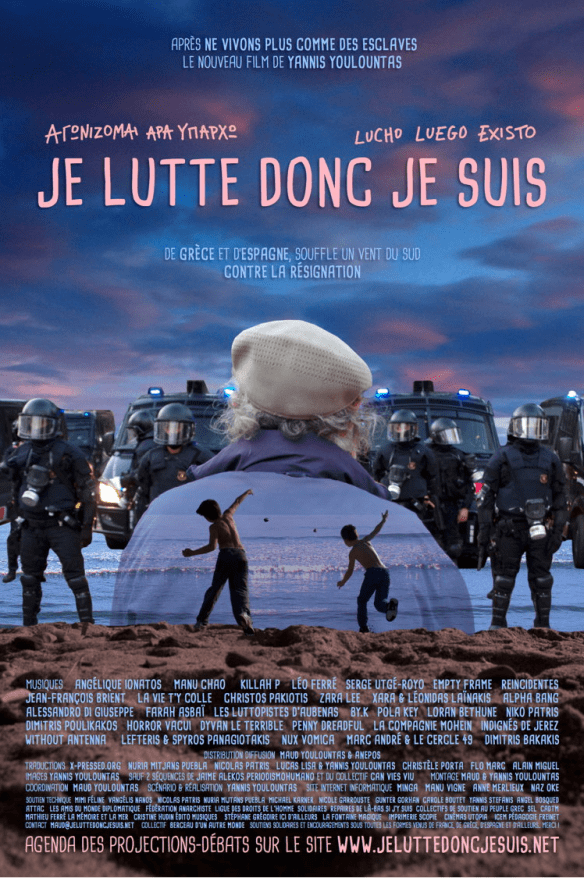
Saturday Matinee: I fight, therefore I am

I fight therefore I am (in french: Je lutte donc je suis) is a documentary film about social and political struggles in Greece and Spain which provides an overview of the struggles in Europe against austerity, capitalism and fascism. A musical journey celebrating Resistance from one end of the Mediterranean to the other. The title is made from the aphorism of the philosopher René Descartes Cogito Ergo Sum (I think therefore I am). Although it hasn’t been distributed by any mainstream company, it has enjoyed great success, and has been shown to numerous theaters, festivals, in France and in Europe.

How To Tell If Someone Is Controlled Opposition

By Caitlin Johnstone

Source: CaitlinJohnstone.com

Every day in my article comments and social media I get people warning me that this or that journalist, activist or politician is “controlled opposition”, meaning someone who pretends to oppose the establishment while covertly serving it. These warnings usually come after I’ve shared or written about something a dissident figure has said or done, and are usually accompanied by an admonishment not to ever do so again lest I spread their malign influence. If you’ve been involved in any kind of anti-establishment activism for any length of time, you’ve probably encountered this yourself.

Paranoia pervades dissident circles of all sorts, and it’s not entirely without merit, since establishment infiltration of political movements is the norm, not the exception. This article by Truthout documents multiple instances in which movements like the 1968 Chicago DNC protest and Peter Camejo’s 1976 anti-establishment presidential campaign were so heavily infiltrated by opaque government agencies that one out of every six people involved in them were secretly working for the feds. This trend of infiltration is known to have continued into the current day with movements like Occupy and Black Lives Matter, and we’d be ignorant not to assume that this has been at least as rampant in online circles where people organize and disseminate ideas and information.

So it’s understandable that people are extremely vigilant about prominent figures in dissident circles, and it’s understandable that people feel paranoid. Over and over again we see shining anti-establishment movements fizzle or rendered impotent, often seemingly with the help of people we once trusted, and it’s hard not to get frustrated and become suspicious of anyone who starts shining bright in antiwar, leftist, or other dissident circles.

The trouble with this paranoia and suspicion is that it doesn’t seem to function with any kind of intelligence. I have received such “controlled opposition” warnings about pretty much every prominent dissident figure in the English-speaking world at one time or another, and if I believed them all there’d be no one in the world whose words I could share or write about, including my own. I myself have been accused at different times of being a “plant” for the CIA, the Russians, Assad, the Chinese Communist Party, the Iranian mullahs, the alt-right, Trump, Pyongyang, and the Palestinians, which if all true would make me a very busy girl indeed. Since I know I’m not a plant for anybody, I know for myself that such accusations don’t come from a place of insight with any degree of reliability, and I’ve therefore had to find my own way to navigate this confusing landscape.

So since I know that infiltration and manipulation happens, but I don’t find other people’s whisperings about “controlled opposition” useful, how do I figure out who’s trustworthy and who isn’t? How do I figure out who it’s safe to cite in my work and who to avoid? How do I separate the fool’s gold from the genuine article? The shit from the Shinola?

Here is my answer: I don’t.

I spend no mental energy whatsoever concerning myself with who may or may not be a secret pro-establishment influencer, and for good reason. There’s no way to know for sure if an individual is secretly scheming to sheep dog the populace into support for the status quo, and as long as government agencies remain opaque and unaccountable there will never be a way to know who might be secretly working for them. What I can know is (A) what I’ve learned about the world, (B) the ways the political/media class is lying about what I know about the world, and (C) when someone says something which highlights those lies. I therefore pay attention solely to the message, and no attention to what may or may not be the hidden underlying agenda of the messenger.

In other words, if someone says something which disrupts establishment narratives, I help elevate what they’re saying in that specific instance. I do this not because I know that the speaker is legit and uncorrupted, but because their message in that moment is worthy of elevation. You can navigate the entire political/media landscape in this way.

Since society is made of narrative and power ultimately rests in the hands of those who are able to control those narratives, it makes no sense to fixate on individuals and it makes perfect sense to focus on narrative. What narratives are being pushed by those in power? How are those narratives being disrupted, undermined and debunked by things that are being said by dissident voices? This is the most effective lens through which to view the battle against the unelected power establishment which is crushing us all to death, not some childish fixation on who should or shouldn’t be our hero.

Have no heroes. Trust nobody but your own inner sense-maker. If someone says something that disrupts establishment narratives based on what you understand those narratives to be, go ahead and help throw what they’re saying into the gears of the machine. Don’t make a religion out of it, don’t get attached to it, just use it as a weapon to attack the narrative matrix.

This by the way is also a useful lens to look through in spiritual development, if you’re into that sort of thing. When you enter spiritual circles concerned with enlightenment, you’ll see all sorts of debates about what teachers are really enlightened and which ones are just pretending, and these conversations mimic precisely the exact kinds of debates you’ll see in marginalized political circles about who’s the real deal and who’s controlled opposition. But the truth is there’s no way to know with certainty what’s going on in someone else’s head, and the best thing to do is to stop concerning yourself with who has and has not attained some special realization or whatever and just focus on what they’re saying. If a spiritual teacher says something which helps you notice something you’d never noticed before about consciousness or perception, then use what they said and maybe stick around to see if they have anything else useful to say. If not, move on.

There’s no reason to worry about what journalists, activists and politicians are coming from a place of authenticity if you know yourself to be coming from a place of authenticity. As you learn more about the world and get better at distinguishing fact from narrative, you will get better and better at seeing the narrative matrix clearly, and you’ll come to see all the things that are being said about what’s going on in the world as weapons in the battle of narrative control. Pick up whatever weapons seem useful to you and use them in whatever ways they’ll be useful, without wasting energy concerning yourself with the individuals who created them. Call the bullshit what it is and use the truth for what it is.

Or maybe I’m fulla shit! Maybe I myself am being paid to say these things by some powerful influencer; you can’t know for sure. All you can know is what’s useful for you. If you really find it useful to try and organize individual dissident figures into “hero” and “controlled opposition” boxes, if that genuinely helps you take apart the system that’s hurting us all, you’d know that better than I would. But if you find what I’m saying here useful, pick it up and add it to your toolbox.

Fuck You, Dying American Empire: Reflections of an Aging Anti-Imperialist

Credit: JOEL PETT

By Jonah Raskin

Source: CounterPunch

Last year at Jamia Millia Islamia Central University in New Delhi, India I met students and teachers who thought that it was cool that I’d written an anti-imperialist book and that it was still in print nearly fifty years after it was first published. It was easy to be an anti-imperialist at Jamia Millia. After all, the students and the teachers were anti-imperialists and all worked-up about U.S. drones, U.S. air strikes and about the Syrians on the ground who had been battered and bombed.

It was also relatively easy to be an anti-imperialist in the late 1960s and early 1970s when anti-imperialism was a red badge of courage in SDS, the Venceremos Brigade, in anti-war circles and even among the Yippies, who were far more internationalist in their outlook than many on the Left assumed. Once upon a time, Jerry Rubin went to Cuba to check out the revolution, and later to Chile with singer and songwriter, Phil Ochs, to see what Salvador Allende was doing.

But here in the U.S. in 2018, is it still possible to be an authentic anti-imperialist, an anti-imperialist in more than name? I thought about that question recently when a former comrade explained that he was still an anti-imperialist and wondered if I was one, too.

It wasn’t the first time that my politics were questioned. In 1980, soon after Reagan was elected president, Professor Edward Said asked me if I was still on the Left and hadn’t drifted to the right like that former radical, David Horowitz, whom Alexander Cockburn dismissed as a “whiner.” A plain “Yes,” or a “No” answer wouldn’t do, nor a “Maybe.”

Am I now and have I ever been an anti- imperialist? It’s really nobody’s business but my own!

I don’t know anyone in my part of northern California who calls himself or herself an anti-imperialist, though friends and neighbors claim to be against racism, sexism, patriarchy and ageism.

U.S. anti-imperialism has a noble lineage. Mark Twain was an anti-imperialist and so was his friend and fellow writer, William Dean Howells. They both belonged to the American Anti-Imperialist League that was founded in 1898 to oppose the U.S. annexation of the Philippines and whose members included an odd assortment of individuals such as Jane Addams, Josephine Shaw Lowell, Henry James, David Starr Jordan, Grover Cleveland and Andrew Carnegie.

The League, which didn’t oppose U.S. entry into World War I, disbanded in 1920 just as U.S. imperialism was flexing its global muscles more than every before, though from its founding the American republic aimed to go West and become a continental empire.

Then, in the twentieth-century, the nation began to shrink the globe big time, to extract labor from peasants and workers in Asia and Africa and export American light bulbs, American Gatling guns, American lingo—“Kilroy Was Here”—and American movies.

Cultural imperialism always bugged me more than any other aspect of imperialism. I hated to see U.S. cultural commodities supplant indigenous cultures. That sight still rankles me, whether I see it in India, Mexico or the American South West. Every time I see and hear about the survival of ancient myths, legends, dances and music I’m ready to cheer.

Membership in an anti-imperialist league or organization makes sense, but to be an anti-imperialist of one in a sea of California anti-intellectualism and provincialism—“We’re number one”—has little or no meaning to me. Why be an anti-imperialist in name only? No, thanks! I don’t mean to live off past glory, though it was a thrill to meet students in India who had studied The Mythology of Imperialism and who told me it was the first book they’d ever read in which they could hear that the author was angry. That was me! I was pissed.

At 77, it’s not possible to be angry with the same intensity that I was angry at 27 when I wrote my anti-imperialist book in-between rioting in the streets, spray painting slogans at Times Square at midnight, going to jail and having the cops kick the shit out of me. I don’t know of any other way to be an anti-imperialist except the way I was an anti-imperialist during the War in Vietnam.

Indeed, it’s no easy feat to be an old anti-imperialist. Che died at 39, Lenin at 53 and Mark Twain at 74. The author of The Adventures of Huckleberry Finn and A Connecticut Yankee in King Arthur’s Court, which takes a big swipe at weapons of mass destruction, noted near the end of his life, “I am always on the side of the revolutionists, because there never was a revolution unless there were some oppressive and intolerable conditions against which to revolute.” Thanks, Mr. Twain. I’m glad you said that.

Today, there are so many oppressive and intolerable conditions the world over, and so many different imperialisms: the Chinese, the Russian, the India, the Israeli, the Brazilian and the U.S. It was comforting in the 1960s and 1970s to recognize that the American Empire was in decline and that the Soviets, the Vietnamese and the Chinese stood up to the Pentagon. Gratifying, too, that crowds in Paris, Rome, and London denounced the U.S. invasion and occupation of Vietnam, Laos and Cambodia.

Now, who stands up to the White House, the Senate, Google, Facebook and Amazon? Precious few citizens! Empires have proliferated and reinvented themselves. The American Empire is still in decline, though as George Lucas noted in 1980 it did “Strike Back” with Reagan, and later with Bush I, Bush II, Clinton and Obama.

An empire in decline—whether Roman, British, or American—isn’t a pretty thing. It can take decades to fall apart. I saw that when I lived in England. An Empire in decline isn’t really anything to cheer about. Indeed, the fall of empire makes life miserable for migrants, serfs, slaves, refugees, prisoners, pensioners and even for aging anti-imperialists. Maybe it’s a cheap shot. I don’t care. I’ll say it here, “Goodbye and Fuck you, American Empire.”

Learning from Gandhi

By Robert J. Burrowes

Mohandas Karamchand Gandhi was born on 2 October 1869: 150 years ago this year.

There will be many tributes to Gandhi published in 2019 so I would like to add one of my own.

This reflects not just my belief that he gave the world inspiration, ideas and powerful strategies for tackling violence in a wide range of contexts but because my own experience in applying his ideas has proven their worth. This included his awareness that led him to declare that ‘If we are to make progress, we must not repeat history but make new history. We must add to the inheritance left by our ancestors.’ and his encouragement to reflect deeply and listen to one’s ‘inner voice’: ‘you should follow your inner voice whatever the consequences’ and ‘even at the risk of being misunderstood’.

In essence, we can productively learn from history but we can build on it too. And, vitally, this includes dealing more effectively with violence.

So how did Gandhi influence me?

Shortly after midnight on 1 July 1942, my Uncle Bob was killed when the USS Sturgeon, a U.S. submarine, fired torpedoes into the Japanese prisoner of war (POW) ship Montevideo Maru. The ship sank immediately and, along with 1,052 other POWs, Bob was killed.

Apart from his older brother, my father’s twin brother was also killed in World War II. In Tom’s case, he was shot down over Rabaul on his first (and final) mission. He was a wireless air gunner on a Beaufort Bomber. See ‘The Last Coastwatcher: My Brothers’.

My childhood is dotted with memories of Bob and Tom. The occasional remembrance service, war medals and the rare story shared by my father.

In 1966, the year I turned 14, I decided to devote my life to finding out why human beings kill each other and to work out how such killing could be ended. The good news about this ‘decision’ is that, at 14, it all felt manageable! But I wasn’t much older before my preliminary investigations proved that even understanding why humans are violent was going to be a profound challenge. And I intuitively understood that I needed this understanding if any strategy to end violence was to be effective.

In any case, as one might expect, my research into violence and strategies for addressing it led me to nonviolence. I came across virtually nothing about nonviolence during my own studies at school and university but was regularly presented with news reports of people participating in activities – such as demonstrations and strikes – that I later learned to label ‘nonviolent action’.

In 1981 I decided to seek out materials on nonviolence and nonviolent action so that I could learn more about it. I had not been reading for long when the routine reference to Mohandas K. (or Mahatma) Gandhi, about whom I had heard a little and knew of his role in leading the Indian independence struggle, forced me to pay more attention to his life and work. So I sought out his writing and started to read some of his published work. An Autobiography: The Story of My Experiments with Truth was an obvious and early book but there were many others besides. I also read many books about Gandhi, to get a clearer sense of his life as a whole, as reported by his coworkers and contemporaries, as well as documented by scholars since his death. And I spent a great many hours in a library basement poring over The Collected Works of Mahatma Gandhi.

The thing that struck me immediately about Gandhi was that his own interest in tackling violence had a comprehensive ‘feel’ about it. That is, he was not just interested in the violence that occurs when nations fight wars or one person kills or injures another. He was interested in addressing the violence that occurs when individuals and nations exploit other individuals/nations (such as when British imperialism exploited India and Indians) and the violence that occurs when a structure (such as capitalism or socialism) exploits the individuals within it. In his words: ‘exploitation is the essence of violence’. He was interested in the violence that occurs when members of one social group (say, Hindus) ‘hate’ the members of another social group (such as Muslims). He was interested in the violence that occurs when men oppress women or caste Hindus oppress ‘untouchables’. He was interested in the violence that occurs when humans destroy the environment. And he was interested in the violence that one inflicts on oneself.

This comprehensive interest resonated deeply with me because, apart from war, my own childhood and adolescence had revealed many manifestations of violence ranging from the starvation of people in developing countries to the racism in the United States (highlighted by Rev. Martin Luther King Jr. during the 1960s) to the destruction of the environment, each of which had gradually but deeply embedded itself in my consciousness. Tackling violence was a far bigger task than the large one I had originally imagined. Violence is everywhere. Most importantly, it seemed to me, there was enormous violence directed against children in the family home but little was spoken or written about this.

So how did Gandhi explain violence and what was his strategy for addressing it?

Gandhi on Conflict and Violence

For Gandhi, conflict was a perennial condition. He also viewed it positively and considered it desirable. For him, it is an important means to greater human unity precisely because their shared conflict could remind antagonists of the deeper, perhaps transcendental, unity of life, which is far more profound than the bond of their social relationship.

He viewed violence differently, however. And, as might be gleaned from the many configurations of violence that concerned him, as noted above, he considered that violence was built into social structures and not into people.

Fundamentally, as Leroy Pelton characterized it, Gandhi understood that the truth cannot be achieved through violence (‘which violates human needs and destroys life’), because violence itself is a form of injustice. In any case, violence cannot resolve conflict because it does not address the issues at stake.

To reiterate then, for Gandhi there was nothing undesirable about conflict. However, Gandhi’s preoccupation was working out how to manage conflict without violence and how to create new social arrangements free of structural violence. The essence, then, of Gandhi’s approach was to identify approaches to conflict that preserved the people while systematically demolishing the evil structure. Nevertheless, he firmly believed that structural purification alone is not enough; self-purification is also essential.

In other words, in Gandhi’s view, resolving the conflict (without violence) is only one aspect of the desired outcome. For Gandhi, success also implies the creation of a superior social structure, higher degrees of fearlessness and self-reliance on the part of both satyagrahis (nonviolent activists) and their opponents, and a greater degree of human unity at the level of social relationships.

Two Key Questions

Despite the enormous influence that Gandhi had in shaping my own conception of conflict and the precise conception of nonviolence that should be used in dealing with it, I nevertheless remained convinced that two questions remained unanswered: What is the psychological origin of the violent behavior of the individual who perpetrates it? And what theory or framework should guide the application of nonviolent action so that campaigns of all kinds are strategically effective?

The first question is important because even if someone is trapped within a social structure (such as the class system) that is violent, the individual must still choose, consciously or unconsciously, to participate (as perpetrator, collaborator or victim) in the violence perpetrated by that structure or one must choose, consciously, to resist it. Why do so many individuals perform one of the first three roles and so few, like Gandhi himself, choose the role of resister?

The second question is important because while Gandhi himself was an astonishingly intuitive strategic thinker (whose 30-year nonviolent strategy liberated India from British occupation), no one before him or since his death has demonstrated anything remotely resembling his capacity in this regard.

Hence, while nonviolence, which is inherently powerful, has chalked up some remarkable successes, vital struggles for peace (and to end war); to halt assaults on Earth’s biosphere; to secure social justice for oppressed and exploited populations; to liberate national groups from dictatorship, occupation or genocidal assault; and struggles in relation to many other just causes limp along devoid of strategy (or use one that is ill-conceived). So badly are we failing, in fact, that humans now teeter on the brink of precipitating our own extinction. See ‘Human Extinction by 2026? A Last Ditch Strategy to Fight for Human Survival’.

Anyway, having studied Gandhi extensively and learned from his strategic approach to nonviolence (elements of which I was progressively including in nonviolent campaigns in which I was involved myself), I resumed my original research to understand the fundamental origin of human violence and also decided to develop a strategic theory and framework for addressing violence in the campaign context so that Gandhi’s strategic thinking could be readily copied by other nonviolent activists.

It turned out that developing this strategic theory and strategy was simpler than the original aim (understanding violence) and I have presented this strategic thinking on two websites: Nonviolent Campaign Strategy and Nonviolent Defense/Liberation Strategy.

Despite my preliminary efforts in the 1990s to encourage fellow activists to use this framework, it soon became clear that only the rarest of activists has the capacity to think strategically about an issue, even when presented with a framework for doing so.

The Origin of Human Violence

Consequently, the vital importance of understanding the origin of human violence was starkly demonstrated to me yet again because I knew it would answer key supplementary questions such as these: Why to do so many people live in denial/delusion utterly incapable of perceiving structural violence or grappling powerfully with (military, social, political, economic and ecological) violence? Why is it that so many people, even activists, are powerless to think strategically? How can activists even believe that success can be achieved, particularly on the major issues of our time (such as the threats of nuclear war, ecological devastation and climate cataclysm), without a focused and comprehensive strategy, particularly given elite resistance to such campaigns? See ‘The Global Elite is Insane Revisited’.

Hence, in an attempt to answer questions such as these, Anita McKone and I went into seclusion in an endeavor to understand how our own minds functioned so that we might better understand the minds of others. I hoped it would take a few months. It took 14 years.

So what is the cause of violence in all contexts and which, depending on its precise configuration in each case, creates perpetrators of violence, people who collaborate with perpetrators of violence, people who are passive victims of violence, people who live in denial/delusion, people who are sexist or racist, and activists who cannot think strategically (among many other adverse outcomes)?

Each of these manifestations of human behaviour is an outcome of the adult war on children. That is, adult violence against children is the fundamental cause of all other violence.

How does this happen? It happens because each child, from birth, is socialized – more accurately, terrorized – so that they fit into their society. That is, each child is subjected to an unrelenting regime of ‘visible’, ‘invisible’ and ‘utterly invisible’ violence until they offer the obedience that every adult – parent, teacher, religious figure… – demands.

So what constitutes ‘visible’, ‘invisible’ and ‘utterly invisible’ violence?

‘Visible’ violence includes hitting, screaming at and sexually abusing a child which, sadly enough, is very common.

But the largest component of damage arises from the ‘invisible’ and ‘utterly invisible’ violence that we adults unconsciously inflict on children during the ordinary course of the day. Tragically, the bulk of this violence occurs in the family home and at school. For a full explanation, see ‘Why Violence?’ and Fearless Psychology and Fearful Psychology: Principles and Practice.

‘Invisible’ violence is the ‘little things’ we do every day, partly because we are just ‘too busy’. For example, when we do not allow time to listen to, and value, a child’s thoughts and feelings, the child learns to not listen to themSelf thus destroying their internal communication system. When we do not let a child say what they want (or ignore them when they do), the child develops communication and behavioral dysfunctionalities as they keep trying to meet their own needs (which, as a basic survival strategy, they are genetically programmed to do).

When we blame, condemn, insult, mock, embarrass, shame, humiliate, taunt, goad, guilt-trip, deceive, lie to, bribe, blackmail, moralize with and/or judge a child, we both undermine their sense of Self-worth and teach them to blame, condemn, insult, mock, embarrass, shame, humiliate, taunt, goad, guilt-trip, deceive, lie, bribe, blackmail, moralize and/or judge.

The fundamental outcome of being bombarded throughout their childhood by this ‘invisible’ violence is that the child is utterly overwhelmed by feelings of fear, pain, anger and sadness (among many others). However, mothers, fathers, teachers, religious figures and other adults also actively interfere with the expression of these feelings and the behavioral responses that are naturally generated by them and it is this ‘utterly invisible’ violence that explains why the dysfunctional behavioral outcomes actually occur.

For example, by ignoring a child when they express their feelings, by comforting, reassuring or distracting a child when they express their feelings, by laughing at or ridiculing their feelings, by terrorizing a child into not expressing their feelings (for instance, by screaming at them when they cry or get angry), and/or by violently controlling a behavior that is generated by their feelings (for example, by hitting them, restraining them or locking them into a room), the child has no choice but to unconsciously suppress their awareness of these feelings.

However, once a child has been terrorized into suppressing their awareness of their feelings (rather than being allowed to have their feelings and to act on them) the child has also unconsciously suppressed their awareness of the reality that caused these feelings. This has many outcomes that are disastrous for the individual, for society and for the biosphere because the individual will now easily suppress their awareness of the feelings that would tell them how to act most functionally in any given circumstance and they will progressively acquire a phenomenal variety of dysfunctional behaviors, including some that are violent towards themself, others and/or the Earth.

So what do we do?

Well, if you want to make an enormous contribution to our effort to end violence, you can make the commitment outlined in ‘My Promise to Children’. If you need to do some healing of your own to be able to nurture children in this way, then consider the information provided in the article ‘Putting Feelings First’.

If you want to systematically tackle violence against the biosphere, consider (accelerated) participation in the fifteen-year strategy, inspired by Gandhi, outlined in ‘The Flame Tree Project to Save Life on Earth’. This project outlines a simple plan for people to systematically reduce their consumption, by at least 80%, involving both energy and resources of every kind – water, household energy, transport fuels, metals, meat, paper and plastic – while dramatically expanding their individual and community self-reliance in 16 areas, so that all environmental concerns are effectively addressed. As Gandhi observed 100 years ago: ‘Earth provides enough for every person’s need but not for every person’s greed.’

But, critically important though he believed personal action to be, Gandhi was also an extraordinary political strategist and he knew that we needed to do more than transform our own personal lives. We need to provide opportunities that compel others to consider doing the same.

So if your passion is campaigning for change, consider doing it strategically, as Gandhi did. See Nonviolent Campaign Strategy.

And if you want to join the worldwide movement to end all violence against humans and the biosphere, you can do so by signing the online pledge of The Peoples Charter to Create a Nonviolent World.

Gandhi was assassinated on 30 January 1948. But his legacy lives on. You can learn from it too, if you wish.


Biodata: Robert J. Burrowes has a lifetime commitment to understanding and ending human violence. He has done extensive research since 1966 in an effort to understand why human beings are violent and has been a nonviolent activist since 1981. He is the author of Why Violence? His email address is flametree@riseup.net and his website is here.

Robert J. Burrowes
P.O. Box 68
Daylesford, Victoria 3460
Australia

Email: flametree@riseup.net

Websites:
Nonviolence Charter
Flame Tree Project to Save Life on Earth
‘Why Violence?’
Feelings First
Nonviolent Campaign Strategy
Nonviolent Defense/Liberation Strategy
Anita: Songs of Nonviolence
Robert Burrowes
Global Nonviolence Network

What Are We Working For? The Economic System is a Labyrinthine Trap

By Edward Curtin

Source: Global Research

One also knows from his letters that nothing appeared more sacred to Van Gogh than work.” – John Berger, “Vincent Van Gogh,” Portraits

Ever since I was a young boy, I have wondered why people do the kinds of work they do.  I sensed early on that the economic system was a labyrinthine trap devised to imprison people in work they hated but needed for survival.  It seemed like common sense to a child when you simply looked and listened to the adults around you.  Karl Marx wasn’t necessary for understanding the nature of alienated labor; hearing adults declaim “Thank God It’s Friday” spoke volumes.

In my Bronx working class neighborhood I saw people streaming to the subway in the mornings for their rides “into the city” and their forlorn trundles home in the evenings. It depressed me.  Yet I knew the goal was to “make it” and move away as one moved “up,” something that many did.  I wondered why, when some people had options, they rarely considered the moral nature of the jobs they pursued.  And why did they not also consider the cost in life (time) lost in their occupations?  Were money, status, and security the deciding factors in their choices?  Was living reserved for weekends and vacations?

I gradually realized that some people, by dint of family encouragement and schooling, had opportunities that others never received.  For the unlucky ones, work would remain a life of toil and woe in which the search for meaning in their jobs was often elusive.  Studs Terkel, in the introduction to his wonderful book of interviews, Working: People Talk About What They Do all Day and How They Feel About What They Do, puts it this way:

This book, being about work, is, by its very nature, about violence – to the spirit as well as to the body.  It is about ulcers as well as accidents, about shouting matches as well as fistfights, about nervous breakdowns as well as kicking the dog around.  It is, above all (or beneath all), about daily humiliations. To survive the day is triumph enough for the walking wounded among the great many of us.

Those words were confirmed for me when in the summer between high school and college I got a job through a relative’s auspices as a clerk for General Motors in Manhattan.  I dreaded taking it for the thought of being cooped up for the first time in an office building while a summer of my youth passed me by, but the money was too good to turn down (always the bait), and I wanted to save as much as possible for college spending money.  So I bought a summer suit and joined the long line of trudgers going to and fro, down and up and out of the underground, adjusting our eyes to the darkness and light.

It was a summer from hell. My boredom was so intense it felt like solitary confinement.  How, I kept wondering, can people do this?  Yet for me it was temporary; for the others it was a life sentence.  But if this were life, I thought, it was a living death.  All my co-workers looked forward to the mid-morning coffee wagon and lunch with a desperation so intense it was palpable.  And then, as the minutes ticked away to 5 P.M., the agitated twitching that proceeded the mad rush to the elevators seemed to synchronize with the clock’s movements.  We’re out of here!

On my last day, I was eating my lunch on a park bench in Central Park when a bird shit on my suit jacket.  The stain was apt, for I felt I had spent my days defiling my true self, and so I resolved never to spend another day of my life working in an office building in a suit for a pernicious corporation, a resolution I have kept.

“An angel is not far from someone who is sad,” says Vincent Van Gogh in the new film, At Eternity’s Gate. For some reason, recently hearing these words in the darkened theater where I was almost alone, brought me back to that summer and the sadness that hung around all the people that I worked with.  I hoped Van Gogh was right and an angel visited them from time to time. Most of them had no options.

The painter Julian Schnabel’s moving picture (moving on many levels since the film shakes and moves with its hand-held camera work and draws you into the act of drawing and painting that was Van Gogh’s work) is a meditation on work.  It asks the questions: What is work?  What is work for?  What is life for?  Why paint? What does it mean to live?  Why do you do what you do?  Are you living or are you dead?  What are you seeking through your work?

For Vincent the answer was simple: reality.  But reality is not given to us and is far from simple; we must create it in acts that penetrate the screens of clichés that wall us off from it.  As John Berger writes,

One is taught to oppose the real to the imaginary, as though the first were always at hand and the second, distant, far away.  This opposition is false.  Events are always to hand.  But the coherence of these events – which is what one means by reality – is an imaginative construction.  Reality always lies beyond – and this is as true for materialists as for idealists. For Plato, for Marx.  Reality, however one interprets it, lies beyond a screen of clichés.

These screens serve to protect the interests of the ruling classes, who devise ways to trap regular people from seeing the reality of their condition.  Yet while working can be a trap, it can also be a means of escape. For Vincent working was the way.  For him work was not a noun but a verb. He drew and he painted as he does in this film to “make people feel what it is to feel alive.”  To be alive is to act, to paint, to write.  He tells his friend Gauguin that there’s a reason it’s called the “act of painting, the “stroke of genius.”  For him painting is living and living is painting.

The actual paintings that he made are almost beside the point, as all creative artists know too well. It is the doing wherein living is found. The completed canvas, essay, or book are what is done.  They are nouns, still lifes, just as Van Gogh’s paintings have become commodities in the years since his death, dead things to be bought and sold by the rich in a culture of death where they can be hung in mausoleums isolated from the living. It is appropriate that the film ends with Vincent very still in his coffin as “viewers” pass him by and avidly now desire his paintings that encircle the room that they once rejected. The man has become a has-been and the funeral parlor the museum.

“Without painting I can’t live,” he says earlier.  He didn’t say without his paintings.

“God gave me the gift for painting,” he said.  “It’s the only gift he gave me.  I am a born painter.”  But his gift has begotten gifts that are still-births that do not circulate and live and breathe to encourage people to find work that will not, “by its very nature, [be] about violence,” as Terkel said. His works, like people, have become commodities, brands to be bought and sold in a world where the accumulation of wealth is accomplished by the infliction of pain, suffering, and death on untold numbers of victims, invisible victims that allow the wealthy to maintain their bad-faith innocence. This is often achieved in the veiled shadows of intermediaries such as stock brokers, tax consultants, and financial managers; in the liberal and conservative boardrooms of mega-corporations or law offices; and in the planning sessions of the world’s great museums. Like drone killings that distance the killers from their victims, this wealth accumulation allows the wealthy to pretend they are on the side of the angels.  It’s called success, and everyone is innocent as they sing, “Hi Ho, Hi Ho, it’s off to work we go.”

“It is not enough to tell me you worked hard to get your gold,” said Henry Thoreau, Van Gogh’s soul-mate. “So does the Devil work hard.”

A few years ago there was a major exhibit of Van Gogh’s nature paintings at the Clark Museum in Williamstown, Massachusetts – “Van Gogh and Nature” – that aptly symbolized Van Gogh in his coffin.  The paintings were exhibited encased in ornate gold frames. Van Gogh in gold. Just perfect.  I am reminded of a scene in At Eternity’s Gatewhere Vincent and Gauguin are talking about the need for a creative revolution – what we sure as hell need – and the two friends stand side by side with backs to the camera and piss into the wind.

But pseudo-innocence dies hard.  Not long ago I was sitting in a breakfast room in a bed-and-breakfast in Houston, Texas, sipping coffee and musing myself awake.  Two men came in and the three of us got to talking.  As people like to say, they were nice guys.  Very pleasant and talkative, in Houston on business. Normal Americans.  Stressed.  Both were about fifty years old with wives and children.

One sold drugs for one of the largest pharmaceutical companies that is known for its very popular anti-depressant drug and its aggressive sales pitches.  He travelled a triangular route from Corpus Christi to Austin to Houston and back again, hawking his wares.  He spoke about his work as being very lucrative and posing no ethical dilemmas.  There were so many depressed people in need of his company’s drugs, he said, as if the causes of their depression had nothing to do with inequality and the sorry state of the country as the rich rip off everyone else.  I thought of recommending a book to him – Deadly Medicines and Organized Crime: How big pharma has corrupted health care by Peter Gotzsche – but held my tongue, appreciative as I was of the small but tasteful fare we were being served and not wishing to cause my companions dyspepsia.  This guy seemed to be trying to convince me of the ethical nature of the way he panned gold, while I kept thinking of that quote attributed to Mark Twain: “Denial ain’t just a river in Egypt.”

The other guy, originally from a small town in Nebraska and now living in Baton Rouge, was a former medevac helicopter pilot who had served in the 1st Gulf War.  He worked in finance for an equally large oil company.  His attitude was a bit different, and he seemed sheepishly guilty about his work with this company as he told me how shocked he was the first time he saw so many oil, gas, and chemical plants lining the Mississippi River from Baton Rouge to New Orleans and all the oil and chemicals being shipped down the river. So many toxins that reminded him of the toxic black smoke rising from all the bombed oil wells in Iraq.  Something about it all left him uneasy, but he too said he made a very good “living” and that his wife also worked for the oil company back home.

My childish thought recurred: when people have options, why do they not choose ethical work that makes the world more beautiful and just?  Why is money and so-called success always the goal?

Having seen At Eternity’s Gate, I now see what Van Gogh was trying to tell us and Julian Schnabel conveys through this moving picture.  I see why these two perfectly normal guys I was breaking bread with in Houston are unable to penetrate the screen that lies between them and reality.  They have never developed the imaginative tools to go beyond normal modes of perception and conception. Or perhaps they lack the faith to dare, to see the futility and violence in what they are working for and what their companies’ products are doing to the world.  They think of themselves as hard at work, travelling hither and yon, doing their calculations, “making their living,” and collecting their pay.  It’s their work that has a payoff in gold, but it’s not working in the sense that painting was for Vincent, a way beyond the screen.  They are mesmerized by the spectacle, as are so many Americans.  Their jobs are perfectly logical and allow them a feeling of calm and control.

But Vincent, responding to Gauguin, a former stock broker, when he urged him to paint slowly and methodically, said, “I need to be out of control. I don’t want to calm down.”  He knew that to be fully alive was to be vulnerable, to not hold back, to always be slipping away, and to be threatened with annihilation at any moment. When painting, he was intoxicated with a creative joy that belies the popular image of him as always depressed.  “I find joy in sorrow,” he said, echoing in a paradoxical way Albert Camus, who said, “I have always felt that I lived on the high seas, threatened, at the heart of a royal happiness.”   Both rebels, one in paint, the other in words: “I rebel: therefore we exist,” was how Camus put it, expressing the human solidarity that is fundamental to genuine work in our ephemeral world. Both nostalgic in the present for the future, creating freedom through vision and disclosing the way for others.

And although my breakfast companions felt safe in their calmness on this side of the screen, it was an illusion. The only really calm ones are corpses. And perhaps that’s why when you look around, as I did as a child, you see so many of the living dead carrying on as normal.

“I paint to stop thinking and feel I am a part of everything inside and outside me,” says Vincent, a self-described exile and pilgrim.

If we could make working a form of such painting, a path to human solidarity because a mode of rebelling, what a wonderful world it might be.

That, I believe, is what working is for.

And So This Is Christmas

By David Swanson

Source: Let’s Try Democracy

Christmas Day. Very late on this day and into the morning of the 26th in 1776, George Washington led a surprise night crossing of the Delaware River and bloody pre-dawn attack on unarmed hung-over-from-Christmas troops still in their underwear — a founding act of violence for the new nation to proudly remember as the progenitor of either the crimes of its “special” forces all over the globe or of peace on earth, I can never recall which.

A more useful memory is certainly that of the 1914 Christmas truce, which was actually more than one truce that year and in the subsequent years of the Great War. This is a true story of people not just managing to speak to each other but actually becoming friends with not just people they had a disagreement with but people who a moment before and for a longtime running had been trying to murder them. It’s a story of war enemies figuring out that the actual enemy is not any people but war itself. And they did it on Christmas. Maybe we can do something good on Christmas too.

Better still is the memory of Jesus, whether fictional character or real man, stripped of all the magical powers, but understood as an innovative and courageous nonviolent activist, or — if you prefer — engager in active nonviolence. In the account Terrence Rynne gives in Choosing Peace: The Catholic Church Returns to Gospel Nonviolence, edited by Marie Dennis, Jesus lived in a violent time and place, the people around him full of rage at the Roman occupiers and their proxy tyrants. (Maybe I should just say a violent time, as the place is still violent and full of rage at distant occupiers and their proxy tyrants.) Jesus predicted catastrophe if the violence was escalated, and he was not heeded, and he was proved right. But his unheeded advice has often been put to use and can still be put to use.

If an occupying soldier smacks you, you can calmly and courageously and lovingly look him in the eye and offer your other cheek. If he takes your coat, you can expose his cruelty by offering your shirt too. If he forces you to carry his pack for a mile, you can make him see your humanity by offering to carry it a second mile. Those of us in the heart of the empire can block distant operations and ask that only the person who has never done anything wrong fire the first missile. We can confront fictional humanitarian justifications with the principled clarity of Jesus who preferred to be killed rather than condone the use of violence against the Romans. We can reject the morality that places politeness above saving the world from climate chaos or nuclear war, with the righteous loving anger of a nonviolent activist overturning the tables of the oligarchs.

A still better memory, though we don’t quite have it and need to create it, is the memory of the cultures displaced by the war-mad Western culture that adopted Christianity and turned it into a powerful argument for both war and sloppy thinking through just war theory. I’m reading right now a book called Kayanerenko:Wa The Great Law of Peace by Kayanesenh Paul Williams, about the law of peace created among the Mohawk, Oneida, Onondaga, Cayuga, and Seneca who became collectively the Haudenosaunee. There is as much to be learned from cultures that did not invent imperialism as from those that invented both it and ways to resist it.

There is the possibility of something being done for peace. President Donald Trump claims he will remove all U.S. troops from Syria. There is very little correlation between what he says and what he does, but if he does this, we need to be prepared to thank him, to celebrate such an action, and to insist that bombing cease as well, and that actual humanitarian aid and unarmed peace workers replace the military force, and that weapons sales and gifts to the region be ended. Trump needs to be shocked by the support for this act from unexpected places.

The U.S. Congress is making a lot of noise about possibly for the very first time using the 1973 War Powers Resolution to end a war, the war on Yemen. We need to make sure this happens and then celebrate it, while insisting that the law be complied with, that all loopholes in it be closed, and that weapons sales and gifts to the region be ended. Similar talk is beginning about also ending the war on Afghanistan. Our responsibility there is the same.

If any of these wars can be ended, we need to rapidly build on that success to end more wars, and more wars, and the funding of the preparations for wars. The United Nations says that $11 billion per year could end the lack of clean drinking water globally. The United States is building a single ugly boat for $13 billion that has no defensive purpose but is likely to start wars. It’s time to change course.

Three years ago, the Pope said this to the U.S. Congress which stood and cheered for it:

“Being at the service of dialogue and peace also means being truly determined to minimize and, in the long term, to end the many armed conflicts throughout our world. Here we have to ask ourselves: Why are deadly weapons being sold to those who plan to inflict untold suffering on individuals and society? Sadly, the answer, as we all know, is simply for money: money that is drenched in blood, often innocent blood. In the face of this shameful and culpable silence, it is our duty to confront the problem and to stop the arms trade.”

If anyone else had said that — I mean anyone else at all — he or she would have been denounced and mocked by members of Congress and by the corporate communications system in the United States. The Pope was cheered instead (and then ignored rather than heeded) not because he has established himself as a moral leader. It’s not that he hasn’t, so much as that we just don’t have those in U.S. corporate media; it isn’t done. The Pope was cheered and tolerated because he is understood to be speaking as a moral leader and is widely believed to be associated in some way with magical powers.

This makes the project that so many great Catholic peace activists are engaged in of trying to move the Catholic Church toward a complete rejection of war very valuable. It also makes it valuable for us all to use Christmas as an occasion to urge the consideration of morality in the question of war or peace, and to demand an end to weapons dealing and death dealing, base building and occupying, killing and maiming and destroying, and threatening fire and fury, in every corner of the world.