Mobility, Meritocracy and Other Myths

justice-fish


By Kevin Carson

Source: Center for a Stateless Society

At the American Enterprise Institute, Mark Perry (“Yes, America’s middle class has been disappearing… into higher income groups,” Dec. 17) justifies the shrinking middle class and growing economic inequality by citing the finding of a recent Pew Institute study that of the 11% shrinkage in the American middle class, 7% have gone to the top and only 4% to the bottom.

First, movement between strata doesn’t legitimize stratification if the structure itself is illegitimate. Meritocracy is a legitimizing myth created to distract people from the question of whether the system of power those meritocratic functionaries serve is just. As Chris Dillow, an unorthodox British Marxist economist, observed (“Beyond social mobility,” Stumbling and Mumbling, Dec. 19):

“Imagine a dictator were to imprison his people, but offer guard jobs to those who passed exams, and well-paid sinecures to those who did especially well. We’d have social mobility — even meritocracy and equality of opportunity. But we wouldn’t have justice, freedom or a good society. They all require that the prisons be torn down.”

Also note that what’s called the “upper class” in the study includes not only the super-rich rentier classes and people in the C-Suites with million-dollar salaries, but also most of the larger managerial stratum. There’s a good reason this stratum has expanded from 14% to 21% of the general population. As David Gordon argued in Fat and Mean, it was the neoliberal decision in the ’70s to cap real hourly wages and shift a greater share of income upwards to rentiers and cowboy CEOs that resulted in increasing internal authoritarianism in the corporation and a need for a larger class of overseers to monitor the (understandably) increasingly disgruntled work force.

And despite the increased income of the managerial classes, the great bulk of them are still salaried employees whose income depends on the ongoing approval of their superiors. That 14-21% of the population is more or less what Orwell, in 1984, called the “middle” stratum (represented in the story by the Inner Party to which Winston and Julia belonged). Here’s how Orwell described the same general type in the corporate England of his day in another novel, Coming Up for Air:  “in every one of those little stucco boxes there’s some poor bastard who’s never free except when he’s fast asleep…”

Not only do these people continue to collect their managerial salary at the good pleasure of the senior oligarchs of the corporate hierarchy, but to even have a shot at that management pay in the first place they’ve got to put themselves in a position of student debt peonage that will likely eat up a major part of that increased income for years (along with a mortgage that means they’ll really be renting their house from the bank into old age). Add to that the long hours middle management types have to work coupled with the endless bureaucratic toadyism and sycophancy required of them, and the ongoing precarity of their position.

Getting back to the issue of legitimacy, there’s also the fact that the functions exercised by most of these managerial types are illegitimate and would be unnecessary absent an exploitative class society. They are, in anarchist anthropologist David Graeber’s famous phrase, “b***s*** jobs.” They exist because the American state, in league with corporate capital, has cartelized the economy under the control of bureaucratic hierarchies many times larger than the point of declining returns in efficiency, and because the authoritarian nature of those hierarchies and the rent-seeking nature of their management creates a conflict of interest that necessitates intensified surveillance and control.

The late Joe Bageant aptly described the nature of the work these people perform: “The empire needs… about 20-25% of its population… to administrate and perpetuate itself — through lawyers, insurance managers, financial managers, college teachers, media managers, scientists, bureaucrats, managers of all types and many other professions and semi-professions.”

When workers own the firm and manage their own work, as in the recuperated enterprises of Argentina, not only can workers be trusted to use their own superior knowledge of the work process but what little coordinating costs remain are a small fraction of U.S. corporate administrative costs. In fact eliminating all those management salaries solved the unit costs problem at one stroke.

The upper quintile is growing in size and income because all the value created by actual productive workers in the lower quintiles gets extracted by those at the top. When the top classes rob everybody else, they need a lot more guard labor to keep their stolen loot secure.

And whether or not there’s been an increase in the real income of the lower four strata, production workers’ loss of control over the work force and increased precarity is even worse than that of those middle managers in the top 21%. Whether for production workers or middle management, stress correlates directly with powerlessness.

We don’t need meritocracy. We need justice.

Bernie Sanders Endorses the World’s Greatest (Presumptive) Evil

Screen-Shot-2016-07-13-at-9.42.28-AM

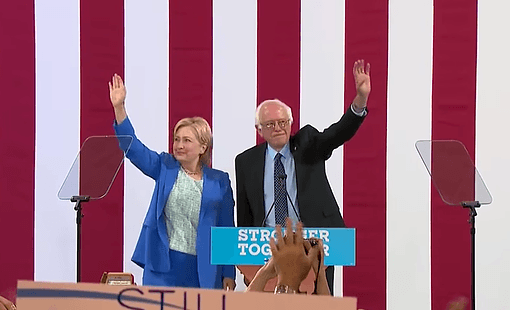
Bernie Sanders ran an extraordinary race, making lots of noise and causing great consternation, but never daring to leave the corporate duopoly. Now his job is to deliver the bulk of his sheep into Hillary Clinton’s enclosure. This final mission will require lots of lying, but Bernie got off to a good start with his surrender speech. “The Clintons have an infinite capacity for lying, and now they’ve got Bernie Sanders lying for them, too.”

By Glen Ford

Source: Black Agenda Report

“Sanders’ job is to shepherd his flock into a little leftwing corner of Hillary’s Big Tent, right next to the latrine and alongside her loyal Black Democrats.”

Bernie Sanders this Tuesday consummated his sheepdog agreement with the Democratic Party, delivering a formal endorsement of Hillary Clinton for president.  The capitulation script that Sanders read in New Hampshire, with the cackling Banshee of War at his side, could have been written back in the spring of last year, when he formally threw his hat into the race. From the very start, Sanders was firm in his allegiance to the Democratic wing of the corporate duopoly, and any indications to the contrary were purely products of his supporters wishful imaginations.

Bernie Sanders did not lie to his followers; they deceived themselves, just as most of them – the ones that were old enough – had fooled themselves into believing that Barack Obama was a peace candidate and a political progressive back in 2008, although Obama’s actual record and policy pronouncements showed him clearly to be a corporate imperialist warmonger – a political twin of his principal primary election opponent, Hillary Clinton and her philandering, huckster husband.

Back then, phony leftists like Bill Fletcher and Tom Hayden swore on their mothers’ honor that Obama’s campaign was really a people’s movement, a prelude to revolution – as if the Democrats, a militarist corporate political party, could give birth to an anti-corporate, anti-militarist people’s revolution.

Real Fascist vs. Trump Cartoon Version

Bernie Sanders threw around the word “revolution” quite a bit. He was still using it in his surrender speech on Tuesday, assuring his flock that the revolution would continue as he marched arm in arm with the most dangerous person in the world, today – far more dangerous than Donald Trump, who will be buried in a landslide of historical proportions in November by a multi-billion dollar mountain of campaign contributions from Hillary Clinton’s Democratic and Republican friends on Wall Street. Sanders’ job is to shepherd his flock into a little leftwing corner of Hillary’s Big Tent, right next to the latrine and alongside her loyal Black Democrats, who are so meek in the presence of power that they won’t even complain about the smell.

In his kow-tow to the Queen of Chaos, Sanders put words in Clinton’s mouth that she never really said, and that would be lies if she did say them. Hillary “feels” this, Hillary “believes” that – it was as if he could read Hillary’s mind.  Hillary “knows,” said Sanders, “that something is very wrong when the very rich become richer while many others are working longer hours for lower wages.” Maybe she does know that, but she has no intention to do anything about it – just as she had no intention of allowing the Democratic Party platform to oppose TPP, although she claims she’s against it. As for those compromises Clinton did make on the platform: she was lying. The Clintons have an infinite capacity for lying, and now they’ve got Bernie Sanders lying for them, too.

If only 5 percent of Bernie Sanders’ 13 million voters formed or joined a party of the 99 percent – let’s say, the Green Party – that party would have nearly twice as many members as the British Labor Party. which would be one helluva start. Or, they can crawl along with Bernie into Hillary’s stinking Big Tent, where the real fascists live – the ones with actual experience in regime change, nuclear brinksmanship and mass Black incarceration.

The 1 Percent’s Houses Are Getting Bigger and Swankier While Average Americans Struggle To Make Rent

0aar7AZ9VX8C5_3820homeless-read-tweets

For a view of the inefficiencies of the free market, there’s no clearer view than the U.S. housing market, where there are as many as 29 empty homes for every homeless person.

By Bob Larson

Source: In These Times

Today’s gigantic class cleavages bring to mind Matthew 8:20, where Jesus describes his persecution: “The foxes have holes, and the birds of the air have nests, but the Son of man hath not where to lay his head.” This description could increasingly also apply to the wrong end of our lopsided capitalist society, which shows itself nowhere more clearly than in housing.

The Wall Street Journal has characteristically thorough reporting on the current housing market, in which it observes “a severe shortage of midtier apartments,” meaning those “aimed at the working class.” This “dearth of lower-priced apartments” has driven up rents for lower- and middle-income-earners, with a market segment average of $845 a month—a daunting figure for many of today’s part-timers and even full-timers.

The reason for this “severe shortage” is pure market economics: “Construction costs are generally too high to justify building new complexes for low- and middle-income tenants. …The difference in costs between installing granite countertops and stainless-steel appliances is so slight compared to buying land and installing elevators that economists say developing a luxury apartment and a midtier one comes out roughly the same.” This has meant that “the supply of less expensive apartments…had decreased 1.6% since 2002. Over that time, high-end apartment inventory has increased 31%.” Not surprising, since rents for the higher-income occupants average $1,702. This isn’t exactly a glowing review of capitalism’s alleged ability to meet consumer demand, regardless of income level.

These market dynamics are especially important for today’s generation of young “millennials,” as the business press observes they tend to rent more, “younger Americans either can’t afford to buy a house or don’t want to.” They’re willing to accept small apartment sizes also, and for reasons that reflect the economic realities of the new generation: “They have diminished expectations, less access to financing and a strong desire to stay in cities.” The tendency for normal working families to be squeezed by high rents out of safe neighborhoods, or into tinier spaces, is another example of the invisible hand giving the finger.

Condo or castle?

On the other hand, a convenient place to observe how the other side of the market works is “Mansion,” a weekly section of the elite-oriented Wall Street Journal, which profiles various different playground properties of elite management and the 1%. Like a lot of print and online media that cover housing, it’s part journalism of lifestyle trends and part naked sales pitch. But the window it provides on the day-to-day life of the ruling class is fascinating.

A conspicuous Mansion headline, “Masters of the Universe,” refers to the infamous phrase used to describe Wall Street power-brokers. But this reference is to the incredible scale of high-end master suites, “With square footage that rivals the average American home.”

The features are gobsmacking: “Amenities have included everything from small kitchens to beauty salons and pedicure stations. Some clients have requested private pools just off the master, separate from the home’s main pool.” At another development, private suites have separate “laundry rooms, small gyms or Pilates areas and ‘super closets’ within the master.” These super closets are their own embarrassment of riches: “closets have evolved from utilitarian storage spaces to showpieces modeled after designer stores, with fireplaces, seating areas and separate dressing rooms.” Illustrated with enormous color photos (often software-generated in the small print), you can easily see that several of these condo and mansion designs have bedroom suites that alone exceed the median modern US house size of 2300 square feet.

Elsewhere, the Mansion section observes that in New York City’s always record-setting property market, “At least two new developments in Manhattan are asking $1 million for a single parking spot,” not failing to notice that this is “about four times the cost of an average single-family home in the U.S.” Spaces can be had for less, but these particular concrete patches are associated with units sporting super-high price tags themselves.

A more old-world example comes from the Financial Times, where a recent edition of its high-living Town & Country section profiles a Scottish Duke with a fair-sized castle in the Argyles. The Times is eager to show a self-effacing, status-disregarding picture of the Duke, encouraging us to see the particularly ludicrous institution of Anglo-Scottish aristocracy with Downton Abbey post-status charm. But the local history is more realist: “To the distress of some Inveraray residents, the whole town was moved in the 1770s to give the castle a more secluded setting.”

Today His Grace is most concerned with fending off the increasingly left-leaning Scottish National Party’s proposals to increase the tax on landed estates like his, and split up the great family fortunes—although estates managed through corporations are exempt. But while he hopes to avoid any splitting of his assets, the Duke also confesses he seldom uses his castle’s two-story library: “I’m just not a book person.”

For the urbane London CEO needing a break from city noise, the WSJ Magazine recommends the “Soho Farmhouse,” actually a fantastically expensive members-only rural retreat with a country club, ice rink, horse stable, football field, event barn, boathouse and tennis courts. To ease rich members into their relaxation time, “a hidden camera scans license plates as guests enter the property,” and “guests are handed cocktails as their vehicles are whisked away…guests can specify their height and foot measurements when checking in online to ensure that they are given properly sized bicycles and Wellington boots for their stay.”

Knowing its audience, the magazine mentions an “Added bonus: If guests don’t want to make their own cocktails, they can summon one of two 24-hour roving milk trucks that have been converted into portable bars with bartenders on hand.” Look, no one appreciates the appeal of a roving bar more than me. But 160,000 kids will die from cheaply-treatable diarrhea-related diseases this month, and these fun cash-burning novelties are pretty obscene to African mothers watching their kids die from conditions that could be cured for far less than an executive’s artisan cocktail.

No vacancies, more vagrancies

But the gaping chasm in housing classes is most dramatically seen by comparing the often-mentioned number of empty houses and apartments, relative to the number of homeless citizens living on the streets or shelters around the United States. Real numbers can be looked up—the Census Bureau’s homeownership survey found that in the first quarter of 2015, 17.3 million housing units were vacant, excluding properties only vacant for part of the year. (Notably, the Mansion survey of gigantic master suites notes that these condos and mansions will often “most likely be a second residence for the potential buyer.”)

The number of homeless Americans is of course somewhat harder to pin down, with the Department of Housing and Urban Development in its Annual Homeless Assessment Report for 2014 (the most recent available) finding 578,424 people homeless on a given night. However this HUD number is considered to be at best incomplete, as its “point-in-time” data reporting tends to underestimate the issue. Nonprofits and advocacy groups like the Urban League approach the number in a longer time frame, trying to estimate how many people experience homelessness over the course of a year. The numbers found through this approach are startlingly different, with older research suggesting numbers around 2.3 million, reflecting high turnover among the homeless population.

The most gross calculation from this data would suggest a ratio of 17.3 million year-round vacant units to 2.3 million homeless, or about 7.5 units per homeless individual. Using the HUD’s more conservative “Homelessness measured on a single night” data would give us an even more insane 29 homes or apartments for each homeless person!

Obviously, numbers anything like these point to a hugely irrational economic system, where people, including families with kids, are spending the nights in dangerous shelters or on the streets while millions of empty apartments and houses sit silently still.

This staggering inefficiency of housing markets throws the irrationality of capitalism into stark relief. Much like crumbling bridges and the unemployed construction workforce, the market economy’s failure to bring these economic factors together is pretty damning. Were Christ to return in our capitalist epoch, He’d need to ante up a lot more than the Word to find a place to lay His head—unless He, like other young Americans, had “diminished expectations” for housing.

About the Author

Rob Larson is Professor of Economics at Tacoma Community College in Washington State, and author of Bleakonomics: A Heartwarming Introduction to Financial Catastrophe, the Jobs Crisis and Environmental Destruction. Follow him on Twitter: @ironicprofessor.

The 1% Versus the 99%: Realignment, Repression or Revolution

640px-Standard_oil_octopus_loc_color

Wealth Inequality Is Putting the US on Course for a Showdown

By Klaus Marre

Source: WhoWhatWhy.org

The richest 20 Americans now own as much wealth as the country’s poorest 152 million people combined.

That is just one of the findings of noted inequality scholar and author Chuck Collins’s most recent report, “Billionaire Bonanza, The Forbes 400 and the Rest of Us.”

In a wide-ranging interview, which will be available in its entirety as a podcast tomorrow, Collins likened the current situation to the “Gilded Age,” the time just before the turn of the 20th century, when there was a similar accumulation of wealth at the top and political power was concentrated in the hands of a few rich men.

And Americans are slowly realizing that the extreme accumulation of wealth at the very top is hurting their own prospects.  But grassroots efforts to redress economic inequality must contend with the political power that comes with great wealth.

This is an unstable situation. With pressure building for change but potent forces stacked against it, there are only three options, Collins told WhoWhatWhy: “Realignment, revolution or repression.”

Rules Rigged, and the Rich Get Richer

Back in the Gilded Age, the country managed to convert the pressure that was building from the bottom up into meaningful changes that resulted in a realignment of political power and the rise of the middle class. Those gains, however, are now being reversed. In fact, a new report found that, for the first time in decades, the middle class no longer constitutes the economic majority in the United States.

The shift toward increasing inequality began in the 1970s. At that time, Collins says (and research shows), “we stopped being an economy in which most people grew together” and instead became a “society that is dramatically pulled apart.”

Wages have now been stagnant for three decades and the median wealth of Americans has actually declined since 1990. At the same time, the rich have gotten richer. A lot richer.

Like the Great Depression in the early 1930s, the economic crisis of 2008 has been a wake-up call for the country. Polls historically have shown that people are indifferent to great wealth as long as they feel the rules are fair and that they at least have the option of moving up the ladder. But for many, the latest crash is changing that perception.

“In the economic meltdown of 2008, people realized the rules are rigged, that the big financial industry people … are tipping the scale in their favor,” Collins said. This has led to a perception that upward mobility in America is stalled — a perception supported by statistical data.

Collins believes that this sentiment has helped boost the candidacies of presidential hopefuls as diverse as Donald Trump and Bernie Sanders.

The collapsing middle class, including groups like recent college students whose prospects are blighted by crushing debt burdens, represents an “angry and mobilized constituency.” These are the people whose dissatisfactions are articulated by populists like Trump.

At the other end of the spectrum, the success of self-avowed “democratic socialist” Sanders shows how fluid the situation is. Collins pointed out that the Vermont senator has been saying the same things for 30 years — but only now are they resonating with a larger proportion of the electorate.

Collins pointed out that Sanders is the only major candidate who does not need a billionaire bankrolling his primary campaign to do well in the polls.

One bloc of voters who can cause a tectonic shift in the near future are millennials, many of whom are resentful of the obstacles they face in pursuing the American dream while paying off their college loans. With 40 million households shouldering a burden of $1.2 trillion in college debt, Collins believes that if this segment of the population were to organize, they could force significant change.

“Otherwise, the machinery of inequality will just keep chugging along as it currently is and it will get more concentrated,” Collins said. In any case, all of the ingredients are there for a major political realignment.

“We’re headed for a showdown.”

[audio http://www.whowhatwhy.org/files/Chuck%20Collins%20WWW%20Final.mp3 ]

http://www.whowhatwhy.org/files/Chuck%20Collins%20WWW%20Final.mp3

The New American Order

natsec

1% Elections, The Privatization of the State, a Fourth Branch of Government, and the Demobilization of “We the People” 

By Tom Engelhardt

Source: TomDispatch.com

Have you ever undertaken some task you felt less than qualified for, but knew that someone needed to do? Consider this piece my version of that, and let me put what I do understand about it in a nutshell: based on developments in our post-9/11 world, we could be watching the birth of a new American political system and way of governing for which, as yet, we have no name.

And here’s what I find strange: the evidence of this, however inchoate, is all around us and yet it’s as if we can’t bear to take it in or make sense of it or even say that it might be so.

Let me make my case, however minimally, based on five areas in which at least the faint outlines of that new system seem to be emerging: political campaigns and elections; the privatization of Washington through the marriage of the corporation and the state; the de-legitimization of our traditional system of governance; the empowerment of the national security state as an untouchable fourth branch of government; and the demobilization of “we the people.”

Whatever this may add up to, it seems to be based, at least in part, on the increasing concentration of wealth and power in a new plutocratic class and in that ever-expanding national security state. Certainly, something out of the ordinary is underway, and yet its birth pangs, while widely reported, are generally categorized as aspects of an exceedingly familiar American system somewhat in disarray.

1. 1% Elections

Check out the news about the 2016 presidential election and you’ll quickly feel a sense of been-there, done-that. As a start, the two names most associated with it, Bush and Clinton, couldn’t be more familiar, highlighting as they do the curiously dynastic quality of recent presidential contests.  (If a Bush or Clinton should win in 2016 and again in 2020, a member of one of those families will have controlled the presidency for 28 of the last 36 years.)

Take, for instance, “Why 2016 Is Likely to Become a Close Race,” a recent piece Nate Cohn wrote for my hometown paper.  A noted election statistician, Cohn points out that, despite Hillary Clinton’s historically staggering lead in Democratic primary polls (and lack of serious challengers), she could lose the general election.  He bases this on what we know about her polling popularity from the Monica Lewinsky moment of the 1990s to the present.  Cohn assures readers that Hillary will not “be a Democratic Eisenhower, a popular, senior statesperson who cruises to an easy victory.”  It’s the sort of comparison that offers a certain implicit reassurance about the near future.  (No, Virginia, we haven’t left the world of politics in which former general and president Dwight D. Eisenhower can still be a touchstone.)

Cohn may be right when it comes to Hillary’s electability, but this is not Dwight D. Eisenhower’s or even Al Gore’s America. If you want a measure of that, consider this year’s primaries. I mean, of course, the 2015 ones. Once upon a time, the campaign season started with candidates flocking to Iowa and New Hampshire early in the election year to establish their bona fides among party voters. These days, however, those are already late primaries.

The early primaries, the ones that count, take place among a small group of millionaires and billionaires, a new caste flush with cash who will personally, or through complex networks of funders, pour multi-millions of dollars into the campaigns of candidates of their choice.  So the early primaries — this year mainly a Republican affair — are taking place in resort spots like Las Vegas, Rancho Mirage, California, and Sea Island, Georgia, as has been widely reported. These “contests” involve groveling politicians appearing at the beck and call of the rich and powerful, and so reflect our new 1% electoral system. (The main pro-Hillary super PAC, for instance, is aiming for a kitty of $500 million heading into 2016, while the Koch brothers network has already promised to drop almost $1 billion into the coming campaign season, doubling their efforts in the last presidential election year.)

Ever since the Supreme Court opened up the ultimate floodgates with its 2010 Citizens United decision, each subsequent election has seen record-breaking amounts of money donated and spent. The 2012 presidential campaign was the first $2 billion election; campaign 2016 is expected to hit the $5 billion mark without breaking a sweat.  By comparison, according to Burton Abrams and Russell Settle in their study, “The Effect of Broadcasting on Political Campaign Spending,” Republicans and Democrats spent just under $13 million combined in 1956 when Eisenhower won his second term.

In the meantime, it’s still true that the 2016 primaries will involve actual voters, as will the election that follows. The previous election season, the midterms of 2014, cost almost $4 billion, a record despite the number of small donors continuing to drop. It also represented the lowest midterm voter turnout since World War II. (See: demobilization of the public, below — and add in the demobilization of the Democrats as a real party, the breaking of organized labor, the fragmenting of the Republican Party, and the return of voter suppression laws visibly meant to limit the franchise.) It hardly matters just what the flood of new money does in such elections, when you can feel the weight of inequality bearing down on the whole process in a way that is pushing us somewhere new.

2. The Privatization of the State (or the U.S. as a Prospective Third-World Nation)

In the recent coverage of the Hillary Clinton email flap, you can find endless references to the Clintons of yore in wink-wink, you-know-how-they-are-style reporting; and yes, she did delete a lot of emails; and yes, it’s an election year coming and, as everyone points out, the Republicans are going to do their best to keep the email issue alive until hell freezes over, etc., etc.  Again, the coverage, while eyeball gluing, is in a you’ve-seen-it-all-before, you’ll-see-it-all-again-mode.

However, you haven’t seen it all before. The most striking aspect of this little brouhaha lies in what’s most obvious but least highlighted.  An American secretary of state chose to set up her own private, safeguarded email system for doing government work; that is, she chose to privatize her communications.  If this were Cairo, it might not warrant a second thought.  But it didn’t happen in some third-world state.  It was the act of a key official of the planet’s reigning (or thrashing) superpower, which — even if it wasn’t the first time such a thing had ever occurred — should be taken as a tiny symptom of something that couldn’t be larger or, in the long stretch of history, newer: the ongoing privatization of the American state, or at least the national security part of it.

Though the marriage of the state and the corporation has a pre-history, the full-scale arrival of the warrior corporation only occurred after 9/11.  Someday, that will undoubtedly be seen as a seminal moment in the formation of whatever may be coming in this country.  Only 13 years later, there is no part of the war state that has not experienced major forms of privatization.  The U.S. military could no longer go to war without its crony corporations doing KP and guard duty, delivering the mail, building the bases, and being involved in just about all of its activities, including training the militaries of foreign allies and even fighting.  Such warrior corporations are now involved in every aspect of the national security state, including torture, drone strikes, and — to the tune of hundreds of thousands of contract employees like Edward Snowden — intelligence gathering and spying.  You name it and, in these years, it’s been at least partly privatized.

All you have to do is read reporter James Risen’s recent book, Pay Any Price, on how the global war on terror was fought in Washington, and you know that privatization has brought something else with it: corruption, scams, and the gaming of the system for profits of a sort that might normally be associated with a typical third-world kleptocracy.  And all of this, a new world being born, was reflected in a tiny way in Hillary Clinton’s very personal decision about her emails.

Though it’s a subject I know so much less about, this kind of privatization (and the corruption that goes with it) is undoubtedly underway in the non-war-making, non-security-projecting part of the American state as well.

3. The De-legitimization of Congress and the Presidency

On a third front, American “confidence” in the three classic check-and-balance branches of government, as measured by polling outfits, continues to fall.  In 2014, Americans expressing a “great deal of confidence” in the Supreme Court hit a new low of 23%; in the presidency, it was 11%, and in Congress a bottom-scraping 5%.  (The military, on the other hand, registers at 50%.)  The figures for “hardly any confidence at all” are respectively 20%, 44%, and more than 50%.  All are in or near record-breaking territory for the last four decades.

It seems fair to say that in recent years Congress has been engaged in a process of delegitimizing itself.  Where that body once had the genuine power to declare war, for example, it is now “debating” in a desultory fashion an “authorization” for a war against the Islamic State in Syria, Iraq, and possibly elsewhere that has already been underway for eight months and whose course, it seems, will be essentially unaltered, whether Congress authorizes it or not.

What would President Harry Truman, who once famously ran a presidential campaign against a “do-nothing” Congress, have to say about a body that truly can do just about nothing?  Or rather, to give the Republican war hawks in that new Congress their due, not quite nothing.  They are proving capable of acting effectively to delegitimize the presidency as well.  House Majority Leader John Boehner’s invitation to Israeli Prime Minister Benjamin Netanyahu to undercut the president’s Iranian nuclear negotiations and the letter signed by 47 Republican senators and directed to the Iranian ayatollahs are striking examples of this.  They are visibly meant to tear down an “imperial presidency” that Republicans gloried in not so long ago.

The radical nature of that letter, not as an act of state but of its de-legitimization, was noted even in Iran, where fundamentalist Supreme Leader Ali Khamenei proclaimed it “a sign of a decline in political ethics and the destruction of the American establishment from within.” Here, however, the letter is either being covered as a singularly extreme one-off act (“treason!”) or, as Jon Stewart didon “The Daily Show,” as part of a repetitive tit-for-tat between Democrats and Republicans over who controls foreign policy.  It is, in fact, neither.  It represents part of a growing pattern in which Congress becomes an ever less effective body, except in its willingness to take on and potentially take out the presidency.

In the twenty-first century, all that “small government” Republicans and “big government” Democrats can agree on is offering essentially unconditional support to the military and the national security state.  The Republican Party — its various factions increasingly at each other’s throats almost as often as at those of the Democrats — seems reasonably united solely on issues of war-making and security.  As for the Democrats, an unpopular administration, facing constant attack by those who loath President Obama, has kept its footing in part by allying with and fusing with the national security state.  A president who came into office rejecting torture and promoting sunshine and transparency in government has, in the course of six-plus years, come to identify himself almost totally with the U.S. military, the CIA, the NSA, and the like.  While it has launched an unprecedented campaign against whistleblowers and leakers (as well as sunshine and transparency), the Obama White House has proved a powerful enabler of, but also remarkably dependent upon, that state-within-a-state, a strange fate for “the imperial presidency.”

4. The Rise of the National Security State as the Fourth Branch of Government

One “branch” of government is, however, visibly on the rise and rapidly gaining independence from just about any kind of oversight.  Its ability to enact its wishes with almost no opposition in Washington is a striking feature of our moment.  But while the symptoms of this process are regularly reported, the overall phenomenon — the creation of a de facto fourth branch of government — gets remarkably little attention.  In the war on terror era, the national security state has come into its own.  Its growth has been phenomenal.  Though it’s seldom pointed out, it should be considered remarkable that in this period we gained a second full-scale “defense department,” the Department of Homeland Security, and that it and the Pentagon have become even more entrenched, each surrounded by its own growing “complex” of private corporations, lobbyists, and allied politicians.  The militarization of the country has, in these years, proceeded apace.

Meanwhile, the duplication to be found in the U.S. Intelligence Community with its 17 major agencies and outfits is staggering.  Its growing ability to surveil and spy on a global scale, including on its own citizens, puts the totalitarian states of the twentieth century to shame.  That the various parts of the national security state can act in just about any fashion without fear of accountability in a court of law is by now too obvious to belabor.  As wealth has traveled upwards in American society in ways not seen since the first Gilded Age, so taxpayer dollars have migrated into the national security state in an almost plutocratic fashion.

New reports regularly surface about the further activities of parts of that state.  In recent weeks, for instance, we learned from Jeremy Scahill and Josh Begley of the Intercept that the CIA has spent years trying to break the encryption on Apple iPhones and iPads; it has, that is, been aggressively seeking to attack an all-American corporation (even if significant parts of its production process are actually in China).  Meanwhile, Devlin Barrett of the Wall Street Journal reported that the CIA, an agency barred from domestic spying operations of any sort, has been helping the U.S. Marshals Service (part of the Justice Department) create an airborne digital dragnet on American cell phones.  Planes flying out of five U.S. cities carry a form of technology that “mimics a cellphone tower.” This technology, developed and tested in distant American war zones and now brought to “the homeland,” is just part of the ongoing militarization of the country from its borders to its police forces.  And there’s hardly been a week since Edward Snowden first released crucial NSA documents in June 2013 when such “advances” haven’t been in the news.

News also regularly bubbles up about the further expansion, reorganization, and upgrading of parts of the intelligence world, the sorts of reports that have become the barely noticed background hum of our lives.  Recently, for instance, Director John Brennan announced a major reorganization of the CIA meant to break down the classic separation between spies and analysts at the Agency, while creating a new Directorate of Digital Innovation responsible for, among other things, cyberwarfare and cyberespionage.  At about the same time, according to the New York Times, the Center for Strategic Counterterrorism Communications, an obscure State Department agency, was given a new and expansive role in coordinating “all the existing attempts at countermessaging [against online propaganda by terror outfits like the Islamic State] by much larger federal departments, including the Pentagon, Homeland Security and intelligence agencies.”

This sort of thing is par for the course in an era in which the national security state has only grown stronger, endlessly elaborating, duplicating, and overlapping the various parts of its increasingly labyrinthine structure.  And keep in mind that, in a structure that has fought hard to keep what it’s doing cloaked in secrecy, there is so much more that we don’t know.  Still, we should know enough to realize that this ongoing process reflects something new in our American world (even if no one cares to notice).

5. The Demobilization of the American People

In The Age of Acquiescence, a new book about America’s two Gilded Ages, Steve Fraser asks why it was that, in the nineteenth century, another period of plutocratic excesses, concentration of wealth and inequality, buying of politicians, and attempts to demobilize the public, Americans took to the streets with such determination and in remarkable numbers over long periods of time to protest their treatment, and stayed there even when the brute power of the state was called out against them.  In our own moment, Fraser wonders, why has the silence of the public in the face of similar developments been so striking?

After all, a grim new American system is arising before our eyes.  Everything we once learned in the civics textbooks of our childhoods about how our government works now seems askew, while the growth of poverty, the flatlining of wages, the rise of the .01%, the collapse of labor, and the militarization of society are all evident.

The process of demobilizing the public certainly began with the military.  It was initially a response to the disruptive and rebellious draftees of the Vietnam-era.  In 1973, at the stroke of a presidential pen, the citizen’s army was declared no more, the raising of new recruits was turned over to advertising agencies (a preview of the privatization of the state to come), and the public was sent home, never again to meddle in military affairs.  Since 2001, that form of demobilization has been etched in stone and transformed into a way of life in the name of the “safety” and “security” of the public.

Since then, “we the people” have made ourselves felt in only three disparate ways: from the left in the Occupy movement, which, with its slogans about the 1% and the 99%, put the issue of growing economic inequality on the map of American consciousness; from the right, in the Tea Party movement, a complex expression of discontent backed and at least partially funded by right-wing operatives and billionaires, and aimed at the de-legitimization of the “nanny state”; and the recent round of post-Ferguson protests spurred at least in part by the militarization of the police in black and brown communities around the country.

The Birth of a New System

Otherwise, a moment of increasing extremity has also been a moment of — to use Fraser’s word — “acquiescence.”  Someday, we’ll assumedly understand far better how this all came to be.  In the meantime, let me be as clear as I can be about something that seems murky indeed: this period doesn’t represent a version, no matter how perverse or extreme, of politics as usual; nor is the 2016 campaign an election as usual; nor are we experiencing Washington as usual.  Put together our 1% elections, the privatization of our government, the de-legitimization of Congress and the presidency, as well as the empowerment of the national security state and the U.S. military, and add in the demobilization of the American public (in the name of protecting us from terrorism), and you have something like a new ballgame.

While significant planning has been involved in all of this, there may be no ruling pattern or design.  Much of it may be happening in a purely seat-of-the-pants fashion.  In response, there has been no urge to officially declare that something new is afoot, let alone convene a new constitutional convention.  Still, don’t for a second think that the American political system isn’t being rewritten on the run by interested parties in Congress, our present crop of billionaires, corporate interests, lobbyists, the Pentagon, and the officials of the national security state.

Out of the chaos of this prolonged moment and inside the shell of the old system, a new culture, a new kind of politics, a new kind of governance is being born right before our eyes. Call it what you want. But call it something. Stop pretending it’s not happening.

Tom Engelhardt is a co-founder of the American Empire Project and the author of The United States of Fear as well as a history of the Cold War, The End of Victory Culture. He is a fellow of the Nation Institute and runs TomDispatch.com. His latest book is Shadow Government: Surveillance, Secret Wars, and a Global Security State in a Single-Superpower World(Haymarket Books).

[Note: My special thanks go to my friend John Cobb, who talked me through this one.  Doing it would have been inconceivable without him.  Tom]

Follow TomDispatch on Twitter and join us on Facebook. Check out the newest Dispatch Book, Rebecca Solnit’s Men Explain Things to Me, and Tom Engelhardt’s latest book, Shadow Government: Surveillance, Secret Wars, and a Global Security State in a Single-Superpower World

Billionaire Fears The Poor RIsing Up Against The Rich

.

Source: Popular Resistance

A billionaire finally had a epiphany and told all his wealthy friends about it.

Johann Rupert is the filthy rich owner of Richemont, a luxury goods company that serves as parent company to jeweler Cartier. His net worth tops out at nearly $8 billion making him part of the 1% of wealthy people who are greedily taking control of most of the world’s wealth to the detriment of poor people and the middle class.

According to Oxfam, an organization that fights poverty, the richest one percent are on pace to control more global wealth than the rest of the 99 percent combined by 2016. And it doesn’t show any signs of stopping.

Unsurprisingly, most of the billionaires in the world live in the United States, where they hire armies of lobbyists to influence the passage of government policies that help them keep their vast wealth and keep it growing. Meanwhile, other nations, despite having a few billionaires, have more regulations designed to narrow the income inequality gap.

Nevertheless, the system that allows the rich to keep getting richer isn’t doing anything for the rest of humanity as most people around the world continue to struggle to make ends meet. While the wealthy continue to make more money, everyone else is making less, which is starting to cause social unrest and upheaval that worries Johann Rupert.

Rupert now fears that the greed of the 1 percent has gone too far, and the thought that one day the rest of the world will grab their pitchforks and torches makes sleeping more difficult for him.

How is society going to cope with structural unemployment and the envy, hatred and the social warfare? We are destroying the middle classes at this stage and it will affect us. It’s unfair. So that’s what keeps me awake at night.

Rupert revealed his terror at the Financial Times Business of Luxury Summit in Monaco, and frankly, he is right to fear this scenario.

There are 7 billion people in this world and only a few hundred grotesquely wealthy people. As people become more desperate to care for themselves and their struggling families in a world where rich people are making more money they don’t need off the backs of the working poor, it won’t be long before people get so fed up that they literally band together to bring down the greedy assholes who care more about owning the world than they do about everyone who lives in it.

That especially applies here in America as income inequality has cast millions of Americans into a never-ending cycle of poverty that becomes harder to escape year after year while the super-wealthy continually try to roll back policies such as minimum wage laws and other benefits in order to engineer a cheaper workforce through legislation. In other words, wealthy businessmen are treating the rest of the world as nothing more than slave labor put on this Earth to keep themselves rich.

Eventually, people will get sick and tired of the game that rich people are playing. They will rise up like Rupert fears and come for them. And then they will wish they had shared the wealth instead of hoarding it all for themselves.

U.S. Wealth-Concentration: The Most-Accurate Current Estimates

un2

By Eric Zuesse

Source: Washington’s Blog

CURRENT REALITIES:

Wealthiest Tenth (10%) of Americans Own 75% of America; They Draw 40% of All U.S. Income.

Wealthiest Hundredth (1%) of Americans Own 43% of America; They Draw 20% of All U.S. Income.

Wealthiest Thousandth (0.1%) of Americans Own 22% of America; They Draw 8% of All U.S. Income.

Wealthiest Ten-Thousandth (0.01%) Own 11.2% of America; They Draw 5% of All U.S. Income.

Wealthiest 0.0025% (Forbes 400) Own 2.75% (of all trackable privately-held wealth, not including ‘non-profits’ that are controlled by them).

That last (2.75%) is this $2.29 trillion divided by this $83,296 billion (representing all of the privately owned wealth in the U.S.), in the final quarter of 2014.

Incidentally, the wealthiest tenth are worth over $1 million and draw incomes above $200,000; so: they’re all “millionaires” in common parlance; all of the “top 10%” are.

Following will be mirror-images of the above-cited breakdowns:

Poorest 90% of Americans Own 25% of America; They Draw 60% of All U.S. Income.

Poorest 99% of Americans Own 57% of America; They Draw 80% of All U.S. Income.

Poorest 99.9% of Americans Own 78% of America; They Draw 92% of All U.S. Income.

Poorest 99.99% of Americans Own Less Than 88.8% of America; They Draw Less Than 95% of All U.S. Income.

Poorer 50%: Comprehensive figures for the wealthier and poorer 50% of Americans haven’t been published as recently. However, for the year 2010, the wealthier 50% of Americans owned 98.9% of America, and the poorer 50% of Americans owned 1.1% of America. That was the year after the crash had supposedly ended in 2009. The last prior year in that same study was 2007, the economic peak, and it showed the wealthier half owning 97.5% of America, and the poorer half owning 2.5% of it. In other words: the losses from the Wall Street economic crash went overwhelmingly to the poorer half of the U.S. population (their wealth going down from 2.5% to only 1.1% of America’s total), because of the bailouts to Wall Street. Wall Street complains about “welfare programs,” as if it’s the poor who get bailed out; but those complaints are merely part of Wall Street’s — and their billionaires’ — scams that are targeted to sway fools. The figures show the exact opposite to be the actual truth. America is overwhelmingly a kleptocracy by the top against everybody else; not a “welfare state for the poor.” That’s just aristocrats’ scam, pumped by the economists they hire, and by the ‘news’ media which are controlled by aristocrats, and believed by suckers they fool.

HERE ARE THE TRENDS:

Right before the crash, in 2006 and 2007, the top 1% owned 33.8% of America; they drew 21.4% of all U.S. income.

A Congressional Research Service study, “An Analysis of the Distribution of Wealth Across Households, 1989-2010,” found that between the economic peak in 2007, and the end of the opening phase of the Wall Street bailouts in 2010, wealth-inequality in America soared, rising even faster than it had been rising during the George W. Bush years. As a consequence, whereas in 2007, the top 1% owned 33.8% of America, by 2010 this figure had risen to 34.5% — and the latest figure is 43%; so, this soaring is continuing (it wasn’t occurring only at the start of Obama’s Administration). What was bad under Bush has thus become lots worse under Obama, despite all of Obama’s rhetoric against wealth-inequality. And yet the Wall Street bailouts continue (under the guise of “QE”), as if the trickle-down policies of Obama and the Republicans had “ended” the “recession” for Americans generally, instead of only for the top 1% — which latter was the reality, and which reality makes a mockery of economists, who say that the “recession ended in 2009.” “Ended,” for whom? The policy is to bail out the megabanksters who made trillions from the MBS scams that brought the economy down — those people were bailed out when they were deep in the hole — while not bailing out their homeowners and cheated investors, who never recovered; statistics show they continue to suffer from those crimes. As a consequence, under Obama, wealth has risen only for the wealthiest of Americans.

However, incomes have been rising slightly for everyone else. For example, the “Bottom 99% Incomes Real Growth” during “2009-2014” was only 4.3% — less than 1% per year — while for the “Top 1%” it was 58% during that 5-year time-expanse. But that — bad as it is — is nonetheless an improvement, on income.

Throughout Obama’s first term, 2009-2012, the “Bottom 99% Incomes Real Growth” had been only 0.4% — less than 1% throughout that entire four-year period. The “Top 1%” received 95% of the “Incomes Real Growth” then. And yet, even though even the incomes of the bottom 99% of the U.S. population were stagnant throughout that four-year period ending in 2012 (all of Obama’s first term), economists still say that the “recession ended in 2009.” And the reality was even worse than this incomes-picture shows, because, in terms of wealth, which is even more important than income, there hasn’t yet  been a “recovery,” in the U.S., for the bottom 99% of Americans. What there has been, instead, is continuing scams, misinforming the public, about what’s actually happening, and what happened, and what caused it to happen. It’s just a racket.

THE DEEPER MEANING:

Under Presidents G.W. Bush and Barack Obama, economic inequality in America has been more extreme, for more years, than under any Presidents in all of the previous U.S. history. But, at least, Bush didn’t pretend to care about it. Obama does. He pretended to a concern for justice which he never really had; he was always merely faking liberalism. It was thus entirely true-to-form that President Obama had his Solicitor General present an argument to the U.S. Supreme Court that lying in politics is Constitutionally protected “free speech.”

But what, then, is really left of ‘democracy’ in the U.S.? After all, even before Obama, democracy in America was already dying, if not yet dead. And what meaningful democracy can even possibly exist in a nation where lying in politics is constitutionally protected ‘free speech,’ which no state may penalize, under any conditions? How may “the people” even conceivably rule in a republic where politicians can reasonably be expected to win only lying-contests, because not to lie in such a nation is not to be politically competitive there at all? Can democracy really consist of contests in deception? Is such a political race-to-the-bottom consistent with democracy?

Or, is it instead the case that such extreme wealth-disparities as exist in the U.S. are the natural result of decades of politics being (perhaps increasingly within recent times) little more than lying-contests? Is that the deeper truth, behind the deplorable figures here?

Is this extreme inequality the result of state-imposed reduction of ‘democracy’ to being basically contests in deceiving the public? Is that what it’s really all about — a racket, basically, against the public, for and on behalf of the aristocracy?

Is this extreme inequality the intended result, or is it merely the result of the stupidity of those who just happen to win high national office in the United States?

Do the farm animals just happen to end up as burger-meat? Or is that what they are there for? We know. Do they?

Anonymous Calls for Worldwide Wave of Action #www

Via: Anonymous

s_500_evolvesociety_org_0_v-for-vendetta-effetto-domino-940x321

The modern paradigm may still seem insurmountable “because it possesses an outward front, the work of a long past, but is in reality an edifice crumbling to ruin and destined to fall in at the first storm.”
— Gustave Le Bon, The Crowd: A Study of the Popular Mind

The decentralized movement toward freedom is raging across the world. It cannot be stopped. The tipping point is near. Despite the lack of coverage in the mainstream media, actions are springing up on an increasing basis. A wave of transformation is rising. The zeitgeist is shifting in our direction.

At this point, given all the nonviolent direct actions that are currently being planned, it makes strategic sense for us to organize them, in a decentralized way, in a way that the mainstream media cannot ignore. A slightly more coordinated approach is all it will take.

The Awakening Wave

The last time we all rallied together in a loosely knit collective fashion, the Occupy movement was born and the 99% meme brought the corruption of our political and economic system, along with the grotesque inequality of wealth, into mass consciousness in a profound and lasting way. It was the opening act, the awakening wave.

Since the Occupy camps were crushed by brutal police state force, the movement has splintered in many different directions. This is now proving to have been a blessing in disguise. It gave us time to learn from our mistakes, figure out what worked best and forced us back into the autonomous actions that built the movement in the first place. We have now experimented with different tactics and thought through longer-term strategies.

Meanwhile, the repressive conditions that inspired Occupy in the first place have become even more oppressive. Now more than ever, governments no longer have the consent of the governed. A critical mass has lost faith and trust in our existing institutions. The present paradigm has outlived its usefulness. It has been overrun with corruption and rendered obsolete. Our political, economic and legal systems are doing much more to limit our potential than enhance it.

It’s Time For A Worldwide Wave of Transformation

Let’s pick a three-month span, perhaps throughout this coming spring, and unite our collective actions into an unprecedented Worldwide Wave that cannot be ignored by anyone.

Let’s crowdsource a relentless global wave of action that protests the corrupt, while also rallying around and celebrating effective alternatives and solutions to the vast problems we are confronted by. Imagine thousands of nonviolent guerrilla armies swarming corrupt targets and rallying for viable solutions for a sustained three-month cycle. If we begin preparing now, a massive spring offensive can lead to a summer of transformation.

Staying true to the vital nature of the movement, you lead, in your own way. Pick whatever issues concern you most and run with them, knowing that likeminded people throughout the world will also be fighting in solidarity, in whatever way they can, at the same time you are.

Not Focused Enough?

In an attempt to dismiss and undermine us, status quo propagandists will once again criticize us by saying that our message of systemic change is not focused enough or lacks coherent goals. This feeble attempt to keep people from joining in with us will be overcome by our widespread and consistent actions, which will lead by example and inspire the cultural shift in mass consciousness that we urgently need. Our diverse crowdsourced actions will boldly demonstrate our will to expose, fight and overcome tyrannical systems. By rallying around viable solutions and protesting what we are against, the goals and freedoms that we aspire to will organically become self-evident to all.

Throughout history, when people have fought against tyranny and oppression, they didn’t have one perfect utopian model outcome agreed upon beforehand. They just knew that the invading and old systems were detrimental to their wellbeing and had to go. We are now in that position.

Don’t let the propagandists fool you. We do not need corrupt corporations or aristocratic government rulers anymore. They are obsolete. People throughout this interconnected technological world have already come up with much more effective systems to replace the tyrannical one that is currently dominating our lives. There are already many effective solutions to our problems, solutions that are held back by the entrenched forces of shortsighted greed. Once a small percentage of us withdraw our participation from corrupt entities and opt out of tyranny, the old and obsolete systems of rule will quickly fall away.

Extensive empirical evidence demonstrates that nonviolent movements toward freedom result in positive outcomes. Research has proven that it only takes approximately 3% of the population engaging in various forms of nonviolent action to create significant meaningful change, for the betterment of society. We now have the necessary critical mass of aware people who are ready, willing and capable.

Guerrilla Tactics

This time the police state will not be able to crush us. We will not have stationary targets. We will be everywhere, fluid and evasive. The movement will be an unstoppable crowdsourced, decentralized and autonomous revolutionary force.

We will engage in a diversity of nonviolent tactics, from large-scale mobilizations to small daily acts. Most of you already know the actions and tactics that are needed. Without revealing too much strategic information, here are a few basic actions to get a fire going in your mind:

-Mass gatherings, demonstrations;
-Marches, parades;
-Flash mobs, swarms;
-Shutdown harmful corporate and governmental operations;
-Worker Strikes;
-Hunger strikes;
-Sit-ins;
-Strategic defaults, debt strikes;
-Foreclosure prevention;
-Boycotting corrupt corporations;
-Monkeywrench corrupt corporations;
-Move your money out of the big banks and the stock market;
-Use alternative currencies and economic systems;
-Cancel your cable television and support independent media;
-Use independent online tools that don’t sell your info and protect your privacy;
-Online civil disobedience, Anonymous operations;
-Leak information on corruption;
-Use alternative energy;
-Build your own urban and hydroponic farms, or get your food from them;
-Support local businesses;
-Join local community organizations;
-Take part in food banks and help develop community support systems;
-Start or join intentional and autonomous communities;
-Experiment with new governing systems, Liquid Democracy;
-Create Temporary Autonomous Zones
-Host teach-ins;
-Organize socially conscious events;
-Make conscious media;
-Guerrilla theater;
-Guerrilla gardening;
-Guerrilla postering, messages on money;
-Help inspiring groups and organizations spread their message;
-Random acts of kindness and compassion;
-Mass meditations, prayer sessions and spiritual actions.

The list goes on and on. You know what you can do to play a part. Do whatever you feel inspired to do. Amplify what you are already doing. Think about what you are willing to do to be the change that we urgently need to see in the world, and then do it.

Don’t get bogged down in infighting and caught up in negativity. Ignore the saboteurs. Collaborate with people who inspire you. Keep moving forward with an indomitable will, a compassionate spirit and radiate a positive attitude. Moods are contagious. Be passionate and have fun!

Our ability to take part in civil disobedience is multiplied by our ability to easily record the actions on video and spread them throughout the Internet. By flooding social media with these inspiring videos, we will create a positive feedback loop that translates into more action on the ground.

Radical change is urgently needed, so let’s make transforming the world the cool thing to do. Let’s create a culture of transformation. Let’s blaze a contagious nonviolent wave of action through mass consciousness, signaling the end of the old world, ushering in a new paradigm.

Now is the time.

~~*~~

Ride the Worldwide Wave of Transformation
001101000010111000110100001011100011000100110100
#www

Tweak this meme! This is a draft call to action, a work in progress. Feel free to make changes to it and spread it around however you see fit.

Source link